




CUET 2026 May 20 Shift 1 Physics Question Paper is available for download here. NTA is conducting the CUET 2026 exam from 11th May to 31st May.
- CUET 2026 Physics exam consists of 50 questions for 250 marks to be attempted in 60 minutes.
- As per the marking scheme, 5 marks are awarded for each correct answer, and 1 mark is deducted for incorrect answer.
Candidates can download CUET 2026 May 20 Shift 1 Physics Question Paper with Answer Key and Solution PDF from links provided below.
Related Links:
CUET 2026 Physics May 20 Shift 1 Question Paper with Solution PDF
| CUET May 20 Shift 1 Physics Question Paper 2026 | Download PDF | Check Solutions |
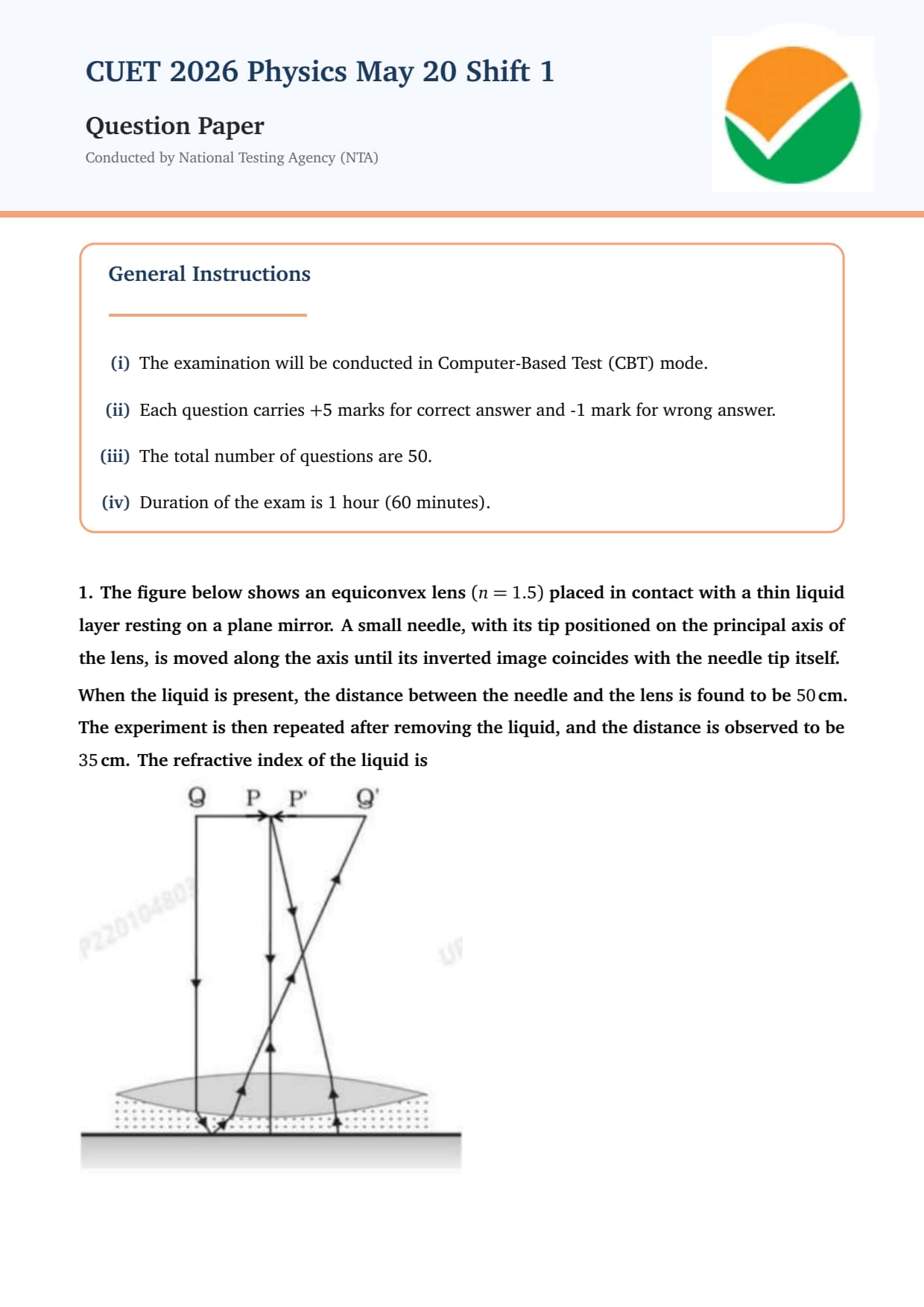




The figure below shows an equiconvex lens \((n = 1.5)\) placed in contact with a thin liquid layer resting on a plane mirror. A small needle, with its tip positioned on the principal axis of the lens, is moved along the axis until its inverted image coincides with the needle tip itself.
When the liquid is present, the distance between the needle and the lens is found to be \(50\,cm\). The experiment is then repeated after removing the liquid, and the distance is observed to be \(35\,cm\). The refractive index of the liquid is

Match List-I with List-II (Symbols have their usual meanings).

Choose the correct answer from the options given below:
According to Bohr's model of the hydrogen atom,
(A) the radius of the orbit of an electron is directly proportional to \(n\).
(B) the speed of the orbiting electron is directly proportional to \(\dfrac{1}{n}\).
(C) the total energy of the electron is directly proportional to \(\dfrac{1}{n^2}\).
(D) the radius of the orbit of an electron is directly proportional to \(n^2\).
Choose the correct answer from the options given below:
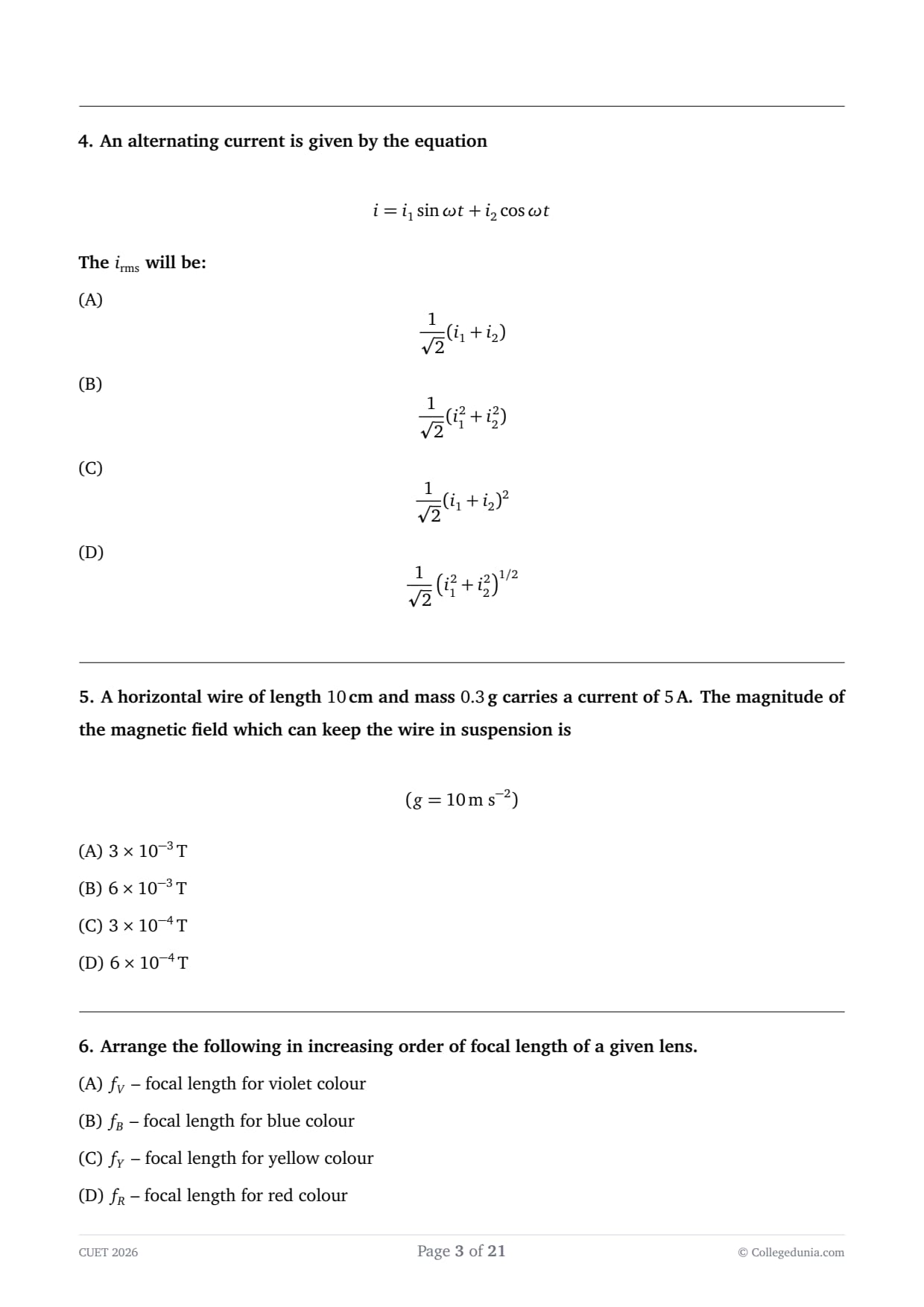
An alternating current is given by the equation
\[ i=i_1\sin\omega t+i_2\cos\omega t \]
The \(i_{\mathrm{rms}}\) will be:
A horizontal wire of length \(10\,cm\) and mass \(0.3\,g\) carries a current of \(5\,A\). The magnitude of the magnetic field which can keep the wire in suspension is
\[ (g=10\,m s^{-2}) \]
Arrange the following in increasing order of focal length of a given lens.
(A) \(f_V\) -- focal length for violet colour
(B) \(f_B\) -- focal length for blue colour
(C) \(f_Y\) -- focal length for yellow colour
(D) \(f_R\) -- focal length for red colour
Choose the correct answer from the options given below:
Light is incident on an interface between water (refractive index \(=1.33\)) and glass (refractive index \(=1.5\)). For total internal reflection, light should be travelling from
\[ (i_c is the critical angle) \]
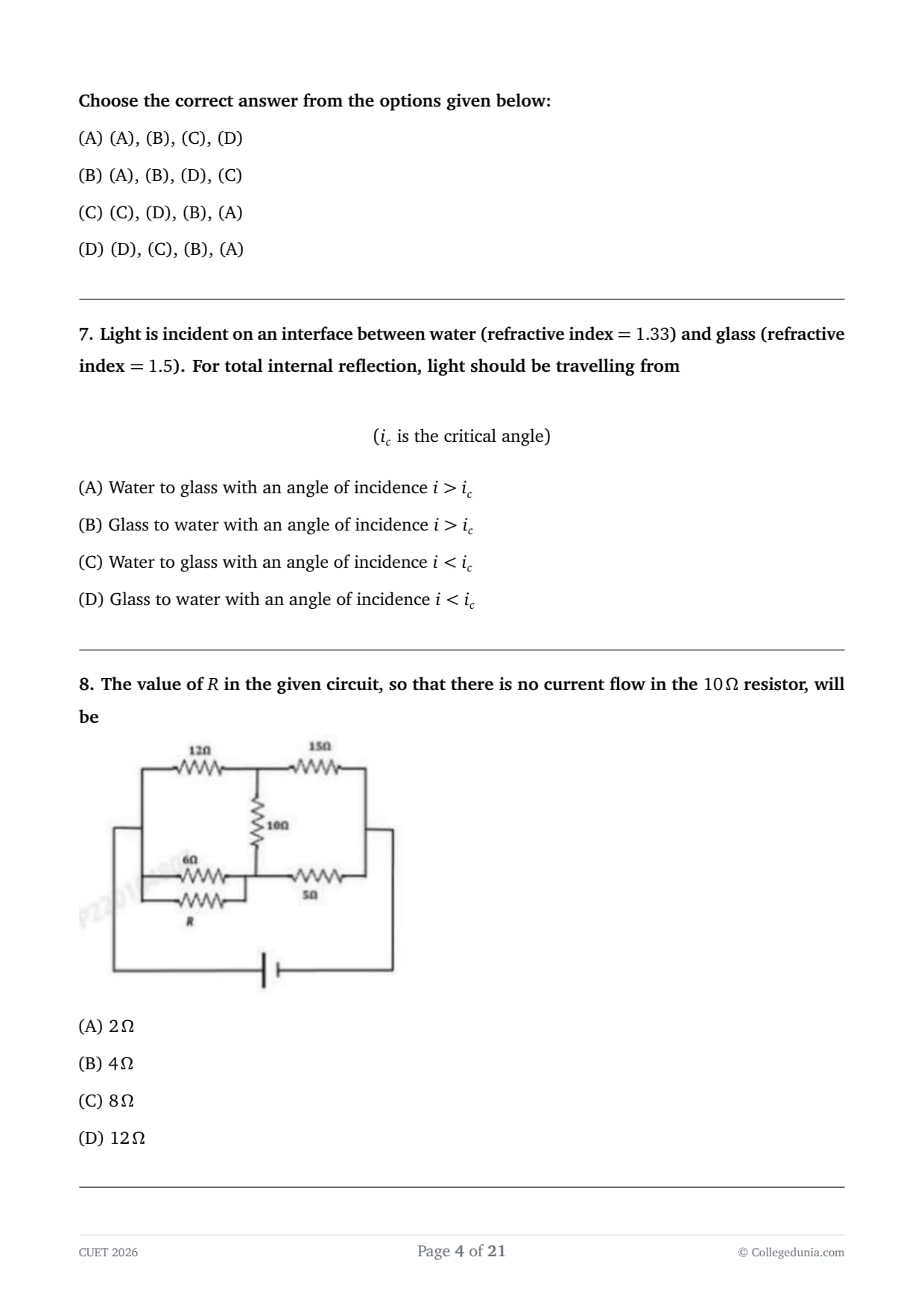
The value of \(R\) in the given circuit, so that there is no current flow in the \(10\,\Omega\) resistor, will be

A charge \(q\) coulomb is circulating in an orbit of radius \(r\) metres making \(n\) revolutions per second. The magnetic field (in N/A m) produced at the centre of the circle is
A parallel plate capacitor \((C)\) is connected to a battery as shown in the figure. Consider two cases:
Case-I: Key \(k\) is kept closed and plates of the capacitor are moved apart using an insulating handle.
Case-II: Initially key \(k\) is closed for a long time and then opened. Now, the plates of the capacitor are moved apart using an insulating handle.

Identify the correct statements among the following:
(A) In Case-I, \(Q\) remains same but \(C\) changes.
(B) In Case-II, \(V\) remains same but \(C\) changes.
(C) In Case-I, \(V\) remains same and hence \(Q\) changes.
(D) In Case-II, \(Q\) remains same and hence \(V\) changes.
Choose the correct answer from the options given below:
The ratio of maximum wavelength to minimum wavelength in Balmer series is
When a magnet is inserted into a coil, the induced e.m.f. in the coil does not depend on
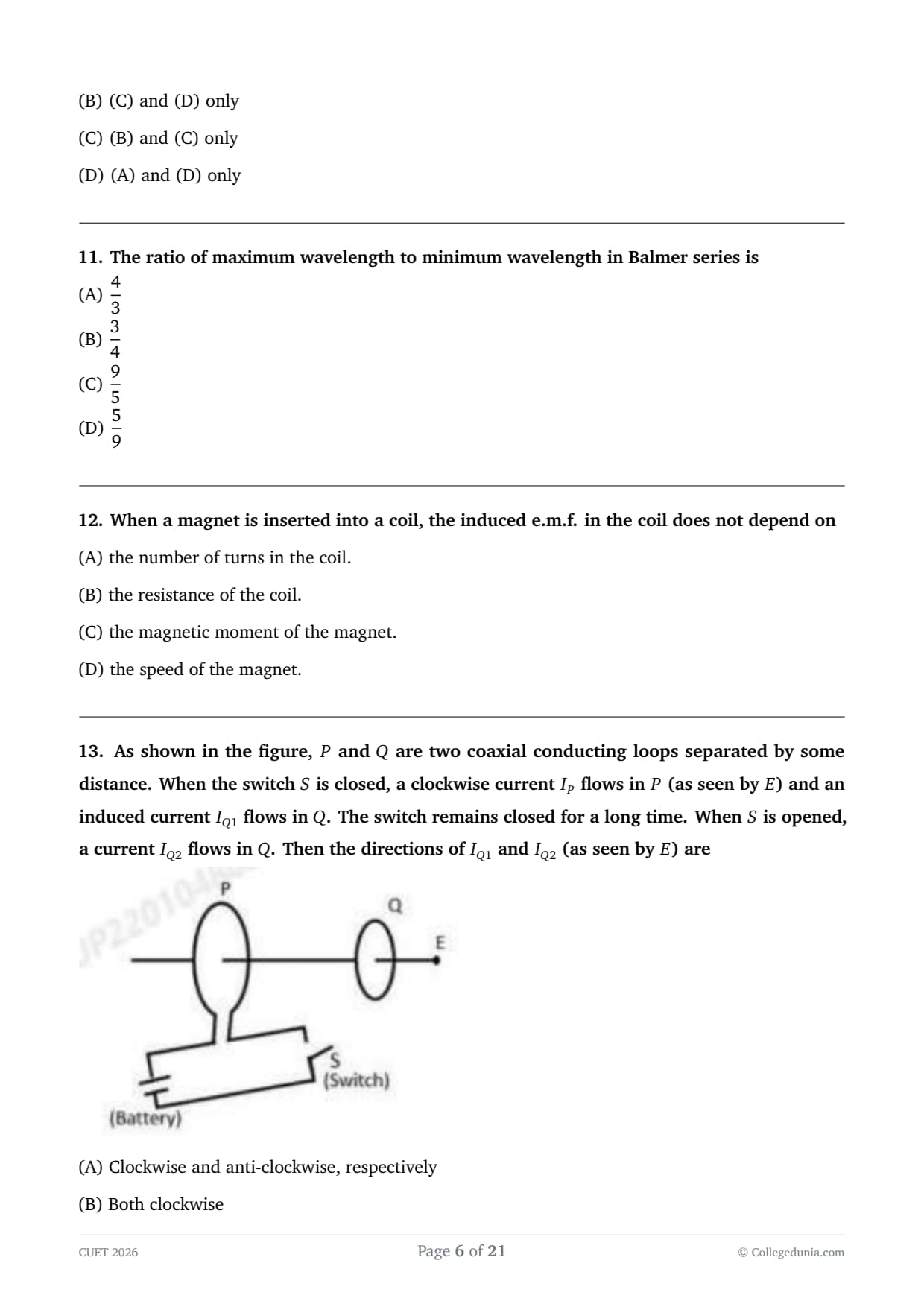
As shown in the figure, \(P\) and \(Q\) are two coaxial conducting loops separated by some distance. When the switch \(S\) is closed, a clockwise current \(I_P\) flows in \(P\) (as seen by \(E\)) and an induced current \(I_{Q1}\) flows in \(Q\). The switch remains closed for a long time. When \(S\) is opened, a current \(I_{Q2}\) flows in \(Q\). Then the directions of \(I_{Q1}\) and \(I_{Q2}\) (as seen by \(E\)) are

Match List-I with List-II in the context of Young's Double Slit Experiment.

Choose the correct answer from the options given below:
In a Young's double slit experiment using monochromatic light of wavelength \(\lambda\), the intensity of light at a point on the screen is \(I_0\), where the path difference between two interfering waves is \(\lambda\). The path difference between the interfering waves at a point on the screen where the intensity is \(\dfrac{I_0}{4}\) will be
Arrange the following media (characterised by their relative dielectric permittivities \((\varepsilon_r)\) and relative magnetic permeabilities \((\mu_r)\)) according to the velocity of an electromagnetic wave propagating in them in ascending order.
(A) \(\varepsilon_r=4,\ \mu_r=400\)
(B) \(\varepsilon_r=3,\ \mu_r=300\)
(C) \(\varepsilon_r=4,\ \mu_r=250\)
(D) \(\varepsilon_r=5,\ \mu_r=150\)
Choose the correct answer from the options given below:
Taking Bohr's radius as \(r_0=53\,pm\), the ground state radius of \(Li^{2+}\) ion, on the basis of Bohr's model, will be about
A deuteron and an alpha particle with the same kinetic energy move in circular paths under the effect of the same magnetic field. The ratio of the radii \((r_d:r_\alpha)\) of their trajectories is
A metal at very low temperature has magnetic permeability \(\mu = 0\). It is a perfect
The radius of curvature of the curved surface of a plano-convex lens is \(20\,cm\). If the refractive index of the material of the lens is \(1.5\), it will
A proton accelerated through a potential difference \(V\) has a de-Broglie wavelength \(\lambda\). On doubling the potential difference, the de-Broglie wavelength of the proton
Arrange the following in the correct order as the angle of incidence in a denser medium is gradually increased.
(A) The refracted ray bends away from the normal.
(B) The refracted ray grazes along the surface of separation.
(C) The light is totally reflected back into the denser medium.
(D) The ray passes undeviated when incident normally.
Choose the correct answer from the options given below:
The source of electromagnetic waves can be
The kinetic energy of an electron in the ground level in hydrogen atom is \(K\) units. The values of potential energy and total energy, respectively, are
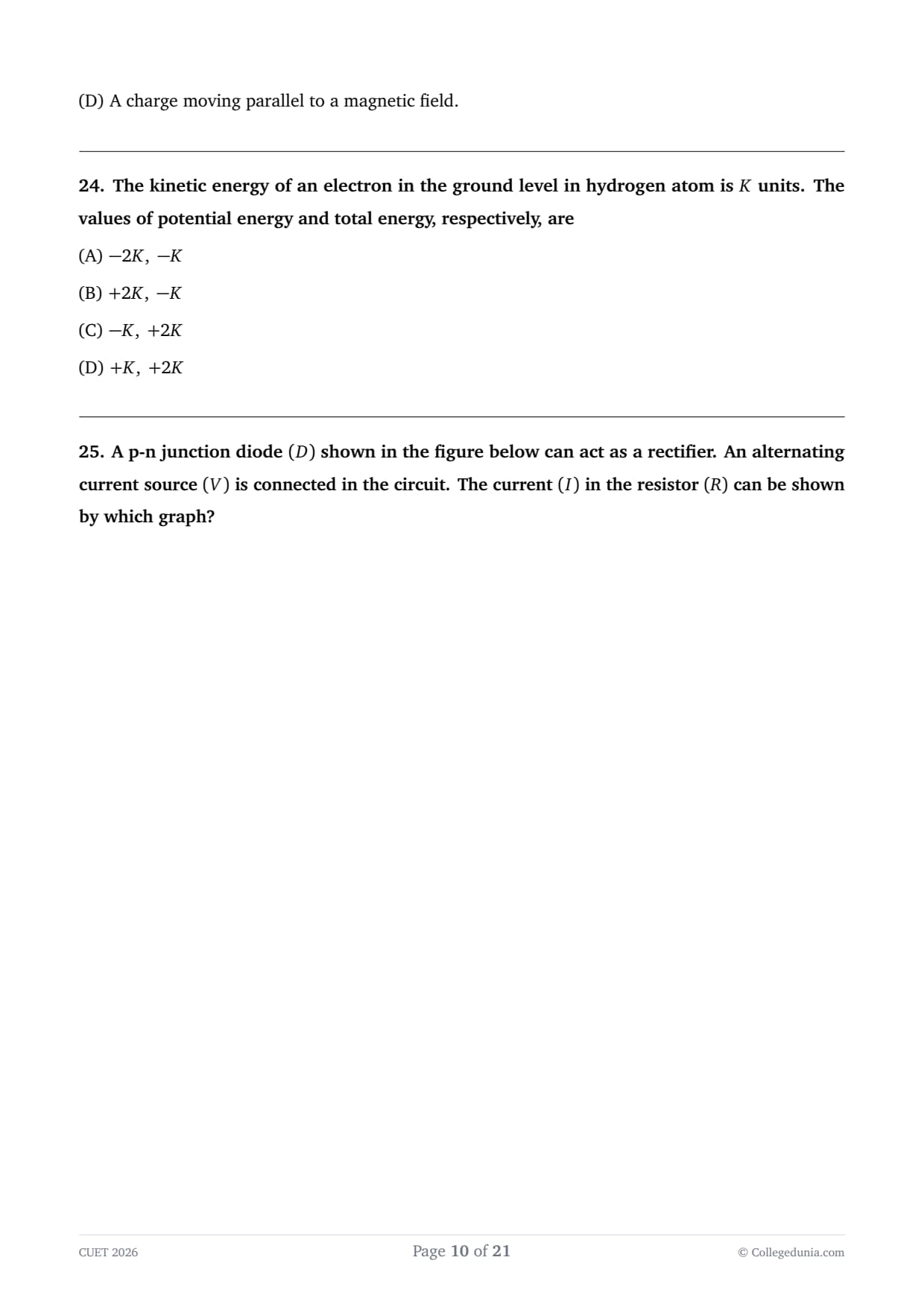
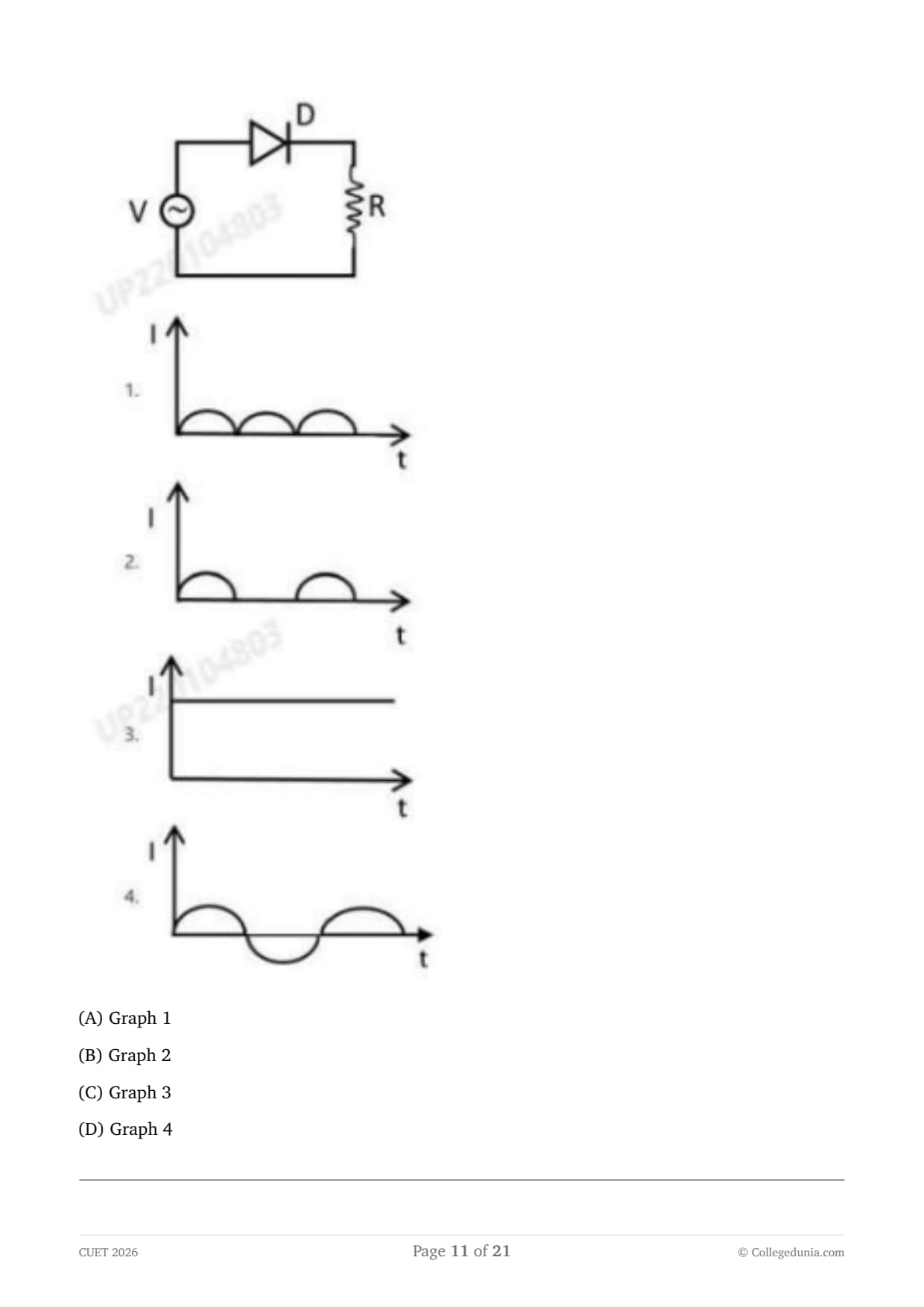
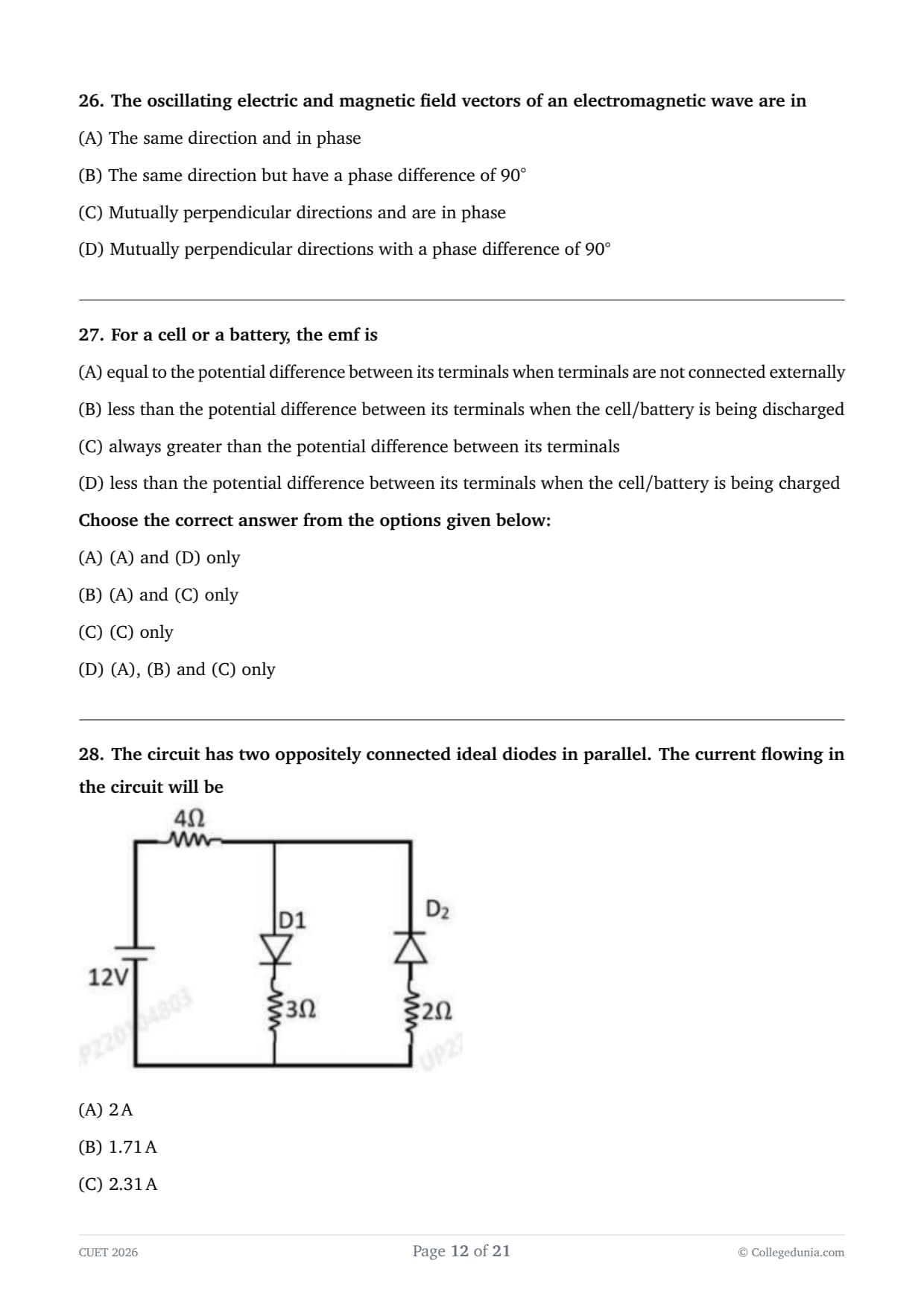
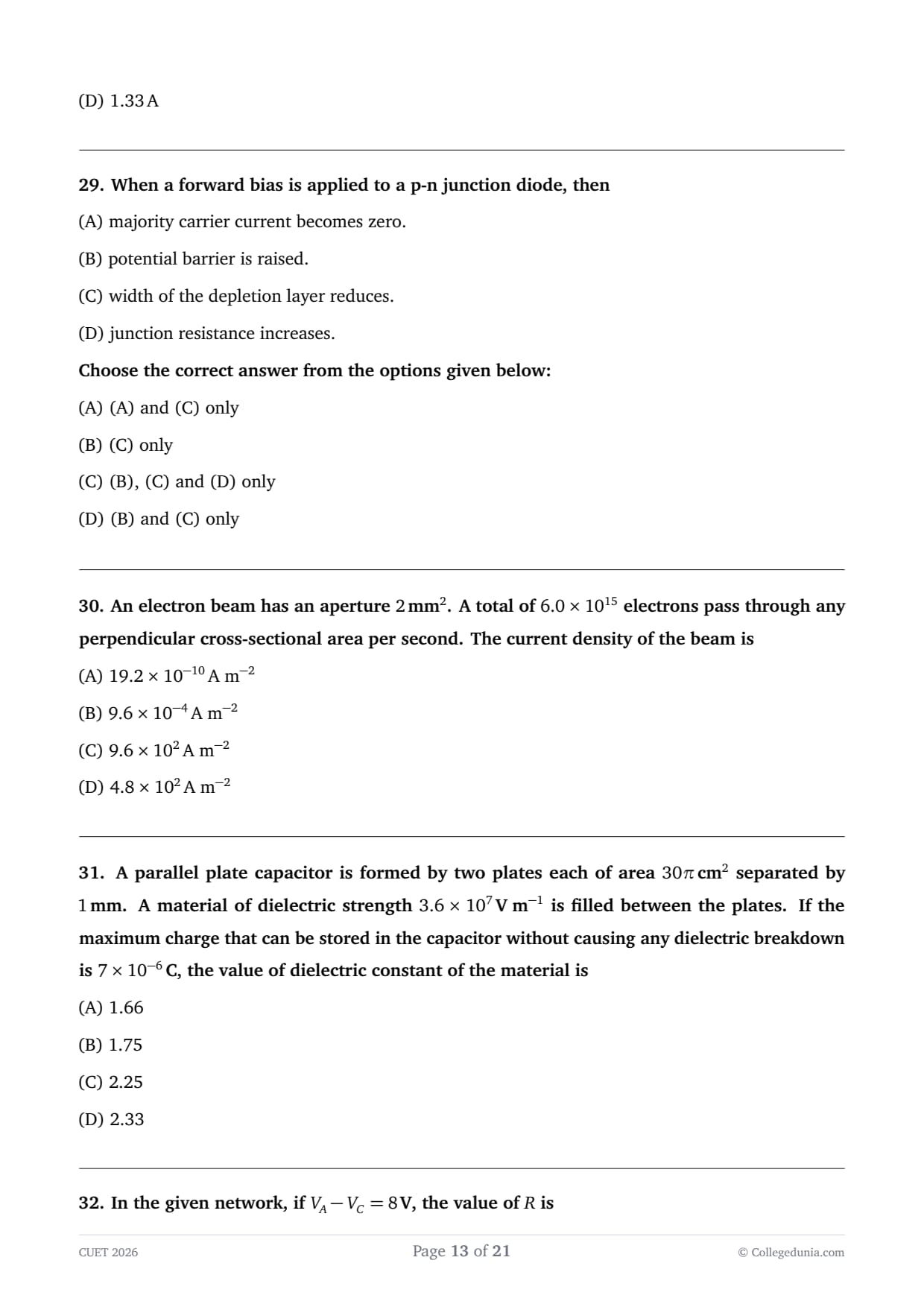
A p-n junction diode \((D)\) shown in the figure below can act as a rectifier. An alternating current source \((V)\) is connected in the circuit. The current \((I)\) in the resistor \((R)\) can be shown by which graph?

The oscillating electric and magnetic field vectors of an electromagnetic wave are in
For a cell or a battery, the emf is
(A) equal to the potential difference between its terminals when terminals are not connected externally
(B) less than the potential difference between its terminals when the cell/battery is being discharged
(C) always greater than the potential difference between its terminals
(D) less than the potential difference between its terminals when the cell/battery is being charged
Choose the correct answer from the options given below:
The circuit has two oppositely connected ideal diodes in parallel. The current flowing in the circuit will be

When a forward bias is applied to a p-n junction diode, then
(A) majority carrier current becomes zero.
(B) potential barrier is raised.
(C) width of the depletion layer reduces.
(D) junction resistance increases.
Choose the correct answer from the options given below:
An electron beam has an aperture \(2\,mm^2\). A total of \(6.0\times10^{15}\) electrons pass through any perpendicular cross-sectional area per second. The current density of the beam is
A parallel plate capacitor is formed by two plates each of area \(30\pi\,cm^2\) separated by \(1\,mm\). A material of dielectric strength \(3.6\times10^7\,V m^{-1}\) is filled between the plates. If the maximum charge that can be stored in the capacitor without causing any dielectric breakdown is \(7\times10^{-6}\,C\), the value of dielectric constant of the material is
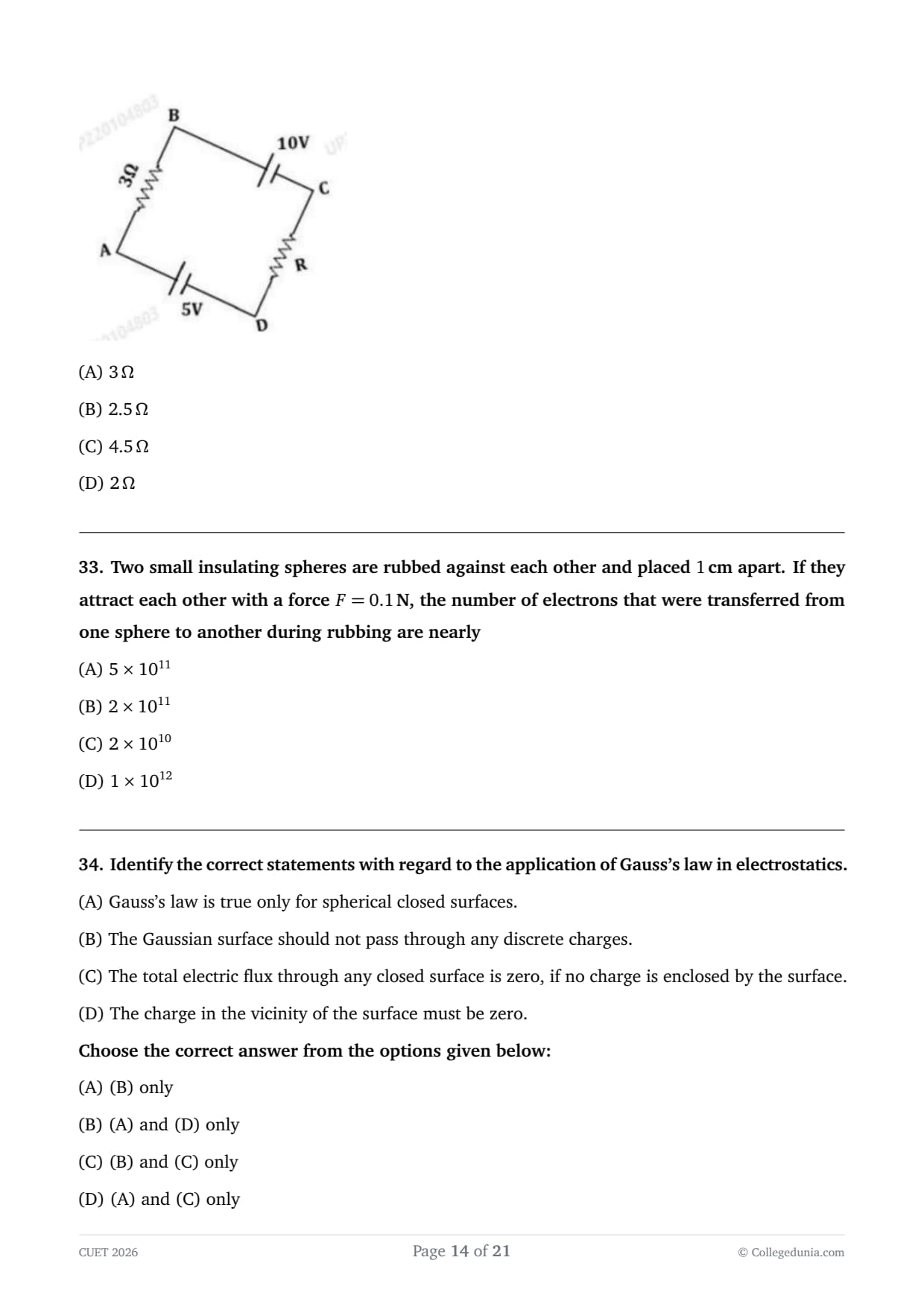
In the given network, if \(V_A-V_C=8\,V\), the value of \(R\) is

Two small insulating spheres are rubbed against each other and placed \(1\,cm\) apart. If they attract each other with a force \(F=0.1\,N\), the number of electrons that were transferred from one sphere to another during rubbing are nearly
Identify the correct statements with regard to the application of Gauss's law in electrostatics.
(A) Gauss's law is true only for spherical closed surfaces.
(B) The Gaussian surface should not pass through any discrete charges.
(C) The total electric flux through any closed surface is zero, if no charge is enclosed by the surface.
(D) The charge in the vicinity of the surface must be zero.
Choose the correct answer from the options given below:
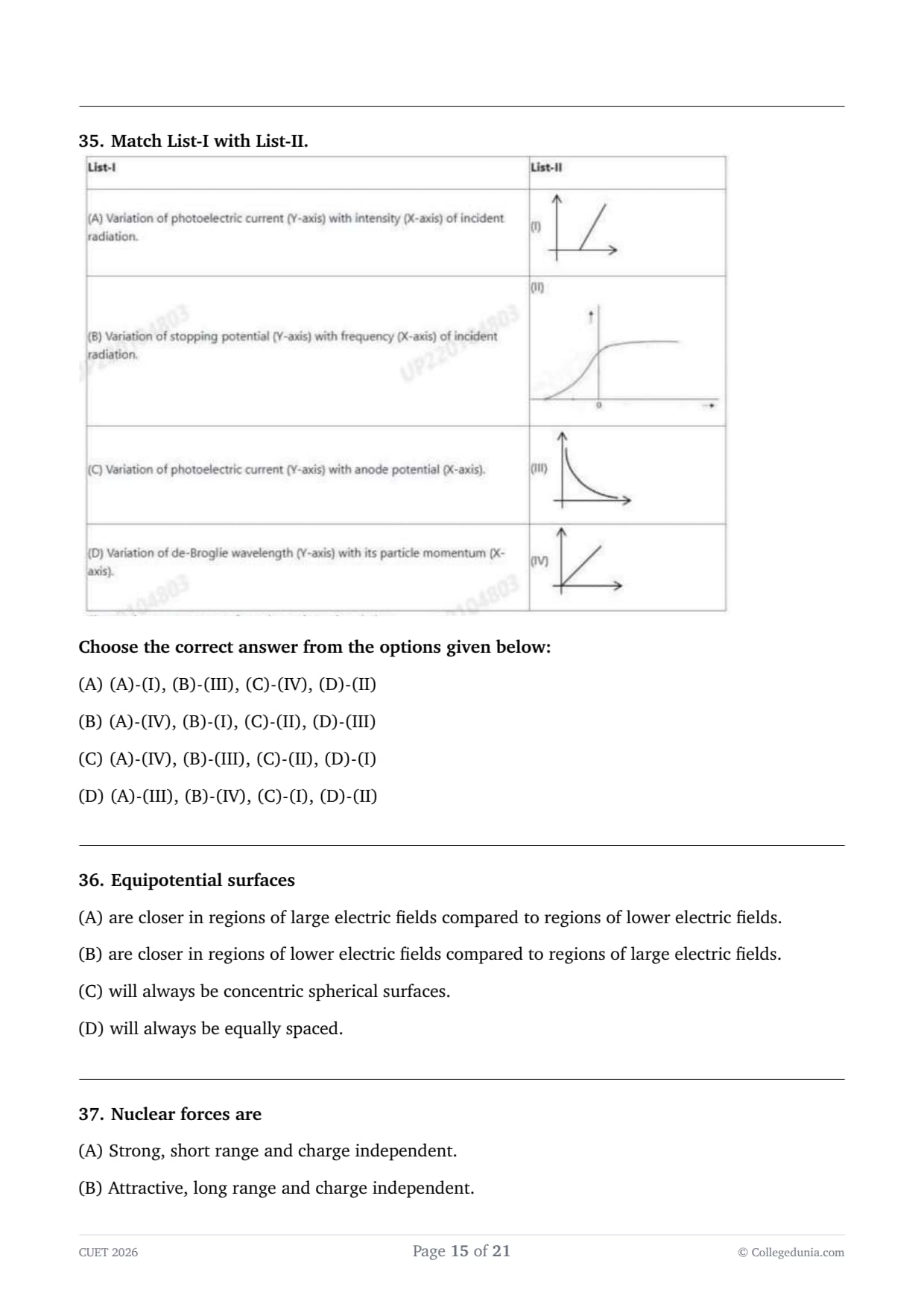
Match List-I with List-II.

Choose the correct answer from the options given below:
Equipotential surfaces
Nuclear forces are
Five cells, each of emf \((E)\) and internal resistance \((r)\), are connected in series. If out of these five cells, one of the cells is connected with opposite polarity, the equivalent emf and internal resistance of the combination, respectively, will be
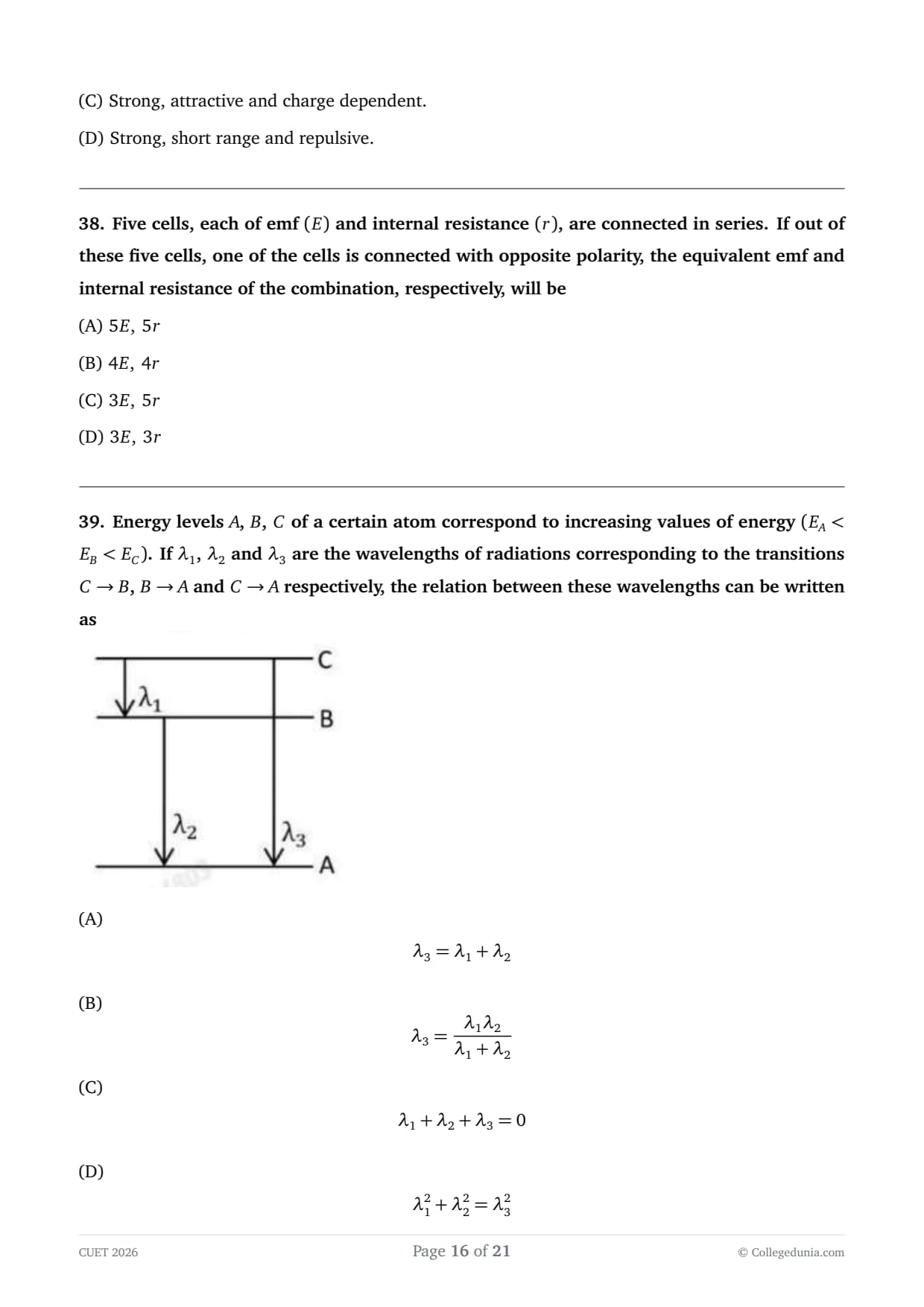
Energy levels \(A\), \(B\), \(C\) of a certain atom correspond to increasing values of energy EA

A magnetic dipole aligned parallel to a uniform magnetic field requires a work of \(W\) to rotate it through \(60^\circ\). The torque exerted by the field on the dipole in this new position is
An electron is found to repel another electron at a distance of \(1\,cm\) with a force \(F=2.3\times10^{-24}\,N\). Two protons placed at a distance of \(5\,cm\) will
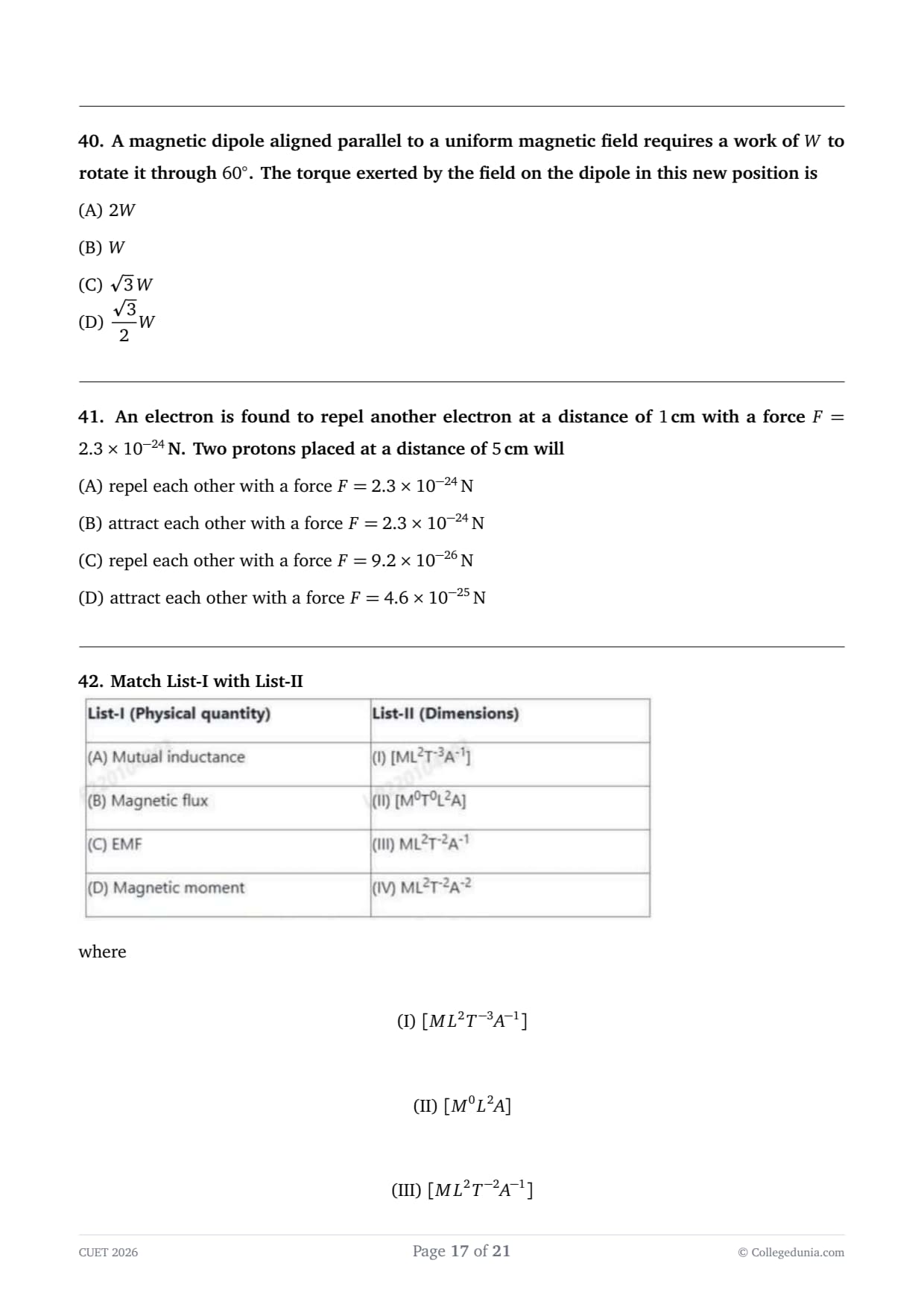
Match List-I with List-II

where
\[ (I)\ [ML^2T^{-3}A^{-1}] \]
\[ (II)\ [M^0L^2A] \]
\[ (III)\ [ML^2T^{-2}A^{-1}] \]
\[ (IV)\ [ML^2T^{-2}A^{-2}] \]
Choose the correct answer from the options given below:
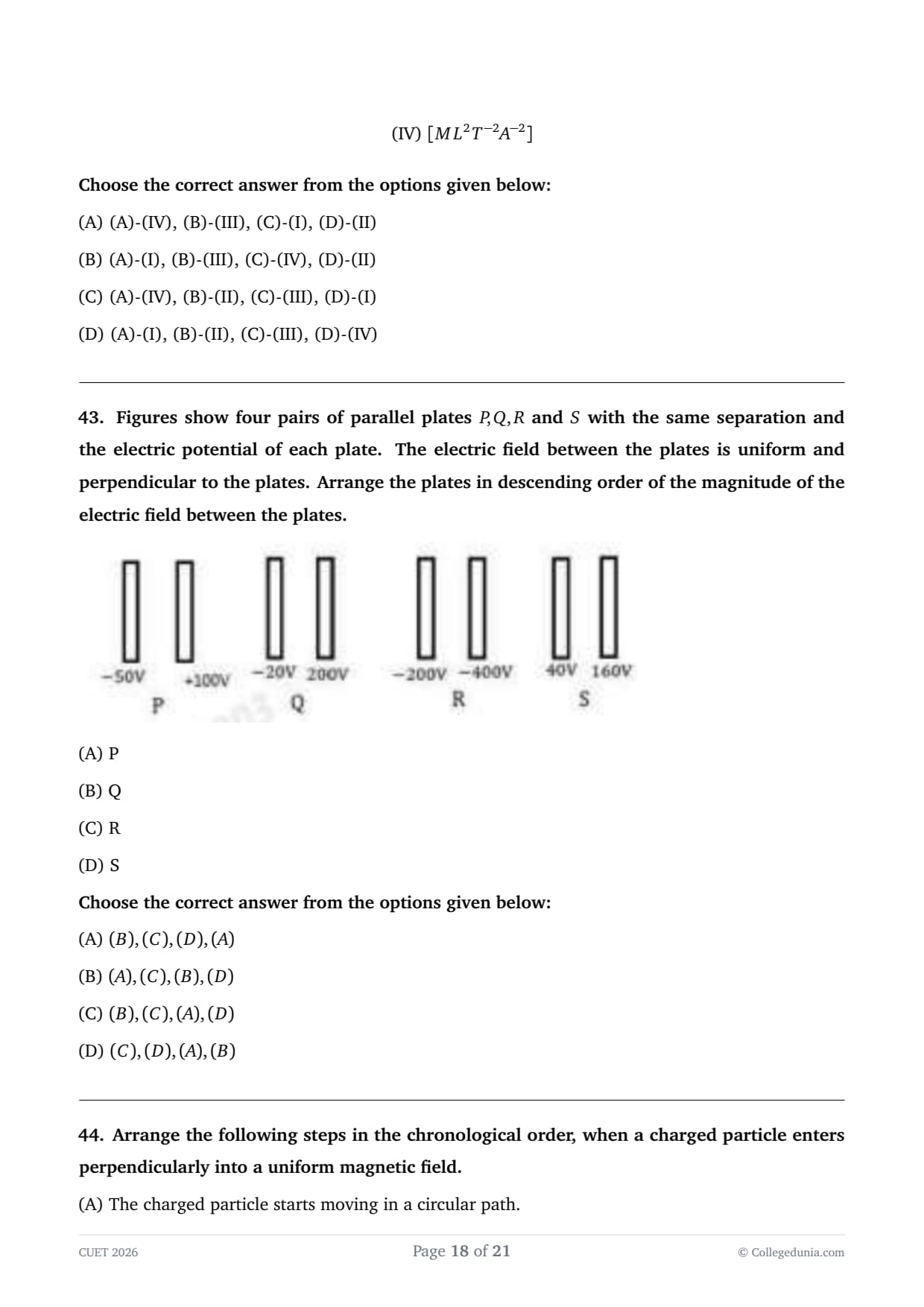
Figures show four pairs of parallel plates \(P,Q,R\) and \(S\) with the same separation and the electric potential of each plate. The electric field between the plates is uniform and perpendicular to the plates. Arrange the plates in descending order of the magnitude of the electric field between the plates.

(A) P
(B) Q
(C) R
(D) S
Choose the correct answer from the options given below:
Arrange the following steps in the chronological order, when a charged particle enters perpendicularly into a uniform magnetic field.
(A) The charged particle starts moving in a circular path.
(B) Net work done by the field is zero.
(C) The speed of the charged particle remains constant but its direction changes.
(D) A force acts perpendicular to both the velocity of the charged particle and the magnetic field.
Choose the correct answer from the options given below:
In a full wave rectifier circuit operating with \(50\,Hz\) mains frequency, the fundamental frequency in the ripple at the output would be
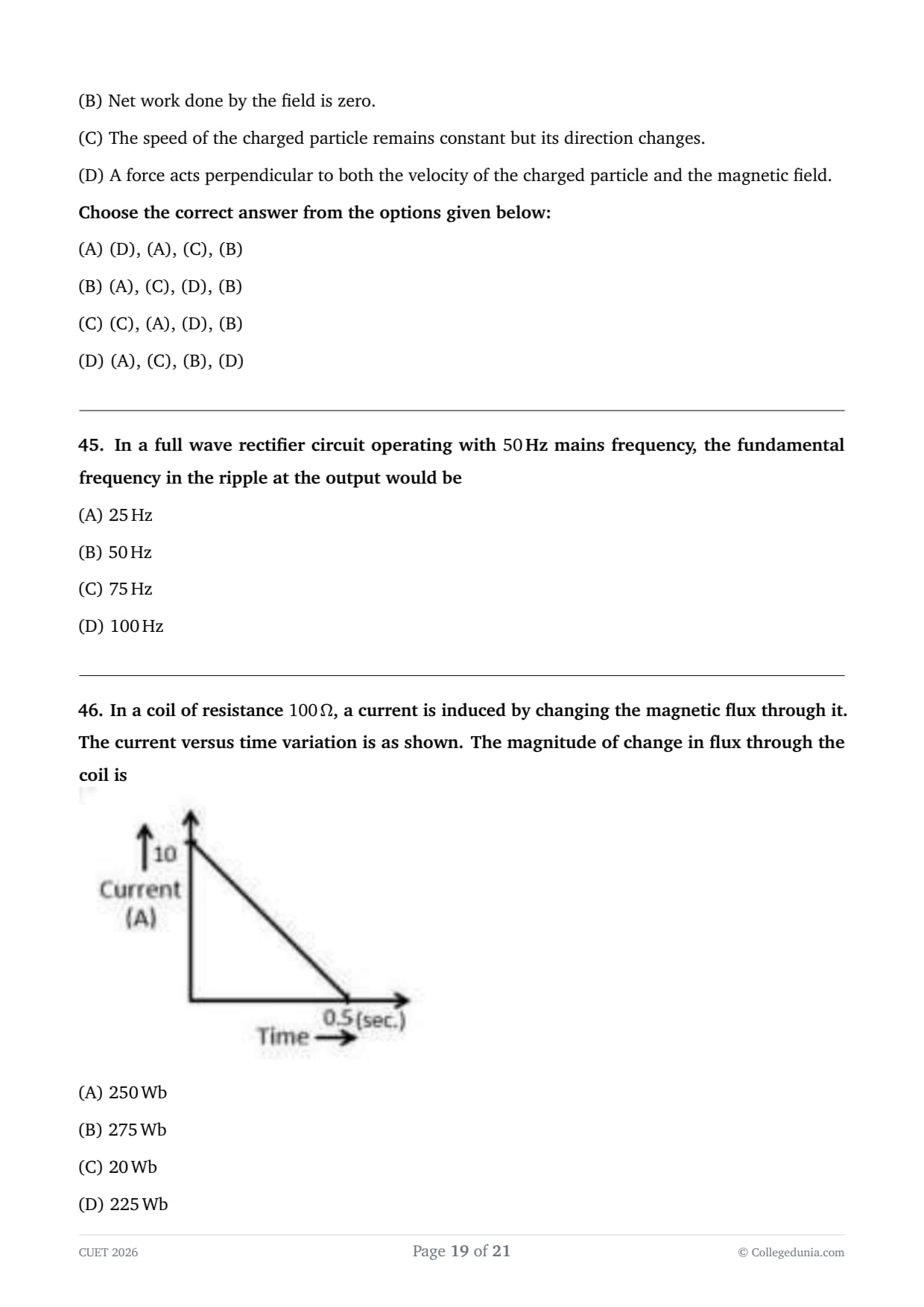
In a coil of resistance \(100\,\Omega\), a current is induced by changing the magnetic flux through it. The current versus time variation is as shown. The magnitude of change in flux through the coil is

The surface of a certain metal is first illuminated with light of wavelength \(\lambda_1=350\,nm\), and then by light of wavelength \(\lambda_2=540\,nm\). It is found that the maximum speed of the photoelectrons in the two cases differ by a factor of \(2\). The work function of the metal (in eV) is close to \[ \left(Energy of photon=\frac{1240}{\lambda(nm)} eV\right) \]
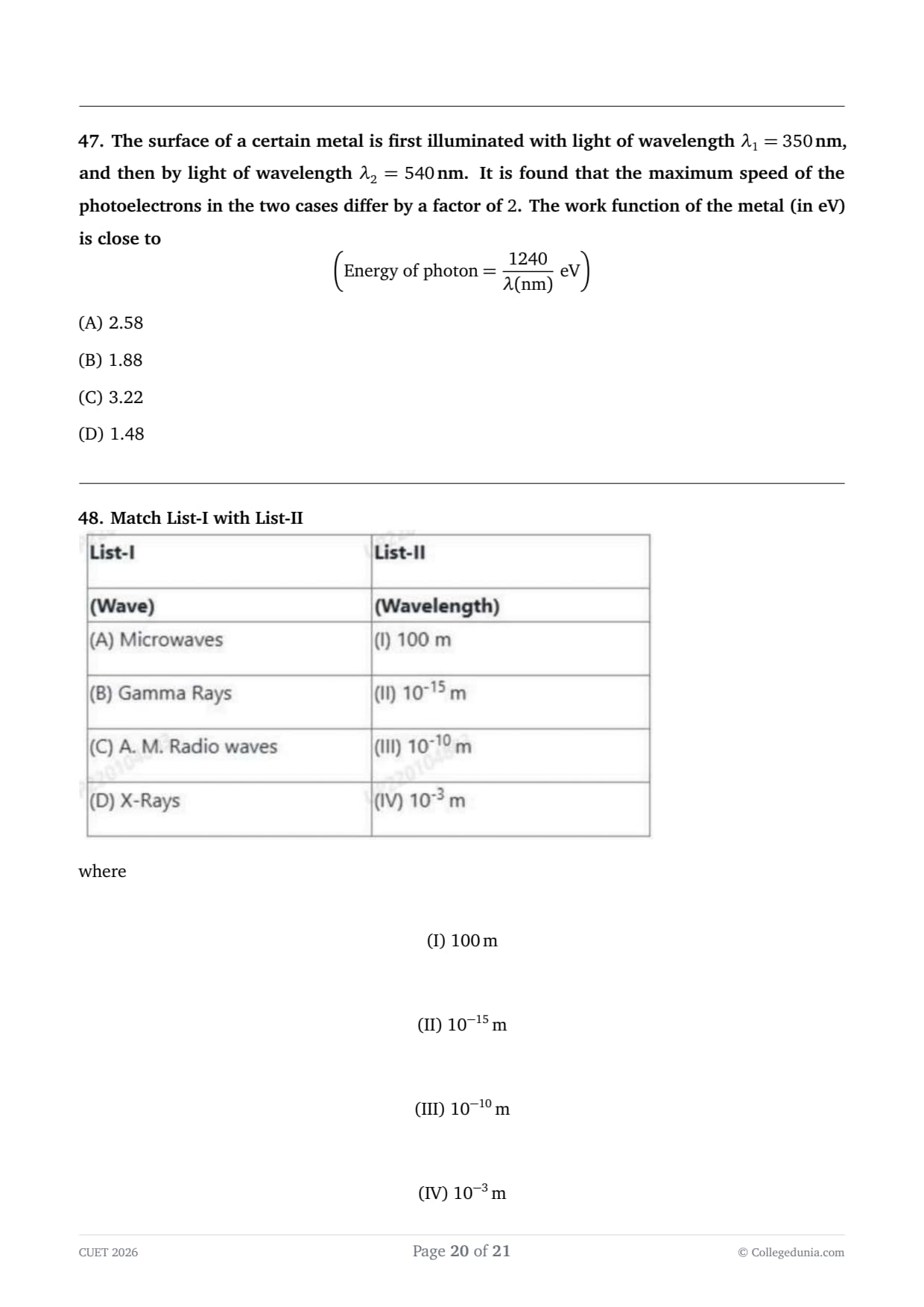
Match List-I with List-II

where
\[ (I)\;100\,m \]
\[ (II)\;10^{-15}\,m \]
\[ (III)\;10^{-10}\,m \]
\[ (IV)\;10^{-3}\,m \]
Choose the correct answer from the options given below:
The velocity of an electromagnetic wave in a medium with \(\varepsilon_r=2\) and \(\mu_r=18\) is
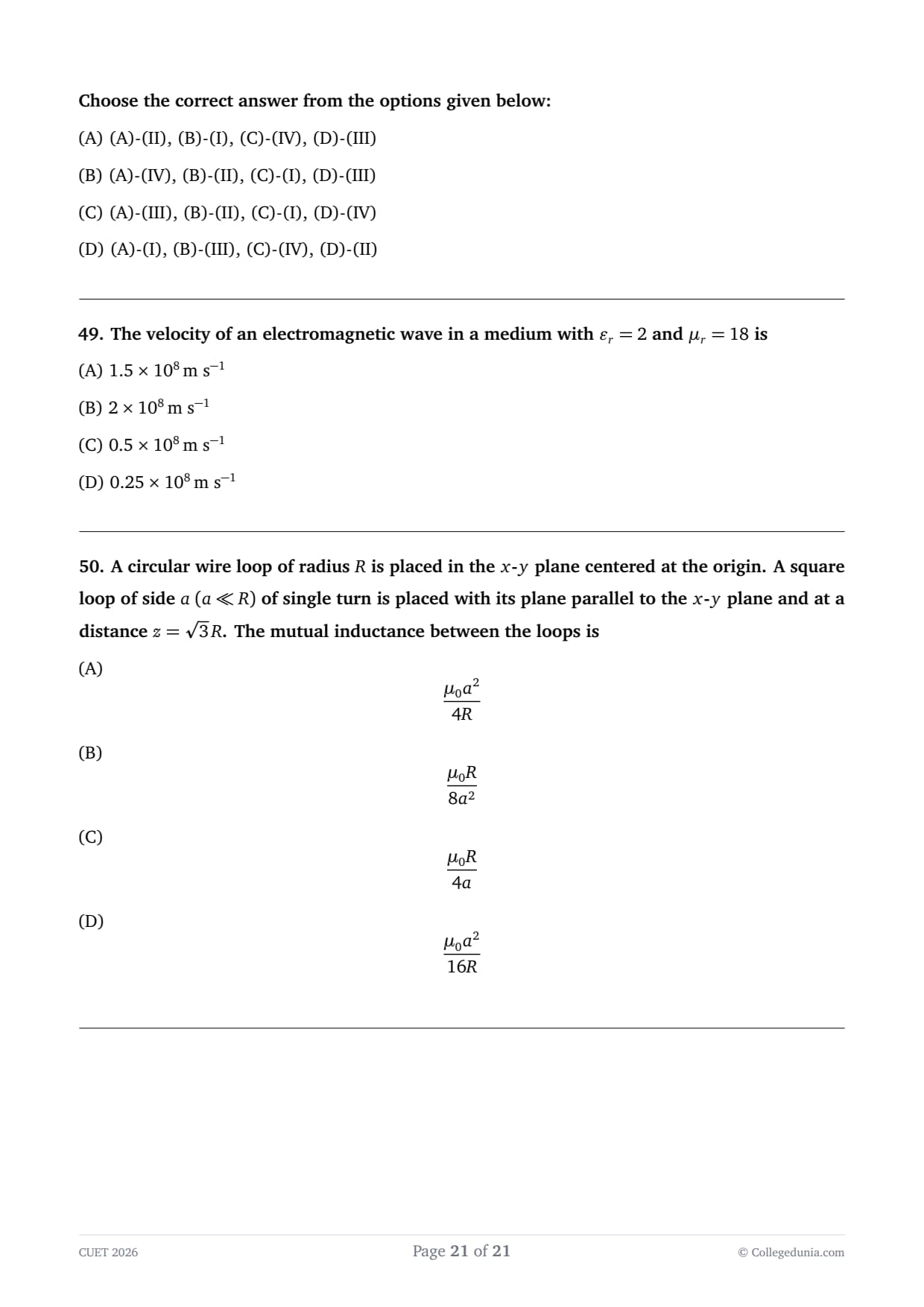
A circular wire loop of radius \(R\) is placed in the \(x\)-\(y\) plane centered at the origin. A square loop of side \(a\;(a\ll R)\) of single turn is placed with its plane parallel to the \(x\)-\(y\) plane and at a distance \(z=\sqrt{3}\,R\). The mutual inductance between the loops is
CUET UG 2026 Exam Pattern
| Parameter | Details |
|---|---|
| Exam Name | Common University Entrance Test (CUET UG) 2026 |
| Conducting Body | National Testing Agency (NTA) |
| Exam Mode | Computer-Based Test (CBT) |
| Exam Duration | 60 minutes per test |
| Total Sections | 3 (Languages, Domain Subjects, General Test) |
| Question Type | Multiple Choice Questions (MCQs) |
| Questions per Test | 50 questions (all compulsory) |
| Marking Scheme | +5 for correct, -1 for incorrect |
| Maximum Marks | 250 marks per test |
| Maximum Subject Choices | 5 subjects in total |
| Syllabus Base | Class 12 NCERT (mainly for Domain Subjects) |




Comments