




CUET 2026 June 6 Shift 1 Chemistry Question Paper is available for download here. NTA is conducting the CUET 2026 exam from 11th May to 31st May and June 6 to June 7.
- CUET 2026 Chemistry exam consists of 50 questions for 250 marks to be attempted in 60 minutes.
- As per the marking scheme, 5 marks are awarded for each correct answer, and 1 mark is deducted for incorrect answer.
Candidates can download CUET 2026 June 6 Shift 1 Chemistry Question Paper with Answer Key and Solution PDF from links provided below.
Related Links:
CUET 2026 Chemistry June 6 Shift 1 Question Paper with Solution PDF
| CUET June 6 Shift 1 Chemistry Question Paper 2026 | Download PDF | Check Solutions |









For the following reaction choose the incorrect expression of rate of reaction. \[ 5 Br^{-}(aq.) + BrO_{3}^{-}(aq.) + 6 H^{+}(aq.) \rightarrow 3 Br_{2}(aq.) + 3 H_{2}O(l) \]
What would be the correct structure of thymine base?


The order of a reaction whose rate constant \(k = 0.693\times10^{-6}\,L mol^{-1}s^{-1}\) is:
Choose the Incorrect option regarding valence bond theory of coordination compound.
Limiting molar conductivities for some ions in water at \(298\,K\) are given below:
\[ \lambda_m^\circ(\mathrm{H^+})=349.6,\quad \lambda_m^\circ(\mathrm{Na^+})=50.1,\quad \lambda_m^\circ(\mathrm{Ca^{2+}})=119.0, \] \[ \lambda_m^\circ(\mathrm{Mg^{2+}})=106.0,\quad \lambda_m^\circ(\mathrm{Cl^-})=76.3,\quad \lambda_m^\circ(\mathrm{SO_4^{2-}})=160.0 \]
Choose the correct decreasing order of molar conductivity \((\Lambda_m^\circ)\) for \(\mathrm{NaCl}\), \(\mathrm{HCl}\), \(\mathrm{CaCl_2}\) and \(\mathrm{MgSO_4}\).
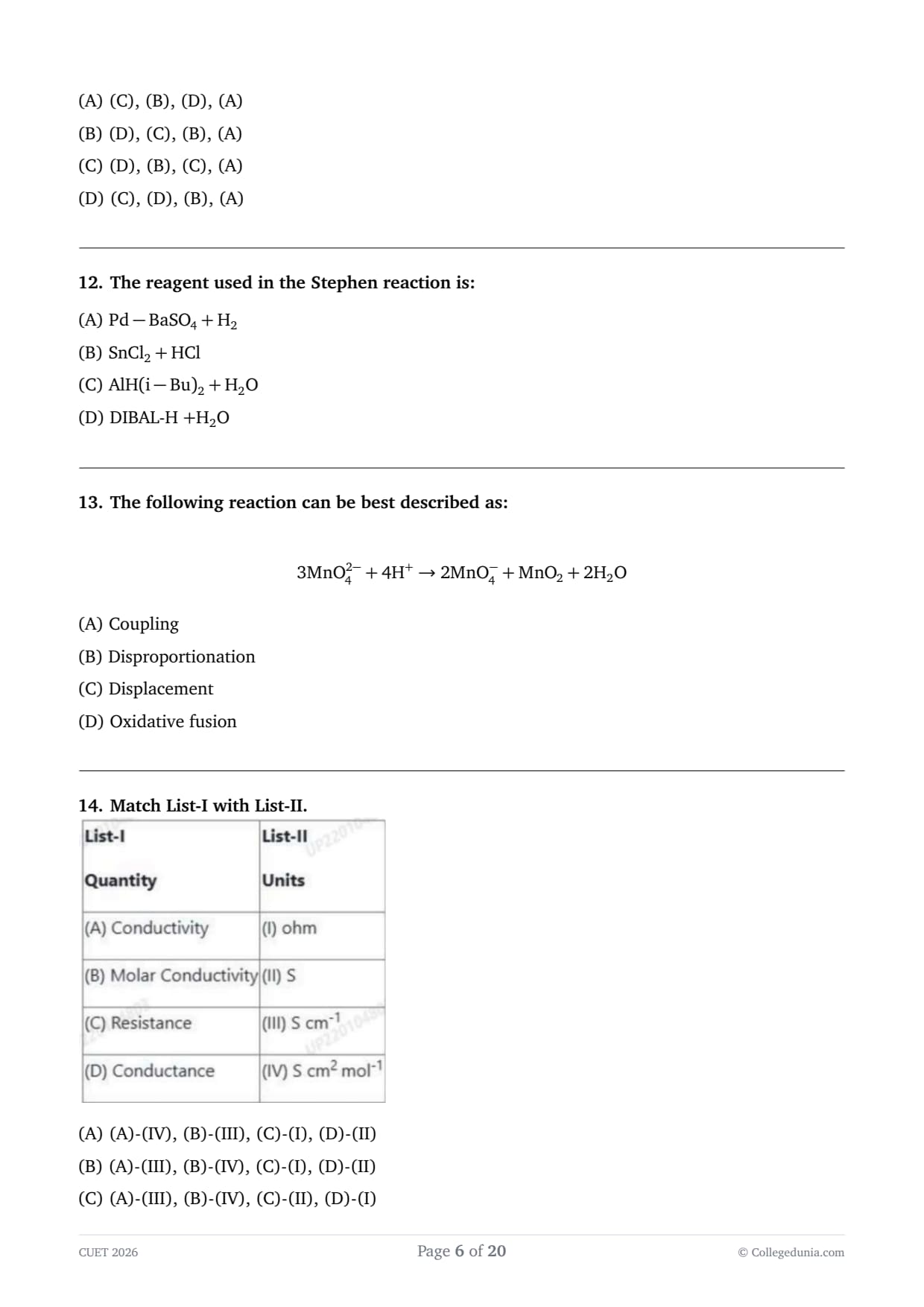
Arrange the compounds in order of their increasing boiling points.
(A) 1-bromoethane
(B) 1-bromobutane
(C) 2-bromo-2-methylpropane
(D) 2-bromobutane
Write the major product A in the following chemical reaction.


The complex \([\mathrm{Co(NH_3)_6}]^{3+}\) is:
The major product Z in the following chemical reaction is:


Arrange the following \(3d\)-series elements in decreasing order of their second ionisation enthalpy:
(A) \(\mathrm{Ti} \ (Z=22)\)
(B) \(\mathrm{V} \ (Z=23)\)
(C) \(\mathrm{Cr} \ (Z=24)\)
(D) \(\mathrm{Mn} \ (Z=25)\)
The reagent used in the Stephen reaction is:
The following reaction can be best described as:
\[ 3\mathrm{MnO_4^{2-}}+4\mathrm{H^+} \rightarrow 2\mathrm{MnO_4^-} +\mathrm{MnO_2} +2\mathrm{H_2O} \]
Match List-I with List-II.

Select the correct statements related to carbohydrates:
(A) Glucose is also known as dextrose.
(B) In glucose, an aldehydic group is present and it gives Schiff's test.
(C) Glycogen is also known as animal starch.
(D) Lactose is a reducing sugar.
Consider the following statements and choose the correct statements:
(A) The bond angle in methanol is slightly higher than the tetrahedral angle.
(B) The reaction of Grignard reagent with methanal produces a secondary alcohol.
(C) The boiling point of ethanol is higher than methoxymethane.
(D) Acetylation of salicylic acid produces Aspirin.
Arrange the following compounds in increasing order of their acid strength.
(A) Phenol
(B) \(m\)-Nitrophenol
(C) \(p\)-Nitrophenol
(D) \(p\)-Cresol
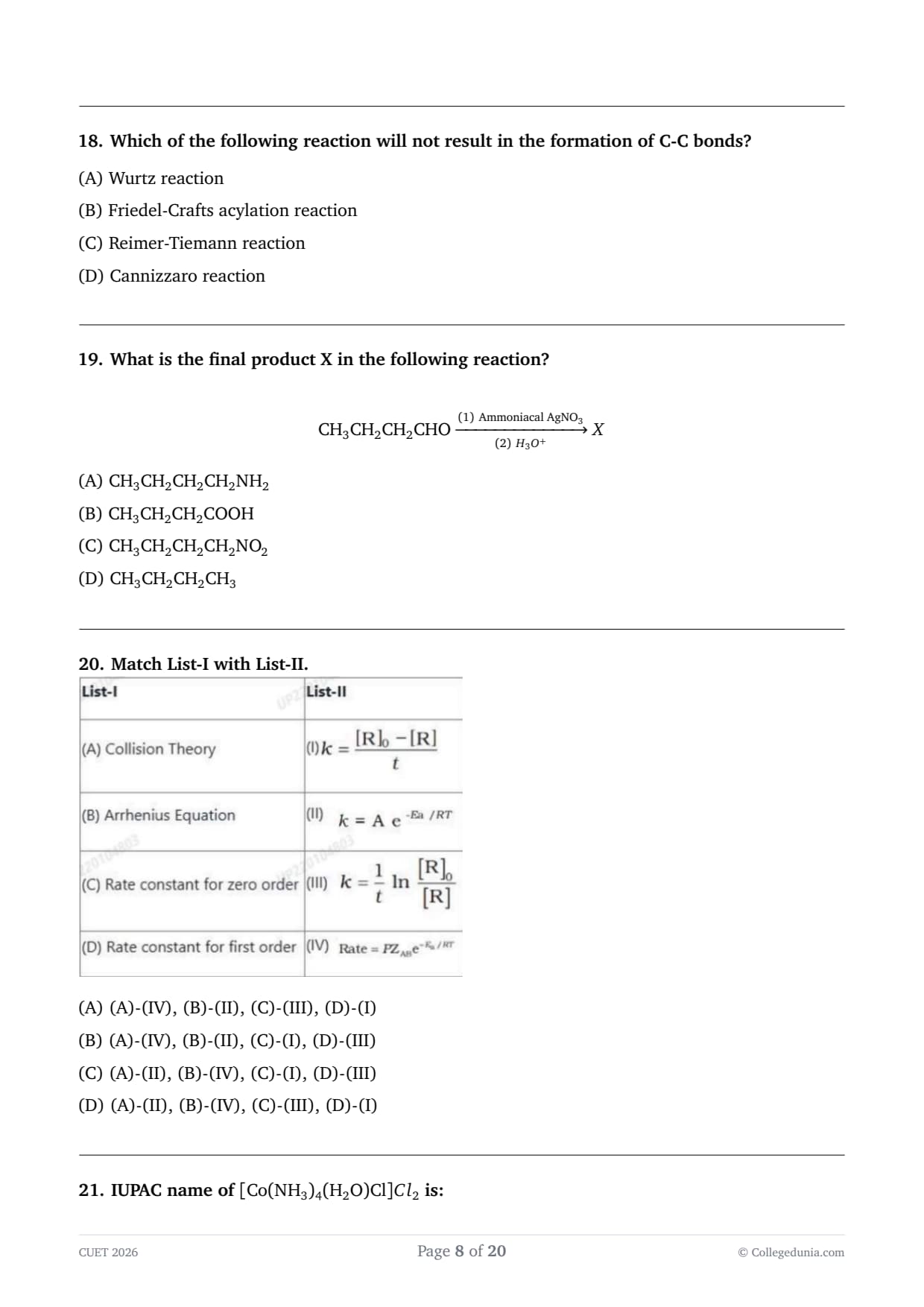
Which of the following reaction will not result in the formation of C-C bonds?
What is the final product X in the following reaction?
\[ \mathrm{CH_3CH_2CH_2CHO} \xrightarrow[(2)\ H_3O^+]{(1)\ Ammoniacal AgNO_3} X \]
Match List-I with List-II.

IUPAC name of \([\mathrm{Co(NH_3)_4(H_2O)Cl}]Cl_2\) is:
\(75%\) of a first-order reaction was completed in \(32\) minutes. How long will it take to undergo \(50%\) completion? Given: \(\log 2 = 0.3010\)
Standard electrode potentials (\(\mathrm{M^{n+}/M}\)) of four metals A, B, C and D are given below:
(A) \(-1.2 V\)
(B) \(+0.5 V\)
(C) \(+1.2 V\)
(D) \(-3.0 V\)
The correct increasing order for the reducing power of these metals will be:
Choose the optically inactive amino acid from the following:
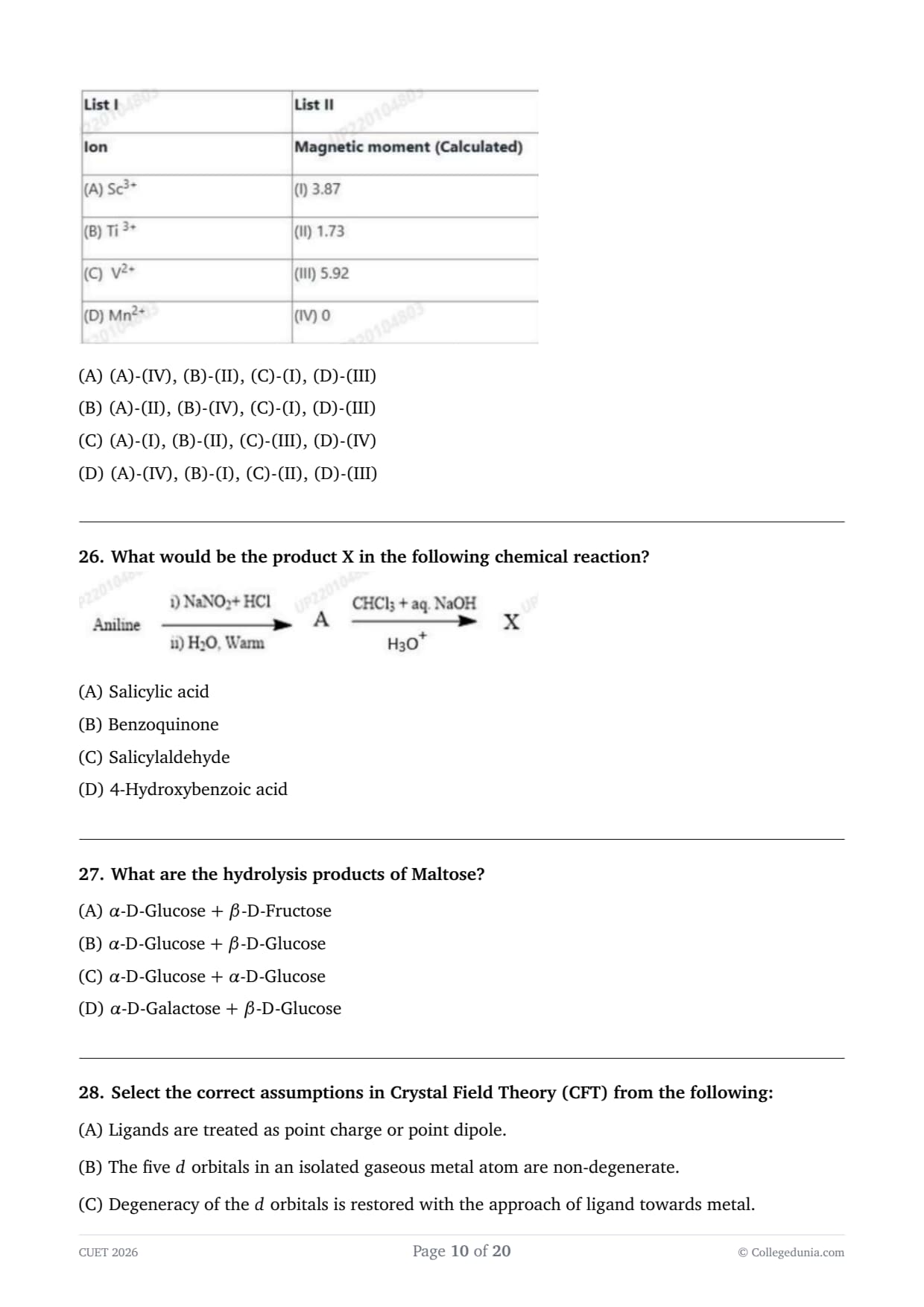
Match Ion given in List I with their Magnetic Moment (Calculated) given in List II.

What would be the product X in the following chemical reaction?

What are the hydrolysis products of Maltose?
Select the correct assumptions in Crystal Field Theory (CFT) from the following:
(A) Ligands are treated as point charge or point dipole.
(B) The five \(d\) orbitals in an isolated gaseous metal atom are non-degenerate.
(C) Degeneracy of the \(d\) orbitals is restored with the approach of ligand towards metal.
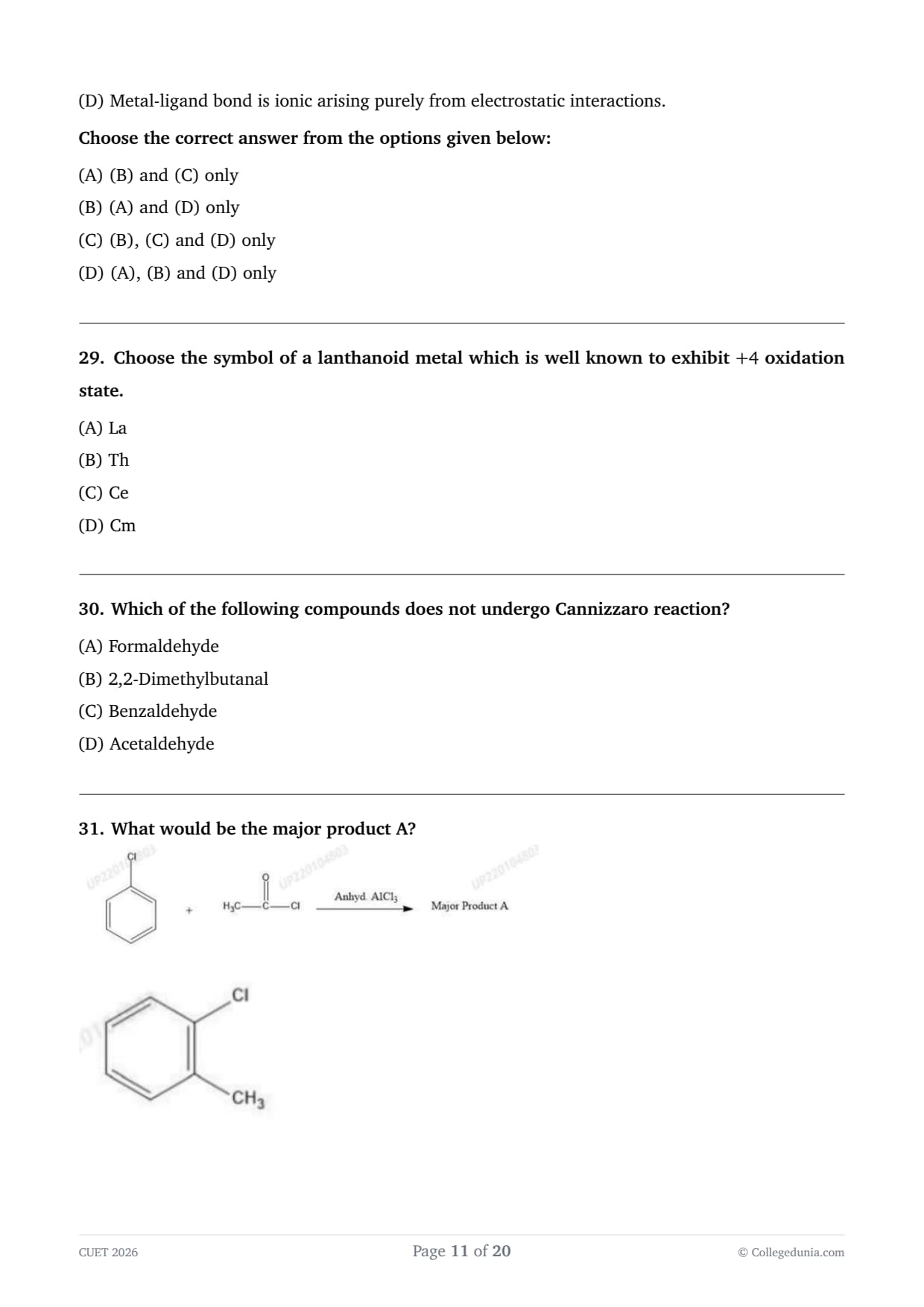
(D) Metal-ligand bond is ionic arising purely from electrostatic interactions.
Choose the correct answer from the options given below:
Choose the symbol of a lanthanoid metal which is well known to exhibit \(+4\) oxidation state.
Which of the following compounds does not undergo Cannizzaro reaction?
What would be the major product A?


Which of the following statements are incorrect for thermodynamic properties?
(A) Both \(E_{cell}\) and \(\Delta_r G\) of reaction are extensive properties.
(B) Both \(E_{cell}\) and \(\Delta_r G\) of reaction are intensive properties.
(C) \(E_{cell}\) is an intensive property while \(\Delta_r G\) of reaction is an extensive property.
(D) \(E_{cell}\) is an extensive property while \(\Delta_r G\) of reaction is an intensive property.
Choose the answer from the options given below:
What would be the geometrical shape of \([\mathrm{NiCl_4}]^{2-}\) and \([\mathrm{PtCl_4}]^{2-}\) compounds?
The major products A and B formed in the following reaction are:

Choose the transition element which exhibit least number of variable oxidation states.
The standard Gibbs energy for the reaction is \(-212.27\,\mathrm{kJ\,mol^{-1}}\).
\[ Zn(s)+Cu^{2+}(aq.) \rightarrow Zn^{2+}(aq.)+Cu(s) \]
The standard electrode potential \((E^\circ_{cell})\) for the Daniell cell is:
Choose the correct statements:
(A) For a gaseous reaction if the concentration of gas is expressed in terms of their partial pressure atm and time in minutes then unit of rate are \(\mathrm{atm\ min^{-1}}\).
(B) The sum of power of the concentration of the reactants in the rate law expression is called order of that reaction.
(C) The thermal decomposition of HI on gold surface is an example of second order reaction.
(D) The overall rate of the reaction is controlled by the slowest step in a reaction called the rate determining step.
Choose the correct answer from the options given below:
Match Reaction with Reagent Required:

Choose the correct answer from the options given below:
What would be the major product when propene reacts with water in presence of acid catalyst?
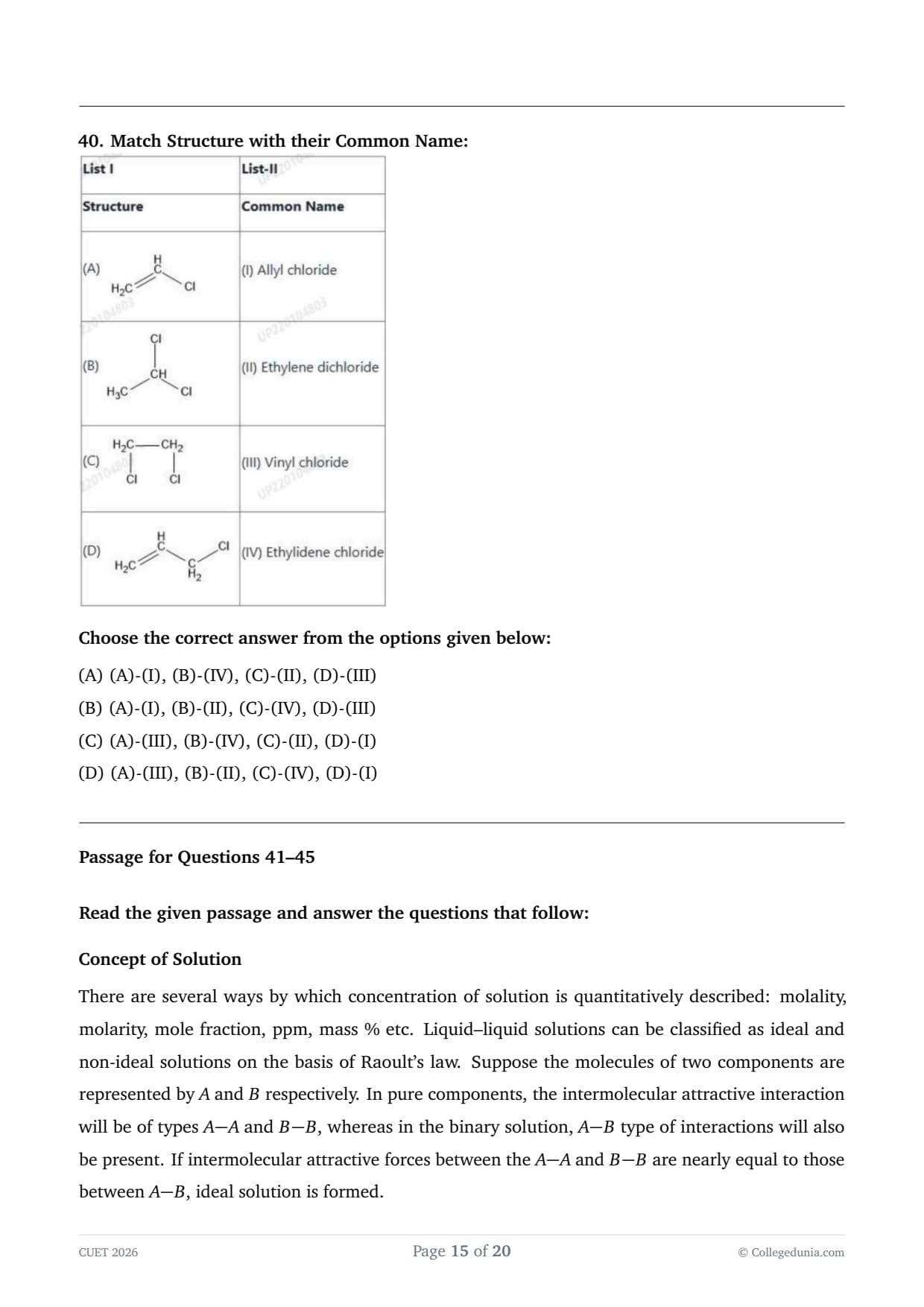
Match Structure with their Common Name:

Choose the correct answer from the options given below:
What would be the molality of \(1.5\,g\) of ethanoic acid (\(CH_3COOH\)) in \(75\,g\) of benzene?
Which one of the following is not correct for an ideal solution?
The vapour pressure of pure benzene at \(25^\circ C\) is \(0.950\) bar. When a \(0.5\,g\) non-volatile, non-electrolyte solute is added to \(39.0\,g\) of benzene (molar mass \(78\,g\,mol^{-1}\)), then the vapour pressure of solution becomes \(0.945\) bar. What is the molar mass of the solute?
The solution of acetone in ethanol:
Which of the following concentration term is temperature dependent?
Select the correct order of boiling points of isomeric amines:
Identify the tertiary amine (\(3^\circ\)) from the following compounds.
Identify the correct decreasing order of basic strength of amines in aqueous solution.
The final structure of amine produced by Hoffmann degradation of \(m\)-bromobenzamide is:


What would be the structure of final product X in the following chemical reaction?


CUET UG 2026 Exam Pattern
| Parameter | Details |
|---|---|
| Exam Name | Common University Entrance Test (CUET UG) 2026 |
| Conducting Body | National Testing Agency (NTA) |
| Exam Mode | Computer-Based Test (CBT) |
| Exam Duration | 60 minutes per test |
| Total Sections | 3 (Languages, Domain Subjects, General Test) |
| Question Type | Multiple Choice Questions (MCQs) |
| Questions per Test | 50 questions (all compulsory) |
| Marking Scheme | +5 for correct, -1 for incorrect |
| Maximum Marks | 250 marks per test |
| Maximum Subject Choices | 5 subjects in total |
| Syllabus Base | Class 12 NCERT (mainly for Domain Subjects) |





Comments