




To start the JEE Advanced preparation strategy, classify chapters as weak, moderate, and advanced to prioritise topics requiring improvement. Revise core theory, formula derivations, assumptions, and boundary conditions before attempting complex JEE Advanced problems.
Solve 15–20 years of JEE Advanced previous-year questions topic-wise to understand question patterns and recurring concepts. Revise facts and short notes regularly to improve recall and reduce memory gaps.
- From Physics, focus on Mechanics, Rigid Body Dynamics, Electrodynamics, Modern Physics and Thermodynamics, with regular practice of multi-step numerical problems.
- From Chemistry, master General Organic Chemistry (GOC), reaction mechanisms, stereochemistry, coordination compounds, and chemical bonding rather than relying on memorisation.
- Improve Mathematical Problem-Solving by prioritising Calculus, Vectors, 3D Geometry, Algebra, Probability and Complex Numbers, especially questions involving multiple concepts.
- Choose limited, but reliable books. Use H.C. Verma for Physics, N. Avasthi for Physical Chemistry, M.S. Chouhan for Organic Chemistry, NCERT for foundational Chemistry and Cengage or the Black Book for Mathematics.
- Complete module exercises and PYQs before moving to selected I.E. Irodov Physics problems, advanced Mathematics worksheets and additional Chemistry problems.
- In the final month, solve complete JEE Advanced papers under exam conditions, practising both compulsory papers within their prescribed three-hour durations.
Related Links:
- JEE Advanced Syllabus 2027: Subject-wise Topics and Important Chapters
- JEE Advanced Exam Pattern 2027: Marking Scheme, Paper Timings and Question Types
- JEE Advanced Previous Year Papers 2026: Chapter-wise Question Papers with Solutions
Key Summary
- JEE Advanced preparation 2027 should begin with the paper's own history, so solve the last 15-20 years of JEE Advanced previous year papers chapter by chapter.
- Successful candidates split their JEE Advanced preparation into 40% concept learning and 60% advanced problem solving, including past papers and mock test analysis.
- Multiple-choice questions carry steep negative marking, so treat every option as an independent True/False statement and never gamble for an extra mark.
How to Start JEE Advanced Preparation 2027 after clearing JEE Mains? — Topper's Tips
Follow the below tips to transition from JEE Mains to Advanced preparation:
- Solve the last 15-20 years of JEE Advanced PYQs chapter by chapter instead of attempting random full papers.
- Observe how separate topics are merged, such as Electrostatics with Simple Harmonic Motion (SHM) or Complex Numbers with Geometry.
- Revisit your JEE Main books and coaching modules and prioritise marked questions, doubts and problems you could not solve earlier.
| Preparation Tip | What to Do |
|---|---|
| 1. Classify Chapters by Preparation Level |
|
| 2. Strengthen Conceptual Understanding |
|
| 3. Revise Existing Books and Modules |
|
| 4. Practise Previous Year Questions |
|
| 6. Attempt Full-Length Mock Tests |
|
| 7. Analyse Every Mock Test |
|
| 8. Revise Memory-Based Topics Daily |
|
| 9. Practise Advanced-Level Problems |
|
The multi-option correct rule: Multi-option questions can significantly affect your WBJEE rank because incorrect selections may lead to negative marking. Practise these questions regularly using the following approach:
- Evaluate Every Option Separately: Treat options A, B, C, and D as independent True/False statements and verify each one.
- Avoid Linking Options: The correctness of one option does not determine whether another is correct. Evaluate each option on its own merits.
- Skip Uncertain Options: If you are confident about A and B but unsure about C, select only the options you can verify.
- Avoid marking doubtful choices that could cost you marks.
This video by the channel “Tiru [IIT Delhi]” discusses a JEE Advanced topper's experience during the last 3 months after JEE Mains, which prepared him for the JEE ADV exam. This detailed 3-month strategy contains all the minute details you should take care of at the end of this long battle.
Ques. How to start JEE Advanced preparation after JEE Main?
Ans. Start JEE Advanced preparation by classifying every chapter as A-, A or A+, revising your existing JEE Main modules and solving 15-20 years of JEE Advanced previous year papers chapter by chapter before adding any new books.
Also Check:
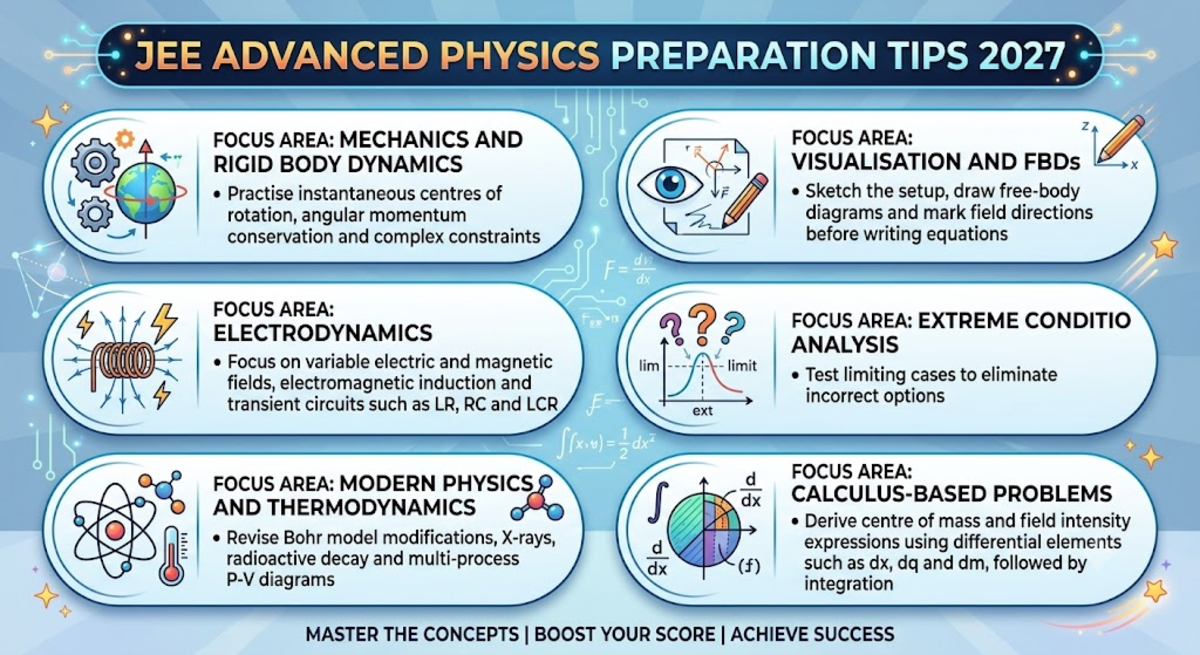
JEE Advanced Physics Preparation Tips 2027
For JEE Advanced Physics preparation, focus on conceptual clarity, application-based numericals, and problem-solving techniques to improve accuracy in the exam.
- Focus on Mechanics, Rigid Body Dynamics, Electrodynamics, and Modern Physics, where multi-step numerical problems require strong conceptual understanding.
- Practise drawing free-body diagrams, applying calculus to distributed systems, and checking extreme cases to eliminate incorrect options.
| Focus Area | Preparation Tips |
|---|---|
| Mechanics and Rigid Body Dynamics | Practise instantaneous centres of rotation, angular momentum conservation and complex constraints |
| Electrodynamics | Focus on variable electric and magnetic fields, electromagnetic induction and transient circuits such as LR, RC and LCR |
| Modern Physics and Thermodynamics | Revise Bohr model modifications, X-rays, radioactive decay and multi-process P-V diagrams |
| Visualisation and FBDs | Sketch the setup, draw free-body diagrams and mark field directions before writing equations |
| Extreme Condition Analysis | Test limiting cases to eliminate incorrect options |
| Calculus-Based Problems | Derive centre of mass and field intensity expressions using differential elements such as dx, dq and dm, followed by integration |
JEE Advanced Chemistry Preparation Tips 2027
JEE Advanced Chemistry questions require mechanism-level understanding over memorised reactant-product pairs.
- Keep NCERT Chemistry for foundational revision and add the deeper resources listed in the books section.
- Focus on GOC, reaction mechanisms, stereochemistry, and coordination compounds to solve application-based questions without relying on rote memorisation.
- Practise equilibrium, chemical kinetics, thermodynamics, and salt analysis to improve accuracy in multi-step calculations and reaction-based problems.
| Focus Area | Preparation Tips |
|---|---|
| Organic Chemistry | Master GOC, hyperconjugation, mesomeric effects and aromaticity instead of memorising reactant-product pairs |
| Reaction Mechanisms | Track electron density and electron-pair movement to understand reactions such as Aldol, Ethers, Cannizzaro and Beckmann rearrangements |
| Stereochemistry | Connect mechanisms with stereochemical outcomes, including SN2 reactions, carbocation rearrangements and syn/anti additions |
| Physical Chemistry | Understand the conditions and limitations of the Arrhenius and Nernst equations, including non-standard states and temperature changes |
| High-Yield Physical Chemistry Topics | Practise ionic equilibrium, buffers, salt hydrolysis, solubility products, complex reaction kinetics, entropy, Gibbs free energy and non-ideal gases |
| Coordination Compounds and Bonding | Study Crystal Field Theory, orbital splitting, isomerism and magnetic properties through structural visualisation |
| Qualitative Inorganic Analysis | Trace colour changes, gas evolution and precipitate formation or dissolution in multi-step salt analysis questions |
JEE Advanced Mathematics Preparation Tips 2027
JEE Advanced Maths questions often combine several concepts in one problem, so practise graphs and simplification as seriously as formulas.
- Focus on Calculus, Vectors, 3D Geometry, and Algebra, especially questions that combine multiple concepts and require multi-step solutions.
- Practise function graphs, domain and range restrictions, symmetry, and algebraic substitutions to simplify lengthy calculations and avoid errors.
| Focus Area | Preparation Tips |
|---|---|
| Calculus | Focus on functional equations, continuity and differentiability, Leibniz's rule and areas under complex bounded curves |
| Vectors and 3D Geometry | Practise scalar and vector triple products, shortest distances between skew lines and intersections of planes |
| Algebra | Work on matrices, probability and complex numbers, including questions that combine multiple concepts |
| Graphical Competency | Sketch transformed functions such as y = |f(|x|)|, greatest integer functions and fractional-part functions to find roots, limits and continuity points |
| Domain and Range | Check restrictions before solving equations |
| Systematic Simplification | Look for symmetry, hidden algebraic patterns and suitable substitutions to simplify lengthy expressions |
Also Check:
JEE Advanced Question Paper 2026 with Solution PDF
| Paper Name | Question Paper Link | Solutions Link |
|---|---|---|
| JEE Advanced 2026 Question Paper – Paper 1 | Download PDF | Check Solutions |
| JEE Advanced 2026 Question Paper – Paper 2 | Download PDF | Check Solutions |
| JEE Advanced 2025 Question Paper – Paper 1 | Download PDF | Check Solutions |
| JEE Advanced 2025 Question Paper – Paper 2 | Download PDF | Check Solutions |
| JEE Advanced Question Paper 2024 – Paper 1 | Download PDF | Check Solutions |
| JEE Advanced Question Paper 2024 – Paper 2 | Download PDF | Check Solutions |
| JEE Advanced 2024 AAT Question Paper | Download PDF | Check Solutions |
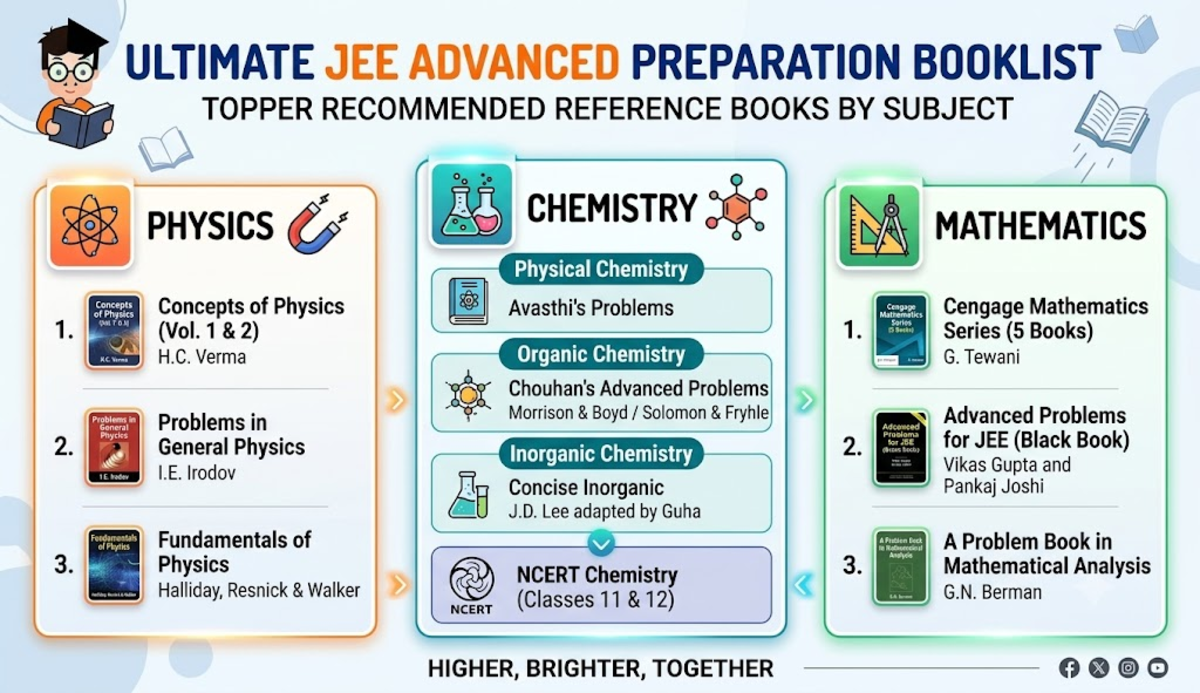
Best Books for IIT JEE Advanced Preparation 2027
Do not buy every book mentioned below. It can cause resource overload and superficial learning. Build a minimal stack of books for your JEE Advanced preparation.
- Pick one theory or series textbook, such as Cengage for Maths or H.C. Verma for Physics.
- Add one specialised problem book, such as the Black Book for Maths or Irodov for Physics.
- Solve a few books completely rather than skimming multiple books.
| Subject | Book Name | Author |
|---|---|---|
| Physics | Concepts of Physics (Vol. 1 & 2) | H.C. Verma |
| Problems in General Physics | I.E. Irodov | |
| Fundamentals of Physics | Halliday, Resnick and Walker | |
| Chemistry - Physical | Problems in Physical Chemistry for JEE Advanced | N. Avasthi |
| Chemistry - Organic | Advanced Problems in Organic Chemistry | M.S. Chouhan |
| Organic Chemistry | Morrison and Boyd / Solomon and Fryhle | |
| Chemistry - Inorganic | Concise Inorganic Chemistry | J.D. Lee, adapted for JEE by Sudarsan Guha |
| Chemistry | NCERT Chemistry (Class 12) and (Class 11) | NCERT |
| Mathematics | Cengage Mathematics Series (5 Books) | G. Tewani |
| Advanced Problems in Mathematics for JEE (Black Book) | Vikas Gupta and Pankaj Joshi | |
| A Problem Book in Mathematical Analysis | G.N. Berman |
Ques. Which are the best JEE Advanced books for Physics, Chemistry and Maths?
Ans. The best JEE Advanced books are H.C. Verma and Irodov for Physics, N. Avasthi, M.S. Chouhan and J.D. Lee for Chemistry, and the Cengage series with the Black Book for Maths.
Check Out:
How Much Time Is Required for JEE Advanced Preparation?
The time you need depends on your current academic stage. The standard, most reliable path is a 2-year timeline covering Class 11 and Class 12. If you have already cleared the JEE Main cutoff and built a strong conceptual base, 3 to 5 months of hyper-focused study on Advanced problem frameworks can be enough.
For whichever window, divide time into 40% concept learning and 60% problem solving.
- Concept Learning (40%): Understand why formulas work, dissect physical and mathematical proofs and note down boundary constraints.
- Problem Solving (60%): Handle complex multi-concept problems, fight through tough past papers and analyse mock test errors.
| Preparation Window | Approach |
|---|---|
| 2 years (Class 11 and 12) | Standard path; build concepts and problem-solving together |
| 3-5 months (after JEE Main) | Hyper-focused study dedicated to Advanced problem frameworks |
| Any window | 40% Concept Learning + 60% Problem Solving |
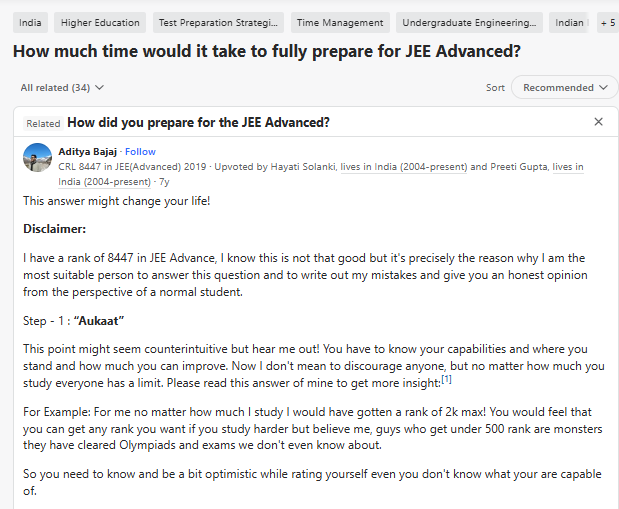
As per discussions on Quora, candidates who clear Advanced after Main focus on the same split of understanding first and then pressure-testing it with hard problems.
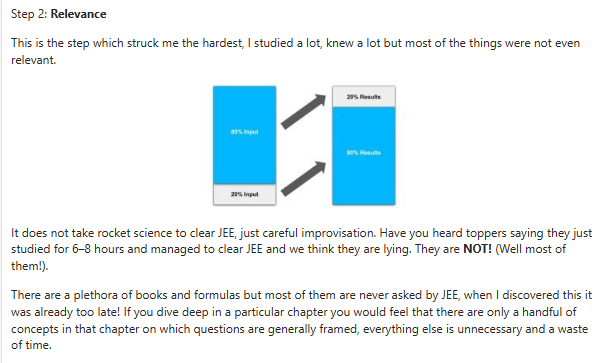
- Toppers typically study 6 to 8 hours daily to clear JEE Advanced.
- Rather than spending excessive time studying irrelevant formulas or diving too deeply into unnecessary topics, focus on core concepts in each chapter on which questions are actually framed.
- Preparation efficiency depends on knowing your personal limits and capabilities rather than focusing solely on studying more hours.
Source: Quora
Ques. What is the best JEE Advanced study plan after JEE Main?
Ans. The best JEE Advanced study plan after JEE Main follows the 40:60 split, uses your existing modules for revision, and builds up to full-length papers in the final month.
Check Out:
- JEE Advanced 2024 Question Paper (Available)- Download Paper 1 and Paper 2 Question Paper with Answers and Solution PDF
- JEE Advanced 2023 Question Paper Available: Download Paper 1 and Paper 2 Question Paper with Answer Key and Solution PDF
- JEE Advanced 2022 Question Papers: Download Paper and Answer Key PDFs
JEE Advanced Preparation in 1 Month
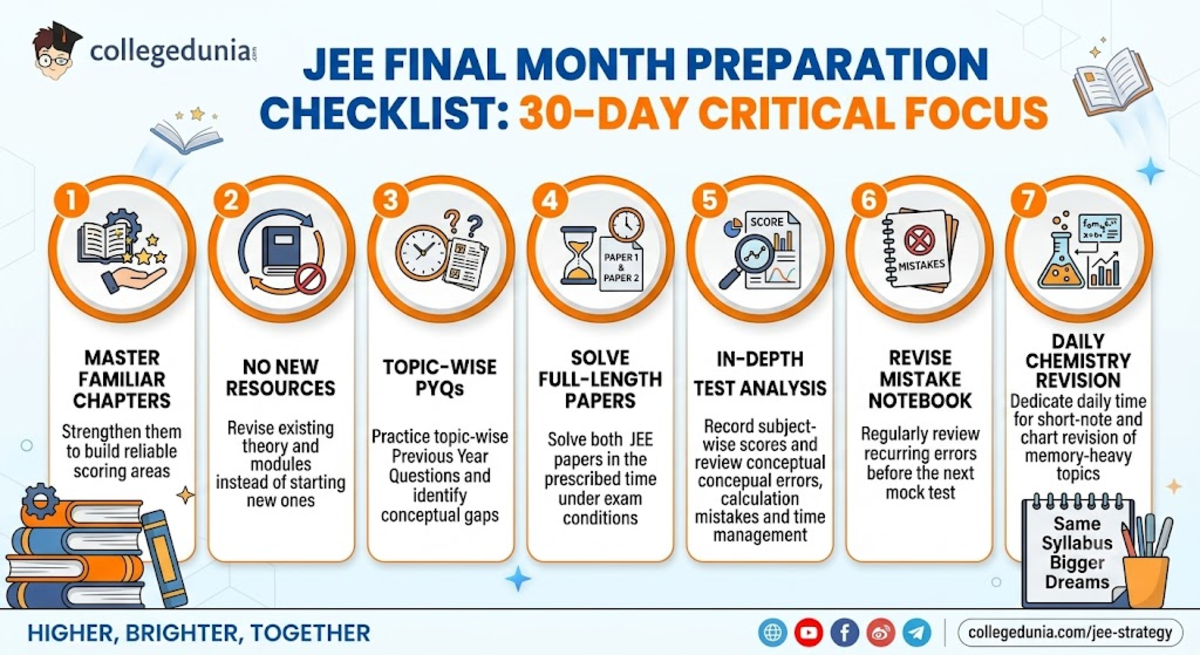
With only one month left, stop focusing on completing the syllabus. The goal should be accuracy, question selection and revision. Follow the tips below for focused JEE Advanced revision in the last 1 month:
- Strengthen chapters where your concepts are clear, and you can already solve JEE Main-level questions.
- Revisit existing books and modules, focusing on marked questions and unresolved doubts.
- Practise JEE Advanced previous year papers by topic and complete older questions before extra advanced sets.
- Give regular attention to memory-heavy topics, reactions and key facts using short notes and charts. After modules and PYQs, attempt selected problems from Irodov, the Black Book or teacher worksheets.
| Focus Area | What to Do in the Final Month |
|---|---|
| Familiar chapters | Strengthen them to build reliable scoring areas |
| Theory and modules | Revise existing resources instead of starting new ones |
| PYQs | Practise topic-wise and identify recurring conceptual gaps |
| Full-length papers | Solve both papers in the prescribed time under exam conditions |
| Test analysis | Record subject-wise scores and review conceptual errors, calculation mistakes and time management |
| Mistake notebook | Revise recurring errors before the next mock test |
| Chemistry revision | Daily short-note and chart revision of memory-heavy topics |
JEE Advanced 2027: Questions Attempt Strategy
- When you hit a tough Advanced problem, do not look at the solution for at least 20 minutes. Try different angles, break down the variables and redraw the scenario; the learning happens during the struggle.
- Advanced penalises partial knowledge, so dedicate sessions only to multi-option correct, matrix match and integer-type questions.
- Maintain an Advanced Error Log: Log the exact point of failure for every mistake.
The errors can be categorised as:
| Error Type | What it Means |
|---|---|
| Concept Gap | You did not know the core property |
| Context Failure | You missed a hidden constraint, such as "x is a positive integer" |
| Calculation Trap | You erred during deep simplification |
Ques. How to prepare for JEE Advanced in 1 month?
Ans. To prepare for JEE Advanced in one month, revise your existing modules, solve JEE Advanced previous year papers topic-wise, take full-length mock tests under exam conditions and review every error in a mistake notebook.
Also Check:
JEE Main vs JEE Advanced Preparation
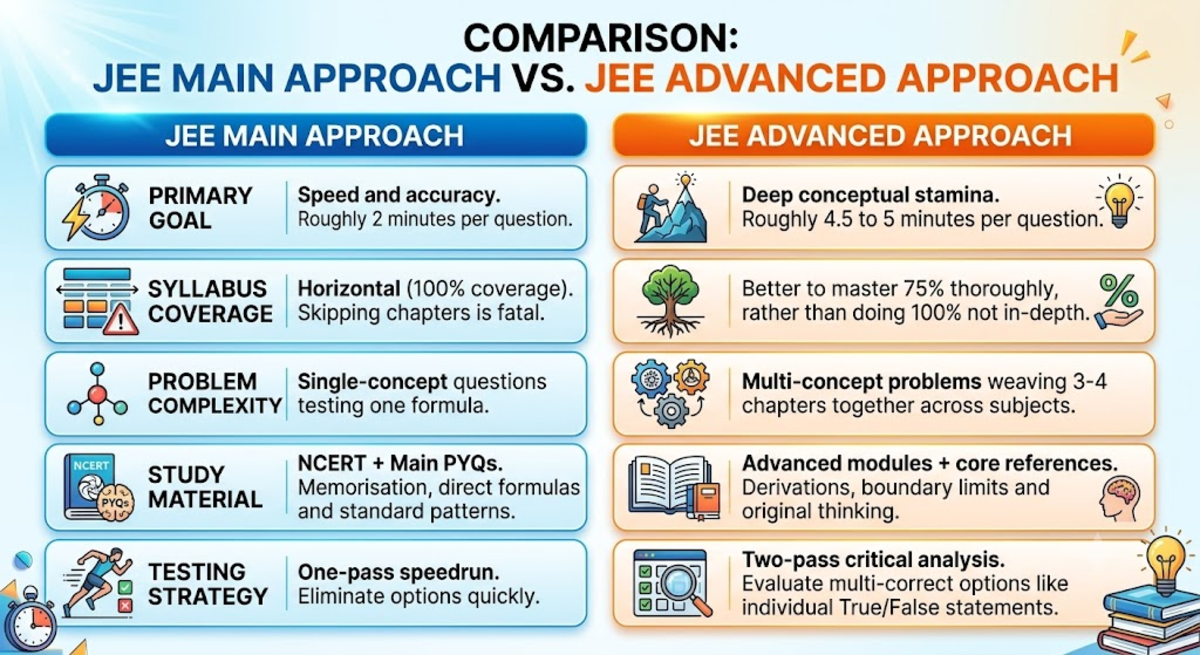
JEE Main and JEE Advanced preparation need two different strategies, daily schedules and mindsets.
- JEE Main: Prioritise NCERT-based facts and broad syllabus coverage, including smaller topics. Practise 60–80 questions daily to improve speed and pattern recognition.
- JEE Advanced: Focus on conceptual depth in Calculus, Electrodynamics, and Organic Chemistry. Solve 15–20 challenging questions daily, spending 20–30 minutes analysing each problem before checking the solution.
| Preparation Metric | JEE Main Approach | JEE Advanced Approach |
|---|---|---|
| Primary Goal |
|
|
| Syllabus Coverage |
|
|
| Problem Complexity |
|
|
| Study Material |
|
|
| Testing Strategy |
|
|
Ques. How is JEE Advanced preparation different from JEE Main?
Ans. JEE Advanced preparation focuses on depth, derivations and multi-concept problems at about 15-20 questions a day, while JEE Main preparation focuses on speed, full syllabus coverage and 60-80 questions a day.
Is JEE Advanced Easy?
JEE Advanced tests conceptual understanding, multi-step problem-solving, and the ability to apply concepts under unfamiliar conditions. It is generally not considered easy by students:
- A single problem may combine concepts from multiple chapters, such as Calculus with Electrostatics or Complex Numbers with Matrices.
- The number of questions, total marks, and marking scheme can change each year, requiring you to adapt to the instructions provided in the exam.
- Two papers in one day, and both papers are compulsory. Paper 1 runs from 9 AM to 12 PM, and Paper 2 from 2:30 PM to 5:30 PM, requiring sustained concentration across six hours of testing.
| Challenge | What it Means | How to Prepare |
|---|---|---|
| Multi-concept problems | 3-4 chapters woven into one question | Practise cross-chapter PYQs and overlapping triggers |
| Changing pattern | Marks and weightage vary every year | Practise JEE Advanced question papers from many years, not one format |
| Negative marking | Wrong options are penalised heavily | Evaluate each option as True/False and skip when unsure |
| Six-hour stamina | Two 3-hour papers on the same day | Take full-length JEE Advanced mock test papers in exam conditions |
Check Out:
JEE Advanced Preparation Tracker: How to Track Your Progress
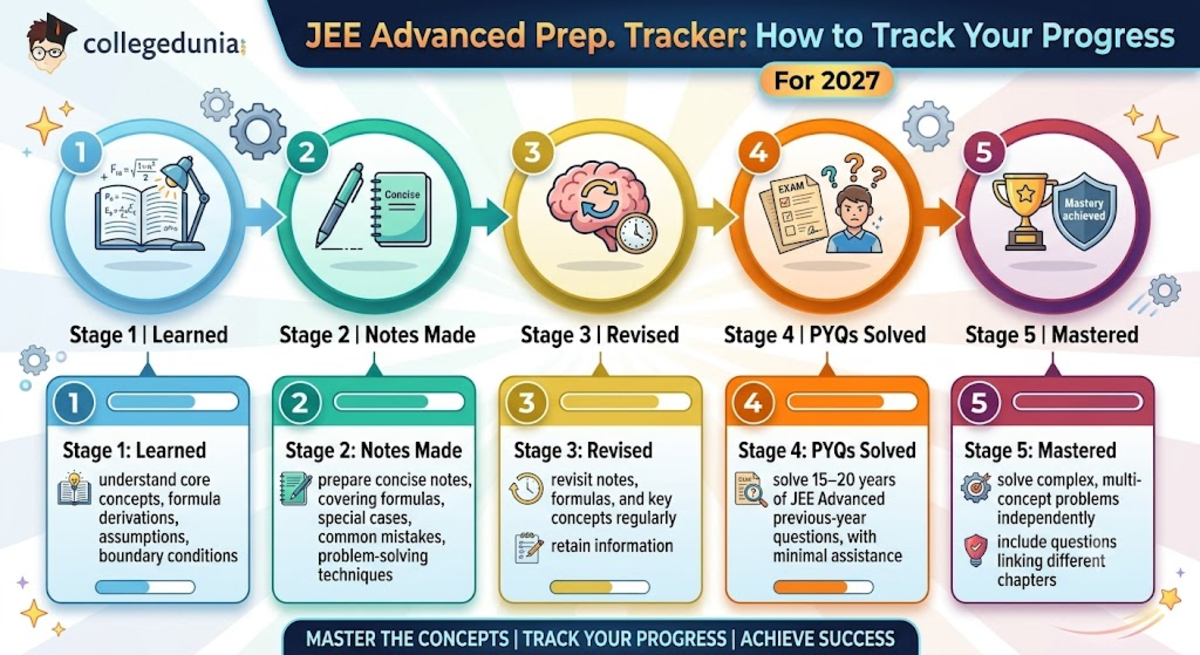
For the JEE Advanced exam, a simple checklist is insufficient. Track each topic across five stages to measure conceptual understanding, revision, practice, and problem-solving ability.
- Progression: Learned → Notes Made → Revised → PYQs Solved → Mastered.
| Mastery Stage | Completion Criteria |
|---|---|
| Stage 1: Learned | Understand core concepts, formula derivations, assumptions, and boundary conditions. |
| Stage 2: Notes Made | Prepare concise notes covering formulas, special cases, common mistakes, and problem-solving techniques. |
| Stage 3: Revised | Revisit notes, formulas, and key concepts regularly to retain information. |
| Stage 4: PYQs Solved | Solve 15–20 years of JEE Advanced previous-year questions with minimal assistance. |
| Stage 5: Mastered | Solve complex, multi-concept problems independently, including questions linking different chapters. |
FAQs About JEE Advanced Preparation
Ques. How to start JEE Advanced preparation 2027 from scratch?
Ans. Start JEE Advanced preparation 2027 by mapping the JEE Advanced syllabus chapter by chapter, building concepts first, and then moving to JEE Advanced previous year papers and practice questions using the 40:60 concept-to-problem split.
Ques. How many hours should I study for JEE Advanced preparation?
Ans. The right number depends on your timeline, but most JEE Advanced preparation plans work best with about 2-3 hours of morning revision for memory-based topics and the rest of the day on problem solving and mock test analysis.
Ques. How many questions should I solve per day for JEE Advanced?
Ans. JEE Advanced preparation favours depth, so around 15-20 high-complexity questions a day, each attempted for 20-30 minutes before you look at the solution, works better than chasing 60-80 JEE Main-style questions.
Ques. When should I start taking JEE Advanced mock tests?
Ans. Start chapter-wise PYQs early and shift to full-length JEE Advanced mock test papers, both papers within the prescribed time, in the final month of your JEE Advanced study plan.
Ques. Is NCERT enough for JEE Advanced Chemistry?
Ans. NCERT Chemistry (Classes 11 and 12) is useful for foundational theory, reactions and inorganic concepts, but JEE Advanced Chemistry also needs mechanism-level practice from problem books.



Comments