




JEE Advanced 2026 had 102 questions across two papers: 48 in Paper 1 and 54 in Paper 2. Paper 1 was considered to be moderate to difficult, while Paper 2 was tougher and longer. Class 11 contributed 53% of Physics marks, while Class 12 contributed 47%.
- Mechanics carries the highest Physics weightage at 38%, covering Rotational Motion, Centre of Mass, Fluid Mechanics, SHM and Waves, followed by Electricity & Magnetism at 18%.
- Modern Physics contributed 12% of JEE Advanced Physics marks, while Optics accounted for 9%.
- Class 12 contributed 68% of Mathematics marks, and Integral Calculus was the highest-weightage Mathematics unit, contributing 19%, followed by Probability at 14%.
- Chemistry had a nearly equal Class 11 and Class 12 distribution, with 51% and 49% weightage, respectively.
- Physical Chemistry carried the highest share at 39%, followed by Organic Chemistry at 36% and Inorganic Chemistry at approximately 25%.
- Thermodynamics & Chemical Equilibrium, Aldehydes & Ketones, Chemical Bonding and Coordination Compounds are high-weightage areas in JEE Advanced Chemistry.
- Questions increasingly involved multiple chapters, with mixed-concept problems becoming more prominent in the 2026 paper.
Related Links:
- JEE Advanced Syllabus 2027: Subject-Wise Topics, Chapter-Wise Weightage and PDF Download
- Download JEE Advanced 2026 Question Paper with Solutions: Access JEE Advanced Previous Year Papers (2007-2025) in PDF Format
- JEE Advanced 2027 Preparation Tips: Timetable, Section-Wise Tips & Best Books
Key Summary
- The 2026 paper had 102 questions: 48 in Paper 1 and 54 in Paper 2.
- Rotational Motion, COM & Rigid Body is the top Physics chapter over five years, at about 13.5%.
- Integral Calculus is the top Maths chapter, at an average of 18.0% over five years.
- Aldehydes, Ketones & Carboxylic Acids and Chemical Bonding & Coordination Compounds are tied in Chemistry, at about 12.4% each.
- The 2027 plan splits study time 60-25-15 across high-weightage, high-return, and short chapters.
JEE Advanced Chapter-Wise Weightage: 2026 Exam Analysis
The 2026 paper tested concepts across chapters. The two papers differed in difficulty. In the JEE Advanced 2026 exam, mixed-concept problems were commonly asked.
- Paper 1 had 48 questions. It was rated moderate to difficult overall. Mathematics was the toughest section. Chemistry offered the highest scoring opportunities.
- Paper 2 had 54 questions. It was rated tougher and lengthier than Paper 1. Physics was the hardest section in this shift.
- Over 55% of the marks in every subject came from three to four dominant units:
- Mechanics
- Calculus
- Physical Chemistry, and
- Organic Chemistry.
JEE Advanced Physics Chapter-Wise Weightage
- Class 11 topics carried around 53% (64 marks), and the Class 12 topics carried 47% (56 marks) in the JEE Advanced 2026 exam.
- Mechanics led at 38%. It covers Rigid Body Motion, Centre of Mass, Fluid Mechanics, and SHM & Waves. Electricity & Magnetism carried 18%.
| Unit / Chapter Group | Key Topics Covered | Weightage |
|---|---|---|
| Mechanics (Class 11) | Rigid Body Motion, Centre of Mass, Fluid Mechanics, SHM & Waves | 38% |
| Electricity & Magnetism | Electrostatics, Current Electricity, Magnetic Field, EMI, Capacitance | 18% |
| Modern Physics | Photoelectric Effect, Nuclear Binding Energy, Radioactivity | 12% |
| Optics | Geometrical Optics, Wave Optics | 9% |
| Other Units | Thermal Physics, Gravitation (3%), Units & Errors (3%) | ~23% |
JEE Advanced Mathematics Chapter-Wise Weightage
- Class 12 topics carried 68% (81 marks). Class 11 topics carried 39 marks, about a third of the paper.
- The paper had around 14 easy and 17 moderate questions. The remaining 3 were difficult.
- Lengthy multi-concept calculations made time management difficult.
| Unit / Chapter Cluster | Approximate Weightage (%) | Key Areas Featured in the Exam |
|---|---|---|
| Integral Calculus | 19% | Definite Integrals (High-yield properties), Differential Equations |
| Probability | 14% | Conditional Probability, Bayes' Theorem, Permutations and Combinations blend |
| Coordinate Geometry | 12% | Circles, Parabola, Ellipse, Hyperbola (Conic Sections blend) |
| Vectors & 3D Geometry | 11% | Vector Algebra, 3-D lines, Plane intersections |
| Matrices & Determinants | 8% | Properties of Matrices, Systems of Linear Equations |
| Differential Calculus | 8% | Limits, Continuity & Differentiability, Application of Derivatives (AOD) |
| Trigonometry | 7% | Inverse Trigonometric Functions (ITF) |
| Algebra (Sequences, Binomial) | 6% | Series summation, Binomial Coefficients |
| Permutations & Combinations | 6% | Combinatorial probability, Grid & selection problems |
| Complex Numbers | 5% | Geometry of complex variables, De Moivre's applications |
JEE Advanced Chemistry Chapter-Wise Weightage
- Class 11 carried 51% (61 marks). Class 12 carried 49% (59 marks). The split was almost equal.
- Physical Chemistry totalled 39%: 24% from Class 11 topics and 15% from Class 12 topics.
- Organic Chemistry totalled 36%: 23% from Class 12 topics and about 13% from Class 11 topics. Inorganic Chemistry carried about 25%.
| Unit / Chapter Group | Key Topics Covered | Weightage |
|---|---|---|
| Physical Chemistry – I (Class 11) | Thermodynamics, Chemical & Ionic Equilibrium, Atomic Structure, Mole Concept | 24% |
| Organic Chemistry – II (Class 12) | Aldehydes & Ketones, Phenols, Amines, Alkyl Halides, Biomolecules | 23% |
| Physical Chemistry – II (Class 12) | Electrochemistry, Chemical Kinetics, Solutions, Solid State | 15% |
| Inorganic Chemistry | Coordination Compounds, p-Block Elements, Chemical Bonding, d & f-Block | ~25% |
| Organic Chemistry – I (Class 11) | General Organic Chemistry (GOC), Isomerism, Hydrocarbons | ~13% |
Ques. Which unit had the highest weightage in JEE Advanced 2026?
Ans. Mechanics in Physics (38%), Integral Calculus in Maths (19%), and Physical Chemistry – I in Chemistry (24%) had the highest weightage in the JEE Advanced exam 2026.
Ques. How many questions were in JEE Advanced 2026?
Ans. JEE Advanced 2026 had 102 questions in total, with 48 questions in Paper 1 and 54 in Paper 2. Each subject (Physics, Chemistry, and Mathematics) had 34 questions across both papers.
Check Out:
JEE Advanced Chapter-Wise Weightage: Last 5 Years Trend
The tables below show the JEE Advanced weightage of chapters from 2022 to 2026. They cover 10 papers: Paper 1 and Paper 2 for each year.
- Total questions per subject changed by year. 2022 had 36 (18 per paper). 2023, 2024, and 2026 had 34 (17 per paper). 2025 had 32 (16 per paper).
- Questions increasingly span two chapters. This started in 2023 and peaked in 2026.
- Experimental Physics questions have almost doubled. Units, Errors & Experimental Physics rose from 1 question in 2022 to 2 in 2025 and 2026.
- Standalone Trigonometry dropped to about 1 question per year; however, Trigonometric identities remain embedded in Calculus and Complex Number problems.
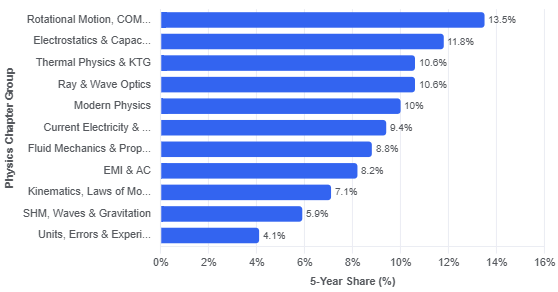
JEE Advanced Physics: 5-Year Weightage Breakdown (2022–2026)
- Rotational Motion, COM & Rigid Body is the highest-weightage chapter, with 23 questions (13.5%) across 2022–2026, consistently contributing 4–5 questions annually.
- Mechanics and Electrodynamics together contribute approximately 64.7% of Physics questions. Mechanics accounts for 35.3%, while Electrodynamics contributes 29.4%.
- Modern Physics, Thermal Physics, and Optics are other high-priority areas, contributing 10%, 10.6% and 10.6% of questions, respectively.
| Unit / Chapter Group | 2022 (36 Qs) | 2023 (34 Qs) | 2024 (34 Qs) | 2025 (32 Qs) | 2026 (34 Qs) | 5-Year Share (%) |
|---|---|---|---|---|---|---|
| Rotational Motion, COM & Rigid Body | 5 | 4 | 5 | 4 | 5 | ~13.5% |
| Electrostatics & Capacitance | 5 | 4 | 4 | 4 | 3 | ~11.8% |
| Thermal Physics & KTG | 4 | 4 | 3 | 3 | 4 | ~10.6% |
| Ray & Wave Optics | 4 | 4 | 4 | 3 | 3 | ~10.6% |
| Modern Physics (Atoms, Nuclei, Dual Nature) | 4 | 3 | 3 | 3 | 4 | ~10.0% |
| Current Electricity & Magnetism (MEC) | 4 | 4 | 3 | 3 | 2 | ~9.4% |
| Fluid Mechanics & Properties of Matter | 3 | 3 | 3 | 3 | 3 | ~8.8% |
| Electromagnetic Induction (EMI) & AC | 3 | 3 | 3 | 3 | 2 | ~8.2% |
| Kinematics, Laws of Motion & WPE | 2 | 2 | 3 | 2 | 3 | ~7.1% |
| SHM, Waves & Gravitation | 1 | 2 | 2 | 2 | 3 | ~5.9% |
| Units, Errors & Experimental Physics | 1 | 1 | 1 | 2 | 2 | ~4.1% |
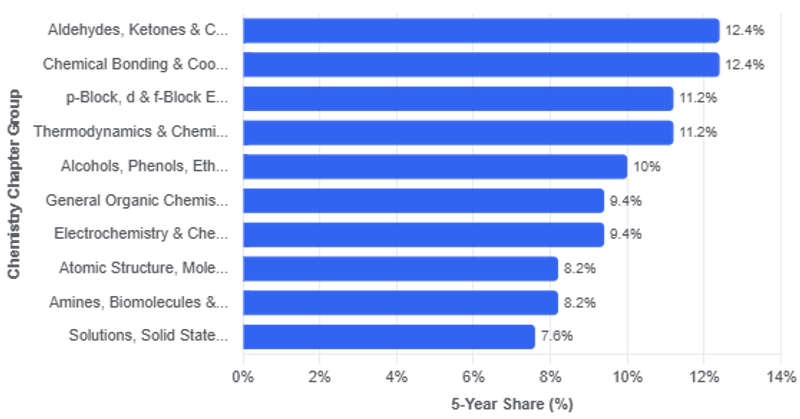
JEE Advanced Chemistry: 5-Year Weightage Breakdown (2022–2026)
- Chemistry stayed balanced across Organic (~36%), Physical (~34%), and Inorganic (~30%).
- Aldehydes, Ketones & Carboxylic Acids and Chemical Bonding & Coordination Compounds are the highest-weightage groups, with 21 questions each (12.4%) across 2022–2026.
- The top four chapter groups account for 80 out of 170 questions, contributing approximately 47% of the total Chemistry questions.
- Thermodynamics & Chemical/Ionic Equilibrium maintained 3–4 questions annually, while Solutions, Solid State & Surface Chemistry increased to 3 questions annually from 2024.
| Unit / Chapter Group | 2022 (36 Qs) | 2023 (34 Qs) | 2024 (34 Qs) | 2025 (32 Qs) | 2026 (34 Qs) | 5-Year Share (%) |
|---|---|---|---|---|---|---|
| Aldehydes, Ketones & Carboxylic Acids | 4 | 4 | 4 | 4 | 5 | ~12.4% |
| Chemical Bonding & Coordination Compounds | 5 | 4 | 4 | 4 | 4 | ~12.4% |
| p-Block, d & f-Block Elements | 5 | 4 | 4 | 3 | 3 | ~11.2% |
| Thermodynamics & Chemical/Ionic Equilibrium | 4 | 4 | 4 | 3 | 4 | ~11.2% |
| Alcohols, Phenols, Ethers & Alkyl Halides | 4 | 4 | 3 | 3 | 3 | ~10.0% |
| General Organic Chemistry (GOC) & Hydrocarbons | 4 | 3 | 3 | 3 | 3 | ~9.4% |
| Electrochemistry & Chemical Kinetics | 3 | 3 | 4 | 3 | 3 | ~9.4% |
| Atomic Structure, Mole Concept & Redox | 3 | 3 | 2 | 3 | 3 | ~8.2% |
| Amines, Biomolecules & Practical Organic | 2 | 3 | 3 | 3 | 3 | ~8.2% |
| Solutions, Solid State & Surface Chemistry | 2 | 2 | 3 | 3 | 3 | ~7.6% |
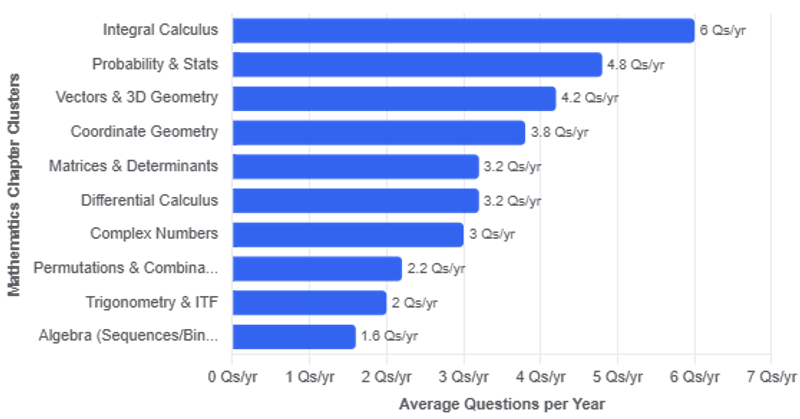
JEE Advanced Mathematics: 5-Year Weightage Breakdown (2022–2026)
- Integral Calculus is the highest-weightage area, averaging 18% over five years and never falling below 15%. Calculus (Integral + Differential) contributes an overall average of 27.2%.
- Probability is another major scoring area, contributing 14–18% of questions in most years. Vectors & 3D Geometry also maintains a consistent 11–15% weightage.
- Matrices & Determinants has gained importance, with its weightage increasing from 7% in 2022 to 11% in 2026.
| Topic / Chapter Cluster | 2022 (36 Qs) | 2023 (34 Qs) | 2024 (34 Qs) | 2025 (32 Qs) | 2026 (34 Qs) | 5-Year Avg (Qs/Yr) |
|---|---|---|---|---|---|---|
| Integral Calculus | 6 | 5 | 7 | 6 | 6 | 6.0 |
| Probability & Stats | 6 | 6 | 4 | 3 | 5 | 4.8 |
| Vectors & 3D Geometry | 4 | 4 | 4 | 5 | 4 | 4.2 |
| Coordinate Geometry | 4 | 4 | 4 | 3 | 4 | 3.8 |
| Matrices & Determinants | 3 | 3 | 3 | 3 | 4 | 3.2 |
| Differential Calculus | 3 | 4 | 3 | 3 | 3 | 3.2 |
| Complex Numbers | 3 | 2 | 3 | 4 | 3 | 3.0 |
| Permutations & Combinations | 3 | 2 | 2 | 2 | 2 | 2.2 |
| Trigonometry & ITF | 2 | 2 | 2 | 2 | 2 | 2.0 |
| Algebra (Sequences/Binomial) | 2 | 2 | 2 | 1 | 1 | 1.6 |
| Total Questions | 36 | 34 | 34 | 32 | 34 | 34.0 |
Ques. For JEE, which section from Physics is the most important?
Ans. Mechanics, at about 36% of Physics, followed by Electrodynamics at about 28%.
Check Out:
JEE Advanced Year-wise Question Paper Download
This YouTube video by the channel “Rittik Baheti(IITIAN)” discusses the top 30 high-weightage chapters for 180+ Marks in the JEE Advanced 2027 exam, Best lectures to cover them fast, important questions and PYQs, and toppers' notes for final revision
Pattern Shifts in JEE Advanced Exam Over the Years
The organising IITs have changed how marks are awarded and deducted. They made these changes to neutralise test-taking tricks and coaching-driven shortcuts.
- Numerical Answer Type (NAT): Earlier, answers were mostly single-digit integers (0–9). Since the shift to CBT, decimal answers rounded to two places have become common.
- Over 2022–2026, Mathematics was the toughest and most time-consuming section. It moved from clever shortcut problems to multi-step algebraic and calculus-heavy derivations.
- After syllabus updates in 2023–2024, questions on lab apparatus (vernier calipers, screw gauges, optical benches) and data or graph interpretation increased.
- Multiple-Correct Questions: Earlier, these followed all-or-nothing marking. They now offer partial marks for correctly selected subsets, with penalties for incorrect options.
- Earlier, matrix matching used 4×4 OMR formats. These were replaced by Match-the-List MCQs, while paragraph-based questions with shared data became part of the paper from 2021.
| Change | Earlier Format | Current Format |
|---|---|---|
| Numerical Value (NAT) | Single-digit integers (0–9) before 2018 | Decimal numericals to two decimal places, 25% to 35% of the paper, +4 and no negative marks |
| Multiple-Correct (MSQ) | All-or-nothing (+4 or −2) | Partial marking (+1, +2, or +3) with −1 or −2 for any wrong option |
| Matching | 4×4 Matrix-Match on OMR sheets | Match-the-List MCQs and 2-question Stem paragraphs (from 2021) |
| Marking scheme disclosure | Not in the brochure | Shown on screen 15 minutes before the exam |
Ques. What percentage of JEE Advanced is numerical value questions?
Ans. 25% to 35% of the paper by 2021–2026, typically +4 for correct and no negative marking.
Ques. What is the JEE Advanced chemistry weightage?
Ans. Physical about 35%, Organic about 35%, and Inorganic about 30% in the 2027 outlook.
Also Check:
JEE Advanced Exam Pattern 2027
JEE Advanced 2027 is expected to be a Computer-Based Test (CBT) with two compulsory 3-hour papers on the same day. The expected total is 360 marks, which is 180 per paper, across Physics, Chemistry, and Mathematics. The core framework stays the same across both shifts.
- Paper 1 is held in the morning and Paper 2 in the afternoon.
- Each paper has 48 to 54 questions, which is 16 to 18 per subject.
- Each subject carries 60 marks per paper.
| Feature | Expected Details for JEE Advanced 2027 |
|---|---|
| Exam Mode | Online Computer-Based Test (CBT) |
| Number of Papers | 2 Compulsory Papers: Paper 1 (Morning) & Paper 2 (Afternoon) |
| Duration | 3 hours per paper (6 hours total); 4 hours per paper for PwD candidates |
| Subjects Covered | Physics, Chemistry, and Mathematics (equal weightage in both papers) |
| Total Questions | ~96 to 108 questions (48–54 per paper; 16–18 per subject) |
| Total Marks | 360 marks (180 marks per paper; 60 marks per subject per paper) |
| Medium of Exam | English and Hindi (candidates can toggle languages mid-exam) |
As per students on Quora, below is the JEE Advanced chapter-wise weightage:
- Physics: Optics, Magnetism (mixed with mechanics), Rotational dynamics, Heat and thermodynamics, and Experiments and errors
- Chemistry: Inorganic chemistry (described as the most scoring), Organic chemistry, Atomic structure (notes that there is usually "one question for sure"), and Equilibrium
- Mathematics: Coordinate geometry (notes that parabola is the most important), Calculus (notes that application of derivatives is the most important), Trigonometry (the user noted this was the "toughest" for them)

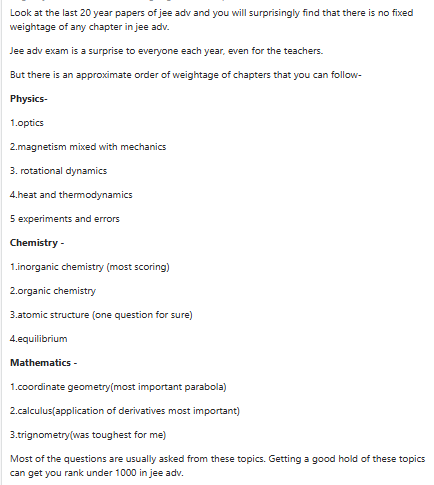
Source: Quora
Ques. What is the JEE Advanced 2027 exam pattern?
Ans. Two compulsory 3-hour CBT papers, 360 marks in total, with about 96 to 108 questions across Physics, Chemistry, and Maths.
Also Check:
How to Prepare for JEE Advanced Based on Chapter-Wise Weightage
Students can apply the below tips in their JEE Advanced preparation while keeping the chapter-wise weightage in mind:
- Cover the whole syllabus. High-weightage chapters anchor the schedule. JEE Advanced also blends low-weightage topics, such as Trigonometry or Mole Concept, into multi-concept questions.
- Target the high-return bridge chapters and practise Multiple-Correct and Numerical formats. Solve previous years' MSQ and decimal NAT questions from the top chapters.
- Link concepts across chapters. Solve mixed-topic worksheets and train for partial marking.
- Build precision for decimal numericals. Do not round intermediate steps. Answers need accuracy up to two decimal places.
Study Time Allocation: 60-25-15 Rule
| Time Allocation | JEE Advanced Topics | Preparation Strategy |
|---|---|---|
| 60% |
|
|
| 25% |
|
|
| 15% |
|
|
JEE Advanced Chapter-Wise Weightage FAQs
Ques. What is the JEE Advanced chapter wise weightage?
Ans. Mechanics leads Physics, Calculus leads Maths, and Organic and Physical Chemistry lead Chemistry. Over 55% of the marks in every subject come from three to four dominant units.
Ques. What is the JEE Advanced physics chapter wise weightage?
Ans. Rotational Motion, COM & Rigid Body is about 13.5%. Electrostatics & Capacitance is about 11.8%. Thermal Physics & KTG and Optics are about 10.6% each.
Ques. What is the JEE Advanced chemistry weightage by topic?
Ans. Aldehydes, Ketones & Carboxylic Acids and Chemical Bonding & Coordination Compounds are about 12.4% each. p-Block, d & f-Block and Thermodynamics & Equilibrium are about 11.2% each.
Ques. For JEE, which section from Physics is the most important?
Ans. Mechanics, at about 36% of Physics, followed by Electrodynamics at about 28%.
Ques. How many questions and marks did each subject have in JEE Advanced 2026?
Ans. 34 questions and 120 marks per subject.
Ques. How much weightage do Class 11 and Class 12 have in JEE Advanced 2026?
Ans.
- Physics: Class 11 53%, Class 12 47%.
- Chemistry: Class 11 51%, Class 12 49%. Maths: Class 12 68% (81 marks), Class 11 39 marks.
Ques. How many Trigonometry questions come in JEE Advanced?
Ans. Standalone Trigonometry questions are about 1 per year. Trigonometry & ITF carried 5% to 7% of the Maths paper from 2022 to 2026.
Ques. Why do chapter counts differ between sources?
Ans. Questions increasingly span two chapters. Coaching institutes classify the same question under different primary chapters.
Ques. Which chapters are high-return for JEE Advanced?
Ans. Modern Physics, Vectors & 3D Geometry, Matrices & Determinants, and Biomolecules / Practical Chemistry.



Comments