




JEE Advanced is a national-level entrance exam for admission to undergraduate programmes at the IITs. The JEE Advanced exam is conducted every year by one of the seven zonal IITs on a rotational basis. JEE Advanced has two compulsory papers, and candidates must appear for both on the same day.
Only candidates who qualify among the top 2,50,000 JEE Main Paper 1 candidates can appear for JEE Advanced. Candidates can attempt JEE Advanced a maximum of two times in two consecutive years.
| JEE Advanced Information Brochure 2027 (Expected in the last week of December 2026) |
- Candidates must have first appeared for their Class 12 board exam in 2026 or 2027 for the 2027 cycle. Physics, Chemistry, and Mathematics are included in both Paper 1 and Paper 2.
- General, OBC-NCL, and EWS candidates must be born on or after October 1, 2002 (with a 5-year relaxation for SC, ST, and PwD).
- A maximum of two attempts in two consecutive years is allowed in JEE Advanced.
- The exam is conducted in computer-based mode, with English and Hindi available as language options. Both Paper 1 and Paper 2 are generally 3 hours long, with additional time provisions for eligible PwD candidates.
- The exact number of questions and marking scheme can change every year, making the official pattern important for each cycle. Both papers together generally contain around 51–54 questions and carry around 360 marks.
- Some questions may offer partial marks, while negative marking depends on the question type.
- Candidates must clear both the subject-wise and aggregate qualifying marks to be considered for ranking. JoSAA counselling begins soon after the JEE Advanced results, so candidates should prepare their preferred institutes and branches in advance.
Related Links:
- JEE Advanced Exam Syllabus 2027: Subject-Wise Topics, Chapter Wise Weightage and PDF Download
- JEE Advanced Exam Paper Analysis: Paper 1&2 Difficulty Level, Students’ Reaction, and Good Attempts
- JEE Advanced Chapter-Wise Weightage 2026: Important Topics, Mark Distribution & Previous Year Question Analysis
Key Summary
- JEE Advanced is open to the top 2,50,000 JEE Main qualifiers, with a maximum of two attempts in consecutive years.
- The exam has two compulsory 3-hour papers covering Physics, Chemistry and Mathematics, with question types and marking schemes that can vary each year.
- Registration is online and requires careful document submission and fee payment. Results include marks, AIR, category rank, and qualifying status.
- Candidates who qualify JEE Advanced can participate in JoSAA counselling for admission to IITs and other participating institutes.
What is JEE Advanced 2027? Key Highlights
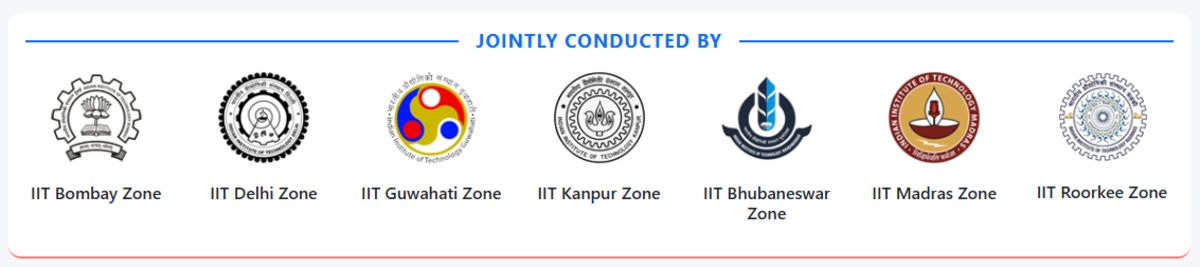
JEE Advanced, Joint Entrance Examination Advanced, is one of India's most competitive engineering entrance exams for admission to undergraduate programmes at the IITs. JEE Advanced is administered on a rotational basis by one of the seven zonal IITs under the Joint Admission Board (JAB).
- Only candidates who clear the JEE Main exam are eligible to apply for the JEE Advanced exam. This is not a standalone exam open to direct applicants.
- The JEE Advanced entrance exam consists of 2 compulsory papers, Paper 1 and Paper 2, taken on the same day. Skipping either of the exams leads to automatic disqualification.
- The exam covers Physics, Chemistry, and Mathematics in both papers, with a computer-based (CBT) format used throughout.
Source: JEE Advanced Official Website 2026
| Particular | Details |
|---|---|
| Conducting Body | One of the seven zonal IITs on a rotational basis under the Joint Admission Board (JAB) |
| Exam Name | Joint Entrance Examination Advanced (JEE Advanced) |
| Courses Covered | B.Tech, B.Arch, Integrated M.Tech, Integrated M.Sc, Dual Degree (B.Tech-M.Tech) |
| Exam Level | National-level undergraduate engineering entrance exam |
| Exam Mode | Computer-Based Test (CBT) |
| Total Questions | Varies yearly Usually around 51–54 total questions across both papers (roughly 17–18 per subject per paper) |
| Total Marks | Varies yearlyTypically around 360 marks total (180 per paper) |
| Marking Scheme | Full marks, partial marks, and zero marks are given, depending on question type |
| Negative Marking | Applicable to most sections; Numerical Value Type questions have no negative marking |
| Basic Eligibility | Rank within the top 2,50,000 JEE Main qualifiers; Maximum two attempts in consecutive years |
| Minimum Marks (for Seat) | 75% aggregate in Class 12 boards (65% for SC/ST/PwD), or Top 20 percentile of your board |
| Age Limit | Generally under 25 years; 5-year relaxation for SC/ST/PwD candidates |
| Application Mode | Strictly online |
| JEE Advanced Official Website | jeeadv.ac.in |
Ques. What is the JEE Advanced total marks, and how is it split between papers?
Ans. The total marks of JEE Advanced is typically around 360, with the JEE Advanced paper 1 and paper 2 total marks usually split close to evenly, though the exact distribution can shift year to year.
Also Check:
JEE Advanced 2027: Important Dates (Tentative)
The JEE Advanced follows a tightly packed schedule each year, generally compressed into just over a month from JEE Main results to the exam itself.
- JEE Advanced registration usually closes within about a week of opening, so candidates should apply early.
- There is generally no correction window, so all details should be entered carefully during registration.
- The admit card and result are released within a short period around the exam, making it important to keep track of the schedule.
- JoSAA counselling starts soon after the result, so candidates should prepare their college and branch preferences in advance.
| Event | Expected Timeline (Tentative) |
|---|---|
| JEE Main 2027 Session 2 Results | Late April 2027 |
| JEE Advanced 2027 Registration Starts | Last week of April 2027 |
| JEE Advanced 2027 Registration Closes | First week of May 2027 |
| Admit Card Download | Mid-May 2027 until the exam day |
| JEE Advanced 2027 Exam (Paper 1) | 9:00 AM – 12:00 PM IST |
| JEE Advanced 2027 Exam (Paper 2) | 2:30 PM – 5:30 PM IST (Same day) |
| Candidate Response Sheets | Late May 2027 |
| Provisional Answer Key | Late May 2027 |
| Objection Window | Late May 2027 |
| Final Answer Key & Results | First week of June 2027 |
| JoSAA Counselling Begins | Mid-June 2027 |
What are the Programs Offered Through JEE Advanced 2027
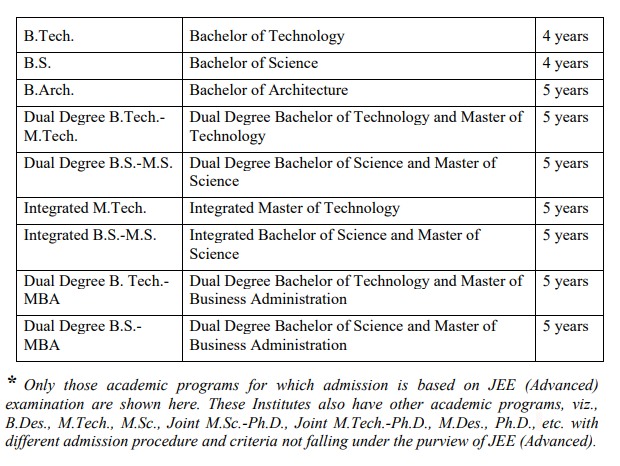
JEE Advanced offers a range of undergraduate, integrated, and dual-degree programmes at IITs, with durations ranging from 4 to 5 years.
- 4-year programmes: B.Tech. and B.S. degrees.
- 5-year programmes: B.Arch. and integrated programmes such as Integrated M.Tech. and Integrated B.S.-M.S.
- Dual-degree options: B.Tech./B.S. can be combined with M.Tech., M.S., or MBA, generally requiring 5 years.
Source: Information Brochure JEE Advanced 2026
Ques. When is the JEE Advanced result date, and where is it declared?
Ans. The JEE Advanced result is expected in the first week of June 2027, declared on the JEE Advanced official website, jeeadv.ac.in.
Also Check:
JEE Advanced 2027 Eligibility Criteria
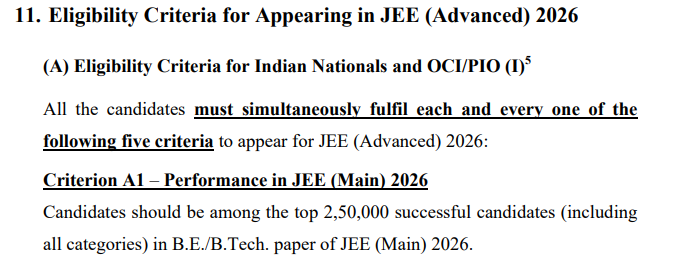
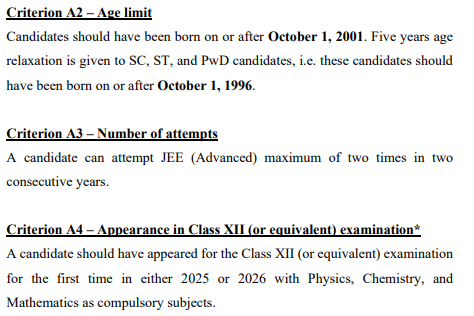
To sit for JEE Advanced, candidates must satisfy five distinct criteria enforced by the Joint Admission Board.
- Candidates must rank among the top 2,50,000 JEE Main qualifiers to be eligible for JEE Advanced. Seats in this quota are divided by category.
- A candidate can appear for JEE Advanced only twice, in two consecutive years from their first Class 12 board appearance.
- Candidates who first appeared for Class 12 boards in 2025 or earlier are not eligible for JEE Advanced 2027.
- Candidates who have already accepted admission to an IIT through JoSAA are generally not eligible to appear again, except in limited cases such as seat cancellation or withdrawal.
Source: Information Brochure JEE Advanced 2026
| Eligibility Criteria | Requirement for JEE Advanced 2027 |
|---|---|
| JEE Main Qualification | Top 2,50,000 candidates in JEE Main 2027 Paper 1 (B.E./B.Tech.) |
| Age Limit | General/OBC-NCL/EWS: born on/after Oct 1, 2002; SC/ST/PwD: born on/after Oct 1, 1997 |
| Number of Attempts | Maximum 2 attempts in two consecutive years |
| Class 12 Passing Year | Must have appeared for boards for the first time in 2026 or 2027 |
| Compulsory Subjects | Physics, Chemistry and Mathematics (PCM) |
| Previous IIT Admission | Must not have been previously admitted via JoSAA, subject to specified exceptions |
| Class 12 Marks for Seat | General/OBC-NCL/EWS: 75% aggregate; SC/ST/PwD: 65% aggregate |
| Alternative to Board Marks | Top 20 percentile of successful candidates in the respective board |
| PwD Reservation | 5% horizontal reservation within each category |
Also Check:
JEE Advanced 2027 Application Fee
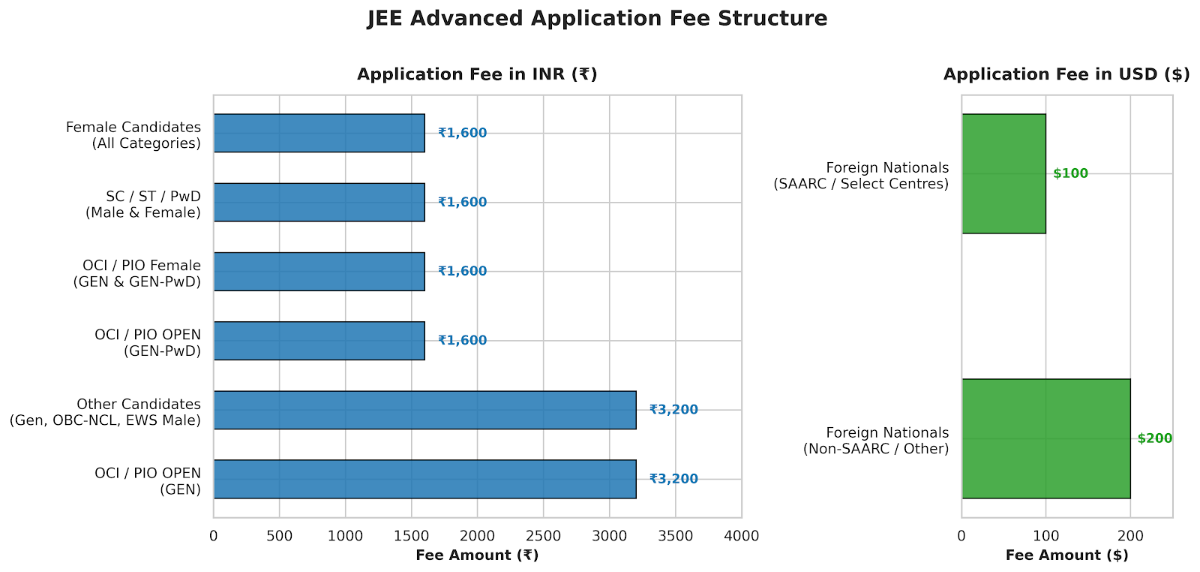
The JEE Advanced registration fee is structured by category, gender, and nationality as follows:
- Female candidates across all categories pay the same reduced fee as SC/ST/PwD candidates of around ₹1,600.
- The fee is strictly non-refundable and non-transferable once paid; there is no late-fee provision, and the payment must clear before the deadline.
- Foreign nationals pay in USD, with a lower rate for SAARC countries than for non-SAARC countries. SAARC countries are:
- Afghanistan
- Bangladesh
- Bhutan
- India
- Maldives
- Nepal
- Pakistan
- Sri Lanka
- Except for foreign nationals, all other students attempt the exam at the centres in India.
| Candidate Category / Exam Centre | Application Fee |
|---|---|
| Female Candidates (All Categories) | ₹1,600 |
| SC / ST / PwD Candidates (Male & Female) | ₹1,600 |
| Other Candidates (General, OBC-NCL, EWS Males) | ₹3,200 |
| OCI / PIO Female Candidates (GEN & GEN-PwD) | ₹1,600 |
| OCI / PIO OPEN (GEN-PwD) | ₹1,600 |
| OCI / PIO OPEN (GEN) | ₹3,200 |
| Foreign Nationals | USD 100 |
| Foreign Nationals | USD 200 |
JEE Advanced Question Paper 2026 with Solution PDF
| Paper Name | Question Paper Link | Solutions Link |
|---|---|---|
| JEE Advanced 2026 Question Paper – Paper 1 | Download PDF | Check Solutions |
| JEE Advanced 2026 Question Paper – Paper 2 | Download PDF | Check Solutions |
JEE Advanced Question Paper 2025 with Solution PDF
| Paper Name | Question Paper Link | Solutions Link |
|---|---|---|
| JEE Advanced 2025 Paper 1 Question Paper (English) | Download PDF | Check Solutions |
| JEE Advanced 2025 Paper 2 Question Paper (English) | Download PDF | Check Solutions |
JEE Advanced 2024 Question Paper with Solution PDF
| Paper Name | Question Paper Link | Solutions Link |
|---|---|---|
| JEE Advanced 2024 Paper 1 Question Paper (English) | Download PDF | Check Solutions |
| JEE Advanced 2024 Paper 2 Question Paper (English) | Download PDF | Check Solutions |
JEE Advanced 2024 Question Paper in Hindi
| JEE Advanced 2024 Paper 1 Question Paper (Hindi) | Download PDF |
| JEE Advanced 2024 Paper 2 Question Paper (Hindi) | Download PDF |
JEE Advanced Application Process
JEE Advanced registration portal automatically syncs data with a candidate's existing JEE Main profile rather than allowing a fresh user account.
- JEE Advanced usually does not provide a correction window, so candidates should check all details carefully before submitting the form.
- Basic details such as name, parents’ names, date of birth, category, and language medium are taken from the JEE Main application. Candidates only need to enter Advanced-specific details such as exam language and exam cities.
- Required documents must be uploaded in the prescribed PDF format and size, along with category certificates wherever applicable.
- The admit card is released only after registration, document upload, and fee payment are completed.
| Step | Process | Key Details |
|---|---|---|
| Step 1 | Registration & Login |
|
| Step 2 | Document Upload |
|
| Step 3 | Fee Payment & Confirmation |
|
Documents Required for JEE Advanced Registration
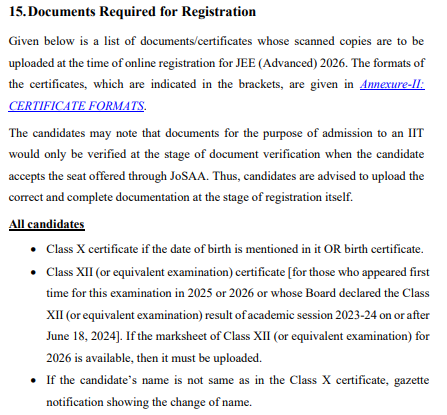
Candidates must upload scanned, clear copies of original documents to complete JEE Advanced registration; all files in PDF format, typically 10 KB to 300 KB.
- A Class 10 certificate is mandatory for every candidate as proof of date of birth, regardless of category.
- The Class 12 marksheet is only needed if boards were completed in a previous year; current-year board candidates skip this upload entirely.
- GEN-EWS and OBC-NCL certificates must carry an issue date on or after April 1, 2027, while SC/ST certificates don't expire and need no reissue.
- A "Declaration in Lieu of Certificate" lets candidates with delayed category certificates register on time and produce the original later during JoSAA counselling.
Source: Information Brochure JEE Advanced 2026
| Document Type | Requirement |
|---|---|
| Class 10 Certificate | Mandatory for all as proof of date of birth |
| Class 12 Marksheet | Required only if boards completed in 2025/2026; Not needed for 2027 board candidates |
| Category Certificate (OBC-NCL/SC/ST/GEN-EWS) | Required if claiming reserved category; OBC-NCL/GEN-EWS must be issued on/after April 1, 2027 |
| Declaration in Lieu of Certificate | Alternative if the valid category certificate is delayed |
| PwD Certificate | Issued by a notified medical authority, Confirming minimum 40% disability |
| Scribe Request Letter | For PwD candidates requiring writing assistance |
| Dyslexic Candidate Certificate (Form-DYSLEXIC) | For candidates seeking compensatory time under this category |
Also Check:
JEE Advanced Exam Pattern 2027
The JEE Advanced pattern changes subtly every year; candidates only discover the exact question count and marking scheme for that cycle once they log into the exam terminal.
- Both papers follow the same syllabus, but the question formats may differ. For example, one paper may have more multi-correct questions, while the other may include more matrix-match or comprehension-based questions.
- Together, Paper 1 and Paper 2 usually have around 51–54 questions, with questions distributed across Physics, Chemistry, and Mathematics.
- The two papers together generally carry around 360 marks, although the exact marks can change each year.
- The marking scheme may include full and partial marks for some questions. Unattempted questions and Numerical Value Type questions generally have no negative marking.
| Particulars | Details |
|---|---|
| Exam Mode | Computer-Based Test (CBT) |
| Papers | 2 compulsory papers (Paper 1 & Paper 2), on the same day |
| Duration | 3 hours per paper 4 hours for PwD candidates |
| Language | English and Hindi, switchable during the exam |
| Subjects | Physics, Chemistry, Mathematics in both papers |
| Total Questions | Around 51–54 across both papers |
| Total Marks | Around 360 marks |
| Single-Correct MCQs | +3 correct, −1 incorrect, 0 unattempted |
| Multi-Correct MCQs | Up to +4 with partial marking; −2 for any incorrect option selected |
| Numerical Value Questions | +3 or +4 for correct answers; no negative marking |
Also Check:
JEE Advanced Physics Syllabus 2027
The JEE Advanced syllabus for Physics spans 7 broad units, from foundational measurement concepts through modern physics.
- Mechanics is the largest part of the syllabus, covering topics from kinematics and laws of motion to rotational dynamics and fluids.
- Electricity and Magnetism is another major unit, covering electrostatics, current electricity, magnetism, and electromagnetic induction.
- Modern Physics covers key topics such as the photoelectric effect, atomic physics, radioactivity, and nuclear physics.
| Physics Unit | Sub-Topics |
|---|---|
| General Physics | Units & Measurements, Experimental Measurements, Mechanics/Thermal/Optics/Sound/Electricity Experiments |
| Mechanics | Kinematics, Circular Motion, Laws of Motion, Friction, Work-Energy-Power, Momentum & Collisions, Centre of Mass, Rigid Body Dynamics, Rotational Motion, SHM, Elasticity, Fluid Mechanics, Gravitation |
| Thermal Physics | Thermal Properties of Matter, Thermal Radiation, Kinetic Theory & Gas Laws, Thermodynamic Processes, Heat Engines |
| Electricity and Magnetism | Electrostatics, Gauss's Law, Capacitance, Current Electricity, Magnetism, Electromagnetic Induction, AC & DC Circuits |
| Electromagnetic Waves | Properties of EM Waves, Electromagnetic Spectrum, Applications |
| Optics | Ray Optics, Prisms, Mirrors & Lenses, Wave Optics, Diffraction, Polarization |
| Modern Physics | Photoelectric Effect, Atomic Physics, X-Rays, Dual Nature of Matter, Radioactivity, Nuclear Physics |
JEE Advanced Chemistry Syllabus 2027
The Chemistry portion of the JEE Advanced syllabus is evenly divided across Physical, Inorganic, Organic, and Practical/Analytical Chemistry.
- Physical Chemistry covers foundational states-of-matter concepts alongside energetics, equilibrium, and kinetics.
- Organic Chemistry spans everything from basic hydrocarbons through complex functional groups and biomolecules.
- Practical & Analytical Chemistry, often under-prepared by candidates, tests qualitative and quantitative lab-style analysis directly.
| Chemistry Unit | Sub-Topics |
|---|---|
| Physical Chemistry | Atomic Structure, Gaseous/Liquid/Solid States, Thermodynamics, Chemical & Ionic Equilibrium, Electrochemistry, Chemical Kinetics, Solutions, Surface Chemistry |
| Inorganic Chemistry | Periodic Table, Chemical Bonding, Metallurgy, s-Block, p-Block, d- & f-Block Elements, Coordination Compounds |
| Organic Chemistry | Basic Principles, Alkanes/Alkenes/Alkynes, Aromatic Hydrocarbons, Alkyl & Aryl Halides, Alcohols/Phenols/Ethers, Aldehydes & Ketones, Carboxylic Acids, Nitrogen Compounds, Biomolecules & Polymers |
| Practical & Analytical Chemistry | Qualitative Analysis (Cations, Anions), Volumetric Titration, Detection of Elements in Organic Compounds |
Also Check: JEE Advanced Chemistry Preparation: Study Material, Tips and Best Books
JEE Advanced Mathematics Syllabus 2027
The Mathematics syllabus for JEE Advanced rewards structural, multi-method problem-solving over straightforward formula application.
- Analytical Geometry (both 2D and 3D) and Differential/Integral Calculus together form the heaviest, most consistently tested portion of the syllabus.
- Vector Algebra and advanced Matrix operations (symmetric, skew-symmetric, orthogonal matrices) test conceptual depth beyond standard board-level coverage.
- Probability & Statistics rounds out the syllabus with a mix of classical probability and descriptive statistics.
| Mathematics Unit | Sub-Topics |
|---|---|
| Algebra | Complex Numbers, Quadratic Equations, AP/GP/HP, Logarithms, Permutations & Combinations, Binomial Theorem, Matrices & Determinants |
| Matrices (Advanced) | Systems of Linear Equations, Symmetric/Skew-Symmetric/Orthogonal/Idempotent/Nilpotent Matrices |
| Probability & Statistics | Probability, Conditional Probability, Bayes' Theorem, Discrete Random Variables, Binomial Distribution, Measures of Central Tendency & Dispersion |
| Trigonometry | Trigonometric Functions & Graphs, Periodicity, Addition/Subtraction Formulae, Trigonometric Equations, Inverse Trig Functions |
| Analytical Geometry (2D & 3D) | Cartesian Coordinates, Straight Lines, Circles, Conic Sections; 3D Direction Cosines, Planes, Distances |
| Vector Algebra | Vector Addition, Dot/Cross/Scalar Triple/Vector Triple Product, Linear Independence & Dependence |
| Differential Calculus | Functions, Limits, Continuity, Differentiability, Derivatives, Rolle's & Lagrange's Theorems, Maxima & Minima |
| Integral Calculus | Indefinite & Definite Integrals, Substitution, Integration by Parts, Partial Fractions, Differential Equations |
Check Out:
| Subject | JEE Advanced 2027 Syllabus PDF |
|---|---|
| Physics | JEE Advanced Physics Syllabus PDF |
| Chemistry | JEE Advanced Chemistry Syllabus PDF |
| Mathematics | JEE Advanced Mathematics Syllabus PDF |
JEE Advanced Preparation Tips 2027
A phase-wise approach works best for JEE Advanced preparation, since the syllabus is deep and the exam rewards conceptual clarity over memorised shortcuts.
- Before October: Focus on building strong concepts and understanding formulas instead of only memorising them.
- November to January: Give extra practice to important topics such as Calculus, Vectors & 3D, Mechanics, and Coordination Compounds.
- From February: Start taking full-length mock tests during the actual exam hours to improve speed, focus, and stamina.
- Throughout preparation: Practise JEE Advanced PYQs regularly to become familiar with its different and challenging question formats.
| Phase | Timeline | Focus |
|---|---|---|
| Phase 1: Conceptual Mastery | Up to October 2026 | Build core clarity; Derive formulas rather than memorise; Interlink topics across subjects |
| Phase 2: Full Syllabus & Heavy Practice | November 2026 – January 2027 | Target high-yield chapters; Maintain an error log book tracking mistakes and fixes |
| Phase 3: Testing & Refinement | February 2027 – Exam Day | Full-length mock tests during actual exam hours (9 AM–12 PM, 2:30 PM–5:30 PM) |
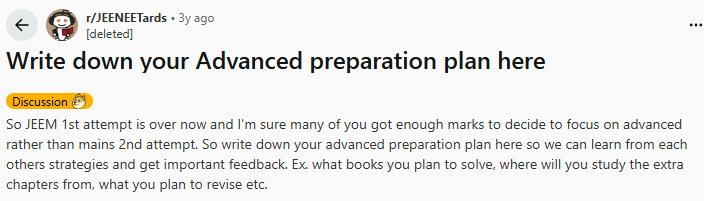
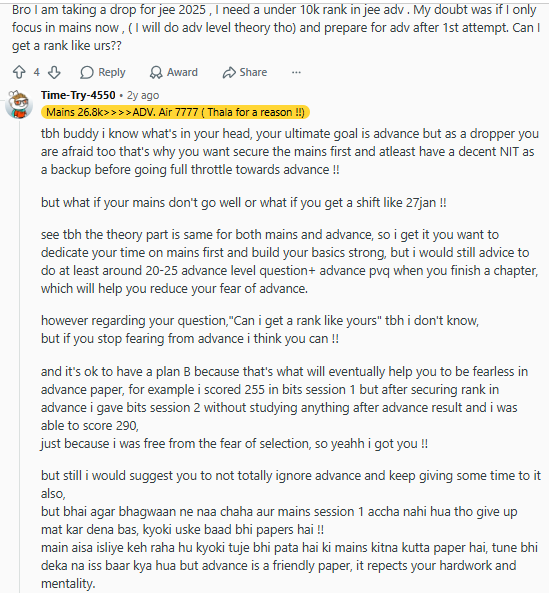
As per Reddit discussions, below are some prep tips to employ in your preparation:
- Integrate 20–25 Advanced-level questions and previous year questions (PYQs) as soon as you finish a chapter rather than postponing Advanced practice entirely until after JEE Main 1.
- Build a solid backup plan (like securing a good JEE Main score or BITSAT rank) to remove the fear of selection, allowing you to approach JEE Advanced with a fearless and calm mindset.
Source: Reddit
Also Check:
- JEE Advanced Preparation: Section-wise Tips and Best Books
- Best Books for JEE Advanced 2024: Mathematics, Physics, and Chemistry, Topic-wise Weightage and Tips
The video discusses effective preparation for JEE Advanced by AIR 1 Shubham Kumar. The topper gives strategies to attempt the exam and suggests resources.
JEE Advanced Admit Card 2027
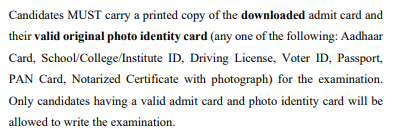
The JEE Advanced admit card is issued only to candidates who clear the JEE Main cutoff and complete registration for the Advanced exam. The admit card is the mandatory entry pass for both papers.
- The admit card is released roughly 6–7 days before the exam, in the second week of May 2027.
- Candidates can download it any time until the start of Paper 2 on exam day itself.
Source: Information Brochure JEE Advanced 2026
| Detail | Information |
|---|---|
| Release Window | Second week of May 2027 (roughly 6–7 days before the exam) |
| Last Date to Download | Until the start of Paper 2 on exam day |
| Fields to Verify | Name, photograph, signature, date of birth, category, roll number, exam centre address |
Also Check:
JEE Advanced 2027: Result and Scorecard
The JEE Advanced result and official scorecard will be declared in the first week of June 2027, published on jeeadv.ac.in by the organising institute for that cycle.
- To check the JEE Advanced result, candidates need their roll number, date of birth, and registered mobile number.
- The result scorecard includes All India Rank (AIR), category rank, subject-wise marks, total marks, and qualifying status.
- To qualify for the Common Rank List, candidates must meet both the minimum marks in each subject and the minimum aggregate marks.
- In JEE Advanced 2026, the topper scored 330 marks, while the qualifying cutoff was 92 marks. The 2027 cutoff may be different.
| Result Milestone | Detail |
|---|---|
| Result Declaration | First week of June 2027 (tentatively around June 7, 2027) |
| Where to Check | Official JEE Advanced website — jeeadv.ac.in |
| Login Requirement | Roll Number, Date of Birth, Registered Mobile Number |
| Scorecard Contents | All India Rank, Category Rank, Subject-wise Marks, Aggregate Marks, Qualifying Status |
| Qualifying Requirement | Subject-wise minimum AND aggregate minimum, both required |
Also Check:
JEE Advanced 2027: Marks vs Rank
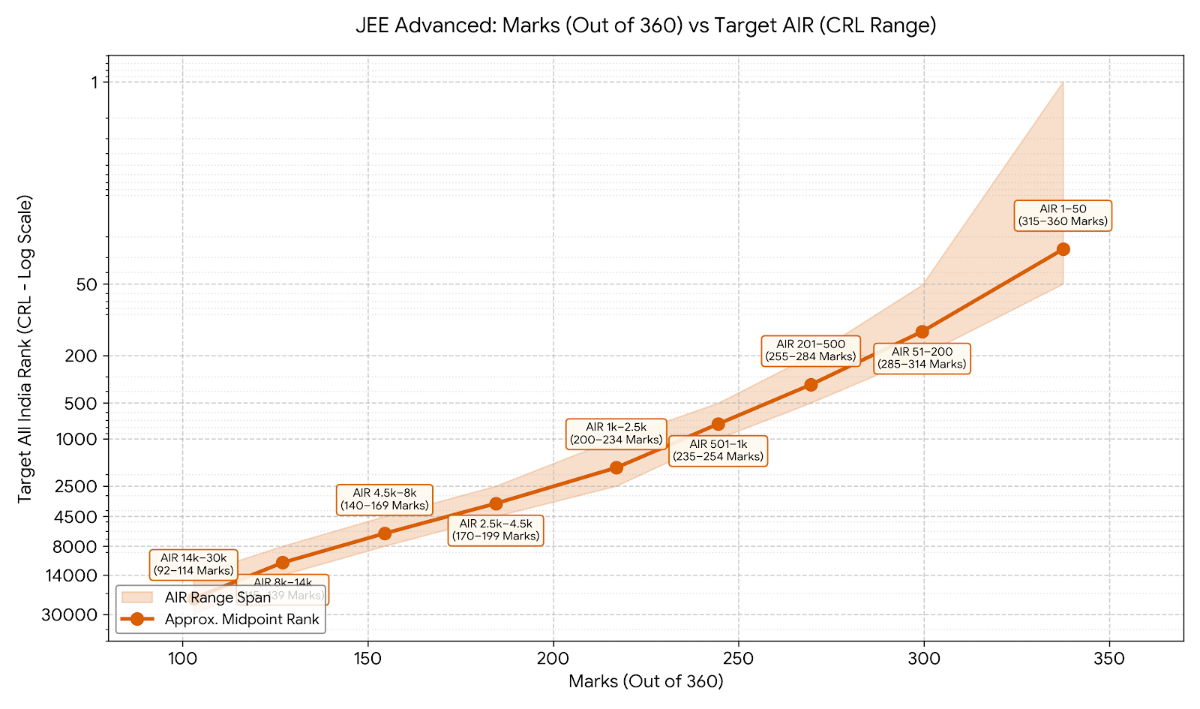
Unlike JEE Main, JEE Advanced marks vs rank doesn't involve any normalisation or percentile adjustment, since every candidate attempts the same question papers on the same day.
- The 130–220 marks range is usually highly competitive, so even a small difference of 1–2 marks can significantly affect the rank.
- Candidates must clear the minimum subject-wise marks in Physics, Chemistry, and Mathematics along with the required aggregate marks to qualify.
- A score of around 315–360 marks can place candidates among the top ranks, giving them a wider choice of institutes and branches.
- A score of around 150 marks can be enough to qualify, but the actual rank and admission chances depend on the category, cutoff, and year-wise competition.
| Marks (Out of 360) | Target AIR (CRL Range) | Target IIT Seat Prospect |
|---|---|---|
| 315–360 | AIR 1–50 | Any branch at any Top-Tier IIT |
| 285–314 | AIR 51–200 | IIT Bombay / IIT Delhi CSE |
| 255–284 | AIR 201–500 | CSE at older IITs (Madras, Kanpur, Kharagpur) |
| 235–254 | AIR 501–1,000 | Core branches (Electrical, Mechanical) at Top 5 IITs |
| 200–234 | AIR 1,001–2,500 | CSE at newer IITs (Hyderabad, Indore, Ropar) |
| 170–199 | AIR 2,501–4,500 | Competitive branches at mid-tier IITs |
| 140–169 | AIR 4,501–8,000 | Good branches at newer IITs, or civil/chemical at older ones |
| 115–139 | AIR 8,001–14,000 | Seat qualification limit for general branches at newer IITs |
| 92–114 | AIR 14,001–30,000 | Included in rank list, meeting generic eligibility only |
Ques. How does JEE Advanced marks vs rank work category-wise?
Ans. Category-wise rank lists are prepared separately from the overall Common Rank List — a candidate's category rank considers only candidates within their own category (OBC-NCL, SC, ST, GEN-EWS, PwD), even though the underlying marks vs rank JEE Advanced trend is calculated on the same raw score.
Also Check: JEE Advanced Marks vs Rank 2026: Result Out, Category Wise Score to Rank and JoSAA Allotment
JEE Advanced 2027: Counselling and Admission
Seat allocation to all 23 IITs after JEE Advanced happens through a centralised, web-based portal run by the Joint Seat Allocation Authority (JoSAA).
- Candidates can use their JEE Main login details to access JoSAA counselling; a separate account is not required.
- Mock allotment rounds help candidates see their possible seat allocation before finalising their choices.
- After seat allotment, candidates can choose Freeze, Slide, or Float depending on whether they want to keep the seat or seek an upgrade.
- To confirm the allotted seat, candidates must pay the Seat Acceptance Fee and upload the required documents for verification.
| Step | What Happens |
|---|---|
| Step 1: Registration & Choice Filling | Log in to JoSAA with JEE Main credentials; fill unlimited choices across IITs, NITs, IIITs, GFTIs |
| Step 2: Mock Seat Allotment | Preview likely seat based on current preferences; modify list before final lock |
| Step 3: Choice Locking | Manually lock choices, or the system auto-locks the last saved preference list |
| Step 4: Seat Allotment Rounds | Typically 5 rounds, based on AIR, category, and preference order |
| Step 5: Acceptance | Choose Freeze, Slide, or Float after each allotment |
| Step 6: Fee Payment & Verification | Pay Seat Acceptance Fee; upload Class 10/12, category, and medical certificates |
Also Check:
Which IIT Will Conduct JEE Advanced 2027? — Zonal Structure
JEE Advanced rotates among the seven zonal IITs under JAB, and each zone groups several newer IITs under one senior coordinating institute.
- Candidates choose their exam cities from the zone assigned to them, rather than from a single nationwide list.
- The zonal system also determines which IIT is responsible for conducting the exam cycle and handling related processes.
- Knowing your assigned zone can help candidates understand exam-city allotment and zone-specific updates during registration.
| Zone | IITs Covered |
|---|---|
| IIT Bombay Zone | IIT Bombay, IIT Gandhinagar, IIT Indore, IIT Goa, IIT Dharwad |
| IIT Delhi Zone | IIT Delhi, IIT Jammu, IIT Jodhpur |
| IIT Madras Zone | IIT Madras, IIT Hyderabad, IIT Tirupati, IIT Palakkad, IIT (BHU) Varanasi |
| IIT Kharagpur Zone | IIT Kharagpur, IIT Bhubaneswar, IIT ISM Dhanbad |
| IIT Kanpur Zone | IIT Kanpur |
| IIT Roorkee Zone | IIT Roorkee, IIT Mandi, IIT Ropar |
| IIT Guwahati Zone | IIT Guwahati, IIT Patna, IIT Bhilai |
JEE Advanced 2027 FAQs
Ques. How many questions are there in JEE Advanced?
Ans. The total number of questions in JEE Advanced typically ranges from 51 to 54 across both papers combined, though the exact count can vary slightly each year.
Ques. What is the JEE Advanced registration fee / JEE Advanced form fees?
Ans. Fees range from ₹1,600 (female candidates and SC/ST/PwD) to ₹3,200 (General/OBC-NCL/EWS male candidates) for Indian centres, with separate USD fees for foreign nationals.
Ques. Is JEE Advanced conducted by NTA?
Ans. No, NTA conducting JEE Advanced is a common misconception. NTA conducts JEE Main, while JEE Advanced is conducted by one of the seven zonal IITs on a rotational basis under the Joint Admission Board.
Ques. Which IIT will conduct JEE Advanced in 2027?
Ans. JEE Advanced rotates among the seven zonal IITs each year; for the 2027 cycle, IIT Delhi is coordinating the exam and result publication process.
Ques. Is there an official JEE Advanced rank predictor or JEE Advanced score calculator?
Ans. IITs do not release an official JEE Advanced rank predictor.



Comments
Found 21 Comments
If your son scores around 195–210 in JEE Advanced, he may secure an AIR between 500–1500, depending on paper difficulty and category. In General category, Computer Science chances are possible in IIT BHU, IIT Guwahati, or newer IITs, while top CSE branches at IIT Bombay or IIT Delhi remain difficult.
With a JEE Advanced rank of around 8000 or above, getting admission to Indian Institute of Technology Bhubaneswar in Computer Science and Engineering is very difficult under the General category, as CSE closes at a much lower rank. However, chances may improve through category reservations, female quota, or special admission rounds depending on yearly cutoff trends.
If you are passing class 12 in 2025, you will be eligible for JEE Advanced 2027. JEE Advanced eligibility requires that candidates appear for JEE Main in the same year or previous year and meet age and attempt limits. Your class 12 year 2025 makes you eligible for the 2027 exam cycle.
JEE Advanced consists of two papers, Paper 1 and Paper 2, each three hours long. Both papers include Physics, Chemistry, and Mathematics with multiple-choice, numerical, and matching-type questions. The exam uses a computer-based format, features negative marking, and tests both conceptual understanding and problem-solving skills for IIT admissions.
The hall ticket for JEE Advanced 2025 was released in May 2025 on the official website of the Indian Institute of Technology. Registered candidates can download it using their login credentials. It is mandatory to carry the admit card with a valid ID proof to the exam center.
For PG courses, students must have a minimum aggregate score of 50% in relevant subjects, or 75% for BTech courses, in order to be eligible for admission to NIT Hamirpur through JEE Advanced. The ultimate decision is made after a counselling process and is dependent on the results of qualifying national-level exams. For JEE Advanced, 200 is the cutoff.
A 96.8 percentile in JEE Mains can qualify you for lower branches at NITs like Raipur, Jalandhar, Hamirpur, Patna, Durgapur, Nagpur, Surat, and Bhopal. You can also get CSE or IT in some lower IIITs
Here are some tips to crack JEE Mains exam:
Building a Strong Foundation
Making a Rigorous and Proper Study Plan
Clear your Doubts
Focus on Your Weaknesses
Solve Previous Year Papers
Practice, Practice, Practice
Stay Motivated
JEE Advanced 2024 exam date is out. IIT Madras is going to conduct JEE Advanced 2024 on May 26, 2024. JEE Advanced 2024 registration will begin on April 21, 2024.
It actually doesn’t make any big difference if you have taken a drop year. If you fall eligible into all the criterias you can appear for JEE Advance 2024. You may check here to know more. JEE Advance 2024
The online application form for NIFT 2023 opened on the 1st of November, 2023, and the deadline for submission is on the 31st of December, 2023. Check here to know more. NIFT
Students who have passed their Class 12 examination or other equivalent qualifying examination in 2022 or 2023 are eligible to appear in the JEE Main 2024. Students currently appearing for their Class 12 examination or other equivalent qualifying examination in 2024 are also eligible. JEE Main 2025 schedule is not out yet.
Yes you can appear for JEE Mains. Students who have passed their Class 12 examination or other equivalent qualifying examination in 2022 or 2023 are eligible to appear in the JEE Main 2024.
Yes, you have to pay for the JEE Advanced examination during the registration process. To read more visit JEE Advanced Registration
There are some important books and preperation methods while preparing for JEE Advanced 2023. To know more visit JEE Advanced Preperation Tips
You can check out JEE Advanced Previous Year Question Paper 2022 as a part of your preparation
To be eligible for JEE Advanced, you must register and take JEE Main first. Students who are in the top 2,50,000 list of JEE Main exam are eligible to register and take JEE Advanced.
There are three sections in JEE Advanced paper: Physics, Chemistry and Mathematics. You can check the syllabus, important topics, mark weightage, etc. for the respective subjects from JEE Advanced Syllabus.
There is no separate JEE Advanced cut-off for international students. Seats allotted to foreign nationals are supernumerary with a cap of 10% of the total number of seats available in every course.
Once the JEE Advanced Form Correction Window has been closed there will no other options for you to make changes in your application form. Test takers are advised to carefully check their application forms before submitting them.