




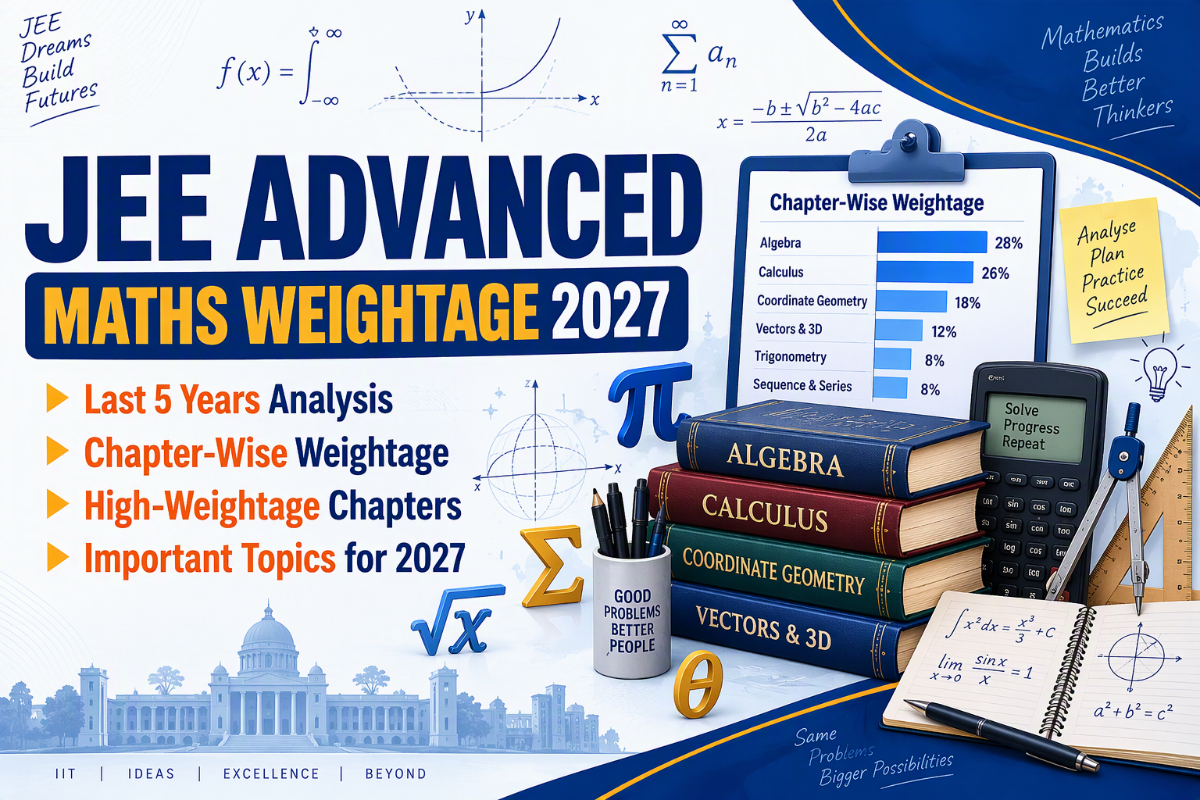
The JEE Advanced maths chapter-wise weightage in the 2026 paper put Integral Calculus first at 19%. Probability followed at 14%, Coordinate Geometry at 12%, and Vectors & 3D Geometry at 11%. These four chapters together carry over 55% of the marks.
- Class 12 Mathematics contributes approximately 68% of the marks, making it more significant than Class 11 topics in the overall paper distribution.
- Calculus (Differential + Integral) carried 27% of the 2026 paper.
- Standalone questions are rare. Most problems merge two or more chapters.
- Probability has one of the widest year-to-year variations, with its weightage declining from 18% in 2022 to 10% in 2024 before recovering to 14% in 2026.
- JEE Advanced Mathematics questions often combine two or more mathematical concepts, requiring candidates to connect formulas, identify relationships, and apply multiple steps.
- JEE Advanced gives Mathematics more time per question than JEE Main. Candidates get approximately 3.5 minutes per question compared with around 2 minutes in JEE Main.
Related Links:
- JEE Advanced Syllabus 2027: Subject-Wise Topics, Chapter-Wise Weightage and PDF Download
- Download JEE Advanced 2026 Question Paper with Solutions: Access JEE Advanced Previous Year Papers (2007-2025) in PDF Format
- JEE Advanced 2027 Preparation Tips: Timetable, Section-Wise Tips & Best Books
Key Summary
- Integral Calculus is the highest-weightage chapter, between 15% and 22% in every year from 2022 to 2026.
- Probability moved between 10% and 18%, the widest swing of any chapter.
- Vectors & 3D Geometry and Matrices & Determinants are the fastest-scoring chapters.
- Matrices rose from 7% in 2022 to 11% in 2026. Sequences & Binomial fell from 7% in 2024 to 3% in 2026.
JEE Advanced Maths Chapter-Wise Weightage: 2026 Exam Analysis
The JEE Advanced Mathematics section is the most conceptual part of the paper. Problems are interconnected, and each one tests more than one idea.
- Calculus accounted for 27% of the math section: Integral Calculus 19% plus Differential Calculus 8%.
- Definite Integration is the highest-yield standalone chapter. It is often combined with limits or functional equations.
- Vectors & 3D Geometry and Matrices & Determinants gave multi-correct and numerical-type questions with direct workflows. These chapters secure baseline cutoff marks.
- The toughest problems merged chapters. Permutations & Combinations were linked with Probability. Coordinate Geometry was linked with Application of Derivatives.
- Class 12 topics account for roughly 68% of the marks in the Mathematics section.
| Unit / Chapter Cluster | Approximate Weightage (%) | Key Areas Featured in the Exam |
|---|---|---|
| Integral Calculus | 19% | Definite Integrals (High-yield properties), Differential Equations |
| Probability | 14% | Conditional Probability, Bayes' Theorem, Permutations and Combinations blend |
| Coordinate Geometry | 12% | Circles, Parabola, Ellipse, Hyperbola (Conic Sections blend) |
| Vectors & 3D Geometry | 11% | Vector Algebra, 3-D lines, Plane intersections |
| Matrices & Determinants | 8% | Properties of Matrices, Systems of Linear Equations |
| Differential Calculus | 8% | Limits, Continuity & Differentiability, Application of Derivatives (AOD) |
| Trigonometry | 7% | Inverse Trigonometric Functions (ITF) |
| Algebra (Sequences, Binomial) | 6% | Series summation, Binomial Coefficients |
| Permutations & Combinations | 6% | Combinatorial probability, Grid & selection problems |
| Complex Numbers | 5% | Geometry of complex variables, De Moivre's applications |
Ques. Which chapter has the highest weightage in JEE Advanced Maths 2026?
Ans. Integral Calculus, at 19%.
Ques. How much of JEE Advanced Maths comes from Class 12?
Ans. Roughly 68% of the marks.
Check Out:
JEE Advanced Maths Chapter-Wise Weightage for the Last 5 Years
The year-wise data shows which chapters stay stable and which swing. It covers 2022 to 2026.
- Integral Calculus never fell below 15% in any of the five years.
- Probability & Stats stayed between 10% and 18%. It peaked at 18% in 2022 through paragraph-based problem sets that needed accurate permutation tracking.
- Integral Calculus rose to 22% in 2024, over one-fifth of the paper. The paper focused on bounding approximations using the Leibnitz rule.
- Vectors & 3D Geometry reached 15% in 2025. It stayed between 11% and 12% in the other four years.
- Coordinate Geometry stayed between 10% and 13%. The distribution across Conic Sections was stable.
- Matrices & Determinants moved from 7% in 2022 to 11% in 2026. The 2026 paper skipped Cramer's Rule systems. It tested matrix trace properties and characteristic functions.
- Algebra (Sequences/Binomial) fell from 7% in 2024 to 3% in 2026. It mostly appears as a sub-concept inside other chapters.
| Topic / Chapter Cluster | 2022 Weightage | 2023 Weightage | 2024 Weightage | 2025 Weightage | 2026 Weightage |
|---|---|---|---|---|---|
| Integral Calculus | 16% | 15% | 22% | 18% | 19% |
| Probability & Stats | 18% | 16% | 10% | 11% | 14% |
| Vectors & 3D Geometry | 11% | 12% | 11% | 15% | 11% |
| Coordinate Geometry | 12% | 13% | 12% | 10% | 12% |
| Matrices & Determinants | 7% | 8% | 9% | 8% | 11% |
| Differential Calculus | 9% | 12% | 8% | 9% | 8% |
| Complex Numbers | 8% | 6% | 7% | 11% | 9% |
| Permutations & Combinations | 9% | 7% | 5% | 6% | 6% |
| Trigonometry & ITF | 5% | 6% | 7% | 6% | 7% |
| Algebra (Sequences/Binomial) | 5% | 5% | 7% | 6% | 3% |
Ques. Which chapter had the biggest jump in weightage between 2022 and 2026?
Ans. Matrices & Determinants, from 7% to 11%.
Ques. Which chapter was highest in 2022 and 2023?
Ans. Probability & Stats, at 18% and 16%.
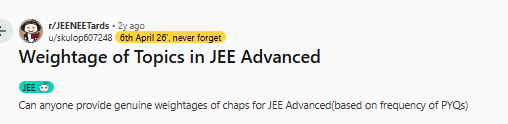
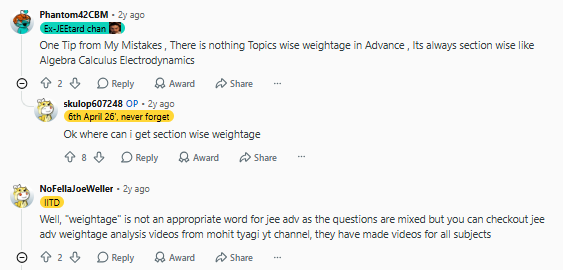
Based on the Reddit discussions, the students are discussing how to understand chapter-wise vs. section-wise weightage for JEE Advanced:
- A user advises based on their past experience that JEE Advanced does not follow individual topic-wise weightage, but rather broader section-wise trends like Algebra, Calculus, and Electrodynamics.
- Another user points out that "weightage" isn't strictly fixed in JEE Advanced due to multi-concept/mixed questions
Source: Reddit
JEE Advanced Year-wise Question Paper Download
This video by the channel “Vora Classes” breaks down key JEE Advanced statistics, including safe scoring percentages, to help candidates set realistic target marks. It provides a detailed, unit- and chapter-wise weightage analysis of Mathematics, while unpacking the paper patterns and smart strategies needed to navigate the exam's unpredictability effectively.
JEE Advanced Calculus Weightage by Year
Calculus is the combined weightage of Integral and Differential Calculus.
- Calculus ranged from 25% to 30% across the five years.
- The peak was 30% in 2024, driven by Integral Calculus at 22%.
- Calculus was 27% in 2023, 2025, and 2026.
- 2022 had the lowest figure, at 25%.
| Year | Integral Calculus | Differential Calculus | Combined Calculus |
|---|---|---|---|
| 2022 | 16% | 9% | 25% |
| 2023 | 15% | 12% | 27% |
| 2024 | 22% | 8% | 30% |
| 2025 | 18% | 9% | 27% |
| 2026 | 19% | 8% | 27% |
Ques. What is the JEE Advanced calculus weightage?
Ans. Between 25% and 30% in each of the last five years, and 27% in 2026.
Pattern Shifts in JEE Advanced Maths Exam Over the Years
Three chapters broke their usual pattern in recent papers. Each exception changed what students needed to practise.
- Probability & P&C are normally moderate-scoring. In 2022 and 2023, they produced 5 multi-select or paragraph questions each year. Students had to write out combinations with zero margin for double-counting errors.
- Definite Integration is normally tested with reduction formulas and integral properties. In 2021, it expanded into 5 distinct problems. Students had to treat the integral as a summation or use squeeze and sandwich methods to approximate numerical bounds.
- Matrices & Determinants normally relied on Cramer's Rule. In 2026 the paper tested the structure of matrices. Students had to identify symmetric, skew-symmetric, and orthogonal transformation combinations.
| Chapter | The Norm | The Exception | Year |
|---|---|---|---|
| Probability & P&C | Moderate-scoring unit testing standard permutations or basic conditional setups | 5 multi-select or paragraph questions that forced manual writing of combinations with zero margin for double-counting errors | 2022, 2023 |
| Definite Integration | Standard reduction formulas or definite integral properties, such as ∫ₐᵇ f(x)dx = ∫ₐᵇ f(a+b−x)dx | 5 distinct problems that treated the integral as a summation or used squeezing/sandwich methods to approximate numerical bounds | 2021 |
| Matrices & Determinants | Cramer's Rule for systems of linear equations | Inner algebraic properties of matrices, with strict identification of symmetric, skew-symmetric, and orthogonal transformation combinations | 2026 |
Ques. Did JEE Advanced 2026 test Cramer's Rule in Matrices?
Ans. The 2026 paper bypassed simple systems of equations. It tested matrix properties such as trace and characteristic functions.
Also Check:
JEE Advanced Maths High Weightage Chapters
High weightage chapters for JEE Advanced are Integral Calculus, Probability, Coordinate Geometry, and Vectors & 3D Geometry. They consistently account for over 55% of the total marks across both papers. The table groups chapters by their combined weightage.
- Integral Calculus, Probability, and Coordinate Geometry together carry about 45%.
- Vectors & 3D Geometry and Matrices & Determinants together carry about 20%.
- Complex Numbers and Application of Derivatives together carry about 15%.
- Prioritizing these chapters gives the highest scoring potential relative to preparation time.
| Chapter / Topic | Group (Combined Weightage) | Key High-Yield Focus Areas |
|---|---|---|
| Integral Calculus | ~45% | Definite Integration (King's property & estimation), Leibnitz Rule, Area under curves, 1st-order Differential Equations |
| Probability | ~45% | Bayes' Theorem, Total probability, Conditional probability, Binomial/multinomial distributions, Multi-concept loops with P&C |
| Coordinate Geometry | ~45% | Circles (Tangents, normals, radical axis), Standard Conic sections (Parabola, Ellipse, Hyperbola), Common tangents, Geometric locus problems |
| Vectors & 3D Geometry | ~20% | Vector & Scalar Triple Products (VTP/STP), Shortest distance between skew lines, Line-plane intersections, Coplanarity |
| Matrices & Determinants | ~20% | Properties of Adjoint & Inverse, Cramer's Rule for linear equations, Symmetric/skew-symmetric proofs, Characteristic equations & trace |
| Complex Numbers | ~15% | Geometric interpretation on Argand plane, De Moivre's Theorem, Cube roots of unity & polygon geometry |
| Application of Derivatives (AOD) | ~15% | Monotonicity, Maxima-Minima optimization, Mean Value Theorems (Rolle's & LMVT), Tangents and Normals |
Ques. What are the high-weightage chapters for JEE Advanced Maths?
Ans. Integral Calculus, Probability, Coordinate Geometry, and Vectors & 3D Geometry, together over 55% of the marks.
Also Check:
Easiest Scoring Chapters in JEE Advanced Maths
Four chapters give the most marks for the least preparation time. Their problem types repeat and follow fixed workflows.
- Vectors & 3D Geometry carries about 11% to 15%. Questions are visual and algebraic.
- Matrices & Determinants carries about 8% to 11%. It follows rigid matrix algebra rules.
- Sequences & Series carries about 5% to 7%. Most advanced problems reduce to telescoping cancellations.
- Tangents & Normals carries about 3% to 4%. It uses coordinate geometry rules with standard differentiation.
- These four blocks together carry about 27% to 37% of the marks.
| Chapter | Weightage | Key High-Yield Areas |
|---|---|---|
| Vectors & 3D Geometry | ~11% – 15% |
|
| Matrices & Determinants | ~8% – 11% |
|
| Sequences & Series | ~5% – 7% |
|
| Application of Derivatives: Tangents & Normals | ~3% – 4% |
|
Ques. What are the easiest scoring chapters in JEE Advanced Maths?
Ans. Vectors & 3D Geometry, Matrices & Determinants, Sequences & Series, and the Tangents & Normals part of Application of Derivatives.
JEE Main vs JEE Advanced Maths Weightage
JEE Main uses a fixed 30-question blueprint per shift, so its distribution stays steady.
- JEE Main questions are almost always single-concept, such as a standalone question on an Ellipse. JEE Advanced problems are multi-concept, such as finding the limit of a sequence using definite integration properties.
- JEE Main includes a guaranteed question on basic Statistics, covering Variance and Standard Deviation. JEE Advanced skips standard statistical deviations and focuses on advanced Probability distributions.
- JEE Main gives roughly 2 minutes per question and tests formula recall speed. JEE Advanced gives about 3.5 minutes per question and tests structural problem-solving and partial-marking logic.
| Mathematics Unit / Cluster | JEE Main Average Weightage | JEE Advanced Average Weightage | Core Difference in Question Style |
|---|---|---|---|
| Calculus (Differential & Integral) | 28% | 32% |
|
| Coordinate Geometry (Conics) | 16% | 12% |
|
| Vectors & 3D Geometry | 14% | 12% |
|
| Matrices & Determinants | 8% | 10% |
|
| Probability & Statistics | 8% | 14% |
|
| Algebra (Sequences, Binomial, Quadratics) | 16% | 10% |
|
| Trigonometry | 6% | 5% |
|
| Main-Exclusive Topics (Reasoning, Sets) | 4% | 0% |
|
Ques. Is Statistics part of JEE Advanced Maths?
Ans. Standard Variance and Standard Deviation calculations are skipped. The focus is on advanced Probability distributions.
Check Out:
JEE Advanced Maths Exam Pattern 2027
JEE Advanced 2027 is expected to run as a Computer-Based Test (CBT) with two compulsory 3-hour papers.
- Single Correct Option MCQs typically give +3 for a correct answer and -1 for an incorrect one.
- Multiple Correct Options (MSQs) give +4 when all correct options are marked. Partial marks of +1 or +2 apply when only some correct options are marked with no wrong option. One incorrect option gives -2.
- Numerical Value / Non-Negative Integer questions typically give +3 or +4 with zero negative marking. Always attempt them.
| Exam Parameter | Expected 2027 Configuration |
|---|---|
| Testing Mode | Online Computer-Based Test (CBT) |
| Exam Language | English & Hindi (Switchable dynamically) |
| Total Papers | Two compulsory papers (Paper 1 & Paper 2) |
| Duration | 3 Hours per paper (4 hours for PwD candidates) |
| Subject Split | Both papers contain Physics, Chemistry, and Mathematics |
| Total Target Marks | Around 360 marks (~180 marks per paper) |
| Total Questions | Approximately 102 questions (~51 to 54 per paper) |
Ques. Is there negative marking in the JEE Advanced Maths numerical questions?
Ans. No. Numerical Value questions typically carry zero negative marking.
Ques. What is the penalty for a wrong option in a JEE Advanced MSQ?
Ans. -2 marks.
How to Prepare for JEE Advanced Maths Based on Chapter-Wise Weightage
Use the below tips to effectively prepare for the JEE Advanced Mathematics exam using chapter-wise weightage:
- Target the intersections. Practise questions that merge concepts, such as a calculus limit applied to a parabola's tangent or a coordinate geometry property evaluated through complex numbers.
- Drill multiple-correct questions. Check every option. Do not stop after finding one true option.
- Use authentic previous year papers. Use structured archives such as the Oswaal 49 Years' Solved Papers Series or the Arihant JEE Advanced Archive. Avoid tracking unverified test series patterns.
- Study by cluster. The table below lists the actionable strategy for each block.
| Focus Area | Preparation Strategy | Key Sub-Topics & High-Yield Skills |
|---|---|---|
| Calculus (Integral & Differential) |
| Properties of integration, Leibnitz Rule, limits/continuity/differentiability, AOD graph sketching |
| Coordinate Geometry (Conic Sections) |
| Circles & parabolas, tangents, normals, chords, origin shifting, geometric locus tracking |
| Vectors & 3D Geometry |
| Scalar & Vector Triple Products (STP/VTP), 3D visualization, shortest distances, intersection points |
| Probability & Statistics |
| Conditional Probability, Bayes' Theorem, multi-tiered counting |
| Matrices & Determinants |
| Cramer's Rule, Adjoint, Inverse, Symmetric & Skew-Symmetric matrix proofs |
| Sequences & Series |
| Telescopic summation, Arithmetico-Geometric Progressions (AGP), sigma notation in limits |
| Complex Numbers |
| 2D vector rotations, Argand plane geometry, locus of circles, lines, & regions |
| Permutations & Combinations (P&C) |
| Logical grouping, grid paths, inclusion-exclusion principle, case-by-case analysis |
Ques. How should I prepare for JEE Advanced Maths using chapter-wise weightage?
Ans. Start with Integral Calculus, Probability, Coordinate Geometry, and Vectors & 3D Geometry. Practise merged-concept problems and previous year papers.
JEE Advanced Maths Chapter-Wise Weightage FAQs
Ques. What is the JEE Advanced maths chapter-wise weightage?
Ans. Integral Calculus 19%, Probability 14%, Coordinate Geometry 12%, Vectors & 3D Geometry 11%, Matrices & Determinants 8%, Differential Calculus 8%, Trigonometry 7%, Algebra 6%, Permutations & Combinations 6%, and Complex Numbers 5% in the 2026 cluster analysis.
Ques. What is the JEE Advanced Maths weightage of Vectors and 3D Geometry?
Ans. Between 11% and 15% across 2022 to 2026, with a peak of 15% in 2025.
Ques. What is the JEE Advanced Maths weightage of Coordinate Geometry?
Ans. Between 10% and 13% across 2022 to 2026.
Ques. What is the JEE Advanced Maths weightage of Probability?
Ans. Between 10% and 18% across 2022 to 2026, with 14% in 2026.
Ques. Is there a JEE Advanced chapter-wise weightage for the last 10 years?
Ans. This article covers the last 5 years, 2022 to 2026. The 2021 paper appears only in the exception analysis for Definite Integration.
Ques. What is the JEE Advanced Chemistry weightage?
Ans. Physical Chemistry carries 35% to 42%, Organic Chemistry 30% to 38%, and Inorganic Chemistry 22% to 30% of the Chemistry section. Chemistry has its own separate syllabus and weightage article.
Ques. How is the JEE Advanced Maths weightage different from JEE Main?
Ans. JEE Advanced has higher Probability (14% vs 8%) and Calculus (32% vs 28%). JEE Main has higher Algebra (16% vs 10%) and Coordinate Geometry (16% vs 12%).
Ques. Which chapters are the easiest to score in JEE Advanced Maths?
Ans. Vectors & 3D Geometry, Matrices & Determinants, Sequences & Series, and Tangents & Normals.



Comments