




CUET PG Zoology Syllabus 2027 is based on the undergraduate Zoology and life science curriculum. The National Testing Agency (NTA) conducts the exam under paper code SCQP28.
The CUET PG Zoology syllabus 2027 (SCQP28) has 14 units, from Cell Biology to Recombinant DNA technology. The paper has 75 compulsory MCQs for 300 marks and must be finished in 90 minutes.
| Direct Link: Download CUET PG Zoology Syllabus 2027 PDF (SCQP28) (EXPECTED SOON) |
- You get +4 marks for a correct answer and -1 for a wrong answer. Unattempted questions carry no penalty.
- Vertebrates and Invertebrates with Developmental Biology carry the highest weightage, at around 25-27%.
- Prioritise cell structure, cell division, cellular functions, DNA replication and protein synthesis. Cell Biology and Molecular Biology account for around 20–22% of the paper.
- Prepare for Mendelian genetics, inheritance patterns, mutations, and basic immune system functions. Genetics and Immunology together contribute approximately 20–22% weightage of the CUET PG Zoology Syllabus 2027.
- The syllabus is expected to stay the same as the 2026 cycle, since no revision has been announced.
Related Links:
- CUET PG Exam Pattern 2027: Questions, Marks, Duration & Marking Scheme
- CUET PG Preparation 2027: Subject-wise Study Plan, Timetable, Last-month Strategy, PYQs, and Mock Tests
- CUET PG 2026 Zoology Question Paper with Solutions
Key Summary
- The CUET PG Zoology syllabus 2027 is expected to match the 2026 syllabus.
- The paper has one section of 75 Zoology MCQs. There is no General Test part.
- Genetics, Immunology, Cell Biology and Molecular Biology together carry about 40% of the paper.
- The official syllabus PDF is listed under paper code SCQP28 on the NTA CUET PG portal.
- B.Sc level books and previous year papers cover the entire syllabus.
CUET PG Zoology Syllabus 2027: Overview
CUET PG is the Common University Entrance Test for postgraduate admissions. Central, state and private universities accept the score for M.Sc. Zoology. It also covers related subjects such as Sericulture and Human Genetics under the same code.
- Students with a bachelor's degree in Zoology or a related life science are eligible for the Zoology paper.
- Individual universities may set their own minimum marks. The syllabus follows the topics taught in a B.Sc. Zoology course.
| Particulars | Details |
|---|---|
| Conducting Body | National Testing Agency (NTA) |
| Paper Code | SCQP28 (Zoology, Sericulture, Human Genetics) |
| Exam Mode | Computer Based Test (CBT) |
| Question Type | Multiple Choice Questions (MCQs) |
| Total Questions | 75 (all compulsory) |
| Total Marks | 300 |
| Marking Scheme | +4 for each correct answer, -1 for each wrong answer, 0 for unattempted |
| Duration | 90 minutes |
| Medium | English and Hindi |
| Syllabus Level | Undergraduate (B.Sc. Zoology) |
Source: NTA CUET PG Portal
Related Links:
CUET PG Zoology Syllabus 2027: What's New?
NTA has not announced any change to the Zoology syllabus for 2027. The latest official SCQP28 syllabus lists 14 units. You should treat it as the working syllabus until NTA publishes an update.
One older change still matters. NTA dropped the General Test (Part A) from the CUET PG paper in 2024. The whole paper now tests only your Zoology knowledge.
| Topic / Unit | 2027 (Expected) | 2026 | Status |
|---|---|---|---|
| All 14 Zoology units | Same as 2026 | 14 units | Unchanged |
| General Test (Part A) | Not included | Not included | Unchanged |
| Marking scheme | +4 and -1 | +4 and -1 | Unchanged |
CUET PG Zoology: Unit-wise Syllabus 2027 (SCQP28)
NTA lists the 14 unit names for Zoology. The topics below follow the standard B.Sc. Zoology curriculum under each unit. Check the official PDF for the final wording of each unit.
Cell Biology, Biochemistry and Molecular Biology
| Unit | Topics Covered | Approx. Weightage |
|---|---|---|
| 1. Cell Biology | Prokaryotic and eukaryotic cells, plasma membrane models, membrane transport, cell junctions, endomembrane system, cell cycle, cell signalling | 20-22% (with Molecular Biology) |
| 2. Biochemistry | Carbohydrates, lipids, amino acids, proteins, nucleic acids, enzymes and kinetics, glycolysis, Krebs cycle, bioenergetics | |
| 3. Molecular Biology | DNA structure and replication, transcription, translation, genetic code, gene regulation, DNA repair | Included above |
Genetics, Immunology and Evolution
| Unit | Topics Covered | Approx. Weightage |
|---|---|---|
| 8. Genetics | Mendelian genetics, linkage and crossing over, mutations, sex determination, extra-chromosomal inheritance, population genetics | 20-22% (with Immunology) |
| 7. Immunology | Innate and adaptive immunity, antigens and antibodies, MHC, B and T cells, vaccines, hypersensitivity | |
| 5. Evolution | Origin of life, theories of evolution, natural selection, speciation, phylogeny, molecular evolution | 15-19% (with Ecology) |
Ecology, Biodiversity and Animal Diversity
| Unit | Topics Covered | Approx. Weightage |
|---|---|---|
| 4. Ecology | Ecosystems, food chains, population and community ecology, succession, biogeochemical cycles, animal behaviour | Included with Evolution |
| 6. Biodiversity and Environment Conservation | Biodiversity levels, hotspots, threats, conservation strategies, protected areas, wildlife laws | Small share of paper |
| 10. Vertebrates and Invertebrates | Classification of animal phyla, comparative anatomy, Protozoa to Mammalia, adaptations, economic importance | 25-27% (with Developmental Biology) |
| 11. Developmental Biology | Gametogenesis, fertilisation, cleavage, gastrulation, organogenesis, metamorphosis, regeneration, embryonic induction |
Physiology, Techniques and Statistics
| Unit | Topics Covered | Approx. Weightage |
|---|---|---|
| 13. Animal Physiology | Digestion, respiration, circulation, excretion, nerve and muscle physiology, endocrinology, reproduction | 10-12% |
| 9. Bio Techniques | Microscopy, centrifugation, chromatography, electrophoresis, spectrophotometry, PCR, blotting techniques | Small share, spread across the paper |
| 12. Biostatistics | Mean, median, mode, standard deviation, probability, hypothesis testing, t-test, chi-square, correlation | |
| 14. Recombinant DNA Technology | Restriction enzymes, vectors, cloning, gene libraries, transgenic animals, gene therapy |
Related Links:
CUET PG Zoology Syllabus 2027: Unit-wise Weightage
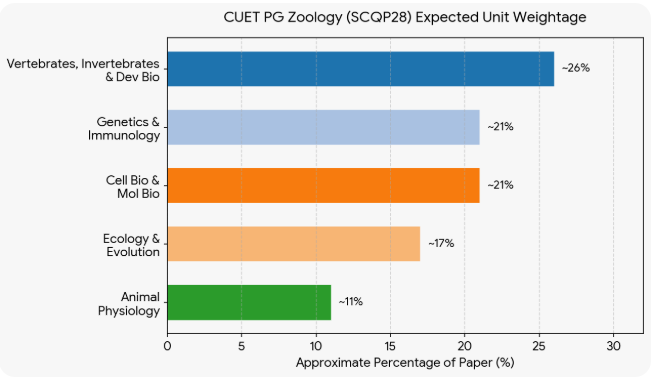
NTA does not publish unit-wise weightage. The figures below come from trends in the 2022 to 2026 papers. Treat them as a guide for prioritising units, not as a fixed pattern.
| Unit Group | Weightage | Questions (Approx.) | Marks (Approx.) |
|---|---|---|---|
| Vertebrates, Invertebrates and Developmental Biology | 25-27% | 19-20 | 76-80 |
| Genetics and Immunology | 20-22% | 15-17 | 60-68 |
| Cell Biology and Molecular Biology | 20-22% | 15-17 | 60-68 |
| Ecology and Evolution | 15-19% | 11-14 | 44-56 |
| Animal Physiology | 10-12% | 8-9 | 32-36 |
Biochemistry, Biostatistics, Bio Techniques and Recombinant DNA technology fill the remaining questions. Previous papers have mostly rated the difficulty from easy to moderate, with no out-of-syllabus questions.
CUET PG Zoology Important Topics 2027
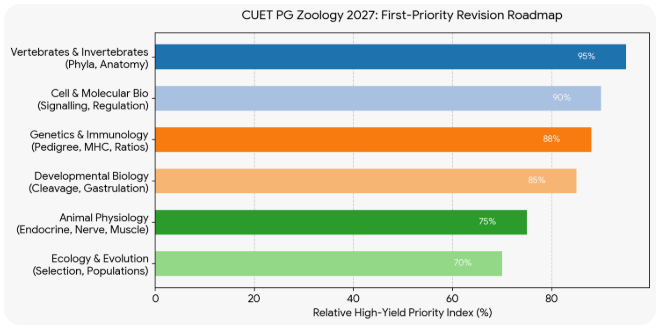
Based on previous year trends, these topics deserve your first round of revision.
- Cell Biology: membrane transport, cell cycle checkpoints and cell signalling.
- Molecular Biology: replication, transcription, translation and gene regulation.
- Genetics: Mendelian ratios, linkage, pedigree analysis and population genetics.
- Immunology: antibody structure, MHC and the roles of B and T cells.
- Developmental Biology: cleavage patterns, gastrulation and embryonic induction.
- Vertebrates and Invertebrates: phyla characteristics, classification and comparative anatomy.
- Animal Physiology: endocrinology, nerve conduction and muscle contraction.
- Evolution and Ecology: natural selection, speciation, population ecology and ecosystems.
Questions often combine two topics, such as evolution with genetics or ecology with physiology. You should revise units together rather than in isolation.
Best Books for CUET PG Zoology 2027
A standard B.Sc. textbook for each unit is enough for most of the paper. Add one previous year paper book for practice.
- Avoid collecting too many books for your CUET PG Zoology exam preparation.
- Use Kotpal for the high-weightage Animal Diversity sections (25–27% of the paper).
- For the molecular, cellular, and biochemical units, rely primarily on your B.Sc. college lecture notes, and open Lehninger or Alberts only when a specific mechanism confuses you.
| Subject | Book Name | Author / Publisher | Why This Book |
|---|---|---|---|
| Animal Diversity | Integrated Principles of Zoology | Hickman, Roberts and Larson | Covers classification and diversity of all phyla |
| Invertebrates | Invertebrate Zoology | R.D. Barnes | Detailed notes on every invertebrate phylum |
| Vertebrates | Modern Textbook of Zoology: Vertebrates | R.L. Kotpal | Clear chapter-wise coverage of chordates |
| Cell and Molecular Biology | Molecular Biology of the Cell | Alberts et al. | Strong concepts for cell and molecular units |
| Biochemistry | Lehninger Principles of Biochemistry | Nelson and Cox | Standard reference for metabolism and enzymes |
| Genetics | Concepts of Genetics | W.S. Klug | Clear explanations with solved problems |
| Physiology | Animal Physiology | Hill, Wyse and Anderson | Covers all major physiological systems |
| Biotechnology | Biotechnology: Expanding Horizons | B.D. Singh | Useful for rDNA technology and techniques |
| Practice | CUET PG Zoology Previous Year Papers (2022 to 2026) | NTA question papers | Shows the real question style and topic spread |
A student on Reddit asked for good book recommendations for CUET PG Zoology preparation 2027, to which a previous-year aspirant suggested studying from the Pathfinder question practice book.


Source: Reddit
Related Links:
CUET PG Zoology Preparation Tips 2027
Cell, Molecular Biology and Genetics
- Draw and label the cell cycle, replication fork and transcription steps.
- Practise genetics problems on ratios, linkage maps and pedigrees every week.
- Make short notes on enzymes and metabolic pathways for quick revision.
Animal Diversity and Developmental Biology
- Prepare a table of phyla with their key characteristics and examples.
- Learn the stages of embryonic development in a fixed order.
- Link each developmental stage to the structures it forms.
Physiology, Ecology and Evolution
- Revise hormones with their glands and functions in one chart.
- Study ecology through diagrams of cycles and food webs.
- Connect evolution theories to genetics for combined questions.
Biostatistics and Techniques
- Practise formulae for mean, standard deviation and chi-square.
- Learn the principle and use of each laboratory technique.
Solve at least five years of previous papers under timed conditions. Aim to finish 75 questions in under 80 minutes so you keep time for review.
This YouTube video by the channel “Srida Biology” discusses the CUET PG Zoology high scorer’s preparation strategy, where she shares her complete strategy for CUET PG Zoology and how she scored +200 marks in her first attempt.
CUET PG Zoology Syllabus 2027: FAQs
Ques. Is the CUET PG Zoology syllabus 2027 the same as last year?
Ans. NTA has not announced any revision, so the syllabus is expected to match 2026. It has 14 units under paper code SCQP28.
Ques. What is the paper code for CUET PG Zoology?
Ans. The paper code is SCQP28. It also covers Sericulture and Human Genetics.
Ques. How many units are there in the CUET PG Zoology syllabus 2027?
Ans. There are 14 units. They run from Cell Biology to Recombinant DNA technology.
Ques. Which unit has the highest weightage in CUET PG Zoology?
Ans. Vertebrates and Invertebrates with Developmental Biology carry about 25-27% of the paper, based on previous year trends.
Ques. How many questions come in the CUET PG Zoology paper?
Ans. The paper has 75 compulsory MCQs worth 300 marks. You get 90 minutes to finish it.
Ques. Is there negative marking in CUET PG Zoology?
Ans. Yes. You lose 1 mark for each wrong answer and gain 4 for each correct answer.
Ques. Is there a General Test in the CUET PG Zoology paper?
Ans. No. NTA removed the General Test (Part A) in 2024. All 75 questions come from Zoology.
Ques. When is the CUET PG 2027 exam?
Ans. NTA has announced the exam for 2 to 31 March 2027. Your own date and shift appear on the admit card.
Ques. Where can I download the CUET PG Zoology syllabus PDF?
Ans. You can download it from the NTA CUET PG portal at exams.nta.nic.in/cuet-pg under paper code SCQP28.
Ques. Is the B.Sc. Zoology syllabus enough for CUET PG?
Ans. Yes, for most of the paper. The syllabus is set at the undergraduate level, so standard B.Sc. books are enough.
Ques. Which books should I follow for CUET PG Zoology?
Ans. Use Hickman for diversity, Lehninger for biochemistry, Klug for genetics and Alberts for cell biology. Add previous year papers for practice.
Ques. How should I cover the CUET PG Zoology syllabus in 4 months?
Ans. Spend two months on the high-weightage units. Use the last two months for revision, mock tests and previous year papers.



Comments