




CUET PG Life Sciences Syllabus 2027 covers eight units, from Techniques to Animal Sciences. The National Testing Agency (NTA) conducts the exam, and the paper is listed under code SCQP17.
- The CUET PG Life Sciences syllabus 2027 has 8 units, from Techniques and Chromatin Structure to Plant and Animal Sciences.
- The paper has 75 compulsory MCQs for 300 marks and must be finished in 90 minutes.
| Direct Link: Download CUET PG Life Sciences Syllabus 2027 PDF (SCQP17) (EXPECTED SOON) |
- You get +4 marks for a correct answer and -1 for a wrong answer. Unattempted questions carry no penalty.
- Molecular Genetics, Biochemistry, and Cell Biology topics are tested most often, based on previous years' trends.
- Prepare enzymes, glycolysis, the TCA cycle, electron transport, and lipid metabolism. Biochemistry accounts for 14–16% weightage. Use Lehninger Principles of Biochemistry by Nelson and Cox.
- Cover restriction enzymes, cloning vectors, recombinant DNA technology, PCR and cell culture. Biotechnology contributes 12–14% of the paper. Refer to Biotechnology: Expanding Horizons by B.D. Singh.
- Revise bacterial structure, microbial diversity, viruses, antibodies, complement and vaccines. Microbiology carries 12–14% weightage. Use Microbiology: An Introduction by Tortora, Funke and Case for preparation.
- The syllabus is expected to stay the same as the 2026 cycle, since no revision has been announced.
Related Links:
- CUET PG Exam Pattern 2027: Questions, Marks, Duration & Marking Scheme
- CUET PG Preparation 2027: Subject-wise Study Plan, Timetable, Last-month Strategy, PYQs, and Mock Tests
- CUET PG 2026 Life Science Question Paper with Solutions
Key Summary
- The CUET PG Life Sciences syllabus 2027 is expected to match the 2026 syllabus.
- The paper has one domain section of 75 MCQs. There is no General Test part.
- Molecular Genetics, Biochemistry and Biotechnology together carry the largest share of questions.
- The official syllabus PDF is listed on the NTA CUET PG portal.
- B.Sc. level books and previous year papers cover the entire syllabus.
CUET PG Life Sciences Syllabus 2027: Overview
CUET PG is the Common University Entrance Test for postgraduate admissions. Central, state, and private universities accept the score for M.Sc. Life Sciences and related programmes.
- The CUET PG Life Sciences paper is a domain-specific test that covers botany, zoology, microbiology, biochemistry and biotechnology in one paper.
- Students with a bachelor's degree in a life science subject are eligible. Individual universities may set their own minimum marks. The syllabus follows the topics taught in a B.Sc. course.
| Particulars | Details |
|---|---|
| Conducting Body | National Testing Agency (NTA) |
| Paper Code | SCQP17 (Life Science) |
| Exam Mode | Computer-Based Test (CBT) |
| Question Type | Multiple Choice Questions (MCQs) |
| Total Questions | 75 (all compulsory) |
| Total Marks | 300 |
| Marking Scheme | +4 for each correct answer, -1 for each wrong answer, 0 for unattempted |
| Duration | 90 minutes |
| Medium | English and Hindi |
| Syllabus Level | Undergraduate (B.Sc. Life Sciences) |
Related Links:
CUET PG Life Sciences Syllabus 2027: What's New?
NTA has not announced any change to the Life Sciences syllabus for 2027. You should treat the latest published syllabus as the working syllabus until NTA releases an update.
One older change still matters. The paper now has only domain questions. The earlier General Test part is no longer included, and all 75 questions test your Life Sciences knowledge.
| Topic / Unit | 2027 (Expected) | 2026 |
|---|---|---|
| All 8 Life Sciences units | Same as 2026 | 8 units |
| General Test | Not included | Not included |
| Marking scheme | +4 and -1 | +4 and -1 |
CUET PG Life Sciences Unit-wise Syllabus 2027
The syllabus is grouped into eight units. Check the official PDF for the final wording of each unit, because NTA can regroup topics.
Techniques, Chromatin and Biochemistry
- The Techniques unit carries approximately 8–10% weightage. Focus on the basic principles and applications of chromatography, microscopy, electrophoresis, centrifugation and PCR.
- Chromatin Structure and Function accounts for around 8–10% of the paper. Prepare chromosome organisation, chromatin structure, centromeres, telomeres and differences between prokaryotic and eukaryotic chromosomes.
- Biochemistry carries approximately 14–16% weightage. Prioritise biomolecules, enzyme functions, metabolic pathways, ATP production and bioenergetics.
| Unit | Topics Covered | Approx. Weightage |
|---|---|---|
| 1. Techniques | Chromatography, spectroscopy, microscopy, electrophoresis, centrifugation, blotting, PCR, radioisotope methods | 8-10% |
| 2. Chromatin Structure and Function | Chromosome organisation in prokaryotes and eukaryotes, chromatin types, centromere, telomere, gene concept | 8-10% |
| 3. Biochemistry | Proteins, nucleic acids, carbohydrates, lipids, vitamins, bioenergetics, glycolysis, TCA cycle, electron transport, ATP synthesis, fatty acid metabolism, membrane structure | 14-16% |
Biotechnology, Microbiology and Molecular Genetics
- Biotechnology contributes around 12–14% of the paper. Cover recombinant DNA technology, gene cloning, cell culture techniques and their applications in medicine and agriculture.
- Microbiology accounts for approximately 12–14% weightage. Focus on microbial classification, bacterial reproduction, viruses, antimicrobial agents and basic immunological concepts.
- Molecular Genetics carries the highest weightage in this section at 16–18%. Prepare Mendelian inheritance, linkage, mutations, DNA replication, transcription and translation.
| Unit | Topics Covered | Approx. Weightage |
|---|---|---|
| 4. Biotechnology | Recombinant DNA technology, gene cloning, uses in medicine, industry and agriculture, animal and plant cell culture, environmental biotechnology | 12-14% |
| 5. Microbiology | Microbial diversity, bacterial reproduction, antimicrobial agents, antigens, antibodies, complement, vaccines, plant and animal viruses | 12-14% |
| 6. Molecular Genetics | Inheritance principles, linkage and crossing over, chromosomal aberrations, extrachromosomal inheritance, replication, transcription, translation, DNA repair, population genetics | 16-18% |
Plant Sciences and Animal Sciences
- Plant Sciences accounts for around 12–14% of the paper. Focus on the classification of major plant groups, photosynthesis, plant growth, and reproductive processes.
- Animal Sciences also carries approximately 12–14% weightage. Prioritise the classification of invertebrates and vertebrates, human anatomy, physiological systems, nerve impulses and hormonal regulation.
| Unit | Topics Covered | Approx. Weightage |
|---|---|---|
| 7. Plant Sciences | Bryophytes, pteridophytes, gymnosperms, angiosperms, vascular system, economic botany, photosynthesis, photoperiodism, vernalization, biogeochemical cycles | 12-14% |
| 8. Animal Sciences | Invertebrate and vertebrate characteristics, human anatomy and physiology, nerve impulse, endocrinology, human diseases, apoptosis, cancer, inherited disorders | 12-14% |
Also Check:
CUET PG Life Sciences Syllabus 2027: Unit-wise Weightage
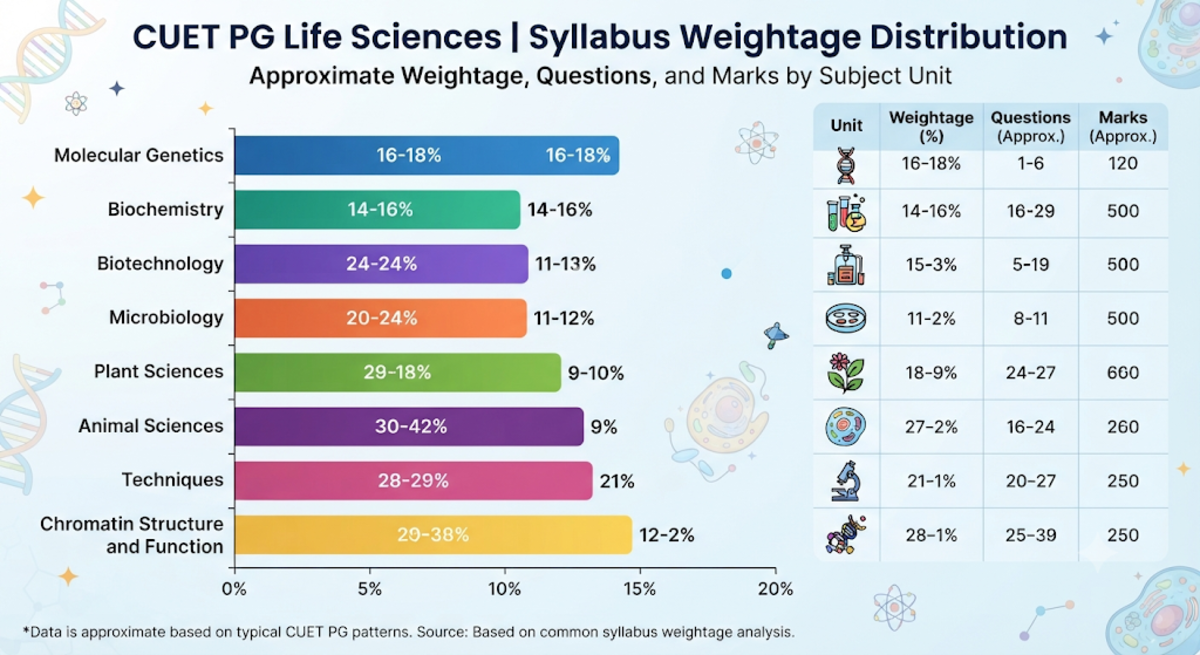
NTA does not publish unit-wise weightage. The figures below are indicative estimates based on topic trends in recent papers. Treat them as a guide for prioritising units, not as a fixed pattern.
- Molecular Genetics has the highest estimated weightage of 16–18%, contributing approximately 12–13 questions or 48–52 marks.
- Biochemistry, Biotechnology and Microbiology together account for approximately 38–44% of the paper. These three units can contribute around 28–32 questions.
- Techniques and Chromatin Structure and Function have the lowest individual weightage of 8–10% each. However, together they can contribute approximately 12–14 questions, so they should not be skipped during preparation.
| Unit | Weightage | Questions (Approx.) | Marks (Approx.) |
|---|---|---|---|
| Molecular Genetics | 16-18% | 12-13 | 48-52 |
| Biochemistry | 14-16% | 10-12 | 40-48 |
| Biotechnology | 12-14% | 9-10 | 36-40 |
| Microbiology | 12-14% | 9-10 | 36-40 |
| Plant Sciences | 12-14% | 9-10 | 36-40 |
| Animal Sciences | 12-14% | 9-10 | 36-40 |
| Techniques | 8-10% | 6-7 | 24-28 |
| Chromatin Structure and Function | 8-10% | 6-7 | 24-28 |
Questions often combine two units, such as genetics with biotechnology or biochemistry with physiology. You should revise related units together.
As per students on Quora, students ask if the CUET PG Life Science exam is tough.
CUET PG Life Sciences is moderately tough, primarily because it is highly interdisciplinary, forcing you to master Botany, Zoology, Microbiology, Genetics, and Biochemistry all in a single paper.

Source: Quora
Also Check:
CUET PG Life Sciences Important Topics 2027
Based on previous year trends, these topics deserve your first round of revision.
- Molecular Genetics: replication, transcription, translation, linkage and population genetics.
- Biochemistry: enzymes, glycolysis, TCA cycle, electron transport and lipid metabolism.
- Biotechnology: restriction enzymes, vectors, cloning, PCR and cell culture.
- Microbiology: bacterial structure, viruses, antibodies, complement and vaccines.
- Plant Sciences: photosynthesis, plant hormones, photoperiodism and plant groups.
- Animal Sciences: nerve impulse, endocrinology, animal groups and cancer.
- Techniques: principles of chromatography, electrophoresis, microscopy and blotting.
- Chromatin: nucleosome structure, centromere, telomere and chromosome organisation.
This video by the channel “Pathfinder Academy” discusses the CUET PG exam for Life Sciences, covering top universities, eligibility criteria, exam pattern and the Part A and Part B syllabus. It also explains the subject-wise syllabus for Life Sciences, Biochemistry, Zoology and Botany, along with previous-year cut-offs, topper scores and topic-wise weightage.
Best Books for CUET PG Life Sciences 2027
A standard B.Sc. textbook for each unit is enough for most of the paper. Add previous year papers for practice.
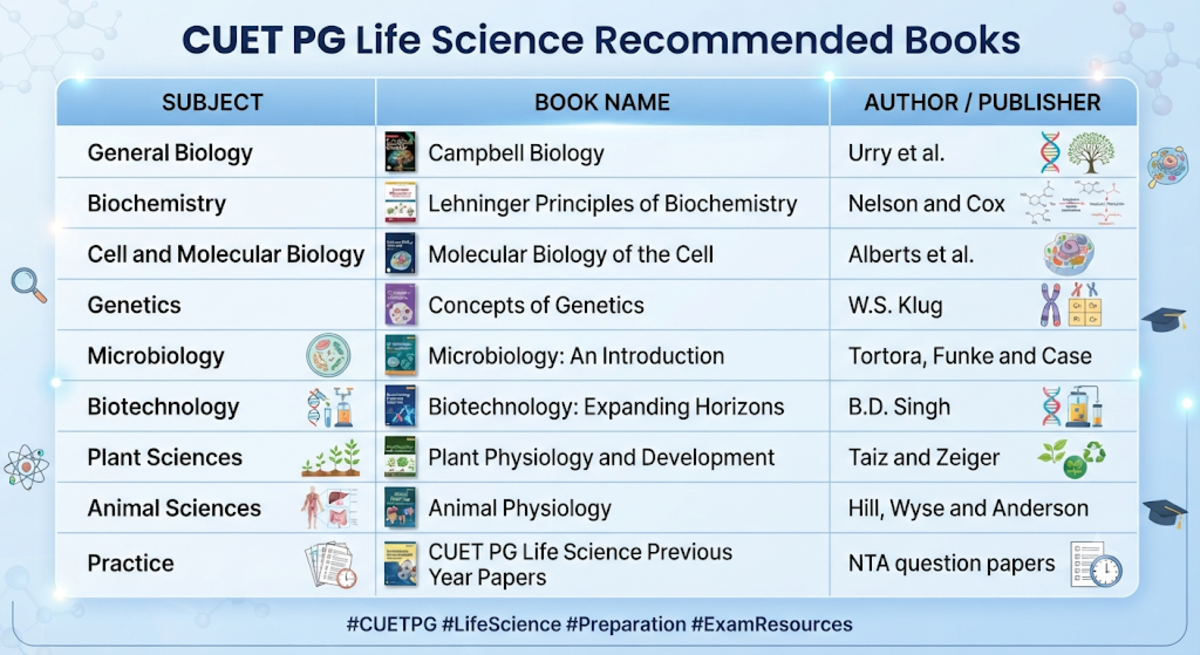
- Use Campbell Biology as the main reference for overall concepts and refer to subject-specific books for detailed preparation in Biochemistry, Genetics, Microbiology, Biotechnology, Plant Sciences and Animal Sciences.
- Prioritise Lehninger, Alberts, Klug, and B.D. Singh for topics such as metabolism, molecular biology, inheritance patterns, and recombinant DNA technology.
- Practise CUET PG Life Science previous-year question papers to understand the exam pattern, identify frequently tested topics, and improve time management.
| Subject | Book Name | Author / Publisher | Why This Book |
|---|---|---|---|
| General Biology | Campbell Biology | Urry et al. | Covers all units at one level |
| Biochemistry | Lehninger Principles of Biochemistry | Nelson and Cox | Standard reference for metabolism and enzymes |
| Cell and Molecular Biology | Molecular Biology of the Cell | Alberts et al. | Strong concepts for chromatin and cell units |
| Genetics | Concepts of Genetics | W.S. Klug | Clear explanations with solved problems |
| Microbiology | Microbiology: An Introduction | Tortora, Funke and Case | Simple coverage of microbes and immunity |
| Biotechnology | Biotechnology: Expanding Horizons | B.D. Singh | Useful for rDNA technology and cell culture |
| Plant Sciences | Plant Physiology and Development | Taiz and Zeiger | Detailed notes on photosynthesis and hormones |
| Animal Sciences | Animal Physiology | Hill, Wyse and Anderson | Covers all major physiological systems |
| Practice | CUET PG Life Science Previous Year Papers | NTA question papers | Shows the real question style and topic spread |
Related Links:
CUET PG Life Sciences Preparation Tips 2027
Genetics, Biochemistry and Chromatin
- Practise genetics problems on ratios, linkage maps and pedigrees every week.
- Draw the replication fork, transcription steps and metabolic pathways from memory.
- Make short notes on enzymes and cofactors for quick revision.
Biotechnology, Microbiology and Techniques
- Learn the principle and use of each laboratory technique in a single table.
- Revise vectors and restriction enzymes with one example each.
- Link antibody types and vaccine types to their functions.
Plant and Animal Sciences
- Prepare a chart of plant groups with their key characteristics.
- Revise hormones with their glands and functions in one table.
- Study photosynthesis through diagrams of the light and dark reactions.
Solve at least five years of previous papers under timed conditions. Aim to finish 75 questions in under 80 minutes, so you keep time for review.

CUET PG Life Sciences Syllabus 2027: FAQs
Ques. Is the CUET PG Life Sciences syllabus 2027 the same as last year?
Ans. NTA has not announced any revision, so the syllabus is expected to match 2026. It has 8 units.
Ques. What is the paper code for CUET PG Life Science?
Ans. The paper is listed under code SCQP17. Confirm the code in the official information bulletin before applying.
Ques. How many units are there in the CUET PG Life Sciences syllabus 2027?
Ans. There are 8 units. They run from Techniques to Animal Sciences.
Ques. Which unit has the highest weightage in CUET PG Life Sciences?
Ans. Molecular Genetics and Biochemistry are tested most often, based on previous years' trends. NTA does not publish official weightage.
Ques. How many questions come in the CUET PG Life Sciences paper?
Ans. The paper has 75 compulsory MCQs worth 300 marks. You get 90 minutes to finish it.
Ques. Is there negative marking in CUET PG Life Sciences?
Ans. Yes. You lose 1 mark for each wrong answer and gain 4 for each correct answer.
Ques. Is there a General Test in the CUET PG Life Sciences paper?
Ans. No. All 75 questions come from the Life Sciences domain.
Ques. When is the CUET PG 2027 exam?
Ans. NTA has announced the exam for 2 to 31 March 2027. Your own date and shift appear on the admit card.
Ques. Where can I download the CUET PG Life Sciences syllabus PDF?
Ans. You can download it from the NTA CUET PG portal at exams.nta.nic.in/cuet-pg.
Ques. Is the B.Sc. syllabus enough for CUET PG Life Sciences?
Ans. Yes, for most of the paper. The syllabus is set at the undergraduate level, so standard B.Sc. books are enough.
Ques. Which books should I follow for CUET PG Life Sciences?
Ans. Use Lehninger for biochemistry, Klug for genetics and Alberts for cell biology. Add previous years' papers for practice.
Ques. How should I cover the CUET PG Life Sciences syllabus in 4 months?
Ans. Spend two months on the high-weightage units. Use the last two months for revision, mock tests, and previous year papers.



Comments