




The IIT JAM Mathematical Statistics Syllabus 2027 covers key topics such as Mathematical Methods, Probability, Statistics, Sampling Distributions, Estimation, and Hypothesis Testing. It also includes other important areas of mathematics and statistical analysis.
IIT Kharagpur has updated the 2027 syllabus on its official website, jam.iitkgp.ac.in, where candidates can review the topics and prepare for the exam.
- The IIT JAM Mathematical Statistics (MS) paper carries 100 marks across 60 questions, divided into 3 sections: MCQ (50 marks), MSQ (20 marks), and NAT (30 marks).
- The exam duration is 3 hours.
- The Mathematical Statistics (MS) syllabus covers Mathematics, Probability, Statistics, Sampling Distributions, Estimation, and Hypothesis Testing, along with other important topics in mathematical and statistical analysis.
- Probability, Distribution Theory, Estimation, and Hypothesis Testing are important areas to prioritize, followed by Calculus, Linear Algebra, and other core mathematical topics.
- The Mathematical Statistics paper tests conceptual understanding, analytical reasoning, numerical problem-solving skills, and the ability to apply statistical methods, probability concepts, and mathematical formulas accurately.
Related Links:
- IIT JAM Exam Pattern 2027: Subject-wise Pattern, Total Marks, Marking Scheme and Question Types
- IIT JAM Paper Analysis 2027: Expected Moderate to Difficult, Subject-wise Difficulty and Session-wise Review
IIT JAM Mathematical Statistics Syllabus 2027: Key Highlights
| Aspect | Details |
|---|---|
| Paper Code | MS |
| Total Weightage Split |
|
| Exam Pattern |
|
| Mathematics Topics |
|
| Core Statistics Topics |
|
| Highest Weightage Areas |
|
| Important Focus Points |
|
| Nature of Questions | Conceptual + Numerical + Application-basedHigh number of NAT questions from Probability & Inference |
| Difficulty Level | Moderate to Difficult (Statistics portion is more rigorous than Mathematics) |
| Best Suited For | Students with a B.Sc in Statistics or a strong Probability background |
Also Read: IIT JAM 2027 Syllabus and Exam Pattern Released; Check Complete Details Here
IIT JAM Mathematical Statistics Syllabus 2027: High-weightage topics
The IIT JAM Mathematical Statistics Syllabus 2027 prioritizes Probability, Distributions, and Estimation. The IIT JAM Statistics Syllabus also includes MSQ/NAT-based questions and scoring topics like Matrices and basic Calculus.
| Topic | Approx. Weightage | Priority | Key Focus Areas |
|---|---|---|---|
| Random Variables & Distributions (Univariate + Multivariate) | 25–30% | Highest | Standard distributions (Binomial, Poisson, Normal, Gamma, Beta, etc.), Joint/Marginal/Conditional distributions, MGF, Transformations, Order statistics, Bivariate Normal |
| Probability Theory | 15–20% | Highest | Axioms, Conditional probability, Bayes’ theorem, Independence, Expectation, Variance, Moments |
| Estimation (Point & Interval) | 12–18% | Highest | MLE, Method of Moments, Unbiasedness, Sufficiency, Completeness, UMVUE (Rao-Blackwell, Lehmann-Scheffe), Cramér-Rao bound |
| Testing of Hypotheses | 10–15% | High | Neyman-Pearson lemma, Likelihood Ratio Tests, UMP tests, Power of a test, p-value |
| Sampling Distributions & Limit Theorems | 8–12% | High | Chi-square, t, F distributions, Central Limit Theorem (CLT), Weak Law of Large Numbers |
| Matrices & Determinants (Mathematics) | 8–12% | Medium-High | Rank, Eigenvalues/Eigenvectors, Inverse, Systems of equations, Quadratic forms |
| Sequences, Series & Calculus (Mathematics) | 10–15% | Medium | Convergence tests, Differential Calculus (one & two variables), Integral Calculus |
IIT JAM Mathematical Statistics Syllabus 2027: Chapter-wise Weightage
The IIT JAM Statistics Syllabus emphasizes Random Variables and Distributions, Probability, Estimation, and Hypothesis Testing.
- These 4 key areas in the IIT JAM MS Syllabus may contribute around 60–70% of the total marks, based on past paper trends.
| Chapter / Topic | Approx. Weightage (%) | Expected Marks |
|---|---|---|
| Random Variables & Distributions (Univariate + Multivariate) | 25–30% | 25–30 |
| Probability Theory | 15–20% | 15–20 |
| Estimation (Point & Interval Estimation) | 12–18% | 12–18 |
| Testing of Hypotheses | 10–15% | 10–15 |
| Sampling Distributions & Limit Theorems | 8–12% | 8–12 |
| Matrices & Determinants (Mathematics) | 8–12% | 8–12 |
| Sequences, Series & Calculus (Mathematics) | 10–15% | 10–15 |
| Descriptive Statistics, Regression & Correlation | 5–8% | 5–8 |
| Nonparametric Methods & Stochastic Processes | 3–6% | 3–6 |
Also Read: IIT JAM Chapter Wise Weightage: Check Subject Wise High Weightage Topics
IIT JAM Mathematical Statistics Syllabus 2027: Mathematics Syllabus
The Mathematics portion of the IIT JAM MS Syllabus is relatively compact. It carries only about 25% weightage, focusing mainly on Sequences & Series, Calculus (one and two variables), and Matrices & Determinants.
| Chapter | Topics Covered |
|---|---|
| Sequences and Series of Real Numbers | Convergence and limits of sequences, Cauchy sequences, monotonic sequences, infinite series, convergence tests, absolute and conditional convergence, power series |
| Differential Calculus | Limits, continuity, differentiability, mean value theorems, Taylor's theorem, maxima and minima, partial derivatives |
| Integral Calculus | Indefinite and definite integrals, improper integrals, double integrals, applications of integration |
| Matrices and Determinants | Matrix operations, determinants, inverse of a matrix, rank, systems of linear equations, eigenvalues and eigenvectors |
IIT JAM Mathematical Statistics Syllabus 2027: Statistics Syllabus
The Statistics section accounts for approx. 75% of the IIT JAM MS Syllabus & includes Sections 4–12 of the official syllabus.
- While less extensive than the Statistics section, the Mathematics section can be highly scoring for candidates with a strong foundation in basic Calculus and Linear Algebra.
- Consistent practice of numerical problems is essential to improve accuracy and maximize marks.
| Chapter | Topics Covered |
|---|---|
| Descriptive Statistics and Probability | Measures of central tendency and dispersion, moments, skewness, kurtosis, correlation, probability rules, conditional probability, Bayes’ theorem, and independence of events |
| Univariate Distributions | Random variables, PMF, PDF, CDF, expectation, moments, MGF, standard discrete and continuous distributions, Markov and Chebyshev inequalities |
| Multivariate Distributions | Joint and marginal distributions, conditional distributions, independence, covariance, correlation, conditional expectation, multinomial and bivariate normal distributions |
| Limit Theorems | Convergence in probability, mean square, almost sure and distribution, weak and strong laws of large numbers, Central Limit Theorem |
| Sampling Distributions | Random samples, statistics, order statistics, Chi-square, t and F distributions, and relationships among these distributions |
| Estimation | Unbiasedness, sufficiency, completeness, consistency, efficiency, UMVUE, Rao-Blackwell and Lehmann-Scheffé theorems, maximum likelihood, method of moments, confidence intervals |
| Testing of Hypotheses | Null and alternative hypotheses, Type I and Type II errors, significance level, power, p-value, most powerful tests, UMP tests, Neyman-Pearson Lemma, likelihood ratio tests |
| Nonparametric Methods | Runs test, empirical distribution function, Kolmogorov-Smirnov test, one-sample and two-sample sign tests, Mann-Whitney test |
| Stochastic Processes | Discrete-time Markov chains, transition probability matrices, Chapman-Kolmogorov equation, classification of states, stationary and limiting distributions, Poisson process |
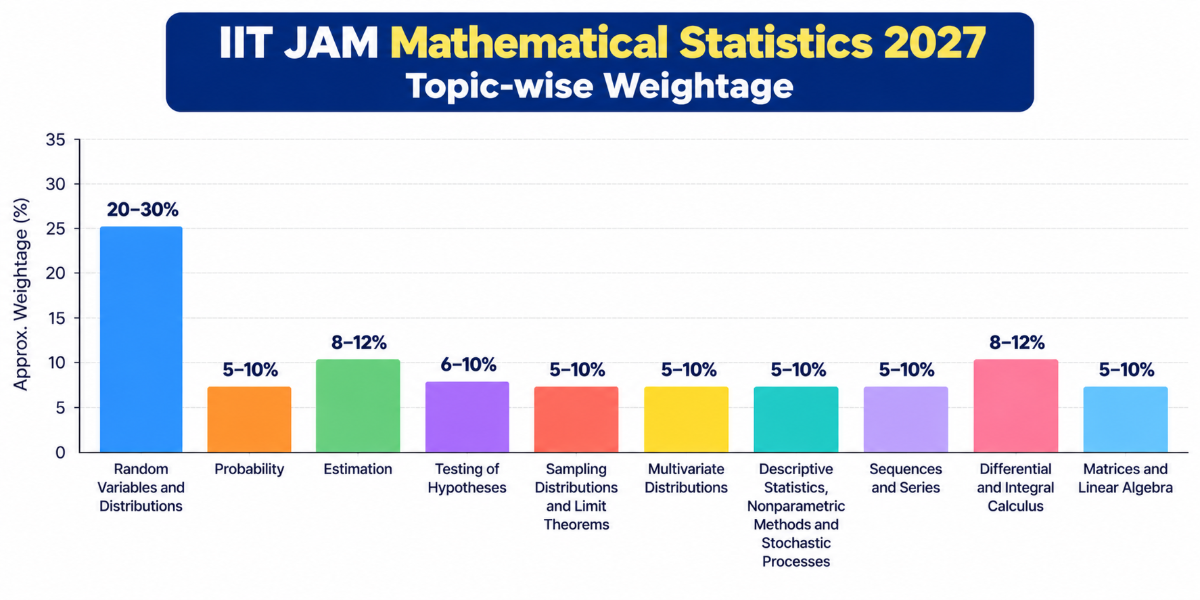
IIT JAM Mathematical Statistics Syllabus 2027: Topic-wise marks Distribution
The IIT JAM MS Syllabus 2027 paper carries 100 marks, with questions from Mathematics and Statistics.
| Topic/Section | Approx. Weightage |
|---|---|
| Random Variables and Distributions | 20–30% |
| Probability | 5–10% |
| Estimation | 8–12% |
| Testing of Hypotheses | 6–10% |
| Sampling Distributions and Limit Theorems | 5–10% |
| Multivariate Distributions | 5–10% |
| Descriptive Statistics, Nonparametric Methods and Stochastic Processes | 5–10% |
| Sequences and Series | 5–10% |
| Differential and Integral Calculus | 8–12% |
| Matrices and Linear Algebra | 5–10% |
IIT JAM Mathematical Statistics Syllabus 2027 for beginners
For IIT JAM MS 2027, prioritize Probability, Univariate Distributions, Matrices, Calculus, Estimation, and Hypothesis Testing before covering the remaining topics in the IIT JAM MS Syllabus.
- Beginners should focus on concepts and standard distributions first, then practise previous-year questions regularly after completing each topic.
Mathematics Part (Sections 1–3) – Approx. 25% Weightage
| Section | Topic | What You Need to Study (Simple Explanation) | Difficulty for Beginners |
|---|---|---|---|
| 1 | Sequences and Series | Convergence of sequences, tests of series (ratio, root, comparison), power series | Easy to Moderate |
| 2 | Differential & Integral Calculus | Limits, continuity, differentiation, maxima-minima, Taylor series, partial derivatives, double integrals, Beta & Gamma functions | Moderate |
| 3 | Matrices and Determinants | Rank, inverse, eigenvalues, eigenvectors, systems of equations, quadratic forms | Easy to Moderate |
Statistics Part (Sections 4–12) – Approx. 75% Weightage
| Topic | What You Need to Study (Simple Explanation) | Difficulty for Beginners |
|---|---|---|
| Descriptive Statistics & Probability | Mean, median, mode, variance, correlation + Basic probability, Bayes’ theorem | Easy |
| Univariate Distributions | Discrete & continuous distributions (Binomial, Poisson, Normal, Exponential, Gamma, Beta, etc.), mean, variance, MGF | Moderate |
| Multivariate Distributions | Joint, marginal & conditional distributions, covariance, bivariate normal | Moderate to Hard |
| Limit Theorems | Law of Large Numbers, Central Limit Theorem (CLT) | Moderate |
| Sampling Distributions | Chi-square, t, and F distributions | Moderate |
| Estimation | MLE, Method of Moments, unbiasedness, sufficiency, UMVUE, Cramér-Rao bound | Hard |
| Testing of Hypotheses | Neyman-Pearson lemma, Likelihood Ratio Tests, Type I & II errors | Hard |
| Nonparametric Methods | Sign test, Mann-Whitney test, Kolmogorov-Smirnov test | Easy to Moderate |
| Stochastic Processes | Markov chains, Poisson process | Moderate |
Best Books to Cover the IIT JAM Mathematical Statistical Syllabus 2027
Books for the IIT JAM MS Syllabus 2027 should balance conceptual clarity and exam practice, with Gupta & Kapoor as a strong starting point.
- For the IIT JAM MS Syllabus, pair it with Hogg & Craig and a previous-year question bank.

Source: Quora
A student on Quora has asked “What are some practice/reference books for the IIT-JAM in mathematical statistics?”
| Section | Book Title | Author(s) | Best For |
|---|---|---|---|
| Statistics (Core) | Fundamentals of Mathematical Statistics | S.C. Gupta & V.K. Kapoor | Complete Statistics portion (Beginners + Intermediate) |
| Statistics (Advanced) | Introduction to Mathematical Statistics | Robert V. Hogg, Joseph McKean & Allen T. Craig | Estimation, Hypothesis Testing & Inference |
| Statistics (Theory) | An Introduction to Probability and Statistics | V.K. Rohatgi & A.K. Md. Ehsanes Saleh | Probability + Univariate/Multivariate Distributions |
| Statistics (Inference) | Statistical Inference | George Casella & Roger L. Berger | Deep understanding of Estimation & Testing |
| Mathematics | Schaum’s Outline of Linear Algebra | Seymour Lipschutz | Matrices & Determinants |
| Mathematics | Mathematical Analysis | S.C. Malik & Savita Arora | Sequences, Series & Calculus |
| Practice | IIT JAM Mathematical Statistics Solved Papers | Anand Kumar / Arihant / IFAS | Exam-oriented practice |
| Practice | Problems and Solutions in Mathematical Statistics | S.C. Gupta, Vikas Gupta & Sanjeev Kumar Gupta | Strengthening problem-solving skills |
Preparation Strategy for IIT JAM Mathematical Statistics 2027
A well-planned preparation strategy for IIT JAM MS 2027 should prioritise high-weightage areas of the IIT JAM Statistic Syllabus such as Probability, Distributions, Estimation, and Hypothesis Testing.
- Following a structured 4–6 month plan with consistent practice of previous year questions and mock tests significantly improves the chances of scoring well in IIT JAM MS 2027.
| Preparation Phase | Topics / Tasks to Cover | Preparation Strategy |
|---|---|---|
| Phase 1: Understand the Syllabus | Mathematics and Statistics topics | Review the official IIT JAM MS syllabus and create a topic-wise checklist. |
| Phase 2: Build Fundamentals | Probability and Univariate Distributions | Understand basic concepts, formulas, standard distributions, and their applications. |
| Phase 3: Cover Mathematics | Sequences and Series, Calculus, Matrices | Practise numerical problems regularly and revise important formulas. |
| Phase 4: Master Core Statistics | Estimation, Hypothesis Testing, Sampling Distributions | Focus on statistical concepts, theorems, problem-solving methods, and application-based questions. |
| Phase 5: Complete Remaining Topics | Multivariate Distributions, Limit Theorems, Nonparametric Methods, Stochastic Processes | Cover the remaining syllabus and practise topic-wise questions. |
| Phase 6: Practise Previous-Year Papers | Previous-year questions (PYQs) | Solve questions after completing each topic to identify weak areas and understand exam trends. |
| Phase 7: Take Mock Tests | Full-length tests and sectional tests | Practise under timed conditions to improve speed, accuracy, and time management. |
| Phase 8: Revise and Evaluate | Formulas, short notes, and difficult questions | Revise regularly, analyse mock-test mistakes, and revisit weak topics before the examination. |
IIT JAM Mathematical Statistics 2027 FAQs
Ques. What is the weightage of Mathematics and Statistics in the MS paper?
Ans. Mathematics carries approximately 25% weightage, while Statistics carries about 75% weightage.
Ques. Is the Mathematics portion in MS the same as the Mathematics (MA) paper?
Ans. No. The Mathematics portion in MS is limited to Sequences & Series, Differential & Integral Calculus, and Matrices & Determinants only.
Ques. How many months are ideally required to prepare for IIT JAM MS?
Ans. With focused preparation, 4–6 months is generally sufficient for most students.
Ques. Which book is best for beginners in Mathematical Statistics?
Ans. Fundamentals of Mathematical Statistics by S.C. Gupta & V.K. Kapoor is the most recommended book for beginners.
Ques. Does the MS paper have negative marking?
Ans. Yes, negative marking is applicable only in Section A (MCQs). There is no negative marking in Section B (MSQs) and Section C (NATs).



Comments