




The IIT JAM Geology Syllabus 2027 covers key topics in geology, Mineralogy, Petrology, Structural Geology, and Paleontology. It includes core areas like Stratigraphy, Economic Geology, Geomorphology, and Applied Geology.
Candidates can check the official IIT JAM website for the 2027 syllabus and prepare by reviewing the prescribed topics and prioritising key chapters.
- The IIT JAM Geology (GG) paper carries 100 marks across 60 questions, divided into 3 sections: MCQ (50 marks), MSQ (20 marks), and NAT (30 marks).
- The duration of the exam is 3 hours.
- The IIT JAM Geology syllabus covers topics such as Mineralogy (15–20%), Petrology (20–25%), Structural Geology (15–20%), Paleontology (5–10%), Stratigraphy (10–15%), Economic Geology (5–10%), and Geomorphology (10–12%).
- Candidates should prioritize important areas such as Mineralogy, Petrology, Structural Geology, and Stratigraphy while preparing for the examination.
- Understanding geological processes, rock formations, and mineral properties is also essential.
- The Geology paper tests conceptual understanding, analytical reasoning, and the ability to interpret geological data, diagrams, maps, and scientific concepts accurately.
- Topics such as Mineralogy, Petrology, Structural Geology, and Paleontology, along with Stratigraphy and Economic Geology, deserve particular attention during preparation.
Related Links:
- IIT JAM Exam Pattern 2027: Subject-wise Pattern, Total Marks, Marking Scheme and Question Types
- IIT JAM Paper Analysis 2027: Expected Moderate to Difficult, Subject-wise Difficulty and Session-wise Review

IIT JAM Geology Syllabus 2027: Overview
The IIT JAM Geology syllabus covers fundamental concepts of Earth science, geological processes, rock and mineral classification, fossils, and applied geology.
| Particulars | Details |
|---|---|
| Exam Name | Joint Admission Test for Masters (IIT JAM) |
| Subject | Geology (GG) |
| Conducting Institute | IIT Kharagpur |
| Exam Date | February 14, 2027 |
| Exam Mode | Computer-Based Test (CBT) |
| Exam Duration | 3 hours |
| Total Questions | 60 |
| Total Marks | 100 |
| Question Types |
|
| Major Topics Covered | The Planet Earth, Geomorphology, Structural Geology, Palaeontology, Stratigraphy, Mineralogy, Petrology, and Economic and Applied Geology |
| Negative Marking |
|
Also Read: IIT JAM 2027 Syllabus and Exam Pattern Released; Check Complete Details Here
IIT JAM Geology Syllabus 2027: High-Weightage Topics
IIT JAM Geology 2027 preparation should focus first on Mineralogy/Petrology and Structural Geology, particularly map interpretation and stereonets, which are important scoring areas.
- Practise numerical problems in Structural Geology and Applied Geology, along with Indian stratigraphy and palaeontology examples.
| Topic | Key Sub-topics | Approx. Weightage (%) |
|---|---|---|
| Mineralogy + Petrology | Crystal symmetry, optical properties, rock-forming minerals; Igneous (classification, textures, magma evolution), Sedimentary (textures, environments), Metamorphic (facies, ACF/AKF/AFM diagrams, zones) | 20–28% |
| Structural Geology | Dip/strike/rake/plunge, folds/faults/joints/unconformities, geological maps & cross-sections, stereographic projections, numerical problems on outcrops/boreholes | 15–20% |
| The Planet Earth | Origin & internal structure, radiometric dating, volcanism, earthquakes, magnetism/gravity/isostasy, plate tectonics & orogeny | 15–20% |
| Stratigraphy | Principles (litho-/chrono-/biostratigraphy), correlation; Indian stratigraphy (Archaean cratons, Cuddapah/Vindhyan, Gondwana, Spiti/Kashmir, Kutch, Trichinopoly, Siwaliks, etc.) | 10–15% |
| Palaeontology | Evolution of life, fossil preservation & applications; Morphology/evolutionary trends of Brachiopoda, Mollusca, Trilobita, Echinodermata, etc.; Gondwana plants; Indian vertebrates | 10–15% |
| Geomorphology | Weathering/erosion/deposition, soil formation, drainage patterns; Fluvial, aeolian, glacial, marine, karst landforms | 10–15% |
| Economic Geology | Ore-forming processes, mode of occurrence & distribution of metallic/non-metallic deposits in India, ore grade/reserves, coal & hydrocarbons | 8–12% |
| Applied Geology | Groundwater (aquifers, porosity/permeability), engineering geology (dams/tunnels), basics of remote sensing | 5–10% |
IIT JAM Geology Syllabus 2027: Chapter-Wise Weightage
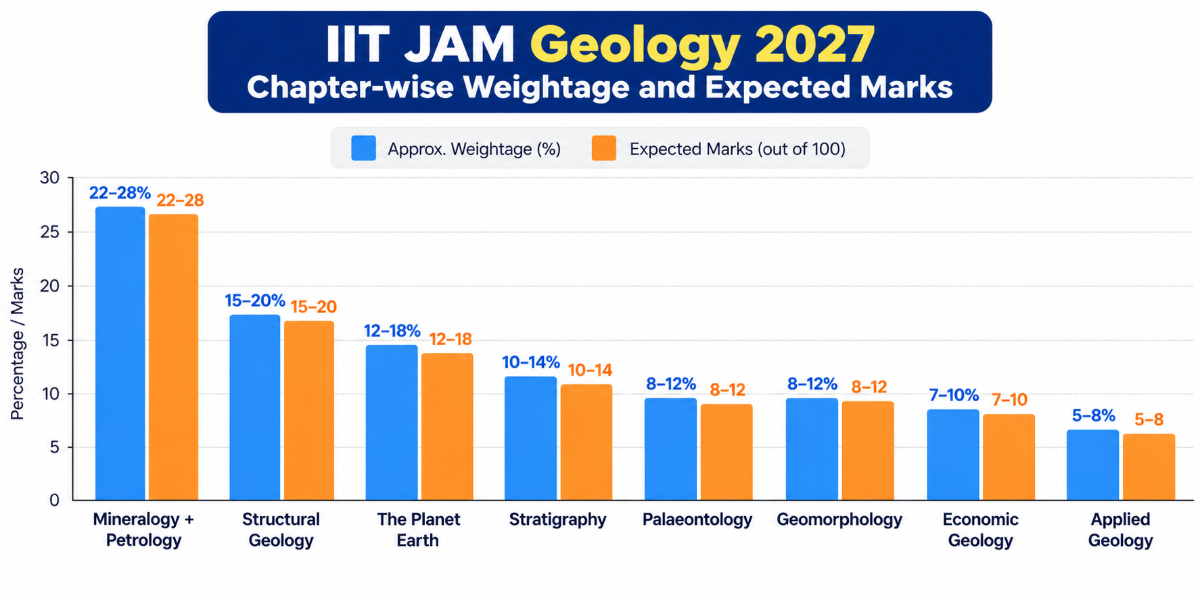
Mineralogy, Petrology, and Structural Geology are high-scoring topics in the IIT JAM Geology Syllabus, often contributing 40–50% of the paper based on previous-year trends.
- For IIT JAM Geology, focus on mineral optics, rock classification, textures, folds, faults, geological maps, and stereographic projections.
| Chapter | Approx. Weightage (%) | Expected Marks | Priority |
|---|---|---|---|
| Mineralogy + Petrology | 22–28% | 22–28 | Highest |
| Structural Geology | 15–20% | 15–20 | Highest |
| The Planet Earth | 12–18% | 12–18 | High |
| Stratigraphy | 10–14% | 10–14 | High |
| Palaeontology | 8–12% | 8–12 | Medium-High |
| Geomorphology | 8–12% | 8–12 | Medium |
| Economic Geology | 7–10% | 7–10 | Medium |
| Applied Geology | 5–8% | 5–8 | Medium |
Also Read: IIT JAM Chapter Wise Weightage: Check Subject Wise High Weightage Topics
IIT JAM Geology Syllabus 2027: Mineralogy
In the IIT JAM Geology Syllabus, Mineralogy and Petrology together carry an estimated 20–28% weightage.
- For IIT JAM Geology, focus on optical properties (PPL and XPL), silicate structures, physical properties, and common rock-forming minerals.
| Sub-topic | Detailed Coverage |
|---|---|
| Crystallography | Symmetry and forms in common crystal classes; Miller indices |
| Twinning | Twinning and twinning laws |
| Mineral Chemistry & Solid Solutions | Isomorphism, polymorphism, solid solution and exsolution |
| Optical Mineralogy | Elements of Optical Mineralogy |
| Rock-forming Minerals | Classification, structure, chemistry, physical and optical properties of common rock-forming minerals |
IIT JAM Geology Syllabus 2027: Petrology
In the IIT JAM Geology Syllabus 2027, Petrology and Mineralogy together carry an estimated 20–28% weightage.
- Focus on igneous textures, rock classification, metamorphic facies, sedimentary structures, and binary phase diagrams in the Geology Syllabus.
| Sub-section | Detailed Topics Covered |
|---|---|
| Igneous Petrology |
|
| Sedimentary Petrology |
|
| Metamorphic Petrology |
|
IIT JAM Geology Syllabus 2027: Structural Geology
In the IIT JAM Geology Syllabus 2027, Structural Geology is a high-weightage area, often contributing 15–20% of the paper.
- Focus on geological maps, cross-sections, stereographic projections, folds, faults, and borehole problems in the Geology Syllabus.
| Sub-topic | Detailed Coverage |
|---|---|
| Orientation of Planes & Lines | Concept of dip, strike, rake and plunge |
| Geological Maps & Outcrops | Contour lines; Rule of ‘V’s and outcrop patterns; Interpretation of geological maps; Cross-section construction |
| Structural Features | Classification and origin of folds, faults, joints, unconformities, foliations and lineations |
| Projections | Stereographic and equal-area projections of planes and lines |
| Quantitative Analysis | Quantitative interpretation of structures, outcrops, and borehole data |
IIT JAM Geology Syllabus 2027: Stratigraphy
In the IIT JAM Geology Syllabus 2027, Stratigraphy carries an estimated 10–15% weightage.
- Focus on Indian stratigraphic successions, including Gondwana, Vindhyan, Cuddapah, and Siwaliks, along with correlation principles and litho-/biostratigraphic classification in the Geology Syllabus.
| Sub-topic | Detailed Coverage |
|---|---|
| Principles of Stratigraphy | Principles of stratigraphy; Litho-, chrono- and bio-stratigraphic classification; Stratigraphic correlation techniques |
| Archaean & Proterozoic | Archaean cratons of Peninsular India (Dharwar, Singhbhum and Aravalli); Proterozoic mobile belts; Stratigraphy of Cuddapah and Vindhyan basins |
| Palaeozoic – Mesozoic | Stratigraphy of Palaeozoic–Mesozoic of Spiti and Kashmir; Gondwana Supergroup; Jurassic of Kutch; Cretaceous of Trichinopoly |
| Cenozoic | Cenozoic sequences of Assam, Bengal and Siwaliks |
Also Read:
IIT JAM Geology Syllabus 2027 for MSc Admission
The IIT JAM Geology Syllabus covers 8 major areas, including Mineralogy, Petrology, Structural Geology, and Stratigraphy. Candidates preparing for IIT JAM Geology 2027 should understand core concepts and practise previous-year questions to strengthen their preparation.
| Topics | Key Areas to Cover |
|---|---|
| The Planet Earth | Origin and structure of Earth, earthquakes, volcanism, plate tectonics, Earth's age, and orogenic cycles |
| Geomorphology | Weathering, erosion, soil formation, transportation, deposition, and landforms |
| Structural Geology | Dip, strike, folds, faults, geological maps, cross-sections, and stereographic projections |
| Palaeontology | Fossils, preservation, evolution of life, major fossil groups, and their geological significance |
| Stratigraphy | Principles of stratigraphy, Indian stratigraphic successions, geological time scale, and stratigraphic correlation |
| Mineralogy | Crystallography, optical properties, physical properties, silicate structures, and rock-forming minerals |
| Petrology | Igneous, sedimentary, and metamorphic rocks, rock classification, textures, and mineral assemblages |
| Economic and Applied Geology | Mineral deposits, groundwater, engineering geology, coal, petroleum, and environmental geology |
IIT JAM Geology Syllabus 2027 for Beginners
Beginners should first study The Planet Earth and Geomorphology to build a strong foundation in geological concepts.
- Focus on Mineralogy, Petrology, and Structural Geology to develop an understanding of minerals, rocks, and geological structures.
- Practise geological maps, rock textures, mineral identification, and structural diagrams for better conceptual clarity.
- Solve IIT JAM Geology PYQs topic-wise to understand question patterns, difficulty levels, and commonly tested concepts.
- Prepare short notes, revise formulas and classifications regularly, and attempt mock tests to improve speed and accuracy.
| Stage | Topics to Cover | Preparation Tips |
|---|---|---|
| Build Basic Concepts | The Planet Earth, Geomorphology | Understand Earth's structure, plate tectonics, weathering, and landforms. |
| Study Minerals and Rocks | Mineralogy, Petrology | Learn mineral properties, optical characteristics, rock types, and classification. |
| Understand Geological Structures | Structural Geology | Practise folds, faults, geological maps, and stereographic projections. |
| Learn Earth's History | Stratigraphy, Palaeontology | Study geological time scales, Indian stratigraphic sequences, and fossils. |
| Cover Applied Topics | Economic and Applied Geology | Understand mineral resources, groundwater, and basic engineering geology. |
| Practise and Revise | Previous-Year Questions (PYQs), Mock Tests | Solve topic-wise questions, revise concepts, and analyse mistakes regularly. |
Best Books to Cover the IIT JAM Geology Syllabus 2027
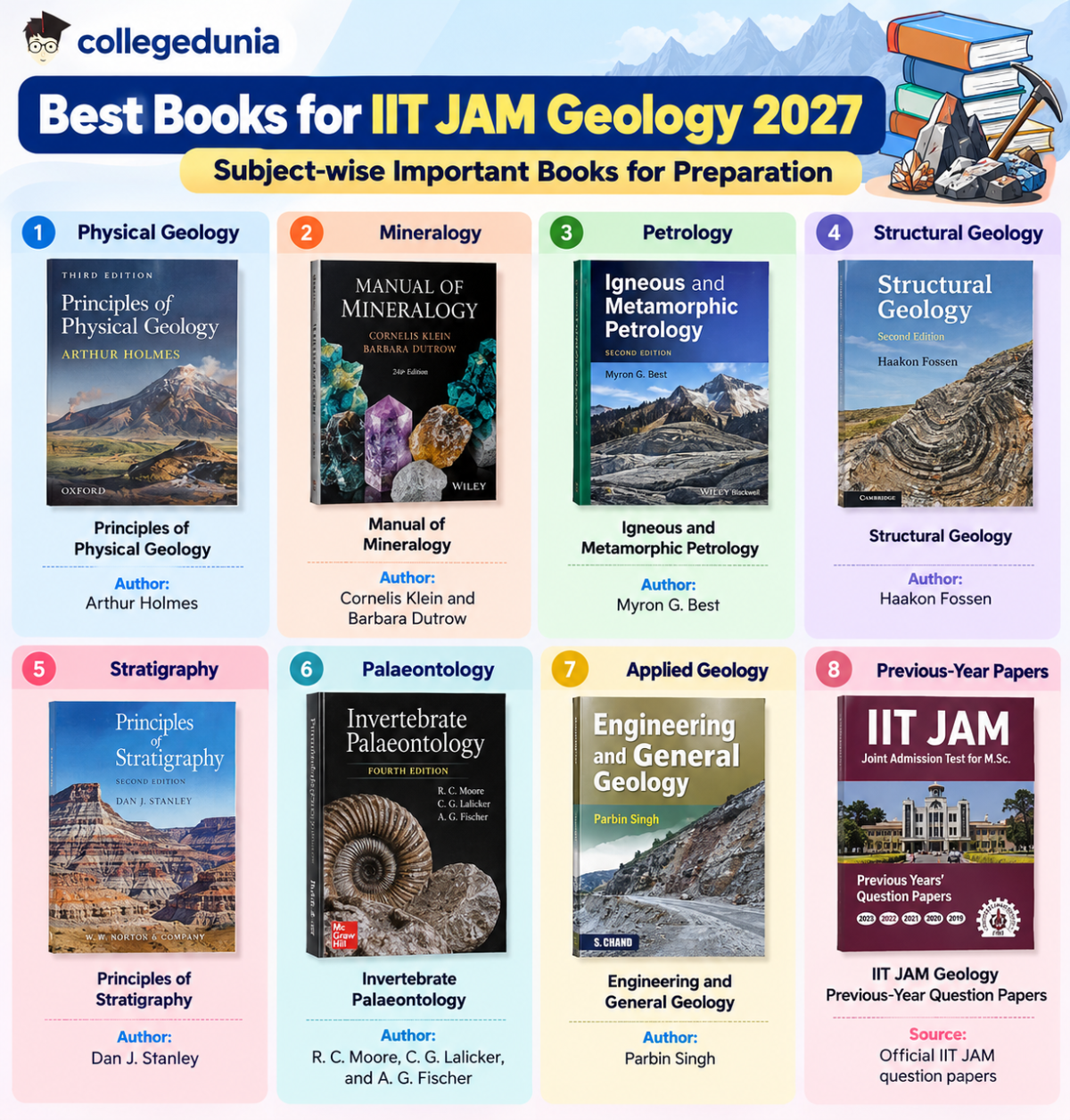
Beginners preparing for the IIT JAM Syllabus 2027 should start with introductory geology books before moving to subject-specific references.
- Practise previous-year questions alongside each topic to strengthen concepts and improve exam readiness.
| Book Name | Author | Topics Covered |
|---|---|---|
| Principles of Physical Geology | Arthur Holmes | Earth structure, geological processes, plate tectonics, and geomorphology |
| Manual of Mineralogy | Cornelis Klein and Barbara Dutrow | Crystallography, mineral properties, and mineral identification |
| Igneous and Metamorphic Petrology | Myron G. Best | Igneous rocks, metamorphism, rock classification, and petrogenesis |
| Structural Geology | Haakon Fossen | Folds, faults, geological maps, and structural analysis |
| Principles of Stratigraphy | Dan J. Stanley | Stratigraphic principles, correlation, and geological history |
| Invertebrate Palaeontology | R. C. Moore, C. G. Lalicker, and A. G. Fischer | Fossils, invertebrate groups, and palaeontological classification |
| Engineering and General Geology | Parbin Singh | Applied geology, groundwater, engineering geology, and mineral resources |
| IIT JAM Geology Previous-Year Question Papers | Official IIT JAM question papers | Exam pattern, question types, practice, and self-assessment |

Source: Quora
A student on Quora has posted a question: “Which portions of the IIT JAM geology syllabus are important for numerical questions?”
Ans. For numerical questions in the IIT JAM Geology exam, focus on Structural Geology, Mineralogy, Petrology, and Geomorphology.
- Practise problems on stereographic projections, geological maps, mineral formulas, phase diagrams, and geological calculations.
- Basic mathematics and data interpretation may also be useful.
- Solve previous-year question papers to identify recurring numerical patterns and improve your speed and accuracy.
Preparation Strategy for IIT JAM Geology Syllabus 2027
To prepare effectively for the Geology Syllabus, build strong fundamentals, prioritise important topics, and practise previous-year questions regularly.
- Take timed mock tests, maintain short revision notes, and analyse mistakes to improve accuracy and time management.
| Preparation Step | What to Do |
|---|---|
| Understand the Syllabus | Review all topics in the IIT JAM Geology Syllabus 2027.Identify your strengths and weaknesses. |
| Build Strong Fundamentals | Start with basic concepts in the Planet Earth, Geomorphology, Mineralogy, and Petrology. |
| Prioritise Important Topics | Give extra practice to Structural Geology, Mineralogy, Petrology, and Stratigraphy while covering the complete syllabus. |
| Follow Standard Books | Use reliable geology textbooks and concise notes for each subject. |
| Practise Previous-Year Questions | Solve IIT JAM Geology PYQs topic-wise and review the solutions. |
| Practise Numerical Problems | Work on geological calculations, stereographic projections, and other numerical questions. |
| Take Mock Tests | Attempt full-length mock tests under timed conditions. |
| Revise Regularly | Maintain short notes for classifications, geological time scales, mineral properties, and key concepts. |
| Analyse Mistakes | Keep an error notebook and revisit weak topics after each test. |

Source: Quora
4-month Study Plan for the IIT JAM Geology Syllabus
Aim for consistent daily study and weekly revision.
- Adjust the schedule according to your existing knowledge, and avoid leaving previous-year questions and mock tests until the final weeks.
| Month | Topics to Cover | Preparation Tasks |
|---|---|---|
| Month 1: Build Fundamentals | The Planet Earth, Geomorphology, Mineralogy | Study basic geological concepts, Earth's structure, landforms, crystallography, and mineral properties. Make short notes and practise topic-wise questions. |
| Month 2: Core Geology | Petrology, Structural Geology | Cover igneous, sedimentary, and metamorphic rocks, folds, faults, geological maps, and stereographic projections. Practise numerical problems regularly. |
| Month 3: Complete the Syllabus | Stratigraphy, Palaeontology, Economic and Applied Geology | Study Indian stratigraphic successions, fossils, geological time scales, mineral resources, and applied geology. Solve previous-year questions for each topic. |
| Month 4: Revision and Mock Tests | All topics in the IIT JAM Geology Syllabus 2027 | Revise short notes, practise previous-year papers, take timed mock tests, analyse mistakes, and strengthen weak areas. |

Source: Quora
A student on Quora has asked an ambitious question, which is “How do I prepare for the IIT JAM Geology in 15 days?”
Ans. Preparing for IIT JAM Geology in 15 days is challenging, but you can improve your score with focused revision and practice.
- Prioritise important topics such as Mineralogy, Petrology, Structural Geology, and Stratigraphy.
- Solve previous-year question papers and attempt timed mock tests to understand the exam pattern.
- Revise short notes, geological classifications, and key concepts daily.
- Avoid starting too many new topics and focus on strengthening areas you already understand.
IIT JAM Geology Syllabus 2027 FAQs
Ques. Which institutes, except for the IITs, offer seats for PG geology on the basis of the IIT JAM results?
Ans. Apart from IITs, institutes such as IISc Bengaluru, NITs, IISER Pune, IISER Bhopal, IIEST Shibpur, and DIAT Pune accept IIT JAM scores for certain postgraduate programmes.
Ques. Is there tough competition in the IIT JAM for geology?
Ans. Yes, IIT JAM Geology has competitive admission due to limited seats in top IITs and other participating institutes. However, a strong understanding of the IIT JAM Geology Syllabus, regular PYQ practice, and mock tests can improve your chances of securing a good rank.
Ques. How many students appear for IIT JAM for Geology?
Ans. Approximately 5,000–7,000 students may appear for the IIT JAM Geology paper in a typical year; however, the exact number varies annually.
Ques. How many marks does one need to score in IIT JAM GEOLOGY to secure a seat in IIT?
Ans. To secure an IIT seat through IIT JAM Geology, aim for 40–50+ marks out of 100 as a preparation target, though the required score varies by IIT, category, and programme. The 2026 General-category qualifying cutoff was 25.98 marks, but qualifying alone does not guarantee admission.



Comments