




MHT CET 2024 May 16 Shift 2 PCM Question Paper is available for download here. Maharashtra State CET Cell conducted MHT CET 2024 PCM Exam on May 16 in Shift 2 from 2 PM to 5 PM in CBT mode.
The MHT CET 2024 PCM question paper includes the following:
- The MHT CET 2024 PCM Question Paper consists of 150 multiple-choice questions (MCQs) totalling 200 marks divided into 3 sections: Physics, Chemistry, and Mathematics, with 50 questions in each subject.
- Physics and Chemistry questions carry 1 mark each while Mathematics questions carry 2 marks each.
- There is no negative marking for incorrect answers.
MHT CET 2024 May 16 Shift 2 PCM Question Paper with Solution PDF
| CD PDF | CD PDF with Solutions |
|---|---|
| Download Collegedunia PDF 0.90 MB | - |
Also Check:
MHT CET 2024 May 16 Shift 2 PCM Questions with Solutions
Physics (Q1 - Q50)
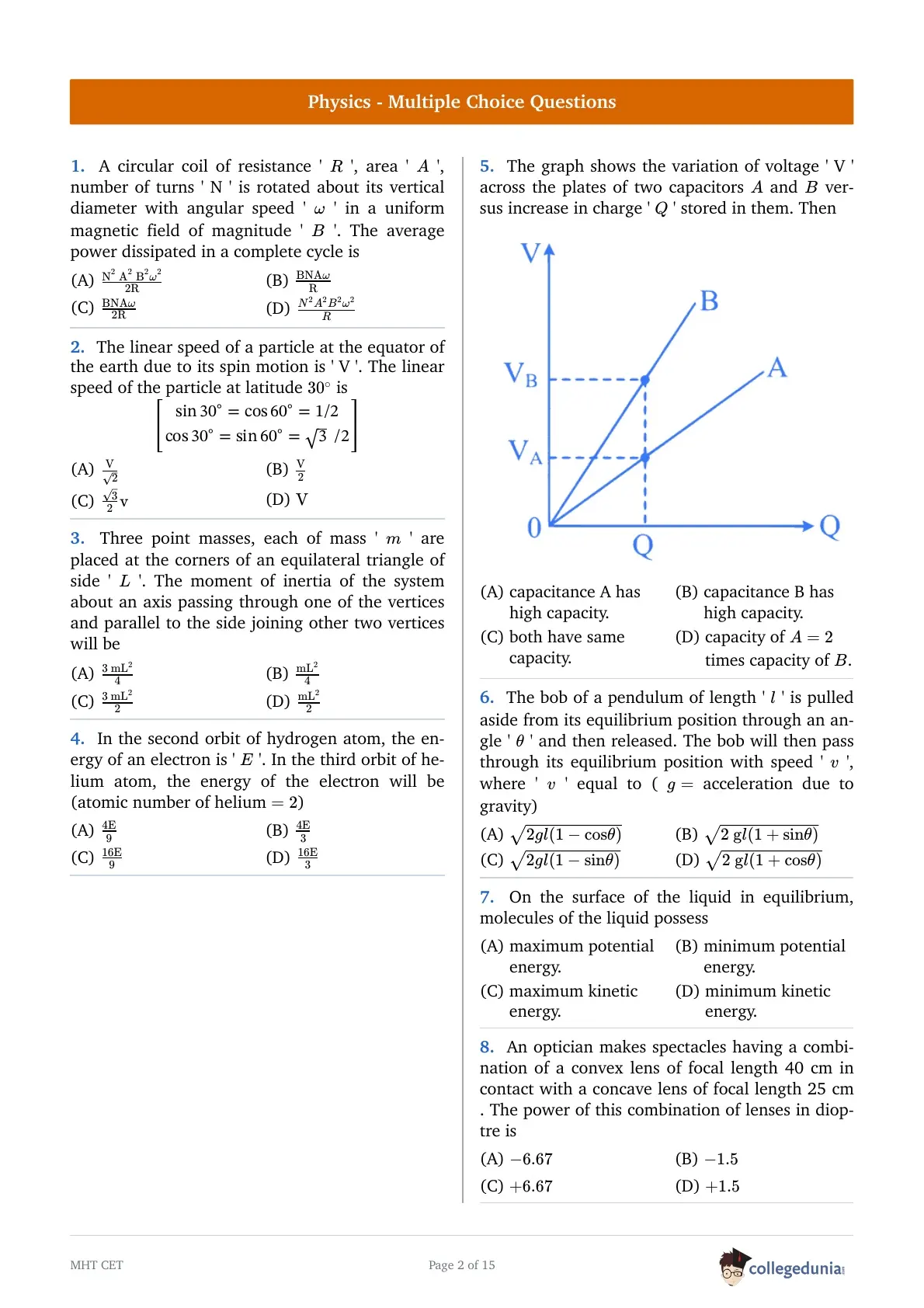
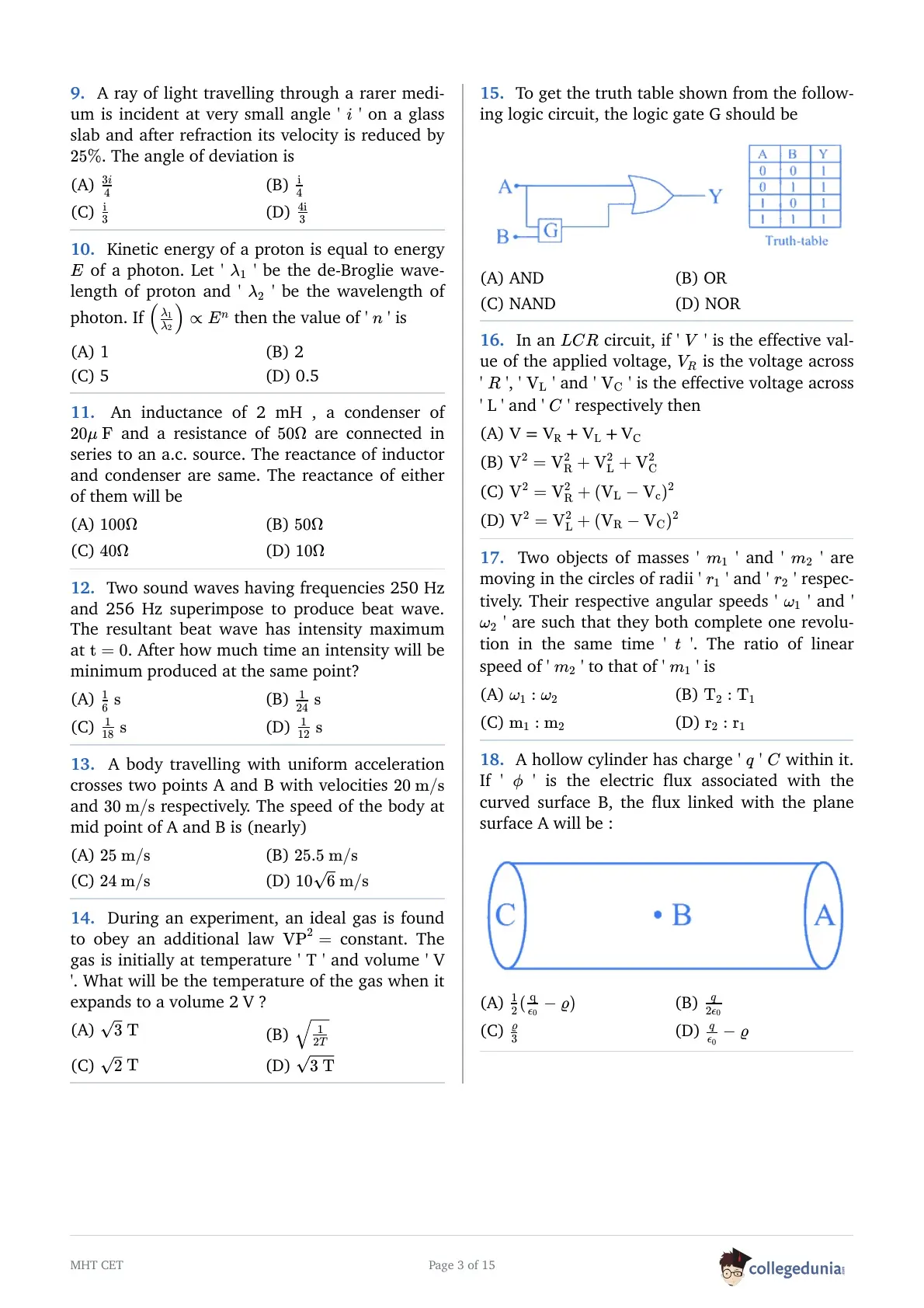
A circular coil of resistance ' \(R\) ', area ' \(A\) ', number of turns ' N ' is rotated about its vertical diameter with angular speed ' \(\omega\) ' in a uniform magnetic field of magnitude ' \(B\) '. The average power dissipated in a complete cycle is
The linear speed of a particle at the equator of the earth due to its spin motion is ' V '. The linear speed of the particle at latitude \(30^{\circ}\) is
\[\left[\begin{array}{l} \sin 30^{\circ}=\cos 60^{\circ}=1 / 2 \\ \cos 30^{\circ}=\sin 60^{\circ}=\sqrt{3} / 2 \end{array}\right]\]
Three point masses, each of mass ' \(m\) ' are placed at the corners of an equilateral triangle of side ' \(L\) '. The moment of inertia of the system about an axis passing through one of the vertices and parallel to the side joining other two vertices will be
In the second orbit of hydrogen atom, the energy of an electron is ' \(E\) '. In the third orbit of helium atom, the energy of the electron will be (atomic number of helium \(=2\))
The graph shows the variation of voltage ' V ' across the plates of two capacitors \(A\) and \(B\) versus increase in charge ' \(Q\) ' stored in them. Then

The bob of a pendulum of length ' \(l\) ' is pulled aside from its equilibrium position through an angle ' \(\theta\) ' and then released. The bob will then pass through its equilibrium position with speed ' \(v\) ', where ' \(v\) ' equal to ( \(g=\) acceleration due to gravity)
On the surface of the liquid in equilibrium, molecules of the liquid possess
An optician makes spectacles having a combination of a convex lens of focal length 40 cm in contact with a concave lens of focal length 25 cm . The power of this combination of lenses in dioptre is
A ray of light travelling through a rarer medium is incident at very small angle ' \(i\) ' on a glass slab and after refraction its velocity is reduced by \(25 \%\). The angle of deviation is
Kinetic energy of a proton is equal to energy \(E\) of a photon. Let ' \(\lambda_1\) ' be the de-Broglie wavelength of proton and ' \(\lambda_2\) ' be the wavelength of photon. If \(\left(\frac{\lambda_1}{\lambda_2}\right) \propto E^n\) then the value of ' \(n\) ' is
An inductance of 2 mH , a condenser of \(20 \mu \mathrm{~F}\) and a resistance of \(50 \Omega\) are connected in series to an a.c. source. The reactance of inductor and condenser are same. The reactance of either of them will be
Two sound waves having frequencies 250 Hz and 256 Hz superimpose to produce beat wave. The resultant beat wave has intensity maximum at \(\mathrm{t}=0\). After how much time an intensity will be minimum produced at the same point?
A body travelling with uniform acceleration crosses two points A and B with velocities \(20 \mathrm{~m} / \mathrm{s}\) and \(30 \mathrm{~m} / \mathrm{s}\) respectively. The speed of the body at mid point of A and B is (nearly)
During an experiment, an ideal gas is found to obey an additional law \(\mathrm{VP}^2=\) constant. The gas is initially at temperature ' T ' and volume ' V '. What will be the temperature of the gas when it expands to a volume 2 V ?
To get the truth table shown from the following logic circuit, the logic gate G should be

In an \(L C R\) circuit, if ' \(V\) ' is the effective value of the applied voltage, \(V_R\) is the voltage across ' \(R\) ', ' \(\mathrm{V}_{\mathrm{L}}\) ' and ' \(\mathrm{V}_{\mathrm{C}}\) ' is the effective voltage across ' L ' and ' \(C\) ' respectively then
Two objects of masses ' \(m_1\) ' and ' \(m_2\) ' are moving in the circles of radii ' \(r_1\) ' and ' \(r_2\) ' respectively. Their respective angular speeds ' \(\omega_1\) ' and ' \(\omega_2\) ' are such that they both complete one revolution in the same time ' \(t\) '. The ratio of linear speed of ' \(m_2\) ' to that of ' \(m_1\) ' is
A hollow cylinder has charge ' \(q\) ' \(C\) within it. If ' \(\phi\) ' is the electric flux associated with the curved surface B, the flux linked with the plane surface A will be :

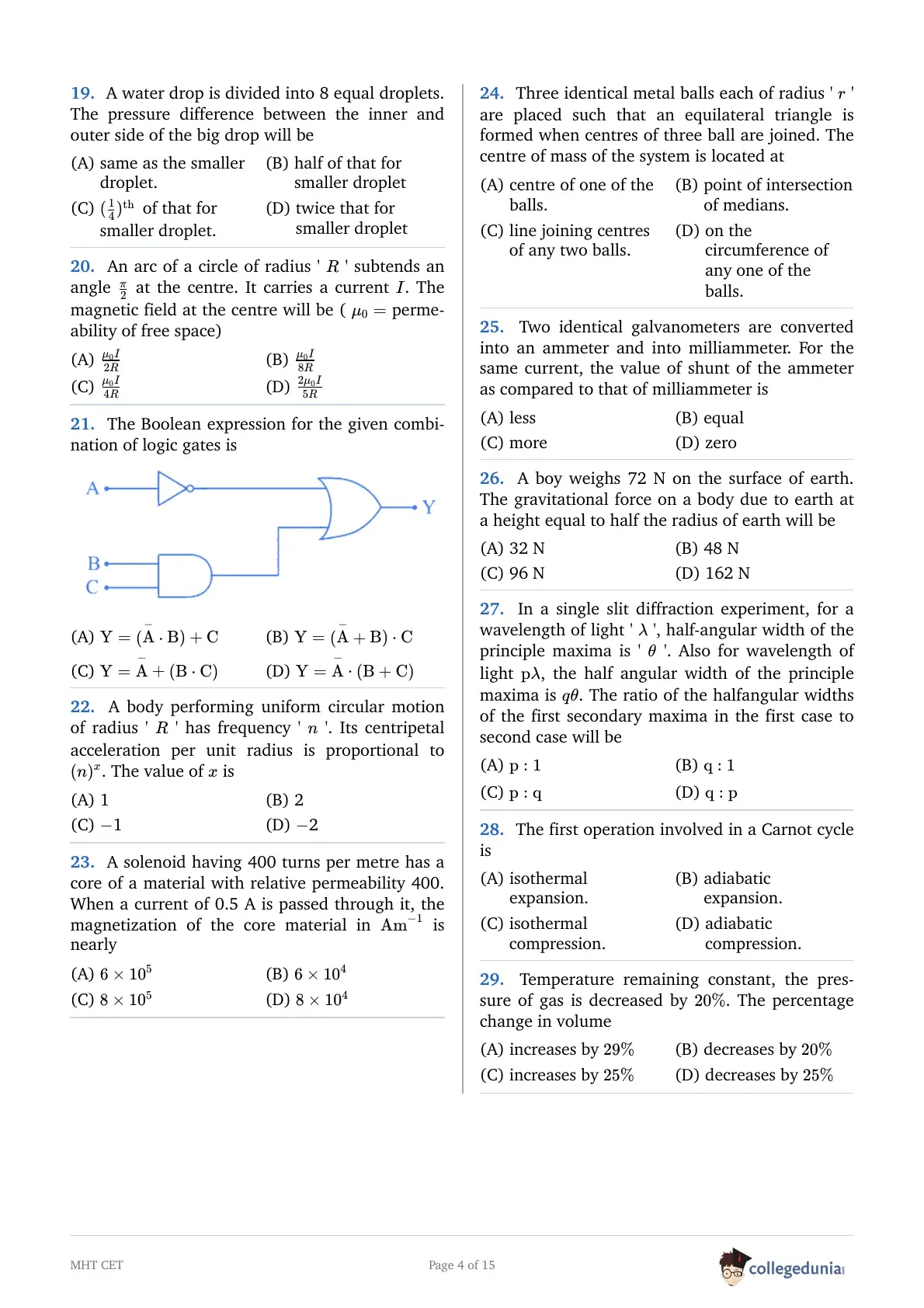
A water drop is divided into 8 equal droplets. The pressure difference between the inner and outer side of the big drop will be
An arc of a circle of radius ' \(R\) ' subtends an angle \(\frac{\pi}{2}\) at the centre. It carries a current \(I\). The magnetic field at the centre will be ( \(\mu_0=\) permeability of free space)

A body performing uniform circular motion of radius ' \(R\) ' has frequency ' \(n\) '. Its centripetal acceleration per unit radius is proportional to \((n)^x\). The value of \(x\) is
A solenoid having 400 turns per metre has a core of a material with relative permeability 400. When a current of 0.5 A is passed through it, the magnetization of the core material in \(\mathrm{Am}^{-1}\) is nearly
Three identical metal balls each of radius ' \(r\) ' are placed such that an equilateral triangle is formed when centres of three ball are joined. The centre of mass of the system is located at
Two identical galvanometers are converted into an ammeter and into milliammeter. For the same current, the value of shunt of the ammeter as compared to that of milliammeter is
A boy weighs 72 N on the surface of earth. The gravitational force on a body due to earth at a height equal to half the radius of earth will be
Temperature remaining constant, the pressure of gas is decreased by \(20 \%\). The percentage change in volume
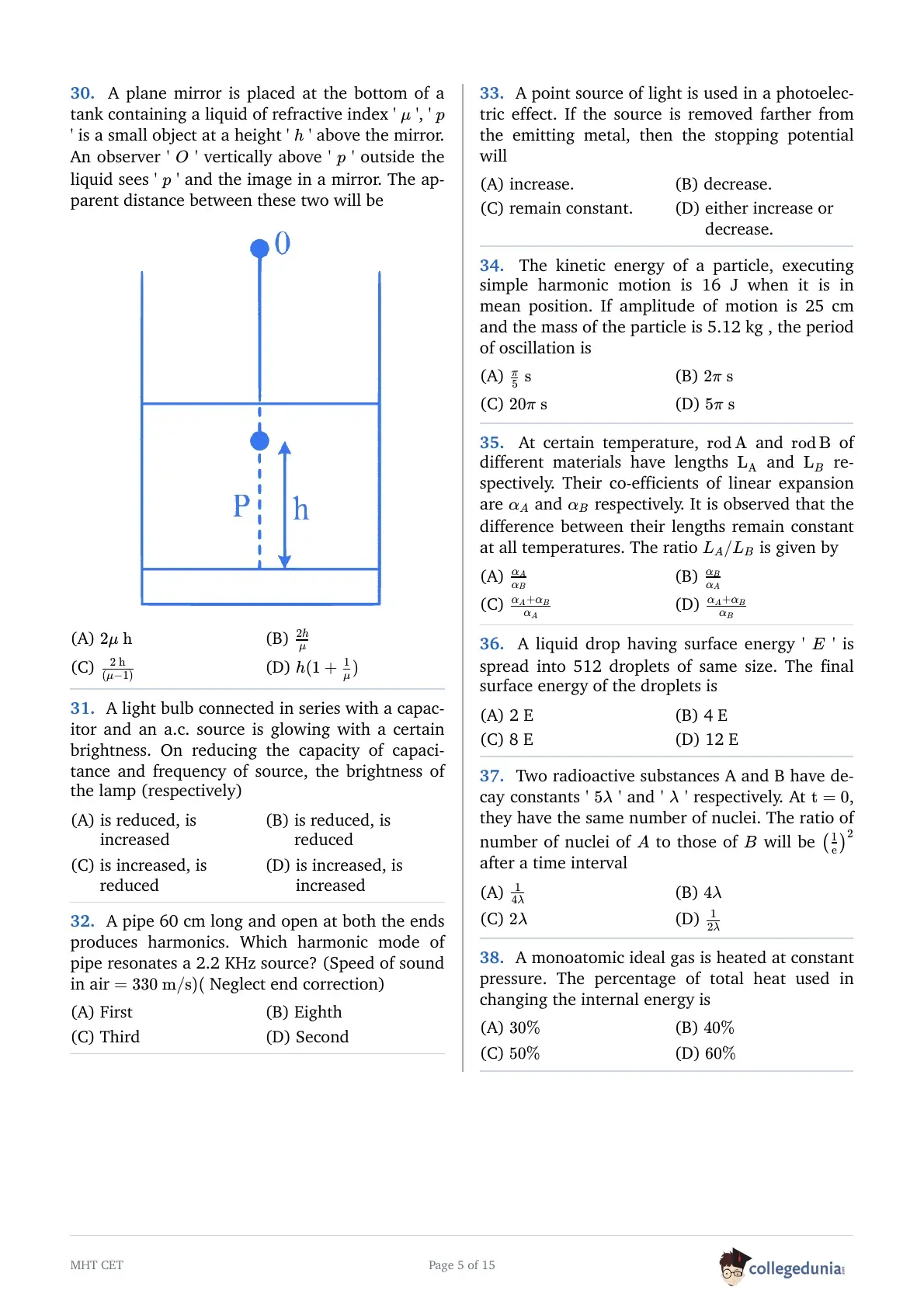
A plane mirror is placed at the bottom of a tank containing a liquid of refractive index ' \(\mu\) ', ' \(p\) ' is a small object at a height ' \(h\) ' above the mirror. An observer ' \(O\) ' vertically above ' \(p\) ' outside the liquid sees ' \(p\) ' and the image in a mirror. The apparent distance between these two will be

A light bulb connected in series with a capacitor and an a.c. source is glowing with a certain brightness. On reducing the capacity of capacitance and frequency of source, the brightness of the lamp (respectively)
A pipe 60 cm long and open at both the ends produces harmonics. Which harmonic mode of pipe resonates a 2.2 KHz source? (Speed of sound in air \(=330 \mathrm{~m} / \mathrm{s})(\) Neglect end correction)
A point source of light is used in a photoelectric effect. If the source is removed farther from the emitting metal, then the stopping potential will
The kinetic energy of a particle, executing simple harmonic motion is 16 J when it is in mean position. If amplitude of motion is 25 cm and the mass of the particle is 5.12 kg , the period of oscillation is
At certain temperature, \(\operatorname{rod} \mathrm{A}\) and \(\operatorname{rod} \mathrm{B}\) of different materials have lengths \(\mathrm{L}_{\mathrm{A}}\) and \(\mathrm{L}_B\) respectively. Their co-efficients of linear expansion are \(\alpha_A\) and \(\alpha_B\) respectively. It is observed that the difference between their lengths remain constant at all temperatures. The ratio \(L_A / L_B\) is given by
A liquid drop having surface energy ' \(E\) ' is spread into 512 droplets of same size. The final surface energy of the droplets is
Two radioactive substances A and B have decay constants ' \(5 \lambda\) ' and ' \(\lambda\) ' respectively. At \(\mathrm{t}=0\), they have the same number of nuclei. The ratio of number of nuclei of \(A\) to those of \(B\) will be \(\left(\frac{1}{\mathrm{e}}\right)^2\) after a time interval
A monoatomic ideal gas is heated at constant pressure. The percentage of total heat used in changing the internal energy is
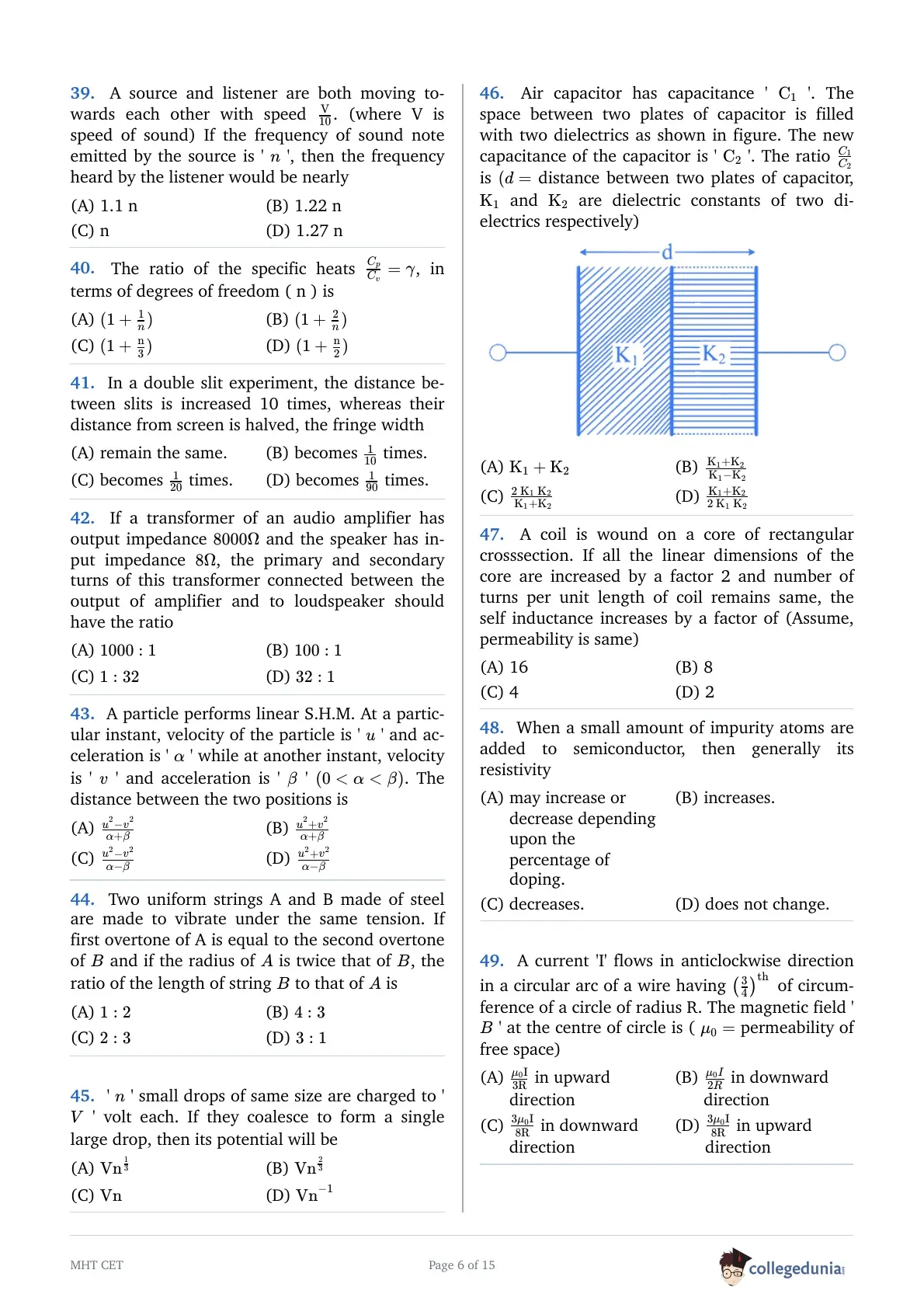
A source and listener are both moving towards each other with speed \(\frac{\mathrm{V}}{10}\). (where V is speed of sound) If the frequency of sound note emitted by the source is ' \(n\) ', then the frequency heard by the listener would be nearly
The ratio of the specific heats \(\frac{C_p}{C_v}=\gamma\), in terms of degrees of freedom ( n ) is
In a double slit experiment, the distance between slits is increased 10 times, whereas their distance from screen is halved, the fringe width
If a transformer of an audio amplifier has output impedance \(8000 \Omega\) and the speaker has input impedance \(8 \Omega\), the primary and secondary turns of this transformer connected between the output of amplifier and to loudspeaker should have the ratio
A particle performs linear S.H.M. At a particular instant, velocity of the particle is ' \(u\) ' and acceleration is ' \(\alpha\) ' while at another instant, velocity is ' \(v\) ' and acceleration is ' \(\beta\) ' \(0<\alpha<\beta\). The distance between the two positions is
Two uniform strings ' A ' and ' B ' made of steel are made to vibrate under same tension. If the first overtone of ' A ' is equal to second overtone of ' B ' and radius of ' A ' is twice that of ' B '. Then the ratio of length of string ' A ' to that of ' B ' is
' \(n\) ' small drops of same size are charged to ' \(V\) ' volt each. If they coalesce to form a single large drop, then its potential will be
Air capacitor has capacitance ' \(\mathrm{C}_1\) '. The space between two plates of capacitor is filled with two dielectrics as shown in figure. The new capacitance of the capacitor is ' \(\mathrm{C}_2\) '. The ratio \(\frac{C_1}{C_2}\) is \((d=\) distance between two plates of capacitor, \(\mathrm{K}_1\) and \(\mathrm{K}_2\) are dielectric constants of two dielectrics respectively)

A coil is wound on a core of rectangular crosssection. If all the linear dimensions of the core are increased by a factor 2 and number of turns per unit length of coil remains same, the self inductance increases by a factor of (Assume, permeability is same)
When a small amount of impurity atoms are added to semiconductor, then generally its resistivity
A current 'I' flows in anticlockwise direction in a circular arc of a wire having \(\left(\frac{3}{4}\right)^{\text {th }}\) of circumference of a circle of radius R. The magnetic field ' \(B\) ' at the centre of circle is ( \(\mu_0=\) permeability of free space)
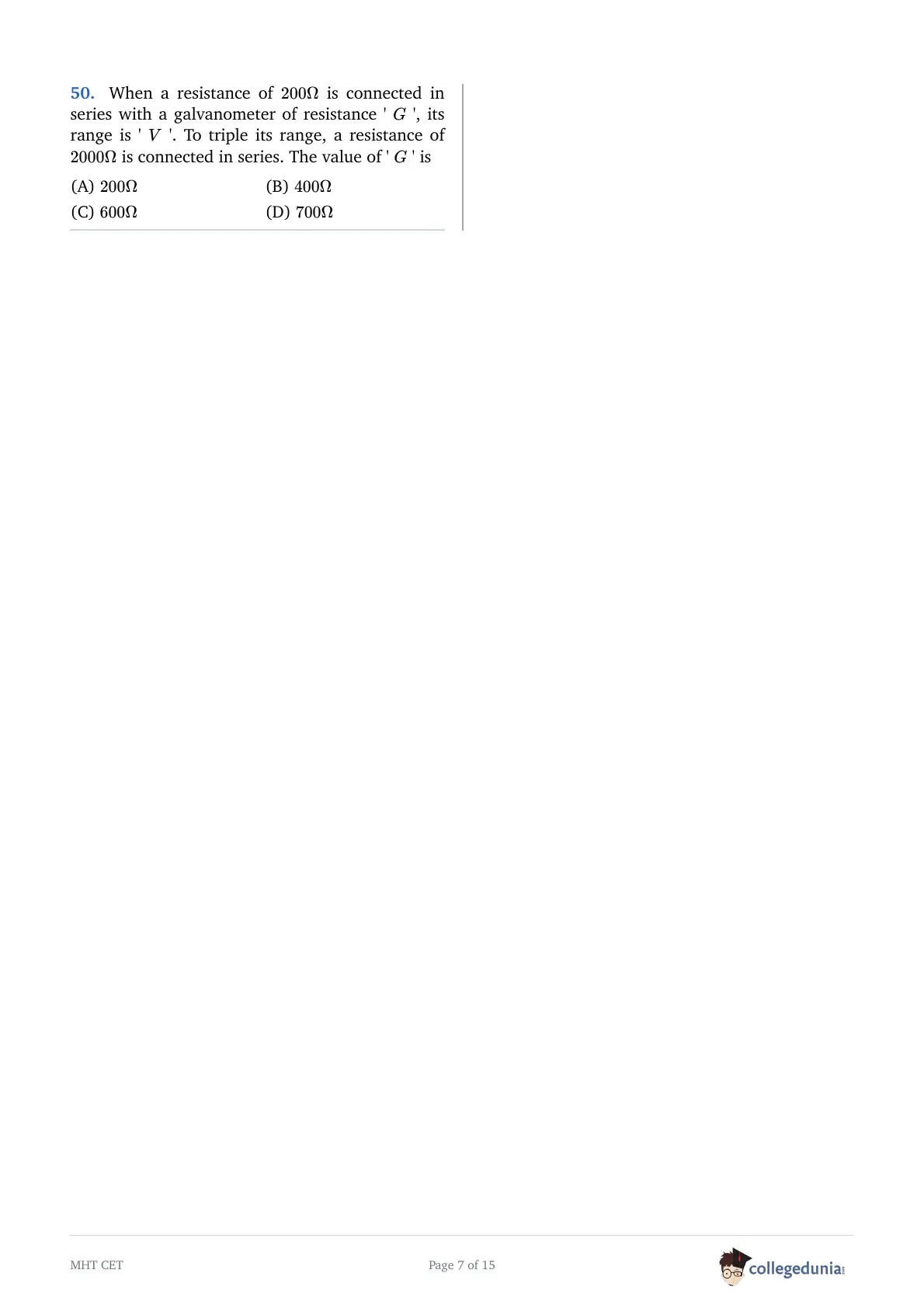
When a resistance of \(200 \Omega\) is connected in series with a galvanometer of resistance ' \(G\) ', its range is ' \(V\) '. To triple its range, a resistance of \(2000 \Omega\) is connected in series. The value of ' \(G\) ' is
Chemistry (Q51 - Q100)
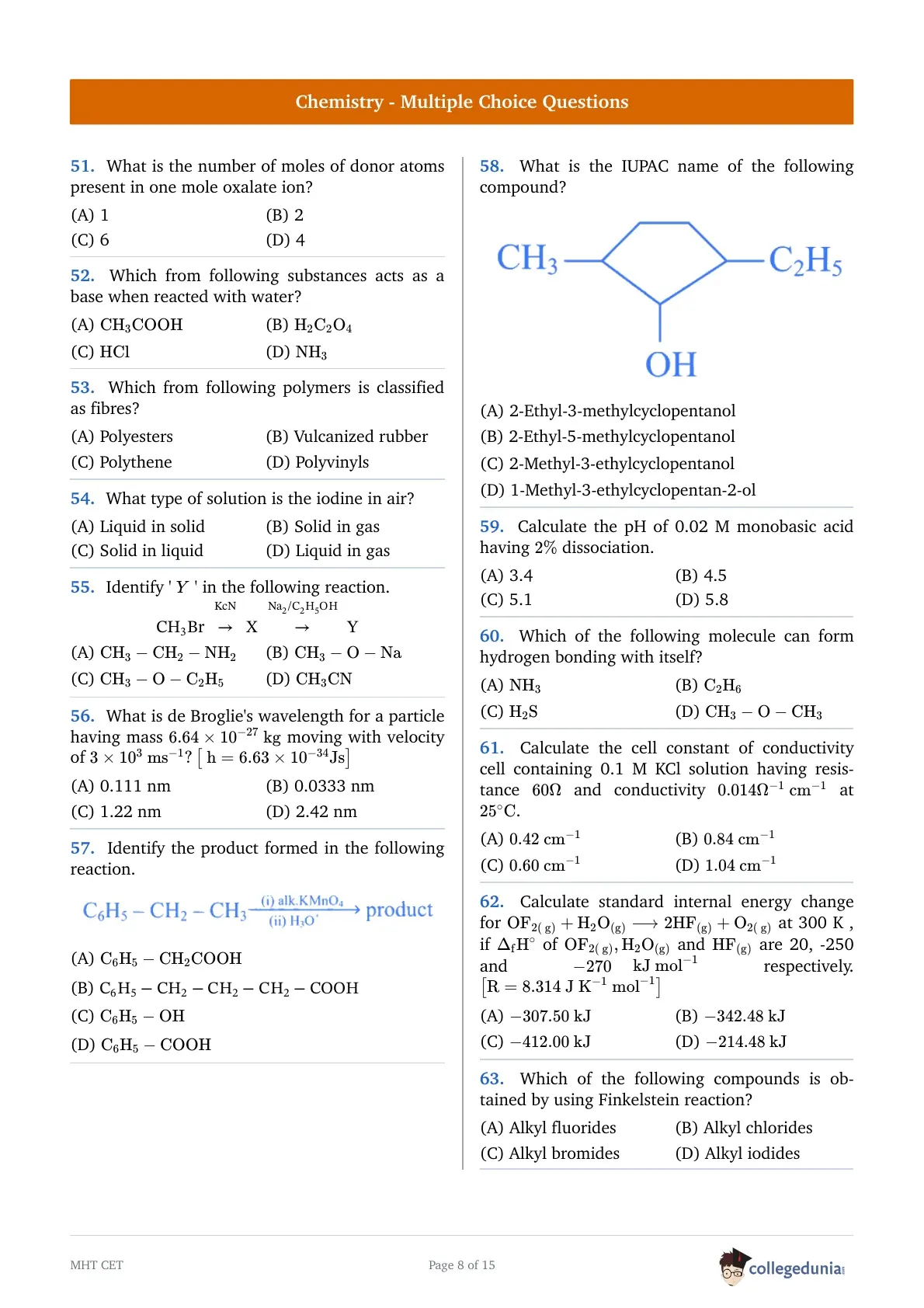
What is the number of moles of donor atoms present in one mole oxalate ion?
Which from following substances acts as a base when reacted with water?
Identify ' \(Y\) ' in the following reaction.
\[\mathrm{CH}_3 \mathrm{Br} \xrightarrow{\mathrm{KcN}} \mathrm{X} \xrightarrow{\mathrm{Na}_2 / \mathrm{C}_2 \mathrm{H}_5 \mathrm{OH}} \mathrm{Y}\]
What is de Broglie's wavelength for a particle having mass \(6.64 \times 10^{-27} \mathrm{~kg}\) moving with velocity of \(3 \times 10^3 \mathrm{~ms}^{-1} ?\left[\mathrm{~h}=6.63 \times 10^{-34} \mathrm{Js}\right]\)


Calculate the pH of 0.02 M monobasic acid having \(2 \%\) dissociation.
Which of the following molecule can form hydrogen bonding with itself?
Calculate the cell constant of conductivity cell containing 0.1 M KCl solution having resistance \(60 \Omega\) and conductivity \(0.014 \Omega^{-1} \mathrm{~cm}^{-1}\) at \(25^{\circ} \mathrm{C}\).
Which of the following compounds is obtained by using Finkelstein reaction?
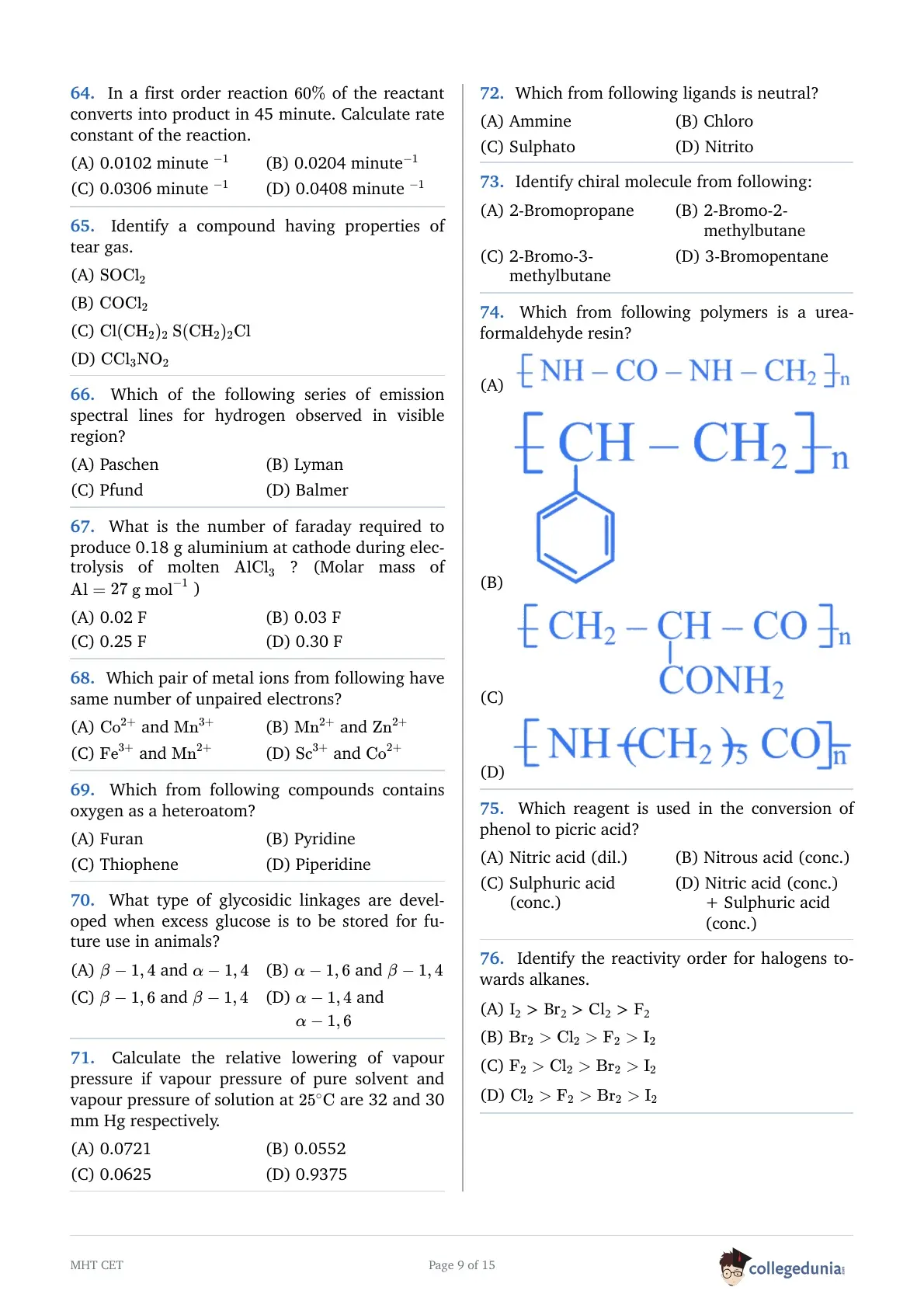
In a first order reaction \(60 \%\) of the reactant converts into product in 45 minute. Calculate rate constant of the reaction.
Which of the following series of emission spectral lines for hydrogen observed in visible region?
What is the number of faraday required to produce 0.18 g aluminium at cathode during electrolysis of molten \(\mathrm{AlCl}_3\) ? (Molar mass of \(\mathrm{Al}=27 \mathrm{~g} \mathrm{~mol}^{-1}\) )
Which pair of metal ions from following have same number of unpaired electrons?
What type of glycosidic linkages are developed when excess glucose is to be stored for future use in animals?
Calculate the relative lowering of vapour pressure if vapour pressure of pure solvent and vapour pressure of solution at \(25^{\circ} \mathrm{C}\) are 32 and 30 mm Hg respectively.
Which from following polymers is a urea-formaldehyde resin?
- (A)
![]()
- (B)
![]()
- (C)
![]()
- (D)
![]()


What is the total number of tetrahedral voids in 0.6 mole of compound that forms hcp structure?
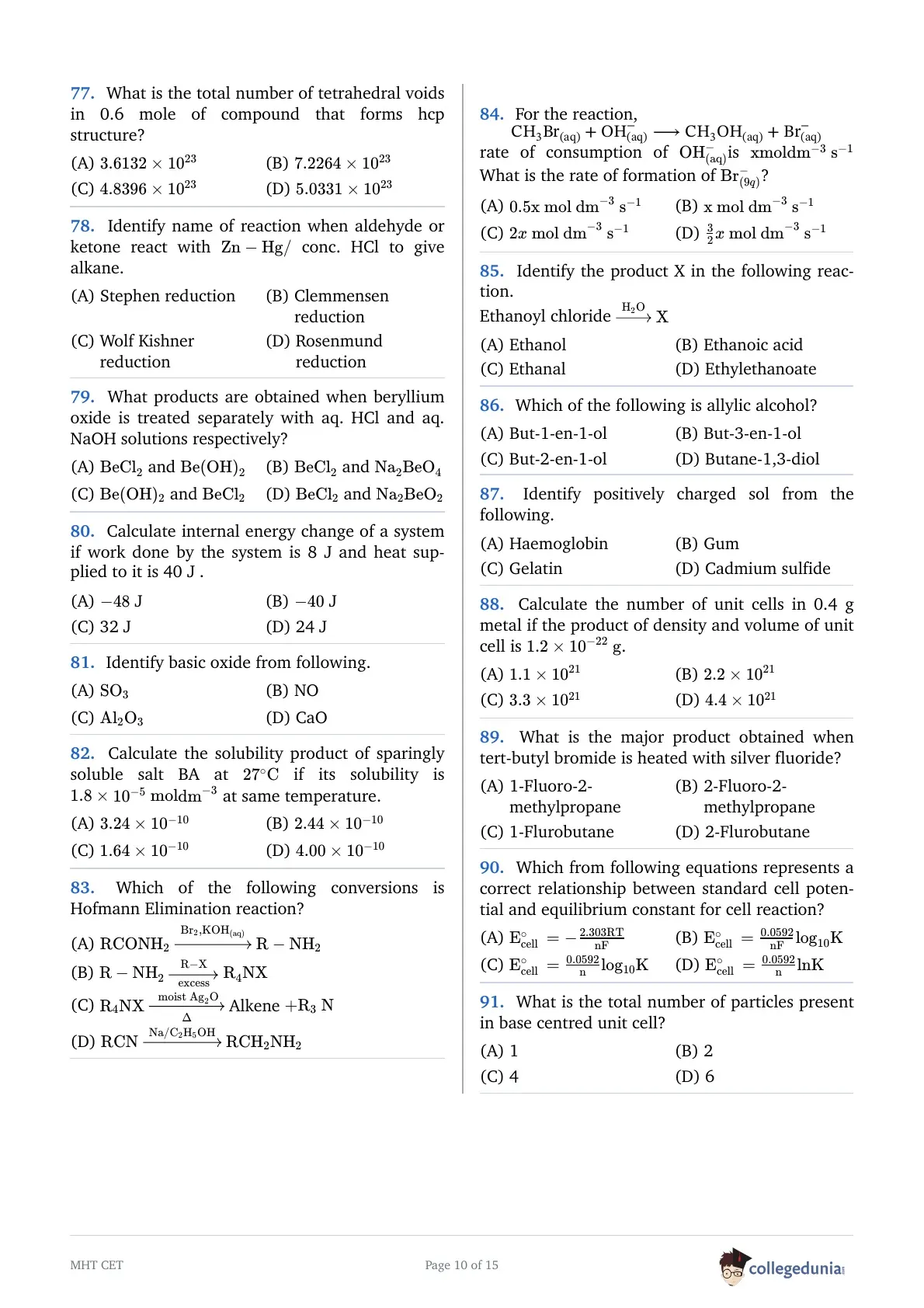
Identify name of reaction when aldehyde or ketone react with \(\mathrm{Zn}-\mathrm{Hg} /\) conc. HCl to give alkane.
What products are obtained when beryllium oxide is treated separately with aq. HCl and aq. NaOH solutions respectively?
Calculate internal energy change of a system if work done by the system is 8 J and heat supplied to it is 40 J .
Calculate the solubility product of sparingly soluble salt BA at \(27^{\circ} \mathrm{C}\) if its solubility is \(1.8 \times 10^{-5} \mathrm{~mol} \mathrm{dm}^{-3}\) at same temperature.
For the reaction,
\[\mathrm{CH}_3 \mathrm{Br}_{(\mathrm{aq})}+\mathrm{OH}_{(\mathrm{aq})}^{-} \longrightarrow \mathrm{CH}_3 \mathrm{OH}_{(\mathrm{aq})}+\mathrm{Br}_{(\mathrm{aq})}^{-}\]
rate of consumption of \(\mathrm{OH}_{(\mathrm{aq})}^{-}\)is \(\mathrm{x} \mathrm{mol} \mathrm{dm}{ }^{-3} \mathrm{~s}^{-1}\) What is the rate of formation of \(\mathrm{Br}_{(9 q)}^{-}\)?
Identify the product X in the following reaction.
Ethanoyl chloride \(\xrightarrow{\mathrm{H}_2 \mathrm{O}} \mathrm{X}\)
Calculate the number of unit cells in 0.4 g metal if the product of density and volume of unit cell is \(1.2 \times 10^{-22} \mathrm{~g}\).
What is the major product obtained when tert-butyl bromide is heated with silver fluoride?
Which from following equations represents a correct relationship between standard cell potential and equilibrium constant for cell reaction?
What is the total number of particles present in base centred unit cell?
Which of the following equation relates temperature of a reaction with \(\Delta \mathrm{H}^{\circ}\) and \(\Delta \mathrm{S}^{\circ}\) at equilibrium?
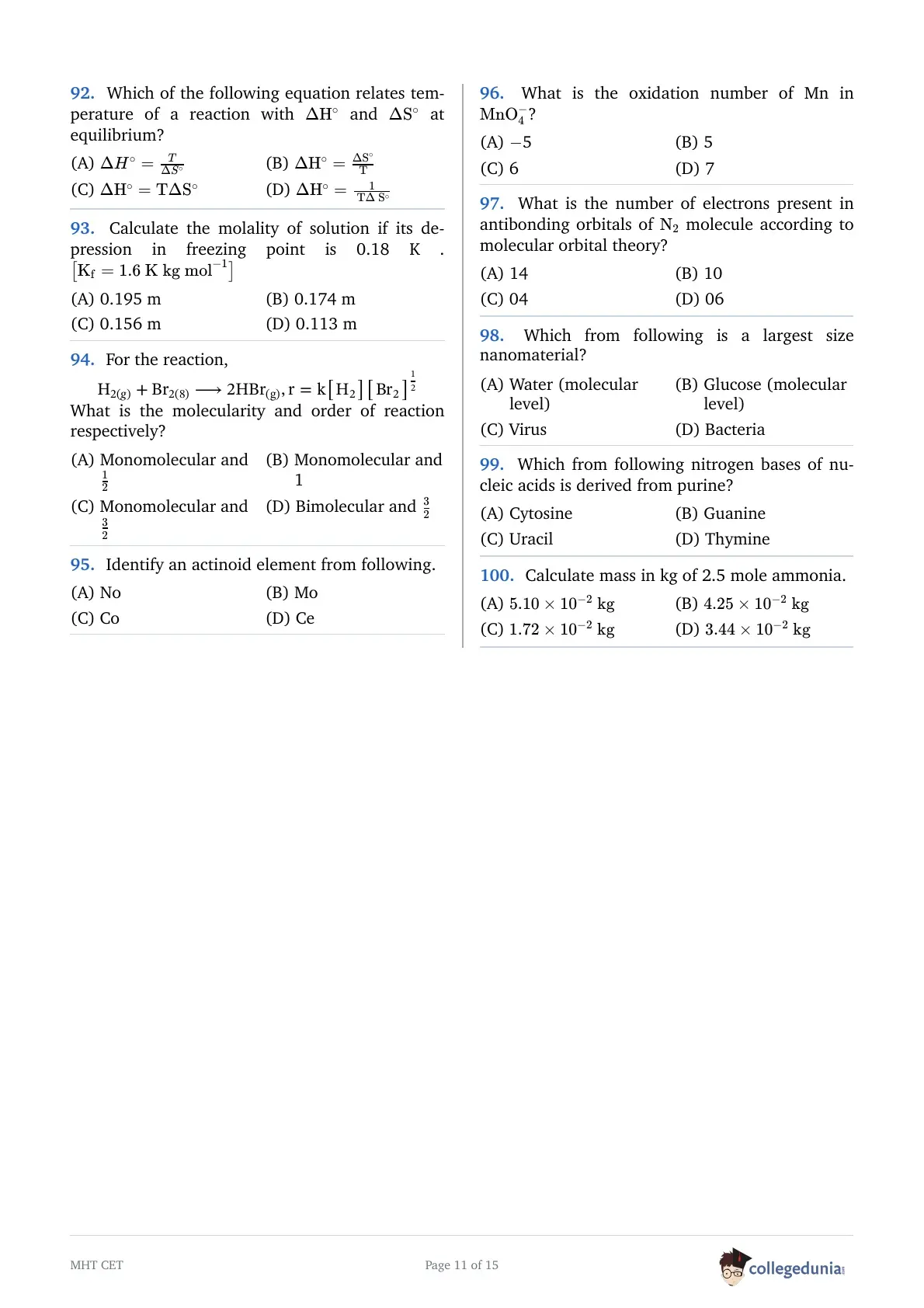
Calculate the molality of solution if its depression in freezing point is 0.18 K . \(\left[\mathrm{K}_{\mathrm{f}}=1.6 \mathrm{~K} \mathrm{~kg} \mathrm{~mol}^{-1}\right]\)
For the reaction,
\[\mathrm{H}_{2(g)}+\mathrm{Br}_{2(8)} \longrightarrow 2 \mathrm{HBr}_{(\mathrm{g})}, \mathrm{r}=\mathrm{k}\left[\mathrm{H}_2\right]\left[\mathrm{Br}_2\right]^{\frac{1}{2}}\]
What is the molecularity and order of reaction respectively?
What is the number of electrons present in antibonding orbitals of \(\mathrm{N}_2\) molecule according to molecular orbital theory?
Which from following nitrogen bases of nucleic acids is derived from purine?
Mathematics (Q101 - Q150)
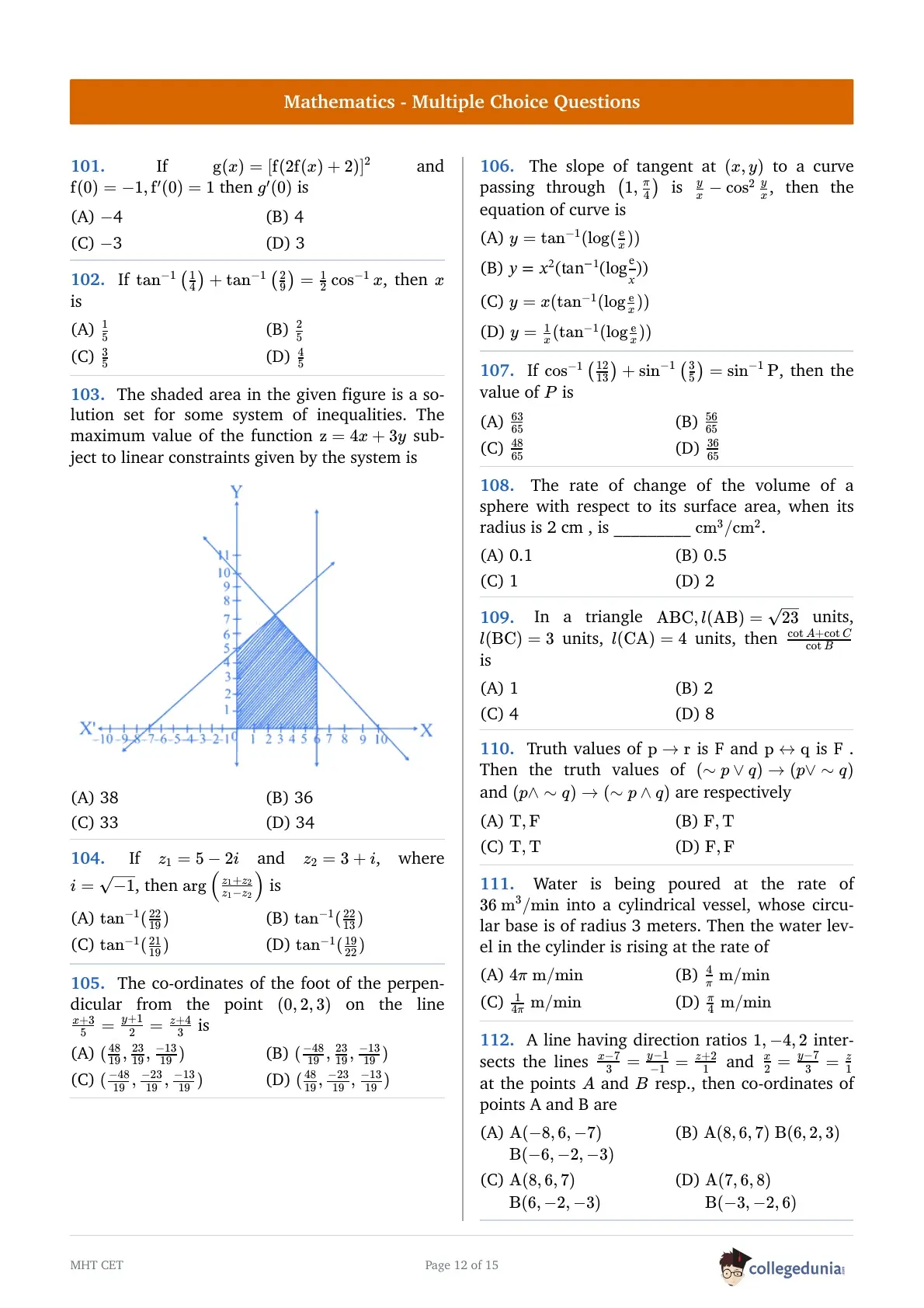
If \(\mathrm{g}(x)=[\mathrm{f}(2 \mathrm{f}(x)+2)]^2\) and \(\mathrm{f}(0)=-1, \mathrm{f}^{\prime}(0)=1\) then \(g^{\prime}(0)\) is
If \(\tan ^{-1}\left(\frac{1}{4}\right)+\tan ^{-1}\left(\frac{2}{9}\right)=\frac{1}{2} \cos ^{-1} x\), then \(x\) is
The shaded area in the given figure is a solution set for some system of inequalities. The maximum value of the function \(\mathrm{z}=4 x+3 y\) subject to linear constraints given by the system is

If \(z_1=5-2 i\) and \(z_2=3+i\), where \(i=\sqrt{-1}\), then \(\arg \left(\frac{z_1+z_2}{z_1-z_2}\right)\) is
The co-ordinates of the foot of the perpendicular from the point \((0,2,3)\) on the line \(\frac{x+3}{5}=\frac{y+1}{2}=\frac{z+4}{3}\) is
The slope of tangent at \((x, y)\) to a curve passing through \(\left(1, \frac{\pi}{4}\right)\) is \(\frac{y}{x}-\cos ^2 \frac{y}{x}\), then the equation of curve is
If \(\cos ^{-1}\left(\frac{12}{13}\right)+\sin ^{-1}\left(\frac{3}{5}\right)=\sin ^{-1} \mathrm{P}\), then the value of \(P\) is
The rate of change of the volume of a sphere with respect to its surface area, when its radius is 2 cm , is _________ \(\mathrm{cm}^3 / \mathrm{cm}^2\).
In a triangle \(\mathrm{ABC}, l(\mathrm{AB})=\sqrt{23}\) units, \(l(\mathrm{BC})=3\) units, \(l(\mathrm{CA})=4\) units, then \(\frac{\cot A+\cot C}{\cot B}\) is
Truth values of \(\mathrm{p} \rightarrow \mathrm{r}\) is F and \(\mathrm{p} \leftrightarrow \mathrm{q}\) is F . Then the truth values of \((\sim p \vee q) \rightarrow(p \vee \sim q)\) and \((p \wedge \sim q) \rightarrow(\sim p \wedge q)\) are respectively
Water is being poured at the rate of \(36 \mathrm{~m}^3 / \mathrm{min}\) into a cylindrical vessel, whose circular base is of radius 3 meters. Then the water level in the cylinder is rising at the rate of
A line having direction ratios \(1,-4,2\) intersects the lines \(\frac{x-7}{3}=\frac{y-1}{-1}=\frac{z+2}{1}\) and \(\frac{x}{2}=\frac{y-7}{3}=\frac{z}{1}\) at the points \(A\) and \(B\) resp., then co-ordinates of points A and B are
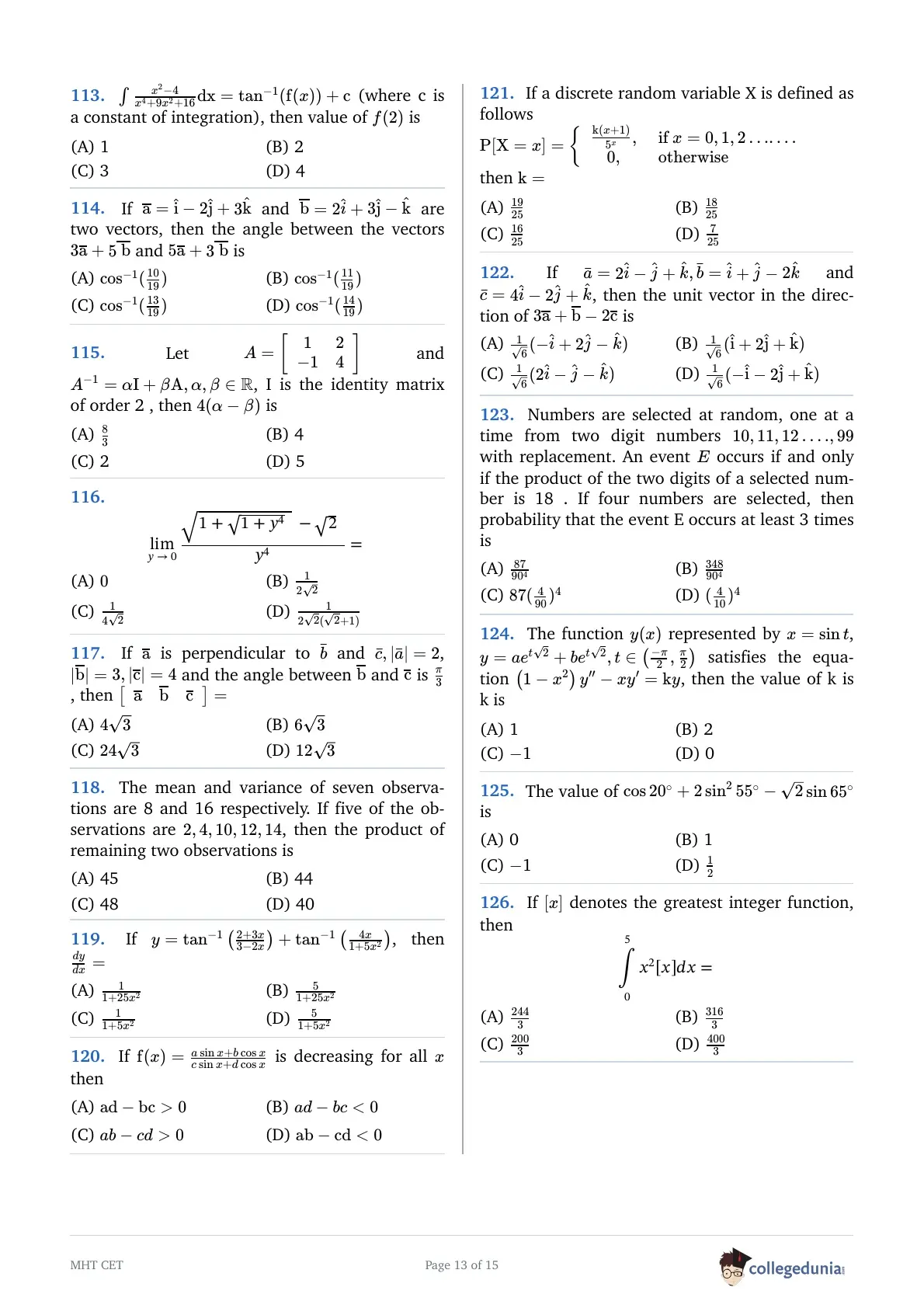
\(\int \frac{x^2-4}{x^4+9 x^2+16} \mathrm{dx}=\tan ^{-1}(\mathrm{f}(x))+\mathrm{c}\) (where c is a constant of integration), then value of \(f(2)\) is
If \(\overline{\mathrm{a}}=\hat{\mathrm{i}}-2 \hat{\mathrm{j}}+3 \hat{\mathrm{k}}\) and \(\overline{\mathrm{b}}=2 \hat{i}+3 \hat{\mathrm{j}}-\hat{\mathrm{k}}\) are two vectors, then the angle between the vectors \(3 \overline{\mathrm{a}}+5 \overline{\mathrm{~b}}\) and \(5 \overline{\mathrm{a}}+3 \overline{\mathrm{~b}}\) is
Let \(A=\left[\begin{array}{cc}1 & 2 \\ -1 & 4\end{array}\right]\) and \(A^{-1}=\alpha \mathrm{I}+\beta \mathrm{A}, \alpha, \beta \in \mathbb{R}\), I is the identity matrix of order 2 , then \(4(\alpha-\beta)\) is
\[\lim _\limits{y \rightarrow 0} \frac{\sqrt{1+\sqrt{1+y^4}}-\sqrt{2}}{y^4}=\]
If \(\overline{\mathrm{a}}\) is perpendicular to \(\bar{b}\) and \(\bar{c},|\bar{a}|=2\), \(|\overline{\mathrm{b}}|=3,|\overline{\mathrm{c}}|=4\) and the angle between \(\overline{\mathrm{b}}\) and \(\overline{\mathrm{c}}\) is \(\frac{\pi}{3}\), then \(\left[\begin{array}{lll}\overline{\mathrm{a}} & \overline{\mathrm{b}} & \overline{\mathrm{c}}\end{array}\right]=\)
The mean and variance of seven observations are 8 and 16 respectively. If five of the observations are \(2,4,10,12,14\), then the product of remaining two observations is
If \(y=\tan ^{-1}\left(\frac{2+3 x}{3-2 x}\right)+\tan ^{-1}\left(\frac{4 x}{1+5 x^2}\right)\), then \(\frac{d y}{d x}=\)
If \(\mathrm{f}(x)=\frac{a \sin x+b \cos x}{c \sin x+d \cos x}\) is decreasing for all \(x\) then
If a discrete random variable X is defined as follows
\(\mathrm{P}[\mathrm{X}=x]=\left\{\begin{array}{cl}\frac{\mathrm{k}(x+1)}{5^x}, & \text { if } x=0,1,2 \ldots \ldots . \\ 0, & \text { otherwise }\end{array}\right.\)
then \(\mathrm{k}=\)
If \(\bar{a}=2 \hat{i}-\hat{j}+\hat{k}, \bar{b}=\hat{i}+\hat{j}-2 \hat{k}\) and \(\bar{c}=4 \hat{i}-2 \hat{j}+\hat{k}\), then the unit vector in the direction of \(3 \overline{\mathrm{a}}+\overline{\mathrm{b}}-2 \overline{\mathrm{c}}\) is
Numbers are selected at random, one at a time from two digit numbers \(10,11,12 \ldots ., 99\) with replacement. An event \(E\) occurs if and only if the product of the two digits of a selected number is 18 . If four numbers are selected, then probability that the event E occurs at least 3 times is
The function \(y(x)\) represented by \(x=\sin t\), \(y=a e^{t \sqrt{2}}+b e^{t \sqrt{2}}, t \in\left(\frac{-\pi}{2}, \frac{\pi}{2}\right)\) satisfies the equation \(\left(1-x^2\right) y^{\prime \prime}-x y^{\prime}=\mathrm{k} y\), then the value of k is k is
The value of \(\cos 20^{\circ}+2 \sin ^2 55^{\circ}-\sqrt{2} \sin 65^{\circ}\) is
If \([x]\) denotes the greatest integer function, then \[\int_\limits0^5 x^2[x] d x=\]
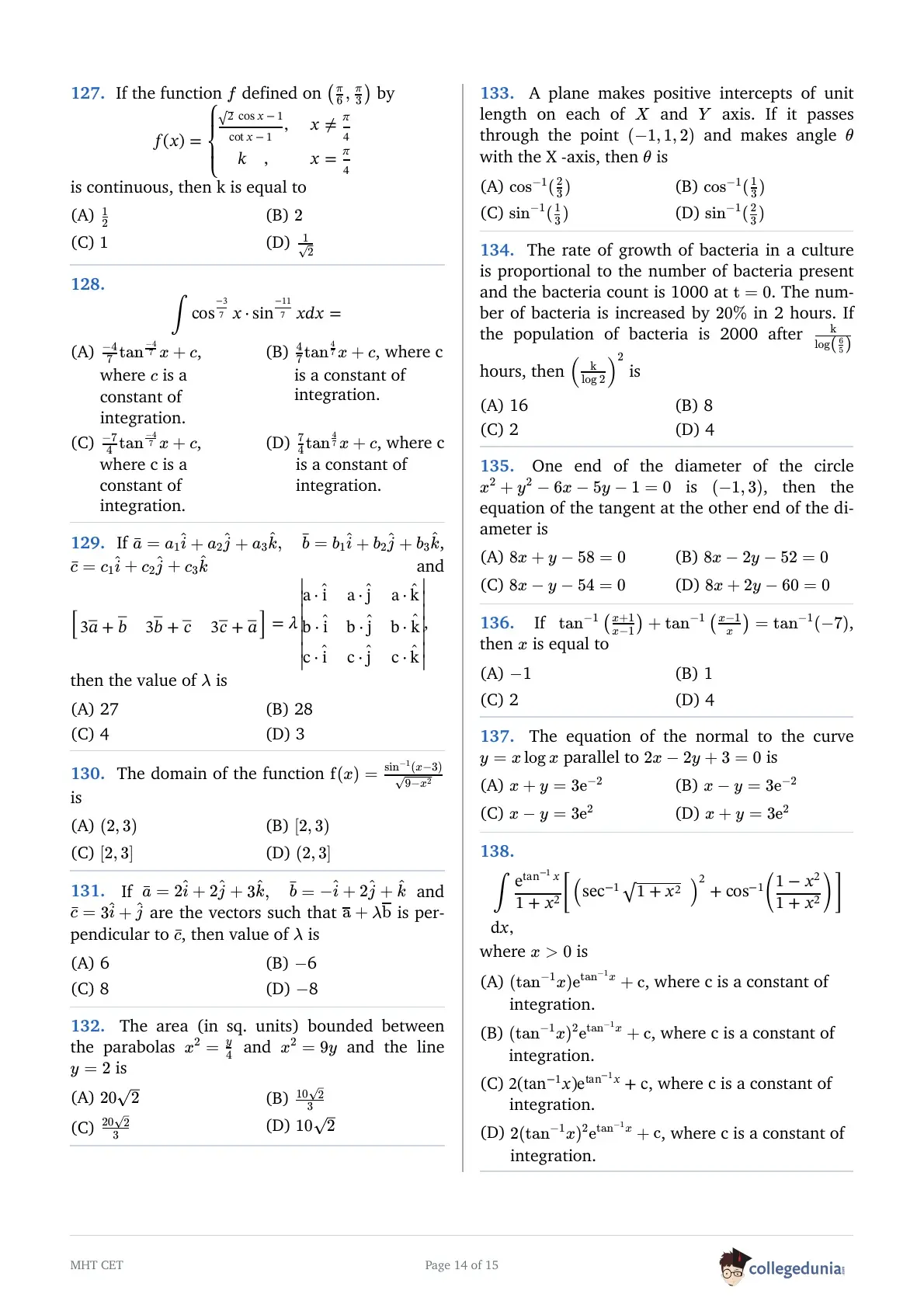
If the function \(f\) defined on \(\left(\frac{\pi}{6}, \frac{\pi}{3}\right)\) by
\[f(x)=\left\{\begin{array}{cc} \frac{\sqrt{2} \cos x-1}{\cot x-1}, & x \neq \frac{\pi}{4} \\ k \quad, & x=\frac{\pi}{4} \end{array}\right.\]
is continuous, then k is equal to
If \(\bar{a}=a_1 \hat{i}+a_2 \hat{j}+a_3 \hat{k}, \quad \bar{b}=b_1 \hat{i}+b_2 \hat{j}+b_3 \hat{k}\), \(\bar{c}=c_1 \hat{i}+c_2 \hat{j}+c_3 \hat{k}\) and \(\left[\begin{array}{lll}3 \bar{a}+\bar{b} & 3 \bar{b}+\bar{c} & 3 \bar{c}+\bar{a}\end{array}\right]=\lambda\left|\begin{array}{lll}\overline{\mathrm{a}} \cdot \hat{\mathrm{i}} & \overline{\mathrm{a}} \cdot \hat{\mathrm{j}} & \overline{\mathrm{a}} \cdot \hat{\mathrm{k}} \\ \overline{\mathrm{b}} \cdot \hat{\mathrm{i}} & \overline{\mathrm{b}} \cdot \hat{\mathrm{j}} & \overline{\mathrm{b}} \cdot \hat{\mathrm{k}} \\ \overline{\mathrm{c}} \cdot \hat{\mathrm{i}} & \overline{\mathrm{c}} \cdot \hat{\mathrm{j}} & \overline{\mathrm{c}} \cdot \hat{\mathrm{k}}\end{array}\right|,\) then the value of \(\lambda\) is
The domain of the function \(\mathrm{f}(x)=\frac{\sin ^{-1}(x-3)}{\sqrt{9-x^2}}\) is
If \(\bar{a}=2 \hat{i}+2 \hat{j}+3 \hat{k}, \quad \bar{b}=-\hat{i}+2 \hat{j}+\hat{k}\) and \(\bar{c}=3 \hat{i}+\hat{j}\) are the vectors such that \(\overline{\mathrm{a}}+\lambda \overline{\mathrm{b}}\) is perpendicular to \(\bar{c}\), then value of \(\lambda\) is
The area (in sq. units) bounded between the parabolas \(x^2=\frac{y}{4}\) and \(x^2=9 y\) and the line \(y=2\) is
A plane makes positive intercepts of unit length on each of \(X\) and \(Y\) axis. If it passes through the point \((-1,1,2)\) and makes angle \(\theta\) with the X -axis, then \(\theta\) is
The rate of growth of bacteria in a culture is proportional to the number of bacteria present and the bacteria count is 1000 at \(\mathrm{t}=0\). The number of bacteria is increased by \(20 \%\) in 2 hours. If the population of bacteria is 2000 after \(\frac{\mathrm{k}}{\log \left(\frac{6}{5}\right)}\) hours, then \(\left(\frac{\mathrm{k}}{\log 2}\right)^2\) is
One end of the diameter of the circle \(x^2+y^2-6 x-5 y-1=0\) is \((-1,3)\), then the equation of the tangent at the other end of the diameter is
If \(\tan ^{-1}\left(\frac{x+1}{x-1}\right)+\tan ^{-1}\left(\frac{x-1}{x}\right)=\tan ^{-1}(-7)\), then \(x\) is equal to
The equation of the normal to the curve \(y=x \log x\) parallel to \(2 x-2 y+3=0\) is
\[\int \frac{\mathrm{e}^{\tan ^{-1} x}}{1+x^2}\left[\left(\sec ^{-1} \sqrt{1+x^2}\right)^2+\cos ^{-1}\left(\frac{1-x^2}{1+x^2}\right)\right] \mathrm{d} x,\] where \(x>0\) is
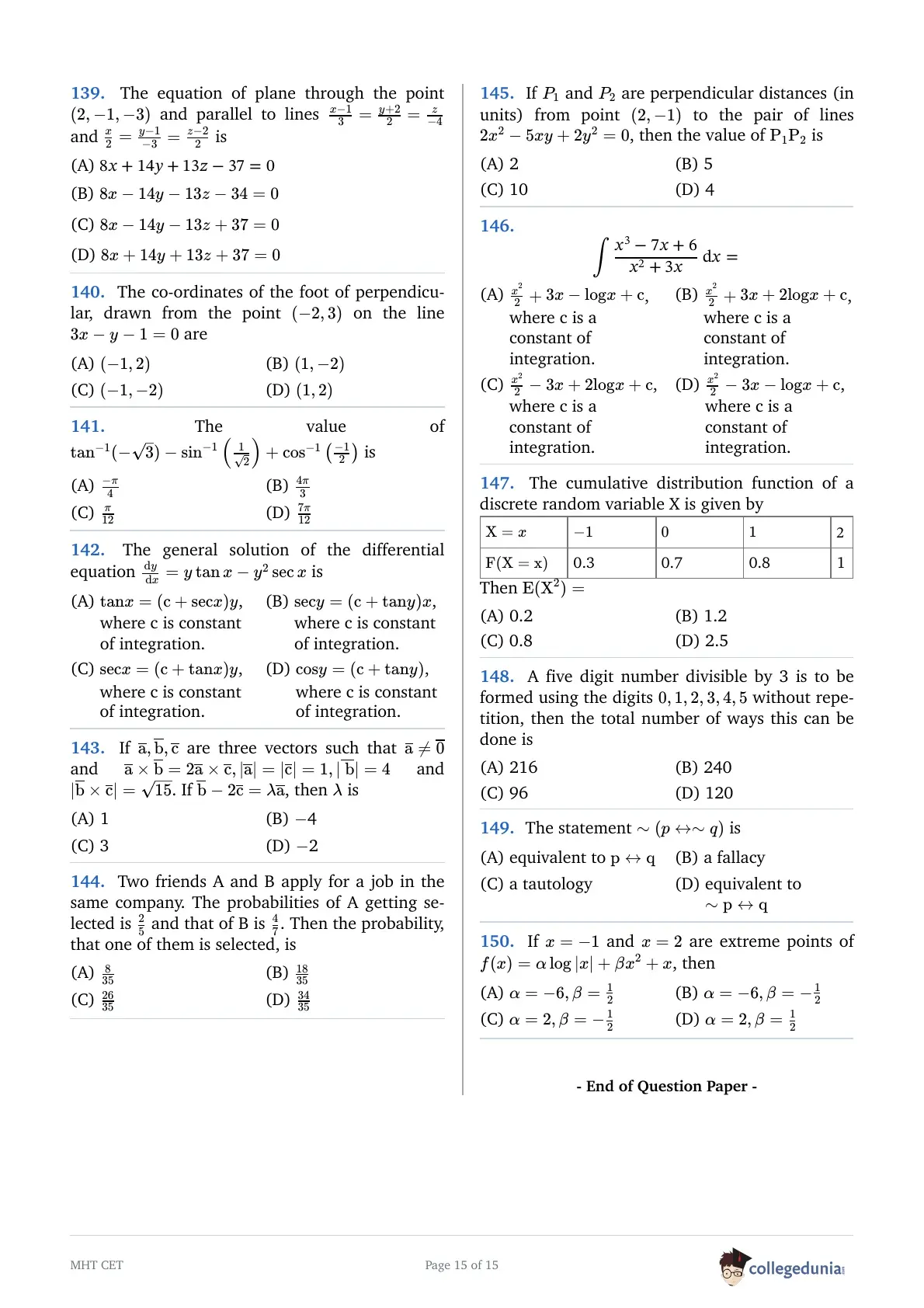
The equation of plane through the point \((2,-1,-3)\) and parallel to lines \(\frac{x-1}{3}=\frac{y+2}{2}=\frac{z}{-4}\) and \(\frac{x}{2}=\frac{y-1}{-3}=\frac{z-2}{2}\) is
The co-ordinates of the foot of perpendicular, drawn from the point \((-2,3)\) on the line \(3 x-y-1=0\) are
The value of \(\tan ^{-1}(-\sqrt{3})-\sin ^{-1}\left(\frac{1}{\sqrt{2}}\right)+\cos ^{-1}\left(\frac{-1}{2}\right)\) is
The general solution of the differential equation \(\frac{\mathrm{d} y}{\mathrm{~d} x}=y \tan x-y^2 \sec x\) is
If \(\overline{\mathrm{a}}, \overline{\mathrm{b}}, \overline{\mathrm{c}}\) are three vectors such that \(\overline{\mathrm{a}} \neq \overline{0}\) and \(\overline{\mathrm{a}} \times \overline{\mathrm{b}}=2 \overline{\mathrm{a}} \times \overline{\mathrm{c}},|\overline{\mathrm{a}}|=|\overline{\mathrm{c}}|=1,|\overline{\mathrm{~b}}|=4\) and \(|\overline{\mathrm{b}} \times \overline{\mathrm{c}}|=\sqrt{15}\). If \(\overline{\mathrm{b}}-2 \overline{\mathrm{c}}=\lambda \overline{\mathrm{a}}\), then \(\lambda\) is
Two friends A and B apply for a job in the same company. The probabilities of A getting selected is \(\frac{2}{5}\) and that of B is \(\frac{4}{7}\). Then the probability, that one of them is selected, is
If \(P_1\) and \(P_2\) are perpendicular distances (in units) from point \((2,-1)\) to the pair of lines \(2 x^2-5 x y+2 y^2=0\), then the value of \(\mathrm{P}_1 \mathrm{P}_2\) is
The cumulative distribution function of a discrete random variable X is given by
| \(\mathrm{X}=x\) | \(-1\) | \(0\) | \(1\) | \(2\) |
|---|---|---|---|---|
| \(\mathrm{F(X=x)}\) | 0.3 | 0.7 | 0.8 | 1 |
A five digit number divisible by 3 is to be formed using the digits \(0,1,2,3,4,5\) without repetition, then the total number of ways this can be done is
If \(x=-1\) and \(x=2\) are extreme points of \(f(x)=\alpha \log |x|+\beta x^2+x\), then
MHT CET 2024 PCM Exam Pattern and Marking Scheme
| Parameter | Details |
|---|---|
| Conducting Body | Maharashtra Common Entrance Test Cell (Maharashtra CET Cell) |
| Exam Mode | Online (Computer-Based Test) |
| Duration | 180 minutes (3 hours) |
| Groups / Subjects | PCM (Physics, Chemistry, Mathematics) for Engineering |
| Total Questions |
150 |
| Total Marks | 200 |
| Question Type | Multiple Choice Questions (MCQs) |
| Marks Distribution |
|
| Negative Marking | No |
| Syllabus Weightage |
|



Comments