




MHT CET 2024 May 16 Shift 1 PCM Question Paper is available for download here. Maharashtra State CET Cell conducted MHT CET 2024 PCM Exam on May 16 in Shift 1 from 9 AM to 12 PM in CBT mode.
The MHT CET 2024 PCM question paper includes the following:
- The MHT CET 2024 PCM Question Paper consists of 150 multiple-choice questions (MCQs) totalling 200 marks divided into 3 sections: Physics, Chemistry, and Mathematics, with 50 questions in each subject.
- Physics and Chemistry questions carry 1 mark each while Mathematics questions carry 2 marks each.
- There is no negative marking for incorrect answers.
MHT CET 2024 May 16 Shift 1 PCM Question Paper with Solution PDF
| CD PDF | CD PDF with Solutions |
|---|---|
| Download Collegedunia PDF 0.81 MB | - |
Also Check:
MHT CET 2024 May 16 Shift 1 PCM Questions with Solutions
Physics (Q1 - Q50)
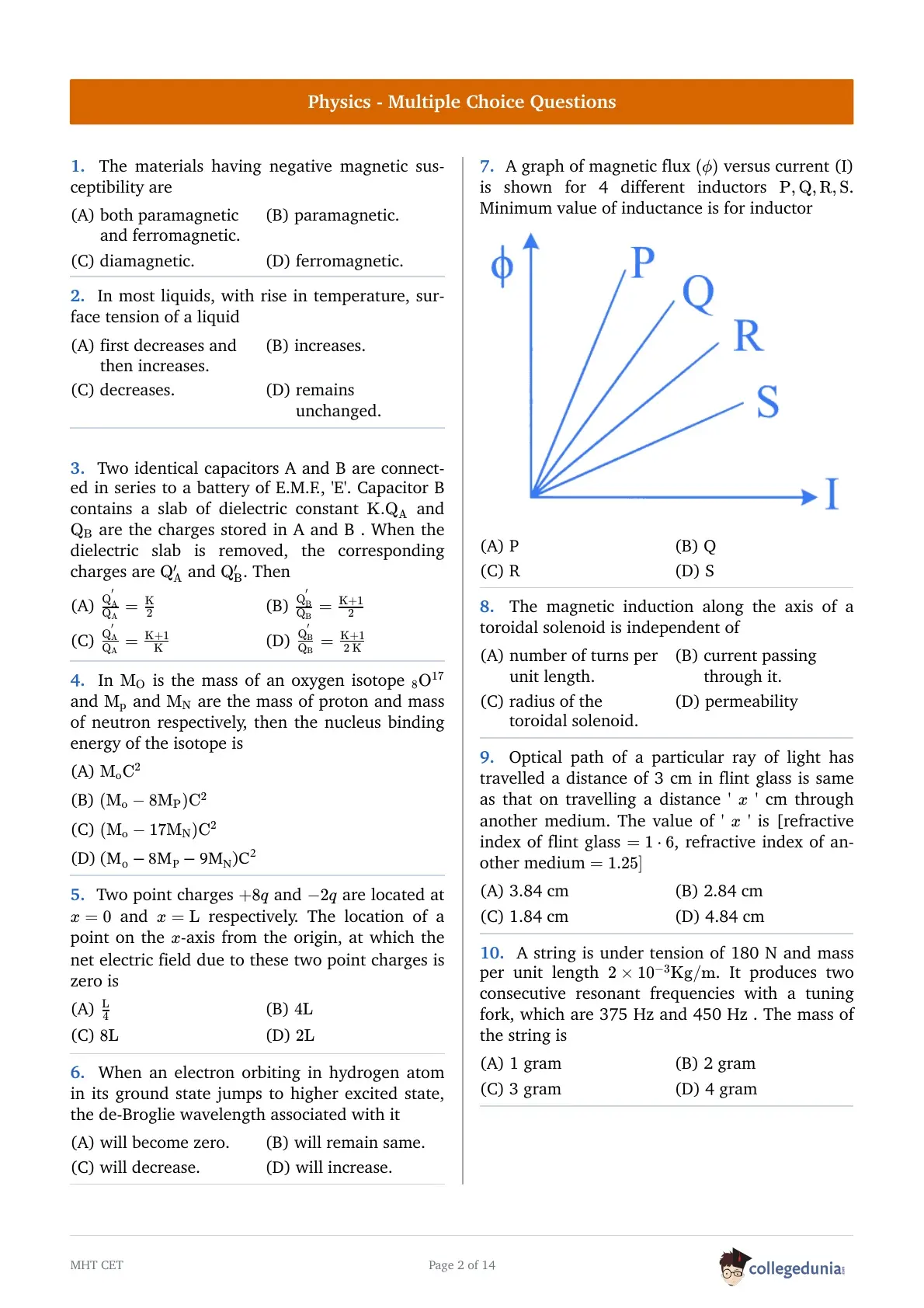
In most liquids, with rise in temperature, surface tension of a liquid
Two identical capacitors A and B are connected in series to a battery of E.M.F., 'E'. Capacitor B contains a slab of dielectric constant \(\mathrm{K} . \mathrm{Q}_{\mathrm{A}}\) and \(\mathrm{Q}_{\mathrm{B}}\) are the charges stored in A and B . When the dielectric slab is removed, the corresponding charges are \(\mathrm{Q}_{\mathrm{A}}^{\prime}\) and \(\mathrm{Q}_{\mathrm{B}}^{\prime}\). Then
In \(\mathrm{M}_{\mathrm{O}}\) is the mass of an oxygen isotope \({ }_8 \mathrm{O}^{17}\) and \(\mathrm{M}_{\mathrm{p}}\) and \(\mathrm{M}_{\mathrm{N}}\) are the mass of proton and mass of neutron respectively, then the nucleus binding energy of the isotope is
Two point charges \(+8 q\) and \(-2 q\) are located at \(x=0\) and \(x=\mathrm{L}\) respectively. The location of a point on the \(x\)-axis from the origin, at which the net electric field due to these two point charges is zero is
When an electron orbiting in hydrogen atom in its ground state jumps to higher excited state, the de-Broglie wavelength associated with it
A graph of magnetic flux \((\phi)\) versus current (I) is shown for 4 different inductors \(\mathrm{P}, \mathrm{Q}, \mathrm{R}, \mathrm{S}\). Minimum value of inductance is for inductor

The magnetic induction along the axis of a toroidal solenoid is independent of
Optical path of a particular ray of light has travelled a distance of 3 cm in flint glass is same as that on travelling a distance ' \(x\) ' cm through another medium. The value of ' \(x\) ' is [refractive index of flint glass \(=1 \cdot 6\), refractive index of another medium \(=1.25]\)
A string is under tension of 180 N and mass per unit length \(2 \times 10^{-3} \mathrm{Kg} / \mathrm{m}\). It produces two consecutive resonant frequencies with a tuning fork, which are 375 Hz and 450 Hz . The mass of the string is
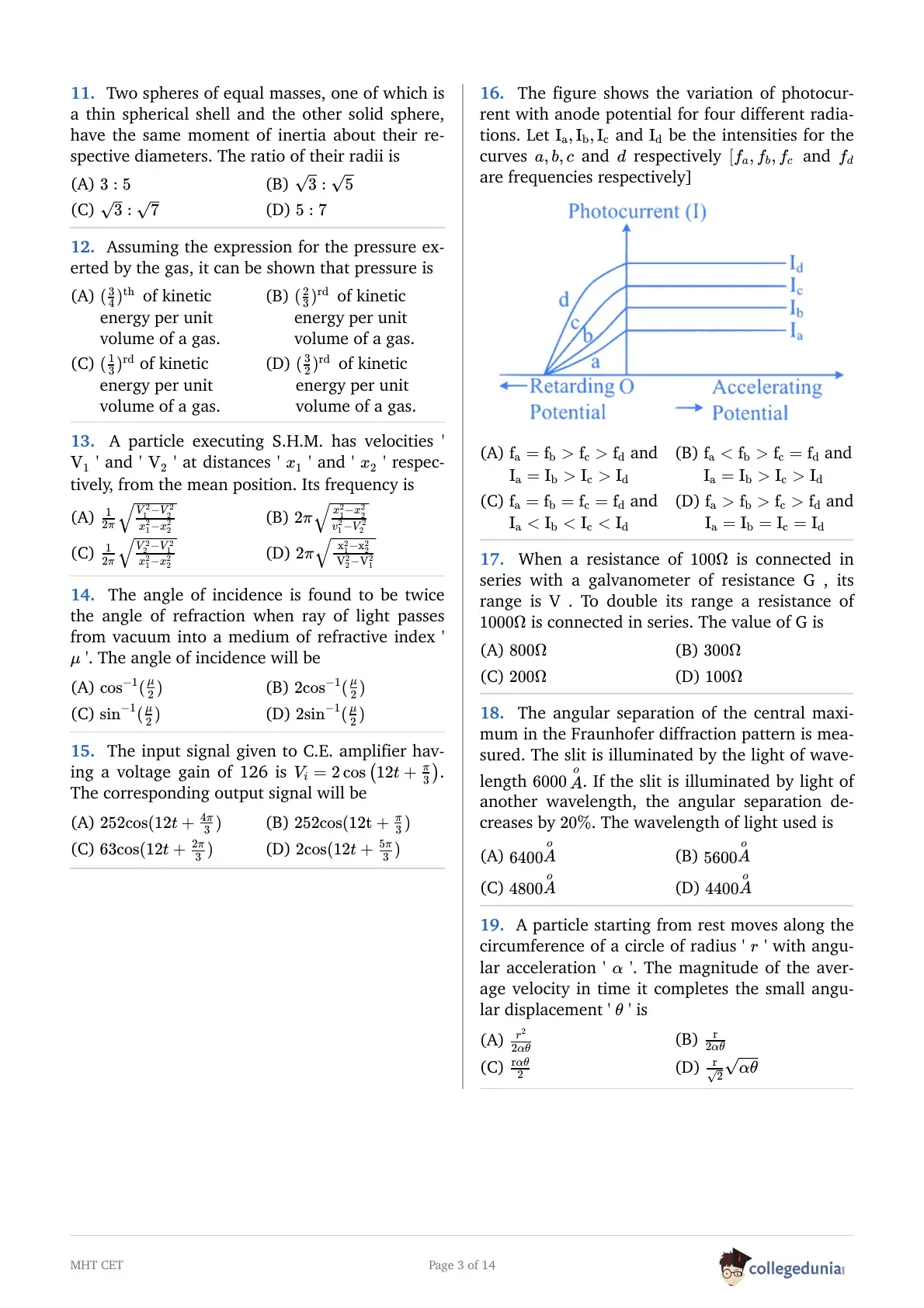
Two spheres of equal masses, one of which is a thin spherical shell and the other solid sphere, have the same moment of inertia about their respective diameters. The ratio of their radii is
Assuming the expression for the pressure exerted by the gas, it can be shown that pressure is
A particle executing S.H.M. has velocities ' \(\mathrm{V}_1\) ' and ' \(\mathrm{V}_2\) ' at distances ' \(x_1\) ' and ' \(x_2\) ' respectively, from the mean position. Its frequency is
The angle of incidence is found to be twice the angle of refraction when ray of light passes from vacuum into a medium of refractive index ' \(\mu\) '. The angle of incidence will be
The input signal given to C.E. amplifier having a voltage gain of 126 is \(V_i=2 \cos \left(12 t+\frac{\pi}{3}\right)\). The corresponding output signal will be
The figure shows the variation of photocurrent with anode potential for four different radiations. Let \(\mathrm{I}_{\mathrm{a}}, \mathrm{I}_{\mathrm{b}}, \mathrm{I}_{\mathrm{c}}\) and \(\mathrm{I}_{\mathrm{d}}\) be the intensities for the curves \(a, b, c\) and \(d\) respectively \(\left[f_a, f_b, f_c\right.\) and \(f_d\) are frequencies respectively]

When a resistance of \(100 \Omega\) is connected in series with a galvanometer of resistance G , its range is V . To double its range a resistance of \(1000 \Omega\) is connected in series. The value of G is
The angular separation of the central maximum in the Fraunhofer diffraction pattern is measured. The slit is illuminated by the light of wavelength \(6000 \mathop A\limits^o\). If the slit is illuminated by light of another wavelength, the angular separation decreases by \(20 \%\). The wavelength of light used is
A particle starting from rest moves along the circumference of a circle of radius ' \(r\) ' with angular acceleration ' \(\alpha\) '. The magnitude of the average velocity in time it completes the small angular displacement ' \(\theta\) ' is
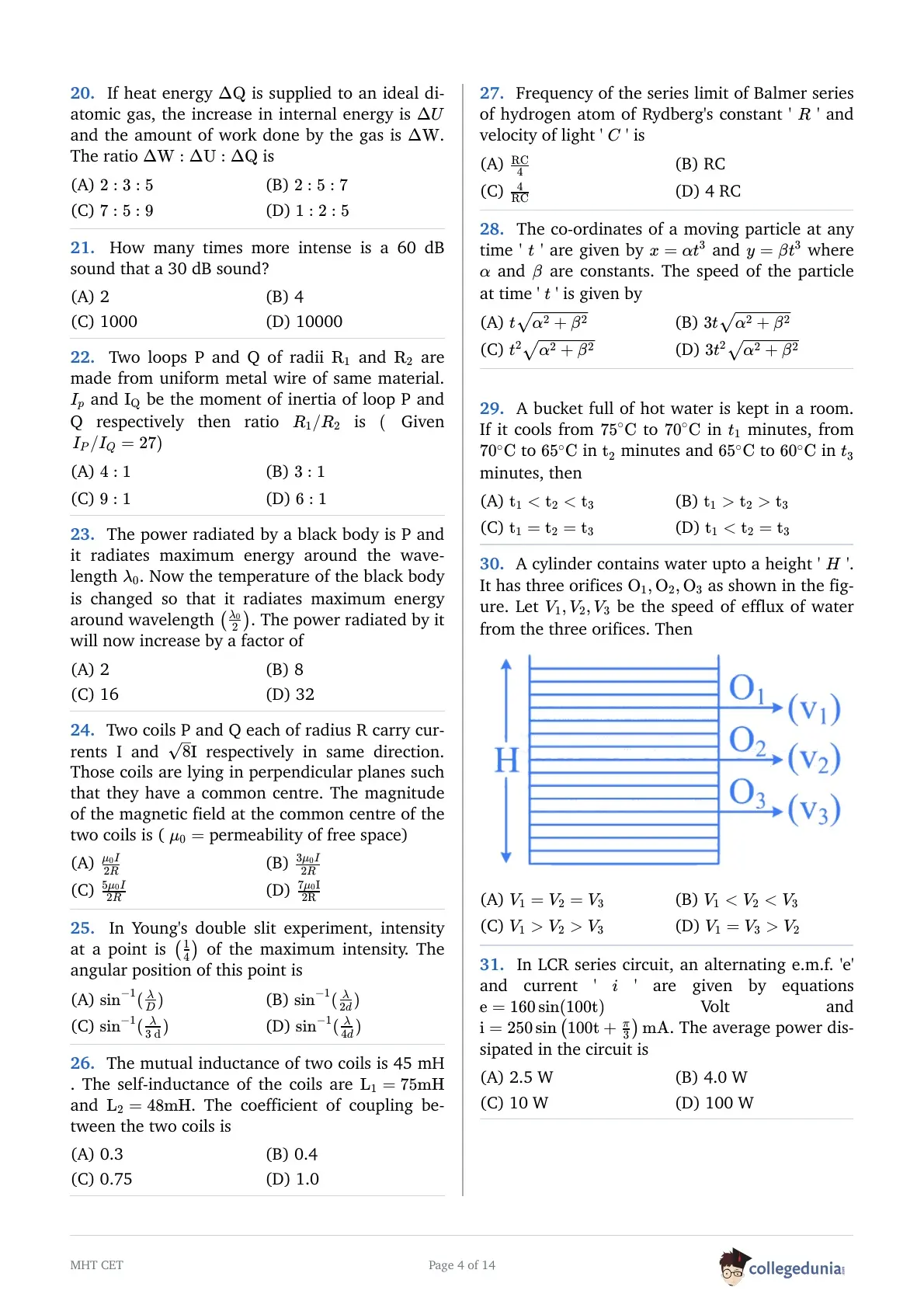
If heat energy \(\Delta \mathrm{Q}\) is supplied to an ideal diatomic gas, the increase in internal energy is \(\Delta U\) and the amount of work done by the gas is \(\Delta \mathrm{W}\). The ratio \(\Delta \mathrm{W}: \Delta \mathrm{U}: \Delta \mathrm{Q}\) is
Two loops P and Q of radii \(\mathrm{R}_1\) and \(\mathrm{R}_2\) are made from uniform metal wire of same material. \(I_p\) and \(\mathrm{I}_{\mathrm{Q}}\) be the moment of inertia of loop P and Q respectively then ratio \(R_1 / R_2\) is \(\left(\right.\) Given \(\left.I_P / I_Q=27\right)\)
The power radiated by a black body is P and it radiates maximum energy around the wavelength \(\lambda_0\). Now the temperature of the black body is changed so that it radiates maximum energy around wavelength \(\left(\frac{\lambda_0}{2}\right)\). The power radiated by it will now increase by a factor of
Two coils P and Q each of radius R carry currents I and \(\sqrt{8} \mathrm{I}\) respectively in same direction. Those coils are lying in perpendicular planes such that they have a common centre. The magnitude of the magnetic field at the common centre of the two coils is ( \(\mu_0=\) permeability of free space)
In Young's double slit experiment, intensity at a point is \(\left(\frac{1}{4}\right)\) of the maximum intensity. The angular position of this point is
The mutual inductance of two coils is 45 mH . The self-inductance of the coils are \(\mathrm{L}_1=75 \mathrm{mH}\) and \(\mathrm{L}_2=48 \mathrm{mH}\). The coefficient of coupling between the two coils is
Frequency of the series limit of Balmer series of hydrogen atom of Rydberg's constant ' \(R\) ' and velocity of light ' \(C\) ' is
The co-ordinates of a moving particle at any time ' \(t\) ' are given by \(x=\alpha t^3\) and \(y=\beta t^3\) where \(\alpha\) and \(\beta\) are constants. The speed of the particle at time ' \(t\) ' is given by
A bucket full of hot water is kept in a room. If it cools from \(75^{\circ} \mathrm{C}\) to \(70^{\circ} \mathrm{C}\) in \(t_1\) minutes, from \(70^{\circ} \mathrm{C}\) to \(65^{\circ} \mathrm{C}\) in \(\mathrm{t}_2\) minutes and \(65^{\circ} \mathrm{C}\) to \(60^{\circ} \mathrm{C}\) in \(t_3\) minutes, then
A cylinder contains water upto a height ' \(H\) '. It has three orifices \(\mathrm{O}_1, \mathrm{O}_2, \mathrm{O}_3\) as shown in the figure. Let \(V_1, V_2, V_3\) be the speed of efflux of water from the three orifices. Then

In LCR series circuit, an alternating e.m.f. 'e' and current ' \(i\) ' are given by equations \(\mathrm{e}=160 \sin (100 \mathrm{t})\) Volt and \(\mathrm{i}=250 \sin \left(100 \mathrm{t}+\frac{\pi}{3}\right) \mathrm{mA}\). The average power dissipated in the circuit is
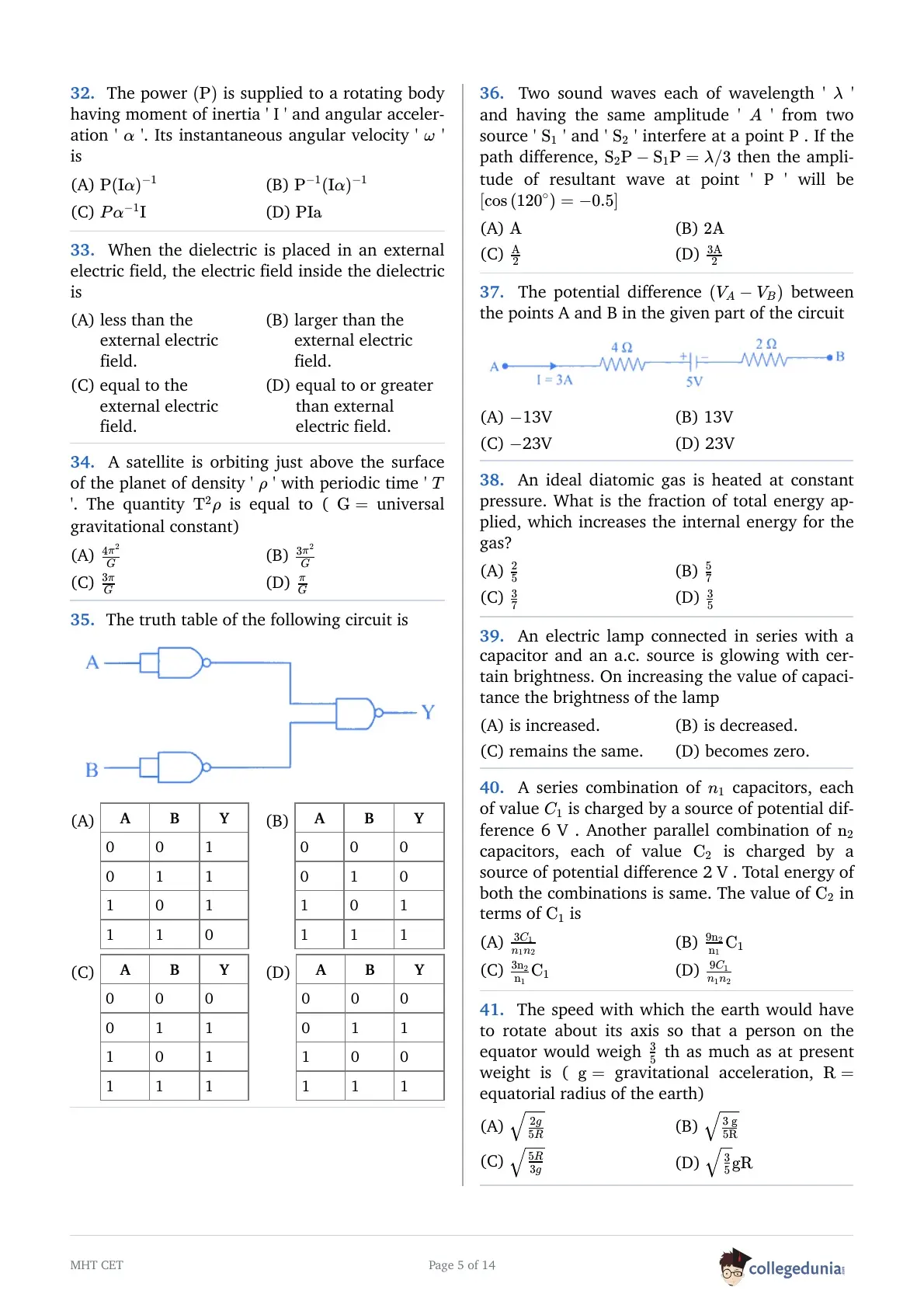
The power \((\mathrm{P})\) is supplied to a rotating body having moment of inertia ' I ' and angular acceleration ' \(\alpha\) '. Its instantaneous angular velocity ' \(\omega\) ' is
When the dielectric is placed in an external electric field, the electric field inside the dielectric is
A satellite is orbiting just above the surface of the planet of density ' \(\rho\) ' with periodic time ' \(T\) '. The quantity \(\mathrm{T}^2 \rho\) is equal to ( \(\mathrm{G}=\) universal gravitational constant)

Two sound waves each of wavelength ' \(\lambda\) ' and having the same amplitude ' \(A\) ' from two source ' \(\mathrm{S}_1\) ' and ' \(\mathrm{S}_2\) ' interfere at a point P . If the path difference, \(\mathrm{S}_2 \mathrm{P}-\mathrm{S}_1 \mathrm{P}=\lambda / 3\) then the amplitude of resultant wave at point ' P ' will be \(\left[\cos \left(120^{\circ}\right)=-0.5\right]\)
The potential difference \(\left(V_A-V_B\right)\) between the points A and B in the given part of the circuit

An ideal diatomic gas is heated at constant pressure. What is the fraction of total energy applied, which increases the internal energy for the gas?
An electric lamp connected in series with a capacitor and an a.c. source is glowing with certain brightness. On increasing the value of capacitance the brightness of the lamp
A series combination of \(n_1\) capacitors, each of value \(C_1\) is charged by a source of potential difference 6 V . Another parallel combination of \(\mathrm{n}_2\) capacitors, each of value \(\mathrm{C}_2\) is charged by a source of potential difference 2 V . Total energy of both the combinations is same. The value of \(\mathrm{C}_2\) in terms of \(\mathrm{C}_1\) is
The speed with which the earth would have to rotate about its axis so that a person on the equator would weigh \(\frac{3}{5}\) th as much as at present weight is ( \(\mathrm{g}=\) gravitational acceleration, \(\mathrm{R}=\) equatorial radius of the earth)
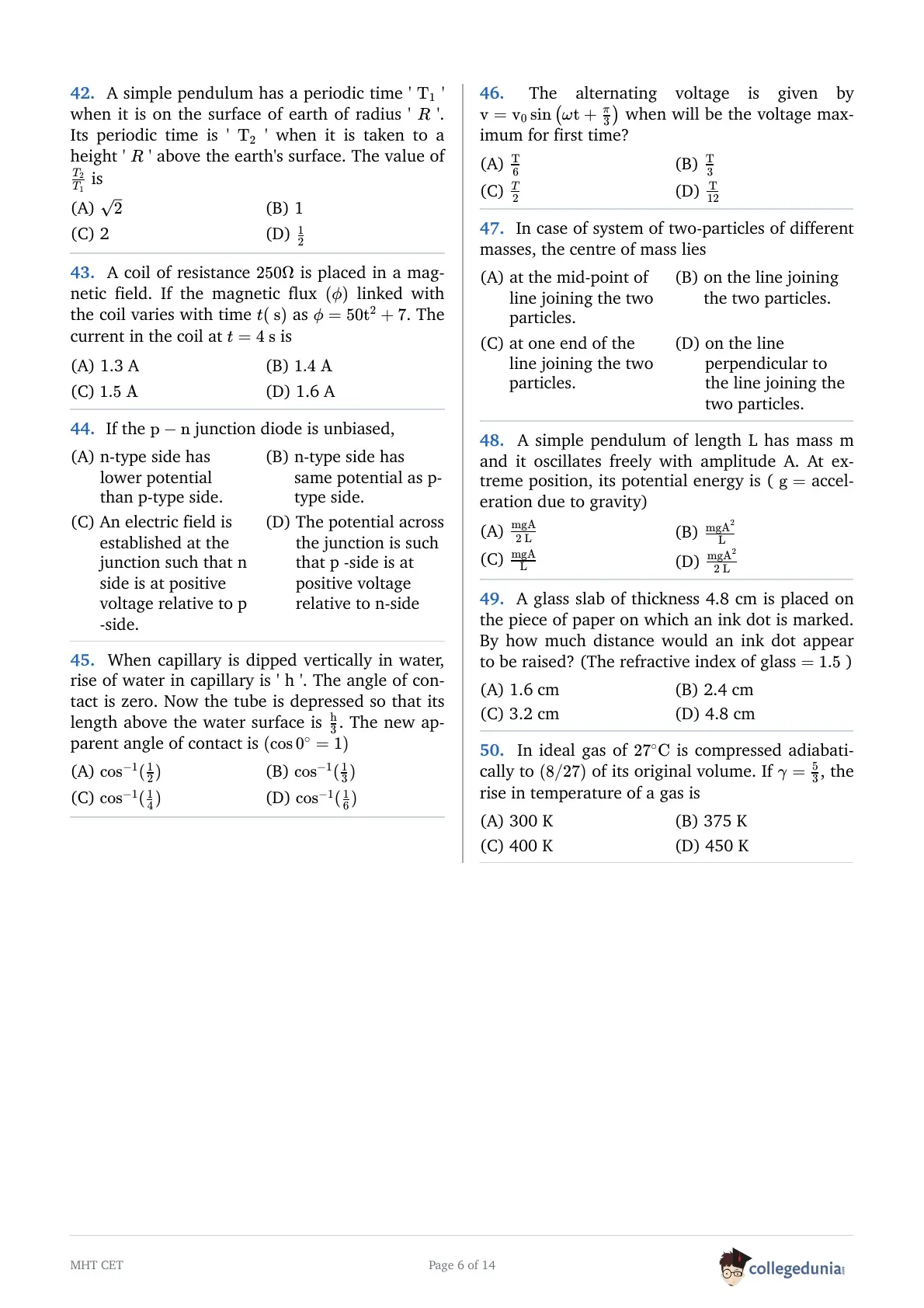
A simple pendulum has a periodic time ' \(\mathrm{T}_1\) ' when it is on the surface of earth of radius ' \(R\) '. Its periodic time is ' \(\mathrm{T}_2\) ' when it is taken to a height ' \(R\) ' above the earth's surface. The value of \(\frac{T_2}{T_1}\) is
A coil of resistance \(250 \Omega\) is placed in a magnetic field. If the magnetic flux \((\phi)\) linked with the coil varies with time \(t(\mathrm{~s})\) as \(\phi=50 \mathrm{t}^2+7\). The current in the coil at \(t=4 \mathrm{~s}\) is
When capillary is dipped vertically in water, rise of water in capillary is ' h '. The angle of contact is zero. Now the tube is depressed so that its length above the water surface is \(\frac{\mathrm{h}}{3}\). The new apparent angle of contact is \(\left(\cos 0^{\circ}=1\right)\)
The alternating voltage is given by \(\mathrm{v}=\mathrm{v}_0 \sin \left(\omega \mathrm{t}+\frac{\pi}{3}\right)\) when will be the voltage maximum for first time?
In case of system of two-particles of different masses, the centre of mass lies
A simple pendulum of length L has mass m and it oscillates freely with amplitude A. At extreme position, its potential energy is ( \(\mathrm{g}=\) acceleration due to gravity)
A glass slab of thickness 4.8 cm is placed on the piece of paper on which an ink dot is marked. By how much distance would an ink dot appear to be raised? (The refractive index of glass \(=1.5\) )
In ideal gas of \(27^{\circ} \mathrm{C}\) is compressed adiabatically to \((8 / 27)\) of its original volume. If \(\gamma=\frac{5}{3}\), the rise in temperature of a gas is
Chemistry (Q51 - Q100)
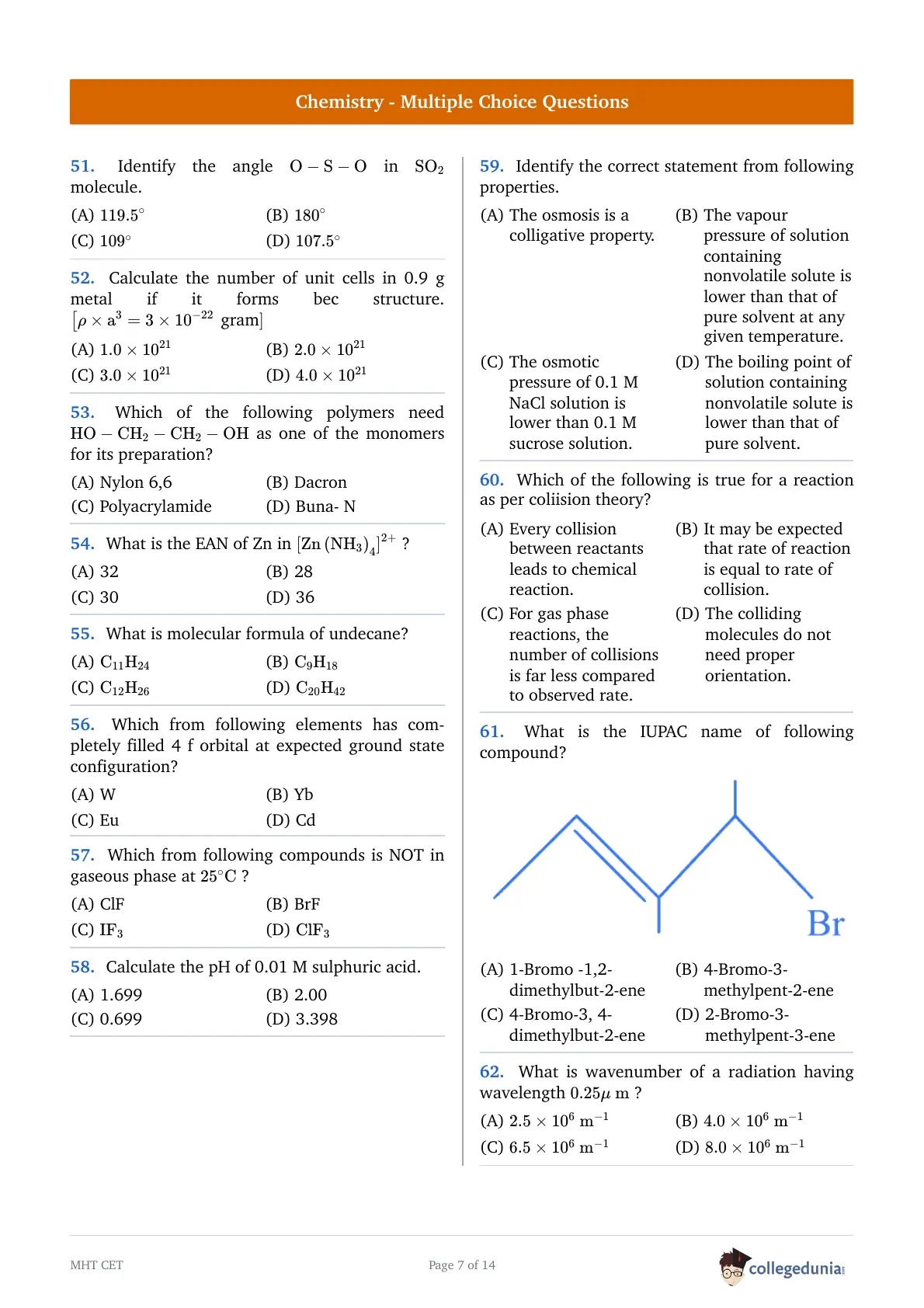
Identify the angle \(\mathrm{O}-\mathrm{S}-\mathrm{O}\) in \(\mathrm{SO}_2\) molecule.
Calculate the number of unit cells in 0.9 g metal if it forms bec structure. \(\left[\rho \times \mathrm{a}^3=3 \times 10^{-22}\right.\) gram\(]\)
Which of the following polymers need \(\mathrm{HO}-\mathrm{CH}_2-\mathrm{CH}_2-\mathrm{OH}\) as one of the monomers for its preparation?
What is the EAN of Zn in \(\left[\mathrm{Zn}\left(\mathrm{NH}_3\right)_4\right]^{2+}\) ?
Which from following elements has completely filled 4 f orbital at expected ground state configuration?
Which from following compounds is NOT in gaseous phase at \(25^{\circ} \mathrm{C}\) ?
Which of the following is true for a reaction as per coliision theory?

What is wavenumber of a radiation having wavelength \(0.25 \mu \mathrm{~m}\) ?
Identify the class of \(\left(\mathrm{C}_6 \mathrm{H}_5\right)_3 \mathrm{~N}\) ?
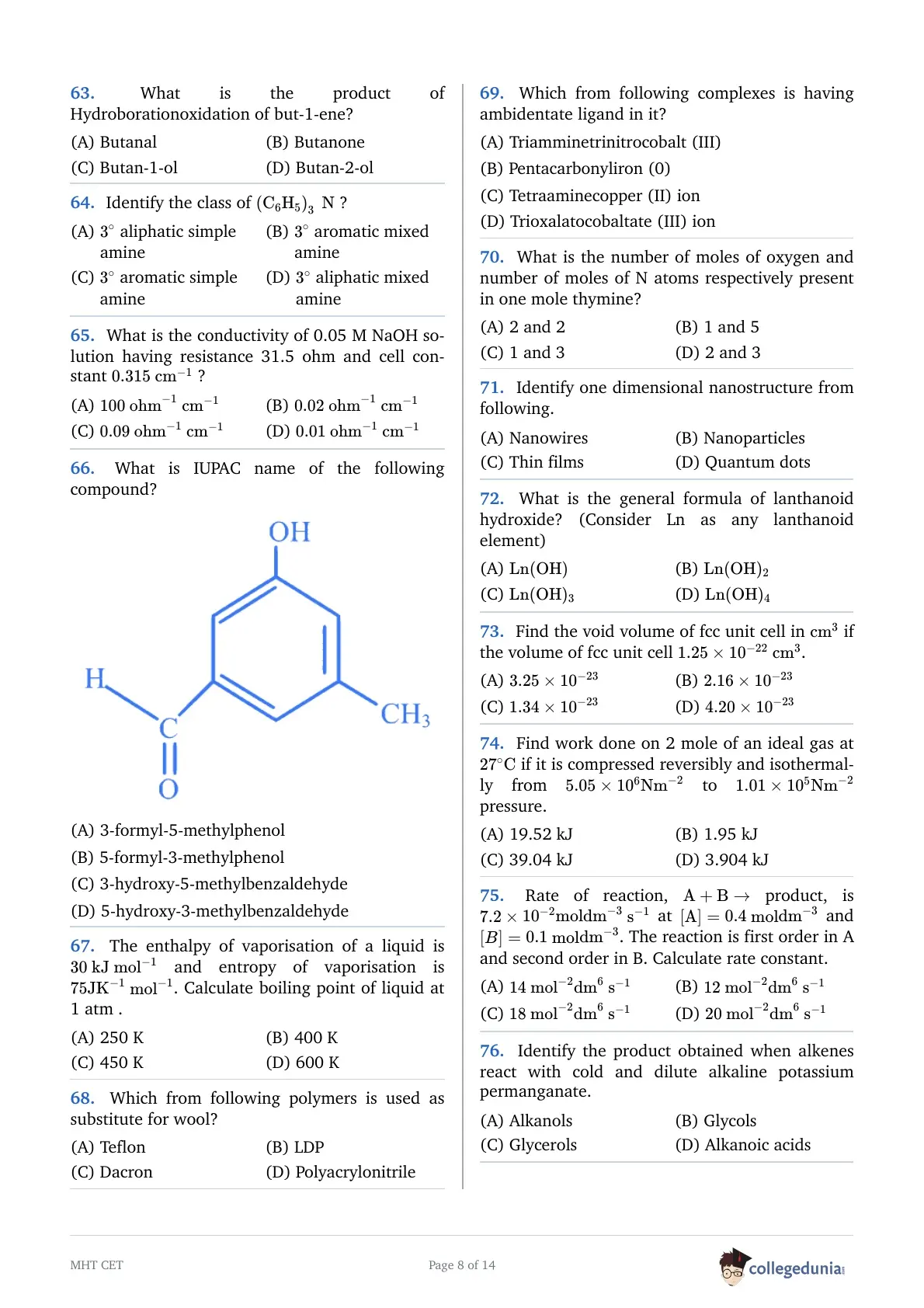
What is the conductivity of 0.05 M NaOH solution having resistance 31.5 ohm and cell constant \(0.315 \mathrm{~cm}^{-1}\) ?

The enthalpy of vaporisation of a liquid is \(30 \mathrm{~kJ} \mathrm{~mol}^{-1}\) and entropy of vaporisation is \(75 \mathrm{JK}^{-1} \mathrm{~mol}^{-1}\). Calculate boiling point of liquid at 1 atm .
What is the number of moles of oxygen and number of moles of N atoms respectively present in one mole thymine?
What is the general formula of lanthanoid hydroxide? (Consider Ln as any lanthanoid element)
Find the void volume of fcc unit cell in \(\mathrm{cm}^3\) if the volume of fcc unit cell \(1.25 \times 10^{-22} \mathrm{~cm}^3\).
Find work done on 2 mole of an ideal gas at \(27^{\circ} \mathrm{C}\) if it is compressed reversibly and isothermally from \(5.05 \times 10^6 \mathrm{Nm}^{-2}\) to \(1.01 \times 10^5 \mathrm{Nm}^{-2}\) pressure.
Rate of reaction, \(\mathrm{A}+\mathrm{B} \rightarrow\) product, is \(7.2 \times 10^{-2} \mathrm{moldm}^{-3} \mathrm{~s}^{-1}\) at \([\mathrm{A}]=0.4 \mathrm{~mol} \mathrm{dm}^{-3}\) and \([B]=0.1 \mathrm{~mol} \mathrm{dm}^{-3}\). The reaction is first order in A and second order in B. Calculate rate constant.
Identify the product obtained when alkenes react with cold and dilute alkaline potassium permanganate.
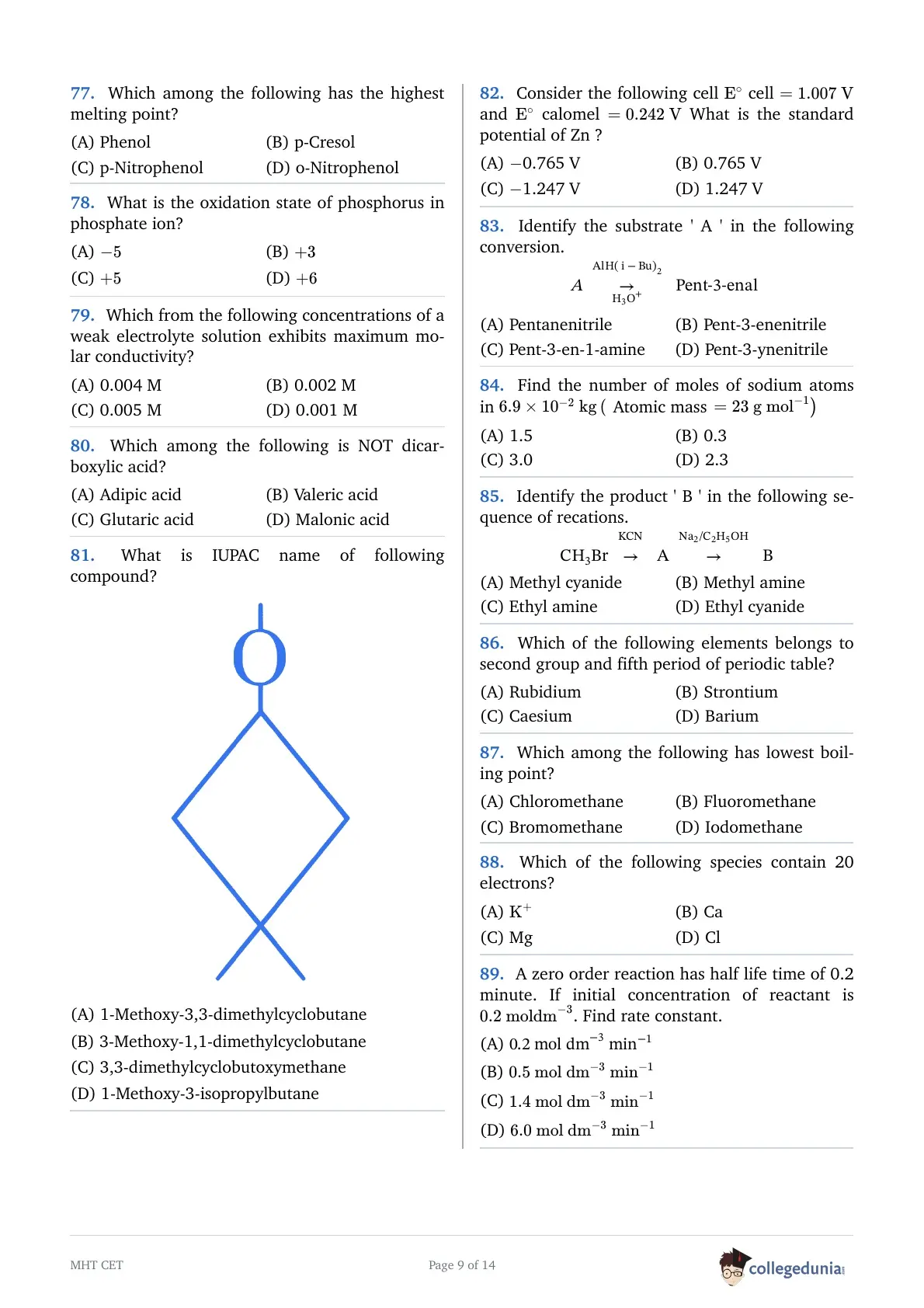
Which from the following concentrations of a weak electrolyte solution exhibits maximum molar conductivity?

Identify the substrate ' A ' in the following conversion.
\[A \xrightarrow[\mathrm{H}_3 \mathrm{O}^{+}]{\mathrm{AlH}(\mathrm{~i-Bu})_2} \text { Pent-3-enal }\]
Find the number of moles of sodium atoms in \(6.9 \times 10^{-2} \mathrm{~kg}\left(\right.\) Atomic mass \(\left.=23 \mathrm{~g} \mathrm{~mol}^{-1}\right)\)
Identify the product ' B ' in the following sequence of recations.
\[\mathrm{CH}_3 \mathrm{Br} \xrightarrow{\mathrm{KCN}} \mathrm{~A} \xrightarrow{\mathrm{Na}_2 / \mathrm{C}_2 \mathrm{H}_5 \mathrm{OH}} \mathrm{~B}\]
Which of the following elements belongs to second group and fifth period of periodic table?
A zero order reaction has half life time of 0.2 minute. If initial concentration of reactant is \(0.2 \mathrm{~mol} \mathrm{dm}^{-3}\). Find rate constant.
What is the numerical value of gas constant \(R\) in terms of \(\mathrm{L} \mathrm{atm} \mathrm{K}^{-1} \mathrm{~mol}^{-1}\) ?
Calculate van't Hoff factor of 0.15 M solution of electrolyte if it freezes at \(-\)0.5 K.
\[\left[\mathrm{K}_{\mathrm{f}}=1.86 \mathrm{~K} \mathrm{~kg} \mathrm{~mol}^{-1}\right]\]
Calculate the solubility in \(\mathrm{mol} \mathrm{dm}^{-3}\) of sparingly soluble salt BA if its solubility product \(4.9 \times 10^{-13}\) at same temperature.
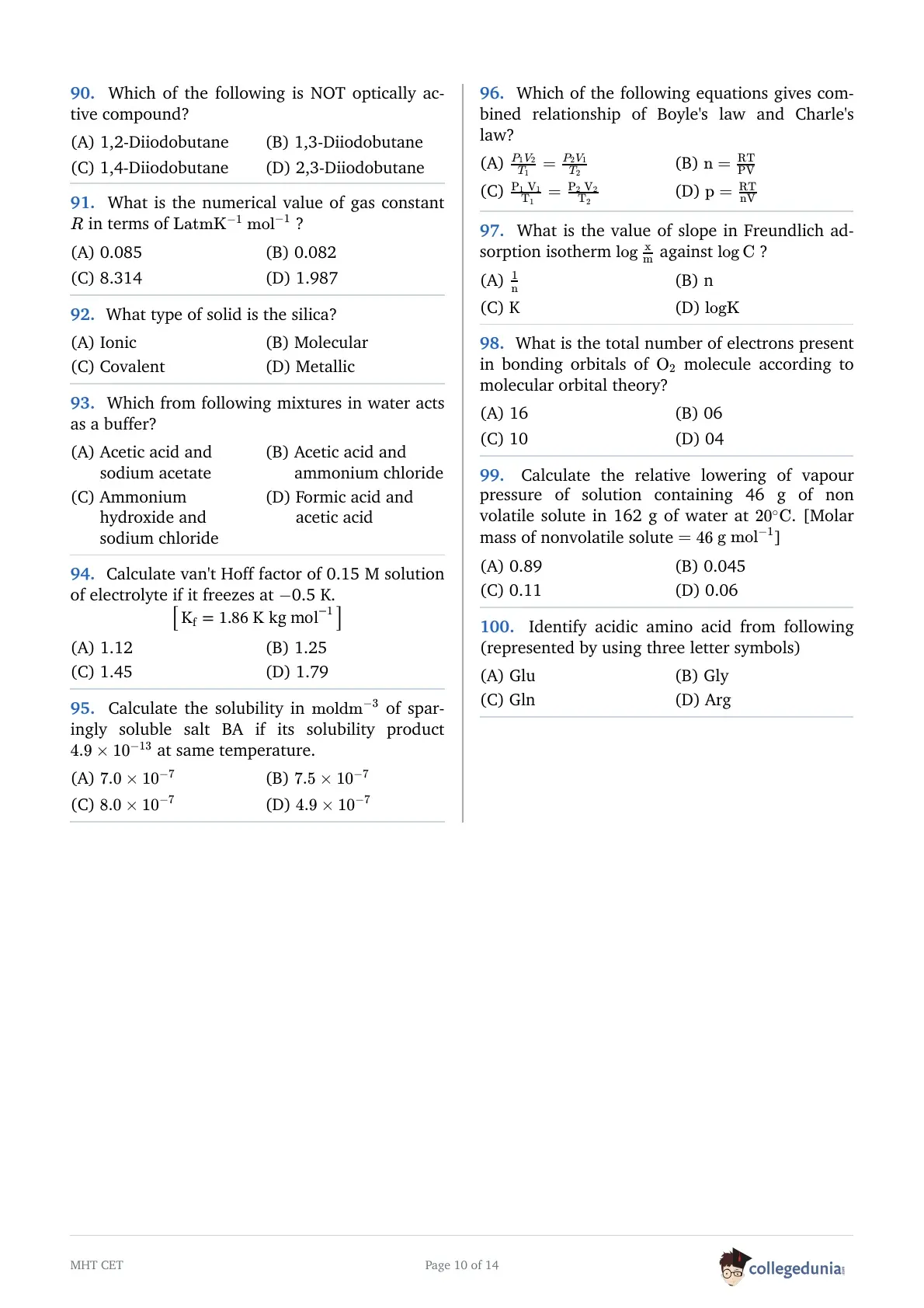
Which of the following equations gives combined relationship of Boyle's law and Charle's law?
What is the value of slope in Freundlich adsorption isotherm \(\log \frac{\mathrm{x}}{\mathrm{m}}\) against \(\log \mathrm{C}\) ?
What is the total number of electrons present in bonding orbitals of \(\mathrm{O}_2\) molecule according to molecular orbital theory?
Calculate the relative lowering of vapour pressure of solution containing 46 g of non volatile solute in 162 g of water at \(20^{\circ} \mathrm{C}\). [Molar mass of nonvolatile solute \(=46 \mathrm{~g} \mathrm{~mol}^{-1}\)]
Identify acidic amino acid from following (represented by using three letter symbols)
Mathematics (Q101 - Q150)
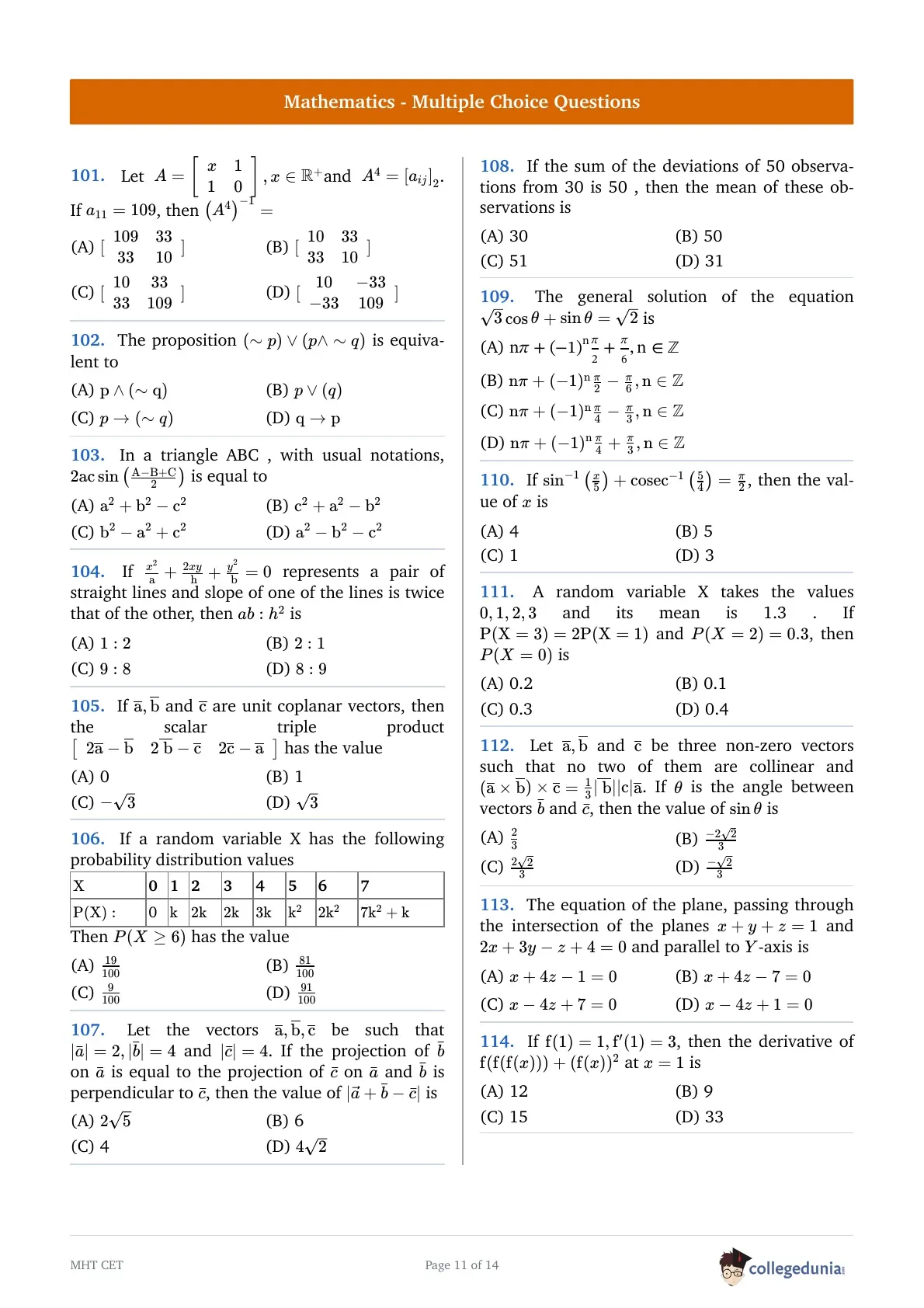
Let \(A=\left[\begin{array}{ll}x & 1 \\ 1 & 0\end{array}\right], x \in \mathbb{R}^{+}\)and \(A^4=\left[a_{i j}\right]_2\). If \(a_{11}=109\), then \(\left(A^4\right)^{-1}=\)
In a triangle ABC , with usual notations, \(2 \mathrm{ac} \sin \left(\frac{\mathrm{A}-\mathrm{B}+\mathrm{C}}{2}\right)\) is equal to
If \(\frac{x^2}{\mathrm{a}}+\frac{2 x y}{\mathrm{~h}}+\frac{y^2}{\mathrm{~b}}=0\) represents a pair of straight lines and slope of one of the lines is twice that of the other, then \(a b: h^2\) is
If \(\overline{\mathrm{a}}, \overline{\mathrm{b}}\) and \(\overline{\mathrm{c}}\) are unit coplanar vectors, then the scalar triple product \(\left[\begin{array}{lll}2 \overline{\mathrm{a}}-\overline{\mathrm{b}} & 2 \overline{\mathrm{~b}}-\overline{\mathrm{c}} & 2 \overline{\mathrm{c}}-\overline{\mathrm{a}}\end{array}\right]\) has the value
If a random variable X has the following probability distribution values
| \(\mathrm{X}\) | 0 | 1 | 2 | 3 | 4 | 5 | 6 | 7 |
|---|---|---|---|---|---|---|---|---|
| \(\mathrm{P(X):}\) | 0 | \(\mathrm{k}\) | \(\mathrm{2k}\) | \(\mathrm{2k}\) | \(\mathrm{3k}\) | \(\mathrm{k^2}\) | \(\mathrm{2k^2}\) | \(\mathrm{7k^2+k}\) |
Let the vectors \(\overline{\mathrm{a}}, \overline{\mathrm{b}}, \overline{\mathrm{c}}\) be such that \(|\bar{a}|=2,|\bar{b}|=4\) and \(|\bar{c}|=4\). If the projection of \(\bar{b}\) on \(\bar{a}\) is equal to the projection of \(\bar{c}\) on \(\bar{a}\) and \(\bar{b}\) is perpendicular to \(\bar{c}\), then the value of \(|\vec{a}+\bar{b}-\bar{c}|\) is
If the sum of the deviations of 50 observations from 30 is 50 , then the mean of these observations is
The general solution of the equation \(\sqrt{3} \cos \theta+\sin \theta=\sqrt{2}\) is
If \(\sin ^{-1}\left(\frac{x}{5}\right)+\operatorname{cosec}^{-1}\left(\frac{5}{4}\right)=\frac{\pi}{2}\), then the value of \(x\) is
A random variable X takes the values \(0,1,2,3\) and its mean is 1.3 . If \(\mathrm{P}(\mathrm{X}=3)=2 \mathrm{P}(\mathrm{X}=1)\) and \(P(X=2)=0.3\), then \(P(X=0)\) is
Let \(\overline{\mathrm{a}}, \overline{\mathrm{b}}\) and \(\overline{\mathrm{c}}\) be three non-zero vectors such that no two of them are collinear and \((\overline{\mathrm{a}} \times \overline{\mathrm{b}}) \times \overline{\mathrm{c}}=\frac{1}{3}|\overline{\mathrm{~b}}||\mathrm{c}| \overline{\mathrm{a}}\). If \(\theta\) is the angle between vectors \(\bar{b}\) and \(\bar{c}\), then the value of \(\sin \theta\) is
The equation of the plane, passing through the intersection of the planes \(x+y+z=1\) and \(2 x+3 y-z+4=0\) and parallel to \(Y\)-axis is
If \(\mathrm{f}(1)=1, \mathrm{f}^{\prime}(1)=3\), then the derivative of \(\mathrm{f}(\mathrm{f}(\mathrm{f}(x)))+(\mathrm{f}(x))^2\) at \(x=1\) is
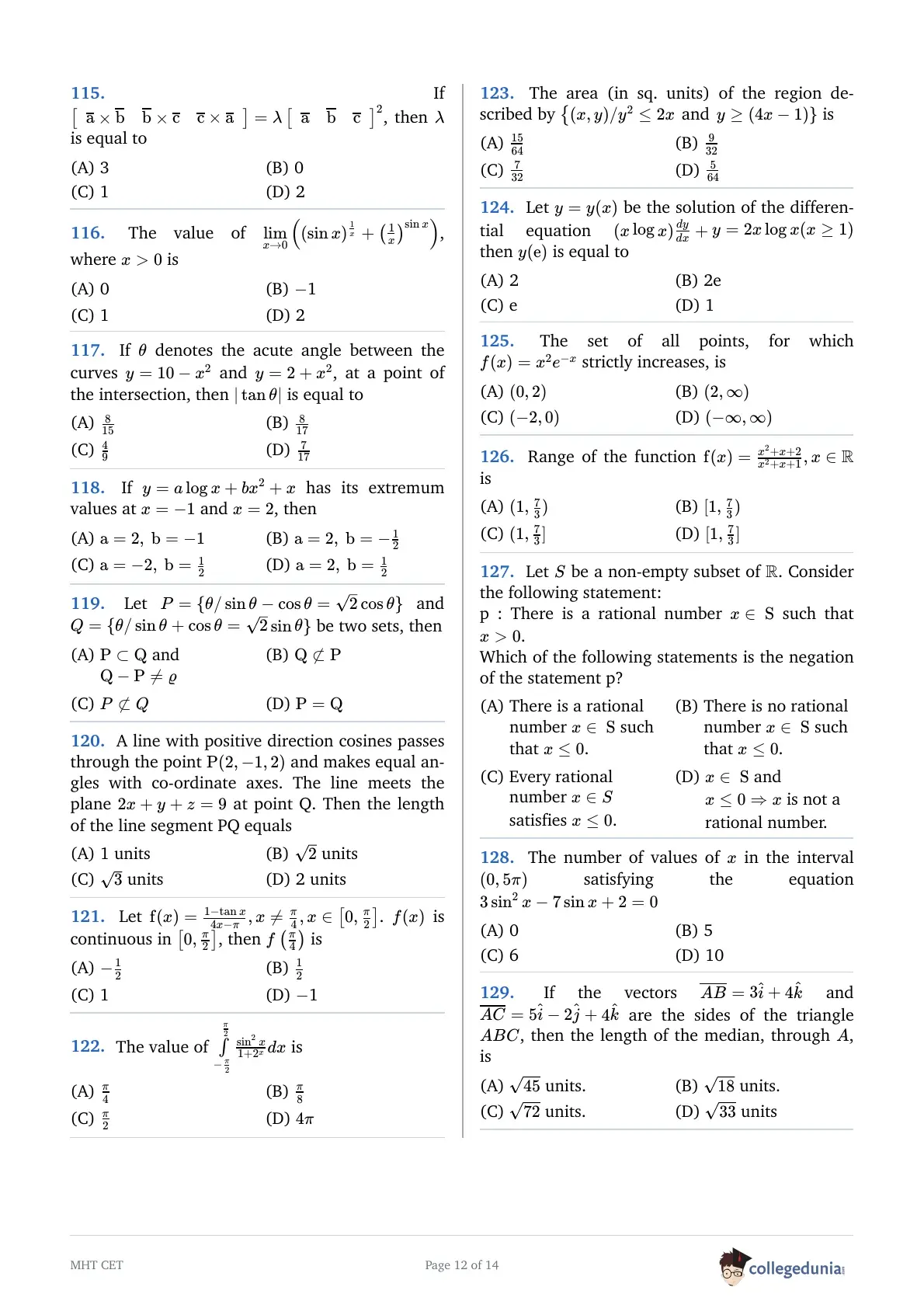
If \(\left[\begin{array}{lll}\overline{\mathrm{a}} \times \overline{\mathrm{b}} & \overline{\mathrm{b}} \times \overline{\mathrm{c}} & \overline{\mathrm{c}} \times \overline{\mathrm{a}}\end{array}\right]=\lambda\left[\begin{array}{lll}\overline{\mathrm{a}} & \overline{\mathrm{b}} & \overline{\mathrm{c}}\end{array}\right]^2\), then \(\lambda\) is equal to
The value of \(\lim _\limits{x \rightarrow 0}\left((\sin x)^{\frac{1}{x}}+\left(\frac{1}{x}\right)^{\sin x}\right)\), where \(x>0\) is
If \(\theta\) denotes the acute angle between the curves \(y=10-x^2\) and \(y=2+x^2\), at a point of the intersection, then \(|\tan \theta|\) is equal to
If \(y=a \log x+b x^2+x\) has its extremum values at \(x=-1\) and \(x=2\), then
Let \(P=\{\theta / \sin \theta-\cos \theta=\sqrt{2} \cos \theta\}\) and \(Q=\{\theta / \sin \theta+\cos \theta=\sqrt{2} \sin \theta\}\) be two sets, then
A line with positive direction cosines passes through the point \(\mathrm{P}(2,-1,2)\) and makes equal angles with co-ordinate axes. The line meets the plane \(2 x+y+z=9\) at point Q. Then the length of the line segment PQ equals
Let \(\mathrm{f}(x)=\frac{1-\tan x}{4 x-\pi}, x \neq \frac{\pi}{4}, x \in\left[0, \frac{\pi}{2}\right]\). \(f(x)\) is continuous in \(\left[0, \frac{\pi}{2}\right]\), then \(f\left(\frac{\pi}{4}\right)\) is
The value of \(\int_\limits{-\frac{\pi}{2}}^{\frac{\pi}{2}} \frac{\sin ^2 x}{1+2^x} d x\) is
The area (in sq. units) of the region described by \(\left\{(x, y) / y^2 \leq 2 x\right.\) and \(\left.y \geq(4 x-1)\right\}\) is
Let \(y=y(x)\) be the solution of the differential equation \((x \log x) \frac{d y}{d x}+y=2 x \log x(x \geq 1)\) then \(y(\mathrm{e})\) is equal to
The set of all points, for which \(f(x)=x^2 e^{-x}\) strictly increases, is
Range of the function \(\mathrm{f}(x)=\frac{x^2+x+2}{x^2+x+1}, x \in \mathbb{R}\) is
Let \(S\) be a non-empty subset of \(\mathbb{R}\). Consider the following statement:
p : There is a rational number \(x \in \mathrm{~S}\) such that \(x>0\).
Which of the following statements is the negation of the statement p?
The number of values of \(x\) in the interval \((0,5 \pi)\) satisfying the equation \(3 \sin ^2 x-7 \sin x+2=0\)
If the vectors \(\overline{A B}=3 \hat{i}+4 \hat{k}\) and \(\overline{A C}=5 \hat{i}-2 \hat{j}+4 \hat{k}\) are the sides of the triangle \(A B C\), then the length of the median, through \(A\), is
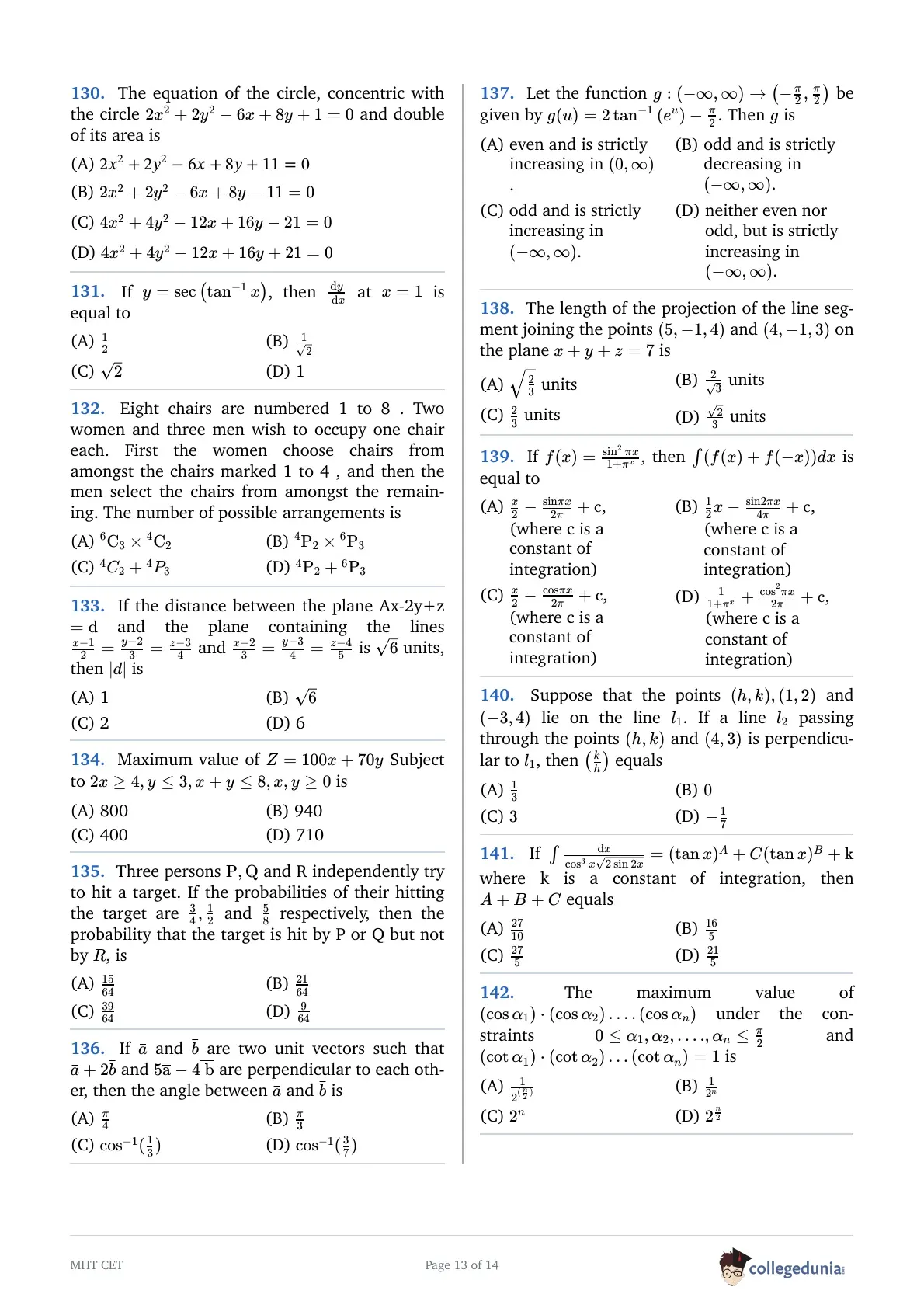
The equation of the circle, concentric with the circle \(2 x^2+2 y^2-6 x+8 y+1=0\) and double of its area is
If \(y=\sec \left(\tan ^{-1} x\right)\), then \(\frac{\mathrm{d} y}{\mathrm{~d} x}\) at \(x=1\) is equal to
Eight chairs are numbered 1 to 8 . Two women and three men wish to occupy one chair each. First the women choose chairs from amongst the chairs marked 1 to 4 , and then the men select the chairs from amongst the remaining. The number of possible arrangements is
If the distance between the plane Ax-2y+z \(=\mathrm{d}\) and the plane containing the lines \(\frac{x-1}{2}=\frac{y-2}{3}=\frac{z-3}{4}\) and \(\frac{x-2}{3}=\frac{y-3}{4}=\frac{z-4}{5}\) is \(\sqrt{6}\) units, then \(|d|\) is
Maximum value of \(Z=100 x+70 y\) Subject to \(2 x \geq 4, y \leq 3, x+y \leq 8, x, y \geq 0\) is
Three persons \(\mathrm{P}, \mathrm{Q}\) and R independently try to hit a target. If the probabilities of their hitting the target are \(\frac{3}{4}, \frac{1}{2}\) and \(\frac{5}{8}\) respectively, then the probability that the target is hit by P or Q but not by \(R\), is
If \(\bar{a}\) and \(\bar{b}\) are two unit vectors such that \(\bar{a}+2 \bar{b}\) and \(5 \overline{\mathrm{a}}-4 \overline{\mathrm{~b}}\) are perpendicular to each other, then the angle between \(\bar{a}\) and \(\bar{b}\) is
Let the function \(g:(-\infty, \infty) \rightarrow\left(-\frac{\pi}{2}, \frac{\pi}{2}\right)\) be given by \(g(u)=2 \tan ^{-1}\left(e^u\right)-\frac{\pi}{2}\). Then \(g\) is
The length of the projection of the line segment joining the points \((5,-1,4)\) and \((4,-1,3)\) on the plane \(x+y+z=7\) is
If \(f(x)=\frac{\sin ^2 \pi x}{1+\pi^x}\), then \(\int(f(x)+f(-x)) d x\) is equal to
Suppose that the points \((h, k),(1,2)\) and \((-3,4)\) lie on the line \(l_1\). If a line \(l_2\) passing through the points \((h, k)\) and \((4,3)\) is perpendicular to \(l_1\), then \(\left(\frac{k}{h}\right)\) equals
If \(\int \frac{\mathrm{d} x}{\cos ^3 x \sqrt{2 \sin 2 x}}=(\tan x)^A+C(\tan x)^B+\mathrm{k}\) where k is a constant of integration, then \(A+B+C\) equals
The maximum value of \(\left(\cos \alpha_1\right) \cdot\left(\cos \alpha_2\right) \ldots .\left(\cos \alpha_n\right)\) under the constraints \(0 \leq \alpha_1, \alpha_2, \ldots ., \alpha_n \leq \frac{\pi}{2}\) and \(\left(\cot \alpha_1\right) \cdot\left(\cot \alpha_2\right) \ldots\left(\cot \alpha_n\right)=1\) is
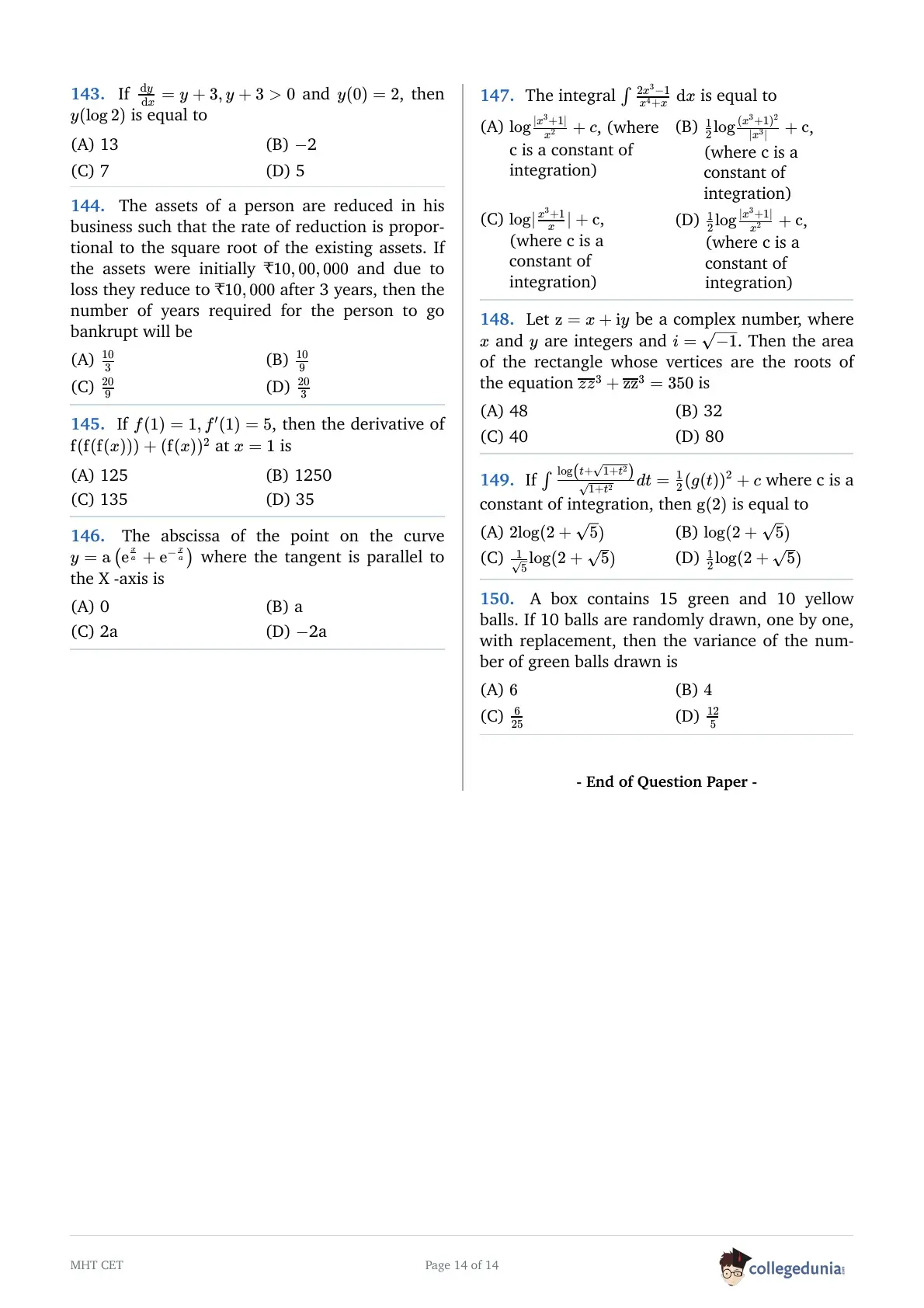
If \(\frac{\mathrm{d} y}{\mathrm{~d} x}=y+3, y+3>0\) and \(y(0)=2\), then \(y(\log 2)\) is equal to
The assets of a person are reduced in his business such that the rate of reduction is proportional to the square root of the existing assets. If the assets were initially ₹\(10,00,000\) and due to loss they reduce to ₹\( 10,000\) after 3 years, then the number of years required for the person to go bankrupt will be
If \(f(1)=1, f^{\prime}(1)=5\), then the derivative of \(\mathrm{f}(\mathrm{f}(\mathrm{f}(x)))+(\mathrm{f}(x))^2\) at \(x=1\) is
The abscissa of the point on the curve \(y=\mathrm{a}\left(\mathrm{e}^{\frac{x}{a}}+\mathrm{e}^{-\frac{x}{a}}\right)\) where the tangent is parallel to the X -axis is
The integral \(\int \frac{2 x^3-1}{x^4+x} \mathrm{~d} x\) is equal to
Let \(\mathrm{z}=x+\mathrm{i} y\) be a complex number, where \(x\) and \(y\) are integers and \(i=\sqrt{-1}\). Then the area of the rectangle whose vertices are the roots of the equation \(\overline{z z}^3+\overline{\mathrm{zz}}^3=350\) is
If \(\int \frac{\log \left(t+\sqrt{1+t^2}\right)}{\sqrt{1+t^2}} d t=\frac{1}{2}(g(t))^2+c\) where c is a constant of integration, then \(\mathrm{g}(2)\) is equal to
A box contains 15 green and 10 yellow balls. If 10 balls are randomly drawn, one by one, with replacement, then the variance of the number of green balls drawn is
MHT CET 2024 PCM Exam Pattern and Marking Scheme
| Parameter | Details |
|---|---|
| Conducting Body | Maharashtra Common Entrance Test Cell (Maharashtra CET Cell) |
| Exam Mode | Online (Computer-Based Test) |
| Duration | 180 minutes (3 hours) |
| Groups / Subjects | PCM (Physics, Chemistry, Mathematics) for Engineering |
| Total Questions |
150 |
| Total Marks | 200 |
| Question Type | Multiple Choice Questions (MCQs) |
| Marks Distribution |
|
| Negative Marking | No |
| Syllabus Weightage |
|



Comments