MHT CET 2024 May 15 Shift 2 PCM Question Paper is available for download here. Maharashtra State CET Cell conducted MHT CET 2024 PCM Exam on May 15 in Shift 2 from 2 PM to 5 PM in CBT mode.
The MHT CET 2024 PCM question paper includes the following:
The MHT CET 2024 PCM Question Paper consists of 150 multiple-choice questions (MCQs) totalling 200 marks divided into 3 sections: Physics, Chemistry, and Mathematics, with 50 questions in each subject.
Physics and Chemistry questions carry 1 mark each while Mathematics questions carry 2 marks each.
There is no negative marking for incorrect answers.
MHT CET 2024 May 15 Shift 2 PCM Question Paper with Solution PDF
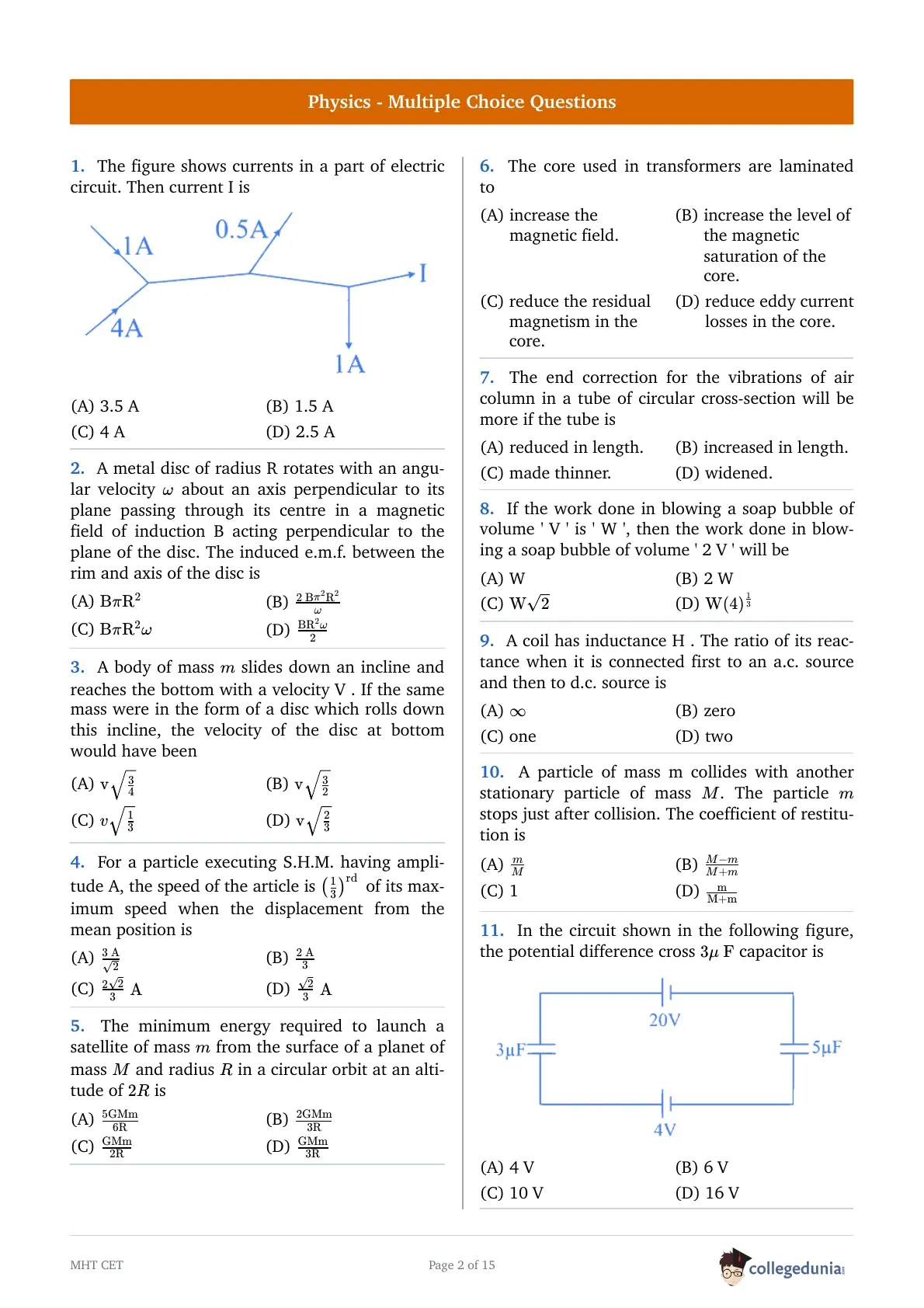
A metal disc of radius R rotates with an angular velocity \(\omega\) about an axis perpendicular to its plane passing through its centre in a magnetic field of induction B acting perpendicular to the plane of the disc. The induced e.m.f. between the rim and axis of the disc is
A body of mass \(m\) slides down an incline and reaches the bottom with a velocity V . If the same mass were in the form of a disc which rolls down this incline, the velocity of the disc at bottom would have been
For a particle executing S.H.M. having amplitude A, the speed of the article is \(\left(\frac{1}{3}\right)^{\text {rd }}\) of its maximum speed when the displacement from the mean position is
The minimum energy required to launch a satellite of mass \(m\) from the surface of a planet of mass \(M\) and radius \(R\) in a circular orbit at an altitude of \(2 R\) is
A particle of mass m collides with another stationary particle of mass \(M\). The particle \(m\) stops just after collision. The coefficient of restitution is
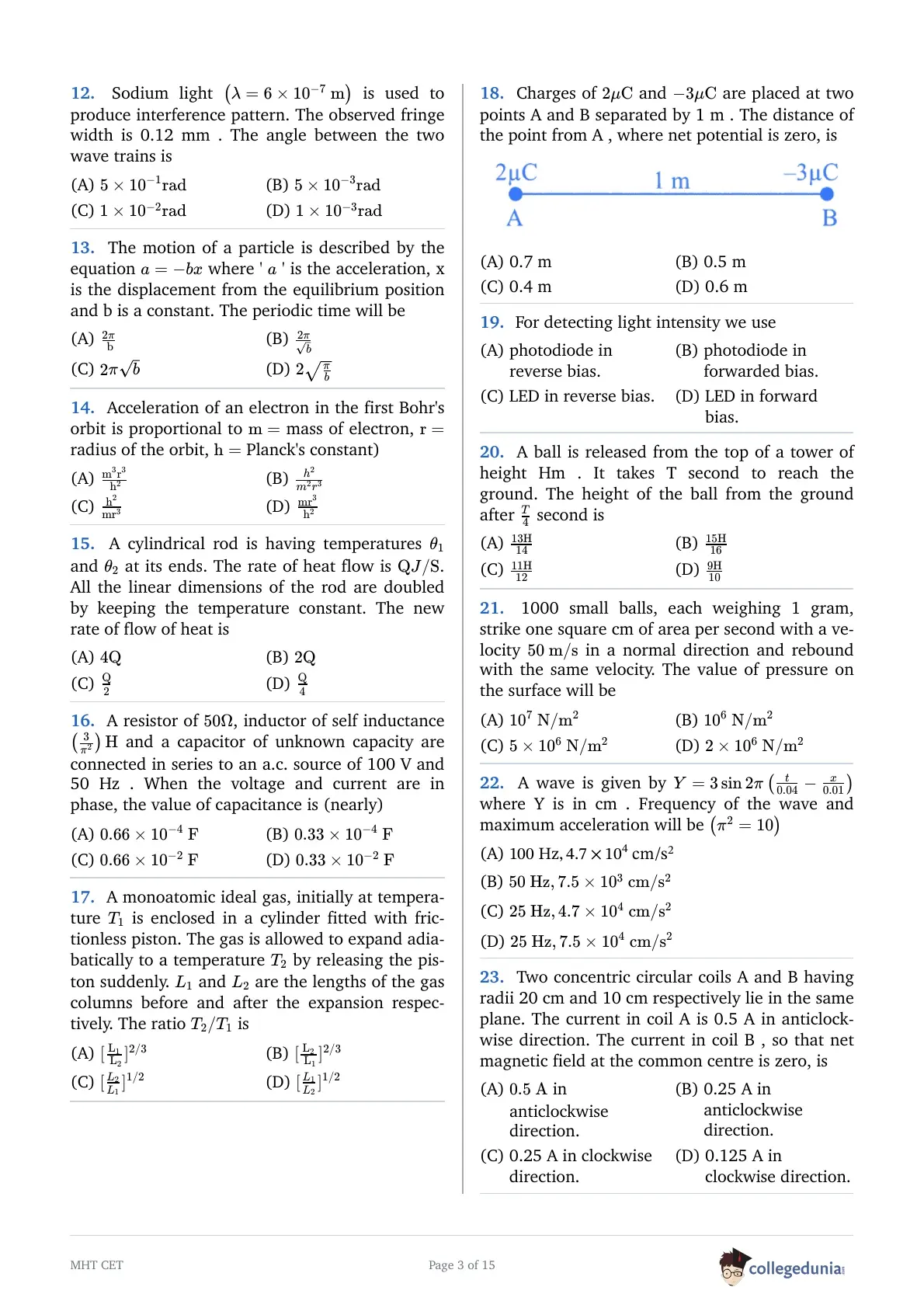
Sodium light \(\left(\lambda=6 \times 10^{-7} \mathrm{~m}\right)\) is used to produce interference pattern. The observed fringe width is 0.12 mm . The angle between the two wave trains is
The motion of a particle is described by the equation \(a=-b x\) where ' \(a\) ' is the acceleration, x is the displacement from the equilibrium position and b is a constant. The periodic time will be
Acceleration of an electron in the first Bohr's orbit is proportional to \(\mathrm{m}=\) mass of electron, \(\mathrm{r}=\) radius of the orbit, \(\mathrm{h}=\) Planck's constant)
A cylindrical rod is having temperatures \(\theta_1\) and \(\theta_2\) at its ends. The rate of heat flow is \(\mathrm{Q} J / \mathrm{S}\). All the linear dimensions of the rod are doubled by keeping the temperature constant. The new rate of flow of heat is
A resistor of \(50 \Omega\), inductor of self inductance \(\left(\frac{3}{\pi^2}\right) \mathrm{H}\) and a capacitor of unknown capacity are connected in series to an a.c. source of 100 V and 50 Hz . When the voltage and current are in phase, the value of capacitance is (nearly)
A monoatomic ideal gas, initially at temperature \(T_1\) is enclosed in a cylinder fitted with frictionless piston. The gas is allowed to expand adiabatically to a temperature \(T_2\) by releasing the piston suddenly. \(L_1\) and \(L_2\) are the lengths of the gas columns before and after the expansion respectively. The ratio \(T_2 / T_1\) is
Charges of \(2 \mu \mathrm{C}\) and \(-3 \mu \mathrm{C}\) are placed at two points A and B separated by 1 m . The distance of the point from A , where net potential is zero, is
A ball is released from the top of a tower of height Hm . It takes T second to reach the ground. The height of the ball from the ground after \(\frac{T}{4}\) second is
1000 small balls, each weighing 1 gram, strike one square cm of area per second with a velocity \(50 \mathrm{~m} / \mathrm{s}\) in a normal direction and rebound with the same velocity. The value of pressure on the surface will be
A wave is given by \(Y=3 \sin 2 \pi\left(\frac{t}{0.04}-\frac{x}{0.01}\right)\) where Y is in cm . Frequency of the wave and maximum acceleration will be \(\left(\pi^2=10\right)\)
Two concentric circular coils A and B having radii 20 cm and 10 cm respectively lie in the same plane. The current in coil A is 0.5 A in anticlockwise direction. The current in coil B , so that net magnetic field at the common centre is zero, is
(A) \(0.5\text{ }\mathrm{A}\) in anticlockwise direction.
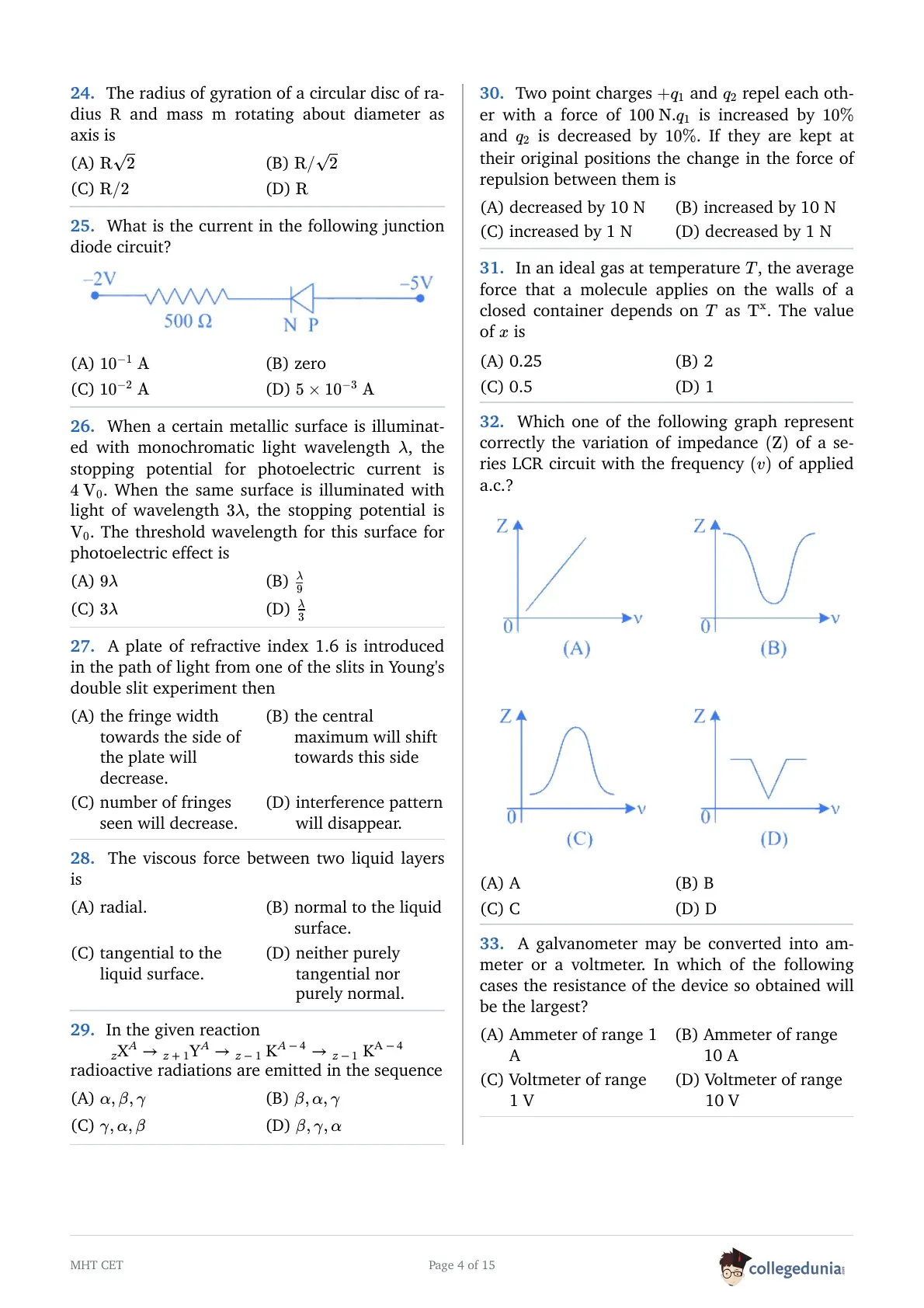
When a certain metallic surface is illuminated with monochromatic light wavelength \(\lambda\), the stopping potential for photoelectric current is \(4 \mathrm{~V}_0\). When the same surface is illuminated with light of wavelength \(3 \lambda\), the stopping potential is \(\mathrm{V}_0\). The threshold wavelength for this surface for photoelectric effect is
Two point charges \(+q_1\) and \(q_2\) repel each other with a force of \(100 \mathrm{~N} . q_1\) is increased by \(10 \%\) and \(q_2\) is decreased by \(10 \%\). If they are kept at their original positions the change in the force of repulsion between them is
In an ideal gas at temperature \(T\), the average force that a molecule applies on the walls of a closed container depends on \(T\) as \(\mathrm{T}^{\mathrm{x}}\). The value of \(x\) is
Which one of the following graph represent correctly the variation of impedance \((\mathrm{Z})\) of a series LCR circuit with the frequency \((v)\) of applied a.c.?
A galvanometer may be converted into ammeter or a voltmeter. In which of the following cases the resistance of the device so obtained will be the largest?
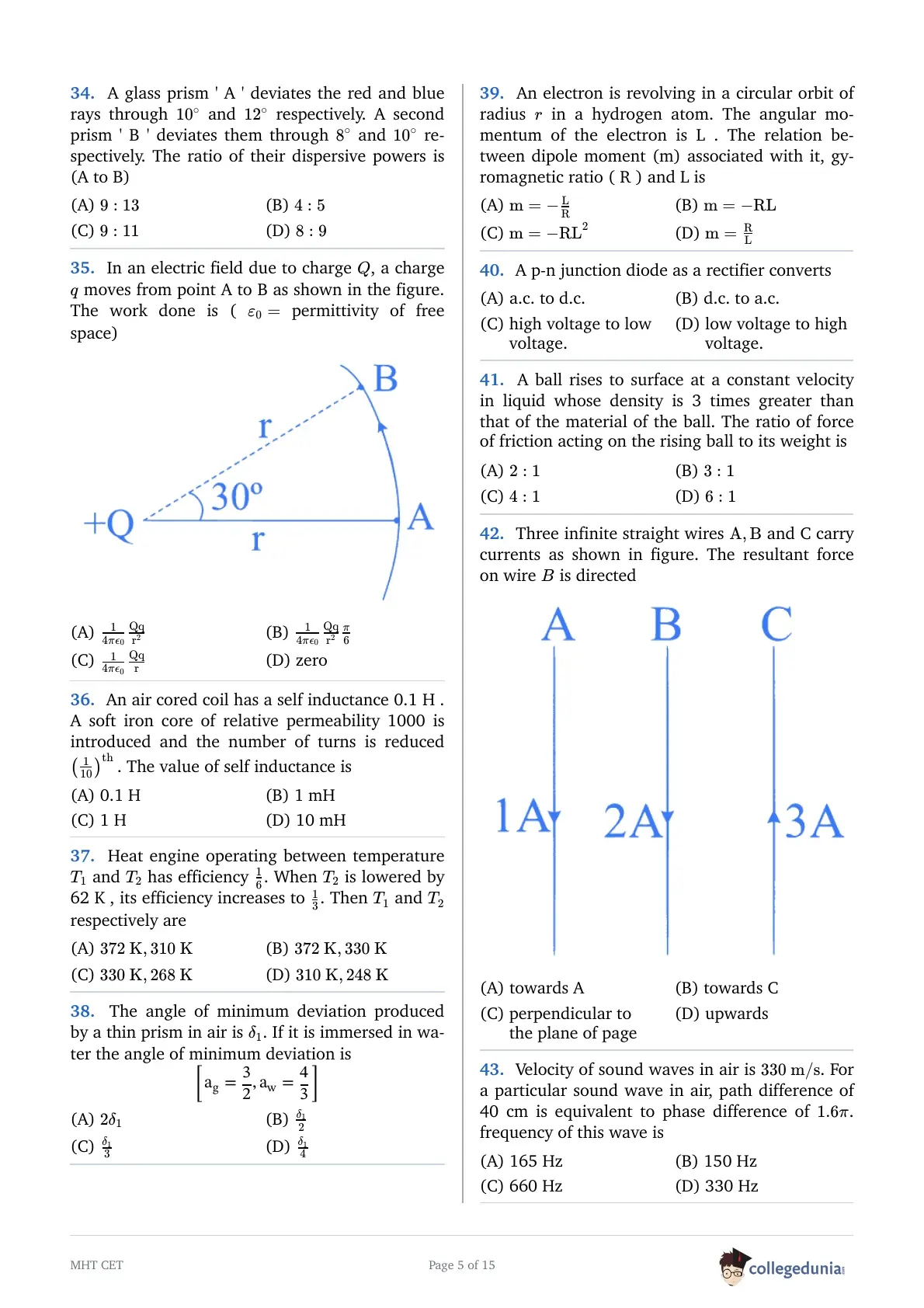
A glass prism ' A ' deviates the red and blue rays through \(10^{\circ}\) and \(12^{\circ}\) respectively. A second prism ' B ' deviates them through \(8^{\circ}\) and \(10^{\circ}\) respectively. The ratio of their dispersive powers is (A to B)
In an electric field due to charge \(Q\), a charge \(q\) moves from point A to B as shown in the figure. The work done is ( \(\varepsilon_0=\) permittivity of free space)
An air cored coil has a self inductance 0.1 H . A soft iron core of relative permeability 1000 is introduced and the number of turns is reduced \(\left(\frac{1}{10}\right)^{\text {th }}\). The value of self inductance is
Heat engine operating between temperature \(T_1\) and \(T_2\) has efficiency \(\frac{1}{6}\). When \(T_2\) is lowered by 62 K , its efficiency increases to \(\frac{1}{3}\). Then \(T_1\) and \(T_2\) respectively are
An electron is revolving in a circular orbit of radius \(r\) in a hydrogen atom. The angular momentum of the electron is L . The relation between dipole moment (m) associated with it, gyromagnetic ratio ( R ) and L is
A ball rises to surface at a constant velocity in liquid whose density is 3 times greater than that of the material of the ball. The ratio of force of friction acting on the rising ball to its weight is
Velocity of sound waves in air is \(330 \mathrm{~m} / \mathrm{s}\). For a particular sound wave in air, path difference of 40 cm is equivalent to phase difference of \(1.6 \pi\). frequency of this wave is
In Young's double slit experiment, the intensity of light at a point on the screen where the path difference is \(\lambda\) is x units, \(\lambda\) being the wavelength of light used. The intensity at a point where the path difference is \(\frac{\lambda}{4}\) will be \(\left(\cos 2 \pi=1, \cos \frac{\pi}{2}=0\right)\)
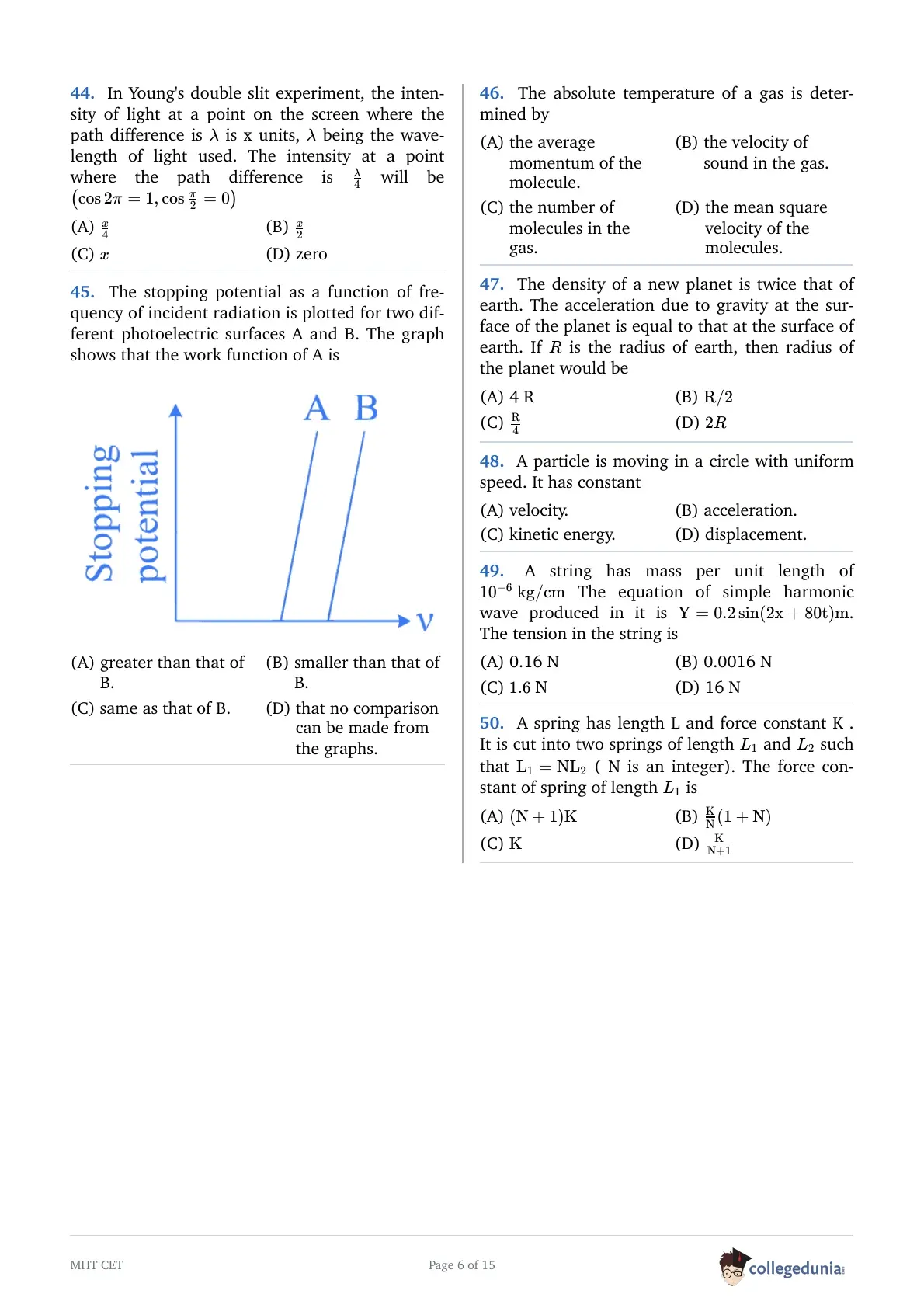
The stopping potential as a function of frequency of incident radiation is plotted for two different photoelectric surfaces A and B. The graph shows that the work function of A is
(A) greater than that of B.
(B) smaller than that of B.
(C) same as that of B.
(D) that no comparison can be made from the graphs.
The density of a new planet is twice that of earth. The acceleration due to gravity at the surface of the planet is equal to that at the surface of earth. If \(R\) is the radius of earth, then radius of the planet would be
A string has mass per unit length of \(10^{-6} \mathrm{~kg} / \mathrm{cm}\) The equation of simple harmonic wave produced in it is \(\mathrm{Y}=0.2 \sin (2 \mathrm{x}+80 \mathrm{t}) \mathrm{m}\). The tension in the string is
A spring has length L and force constant K . It is cut into two springs of length \(L_1\) and \(L_2\) such that \(\mathrm{L}_1=\mathrm{NL}_2\) ( N is an integer). The force constant of spring of length \(L_1\) is
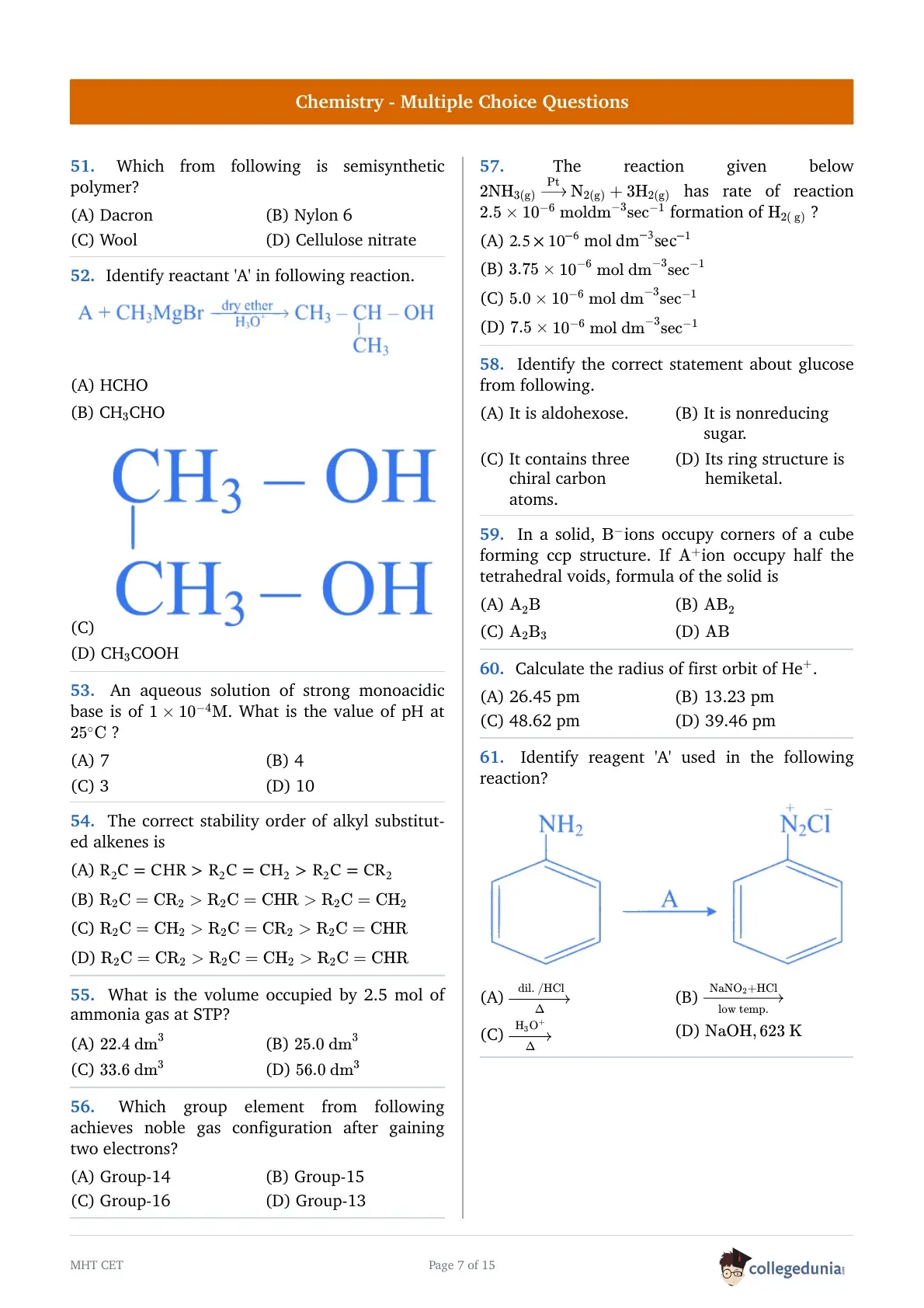
The reaction given below \(2 \mathrm{NH}_{3(\mathrm{g})} \xrightarrow{\mathrm{Pt}} \mathrm{N}_{2(\mathrm{g})}+3 \mathrm{H}_{2(\mathrm{g})}\) has rate of reaction \(2.5 \times 10^{-6} \mathrm{~mol} \mathrm{dm}^{-3} \mathrm{sec}^{-1}\) formation of \(\mathrm{H}_{2(\mathrm{~g})}\) ?
In a solid, \(\mathrm{B}^{-}\)ions occupy corners of a cube forming ccp structure. If \(\mathrm{A}^{+}\)ion occupy half the tetrahedral voids, formula of the solid is
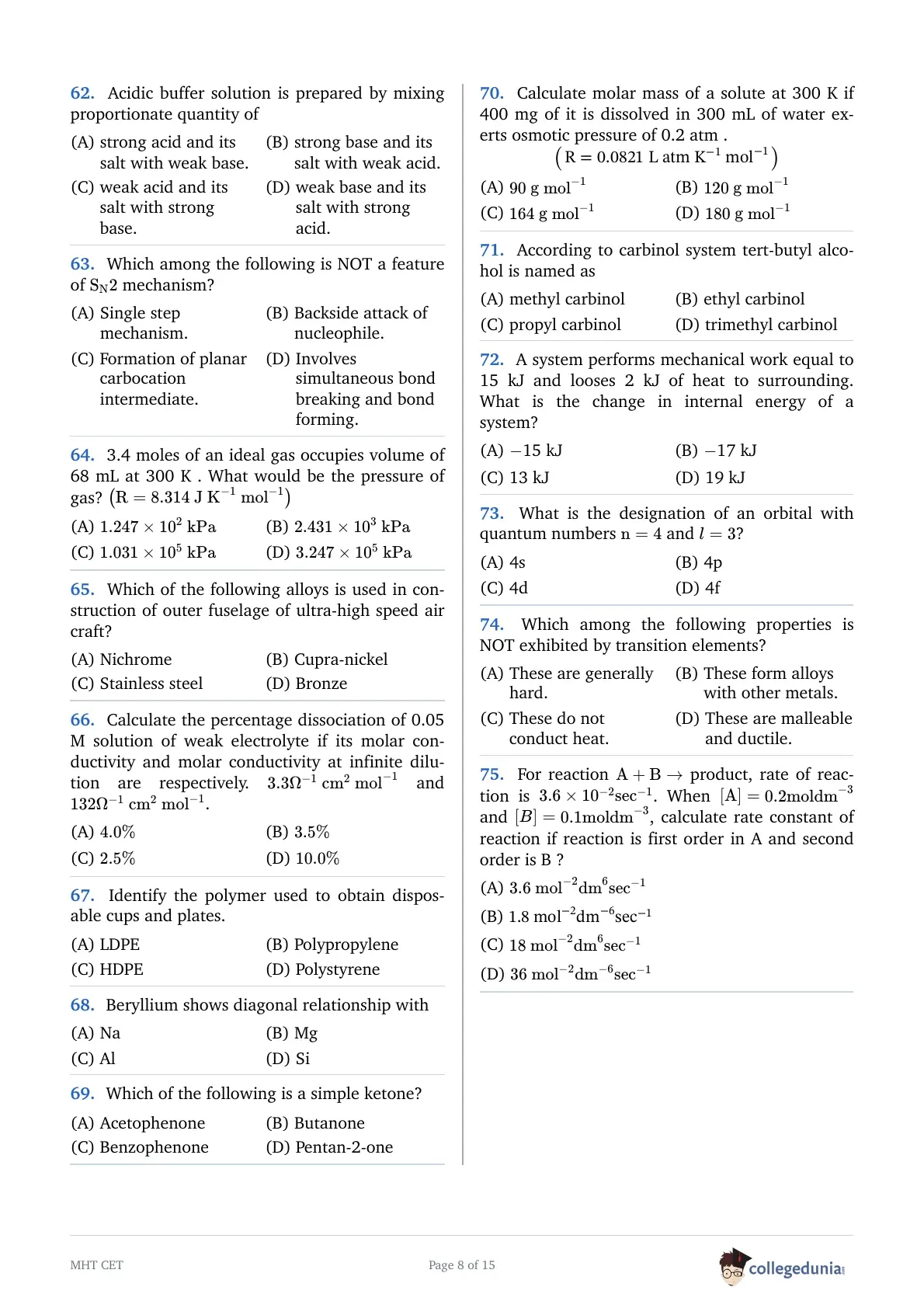
Calculate the percentage dissociation of 0.05 M solution of weak electrolyte if its molar conductivity and molar conductivity at infinite dilution are respectively. \(3.3 \Omega^{-1} \mathrm{~cm}^2 \mathrm{~mol}^{-1}\) and \(132 \Omega^{-1} \mathrm{~cm}^2 \mathrm{~mol}^{-1}\).
For reaction \(\mathrm{A}+\mathrm{B} \rightarrow\) product, rate of reaction is \(3.6 \times 10^{-2} \mathrm{sec}^{-1}\). When \([\mathrm{A}]=0.2 \mathrm{moldm}^{-3}\) and \([B]=0.1 \mathrm{moldm}^{-3}\), calculate rate constant of reaction if reaction is first order in A and second order is B ?
Unit cell of an element has edge length of 5\[\mathop A\limits^o \] with density \(4 \mathrm{~g} \mathrm{~cm}^{-3}\), if its atomic mass is 149, identify the crystal structure.
The degree of dissociation of 0.01 M solution of \(\mathrm{NH}_4 \mathrm{OH}\) is \(4.2 \times 10^{-2}\). What is the percent dissociation of \(\mathrm{NH}_4 \mathrm{OH}\) ?
What is the vapour pressure of a solution containing 0.1 mol of non volatile solute dissolved in 16.2 g water? \(\left(\mathrm{P}_1^0=24 \mathrm{mmHg}\right.\), molar mass of water \(18 \mathrm{~g} \mathrm{~mol}^{-1}\) )
Let \(P, Q, R\) and \(S\) be the points on the plane with position vectors \(-2 \hat{i}-\hat{j}, 4 \hat{i}, 3 \hat{i}+3 \hat{j}\) and \(-3 \hat{i}+2 \hat{j}\) respectively. Then the quadrilateral PQRS must be a
(A) parallelogram, which is neither a rhombus nor a rectangle.
An open tank with a square bottom, to contain 4000 cubic cm . of liquid, is to be constructed. The dimensions of the tank, so that the surface area of the tank is minimum, are
(A) side of square bottom \(=40\text{ }\mathrm{cm}\), height \(=10\text{ }\mathrm{cm}\).
(B) side of square bottom \(=20\text{ }\mathrm{cm}\), height \(=10\text{ }\mathrm{cm}\).
(C) side of square bottom \(=10\text{ }\mathrm{cm}\), height \(=40\text{ }\mathrm{cm}\).
(D) side of square bottom \(=5\text{ }\mathrm{cm}\), height \(=160\text{ }\mathrm{cm}\).
There are 3 sections in a question paper and each section contains 5 questions. A candidate has to answer a total of 5 questions, choosing at least one question from each section. Then the number of ways, in which the candidate can choose the questions, is
If the sides of a rectangle are given by the equations \(x=-2, x=6, y=-2, y=5\), then the equation of the circle, drawn on the diagonal of this rectangle as its diameter, is
If the function \(f(x)= \begin{cases}-2 \sin x & \text {, if } x \leq \frac{-\pi}{2} \\ A \sin x+B & , \text { if } \frac{-\pi}{2}< x<\frac{\pi}{2} \\ \cos x & , \text { if } x \geq \frac{\pi}{2}\end{cases}\) is continuous everywhere, then the values of \(A\) and \(B\) are respectively
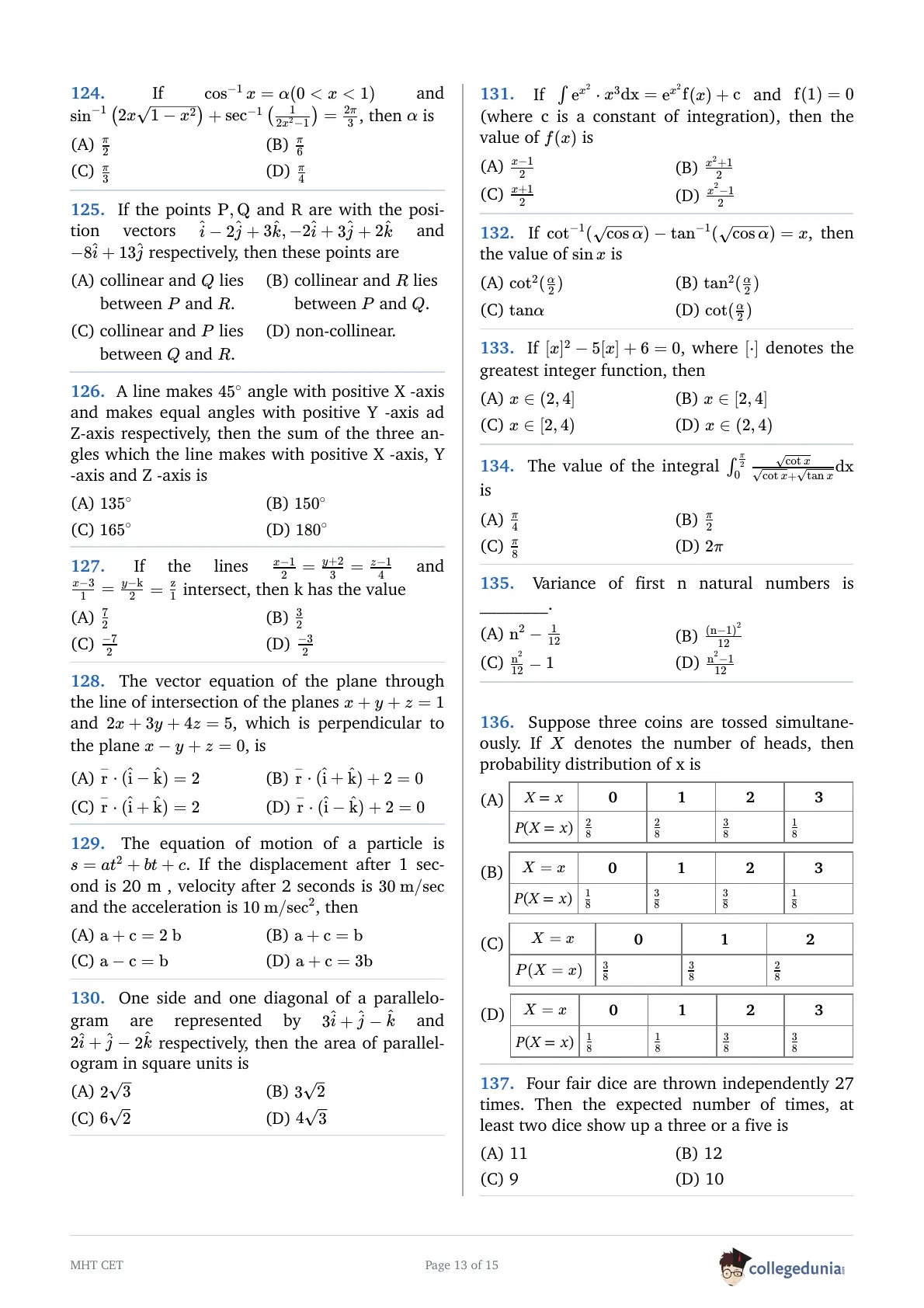
If \(\cos ^{-1} x=\alpha\ (0< x < 1)\) and \(\sin ^{-1}\left(2 x \sqrt{1-x^2}\right)+\sec ^{-1}\left(\frac{1}{2 x^2-1}\right)=\frac{2 \pi}{3}\), then \(\alpha\) is
If the points \(\mathrm{P}, \mathrm{Q}\) and R are with the position vectors \(\hat{i}-2 \hat{j}+3 \hat{k},-2 \hat{i}+3 \hat{j}+2 \hat{k}\) and \(-8 \hat{i}+13 \hat{j}\) respectively, then these points are
(A) collinear and \(Q\) lies between \(P\) and \(R\).
(B) collinear and \(R\) lies between \(P\) and \(Q\).
(C) collinear and \(P\) lies between \(Q\) and \(R\).
A line makes \(45^{\circ}\) angle with positive X -axis and makes equal angles with positive Y -axis ad Z-axis respectively, then the sum of the three angles which the line makes with positive X -axis, Y -axis and Z -axis is
If the lines \(\frac{x-1}{2}=\frac{y+2}{3}=\frac{z-1}{4}\) and \(\frac{x-3}{1}=\frac{y-\mathrm{k}}{2}=\frac{\mathrm{z}}{1}\) intersect, then k has the value
The vector equation of the plane through the line of intersection of the planes \(x+y+z=1\) and \(2 x+3 y+4 z=5\), which is perpendicular to the plane \(x-y+z=0\), is
The equation of motion of a particle is \(s=a t^2+b t+c\). If the displacement after 1 second is 20 m , velocity after 2 seconds is \(30 \mathrm{~m} / \mathrm{sec}\) and the acceleration is \(10 \mathrm{~m} / \mathrm{sec}^2\), then
One side and one diagonal of a parallelogram are represented by \(3 \hat{i}+\hat{j}-\hat{k}\) and \(2 \hat{i}+\hat{j}-2 \hat{k}\) respectively, then the area of parallelogram in square units is
If \(\int \mathrm{e}^{x^2} \cdot x^3 \mathrm{dx}=\mathrm{e}^{x^2} \mathrm{f}(x)+\mathrm{c}\) and \(\mathrm{f}(1)=0\) (where c is a constant of integration), then the value of \(f(x)\) is
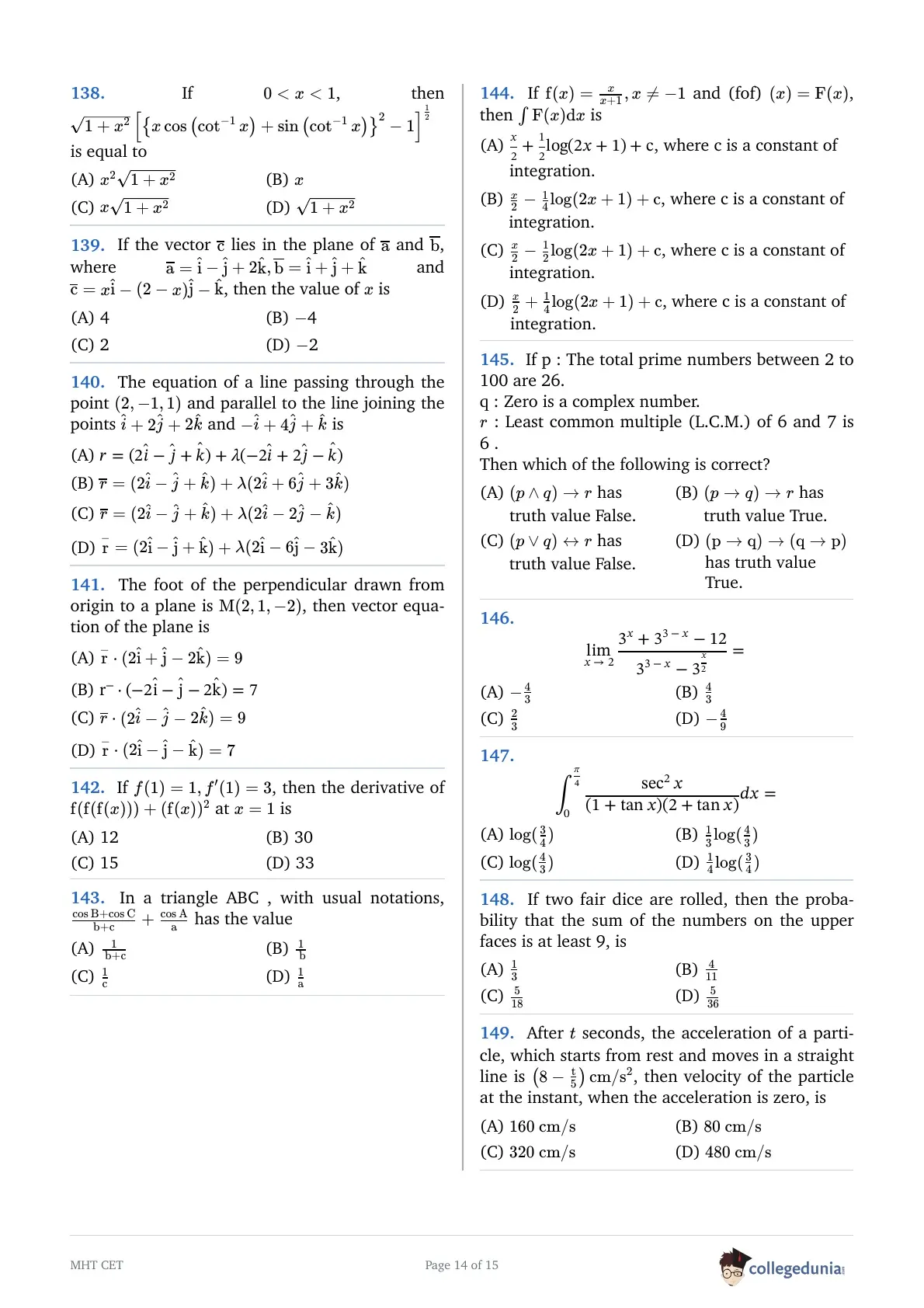
If \(0< x<1\), then \(\sqrt{1+x^2}\left[\left\{x \cos \left(\cot ^{-1} x\right)+\sin \left(\cot ^{-1} x\right)\right\}^2-1\right]^{\frac{1}{2}}\) is equal to
If the vector \(\overline{\mathrm{c}}\) lies in the plane of \(\overline{\mathrm{a}}\) and \(\overline{\mathrm{b}}\), where \(\overline{\mathrm{a}}=\hat{\mathrm{i}}-\hat{\mathrm{j}}+2 \hat{\mathrm{k}}, \overline{\mathrm{b}}=\hat{\mathrm{i}}+\hat{\mathrm{j}}+\hat{\mathrm{k}}\) and \(\overline{\mathrm{c}}=x \hat{\mathrm{i}}-(2-x) \hat{\mathrm{j}}-\hat{\mathrm{k}}\), then the value of \(x\) is
The equation of a line passing through the point \((2,-1,1)\) and parallel to the line joining the points \(\hat{i}+2 \hat{j}+2 \hat{k}\) and \(-\hat{i}+4 \hat{j}+\hat{k}\) is
In a triangle ABC , with usual notations, \(\frac{\cos \mathrm{B}+\cos \mathrm{C}}{\mathrm{b}+\mathrm{c}}+\frac{\cos \mathrm{A}}{\mathrm{a}}\) has the value
After \(t\) seconds, the acceleration of a particle, which starts from rest and moves in a straight line is \(\left(8-\frac{\mathrm{t}}{5}\right) \mathrm{cm} / \mathrm{s}^2\), then velocity of the particle at the instant, when the acceleration is zero, is
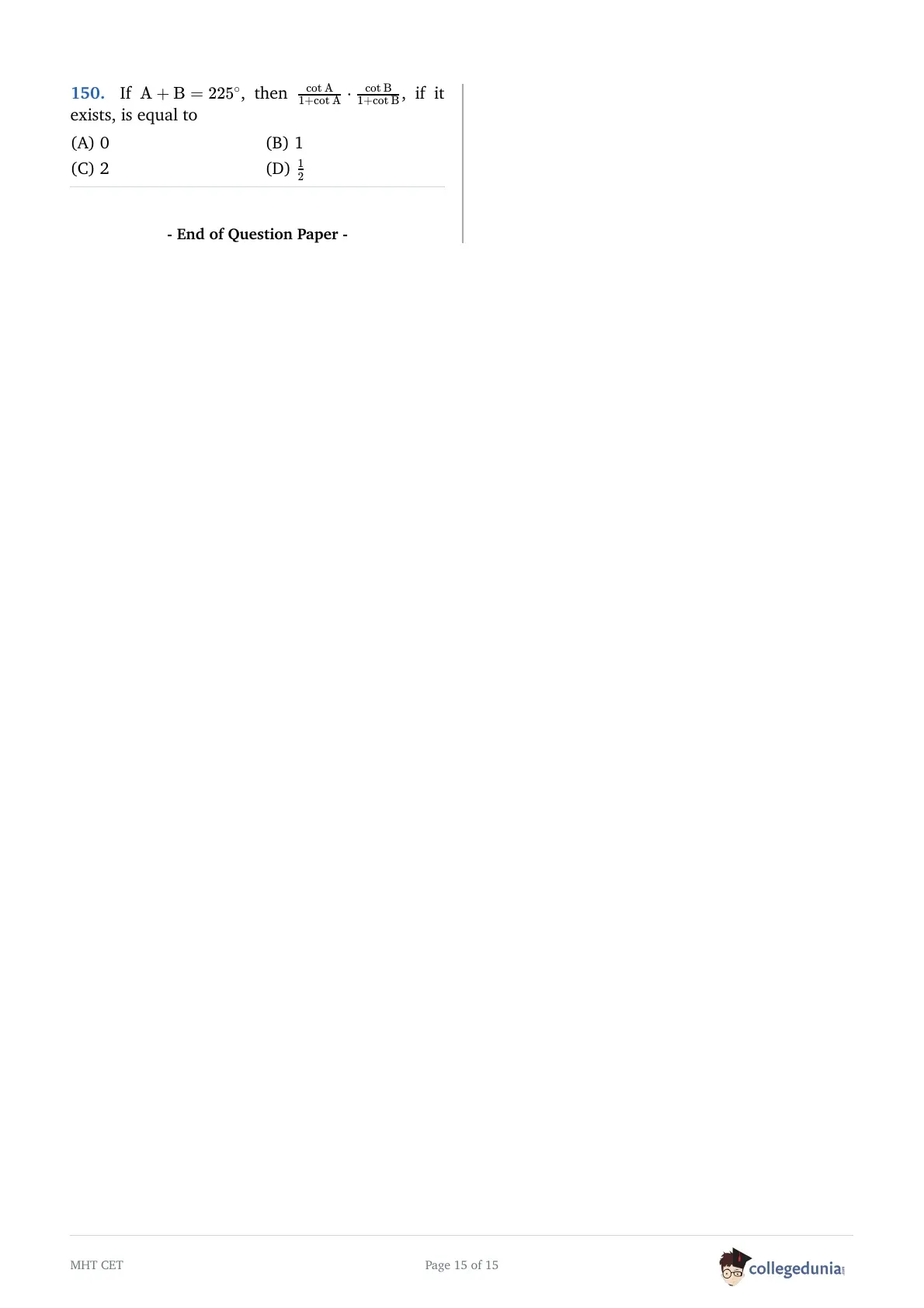
If \(\mathrm{A}+\mathrm{B}=225^{\circ}\), then \(\frac{\cot \mathrm{A}}{1+\cot \mathrm{A}} \cdot \frac{\cot \mathrm{B}}{1+\cot \mathrm{B}}\), if it exists, is equal to








Comments