




WBJEE Syllabus 2027 includes Physics, Chemistry, and Mathematics, aligned with the West Bengal Board and Class 11–12 curricula. The exam carries 200 marks, with 155 questions across two papers conducted over 4 hours.
- Mathematics carries 100 marks, accounting for 50% of the total exam marks. Algebra constitutes around 16–18 questions carrying 20–24 marks, making it one of the highest-weightage areas in Mathematics.
- Both Physics and Chemistry carry 50 marks each, contributing 25% of the total marks.
- Heat, Thermodynamics and Kinetic Theory carry approximately 4 Physics questions, with an estimated weightage of 10%.
- Chemical Kinetics and Chemical Bonding contribute around 2–3 Chemistry questions, with approximately 6–7% weightage per topic.
- WBJEE Questions are divided into three categories, with different marking schemes and negative marking applicable to Categories 1 and 2.
- Best Books for WBJEE 2027:
- Use H.C. Verma and D.C. Pandey for Physics,
- NCERT and O.P. Tandon for Chemistry, and
- R.D. Sharma and Hall & Knight for Mathematics.
Related Links:
- WBJEE Mathematics Syllabus 2027: Check Topic-Wise Weightage, Marks Distribution
- WBJEE Physics Syllabus Topics 2027: Download PDF, Check Weightage, Exam Pattern
- WBJEE Chemistry Syllabus 2027 Topics: Check PDF Download Link, Weightage, Marks Allotment, and Exam Pattern
Key Summary
- The WBJEE Mathematics paper includes 75 questions for 100 marks; Physics and Chemistry include 40 questions for 50 marks each.
- The WBJEE total marks are 200 for 155 multiple-choice questions, and the medium os question paper is English and Bengali.
- The WBJEE exam is conducted offline, in OMR-based mode for 4 hours, with 2 hours for Maths and 2 hours for Physics and Chemistry combined.
- The WBJEE syllabus 2027 includes Class 11 and 12 CBSE topics. Thus, students must refer to NCERT Class 11 and 12 books for better preparation.
WBJEE Syllabus 2027: Download Subject-Wise PDFs
The WBJEE syllabus 2027 PDF download links for the Mathematics, Physics, and Chemistry subjects are as follows:
| Subjects | Download Link |
|---|---|
| WBJEE Mathematics Syllabus 2027 PDF Link | Click Here |
| WBJEE Physics Syllabus 2027 PDF Link | Click Here |
| WBJEE Chemistry Syllabus 2027 PDF Link | Click Here |
Related Links:
- WBJEE Exam Preparation Tips 2027: Check Correct Strategy and Guidelines
- Appear for WBJEE Mock Test Papers: Check Subject-Wise Mock Test Links
Ques. Is a calculator allowed in the WBJEE exam 2027?
Ans. No, calculators are not allowed to be carried in the examination of the WBJEE 2027. Students are not allowed to carry any electronic devices at the exam centre.
WBJEE Syllabus: Highlights
| Parameter | Details |
|---|---|
| Conducting Body | West Bengal Joint Entrance Examinations Board (WBJEEB) |
| Total Marks | 200 marks
|
| Total Questions | 155 questions
|
| Total Duration | 4 hours total (2 hours per paper) |
| Syllabus Level |
|
| Subjects Included | Physics, Chemistry, and Mathematics |
| Subject Groups | Divided into two sessions/papers:
|
| Question Type | Multiple Choice Questions (MCQs) grouped into 3 distinct categories:
|
| Language of Paper | English and Bengali |
WBJEE Sample Paper 2027: Download PDF
| WBJEE Subject-wise Sample Paper | Sample Paper |
|---|---|
| WBJEE Mathematics Sample Paper | Download PDF |
| WBJEE Physics Sample Paper | Download PDF |
| WBJEE Chemistry Sample Paper | Download PDF |
WBJEE Physics Syllabus Topics 2027
The WBJEE exam Physics syllabus 2027 detailed topics are shared in the table below.
- Mechanics and Thermal Physics: Focus on motion, rotational dynamics, work and energy, thermodynamics, and heat transfer to build a strong foundation in numerical problem-solving.
- Electromagnetism, Optics and Modern Physics: Revise electrostatics, current electricity, magnetism, ray and wave optics, atomic physics, nuclear physics, and semiconductors, with emphasis on formulas and application-based questions.
| Topics | Brief Syllabus |
|---|---|
| Physical World & Measurements | Units, dimensions, errors and significant figures |
| Kinematics | Vectors, motion, equations of motion and graphs |
| Laws of Motion | Newton’s laws, momentum, collisions and circular motion |
| Work, Power & Energy | Work-energy theorem, power and conservation of energy |
| Rotational Motion | Centre of mass, torque, moment of inertia and friction |
| Gravitation | Kepler’s laws, gravitational potential, satellites and escape velocity |
| Properties of Matter | Elasticity, fluid mechanics, surface tension and viscosity |
| Heat & Thermal Physics | Thermal expansion, calorimetry, heat transfer and change of state |
| Thermodynamics | Thermal equilibrium, laws of thermodynamics and thermodynamic processes |
| Kinetic Theory of Gases | Gas laws, molecular speeds, degrees of freedom and specific heat |
| Oscillations & Waves | SHM, resonance, wave motion, sound, harmonics and Doppler effect |
| Electrostatics | Coulomb’s law, electric fields, potential, Gauss’s law and capacitors |
| Current Electricity | Ohm’s law, circuits, resistance, Kirchhoff’s laws and potentiometers |
| Magnetic Effects of Current | Magnetic fields, electromagnetic forces, galvanometers and cyclotrons |
| Magnetism | Magnetic dipoles, bar magnets, Earth’s magnetism and magnetic materials |
| EMI & Alternating Current | Faraday’s and Lenz’s laws, induction, AC circuits and resonance |
| Electromagnetic Waves | Properties, electromagnetic spectrum and applications |
| Ray Optics | Mirrors, lenses, refraction, prisms and optical instruments |
| Wave Optics | Huygens’ principle, interference, diffraction and scattering |
| Dual Nature of Matter & Light | Photoelectric effect and de Broglie waves |
| Atomic Physics | Rutherford and Bohr models, atomic spectra and X-rays |
| Nuclear Physics | Radioactivity, nuclear reactions, mass defect and binding energy |
| Solid-State Electronics | Semiconductors, diodes, transistors, rectifiers and logic gates |
WBJEE Physics Syllabus 2027: Topic-wise Weightage
The WBJEE exam 2027 Physics paper carries 40 multiple-choice questions for 50 marks.
- The Physics syllabus topic weightage in the WBJEE 2027 exam is 25%.
- Students must put more emphasis on Current Electricity, Electrostatics, Optics, and Modern Physics.
- Work on the numerical concepts of Mechanics, Electricity, and Magnetism.
| Topics | Expected Questions | Expected Marks | Expected Weightage |
|---|---|---|---|
| Physical World, Units & Dimensions, Errors | 2 | 5% | 2 - 3 |
| Kinematics | 2 | 5% | 2–3 |
| Laws of Motion, Friction & Circular Motion | 2 | 5% | 2 - 3 |
| Work, Energy & Power, Collisions | 2 | 5% | 2 - 3 |
| Rotational Motion & Moment of Inertia | 2 | 5% | 2 - 3 |
| Gravitation | 1 | 2.5% | 1 - 2 |
| Properties of Matter: Elasticity, Fluids, Viscosity & Surface Tension | 3 | 7.5% | 3 - 4 |
| Heat, Thermodynamics & Kinetic Theory of Gases | 4 | 10% | 5 |
| Oscillations & Waves, SHM & Sound | 3 | 7.5% | 3 - 4 |
| Electrostatics | 3 | 7.5% | 3 - 4 |
| Current Electricity | 3 | 7.5% | 3 - 4 |
| Magnetic Effects of Current & Magnetism | 3 | 7.5% | 3 - 4 |
| Electromagnetic Induction & Alternating Current | 2 | 5% | 2 - 3 |
| Electromagnetic Waves | 1 | 2.5% | 1 - 2 |
| Ray Optics | 2 | 5% | 2 - 3 |
| Wave Optics | 1 | 2.5% | 1 - 2 |
| Modern Physics: Dual Nature, Atomic & Nuclear Physics, X-rays | 3 | 7.5% | 3 - 4 |
| Solid State Electronics: Semiconductors, Diodes, Transistors & Logic Gates | 1 | 2.5% | 1 - 2 |
WBJEE Physics Sample Papers 2027
| WBJEE Physics Sample Paper | Direct Link |
|---|---|
| WBJEE Physics Sample Paper 1 | Download PDF |
| WBJEE Physics Sample Paper 2 | Download PDF |
| WBJEE Physics Sample Paper 3 | Download PDF |
| WBJEE Physics Sample Paper 4 | Download PDF |
| WBJEE Physics Sample Paper 5 | Download PDF |
| WBJEE Physics Sample Paper 6 | Download PDF |
| WBJEE Physics Sample Paper 7 | Download PDF |
| WBJEE Physics Sample Paper 8 | Download PDF |
| WBJEE Physics Sample Paper 9 | Download PDF |
| WBJEE Physics Sample Paper 10 | Download PDF |
WBJEE Chemistry Syllabus 2027
Go through the WBJEE exam 2027 syllabus Chemistry topics provided in detail below:
- Physical Chemistry: Prioritise numerical practice in mole concept, thermodynamics, equilibrium, solutions, chemical kinetics and electrochemistry.
- Organic Chemistry: Focus on reaction mechanisms, electronic effects, hydrocarbons and functional groups, along with biomolecules and polymers.
- Inorganic Chemistry: Revise periodic trends, p-block elements, coordination compounds and d- and f-block elements, while also covering environmental chemistry and qualitative analysis.
| Section | Topics | Brief Syllabus |
|---|---|---|
| Physical Chemistry | Basic Concepts & Atomic Structure | Mole concept, stoichiometry, quantum numbers and electronic configuration |
| Periodicity & Chemical Bonding | Periodic trends, chemical bonds, molecular geometry and hybridisation | |
| States of Matter | Solid structures, gas laws, kinetic theory and unit cells | |
| Thermodynamics & Equilibrium | Laws of thermodynamics, enthalpy, entropy, chemical and ionic equilibrium | |
| Solutions, Chemical Kinetics, and Redox & Electrochemistry | Solubility, Raoult’s law and colligative properties, Reaction rates, rate laws, order, half-life and activation energy, Oxidation numbers, redox reactions, electrolysis, cell potential and Nernst equation | |
| Organic Chemistry | Basic Principles & Hydrocarbons | Nomenclature, electronic effects, reaction mechanisms and hydrocarbons |
| Organic Compounds | Haloalkanes, haloarenes, alcohols, phenols, ethers, aldehydes, ketones and carboxylic acids | |
| Nitrogen Compounds | Nitro compounds, amines, cyanides, isocyanides and diazonium salts | |
| Biomolecules & Polymers | Carbohydrates, proteins, nucleic acids and important polymers | |
| Inorganic Chemistry | s-Block & p-Block Elements | Elemental properties, periodic trends, important compounds and reactions |
| d- and f-Block Elements | Electronic configurations, oxidation states, magnetic properties and lanthanoid contraction | |
| Coordination Compounds | Ligands, nomenclature, bonding theories, isomerism and applications | |
| Applied Chemistry | Environmental Chemistry | Air, water and soil pollution, pollutants, waste management and green chemistry |
| Qualitative & Quantitative Analysis | Lassaigne’s test, functional group detection, titrations and identification of ions |
WBJEE Chemistry Syllabus 2027: Check Topic-Wise Weightage
The WBJEE syllabus 2027 Chemistry paper consists of 40 multiple-choice questions for 50 marks. The weightage of the Chemistry paper is 25% of the WBJEE exam.
By covering Organic Chemistry and Chemical Kinetics & Equilibrium, students will be able to cover 30 - 35% of the syllabus.
| Chemistry Topic | Expected Questions | Expected Weightage | Expected Marks |
|---|---|---|---|
| Chemical Kinetics | 2 - 3 | 6 - 7% | 3 - 4 |
| Chemical Bonding | 2 - 3 | 6 - 7% | 3 - 4 |
| p-Block Elements | 2 - 3 | 6 - 7% | 3 - 4 |
| d- & f-Block Elements | 2 - 3 | 5 - 6% | 3 - 4 |
| Organic Chemistry – Basic Principles | 2 - 3 | 5 - 6% | 3 - 4 |
| Coordination Compounds | 2 | 4 - 5% | 2 - 3 |
| Redox Reactions & Electrochemistry | 2 | 4 - 5% | 2 - 3 |
| Chemical Thermodynamics | 2 | 4 - 5% | 2 - 3 |
| Alcohols, Phenols & Ethers | 2 | 4 - 5% | 2 - 3 |
| Carboxylic Acids & Derivatives | 2 | 4 - 5% | 2 - 3 |
| Ionic Equilibrium | 1 - 2 | 3 - 4% | 2 - 3 |
| Chemical Equilibrium | 1 - 2 | 3 - 4% | 2 - 3 |
| Atomic Structure | 1 - 2 | 3 - 4% | 2 - 3 |
| Organic Chemistry – Hydrocarbons | 1 - 2 | 3 - 4% | 2 - 3 |
| Haloalkanes & Haloarenes | 1 - 2 | 3 - 4% | 2 - 3 |
| Aldehydes & Ketones | 1 - 2 | 3 - 4% | 2 - 3 |
| Amines & Nitrogen Compounds | 1 - 2 | 3 - 4% | 2 - 3 |
| Solutions & Colloids | 1 - 2 | 3 - 4% | 2 - 3 |
| S-Block Elements | 1 - 2 | 3 - 4% | 2 - 3 |
| Metallurgy / Chemistry of Metals | 1 | 2 - 3% | 1 - 2 |
| Hydrogen | 1 | 2 - 3% | 1 - 2 |
| Environmental Chemistry | 1 | 1 - 2% | 1 - 2 |
| Polymers | 1 | 2 - 3% | 1 - 2 |
| Biomolecules | 1 | 2 - 3% | 1 - 2 |
| Surface Chemistry | 1 | 2 - 3% | 1 - 2 |
| Qualitative Analysis | 1 | 2 - 3% | 1 - 2 |
| Chemistry in Industry | 0 - 1 | 1 - 2% | 0 - 2 |
| Chemistry of Carbon Compounds / Applied Chemistry | 0 - 1 | 1 - 2% | 0 - 2 |
Ques. What are the important topics in WBJEE Mathematics Syllabus 2027?
Ans. There are a few important topics in the WBJEE Maths paper that students should cover on a priority basis. The list includes Calculus, Algebra, Coordinate Geometry, Vectors, 3D Geometry, Probability, Trigonometry, Matrices and Determinants.
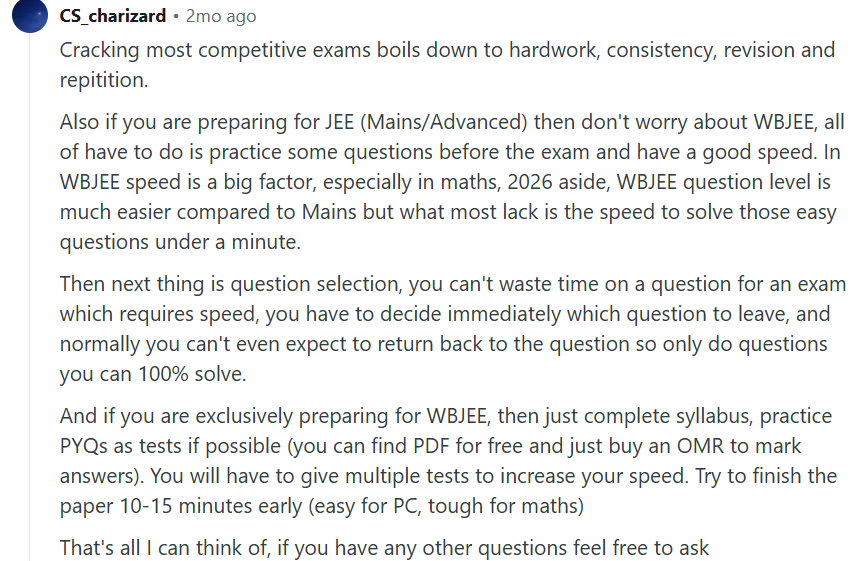
A Reddit user asked for guidance for WBJEE 2027 preparation.

Replying to that, another user said that if you are preparing for WBJEE, then you must focus on covering the JEE syllabus, as the topics are similar. Further, you must focus on speed and accuracy for better results.
Source: Reddit
Related Links:
WBJEE Chemistry Sample Paper 2026 PDF Download
| WBJEE Chemistry Sample Paper | Direct Link |
|---|---|
| WBJEE Chemistry Sample Paper 1 | Download PDF |
| WBJEE Chemistry Sample Paper 2 | Download PDF |
| WBJEE Chemistry Sample Paper 3 | Download PDF |
| WBJEE Chemistry Sample Paper 4 | Download PDF |
| WBJEE Chemistry Sample Paper 5 | Download PDF |
| WBJEE Chemistry Sample Paper 6 | Download PDF |
| WBJEE Chemistry Sample Paper 7 | Download PDF |
| WBJEE Chemistry Sample Paper 8 | Download PDF |
| WBJEE Chemistry Sample Paper 9 | Download PDF |
| WBJEE Chemistry Sample Paper 10 | Download PDF |
WBJEE Mathematics Syllabus Topics 2027
The detailed WBJEE syllabus 2027 Mathematics topics are given below.
- Algebra and Coordinate Geometry: Focus on matrices, determinants, probability, complex numbers, straight lines, circles and conic sections for strong problem-solving practice.
- Calculus and Vectors: Prioritise limits, derivatives, integration, differential equations and vector operations, practising formula-based and application-oriented questions.
| Chapter | Topics | Brief Syllabus |
|---|---|---|
| Algebra | Progressions & Logarithms and Complex Numbers | A.P., G.P., H.P., sums and logarithmic laws, Modulus, arguments, De Moivre’s theorem and roots |
| Polynomial & Quadratic Equations | Roots, coefficients, nature of roots and quadratic expressions | |
| Permutations & Combinations, Mathematical Induction | Arrangements, selections and counting principles, Proofs involving sums and divisibility | |
| Binomial Theorem and Matrices & Determinants | General terms, middle terms and binomial coefficients | |
| Matrix operations, inverses, determinants and linear equations | ||
| Sets, Relations & Mappings | Set operations, relations, functions and inverses | |
| Statistics & Probability | Mean, variance, standard deviation and probability rules | |
| Trigonometry | Trigonometric Functions | Identities, equations, inverse functions and triangle properties |
| Coordinate Geometry (2D) | Straight Lines & Circles | Equations, slopes, distances, tangents and chords |
| Conic Sections | Parabola, ellipse, hyperbola, foci and eccentricity | |
| Three-Dimensional Geometry | Direction ratios, lines, planes and distances | |
| Calculus | Differential Calculus | Functions, limits, continuity, differentiability and derivatives |
| Applications of Derivatives | Maxima, minima, tangents, normals and rates of change | |
| Integral Calculus | Indefinite and definite integrals, areas under curves | |
| Differential Equations | Formation and solutions of basic differential equations | |
| Vectors | Vector Algebra | Vector operations, dot product, cross product and scalar triple product |
WBJEE Mathematics Syllabus 2027: Check Topic-Wise Weightage
The WBJEE 2027 exam Mathematics paper consists of 75 multiple-choice questions with 100 marks.
- The Mathematics paper alone carries 50% of the WBJEE exam weightage. Thus, students must focus more on the Maths paper.
- For the WBJEE Mathematics exam paper, the most important topics are Calculus, Algebra, and Coordinate Geometry.
| Mathematics Topic | Expected Questions | Expected Marks | Expected Weightage |
|---|---|---|---|
| Calculus | 15 - 17 | 20 - 23 | 20 - 23% |
| Algebra | 16 - 18 | 20 - 24 | 20 - 24% |
| Coordinate Geometry | 9 - 11 | 12 - 15 | 12 - 15% |
| Vectors | 5 - 6 | 6 - 8 | 6 - 8% |
| Probability | 5 - 6 | 6 - 8 | 6 - 8% |
| 3D Geometry | 4 - 5 | 5 - 7 | 5 - 7% |
| Trigonometry | 4 - 5 | 5 - 6 | 5 - 6% |
| Matrices & Determinants | 4 - 5 | 5 - 7 | 5 - 7% |
| Complex Numbers | 3 - 4 | 4 - 5 | 4 - 5% |
| Permutation & Combination | 2 - 3 | 3 - 4 | 3 - 4% |
| Sets, Relations & Functions | 2 - 3 | 3 - 4 | 3 - 4% |
Appear for WBJEE Mock Test Papers:
- WBJEE Physics Mock Test Papers: Attempt for Free
- Check WBJEE Chemistry Mock Test Links, Attempt in Online Mode for Free
- WBJEE Mathematics Mock Paper Link, Practice Questions for Free, Learn Question Structure
Ques. Which chapters should I study first for WBJEE 2027?
Ans. The list of chapters students must cover first for the WBJEE 2027 exam is Mechanics and Electricity in Physics, Chemical Bonding and Physical/Organic Chemistry in Chemistry, and Algebra and Calculus in Mathematics.
WBJEE Mathematics Sample Papers 2027
| WBJEE Mathematics Sample Paper | Direct Link |
|---|---|
| WBJEE Mathematics Sample Paper 1 | Download PDF |
| WBJEE Mathematics Sample Paper 2 | Download PDF |
| WBJEE Mathematics Sample Paper 3 | Download PDF |
| WBJEE Mathematics Sample Paper 4 | Download PDF |
| WBJEE Mathematics Sample Paper 5 | Download PDF |
| WBJEE Mathematics Sample Paper 6 | Download PDF |
| WBJEE Mathematics Sample Paper 7 | Download PDF |
| WBJEE Mathematics Sample Paper 8 | Download PDF |
| WBJEE Mathematics Sample Paper 9 | Download PDF |
| WBJEE Mathematics Sample Paper 10 | Download PDF |
Which Books Are Best for WBJEE Exam 2027 Preparation?
The list of WBJEE books 2027 for the Physics, Chemistry, and Mathematics papers is shared below.
- Physics: Focus on H.C. Verma for conceptual clarity and numerical practice. Use D.C. Pandey for additional WBJEE-level problem-solving practice.
- Chemistry: Prioritise NCERT Class 11 and 12 for core concepts, then use O.P. Tandon for Physical and Organic Chemistry practice.
- Mathematics: Use R.D. Sharma to strengthen fundamentals before moving to advanced problems from Hall & Knight and S.L. Loney.
| Subjects | Best Book | Author/Publisher |
|---|---|---|
| Physics | Concepts of Physics Vol. 1 & 2 | H.C. Verma |
| Understanding Physics | D.C. Pandey, Arihant | |
| Fundamentals of Physics | V.K. Mehta | |
| Chemistry | NCERT Chemistry Class 11 & 12 | NCERT |
| Physical Chemistry | O.P. Tandon | |
| Organic Chemistry | O.P. Tandon | |
| Organic Chemistry | Morrison & Boyd | |
| Mathematics | Mathematics for Class 11 & 12 | R.D. Sharma |
| Mathematics | R.S. Aggarwal | |
| Higher Algebra | Hall & Knight | |
| Plane Trigonometry | S.L. Loney |
WBJEE Previous Year Question Paper Links:
WBJEE Syllabus 2027 FAQs
Ques. Is the WBJEE syllabus 2027 based on Class 11 and 12 of CBSE?
Ans. Yes, the WBJEE 2027 exam syllabus is prepared considering the CBSE Class 11 and 12 topics.
Ques. Which are the high-weightage topics of the WBJEE Chemistry 2027 paper?
Ans. The WBJEE 2027 Chemistry high-weightage topics are Organic Chemistry, Chemical Kinetics, Chemical Bonding, p-Block Elements, Thermodynamics, Equilibrium, Redox Reactions, and Coordination Compounds.
Ques. Is WBJEE harder than the JEE exam?
Ans. The JEE exam is considered a harder and more difficult exam compared to WBJEE. However, the WBJEE is also challenging because of its unique time division. It is hard to manage time and complete the paper.
Ques. Has the WBJEE syllabus 2027 changed?
Ans. No, there is no change in the WBJEE 2027 exam syllabus announced by the authority yet. The official syllabus for the 2027 academic year has not been released yet.
Ques. Are NCERT books enough for the WBJEE exam preparation?
Ans. No, NCERT books alone are not enough to score high marks in the WBJEE exam 2027. The NCERT books are helpful in learning the basic concepts of the topics and understanding the formulas.



Comments
Found 1 Comment