




MHT CET 2025 April 25 Shift 2 PCM Question Paper is available for download here. Maharashtra State CET Cell conducted MHT CET 2025 PCM Exam on April 25 in Shift 2 from 2 PM to 5 PM in CBT mode.
The MHT CET 2025 PCM question paper includes the following:
- The MHT CET 2025 PCM Question Paper consists of 150 multiple-choice questions (MCQs) totalling 200 marks divided into 3 sections: Physics, Chemistry, and Mathematics, with 50 questions in each subject.
- Physics and Chemistry questions carry 1 mark each while Mathematics questions carry 2 marks each.
- There is no negative marking for incorrect answers.
MHT CET 2025 April 25 Shift 2 PCM Question Paper with Solution PDF
| CD PDF | CD PDF with Solutions |
|---|---|
| Download Collegedunia PDF 0.86 MB | - |
Also Check:
MHT CET 2025 April 25 Shift 2 PCM Questions with Solutions
Physics (Q1 - Q50)
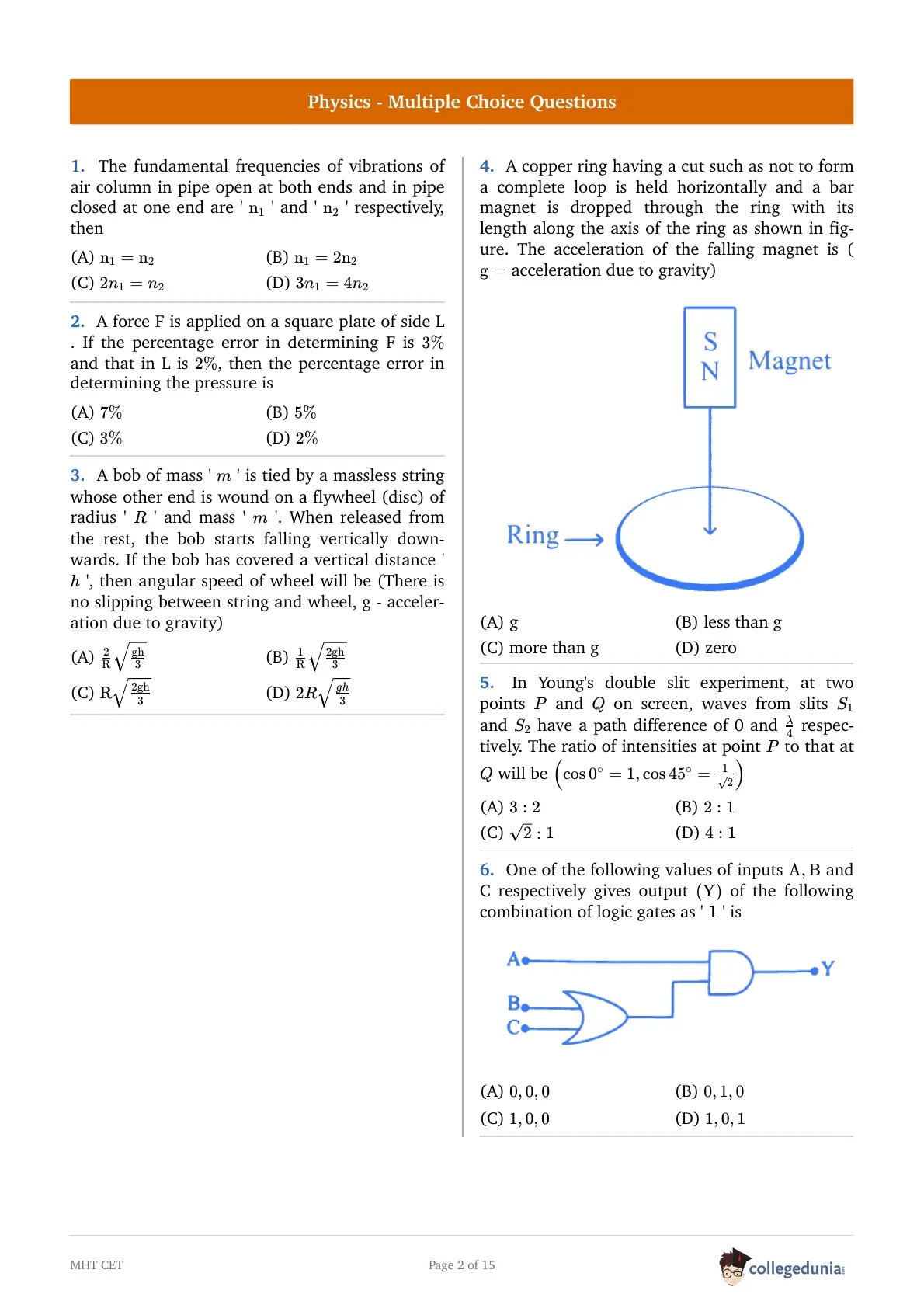
The fundamental frequencies of vibrations of air column in pipe open at both ends and in pipe closed at one end are \(n_1\) and \(n_2\) respectively, then …
A force F is applied on a square plate of side L. If the percentage error in F is 3% and in L is 2%, then the percentage error in pressure is …
A bob of mass 'm' is tied by a string wound on a flywheel (disc) of radius 'R' and mass 'm'. If the bob has covered a vertical distance 'h', then the angular speed of the wheel will be …
A copper ring having a cut such as not to form a complete loop is held horizontally and a bar magnet is dropped through the ring. The acceleration of the falling magnet is …

In Young's double slit experiment, at two points P and Q on screen, waves from slits \(S_1\) and \(S_2\) have a path difference of 0 and \(\lambda/4\) respectively. The ratio of intensities at point P to that at Q will be …
One of the following values of inputs A, B and C respectively gives output (Y) of the following combination of logic gates as '1' is …

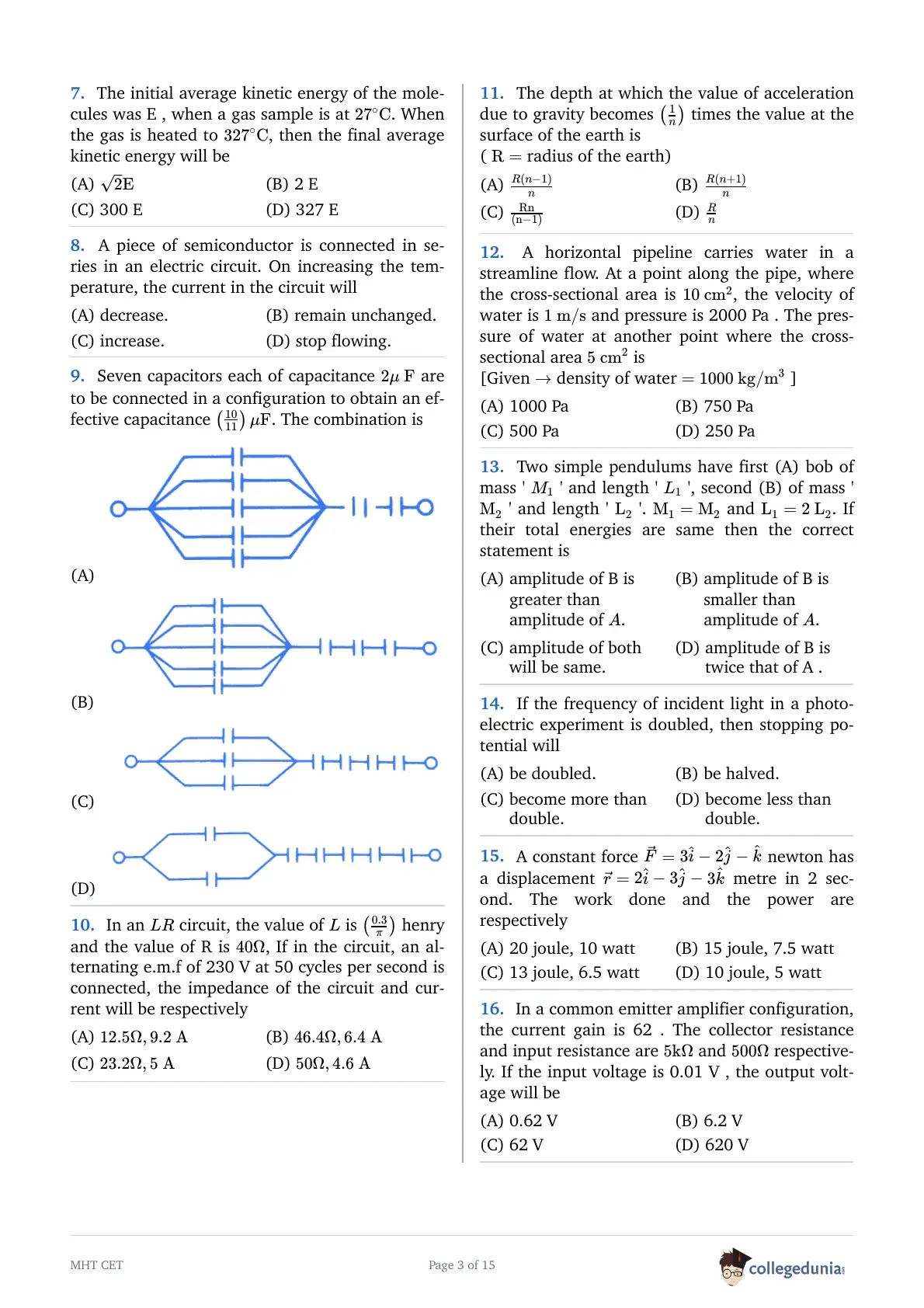
The initial average kinetic energy of the molecules was E, when a gas sample is at 27\(^\circ\)C. When the gas is heated to 327\(^\circ\)C, then the final average kinetic energy will be ______.
A piece of semiconductor is connected in series in an electric circuit. On increasing the temperature, the current in the circuit will ______.
In an \(LR\) circuit, the value of \(L\) is \((0.3/\pi)\) henry and the value of \(R\) is \(40 \Omega\). If an alternating e.m.f of 230 V at 50 cycles per second is connected, the impedance of the circuit and current will be respectively ______.
The depth at which the value of acceleration due to gravity becomes (\(1/n\)) times the value at the surface of the earth is (R = radius of the earth) ______.
A horizontal pipeline carries water in streamline flow. At \(A_1 = 10\) cm\(^2\), \(v_1 = 1\) m/s and \(P_1 = 2000\) Pa. The pressure at \(A_2 = 5\) cm\(^2\) is … [\(\rho = 1000\) kg/m\(^3\)]
Two simple pendulums have (A) mass \(M_1\), length \(L_1\) and (B) mass \(M_2\), length \(L_2\). Given \(M_1 = M_2\) and \(L_1 = 2L_2\). If their total energies are same, then …
If the frequency of incident light in a photoelectric experiment is doubled, then stopping potential will ______.
A constant force \(\vec{F} = 3\hat{i} - 2\hat{j} - \hat{k}\) N has a displacement \(\vec{r} = 2\hat{i} - 3\hat{j} - 3\hat{k}\) m in 2 second. The work done and the power are respectively ______.
In a common emitter amplifier configuration, the current gain is 62. The collector resistance and input resistance are 5k\(\Omega\) and 500\(\Omega\) respectively. If the input voltage is 0.01 V, the output voltage will be ______.
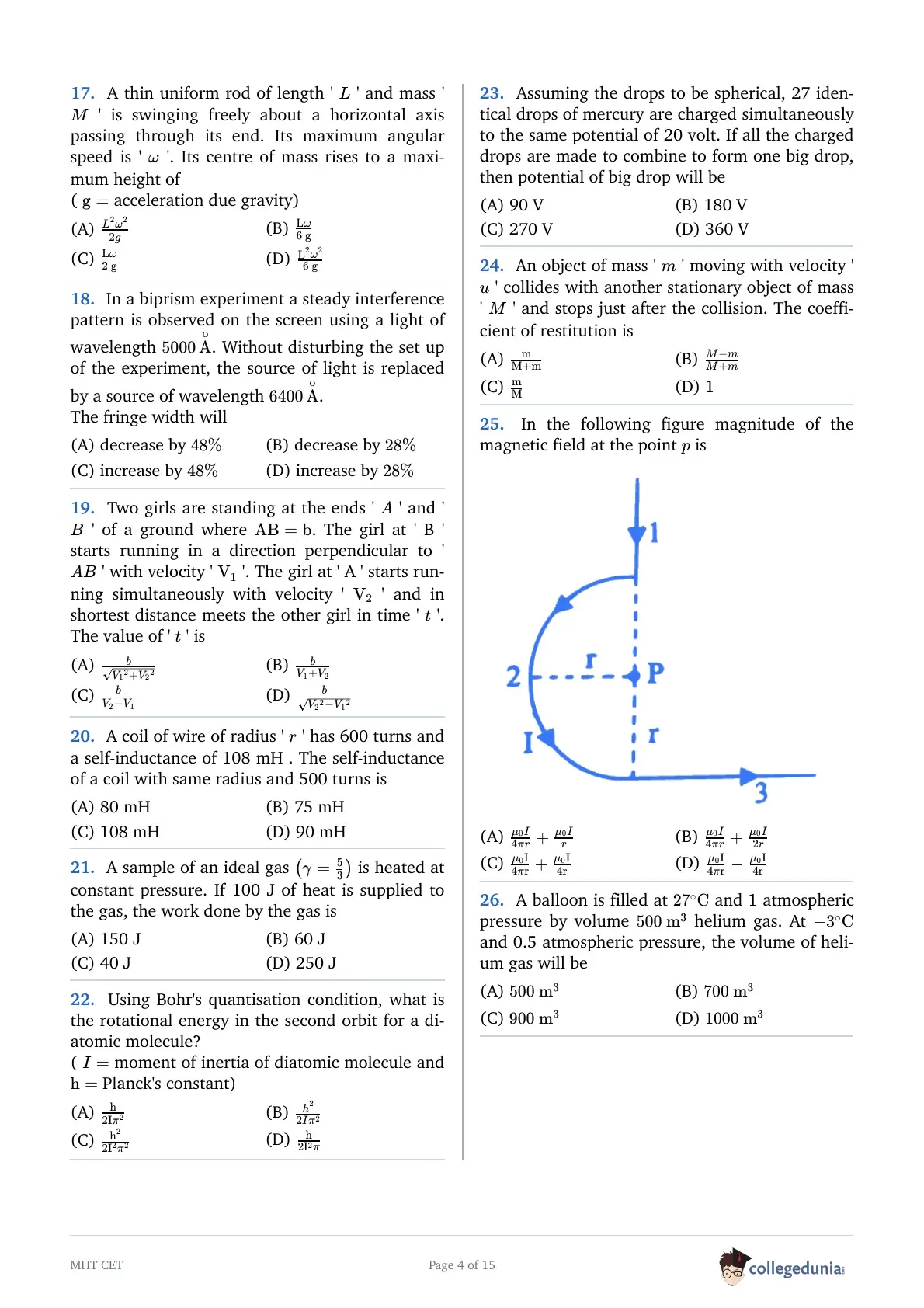
A thin uniform rod of length 'L' and mass 'M' is swinging freely about a horizontal axis passing through its end. Its maximum angular speed is '\(\omega\)'. Its centre of mass rises to a maximum height of ______.
In a biprism experiment a steady interference pattern is observed on the screen using a light of wavelength \(5000 \mathop {\rm{A}}\limits^{\rm{o}}\). Without disturbing the set up of the experiment, the source of light is replaced by a source of wavelength \(6400 \mathop {\rm{A}}\limits^{\rm{o}}\).
The fringe width will
Two girls are standing at the ends 'A' and 'B' of a ground where \(AB = b\). The girl at 'B' starts running perpendicular to 'AB' with velocity \(V_1\). The girl at 'A' starts running simultaneously with velocity \(V_2\) and in shortest distance meets the other girl in time 't'. The value of 't' is ______.
A coil of wire of radius 'r' has 600 turns and a self-inductance of 108 mH. The self-inductance of a coil with same radius and 500 turns is ______.
A sample of an ideal gas (\(\gamma = 5/3\)) is heated at constant pressure. If 100 J of heat is supplied to the gas, the work done by the gas is ______.
Using Bohr's quantisation condition, what is the rotational energy in the second orbit for a diatomic molecule? (\(I\) = moment of inertia and \(h\) = Planck's constant) ______.
Assuming the drops to be spherical, 27 identical drops of mercury are charged simultaneously to the same potential of 20 volt. If all the charged drops are made to combine to form one big drop, then potential of big drop will be ______.
An object of mass 'm' moving with velocity 'u' collides with another stationary object of mass 'M' and stops just after the collision. The coefficient of restitution is ______.
In the following figure magnitude of the magnetic field at the point p is ______.

A balloon is filled at 27\(^\circ\)C and 1 atmospheric pressure by volume 500 m\(^3\) helium gas. At -3\(^\circ\)C and 0.5 atmospheric pressure, the volume of helium gas will be ______.
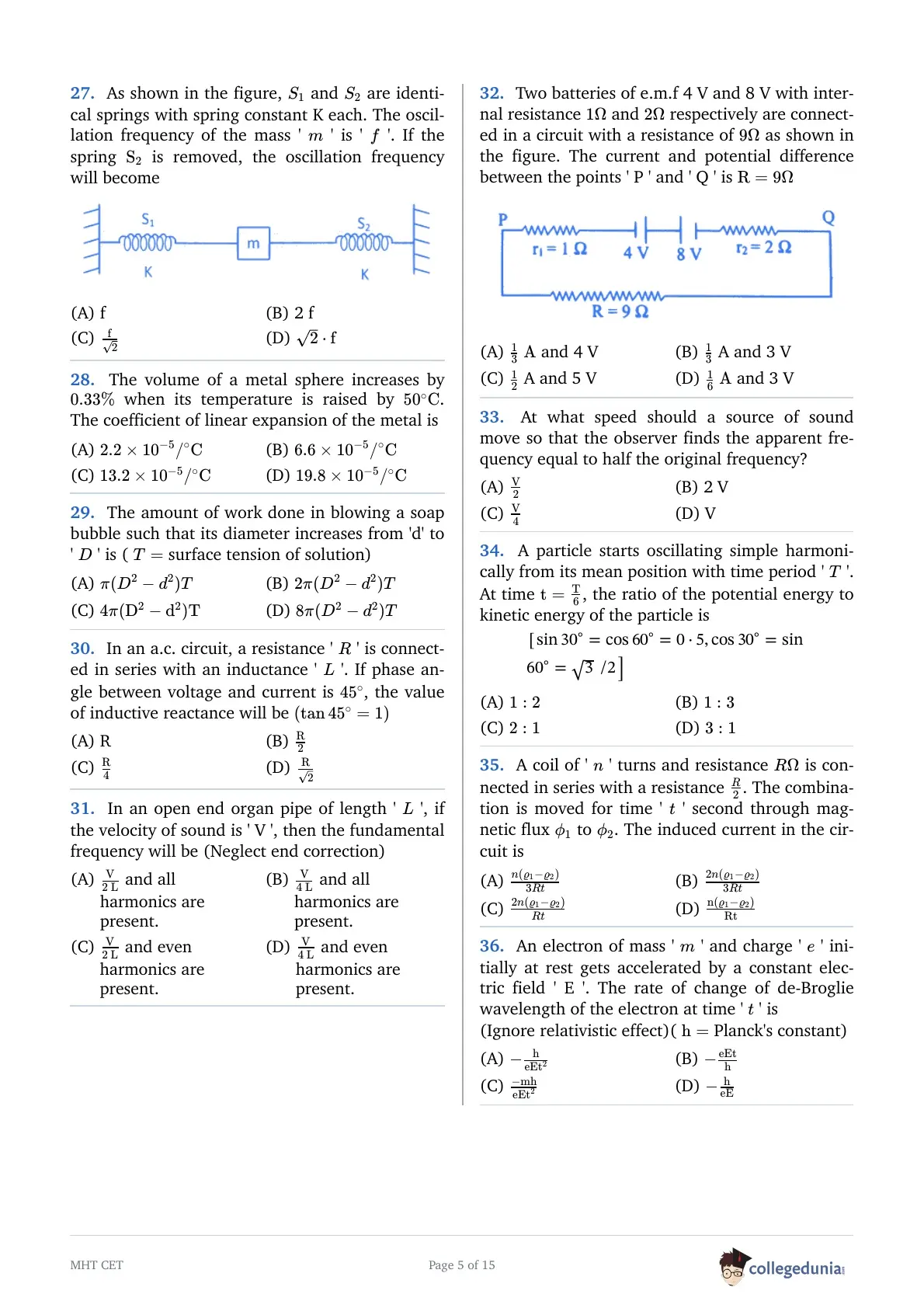
As shown in the figure, \(S_1\) and \(S_2\) are identical springs with spring constant K each. The oscillation frequency of the mass 'm' is 'f'. If the spring \(S_2\) is removed, the oscillation frequency will become ______.

The volume of a metal sphere increases by 0.33% when its temperature is raised by 50\(^\circ\)C. The coefficient of linear expansion of the metal is ______.
The amount of work done in blowing a soap bubble such that its diameter increases from 'd' to 'D' is (\(T\) = surface tension of solution) ______.
In an a.c. circuit, a resistance 'R' is connected in series with an inductance 'L'. If phase angle between voltage and current is 45\(^\circ\), the value of inductive reactance will be (\(\tan 45^\circ = 1\)) ______.
In an open end organ pipe of length 'L', if the velocity of sound is 'V', then the fundamental frequency will be (Neglect end correction) ______.
Two batteries of e.m.f 4 V and 8 V with internal resistance 1\(\Omega\) and 2\(\Omega\) respectively are connected in series (opposing) with a 9\(\Omega\) resistor. The current and potential difference between points 'P' and 'Q' is …

At what speed should a source of sound move away from a stationary observer so that the observer finds the apparent frequency equal to half the original frequency?
A particle starts oscillating simple harmonically from its mean position with time period 'T'. At time \(t = T/6\), the ratio of the potential energy to kinetic energy of the particle is …
A coil of 'n' turns and resistance \(R \Omega\) is connected in series with a resistance \(R/2\). The combination is moved for time 't' second through magnetic flux \(\phi_1\) to \(\phi_2\). The induced current in the circuit is ______.
An electron of mass 'm' and charge 'e' initially at rest gets accelerated by a constant electric field 'E'. The rate of change of de-Broglie wavelength of the electron at time 't' is (Ignore relativistic effect) (\(h\) = Planck's constant) ______.
The moment of inertia of a solid sphere of mass 'm' and radius 'R' about its diametric axis is 'I'. Its moment of inertia about a tangent in the plane is ______.
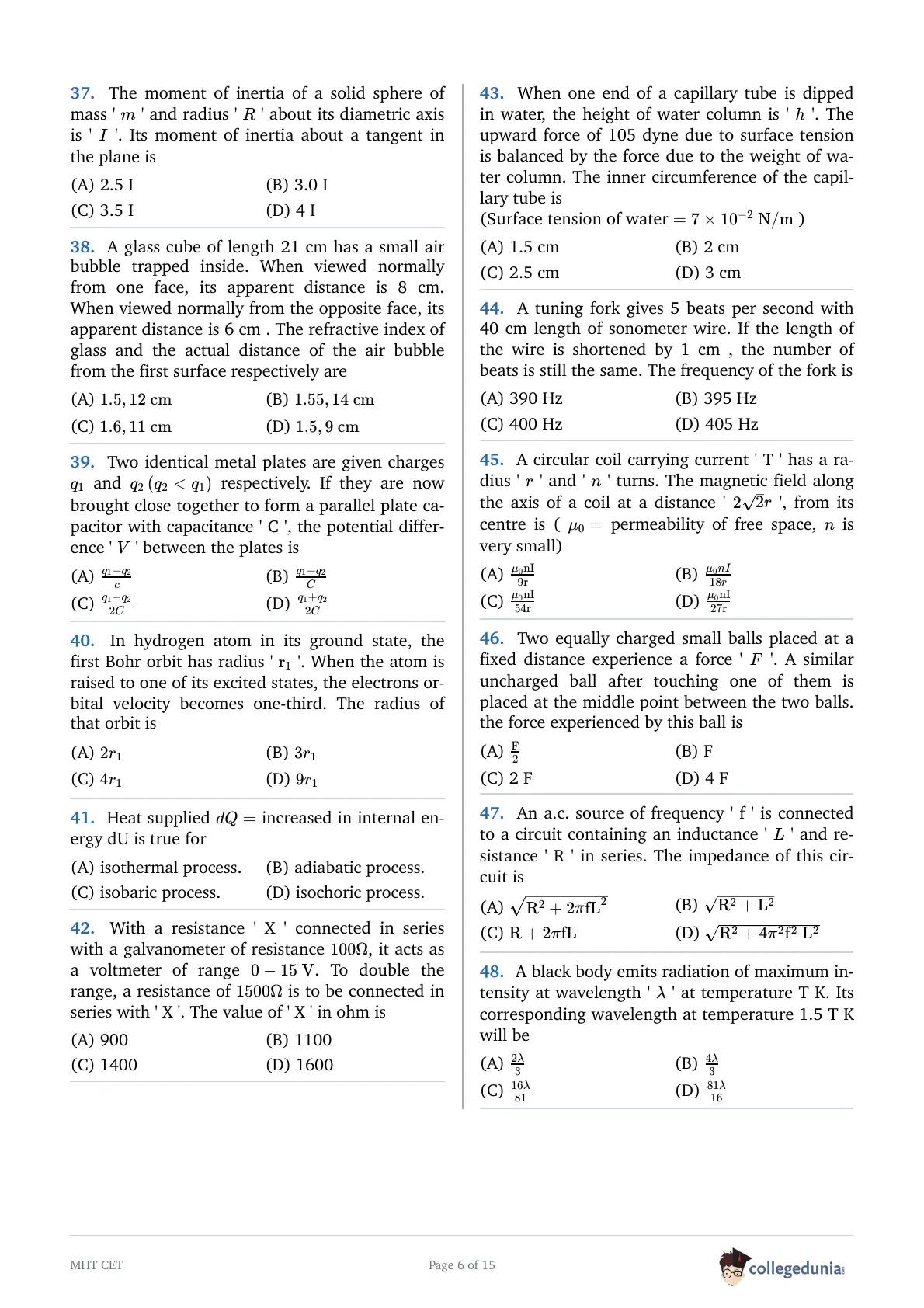
A glass cube of length 21 cm has a small air bubble trapped inside. When viewed normally from one face, its apparent distance is 8 cm. When viewed normally from the opposite face, its apparent distance is 6 cm . The refractive index of glass and the actual distance of the air bubble from the first surface respectively are
Two identical metal plates are given charges \(q_1\) and \(q_2\left(q_2 < q_1\right)\) respectively. If they are now brought close together to form a parallel plate capacitor with capacitance \(C\), the potential difference \(V\) between the plates is
In hydrogen atom in its ground state, the first Bohr orbit has radius \(r_1\). When the atom is raised to one of its excited states, the electron's orbital velocity becomes one-third. The radius of that orbit is …
Heat supplied \(dQ\) = increase in internal energy \(dU\) is true for …
With a resistance 'X' connected in series with a galvanometer of resistance 100\(\Omega\), it acts as a voltmeter of range 0 – 15 V. To double the range, a resistance of 1500\(\Omega\) is to be connected in series with 'X'. The value of 'X' in ohm is …
When one end of a capillary tube is dipped in water, the height of water column is ' \(h\) '. The upward force of 105 dyne due to surface tension is balanced by the force due to the weight of water column. The inner circumference of the capillary tube is
(Surface tension of water \(=7 \times 10^{-2} \mathrm{~N} / \mathrm{m}\) )
A tuning fork gives 5 beats per second with 40 cm length of sonometer wire. If the length of the wire is shortened by 1 cm, the number of beats is still the same. The frequency of the fork is ______.
A circular coil carrying current ' T ' has a radius ' \(r\) ' and ' \(n\) ' turns. The magnetic field along the axis of a coil at a distance ' \(2 \sqrt{2} r\) ', from its centre is ( \(\mu_0=\) permeability of free space, \(n\) is very small)
Two equally charged small balls placed at a fixed distance experience a force 'F'. A similar uncharged ball after touching one of them is placed at the middle point between the two balls. The force experienced by this ball is ______.
An a.c. source of frequency 'f' is connected to a circuit containing an inductance 'L' and resistance 'R' in series. The impedance of this circuit is ______.
A black body emits radiation of maximum intensity at wavelength '\(\lambda\)' at temperature \(T\) K. Its corresponding wavelength at temperature \(1.5 T\) K will be ______.
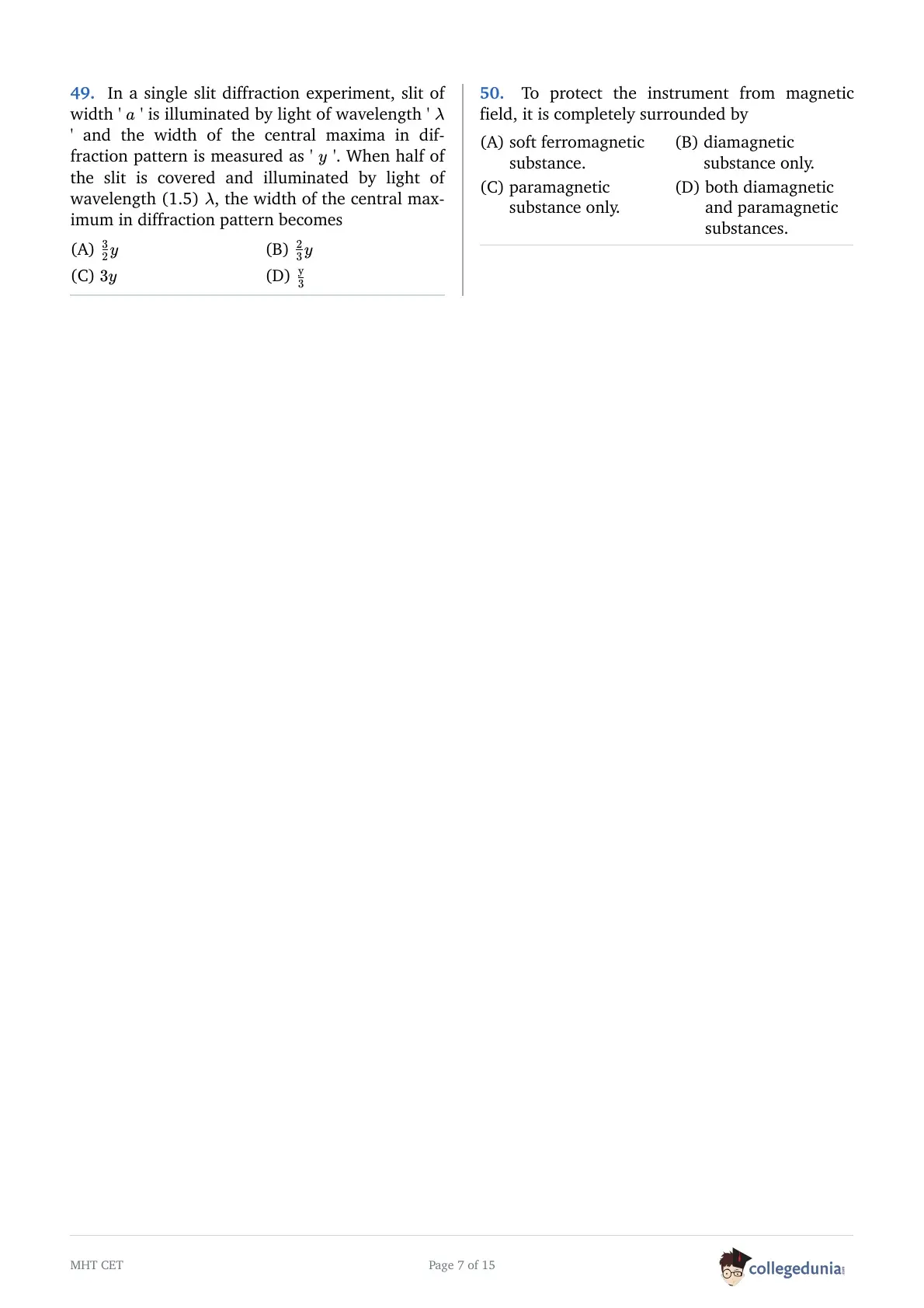
In a single slit diffraction experiment, slit width 'a' is illuminated by wavelength '\(\lambda\)' and the width of central maxima is 'y'. When half the slit is covered and illuminated by \((1.5)\lambda\), the width of the central maximum becomes ______.
To protect the instrument from magnetic field, it is completely surrounded by ______.
Chemistry (Q51 - Q100)
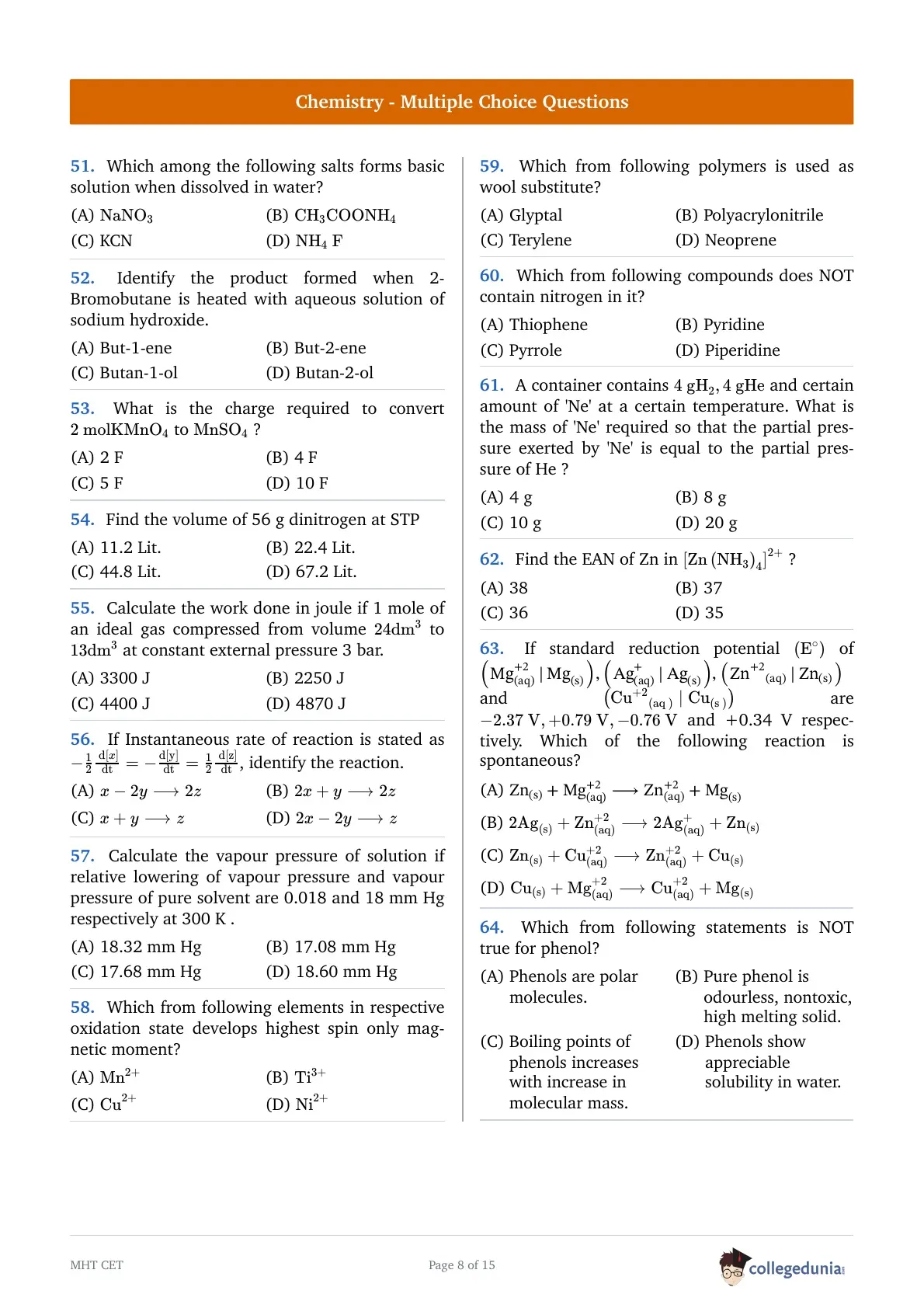
Which among the following salts forms basic solution when dissolved in water?
Identify the product formed when 2-Bromobutane is heated with aqueous solution of sodium hydroxide.
What is the charge required to convert 2 mol \(KMnO_4\) to \(MnSO_4\)?
Find the volume of 56 g dinitrogen at STP.
Calculate the work done in joule if 1 mole of an ideal gas compressed from volume 24 dm\(^3\) to 13 dm\(^3\) at constant external pressure 3 bar.
If instantaneous rate of reaction is stated as \(-\frac{1}{2} \frac{d[x]}{dt} = -\frac{d[y]}{dt} = \frac{1}{2} \frac{d[z]}{dt}\), identify the reaction.
Calculate the vapour pressure of solution if relative lowering of vapour pressure and vapour pressure of pure solvent are 0.018 and 18 mm Hg respectively at 300 K.
Which from following elements in respective oxidation state develops highest spin only magnetic moment?
Which from following polymers is used as wool substitute?
Which from following compounds does NOT contain nitrogen in it?
A container contains 4 g \(H_2\), 4 g \(He\) and certain amount of 'Ne' at a certain temperature. What is the mass of 'Ne' required so that the partial pressure exerted by 'Ne' is equal to the partial pressure of He?
Find the EAN of Zn in \([Zn(NH_3)_4]^{2+}\)?
If standard reduction potential (\(E^\circ\)) of (\(Mg^{2+} | Mg(s)\)), (\(Ag^+ | Ag(s)\)), (\(Zn^{2+}(aq) | Zn(s)\)) and (\(Cu^{2+}(aq) | Cu(s)\)) are \(-2.37\) V, \(+0.79\) V, \(-0.76\) V and \(+0.34\) V respectively. Which of the following reaction is spontaneous?
Which from following statements is NOT true for phenol?
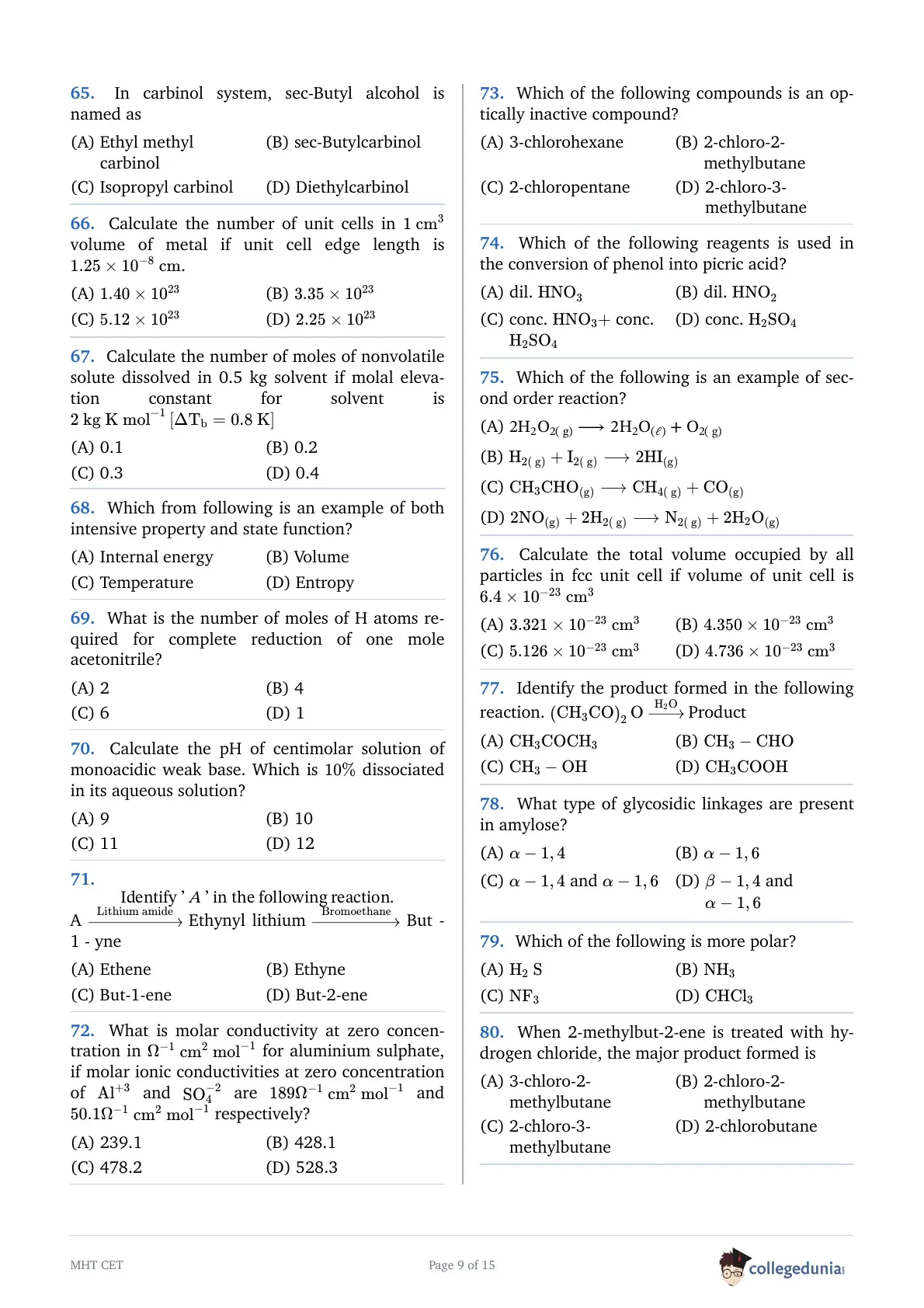
In carbinol system, sec-Butyl alcohol is named as ______.
Calculate the number of unit cells in 1 cm\(^3\) volume of metal if unit cell edge length is \(1.25 \times 10^{-8}\) cm.
Calculate the number of moles of nonvolatile solute dissolved in 0.5 kg solvent if molal elevation constant for solvent is 2 kg K mol\(^{-1}\) [\(\Delta T_b = 0.8\) K].
Which from following is an example of both intensive property and state function?
What is the number of moles of H atoms required for complete reduction of one mole acetonitrile?
Calculate the pH of centimolar solution of monoacidic weak base. Which is 10% dissociated in its aqueous solution?
Identify 'A' in the following reaction: A + Lithium amide \(\rightarrow\) Ethynyl lithium \(\rightarrow\) Bromoethane \(\rightarrow\) But-1-yne
What is molar conductivity at zero concentration in \(\Omega^{-1}\) cm\(^2\) mol\(^{-1}\) for aluminium sulphate, if molar ionic conductivities at zero concentration of Al\(^{3+}\) and SO\(_4^{2-}\) are 189 \(\Omega^{-1}\) cm\(^2\) mol\(^{-1}\) and 50.1 \(\Omega^{-1}\) cm\(^2\) mol\(^{-1}\) respectively?
Which of the following compounds is an optically inactive compound?
Which of the following reagents is used in the conversion of phenol into picric acid?
Calculate the total volume occupied by all particles in fcc unit cell if volume of unit cell is \(6.4 \times 10^{-23}\) cm\(^3\).
Identify the product formed in the following reaction. \(\left(\mathrm{CH}_3 \mathrm{CO}\right)_2 \mathrm{O} \xrightarrow{\mathrm{H}_2 \mathrm{O}}\) Product
What type of glycosidic linkages are present in amylose?
Which of the following is more polar?
When 2-methylbut-2-ene is treated with hydrogen chloride, the major product formed is ______.
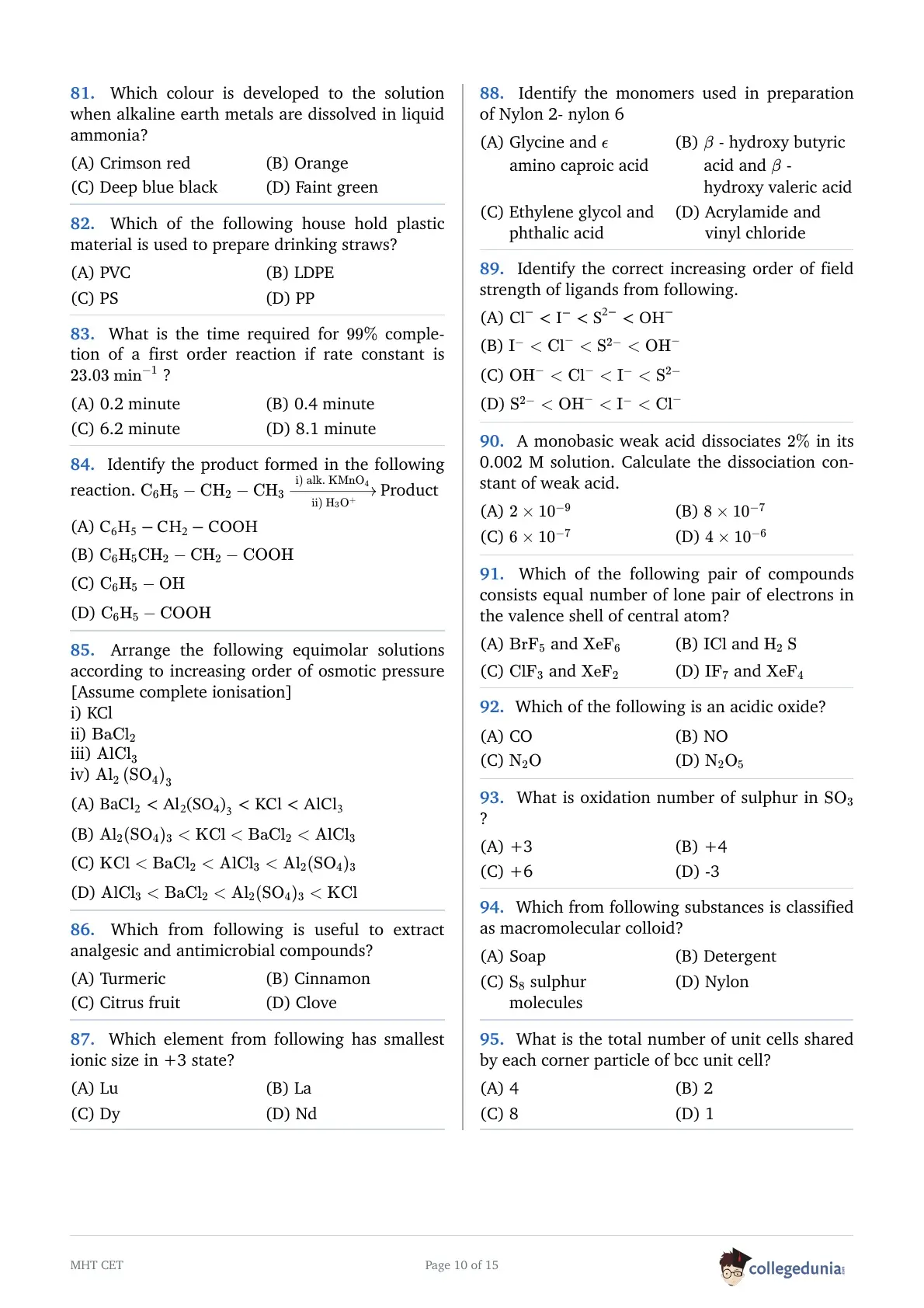
Which colour is developed to the solution when alkaline earth metals are dissolved in liquid ammonia?
Which of the following household plastic material is used to prepare drinking straws?
What is the time required for 99% completion of a first order reaction if rate constant is 23.03 min\(^{-1}\)?
Identify the product formed in the following reaction:
\(C_6H_5 - CH_2 - CH_3 \xrightarrow[\text{ii) } H_3O^+]{\text{i) alk. } KMnO_4} \text{Product}\)
Arrange the following equimolar solutions according to increasing order of osmotic pressure [Assume complete ionisation]
i) KCl
ii) \(BaCl_2\)
iii) \(AlCl_3\)
iv) \(Al_2(SO_4)_3\)
Which from following is useful to extract analgesic and antimicrobial compounds?
Which element from following has smallest ionic size in +3 state?
Identify the monomers used in preparation of Nylon 2-nylon 6.
Identify the correct increasing order of field strength of ligands from following.
A monobasic weak acid dissociates 2% in its 0.002 M solution. Calculate the dissociation constant of weak acid.
Which of the following pair of compounds consists equal number of lone pair of electrons in the valence shell of central atom?
Which of the following is an acidic oxide?
What is oxidation number of sulphur in \(SO_3\)?
Which from following substances is classified as macromolecular colloid?
What is the total number of unit cells shared by each corner particle of bcc unit cell?
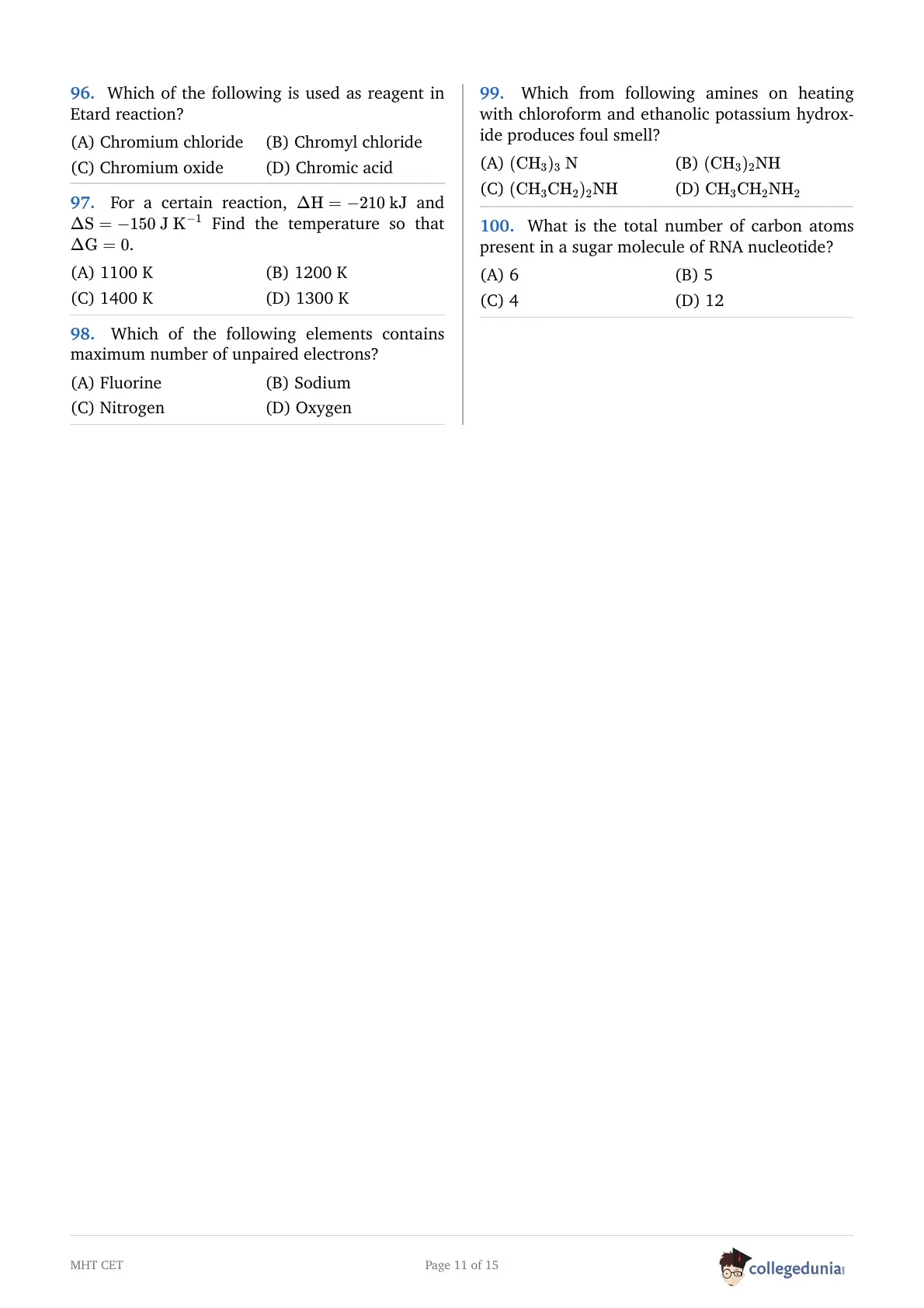
Which of the following is used as reagent in Etard reaction?
For a certain reaction, \(\Delta H = -210\) kJ and \(\Delta S = -150\) J K\(^{-1}\). Find the temperature so that \(\Delta G = 0\).
Which of the following elements contains maximum number of unpaired electrons?
Which from following amines on heating with chloroform and ethanolic potassium hydroxide produces foul smell?
What is the total number of carbon atoms present in a sugar molecule of RNA nucleotide?
Mathematics (Q101 - Q150)
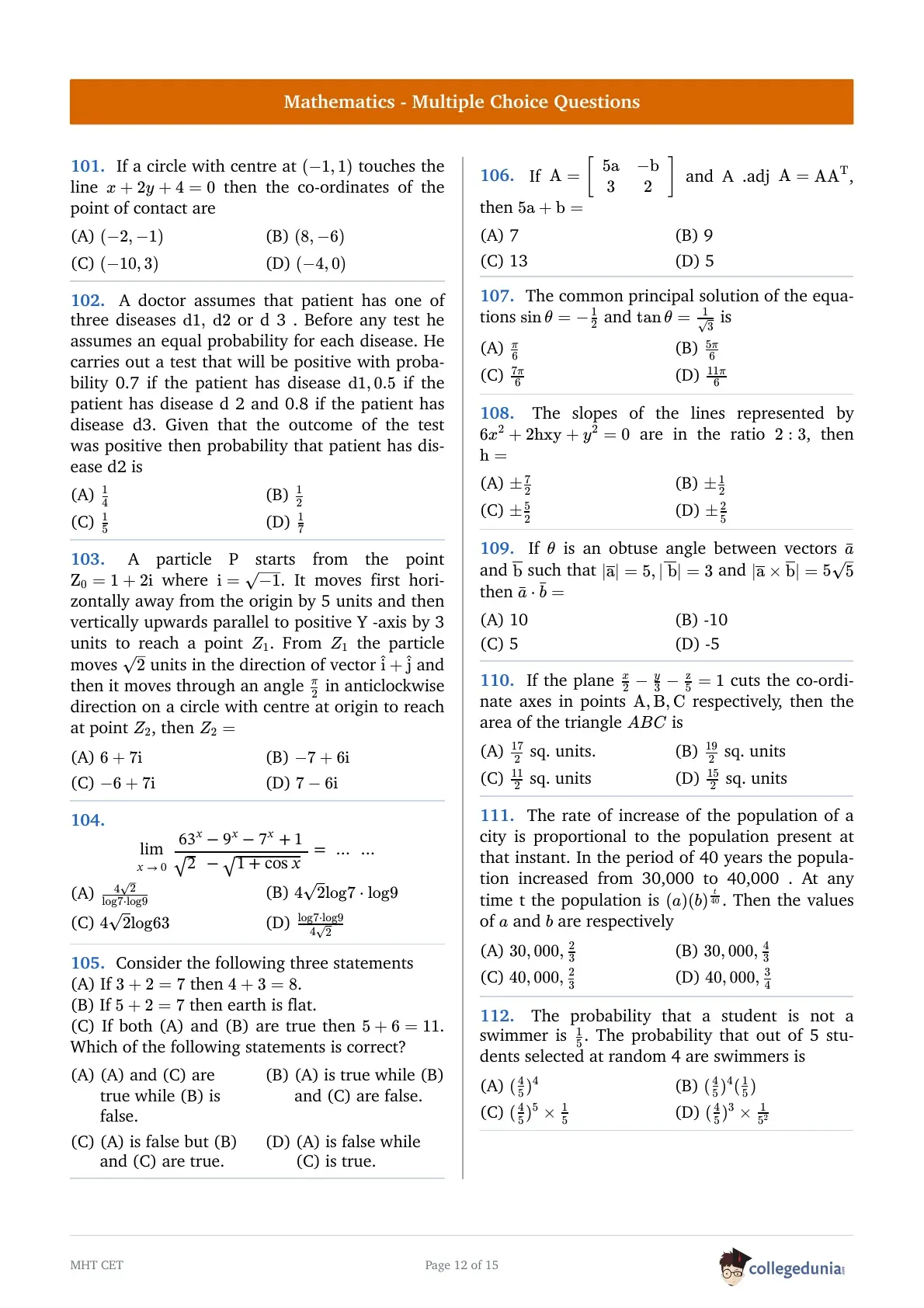
If a circle with centre at \((-1,1)\) touches the line \(x+2 y+4=0\) then the co-ordinates of the point of contact are
A doctor assumes that patient has one of three diseases \(\mathrm{d} 1, \mathrm{~d} 2\) or d 3 . Before any test he assumes an equal probability for each disease. He carries out a test that will be positive with probability 0.7 if the patient has disease \(\mathrm{d} 1,0.5\) if the patient has disease d 2 and 0.8 if the patient has disease d3. Given that the outcome of the test was positive then probability that patient has disease d2 is
A particle P starts from \(Z_0 = 1 + 2i\). It moves horizontally away from origin by 5 units, then vertically up by 3 units to \(Z_1\). From \(Z_1\) it moves \(\sqrt{2}\) units in direction \(\hat{i} + \hat{j}\), then moves through \(\pi/2\) anticlockwise on a circle with centre at origin to reach \(Z_2\). Then \(Z_2 = \dots\)
\(\lim_{x \to 0} \frac{63^x - 9^x - 7^x + 1}{\sqrt{2} - \sqrt{1 + \cos x}} = \dots\)
Consider the following three statements:
(A) If \(3 + 2 = 7\) then \(4 + 3 = 8\).
(B) If \(5 + 2 = 7\) then earth is flat.
(C) If both (A) and (B) are true then \(5 + 6 = 11\).
Which of the following statements is correct?
If \(\mathrm{A}=\left[\begin{array}{cc}5 \mathrm{a} & -\mathrm{b} \\ 3 & 2\end{array}\right]\) and A .adj \(\mathrm{A}=\mathrm{AA}^{\mathrm{T}}\), then \(5 \mathrm{a}+\mathrm{b}=\)
The common principal solution of the equations \(\sin \theta = -1/2\) and \(\tan \theta = 1/\sqrt{3}\) is …}
The slopes of the lines represented by \(6x^2 + 2hxy + y^2 = 0\) are in the ratio 2 : 3, then \(h = \dots\)
If \(\theta\) is an obtuse angle between vectors \(\vec{a}\) and \(\vec{b}\) such that \(|\vec{a}| = 5, |\vec{b}| = 3\) and \(|\vec{a} \times \vec{b}| = 5\sqrt{5}\) then \(\vec{a} \cdot \vec{b} = \dots\)
If the plane \(x/2 - y/3 - z/5 = 1\) cuts the co-ordinate axes in points A, B, C respectively, then the area of the triangle ABC is ______.
The rate of increase of population of a city is proportional to population present. In 40 years it increased from 30,000 to 40,000. At time \(t\) population is \(a(b)^{t/40}\). Then \(a\) and \(b\) are …}
The probability that a student is not a swimmer is 1/5. The probability that out of 5 students selected at random 4 are swimmers is ______.
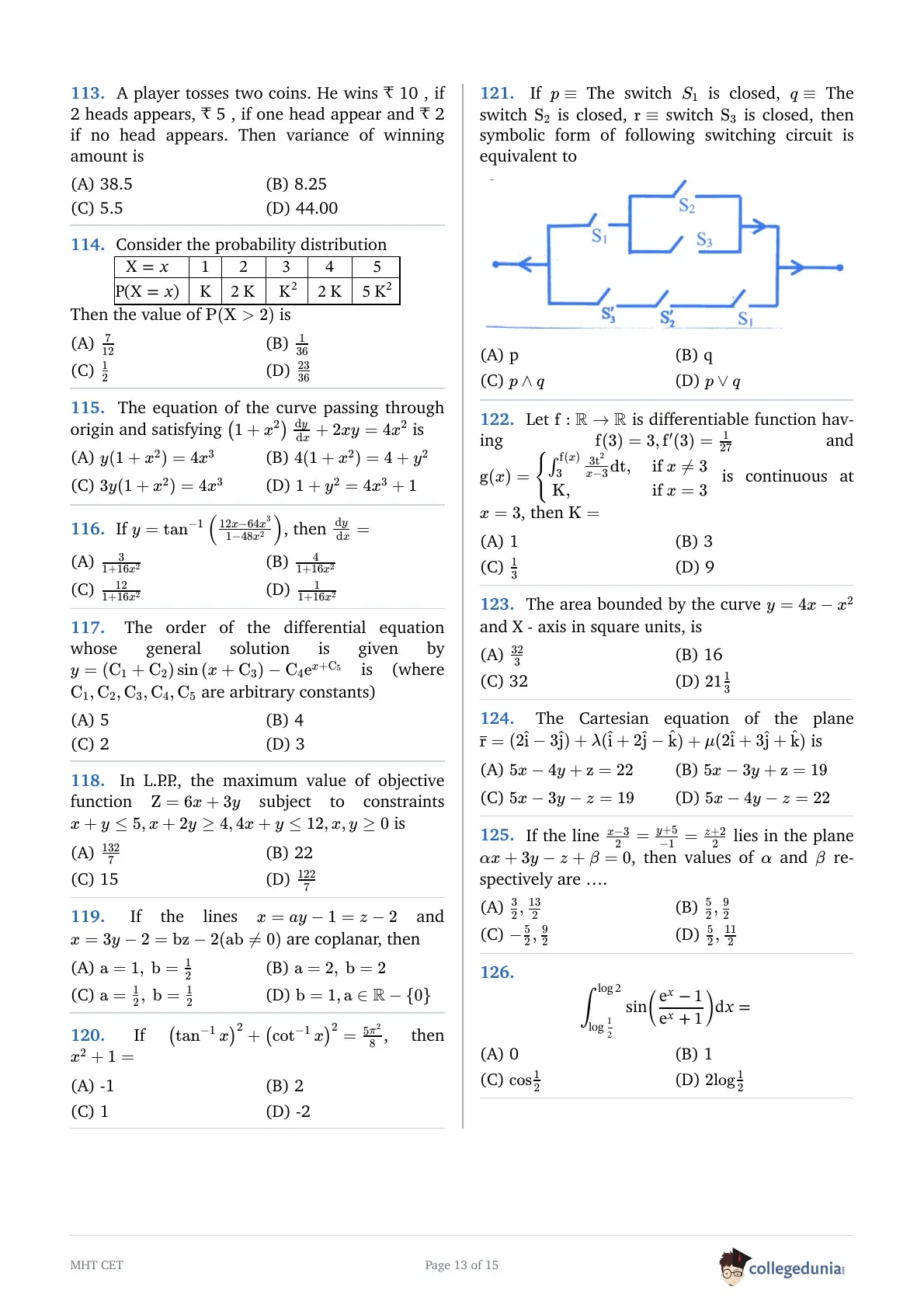
A player tosses two coins. He wins ₹10 if 2 heads appear, ₹5 if one head appears, and ₹2 if no head appears. Then variance of winning amount is ______.
Consider the probability distribution
\[ \begin{array}{|l|l|l|l|l|l|} \hline \mathrm{X}=x & 1 & 2 & 3 & 4 & 5 \\ \hline \mathrm{P}(\mathrm{X}=x) & \mathrm{K} & 2 \mathrm{~K} & \mathrm{~K}^2 & 2 \mathrm{~K} & 5 \mathrm{~K}^2 \\ \hline \end{array} \]
Then the value of \(\mathrm{P}(\mathrm{X}>2)\) is
The equation of the curve passing through origin and satisfying \((1 + x^2) \frac{dy}{dx} + 2xy = 4x^2\) is ______.
If \(y=\tan ^{-1}\left(\frac{12 x-64 x^3}{1-48 x^2}\right)\), then \(\frac{\mathrm{d} y}{\mathrm{~d} x}=\)
The order of the differential equation whose general solution is given by \(y = (C_1 + C_2) \sin(x + C_3) - C_4 e^{x+C_5}\) is …}
In L.P.P., the maximum value of objective function \(Z = 6x + 3y\) subject to \(x + y \leq 5, x + 2y \geq 4, 4x + y \leq 12, x, y \geq 0\) is …
If the lines \(x = ay - 1 = z - 2\) and \(x = 3y - 2 = bz - 2\) (\(ab \neq 0\)) are coplanar, then …
If \((\tan^{-1} x)^2 + (\cot^{-1} x)^2 = 5\pi^2/8\), then \(x^2 + 1 = \dots\)
If \(p \equiv\) The switch \(S_1\) is closed, \(q \equiv\) The switch \(S_2\) is closed, \(r \equiv\) switch \(S_3\) is closed, then symbolic form of the switching circuit is equivalent to …
Let \(f : \mathbb{R} \rightarrow \mathbb{R}\) is differentiable function having \(f(3) = 3, f'(3) = 1/27\) and \(g(x) = \begin{cases} \int_3^{f(x)} \frac{3t^2}{x-3} dt, & x \neq 3 \\ K, & x = 3 \end{cases}\) is continuous at \(x = 3\), then \(K = \dots\)
The area bounded by the curve \(y = 4x - x^2\) and X-axis in square units, is …
The Cartesian equation of the plane \(\vec{r} = (2\hat{i} - 3\hat{j}) + \lambda(\hat{i} + 2\hat{j} - \hat{k}) + \mu(2\hat{i} + 3\hat{j} + \hat{k})\) is …}
If the line \(\frac{x-3}{2} = \frac{y+5}{1} = \frac{z+2}{2}\) lies in the plane \(\alpha x + 3y - z + \beta = 0\), then values of \(\alpha\) and \(\beta\) respectively are …}
\(\int_{\log(1/2)}^{\log 2} \sin \left( \frac{e^x - 1}{e^x + 1} \right) dx = \_\_\_\_\_\_.\)
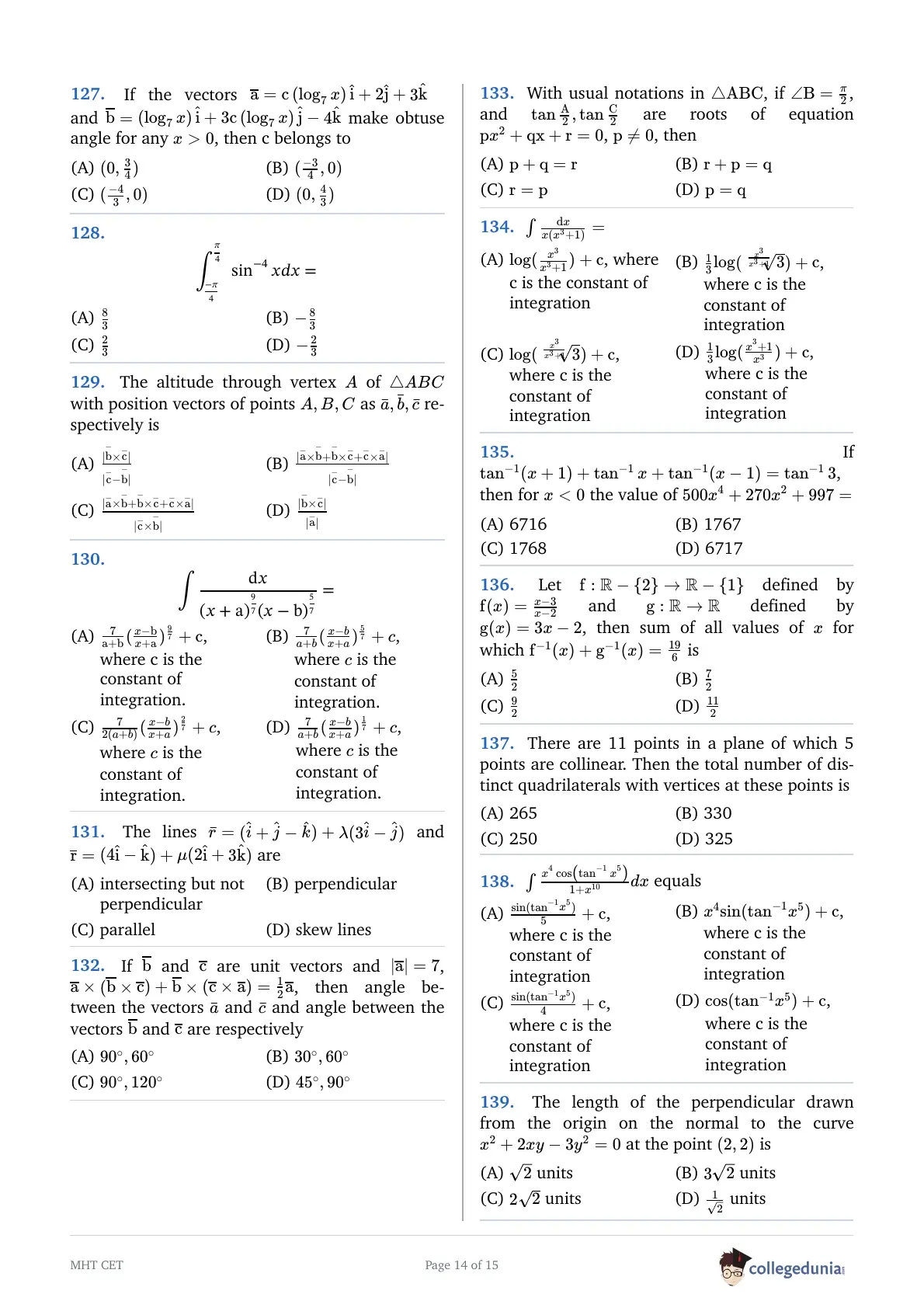
If the vectors \(\vec{a} = c (\log_7 x) \hat{i} + 2\hat{j} + 3\hat{k}\) and \(\vec{b} = (\log_7 x) \hat{i} + 3c (\log_7 x) \hat{j} - 4\hat{k}\) make obtuse angle for any x > 0, then c belongs to ______.
The altitude through vertex A of \(\triangle ABC\) with position vectors of points A, B, C as \(\vec{a}, \vec{b}, \vec{c}\) respectively is ______.
\[ \int \frac{\mathrm{d} x}{(x+\mathrm{a})^{\frac{9}{7}}(x-\mathrm{b})^{\frac{5}{7}}}= \]
The lines \(\vec{r} = (\hat{i} + \hat{j} - \hat{k}) + \lambda(3\hat{i} - \hat{j})\) and \(\vec{r} = (4\hat{i} - \hat{k}) + \mu(2\hat{i} + 3\hat{k})\) are …}
If \(\overline{\mathrm{b}}\) and \(\overline{\mathrm{c}}\) are unit vectors and \(|\overline{\mathrm{a}}|=7\), \(\overline{\mathrm{a}} \times(\overline{\mathrm{b}} \times \overline{\mathrm{c}})+\overline{\mathrm{b}} \times(\overline{\mathrm{c}} \times \overline{\mathrm{a}})=\frac{1}{2} \overline{\mathrm{a}}\), then angle between the vectors \(\bar{a}\) and \(\bar{c}\) and angle between the vectors \(\overline{\mathrm{b}}\) and \(\overline{\mathrm{c}}\) are respectively
With usual notations in \(\triangle \mathrm{ABC}\), if \(\angle \mathrm{B}=\frac{\pi}{2}\), and \(\tan \frac{\mathrm{A}}{2}, \tan \frac{\mathrm{C}}{2}\) are roots of equation \(\mathrm{p} x^2+\mathrm{qx}+\mathrm{r}=0\), \(\mathrm{p} \neq 0\), then
Let \(f : \mathbb{R} - \{2\} \rightarrow \mathbb{R} - \{1\}\) defined by \(f(x) = \frac{x-3}{x-2}\) and \(g : \mathbb{R} \rightarrow \mathbb{R}\) defined by \(g(x) = 3x - 2\), then sum of all values of \(x\) for which \(f^{-1}(x) + g^{-1}(x) = 19/6\) is ______.
There are 11 points in a plane of which 5 points are collinear. Then the total number of distinct quadrilaterals with vertices at these points is ______.
\(\int \frac{x^4 \cos \left(\tan ^{-1} x^5\right)}{1+x^{10}} d x\) equals
The length of the perpendicular drawn from the origin on the normal to the curve \(x^2 + 2xy - 3y^2 = 0\) at the point \((2, 2)\) is ______.
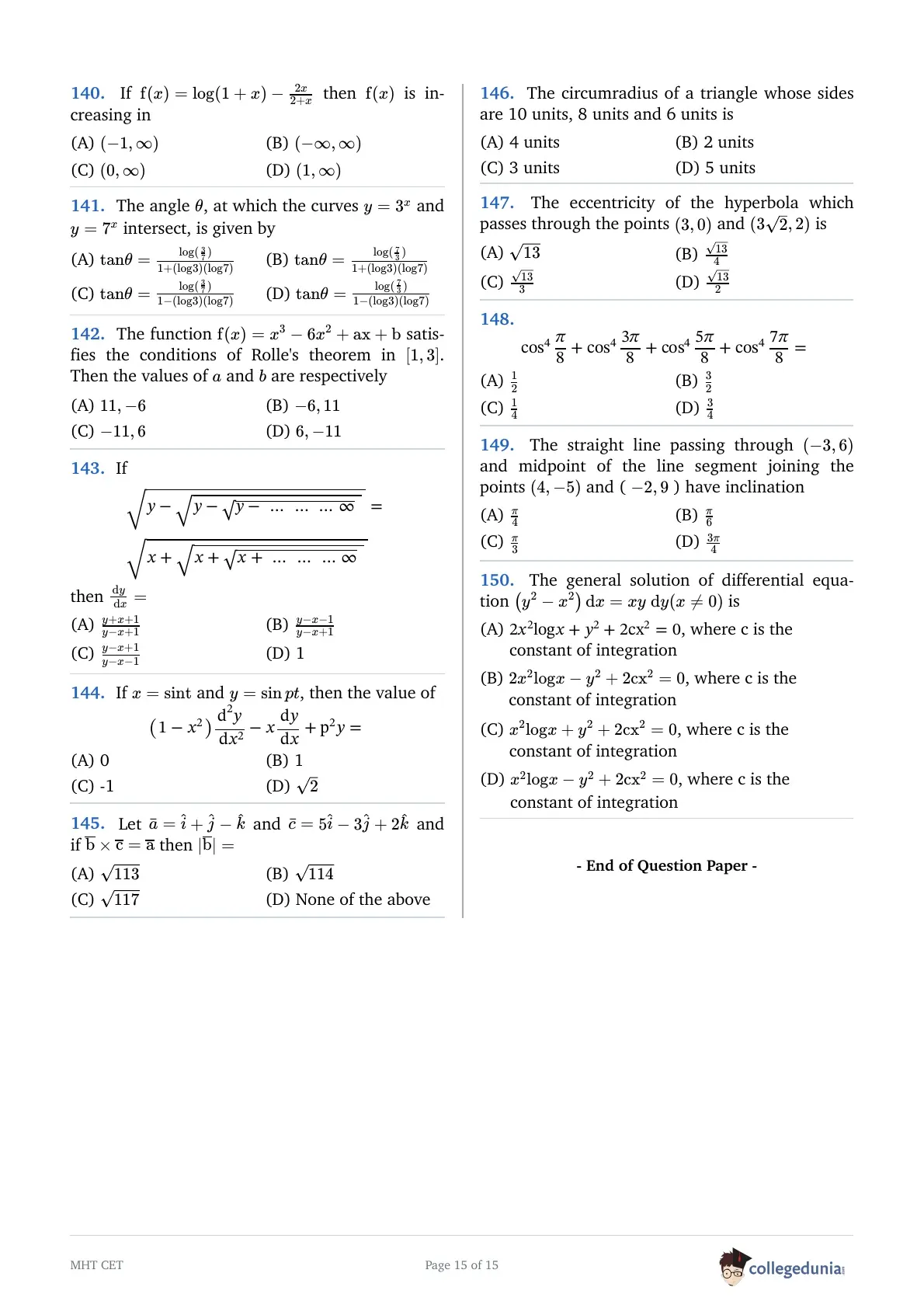
If \(f(x) = \log(1 + x) - \frac{2x}{2 + x}\), then \(f(x)\) is increasing in ______.
The angle \(\theta\), at which the curves \(y = 3^x\) and \(y = 7^x\) intersect, is given by ______.
The function \(f(x) = x^3 - 6x^2 + ax + b\) satisfies the conditions of Rolle's theorem in \([1, 3]\). Then the values of \(a\) and \(b\) are respectively …
If
\[ \sqrt{y-\sqrt{y-\sqrt{y-\ldots \ldots \ldots \infty}}}=\sqrt{x+\sqrt{x+\sqrt{x+\ldots \ldots \ldots \infty}}} \]
then \(\frac{\mathrm{d} y}{\mathrm{~d} x}=\)
If \(x = \sin t\) and \(y = \sin pt\), then the value of \((1 - x^2) \frac{d^2y}{dx^2} - x \frac{dy}{dx} + p^2 y = \dots\)
The circumradius of a triangle whose sides are 10 units, 8 units and 6 units is ______.
The eccentricity of the hyperbola which passes through the points \((3, 0)\) and \((3\sqrt{2}, 2)\) is …
\(\cos^4(\pi/8) + \cos^4(3\pi/8) + \cos^4(5\pi/8) + \cos^4(7\pi/8) = \dots\)
The straight line passing through \((-3, 6)\) and midpoint of the line segment joining the points \((4, -5)\) and \((-2, 9)\) have inclination ______.
The general solution of differential equation \((y^2 - x^2)dx = xy dy\) (\(x \neq 0\)) is ______.
MHT CET 2025 PCM Exam Pattern and Marking Scheme
| Parameter | Details |
|---|---|
| Conducting Body | Maharashtra Common Entrance Test Cell (Maharashtra CET Cell) |
| Exam Mode | Online (Computer-Based Test) |
| Duration | 180 minutes (3 hours) |
| Groups / Subjects | PCM (Physics, Chemistry, Mathematics) for Engineering |
| Total Questions |
150 |
| Total Marks | 200 |
| Question Type | Multiple Choice Questions (MCQs) |
| Marks Distribution |
|
| Negative Marking | No |
| Syllabus Weightage |
|



Comments