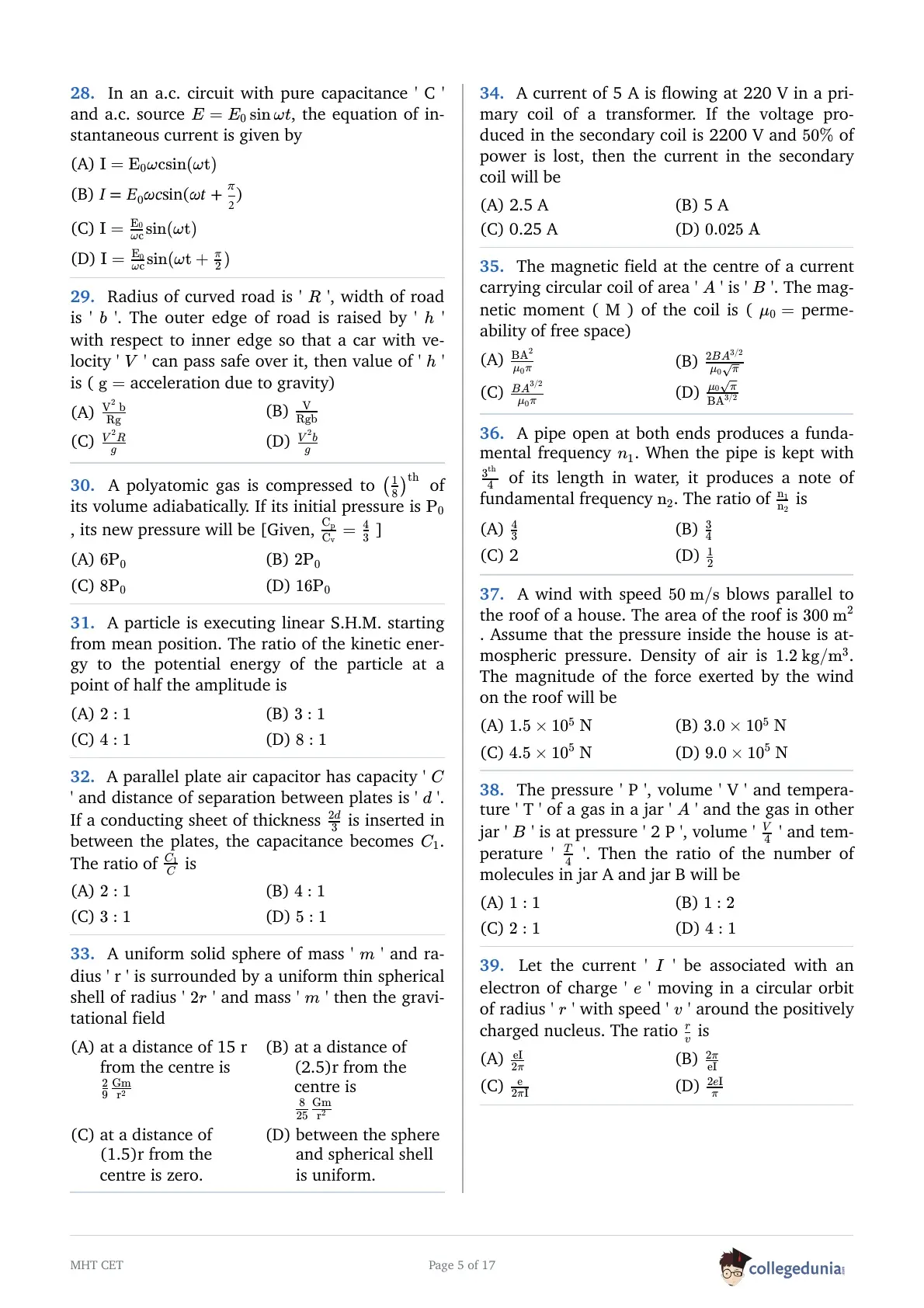
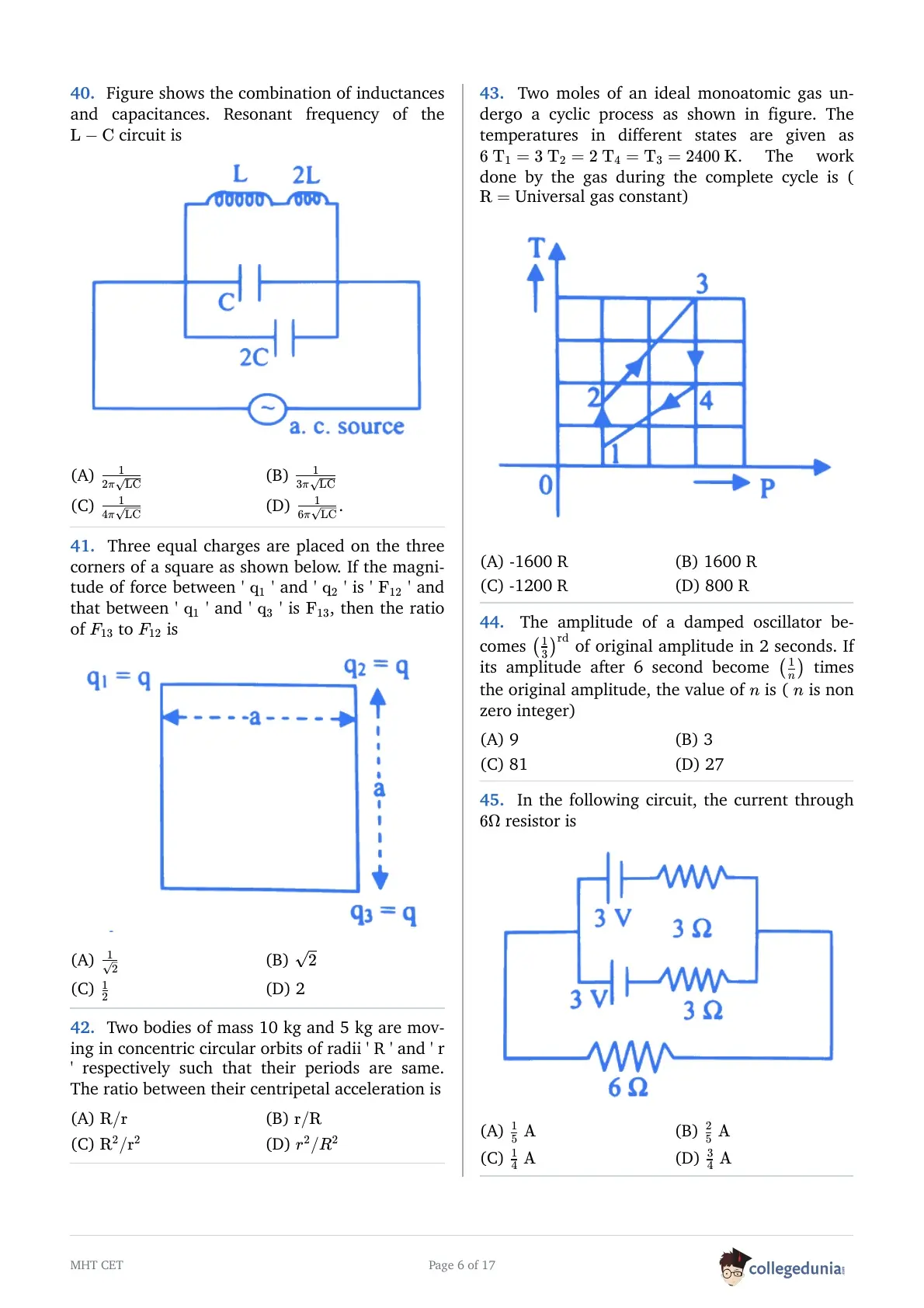
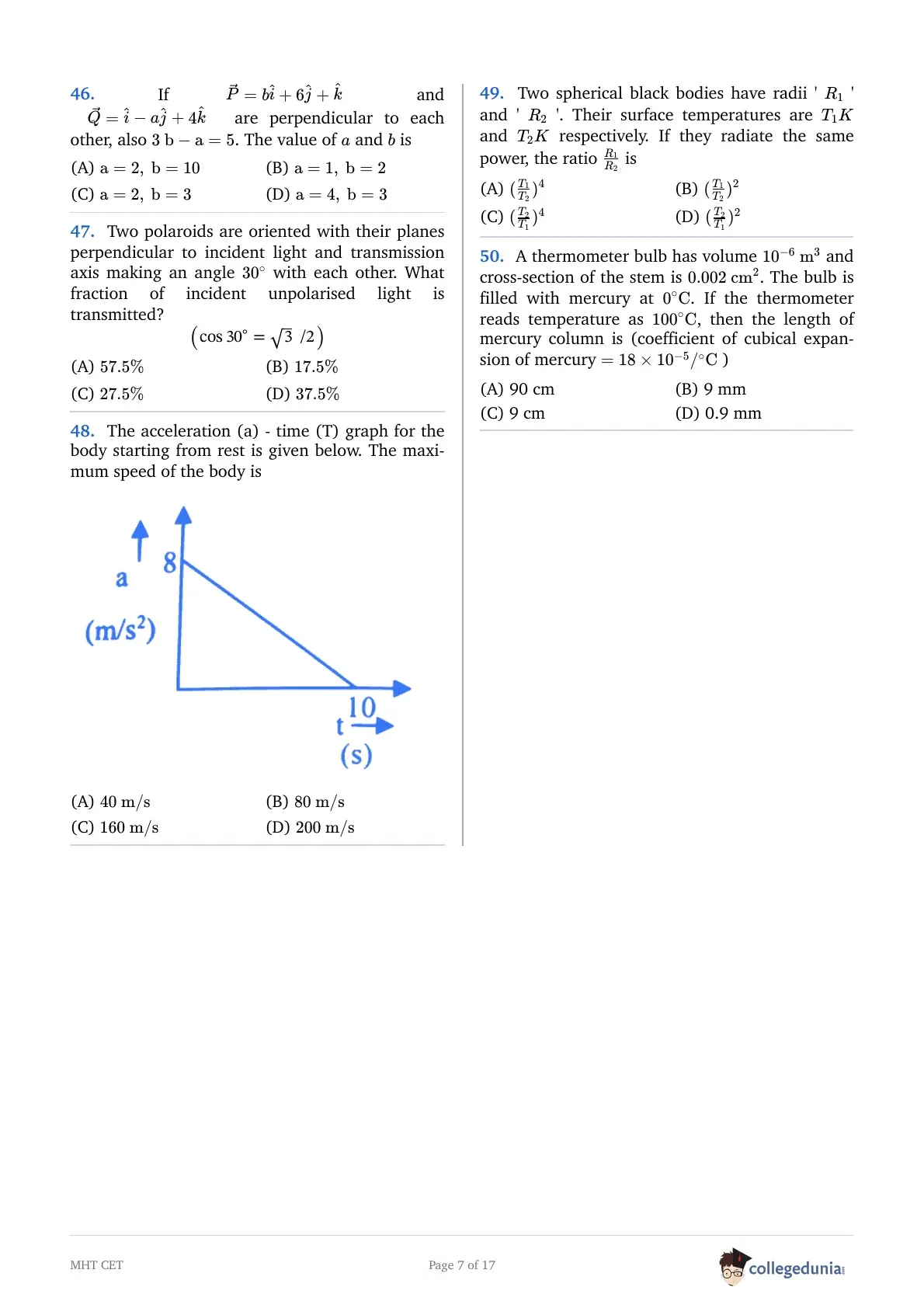
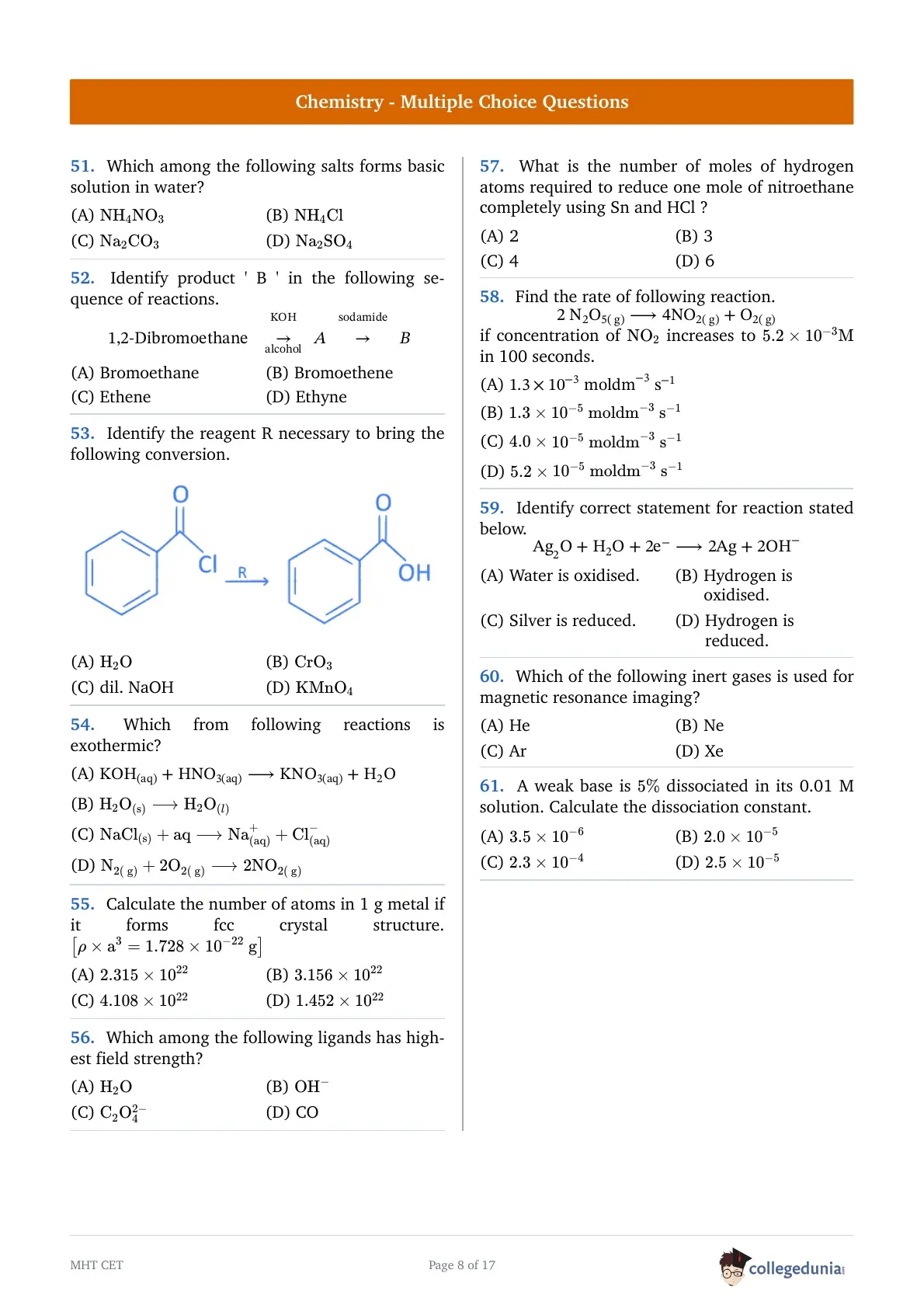
MHT CET 2025 April 23 Shift 1 PCM Question Paper is available for download here. Maharashtra State CET Cell conducted MHT CET 2025 PCM Exam on April 23 in Shift 1 from 9 AM to 12 PM in CBT mode.

The MHT CET 2025 PCM question paper includes the following:

  • The MHT CET 2025 PCM Question Paper consists of 150 multiple-choice questions (MCQs) totalling 200 marks divided into 3 sections: Physics, Chemistry, and Mathematics, with 50 questions in each subject.
  • Physics and Chemistry questions carry 1 mark each while Mathematics questions carry 2 marks each.
  • There is no negative marking for incorrect answers.

MHT CET 2025 April 23 Shift 1 PCM Question Paper with Solution PDF

CD PDF CD PDF with Solutions
Download Collegedunia PDF 1.03 MB -

Also Check:

MHT CET 2025 April 23 Shift 1 PCM Questions with Solutions


Physics (Q1 - Q50)

Question 1:

Which of the following statements is TRUE for n-type semiconductor?

  • (A) Holes are majority carriers and trivalent atoms are dopants.
  • (B) Electrons are majority carriers and trivalent atoms are dopants.
  • (C) Holes are minority carriers and pentavalent atoms are dopants.
  • (D) Electrons are minority carriers and pentavalent atoms are dopants.

Question 2:

When a current in the conducting coil is changed from 5 A in one direction to 5 A in opposite direction in 0.5 second, an average induced e.m.f in the coil is 2 V . The selfinductance of the coil is

  • (A) 25 mH
  • (B) 50 mH
  • (C) 75 mH
  • (D) 100 mH

Question 3:

The electric field intensity near a conducting surface having uniform surface charge density ' \(\sigma\) ' is given by ( \(\varepsilon_0=\) permittivity of free space)

  • (A) \(\frac{\sigma}{\epsilon _{0}}\) and is parallel to the surface
  • (B) \(\frac{2\sigma}{\epsilon _{0}}\) and is parallel to the surface
  • (C) \(\frac{\sigma}{\epsilon _{0}}\) and is normal to the surface
  • (D) \(\frac{2\sigma}{\epsilon _{0}}\) and is normal to the surface

Question 4:

The excess pressure inside first soap bubble is three times that of a second soap bubble. The ratio of volumes of the first to second bubble

  • (A) \(1:3\)
  • (B) \(1:9\)
  • (C) \(1:27\)
  • (D) \(27:1\)

Question 5:

A particle performs S.H.M. of amplitude 'A' and wavelength ' \(\lambda\) ', Then the velocity of the wave (V) and the maximum particle velocity (v) are related as

  • (A) \(v=\frac{\lambda V}{4\pi A}\)
  • (B) \(V=\frac{\lambda v}{4\pi A}\)
  • (C) \(v=\frac{2\pi A}{\lambda}V\)
  • (D) \(V=\frac{2\pi A}{\lambda}v\)

Question 6:

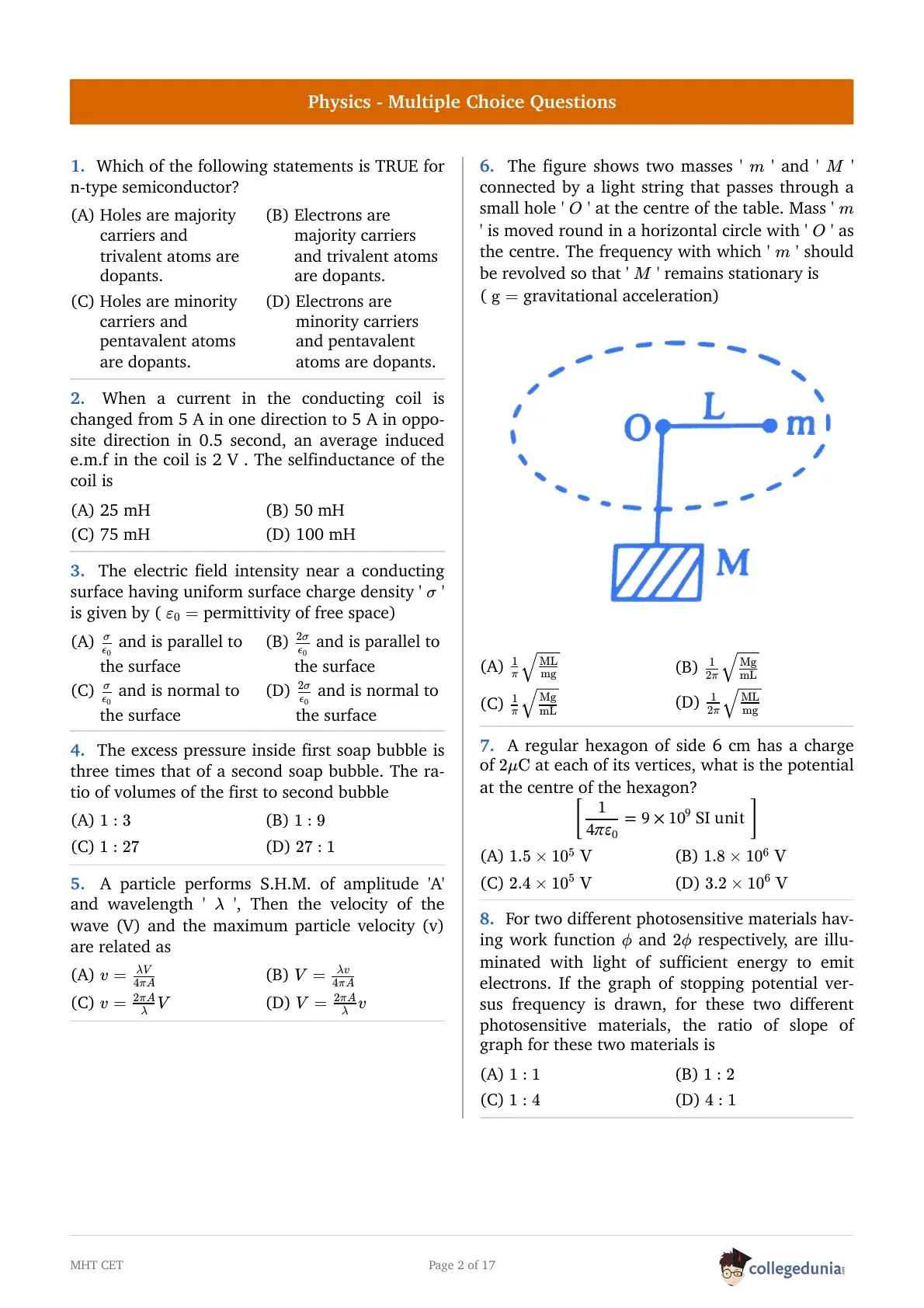
The figure shows two masses ' \(m\) ' and ' \(M\) ' connected by a light string that passes through a small hole ' \(O\) ' at the centre of the table. Mass ' \(m\) ' is moved round in a horizontal circle with ' \(O\) ' as the centre. The frequency with which ' \(m\) ' should be revolved so that ' \(M\) ' remains stationary is

( \(\mathrm{g}=\) gravitational acceleration)

  • (A) \(\frac{1}{\pi}\sqrt{\frac{\mathrm{ML}}{\mathrm{mg}}}\)
  • (B) \(\frac{1}{2\pi}\sqrt{\frac{\mathrm{Mg}}{\mathrm{mL}}}\)
  • (C) \(\frac{1}{\pi}\sqrt{\frac{\mathrm{Mg}}{\mathrm{mL}}}\)
  • (D) \(\frac{1}{2\pi}\sqrt{\frac{\mathrm{ML}}{\mathrm{mg}}}\)

Question 7:

A regular hexagon of side 6 cm has a charge of \(2 \mu \mathrm{C}\) at each of its vertices, what is the potential at the centre of the hexagon?

\[ \left[\frac{1}{4 \pi \varepsilon_0}=9 \times 10^9 \text { SI unit }\right] \]

  • (A) \(1.5\times 10^{5}\text{ }\mathrm{V}\)
  • (B) \(1.8\times 10^{6}\text{ }\mathrm{V}\)
  • (C) \(2.4\times 10^{5}\text{ }\mathrm{V}\)
  • (D) \(3.2\times 10^{6}\text{ }\mathrm{V}\)

Question 8:

For two different photosensitive materials having work function \(\phi\) and \(2 \phi\) respectively, are illuminated with light of sufficient energy to emit electrons. If the graph of stopping potential versus frequency is drawn, for these two different photosensitive materials, the ratio of slope of graph for these two materials is

  • (A) \(1:1\)
  • (B) \(1:2\)
  • (C) \(1:4\)
  • (D) \(4:1\)

Question 9:

The weight of man in a stationary lift is \(w_1\) and when it is moving downwards with uniform acceleration ' a ' is \(\mathrm{w}_2\). If the ratio \(\mathrm{w}_1: \mathrm{w}_2=4: 3\), then the value of ' a ' is ( \(\mathrm{g}=\) acceleration due to gravity)

  • (A) \(\frac{\mathrm{g}}{3}\)
  • (B) \(\frac{\mathrm{g}}{4}\)
  • (C) \(\frac{3}{4}\text{ }\mathrm{g}\)
  • (D) \(\frac{4}{\text{ }\mathrm{g}}\)

Question 10:

The activity of radioactive sample is measured as \(\mathrm{N}_0\) counts per minute at time \(\mathrm{t}=0\), and \(\frac{\mathrm{N}_0}{\mathrm{e}}\) counts per minute at time \(\mathrm{t}=3\) minute, The activity reduces to half its value in time (in minute)

  • (A) \(\frac{1}{3}\mathrm{log}_{\mathrm{e}}2\)
  • (B) \(3\mathrm{log}_{\mathrm{e}}2\)
  • (C) \(3\mathrm{log}_{10}2\)
  • (D) \(\frac{3}{\mathrm{log}_{10}2}\)

Question 11:

Two identical straight wires are stretched so as to produce 6 beats per second when vibrating simultaneously with tensions ' \(\mathrm{T}_1\) ' and ' \(\mathrm{T}_2\) ' respectively. On changing the tension slightly in one of them, the beat frequency remains unchanged. This will happen when (Given \(\rightarrow \mathrm{T}_1>\mathrm{T}_2\) )

  • (A) \(\mathrm{T}_{1}\) is increased or \(\mathrm{T}_{2}\) is decreased
  • (B) \(\mathrm{T}_{1}\) is increased by 144
  • (C) \(\mathrm{T}_{2}\) is decreased by 144
  • (D) \(T_{1}\) is decreased or \(T_{2}\) is increased

Question 12:

How much should the pressure be increased in order to reduce the volume of a given mass of gas by \(5 \%\) at the constant temperature?

  • (A) \(5\%\)
  • (B) \(10\%\)
  • (C) \(5.26\%\)
  • (D) \(4\%\)

Question 13:

In Young's double slit experiment the wavelength of light used is \(6000 \mathop {\rm{A}}\limits^{\rm{o}}\), the screen is 40 cm from the slits and the fringe width is 0.012 cm , the distance between two slits is

  • (A) 0.024 cm
  • (B) 2.4 cm
  • (C) 0.24 cm
  • (D) 0.2 cm

Question 14:

A square coil ABCD of side ' L ' is carrying a current in clockwise direction. A straight conductor carrying current \(\mathrm{I}_2\) (upward direction) is kept parallel to side AB at a distance \(\frac{\mathrm{L}}{3}\) in the plane of \(A B C D\). The net force on the coil ABCD is ( \(\mu_0=\) magnetic permeability)

  • (A) \(\frac{\mu _{0}\mathrm{I}_{1}\mathrm{I}_{2}}{3\pi}\)
  • (B) \(\frac{3\mu _{0}\mathrm{I}_{1}\mathrm{I}_{2}}{4\pi}\)
  • (C) \(\frac{3\mu _{0}\mathrm{I}_{1}\mathrm{I}_{2}}{8\pi}\)
  • (D) \(\frac{9\mu _{0}\mathrm{I}_{1}\mathrm{I}_{2}}{8\pi}\)

Question 15:

In a common emitter transistor amplifier circuit, the current gain \(\alpha=0.8\). If the base current changes by \(3 \mu \mathrm{~A}\) then the collector current changes by

  • (A) \(4\mu \text{ }\mathrm{A}\)
  • (B) \(12\mu \text{ }\mathrm{A}\)
  • (C) \(6\mu \text{ }\mathrm{A}\)
  • (D) \(24\mu \text{ }\mathrm{A}\)

Question 16:

A ray of light is incident on first face of an equilateral glass prism at an angle of incidence ' \(I\) '. The emergent ray just grazes along the adjacent face. The refractive index of the the prism is \(\sqrt{2}\). The value of angle of incidence at first face is \(\left(\sin 45^{\circ}=\frac{1}{\sqrt{2}}, \sin 90^{\circ}=1\right)\)

  • (A) \(\mathrm{sin}^{-1}(\sqrt{2}\mathrm{sin}15^{\circ})\)
  • (B) \(\mathrm{sin}^{-1}(\frac{\mathrm{sin}30^{\circ}}{\sqrt{2}})\)
  • (C) \(\mathrm{cos}^{-1}(\sqrt{2}\mathrm{sin}20^{\circ})\)
  • (D) \(\mathrm{tan}^{-1}\sqrt{2\mathrm{sin}15^{\circ}}\)

Question 17:

In hydrogen atom, the energy of electron in first and third orbit is ' \(E_1\) ' and' \(E_3\) ' respectively. If \(E_3=x E_1\) then the value of \(x\) will be

  • (A) \(\frac{1}{9}\)
  • (B) \(\frac{1}{64}\)
  • (C) \(\frac{1}{27}\)
  • (D) \(\frac{1}{8}\)

Question 18:

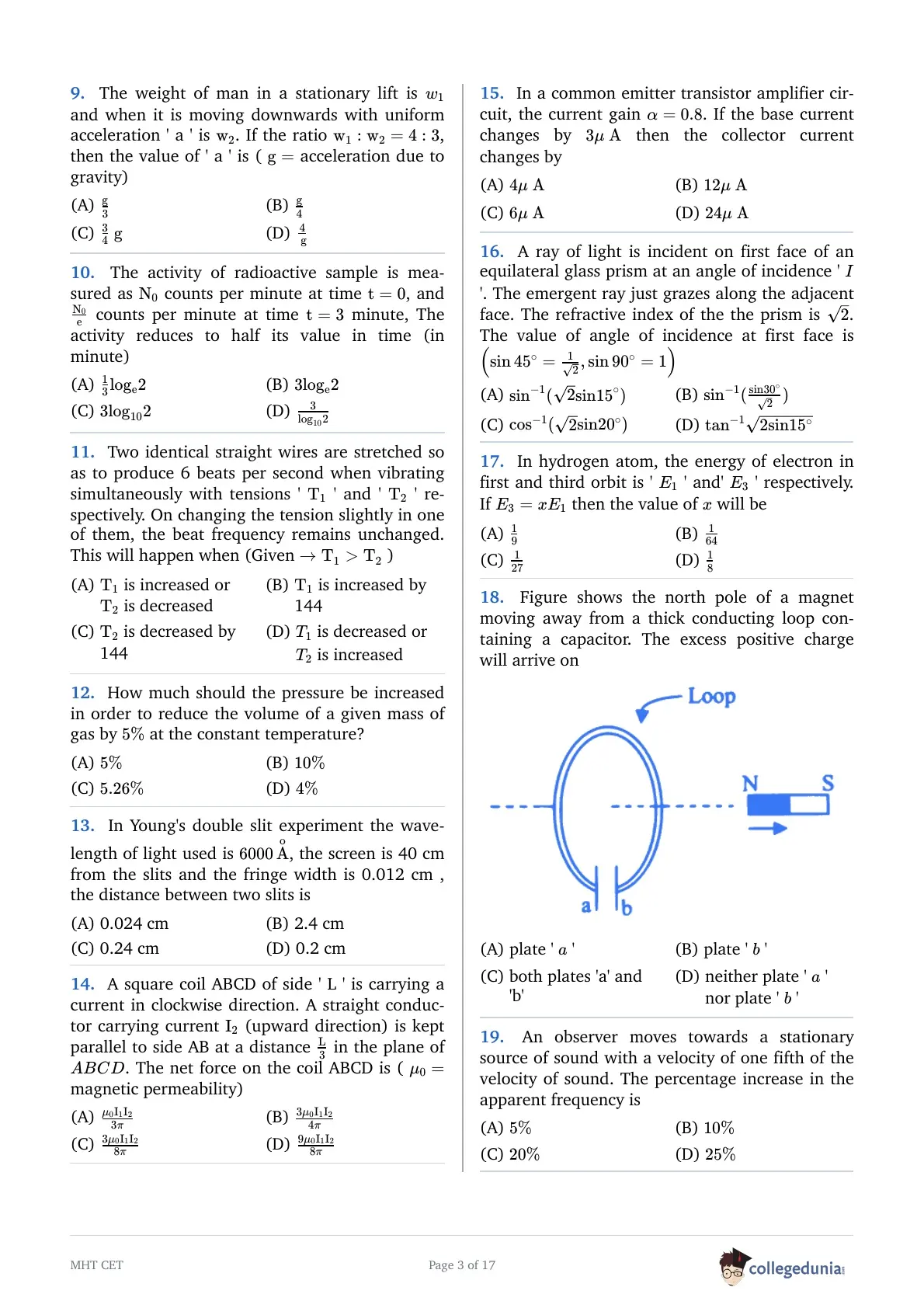
Figure shows the north pole of a magnet moving away from a thick conducting loop containing a capacitor. The excess positive charge will arrive on

  • (A) plate ' \(a\) '
  • (B) plate ' \(b\) '
  • (C) both plates 'a' and 'b'
  • (D) neither plate ' \(a\) ' nor plate ' \(b\) '

Question 19:

An observer moves towards a stationary source of sound with a velocity of one fifth of the velocity of sound. The percentage increase in the apparent frequency is

  • (A) \(5\%\)
  • (B) \(10\%\)
  • (C) \(20\%\)
  • (D) \(25\%\)

Question 20:

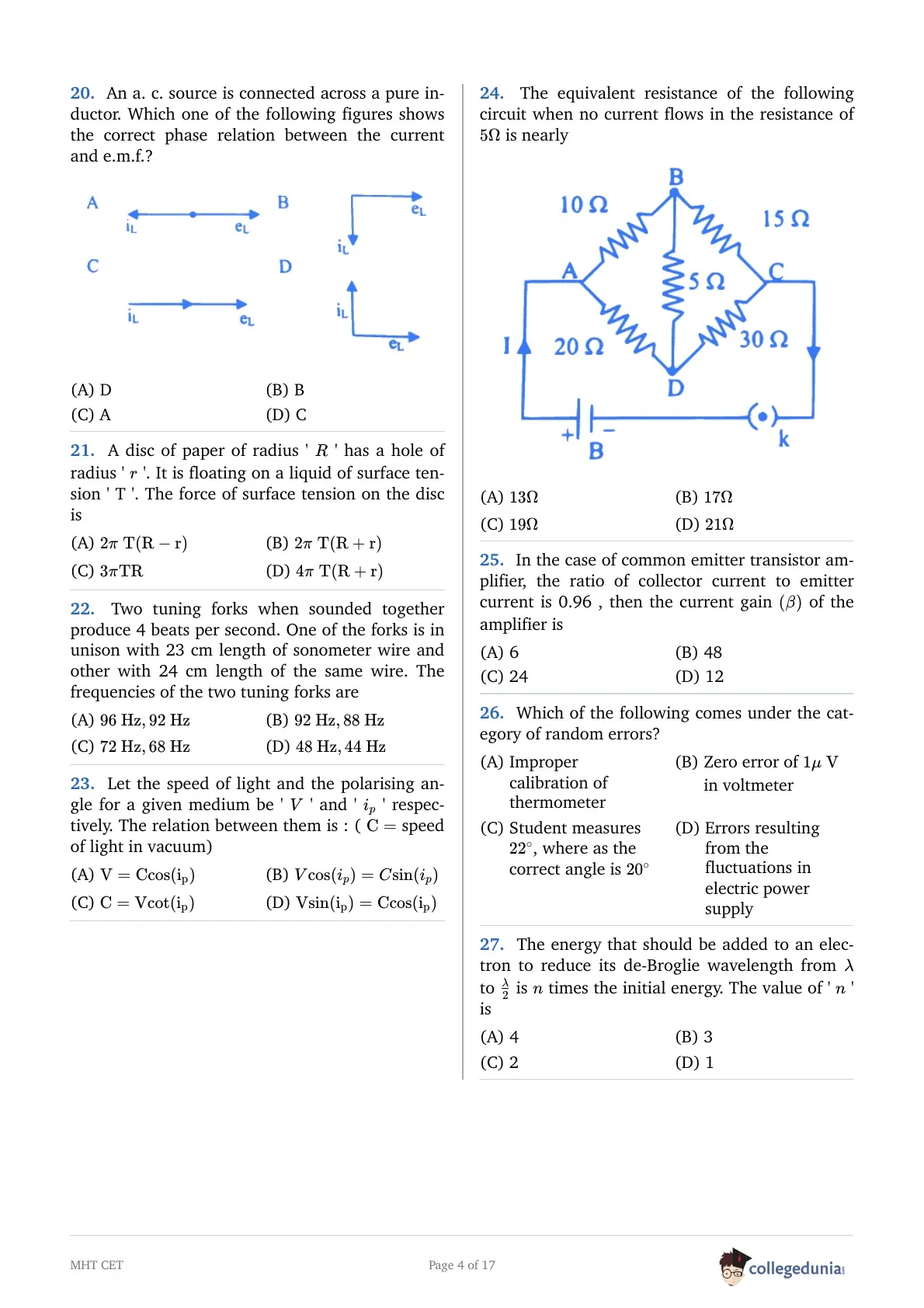
An a. c. source is connected across a pure inductor. Which one of the following figures shows the correct phase relation between the current and e.m.f.?

  • (A) D
  • (B) B
  • (C) A
  • (D) C

Question 21:

A disc of paper of radius ' \(R\) ' has a hole of radius ' \(r\) '. It is floating on a liquid of surface tension ' T '. The force of surface tension on the disc is

  • (A) \(2\pi \text{ }\mathrm{T}(\mathrm{R}-\mathrm{r})\)
  • (B) \(2\pi \text{ }\mathrm{T}(\mathrm{R}+\mathrm{r})\)
  • (C) \(3\pi \mathrm{TR}\)
  • (D) \(4\pi \text{ }\mathrm{T}(\mathrm{R}+\mathrm{r})\)

Question 22:

Two tuning forks when sounded together produce 4 beats per second. One of the forks is in unison with 23 cm length of sonometer wire and other with 24 cm length of the same wire. The frequencies of the two tuning forks are

  • (A) \(96\text{ }\mathrm{Hz},92\text{ }\mathrm{Hz}\)
  • (B) \(92\text{ }\mathrm{Hz},88\text{ }\mathrm{Hz}\)
  • (C) \(72\text{ }\mathrm{Hz},68\text{ }\mathrm{Hz}\)
  • (D) \(48\text{ }\mathrm{Hz},44\text{ }\mathrm{Hz}\)

Question 23:

Let the speed of light and the polarising angle for a given medium be ' \(V\) ' and ' \(i_p\) ' respectively. The relation between them is : ( \(\mathrm{C}=\) speed of light in vacuum)

  • (A) \(\mathrm{V}=\mathrm{Ccos}(\mathrm{i}_{\mathrm{p}})\)
  • (B) \(V\mathrm{cos}(i_{p})=C\mathrm{sin}(i_{p})\)
  • (C) \(\mathrm{C}=\mathrm{Vcot}(\mathrm{i}_{\mathrm{p}})\)
  • (D) \(\mathrm{Vsin}(\mathrm{i}_{\mathrm{p}})=\mathrm{Ccos}(\mathrm{i}_{\mathrm{p}})\)

Question 24:

The equivalent resistance of the following circuit when no current flows in the resistance of \(5 \Omega\) is nearly

  • (A) \(13\Omega\)
  • (B) \(17\Omega\)
  • (C) \(19\Omega\)
  • (D) \(21\Omega\)

Question 25:

In the case of common emitter transistor amplifier, the ratio of collector current to emitter current is 0.96 , then the current gain \((\beta)\) of the amplifier is

  • (A) 6
  • (B) 48
  • (C) 24
  • (D) 12

Question 26:

Which of the following comes under the category of random errors?

  • (A) Improper calibration of thermometer
  • (B) Zero error of \(1\mu \text{ }\mathrm{V}\) in voltmeter
  • (C) Student measures \(22^{\circ}\), where as the correct angle is \(20^{\circ}\)
  • (D) Errors resulting from the fluctuations in electric power supply

Question 27:

The energy that should be added to an electron to reduce its de-Broglie wavelength from \(\lambda\) to \(\frac{\lambda}{2}\) is \(n\) times the initial energy. The value of ' \(n\) ' is

  • (A) 4
  • (B) 3
  • (C) 2
  • (D) 1

Question 28:

In an a.c. circuit with pure capacitance ' C ' and a.c. source \(E=E_0 \sin \omega t\), the equation of instantaneous current is given by

  • (A) \(\mathrm{I}=\mathrm{E}_{0}\omega \mathrm{csin}(\omega \mathrm{t})\)
  • (B) \(I=E_{0}\omega c\mathrm{sin}(\omega t+\frac{\pi}{2})\)
  • (C) \(\mathrm{I}=\frac{\mathrm{E}_{0}}{\omega \mathrm{c}}\mathrm{sin}(\omega \mathrm{t})\)
  • (D) \(\mathrm{I}=\frac{\mathrm{E}_{0}}{\omega \mathrm{c}}\mathrm{sin}(\omega \mathrm{t}+\frac{\pi}{2})\)

Question 29:

Radius of curved road is ' \(R\) ', width of road is ' \(b\) '. The outer edge of road is raised by ' \(h\) ' with respect to inner edge so that a car with velocity ' \(V\) ' can pass safe over it, then value of ' \(h\) ' is ( \(\mathrm{g}=\) acceleration due to gravity)

  • (A) \(\frac{\mathrm{V}^{2}\text{ }\mathrm{b}}{\mathrm{Rg}}\)
  • (B) \(\frac{\mathrm{V}}{\mathrm{Rgb}}\)
  • (C) \(\frac{V^{2}R}{g}\)
  • (D) \(\frac{V^{2}b}{g}\)

Question 30:

A polyatomic gas is compressed to \(\left(\frac{1}{8}\right)^{\text {th }}\) of its volume adiabatically. If its initial pressure is \(\mathrm{P}_0\), its new pressure will be [Given, \(\frac{\mathrm{C}_{\mathrm{p}}}{\mathrm{C}_{\mathrm{v}}}=\frac{4}{3}\) ]

  • (A) \(6\mathrm{P}_{0}\)
  • (B) \(2\mathrm{P}_{0}\)
  • (C) \(8\mathrm{P}_{0}\)
  • (D) \(16\mathrm{P}_{0}\)

Question 31:

A particle is executing linear S.H.M. starting from mean position. The ratio of the kinetic energy to the potential energy of the particle at a point of half the amplitude is

  • (A) \(2:1\)
  • (B) \(3:1\)
  • (C) \(4:1\)
  • (D) \(8:1\)

Question 32:

A parallel plate air capacitor has capacity ' \(C\) ' and distance of separation between plates is ' \(d\) '. If a conducting sheet of thickness \(\frac{2 d}{3}\) is inserted in between the plates, the capacitance becomes \(C_1\). The ratio of \(\frac{C_1}{C}\) is

  • (A) \(2:1\)
  • (B) \(4:1\)
  • (C) \(3:1\)
  • (D) \(5:1\)

Question 33:

A uniform solid sphere of mass ' \(m\) ' and radius ' r ' is surrounded by a uniform thin spherical shell of radius ' \(2 r\) ' and mass ' \(m\) ' then the gravitational field

  • (A)

    at a distance of 15 r from the centre is

    \(\frac{2}{9}\frac{\mathrm{Gm}}{\mathrm{r}^{2}}\)

  • (B)

    at a distance of (2.5)r from the centre is

    \(\frac{8}{25}\frac{\mathrm{Gm}}{\mathrm{r}^{2}}\)

  • (C) at a distance of (1.5)r from the centre is zero.
  • (D) between the sphere and spherical shell is uniform.

Question 34:

A current of 5 A is flowing at 220 V in a primary coil of a transformer. If the voltage produced in the secondary coil is 2200 V and \(50 \%\) of power is lost, then the current in the secondary coil will be

  • (A) 2.5 A
  • (B) 5 A
  • (C) 0.25 A
  • (D) \(0.025\text{ }\mathrm{A}\)

Question 35:

The magnetic field at the centre of a current carrying circular coil of area ' \(A\) ' is ' \(B\) '. The magnetic moment ( M ) of the coil is ( \(\mu_0=\) permeability of free space)

  • (A) \(\frac{\mathrm{BA}^{2}}{\mu _{0}\pi}\)
  • (B) \(\frac{2BA^{3/2}}{\mu _{0}\sqrt{\pi}}\)
  • (C) \(\frac{BA^{3/2}}{\mu _{0}\pi}\)
  • (D) \(\frac{\mu _{0}\sqrt{\pi}}{\mathrm{BA}^{3/2}}\)

Question 36:

A pipe open at both ends produces a fundamental frequency \(n_1\). When the pipe is kept with \(\frac{3^{\text {th }}}{4}\) of its length in water, it produces a note of fundamental frequency \(\mathrm{n}_2\). The ratio of \(\frac{\mathrm{n}_1}{\mathrm{n}_2}\) is

  • (A) \(\frac{4}{3}\)
  • (B) \(\frac{3}{4}\)
  • (C) 2
  • (D) \(\frac{1}{2}\)

Question 37:

A wind with speed \(50 \mathrm{~m} / \mathrm{s}\) blows parallel to the roof of a house. The area of the roof is \(300 \mathrm{~m}^2\). Assume that the pressure inside the house is atmospheric pressure. Density of air is \(1.2 \mathrm{~kg} / \mathrm{m}^3\). The magnitude of the force exerted by the wind on the roof will be

  • (A) \(1.5\times 10^{5}\text{ }\mathrm{N}\)
  • (B) \(3.0\times 10^{5}\text{ }\mathrm{N}\)
  • (C) \(4.5\times 10^{5}\text{ }\mathrm{N}\)
  • (D) \(9.0\times 10^{5}\text{ }\mathrm{N}\)

Question 38:

The pressure ' P ', volume ' V ' and temperature ' T ' of a gas in a jar ' \(A\) ' and the gas in other jar ' \(B\) ' is at pressure ' 2 P ', volume ' \(\frac{V}{4}\) ' and temperature ' \(\frac{T}{4}\) '. Then the ratio of the number of molecules in jar A and jar B will be

  • (A) \(1:1\)
  • (B) \(1:2\)
  • (C) \(2:1\)
  • (D) \(4:1\)

Question 39:

Let the current ' \(I\) ' be associated with an electron of charge ' \(e\) ' moving in a circular orbit of radius ' \(r\) ' with speed ' \(v\) ' around the positively charged nucleus. The ratio \(\frac{r}{v}\) is

  • (A) \(\frac{\mathrm{eI}}{2\pi}\)
  • (B) \(\frac{2\pi}{\mathrm{eI}}\)
  • (C) \(\frac{\mathrm{e}}{2\pi \mathrm{I}}\)
  • (D) \(\frac{2e\mathrm{I}}{\pi}\)

Question 40:

Figure shows the combination of inductances and capacitances. Resonant frequency of the \(\mathrm{L}-\mathrm{C}\) circuit is

  • (A) \(\frac{1}{2\pi \sqrt{\mathrm{LC}}}\)
  • (B) \(\frac{1}{3\pi \sqrt{\mathrm{LC}}}\)
  • (C) \(\frac{1}{4\pi \sqrt{\mathrm{LC}}}\)
  • (D) \(\frac{1}{6\pi \sqrt{\mathrm{LC}}}\).

Question 41:

Three equal charges are placed on the three corners of a square as shown below. If the magnitude of force between ' \(\mathrm{q}_1\) ' and ' \(\mathrm{q}_2\) ' is ' \(\mathrm{F}_{12}\) ' and that between ' \(\mathrm{q}_1\) ' and ' \(\mathrm{q}_3\) ' is \(\mathrm{F}_{13}\), then the ratio of \(F_{13}\) to \(F_{12}\) is

  • (A) \(\frac{1}{\sqrt{2}}\)
  • (B) \(\sqrt{2}\)
  • (C) \(\frac{1}{2}\)
  • (D) 2

Question 42:

Two bodies of mass 10 kg and 5 kg are moving in concentric circular orbits of radii ' R ' and ' r ' respectively such that their periods are same. The ratio between their centripetal acceleration is

  • (A) \(\mathrm{R}/\mathrm{r}\)
  • (B) \(\mathrm{r}/\mathrm{R}\)
  • (C) \(\mathrm{R}^{2}/\mathrm{r}^{2}\)
  • (D) \(r^{2}/R^{2}\)

Question 43:

Two moles of an ideal monoatomic gas undergo a cyclic process as shown in figure. The temperatures in different states are given as \(6 \mathrm{~T}_1=3 \mathrm{~T}_2=2 \mathrm{~T}_4=\mathrm{T}_3=2400 \mathrm{~K}\). The work done by the gas during the complete cycle is ( \(\mathrm{R}=\) Universal gas constant)

  • (A) -1600 R
  • (B) 1600 R
  • (C) -1200 R
  • (D) 800 R

Question 44:

The amplitude of a damped oscillator becomes \(\left(\frac{1}{3}\right)^{\mathrm{rd}}\) of original amplitude in 2 seconds. If its amplitude after 6 second become \(\left(\frac{1}{n}\right)\) times the original amplitude, the value of \(n\) is ( \(n\) is non zero integer)

  • (A) 9
  • (B) 3
  • (C) 81
  • (D) 27

Question 45:

In the following circuit, the current through \(6 \Omega\) resistor is

  • (A) \(\frac{1}{5}\text{ }\mathrm{A}\)
  • (B) \(\frac{2}{5}\text{ }\mathrm{A}\)
  • (C) \(\frac{1}{4}\text{ }\mathrm{A}\)
  • (D) \(\frac{3}{4}\text{ }\mathrm{A}\)

Question 46:

If \(\vec{P}=b \hat{i}+6 \hat{j}+\hat{k} \quad\) and \(\quad \vec{Q}=\hat{i}-a \hat{j}+4 \hat{k} \quad\) are perpendicular to each other, also \(3 \mathrm{~b}-\mathrm{a}=5\). The value of \(a\) and \(b\) is

  • (A) \(\mathrm{a}=2,\text{ }\mathrm{b}=10\)
  • (B) \(\mathrm{a}=1,\text{ }\mathrm{b}=2\)
  • (C) \(\mathrm{a}=2,\text{ }\mathrm{b}=3\)
  • (D) \(\mathrm{a}=4,\text{ }\mathrm{b}=3\)

Question 47:

Two polaroids are oriented with their planes perpendicular to incident light and transmission axis making an angle \(30^{\circ}\) with each other. What fraction of incident unpolarised light is transmitted?

\[ \left(\cos 30^{\circ}=\sqrt{3} / 2\right) \]

  • (A) \(57.5\%\)
  • (B) \(17.5\%\)
  • (C) \(27.5\%\)
  • (D) \(37.5\%\)

Question 48:

The acceleration (a) - time (T) graph for the body starting from rest is given below. The maximum speed of the body is

  • (A) \(40\text{ }\mathrm{m}/\mathrm{s}\)
  • (B) \(80\text{ }\mathrm{m}/\mathrm{s}\)
  • (C) \(160\text{ }\mathrm{m}/\mathrm{s}\)
  • (D) \(200\text{ }\mathrm{m}/\mathrm{s}\)

Question 49:

Two spherical black bodies have radii ' \(R_1\) ' and ' \(R_2\) '. Their surface temperatures are \(T_1 K\) and \(T_2 K\) respectively. If they radiate the same power, the ratio \(\frac{R_1}{R_2}\) is

  • (A) \((\frac{T_{1}}{T_{2}})^{4}\)
  • (B) \((\frac{T_{1}}{T_{2}})^{2}\)
  • (C) \((\frac{T_{2}}{T_{1}})^{4}\)
  • (D) \((\frac{T_{2}}{T_{1}})^{2}\)

Question 50:

A thermometer bulb has volume \(10^{-6} \mathrm{~m}^3\) and cross-section of the stem is \(0.002 \mathrm{~cm}^2\). The bulb is filled with mercury at \(0^{\circ} \mathrm{C}\). If the thermometer reads temperature as \(100^{\circ} \mathrm{C}\), then the length of mercury column is (coefficient of cubical expansion of mercury \(=18 \times 10^{-5} /{ }^{\circ} \mathrm{C}\) )

  • (A) 90 cm
  • (B) 9 mm
  • (C) 9 cm
  • (D) 0.9 mm

Chemistry (Q51 - Q100)

Question 51:

Which among the following salts forms basic solution in water?

  • (A) \(\mathrm{NH}_{4}\mathrm{NO}_{3}\)
  • (B) \(\mathrm{NH}_{4}\mathrm{Cl}\)
  • (C) \(\mathrm{Na}_{2}\mathrm{CO}_{3}\)
  • (D) \(\mathrm{Na}_{2}\mathrm{SO}_{4}\)

Question 52:

Identify product ' B ' in the following sequence of reactions.

\[ \text { 1,2-Dibromoethane } \xrightarrow[\text { alcohol }]{\mathrm{KOH}} A \xrightarrow{\text { sodamide }} B \]

  • (A) Bromoethane
  • (B) Bromoethene
  • (C) Ethene
  • (D) Ethyne

Question 53:

Identify the reagent R necessary to bring the following conversion.

  • (A) \(\mathrm{H}_{2}\mathrm{O}\)
  • (B) \(\mathrm{CrO}_{3}\)
  • (C) dil. NaOH
  • (D) \(\mathrm{KMnO}_{4}\)

Question 54:

Which from following reactions is exothermic?

  • (A)

    \(\mathrm{KOH}_{(\mathrm{aq})}+\mathrm{HNO}_{3(\mathrm{aq})}\longrightarrow \mathrm{KNO}_{3(\mathrm{aq})}+\mathrm{H}_{2}\mathrm{O}\)

  • (B)

    \(\mathrm{H}_{2}\mathrm{O}_{(\mathrm{s})}\longrightarrow \mathrm{H}_{2}\mathrm{O}_{(l)}\)

  • (C)

    \(\mathrm{NaCl}_{(\mathrm{s})}+\mathrm{aq}\longrightarrow \mathrm{Na}_{(\mathrm{aq})}^{+}+\mathrm{Cl}_{(\mathrm{aq})}^{-}\)

  • (D)

    \(\mathrm{N}_{2(\text{ }\mathrm{g})}+2\mathrm{O}_{2(\text{ }\mathrm{g})}\longrightarrow 2\mathrm{NO}_{2(\text{ }\mathrm{g})}\)


Question 55:

Calculate the number of atoms in 1 g metal if it forms fcc crystal structure. \(\left[\rho \times \mathrm{a}^3=1.728 \times 10^{-22} \mathrm{~g}\right]\)

  • (A) \(2.315\times 10^{22}\)
  • (B) \(3.156\times 10^{22}\)
  • (C) \(4.108\times 10^{22}\)
  • (D) \(1.452\times 10^{22}\)

Question 56:

Which among the following ligands has highest field strength?

  • (A) \(\mathrm{H}_{2}\mathrm{O}\)
  • (B) \(\mathrm{OH}^{-}\)
  • (C) \(\mathrm{C}_{2}\mathrm{O}_{4}^{2-}\)
  • (D) CO

Question 57:

What is the number of moles of hydrogen atoms required to reduce one mole of nitroethane completely using Sn and HCl ?

  • (A) 2
  • (B) 3
  • (C) 4
  • (D) 6

Question 58:

Find the rate of following reaction.

\[ 2 \mathrm{~N}_2 \mathrm{O}_{5(\mathrm{~g})} \longrightarrow 4 \mathrm{NO}_{2(\mathrm{~g})}+\mathrm{O}_{2(\mathrm{~g})} \]

if concentration of \(\mathrm{NO}_2\) increases to \(5.2 \times 10^{-3} \mathrm{M}\) in 100 seconds.

  • (A) \(1.3\times 10^{-3}\text{ }\mathrm{moldm}^{-3}\text{ }\mathrm{s}^{-1}\)
  • (B) \(1.3\times 10^{-5}\text{ }\mathrm{moldm}^{-3}\text{ }\mathrm{s}^{-1}\)
  • (C) \(4.0\times 10^{-5}\text{ }\mathrm{moldm}^{-3}\text{ }\mathrm{s}^{-1}\)
  • (D) \(5.2\times 10^{-5}\text{ }\mathrm{moldm}^{-3}\text{ }\mathrm{s}^{-1}\)

Question 59:

Identify correct statement for reaction stated below.

\[ \mathrm{Ag}_2 \mathrm{O}+\mathrm{H}_2 \mathrm{O}+2 \mathrm{e}^{-} \longrightarrow 2 \mathrm{Ag}+2 \mathrm{OH}^{-} \]

  • (A) Water is oxidised.
  • (B) Hydrogen is oxidised.
  • (C) Silver is reduced.
  • (D) Hydrogen is reduced.

Question 60:

Which of the following inert gases is used for magnetic resonance imaging?

  • (A) He
  • (B) Ne
  • (C) Ar
  • (D) Xe

Question 61:

A weak base is \(5 \%\) dissociated in its 0.01 M solution. Calculate the dissociation constant.

  • (A) \(3.5\times 10^{-6}\)
  • (B) \(2.0\times 10^{-5}\)
  • (C) \(2.3\times 10^{-4}\)
  • (D) \(2.5\times 10^{-5}\)

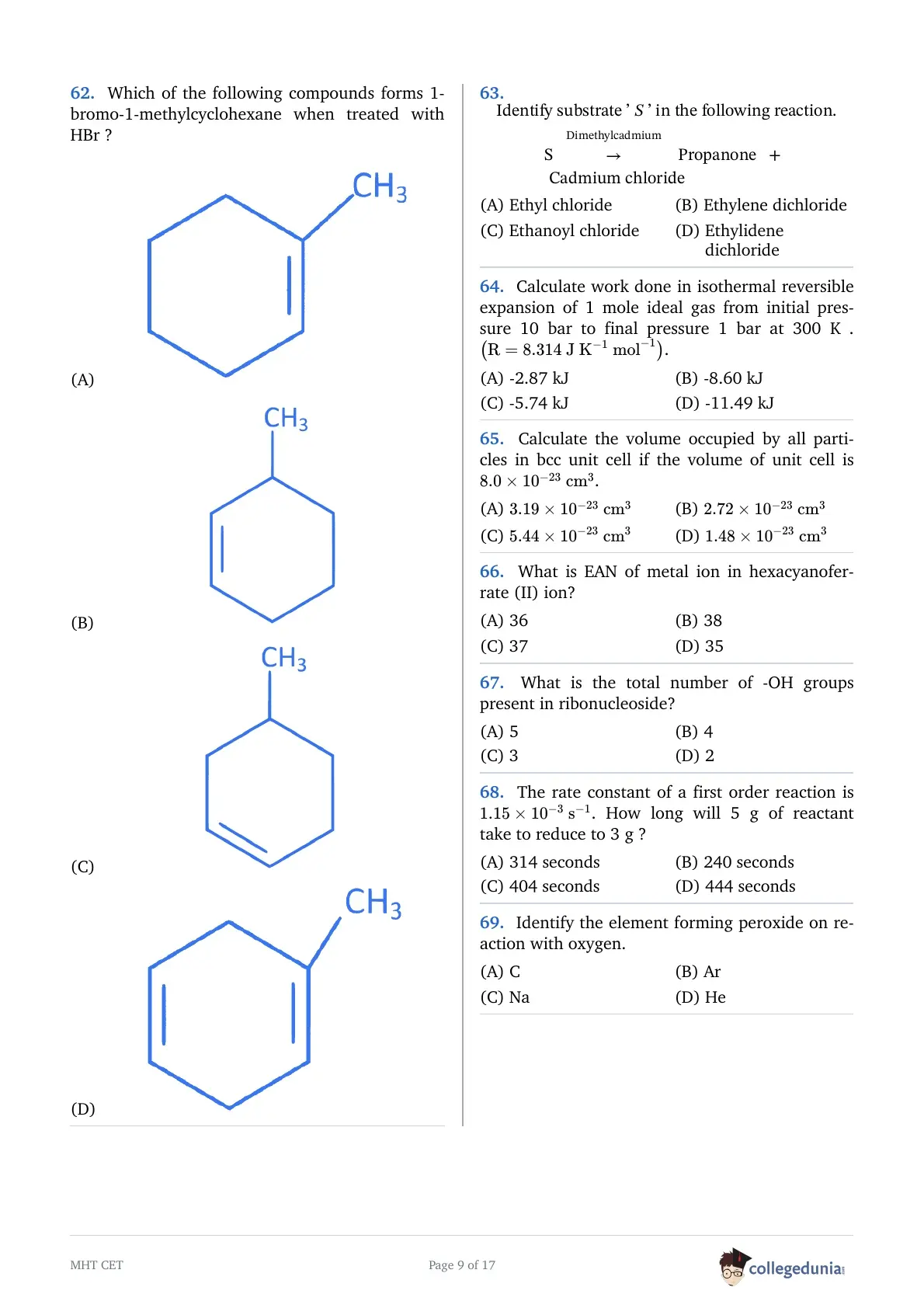
Question 62:

Which of the following compounds forms 1-bromo-1-methylcyclohexane when treated with HBr ?

  • (A)
  • (B)
  • (C)
  • (D)

Question 63:

\[ \text { Identify substrate ' } S \text { ' in the following reaction. } \]

\[ \mathrm{S} \xrightarrow{\text { Dimethylcadmium }} \text { Propanone }+ \text { Cadmium chloride } \]

  • (A) Ethyl chloride
  • (B) Ethylene dichloride
  • (C) Ethanoyl chloride
  • (D) Ethylidene dichloride

Question 64:

Calculate work done in isothermal reversible expansion of 1 mole ideal gas from initial pressure 10 bar to final pressure 1 bar at 300 K . \(\left(\mathrm{R}=8.314 \mathrm{~J} \mathrm{~K}^{-1} \mathrm{~mol}^{-1}\right)\).

  • (A) -2.87 kJ
  • (B) -8.60 kJ
  • (C) -5.74 kJ
  • (D) -11.49 kJ

Question 65:

Calculate the volume occupied by all particles in bcc unit cell if the volume of unit cell is \(8.0 \times 10^{-23} \mathrm{~cm}^3\).

  • (A) \(3.19\times 10^{-23}\text{ }\mathrm{cm}^{3}\)
  • (B) \(2.72\times 10^{-23}\text{ }\mathrm{cm}^{3}\)
  • (C) \(5.44\times 10^{-23}\text{ }\mathrm{cm}^{3}\)
  • (D) \(1.48\times 10^{-23}\text{ }\mathrm{cm}^{3}\)

Question 66:

What is EAN of metal ion in hexacyanoferrate (II) ion?

  • (A) 36
  • (B) 38
  • (C) 37
  • (D) 35

Question 67:

What is the total number of -OH groups present in ribonucleoside?

  • (A) 5
  • (B) 4
  • (C) 3
  • (D) 2

Question 68:

The rate constant of a first order reaction is \(1.15 \times 10^{-3} \mathrm{~s}^{-1}\). How long will 5 g of reactant take to reduce to 3 g ?

  • (A) 314 seconds
  • (B) 240 seconds
  • (C) 404 seconds
  • (D) 444 seconds

Question 69:

Identify the element forming peroxide on reaction with oxygen.

  • (A) C
  • (B) Ar
  • (C) Na
  • (D) He

Question 70:

Consider galvanic cell, \({ }^{\ominus} \mathrm{A}_{(\mathrm{s})}\left|\mathrm{A}_{(\mathrm{aq})}^{+2}\right|\left|\mathrm{B}_{(\mathrm{aq})}^{+}\right| \mathrm{B}_{(\mathrm{s})}^{\oplus}\)

if emf of cell is positive, identify a correct cell reaction from following.

  • (A) \(\mathrm{A}_{(\mathrm{s})}+\mathrm{B}_{(\mathrm{aq})}^{+2}\longrightarrow \text{ }\mathrm{A}_{(\mathrm{aq})}^{+2}+\mathrm{B}_{(\mathrm{s})}\)
  • (B) \(\mathrm{A}_{(\mathrm{s})}+2\text{ }\mathrm{B}_{(\mathrm{aq})}^{+}\longrightarrow \mathrm{A}_{(\mathrm{aq})}^{+2}+2\text{ }\mathrm{B}_{(\mathrm{s})}\)
  • (C)

    \(2\text{ }\mathrm{A}_{(\mathrm{aq})}^{+2}+\mathrm{B}_{(\mathrm{s})}\longrightarrow 2\text{ }\mathrm{A}_{(\mathrm{s})}+\mathrm{B}_{(\mathrm{aq})}^{+}\)

  • (D)

    \(2\text{ }\mathrm{A}_{(\mathrm{s})}+\mathrm{B}_{(\mathrm{aq})}^{+}\longrightarrow 2\text{ }\mathrm{A}_{(\mathrm{aq})}^{+2}+\mathrm{B}_{(\mathrm{s})}\)


Question 71:

Solubility of binary sparingly soluble salt is \(1.12 \times 10^{-4} \mathrm{~g} / \mathrm{dm}^3\). Calculate its solubility product (molar mass of salt \(=112 \mathrm{~g} \mathrm{~mol}^{-1}\) )

  • (A) \(1\times 10^{-3}\)
  • (B) \(1\times 10^{-6}\)
  • (C) \(1\times 10^{-9}\)
  • (D) \(1\times 10^{-12}\)

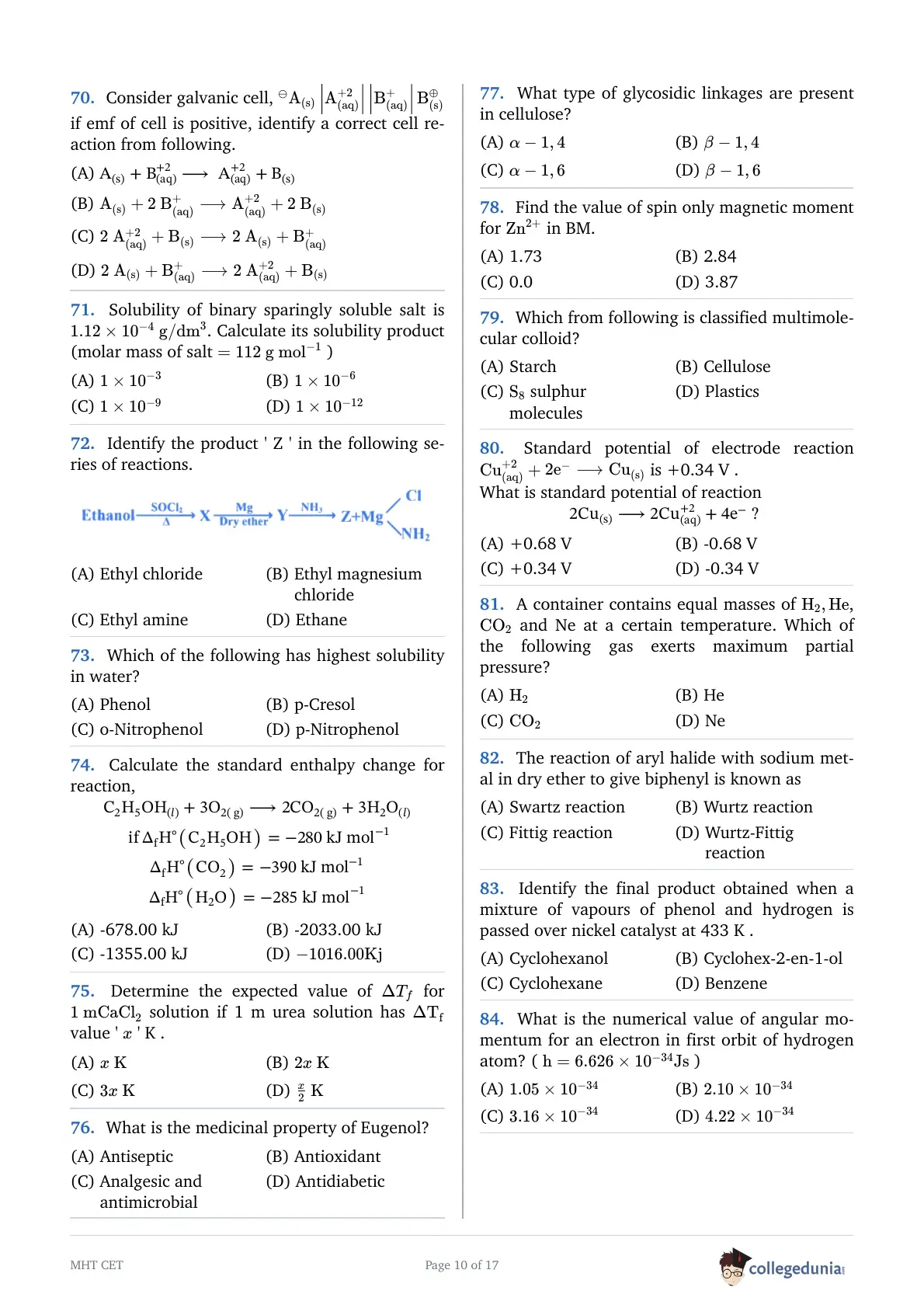
Question 72:

Identify the product ' Z ' in the following series of reactions.

  • (A) Ethyl chloride
  • (B) Ethyl magnesium chloride
  • (C) Ethyl amine
  • (D) Ethane

Question 73:

Which of the following has highest solubility in water?

  • (A) Phenol
  • (B) p-Cresol
  • (C) o-Nitrophenol
  • (D) p-Nitrophenol

Question 74:

Calculate the standard enthalpy change for reaction,

\[ \begin{aligned} & \mathrm{C}_2 \mathrm{H}_5 \mathrm{OH}_{(l)}+3 \mathrm{O}_{2(\mathrm{~g})} \longrightarrow 2 \mathrm{CO}_{2(\mathrm{~g})}+3 \mathrm{H}_2 \mathrm{O}_{(l)} \\ & \text { if } \Delta_{\mathrm{f}} \mathrm{H}^{\circ}\left(\mathrm{C}_2 \mathrm{H}_5 \mathrm{OH}\right)=-280 \mathrm{~kJ} \mathrm{~mol}^{-1} \\ & \Delta_{\mathrm{f}} \mathrm{H}^{\circ}\left(\mathrm{CO}_2\right)=-390 \mathrm{~kJ} \mathrm{~mol}^{-1} \\ & \Delta_{\mathrm{f}} \mathrm{H}^{\circ}\left(\mathrm{H}_2 \mathrm{O}\right)=-285 \mathrm{~kJ} \mathrm{~mol}^{-1} \end{aligned} \]

  • (A) -678.00 kJ
  • (B) -2033.00 kJ
  • (C) -1355.00 kJ
  • (D) \(-1016.00\mathrm{Kj}\)

Question 75:

Determine the expected value of \(\Delta T_f\) for \(1 \mathrm{~m} \mathrm{CaCl}_2\) solution if 1 m urea solution has \(\Delta \mathrm{T}_{\mathrm{f}}\) value ' \(x\) ' K .

  • (A) \(x\text{ }\mathrm{K}\)
  • (B) \(2x\text{ }\mathrm{K}\)
  • (C) \(3x\text{ }\mathrm{K}\)
  • (D) \(\frac{x}{2}\text{ }\mathrm{K}\)

Question 76:

What is the medicinal property of Eugenol?

  • (A) Antiseptic
  • (B) Antioxidant
  • (C) Analgesic and antimicrobial
  • (D) Antidiabetic

Question 77:

What type of glycosidic linkages are present in cellulose?

  • (A) \(\alpha -1,4\)
  • (B) \(\beta -1,4\)
  • (C) \(\alpha -1,6\)
  • (D) \(\beta -1,6\)

Question 78:

Find the value of spin only magnetic moment for \(\mathrm{Zn}^{2+}\) in BM.

  • (A) 1.73
  • (B) 2.84
  • (C) 0.0
  • (D) 3.87

Question 79:

Which from following is classified multimolecular colloid?

  • (A) Starch
  • (B) Cellulose
  • (C) \(\mathrm{S}_{8}\) sulphur molecules
  • (D) Plastics

Question 80:

Standard potential of electrode reaction \(\mathrm{Cu}_{(\mathrm{aq})}^{+2}+2 \mathrm{e}^{-} \longrightarrow \mathrm{Cu}_{(\mathrm{s})}\) is +0.34 V .

What is standard potential of reaction

\[ 2 \mathrm{Cu}_{(\mathrm{s})} \longrightarrow 2 \mathrm{Cu}_{(\mathrm{aq})}^{+2}+4 \mathrm{e}^{-} ? \]

  • (A) +0.68 V
  • (B) -0.68 V
  • (C) +0.34 V
  • (D) -0.34 V

Question 81:

A container contains equal masses of \(\mathrm{H}_2, \mathrm{He}\), \(\mathrm{CO}_2\) and Ne at a certain temperature. Which of the following gas exerts maximum partial pressure?

  • (A) \(\mathrm{H}_{2}\)
  • (B) He
  • (C) \(\mathrm{CO}_{2}\)
  • (D) Ne

Question 82:

The reaction of aryl halide with sodium metal in dry ether to give biphenyl is known as

  • (A) Swartz reaction
  • (B) Wurtz reaction
  • (C) Fittig reaction
  • (D) Wurtz-Fittig reaction

Question 83:

Identify the final product obtained when a mixture of vapours of phenol and hydrogen is passed over nickel catalyst at 433 K .

  • (A) Cyclohexanol
  • (B) Cyclohex-2-en-1-ol
  • (C) Cyclohexane
  • (D) Benzene

Question 84:

What is the numerical value of angular momentum for an electron in first orbit of hydrogen atom? ( \(\mathrm{h}=6.626 \times 10^{-34} \mathrm{Js}\) )

  • (A) \(1.05\times 10^{-34}\)
  • (B) \(2.10\times 10^{-34}\)
  • (C) \(3.16\times 10^{-34}\)
  • (D) \(4.22\times 10^{-34}\)

Question 85:

Calculate van't Hoff factor of aqueous solution of 0.18 m electrolyte that freezes at \(-0.54^{\circ} \mathrm{C}\).

\(\left(\mathrm{K}_{\mathrm{f}}\right.\) for solvent \(\left.=1.86 \mathrm{~K} \mathrm{~kg} \mathrm{~mol}^{-1}\right)\)

  • (A) 1.126
  • (B) 2.449
  • (C) 1.612
  • (D) 2.150

Question 86:

What is the molar mass of third homologue of alkane series?

  • (A) \(40\text{ }\mathrm{g}\text{ }\mathrm{mol}^{-1}\)
  • (B) \(58\text{ }\mathrm{g}\text{ }\mathrm{mol}^{-1}\)
  • (C) \(44\text{ }\mathrm{g}\text{ }\mathrm{mol}^{-1}\)
  • (D) \(46\text{ }\mathrm{g}\text{ }\mathrm{mol}^{-1}\)

Question 87:

Which from following polymers is used to obtain oil seals?

  • (A) Teflon
  • (B) Dacron
  • (C) Nylon 6
  • (D) LDP

Question 88:

Which element from following has largest ionic size in +3 state?

  • (A) Pr
  • (B) Sm
  • (C) La
  • (D) Yb

Question 89:

Identify the principle suggesting to avoid protection and deprotection of selective group for organic reactions in green chemistry.

  • (A) Reduce derivatives
  • (B) Use of renewable feedstock
  • (C) Design for energy efficiency
  • (D) Designing safer chemicals

Question 90:

What is value of \(E_{\text {cell }}\) at 298 K for the reaction, \(\mathrm{Zn}_{(\mathrm{s})}+\mathrm{Cu}^{+2}(0.1 \mathrm{M}) \longrightarrow \mathrm{Zn}^{+2}(0.1 \mathrm{M})+\mathrm{Cu}_{(\mathrm{s})}\) if \(\mathrm{E}_{\text {cell }}^{\circ}=1.1 \mathrm{~V}\) ?

  • (A) 1.1 V
  • (B) 0.11 V
  • (C) 1.0408 V
  • (D) 0.0296 V

Question 91:

Which of the following compounds has high lattice enthalpy?

  • (A) LiCl
  • (B) NaCl
  • (C) \(\mathrm{BeF}_{2}\)
  • (D) \(\mathrm{CaCl}_{2}\)

Question 92:

Which among the following is a pair of functional isomers?

  • (A) Butan-2-ol and 2-Methylpropanol
  • (B) Butan-1-ol and 1-Methoxypropane
  • (C) 1-Methoxypropane and Ethoxyethane
  • (D) 2-Methoxypropane and 1-Methoxypropane

Question 93:

Which among the following compounds has highest boiling point?

  • (A) Propanal
  • (B) Ethanal
  • (C) Pentanal
  • (D) Hexanal

Question 94:

Calculate the molality of solution of nonvolatile solute if boiling point elevation is 1.75 K .

[ \(\mathrm{K}_{\mathrm{b}}\) for solvent \(=3 \mathrm{~K} \mathrm{~kg} \mathrm{~mol}^{-1}\) ]

  • (A) 0.480 m
  • (B) 0.33 m
  • (C) 0.58 m
  • (D) 0.63 m

Question 95:

Which from following pair of compounds exhibits isomorphism?

  • (A) Calcite and aragonite
  • (B) \(\alpha\)-quartz and cristobalite
  • (C) Sodium nitrate and calcium carbonate
  • (D) Diamond and fullerene

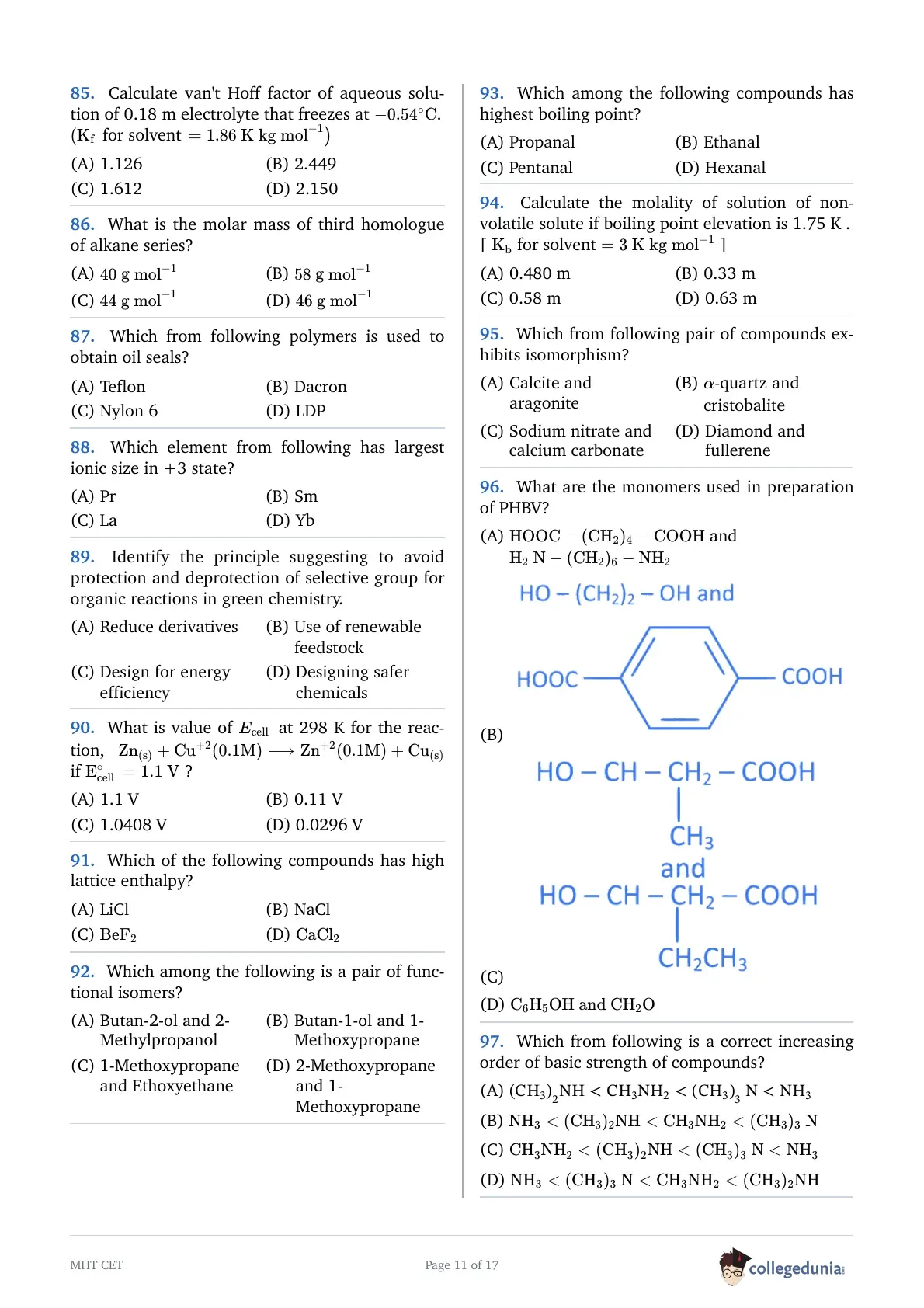
Question 96:

What are the monomers used in preparation of PHBV?

  • (A)

    \(\mathrm{HOOC}-(\mathrm{CH}_{2})_{4}-\mathrm{COOH}\) and \(\mathrm{H}_{2}\text{ }\mathrm{N}-(\mathrm{CH}_{2})_{6}-\mathrm{NH}_{2}\)

  • (B)
  • (C)
  • (D)

    \(\mathrm{C}_{6}\mathrm{H}_{5}\mathrm{OH}\text{ and }\mathrm{CH}_{2}\mathrm{O}\)


Question 97:

Which from following is a correct increasing order of basic strength of compounds?

  • (A)

    \((\mathrm{CH}_{3})_{2}\mathrm{NH}<\mathrm{CH}_{3}\mathrm{NH}_{2}<(\mathrm{CH}_{3})_{3}\text{ }\mathrm{N}<\mathrm{NH}_{3}\)

  • (B)

    \(\mathrm{NH}_{3}<(\mathrm{CH}_{3})_{2}\mathrm{NH}<\mathrm{CH}_{3}\mathrm{NH}_{2}<(\mathrm{CH}_{3})_{3}\text{ }\mathrm{N}\)

  • (C)

    \(\mathrm{CH}_{3}\mathrm{NH}_{2}<(\mathrm{CH}_{3})_{2}\mathrm{NH}<(\mathrm{CH}_{3})_{3}\text{ }\mathrm{N}<\mathrm{NH}_{3}\)

  • (D)

    \(\mathrm{NH}_{3}<(\mathrm{CH}_{3})_{3}\text{ }\mathrm{N}<\mathrm{CH}_{3}\mathrm{NH}_{2}<(\mathrm{CH}_{3})_{2}\mathrm{NH}\)


Question 98:

Which of the following is an example of first order reaction?

  • (A)

    \(\mathrm{CH}_{3}\mathrm{CHO}_{(\mathrm{g})}\longrightarrow \mathrm{CH}_{4(\text{ }\mathrm{g})}+\mathrm{CO}_{(\mathrm{g})}\)

  • (B)

    \(2\mathrm{NO}_{2(\text{ }\mathrm{g})}+\mathrm{F}_{2(\text{ }\mathrm{g})}\longrightarrow 2\mathrm{NO}_{2}\text{ }\mathrm{F}_{(\mathrm{g})}\)

  • (C)

    \(2\mathrm{NO}_{(\mathrm{g})}+2\mathrm{H}_{2(\text{ }\mathrm{g})}\longrightarrow \mathrm{N}_{2(\text{ }\mathrm{g})}+2\mathrm{H}_{2}\mathrm{O}_{(\mathrm{g})}\)

  • (D)

    \(2\mathrm{H}_{2}\mathrm{O}_{2(l)}\longrightarrow 2\mathrm{H}_{2}\mathrm{O}_{(l)}+\mathrm{O}_{2(\text{ }\mathrm{g})}\)


Question 99:

What is the number of moles present in \(1 \mathrm{~m}^3\) of any gas at STP?

  • (A) 32.4
  • (B) 54.6
  • (C) 44.6
  • (D) 28.2

Question 100:

Identify from following compounds where valence shell of 'Xe' consists one lone pair of electrons.

  • (A) \(\mathrm{XeF}_{2}\)
  • (B) \(\mathrm{XeF}_{4}\)
  • (C) \(\mathrm{XeOF}_{2}\)
  • (D) \(\mathrm{XeOF}_{4}\)

Mathematics (Q101 - Q150)

Question 101:

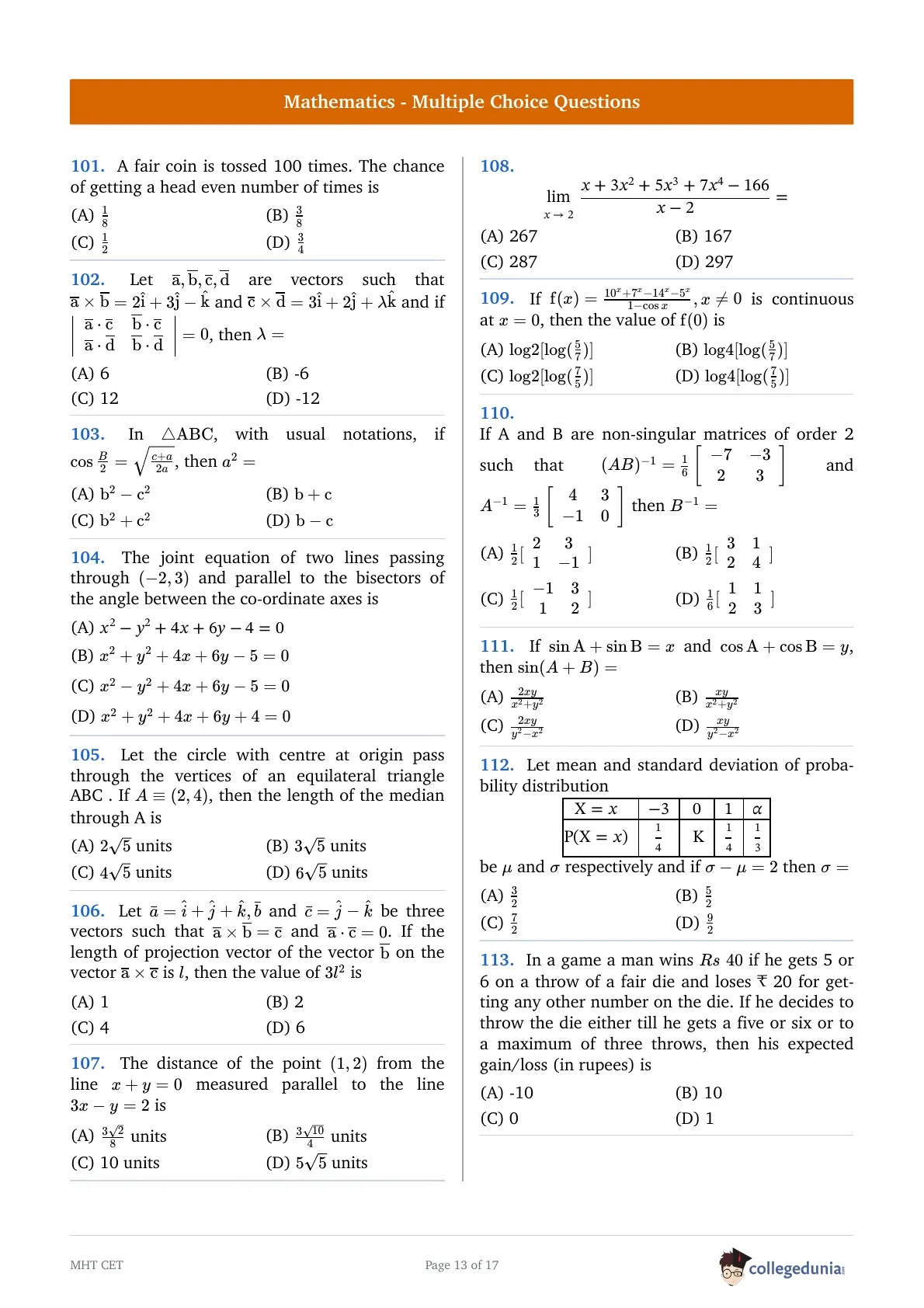
A fair coin is tossed 100 times. The chance of getting a head even number of times is

  • (A) \(\frac{1}{8}\)
  • (B) \(\frac{3}{8}\)
  • (C) \(\frac{1}{2}\)
  • (D) \(\frac{3}{4}\)

Question 102:

Let \(\overline{\mathrm{a}}, \overline{\mathrm{b}}, \overline{\mathrm{c}}, \overline{\mathrm{d}}\) are vectors such that \(\overline{\mathrm{a}} \times \overline{\mathrm{b}}=2 \hat{\mathrm{i}}+3 \hat{\mathrm{j}}-\hat{\mathrm{k}}\) and \(\overline{\mathrm{c}} \times \overline{\mathrm{d}}=3 \hat{\mathrm{i}}+2 \hat{\mathrm{j}}+\lambda \hat{\mathrm{k}}\) and if \(\left|\begin{array}{ll}\overline{\mathrm{a}} \cdot \overline{\mathrm{c}} & \overline{\mathrm{b}} \cdot \overline{\mathrm{c}} \\ \overline{\mathrm{a}} \cdot \overline{\mathrm{d}} & \overline{\mathrm{b}} \cdot \overline{\mathrm{d}}\end{array}\right|=0\), then \(\lambda=\)

  • (A) 6
  • (B) -6
  • (C) 12
  • (D) -12

Question 103:

In \(\triangle \mathrm{ABC}\), with usual notations, if \(\cos \frac{B}{2}=\sqrt{\frac{c+a}{2 a}}\), then \(a^2=\)

  • (A) \(\mathrm{b}^{2}-\mathrm{c}^{2}\)
  • (B) \(\mathrm{b}+\mathrm{c}\)
  • (C) \(\mathrm{b}^{2}+\mathrm{c}^{2}\)
  • (D) \(\mathrm{b}-\mathrm{c}\)

Question 104:

The joint equation of two lines passing through \((-2,3)\) and parallel to the bisectors of the angle between the co-ordinate axes is

  • (A) \(x^{2}-y^{2}+4x+6y-4=0\)
  • (B) \(x^{2}+y^{2}+4x+6y-5=0\)
  • (C) \(x^{2}-y^{2}+4x+6y-5=0\)
  • (D) \(x^{2}+y^{2}+4x+6y+4=0\)

Question 105:

Let the circle with centre at origin pass through the vertices of an equilateral triangle ABC . If \(A \equiv(2,4)\), then the length of the median through A is

  • (A) \(2\sqrt{5}\) units
  • (B) \(3\sqrt{5}\) units
  • (C) \(4\sqrt{5}\) units
  • (D) \(6\sqrt{5}\) units

Question 106:

Let \(\bar{a}=\hat{i}+\hat{j}+\hat{k}, \bar{b}\) and \(\bar{c}=\hat{j}-\hat{k}\) be three vectors such that \(\overline{\mathrm{a}} \times \overline{\mathrm{b}}=\overline{\mathrm{c}}\) and \(\overline{\mathrm{a}} \cdot \overline{\mathrm{c}}=0\). If the length of projection vector of the vector \(\overline{\mathrm{b}}\) on the vector \(\overline{\mathrm{a}} \times \overline{\mathrm{c}}\) is \(l\), then the value of \(3 l^2\) is

  • (A) 1
  • (B) 2
  • (C) 4
  • (D) 6

Question 107:

The distance of the point \((1,2)\) from the line \(x+y=0\) measured parallel to the line \(3 x-y=2\) is

  • (A) \(\frac{3\sqrt{2}}{8}\) units
  • (B) \(\frac{3\sqrt{10}}{4}\) units
  • (C) 10 units
  • (D) \(5\sqrt{5}\) units

Question 108:

\[ \mathop {\lim }\limits_{x \to 2} \frac{x+3 x^2+5 x^3+7 x^4-166}{x-2}= \]

  • (A) 267
  • (B) 167
  • (C) 287
  • (D) 297

Question 109:

If \(\mathrm{f}(x)=\frac{10^x+7^x-14^x-5^x}{1-\cos x}, x \neq 0\) is continuous at \(x=0\), then the value of \(\mathrm{f}(0)\) is

  • (A) \(\mathrm{log}2[\mathrm{log}(\frac{5}{7})]\)
  • (B) \(\mathrm{log}4[\mathrm{log}(\frac{5}{7})]\)
  • (C) \(\mathrm{log}2[\mathrm{log}(\frac{7}{5})]\)
  • (D) \(\mathrm{log}4[\mathrm{log}(\frac{7}{5})]\)

Question 110:

If A and B are non-singular matrices of order 2 such that \(\quad(A B)^{-1}=\frac{1}{6}\left[\begin{array}{cc}-7 & -3 \\ 2 & 3\end{array}\right] \quad\) and \(A^{-1}=\frac{1}{3}\left[\begin{array}{cc}4 & 3 \\ -1 & 0\end{array}\right]\) then \(B^{-1}=\)

  • (A) \(\frac{1}{2}[\begin{array}{cc} 2 & 3 \\ 1 & -1 \end{array}]\)
  • (B) \(\frac{1}{2}[\begin{array}{cc} 3 & 1 \\ 2 & 4 \end{array}]\)
  • (C) \(\frac{1}{2}[\begin{array}{cc} -1 & 3 \\ 1 & 2 \end{array}]\)
  • (D) \(\frac{1}{6}[\begin{array}{cc} 1 & 1 \\ 2 & 3 \end{array}]\)

Question 111:

If \(\sin \mathrm{A}+\sin \mathrm{B}=x\) and \(\cos \mathrm{A}+\cos \mathrm{B}=y\), then \(\sin (A+B)=\)

  • (A) \(\frac{2xy}{x^{2}+y^{2}}\)
  • (B) \(\frac{xy}{x^{2}+y^{2}}\)
  • (C) \(\frac{2xy}{y^{2}-x^{2}}\)
  • (D) \(\frac{xy}{y^{2}-x^{2}}\)

Question 112:

Let mean and standard deviation of probability distribution

\[ \begin{array}{|c|c|c|c|c|} \hline \mathrm{X}=x & -3 & 0 & 1 & \alpha \\ \hline \mathrm{P}(\mathrm{X}=x) & \frac{1}{4} & \mathrm{~K} & \frac{1}{4} & \frac{1}{3} \\ \hline \end{array} \]

be \(\mu\) and \(\sigma\) respectively and if \(\sigma-\mu=2\) then \(\sigma=\)

  • (A) \(\frac{3}{2}\)
  • (B) \(\frac{5}{2}\)
  • (C) \(\frac{7}{2}\)
  • (D)

    \(\frac{9}{2}\)


Question 113:

In a game a man wins \(Rs \,\, 40\) if he gets 5 or 6 on a throw of a fair die and loses ₹ 20 for getting any other number on the die. If he decides to throw the die either till he gets a five or six or to a maximum of three throws, then his expected gain/loss (in rupees) is

  • (A) -10
  • (B) 10
  • (C) 0
  • (D) 1

Question 114:

The rate at which a substance cools in moving air, is proportional to the difference between the temperature of the substance and that of air. The temperature of air is 290 K and the substance cools from 370 K to 330 K in 10 minutes. Then the time to cool the substance upto 295 K is

  • (A) 40 min
  • (B) 96 min
  • (C) 50 min
  • (D) 60 min

Question 115:

If \(x \frac{\mathrm{~d} y}{\mathrm{~d} x}=y(\log y-\log x+1)\), then the solution of the equation is

  • (A) \(\mathrm{log}\frac{x}{y}=\mathrm{c}y\), where c is the constant of integration
  • (B) \(\mathrm{log}\frac{y}{x}=\mathrm{c}y\), where c is the constant of integration
  • (C) \(\mathrm{log}\frac{x}{y}=\mathrm{c}x\), where c is the constant of integration
  • (D) \(\mathrm{log}\frac{y}{x}=\mathrm{cx}\), where c is the constant of integration

Question 116:

The order and degree of the differential equation \(\sqrt{\frac{\mathrm{d} y}{\mathrm{~d} x}}-4 \frac{\mathrm{~d} y}{\mathrm{~d} x}-7 x=0\) is respectively

  • (A) 1,2
  • (B) 2,1
  • (C) 2,2
  • (D) 3,1

Question 117:

The differential equation of all circles touching the Y -axis at the origin and centre on the X -axis is

  • (A) \(x^{2}+y^{2}+2xy\frac{\text{ }\mathrm{d}y}{\text{ }\mathrm{d}x}=0\)
  • (B) \(x^{2}-y^{2}+2xy\frac{\text{ }\mathrm{d}y}{\text{ }\mathrm{d}x}=0\)
  • (C) \(2x^{2}+y^{2}+xy\frac{\text{ }\mathrm{d}y}{\text{ }\mathrm{d}x}=0\)
  • (D) \(x^{2}-2y^{2}+2xy\frac{\text{ }\mathrm{d}y}{\text{ }\mathrm{d}x}=0\)

Question 118:

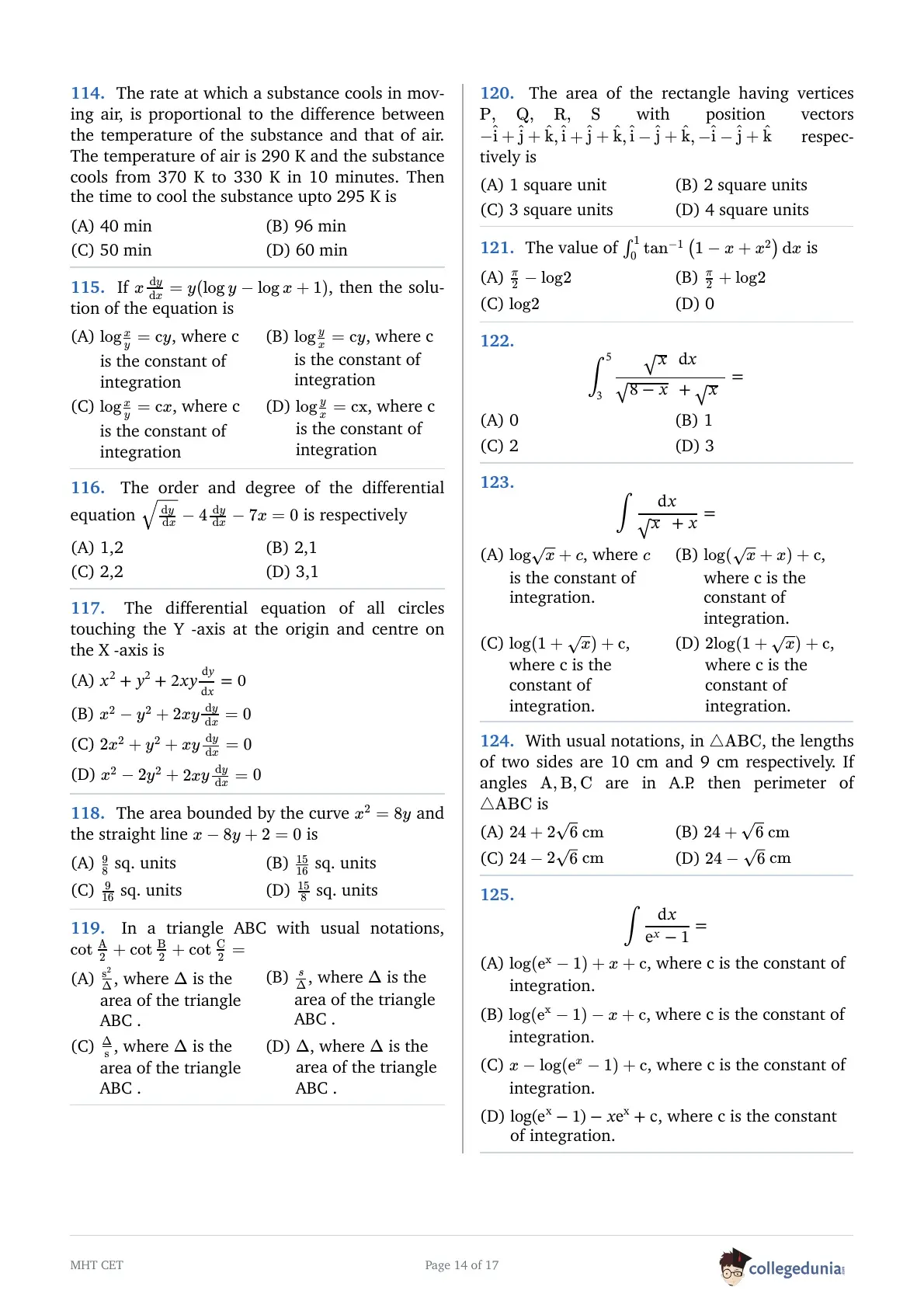
The area bounded by the curve \(x^2=8 y\) and the straight line \(x-8 y+2=0\) is

  • (A) \(\frac{9}{8}\) sq. units
  • (B) \(\frac{15}{16}\) sq. units
  • (C) \(\frac{9}{16}\) sq. units
  • (D) \(\frac{15}{8}\) sq. units

Question 119:

In a triangle ABC with usual notations, \(\cot \frac{\mathrm{A}}{2}+\cot \frac{\mathrm{B}}{2}+\cot \frac{\mathrm{C}}{2}=\)

  • (A) \(\frac{\mathrm{s}^{2}}{\Delta}\), where \(\Delta\) is the area of the triangle ABC .
  • (B) \(\frac{s}{\Delta}\), where \(\Delta\) is the area of the triangle ABC .
  • (C) \(\frac{\Delta}{\mathrm{s}}\), where \(\Delta\) is the area of the triangle ABC .
  • (D) \(\Delta\), where \(\Delta\) is the area of the triangle ABC .

Question 120:

The area of the rectangle having vertices \(\mathrm{P}, \quad \mathrm{Q}, \quad \mathrm{R}, \quad \mathrm{S}\) with position vectors \(-\hat{\mathrm{i}}+\hat{\mathrm{j}}+\hat{\mathrm{k}}, \hat{\mathrm{i}}+\hat{\mathrm{j}}+\hat{\mathrm{k}}, \hat{\mathrm{i}}-\hat{\mathrm{j}}+\hat{\mathrm{k}},-\hat{\mathrm{i}}-\hat{\mathrm{j}}+\hat{\mathrm{k}}\) respectively is

  • (A) 1 square unit
  • (B) 2 square units
  • (C) 3 square units
  • (D) 4 square units

Question 121:

The value of \(\int_0^1 \tan ^{-1}\left(1-x+x^2\right) \mathrm{d} x\) is

  • (A) \(\frac{\pi}{2}-\mathrm{log}2\)
  • (B) \(\frac{\pi}{2}+\mathrm{log}2\)
  • (C) \(\mathrm{log}2\)
  • (D) 0

Question 122:

\[ \int_3^5 \frac{\sqrt{x} \mathrm{~d} x}{\sqrt{8-x}+\sqrt{x}}= \]

  • (A) 0
  • (B) 1
  • (C) 2
  • (D) 3

Question 123:

\[ \int \frac{\mathrm{d} x}{\sqrt{x}+x}= \]

  • (A) \(\mathrm{log}\sqrt{x}+c\), where \(c\) is the constant of integration.
  • (B) \(\mathrm{log}(\sqrt{x}+x)+\mathrm{c}\), where c is the constant of integration.
  • (C) \(\mathrm{log}(1+\sqrt{x})+\mathrm{c}\), where c is the constant of integration.
  • (D) \(2\mathrm{log}(1+\sqrt{x})+\mathrm{c}\), where c is the constant of integration.

Question 125:

\[ \int \frac{\mathrm{d} x}{\mathrm{e}^x-1}= \]

  • (A) \(\mathrm{log}(\mathrm{e}^{\mathrm{x}}-1)+x+\mathrm{c}\), where c is the constant of integration.
  • (B) \(\mathrm{log}(\mathrm{e}^{\mathrm{x}}-1)-x+\mathrm{c}\), where c is the constant of integration.
  • (C) \(x-\mathrm{log}(\mathrm{e}^{x}-1)+\mathrm{c}\), where c is the constant of integration.
  • (D) \(\mathrm{log}(\mathrm{e}^{\mathrm{x}}-1)-x\mathrm{e}^{\mathrm{x}}+\mathrm{c}\), where c is the constant of integration.

Question 126:

The maximum value of \(x^{2 / 3}+(x-2)^{2 / 3}\) is

  • (A) 0
  • (B) 2
  • (C) \(2^{\frac{2}{3}}\)
  • (D) 1

Question 127:

\[ \int\left(\frac{x-3}{x^2+9}\right)^2 d x= \]

  • (A) \(\frac{1}{3}\mathrm{tan}^{-1}(\frac{x}{3})-\frac{3}{x^{2}+9}+\mathrm{c}\), where c is the constant of integration.
  • (B) \(\frac{1}{3}\mathrm{tan}^{-1}(\frac{x}{3})-\frac{1}{x^{2}+9}+c\), where \(c\) is the constant of integration.
  • (C) \(\frac{1}{3}\mathrm{tan}^{-1}(\frac{x}{3})+\frac{3}{x^{2}+9}+c\), where \(c\) is the constant of integration.
  • (D) \(\frac{1}{3}\mathrm{tan}^{-1}(\frac{x}{3})+\frac{1}{x^{2}+9}+c\), where \(c\) is the constant of integration.

Question 128:

The point on the curve \(4 y^2-4 y+2 x-1=0\) at which the tangent becomes parallel to Y -axis is

  • (A) \((1,\frac{1}{2})\)
  • (B) \((\frac{1}{2},1)\)
  • (C) \((-1,-\frac{1}{2})\)
  • (D) \((\frac{1}{2},0)\)

Question 129:

The value of \(\tan ^2\left(\sec ^{-1} 4\right)+\cot ^2\left(\operatorname{cosec}^{-1} 3\right)\) is

  • (A) 15
  • (B) 25
  • (C) 23
  • (D) 7

Question 130:

In a triangle ABC , with usual notations, if \(\mathrm{a}=5, \mathrm{~b}=4, \cos (\mathrm{~A}-\mathrm{B})=\frac{31}{32}\), then \(\mathrm{c}=\)

  • (A) 6
  • (B) 7
  • (C) 5
  • (D) 2

Question 131:

Which of the following is the negation of the statement " For all M>0, there exist \(x \in \mathrm{~s}\) such that \(x \geqslant \mathrm{M}^{\prime \prime}\)

  • (A) \(\exists \mathrm{M}>0\) such that \(x\geq \mathrm{M}\) for all \(x\in \text{ }\mathrm{s}\)
  • (B) \(\exists \mathrm{M}>0,\exists x\in \text{ }\mathrm{s}\) such that \(x\geq \mathrm{M}\)
  • (C) \(\exists \mathrm{M}>0\) such that \(x<\mathrm{M}\) for all \(x\in \text{ }\mathrm{s}\)
  • (D) \(\exists \mathrm{M}>0\), there exist \(x\in \text{ }\mathrm{s}\) such that \(x<\mathrm{M}\)

Question 132:

The equation of the line passing through the point of intersection of \(\frac{x-1}{2}=\frac{y-2}{3}=\frac{z-3}{4}\) and \(\frac{x-4}{5}=\frac{y-1}{2}=z\) and also through the point ( \(2,1,-2\) ) is

  • (A)

    \(\overset{-}{\mathrm{r}}=(-\hat{\mathrm{i}}-\hat{\mathrm{j}}-\hat{\mathrm{k}})+\lambda (\hat{\mathrm{i}}+2\hat{\mathrm{j}}+\hat{\mathrm{k}})\)

  • (B)

    \(\overset{-}{\mathrm{r}}=(-\hat{\mathrm{i}}-\hat{\mathrm{j}}+\hat{\mathrm{k}})+\lambda (2\hat{\mathrm{i}}+2\hat{\mathrm{j}}+\hat{\mathrm{k}})\)

  • (C)

    \(\frac{x+1}{3}=\frac{y+1}{2}=\frac{z+1}{-1}\)

  • (D)

    \(\frac{x-1}{3}=\frac{y-1}{2}=\frac{z+1}{1}\)


Question 133:

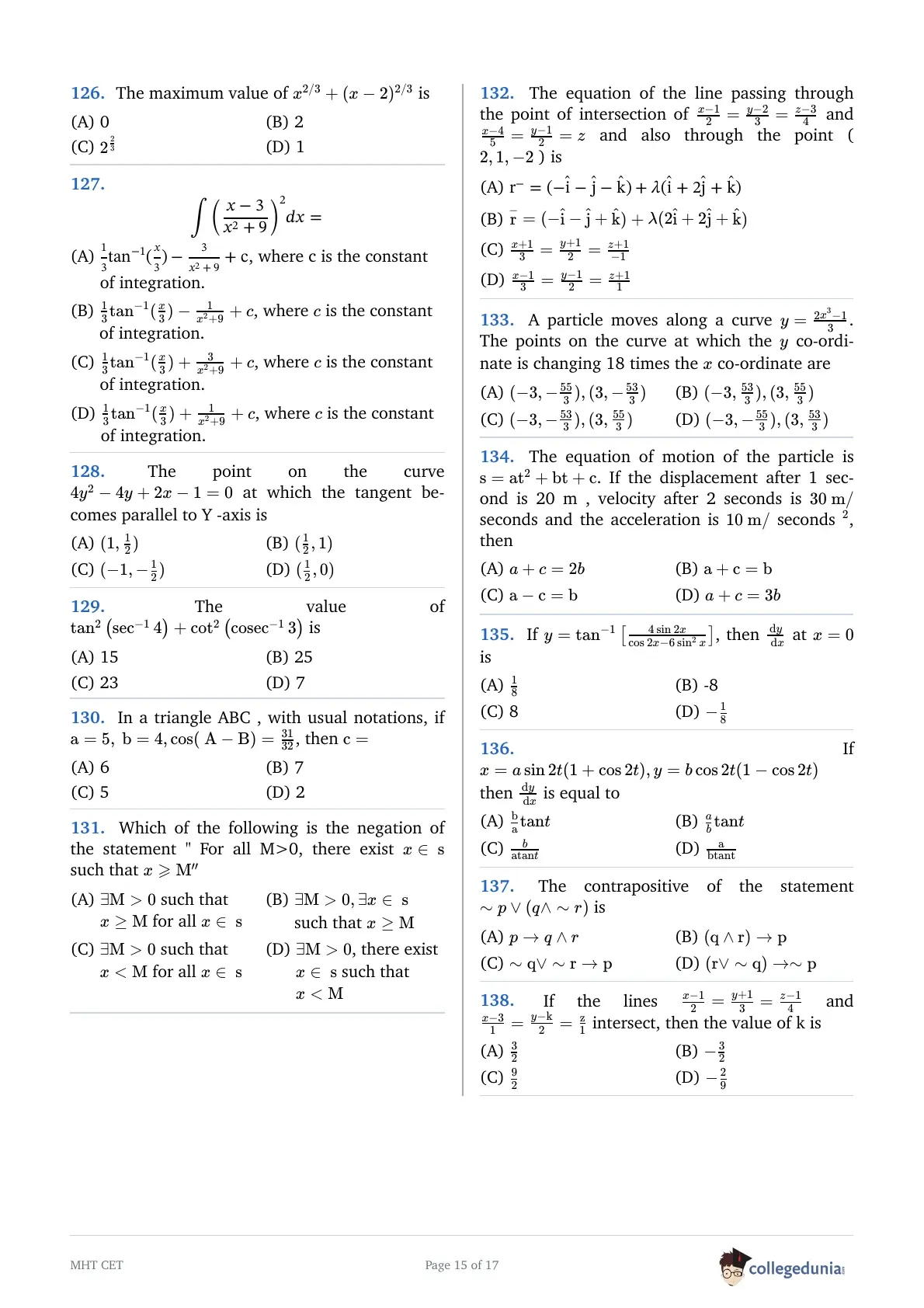
A particle moves along a curve \(y=\frac{2 x^3-1}{3}\). The points on the curve at which the \(y\) co-ordinate is changing 18 times the \(x\) co-ordinate are

  • (A) \((-3,-\frac{55}{3}),(3,-\frac{53}{3})\)
  • (B) \((-3,\frac{53}{3}),(3,\frac{55}{3})\)
  • (C) \((-3,-\frac{53}{3}),(3,\frac{55}{3})\)
  • (D) \((-3,-\frac{55}{3}),(3,\frac{53}{3})\)

Question 134:

The equation of motion of the particle is \(\mathrm{s}=\mathrm{at}^2+\mathrm{bt}+\mathrm{c}\). If the displacement after 1 second is 20 m , velocity after 2 seconds is \(30 \mathrm{~m} /\) seconds and the acceleration is \(10 \mathrm{~m} /\) seconds \(^2\), then

  • (A) \(a+c=2b\)
  • (B) \(\mathrm{a}+\mathrm{c}=\mathrm{b}\)
  • (C) \(\mathrm{a}-\mathrm{c}=\mathrm{b}\)
  • (D) \(a+c=3b\)

Question 135:

If \(y=\tan ^{-1}\left[\frac{4 \sin 2 x}{\cos 2 x-6 \sin ^2 x}\right]\), then \(\frac{\mathrm{d} y}{\mathrm{~d} x}\) at \(x=0\) is

  • (A) \(\frac{1}{8}\)
  • (B) -8
  • (C) 8
  • (D) \(-\frac{1}{8}\)

Question 136:

If \(x=a \sin 2 t(1+\cos 2 t), y=b \cos 2 t(1-\cos 2 t)\) then \(\frac{\mathrm{d} y}{\mathrm{~d} x}\) is equal to

  • (A) \(\frac{\mathrm{b}}{\mathrm{a}}\mathrm{tan}t\)
  • (B) \(\frac{a}{b}\mathrm{tan}t\)
  • (C) \(\frac{b}{\mathrm{atan}t}\)
  • (D) \(\frac{\mathrm{a}}{\mathrm{btant}}\)

Question 137:

The contrapositive of the statement \(\sim p \vee(q \wedge \sim r)\) is

  • (A) \(p\rightarrow q\wedge r\)
  • (B) \((\mathrm{q}\wedge \mathrm{r})\rightarrow \mathrm{p}\)
  • (C) \(\sim \mathrm{q}\vee \sim \mathrm{r}\rightarrow \mathrm{p}\)
  • (D) \((\mathrm{r}\vee \sim \mathrm{q})\rightarrow \sim \mathrm{p}\)

Question 138:

If the lines \(\frac{x-1}{2}=\frac{y+1}{3}=\frac{z-1}{4}\) and \(\frac{x-3}{1}=\frac{y-\mathrm{k}}{2}=\frac{\mathrm{z}}{1}\) intersect, then the value of k is

  • (A) \(\frac{3}{2}\)
  • (B) \(-\frac{3}{2}\)
  • (C) \(\frac{9}{2}\)
  • (D) \(-\frac{2}{9}\)

Question 140:

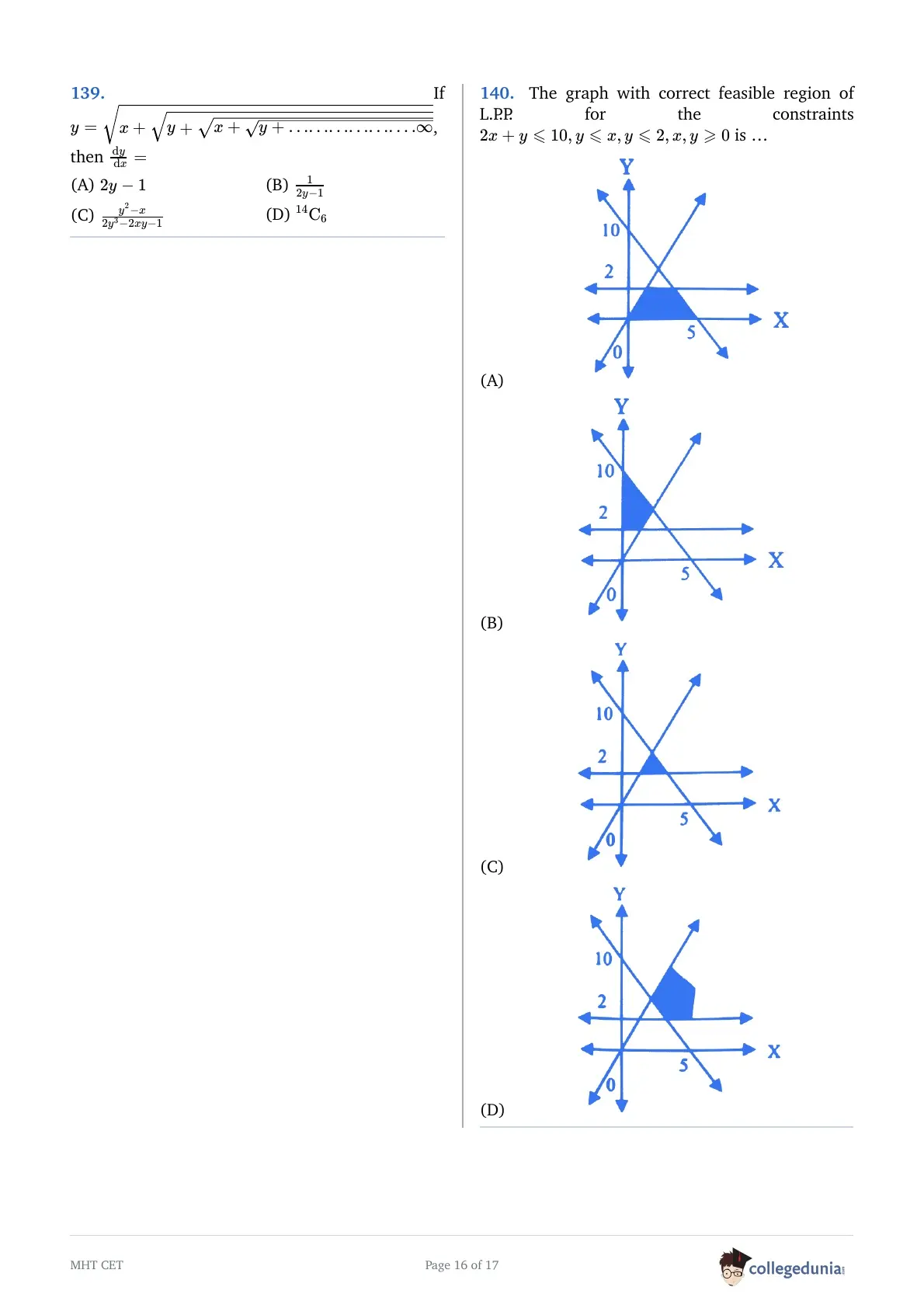
The graph with correct feasible region of L.P.P. for the constraints \(2 x+y \leqslant 10, y \leqslant x, y \leqslant 2, x, y \geqslant 0\) is …

  • (A)
  • (B)
  • (C)
  • (D)

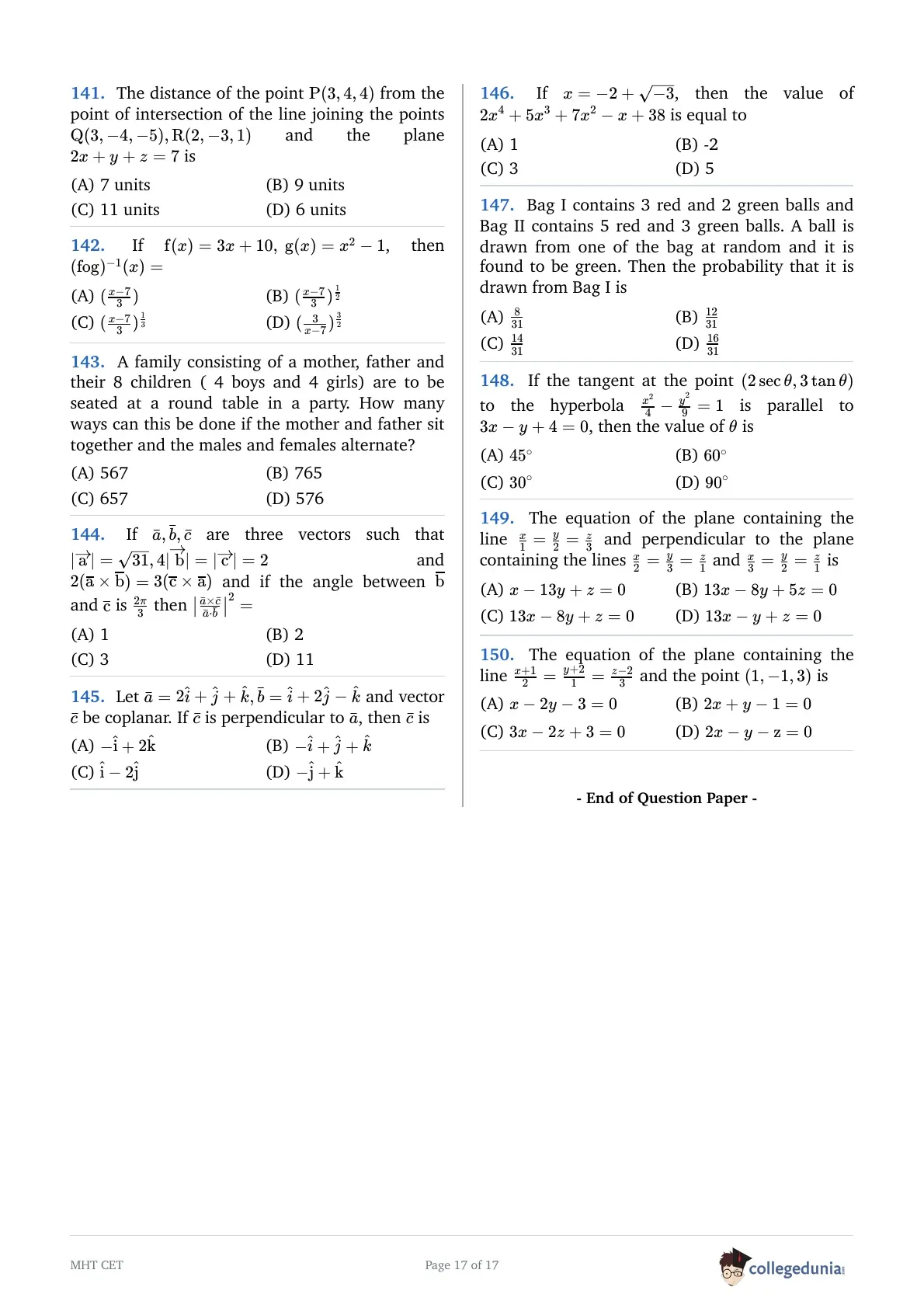
Question 141:

The distance of the point \(\mathrm{P}(3,4,4)\) from the point of intersection of the line joining the points \(\mathrm{Q}(3,-4,-5), \mathrm{R}(2,-3,1)\) and the plane \(2 x+y+z=7\) is

  • (A) 7 units
  • (B) 9 units
  • (C) 11 units
  • (D) 6 units

Question 142:

If \(\mathrm{f}(x)=3 x+10, \mathrm{~g}(x)=x^2-1\), then \((\mathrm{fog})^{-1}(x)=\)

  • (A) \((\frac{x-7}{3})\)
  • (B) \((\frac{x-7}{3})^{\frac{1}{2}}\)
  • (C) \((\frac{x-7}{3})^{\frac{1}{3}}\)
  • (D) \((\frac{3}{x-7})^{\frac{3}{2}}\)

Question 144:

If \(\bar{a}, \bar{b}, \bar{c}\) are three vectors such that \(|\overrightarrow{\mathrm{a}}|=\sqrt{31}, 4|\overrightarrow{\mathrm{~b}}|=|\overrightarrow{\mathrm{c}}|=2\) and \(2(\overline{\mathrm{a}} \times \overline{\mathrm{b}})=3(\overline{\mathrm{c}} \times \overline{\mathrm{a}})\) and if the angle between \(\overline{\mathrm{b}}\) and \(\overline{\mathrm{c}}\) is \(\frac{2 \pi}{3}\) then \(\left|\frac{\bar{a} \times \bar{c}}{\bar{a} \cdot \bar{b}}\right|^2=\)

  • (A) 1
  • (B) 2
  • (C) 3
  • (D) 11

Question 145:

Let \(\bar{a}=2 \hat{i}+\hat{j}+\hat{k}, \bar{b}=\hat{i}+2 \hat{j}-\hat{k}\) and vector \(\bar{c}\) be coplanar. If \(\bar{c}\) is perpendicular to \(\bar{a}\), then \(\bar{c}\) is

  • (A) \(-\hat{\mathrm{i}}+2\hat{\mathrm{k}}\)
  • (B) \(-\hat{i}+\hat{j}+\hat{k}\)
  • (C) \(\hat{\mathrm{i}}-2\hat{\mathrm{j}}\)
  • (D) \(-\hat{\mathrm{j}}+\hat{\mathrm{k}}\)

Question 146:

If \(x=-2+\sqrt{-3}\), then the value of \(2 x^4+5 x^3+7 x^2-x+38\) is equal to

  • (A) 1
  • (B) -2
  • (C) 3
  • (D) 5

Question 147:

Bag I contains 3 red and 2 green balls and Bag II contains 5 red and 3 green balls. A ball is drawn from one of the bag at random and it is found to be green. Then the probability that it is drawn from Bag I is

  • (A) \(\frac{8}{31}\)
  • (B) \(\frac{12}{31}\)
  • (C) \(\frac{14}{31}\)
  • (D) \(\frac{16}{31}\)

Question 148:

If the tangent at the point \((2 \sec \theta, 3 \tan \theta)\) to the hyperbola \(\frac{x^2}{4}-\frac{y^2}{9}=1\) is parallel to \(3 x-y+4=0\), then the value of \(\theta\) is

  • (A) \(45^{\circ}\)
  • (B) \(60^{\circ}\)
  • (C) \(30^{\circ}\)
  • (D) \(90^{\circ}\)

Question 149:

The equation of the plane containing the line \(\frac{x}{1}=\frac{y}{2}=\frac{z}{3}\) and perpendicular to the plane containing the lines \(\frac{x}{2}=\frac{y}{3}=\frac{z}{1}\) and \(\frac{x}{3}=\frac{y}{2}=\frac{z}{1}\) is

  • (A) \(x-13y+z=0\)
  • (B) \(13x-8y+5z=0\)
  • (C) \(13x-8y+z=0\)
  • (D) \(13x-y+z=0\)

Question 150:

The equation of the plane containing the line \(\frac{x+1}{2}=\frac{y+2}{1}=\frac{z-2}{3}\) and the point \((1,-1,3)\) is

  • (A) \(x-2y-3=0\)
  • (B) \(2x+y-1=0\)
  • (C) \(3x-2z+3=0\)
  • (D) \(2x-y-\mathrm{z}=0\)

MHT CET 2025 PCM Exam Pattern and Marking Scheme

Parameter Details
Conducting Body Maharashtra Common Entrance Test Cell (Maharashtra CET Cell)
Exam Mode Online (Computer-Based Test)
Duration 180 minutes (3 hours)
Groups / Subjects PCM (Physics, Chemistry, Mathematics) for Engineering
Total Questions

150

Total Marks 200
Question Type Multiple Choice Questions (MCQs)
Marks Distribution
  • Mathematics – 2 marks/question
  • Physics and Chemistry – 1 mark/question
Negative Marking No
Syllabus Weightage
  • Class 12 – 80%
  • Class 11 – 20%