




MHT CET 2025 April 22 Shift 2 PCM Question Paper is available for download here. Maharashtra State CET Cell conducted MHT CET 2025 PCM Exam on April 22 in Shift 2 from 2 PM to 5 PM in CBT mode.
The MHT CET 2025 PCM question paper includes the following:
- The MHT CET 2025 PCM Question Paper consists of 150 multiple-choice questions (MCQs) totalling 200 marks divided into 3 sections: Physics, Chemistry, and Mathematics, with 50 questions in each subject.
- Physics and Chemistry questions carry 1 mark each while Mathematics questions carry 2 marks each.
- There is no negative marking for incorrect answers.
MHT CET 2025 April 22 Shift 2 PCM Question Paper with Solution PDF
| CD PDF | CD PDF with Solutions |
|---|---|
| Download Collegedunia PDF 0.84 MB | - |
Also Check:
MHT CET 2025 April 22 Shift 2 PCM Questions with Solutions
Physics (Q1 - Q50)
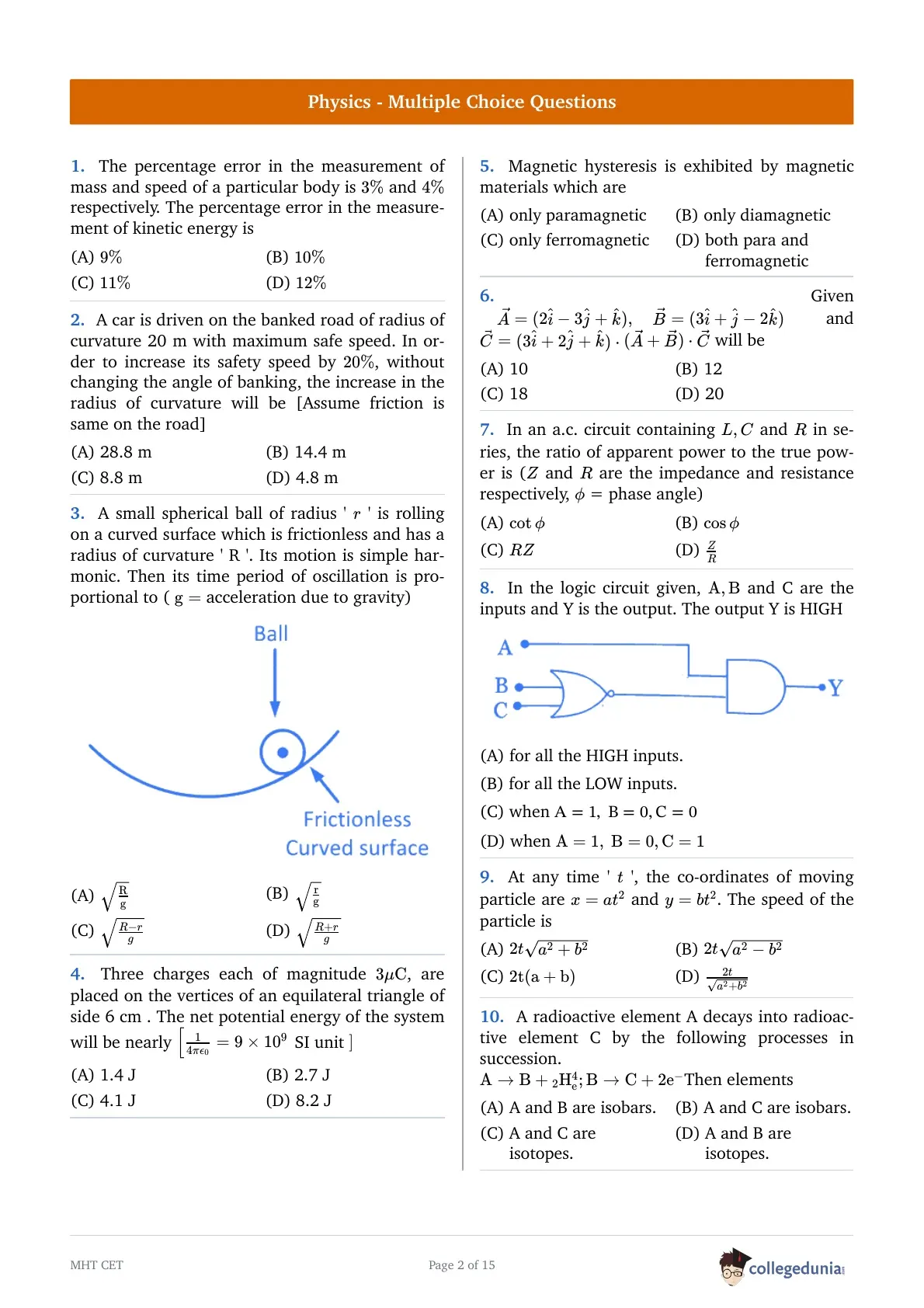
The percentage error in the measurement of mass and speed of a particular body is 3% and 4% respectively. The percentage error in the measurement of kinetic energy is
A car is driven on the banked road of radius of curvature 20 m with maximum safe speed. In order to increase its safety speed by 20%, without changing the angle of banking, the increase in the radius of curvature will be [Assume friction is same on the road]}
A small spherical ball of radius ' r ' is rolling on a curved surface which is frictionless and has a radius of curvature ' R '. Its motion is simple harmonic. Then its time period of oscillation is proportional to ( g = acceleration due to gravity)}
Three charges each of magnitude \(3\mu C\), are placed on the vertices of an equilateral triangle of side 6 cm . The net potential energy of the system will be nearly \(\left[ \frac{1}{4\pi\epsilon_0} = 9 \times 10^9 \text{ SI unit} \right]\)}
Magnetic hysteresis is exhibited by magnetic materials which are
Given \(\quad \vec{A}=(2 \hat{i}-3 \hat{j}+\hat{k}), \quad \vec{B}=(3 \hat{i}+\hat{j}-2 \hat{k})\) and \(\vec{C}=(3 \hat{i}+2 \hat{j}+\hat{k}) \cdot(\vec{A}+\vec{B}) \cdot \vec{C}\) will be
In an a.c. circuit containing \(L, C\) and \(R\) in series, the ratio of apparent power to the true power is (\(Z\) and \(R\) are the impedance and resistance respectively, \(\phi\) = phase angle)
In the logic circuit given, \(\mathrm{A}, \mathrm{B}\) and C are the inputs and Y is the output. The output Y is HIGH

At any time \( t \), the co-ordinates of moving particle are \( x = at^2 \) and \( y = bt^2 \). The speed of the particle is
A radioactive element A decays into radioactive element C by the following processes in succession. \( A \rightarrow B + _2\text{He}^4; B \rightarrow C + 2e^- \) Then elements}
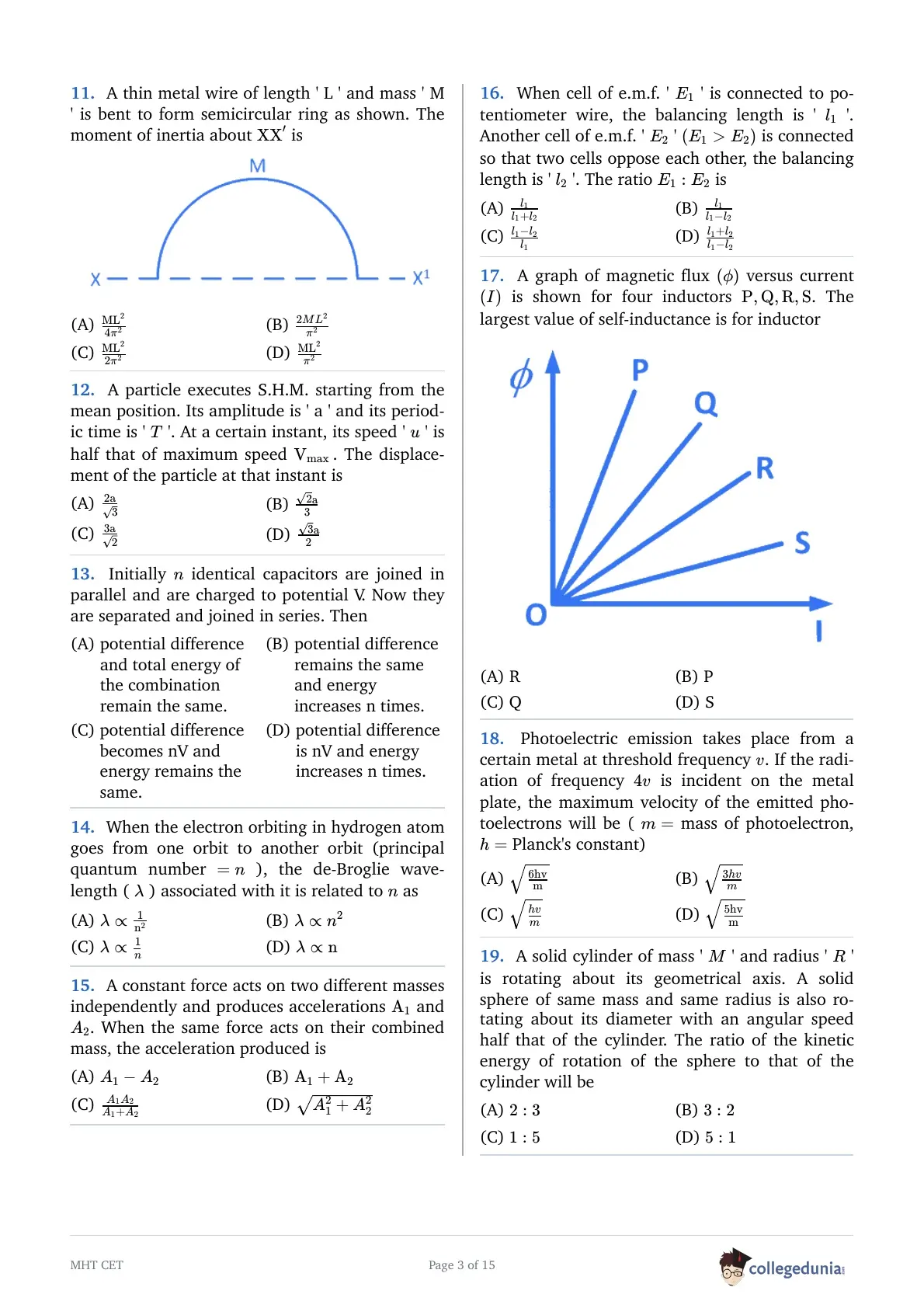
A thin metal wire of length ' L ' and mass ' M ' is bent to form semicircular ring as shown. The moment of inertia about XX' is

A particle executes S.H.M. starting from the mean position. Its amplitude is ' a ' and its periodic time is ' T '. At a certain instant, its speed ' u ' is half that of maximum speed \( V_{\text{max}} \). The displacement of the particle at that instant is
Initially \( n \) identical capacitors are joined in parallel and are charged to potential V. Now they are separated and joined in series. Then}
When the electron orbiting in hydrogen atom goes from one orbit to another orbit (principal quantum number \( = n \)), the de-Broglie wavelength (\( \lambda \)) associated with it is related to \( n \) as}
A constant force acts on two different masses independently and produces accelerations \( A_1 \) and \( A_2 \). When the same force acts on their combined mass, the acceleration produced is
When cell of e.m.f. ' \( E_1 \) ' is connected to potentiometer wire, the balancing length is ' \( l_1 \) '. Another cell of e.m.f. ' \( E_2 \) ' (\( E_1>E_2 \)) is connected so that two cells oppose each other, the balancing length is ' \( l_2 \) '. The ratio \( E_1 : E_2 \) is
A graph of magnetic flux (\( \phi \)) versus current (\( I \)) is shown for four inductors P, Q, R, S. The largest value of self-inductance is for inductor}

Photoelectric emission takes place from a certain metal at threshold frequency \( \nu \). If the radiation of frequency \( 4\nu \) is incident on the metal plate, the maximum velocity of the emitted photoelectrons will be (\( m = \) mass of photoelectron, \( h = \) Planck's constant)}
A solid cylinder of mass ' \( M \) ' and radius ' \( R \) ' is rotating about its geometrical axis. A solid sphere of same mass and same radius is also rotating about its diameter with an angular speed half that of the cylinder. The ratio of the kinetic energy of rotation of the sphere to that of the cylinder will be}
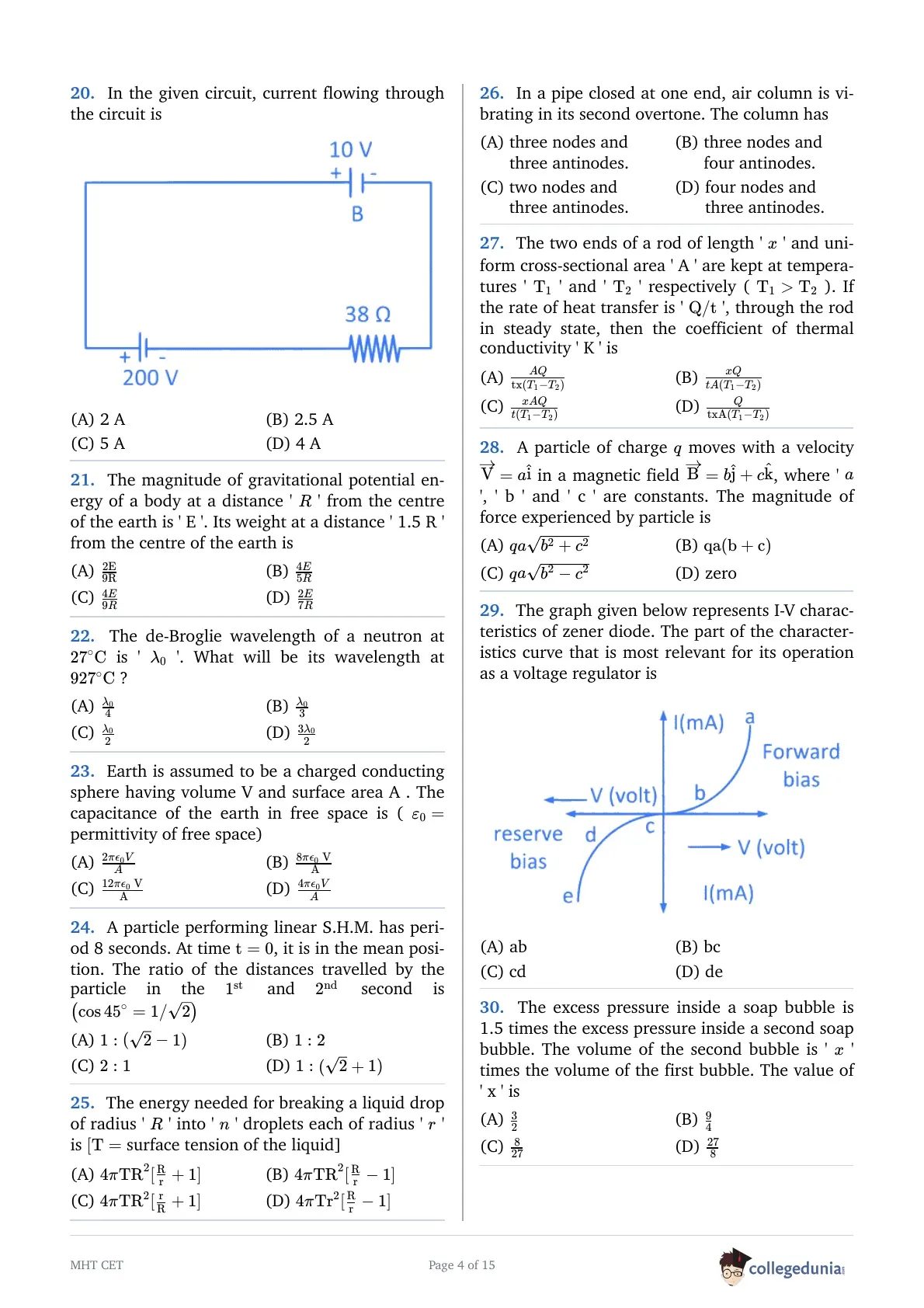
The magnitude of gravitational potential energy of a body at a distance ' \( R \) ' from the centre of the earth is ' \( E \) '. Its weight at a distance ' \( 1.5 R \) ' from the centre of the earth is
The de-Broglie wavelength of a neutron at \( 27^\circ\text{C} \) is ' \( \lambda_0 \) '. What will be its wavelength at \( 927^\circ\text{C} \)?
Earth is assumed to be a charged conducting sphere having volume V and surface area A. The capacitance of the earth in free space is (\( \varepsilon_0 = \) permittivity of free space)}
A particle performing linear S.H.M. has period 8 seconds. At time t = 0, it is in the mean position. The ratio of the distances travelled by the particle in the \( 1^{\text{st}} \) and \( 2^{\text{nd}} \) second is (\( \cos 45^\circ = 1/\sqrt{2} \))}
The energy needed for breaking a liquid drop of radius ' \( R \) ' into ' \( n \) ' droplets each of radius ' \( r \) ' is [\( T = \) surface tension of the liquid]}
In a mirror or pipe closed at one end, air column is vibrating in its second overtone. The column has}
The two ends of a rod of length ' \( x \) ' and uniform cross-sectional area ' \( A \) ' are kept at temperatures ' \( T_1 \) ' and ' \( T_2 \) ' respectively (\( T_1>T_2 \)). If the rate of heat transfer is ' \( Q/t \) ', through the rod in steady state, then the coefficient of thermal conductivity ' \( K \) ' is
A particle of charge \( q \) moves with a velocity \( \vec{v} = a\hat{i} \) in a magnetic field \( \vec{B} = b\hat{j} + c\hat{k} \), where ' a ', ' b ' and ' c ' are constants. The magnitude of force experienced by particle is
The graph given below represents I-V characteristics of zener diode. The part of the characteristics curve that is most relevant for its operation as a voltage regulator is

The excess pressure inside a soap bubble is 1.5 times the excess pressure inside a second soap bubble. The volume of the second bubble is ' \( x \) ' times the volume of the first bubble. The value of ' \( x \) ' is
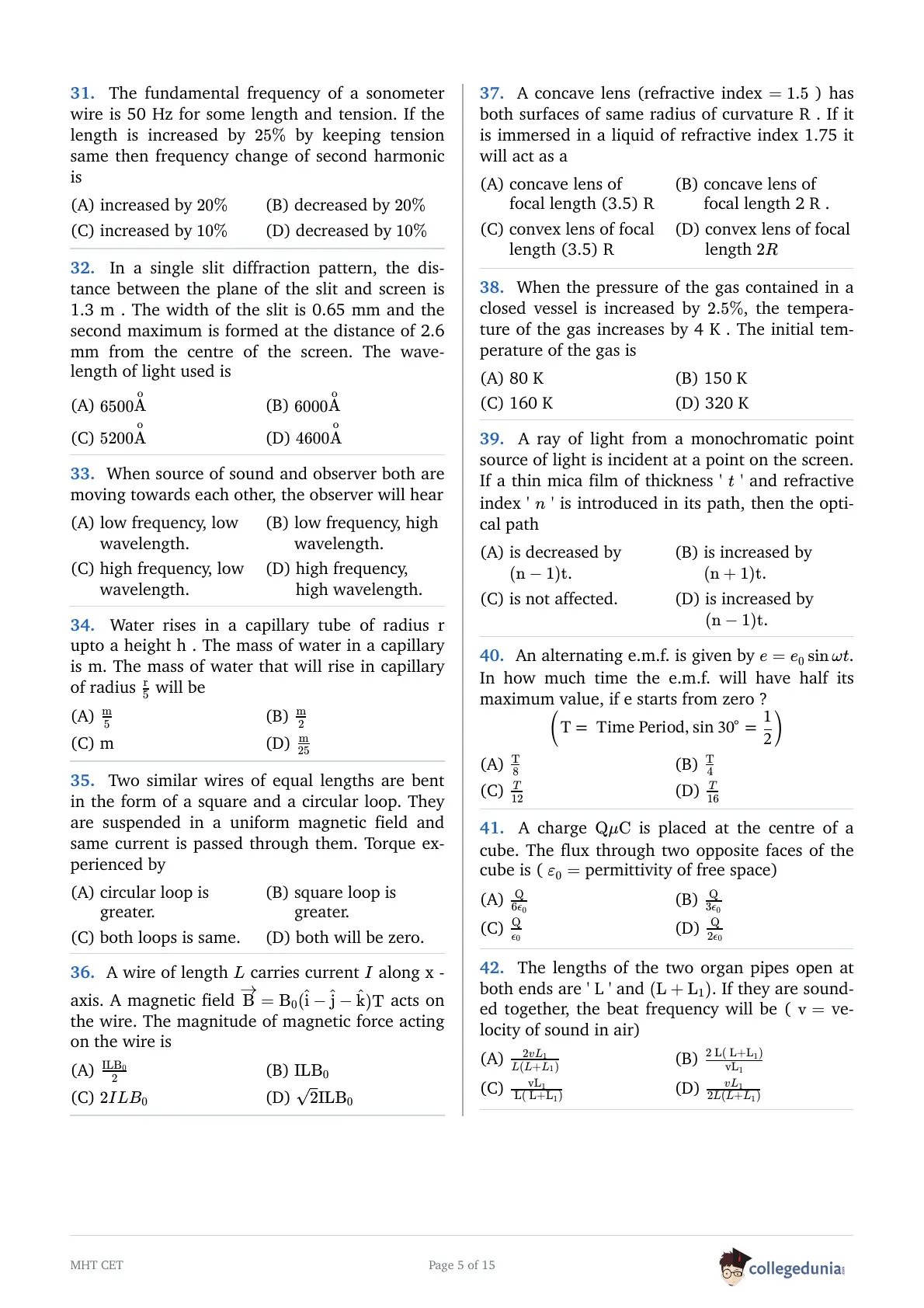
The fundamental frequency of a sonometer wire is 50 Hz for some length and tension. If the length is increased by 25% by keeping tension same then frequency change of second harmonic is
In a single slit diffraction pattern, the distance between the plane of the slit and screen is 1.3 m . The width of the slit is 0.65 mm and the second maximum is formed at the distance of 2.6 mm from the centre of the screen. The wavelength of light used is
When source of sound and observer both are moving towards each other, the observer will hear}
Water rises in a capillary tube of radius r upto height h . The mass of water in a capillary is m. The mass of water that will rise in capillary of radius \(\frac{r}{5}\) will be}
Two similar wires of equal lengths are bent in the form of a square and a circular loop. They are suspended in a uniform magnetic field and same current is passed through them. Torque experienced by}
A wire of length \(L\) carries current \(I\) along x - axis. A magnetic field \(\vec{B} = B_0(\hat{i} - \hat{j} - \hat{k})\text{T}\) acts on the wire. The magnitude of magnetic force acting on the wire is
A concave lens (refractive index \(= 1.5\)) has both surfaces of same radius of curvature R . If it is immersed in a liquid of refractive index 1.75 it will act as a}
When the pressure of the gas contained in a closed vessel is increased by 2.5%, the temperature of the gas increases by 4 K . The initial temperature of the gas is
A ray of light from a monochromatic point source of light is incident at a point on the screen. If a thin mica film of thickness ' \(t\) ' and refractive index ' \(n\) ' is introduced in its path, then the optical path}
An alternating e.m.f. is given by \(e = e_0 \sin \omega t\). In how much time the e.m.f. will have half its maximum value, if e starts from zero ? (\(\text{T} = \text{Time Period, } \sin 30^\circ = \frac{1}{2}\))}
A charge \(Q\mu\text{C}\) is placed at the centre of a cube. The flux through two opposite faces of the cube is (\(\varepsilon_0 = \) permittivity of free space)}
The lengths of the two organ pipes open at both ends are ' \(L\) ' and \((L + L_1)\). If they are sounded together, the beat frequency will be (\(v = \) velocity of sound in air)}
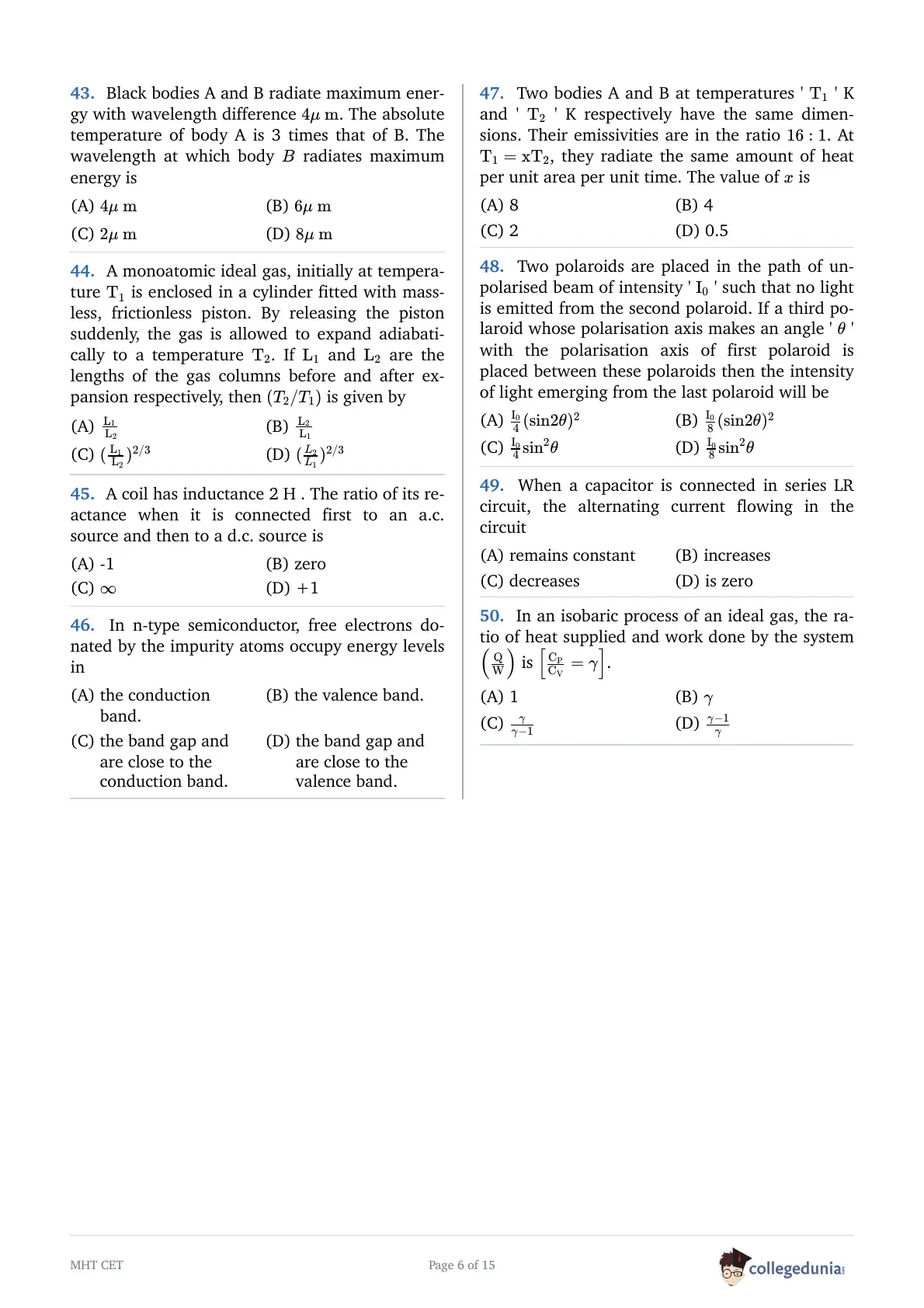
Black bodies A and B radiate maximum energy with wavelength difference \(4\mu \text{ m}\). The absolute temperature of body A is 3 times that of B. The wavelength at which body \(B\) radiates maximum energy is
A monoatomic ideal gas, initially at temperature \(\text{T}_1\) is enclosed in a cylinder fitted with massless, frictionless piston. By releasing the piston suddenly, the gas is allowed to expand adiabatically to a temperature \(\text{T}_2\). If \(\text{L}_1\) and \(\text{L}_2\) are the lengths of the gas columns before and after expansion respectively, then \((\text{T}_2/\text{T}_1)\) is given by}
A coil has inductance \(2 \text{ H}\). The ratio of its reactance when it is connected first to an a.c. source and then to a d.c. source is
In n-type semiconductor, free electrons donated by the impurity atoms occupy energy levels in}
Two bodies A and B at temperatures ' \(\text{T}_1\) ' \(\text{K}\) and ' \(\text{T}_2\) ' \(\text{K}\) respectively have the same dimensions. Their emissivities are in the ratio \(16 : 1\). At \(\text{T}_1 = x\text{T}_2\), they radiate the same amount of heat per unit area per unit time. The value of \(x\) is
Two polaroids are placed in the path of unpolarised beam of intensity ' \(\text{I}_0\) ' such that no light is emitted from the second polaroid. If a third polaroid whose polarisation axis makes an angle ' \(\theta\) ' with the polarisation axis of first polaroid is placed between these polaroids then the intensity of light emerging from the last polaroid will be}
When a capacitor is connected in series LR circuit, the alternating current flowing in the circuit}
In an isobaric process of an ideal gas, the ratio of heat supplied and work done by the system \(\left(\frac{\text{Q}}{\text{W}}\right)\) is \(\left[\frac{\text{C}_{\text{P}}}{\text{C}_{\text{V}}} = \gamma\right]\).
Chemistry (Q51 - Q100)
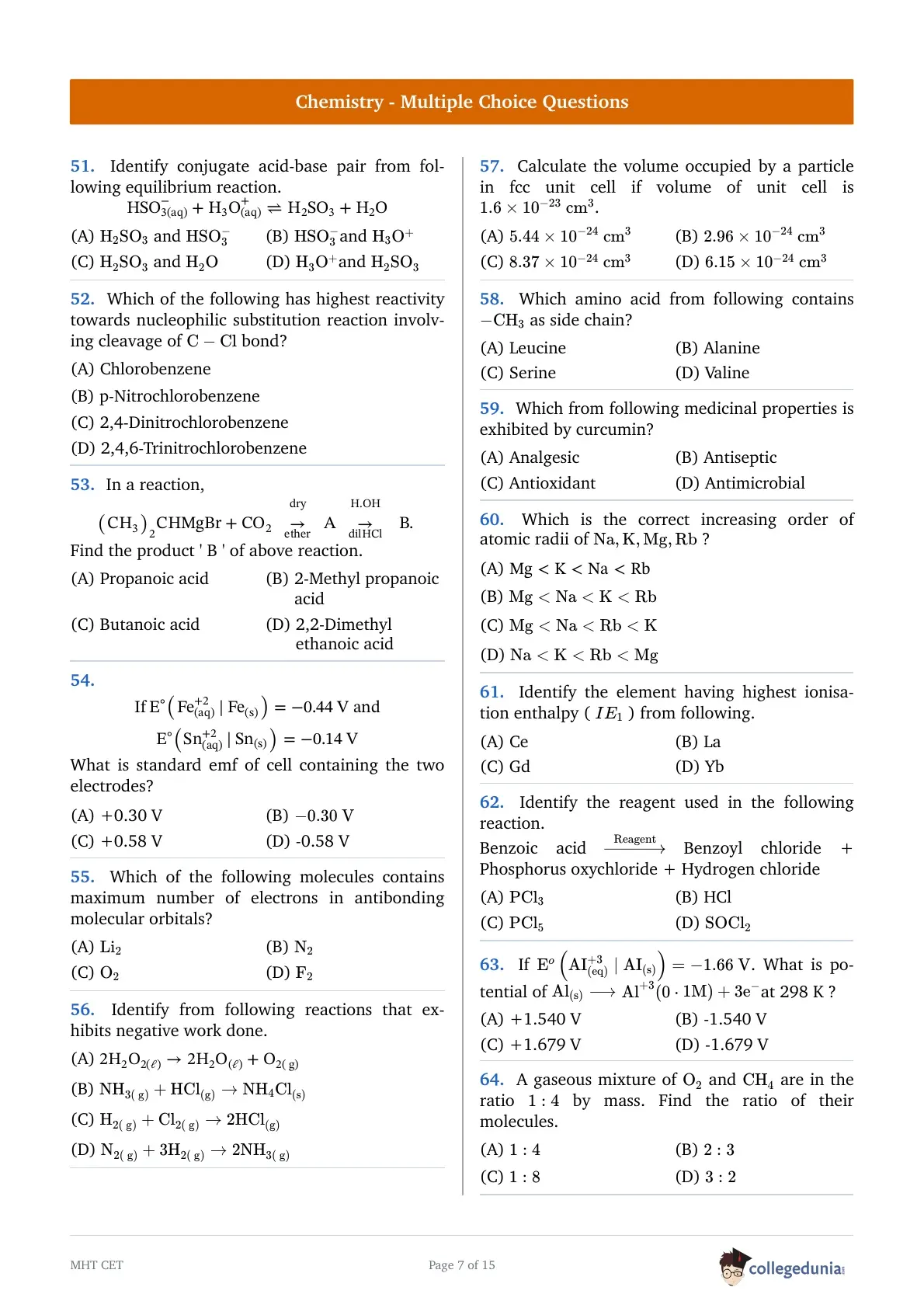
Identify conjugate acid-base pair from following equilibrium reaction.
\(\text{HSO}_{3(\text{aq})}^- + \text{H}_3\text{O}_{(\text{aq})}^+ \rightleftharpoons \text{H}_2\text{SO}_3 + \text{H}_2\text{O}\)
Which of the following has highest reactivity towards nucleophilic substitution reaction involving cleavage of C — Cl bond?
In a reaction,
\((\text{CH}_3)_2\text{CHMgBr} + \text{CO}_2 \xrightarrow[\text{ether}]{\text{dry}} \text{A} \xrightarrow[\text{dilHCl}]{\text{H.OH}} \text{B}\).
Find the product ' B ' of above reaction.
If \(\text{E}^\circ \left( \text{Fe}_{(\text{aq})}^{+2} \mid \text{Fe}_{(\text{s})} \right) = -0.44 \text{ V}\) and \(\text{E}^\circ \left( \text{Sn}_{(\text{aq})}^{+2} \mid \text{Sn}_{(\text{s})} \right) = -0.14 \text{ V}\)
What is standard emf of cell containing the two electrodes?
Which of the following molecules contains maximum number of electrons in antibonding molecular orbitals?
Calculate the volume occupied by a particle in fcc unit cell if volume of unit cell is \(1.6 \times 10^{-23} \text{ cm}^3\).
Which amino acid from following contains —CH\(_3\) as side chain?
Which is the correct increasing order of atomic radii of Na, K, Mg, Rb ?
Identify the element having highest ionisation enthalpy ( \(IE_1\) ) from following.
Identify the reagent used in the following reaction.
Benzoic acid \(\xrightarrow{\text{Reagent}\) Benzoyl chloride + Phosphorus oxychloride + Hydrogen chloride}
If \(\text{E}^o \left( \text{Al}_{(\text{eq})}^{+3} \mid \text{Al}_{(\text{s})} \right) = -1.66 \text{ V}\). What is potential of \(\text{Al}_{(\text{s})} \longrightarrow \text{Al}^{+3}(0 \cdot 1\text{M}) + 3\text{e}^-\) at 298 K ?
A gaseous mixture of O\(_2\) and CH\(_4\) are in the ratio 1 : 4 by mass. Find the ratio of their molecules.
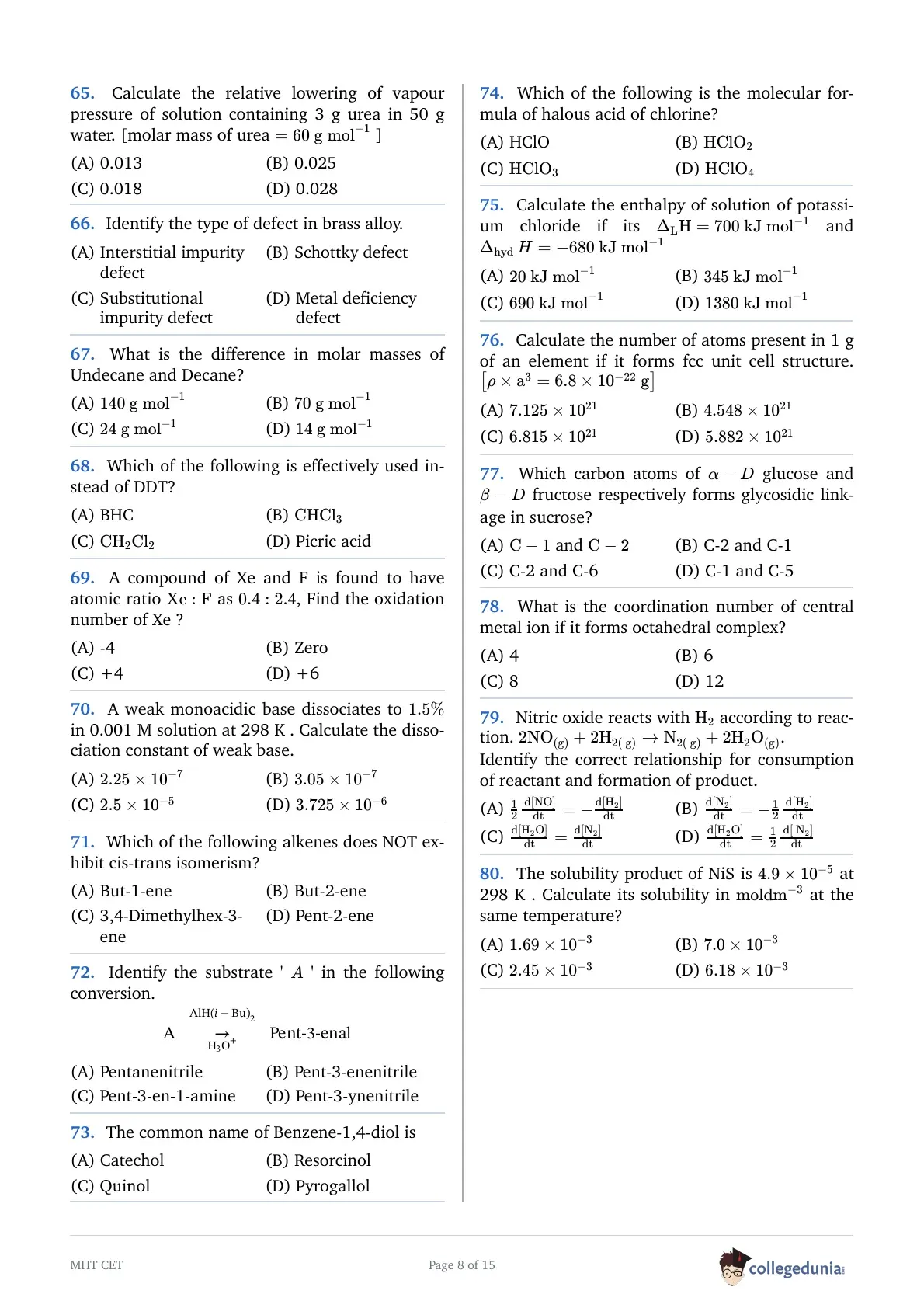
Calculate the relative lowering of vapour pressure of solution containing 3 g urea in 50 g water. [molar mass of urea = 60 g mol\(^{-1}\) ]}
Identify the type of defect in brass alloy.
What is the difference in molar masses of Undecane and Decane?
Which of the following is effectively used instead of DDT?
A compound of Xe and F is found to have atomic ratio Xe : F as 0.4 : 2.4, Find the oxidation number of Xe ?
A weak monoacidic base dissociates to 1.5% in 0.001 M solution at 298 K . Calculate the dissociation constant of weak base.
Which of the following alkenes does NOT exhibit cis-trans isomerism?
Identify the substrate ' A ' in the following conversion.
A \(\xrightarrow[\text{H}_3\text{O}^+]{\text{AlH}(i-\text{Bu})_2}\) Pent-3-enal}
The common name of Benzene-1,4-diol is
Which of the following is the molecular formula of halous acid of chlorine?
Calculate the enthalpy of solution of potassium chloride if its \(\Delta_{\text{L}\text{H} = 700 \text{ kJ mol}^{-1}\) and \(\Delta_{\text{hyd}} \text{ H} = -680 \text{ kJ mol}^{-1}\)
Calculate the number of atoms present in 1 g of an element if it forms fcc unit cell structure. [\(\rho \times \text{a}^3 = 6.8 \times 10^{-22} \text{ g}\)]}
Which carbon atoms of \(\alpha - D\) glucose and \(\beta - D\) fructose respectively forms glycosidic linkage in sucrose?
What is the coordination number of central metal ion if it forms octahedral complex?
Nitric oxide reacts with H\(_2\) according to reaction. 2NO\(_{(\text{g})}\) + 2H\(_{2(\text{g})}\) \(\to\) N\(_{2(\text{g})}\) + 2H\(_2\)O\(_{(\text{g})}\).
Identify the correct relationship for consumption of reactant and formation of product.
The solubility product of NiS is \(4.9 \times 10^{-5}\) at 298 K . Calculate its solubility in moldm\(^{-3}\) at the same temperature?
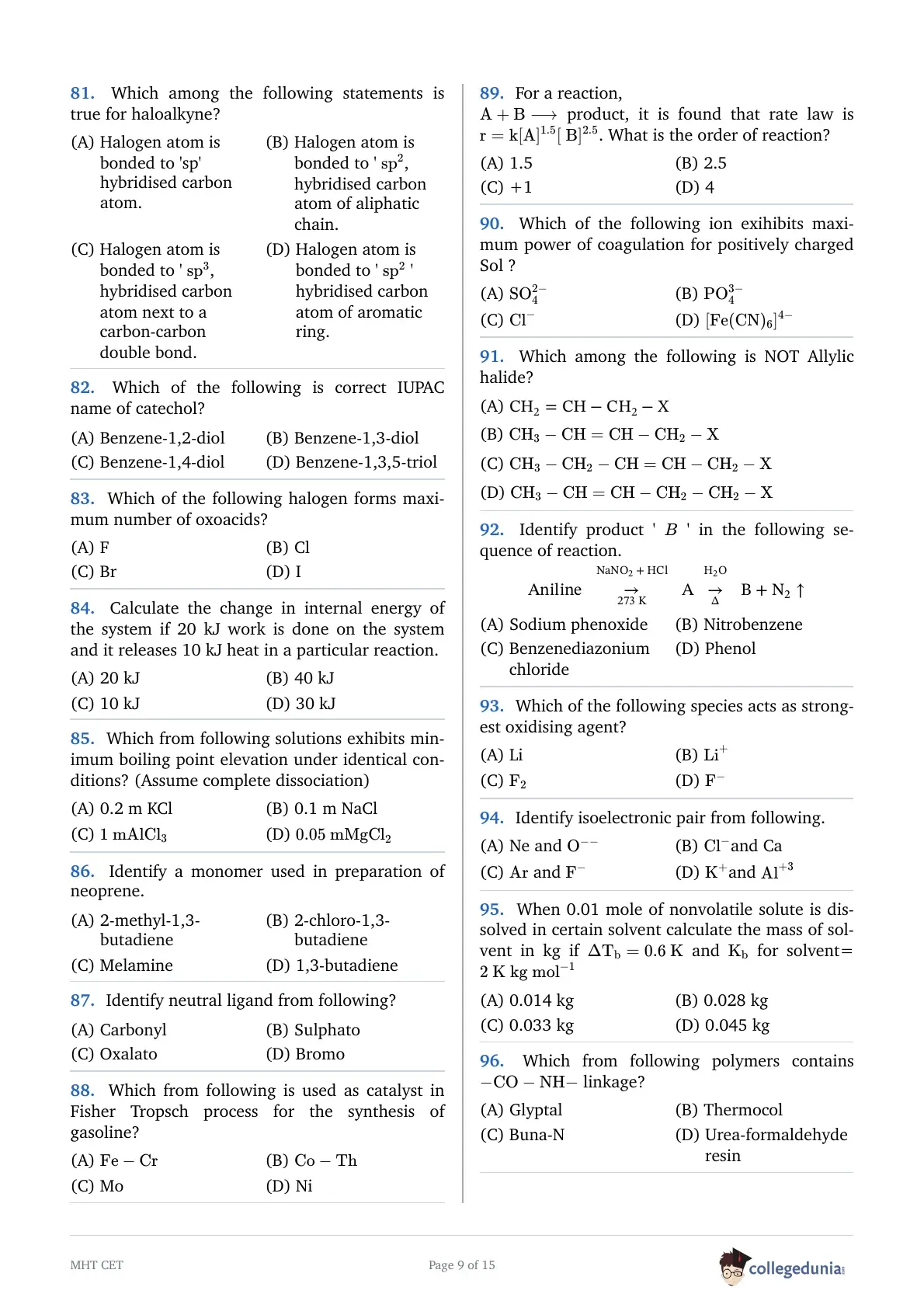
Which among the following statements is true for haloalkyne?
Which of the following is correct IUPAC name of catechol?
Calculate the change in internal energy of the system if 20 kJ work is done on the system and it releases 10 kJ heat in a particular reaction.
Which from following solutions exhibits minimum boiling point elevation under identical conditions? (Assume complete dissociation)}
Identify a monomer used in preparation of neoprene.
Identify neutral ligand from following?
Which from following is used as catalyst in Fisher Tropsch process for the synthesis of gasoline?
For a reaction, A + B \(\longrightarrow\) product, it is found that rate law is r = k[A]\(^{1.5}\) [B]\(^{2.5}\). What is the order of reaction?
Which of the following ion exhibits maximum power of coagulation for positively charged Sol ?
Which among the following is NOT Allylic halide?
Identify product ' \(B\) ' in the following sequence of reaction.
\(\text{Aniline} \xrightarrow[273 \text{ K}]{\text{NaNO}_2 + \text{HCl}} \text{A} \xrightarrow{\Delta}{\text{H}_2\text{O}} \text{B} + \text{N}_2 \uparrow\)
Which of the following species acts as strongest oxidising agent?
Identify isoelectronic pair from following.
When 0.01 mole of nonvolatile solute is dissolved in certain solvent calculate the mass of solvent in kg if \(\Delta \text{T}_{\text{b}} = 0.6 \text{ K}\) and \(\text{K}_{\text{b}}\) for solvent \(= 2 \text{ K kg mol}^{-1}\)
Which from following polymers contains \(-\text{CO}-\text{NH}-\) linkage?
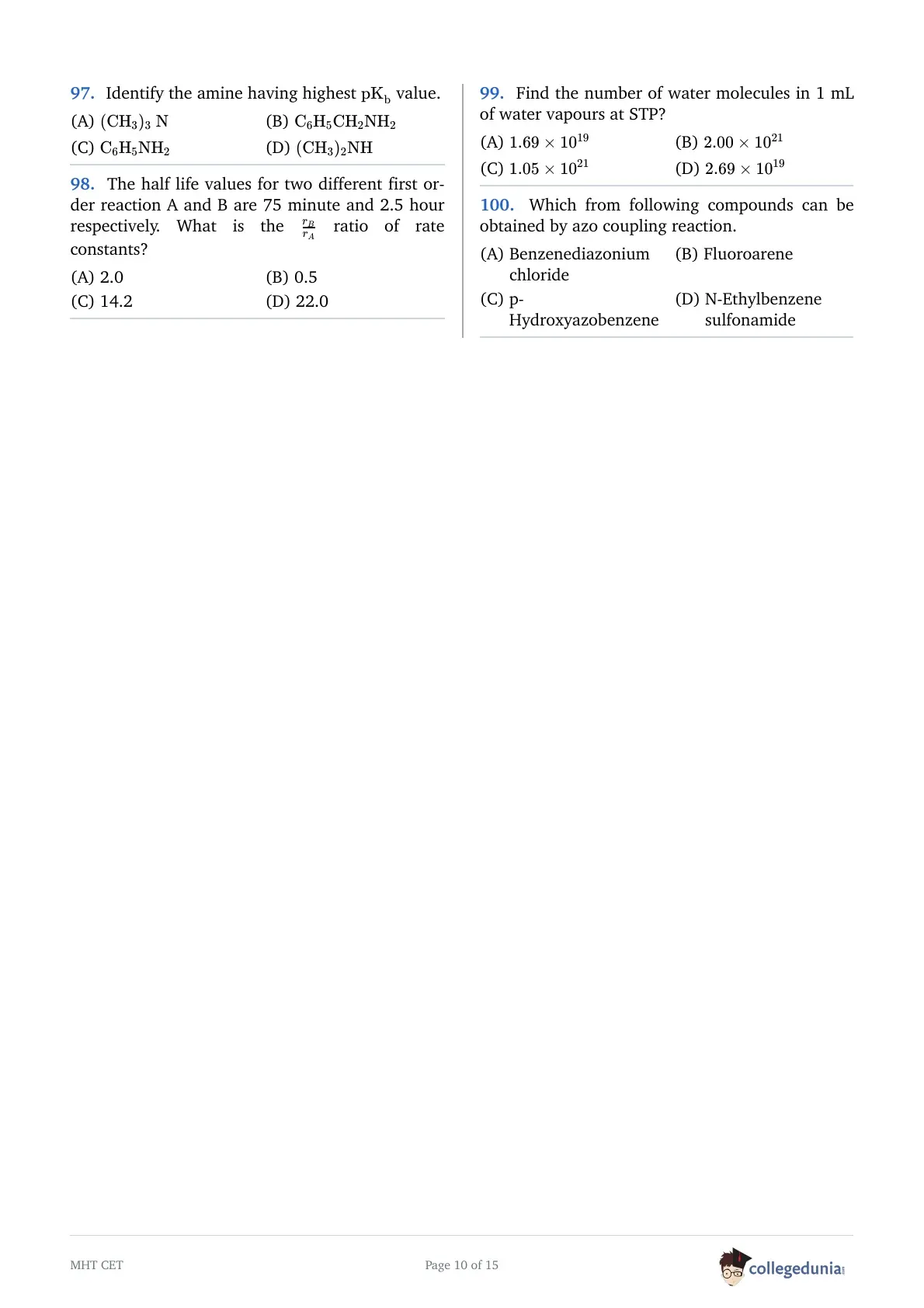
Identify the amine having highest \(\text{p}\text{K}_{\text{b}}\) value.
The half life values for two different first order reaction A and B are 75 minute and 2.5 hour respectively. What is the \(\frac{\text{r}_B}{\text{r}_A}\) ratio of rate constants?
Find the number of water molecules in \(1 \text{ mL}\) of water vapours at STP?
Which from following compounds can be obtained by azo coupling reaction.
Mathematics (Q101 - Q150)
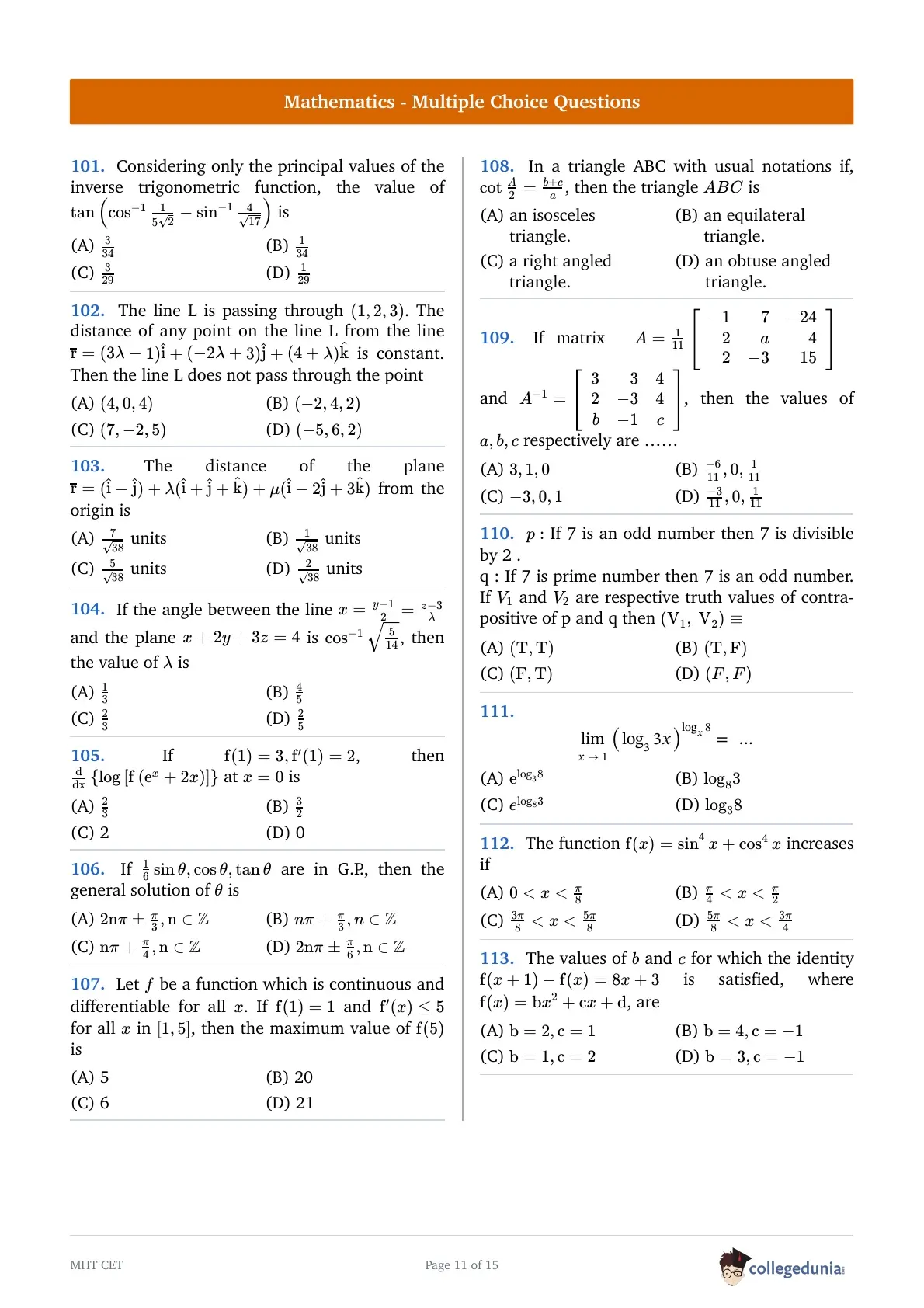
Considering only the principal values of the inverse trigonometric function, the value of \(\tan \left( \cos^{-1} \frac{1}{5\sqrt{2}} - \sin^{-1} \frac{4}{\sqrt{17}} \right)\) is
The line \(L\) is passing through \((1, 2, 3)\). The distance of any point on the line \(L\) from the line \(\vec{r} = (3\lambda - 1)\hat{i} + (-2\lambda + 3)\hat{j} + (4 + \lambda)\hat{k}\) is constant. Then the line \(L\) does not pass through the point ______.
The distance of the plane \(\vec{r} = (\hat{i} - \hat{j}) + \lambda(\hat{i} + \hat{j} + \hat{k}) + \mu(\hat{i} - 2\hat{j} + 3\hat{k})\) from the origin is ______.
If the angle between the line \(x = \frac{y-1}{2} = \frac{z-3}{\lambda}\) and the plane \(x + 2y + 3z = 4\) is \(\cos^{-1} \sqrt{\frac{5}{14}}\), then the value of \(\lambda\) is
If \(f(1) = 3,\; f'(1) = 2\), then \(\dfrac{d}{dx}\left\{\log\left[f\left(e^x + 2x\right)\right]\right\}\) at \(x = 0\) is ______.
If \(\frac{1}{6} \sin \theta, \cos \theta, \tan \theta\) are in G.P., then the general solution of \(\theta\) is
Let \(f\) be a function which is continuous and differentiable for all \(x\). If \(f(1) = 1\) and \(f'(x) \leq 5\) for all \(x\) in \([1, 5]\), then the maximum value of \(f(5)\) is
In a triangle ABC with usual notations if, \(\cot \frac{A}{2} = \frac{b+c}{a}\), then the triangle \(ABC\) is
If matrix \(A = \frac{1}{11} \begin{bmatrix} -1 & 7 & -24 \\ 2 & a & 4 \\ 2 & -3 & 15 \end{bmatrix}\) and \(A^{-1} = \begin{bmatrix} 3 & 3 & 4 \\ 2 & -3 & 4 \\ b & -1 & c \end{bmatrix}\), then the values of \(a, b, c\) respectively are ..............
\(p\) : If 7 is an odd number then 7 is divisible by 2.
\(q\) : If 7 is prime number then 7 is an odd number. If \(V_1\) and \(V_2\) are respective truth values of contrapositive of p and q then \((V_1, V_2) \equiv\)
\[ \mathop {\lim }\limits_{x \to 1}\left(\log _3 3 x\right)^{\log _x 8}=\ldots \]
The function \(f(x) = \sin^4 x + \cos^4 x\) increases if}
The values of \(b\) and \(c\) for which the identity \(f(x + 1) - f(x) = 8x + 3\) is satisfied, where \(f(x) = bx^2 + cx + d\), are
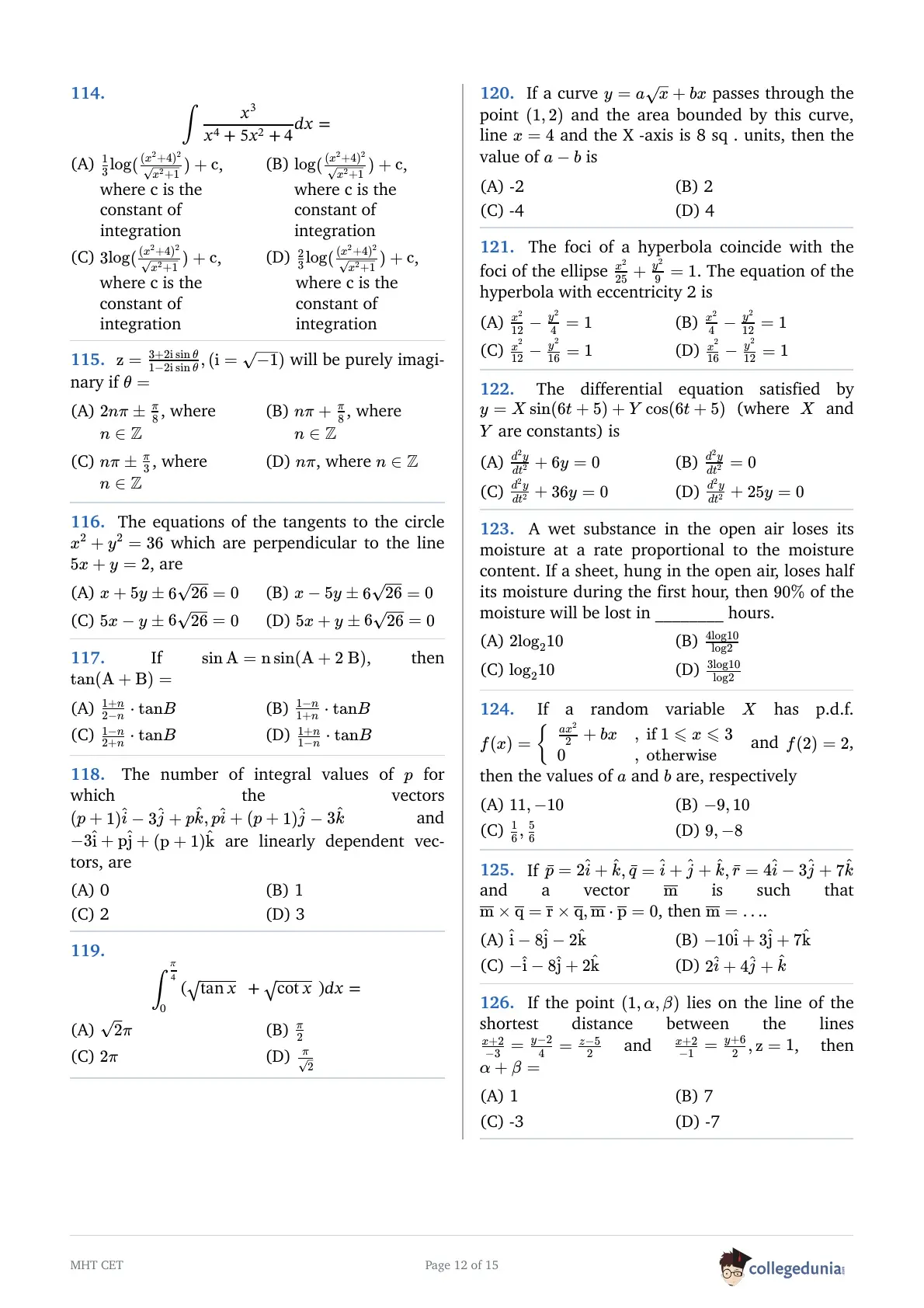
\(z = \frac{3+2i \sin \theta}{1-2i \sin \theta}, (i = \sqrt{-1})\) will be purely imaginary if \(\theta =\)
The equations of the tangents to the circle \(x^2 + y^2 = 36\) which are perpendicular to the line \(5x + y = 2\), are
If sin A = n sin(A + 2 B), then tan(A + B) =}
The number of integral values of \(p\) for which the vectors \((p + 1)\hat{i} - 3\hat{j} + p\hat{k},\; p\hat{i} + (p + 1)\hat{j} - 3\hat{k}\) and \(-3\hat{i} + p\hat{j} + (p + 1)\hat{k}\) are linearly dependent, is ______.
\(\int_0^{\pi/4} (\sqrt{\tan x} + \sqrt{\cot x}) dx =\)
If a curve \(y = a\sqrt{x} + bx\) passes through the point \((1, 2)\) and the area bounded by this curve, line \(x = 4\) and the X -axis is 8 sq . units, then the value of \(a - b\) is
The foci of a hyperbola coincide with the foci of the ellipse \(\frac{x^2}{25} + \frac{y^2}{9} = 1\). The equation of the hyperbola with eccentricity 2 is
The differential equation satisfied by \(y = X\sin(6t+5) + Y\cos(6t+5)\) (where \(X\) and \(Y\) are constants) is
A wet substance in the open air loses its moisture at a rate proportional to the moisture content. If a sheet, hung in the open air, loses half its moisture during the first hour, then \(90%\) of the moisture will be lost in .............. hours.
If a random variable \(X\) has p.d.f. \(f(x) = \begin{cases} \frac{ax^2}{2} + bx & , \text{if } 1 \leq x \leq 3 \\ 0 & , \text{otherwise} \end{cases}\) and \(f(2) = 2\), then the values of \(a\) and \(b\) are, respectively}
If \(\bar{p} = 2\hat{\text{i}} + \hat{\text{k}}, \bar{q} = \hat{\text{i}} + \hat{\text{j}} + \hat{\text{k}}, \bar{r} = 4\hat{\text{i}} - 3\hat{\text{j}} + 7\hat{\text{k}}\) and a vector \(\bar{\text{m}}\) is such that \(\bar{\text{m}} \times \bar{q} = \bar{r} \times \bar{q}, \bar{\text{m}} \cdot \bar{p} = 0\), then \(\bar{\text{m}} = .......\)
If the point \((1, \alpha, \beta)\) lies on the line of the shortest distance between the lines \(\frac{x+2}{-3}=\frac{y-2}{4}=\frac{z-5}{2}\) and \(\frac{x+2}{-1}=\frac{y+6}{2}, \mathrm{z}=1\), then \(\alpha+\beta=\)
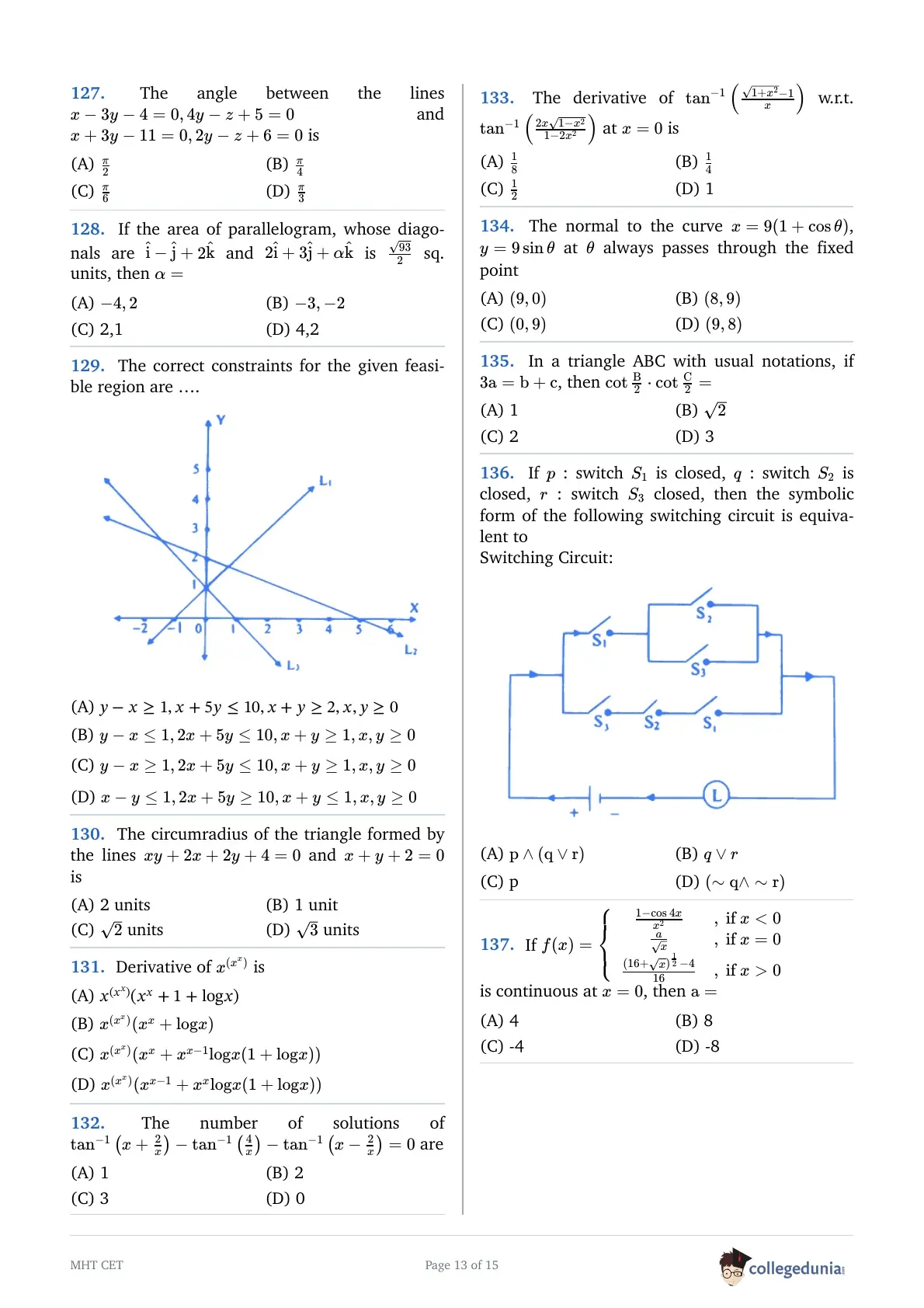
The angle between the lines \(x - 3y - 4 = 0, 4y - z + 5 = 0\) and \(x + 3y - 11 = 0, 2y - z + 6 = 0\) is
If the area of a parallelogram, whose diagonals are \(\hat{i} - \hat{j} + 2\hat{k}\) and \(2\hat{i} + 3\hat{j} + \alpha \hat{k}\) is \(\dfrac{\sqrt{93}}{2}\) sq. units, then find \(\alpha\).
The correct constraints for the given feasible region are ..............
The circumradius of the triangle formed by the lines \(xy + 2x + 2y + 4 = 0\) and \(x + y + 2 = 0\) is
Derivative of \(x^{(x^x)}\) is
The number of solutions of \(\tan^{-1} (x + \frac{2}{x}) - \tan^{-1} (\frac{4}{x}) - \tan^{-1} (x - \frac{2}{x}) = 0\) are
The derivative of \(\tan^{-1} \left( \frac{\sqrt{1+x^2}-1}{x} \right)\) w.r.t. \(\tan^{-1} \left( \frac{2x\sqrt{1-x^2}}{1-2x^2} \right)\) at \(x = 0\) is
The normal to the curve \(x = 9(1 + \cos \theta), y = 9 \sin \theta\) at \(\theta\) always passes through the fixed point}
In a triangle ABC with usual notations, if \(3a = b + c\), then \(\cot \frac{B}{2} \cdot \cot \frac{C}{2} =\)
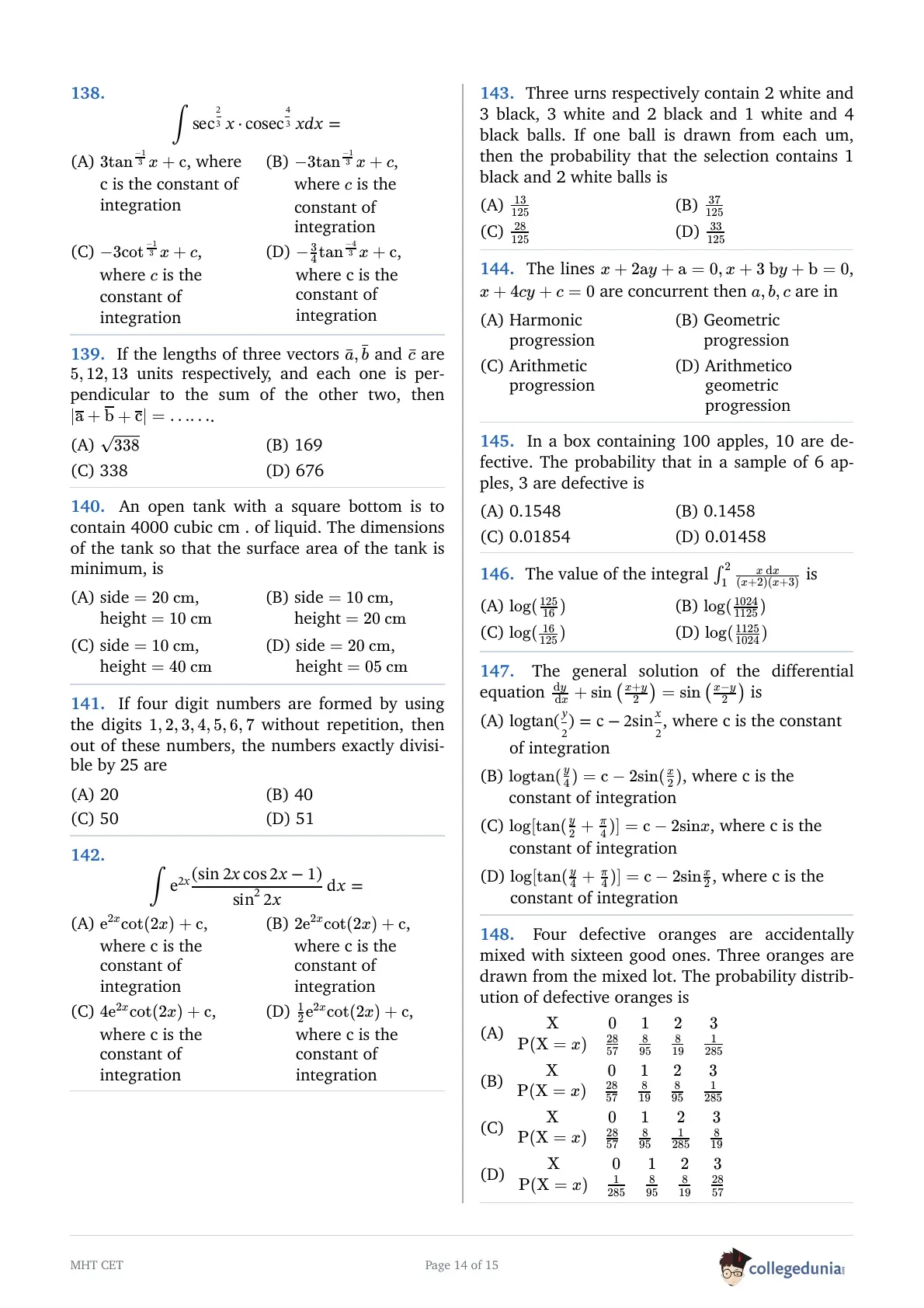
\[ \int \sec ^{\frac{2}{3}} x \cdot \operatorname{cosec}^{\frac{4}{3}} x d x= \]
If the lengths of three vectors \(\bar{a}, \bar{b}\) and \(\bar{c}\) are 5, 12, 13 units respectively, and each one is perpendicular to the sum of the other two, then \(|\bar{a} + \bar{b} + \bar{c}| = ..............\)
An open tank with a square bottom is to contain 4000 cubic cm . of liquid. The dimensions of the tank so that the surface area of the tank is minimum, is
If four digit numbers are formed by using the digits 1, 2, 3, 4, 5, 6, 7 without repetition, then out of these numbers, the numbers exactly divisible by 25 are
\(\int \text{e}^{2x} \frac{(\sin 2x \cos 2x-1)}{\sin^2 2x} \text{d}x =\)
Three urns respectively contain 2 white and 3 black, 3 white and 2 black and 1 white and 4 black balls. If one ball is drawn from each um, then the probability that the selection contains 1 black and 2 white balls is
The lines \(x + 2ay + \text{a} = 0, x + 3by + \text{b} = 0, x + 4cy + \text{c} = 0\) are concurrent then \(a, b, c\) are in}
In a box containing 100 apples, 10 are defective. The probability that in a sample of 6 apples, 3 are defective is
The value of the integral \(\int_1^2 \frac{x \text{ d}x}{(x+2)(x+3)}\) is
The general solution of the differential equation \(\frac{\text{d}y}{\text{d}x} + \sin \left( \frac{x+y}{2} \right) = \sin \left( \frac{x-y}{2} \right)\) is
Four defective oranges are accidentally mixed with sixteen good ones. Three oranges are drawn from the mixed lot. The probability distribution of defective oranges is
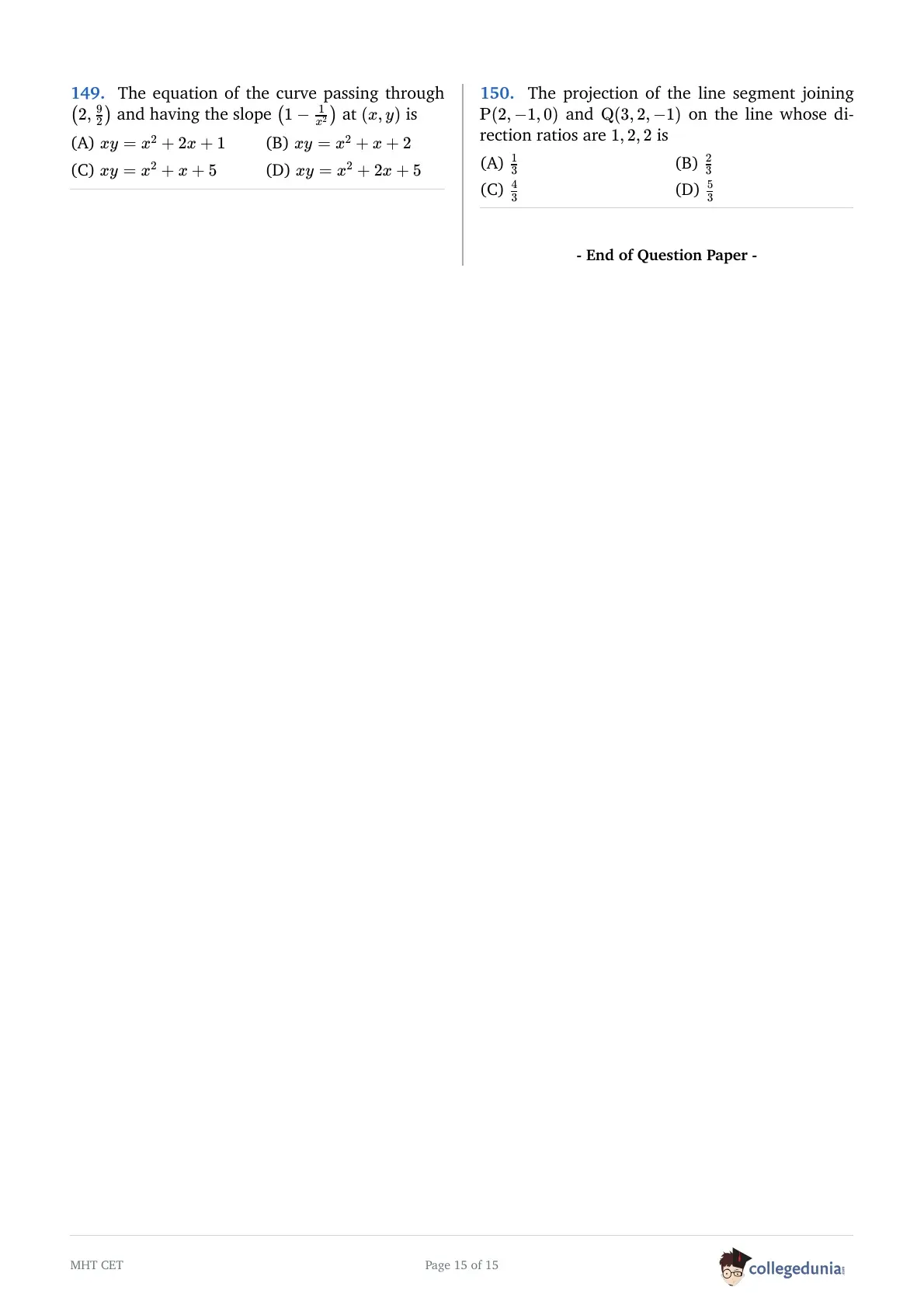
The equation of the curve passing through \((2, \frac{9}{2})\) and having the slope \((1 - \frac{1}{x^2})\) at \((x, y)\) is
The projection of the line segment joining P(2, -1, 0) and Q(3, 2, -1) on the line whose direction ratios are 1, 2, 2 is
MHT CET 2025 PCM Exam Pattern and Marking Scheme
| Parameter | Details |
|---|---|
| Conducting Body | Maharashtra Common Entrance Test Cell (Maharashtra CET Cell) |
| Exam Mode | Online (Computer-Based Test) |
| Duration | 180 minutes (3 hours) |
| Groups / Subjects | PCM (Physics, Chemistry, Mathematics) for Engineering |
| Total Questions |
150 |
| Total Marks | 200 |
| Question Type | Multiple Choice Questions (MCQs) |
| Marks Distribution |
|
| Negative Marking | No |
| Syllabus Weightage |
|



Comments