




MHT CET 2025 April 22 Shift 1 PCM Question Paper is available for download here. Maharashtra State CET Cell conducted MHT CET 2025 PCM Exam on April 22 in Shift 1 from 9 AM to 12 PM in CBT mode.
The MHT CET 2025 PCM question paper includes the following:
- The MHT CET 2025 PCM Question Paper consists of 150 multiple-choice questions (MCQs) totalling 200 marks divided into 3 sections: Physics, Chemistry, and Mathematics, with 50 questions in each subject.
- Physics and Chemistry questions carry 1 mark each while Mathematics questions carry 2 marks each.
- There is no negative marking for incorrect answers.
MHT CET 2025 April 22 Shift 1 PCM Question Paper with Solution PDF
| CD PDF | CD PDF with Solutions |
|---|---|
| Download Collegedunia PDF 0.90 MB | - |
Also Check:
MHT CET 2025 April 22 Shift 1 PCM Questions with Solutions
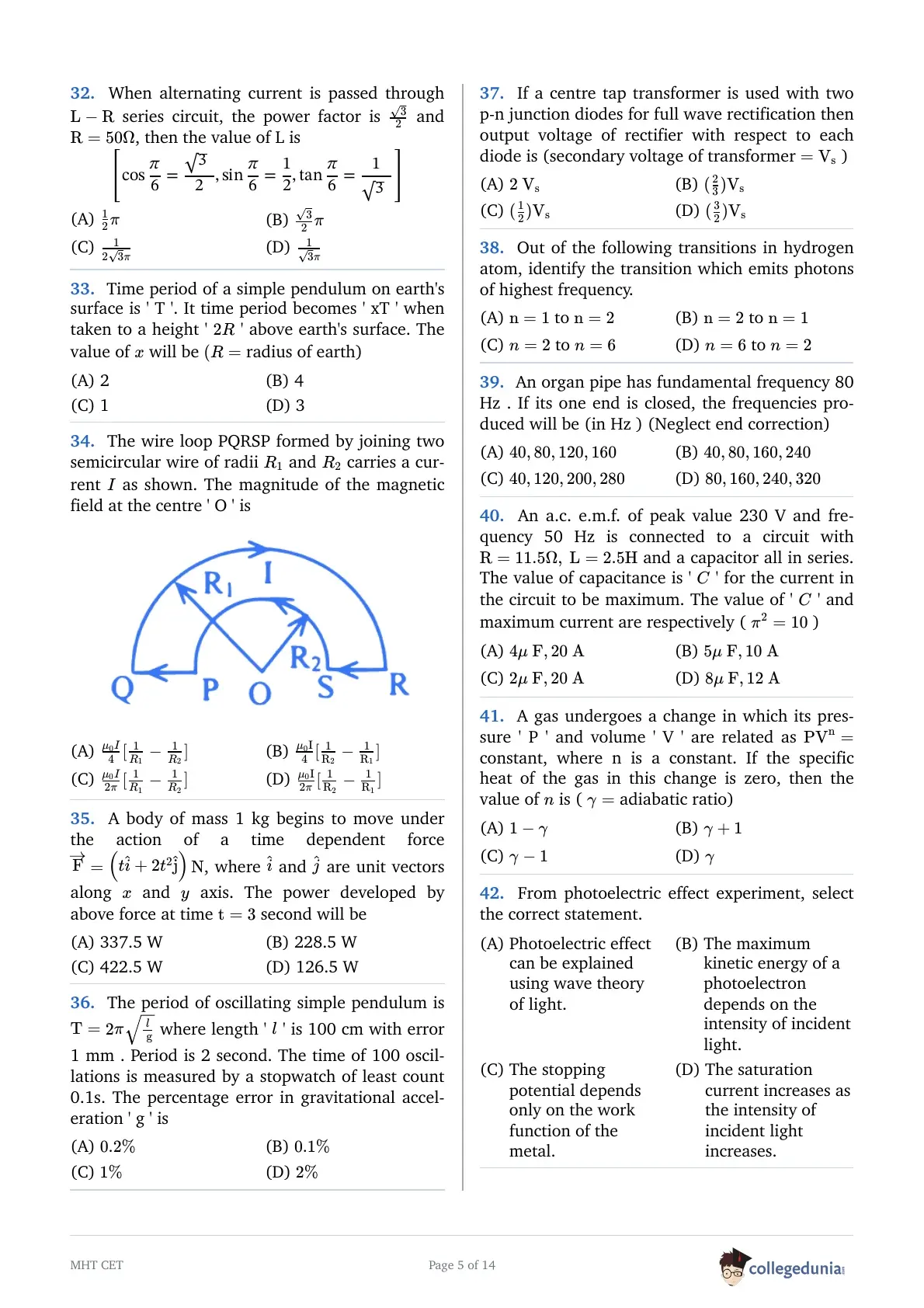
Physics (Q1 - Q50)
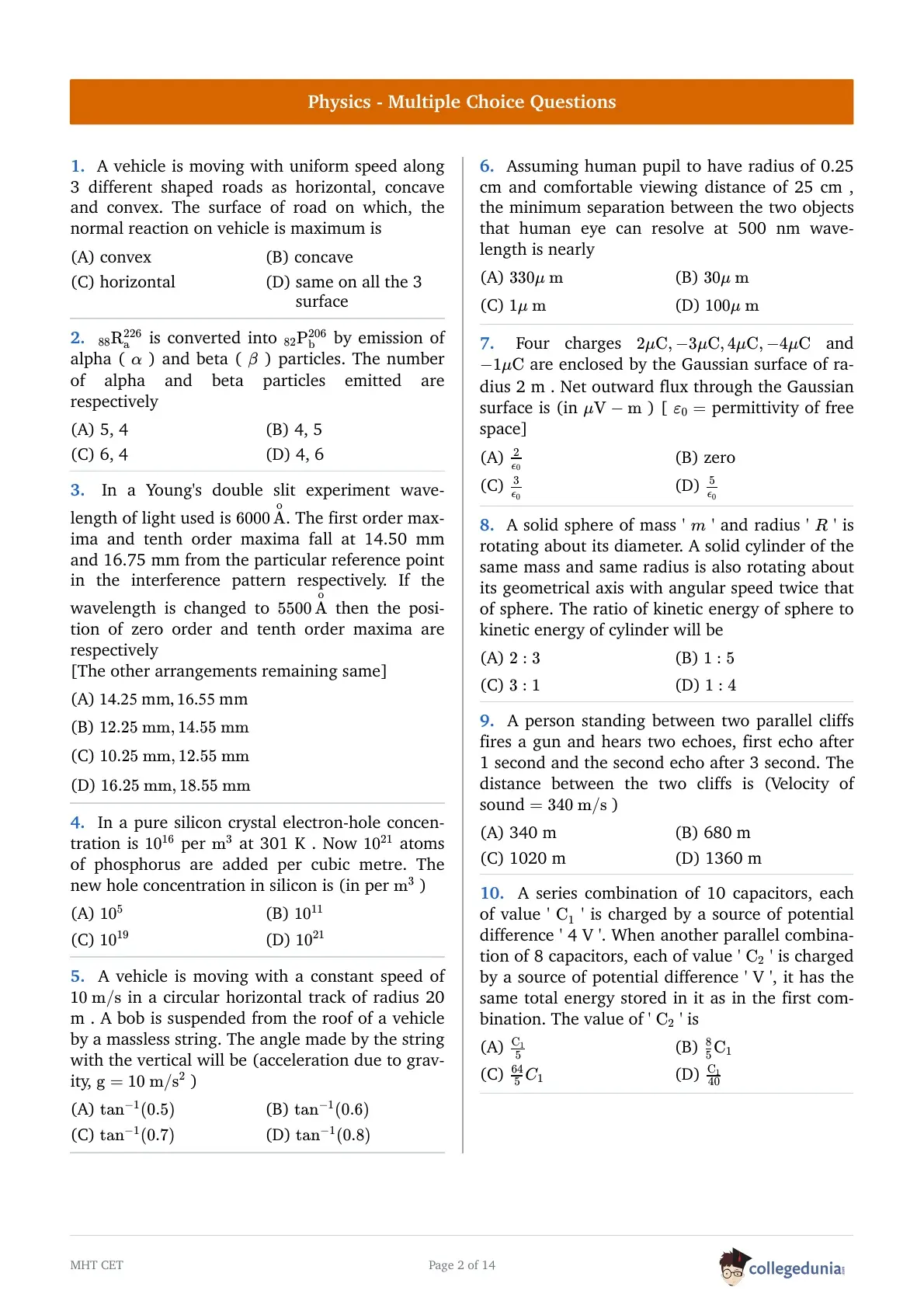
A vehicle is moving with uniform speed along 3 different shaped roads as horizontal, concave and convex. The surface of road on which, the normal reaction on vehicle is maximum is
\(_{88}\text{R}_{\text{a}}^{226}\) is converted into \(_{82}\text{P}_{\text{b}}^{206}\) by emission of alpha ( \(\alpha\) ) and beta ( \(\beta\) ) particles. The number of alpha and beta particles emitted are respectively}
In a Young's double slit experiment wavelength of light used is \(6000\text{\AA}\). The first order maxima and tenth order maxima fall at \(14.50\text{ mm}\) and \(16.75\text{ mm}\) from the particular reference point in the interference pattern respectively. If the wavelength is changed to \(5500\text{\AA}\) then the position of zero order and tenth order maxima are respectively} [The other arrangements remaining same]
In a pure silicon crystal electron-hole concentration is \(10^{16}\) per \(\text{m}^3\) at \(301\text{ K}\) . Now \(10^{21}\) atoms of phosphorus are added per cubic metre. The new hole concentration in silicon is (in per \(\text{m}^3\) )}
A vehicle is moving with a constant speed of \(10\text{ m/s}\) in a circular horizontal track of radius \(20\text{ m}\) . A bob is suspended from the roof of a vehicle by a massless string. The angle made by the string with the vertical will be (acceleration due to gravity, \(g = 10\text{ m/s}^2\) )}
Assuming human pupil to have radius of \(0.25\text{ cm}\) and comfortable viewing distance of \(25\text{ cm}\) , the minimum separation between the two objects that human eye can resolve at \(500\text{ nm}\) wavelength is nearly}
Four charges \(2\mu\text{C}, -3\mu\text{C}, 4\mu\text{C}, -4\mu\text{C}\) and \(-1\mu\text{C}\) are enclosed by the Gaussian surface of radius \(2\text{ m}\) . Net outward flux through the Gaussian surface is (in \(\mu\text{V} - \text{m}\) ) [ \(\epsilon_0 =\) permittivity of free space]}
A solid sphere of mass ' \(m\) ' and radius ' \(R\) ' is rotating about its diameter. A solid cylinder of the same mass and same radius is also rotating about its geometrical axis with angular speed twice that of sphere. The ratio of kinetic energy of sphere to kinetic energy of cylinder will be
A person standing between two parallel cliffs fires a gun and hears two echoes, first echo after \(1\) second and the second echo after \(3\) second. The distance between the two cliffs is (Velocity of sound \(= 340\text{ m/s}\) )
A series combination of \(10\) capacitors, each of value ' \(C_1\) ' is charged by a source of potential difference ' \(4\text{ V}\) '. When another parallel combination of \(8\) capacitors, each of value ' \(C_2\) ' is charged by a source of potential difference ' \(V\) ', it has the same total energy stored in it as in the first combination. The value of ' \(C_2\) ' is
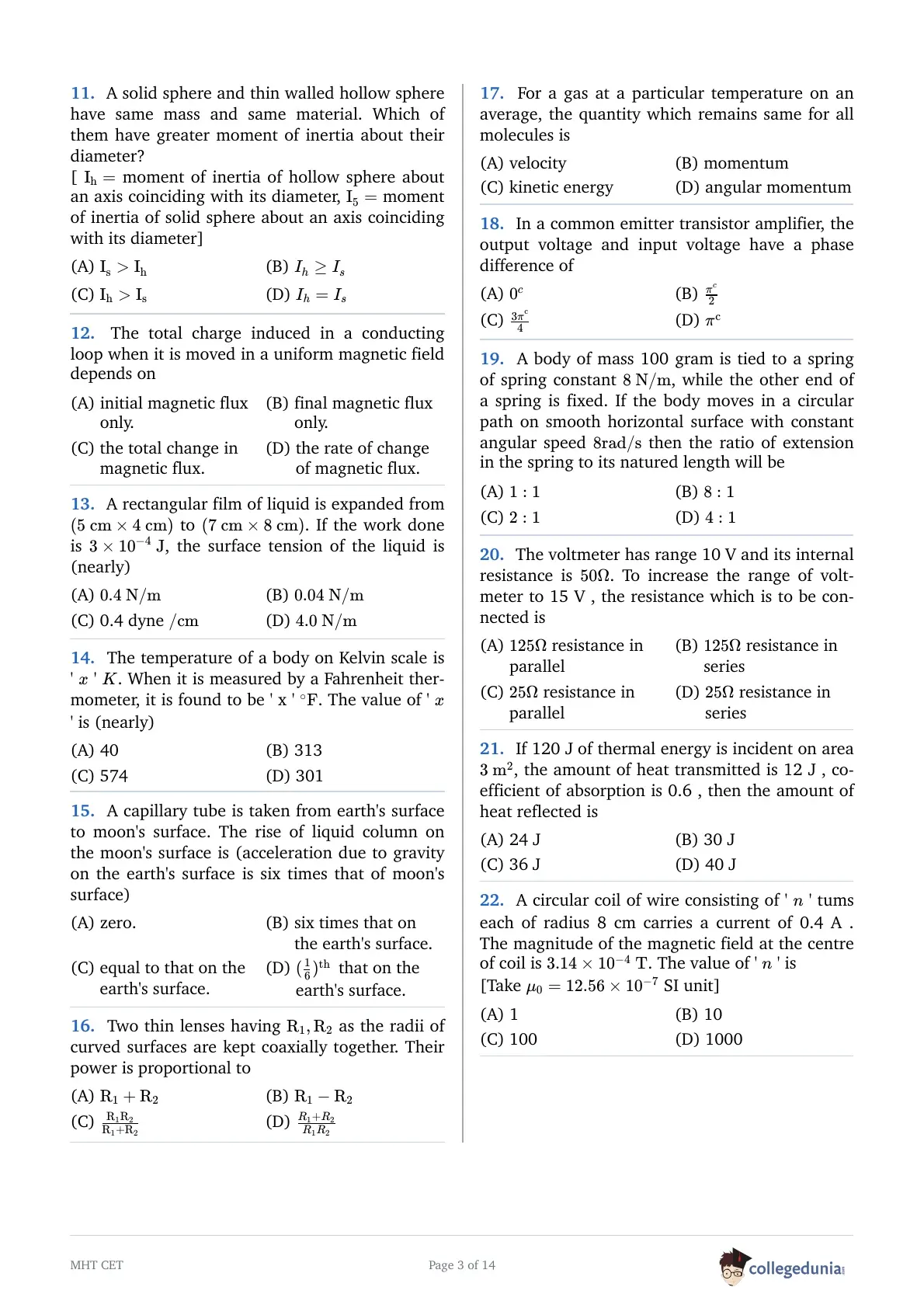
A solid sphere and thin walled hollow sphere have same mass and same material. Which of them have greater moment of inertia about their diameter? [ \(I_h =\) moment of inertia of hollow sphere about an axis coinciding with its diameter, \(I_s =\) moment of inertia of solid sphere about an axis coinciding with its diameter]
The total charge induced in a conducting loop when it is moved in a uniform magnetic field depends on
A rectangular film of liquid is expanded from \((5\text{ cm} \times 4\text{ cm})\) to \((7\text{ cm} \times 8\text{ cm})\). If the work done is \(3 \times 10^{-4}\text{ J}\), the surface tension of the liquid is (nearly)}
The temperature of a body on Kelvin scale is ' \(x\text{ }K\) '. When it is measured by a Fahrenheit thermometer, it is found to be ' \(x\text{ }^\circ\text{F}\) '. The value of ' \(x\) ' is (nearly)}
A capillary tube is taken from earth's surface to moon's surface. The rise of liquid column on the moon's surface is (acceleration due to gravity on the earth's surface is six times that of moon's surface)
Two thin lenses having \(\text{R}_1, \text{R}_2\) as the radii of curved surfaces are kept coaxially together. Their power is proportional to}
For a gas at a particular temperature on an average, the quantity which remains same for all molecules is
In a common emitter transistor amplifier, the output voltage and input voltage have a phase difference of
A body of mass \(100\text{ gram}\) is tied to a spring of spring constant \(8\text{ N/m}\), while the other end of a spring is fixed. If the body moves in a circular path on smooth horizontal surface with constant angular speed \(8\text{rad/s}\) then the ratio of extension in the spring to its natured length will be}
The voltmeter has range \(10\text{ V}\) and its internal resistance is \(50\Omega\). To increase the range of voltmeter to \(15\text{ V}\) , the resistance which is to be connected is
If \(120\text{ J}\) of thermal energy is incident on area \(3\text{ m}^2\), the amount of heat transmitted is \(12\text{ J}\) , coefficient of absorption is \(0.6\) , then the amount of heat reflected is
A circular coil of wire consisting of ' \(n\) ' turns each of radius \(8\text{ cm}\) carries a current of \(0.4\text{ A}\) . The magnitude of the magnetic field at the centre of coil is \(3.14 \times 10^{-4}\text{ T}\). The value of ' \(n\) ' is [Take \(\mu_0 = 12.56 \times 10^{-7}\text{ SI unit}\)]}
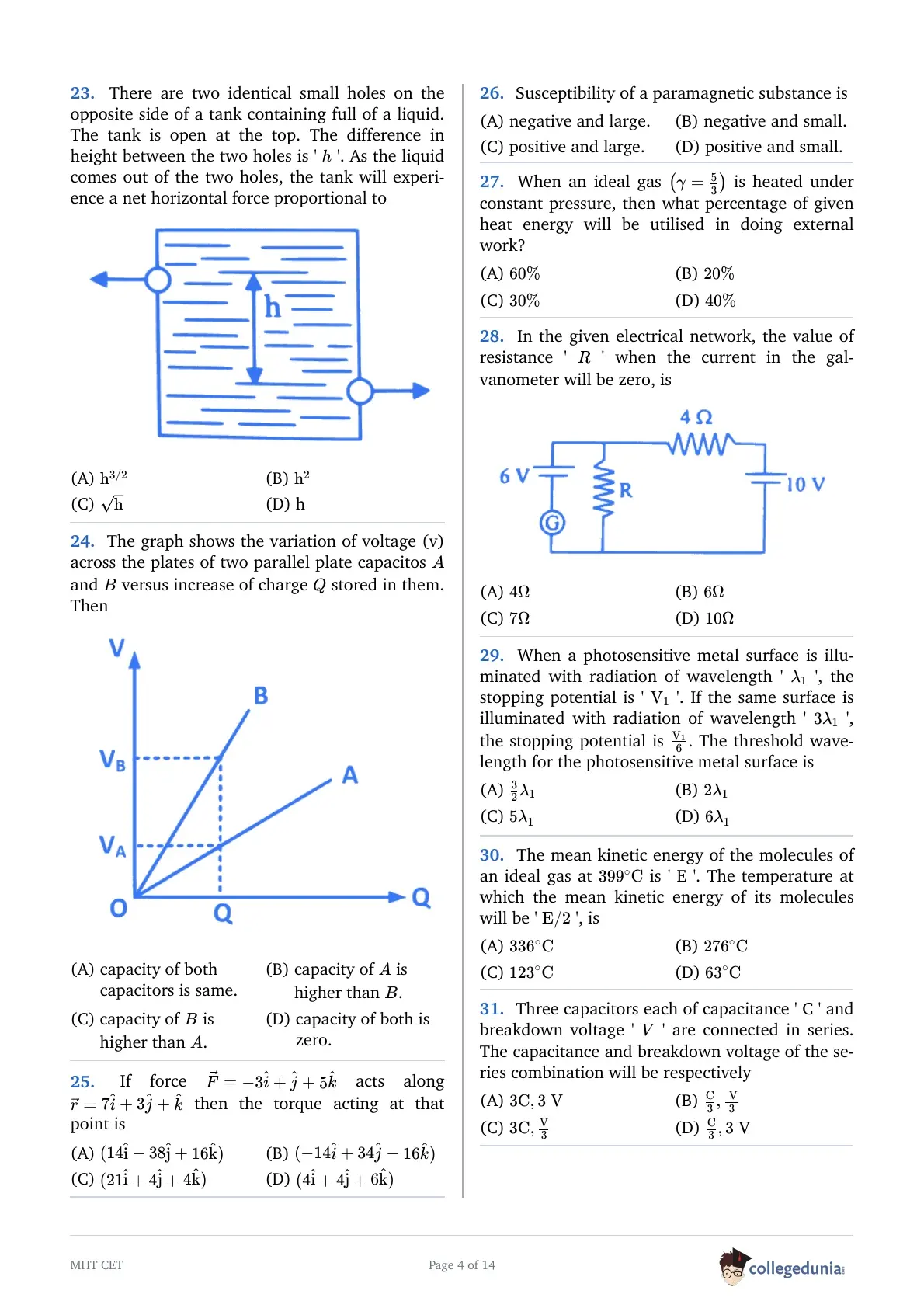
There are two identical small holes on the opposite side of a tank containing full of a liquid. The tank is open at the top. The difference in height between the two holes is ' \(h\) '. As the liquid comes out of the two holes, the tank will experience a net horizontal force proportional to

If force \(\vec{F} = -3\hat{i} + \hat{j} + 5\hat{k}\) acts along \(\vec{r} = 7\hat{i} + 3\hat{j} + \hat{k}\) then the torque acting at that point is
Susceptibility of a paramagnetic substance is
When an ideal gas \((\gamma = \frac{5}{3})\) is heated under constant pressure, then what percentage of given heat energy will be utilised in doing external work?
In the given electrical network, the value of resistance ' \(R\) ' when the current in the galvanometer will be zero, is

When a photosensitive metal surface is illuminated with radiation of wavelength ' \(\lambda_1\) ', the stopping potential is ' \(V_1\) '. If the same surface is illuminated with radiation of wavelength ' \(3\lambda_1\) ', the stopping potential is \(\frac{V_1}{6}\). The threshold wavelength for the photosensitive metal surface is
The mean kinetic energy of the molecules of an ideal gas at \(399^\circ\text{C}\) is ' \(E\) '. The temperature at which the mean kinetic energy of its molecules will be ' \(E/2\) ', is
Three capacitors each of capacitance ' C ' and breakdown voltage ' \(V\) ' are connected in series. The capacitance and breakdown voltage of the series combination will be respectively
Time period of a simple pendulum on earth's surface is ' \(T\) '. It time period becomes ' \(xT\) ' when taken to a height ' \(2R\) ' above earth's surface. The value of \(x\) will be (\(R = \text{radius of earth}\))
A body of mass \(1\text{ kg}\) begins to move under the action of a time dependent force \(\vec{F} = (t\hat{i} + 2t^2\hat{j})\text{ N}\), where \(\hat{i}\) and \(\hat{j}\) are unit vectors along \(x\) and \(y\) axis. The power developed by above force at time \(t = 3\text{ second}\) will be}
The period of oscillating simple pendulum is \(T = 2\pi \sqrt{\frac{l}{g}}\) where length ' \(l\) ' is \(100\text{ cm}\) with error \(1\text{ mm}\) . Period is \(2\text{ second}\). The time of \(100\) oscillations is measured by a stopwatch of least count \(0.1\text{s}\). The percentage error in gravitational acceleration ' \(g\) ' is
If a centre tap transformer is used with two p-n junction diodes for full wave rectification then output voltage of rectifier with respect to each diode is (secondary voltage of transformer \(= V_s\) )
Out of the following transitions in hydrogen atom, identify the transition which emits photons of highest frequency.
An organ pipe has fundamental frequency \(80\text{ Hz}\) . If its one end is closed, the frequencies produced will be (in \(\text{Hz}\) ) (Neglect end correction)}
An a.c. e.m.f. of peak value \(230\text{ V}\) and frequency \(50\text{ Hz}\) is connected to a circuit with \(R = 11.5\Omega, L = 2.5\text{H}\) and a capacitor all in series. The value of capacitance is ' \(C\) ' for the current in the circuit to be maximum. The value of ' \(C\) ' and maximum current are respectively (\(\pi^2 = 10\) )}
A gas undergoes a change in which its pressure ' \(P\) ' and volume ' \(V\) ' are related as \(PV^n = \text{constant}\), where \(n\) is a constant. If the specific heat of the gas in this change is zero, then the value of \(n\) is (\(\gamma = \text{adiabatic ratio}\))}
From photoelectric effect experiment, select the correct statement.
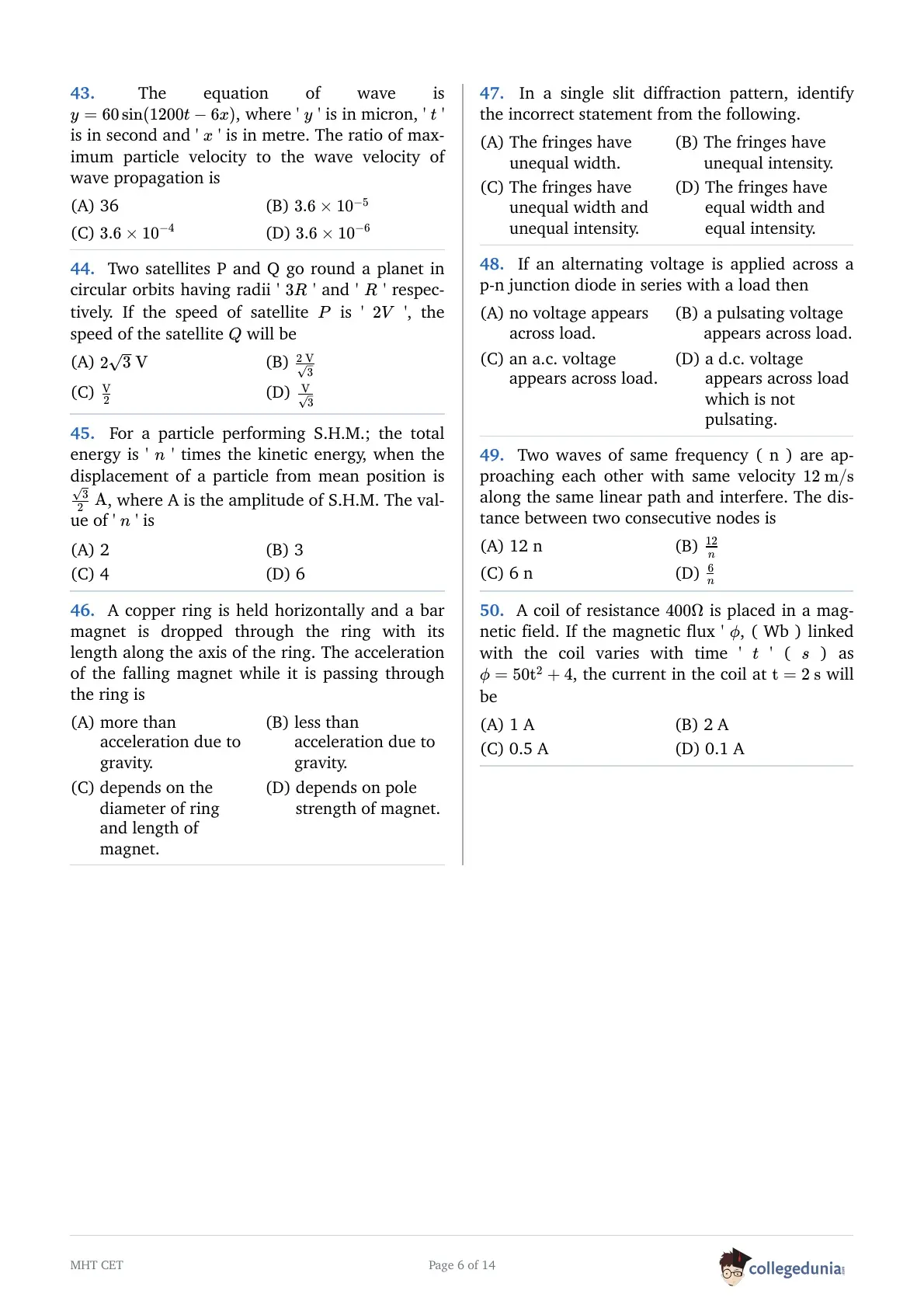
The equation of wave is \(y = 60 \sin(1200t - 6x)\), where ' \(y\) ' is in micron, ' \(t\) ' is in second and ' \(x\) ' is in metre. The ratio of maximum particle velocity to the wave velocity of wave propagation is
Two satellites P and Q go round a planet in circular orbits having radii ' \(3R\) ' and ' \(R\) ' respectively. If the speed of satellite \(P\) is ' \(2V\) ', the speed of the satellite \(Q\) will be
For a particle performing S.H.M.; the total energy is ' \(n\) ' times the kinetic energy, when the displacement of a particle from mean position is \(\frac{\sqrt{3}{2}A\), where A is the amplitude of S.H.M. The value of ' \(n\) ' is
A copper ring is held horizontally and a bar magnet is dropped through the ring with its length along the axis of the ring. The acceleration of the falling magnet while it is passing through the ring is
In a single slit diffraction pattern, identify the incorrect statement from the following.
If an alternating voltage is applied across a p-n junction diode in series with a load then
Two waves of same frequency ( \(n\) ) are approaching each other with same velocity \(12\text{ m/s}\) along the same linear path and interfere. The distance between two consecutive nodes is
A coil of resistance \(400\Omega\) is placed in magnetic field. If the magnetic flux ' \(\phi\) ( Wb ) linked with the coil varies with time ' \(t\) ( s ) is \(\phi = 50t^2 + 4\), the current in the coil at \(t = 2\text{ s}\) will be}
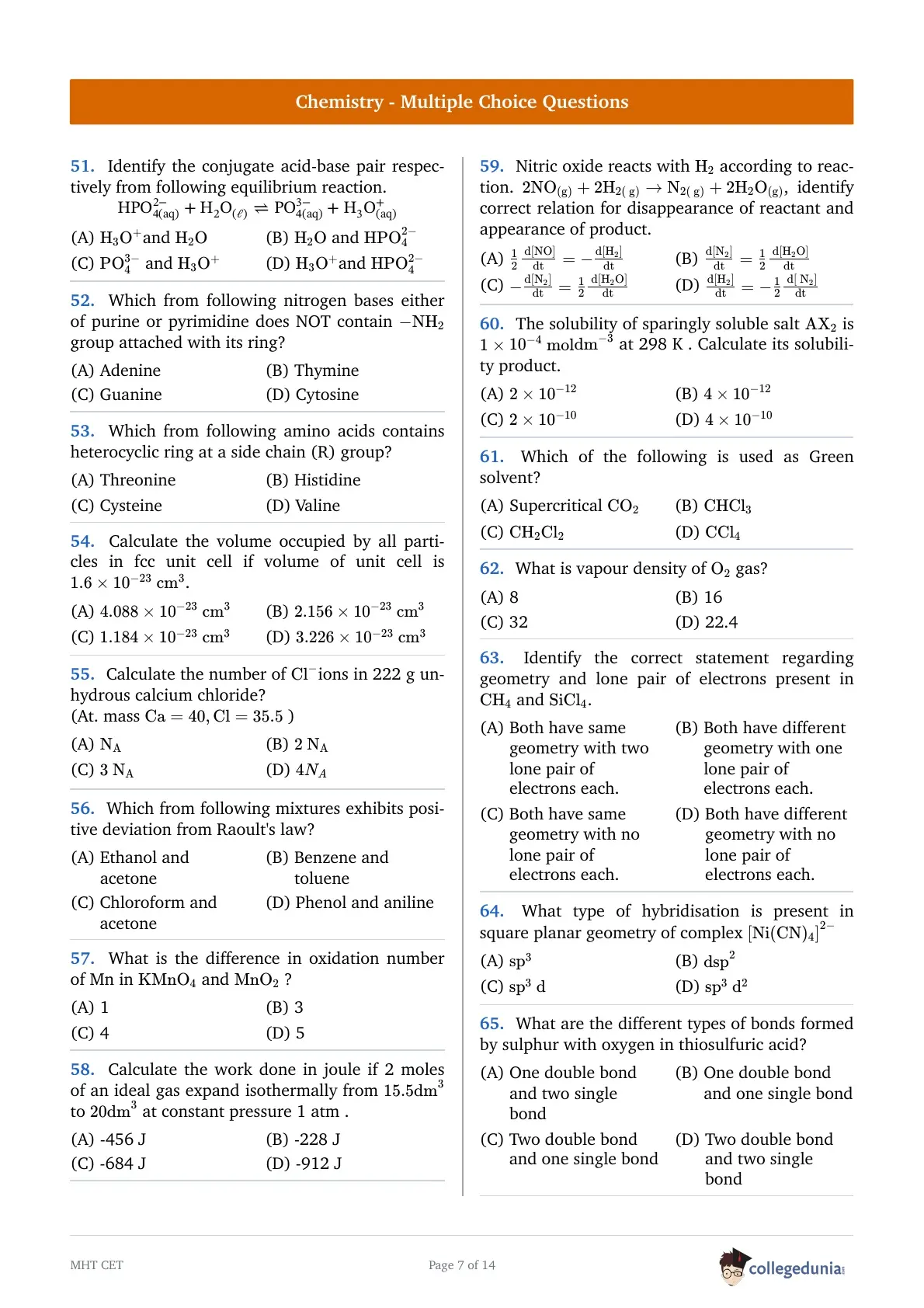
Chemistry (Q51 - Q100)
Identify the conjugate acid-base pair respectively from the following equilibrium reaction:
\[
\text{HPO}_4^{2-}\text{(aq)} + \text{H}_2\text{O}\text{(l)}
\rightleftharpoons
\text{PO}_4^{3-}\text{(aq)} + \text{H}_3\text{O}^{+}\text{(aq)}
\]
Which from following nitrogen bases either of purine or pyrimidine does NOT contain \(-\text{NH}_2\) group attached with its ring?
Which from following amino acids contains heterocyclic ring at a side chain (R) group?
Calculate the volume occupied by all particles in fcc unit cell if volume of unit cell is \(1.6 \times 10^{-23} \text{ cm}^3\).
Calculate the number of \(\text{Cl}^-\) ions in 222 g unhydrous calcium chloride?
(At. mass \(\text{Ca} = 40, \text{Cl} = 35.5\) )
Which from following mixtures exhibits positive deviation from Raoult's law?
What is the difference in oxidation number of Mn in \(\text{KMnO}_4\) and \(\text{MnO}_2\) ?
Calculate the work done in joule if 2 moles of an ideal gas expand isothermally from \(15.5 \text{ dm}^3\) to \(20 \text{ dm}^3\) at constant pressure 1 atm .
Nitric oxide reacts with \( \text{H}_2 \) according to the reaction:
\[ 2\text{NO}_{\text{(g)}} + 2\text{H}_2{}_{\text{(g)}} \rightarrow \text{N}_2{}_{\text{(g)}} + 2\text{H}_2\text{O}_{\text{(g)}} \] Identify the correct relation for the disappearance of reactants and appearance of products.
The solubility of sparingly soluble salt \(\text{AX}_2\) is \(1 \times 10^{-4} \text{ mol dm}^{-3}\) at 298 K . Calculate its solubility product.
Which of the following is used as Green solvent?
What is vapour density of \(\text{O}_2\) gas?
Identify the correct statement regarding geometry and lone pair of electrons present in \(\text{CH}_4\) and \(\text{SiCl}_4\).
What type of hybridisation is present in the square planar geometry of the complex \( [\text{Ni}(\text{CN})_4]^{2-} \)?
What are the different types of bonds formed by sulphur with oxygen in thiosulfuric acid?
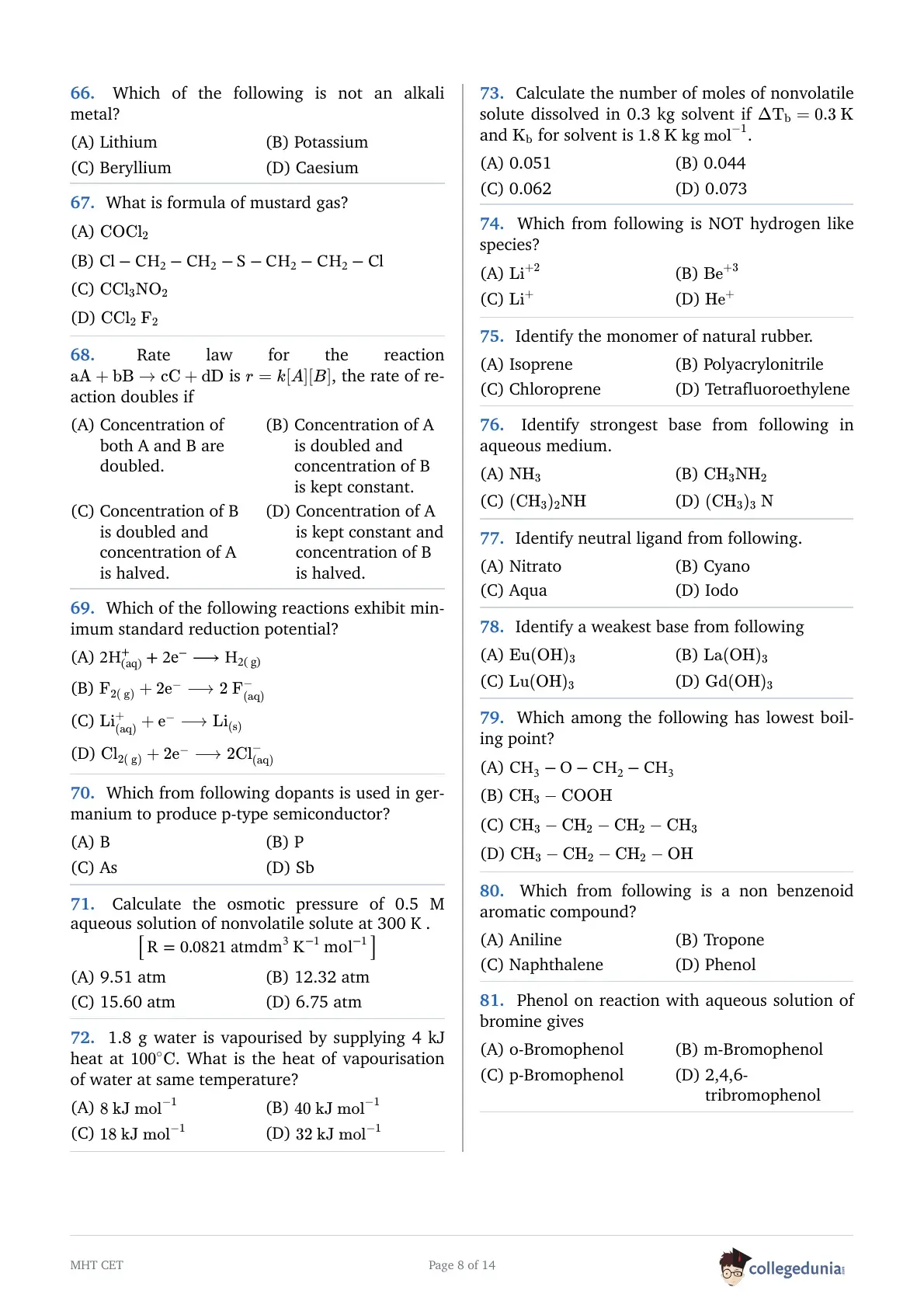
Which of the following is not an alkali metal?
What is formula of mustard gas?
Rate law for the reaction \(\text{aA} + \text{bB} \rightarrow \text{cC} + \text{dD}\) is \(r = k[A][B]\), the rate of reaction doubles if
Which of the following reactions exhibit minimum standard reduction potential?
Which from following dopants is used in germanium to produce p-type semiconductor?
Calculate the osmotic pressure of 0.5 M aqueous solution of nonvolatile solute at 300 K .
\(\left[ \text{R} = 0.0821 \text{ atm dm}^3 \text{ K}^{-1} \text{ mol}^{-1} \right]\)
1.8 g water is vapourised by supplying 4 kJ heat at \(100^\circ\text{C}\). What is the heat of vapourisation of water at same temperature?
Calculate the number of moles of nonvolatile solute dissolved in 0.3 kg solvent if \(\Delta\text{T}_\text{b} = 0.3 \text{ K}\) and \(\text{K}_\text{b}\) for solvent is \(1.8 \text{ K kg mol}^{-1}\).
Which from following is NOT hydrogen like species?
Identify the monomer of natural rubber.
Identify strongest base from following in aqueous medium.
Identify neutral ligand from following.
Identify a weakest base from following
Which among the following has lowest boiling point?
Which from following is a non benzenoid aromatic compound?
Phenol on reaction with aqueous solution of bromine gives
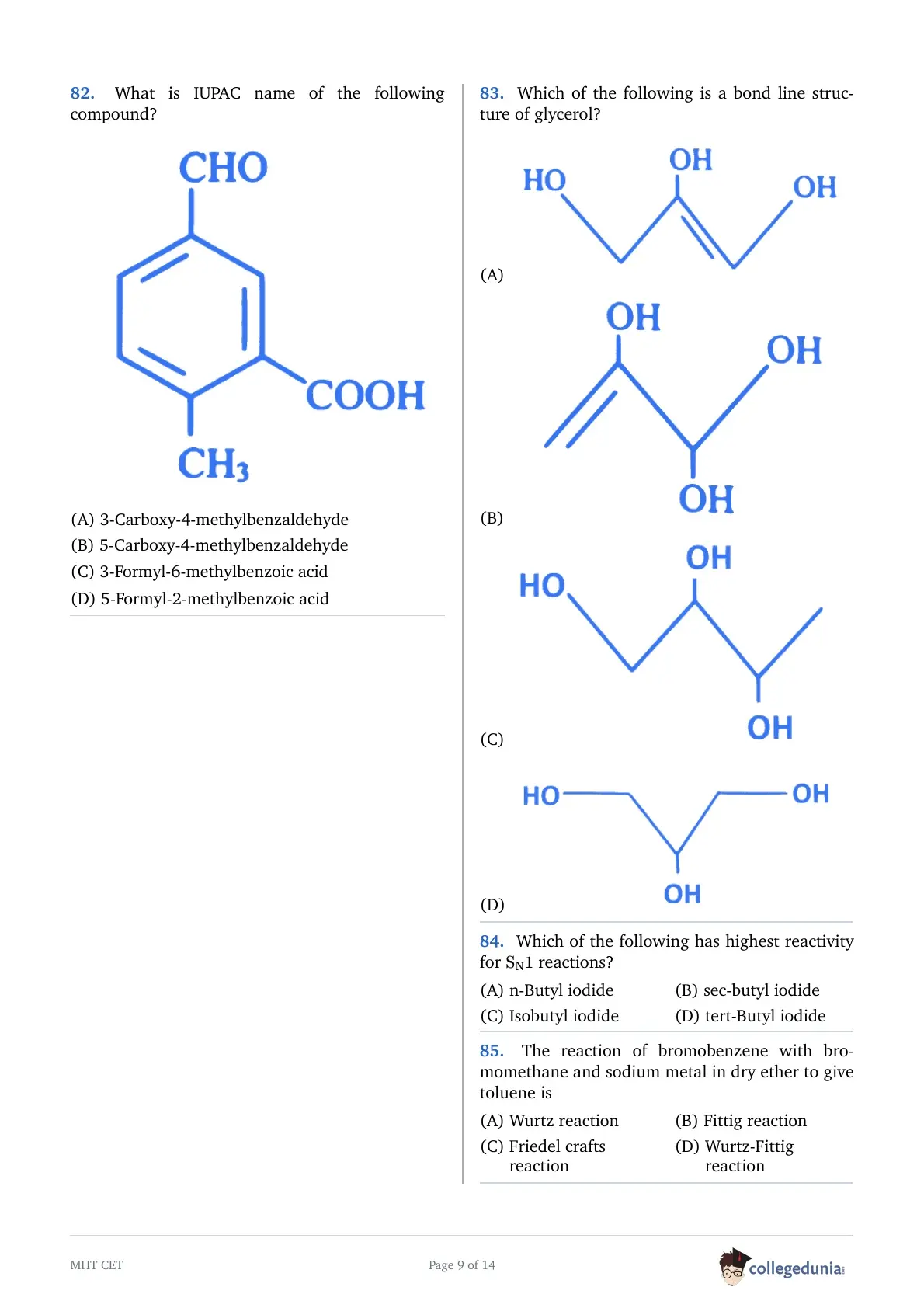
Which of the following has highest reactivity for \(\text{S}_{\text{N}}1\) reactions?
The reaction of bromobenzene with bromomethane and sodium metal in dry ether to give toluene is
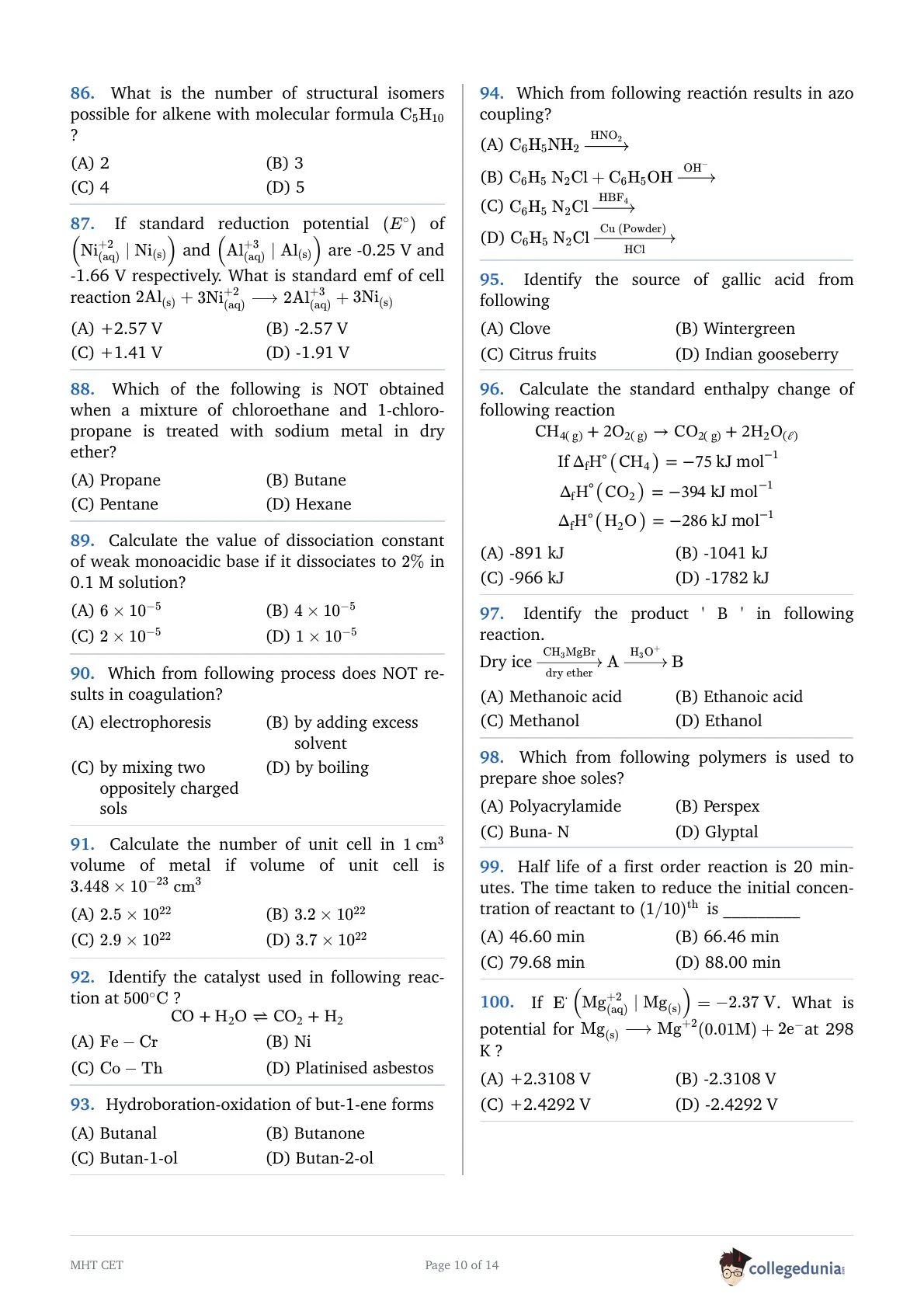
What is the number of structural isomers possible for alkene with molecular formula \(\text{C}_5\text{H}_{10}\) ?
If the standard reduction potential (\( E^\circ \)) of \( \left( \text{Ni}^{2+}_{\text{(aq)}} \mid \text{Ni}_{\text{(s)}} \right) \) and \( \left( \text{Al}^{3+}_{\text{(aq)}} \mid \text{Al}_{\text{(s)}} \right) \) are \( -0.25 \, \text{V} \) and \( -1.66 \, \text{V} \) respectively, then what is the standard emf of the cell reaction?
\[ 2\text{Al}_{\text{(s)}} + 3\text{Ni}^{2+}_{\text{(aq)}} \longrightarrow 2\text{Al}^{3+}_{\text{(aq)}} + 3\text{Ni}_{\text{(s)}} \]
Which of the following is NOT obtained when a mixture of chloroethane and 1-chloropropane is treated with sodium metal in dry ether?
Calculate the value of dissociation constant of weak monoacidic base if it dissociates to 2% in 0.1 M solution?
Which from following process does NOT results in coagulation?
Calculate the number of unit cell in \(1 \text{ cm}^3\) volume of metal if volume of unit cell is \(3.448 \times 10^{-23} \text{ cm}^3\)
Identify the catalyst used in following reaction at \(500^\circ\text{C}\) ?
\(\text{CO} + \text{H}_2\text{O} \rightleftharpoons \text{CO}_2 + \text{H}_2\)
Hydroboration-oxidation of but-1-ene forms
Which from following reaction results in azo coupling?
Identify the source of gallic acid from following
Calculate the standard enthalpy change of the following reaction:
\[ \text{CH}_4{}_{\text{(g)}} + 2\text{O}_2{}_{\text{(g)}} \rightarrow \text{CO}_2{}_{\text{(g)}} + 2\text{H}_2\text{O}_{\text{(l)}} \]
If:
\[ \Delta_f H^\circ (\text{CH}_4) = -75 \, \text{kJ mol}^{-1} \] \[ \Delta_f H^\circ (\text{CO}_2) = -394 \, \text{kJ mol}^{-1} \] \[ \Delta_f H^\circ (\text{H}_2\text{O}) = -286 \, \text{kJ mol}^{-1} \]
Identify the product ' B ' in following reaction.
\(\text{Dry ice} \xrightarrow[\text{dry ether}]{\text{CH}_3\text{MgBr}} \text{A} \xrightarrow{\text{H}_3\text{O}^+} \text{B}\)
Which from following polymers is used to prepare shoe soles?
Half-life of a first-order reaction is 20 minutes. The time taken to reduce the initial concentration of the reactant to \( \left(\frac{1}{10}\right)^{\text{th}} \) of its initial value is __________.
If the standard reduction potential is \( E^\circ \left( \text{Mg}^{2+}_{\text{(aq)}} \mid \text{Mg}_{\text{(s)}} \right) = -2.37 \, \text{V} \), then what is the electrode potential for the following reaction at \( 298 \, \text{K} \)?
\[ \text{Mg}_{\text{(s)}} \longrightarrow \text{Mg}^{2+}_{\text{(aq)}}(0.01\,\text{M}) + 2e^- \]
Mathematics (Q101 - Q150)
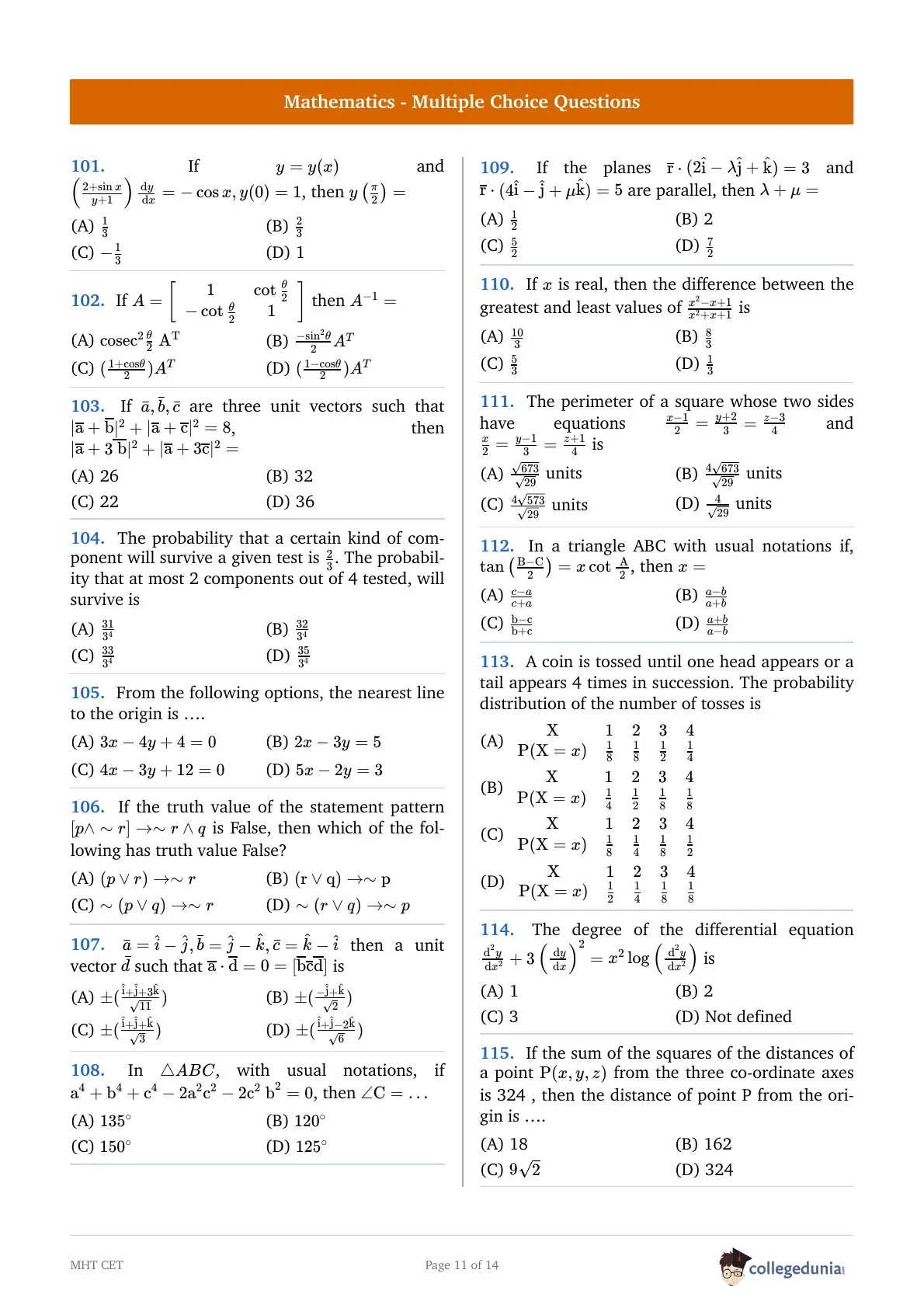
If \( y = y(x) \) and \[ \left( \frac{2+\sin x}{y+1} \right)\frac{dy}{dx} = -\cos x, \] with the initial condition \( y(0) = 1 \), then find \[ y\left(\frac{\pi}{2}\right) = \, ? \]
If \(A = \left[ \begin{array}{cc} 1 & \cot \frac{\theta}{2} \\ -\cot \frac{\theta}{2} & 1 \end{array} \right]\) then \(A^{-1} =\)
If \(\bar{a}, \bar{b}, \bar{c}\) are three unit vectors such that \(|\bar{a} + \bar{b}|^2 + |\bar{a} + \bar{c}|^2 = 8\), then \(|\bar{a} + 3\bar{b}|^2 + |\bar{a} + 3\bar{c}|^2 =\)
The probability that a certain kind of component will survive a given test is \(\frac{2}{3}\). The probability that at most \(2\) components out of \(4\) tested, will survive is
From the following options, the nearest line to the origin is ....
If the truth value of the statement pattern \([p \wedge \sim r] \to \sim r \wedge q\) is False, then which of the following has truth value False?
\(\bar{a} = \hat{i} - \hat{j}, \bar{b} = \hat{j} - \hat{k}, \bar{c} = \hat{k} - \hat{i}\) then a unit vector \(\bar{d}\) such that \(\bar{a} \cdot \bar{d} = 0 = [\bar{b} \bar{c} \bar{d}]\) is
In \(\triangle ABC\), with usual notations, if \(a^4 + b^4 + c^4 - 2a^2 c^2 - 2c^2 b^2 = 0\), then \(\angle C = \dots\)
If the planes \(\bar{r} \cdot (2\hat{i} - \lambda\hat{j} + \hat{k}) = 3\) and \(\bar{r} \cdot (4\hat{i} - \hat{j} + \mu\hat{k}) = 5\) are parallel, then \(\lambda + \mu =\)
If \(x\) is real, then the difference between the greatest and least values of \(\frac{x^2 - x + 1}{x^2 + x + 1}\) is
The perimeter of a square whose two sides have equations \(\frac{x-1}{2} = \frac{y+2}{3} = \frac{z-3}{4}\) and \(\frac{x}{2} = \frac{y-1}{3} = \frac{z+1}{4}\) is
In a triangle \( ABC \) with usual notations, if \[ \tan \left( \frac{B-C}{2} \right) = x \cot \left( \frac{A}{2} \right), \] then \( x = \, ? \)
A coin is tossed until one head appears or a tail appears 4 times in succession. The probability distribution of the number of tosses is
The degree of the differential equation \(\frac{d^2y}{dx^2} + 3 \left( \frac{dy}{dx} \right)^2 = x^2 \log \left( \frac{d^2y}{dx^2} \right)\) is
If the sum of the squares of the distances of a point \(P(x, y, z)\) from the three co-ordinate axes is \(324\), then the distance of point \(P\) from the origin is ....
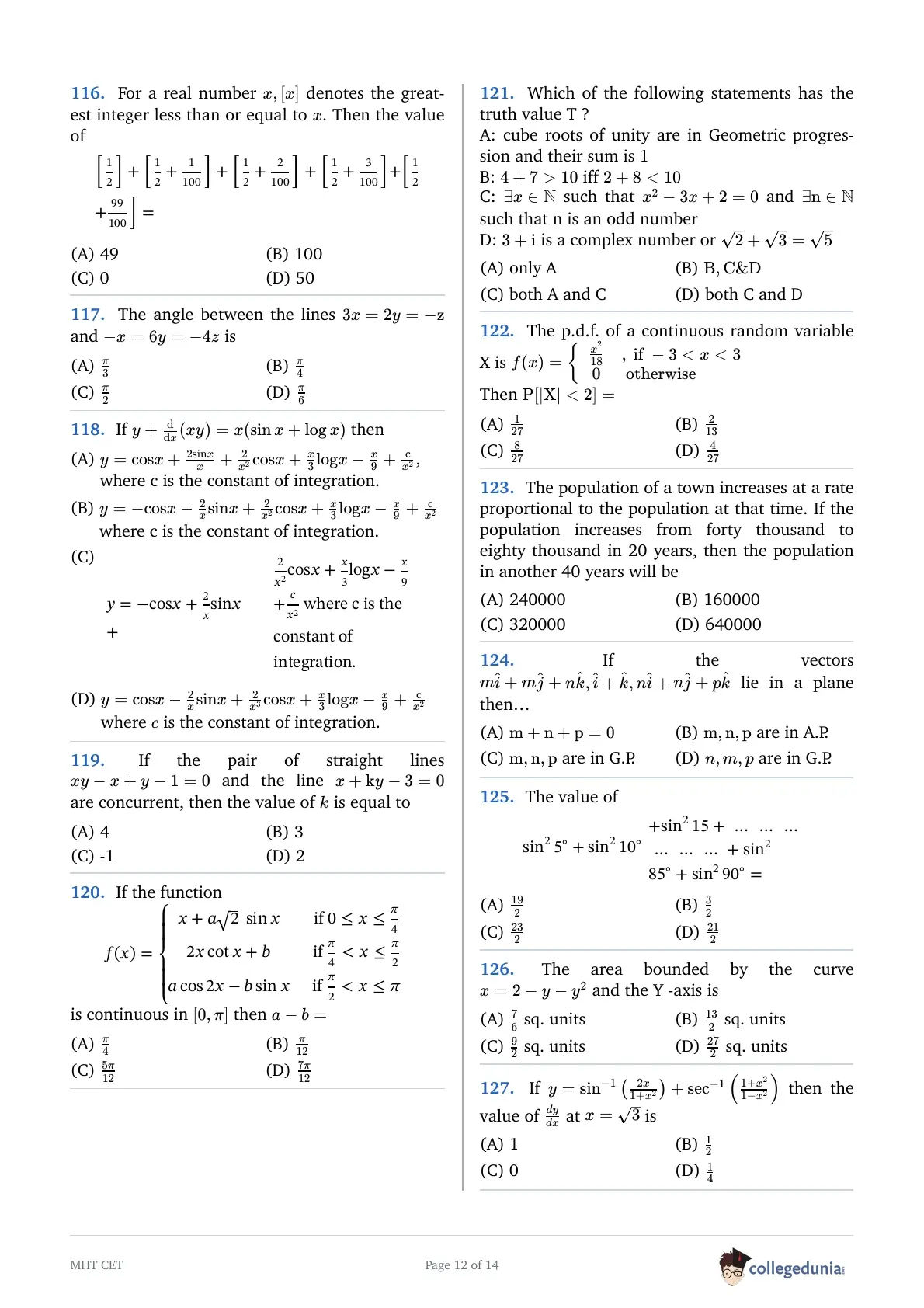
For a real number \(x\), \([x]\) denotes the greatest integer less than or equal to \(x\). Then the value of \(\left[ \frac{1}{2} \right] + \left[ \frac{1}{2} + \frac{1}{100} \right] + \left[ \frac{1}{2} + \frac{2}{100} \right] + \dots + \left[ \frac{1}{2} + \frac{99}{100} \right] =\)
The angle between the lines \(3 x=2 y=-\mathrm{z}\) and \(-x=6 y=-4 z\) is
If the pair of straight lines \(xy - x + y - 1 = 0\) and the line \(x + ky - 3 = 0\) are concurrent, then the value of \(k\) is equal to
If the function
\[f(x)=\left\{\begin{array}{cc} x+a \sqrt{2} \sin x & \text { if } 0 \leq x \leq \frac{\pi}{4} \\ 2 x \cot x+b & \text { if } \frac{\pi}{4} < x \leq \frac{\pi}{2} \\ a \cos 2 x-b \sin x & \text { if } \frac{\pi}{2} < x \leq \pi \end{array}\right.\]
is continuous in \([0, \pi]\) then \(a-b=\)
Which of the following statements has the truth value \(T\)?
A. Cube roots of unity are in Geometric Progression and their sum is \(1\)
B. \[ 4 + 7 > 10 \iff 2 + 8 < 10 \]
C. \[ \exists x \in \mathbb{N} \text{ such that } x^2 - 3x + 2 = 0 \text{ and } \exists n \in \mathbb{N} \text{ such that } n \text{ is an odd number} \]
D. \[ 3+i \text{ is a complex number } \; \text{or} \; \sqrt{2}+\sqrt{3}=\sqrt{5} \]
The p.d.f. of a continuous random variable \(X\) is \(f(x)\).
\[ f(x)= \begin{cases} \dfrac{x^2}{18}, & -3 \le x \le 3 \\ 0, & \text{otherwise} \end{cases} \] Then find \(P(|X|<2)\).
The population of a town increases at a rate proportional to the population at that time. If the population increases from forty thousand to eighty thousand in 20 years, then the population in another 40 years will be
If the vectors \(m\hat{i} + m\hat{j} + n\hat{k}, \hat{i} + \hat{k}, n\hat{i} + n\hat{j} + p\hat{k}\) lie in a plane then...
The value of \(\sin^2 5^\circ + \sin^2 10^\circ + \dots + \sin^2 85^\circ + \sin^2 90^\circ =\)
The area bounded by the curve \(x = 2 - y - y^2\) and the Y-axis is
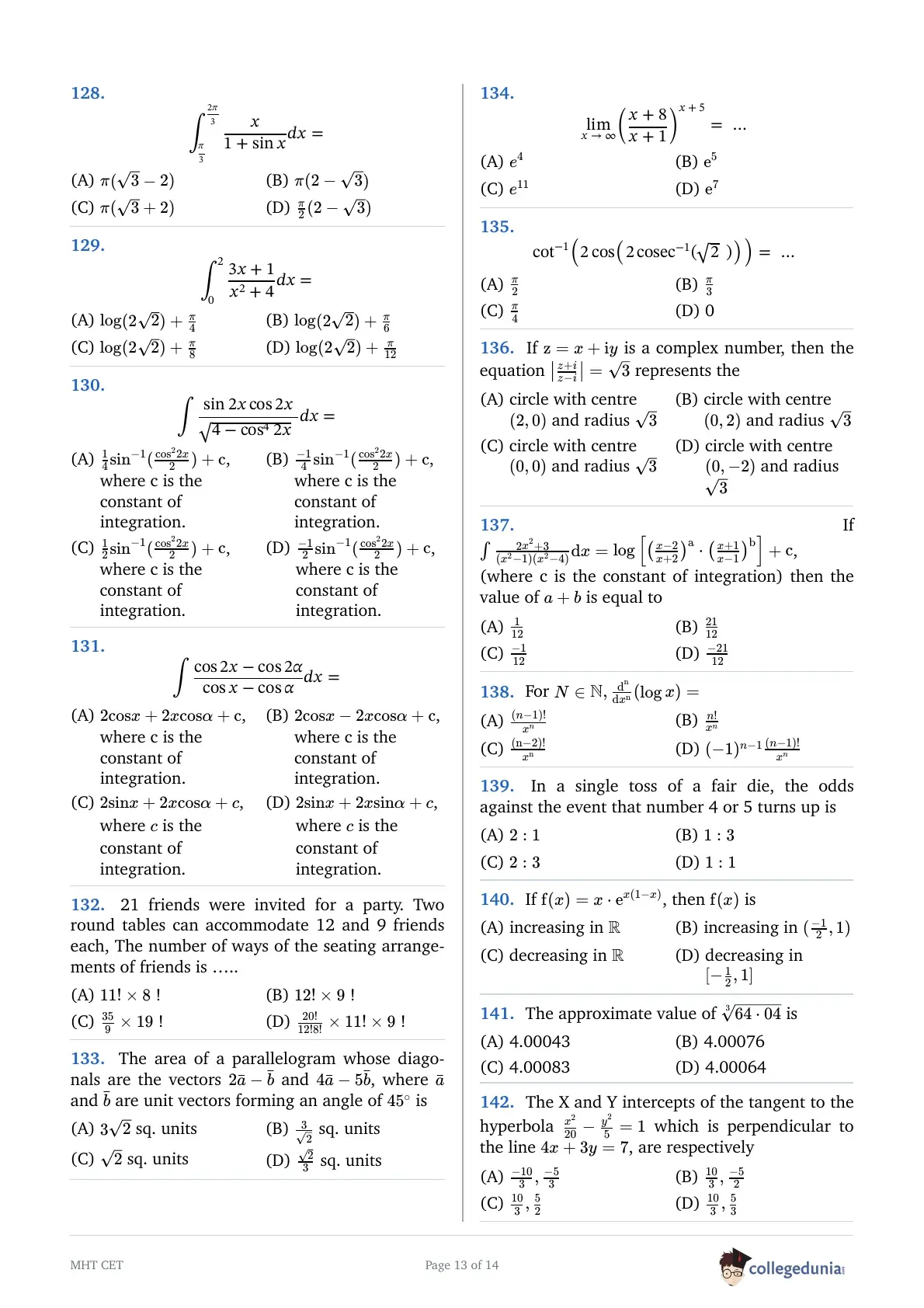
\[ \int_{\frac{\pi}{3}}^{\frac{2 \pi}{3}} \frac{x}{1+\sin x} d x= \]
\(\int_0^2 \frac{3x+1}{x^2+4} dx\)
\(\int \frac{\cos 2x - \cos 2\alpha}{\cos x - \cos \alpha} dx =\)
21 friends were invited for a party. Two round tables can accommodate 12 and 9 friends each, The number of ways of the seating arrangements of friends is .....
The area of a parallelogram whose diagonals are the vectors \(2\bar{a} - \bar{b}\) and \(4\bar{a} - 5\bar{b}\), where \(\bar{a}\) and \(\bar{b}\) are unit vectors forming an angle of \(45^\circ\) is
Evaluate: \[ \lim_{x \to \infty} \left( \frac{x+8}{x+1} \right)^{x+5} = \, ? \]
\(\cot^{-1} (2 \cos(2 \text{cosec}^{-1}(\sqrt{2}))) = \dots\)
If \(z = x + iy\) is a complex number, then the equation \(\left| \frac{z+i}{z-i} \right| = \sqrt{3}\) represents the
If \[ \int \frac{2x^2+3}{(x^2-1)(x^2-4)} \, dx = \log \left[ \left( \frac{x-2}{x+2} \right)^a \cdot \left( \frac{x+1}{x-1} \right)^b \right] + c \] where \( c \) is the constant of integration, then the value of \[ a+b = \, ? \]
For \(N \in \mathbb{N}, \frac{d^n}{dx^n} (\log x) =\)
In a single toss of a fair die, the odds against the event that number 4 or 5 turns up is
The approximate value of \(\sqrt[3]{64.04}\) is
The X and Y intercepts of the tangent to the hyperbola \(\frac{x^2}{20} - \frac{y^2}{5} = 1\) which is perpendicular to the line \(4x + 3y = 7\), are respectively
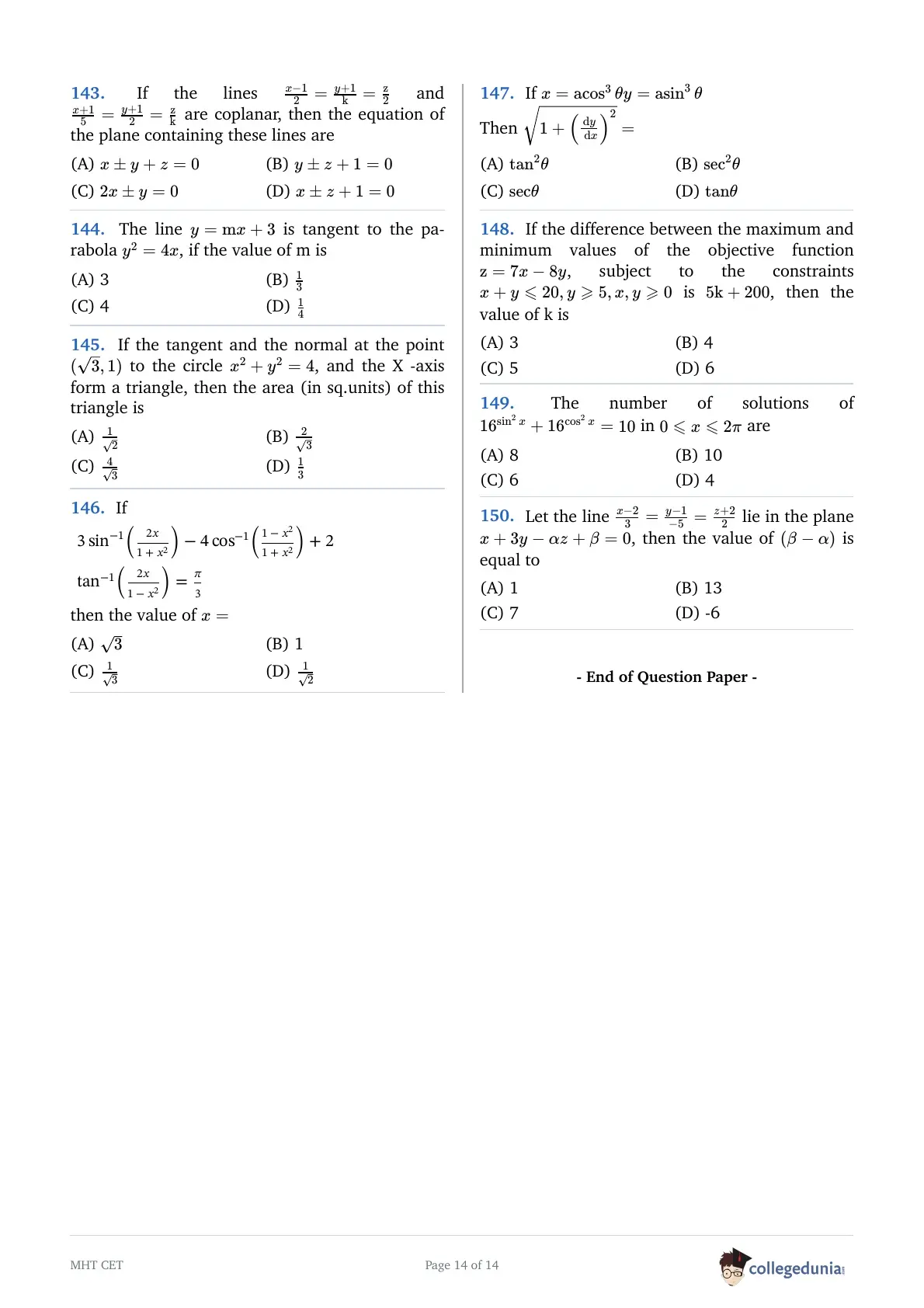
If the lines \(\frac{x-1}{2} = \frac{y+1}{k} = \frac{z}{2}\) and \(\frac{x+1}{5} = \frac{y+1}{2} = \frac{z}{k}\) are coplanar, then the equation of the plane containing these lines are
The line \(y = mx + 3\) is tangent to the parabola \(y^2 = 4x\), if the value of m is
If the tangent and the normal at the point \((\sqrt{3}, 1)\) to the circle \(x^2 + y^2 = 4\), and the X-axis form a triangle, then the area (in sq.units) of this triangle is
If \[ 3\sin^{-1}\left(\frac{2x}{1+x^2}\right) - 4\cos^{-1}\left(\frac{1-x^2}{1+x^2}\right) + 2\tan^{-1}\left(\frac{2x}{1-x^2}\right) = \frac{\pi}{3}, \] then the value of \[ x = \, ? \]
If \(x=\operatorname{acos}^3 \theta y=\operatorname{asin}^3 \theta\)
Then \(\sqrt{1+\left(\frac{\mathrm{d} y}{\mathrm{~d} x}\right)^2}=\)
If the difference between the maximum and minimum values of the objective function \(z = 7x - 8y\), subject to the constraints \(x + y \le 20, y \ge 5, x, y \ge 0\) is \(5k + 200\), then the value of k is
The number of solutions of \(16^{\sin^2 x} + 16^{\cos^2 x} = 10\) in \(0 \le x \le 2\pi\) are
Let the line \(\frac{x-2}{3} = \frac{y-1}{-5} = \frac{z+2}{2}\) lie in the plane \(x + 3y - \alpha z + \beta = 0\), then the value of \((\beta - \alpha)\) is equal to
MHT CET 2025 PCM Exam Pattern and Marking Scheme
| Parameter | Details |
|---|---|
| Conducting Body | Maharashtra Common Entrance Test Cell (Maharashtra CET Cell) |
| Exam Mode | Online (Computer-Based Test) |
| Duration | 180 minutes (3 hours) |
| Groups / Subjects | PCM (Physics, Chemistry, Mathematics) for Engineering |
| Total Questions |
150 |
| Total Marks | 200 |
| Question Type | Multiple Choice Questions (MCQs) |
| Marks Distribution |
|
| Negative Marking | No |
| Syllabus Weightage |
|



Comments