




MHT CET 2025 April 19 Shift 1 PCM Question Paper is available for download here. Maharashtra State CET Cell conducted MHT CET 2025 PCM Exam on April 19 in Shift 1 from 9 AM to 12 PM in CBT mode.
The MHT CET 2025 PCM question paper includes the following:
- The MHT CET 2025 PCM Question Paper consists of 150 multiple-choice questions (MCQs) totalling 200 marks divided into 3 sections: Physics, Chemistry, and Mathematics, with 50 questions in each subject.
- Physics and Chemistry questions carry 1 mark each while Mathematics questions carry 2 marks each.
- There is no negative marking for incorrect answers.
MHT CET 2025 April 19 Shift 1 PCM Question Paper with Solution PDF
| CD PDF | CD PDF with Solutions |
|---|---|
| Download Collegedunia PDF 0.91 MB | - |
Also Check:
MHT CET 2025 April 19 Shift 1 PCM Questions with Solutions
Physics (Q1 - Q50)
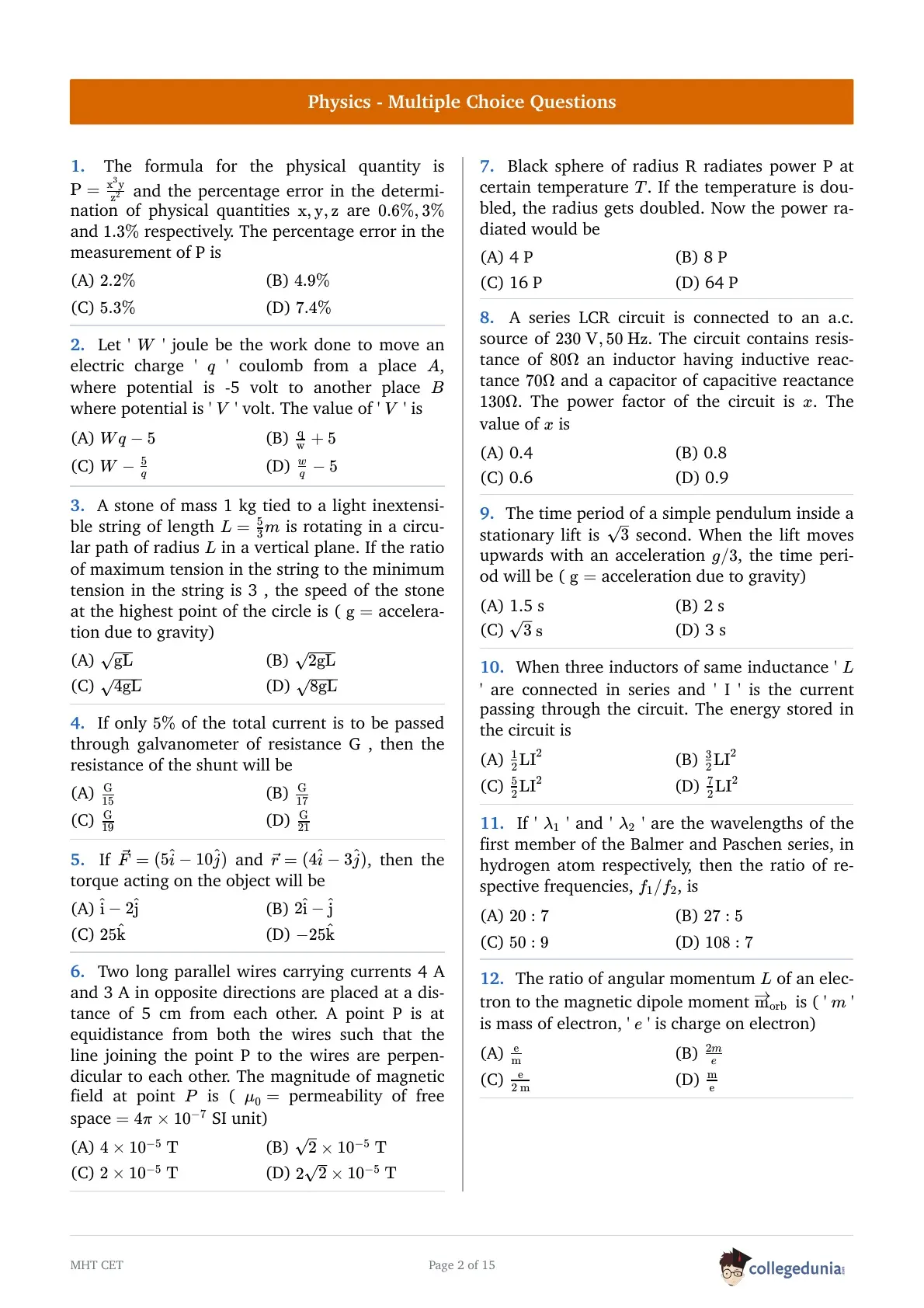
The formula for the physical quantity is \(P = \frac{x^3 y}{z^2}\) and the percentage error in the determination of physical quantities \(x, y, z\) are \(0.6%, 3%\) and \(1.3%\) respectively. The percentage error in the measurement of \(P\) is
Let '\(W\)' joule be the work done to move an electric charge '\(q\)' coulomb from a place \(A\), where potential is \(-5\text{ volt}\) to another place \(B\) where potential is '\(V\)' volt. The value of '\(V\)' is
A stone of mass \(1\text{ kg}\) tied to a light inextensible string of length \(L = \frac{5}{3}\text{ m}\) is rotating in a circular path of radius \(L\) in a vertical plane. If the ratio of maximum tension in the string to the minimum tension in the string is 3 , the speed of the stone at the highest point of the circle is ( \(g =\) acceleration due to gravity)
If only \(5%\) of the total current is to be passed through galvanometer of resistance \(\text{G}\) , then the resistance of the shunt will be
If \(\vec{F} = (5\hat{i} - 10\hat{j})\) and \(\vec{r} = (4\hat{i} - 3\hat{j})\), then the torque acting on the object will be
Two long parallel wires carrying currents \(4\text{ A}\) and \(3\text{ A}\) in opposite directions are placed at a distance of \(5\text{ cm}\) from each other. A point \(P\) is at equidistance from both the wires such that the line joining the point \(P\) to the wires are perpendicular to each other. The magnitude of magnetic field at point \(P\) is ( \(\mu_0 = 4\pi \times 10^{-7}\) SI unit )
Black sphere of radius \(\text{R}\) radiates power \(\text{P}\) at certain temperature \(T\). If the temperature is doubled, the radius gets doubled. Now the power radiated would be
A series LCR circuit is connected to an a.c. source of \(230\text{ V}, 50\text{ Hz}\). The circuit contains resistance of \(80\Omega\), inductive reactance \(70\Omega\) and capacitive reactance \(130\Omega\). The power factor of the circuit is \(x\). The value of \(x\) is
The time period of a simple pendulum inside a stationary lift is \(\sqrt{3}\) second. When the lift moves upwards with an acceleration \(g/3\), the time period will be ( \(g =\) acceleration due to gravity)
When three inductors of same inductance '\(L\)' are connected in series and '\(I\)' is the current passing through the circuit. The energy stored in the circuit is
If '\(\lambda_1\)' and '\(\lambda_2\)' are the wavelengths of the first member of the Balmer and Paschen series, in hydrogen atom respectively, then the ratio of respective frequencies, \(f_1/f_2\) , is
The ratio of angular momentum \(L\) of an electron to the magnetic dipole moment \(\vec{\text{m}}_{\text{orb}}\) is ( '\(m\)' is mass of electron, '\(e\)' is charge on electron)
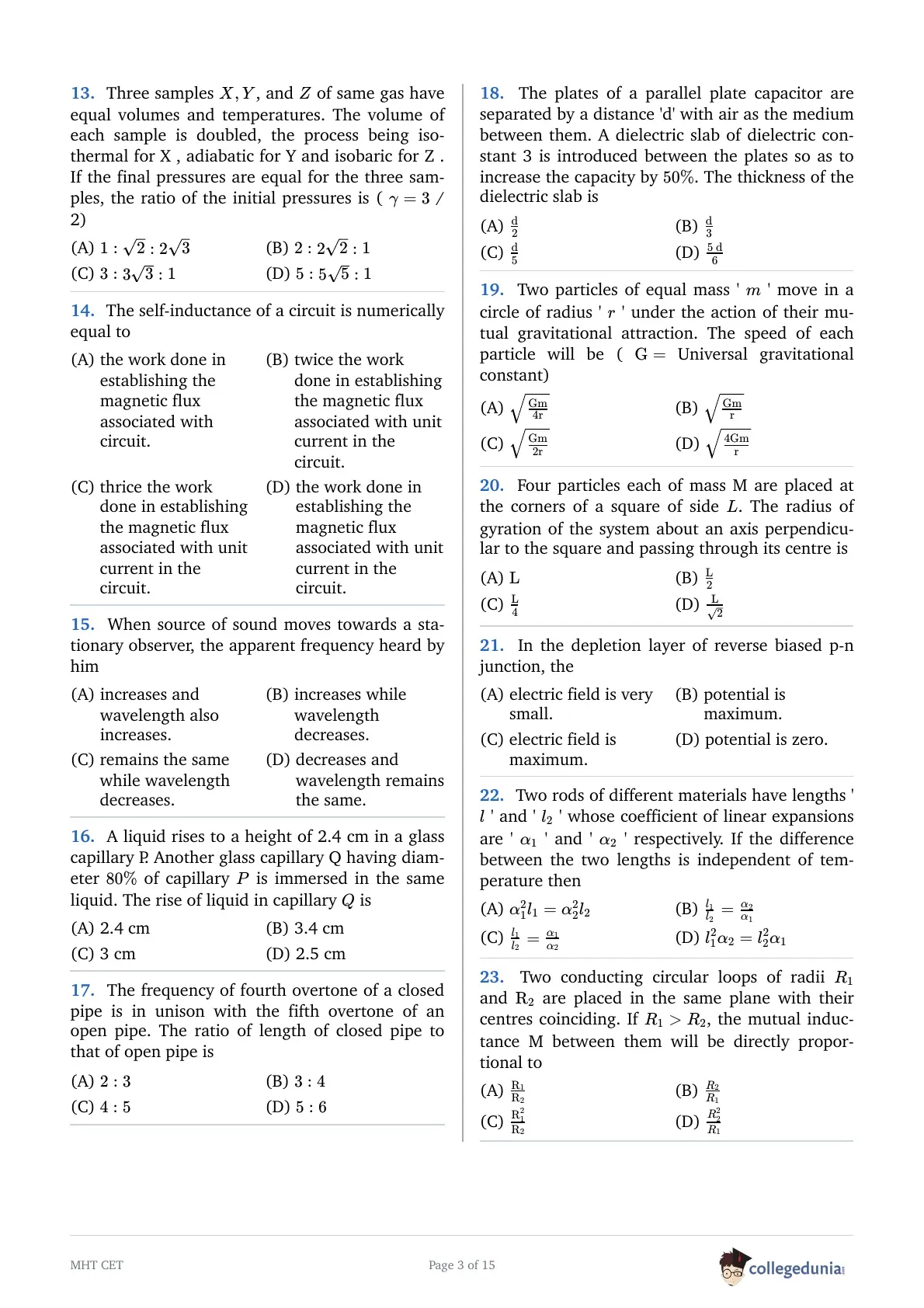
Three samples \(X, Y\), and \(Z\) of same gas have equal volumes and temperatures. The volume of each sample is doubled, the process being isothermal for X , adiabatic for Y and isobaric for Z . If the final pressures are equal for the three samples, the ratio of the initial pressures is ( \(\gamma = 3/2\) )
The self-inductance of a circuit is numerically equal to
When source of sound moves towards a stationary observer, the apparent frequency heard by him
A liquid rises to a height of \(2.4\text{ cm}\) in a glass capillary \(P\). Another glass capillary \(Q\) having diameter \(80%\) of capillary \(P\) is immersed in the same liquid. The rise of liquid in capillary \(Q\) is
The frequency of fourth overtone of a closed pipe is in unison with the fifth overtone of an open pipe. The ratio of length of closed pipe to that of open pipe is
The plates of a parallel plate capacitor are separated by a distance '\(d\)' with air as the medium between them. A dielectric slab of dielectric constant 3 is introduced between the plates so as to increase the capacity by \(50%\). The thickness of the dielectric slab is
Two particles of equal mass '\(m\)' move in a circle of radius '\(r\)' under the action of their mutual gravitational attraction. The speed of each particle will be ( \(\text{G} =\) Universal gravitational constant)
Four particles each of mass \(M\) are placed at the corners of a square of side \(L\). The radius of gyration of the system about an axis perpendicular to the square and passing through its centre is
In the depletion layer of reverse biased p-n junction, the
Two rods of different materials have lengths '\(l_1\)' and '\(l_2\)' whose coefficient of linear expansions are '\(\alpha_1\)' and '\(\alpha_2\)' respectively. If the difference between the two lengths is independent of temperature then
Two conducting circular loops of radii \(R_1\) and \(R_2\) are placed in the same plane with their centres coinciding. If \(R_1>R_2\), the mutual inductance \(M\) between them will be directly proportional to
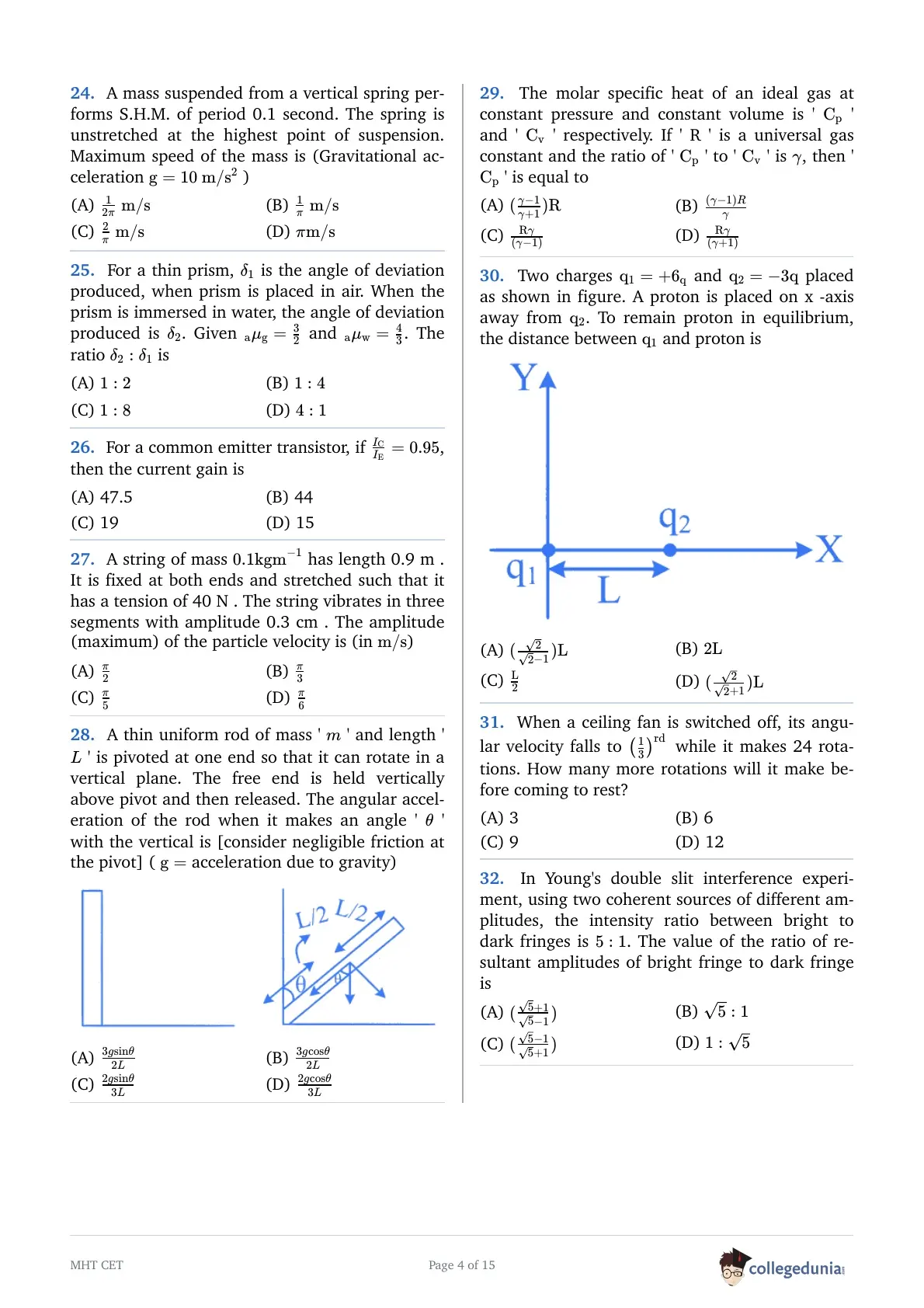
A mass suspended from a vertical spring performs S.H.M. of period \(0.1\) second. The spring is unstretched at the highest point of suspension. Maximum speed of the mass is (Gravitational acceleration \(g = 10\text{ m/s}^2\))
For a thin prism, \(\delta_1\) is the angle of deviation produced, when prism is placed in air. When the prism is immersed in water, the angle of deviation produced is \(\delta_2\). Given \({}_{\text{a}}\mu_{\text{g}} = \frac{3}{2}\) and \({}_{\text{a}}\mu_{\text{w}} = \frac{4}{3}\) . The ratio \(\delta_2 : \delta_1\) is
For a common emitter transistor, if \(\frac{I_C}{I_E} = 0.95\), then the current gain is
A string of mass \(0.1\text{ kg m}^{-1}\) has length \(0.9\text{ m}\). It is fixed at both ends and stretched such that it has a tension of \(40\text{ N}\). The string vibrates in three segments with amplitude \(0.3\text{ cm}\). The amplitude (maximum) of the particle velocity is (in \(\text{m/s}\))
A thin uniform rod of mass \(m\) and length \(L\) is pivoted at one end so that it can rotate in a vertical plane. The free end is held vertically above pivot and then released. The angular acceleration of the rod when it makes an angle \(\theta\) with the vertical is (consider negligible friction at the pivot) (\(g =\) acceleration due to gravity)
The molar specific heat of an ideal gas at constant pressure and constant volume is '\(C_P\)' and '\(C_V\)' respectively. If '\(R\)' is a universal gas constant and the ratio of '\(C_P\)' to '\(C_V\)' is \(\gamma\), then '\(C_P\)' is equal to
Two charges \(q_1 = +6q\) and \(q_2 = -3q\) placed as shown in figure. A proton is placed on x-axis away from \(q_2\). To remain proton in equilibrium, the distance between \(q_1\) and proton is
When a ceiling fan is switched off, its angular velocity falls to \((\frac{1}{3})^{\text{rd}\) while it makes 24 rotations. How many more rotations will it make before coming to rest?
In Young's double slit interference experiment, using two coherent sources of different amplitudes, the intensity ratio between bright to dark fringes is \(5 : 1\). The value of the ratio of resultant amplitudes of bright fringe to dark fringe is
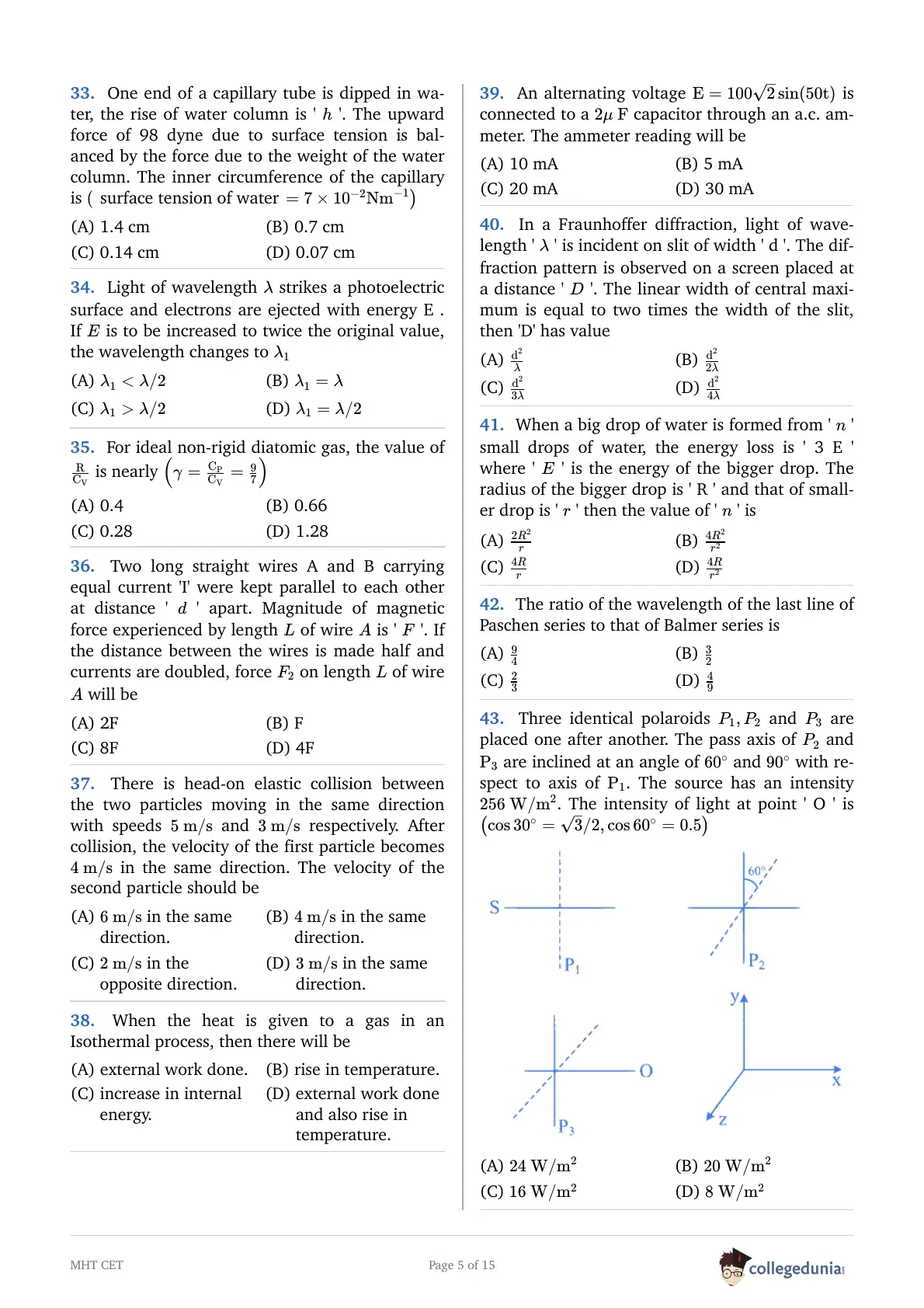
One end of a capillary tube is dipped in water, the rise of water column is '\(h\)'. The upward force of 98 dyne due to surface tension is balanced by the force due to the weight of the water column. The inner circumference of the capillary is ( surface tension of water \(= 7 \times 10^{-2}\text{Nm}^{-1}\) )
Light of wavelength \(\lambda\) strikes a photoelectric surface and electrons are ejected with energy \(E\). If \(E\) is to be increased to twice the original value, the wavelength changes to \(\lambda_1\)
For ideal non-rigid diatomic gas, the value of \(\frac{R}{C_V}\) is nearly \((\gamma = \frac{C_P}{C_V} = \frac{9}{7})\)
Two long straight wires A and B carrying equal current 'I' were kept parallel to each other at distance ' d ' apart. Magnitude of magnetic force experienced by length \(L\) of wire A is ' \(F\) '. If the distance between the wires is made half and currents are doubled, force \(F_2\) on length \(L\) of wire A will be
There is head-on elastic collision between the two particles moving in the same direction with speeds \(5\text{ m/s}\) and \(3\text{ m/s}\) respectively. After collision, the velocity of the first particle becomes \(4\text{ m/s}\) in the same direction. The velocity of the second particle should be
When the heat is given to a gas in an Isothermal process, then there will be
An alternating voltage \(E = 100\sqrt{2} \sin(50t)\) is connected to a \(2\mu\text{F}\) capacitor through an a.c. ammeter. The ammeter reading will be
In a Fraunhoffer diffraction, light of wavelength '\(\lambda\)' is incident on slit of width ' d '. The diffraction pattern is observed on a screen placed at a distance ' D '. The linear width of central maximum is equal to two times the width of the slit, then 'D' has value
When a big drop of water is formed from ' \(n\) ' small drops of water, the energy loss is ' \(3E\) ' where ' \(E\) ' is the energy of the bigger drop. The radius of the bigger drop is ' R ' and that of smaller drop is ' \(r\) ' then the value of ' \(n\) ' is
The ratio of the wavelength of the last line of Paschen series to that of Balmer series is
Three identical polaroids \(P_1, P_2\) and \(P_3\) are placed one after another. The pass axis of \(P_2\) and \(P_3\) are inclined at an angle of \(60^\circ\) and \(90^\circ\) with respect to axis of \(P_1\). The source has an intensity \(256 \text{ W/m}^2\). The intensity of light at point ‘O’ is
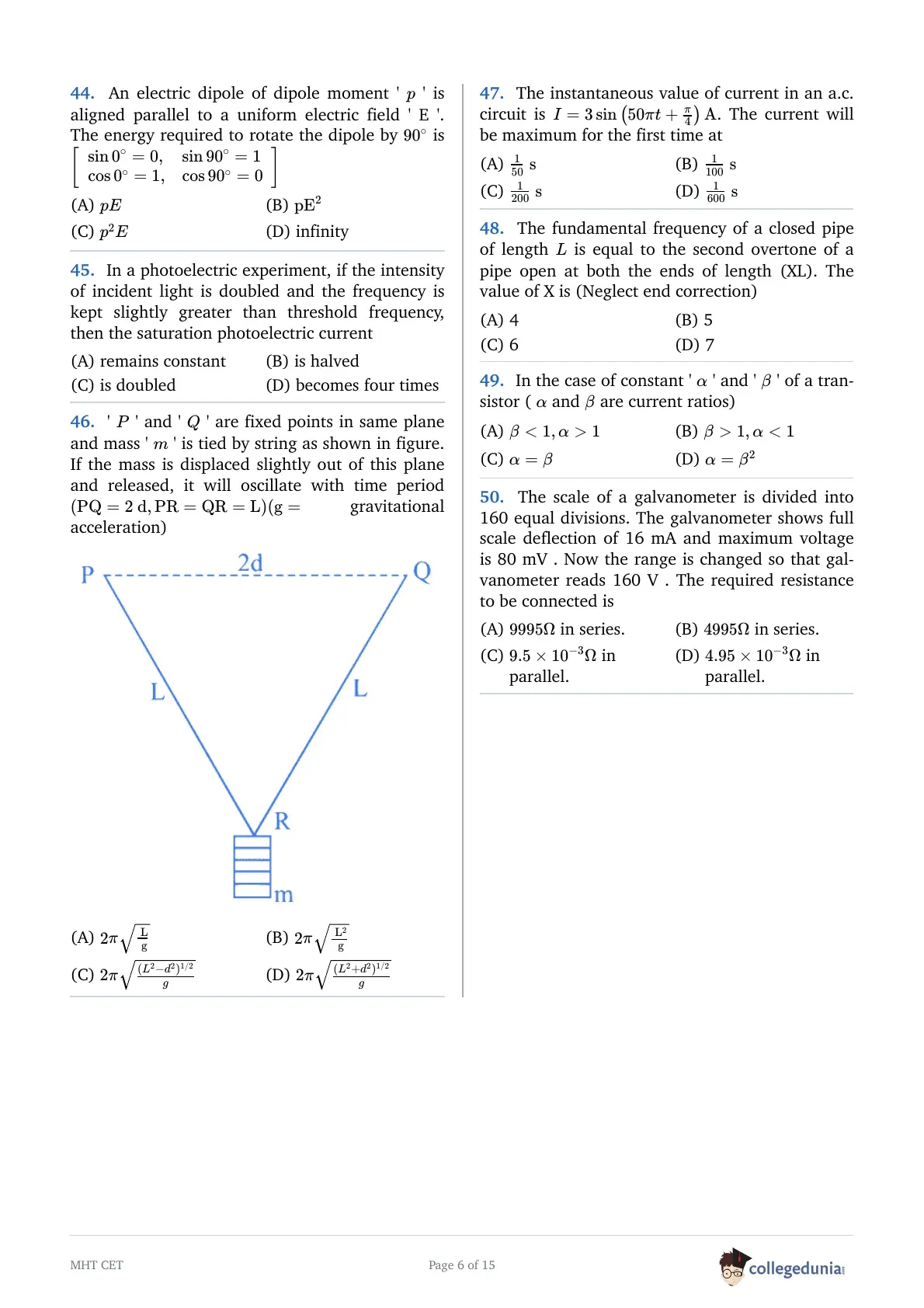
An electric dipole of dipole moment ' \(p\) ' is aligned parallel to a uniform electric field ' E '. The energy required to rotate the dipole by \(90^\circ\) is \( \begin{bmatrix} \sin 0^\circ = 0, & \sin 90^\circ = 1 \\ \cos 0^\circ = 1, & \cos 90^\circ = 0 \end{bmatrix} \)
In a photoelectric experiment, if the intensity of incident light is doubled and the frequency is kept slightly greater than threshold frequency, then the saturation photoelectric current
‘P’ and ‘Q’ are fixed points in same plane and mass ‘m’ is tied by string as shown in figure. If the mass is displaced slightly out of this plane and released, it will oscillate with time period (\(PQ = 2d,\; PR = QR = L\))
The instantaneous value of current in an a.c. circuit is \(I = 3 \sin (50\pi t + \frac{\pi}{4})\text{A}\). The current will be maximum for the first time at
The fundamental frequency of a closed pipe of length \(L\) is equal to the second overtone of a pipe open at both the ends of length (XL). The value of X is (Neglect end correction)
In the case of constant ' \(\alpha\) ' and ' \(\beta\) ' of a transistor ( \(\alpha\) and \(\beta\) are current ratios)
The scale of a galvanometer is divided into 160 equal divisions. The galvanometer shows full scale deflection of \(16\text{ mA}\) and maximum voltage is \(80\text{ mV}\) . Now the range is changed so that galvanometer reads \(160\text{ V}\) . The required resistance to be connected is
Chemistry (Q51 - Q100)
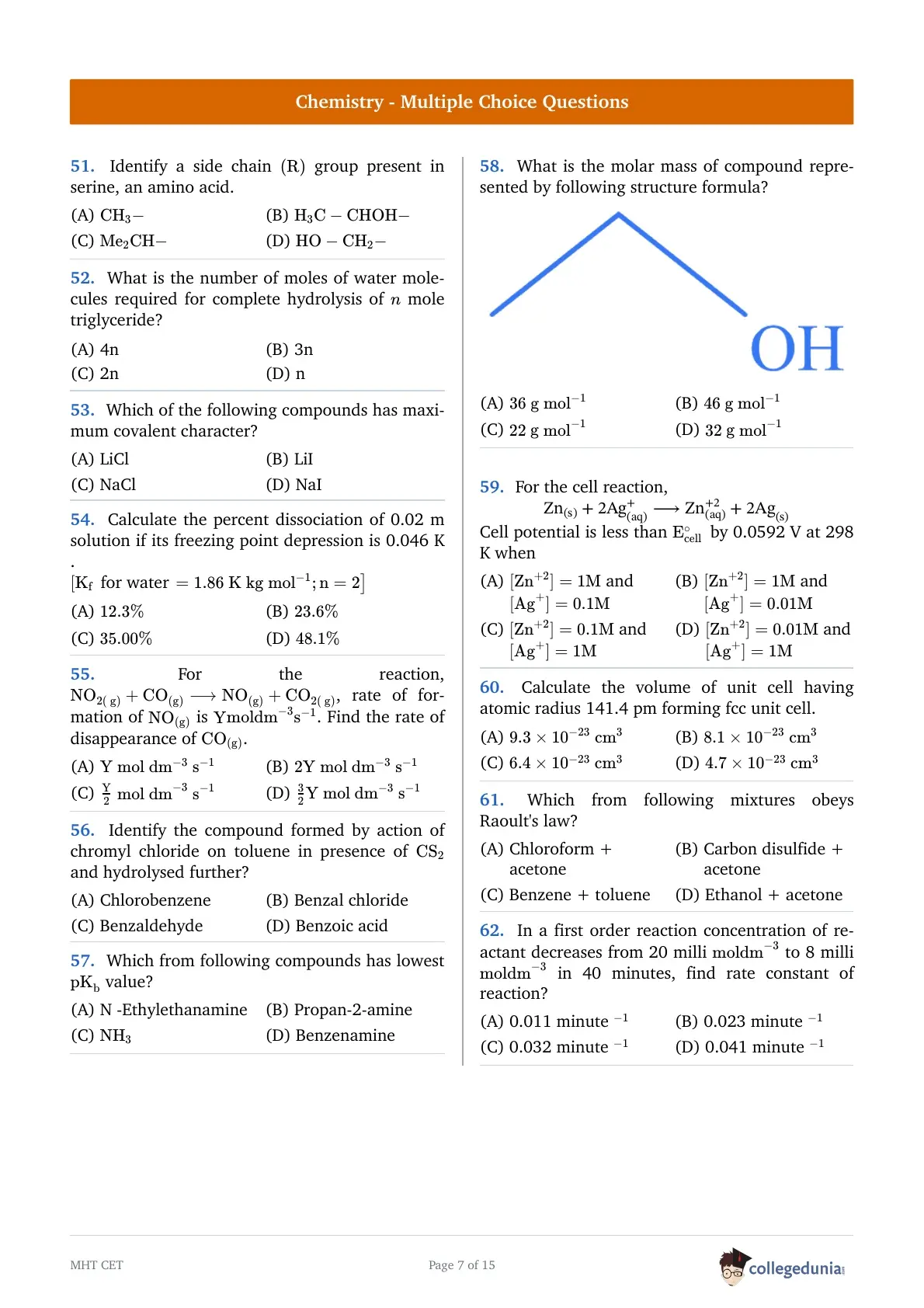
Identify a side chain (R) group present in serine, an amino acid.
What is the number of moles of water molecules required for complete hydrolysis of \(n\) mole triglyceride?
Which of the following compounds has maximum covalent character?
Calculate the percent dissociation of \(0.02\text{ m}\) solution if its freezing point depression is \(0.046\text{ K}\) . \([\text{K}_\text{f} \text{ for water } = 1.86\text{ K kg mol}^{-1}; \text{n} = 2]\)
For the reaction, \(\text{NO}_{2(\text{g})} + \text{CO}_{(\text{g})} \longrightarrow \text{NO}_{(\text{g})} + \text{CO}_{2(\text{g})}\), rate of formation of \(\text{NO}_{(\text{g})}\) is \(\text{Y mol dm}^{-3}\text{ s}^{-1}\). Find the rate of disappearance of \(\text{CO}_{(\text{g})}\).
Identify the compound formed by action of chromyl chloride on toluene in presence of \(\text{CS}_2\) and hydrolysed further?
Which from following compounds has lowest \(\text{pK}_\text{b}\) value?
What is the molar mass of compound represented by following structure formula?

For the cell reaction,
\(\text{Zn}_{(\text{s})} + 2\text{Ag}^+_{(\text{aq})} \longrightarrow \text{Zn}^{+2}_{(\text{aq})} + 2\text{Ag}_{(\text{s})}\)
Cell potential is less than \(\text{E}^\circ_{\text{cell}}\) by \(0.0592\text{ V}\) at \(298\text{ K}\) when
Calculate the volume of unit cell having atomic radius \(141.4\text{ pm}\) forming fcc unit cell.
Which from following mixtures obeys Raoult's law?
In a first order reaction concentration of reactant decreases from \(20\text{ milli mol dm}^{-3}\) to \(8\text{ milli mol dm}^{-3}\) in \(40\text{ minutes}\), find rate constant of reaction?
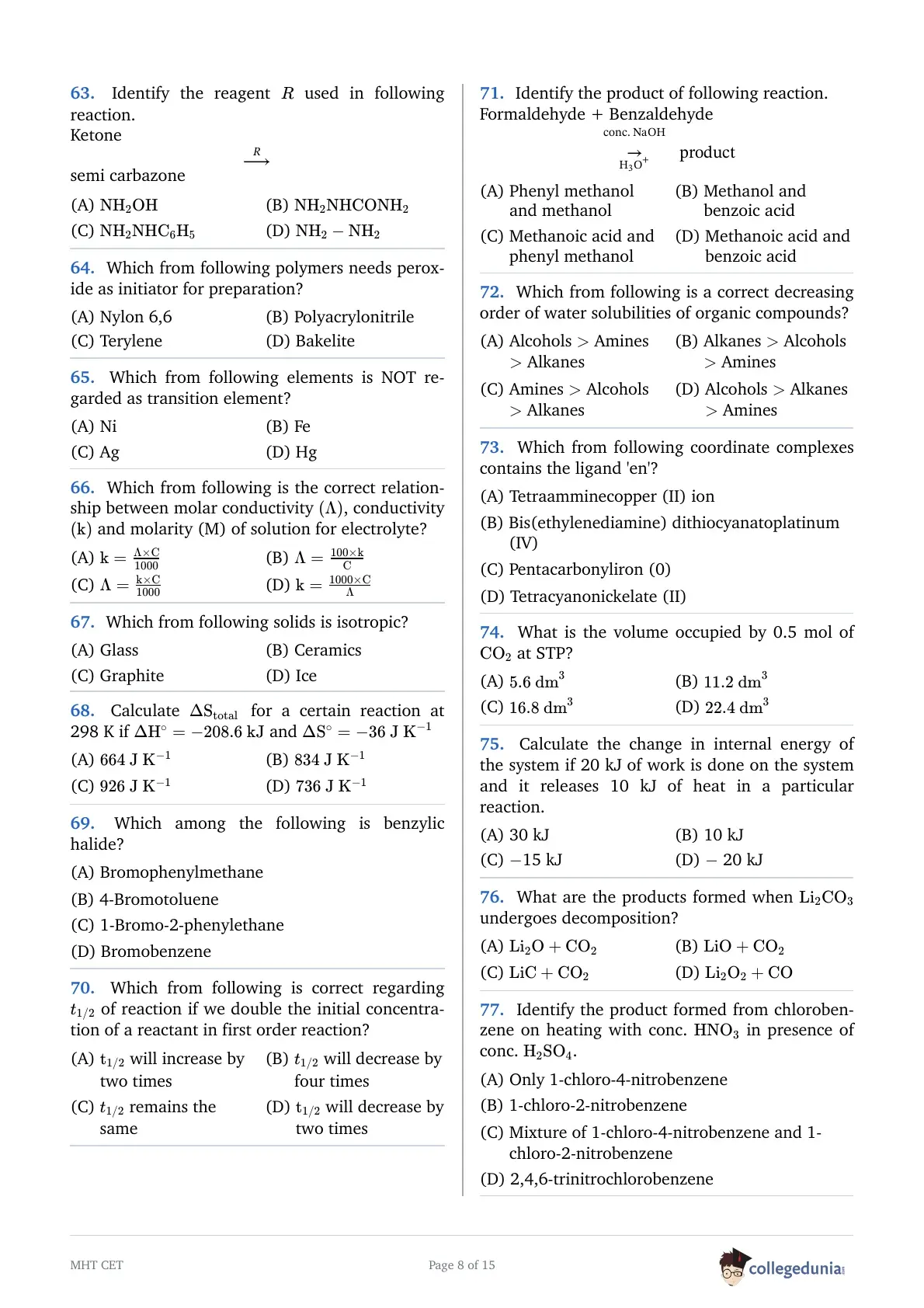
Identify the reagent \(R\) used in following reaction.
\(\text{Ketone} \xrightarrow{R} \text{semi carbazone}\)
Which from following polymers needs peroxide as initiator for preparation?
Which from following elements is NOT regarded as transition element?
Which from following is the correct relationship between molar conductivity (\(\Lambda\)), conductivity (\(\text{k}\)) and molarity (\(\text{M}\)) of solution for electrolyte?
Which from following solids is isotropic?
Calculate \(\Delta \text{S}_{\text{total}}\) for a certain reaction at \(298\text{ K}\) if \(\Delta \text{H}^\circ = -208.6\text{ kJ}\) and \(\Delta \text{S}^\circ = -36\text{ J K}^{-1}\)
Which among the following is benzylic halide?
Which from following is correct regarding \(t_{1/2}\) of reaction if we double the initial concentration of a reactant in first order reaction?
Identify the product of following reaction.
\(\text{Formaldehyde} + \text{Benzaldehyde} \xrightarrow[\text{H}_3\text{O}^+]{\text{conc. NaOH}} \text{product}\)
Which from following is a correct decreasing order of water solubilities of organic compounds?
Which from following coordinate complexes contains the ligand 'en'?
What is the volume occupied by \(0.5\text{ mol}\) of \(\text{CO}_2\) at STP?
Calculate the change in internal energy of the system if \(20\text{ kJ}\) of work is done on the system and it releases \(10\text{ kJ}\) of heat in a particular reaction.
What are the products formed when \(\text{Li}_2\text{CO}_3\) undergoes decomposition?
Identify the product formed from chlorobenzene on heating with conc. \(\text{HNO}_3\) in presence of conc. \(\text{H}_2\text{SO}_4\).
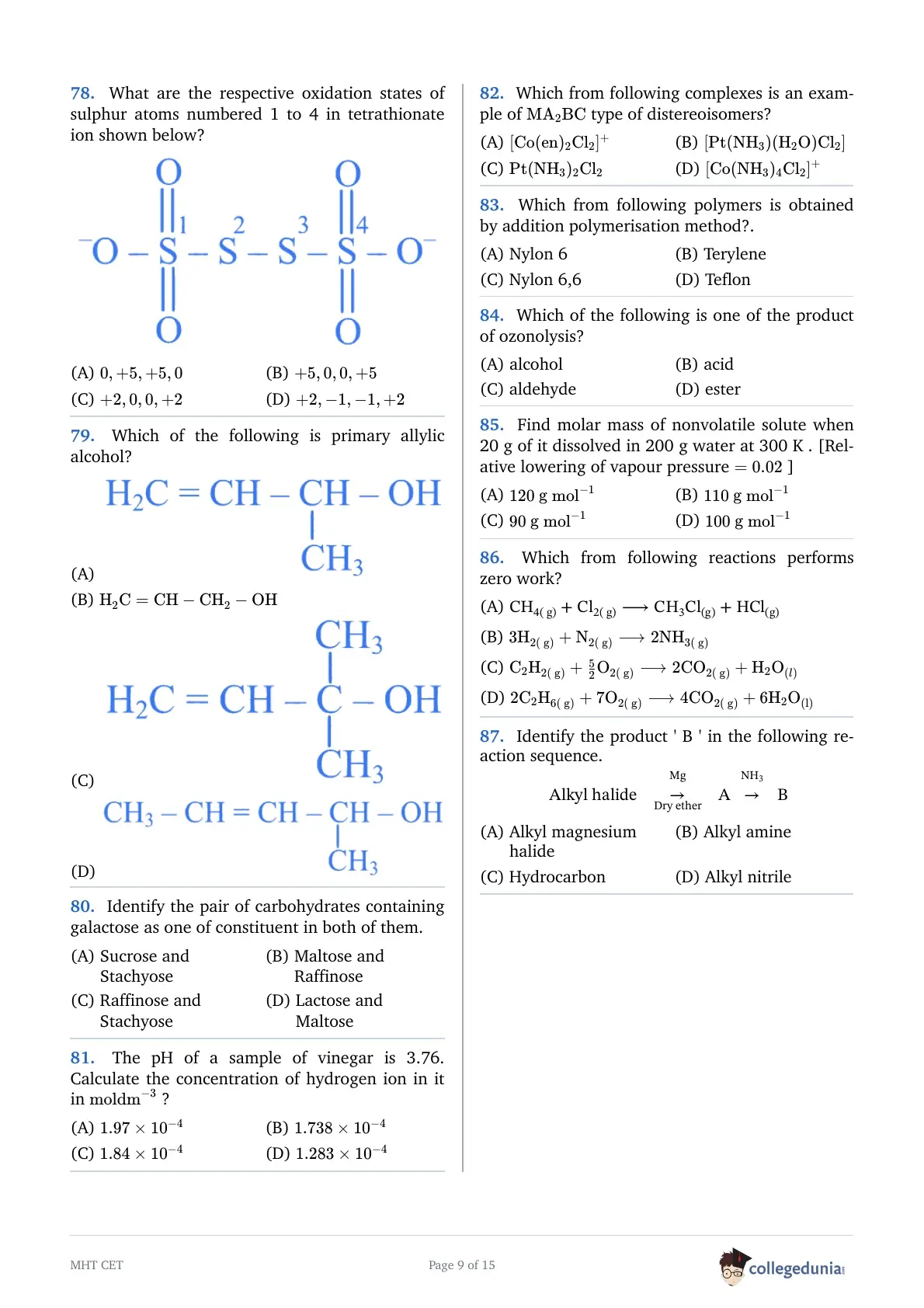
What are the respective oxidation states of sulphur atoms numbered 1 to 4 in tetrathionate ion as shown below?

Which of the following is primary allylic alcohol?
Identify the pair of carbohydrates containing galactose as one of constituent in both of them.
The pH of a sample of vinegar is 3.76. Calculate the concentration of hydrogen ion in it in \(\text{mol dm}^{-3}\) ?
Which from following complexes is an example of \(\text{MA}_2\text{BC}\) type of distereoisomers?
Which from following polymers is obtained by addition polymerisation method?
Which of the following is one of the product of ozonolysis?
Find molar mass of nonvolatile solute when 20 g of it dissolved in 200 g water at 300 K. [Relative lowering of vapour pressure = 0.02]
Which from following reactions performs zero work?
Identify the product ' B ' in the following reaction sequence.
Alkyl halide \(\xrightarrow{\text{Mg/Dry ether}} \text{A} \xrightarrow{\text{NH}_3} \text{B}\)
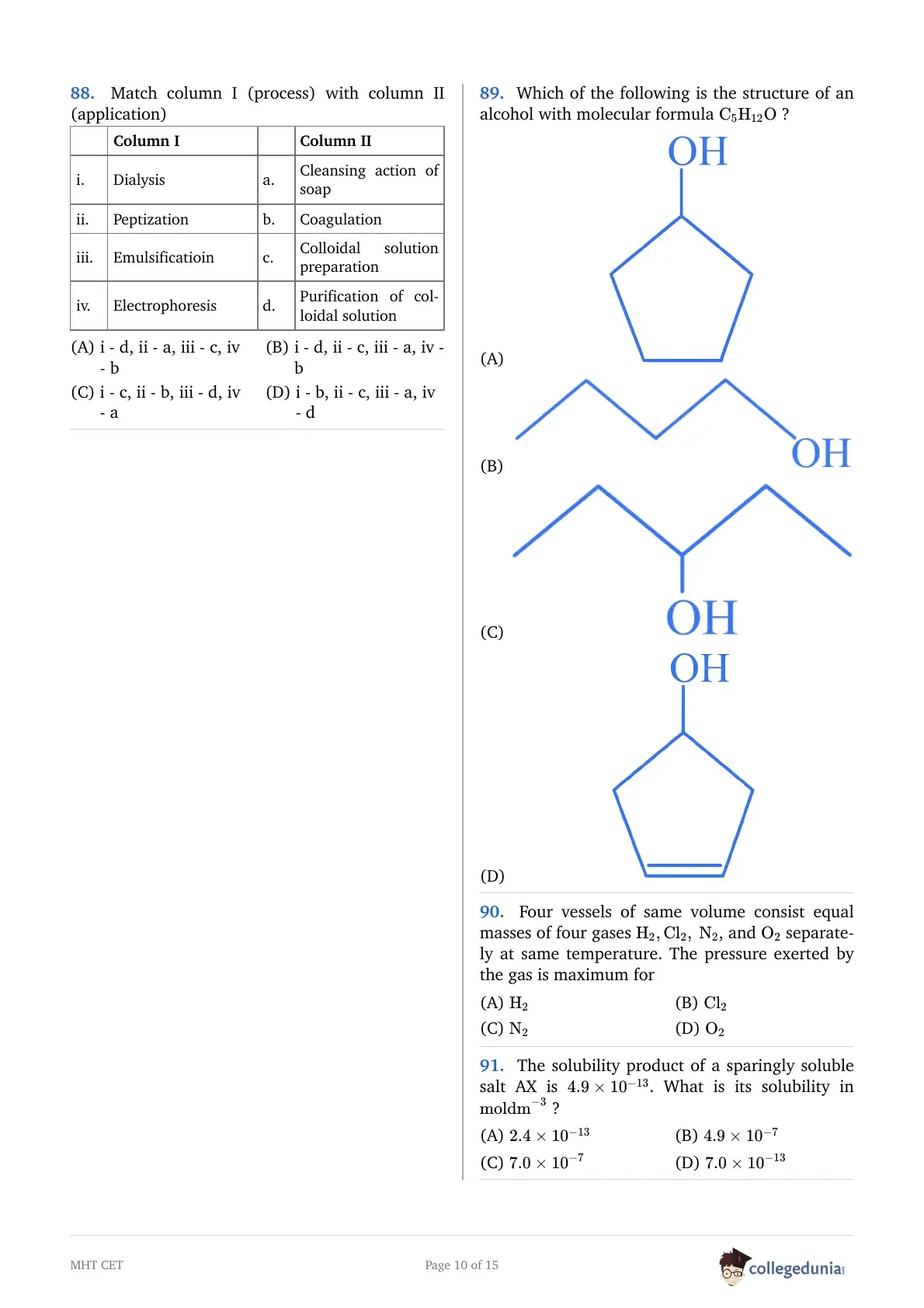
Match column I (process) with column II (application)
| Column I | Column II | ||
|---|---|---|---|
| i. | Dialysis | a. | Cleansing action of soap |
| ii. | Peptization | b. | Coagulation |
| iii. | Emulsificatioin | c. | Colloidal solution preparation |
| iv. | Electrophoresis | d. | Purification of colloidal solution |
Four vessels of same volume consist equal masses of four gases \(\text{H}_2\), \(\text{Cl}_2\), \(\text{N}_2\), and \(\text{O}_2\) separately at same temperature. The pressure exerted by the gas is maximum for
The solubility product of a sparingly soluble salt AX is \(4.9 \times 10^{-13}\). What is its solubility in \(\text{mol dm}^{-3}\) ?
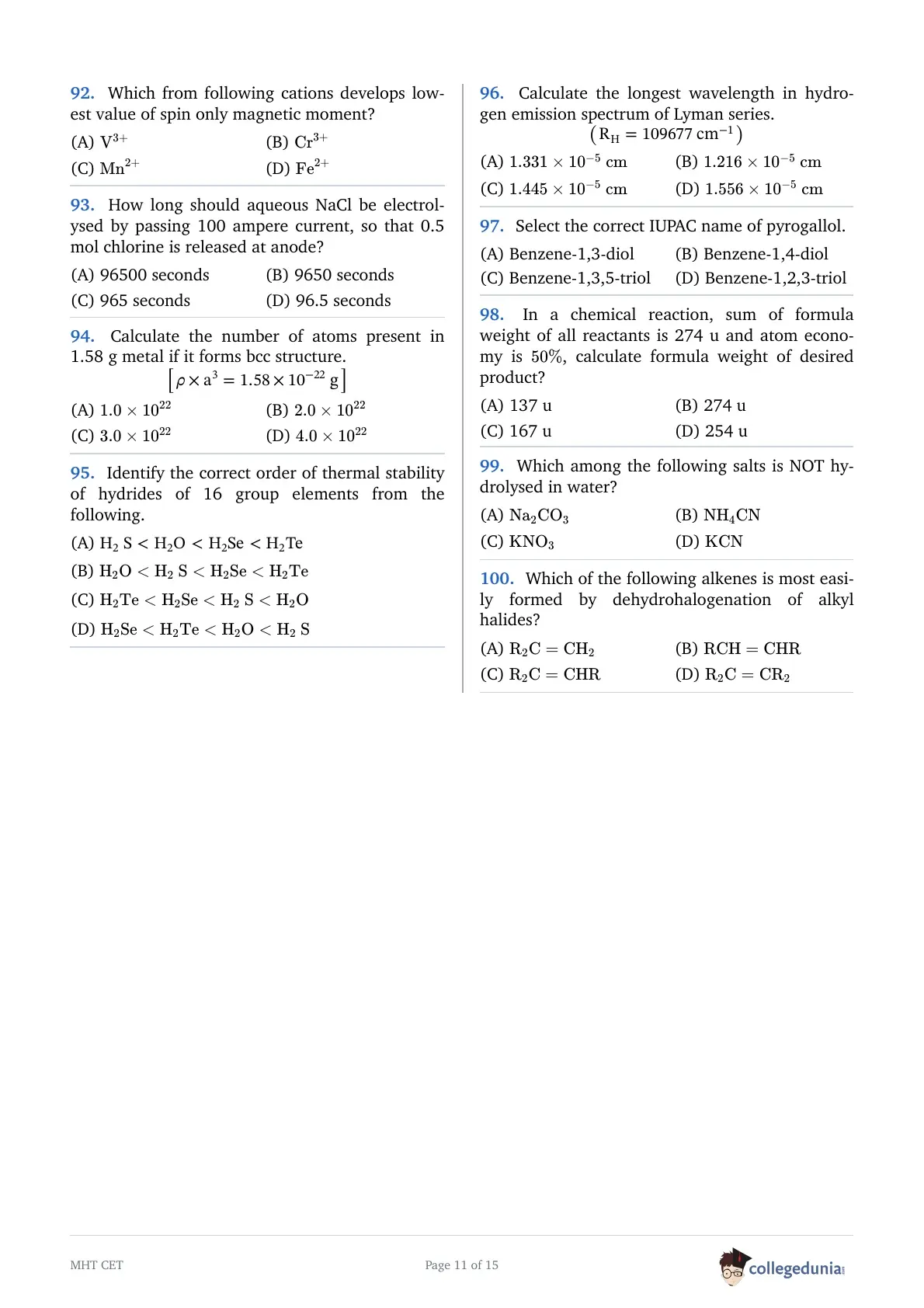
Which from following cations develops lowest value of spin only magnetic moment?
How long should aqueous \(\text{NaCl}\) be electrolysed by passing 100 ampere current, so that 0.5 mol chlorine is released at anode?
Calculate the number of atoms present in 1.58 g metal if it forms bcc structure.
\([\rho \times \text{a}^3 = 1.58 \times 10^{-22}\text{ g}]\)
Identify the correct order of thermal stability of hydrides of 16 group elements from the following.
Calculate the longest wavelength in hydrogen emission spectrum of Lyman series.
\([\text{R}_{\text{H}} = 109677\text{ cm}^{-1}]\)
Select the correct IUPAC name of pyrogallol.
In a chemical reaction, sum of formula weight of all reactants is 274 u and atom economy is 50%, calculate formula weight of desired product?
Which among the following salts is NOT hydrolysed in water?
Which of the following alkenes is most easily formed by dehydrohalogenation of alkyl halides?
Mathematics (Q101 - Q150)
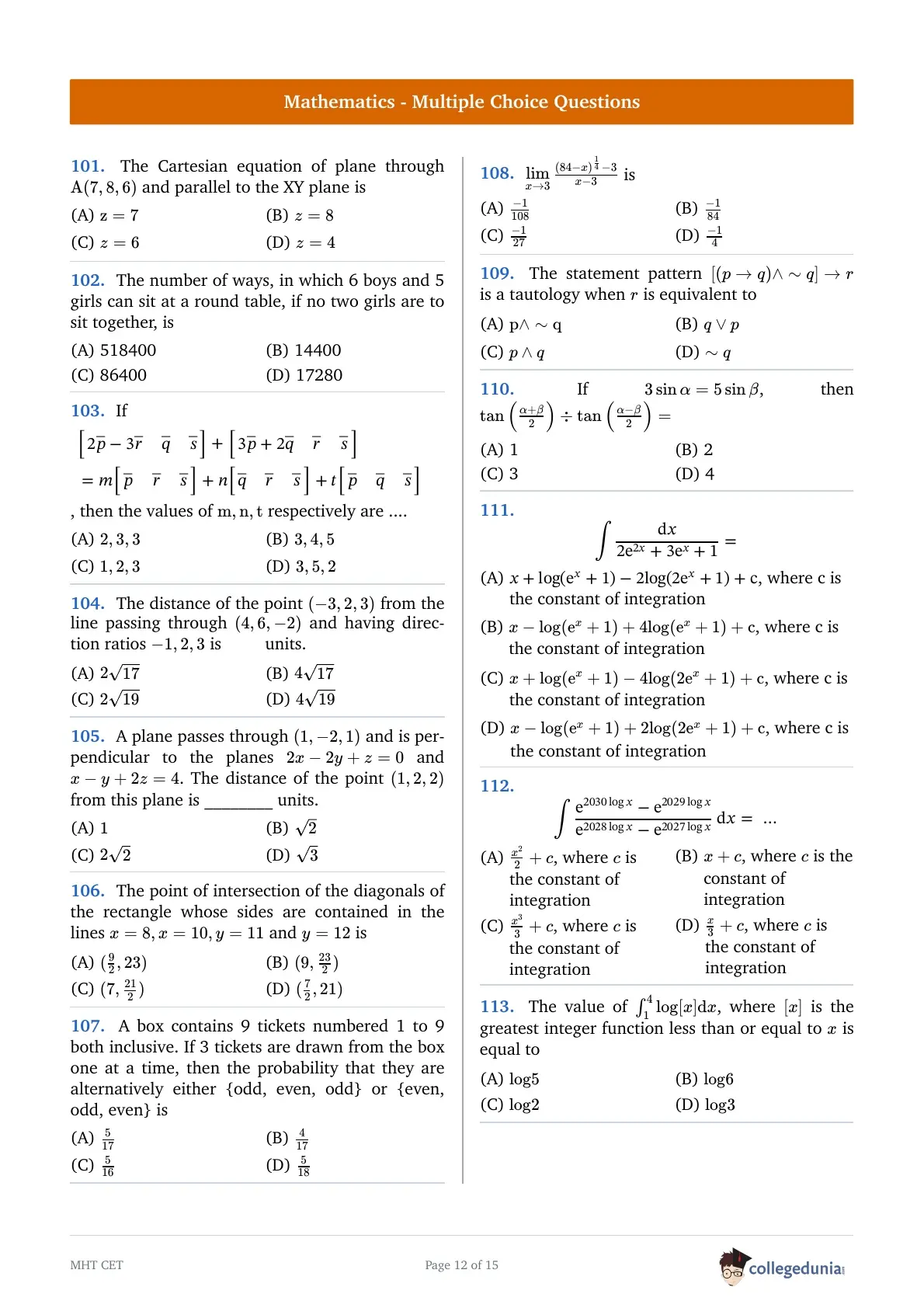
The Cartesian equation of plane through A\((7, 8, 6)\) and parallel to the XY plane is
The number of ways, in which 6 boys and 5 girls can sit at a round table, if no two girls are to sit together, is
If \([2\bar{p} - 3\bar{r} \quad \bar{q} \quad \bar{s}] + [3\bar{p} + 2\bar{q} \quad \bar{r} \quad \bar{s}] = m [\bar{p} \quad \bar{r} \quad \bar{s}] + n [\bar{q} \quad \bar{r} \quad \bar{s}] + t [\bar{p} \quad \bar{q} \quad \bar{s}]\), then the values of m, n, t respectively are ....
The distance of the point \((-3, 2, 3)\) from the line passing through \((4, 6, -2)\) and having direction ratios \(-1, 2, 3\) is ________ units.
A plane passes through \((1, -2, 1)\) and is perpendicular to the planes \(2x - 2y + z = 0\) and \(x - y + 2z = 4\). The distance of the point \((1, 2, 2)\) from this plane is ________ units.
The point of intersection of the diagonals of the rectangle whose sides are contained in the lines \(x = 8, x = 10, y = 11\) and \(y = 12\) is
A box contains 9 tickets numbered 1 to 9 both inclusive. If 3 tickets are drawn from the box one at a time, then the probability that they are alternatively either \(\{odd, even, odd\}\) or \(\{even, odd, even\}\) is
\(\lim_{x \to 3} \frac{(84-x)^{\frac{1}{4}} - 3}{x - 3}\) is
The statement pattern \([(p \rightarrow q)\land \sim q] \rightarrow r\) is a tautology when \(r\) is equivalent to
If \(3 \sin \alpha=5 \sin \beta\), then \(\tan \left(\frac{\alpha+\beta}{2}\right) \div \tan \left(\frac{\alpha-\beta}{2}\right)=\)
\[\int \frac{\mathrm{d} x}{2 \mathrm{e}^{2 x}+3 \mathrm{e}^x+1}=\]
\(\int \frac{\text{e}^{2030 \log x} - \text{e}^{2029 \log x}}{\text{e}^{2028 \log x} - \text{e}^{2027 \log x}} \text{d}x = .......\)
The value of \(\int_1^4 \log[x]\text{d}x\), where \([x]\) is the greatest integer function is equal to
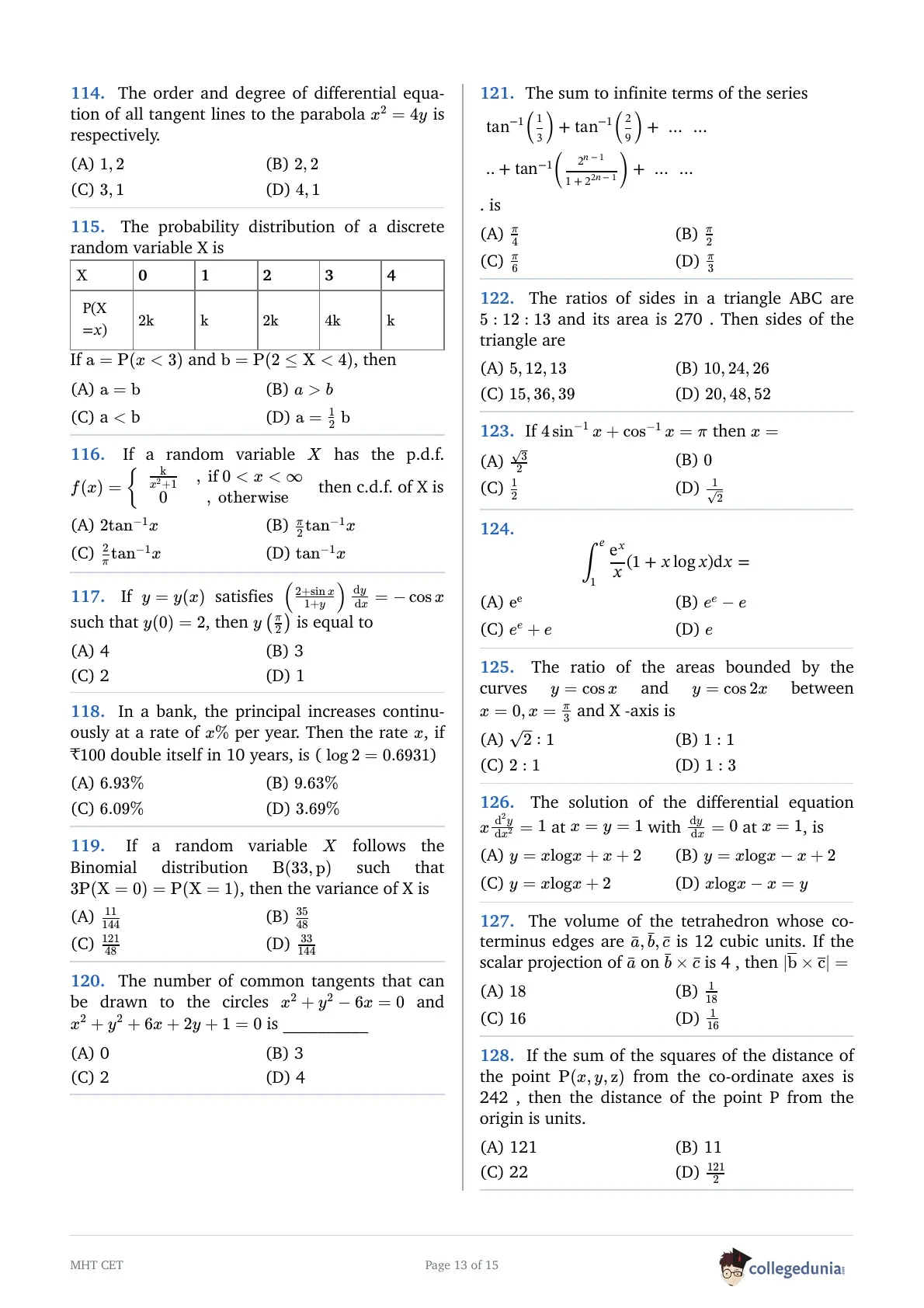
The order and degree of differential equation of all tangent lines to the parabola \(x^2 = 4y\) is respectively.

If a random variable \(X\) has the p.d.f. \(f(x) = \begin{cases} \frac{k}{x^2+1} & , \text{if } 0<x<\infty \\ 0 & , \text{otherwise} \end{cases}\) then c.d.f. of X is
If \(y = y(x)\) satisfies \(\left(\frac{2+\sin x}{1+y}\right) \frac{dy}{dx} = -\cos x\) such that \(y(0) = 2\), then \(y\left(\frac{\pi}{2}\right)\) is equal to
In a bank, the principal increases continuously at a rate of \(x%\) per year. Then the rate \(x\), if Rs.\ 100 doubles itself in 10 years, is (\(\log 2 = 0.6931\))
If a random variable \(X\) follows the Binomial distribution \(\text{B}(33, \text{p})\) such that \(3\text{P}(\text{X} = 0) = \text{P}(\text{X} = 1)\), then the variance of X is
The number of common tangents that can be drawn to the circles \(x^2 + y^2 - 6x = 0\) and \(x^2 + y^2 + 6x + 2y + 1 = 0\) is ________
The sum to infinite terms of the series \(\tan^{-1} \left(\frac{1}{3}\right) + \tan^{-1} \left(\frac{2}{9}\right) + ..................... + \tan^{-1} \left(\frac{2^{n-1}}{1+2^{2n-1}}\right) + ..............\) is
The ratios of sides in a triangle ABC are \(5 : 12 : 13\) and its area is 270 . Then sides of the triangle are
If \(4 \sin^{-1} x + \cos^{-1} x = \pi\) then \(x =\)
\(\int_1^e \frac{e^x}{x}(1 + x \log x) dx =\)
The ratio of the areas bounded by the curves \(y = \cos x\) and \(y = \cos 2x\) between \(x = 0, x = \frac{\pi}{3}\) and X -axis is
The solution of the differential equation \(x \frac{\text{d}^2 y}{\text{d}x^2} = 1\) at \(x = y = 1\) with \(\frac{\text{d}y}{\text{d}x} = 0\) at \(x = 1\), is
The volume of the tetrahedron whose co-terminus edges are \(\bar{a}, \bar{b}, \bar{c}\) is 12 cubic units. If the scalar projection of \(\bar{a}\) on \(\bar{b} \times \bar{c}\) is 4 , then \(|\bar{b} \times \bar{c}| =\)
If the sum of the squares of the distance of the point \(\text{P}(x, y, z)\) from the co-ordinate axes is 242 , then the distance of the point P from the origin is units.
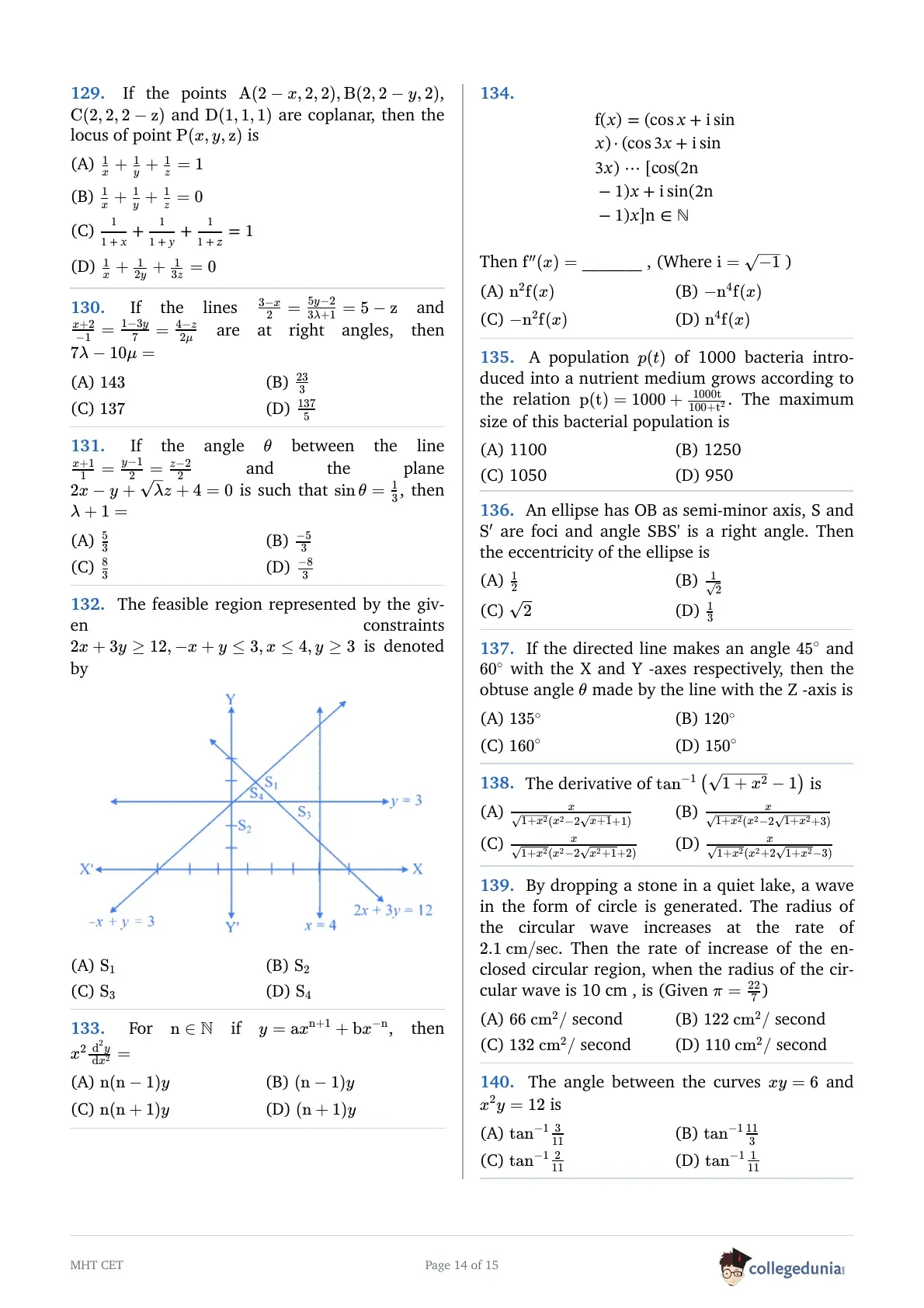
If the points \(\text{A}(2 - x, 2, 2), \text{B}(2, 2 - y, 2), \text{C}(2, 2, 2 - z)\) and \(\text{D}(1, 1, 1)\) are coplanar, then the locus of point \(\text{P}(x, y, z)\) is
If the lines \(\frac{3-x}{2}=\frac{5 y-2}{3 \lambda+1}=5-\mathrm{z}\) and \(\frac{x+2}{-1}=\frac{1-3 y}{7}=\frac{4-z}{2 \mu}\) are at right angles, then \(7 \lambda-10 \mu=\)
If the angle \(\theta\) between the line \(\frac{x+1}{1} = \frac{y-1}{2} = \frac{z-2}{2}\) and the plane \(2x - y + \sqrt{\lambda}z + 4 = 0\) is such that \(\sin \theta = \frac{1}{3}\), then \(\lambda + 1 =\)
For \(\text{n} \in \mathbb{N}\) if \(y = \text{a}x^{\text{n}+1} + \text{b}x^{-\text{n}}\), then \(x^2 \frac{\text{d}^2 y}{\text{d}x^2} =\)
\(f(x) = (\cos x + \text{i}\sin x) \cdot (\cos 3x + \text{i}\sin 3x) \cdots [\cos(2\text{n} - 1)x + \text{i}\sin(2\text{n} - 1)x] \text{n} \in \mathbb{N}\) Then \(f''(x) = \) ________, (Where \(\text{i} = \sqrt{-1}\) )
A population \(p(t)\) of 1000 bacteria introduced into a nutrient medium grows according to the relation \(\text{p}(t) = 1000 + \frac{1000t}{100+t^2}\). The maximum size of this bacterial population is
An ellipse has OB as semi-minor axis, S and S' are foci and angle SBS' is a right angle. Then the eccentricity of the ellipse is
If the directed line makes an angle \(45^\circ\) and \(60^\circ\) with the X and Y -axes respectively, then the obtuse angle \(\theta\) made by the line with the Z -axis is
The derivative of \(\tan^{-1} \left(\sqrt{1+x^2}-1\right)\) is
By dropping a stone in a quiet lake, a wave in the form of circle is generated. The radius of the circular wave increases at the rate of \(2.1 \text{ cm/sec}\). Then the rate of increase of the enclosed circular region, when the radius of the circular wave is \(10 \text{ cm}\) , is (Given \(\pi = \frac{22}{7}\) )
The angle between the curves \(xy = 6\) and \(x^2y = 12\) is
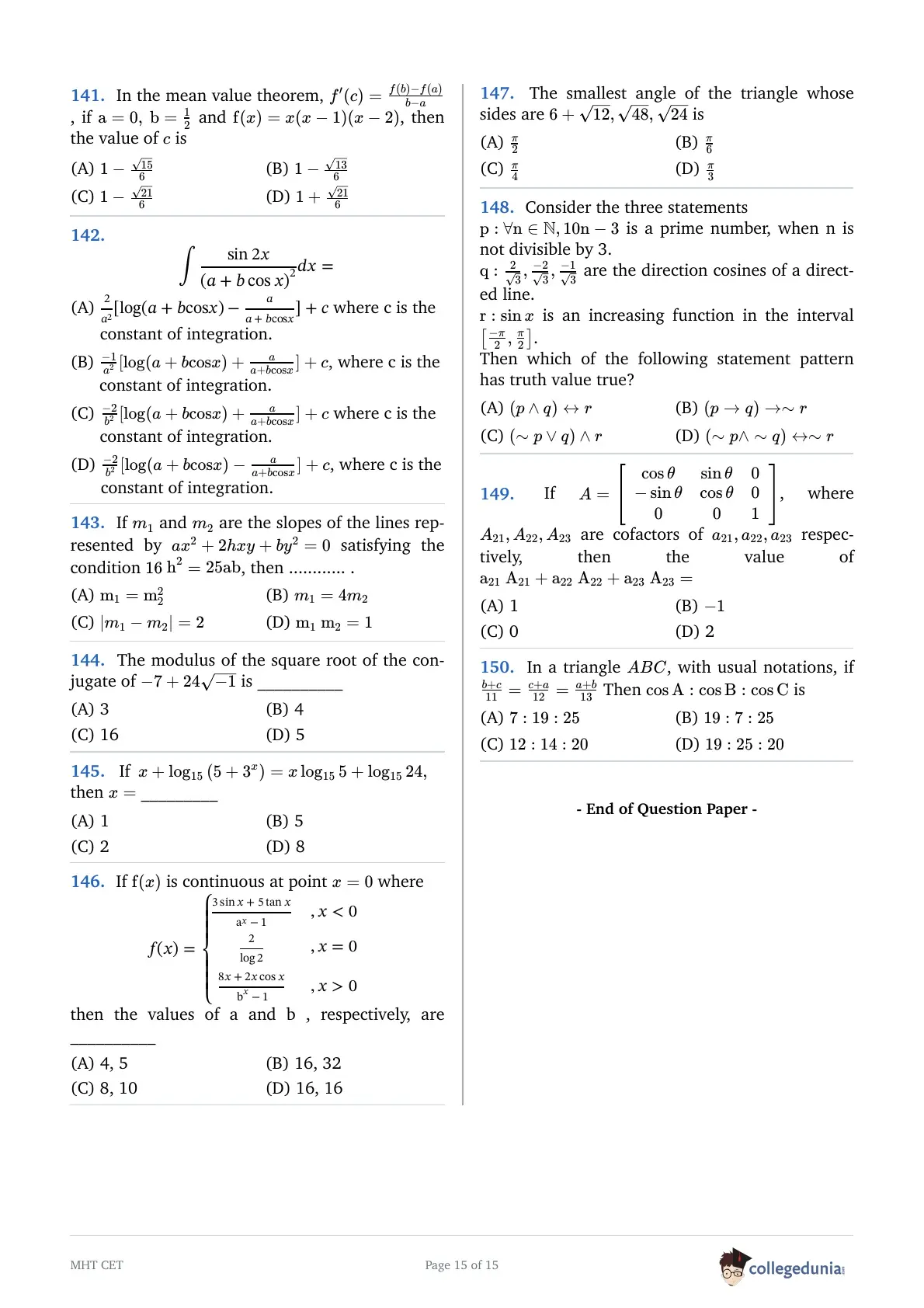
In the mean value theorem, \(f'(c) = \frac{f(b)-f(a)}{b-a}\), if \(\text{a} = 0\), \(\text{b} = \frac{1}{2}\) and \(f(x) = x(x - 1)(x - 2)\), then the value of \(c\) is
\(\int \frac{\sin 2x}{(a+b\cos x)^2} dx =\)
If \(m_1\) and \(m_2\) are the slopes of the lines represented by \(ax^2 + 2hxy + by^2 = 0\) satisfying the condition \(16\text{h}^2 = 25\text{ab}\), then

The modulus of the square root of the conjugate of \(-7 + 24\sqrt{-1}\) is __________
If \(x + \log_{15}(5 + 3^x) = x \log_{15} 5 + \log_{15} 24\), then \(x =\) ________
If \(f(x)\) is continuous at point \(x = 0\) where \(f(x) = \begin{cases} \frac{3\sin x + 5\tan x}{\text{a}^x - 1} & , x<0 \\ \frac{2}{\log 2} & , x = 0 \\ \frac{8x + 2x\cos x}{\text{b}^x - 1} & , x>0 \end{cases}\) then the values of a and b, respectively, are ________
The smallest angle of the triangle whose sides are \(6 + \sqrt{12}, \sqrt{48}, \sqrt{24}\) is
Consider the three statements
\(\text{p} : \forall \text{n} \in \mathbb{N}, 10\text{n} - 3\) is a prime number, when n is not divisible by 3.
\(\text{q} : \frac{2}{\sqrt{3}}, \frac{-2}{\sqrt{3}}, \frac{-1}{\sqrt{3}}\) are the direction cosines of a directed line.
\(\text{r} : \sin x\) is an increasing function in the interval \(\left[-\frac{\pi}{2}, \frac{\pi}{2}\right]\).
If \(A = \begin{bmatrix} \cos \theta & \sin \theta & 0 \\ -\sin \theta & \cos \theta & 0 \\ 0 & 0 & 1 \end{bmatrix}\), where \(A_{21}, A_{22}, A_{23}\) are cofactors of \(a_{21}, a_{22}, a_{23}\) respectively, then the value of \(a_{21}\text{A}_{21} + \text{a}_{22}\text{A}_{22} + \text{a}_{23}\text{A}_{23} =\)
In a triangle \(ABC\), with usual notations, if \(\frac{b+c}{11} = \frac{c+a}{12} = \frac{a+b}{13}\) Then \(\cos \text{A} : \cos \text{B} : \cos \text{C}\) is
MHT CET 2025 PCM Exam Pattern and Marking Scheme
| Parameter | Details |
|---|---|
| Conducting Body | Maharashtra Common Entrance Test Cell (Maharashtra CET Cell) |
| Exam Mode | Online (Computer-Based Test) |
| Duration | 180 minutes (3 hours) |
| Groups / Subjects | PCM (Physics, Chemistry, Mathematics) for Engineering |
| Total Questions |
150 |
| Total Marks | 200 |
| Question Type | Multiple Choice Questions (MCQs) |
| Marks Distribution |
|
| Negative Marking | No |
| Syllabus Weightage |
|



Comments