




CBSE Class 12 Economics Compartment Set 2 - (58/7/2) Question Paper 2026 details are given here. CBSE conducted the Class 12 Economics Compartment (supplementary) examination on July 28, 2026, from 10:30 AM to 1:30 PM. The Economics paper is of 80 marks and the time allowed is 3 hours. This paper carries the Q.P. code 58/7/2 and is of Set 2. The question paper was handed out at 10:15 AM, and the first 15 minutes were given for reading it.
Also Check: CBSE Class 12 Question Paper 2026 (All Subjects)
The paper has 34 questions in two sections, Section A (Macro Economics) and Section B (Indian Economic Development), and all questions are compulsory. It has the following:
- 20 multiple choice questions of 1 mark each
- 4 short answer type-I questions of 3 marks each (60 - 80 words)
- 6 short answer type-II questions of 4 marks each (80 - 100 words)
- 4 long answer questions of 6 marks each (100 - 150 words)
CBSE Class 12 Economics Compartment Set 2 - (58/7/2) Question Paper 2026 with Solution PDF
| CBSE Official PDF | CD PDF | CD PDF with Solutions |
|---|---|---|
| Download official PDF 0.64 MB | Download Collegedunia PDF 0.80 MB | – |
CBSE Class 12 Economics Compartment 2026 Set 2 (58/7/2) Questions with Solutions
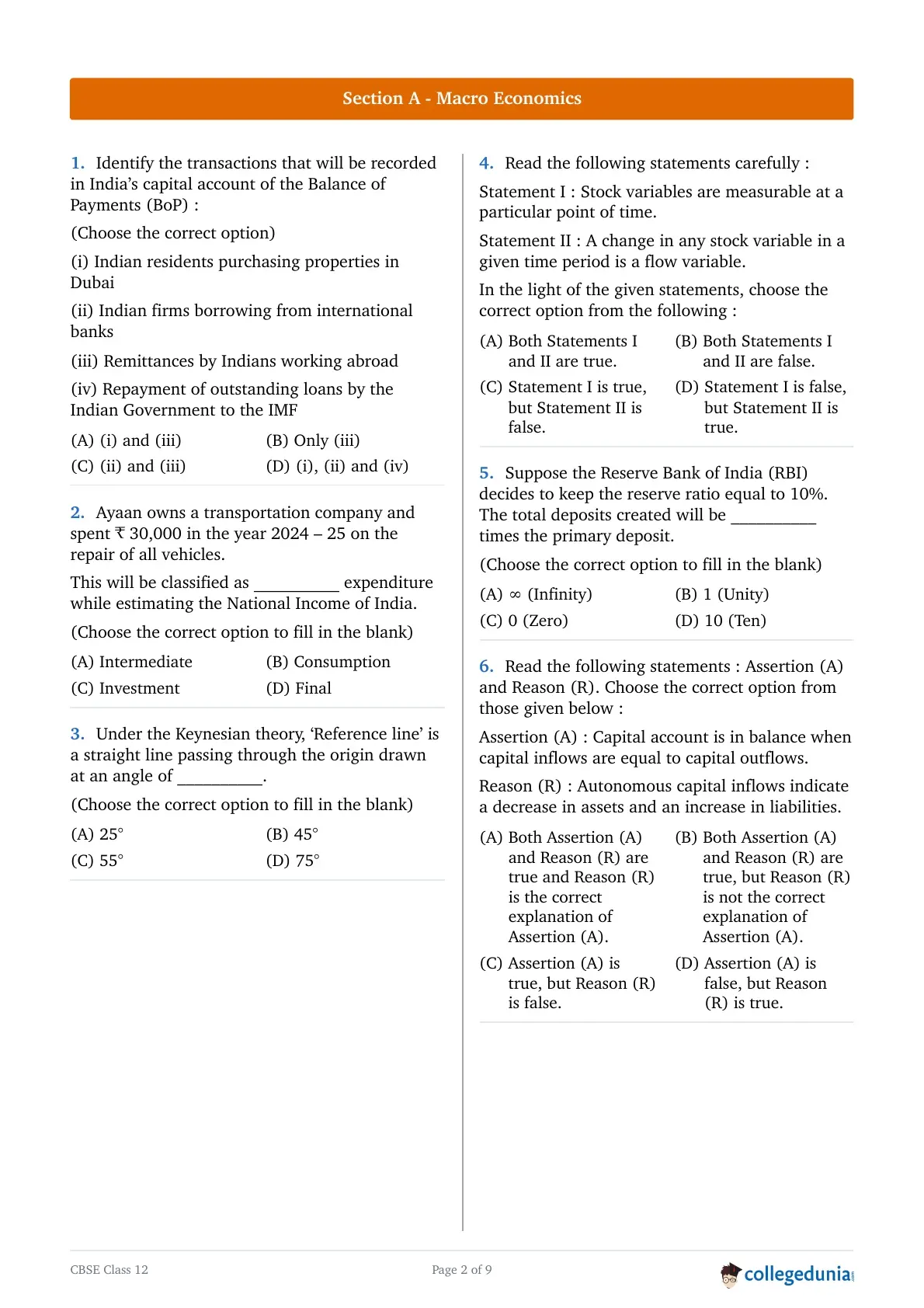
Identify the transactions that will be recorded in India’s capital account of the Balance of Payments (BoP) :
(Choose the correct option)
(i) Indian residents purchasing properties in Dubai
(ii) Indian firms borrowing from international banks
(iii) Remittances by Indians working abroad
(iv) Repayment of outstanding loans by the Indian Government to the IMF
Ayaan owns a transportation company and spent ₹ 30,000 in the year 2024 – 25 on the repair of all vehicles.
This will be classified as __________ expenditure while estimating the National Income of India.
(Choose the correct option to fill in the blank)
Under the Keynesian theory, ‘Reference line’ is a straight line passing through the origin drawn at an angle of __________.
(Choose the correct option to fill in the blank)
Read the following statements carefully :
Statement I : Stock variables are measurable at a particular point of time.
Statement II : A change in any stock variable in a given time period is a flow variable.
In the light of the given statements, choose the correct option from the following :
Suppose the Reserve Bank of India (RBI) decides to keep the reserve ratio equal to 10%. The total deposits created will be __________ times the primary deposit.
(Choose the correct option to fill in the blank)
Read the following statements : Assertion (A) and Reason (R). Choose the correct option from those given below :
Assertion (A) : Capital account is in balance when capital inflows are equal to capital outflows.
Reason (R) : Autonomous capital inflows indicate a decrease in assets and an increase in liabilities.
“In recent times, the Reserve Bank of India has reduced the Repo Rate (RR).”
The most likely objective of the Reserve Bank of India behind this policy change is to __________ the borrowing cost and __________ liquidity in the economy.
(Choose the correct option to fill in the blanks)
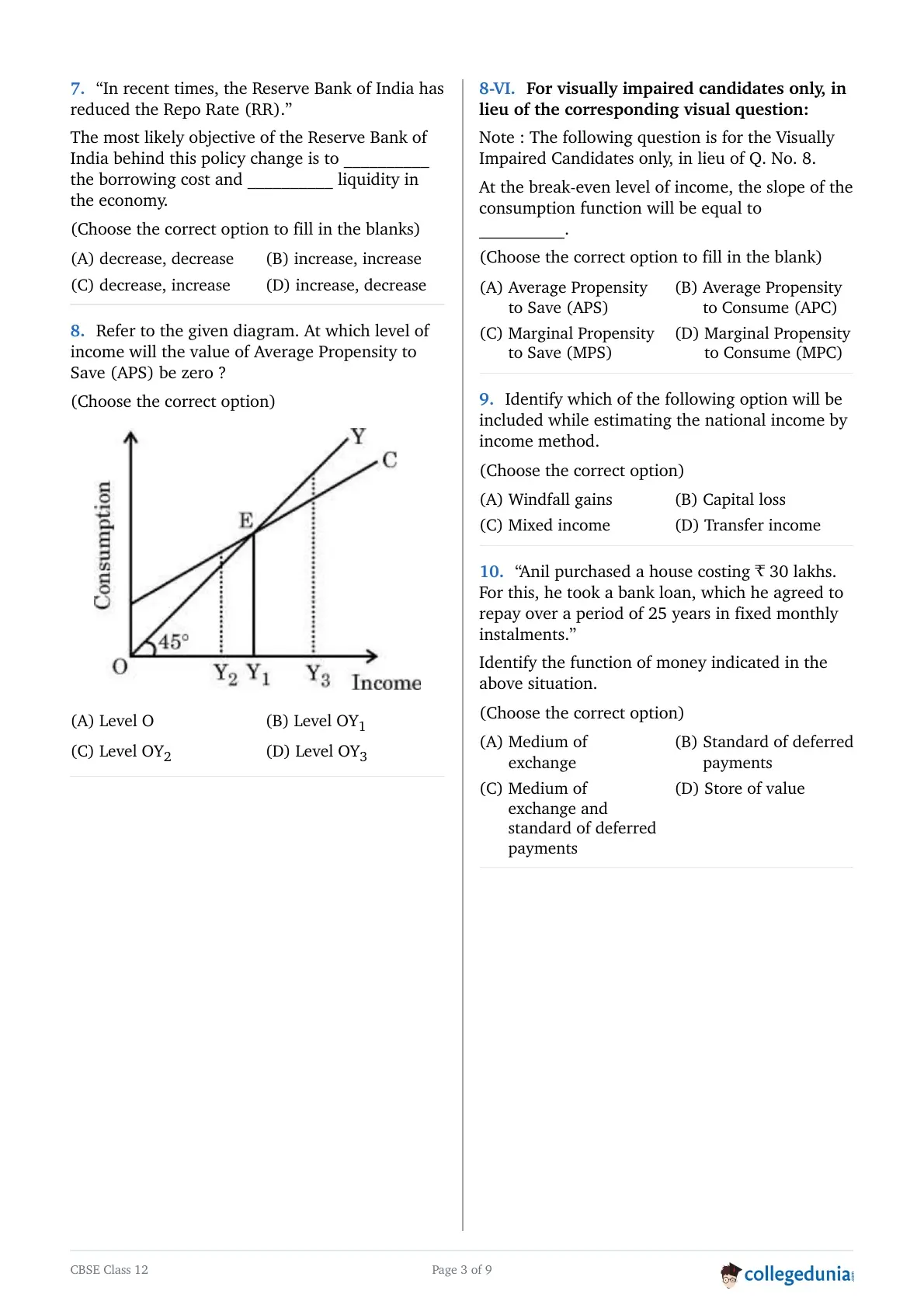
Refer to the given diagram. At which level of income will the value of Average Propensity to Save (APS) be zero ?
(Choose the correct option)

Identify which of the following option will be included while estimating the national income by income method.
(Choose the correct option)
“Anil purchased a house costing ₹ 30 lakhs. For this, he took a bank loan, which he agreed to repay over a period of 25 years in fixed monthly instalments.”
Identify the function of money indicated in the above situation.
(Choose the correct option)
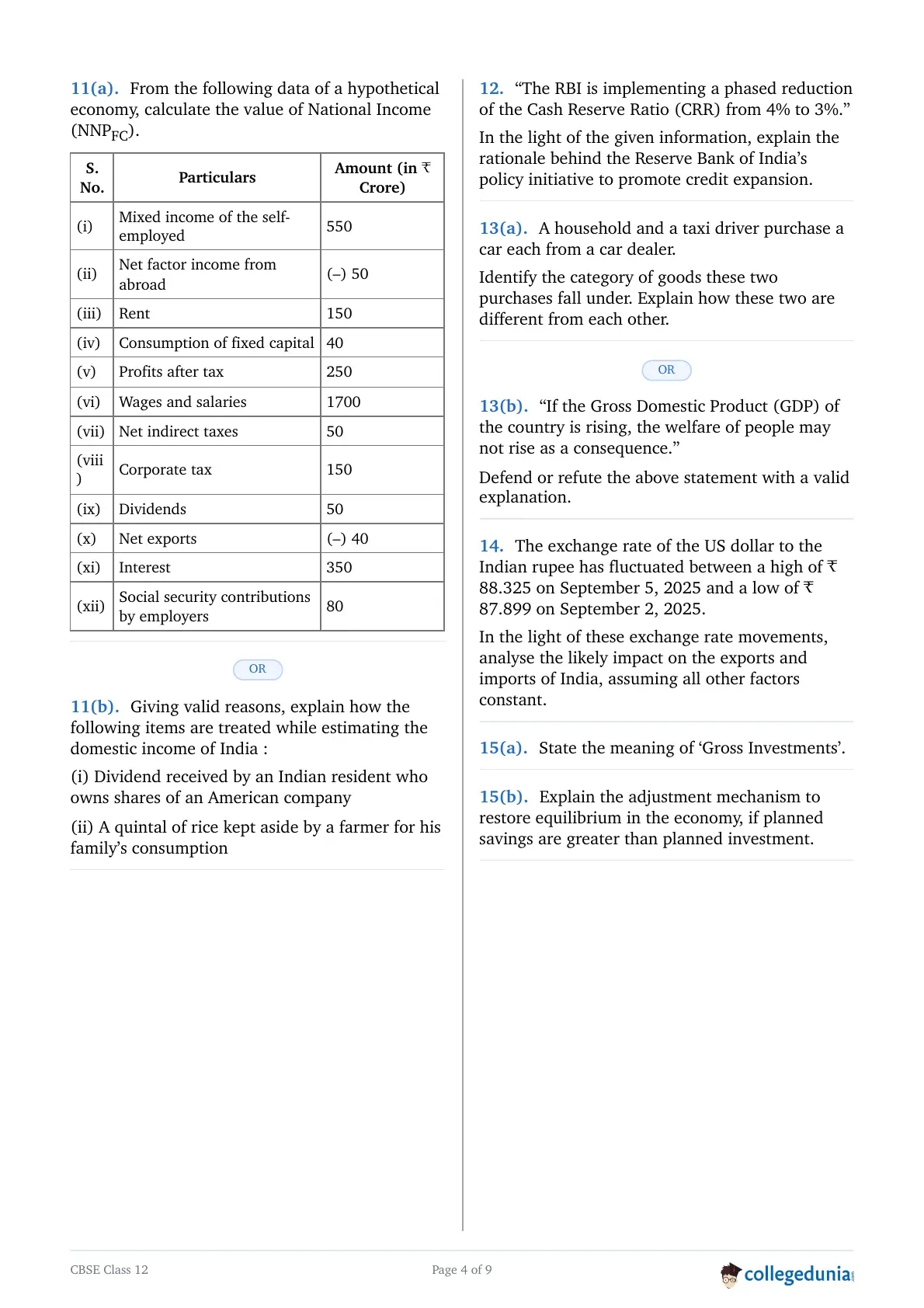
From the following data of a hypothetical economy, calculate the value of National Income (NNPFC).
| S. No. | Particulars | Amount (in ₹ Crore) |
|---|---|---|
| (i) | Mixed income of the self-employed | 550 |
| (ii) | Net factor income from abroad | (–) 50 |
| (iii) | Rent | 150 |
| (iv) | Consumption of fixed capital | 40 |
| (v) | Profits after tax | 250 |
| (vi) | Wages and salaries | 1700 |
| (vii) | Net indirect taxes | 50 |
| (viii) | Corporate tax | 150 |
| (ix) | Dividends | 50 |
| (x) | Net exports | (–) 40 |
| (xi) | Interest | 350 |
| (xii) | Social security contributions by employers | 80 |
Giving valid reasons, explain how the following items are treated while estimating the domestic income of India :
(i) Dividend received by an Indian resident who owns shares of an American company
(ii) A quintal of rice kept aside by a farmer for his family’s consumption
“The RBI is implementing a phased reduction of the Cash Reserve Ratio (CRR) from 4% to 3%.”
In the light of the given information, explain the rationale behind the Reserve Bank of India’s policy initiative to promote credit expansion.
A household and a taxi driver purchase a car each from a car dealer.
Identify the category of goods these two purchases fall under. Explain how these two are different from each other.
“If the Gross Domestic Product (GDP) of the country is rising, the welfare of people may not rise as a consequence.”
Defend or refute the above statement with a valid explanation.
The exchange rate of the US dollar to the Indian rupee has fluctuated between a high of ₹ 88.325 on September 5, 2025 and a low of ₹ 87.899 on September 2, 2025.
In the light of these exchange rate movements, analyse the likely impact on the exports and imports of India, assuming all other factors constant.
Explain the adjustment mechanism to restore equilibrium in the economy, if planned savings are greater than planned investment.
Comprehension:
Read the following text carefully :
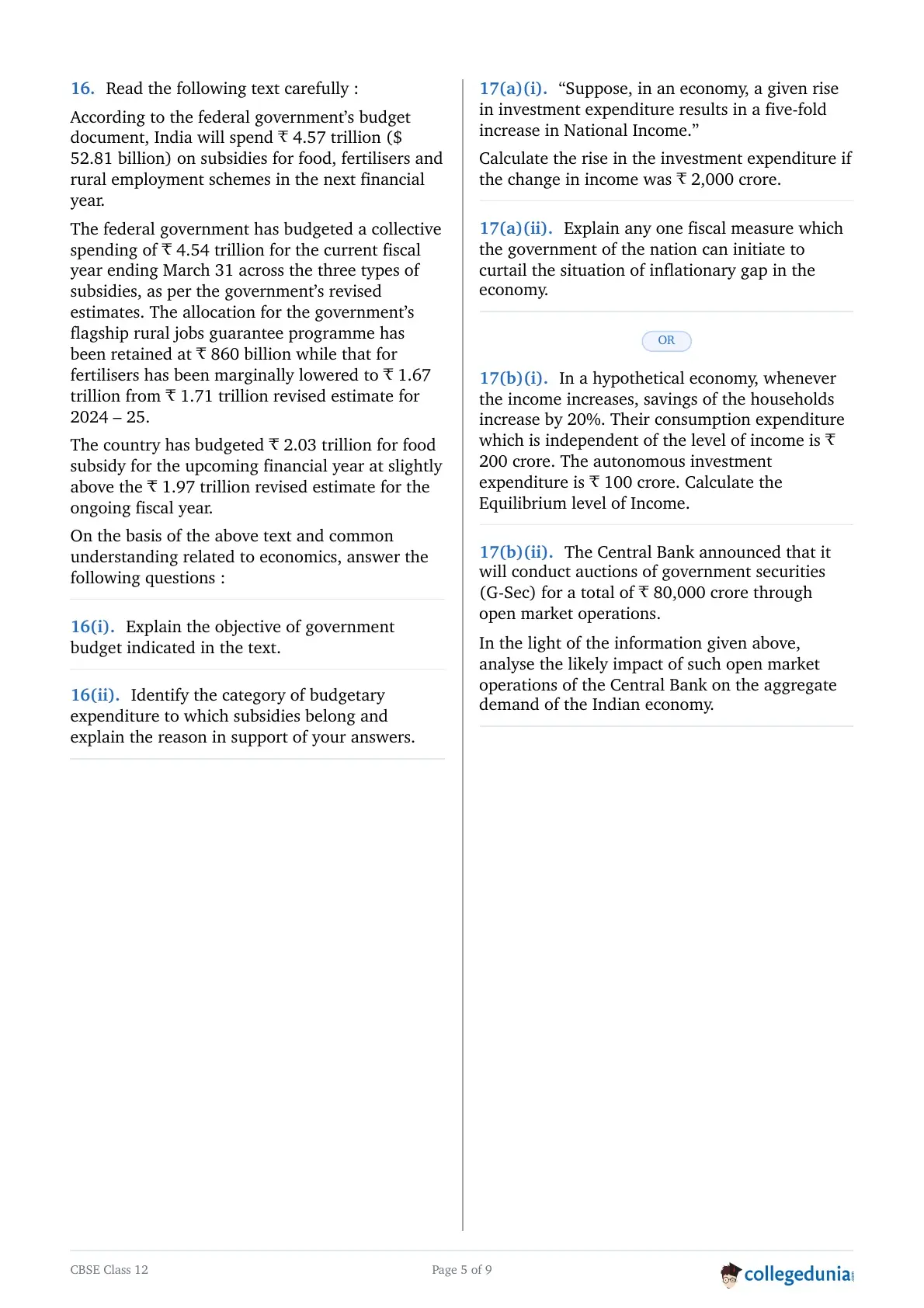
According to the federal government’s budget document, India will spend ₹ 4.57 trillion ($ 52.81 billion) on subsidies for food, fertilisers and rural employment schemes in the next financial year.
The federal government has budgeted a collective spending of ₹ 4.54 trillion for the current fiscal year ending March 31 across the three types of subsidies, as per the government’s revised estimates. The allocation for the government’s flagship
Read More
rural jobs guarantee programme has been retained at ₹ 860 billion while that for fertilisers has been marginally lowered to ₹ 1.67 trillion from ₹ 1.71 trillion revised estimate for 2024 – 25.The country has budgeted ₹ 2.03 trillion for food subsidy for the upcoming financial year at slightly above the ₹ 1.97 trillion revised estimate for the ongoing fiscal year.
On the basis of the above text and common understanding related to economics, answer the following questions :
Identify the category of budgetary expenditure to which subsidies belong and explain the reason in support of your answers.
“Suppose, in an economy, a given rise in investment expenditure results in a five-fold increase in National Income.”
Calculate the rise in the investment expenditure if the change in income was ₹ 2,000 crore.
Explain any one fiscal measure which the government of the nation can initiate to curtail the situation of inflationary gap in the economy.
In a hypothetical economy, whenever the income increases, savings of the households increase by 20%. Their consumption expenditure which is independent of the level of income is ₹ 200 crore. The autonomous investment expenditure is ₹ 100 crore. Calculate the Equilibrium level of Income.
The Central Bank announced that it will conduct auctions of government securities (G-Sec) for a total of ₹ 80,000 crore through open market operations.
In the light of the information given above, analyse the likely impact of such open market operations of the Central Bank on the aggregate demand of the Indian economy.
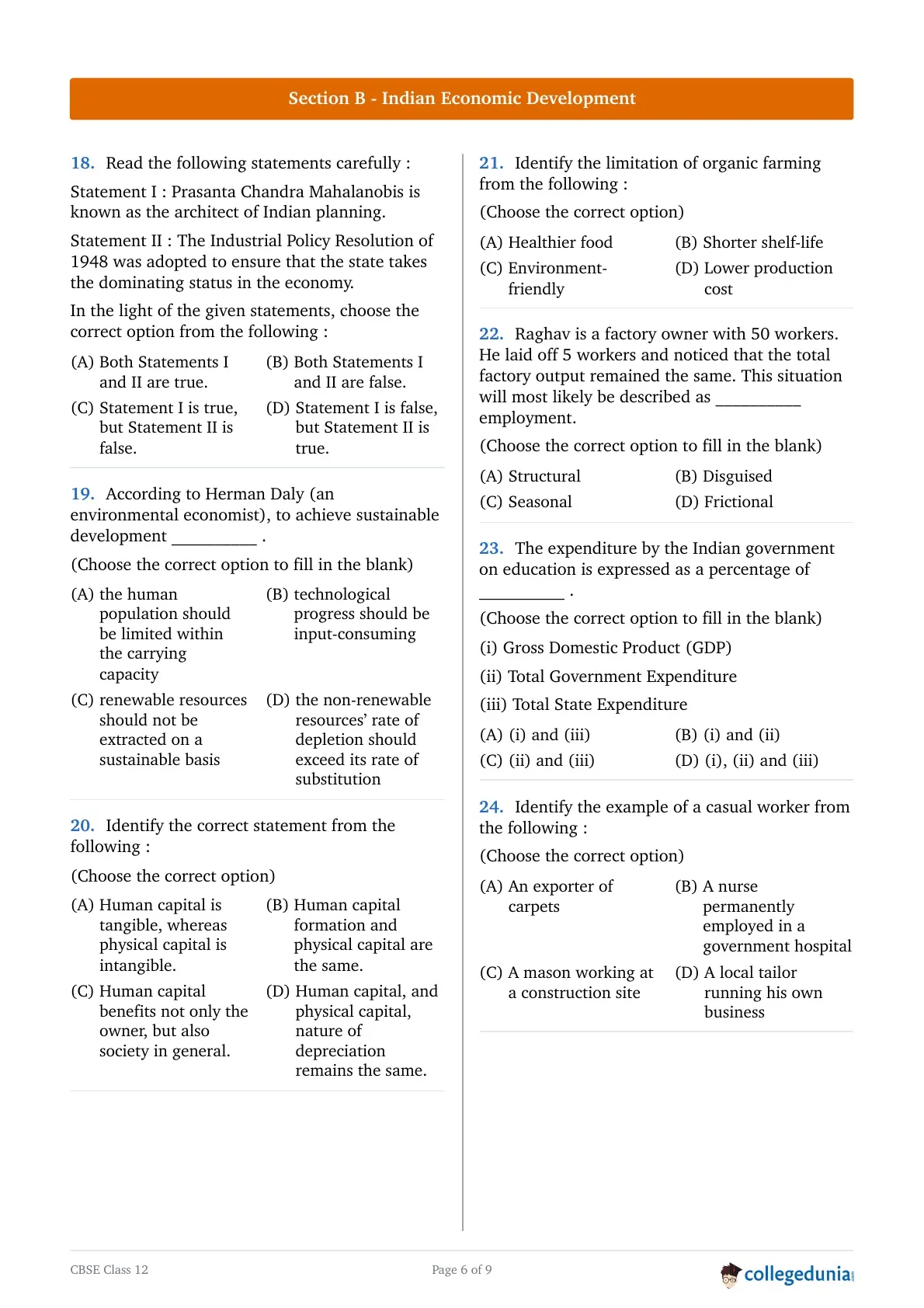
Read the following statements carefully :
Statement I : Prasanta Chandra Mahalanobis is known as the architect of Indian planning.
Statement II : The Industrial Policy Resolution of 1948 was adopted to ensure that the state takes the dominating status in the economy.
In the light of the given statements, choose the correct option from the following :
According to Herman Daly (an environmental economist), to achieve sustainable development __________ .
(Choose the correct option to fill in the blank)
Identify the correct statement from the following :
(Choose the correct option)
Identify the limitation of organic farming from the following :
(Choose the correct option)
Raghav is a factory owner with 50 workers. He laid off 5 workers and noticed that the total factory output remained the same. This situation will most likely be described as __________ employment.
(Choose the correct option to fill in the blank)
The expenditure by the Indian government on education is expressed as a percentage of __________ .
(Choose the correct option to fill in the blank)
(i) Gross Domestic Product (GDP)
(ii) Total Government Expenditure
(iii) Total State Expenditure
Identify the example of a casual worker from the following :
(Choose the correct option)
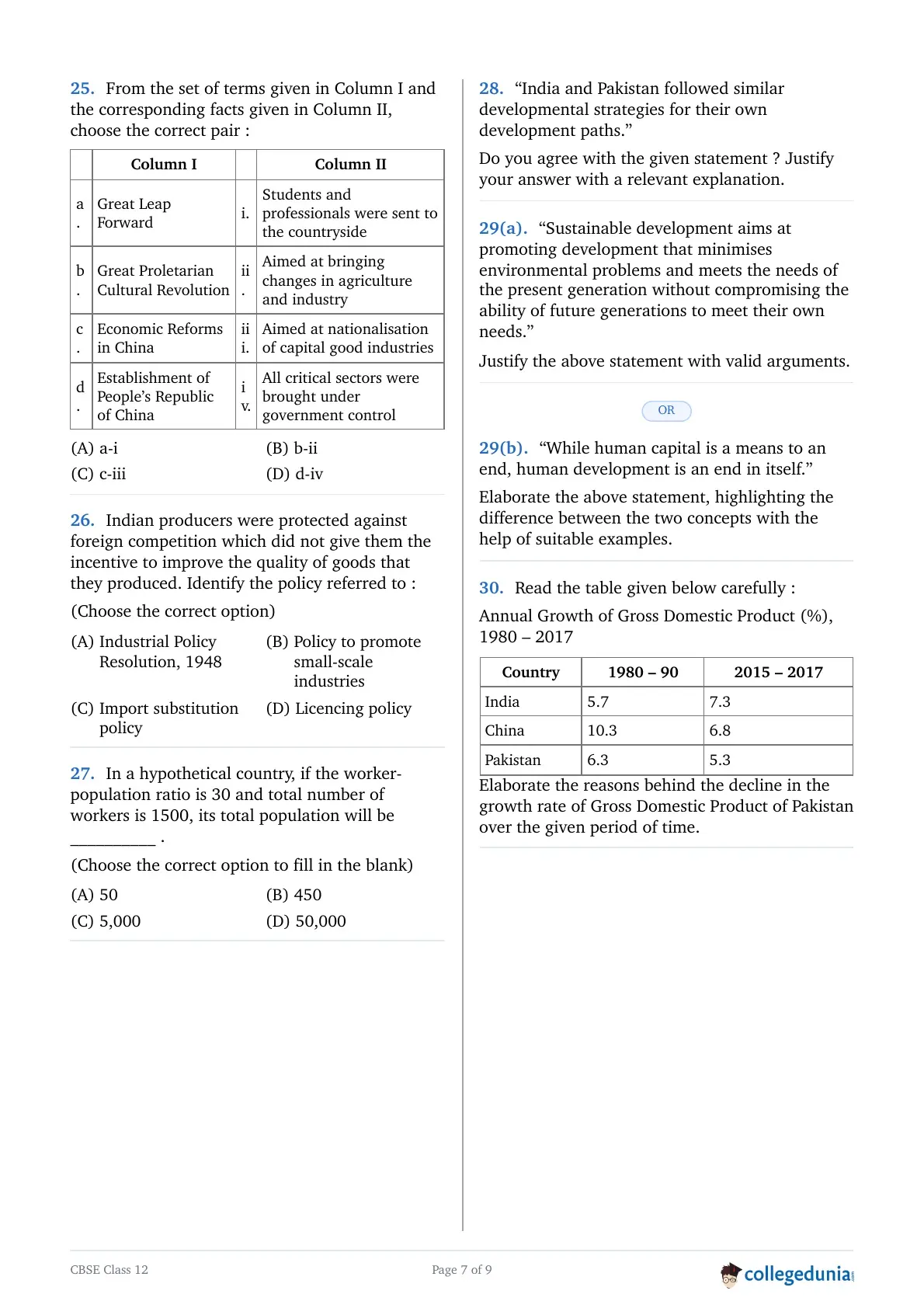
From the set of terms given in Column I and the corresponding facts given in Column II, choose the correct pair :
| Column I | Column II | ||
|---|---|---|---|
| a. | Great Leap Forward | i. | Students and professionals were sent to the countryside |
| b. | Great Proletarian Cultural Revolution | ii. | Aimed at bringing changes in agriculture and industry |
| c. | Economic Reforms in China | iii. | Aimed at nationalisation of capital good industries |
| d. | Establishment of People’s Republic of China | iv. | All critical sectors were brought under government control |
Indian producers were protected against foreign competition which did not give them the incentive to improve the quality of goods that they produced. Identify the policy referred to :
(Choose the correct option)
In a hypothetical country, if the worker-population ratio is 30 and total number of workers is 1500, its total population will be __________ .
(Choose the correct option to fill in the blank)
“India and Pakistan followed similar developmental strategies for their own development paths.”
Do you agree with the given statement ? Justify your answer with a relevant explanation.
“Sustainable development aims at promoting development that minimises environmental problems and meets the needs of the present generation without compromising the ability of future generations to meet their own needs.”
Justify the above statement with valid arguments.
“While human capital is a means to an end, human development is an end in itself.”
Elaborate the above statement, highlighting the difference between the two concepts with the help of suitable examples.
Read the table given below carefully :
Annual Growth of Gross Domestic Product (%), 1980 – 2017
| Country | 1980 – 90 | 2015 – 2017 |
|---|---|---|
| India | 5.7 | 7.3 |
| China | 10.3 | 6.8 |
| Pakistan | 6.3 | 5.3 |
Elaborate the reasons behind the decline in the growth rate of Gross Domestic Product of Pakistan over the given period of time.
“Before 1991, the Indian Banking sector was dominated by Public Sector Banks, regulated and controlled by the Reserve Bank of India.”
Discuss the reforms undertaken by the Indian government in the year 1991 to improve the banking system.
“The enforcement of land ceiling laws in India faced numerous challenges which restricted their success.”
Do you agree with the given statement ? Give a valid explanation in support of your answer.
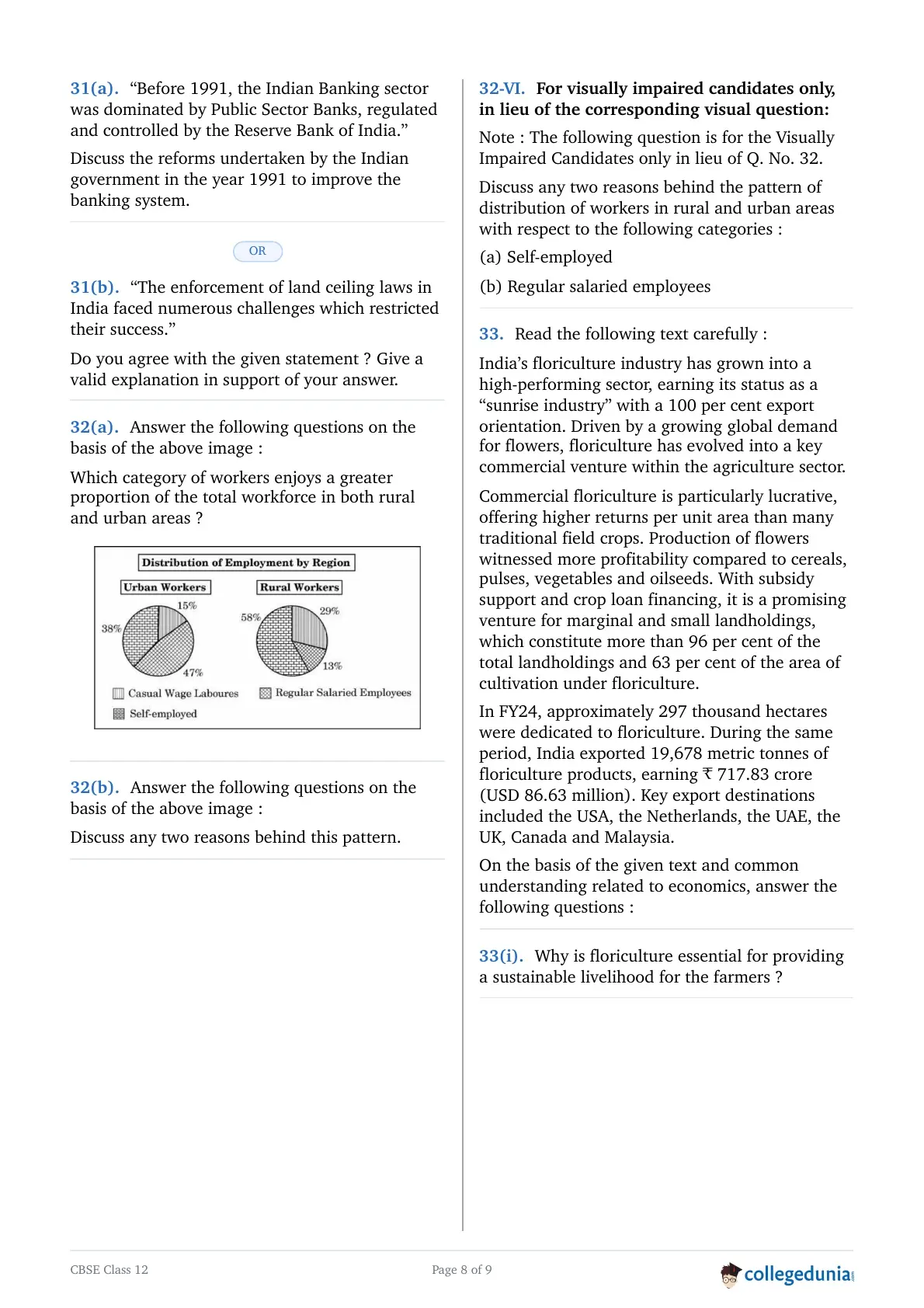
Answer the following questions on the basis of the above image :
Which category of workers enjoys a greater proportion of the total workforce in both rural and urban areas ?

Answer the following questions on the basis of the above image :
Discuss any two reasons behind this pattern.

Comprehension:
Read the following text carefully :
India’s floriculture industry has grown into a high-performing sector, earning its status as a “sunrise industry” with a 100 per cent export orientation. Driven by a growing global demand for flowers, floriculture has evolved into a key commercial venture within the agriculture sector.
Commercial floriculture is particularly lucrative, offering higher returns per unit area than many traditional field crops. Production of flowers witnessed more profitability compared to cereals, pulses, vegetables and oilseeds. With subsidy support and crop loan financing, it is
Read More
a promising venture for marginal and small landholdings, which constitute more than 96 per cent of the total landholdings and 63 per cent of the area of cultivation under floriculture.In FY24, approximately 297 thousand hectares were dedicated to floriculture. During the same period, India exported 19,678 metric tonnes of floriculture products, earning ₹ 717.83 crore (USD 86.63 million). Key export destinations included the USA, the Netherlands, the UAE, the UK, Canada and Malaysia.
On the basis of the given text and common understanding related to economics, answer the following questions :
Why is floriculture essential for providing a sustainable livelihood for the farmers ?
Explain any two ways in which the government can extend help to the small and marginal farmers.
As the Disinvestment Commission has observed, “the essence of a long-term disinvestment strategy should be not only to enhance budgetary receipts, but also minimise budgetary support towards unprofitable units. Also, it must ensure the long-term viability and sustainable levels of employment in such units.”
Identify the sector, whose disinvestment is being referred to in the statement.
As the Disinvestment Commission has observed, “the essence of a long-term disinvestment strategy should be not only to enhance budgetary receipts, but also minimise budgetary support towards unprofitable units. Also, it must ensure the long-term viability and sustainable levels of employment in such units.”
Justify this disinvestment strategy adopted by the Indian Government.
“Agricultural stagnation in colonial India was not only due to the use of backward techniques of production, but also a result of exploitative land settlement systems and policies adopted by the British.”
Defend or refute this statement giving valid arguments.
“In the 1950s, excessive government regulation prevented the growth of entrepreneurship.”
Do you agree with the given statement ? Give a valid explanation in support of your answer.
“The tax reductions in the reform period have not resulted in an increase in tax revenue.”
Justify the given statement with a valid explanation.
CBSE Class 12 Economics Compartment 2026 Set 2 - (58/7/2) Exam Pattern and Marking Scheme
| Question Type | Number of Questions | Marks per Question | Word Limit | Marks |
|---|---|---|---|---|
| Multiple choice questions | 20 | 1 | - | 20 |
| Short answer type-I | 4 | 3 | 60 - 80 words | 12 |
| Short answer type-II | 6 | 4 | 80 - 100 words | 24 |
| Long answer type | 4 | 6 | 100 - 150 words | 24 |
| Total | 34 questions | 80 |
CBSE Class 12 Economics Compartment 2026 Set 2 - (58/7/2) Question Paper FAQs
Ques. How many questions are there in the Economics Compartment 2026 paper (Set 2 - 58/7/2)?
Ans. The paper has 34 questions: 20 multiple choice questions, 4 short answer type-I, 6 short answer type-II and 4 long answer questions.
Ques. How are the marks divided?
Ans. The 20 multiple choice questions carry 20 marks, the short answer type-I questions 12 marks, the short answer type-II questions 24 marks and the long answer questions 24 marks, for a total of 80 marks.
Ques. Is there any choice in the paper?
Ans. There is no overall choice. An internal choice is given in a few questions, and only one of the choices has to be attempted. All parts of a question should be attempted together.
Ques. How much time is given for the CBSE Class 12 Economics Compartment 2026 paper?
Ans. The paper is of 3 hours (10:30 AM to 1:30 PM). The question paper is distributed at 10:15 AM and candidates get 15 minutes to read it before they start writing.
Ques. When was the CBSE Class 12 Economics Compartment 2026 exam held?
Ans. The Class 12 compartment (supplementary) paper of Economics was held on July 28, 2026.
Ques. Where can I get the official CBSE Class 12 Economics Compartment question paper?
Ans. The official question papers are published on the CBSE website, cbse.gov.in.



Comments