




CBSE Class 12 Chemistry Question Paper 2026 (Set 2 - 56/4/2) with Solutions is now available here for download. CBSE conducted the Class 12 Chemistry examination on February 28, 2026, from 10:30 AM to 1:30 PM.
CBSE Class 12 Chemistry paper is of total 100 marks out of which 70 marks are allocated to the theory paper and 30 marks are for practical examination.
The theory paper consists of 33 questions divided into five sections:
- Section A contains Multiple Choice Questions (MCQs),
- Section B contains Very Short Answer Type (VSA) Questions,
- Section C contains Short Answer Type (SA) Questions,
- Section D contains Case-Study based Questions,
- Section E contains Long Answer (LA) Type Questions.
All sections are compulsory.
CBSE Class 12 Chemistry Question Paper 2026 (Set 2 - 56/4/2) with Solution PDF
| CBSE Official PDF | CD PDF | CD PDF with Solutions |
|---|---|---|
| Download official PDF 0.67 MB | Download Collegedunia PDF 0.50 MB | Download solutions PDF 0.64 MB |
CBSE Class 12 Chemistry 2026 Set 2 (56/4/2) Questions with Solutions
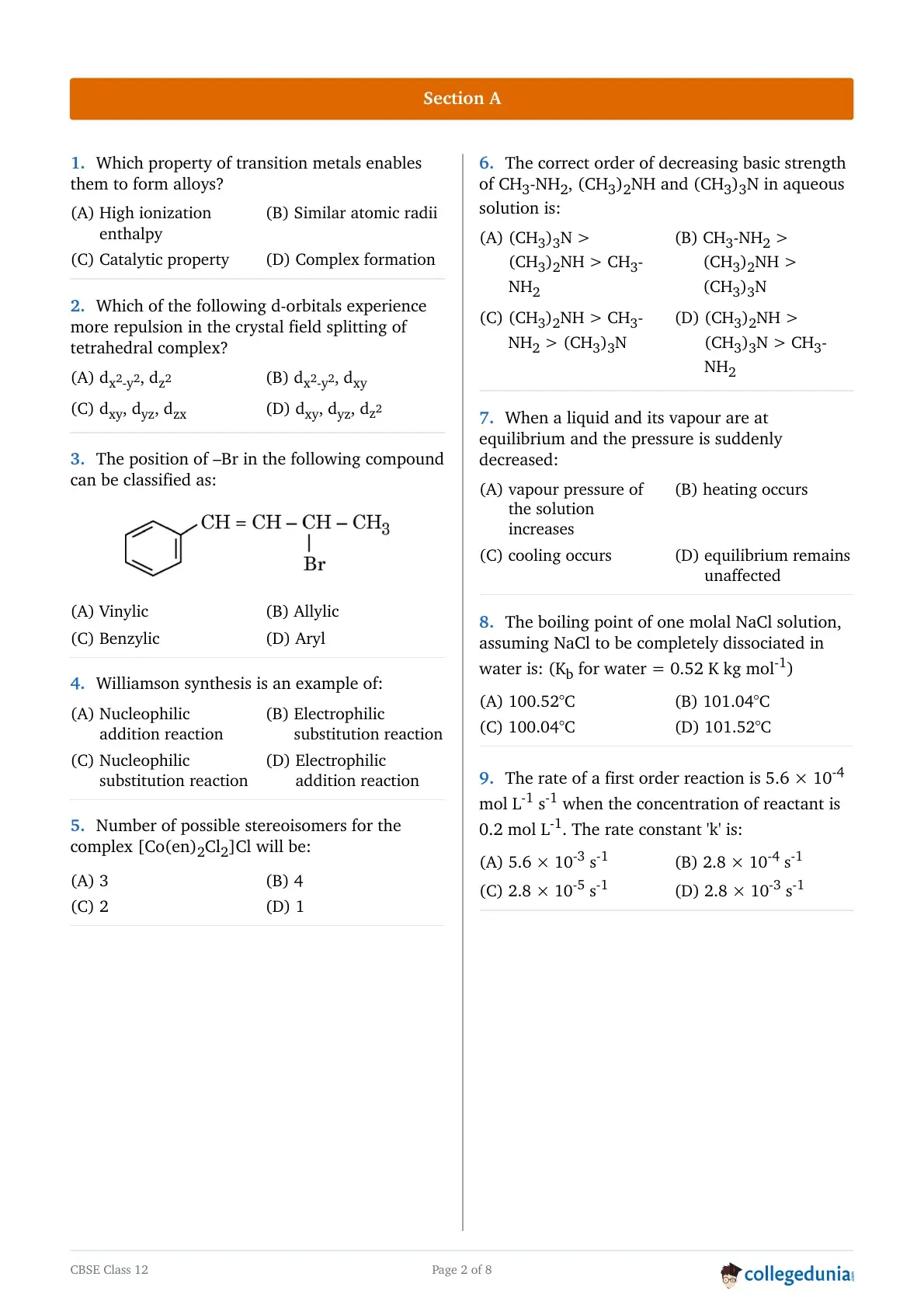
Which property of transition metals enables them to form alloys?
Which of the following d-orbitals experience more repulsion in the crystal field splitting of a tetrahedral complex?
The position of \(-\)Br in the compound shown can be classified as :
Williamson synthesis is an example of:
Number of possible stereoisomers for the complex \([Co(en)_2Cl_2]Cl\) will be:
The correct order of decreasing basic strength of \(CH_3NH_2\), \((CH_3)_2NH\) and \((CH_3)_3N\) in aqueous solution is:
When a liquid and its vapour are at equilibrium and the pressure is suddenly decreased :
The boiling point of one molal \( NaCl \) solution, assuming \( NaCl \) to be completely dissociated in water is : (\( K_{b} \) for water = \( 0.52 \, K \, kg \, mol^{-1} \))
The rate of a first order reaction is \( 5.6 \times 10^{-4} \, mol \, L^{-1} \, s^{-1} \), when the concentration of reactant is \( 0.2 \, mol \, L^{-1} \). The rate constant \( 'k' \) is :
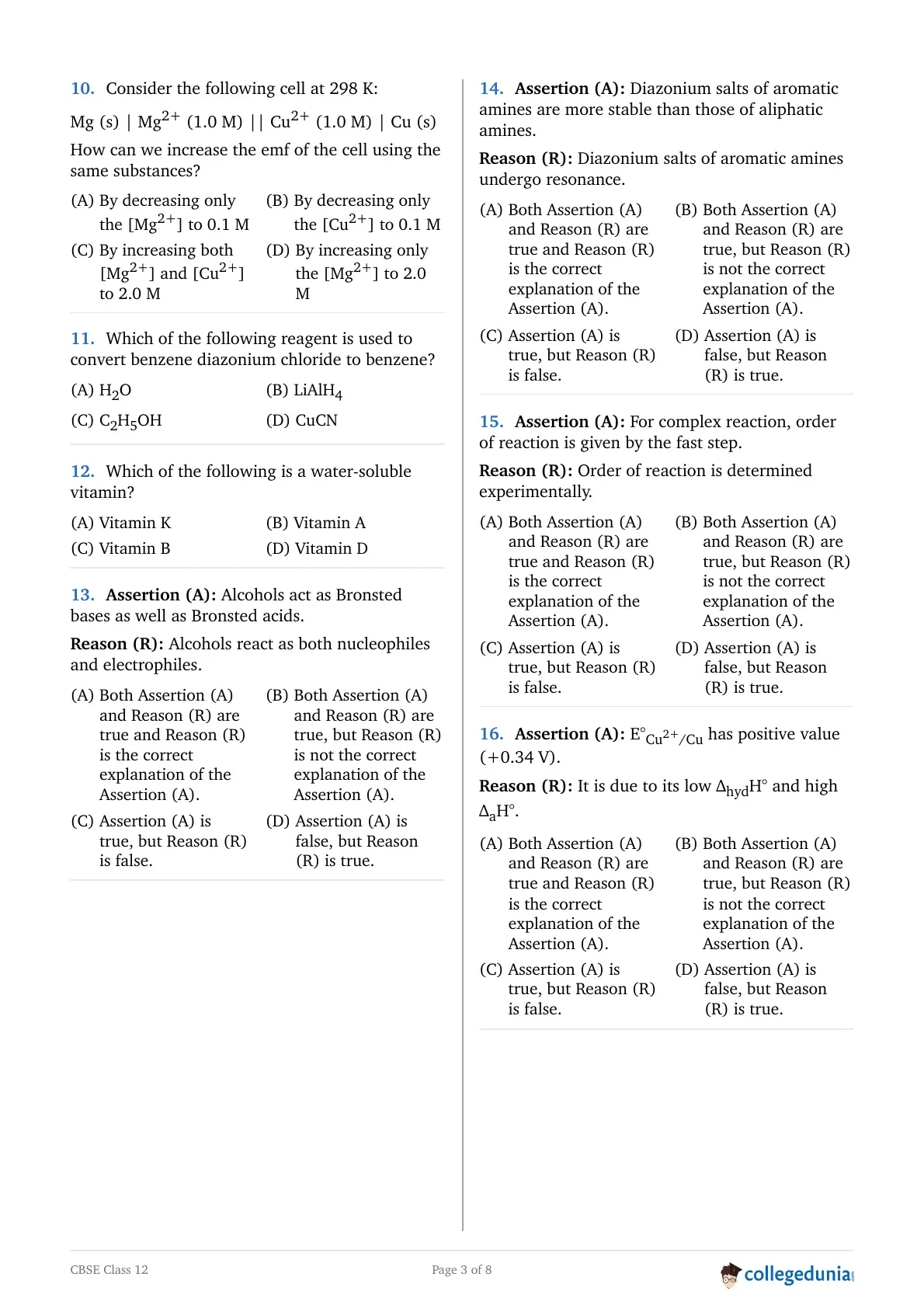
Consider the following cell at \( 298 \, K \): \( Mg (s) \mid Mg^{2+} (1.0 \, M) \parallel Cu^{2+} (1.0 \, M) \mid Cu (s) \). How can we increase the emf of the cell using the same substances ?
Which reagent is used to convert benzene diazonium chloride to benzene?
Which of the following is a water-soluble vitamin?
Assertion (A): Alcohols act as Bronsted bases as well as Bronsted acids.
Reason (R): Alcohols react as both nucleophiles and electrophiles.
Assertion (A) : Diazonium salts of aromatic amines are more stable than those of aliphatic amines.
Reason (R) : Diazonium salts of aliphatic amines undergo resonance.
Assertion (A): For complex reactions, order of reaction is given by the fast step.
Reason (R): Order of reaction is determined experimentally.
Assertion (A) : \(E^\circ_{Cu^{2+}/Cu}\) has positive value (+ 0.34 V).
Reason (R) : It is due to low \(\Delta_{hyd}H^\circ\) and high \(\Delta_{a}H^\circ\).
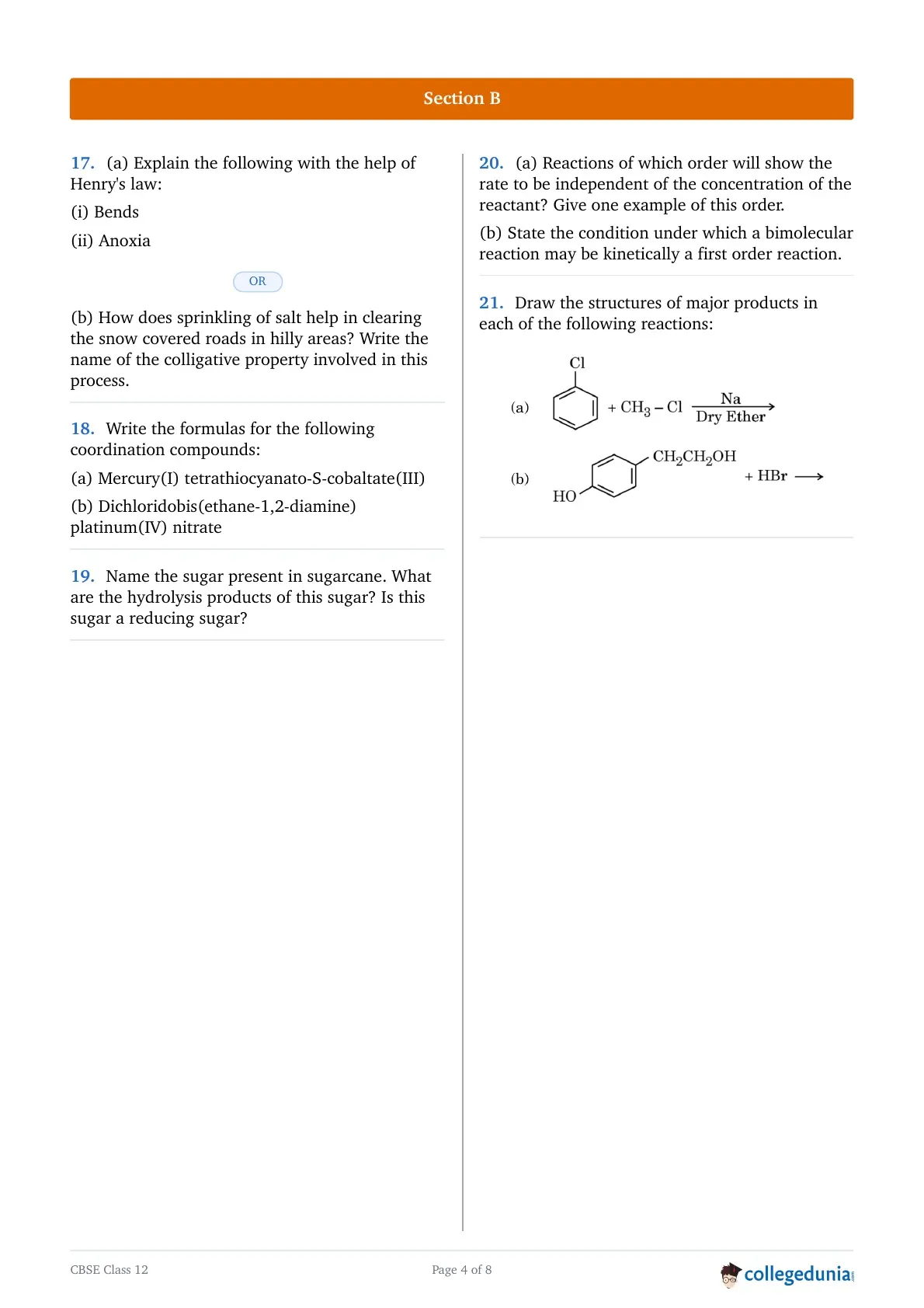
How does sprinkling of salt help in clearing snow-covered roads in hilly areas? Name the colligative property involved.
Explain the following with the help of Henry’s law : (i) Bends (ii) Anoxia
Write the formulas of: (a) Mercury(I) tetrathiocyanato-S-cobaltate(III)
(b) Dichloridobis(ethane-1,2-diamine)platinum(IV) nitrate
Name the sugar present in sugarcane. What are the hydrolysis products of this sugar? Is this sugar a reducing sugar?
Reactions of which order will show the rate to be independent of the concentration of the reactant ? Give one example of this order.
State the condition under which a bimolecular reaction may be kinetically a first order reaction.
Draw the structures of major products in each of the following reactions :


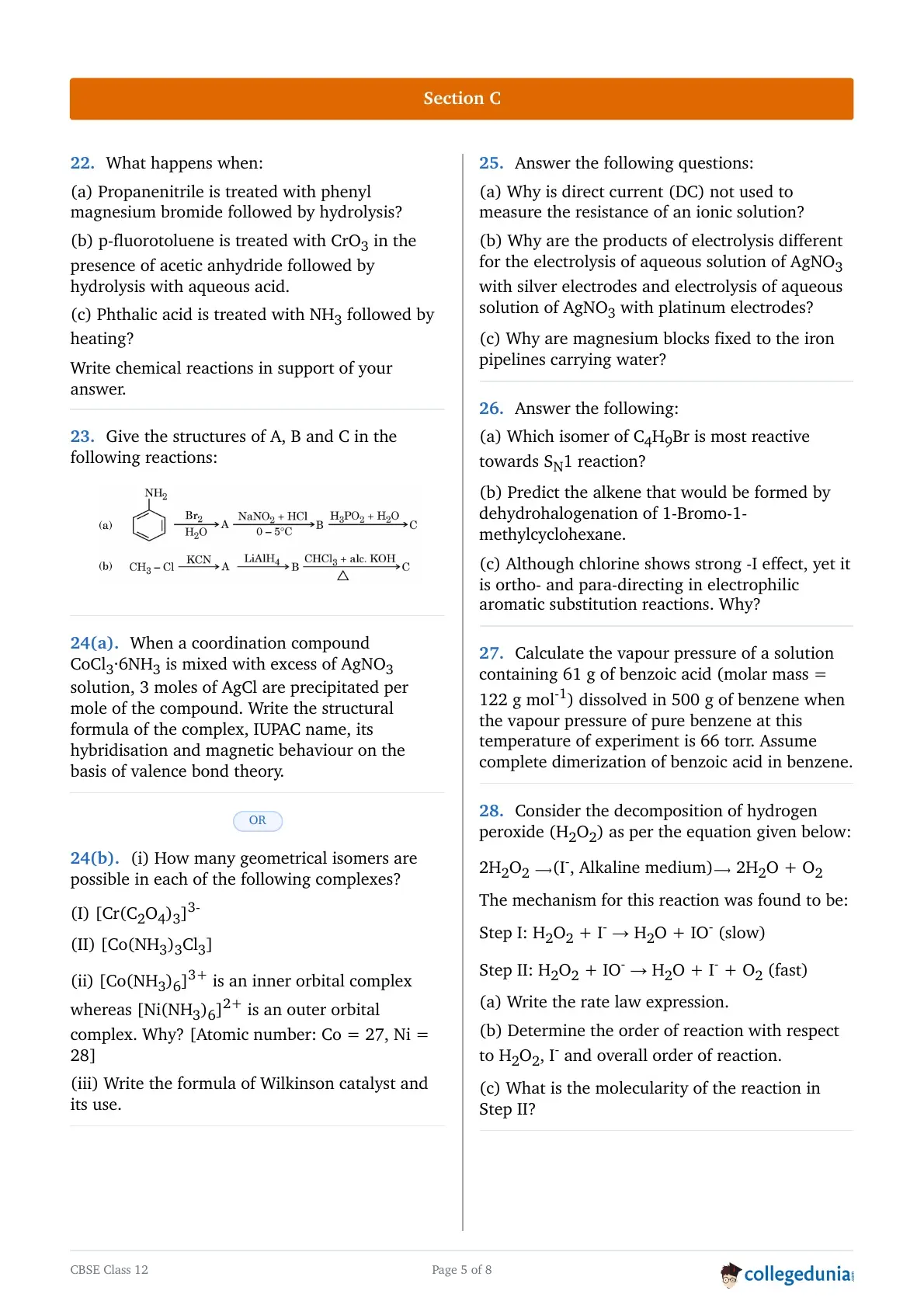
What happens when : (a) Propanenitrile is treated with phenyl magnesium bromide followed by hydrolysis ? (b) p-Fluorotoluene is treated with \( \mathrm{CrO_3} \) in the presence of acetic anhydride followed by hydrolysis with aqueous acid. (c) Phthalic acid is treated with \( \mathrm{NH_3} \) followed by heating ? Write chemical reactions in support of your answer.


When a coordination compound \( CoCl_{3} \cdot 6NH_{3} \) is mixed with excess of \( AgNO_{3} \) solution, 3 moles of \( AgCl \) are precipitated per mole of the compound. Write the structural formula of the complex, IUPAC name, its hybridisation and magnetic behaviour on the basis of valence bond theory.
(i) How many geometrical isomers are possible in each of the following complexes ?
(I) \( \mathrm{[Cr(C_2O_4)_3]^{3-}} \)
(II) \( \mathrm{[Co(NH_3)_3Cl_3]} \)
(ii) \( \mathrm{[Co(NH_3)_6]^{3+}} \) is an inner orbital complex whereas \( \mathrm{[Ni(NH_3)_6]^{2+}} \) is an outer orbital complex. Why ?
[Atomic number : Co = 27, Ni = 28]
(iii) Write the formula of Wilkinson catalyst and its use.
Why are the products of electrolysis different for the electrolysis of aqueous solution of \( AgNO_{3} \) with silver electrodes and electrolysis of aqueous solution of \( AgNO_{3} \) with platinum electrodes?
Why is direct current (DC) not used to measure the resistance of an ionic solution?
Why are magnesium blocks fixed to the iron pipelines carrying water?
Predict the alkene that would be formed by dehydrohalogenation of 1-Bromo-1-methylcyclohexane.
Although chlorine shows strong \( -I \) effect, yet it is ortho- and para-directing in electrophilic aromatic substitution reactions. Why?
Which isomer of \(C_4H_9Br\) is most reactive towards \(S_N1\) reaction?
Calculate the vapour pressure of a solution containing \( 61 \, g \) of benzoic acid (molar mass \( = 122 \, g \, mol^{-1} \)) dissolved in \( 500 \, g \) of benzene when the vapour pressure of pure benzene at this temperature of experiment is \( 66 \, torr \). Assume complete dimerization of benzoic acid in benzene.
Consider the decomposition of hydrogen peroxide \((H_{2}O_{2})\) as per the equation given below: \[ 2H_{2}O_{2} \xrightarrow[\text{Alkaline medium}]{I^-} 2H_{2}O + O_{2} \] The mechanism for this reaction was found to be: \[ \textbf{Step I:}\qquad H_{2}O_{2}+I^- \longrightarrow H_{2}O+IO^- \qquad (\text{slow}) \] \[ \textbf{Step II:}\qquad H_{2}O_{2}+IO^- \longrightarrow H_{2}O+I^-+O_{2} \qquad (\text{fast}) \] (a) Write the rate law expression. (b) Determine the order of reaction with respect to \(H_{2}O_{2}\), \(I^-\) and overall order of reaction. (c) What is the molecularity of the reaction in Step II ?
Consider the decomposition of hydrogen peroxide (\( \mathrm{H_2O_2} \)) as per the equation given below :
\[ 2\mathrm{H_2O_2} \xrightarrow[\text{Alkaline medium}]{\mathrm{I^-}} 2\mathrm{H_2O} + \mathrm{O_2} \]
The mechanism for this reaction was found to be :
Step I : \( \mathrm{H_2O_2 + I^-} \rightarrow \mathrm{H_2O + IO^-} \) (slow)
Step II : \( \mathrm{H_2O_2 + IO^-} \rightarrow \mathrm{H_2O + I^- + O_2} \) (fast)
Determine the order of reaction with respect to \( \mathrm{H_2O_2} \), \( \mathrm{I^-} \) and overall order of reaction.
Consider the decomposition of hydrogen peroxide (\( \mathrm{H_2O_2} \)) as per the equation given below :
\[ 2\mathrm{H_2O_2} \xrightarrow[\text{Alkaline medium}]{\mathrm{I^-}} 2\mathrm{H_2O} + \mathrm{O_2} \]
The mechanism for this reaction was found to be :
Step I : \( \mathrm{H_2O_2 + I^-} \rightarrow \mathrm{H_2O + IO^-} \) (slow)
Step II : \( \mathrm{H_2O_2 + IO^-} \rightarrow \mathrm{H_2O + I^- + O_2} \) (fast)
What is the molecularity of the reaction in Step II ?
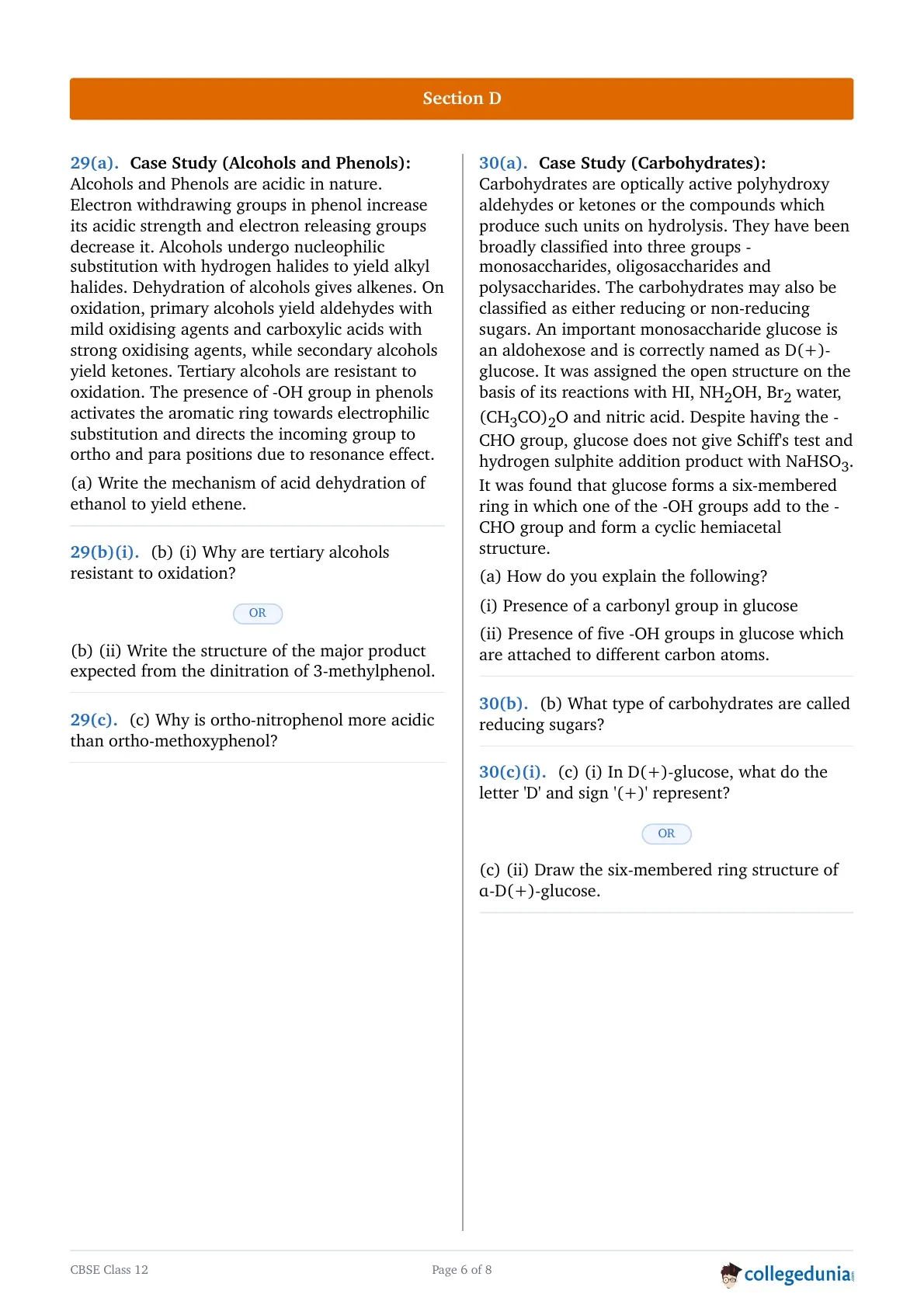
Write the mechanism of acid dehydration of ethanol to yield ethene.
Alcohols and Phenols are acidic in nature. Electron withdrawing groups in phenol increase its acidic strength and electron releasing groups decrease it. Alcohols undergo nucleophilic substitution with hydrogen halides to yield alkyl halides. Dehydration of alcohols gives alkenes. On oxidation, primary alcohols yield aldehydes with mild oxidising agents and carboxylic acids with strong oxidising agents, while secondary alcohols yield ketones. Tertiary alcohols are resistant to oxidation. The presence of - OH group in phenols activates the aromatic ring towards electrophilic substitution and directs the incoming group to ortho and para positions due to resonance effect.
Answer the following questions :
(i) Why are tertiary alcohols resistant to oxidation ?
Alcohols and Phenols are acidic in nature. Electron withdrawing groups in phenol increase its acidic strength and electron releasing groups decrease it. Alcohols undergo nucleophilic substitution with hydrogen halides to yield alkyl halides. Dehydration of alcohols gives alkenes. On oxidation, primary alcohols yield aldehydes with mild oxidising agents and carboxylic acids with strong oxidising agents, while secondary alcohols yield ketones. Tertiary alcohols are resistant to oxidation. The presence of - OH group in phenols activates the aromatic ring towards electrophilic substitution and directs the incoming group to ortho and para positions due to resonance effect.
Answer the following questions :
(ii) Write the structure of the major product expected from the dinitration of 3-methylphenol.
Alcohols and Phenols are acidic in nature. Electron withdrawing groups in phenol increase its acidic strength and electron releasing groups decrease it. Alcohols undergo nucleophilic substitution with hydrogen halides to yield alkyl halides. Dehydration of alcohols gives alkenes. On oxidation, primary alcohols yield aldehydes with mild oxidising agents and carboxylic acids with strong oxidising agents, while secondary alcohols yield ketones. Tertiary alcohols are resistant to oxidation. The presence of - OH group in phenols activates the aromatic ring towards electrophilic substitution and directs the incoming group to ortho and para positions due to resonance effect.
Answer the following questions :
Why is ortho-nitrophenol more acidic than ortho-methoxyphenol ?
Carbohydrates are optically active polyhydroxy aldehydes or ketones or the compounds which produce such units on hydrolysis. They have been broadly classified into three groups - monosaccharides, oligosaccharides and polysaccharides. The carbohydrates may also be classified as either reducing or non-reducing sugars. An important monosaccharide glucose is an aldohexose and is correctly named as D(+)-glucose. It was assigned the open structure on the basis of its reactions with HI, \(\mathrm{NH_2OH}\), \(\mathrm{Br_2}\) water, \(\mathrm{(CH_3CO)_2O}\) and nitric acid.
Despite having the - CHO group, glucose does not give Schiff's test and hydrogen sulphite addition product with \(\mathrm{NaHSO_3}\). It was found that glucose forms a six-membered ring in which one of the - OH groups add to the - CHO group and form a cyclic hemiacetal structure.
Answer the following questions :
How do you explain the following ?
(i) Presence of a carbonyl group in glucose
(ii) Presence of five - OH groups in glucose which are attached to different carbon atoms.
Carbohydrates are optically active polyhydroxy aldehydes or ketones or the compounds which produce such units on hydrolysis. They have been broadly classified into three groups - monosaccharides, oligosaccharides and polysaccharides. The carbohydrates may also be classified as either reducing or non-reducing sugars. An important monosaccharide glucose is an aldohexose and is correctly named as D(+)-glucose. It was assigned the open structure on the basis of its reactions with HI, \(\mathrm{NH_2OH}\), \(\mathrm{Br_2}\) water, \(\mathrm{(CH_3CO)_2O}\) and nitric acid.
Despite having the - CHO group, glucose does not give Schiff's test and hydrogen sulphite addition product with \(\mathrm{NaHSO_3}\). It was found that glucose forms a six-membered ring in which one of the - OH groups add to the - CHO group and form a cyclic hemiacetal structure.
Answer the following questions :
What type of carbohydrates are called reducing sugars ?
Carbohydrates are optically active polyhydroxy aldehydes or ketones or the compounds which produce such units on hydrolysis. They have been broadly classified into three groups - monosaccharides, oligosaccharides and polysaccharides. The carbohydrates may also be classified as either reducing or non-reducing sugars. An important monosaccharide glucose is an aldohexose and is correctly named as D(+)-glucose. It was assigned the open structure on the basis of its reactions with HI, \(\mathrm{NH_2OH}\), \(\mathrm{Br_2}\) water, \(\mathrm{(CH_3CO)_2O}\) and nitric acid.
Despite having the - CHO group, glucose does not give Schiff's test and hydrogen sulphite addition product with \(\mathrm{NaHSO_3}\). It was found that glucose forms a six-membered ring in which one of the - OH groups add to the - CHO group and form a cyclic hemiacetal structure.
Answer the following questions :
(i) In D(+)-glucose, what do the letter 'D' and sign '(+)' represent ?
Carbohydrates are optically active polyhydroxy aldehydes or ketones or the compounds which produce such units on hydrolysis. They have been broadly classified into three groups - monosaccharides, oligosaccharides and polysaccharides. The carbohydrates may also be classified as either reducing or non-reducing sugars. An important monosaccharide glucose is an aldohexose and is correctly named as D(+)-glucose. It was assigned the open structure on the basis of its reactions with HI, \(\mathrm{NH_2OH}\), \(\mathrm{Br_2}\) water, \(\mathrm{(CH_3CO)_2O}\) and nitric acid.
Despite having the - CHO group, glucose does not give Schiff's test and hydrogen sulphite addition product with \(\mathrm{NaHSO_3}\). It was found that glucose forms a six-membered ring in which one of the - OH groups add to the - CHO group and form a cyclic hemiacetal structure.
Answer the following questions :
(ii) Draw the six-membered ring structure of \(\alpha\)-D(+)-glucose.
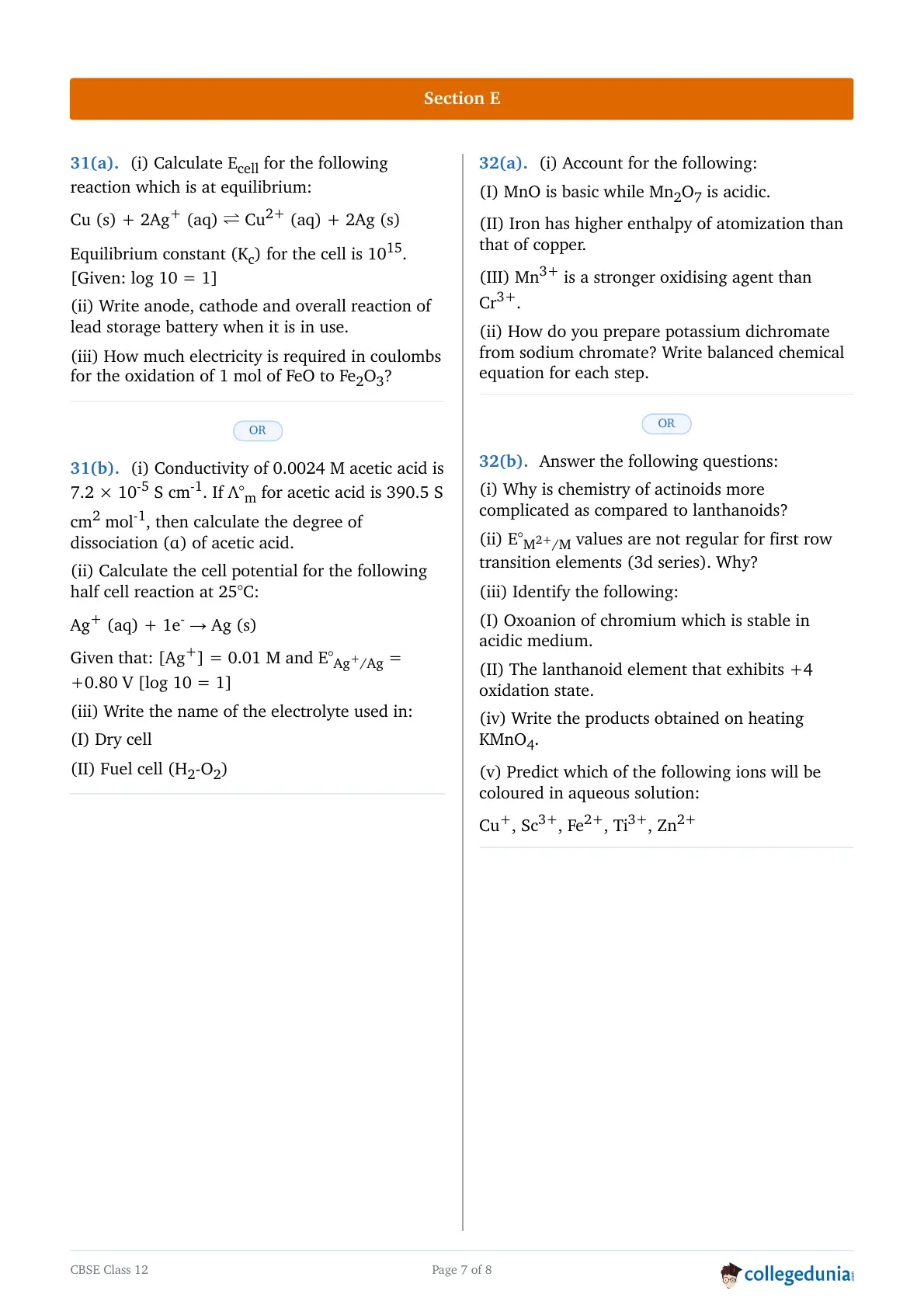
(i) Calculate \( E^\circ_{cell} \) for the following reaction which is at equilibrium :
\( \mathrm{Cu(s) + 2Ag^+(aq) \rightleftharpoons Cu^{2+}(aq) + 2Ag(s)} \)
Equilibrium constant \( (K_c) \) for the cell is \( 10^{15} \).
[Given : log 10 = 1]
(ii) Write anode, cathode and overall reaction of lead storage battery when it is in use.
(iii) How much electricity is required in coulombs for the oxidation of 1 mol of FeO to \( \mathrm{Fe_2O_3} \) ?
(i) Conductivity of 0.0024 M acetic acid is \( 7.2 \times 10^{-5}\ \mathrm{S\ cm^{-1}} \). If \( \Lambda^\circ_m \) for acetic acid is \( 390.5\ \mathrm{S\ cm^2\ mol^{-1}} \), then calculate the degree of dissociation (\( \alpha \)) of acetic acid.
(ii) Calculate the cell potential for the following half cell reaction at \( 25^\circ \mathrm{C} \) :
\( \mathrm{Ag^+(aq) + 1\,e^- \longrightarrow Ag(s)} \)
Given that : \( [\mathrm{Ag^+}] = 0.01\ \mathrm{M} \) and \( E^\circ_{\mathrm{Ag^+/Ag}} = +0.80\ \mathrm{V} \)
[log 10 = 1]
(iii) Write the name of the electrolyte used in :
(I) Dry cell
(II) Fuel cell (\( \mathrm{H_2 - O_2} \))
(i) Account for the following :
(I) \(\mathrm{MnO}\) is basic while \(\mathrm{Mn_2O_7}\) is acidic.
(II) Iron has higher enthalpy of atomization than that of copper.
(III) \(\mathrm{Mn^{3+}}\) is a stronger oxidising agent than \(\mathrm{Cr^{3+}}\).
(ii) How do you prepare potassium dichromate from sodium chromate ? Write balanced chemical equation for each step.
Answer the following questions :
(i) Why is chemistry of actinoids more complicated as compared to lanthanoids ?
(ii) \(E^\circ_{M^{2+}/M}\) values are not regular for first row transition elements (3d series). Why ?
(iii) Identify the following :
(I) Oxoanion of chromium which is stable in acidic medium.
(II) The lanthanoid element that exhibits +4 oxidation state.
(iv) Write the products obtained on heating \(\mathrm{KMnO_4}\).
(v) Predict which of the following ions will be coloured in aqueous solution :
\(\mathrm{Cu^{+}}\), \(\mathrm{Sc^{3+}}\), \(\mathrm{Fe^{2+}}\), \(\mathrm{Ti^{3+}}\), \(\mathrm{Zn^{2+}}\)
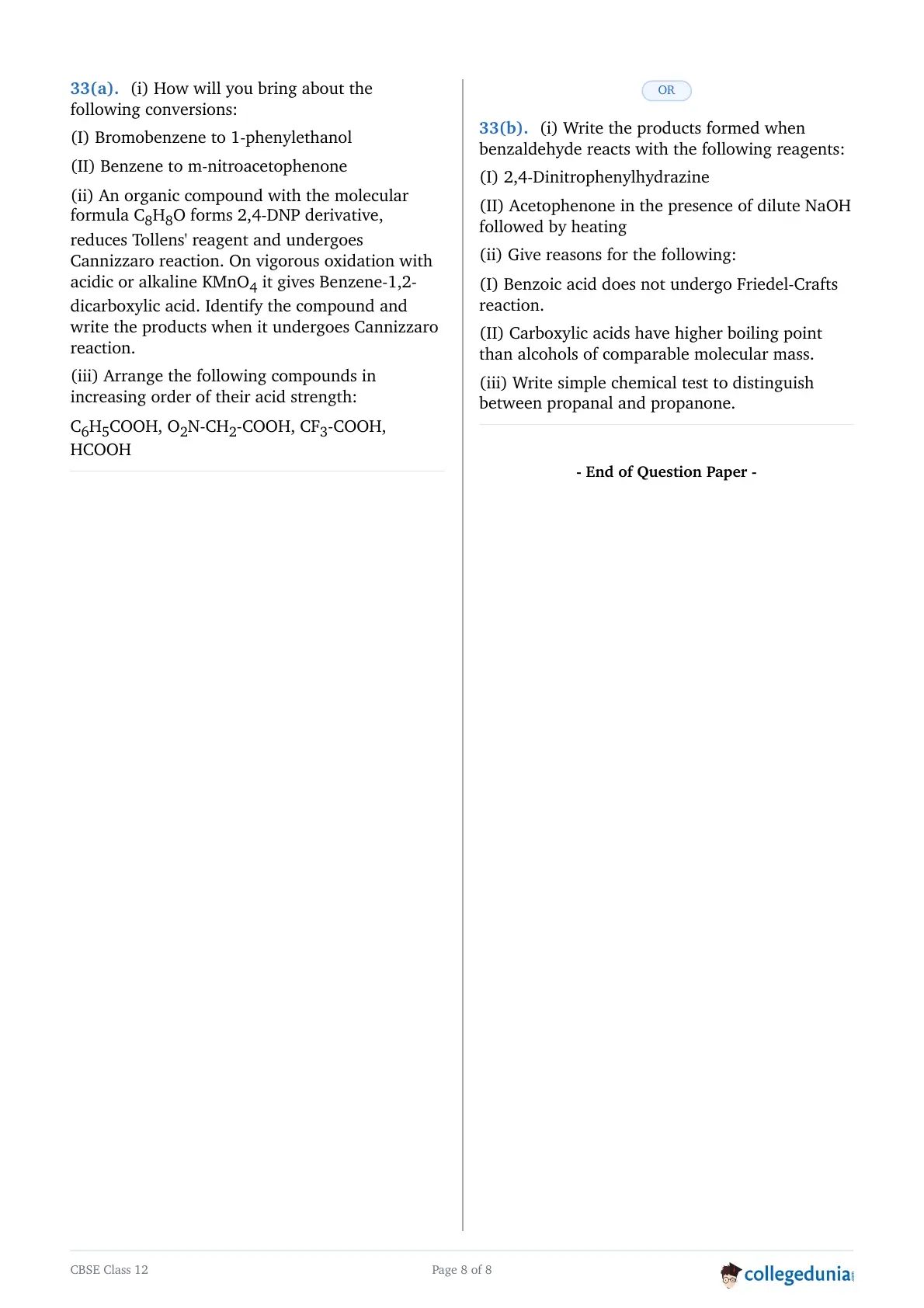
(i) How will you bring about the following conversions :
(I) Bromobenzene to 1-phenylethanol
(II) Benzene to m-nitroacetophenone
(ii) An organic compound with the molecular formula \( \mathrm{C_8H_8O} \) forms 2,4-DNP derivative, reduces Tollens' reagent and undergoes Cannizzaro reaction. On vigorous oxidation with acidic or alkaline \( \mathrm{KMnO_4} \) it gives Benzene-1,2-dicarboxylic acid. Identify the compound and write the products when it undergoes Cannizzaro reaction.
(iii) Arrange the following compounds in increasing order of their acid strength :
\( \mathrm{C_6H_5COOH,\ O_2N - CH_2 - COOH,\ CF_3 - COOH,\ HCOOH} \)
(i) Write the products formed when benzaldehyde reacts with the following reagents :
(I) 2,4-Dinitrophenylhydrazine
(II) Acetophenone in the presence of dilute NaOH followed by heating
(ii) Give reasons for the following :
(I) Benzoic acid does not undergo Friedel-Crafts reaction.
(II) Carboxylic acids have higher boiling point than alcohols of comparable molecular mass.
(iii) Write simple chemical test to distinguish between propanal and propanone.
CBSE Class 12 Chemistry Paper Structure
| Question Type | Description |
|---|---|
| Very Short Answer | 1–2 line answers, definitions, or simple equations |
| Short Answer | Explanations, derivations, or numerical problems |
| Long Answer | Detailed answers, reaction mechanisms, or calculations |
| Case-based / Integrated | Questions based on a given situation may include calculations or reasoning |



Comments