




CBSE Class 12 Chemistry Question Paper 2026 (Set 1 - 56/3/1) with Solutions is now available here for download. CBSE conducted the Class 12 Chemistry examination on February 28, 2026, from 10:30 AM to 1:30 PM.
CBSE Class 12 Chemistry paper is of total 100 marks out of which 70 marks are allocated to the theory paper and 30 marks are for practical examination.
The theory paper consists of 33 questions divided into five sections:
- Section A contains Multiple Choice Questions (MCQs),
- Section B contains Very Short Answer Type (VSA) Questions,
- Section C contains Short Answer Type (SA) Questions,
- Section D contains Case-Study based Questions,
- Section E contains Long Answer (LA) Type Questions.
All sections are compulsory.
CBSE Class 12 Chemistry Question Paper 2026 (Set 1 - 56/3/1) with Solution PDF
| CBSE Official PDF | CD PDF | CD PDF with Solutions |
|---|---|---|
| Download official PDF 0.65 MB | Download Collegedunia PDF 0.44 MB | Download solutions PDF 0.54 MB |
CBSE Class 12 Chemistry 2026 Set 1 (56/3/1) Questions with Solutions
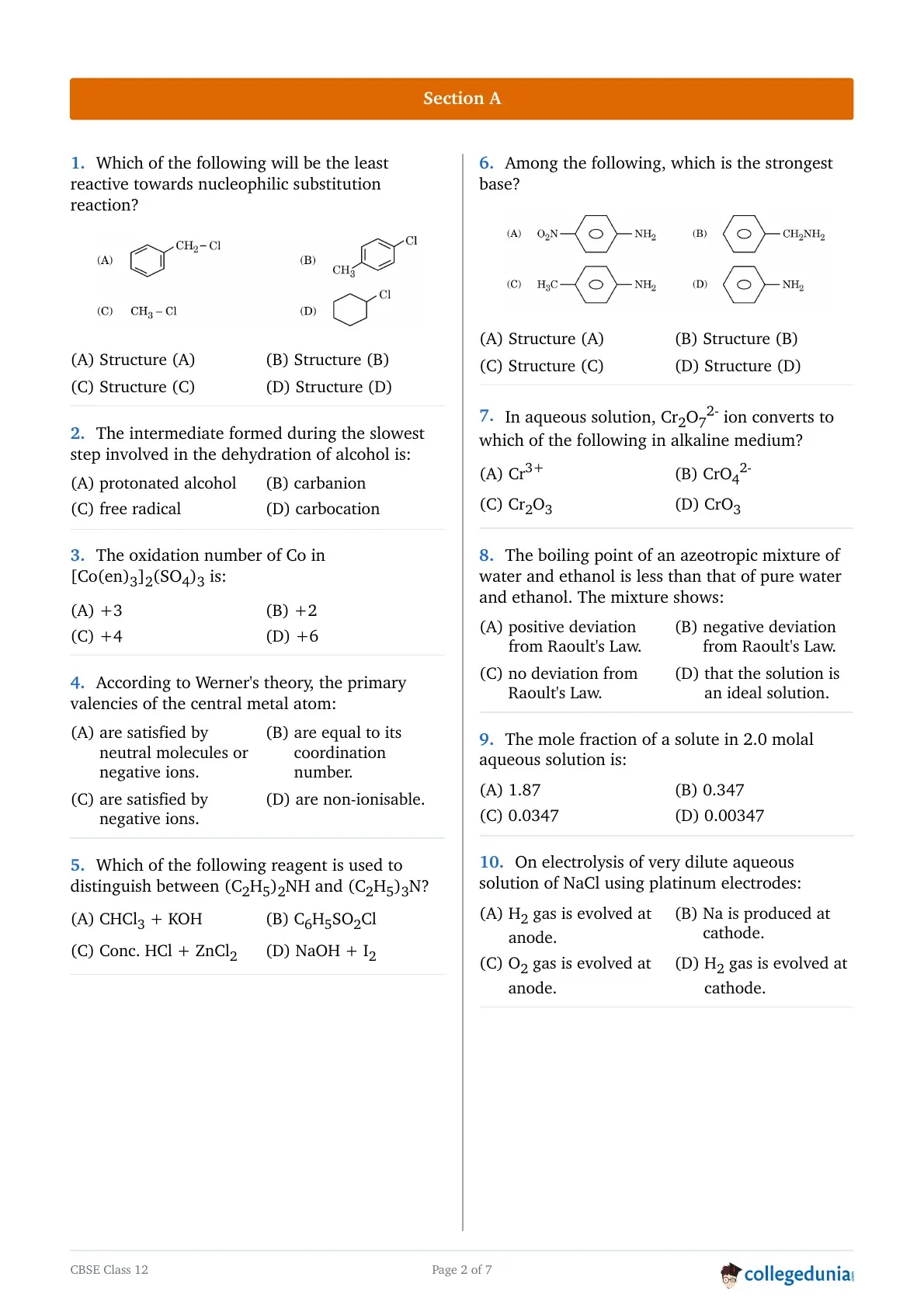
Which of the following will be the least reactive towards nucleophilic substitution reaction?

The intermediate formed during the slowest step involved in the dehydration of alcohol is:
The oxidation number of Co in \([Co(en)_3]_2(SO_4)_3\) is:
According to Werner's theory, the primary valencies of the central metal atom :
Which of the following reagent is used to distinguish between \((C_2H_5)_2NH\) and \((C_2H_5)_3N\)?

In aqueous solution, \(Cr_2O_7^{2-}\) ion converts to which of the following in alkaline medium?
The boiling point of an azeotropic mixture of water and ethanol is less than that of pure water and ethanol. The mixture shows:
The mole fraction of a solute in 2.0 molal aqueous solution is :
On electrolysis of very dilute aqueous solution of NaCl using platinum electrodes :
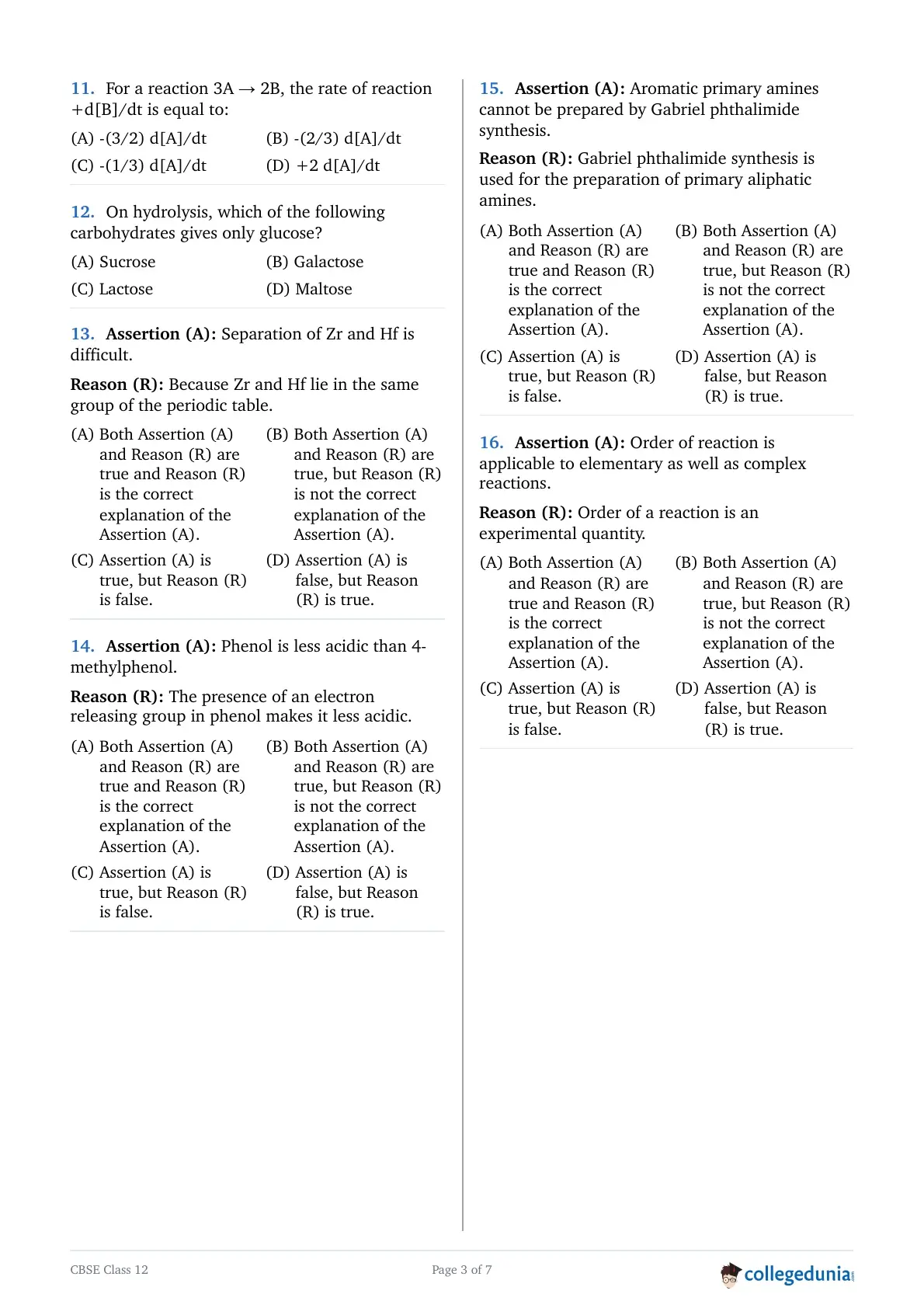
For a reaction \(3A \rightarrow 2B\), the rate of reaction \(+\dfrac{d[B]}{dt}\) is equal to:
On hydrolysis, which of the following carbohydrates gives only glucose?
Assertion (A): Separation of Zr and Hf is difficult. Reason (R): Because Zr and Hf lie in the same group of the periodic table.
Assertion (A): Phenol is less acidic than 4-methylphenol. Reason (R): The presence of an electron releasing group in phenol makes it less acidic.
Assertion (A): Aromatic primary amines cannot be prepared by Gabriel phthalimide synthesis. Reason (R): Gabriel phthalimide synthesis is used for the preparation of primary aliphatic amines.
Assertion (A): Order of reaction is applicable to elementary as well as complex reactions. Reason (R): Order of a reaction is an experimental quantity.
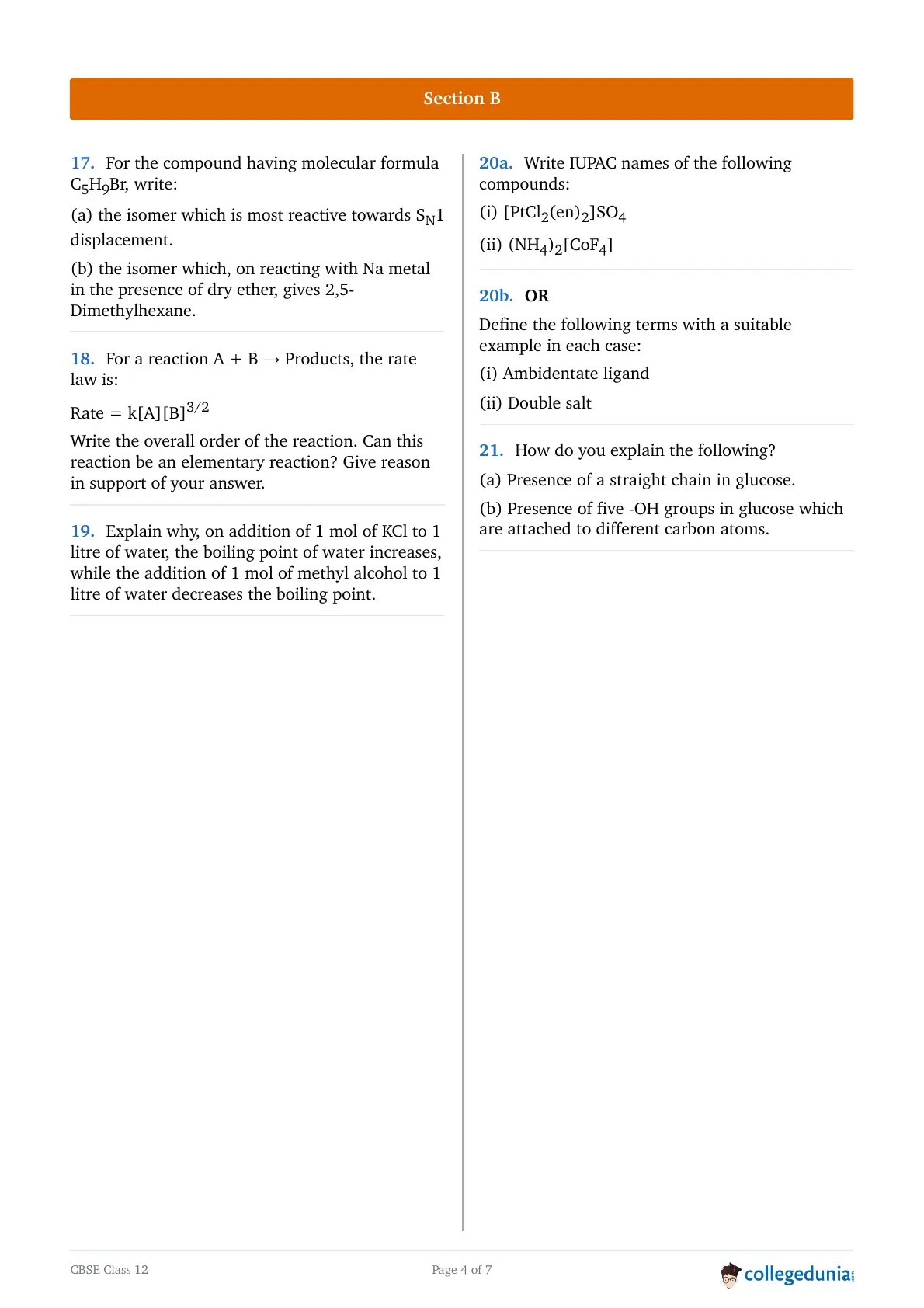
For the compound having molecular formula C\(_4\)H\(_9\)Br, write : (a) the isomer which is most reactive towards SN1 displacement. (b) the isomer which, on reacting with Na metal in the presence of dry ether, gives 2,5-Dimethylhexane.
For a reaction A + B → Products, the rate law is \(\mathrm{Rate = k[A][B]^{3/2}}\). Write the overall order of the reaction. Can this reaction be an elementary reaction ? Give reason in support of your answer.
Explain why, on addition of 1 mol of KCl to 1 litre of water, the boiling point of water increases, while the addition of 1 mol of methyl alcohol to 1 litre of water decreases the boiling point.
Write IUPAC names of the following compounds :
(i) \( \mathrm{[PtCl_2(en)_2]SO_4} \)
(ii) \( \mathrm{(NH_4)_2[CoF_4]} \)
Define the following terms with a suitable example in each case :
(i) Ambidentate ligand
(ii) Double salt
How do you explain the presence of following in open structure of glucose ?
(a) all the six carbon atoms are in a straight chain.
(b) five \(-OH\) groups which are attached to different carbon atoms.
(c) an aldehyde group.
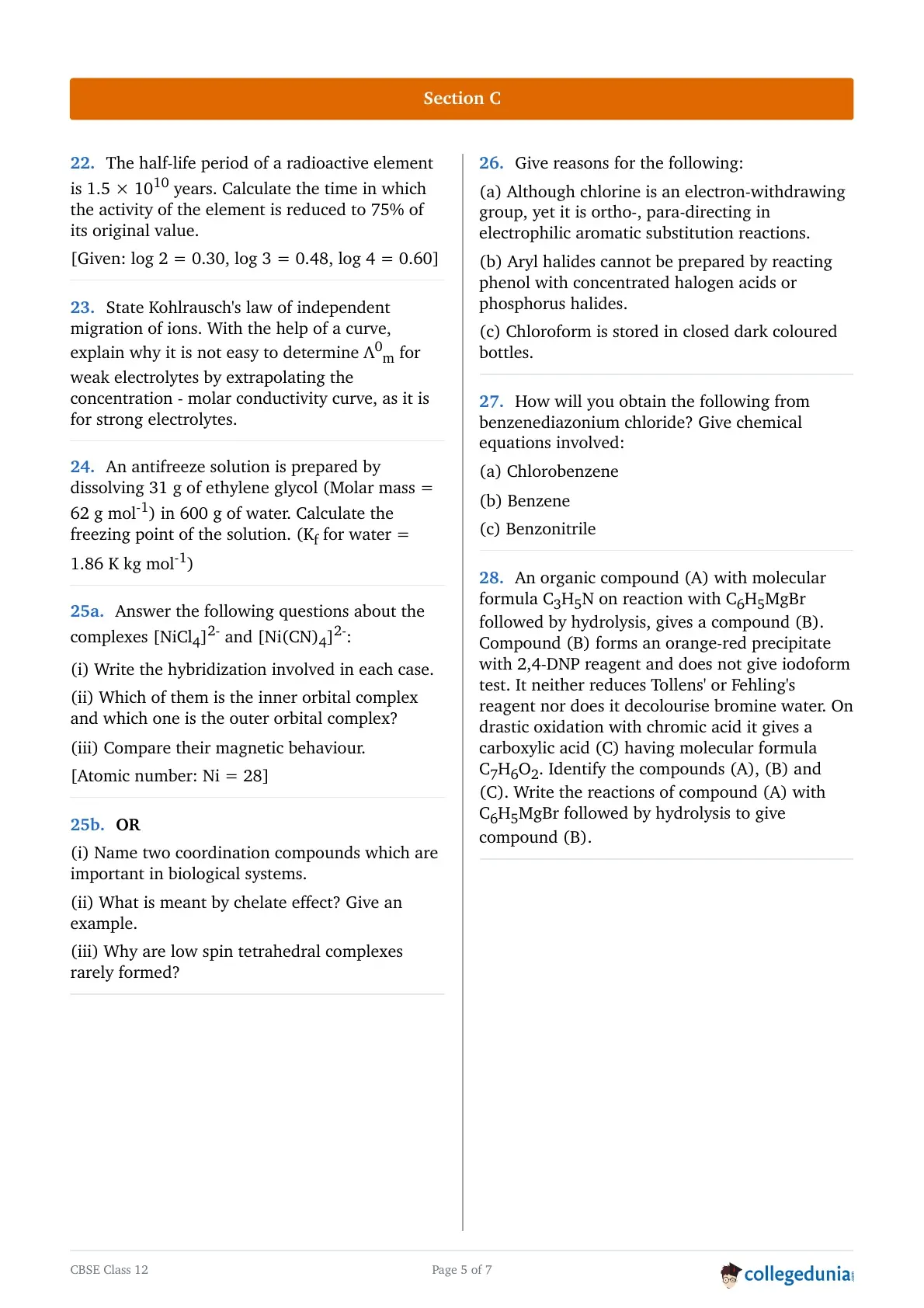
The half-life period of a radioactive element is \(1.5 \times 10^{10}\) years. Calculate the time in which the activity of the element is reduced to 75% of its original value. \[ \text{Given : } \log 2 = 0.30,\; \log 3 = 0.48,\; \log 4 = 0.60 \]
State Kohlrausch's law of independent migration of ions. With the help of a curve, explain why it is not easy to determine \(\Lambda_m^\circ\) for weak electrolytes by extrapolating the concentration--molar conductivity curve, as it is for strong electrolytes.
An antifreeze solution is prepared by dissolving 31 g of ethylene glycol (Molar mass = 62 g mol\(^{-1}\)) in 600 g of water. Calculate the freezing point of the solution. (K\(_f\) for water = 1.86 K kg mol\(^{-1}\))
Answer the following questions about the complexes \(\mathrm{[NiCl_4]^{2-}}\) and \(\mathrm{[Ni(CN)_4]^{2-}}\) :
(i) Write the hybridization involved in each case.
(ii) Which of them is the inner orbital complex and which one is the outer orbital complex ?
(iii) Compare their magnetic behaviour. [Atomic number : Ni = 28]
(i) Name two coordination compounds which are important in biological systems. (ii) What is meant by chelate effect ? Give an example. (iii) Why are low spin tetrahedral complexes rarely formed ?
Give reasons for the following: \[ (a)\;\text{Although chlorine is an electron-withdrawing group, yet it is ortho-, para-directing in electrophilic aromatic substitution reactions.} \] \[ (b)\;\text{Aryl halides cannot be prepared by reacting phenol with concentrated halogen acids or phosphorus halides.} \] \[ (c)\;\text{Chloroform is stored in closed dark coloured bottles.} \]
How will you obtain the following from benzenediazonium chloride? Give chemical equations involved: \[ (a)\;\text{Chlorobenzene} \] \[ (b)\;\text{Benzene} \] \[ (c)\;\text{Benzonitrile} \]
An organic compound (A) with molecular formula C\(_3\)H\(_5\)N on reaction with C\(_6\)H\(_5\)MgBr followed by hydrolysis, gives a compound (B). Compound (B) forms an orange-red precipitate with 2,4-DNP reagent and does not give iodoform test. It neither reduces Tollens' or Fehling's reagent nor does it decolourise bromine water. On drastic oxidation with chromic acid it gives a carboxylic acid (C) having molecular formula C\(_7\)H\(_6\)O\(_2\). Identify the compounds (A), (B) and (C). Write the reactions of compound (A) with C\(_6\)H\(_5\)MgBr followed by hydrolysis to give compound (B).
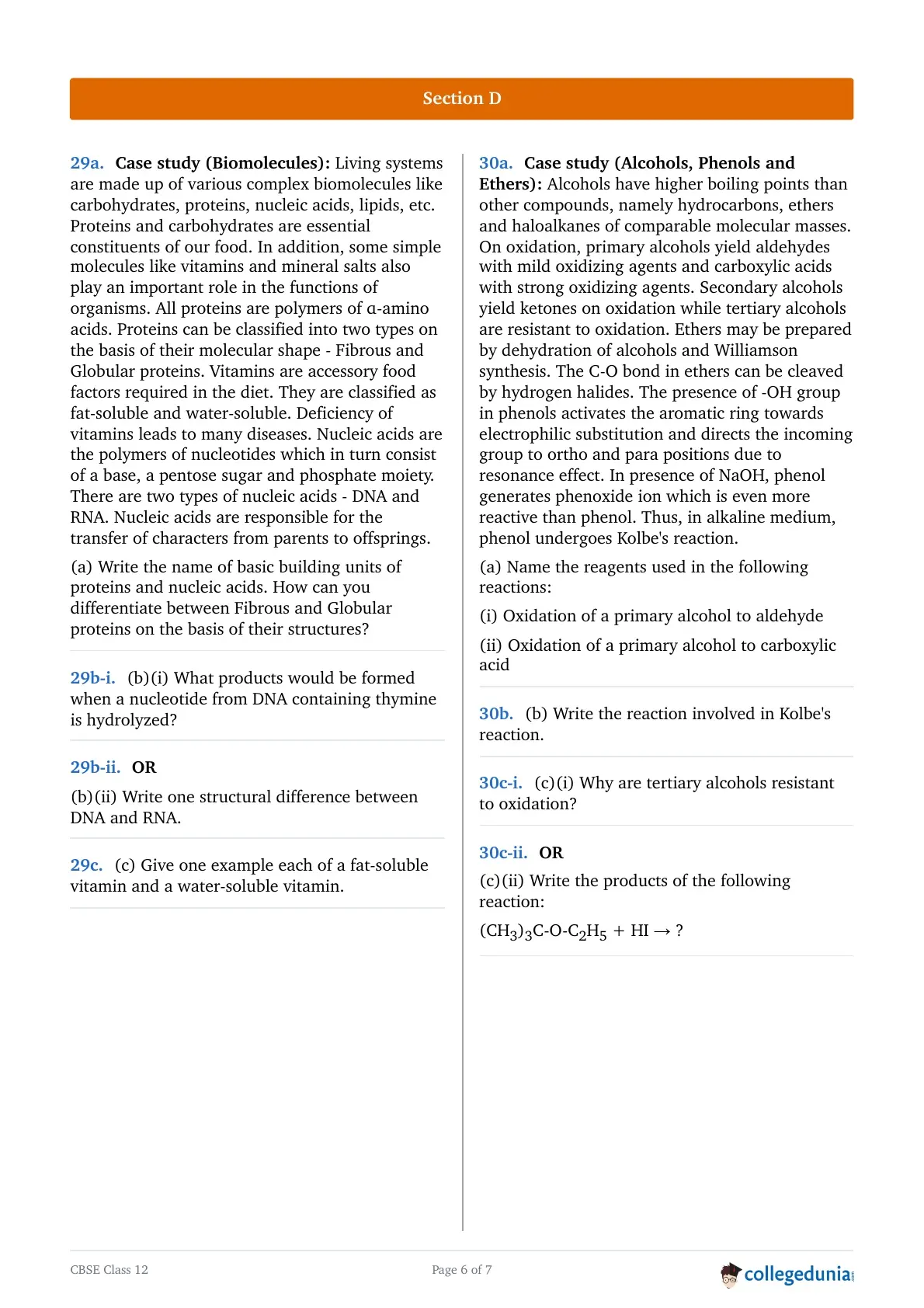
Living systems are made up of various complex biomolecules like carbohydrates, proteins, nucleic acids, lipids, etc. Proteins and carbohydrates are essential constituents of our food. In addition, some simple molecules like vitamins and mineral salts also play an important role in the functions of organisms. All proteins are polymers of \(\mathrm{\alpha}\)-amino acids. Proteins can be classified into two types on the basis of their molecular shape — Fibrous and Globular proteins. Vitamins are accessory food factors required in the diet. They are classified as fat-soluble and water-soluble. Deficiency of vitamins leads to many diseases. Nucleic acids are the polymers of nucleotides which in turn consist of a base, a pentose sugar and phosphate moiety. There are two types of nucleic acids — DNA and RNA. Nucleic acids are responsible for the transfer of characters from parents to offsprings.
Write the name of basic building units of proteins and nucleic acids. How can you differentiate between Fibrous and Globular proteins on the basis of their structures ?
What products would be formed when a nucleotide from DNA containing thymine is hydrolyzed ?
Write one structural difference between DNA and RNA.
Give one example each of a fat-soluble vitamin and a water-soluble vitamin.
Name the reagents used in the following reactions : (i) Oxidation of a primary alcohol to aldehyde (ii) Oxidation of a primary alcohol to carboxylic acid
Write the reaction involved in Kolbe's reaction.
Why are tertiary alcohols resistant to oxidation ?
Write the products of the following reaction : \[ (CH_3)_3C-O-C_2H_5 \xrightarrow{HI} ? \]
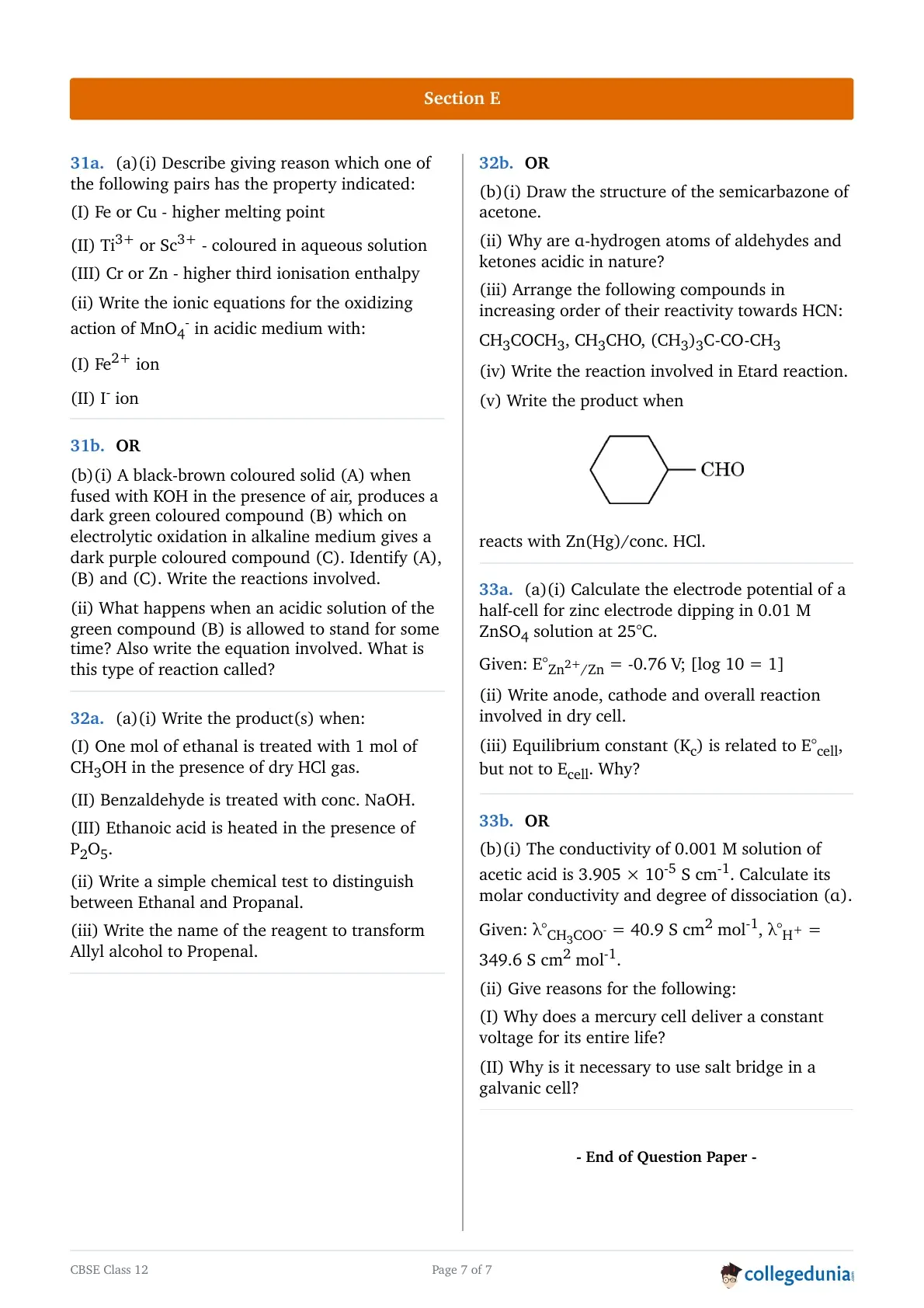
Answer the following: \[ (a)(i)\;\text{Describe giving reason which one of the following pairs has the property indicated:} \] \[ (I)\;Fe\text{ or }Cu-\text{higher melting point} \] \[ (II)\;Ti^{3+}\text{ or }Sc^{3+}-\text{coloured in aqueous solution} \] \[ (III)\;Cr\text{ or }Zn-\text{higher third ionisation enthalpy} \] \[ (a)(ii)\;\text{Write the ionic equations for the oxidizing action of }MnO_4^-\text{ in acidic medium with:} \] \[ (I)\;Fe^{2+}\text{ ion} \] \[ (II)\;I^-\text{ ion} \]
A black-brown coloured solid (A) when fused with KOH in the presence of air, produces a dark green coloured compound (B) which on electrolytic oxidation in alkaline medium gives a dark purple coloured compound (C). Identify (A), (B) and (C). Write the reactions involved.
\[ \text{What happens when an acidic solution of the green compound }(B)\text{ is allowed to stand for some time? Also write the equation involved. What is this type of reaction called?} \]
Answer the following: \[ (a)(i)\;\text{Write the product(s) when:} \] \[ (I)\;\text{One mol of ethanal is treated with }1\text{ mol of }CH_3OH\text{ in the presence of dry }HCl\text{ gas.} \] \[ (II)\;\text{Benzaldehyde is treated with conc. }NaOH. \] \[ (III)\;\text{Ethanoic acid is heated in the presence of }P_2O_5. \] \[ (a)(ii)\;\text{Write a simple chemical test to distinguish between ethanal and propanal.} \] \[ (a)(iii)\;\text{Write the name of the reagent to transform allyl alcohol to propenal.} \]
Write the product(s) when : (I) One mol of ethanal is treated with 1 mol of \(CH_3OH\) in the presence of dry HCl gas. (II) Benzaldehyde is treated with conc. NaOH. (III) Ethanoic acid is heated in the presence of \(P_2O_5\).
(i) Draw the structure of the semicarbazone of acetone.
(ii) Why are \(\alpha\)-hydrogen atoms of aldehydes and ketones acidic in nature ?
(iii) Arrange the following compounds in increasing order of their reactivity towards HCN :
\( \mathrm{CH_3COCH_3} \), \( \mathrm{CH_3CHO} \), \( \mathrm{(CH_3)_3C-CO-CH_3} \)
(iv) Write the reaction involved in Etard reaction.
(v) Write the product when \( \mathrm{C_6H_{11}-CHO} \) reacts with Zn(Hg)/conc. HCl.
Answer the following: \[ (a)(i)\;\text{Calculate the electrode potential of a half-cell for zinc electrode dipping in }0.01M\;ZnSO_4\text{ solution at }25^\circ C. \] \[ E^\circ_{Zn^{2+}/Zn}=-0.76V,\quad \log 10=1 \] \[ (a)(ii)\;\text{Write anode, cathode and overall reaction involved in dry cell.} \] \[ (a)(iii)\;\text{Equilibrium constant }(K_c)\text{ is related to }E^\circ_{\text{cell}},\text{ but not to }E_{\text{cell}}.\text{ Why?} \]
(i) The conductivity of 0.001 M solution of acetic acid is \( 3.905 \times 10^{-5} \) S cm\(^{-1}\). Calculate its molar conductivity and degree of dissociation (\(\alpha\)).
Given : \( \lambda^\circ_{\mathrm{CH_3COO^-}} = 40.9 \) S cm\(^2\) mol\(^{-1}\)
\( \lambda^\circ_{\mathrm{H^+}} = 349.6 \) S cm\(^2\) mol\(^{-1}\)
(ii) Give reasons for the following :
(I) Why does a mercury cell deliver a constant voltage for its entire life ?
(II) Why is it necessary to use salt bridge in a galvanic cell ?
CBSE Class 12 Chemistry Paper Structure
| Question Type | Description |
|---|---|
| Very Short Answer | 1–2 line answers, definitions, or simple equations |
| Short Answer | Explanations, derivations, or numerical problems |
| Long Answer | Detailed answers, reaction mechanisms, or calculations |
| Case-based / Integrated | Questions based on a given situation may include calculations or reasoning |



Comments