




Projectile Motion is a topic from the Motion in a Plane chapter of Class 11 Physics, and it is part of the Physics section of the MHT CET for candidates who are preparing for the PCM (Physics, Chemistry, and Mathematics).
The key topics covered in Projectile Motion PYQs are:
- Maximum height, range and angle of projection
- Time of flight from given data
- Complementary angles and equal range
- Speed and energy at the highest point
- Trajectory equation of a projectile
Practising Projectile Motion MHT CET PYQ helps candidates to understand question pattern, improve calculation speed, and identify concepts which were asked in previous exams.
Based on chapter-wise analysis of the MHT CET Physics paper, Projectile Motion is a small topic worth up to 1 mark in a paper. It recorded 13 questions across the 80 shifts in the data, and 9 of them came in the 2025 and 2026 papers. The 7 questions from 2026 each came from a different shift.
MHT CET Projectile Motion Chapter: Question Count, Marks and Weightage:
| 0.16 Average questions per shift (2018-2026) | 9 Questions in the 2025 and 2026 papers (33 shifts) |
| 13 Questions in the PDF (2021-2026) | 0.3% Estimated Physics paper weightage (0.5% in 2025-2026) |
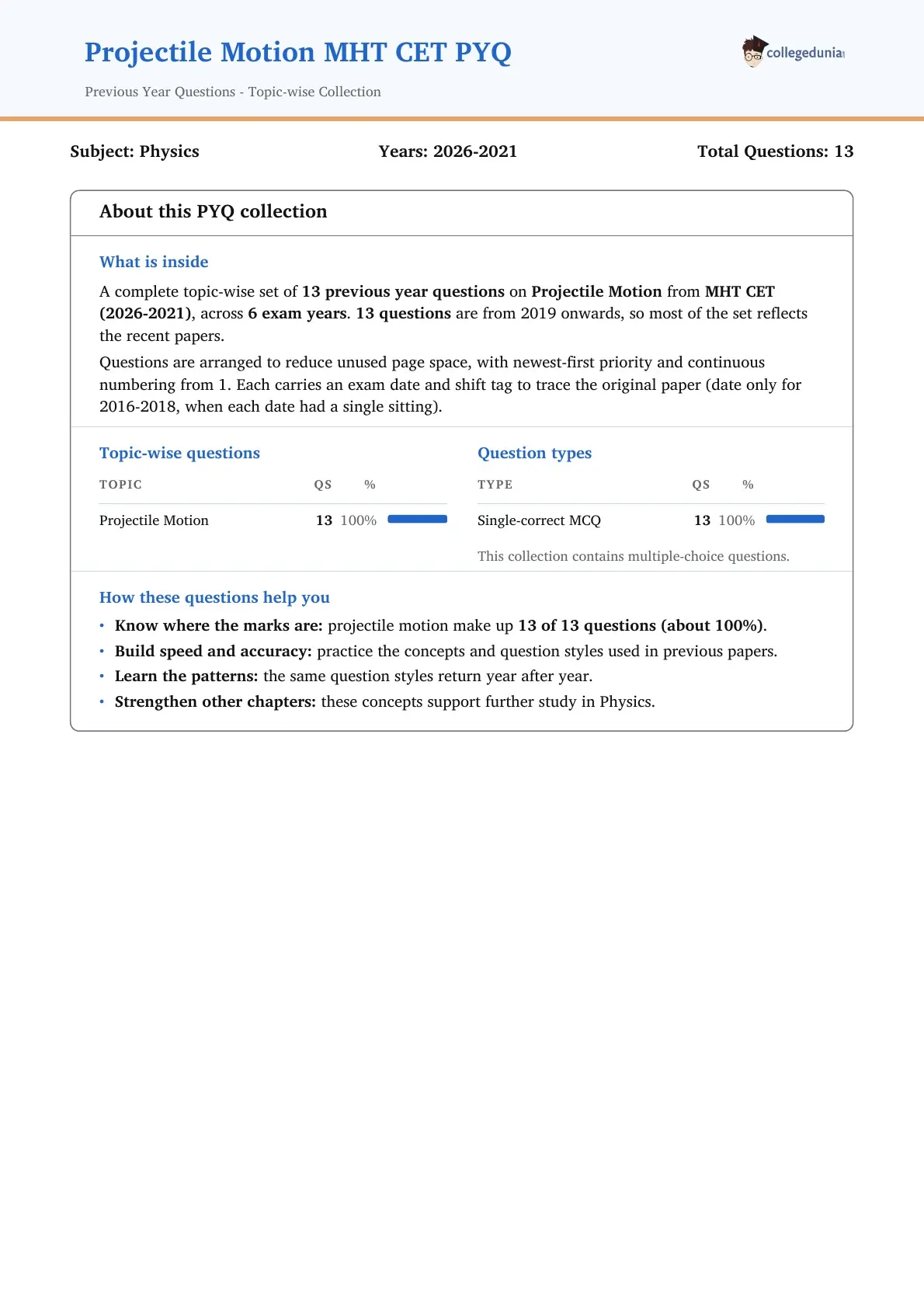
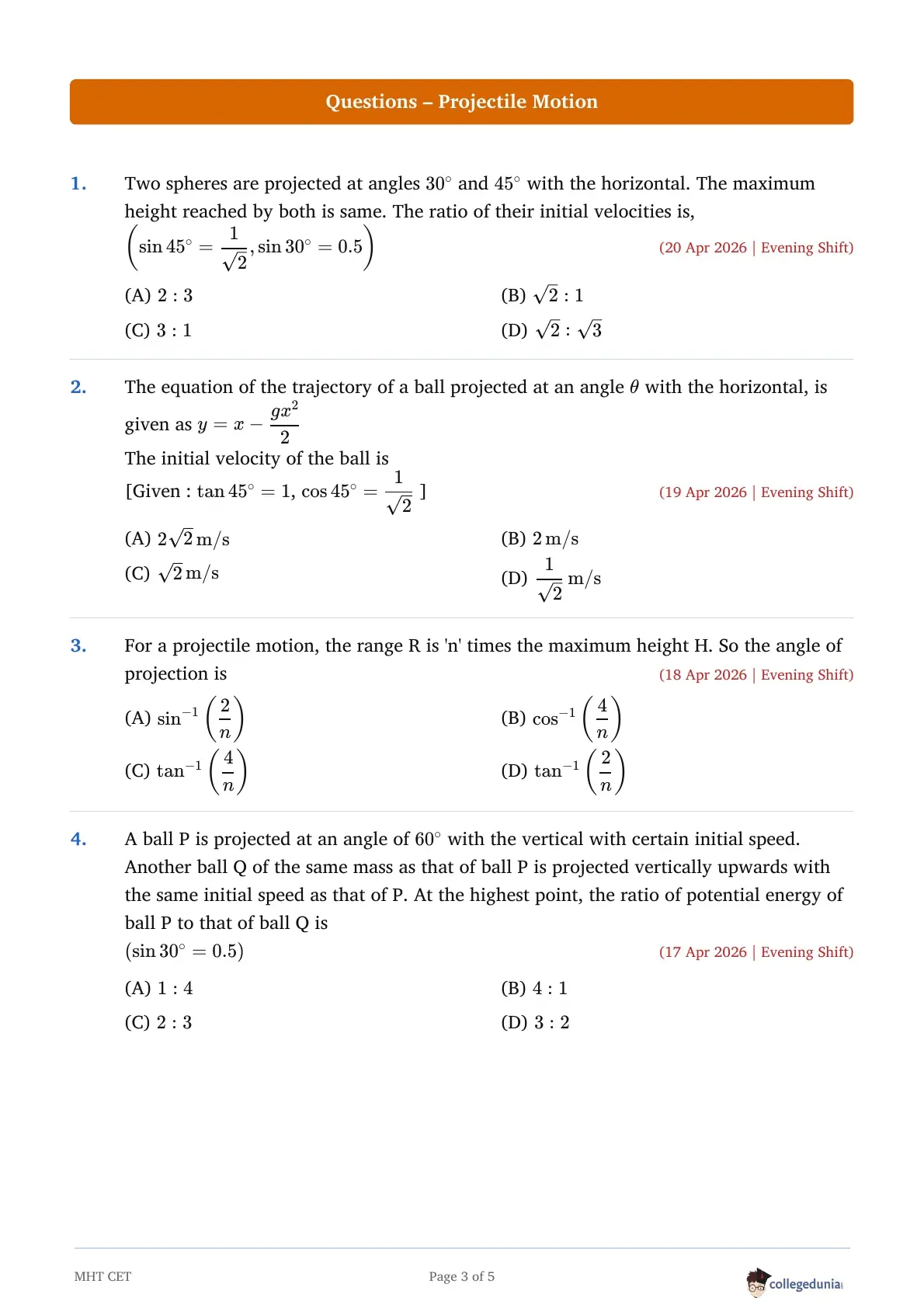
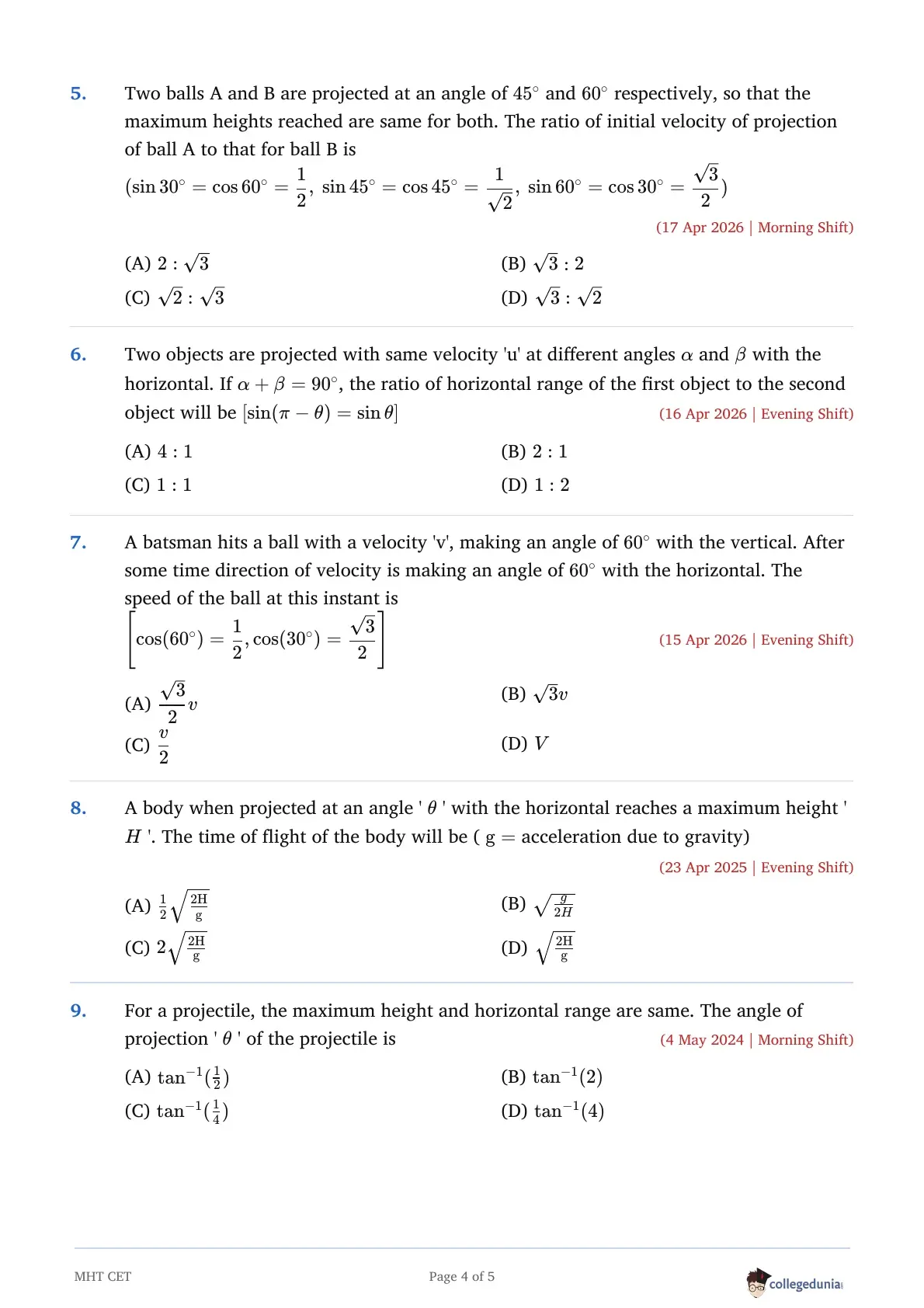
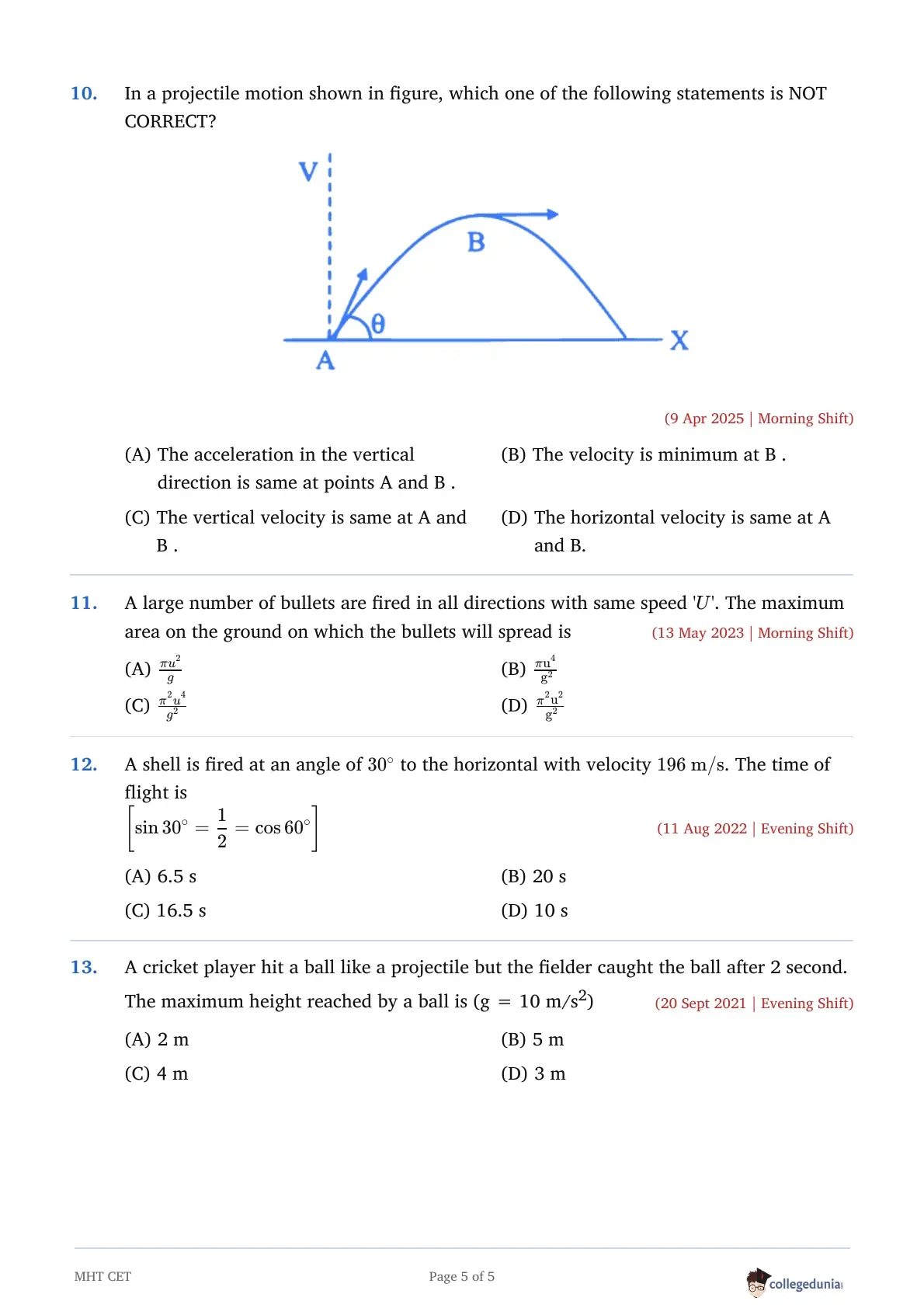
The PDF holds 13 questions from MHT CET 2026 to 2021, newest first, each with its exam date and shift. Options are as printed and answer keys are not included.
Projectile Motion PYQ Statistics (2022-2026)
The table below shows the number of questions asked in MHT CET Projectile Motion PYQs. Every shift has 50 Physics questions, so the last column is the average per shift divided by 50.
| Year | Total Questions (across shifts) | Shifts in the Data | Average per Shift | Weightage (out of 50 Physics Qs) |
|---|---|---|---|---|
| 2026 | 7 | 16 | 0.44 | 0.9% |
| 2025 | 2 | 17 | 0.12 | 0.2% |
| 2024 | 1 | 18 | 0.06 | 0.1% |
| 2023 | 1 | 12 | 0.08 | 0.2% |
| 2022 | 1 | 1 | 1.00 | 2.0% |
The 2018 to 2021 papers in the PDF add 1 more questions: 2021 had 1, 2020 had none, 2019 had none, 2018 had none. The 2022 and 2021 questions in the PDF are the shell with a time of flight and the cricketer's ball.
MHT CET Projectile Motion Important Questions: Based on the Last 5 Years
The major types of questions asked from Projectile Motion in MHT CET cover the following topics:
| Topic | Questions in the PDF | Questions in 2022-2026 | Average per Shift (2022-2026) |
|---|---|---|---|
| Relations between range, maximum height and angle of projection, including equal range at complementary angles and the maximum area covered by bullets | 6 | 6 | 0.09 |
| Time of flight and maximum height from given data, such as H, the speed of the shell, or the time the ball stays in the air | 3 | 2 | 0.03 |
| Speed and potential energy at the highest point | 2 | 2 | 0.03 |
| Trajectory equation and statements about the path in a figure | 2 | 2 | 0.03 |
Pair PYQs with Other Study Material for MHT CET 2027
Click on the link to practise problems and time management skills:
| Resource | Link |
|---|---|
| MHT CET Sample Paper | Check Here |
| MHT CET Mock Test | Check Here |
Question Style in MHT CET Projectile Motion PYQs
All 13 questions in this PDF are single-correct MCQs. Most are ratio or angle questions that need one or two formulas of projectile motion.
| Question Style | What it Tests |
|---|---|
| Ratio of velocities, heights or ranges | Two projectiles with the same maximum height, or with angles that add up to 90 degrees, and the ratio asked is found from H = u²sin²θ/2g and R = u²sin2θ/g |
| Angle from a given relation | The angle of projection when R is n times H, or when the maximum height equals the range |
| Trigonometric values supplied | Several questions give sin 30, sin 45, sin 60 or cos 60 in brackets, so the working is substitution and simplification |
| Time of flight and height from data | Time of flight of a shell fired at 30 degrees with 196 m/s, the time of flight in terms of H, and the height reached when the ball is caught after 2 seconds |
| Concept and figure based | The statement that is NOT correct about a projectile path drawn in a figure, and the initial velocity from the equation of the trajectory |
How to Use the Projectile Motion PYQ PDF for MHT CET
- Start with the 2026 papers first, because they hold 7 of the 13 questions.
- Write down the three formulas of H, R and time of flight before you start and check each question against them.
- Keep sin 30, sin 45 and sin 60 values on one line of your rough work, since many questions give them in brackets.
- Solve year-wise PYQs by timing yourself, as time management is crucial.
- Re-attempt only the questions you got wrong, and note which formula you missed.
Video: Projectile Motion PYQs and MCQs
Source: Ritesh Dalal | Physics Edupoint
Projectile Motion PYQ for MHT CET Physics FAQs
Ques. How many questions come from Projectile Motion every year?
Ans. In this PDF, 7 questions are from the 2026 papers, 2 from 2025, and 1 each from 2024, 2023, 2022 and 2021. The questions in 2026 came from 7 different shifts.
Ques. Which topics are asked most frequently in MHT CET Projectile Motion?
Ans. Relations between range, maximum height and angle of projection make up 6 of the 13 questions. Time of flight and maximum height from data account for 3, and speed or energy at the highest point and the trajectory equation have 2 each.
Ques. What kind of questions are asked from Projectile Motion?
Ans. Single-correct MCQs, mostly ratios and angles that follow from the formulas for H, R and time of flight. A few give trigonometric values in brackets.
Ques. What is the best way to practise Projectile Motion PYQs?
Ans. First solve the 2026 questions completely, then the older ones, and finally re-attempt the questions you got wrong.
Ques. Can I score full marks from Projectile Motion?
Ans. The topic is small. It carried about 1 question in a few shifts of 2026, and each Physics question in MHT CET is worth 1 mark. Knowing the formulas of H, R and time of flight is enough to secure that mark.
Ques. Does the Projectile Motion PYQ PDF include solutions?
Ans. No. The PDF contains the questions with their exam date and shift, without answer keys or solutions.



Comments