




MHT CET 2024 May 15 Shift 1 PCM Question Paper is available for download here. Maharashtra State CET Cell conducted MHT CET 2024 PCM Exam on May 15 in Shift 1 from 9 AM to 12 PM in CBT mode.
The MHT CET 2024 PCM question paper includes the following:
- The MHT CET 2024 PCM Question Paper consists of 150 multiple-choice questions (MCQs) totalling 200 marks divided into 3 sections: Physics, Chemistry, and Mathematics, with 50 questions in each subject.
- Physics and Chemistry questions carry 1 mark each while Mathematics questions carry 2 marks each.
- There is no negative marking for incorrect answers.
MHT CET 2024 May 15 Shift 1 PCM Question Paper with Solution PDF
| CD PDF | CD PDF with Solutions |
|---|---|
| Download Collegedunia PDF 0.84 MB | - |
Also Check:
MHT CET 2024 May 15 Shift 1 PCM Questions with Solutions
Physics (Q1 - Q50)
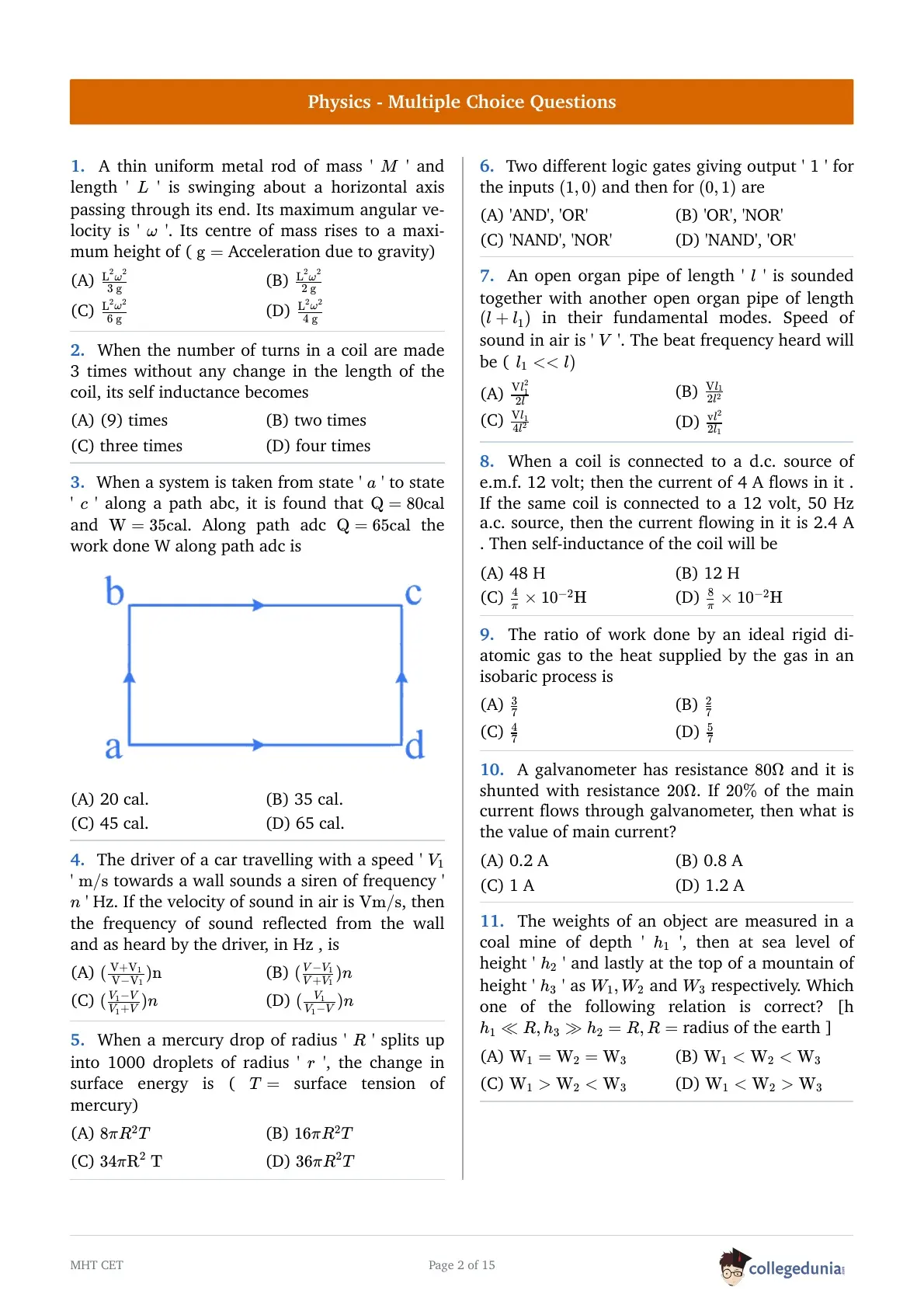
A thin uniform metal rod of mass ' \(M\) ' and length ' \(L\) ' is swinging about a horizontal axis passing through its end. Its maximum angular velocity is ' \(\omega\) '. Its centre of mass rises to a maximum height of ( \(\mathrm{g}=\) Acceleration due to gravity)
When the number of turns in a coil are made 3 times without any change in the length of the coil, its self inductance becomes
When a system is taken from state ' \(a\) ' to state ' \(c\) ' along a path abc, it is found that \(\mathrm{Q}=80 \mathrm{cal}\) and \(\mathrm{W}=35 \mathrm{cal}\). Along path adc \(\mathrm{Q}=65 \mathrm{cal}\) the work done W along path adc is

The driver of a car travelling with a speed ' \(V_1\) ' \(\mathrm{m} / \mathrm{s}\) towards a wall sounds a siren of frequency ' \(n\) ' Hz. If the velocity of sound in air is \(\mathrm{V} \mathrm{m} / \mathrm{s}\), then the frequency of sound reflected from the wall and as heard by the driver, in Hz , is
When a mercury drop of radius ' \(R\) ' splits up into 1000 droplets of radius ' \(r\) ', the change in surface energy is ( \(T=\) surface tension of mercury)
Two different logic gates giving output ' 1 ' for the inputs \((1,0)\) and then for \((0,1)\) are
An open organ pipe of length ' \(l\) ' is sounded together with another open organ pipe of length \(\left(l+l_1\right)\) in their fundamental modes. Speed of sound in air is ' \(V\) '. The beat frequency heard will be \(\left(l_1 \ll l\right)\)
When a coil is connected to a d.c. source of e.m.f. 12 volt; then the current of 4 A flows in it . If the same coil is connected to a 12 volt, 50 Hz a.c. source, then the current flowing in it is 2.4 A . Then self-inductance of the coil will be
The ratio of work done by an ideal rigid diatomic gas to the heat supplied by the gas in an isobaric process is
The weights of an object are measured in a coal mine of depth ' \(h_1\) ', then at sea level of height ' \(h_2\) ' and lastly at the top of a mountain of height ' \(h_3\) ' as \(W_1, W_2\) and \(W_3\) respectively. Which one of the following relation is correct? [\(h_1 \ll R, h_3 \gg h_2=R, R=\) radius of the earth ]
The angle of contact between glass and water is \(0^{\circ}\) and water rises in a glass capillary upto 6 cm (Surface tension of water is T). Another liquid of surface tension ' \(2 \mathrm{~T}^{\prime}\) ', angle of contact \(60^{\circ}\) and relative density 2 will rise in the same capillary up to \(\left(\cos 0^{\circ}=1, \cos 60^{\circ}=0.5\right)\)
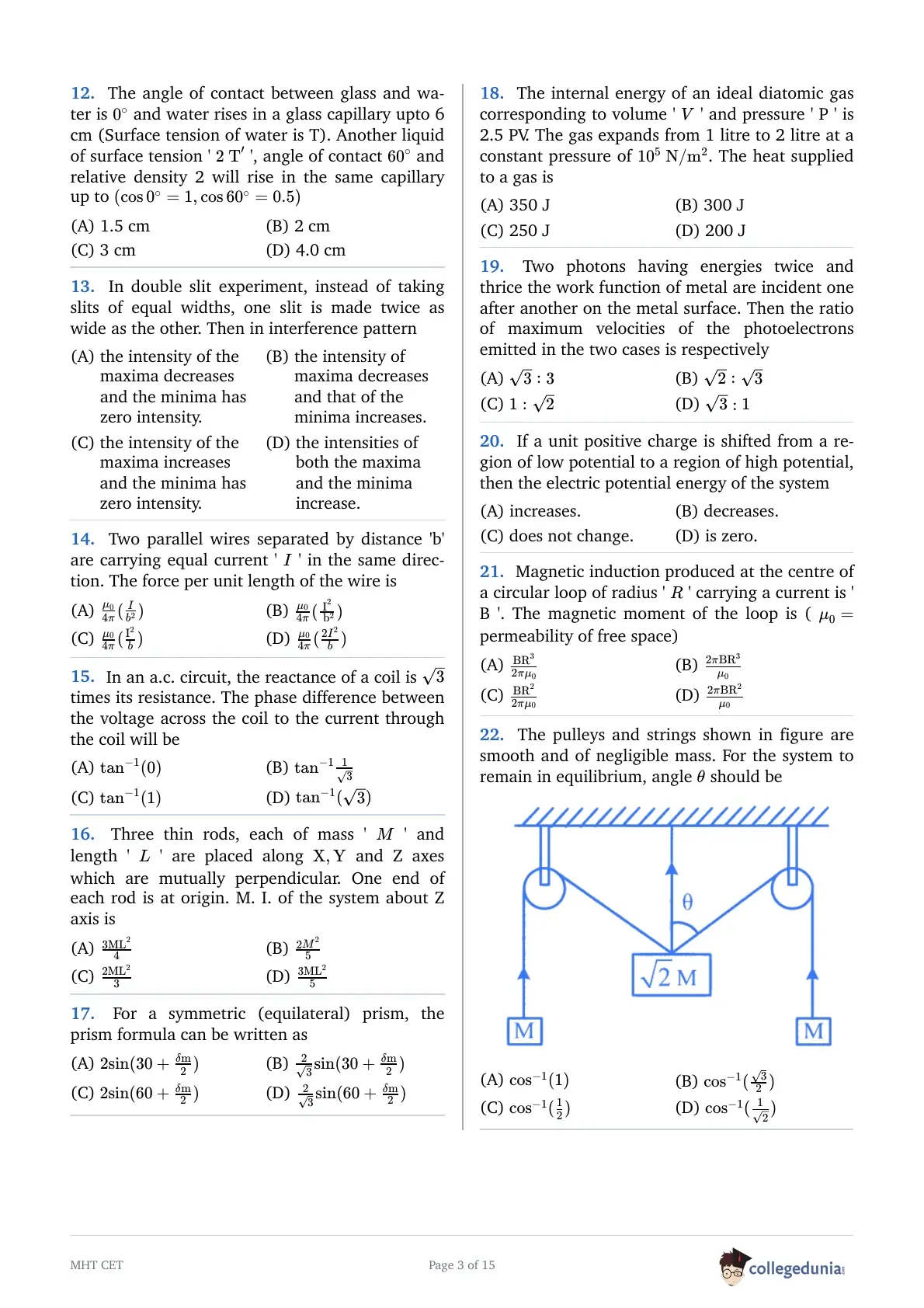
In double slit experiment, instead of taking slits of equal widths, one slit is made twice as wide as the other. Then in interference pattern
Two parallel wires separated by distance 'b' are carrying equal current ' \(I\) ' in the same direction. The force per unit length of the wire is
In an a.c. circuit, the reactance of a coil is \(\sqrt{3}\) times its resistance. The phase difference between the voltage across the coil to the current through the coil will be
Three thin rods, each of mass ' \(M\) ' and length ' \(L\) ' are placed along \(\mathrm{X}, \mathrm{Y}\) and Z axes which are mutually perpendicular. One end of each rod is at origin. M. I. of the system about Z axis is
For a symmetric (equilateral) prism, the prism formula can be written as
The internal energy of an ideal diatomic gas corresponding to volume ' \(V\) ' and pressure ' P ' is 2.5 PV. The gas expands from 1 litre to 2 litre at a constant pressure of \(10^5 \mathrm{~N} / \mathrm{m}^2\). The heat supplied to a gas is
Two photons having energies twice and thrice the work function of metal are incident one after another on the metal surface. Then the ratio of maximum velocities of the photoelectrons emitted in the two cases is respectively
If a unit positive charge is shifted from a region of low potential to a region of high potential, then the electric potential energy of the system
Magnetic induction produced at the centre of a circular loop of radius ' \(R\) ' carrying a current is ' B '. The magnetic moment of the loop is ( \(\mu_0=\) permeability of free space)
The pulleys and strings shown in figure are smooth and of negligible mass. For the system to remain in equilibrium, angle \(\theta\) should be

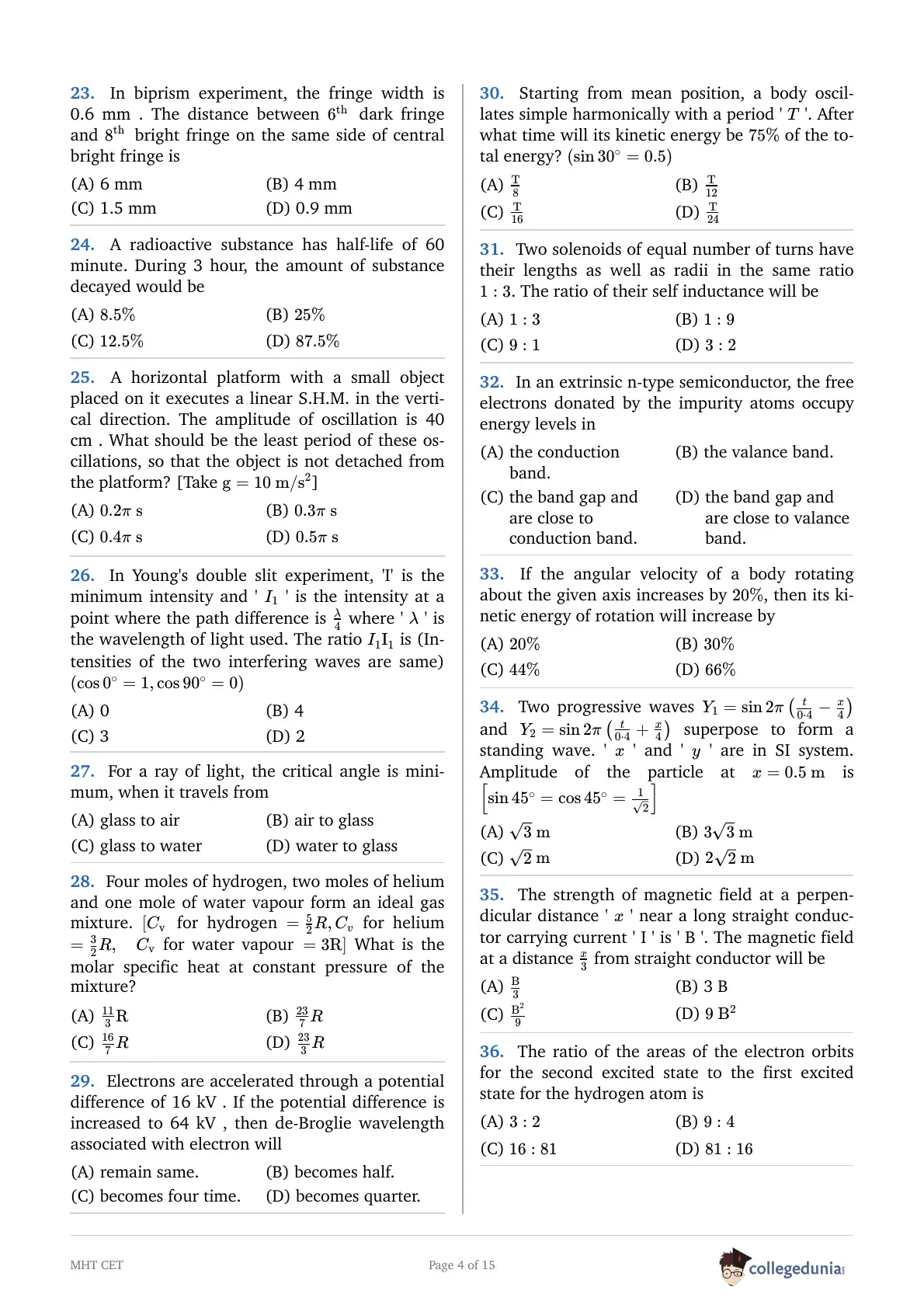
In biprism experiment, the fringe width is 0.6 mm . The distance between \(6^{\text {th }}\) dark fringe and \(8^{\text {th }}\) bright fringe on the same side of central bright fringe is
A radioactive substance has half-life of 60 minute. During 3 hour, the amount of substance decayed would be
A horizontal platform with a small object placed on it executes a linear S.H.M. in the vertical direction. The amplitude of oscillation is 40 cm . What should be the least period of these oscillations, so that the object is not detached from the platform? [Take \(\mathrm{g}=10 \mathrm{~m} / \mathrm{s}^2\)]
For a ray of light, the critical angle is minimum, when it travels from
Four moles of hydrogen, two moles of helium and one mole of water vapour form an ideal gas mixture. \(\left[C_{\mathrm{v}}\right.\) for hydrogen \(=\frac{5}{2} R, C_v\) for helium \(=\frac{3}{2} R, \quad C_{\mathrm{v}}\) for water vapour \(\left.=3 \mathrm{R}\right]\) What is the molar specific heat at constant pressure of the mixture?
Electrons are accelerated through a potential difference of 16 kV . If the potential difference is increased to 64 kV , then de-Broglie wavelength associated with electron will
Starting from mean position, a body oscillates simple harmonically with a period ' \(T\) '. After what time will its kinetic energy be \(75 \%\) of the total energy? \(\left(\sin 30^{\circ}=0.5\right)\)
Two solenoids of equal number of turns have their lengths as well as radii in the same ratio \(1: 3\). The ratio of their self inductance will be
In an extrinsic n-type semiconductor, the free electrons donated by the impurity atoms occupy energy levels in
If the angular velocity of a body rotating about the given axis increases by \(20 \%\), then its kinetic energy of rotation will increase by
Two progressive waves \(Y_1=\sin 2 \pi\left(\frac{t}{0 \cdot 4}-\frac{x}{4}\right)\) and \(Y_2=\sin 2 \pi\left(\frac{t}{0 \cdot 4}+\frac{x}{4}\right)\) superpose to form a standing wave. ' \(x\) ' and ' \(y\) ' are in SI system. Amplitude of the particle at \(x=0.5 \mathrm{~m}\) is \(\left[\sin 45^{\circ}=\cos 45^{\circ}=\frac{1}{\sqrt{2}}\right]\)
The strength of magnetic field at a perpendicular distance ' \(x\) ' near a long straight conductor carrying current ' I ' is ' B '. The magnetic field at a distance \(\frac{x}{3}\) from straight conductor will be
The ratio of the areas of the electron orbits for the second excited state to the first excited state for the hydrogen atom is
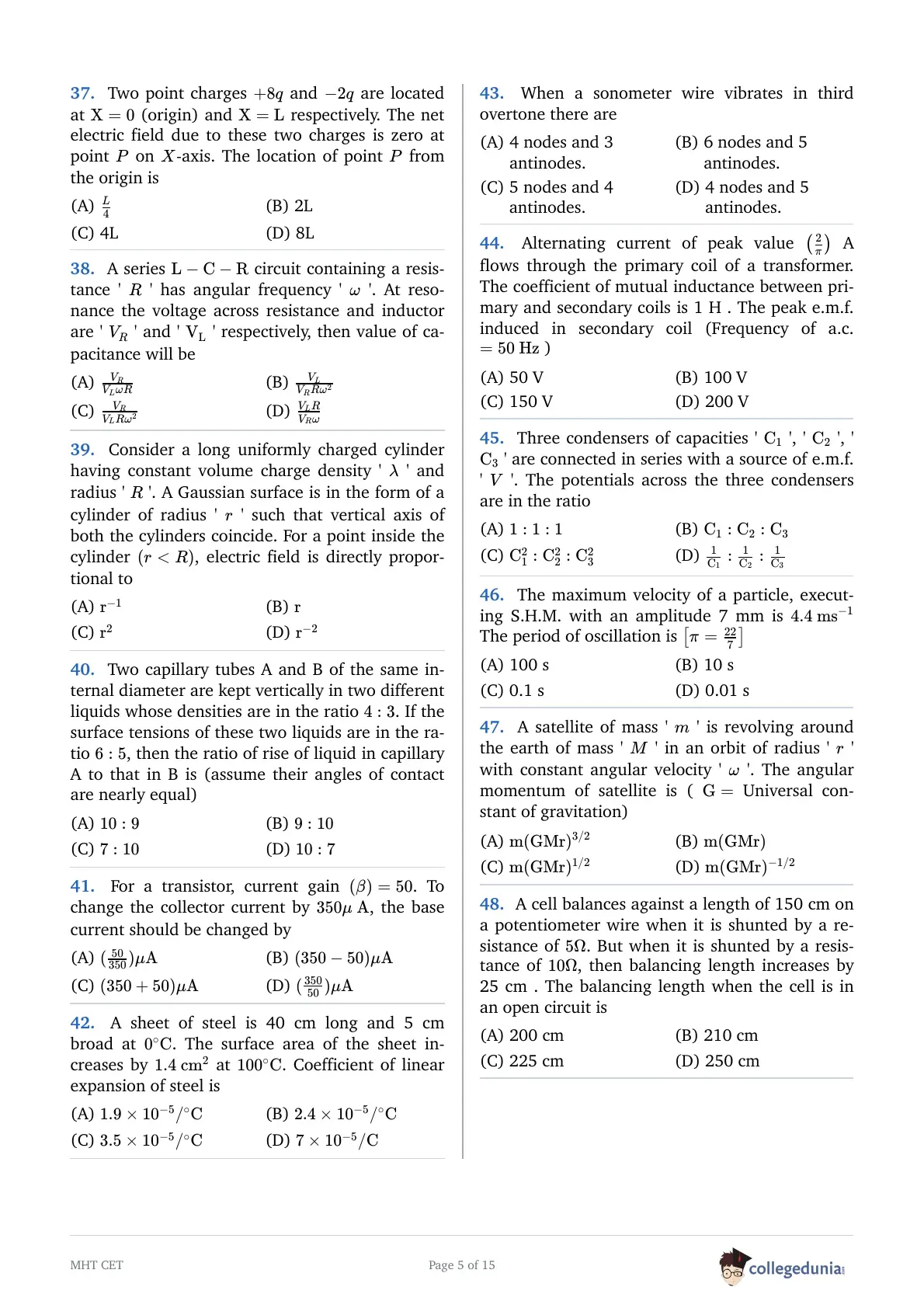
Two point charges \(+8 q\) and \(-2 q\) are located at \(\mathrm{X}=0\) (origin) and \(\mathrm{X}=\mathrm{L}\) respectively. The net electric field due to these two charges is zero at point \(P\) on \(X\)-axis. The location of point \(P\) from the origin is
A series \(\mathrm{L}-\mathrm{C}-\mathrm{R}\) circuit containing a resistance ' \(R\) ' has angular frequency ' \(\omega\) '. At resonance the voltage across resistance and inductor are ' \(V_R\) ' and ' \(\mathrm{V}_{\mathrm{L}}\) ' respectively, then value of capacitance will be
Consider a long uniformly charged cylinder having constant volume charge density ' \(\lambda\) ' and radius ' \(R\) '. A Gaussian surface is in the form of a cylinder of radius ' \(r\) ' such that vertical axis of both the cylinders coincide. For a point inside the cylinder \(r< R\), electric field is directly proportional to
Two capillary tubes A and B of the same internal diameter are kept vertically in two different liquids whose densities are in the ratio \(4: 3\). If the surface tensions of these two liquids are in the ratio \(6: 5\), then the ratio of rise of liquid in capillary A to that in B is (assume their angles of contact are nearly equal)
For a transistor, current gain \((\beta)=50\). To change the collector current by \(350 \mu \mathrm{~A}\), the base current should be changed by
A sheet of steel is 40 cm long and 5 cm broad at \(0^{\circ} \mathrm{C}\). The surface area of the sheet increases by \(1.4 \mathrm{~cm}^2\) at \(100^{\circ} \mathrm{C}\). Coefficient of linear expansion of steel is
Alternating current of peak value \(\left(\frac{2}{\pi}\right)\) A flows through the primary coil of a transformer. The coefficient of mutual inductance between primary and secondary coils is 1 H . The peak e.m.f. induced in secondary coil (Frequency of a.c. \(=50 \mathrm{~Hz}\) )
Three condensers of capacities ' \(\mathrm{C}_1\) ', ' \(\mathrm{C}_2\) ', ' \(\mathrm{C}_3\) ' are connected in series with a source of e.m.f. ' \(V\) '. The potentials across the three condensers are in the ratio
The maximum velocity of a particle, executing S.H.M. with an amplitude 7 mm is \(4.4 \mathrm{~ms}^{-1}\) The period of oscillation is \(\left[\pi=\frac{22}{7}\right]\)
A satellite of mass ' \(m\) ' is revolving around the earth of mass ' \(M\) ' in an orbit of radius ' \(r\) ' with constant angular velocity ' \(\omega\) '. The angular momentum of satellite is ( \(\mathrm{G}=\) Universal constant of gravitation)
A cell balances against a length of 150 cm on a potentiometer wire when it is shunted by a resistance of \(5 \Omega\). But when it is shunted by a resistance of \(10 \Omega\), then balancing length increases by 25 cm . The balancing length when the cell is in an open circuit is
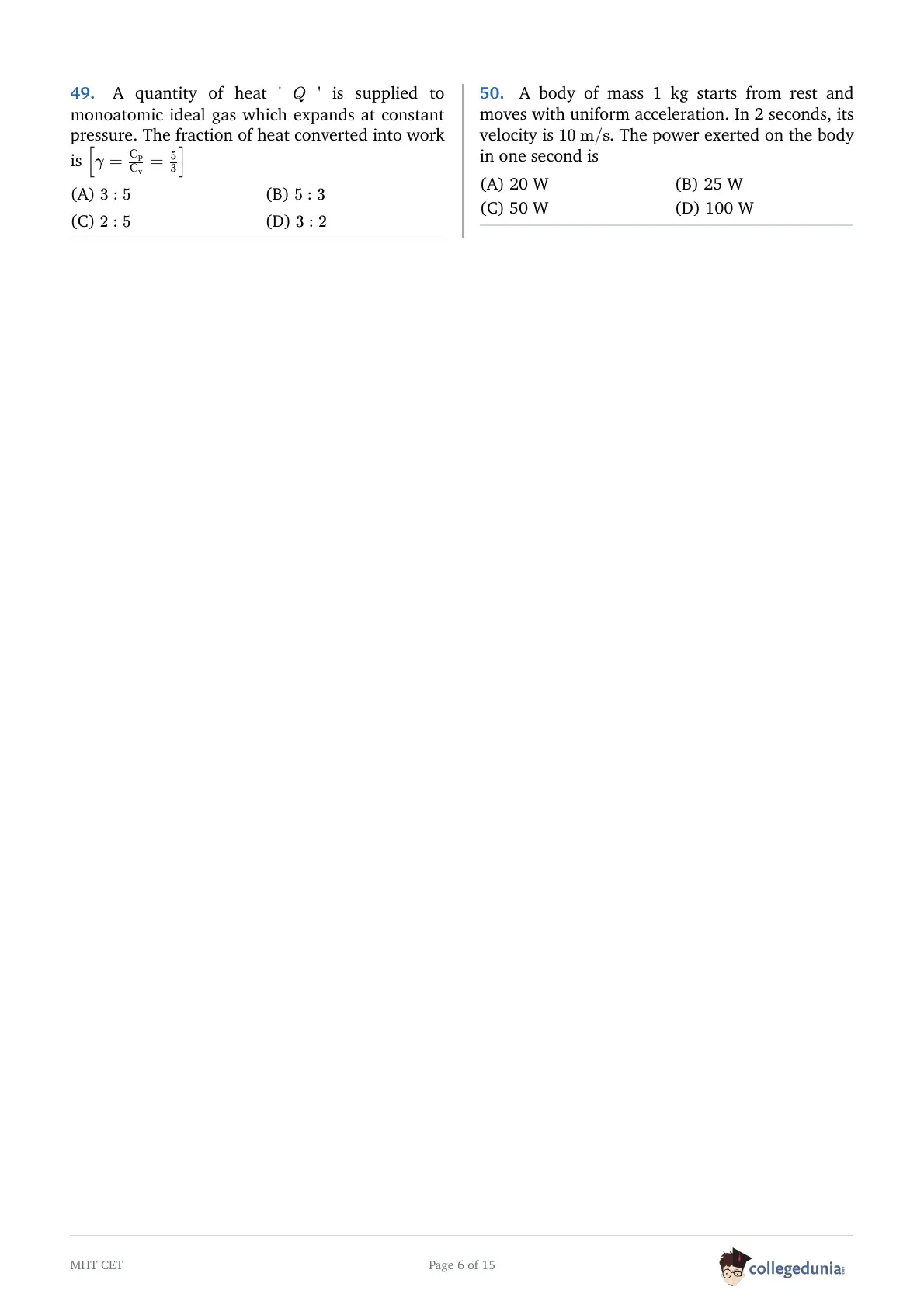
A quantity of heat ' \(Q\) ' is supplied to monoatomic ideal gas which expands at constant pressure. The fraction of heat converted into work is \(\left[\gamma=\frac{\mathrm{C}_{\mathrm{p}}}{\mathrm{C}_{\mathrm{v}}}=\frac{5}{3}\right]\)
A body of mass 1 kg starts from rest and moves with uniform acceleration. In 2 seconds, its velocity is \(10 \mathrm{~m} / \mathrm{s}\). The power exerted on the body in one second is
Chemistry (Q51 - Q100)
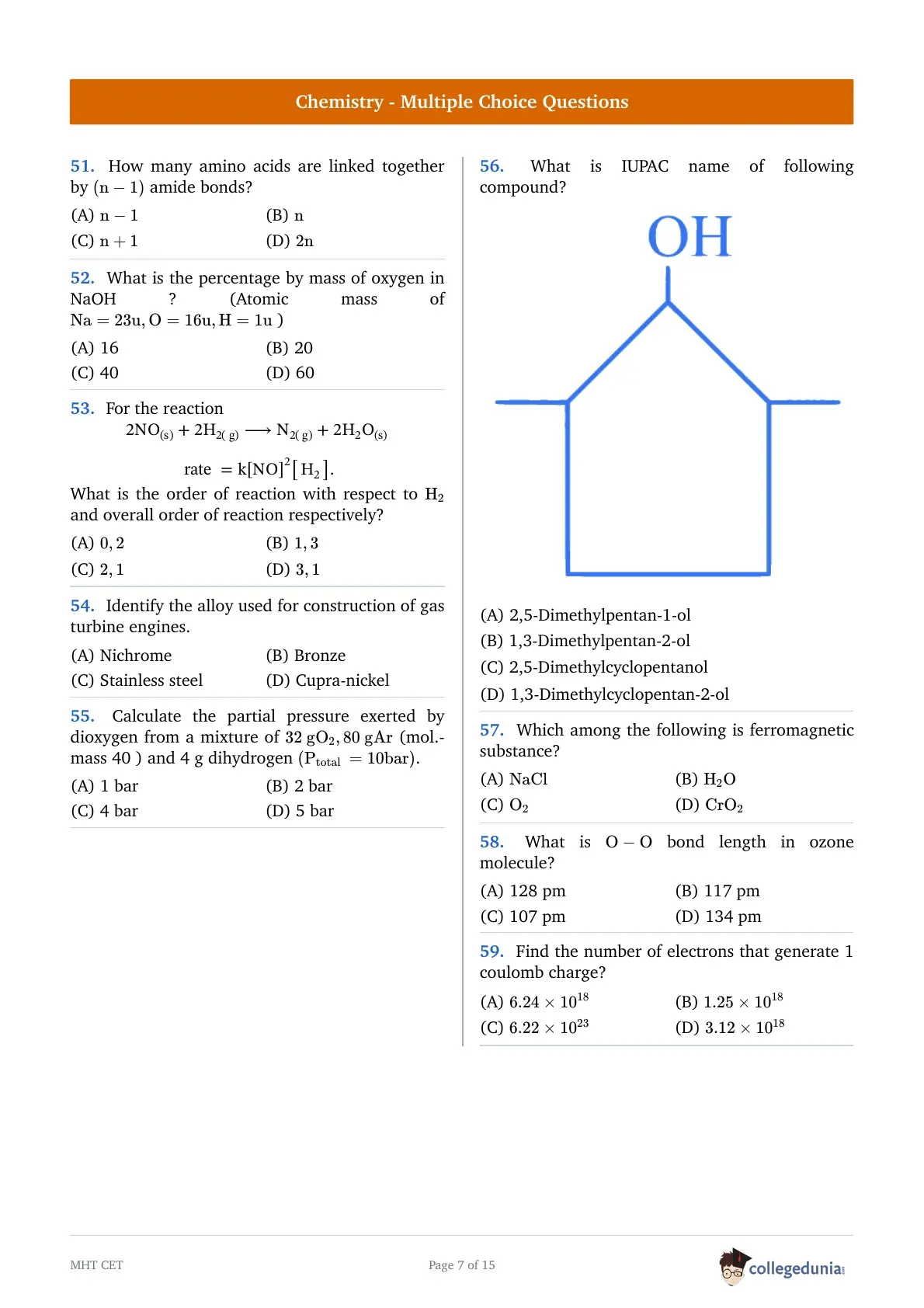
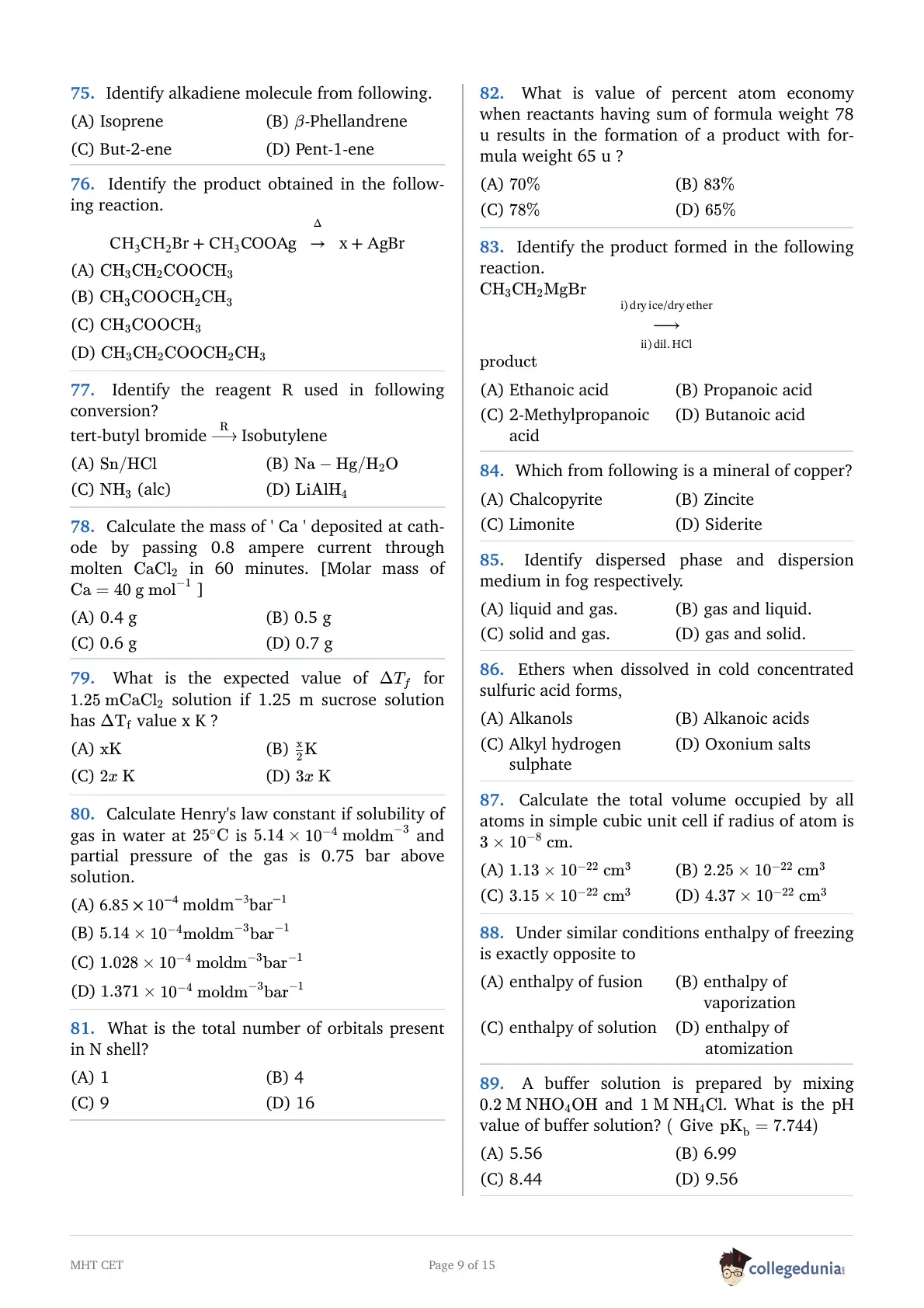
How many amino acids are linked together by \((\mathrm{n}-1)\) amide bonds?
What is the percentage by mass of oxygen in NaOH ? (Atomic mass of \(\mathrm{Na}=23 \mathrm{u}, \mathrm{O}=16 \mathrm{u}, \mathrm{H}=1 \mathrm{u}\) )
For the reaction
\[\begin{aligned} & 2 \mathrm{NO}_{(\mathrm{s})}+2 \mathrm{H}_{2(\mathrm{~g})} \longrightarrow \mathrm{N}_{2(\mathrm{~g})}+2 \mathrm{H}_2 \mathrm{O}_{(\mathrm{s})} \\\\ & \text { rate }=\mathrm{k}[\mathrm{NO}]^2\left[\mathrm{H}_2\right] . \end{aligned}\]
What is the order of reaction with respect to \(\mathrm{H}_2\) and overall order of reaction respectively?
Calculate the partial pressure exerted by dioxygen from a mixture of \(32 \mathrm{~g} \mathrm{O}_2, 80 \mathrm{~g} \mathrm{Ar}\) (mol.mass 40 ) and 4 g dihydrogen \(\left(\mathrm{P}_{\text {total }}=10 \mathrm{bar}\right)\).

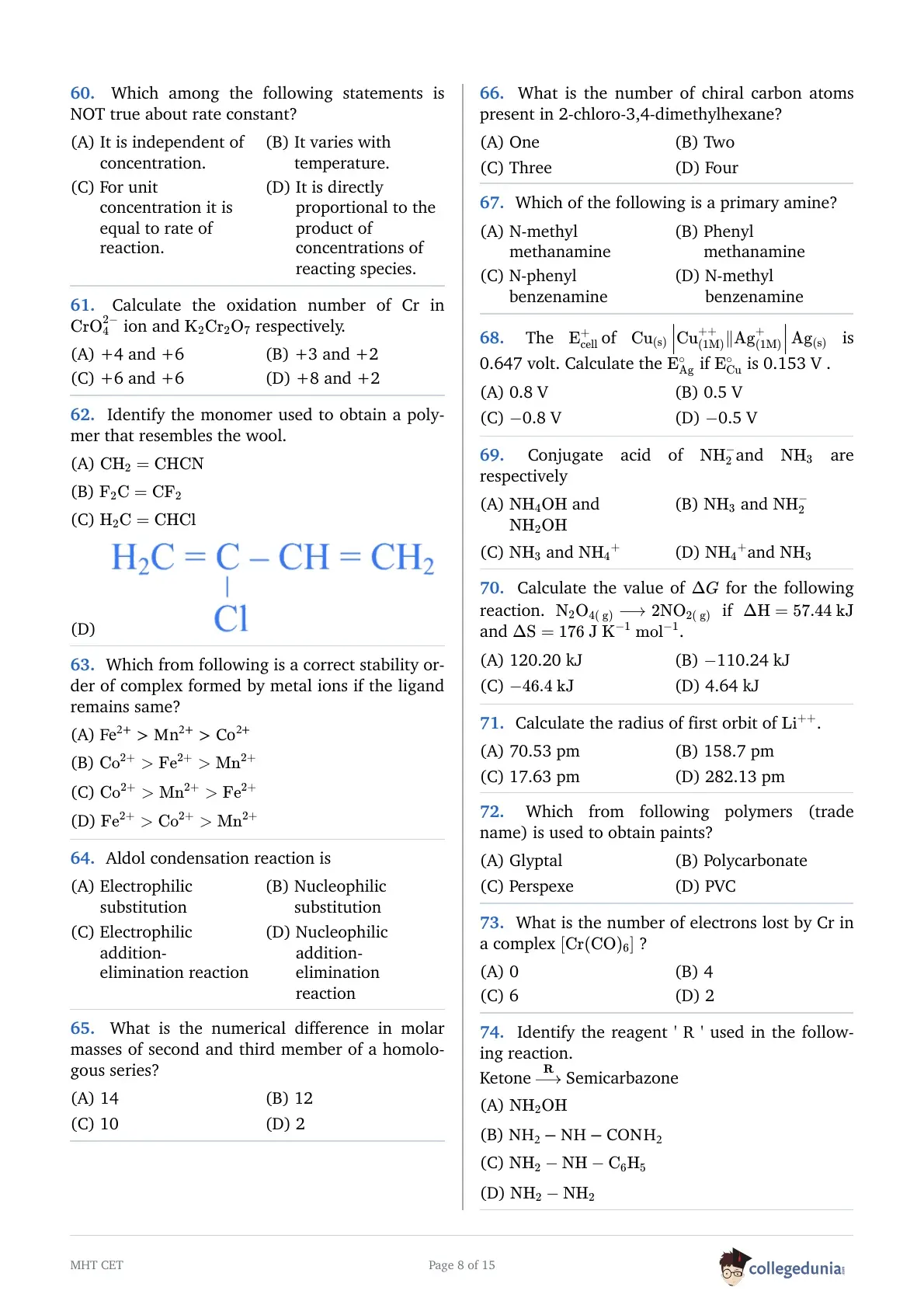
Which among the following statements is NOT true about rate constant?
Calculate the oxidation number of Cr in \(\mathrm{CrO}_4^{2-}\) ion and \(\mathrm{K}_2 \mathrm{Cr}_2 \mathrm{O}_7\) respectively.
Identify the monomer used to obtain a polymer that resembles the wool.
- (A) \(\mathrm{CH}_{2}=\mathrm{CHCN}\)
- (B) \(\mathrm{F}_{2}\mathrm{C}=\mathrm{CF}_{2}\)
- (C) \(\mathrm{H}_{2}\mathrm{C}=\mathrm{CHCl}\)
- (D)
![]()

Which from following is a correct stability order of complex formed by metal ions if the ligand remains same?
What is the numerical difference in molar masses of second and third member of a homologous series?
What is the number of chiral carbon atoms present in 2-chloro-3,4-dimethylhexane?
The \(\mathrm{E}_{\text {cell }}^{+}\)of \(\mathrm{Cu}_{(\mathrm{s})}\left|\mathrm{Cu}_{(\mathrm{1M})}^{++} \| \mathrm{Ag}_{(\mathrm{1M})}^{+}\right| \mathrm{Ag}_{(\mathrm{s})}\) is 0.647 volt. Calculate the \(\mathrm{E}_{\mathrm{Ag}}^{\circ}\) if \(\mathrm{E}_{\mathrm{Cu}}^{\circ}\) is 0.153 V .
Conjugate acid of \(\mathrm{NH}_2^{-}\)and \(\mathrm{NH}_3\) are respectively
Calculate the value of \(\Delta G\) for the following reaction. \(\mathrm{N}_2 \mathrm{O}_{4(\mathrm{~g})} \longrightarrow 2 \mathrm{NO}_{2(\mathrm{~g})}\) if \(\Delta \mathrm{H}=57.44 \mathrm{~kJ}\) and \(\Delta \mathrm{S}=176 \mathrm{~J} \mathrm{~K}^{-1} \mathrm{~mol}^{-1}\).
What is the number of electrons lost by Cr in a complex \(\left[\mathrm{Cr}(\mathrm{CO})_6\right]\) ?
Identify the reagent ' R ' used in the following reaction.
Ketone \(\xrightarrow{\mathbf{R}}\) Semicarbazone
Identify the product obtained in the following reaction.
\[\mathrm{CH}_3 \mathrm{CH}_2 \mathrm{Br}+\mathrm{CH}_3 \mathrm{COOAg} \xrightarrow{\Delta} \mathrm{x}+\mathrm{AgBr}\]
Calculate the mass of ' Ca ' deposited at cathode by passing 0.8 ampere current through molten \(\mathrm{CaCl}_2\) in 60 minutes. [Molar mass of \(\mathrm{Ca}=40 \mathrm{~g} \mathrm{~mol}^{-1}\) ]
What is the expected value of \(\Delta T_f\) for \(1.25 \mathrm{~m} \mathrm{CaCl}_2\) solution if 1.25 m sucrose solution has \(\Delta \mathrm{T}_{\mathrm{f}}\) value x K ?
Calculate Henry's law constant if solubility of gas in water at \(25^{\circ} \mathrm{C}\) is \(5.14 \times 10^{-4} \mathrm{~mol} \mathrm{dm}^{-3}\) and partial pressure of the gas is 0.75 bar above solution.
What is value of percent atom economy when reactants having sum of formula weight 78 u results in the formation of a product with formula weight 65 u ?
Identify the product formed in the following reaction.
\(\mathrm{CH_3CH_2MgBr}\) \[\mathrm{\mathrel{\mathop{\kern0pt\longrightarrow} \limits_{ii)\,dil.\,HCl}^{i)\,dry\,ice/dry\,ether}}}\] \(\mathrm{product}\)
Calculate the total volume occupied by all atoms in simple cubic unit cell if radius of atom is \(3 \times 10^{-8} \mathrm{~cm}\).
A buffer solution is prepared by mixing \(0.2 \mathrm{~M} \mathrm{~NH} \mathrm{O}_4 \mathrm{OH}\) and \(1 \mathrm{~M} \mathrm{~NH}_4 \mathrm{Cl}\). What is the pH value of buffer solution? \(\left(\right.\) Give \(\left.\mathrm{pK}_{\mathrm{b}}=7.744\right)\)
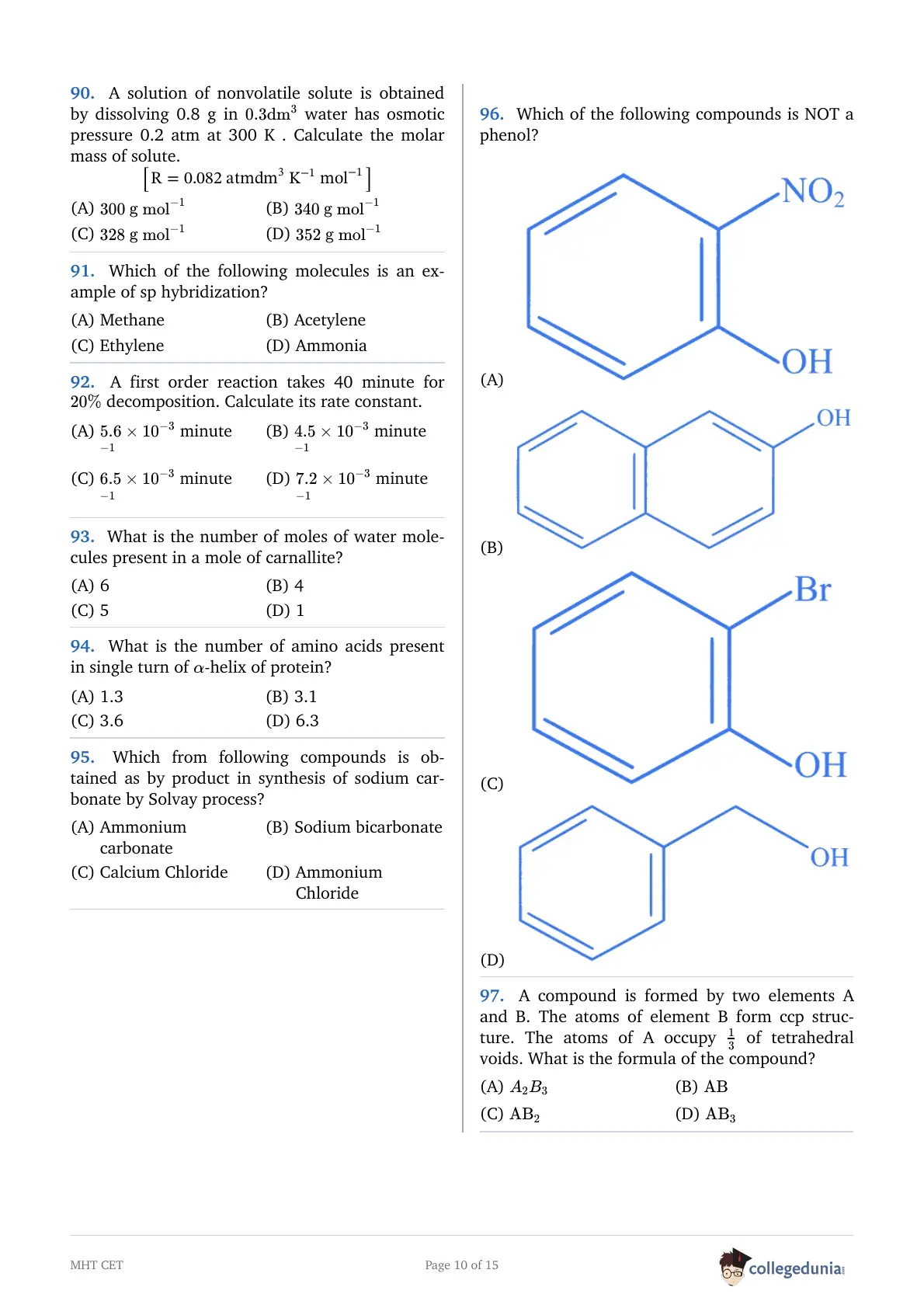
A solution of nonvolatile solute is obtained by dissolving 0.8 g in \(0.3 \mathrm{dm}^3\) water has osmotic pressure 0.2 atm at 300 K . Calculate the molar mass of solute.
\[\left[\mathrm{R}=0.082 \mathrm{~atm} \mathrm{dm}^3 \mathrm{~K}^{-1} \mathrm{~mol}^{-1}\right]\]
A first order reaction takes 40 minute for \(20 \%\) decomposition. Calculate its rate constant.
What is the number of moles of water molecules present in a mole of carnallite?
What is the number of amino acids present in single turn of \(\alpha\)-helix of protein?
Which from following compounds is obtained as by product in synthesis of sodium carbonate by Solvay process?


A compound is formed by two elements A and B. The atoms of element B form ccp structure. The atoms of A occupy \(\frac{1}{3}\) of tetrahedral voids. What is the formula of the compound?
Which of the following isomers of \(\mathrm{C}_4 \mathrm{H}_9 \mathrm{Br}\) is a chiral molecule?
The dissociation constant of a weak monobasic acid is \(3.2 \times 10^{-4}\). Calculate the degree of dissociation in its 0.04 M solution.
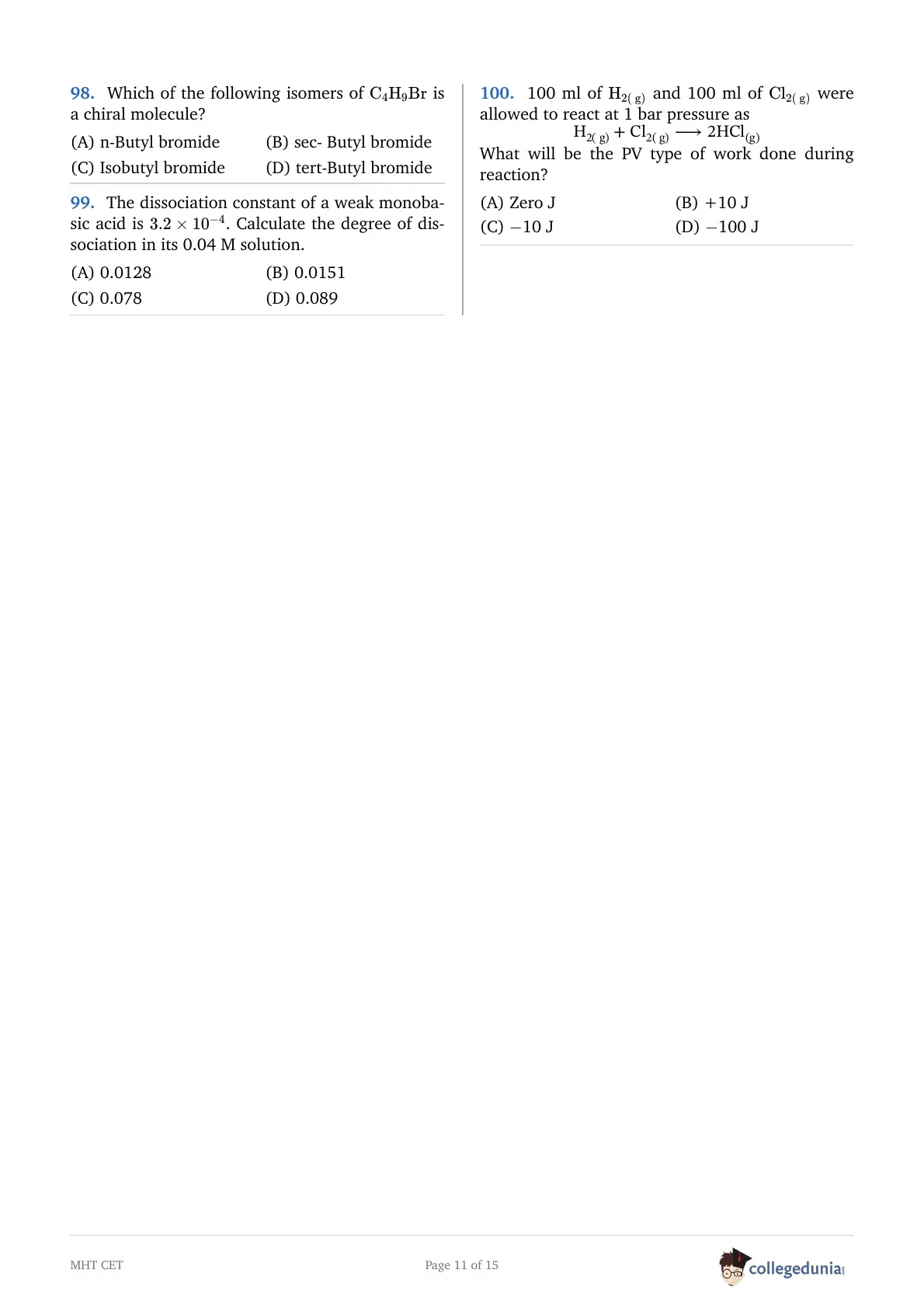
100 ml of \(\mathrm{H}_{2(\mathrm{~g})}\) and 100 ml of \(\mathrm{Cl}_{2(\mathrm{~g})}\) were allowed to react at 1 bar pressure as
\[\mathrm{H}_{2(\mathrm{~g})}+\mathrm{Cl}_{2(\mathrm{~g})} \longrightarrow 2 \mathrm{HCl}_{(\mathrm{g})}\]
What will be the PV type of work done during reaction?
Mathematics (Q101 - Q150)
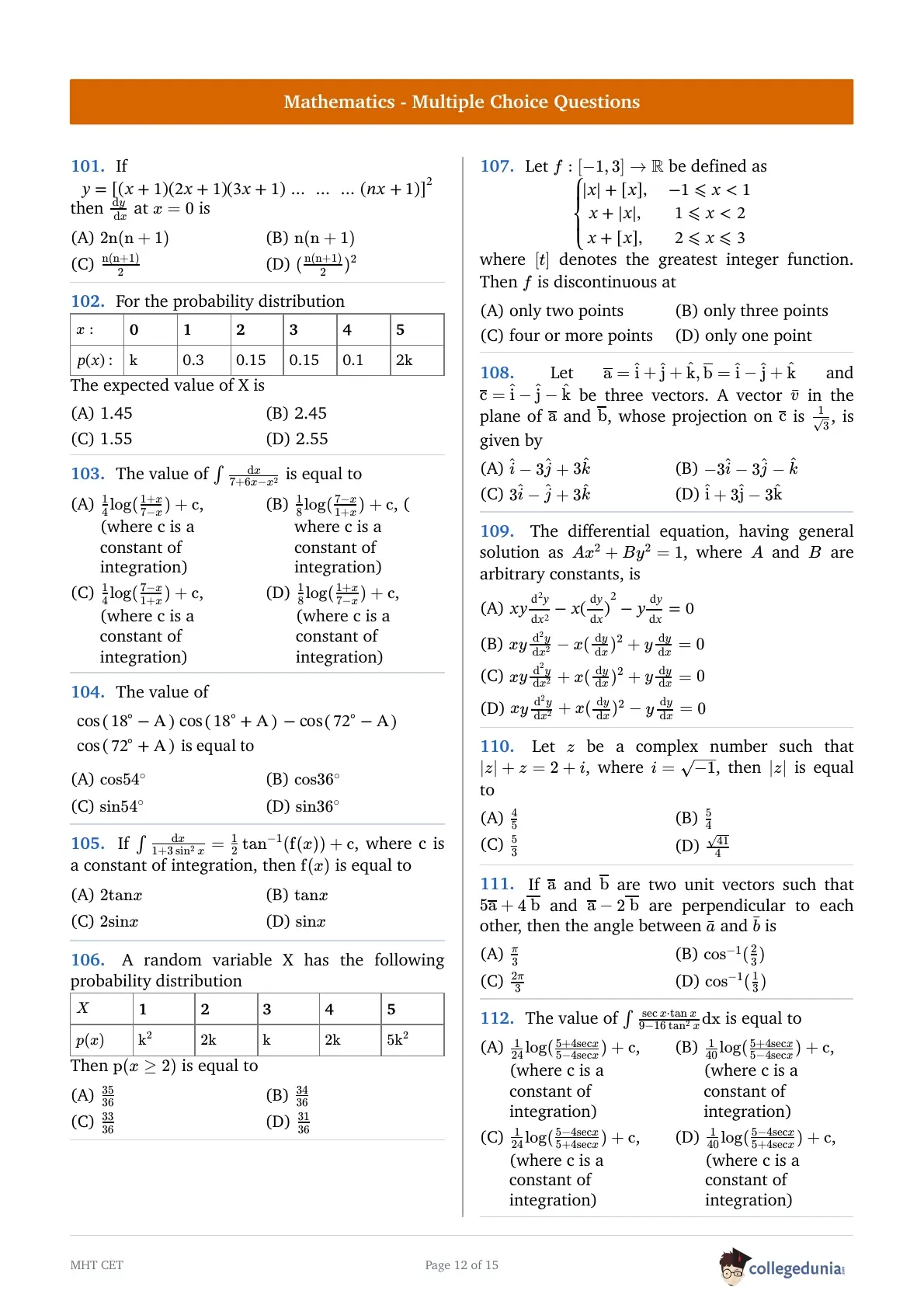
If \[ y=[(x+1)(2 x+1)(3 x+1) \ldots \ldots \ldots(n x+1)]^2 \] then \(\frac{\mathrm{d} y}{\mathrm{~d} x}\) at \(x=0\) is
For the probability distribution
| \(x :\) | 0 | 1 | 2 | 3 | 4 | 5 |
|---|---|---|---|---|---|---|
| \(p(x):\) | \(\mathrm{k}\) | 0.3 | 0.15 | 0.15 | 0.1 | 2\(\mathrm{k}\) |
If \(\int \frac{\mathrm{d} x}{1+3 \sin ^2 x}=\frac{1}{2} \tan ^{-1}(\mathrm{f}(x))+\mathrm{c}\), where c is a constant of integration, then \(\mathrm{f}(x)\) is equal to
A random variable X has the following probability distribution
| \(X\) | 1 | 2 | 3 | 4 | 5 |
|---|---|---|---|---|---|
| \(p(x)\) | \(\mathrm{k^2}\) | \(\mathrm{2k}\) | \(\mathrm{k}\) | \(\mathrm{2k}\) | \(\mathrm{5k^2}\) |
Let \(\overline{\mathrm{a}}=\hat{\mathrm{i}}+\hat{\mathrm{j}}+\hat{\mathrm{k}}, \overline{\mathrm{b}}=\hat{\mathrm{i}}-\hat{\mathrm{j}}+\hat{\mathrm{k}}\) and \(\overline{\mathrm{c}}=\hat{\mathrm{i}}-\hat{\mathrm{j}}-\hat{\mathrm{k}}\) be three vectors. A vector \(\bar{v}\) in the plane of \(\overline{\mathrm{a}}\) and \(\overline{\mathrm{b}}\), whose projection on \(\overline{\mathrm{c}}\) is \(\frac{1}{\sqrt{3}}\), is given by
The differential equation, having general solution as \(A x^2+B y^2=1\), where \(A\) and \(B\) are arbitrary constants, is
Let \(z\) be a complex number such that \(|z|+z=2+i\), where \(i=\sqrt{-1}\), then \(|z|\) is equal to
If \(\overline{\mathrm{a}}\) and \(\overline{\mathrm{b}}\) are two unit vectors such that \(5 \overline{\mathrm{a}}+4 \overline{\mathrm{~b}}\) and \(\overline{\mathrm{a}}-2 \overline{\mathrm{~b}}\) are perpendicular to each other, then the angle between \(\bar{a}\) and \(\bar{b}\) is
The value of \(\int \frac{\sec x \cdot \tan x}{9-16 \tan ^2 x} \mathrm{dx}\) is equal to
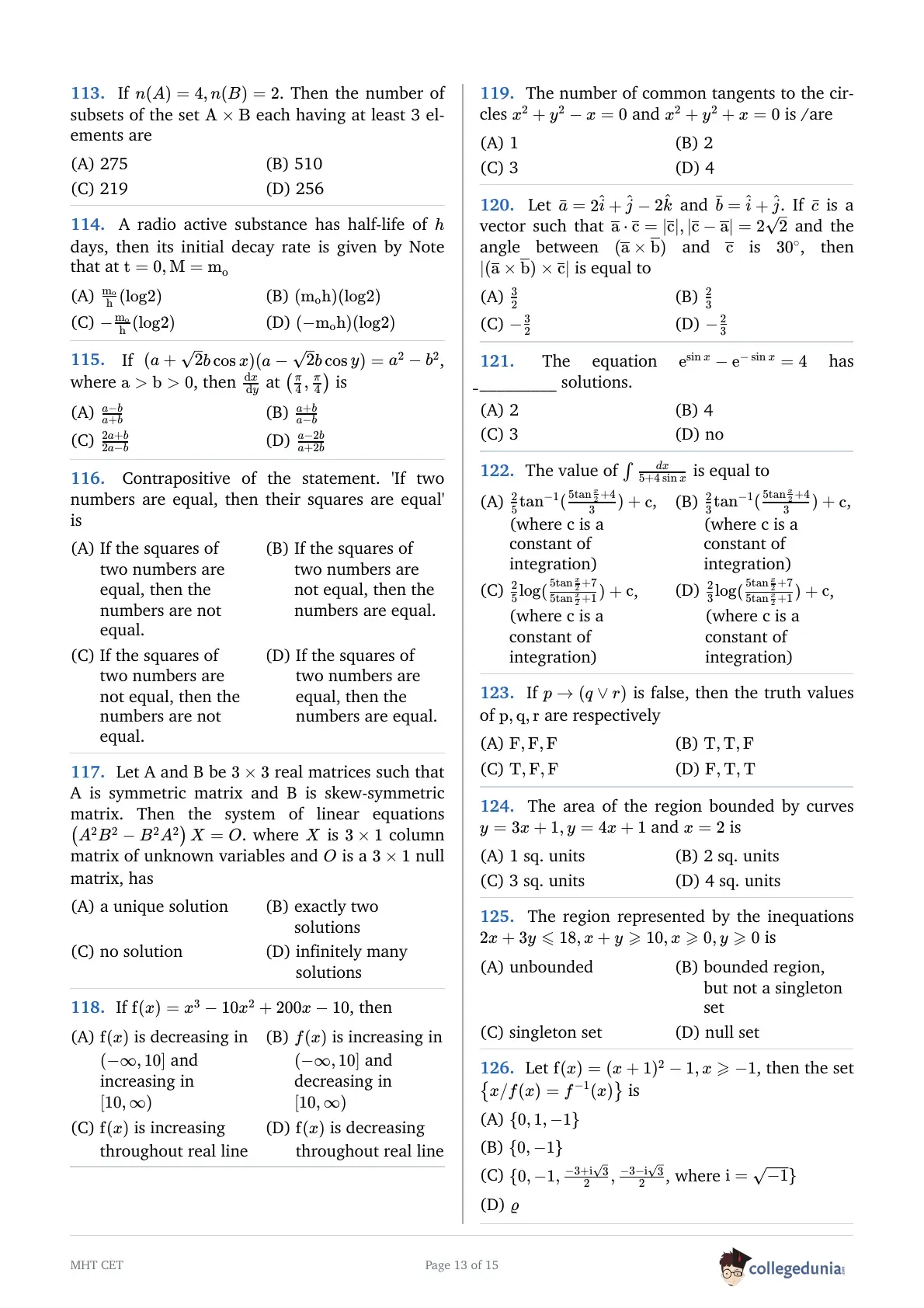
If \(n(A)=4, n(B)=2\). Then the number of subsets of the set \(\mathrm{A} \times \mathrm{B}\) each having at least 3 elements are
A radio active substance has half-life of \(h\) days, then its initial decay rate is given by Note that at \(\mathrm{t}=0, \mathrm{M}=\mathrm{m}_{\mathrm{o}}\)
If \((a+\sqrt{2} b \cos x)(a-\sqrt{2} b \cos y)=a^2-b^2\), where \(\mathrm{a}>\mathrm{b}>0\), then \(\frac{\mathrm{d} x}{\mathrm{~d} y}\) at \(\left(\frac{\pi}{4}, \frac{\pi}{4}\right)\) is
Contrapositive of the statement. 'If two numbers are equal, then their squares are equal' is
Let A and B be \(3 \times 3\) real matrices such that A is symmetric matrix and B is skew-symmetric matrix. Then the system of linear equations \(\left(A^2 B^2-B^2 A^2\right) X=O\). where \(X\) is \(3 \times 1\) column matrix of unknown variables and \(O\) is a \(3 \times 1\) null matrix, has
The number of common tangents to the circles \(x^2+y^2-x=0\) and \(x^2+y^2+x=0\) is /are
Let \(\bar{a}=2 \hat{i}+\hat{j}-2 \hat{k}\) and \(\bar{b}=\hat{i}+\hat{j}\). If \(\bar{c}\) is a vector such that \(\overline{\mathrm{a}} \cdot \overline{\mathrm{c}}=|\overline{\mathrm{c}}|,|\overline{\mathrm{c}}-\overline{\mathrm{a}}|=2 \sqrt{2}\) and the angle between \((\overline{\mathrm{a}} \times \overline{\mathrm{b}})\) and \(\overline{\mathrm{c}}\) is \(30^{\circ}\), then \(|(\overline{\mathrm{a}} \times \overline{\mathrm{b}}) \times \overline{\mathrm{c}}|\) is equal to
The equation \(\mathrm{e}^{\sin x}-\mathrm{e}^{-\sin x}=4\) has ̱_________ solutions.
If \(p \rightarrow(q \vee r)\) is false, then the truth values of \(\mathrm{p}, \mathrm{q}, \mathrm{r}\) are respectively
The area of the region bounded by curves \(y=3 x+1, y=4 x+1\) and \(x=2\) is
The region represented by the inequations \(2 x+3 y \leqslant 18, x+y \geqslant 10, x \geqslant 0, y \geqslant 0\) is
Let \(\mathrm{f}(x)=(x+1)^2-1, x \geqslant-1\), then the set \(\left\{x / f(x)=f^{-1}(x)\right\}\) is
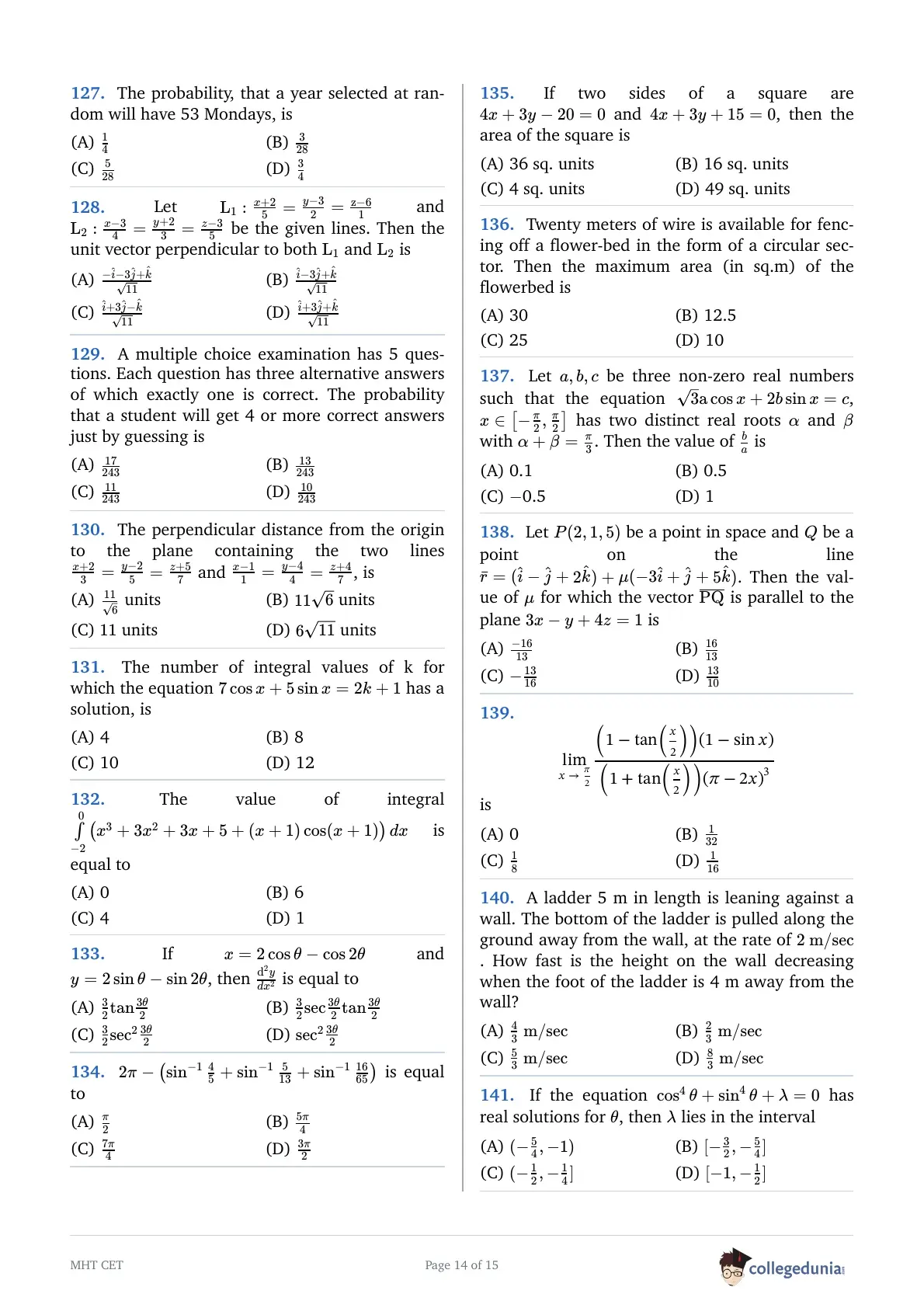
The probability, that a year selected at random will have 53 Mondays, is
Let \(\mathrm{L}_1: \frac{x+2}{5}=\frac{y-3}{2}=\frac{\mathrm{z}-6}{1}\) and \(\mathrm{L}_2: \frac{x-3}{4}=\frac{y+2}{3}=\frac{z-3}{5}\) be the given lines. Then the unit vector perpendicular to both \(\mathrm{L}_1\) and \(\mathrm{L}_2\) is
A multiple choice examination has 5 questions. Each question has three alternative answers of which exactly one is correct. The probability that a student will get 4 or more correct answers just by guessing is
The perpendicular distance from the origin to the plane containing the two lines \(\frac{x+2}{3}=\frac{y-2}{5}=\frac{z+5}{7}\) and \(\frac{x-1}{1}=\frac{y-4}{4}=\frac{z+4}{7}\), is
The number of integral values of k for which the equation \(7\cos x+5\sin x=2k+1\) has a solution, is
\(2 \pi-\left(\sin ^{-1} \frac{4}{5}+\sin ^{-1} \frac{5}{13}+\sin ^{-1} \frac{16}{65}\right)\) is equal to
If two sides of a square are \(4 x+3 y-20=0\) and \(4 x+3 y+15=0\), then the area of the square is
Twenty meters of wire is available for fencing off a flower-bed in the form of a circular sector. Then the maximum area (in sq.m) of the flowerbed is
Let \(a, b, c\) be three non-zero real numbers such that the equation \(\sqrt{3} \mathrm{a} \cos x+2 b \sin x=c\), \(x \in\left[-\frac{\pi}{2}, \frac{\pi}{2}\right]\) has two distinct real roots \(\alpha\) and \(\beta\) with \(\alpha+\beta=\frac{\pi}{3}\). Then the value of \(\frac{b}{a}\) is
Let \(P(2,1,5)\) be a point in space and \(Q\) be a point on the line \(\bar{r}=(\hat{i}-\hat{j}+2 \hat{k})+\mu(-3 \hat{i}+\hat{j}+5 \hat{k})\). Then the value of \(\mu\) for which the vector \(\overline{\mathrm{PQ}}\) is parallel to the plane \(3 x-y+4 z=1\) is
\[\lim _\limits{x \rightarrow \frac{\pi}{2}} \frac{\left(1-\tan \left(\frac{x}{2}\right)\right)(1-\sin x)}{\left(1+\tan \left(\frac{x}{2}\right)\right)(\pi-2 x)^3}\] is
A ladder 5 m in length is leaning against a wall. The bottom of the ladder is pulled along the ground away from the wall, at the rate of \(2 \mathrm{~m} / \mathrm{sec}\). How fast is the height on the wall decreasing when the foot of the ladder is 4 m away from the wall?
If the equation \(\cos ^4 \theta+\sin ^4 \theta+\lambda=0\) has real solutions for \(\theta\), then \(\lambda\) lies in the interval
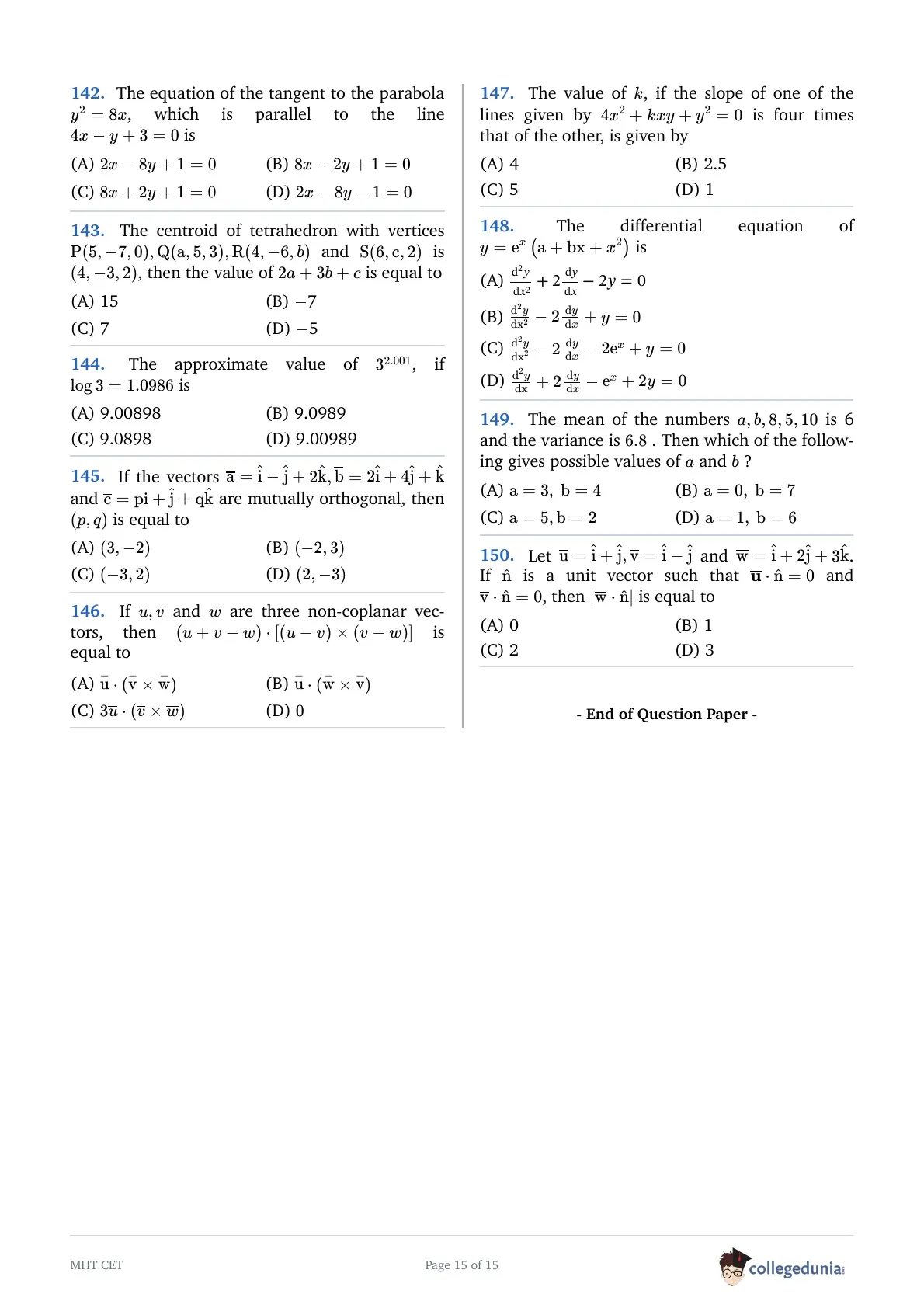
The equation of the tangent to the parabola \(y^2=8 x\), which is parallel to the line \(4 x-y+3=0\) is
The centroid of tetrahedron with vertices \(\mathrm{P}(5,-7,0), \mathrm{Q}(\mathrm{a}, 5,3), \mathrm{R}(4,-6, b)\) and \(\mathrm{S}(6, \mathrm{c}, 2)\) is \((4,-3,2)\), then the value of \(2 a+3 b+c\) is equal to
If the vectors \(\overline{\mathrm{a}}=\hat{\mathrm{i}}-\hat{\mathrm{j}}+2 \hat{\mathrm{k}}, \overline{\mathrm{b}}=2 \hat{\mathrm{i}}+4 \hat{\mathrm{j}}+\hat{\mathrm{k}}\) and \(\overline{\mathrm{c}}=\mathrm{pi}+\hat{\mathrm{j}}+\mathrm{q} \hat{\mathrm{k}}\) are mutually orthogonal, then \((p, q)\) is equal to
If \(\bar{u}, \bar{v}\) and \(\bar{w}\) are three non-coplanar vectors, then \((\bar{u}+\bar{v}-\bar{w}) \cdot[(\bar{u}-\bar{v}) \times(\bar{v}-\bar{w})]\) is equal to
The value of \(k\), if the slope of one of the lines given by \(4 x^2+k x y+y^2=0\) is four times that of the other, is given by
The differential equation of \(y=\mathrm{e}^x\left(\mathrm{a}+\mathrm{bx}+x^2\right)\) is
The mean of the numbers \(a, b, 8,5,10\) is 6 and the variance is \(6.8\) . Then which of the following gives possible values of \(a\) and \(b\) ?
Let \(\overline{\mathrm{u}}=\hat{\mathrm{i}}+\hat{\mathrm{j}}, \overline{\mathrm{v}}=\hat{\mathrm{i}}-\hat{\mathrm{j}}\) and \(\overline{\mathrm{w}}=\hat{\mathrm{i}}+2 \hat{\mathrm{j}}+3 \hat{\mathrm{k}}\). If \(\hat{\mathrm{n}}\) is a unit vector such that \(\overline{\mathbf{u}} \cdot \hat{\mathrm{n}}=0\) and \(\overline{\mathrm{v}} \cdot \hat{\mathrm{n}}=0\), then \(|\overline{\mathrm{w}} \cdot \hat{\mathrm{n}}|\) is equal to
MHT CET 2024 PCM Exam Pattern and Marking Scheme
| Parameter | Details |
|---|---|
| Conducting Body | Maharashtra Common Entrance Test Cell (Maharashtra CET Cell) |
| Exam Mode | Online (Computer-Based Test) |
| Duration | 180 minutes (3 hours) |
| Groups / Subjects | PCM (Physics, Chemistry, Mathematics) for Engineering |
| Total Questions |
150 |
| Total Marks | 200 |
| Question Type | Multiple Choice Questions (MCQs) |
| Marks Distribution |
|
| Negative Marking | No |
| Syllabus Weightage |
|



Comments