MHT CET 2023 May 13 Shift 1 PCM Question Paper is available for download here. Maharashtra State CET Cell conducted MHT CET 2023 PCM Exam on May 13 in Shift 1 from 9 AM to 12 PM in CBT mode.

The MHT CET 2023 PCM question paper includes the following:

  • The MHT CET 2023 PCM Question Paper consists of 150 multiple-choice questions (MCQs) totalling 200 marks divided into 3 sections: Physics, Chemistry, and Mathematics, with 50 questions in each subject.
  • Physics and Chemistry questions carry 1 mark each while Mathematics questions carry 2 marks each.
  • There is no negative marking for incorrect answers.

MHT CET 2023 May 13 Shift 1 PCM Question Paper with Solution PDF

CD PDF CD PDF with Solutions
Download Collegedunia PDF 1.29 MB -

Also Check:

MHT CET 2023 May 13 Shift 1 PCM Questions with Solutions


Physics (Q1 - Q50)

Question 1:

Select the 'WRONG' statement out of the following.

  • (A) Electromagnetic waves do not require any medium for their propagation.
  • (B) Electromagnetic waves can travel through vacuum with speed of light
  • (C) Material medium is necessary for propagation of electromagnetic waves.
  • (D) Electromagnetic waves are transverse in nature.

Question 2:

Two cells \[E_1\] and \[E_2\] having equal EMF '\[E\]' and internal resistances \[r_1\] and \[r_2\left(r_1>r_2\right)\] respectively are connected in series. This combination is connected to an external resistance '\[R\]'. It is observed that the potential difference across the cell \[\mathrm{E}_1\] becomes zero. The value of '\[R\]' will be

  • (A) \(r_{1}-r_{2}\)
  • (B) \(\mathrm{r}_{1}+\mathrm{r}_{2}\)
  • (C) \(\frac{r_{1}-r_{2}}{2}\)
  • (D) \(\frac{r_{1}+r_{2}}{2}\)

Question 3:

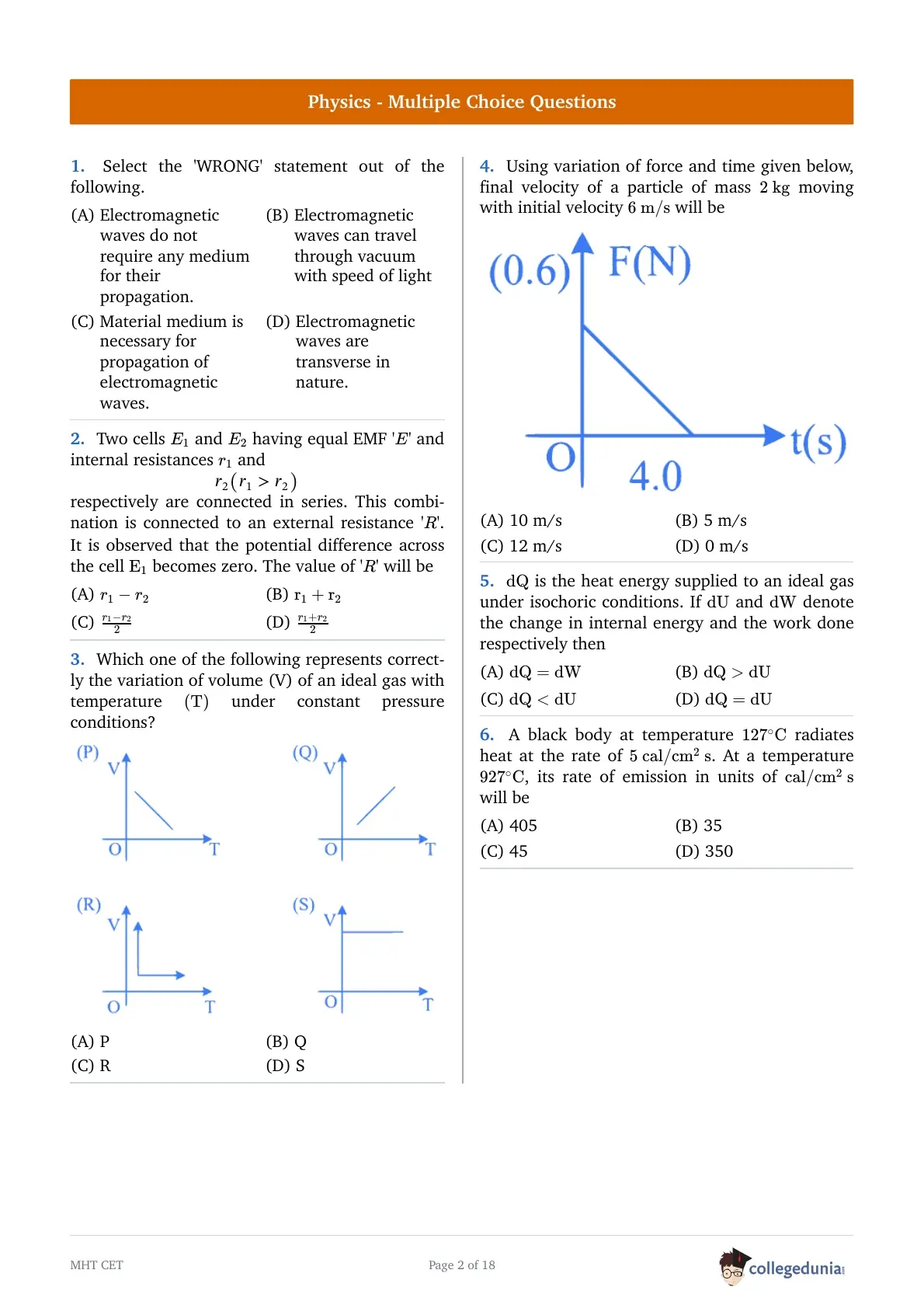
Which one of the following represents correctly the variation of volume (V) of an ideal gas with temperature \[(\mathrm{T})\] under constant pressure conditions?

  • (A) P
  • (B) Q
  • (C) R
  • (D) S

Question 5:

\[\mathrm{dQ}\] is the heat energy supplied to an ideal gas under isochoric conditions. If \[\mathrm{dU}\] and \[\mathrm{dW}\] denote the change in internal energy and the work done respectively then

  • (A) \(\mathrm{dQ}=\mathrm{dW}\)
  • (B) \(\mathrm{dQ}>\mathrm{dU}\)
  • (C) \(\mathrm{dQ}<\mathrm{dU}\)
  • (D) \(\mathrm{dQ}=\mathrm{dU}\)

Question 6:

A black body at temperature \[127^{\circ} \mathrm{C}\] radiates heat at the rate of \[5 \mathrm{~cal} / \mathrm{cm}^2 \mathrm{~s}\]. At a temperature \[927^{\circ} \mathrm{C}\], its rate of emission in units of \[\mathrm{cal} / \mathrm{cm}^2 \mathrm{~s}\] will be

  • (A) 405
  • (B) 35
  • (C) 45
  • (D) 350

Question 7:

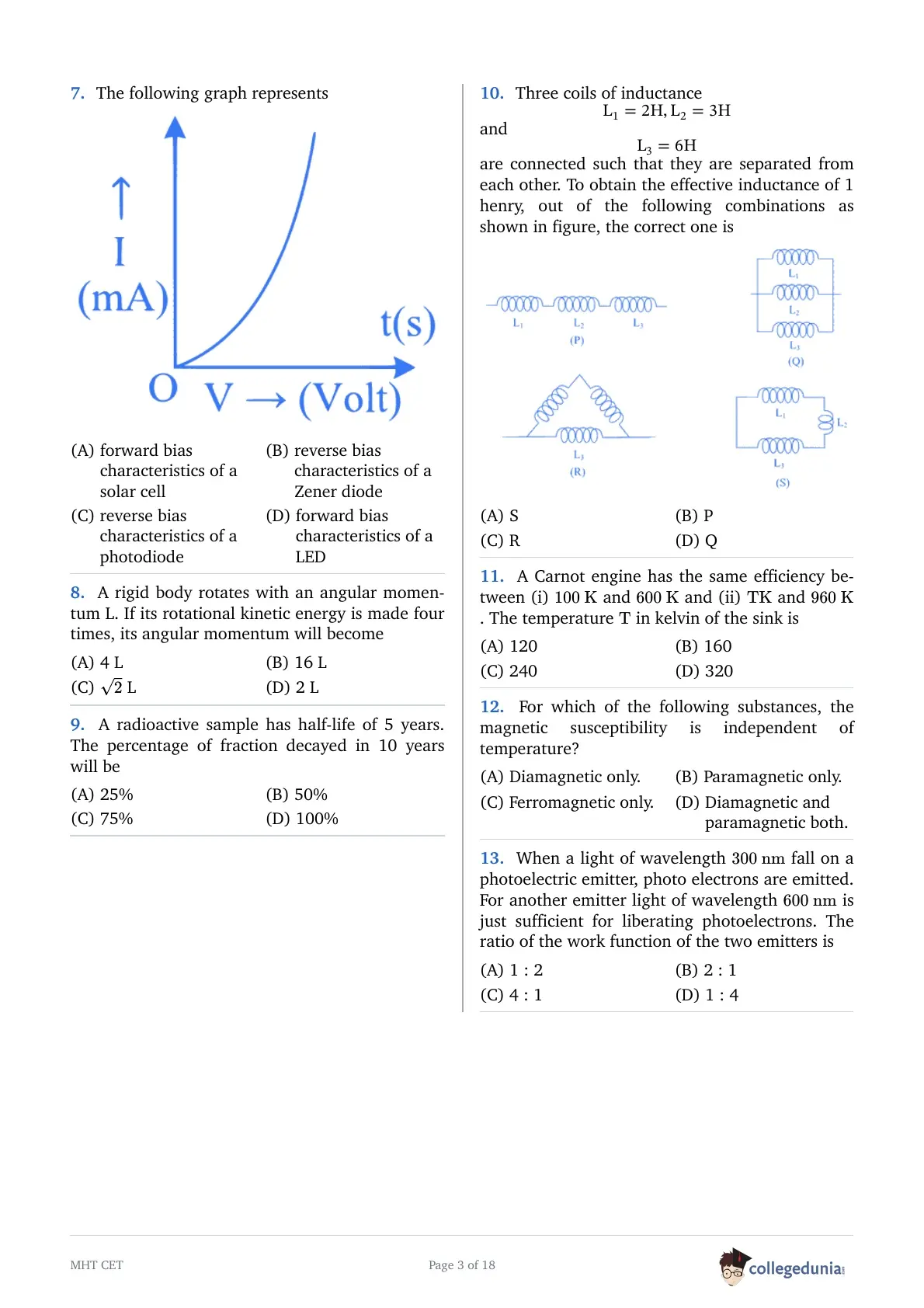
The following graph represents

  • (A) forward bias characteristics of a solar cell
  • (B) reverse bias characteristics of a Zener diode
  • (C) reverse bias characteristics of a photodiode
  • (D) forward bias characteristics of a LED

Question 8:

A rigid body rotates with an angular momentum L. If its rotational kinetic energy is made four times, its angular momentum will become

  • (A) 4 L
  • (B) 16 L
  • (C) \(\sqrt{2}\) L
  • (D) 2 L

Question 9:

A radioactive sample has half-life of 5 years. The percentage of fraction decayed in 10 years will be

  • (A) 25%
  • (B) 50%
  • (C) 75%
  • (D) 100%

Question 10:

Three coils of inductance \[\mathrm{L}_1=2 \mathrm{H}, \mathrm{L}_2=3 \mathrm{H}\] and \[\mathrm{L}_3=6 \mathrm{H}\] are connected such that they are separated from each other. To obtain the effective inductance of 1 henry, out of the following combinations as shown in figure, the correct one is

  • (A) S
  • (B) P
  • (C) R
  • (D) Q

Question 11:

A Carnot engine has the same efficiency between (i) \[100 \mathrm{~K}\] and \[600 \mathrm{~K}\] and (ii) \[\mathrm{T} \mathrm{K}\] and \[960 \mathrm{~K}\]. The temperature \[\mathrm{T}\] in kelvin of the sink is

  • (A) 120
  • (B) 160
  • (C) 240
  • (D) 320

Question 12:

For which of the following substances, the magnetic susceptibility is independent of temperature?

  • (A) Diamagnetic only.
  • (B) Paramagnetic only.
  • (C) Ferromagnetic only.
  • (D) Diamagnetic and paramagnetic both.

Question 13:

When a light of wavelength \[300 \mathrm{~nm}\] fall on a photoelectric emitter, photo electrons are emitted. For another emitter light of wavelength \[600 \mathrm{~nm}\] is just sufficient for liberating photoelectrons. The ratio of the work function of the two emitters is

  • (A) 1 : 2
  • (B) 2 : 1
  • (C) 4 : 1
  • (D) 1 : 4

Question 14:

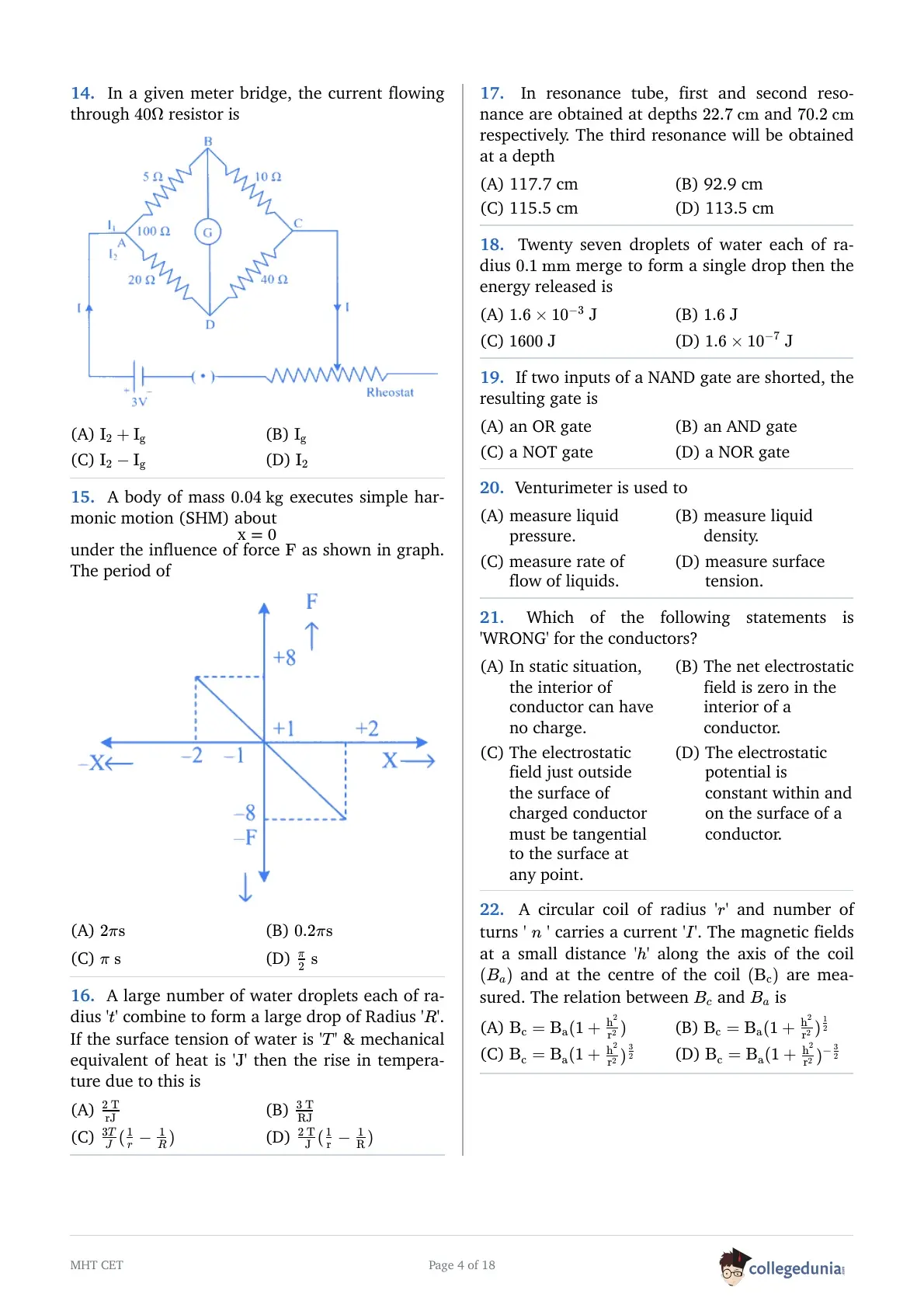
In a given meter bridge, the current flowing through \[40 \Omega\] resistor is

  • (A) \(\mathrm{I}_{2}+\mathrm{I}_{\mathrm{g}}\)
  • (B) \(\mathrm{I}_{\mathrm{g}}\)
  • (C) \(\mathrm{I}_{2}-\mathrm{I}_{\mathrm{g}}\)
  • (D) \(\mathrm{I}_{2}\)

Question 15:

A body of mass \[0.04 \mathrm{~kg}\] executes simple harmonic motion (SHM) about \[\mathrm{x}=0\] under the influence of force \[\mathrm{F}\] as shown in graph. The period of

  • (A) \(2\pi \mathrm{s}\)
  • (B) \(0.2\pi \mathrm{s}\)
  • (C) \(\pi \text{ }\mathrm{s}\)
  • (D) \(\frac{\pi}{2}\text{ }\mathrm{s}\)

Question 16:

A large number of water droplets each of radius '\[t\]' combine to form a large drop of Radius '\[R\]'. If the surface tension of water is '\[T\]' & mechanical equivalent of heat is '\[\mathrm{J}\]' then the rise in temperature due to this is

  • (A) \(\frac{2\text{ }\mathrm{T}}{\mathrm{rJ}}\)
  • (B) \(\frac{3\text{ }\mathrm{T}}{\mathrm{RJ}}\)
  • (C) \(\frac{3T}{J}(\frac{1}{r}-\frac{1}{R})\)
  • (D) \(\frac{2\text{ }\mathrm{T}}{\text{ }\mathrm{J}}(\frac{1}{\mathrm{r}}-\frac{1}{\mathrm{R}})\)

Question 17:

In resonance tube, first and second resonance are obtained at depths \[22.7 \mathrm{~cm}\] and \[70.2 \mathrm{~cm}\] respectively. The third resonance will be obtained at a depth

  • (A) 117.7 cm
  • (B) 92.9 cm
  • (C) 115.5 cm
  • (D) 113.5 cm

Question 18:

Twenty seven droplets of water each of radius \[0.1 \mathrm{~mm}\] merge to form a single drop then the energy released is

  • (A) \(1.6\times 10^{-3}\text{ }\mathrm{J}\)
  • (B) \(1.6\text{ }\mathrm{J}\)
  • (C) \(1600\text{ }\mathrm{J}\)
  • (D) \(1.6\times 10^{-7}\text{ }\mathrm{J}\)

Question 19:

If two inputs of a NAND gate are shorted, the resulting gate is

  • (A) an OR gate
  • (B) an AND gate
  • (C) a NOT gate
  • (D) a NOR gate

Question 20:

Venturimeter is used to

  • (A) measure liquid pressure.
  • (B) measure liquid density.
  • (C) measure rate of flow of liquids.
  • (D) measure surface tension.

Question 21:

Which of the following statements is 'WRONG' for the conductors?

  • (A) In static situation, the interior of conductor can have no charge.
  • (B) The net electrostatic field is zero in the interior of a conductor.
  • (C) The electrostatic field just outside the surface of charged conductor must be tangential to the surface at any point.
  • (D) The electrostatic potential is constant within and on the surface of a conductor.

Question 22:

A circular coil of radius '\[r\]' and number of turns ' \(n\) ' carries a current '\[I\]'. The magnetic fields at a small distance '\[h\]' along the axis of the coil \[\left(B_a\right)\] and at the centre of the coil \[\left(\mathrm{B}_{\mathrm{c}}\right)\] are measured. The relation between \[B_c\] and \[B_a\] is

  • (A) \(\mathrm{B}_{\mathrm{c}}=\mathrm{B}_{\mathrm{a}}(1+\frac{\mathrm{h}^{2}}{\mathrm{r}^{2}})\)
  • (B) \(\mathrm{B}_{\mathrm{c}}=\mathrm{B}_{\mathrm{a}}(1+\frac{\mathrm{h}^{2}}{\mathrm{r}^{2}})^{\frac{1}{2}}\)
  • (C) \(\mathrm{B}_{\mathrm{c}}=\mathrm{B}_{\mathrm{a}}(1+\frac{\mathrm{h}^{2}}{\mathrm{r}^{2}})^{\frac{3}{2}}\)
  • (D) \(\mathrm{B}_{\mathrm{c}}=\mathrm{B}_{\mathrm{a}}(1+\frac{\mathrm{h}^{2}}{\mathrm{r}^{2}})^{-\frac{3}{2}}\)

Question 23:

A spherical surface of radius of curvature '\[R\]' separates air from glass of refractive index 1.5. The centre of curvature is in the glass. A point object \[\mathrm{P}\] placed in air forms a real image \[\mathrm{Q}\] in the glass. The line \[P Q\] cuts the surface at point '\[O\]' and \[\mathrm{PO}=\mathrm{OQ}=\mathrm{x}\]. Hence the distance '\[\mathrm{x}\]' is equal to

  • (A) \(1.5\text{ }\mathrm{R}\)
  • (B) \(2\text{ }\mathrm{R}\)
  • (C) \(3\text{ }\mathrm{R}\)
  • (D) \(5\text{ }\mathrm{R}\)

Question 24:

The rotational kinetic energy and translational kinetic energy of a rolling body are same, the body is

  • (A) disc
  • (B) sphere
  • (C) cylinder
  • (D) ring

Question 25:

Two concentric circular coils A and B have radii \[20 \mathrm{~cm}\] and \[10 \mathrm{~cm}\] respectively lie in the same plane. The current in coil A is \[0.5 \mathrm{~A}\] in anticlockwise direction. The current in coil B so that net field at the common centre is zero, is

  • (A) \(0.5\text{ }\mathrm{A}\) in anticlockwise direction
  • (B) \(0.25\text{ }\mathrm{A}\) in anticlockwise direction.
  • (C) \(0.25\text{ }\mathrm{A}\) in clockwise direction.
  • (D) \(0.125\text{ }\mathrm{A}\) in clockwise direction.

Question 26:

A charged spherical conductor of radius '\[R\]' is connected momentarily to another uncharged spherical conductor of radius '\[r\]' by means of a thin conducting wire, then the ratio of the surface charge density of the first to the second conductor is

  • (A) \(\mathrm{R}:\mathrm{r}^{2}\)
  • (B) \(\mathrm{R}:\mathrm{r}\)
  • (C) \(\mathrm{r}:\mathrm{R}\)
  • (D) \(1:1\)

Question 27:

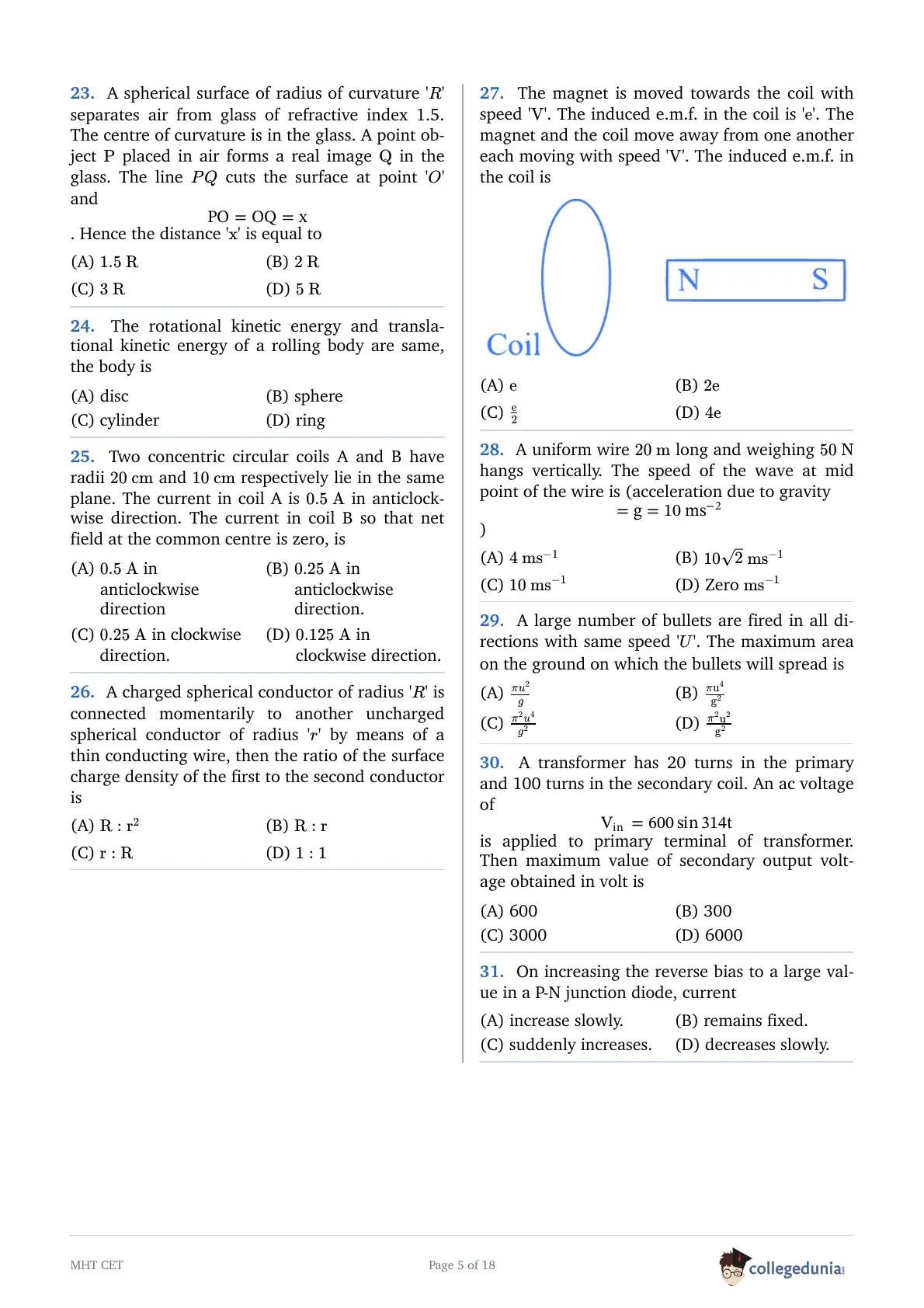
The magnet is moved towards the coil with speed '\[\mathrm{V}\]'. The induced e.m.f. in the coil is '\[\mathrm{e}\]'. The magnet and the coil move away from one another each moving with speed '\[\mathrm{V}\]'. The induced e.m.f. in the coil is

  • (A) \(\mathrm{e}\)
  • (B) \(2\mathrm{e}\)
  • (C) \(\frac{\mathrm{e}}{2}\)
  • (D) \(4\mathrm{e}\)

Question 28:

A uniform wire \[20 \mathrm{~m}\] long and weighing \[50 \mathrm{~N}\] hangs vertically. The speed of the wave at mid point of the wire is (acceleration due to gravity \[=\mathrm{g}=10 \mathrm{~ms}^{-2}\] )

  • (A) \(4\text{ }\mathrm{ms}^{-1}\)
  • (B) \(10\sqrt{2}\text{ }\mathrm{ms}^{-1}\)
  • (C) \(10\text{ }\mathrm{ms}^{-1}\)
  • (D) Zero \(\mathrm{ms}^{-1}\)

Question 29:

A large number of bullets are fired in all directions with same speed '\[U\]'. The maximum area on the ground on which the bullets will spread is

  • (A) \(\frac{\pi u^{2}}{g}\)
  • (B) \(\frac{\pi \mathrm{u}^{4}}{\text{ }\mathrm{g}^{2}}\)
  • (C) \(\frac{\pi ^{2}u^{4}}{g^{2}}\)
  • (D) \(\frac{\pi ^{2}\mathrm{u}^{2}}{\text{ }\mathrm{g}^{2}}\)

Question 30:

A transformer has 20 turns in the primary and 100 turns in the secondary coil. An ac voltage of \[\mathrm{V}_{\text {in }}=600 \sin 314 \mathrm{t}\] is applied to primary terminal of transformer. Then maximum value of secondary output voltage obtained in volt is

  • (A) 600
  • (B) 300
  • (C) 3000
  • (D) 6000

Question 31:

On increasing the reverse bias to a large value in a P-N junction diode, current

  • (A) increase slowly.
  • (B) remains fixed.
  • (C) suddenly increases.
  • (D) decreases slowly.

Question 32:

For an ideal gas the density of the gas is \[\rho_0\] when temperature and pressure of the gas are \[T_0\] and \[P_0\] respectively. When the temperature of the gas is \[2 \mathrm{~T}_0\], its pressure will be \[3 \mathrm{P}_0\]. The new density will be

  • (A) \(\frac{3}{2}\rho _{0}\)
  • (B) \(\frac{4}{3}\rho _{0}\)
  • (C) \(\frac{3}{4}\rho _{0}\)
  • (D) \(\frac{2}{3}\rho _{0}\)

Question 33:

The temperature gradient in a rod of length \[75 \mathrm{~cm}\] is \[40^{\circ} \mathrm{C} / \mathrm{m}\]. If the temperature of cooler end of the rod is \[10^{\circ} \mathrm{C}\], then the temperature of hotter end is

  • (A) \(50^{\circ}\mathrm{C}\)
  • (B) \(40^{\circ}\mathrm{C}\)
  • (C) \(35^{\circ}\mathrm{C}\)
  • (D) \(25^{\circ}\mathrm{C}\)

Question 34:

In an oscillating LC circuit, the maximum charge on the capacitor is '\[Q\]'. When the energy is stored equally between the electric and magnetic fields, the charge on the capacitor becomes

  • (A) \(\frac{\mathrm{Q}}{4}\)
  • (B) \(\frac{\mathrm{Q}}{2}\)
  • (C) \(\frac{\mathrm{Q}}{\sqrt{2}}\)
  • (D) \(\frac{\mathrm{Q}}{\sqrt{3}}\)

Question 35:

A body of mass '\[\mathrm{m}\]' is raised through a height above the earth's surface so that the increase in potential energy is \[\frac{\mathrm{mgR}}{5}\]. The height to which the body is raised is ( \[\mathrm{R}=\] radius of earth, \[\mathrm{g}=\] acceleration due to gravity)

  • (A) \(\mathrm{R}\)
  • (B) \(\frac{\mathrm{R}}{2}\)
  • (C) \(\frac{\mathrm{R}}{4}\)
  • (D) \(\frac{\mathrm{R}}{8}\)

Question 36:

With increase in frequency of a.c. supply, the impedance of an L-C-R series circuit

  • (A) remains constant.
  • (B) increases.
  • (C) decreases.
  • (D) decreases at first, becomes minimum and then increases.

Question 37:

A passenger is sitting in a train which is moving fast. The engine of the train blows a whistle of frequency '\[n\]'. If the apparent frequency of sound heard by the passenger is '\[f\]' then

  • (A) \(\mathrm{f}=\mathrm{n}\)
  • (B) \(\mathrm{f}>\mathrm{n}\)
  • (C) \(\mathrm{f}<\mathrm{n}\)
  • (D) \(\mathrm{f}\leq \mathrm{n}\)

Question 39:

In an a.c. circuit the instantaneous current and emf are represented as \[\mathrm{I}=\mathrm{I}_0, \sin [\omega \mathrm{t}-\pi / 6]\] and \[\mathrm{E}=\mathrm{E}_0 \sin [\omega \mathrm{t}+\pi / 3]\] respectively. The voltage leads the current by

  • (A) \(\frac{\pi}{2}\)
  • (B) \(\frac{\pi}{4}\)
  • (C) \(\frac{\pi}{3}\)
  • (D) \(\frac{\pi}{6}\)

Question 40:

In a biprism experiment, monochromatic light of wavelength '\[\lambda\]' is used. The distance between two coherent sources '\[\mathrm{d}\]' is kept constant. If the distance between slit and eyepiece '\[\mathrm{D}\]' is varied as \[D_1, D_2, D_3 \& D_4\] and corresponding measured fringe widths are \[Z_1, Z_2, Z_3\] and \[Z_4\] then

  • (A) \(\mathrm{Z}_{1}\mathrm{D}_{1}=\mathrm{Z}_{2}\mathrm{D}_{2}=\mathrm{Z}_{3}\mathrm{D}_{3}=\mathrm{Z}_{4}\mathrm{D}_{4}\)
  • (B) \(\frac{Z_{1}}{D_{1}}=\frac{Z_{2}}{D_{2}}=\frac{Z_{3}}{D_{3}}=\frac{Z_{4}}{D_{4}}\)
  • (C) \(\mathrm{D}_{1}\sqrt{\mathrm{Z}_{1}}=\mathrm{D}_{2}\sqrt{\mathrm{Z}_{2}}=\mathrm{D}_{3}\sqrt{\mathrm{Z}_{3}}=\mathrm{D}_{4}\sqrt{\mathrm{Z}_{4}}\)
  • (D) \(Z_{1}\sqrt{D_{1}}=Z_{2}\sqrt{D_{2}}=Z_{3}\sqrt{D_{3}}=Z_{4}\sqrt{D_{4}}\)

Question 41:

Three charges each of value \[+q\] are placed at the corners of an isosceles triangle \[\mathrm{ABC}\] of sides \[\mathrm{AB}\] and \[\mathrm{AC}\] each equal to \[2 \mathrm{a}\]. The mid points of \[A B\] and \[A C\] are \[D\] and \[E\] respectively. The work done in taking a charge \[Q\] from \[D\] to \[E\] is ( \[\varepsilon_0=\] permittivity of free space)

  • (A) Zero
  • (B) \(\frac{3q\mathrm{Q}}{4\pi \epsilon _{0}\mathrm{a}}\)
  • (C) \(\frac{\mathrm{qQ}}{8\pi \epsilon _{0}\mathrm{a}}\)
  • (D) \(\frac{3\mathrm{qQ}}{8\pi \epsilon _{0}\mathrm{a}}\)

Question 42:

Light of frequency 1.5 times the threshold frequency is incident on photosensitive material. If the frequency is halved and intensity is doubled, the photocurrent becomes

  • (A) quadrupled
  • (B) double
  • (C) half
  • (D) zero

Question 43:

A solid cylinder of mass \[3 \mathrm{~kg}\] is rolling on a horizontal surface with velocity \[4 \mathrm{~m} / \mathrm{s}\]. It collides with a horizontal spring whose one end is fixed to rigid support. The force constant of material of spring is \[200 \mathrm{~N} / \mathrm{m}\]. The maximum compression produced in the spring will be (assume collision between cylinder & spring be elastic)

  • (A) 0.7 m
  • (B) 0.2 m
  • (C) 0.5 m
  • (D) 0.6 m

Question 44:

Which one of the following statements is Wrong?

  • (A) A body can have zero velocity and still be accelerated.
  • (B) A body can have a constant velocity and still have a varying speed.
  • (C) A body can have a constant speed and still have a varying velocity.
  • (D) The direction of the velocity of a body can change when its acceleration is constant.

Question 45:

The fundamental frequency of a sonometer wir carrying a block of mass '\[M\]' and density '\[\rho\]' is '\[n\]' Hz. When the block is completely immerse in a liquid of density '\[\sigma\]' then the new frequency will be

  • (A) \(\mathrm{n}[\frac{\rho -\sigma}{\rho}]^{\frac{1}{2}}\)
  • (B) \(\mathrm{n}[\frac{\rho -\sigma}{\sigma}]^{\frac{1}{2}}\)
  • (C) \(\mathrm{n}[\frac{\rho}{\rho -\sigma}]^{\frac{1}{2}}\)
  • (D) \(n[\frac{\sigma}{\rho -\sigma}]^{\frac{1}{2}}\)

Question 46:

A simple pendulum has a time period '\[T\]' in air. Its time period when it is completely immersed in a liquid of density one eighth the density of the material of bob is

  • (A) \((\sqrt{\frac{7}{8}})\mathrm{T}\)
  • (B) \((\sqrt{\frac{5}{8}})\mathrm{T}\)
  • (C) \((\sqrt{\frac{3}{8}})\mathrm{T}\)
  • (D) \((\sqrt{\frac{8}{7}})\mathrm{T}\)

Question 47:

Array of light is incident at an angle of incidence '\[i\]' on one surface of a prism of small angle \[\mathrm{A}\] and emerges normally from the other surface. If the refractive index of the material of the prism is '\[\mu\]', then the angle of incidence is equal to

  • (A) \(\frac{\mathrm{A}}{2\mu}\)
  • (B) \(\frac{\mathrm{A}\mu}{2}\)
  • (C) \(\mathrm{A}\mu\)
  • (D) \(\frac{\mathrm{A}}{\mu}\)

Question 48:

An isotope of the original nucleus can be formed in a radioactive decay, with the emission of following particles.

  • (A) one \(\alpha\) and one \(\beta\)
  • (B) one \(\alpha\) and two \(\beta\)
  • (C) one \(\alpha\) and four \(\beta\)
  • (D) four \(\alpha\) and one \(\beta\)

Question 49:

If two identical spherical bodies of same material and dimensions are kept in contact, the gravitational force between them is proportional to \[\mathrm{R}^{\mathrm{X}}\], where \[\mathrm{x}\] is non zero integer [Given : \[\mathrm{R}\] is radius of each spherical body]

  • (A) \(-\)4
  • (B) 4
  • (C) 2
  • (D) \(-\)2

Question 50:

\[\mathrm{A}\] and \[\mathrm{B}\] are two interfering sources where \[\mathrm{A}\] is ahead in phase by \[54^{\circ}\] relative to B. The observation is taken from point \[\mathrm{P}\] such that PB \[-\] PA = 2.5 \[\lambda\]. Then the phase difference between the waves from A and B reaching point P is (in rad)

  • (A) \(3.5\pi\)
  • (B) \(5.3\pi\)
  • (C) \(4.3\pi\)
  • (D) \(5.8\pi\)

Chemistry (Q51 - Q100)

Question 51:

Identify cationic sphere complex from following.

  • (A) Tetraaminecopper(II) ion
  • (B) Tetracyanonickelate(II) ion
  • (C) Trioxalatocobaltate(III) ion
  • (D) Triamminetrinitrocobalt(III)

Question 52:

Identify substrate '\[\mathrm{A}\]' in the following conversion.

\[\mathrm{A}+\underset{\text { (excess) }}{\mathrm{CH}_3 \mathrm{I}} \stackrel{\Delta}{\longrightarrow} {\mathrm{C}_2 \mathrm{H}_5}\left(\mathrm{CH}_3\right)_3 \stackrel{+}{\mathrm{N}} \mathrm{I}^{-}\]

  • (A) \(\mathrm{C}_{2}\mathrm{H}_{5}\mathrm{NO}_{2}\)
  • (B) \(\mathrm{C}_{2}\mathrm{H}_{5}\mathrm{CN}\)
  • (C) \(\mathrm{C}_{2}\mathrm{H}_{5}\mathrm{NH}_{2}\)
  • (D) \(\mathrm{CH}_{3}\mathrm{CONH}_{2}\)

Question 53:

Identify FALSE statement regarding adsorption from following.

  • (A) It takes place due to unbalanced forces acting on the surface of solid or liquid.
  • (B) During adsorption surface energy of adsorbent increases.
  • (C) It is caused by van der Waals forces.
  • (D) It is an exothermic process.

Question 54:

Find the rate of formation of \[\mathrm{NO}_{2(\mathrm{~g})}\] in the following reaction.

\[\begin{aligned} & 2 \mathrm{~N}_2 \mathrm{O}_{5(\mathrm{~g})} \rightarrow 4 \mathrm{NO}_{2(\mathrm{~g})}+\mathrm{O}_{2(\mathrm{~g})} \\ & {\left[\frac{-\mathrm{d}\left[\mathrm{N}_2 \mathrm{O}_5\right]}{\mathrm{dt}}=0.02 \mathrm{~mol} \mathrm{~dm}^{-3}\right]} \end{aligned}\]

  • (A) \(0.01\text{ }\mathrm{mol}\text{ }\mathrm{dm}^{-3}\)
  • (B) \(0.02\text{ }\mathrm{mol}\text{ }\mathrm{dm}^{-3}\)
  • (C) \(0.03\text{ }\mathrm{mol}\text{ }\mathrm{dm}^{-3}\)
  • (D) \(0.04\text{ }\mathrm{mol}\text{ }\mathrm{dm}^{-3}\)

Question 55:

Which from following properties is exhibited by group 2 elements?

  • (A) Act as inert elements in +1 state.
  • (B) Form \(\mathrm{MH}_{2}\) type hydrides with hydrogen on heating.
  • (C) Elements at the top in the group catch fire when kept on water.
  • (D) Reducing power of these elements is more than group I elements.

Question 56:

Calculate the rate constant of the first order reaction if \[20 \%\] of the reactant decomposes in 15 minutes.

  • (A) \(1.488\times 10^{-2}\) minute \({}^{-1}\)
  • (B) \(1.881\times 10^{-2}\) minute \({}^{-1}\)
  • (C) \(1.984\times 10^{-2}\) minute \({}^{-1}\)
  • (D) \(1.18\times 10^{-2}\) minute \({}^{-1}\)

Question 57:

Which from following methods of structural formula representation uses conventionally a point for front carbon and a circle around it for rear carbon?

  • (A) Andiron formula
  • (B) Condensed formula
  • (C) Newman projection formula
  • (D) Fisher projection formula

Question 58:

Identify substrate '\[\mathrm{A}\]' in the following sequence of reactions.

A \[\mathrm{\mathrel{\mathop{\kern0pt\longrightarrow} \limits_\Delta ^{SOC{l_2}}}}\] B \[\mathrm{\mathrel{\mathop{\kern0pt\longrightarrow} \limits_{{C_2}{H_5}Cl}^{Na/ether}}}\] 2-Methylbutane

  • (A) Propan-1-ol
  • (B) Propan-2-ol
  • (C) 2-Chloropropane
  • (D) Butan-2-ol

Question 59:

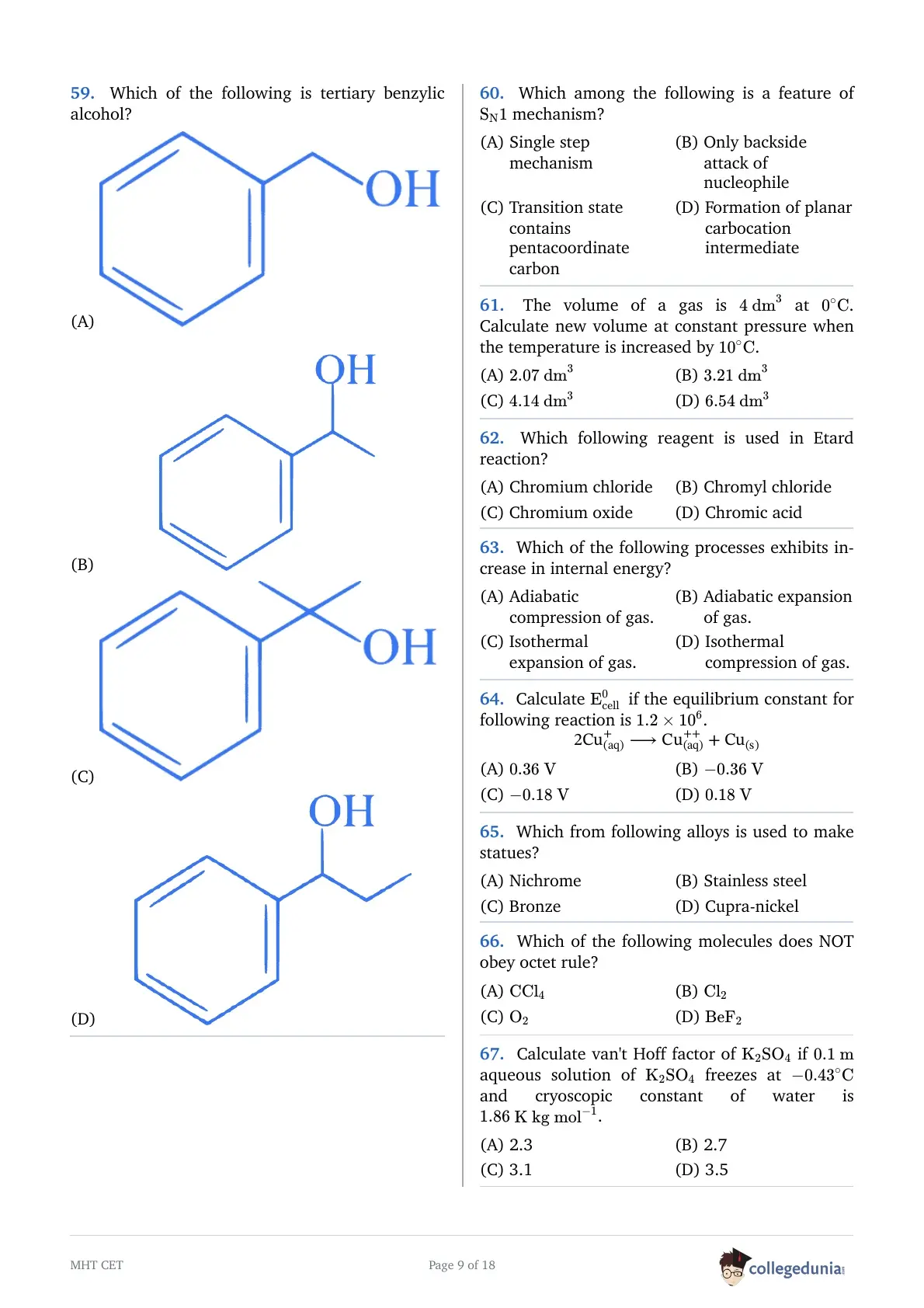
Which of the following is tertiary benzylic alcohol?

  • (A)
  • (B)
  • (C)
  • (D)

Question 60:

Which among the following is a feature of \[\mathrm{S}_{\mathrm{N}} 1\] mechanism?

  • (A) Single step mechanism
  • (B) Only backside attack of nucleophile
  • (C) Transition state contains pentacoordinate carbon
  • (D) Formation of planar carbocation intermediate

Question 61:

The volume of a gas is \[4 \mathrm{~dm}^3\] at \[0^{\circ} \mathrm{C}\]. Calculate new volume at constant pressure when the temperature is increased by \[10^{\circ} \mathrm{C}\].

  • (A) \(2.07\text{ }\mathrm{dm}^{3}\)
  • (B) \(3.21\text{ }\mathrm{dm}^{3}\)
  • (C) \(4.14\text{ }\mathrm{dm}^{3}\)
  • (D) \(6.54\text{ }\mathrm{dm}^{3}\)

Question 62:

Which following reagent is used in Etard reaction?

  • (A) Chromium chloride
  • (B) Chromyl chloride
  • (C) Chromium oxide
  • (D) Chromic acid

Question 63:

Which of the following processes exhibits increase in internal energy?

  • (A) Adiabatic compression of gas.
  • (B) Adiabatic expansion of gas.
  • (C) Isothermal expansion of gas.
  • (D) Isothermal compression of gas.

Question 64:

Calculate \[\mathrm{E}_{\text {cell }}^0\] if the equilibrium constant for following reaction is \[1.2 \times 10^6\].

\[2 \mathrm{Cu}_{(\mathrm{aq})}^{+} \longrightarrow \mathrm{Cu}_{(\mathrm{aq})}^{++}+\mathrm{Cu}_{(\mathrm{s})}\]

  • (A) \(0.36\text{ }\mathrm{V}\)
  • (B) \(-0.36\text{ }\mathrm{V}\)
  • (C) \(-0.18\text{ }\mathrm{V}\)
  • (D) \(0.18\text{ }\mathrm{V}\)

Question 65:

Which from following alloys is used to make statues?

  • (A) Nichrome
  • (B) Stainless steel
  • (C) Bronze
  • (D) Cupra-nickel

Question 66:

Which of the following molecules does NOT obey octet rule?

  • (A) \(\mathrm{CCl}_{4}\)
  • (B) \(\mathrm{Cl}_{2}\)
  • (C) \(\mathrm{O}_{2}\)
  • (D) \(\mathrm{BeF}_{2}\)

Question 67:

Calculate van't Hoff factor of \[\mathrm{K}_2 \mathrm{SO}_4\] if \[0.1 \mathrm{~m}\] aqueous solution of \[\mathrm{K}_2 \mathrm{SO}_4\] freezes at \[-0.43{ }^{\circ} \mathrm{C}\] and cryoscopic constant of water is \[1.86 \mathrm{~K} \mathrm{~kg} \mathrm{~mol}^{-1}\].

  • (A) 2.3
  • (B) 2.7
  • (C) 3.1
  • (D) 3.5

Question 68:

Find the radius of fourth orbit of hydrogen atom if its radius of first orbit is \[\mathrm{R}\] pm.

  • (A) R pm
  • (B) 4 R pm
  • (C) 9 R pm
  • (D) 16 R pm

Question 69:

Which noble gas element from following exhibits highest number of different oxidation states?

  • (A) Xe
  • (B) Kr
  • (C) Ar
  • (D) Ne

Question 70:

Which among the following is a pair of monocarboxylic acids?

  • (A) Malonic acid and propionic acid
  • (B) Valeric acid and succinic acid
  • (C) Acetic acid and adipic acid
  • (D) Butyric acid and caproic acid

Question 71:

Identify the overall oxidation reaction that occurs in lead storage cell during discharge.

  • (A) \(\mathrm{Pb}_{\text{(aq) }}^{++}+\mathrm{SO}_{4(\text{ aq) }}^{--}\longrightarrow \mathrm{PbSO}_{4(\mathrm{s})}\)
  • (B) \(\mathrm{PbSO}_{4(\text{ }\mathrm{s})}+2\mathrm{H}_{2}\mathrm{O}_{(f)}\longrightarrow \mathrm{PbO}_{2(\text{ }\mathrm{B})}+4\mathrm{H}_{(\mathrm{aq})}^{+}+\mathrm{SO}_{4(\mathrm{aq})}^{--}+2\mathrm{e}^{-}\)
  • (C) \(\mathrm{Pb}_{(\mathrm{s})}+\mathrm{SO}_{4(\text{ aq })}^{--}\longrightarrow \mathrm{PbSO}_{4(\mathrm{s})}+2\mathrm{e}^{-}\)
  • (D) \(\mathrm{PbSO}_{4(\text{ }\mathrm{s})}+2\mathrm{e}^{-}\longrightarrow \mathrm{Pb}_{(\mathrm{s})}+\mathrm{SO}_{4(\mathrm{aq})}^{--}\)

Question 72:

What is the change in oxidation number of selenium in the following redox reaction?

\[\mathrm{SeO}_{3(\text { (a) })}^{2-}+\mathrm{Cl}_{2(\mathrm{~g})}+2 \mathrm{OH}^{-} \longrightarrow \mathrm{SeO}_{4(\text { (a) })}^{2-}+2 \mathrm{Cl}_{(\text {(a) })}^{-}+\mathrm{H}_2 \mathrm{O}\]

  • (A) +2 to \(-\)2
  • (B) \(-\)2 to +2
  • (C) +4 to +6
  • (D) +3 to +4

Question 73:

A buffer solution is prepared by mixing equimolar acetic acid and sodium acetate. If '\[\mathrm{K}_d\]' of acetic acid is \[1.78 \times 10^{-5}\], find the \[\mathrm{pH}\] of buffer solution.

  • (A) 4.75
  • (B) 8.9
  • (C) 9.4
  • (D) 2.6

Question 74:

What is the number of moles of nascent hydrogen required to prepare 1 mole of methane from iodomethane?

  • (A) 4
  • (B) 3
  • (C) 2
  • (D) 1

Question 75:

Which from following metal has hcp crystal structure?

  • (A) Cu
  • (B) Zn
  • (C) Ag
  • (D) Po

Question 77:

Which of the following temperature values in Fahrenheit \[\left({ }^{\circ} \mathrm{F}\right)\] is equal to \[50^{\circ} \mathrm{C}\] ?

  • (A) \(90^{\circ}\mathrm{F}\)
  • (B) \(100^{\circ}\mathrm{F}\)
  • (C) \(110^{\circ}\mathrm{F}\)
  • (D) \(122{}^{\circ}\mathrm{F}\)

Question 78:

Which from following formulae is of trioxalatocobaltate(III) ion?

  • (A) \([\mathrm{Co}_{3}(\mathrm{C}_{2}\mathrm{O}_{4})]^{3-}\)
  • (B) \([\mathrm{Co}(\mathrm{C}_{2}\mathrm{O}_{4})_{3}]^{3+}\)
  • (C) \([\mathrm{Co}_{3}(\mathrm{C}_{2}\mathrm{O}_{4})]^{3+}\)
  • (D) \([\mathrm{Co}(\mathrm{C}_{2}\mathrm{O}_{4})_{3}]^{3-}\)

Question 79:

Which of the following pair of nuclides is an example of isotones?

  • (A) \(_{17}^{35}\mathrm{Cl},_{17}^{37}\mathrm{Cl}\)
  • (B) \(_{18}^{40}\mathrm{Ar},_{19}^{40}\text{ }\mathrm{K}\)
  • (C) \(_{6}^{13}\mathrm{C},_{5}^{11}\text{ }\mathrm{B}\)
  • (D) \(_{6}^{12}\mathrm{C},_{5}^{11}\text{ }\mathrm{B}\)

Question 80:

Identify FALSE statement from following.

  • (A) Boiling point of sulfur is lower than oxygen.
  • (B) Ionization enthalpy of group 16 elements gradually decreases from top to bottom.
  • (C) Group 16 elements have lower ionization enthalpy than group 15 elements in corresponding periods.
  • (D) Oxygen has highest electronegativity next to fluorine amongst all the elements.

Question 81:

What is IUPAC name of crotonyl alcohol?

  • (A) But-3-en-1-ol
  • (B) But-2-en-1-ol
  • (C) But-1-en-2-ol
  • (D) But-1-en-3-ol

Question 82:

A solution of \[5.6 \mathrm{~g}\] non-volatile solute in \[50 \mathrm{~g}\] solvent has elevation in boiling point \[1.75 \mathrm{~K}\]. What is the molar mass of solute \[\left(\mathrm{K}_{\mathrm{b}}=3 \mathrm{~K} \mathrm{~kg} \mathrm{~mol}^{-1}\right)\] ?

  • (A) \(192\text{ }\mathrm{g}\text{ }\mathrm{mol}^{-1}\)
  • (B) \(200\text{ }\mathrm{g}\text{ }\mathrm{mol}^{-1}\)
  • (C) \(184\text{ }\mathrm{g}\text{ }\mathrm{mol}^{-1}\)
  • (D) \(176\text{ }\mathrm{g}\text{ }\mathrm{mol}^{-1}\)

Question 83:

What is the common name of benzene-1,3-diol?

  • (A) Catechol
  • (B) Resorcinol
  • (C) Quinol
  • (D) Pyrogallol

Question 84:

Identify the CORRECT decreasing order of basic strength of compounds from following.

  • (A) \(\mathrm{CH}_{3}\mathrm{NH}_{2}>(\mathrm{CH}_{3})_{2}\mathrm{NH}>\mathrm{C}_{6}\mathrm{H}_{5}\mathrm{NH}_{2}>\mathrm{NH}_{3}\)
  • (B) \((\mathrm{CH}_{3})_{2}\mathrm{NH}>\mathrm{CH}_{3}\mathrm{NH}_{2}>\mathrm{NH}_{3}>\mathrm{C}_{6}\mathrm{H}_{5}\mathrm{NH}_{2}\)
  • (C) \(\mathrm{NH}_{3}>\mathrm{CH}_{3}\mathrm{NH}_{2}>(\mathrm{CH}_{3})_{2}\mathrm{NH}>\mathrm{C}_{6}\mathrm{H}_{5}\mathrm{NH}_{2}\)
  • (D) \(\mathrm{C}_{6}\mathrm{H}_{5}\mathrm{NH}_{2}>(\mathrm{CH}_{3})_{2}\mathrm{NH}>\mathrm{CH}_{3}\mathrm{NH}_{2}>\mathrm{NH}_{3}\)

Question 85:

Calculate the work done in the following reaction at \[300 \mathrm{~K}\] and at constant pressure.

\[\left(\mathrm{R}=8.314 \mathrm{~J} \mathrm{~K}^{-1} \mathrm{~mol}^{-1}\right)\]

\[4 \mathrm{HCl}_{(\mathrm{g})}+\mathrm{O}_{2(\mathrm{~g})} \rightarrow 2 \mathrm{Cl}_{2(\mathrm{~g})}+2 \mathrm{H}_2 \mathrm{O}_{(\mathrm{g})}\]

  • (A) \(-7482\text{ }\mathrm{J}\)
  • (B) \(-4988\text{ }\mathrm{J}\)
  • (C) \(2494\text{ }\mathrm{J}\)
  • (D) \(3200\text{ }\mathrm{J}\)

Question 86:

The solubility product of \[\mathrm{Mg}(\mathrm{OH})_2\] is \[1.8 \times 10^{-11}\] at \[298 \mathrm{~K}\]. What is its solubility in \[\mathrm{mol} \mathrm{~dm}^{-3}\] ?

  • (A) \(1.650\times 10^{-4}\)
  • (B) \(2.120\times 10^{-4}\)
  • (C) \(3.184\times 10^{-4}\)
  • (D) \(4.550\times 10^{-4}\)

Question 87:

If \[\mathrm{K}_{\mathrm{sp}}\] is solubility product of \[\mathrm{Al}(\mathrm{OH})_3\], its solubility is expressed by formula,

  • (A) \(\sqrt[\frac{4}{\text{ }\mathrm{K}_{\mathrm{sp}}}]{3}\)
  • (B) \(\sqrt[\frac{K_{sp}}{4}]{3}\)
  • (C) \(\sqrt[\frac{K_{sp}}{27}]{4}\)
  • (D) \(\sqrt[\mathrm{K}_{\mathrm{sp}}\times 27]{4}\)

Question 88:

Which from following is the slope of the graph of \[[\mathrm{A}]_{\mathrm{t}}\] versus time for zero order reaction?

  • (A) \(-\mathrm{k}\)
  • (B) \(\mathrm{k}\)
  • (C) \(\frac{\mathrm{k}}{2.303}\)
  • (D) \(\frac{-\mathrm{k}}{2.303}\)

Question 89:

Which from following statements is NOT true about natural rubber?

  • (A) It is a linear polymer.
  • (B) In this polymer chain has coiled structure.
  • (C) In this polymer chains are held together by weak van der Waals forces.
  • (D) It is obtained from chloroprene.

Question 90:

What is the molal elevation constant if one gram mole of a nonvolatile solute is dissolved in \[1 \mathrm{~kg}\] of ethyl acetate? \[\left(\Delta \mathrm{T}_{\mathrm{b}}=x \mathrm{~K}\right)\]

  • (A) \(x\text{ }\mathrm{K}\text{ }\mathrm{kg}\text{ }\mathrm{mol}^{-1}\)
  • (B) \(\frac{x}{2}\text{ }\mathrm{K}\text{ }\mathrm{kg}\text{ }\mathrm{mol}^{-1}\)
  • (C) \(2x\text{ }\mathrm{K}\text{ }\mathrm{kg}\text{ }\mathrm{mol}^{-1}\)
  • (D) \(3x\text{ }\mathrm{K}\text{ }\mathrm{kg}\text{ }\mathrm{mol}^{-1}\)

Question 91:

Which from following elements exhibits ferromagnetic properties?

  • (A) Mn
  • (B) Co
  • (C) Zn
  • (D) Sc

Question 92:

Which of the following is NOT a globular protein?

  • (A) Insulin
  • (B) Egg albumin
  • (C) Serum albumin
  • (D) Keratin

Question 93:

Calculate the time required in second to deposit \[6.35 \mathrm{~g}\] copper from its salt solution by passing 5 ampere current. [Molar mass of \[\mathrm{Cu}=63.5 \mathrm{~g} \mathrm{~mol}^{-1}\] ]

  • (A) 3600
  • (B) 3700
  • (C) 3860
  • (D) 4000

Question 94:

Which from following nanomaterial has one dimension less than \[100 \mathrm{~nm}\] ?

  • (A) Fibres
  • (B) Nanoparticles
  • (C) Thin films
  • (D) Microcapsules

Question 95:

Which among the following compounds has highest boiling point?

  • (A) Propanone
  • (B) Ethanoic acid
  • (C) Propan-1-ol
  • (D) Propanal

Question 96:

Calculate the radius of metal atom in bcc unit cell having edge length \[287 \mathrm{~pm}\].

  • (A) \(124.27\text{ }\mathrm{pm}\)
  • (B) \(143.51\text{ }\mathrm{pm}\)
  • (C) \(101.45\text{ }\mathrm{pm}\)
  • (D) \(57.4\text{ }\mathrm{pm}\)

Question 97:

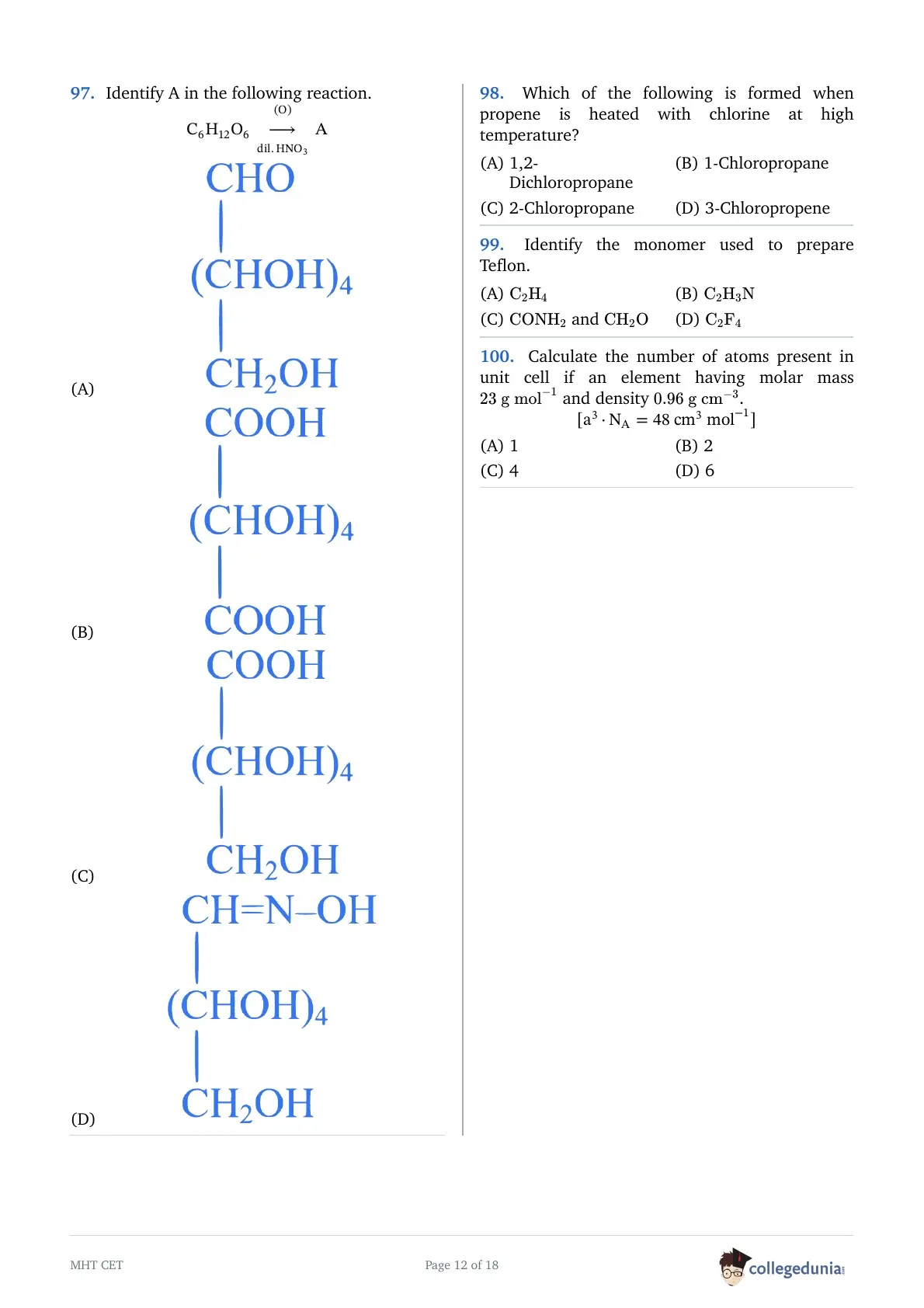
Identify A in the following reaction.

\[\mathrm{{C_6}{H_{12}}{O_6}\mathrel{\mathop{\kern0pt\longrightarrow} \limits_{dil.\,HN{O_3}}^{(O)}} A}\]

  • (A)
  • (B)
  • (C)
  • (D)

Question 98:

Which of the following is formed when propene is heated with chlorine at high temperature?

  • (A) 1,2-Dichloropropane
  • (B) 1-Chloropropane
  • (C) 2-Chloropropane
  • (D) 3-Chloropropene

Question 99:

Identify the monomer used to prepare Teflon.

  • (A) \(\mathrm{C}_{2}\mathrm{H}_{4}\)
  • (B) \(\mathrm{C}_{2}\mathrm{H}_{3}\mathrm{N}\)
  • (C) \(\mathrm{CONH}_{2}\) and \(\mathrm{CH}_{2}\mathrm{O}\)
  • (D) \(\mathrm{C}_{2}\mathrm{F}_{4}\)

Question 100:

Calculate the number of atoms present in unit cell if an element having molar mass \[23 \mathrm{~g} \mathrm{~mol}^{-1}\] and density \[0.96 \mathrm{~g} \mathrm{~cm}^{-3}\].

\[[\mathrm{a}^3 \cdot \mathrm{N}_{\mathrm{A}}=48 \mathrm{~cm}^3 \mathrm{~mol}^{-1}]\]

  • (A) 1
  • (B) 2
  • (C) 4
  • (D) 6

Mathematics (Q101 - Q150)

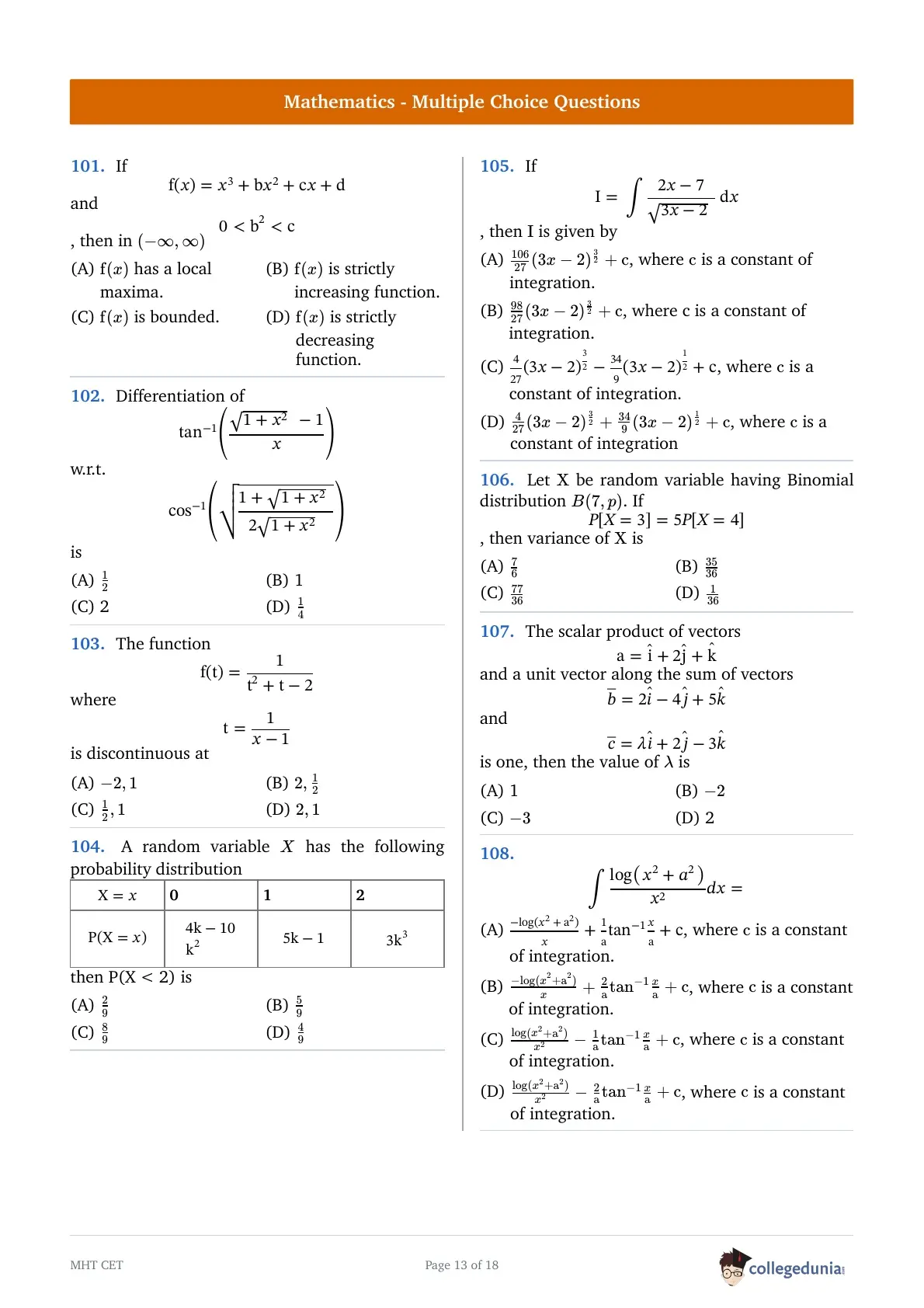
Question 101:

If \(\mathrm{f}(x)=x^3+\mathrm{b} x^2+\mathrm{c} x+\mathrm{d}\) and \(0<\mathrm{b}^2<\mathrm{c}\), then in \((-\infty, \infty)\)

  • (A) \(\mathrm{f}(x)\) has a local maxima.
  • (B) \(\mathrm{f}(x)\) is strictly increasing function.
  • (C) \(\mathrm{f}(x)\) is bounded.
  • (D) \(\mathrm{f}(x)\) is strictly decreasing function.

Question 102:

Differentiation of \[\tan ^{-1}\left(\frac{\sqrt{1+x^2}-1}{x}\right)\] w.r.t. \[\cos ^{-1}\left(\sqrt{\frac{1+\sqrt{1+x^2}}{2 \sqrt{1+x^2}}}\right)\] is

  • (A) \(\frac{1}{2}\)
  • (B) 1
  • (C) 2
  • (D) \(\frac{1}{4}\)

Question 103:

The function \[\mathrm{f}(\mathrm{t})=\frac{1}{\mathrm{t}^2+\mathrm{t}-2}\] where \[\mathrm{t}=\frac{1}{x-1}\] is discontinuous at

  • (A) \(-2,1\)
  • (B) \(2,\frac{1}{2}\)
  • (C) \(\frac{1}{2},1\)
  • (D) \(2,1\)

Question 104:

A random variable \[X\] has the following probability distribution

\[\mathrm{X}=x\]012
\[\mathrm{P(X}=x)\]\[\mathrm{4k-10k^2}\]\[\mathrm{5k-1}\]\[\mathrm{3k^3}\]
  • (A) \(\frac{2}{9}\)
  • (B) \(\frac{5}{9}\)
  • (C) \(\frac{8}{9}\)
  • (D) \(\frac{4}{9}\)

Question 105:

If \[\mathrm{I}=\int \frac{2 x-7}{\sqrt{3 x-2}} \mathrm{~d} x\], then \[\mathrm{I}\] is given by

  • (A) \(\frac{106}{27}(3x-2)^{\frac{3}{2}}+\mathrm{c}\), where \(\mathrm{c}\) is a constant of integration.
  • (B) \(\frac{98}{27}(3x-2)^{\frac{3}{2}}+\mathrm{c}\), where c is a constant of integration.
  • (C) \(\frac{4}{27}(3x-2)^{\frac{3}{2}}-\frac{34}{9}(3x-2)^{\frac{1}{2}}+\mathrm{c}\), where \(\mathrm{c}\) is a constant of integration.
  • (D) \(\frac{4}{27}(3x-2)^{\frac{3}{2}}+\frac{34}{9}(3x-2)^{\frac{1}{2}}+\mathrm{c}\), where \(\mathrm{c}\) is a constant of integration

Question 106:

Let \[\mathrm{X}\] be random variable having Binomial distribution \[B(7, p)\]. If \[P[X=3]=5 P[X=4]\], then variance of \[\mathrm{X}\] is

  • (A) \(\frac{7}{6}\)
  • (B) \(\frac{35}{36}\)
  • (C) \(\frac{77}{36}\)
  • (D) \(\frac{1}{36}\)

Question 107:

The scalar product of vectors \[\overline{\mathrm{a}}=\hat{\mathrm{i}}+2 \hat{\mathrm{j}}+\hat{\mathrm{k}}\] and a unit vector along the sum of vectors \[\bar{b}=2 \hat{i}-4 \hat{j}+5 \hat{k}\] and \[\bar{c}=\lambda \hat{i}+2 \hat{j}-3 \hat{k}\] is one, then the value of \[\lambda\] is

  • (A) 1
  • (B) \(-2\)
  • (C) \(-3\)
  • (D) 2

Question 108:

\[\int \frac{\log \left(x^2+a^2\right)}{x^2} d x=\]

  • (A) \(\frac{-\mathrm{log}(x^{2}+\mathrm{a}^{2})}{x}+\frac{1}{\mathrm{a}}\mathrm{tan}^{-1}\frac{x}{\mathrm{a}}+\mathrm{c}\), where \(\mathrm{c}\) is a constant of integration.
  • (B) \(\frac{-\mathrm{log}(x^{2}+\mathrm{a}^{2})}{x}+\frac{2}{\mathrm{a}}\mathrm{tan}^{-1}\frac{x}{\mathrm{a}}+\mathrm{c}\), where \(\mathrm{c}\) is a constant of integration.
  • (C) \(\frac{\mathrm{log}(x^{2}+\mathrm{a}^{2})}{x^{2}}-\frac{1}{\mathrm{a}}\mathrm{tan}^{-1}\frac{x}{\mathrm{a}}+\mathrm{c}\), where \(\mathrm{c}\) is a constant of integration.
  • (D) \(\frac{\mathrm{log}(x^{2}+\mathrm{a}^{2})}{x^{2}}-\frac{2}{\mathrm{a}}\mathrm{tan}^{-1}\frac{x}{\mathrm{a}}+\mathrm{c}\), where \(\mathrm{c}\) is a constant of integration.

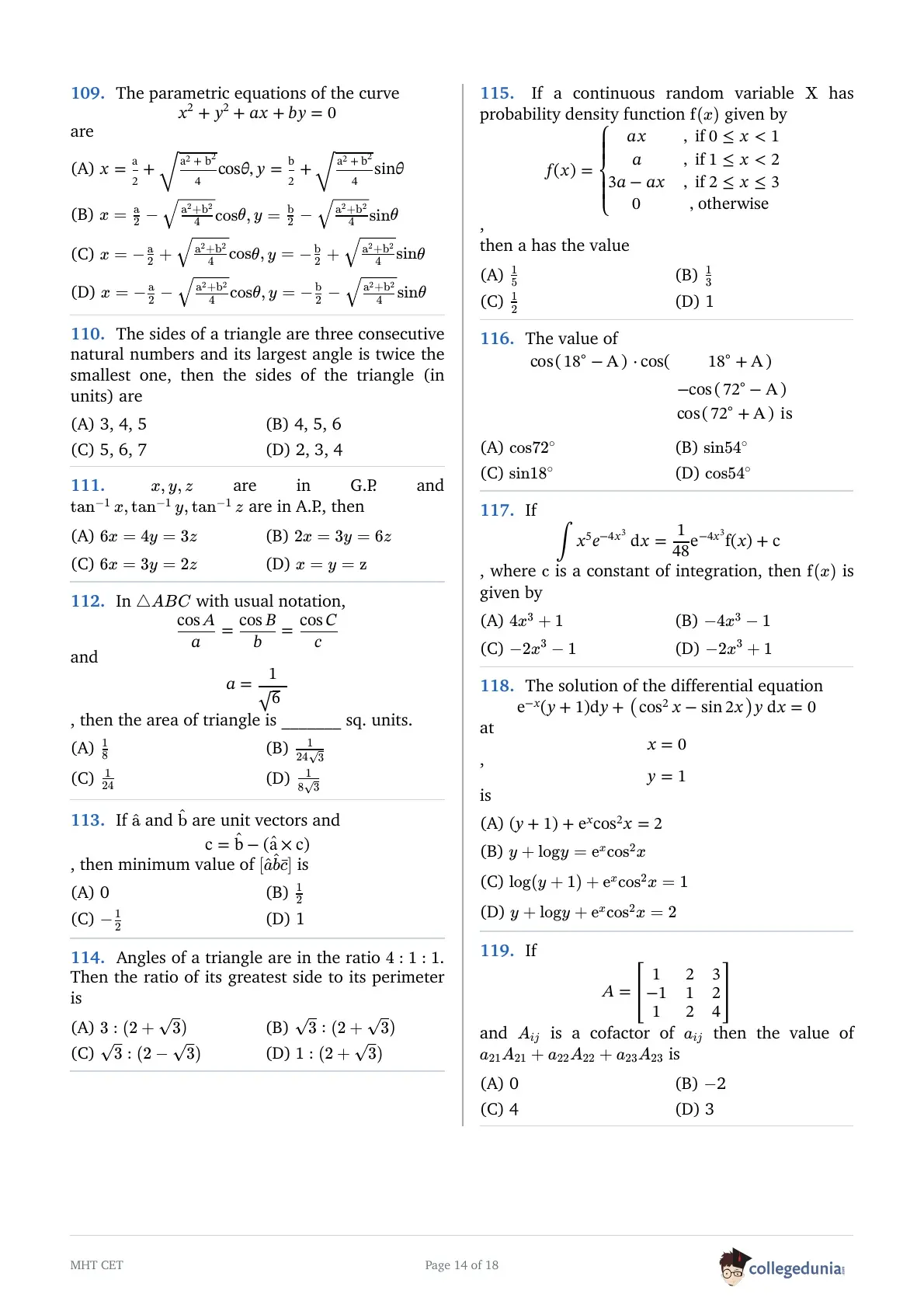
Question 109:

The parametric equations of the curve \[x^2+y^2+a x+b y=0\] are

  • (A) \(x=\frac{\mathrm{a}}{2}+\sqrt{\frac{\mathrm{a}^{2}+\mathrm{b}^{2}}{4}}\mathrm{cos}\theta ,y=\frac{\mathrm{b}}{2}+\sqrt{\frac{\mathrm{a}^{2}+\mathrm{b}^{2}}{4}}\mathrm{sin}\theta\)
  • (B) \(x=\frac{\mathrm{a}}{2}-\sqrt{\frac{\mathrm{a}^{2}+\mathrm{b}^{2}}{4}}\mathrm{cos}\theta ,y=\frac{\mathrm{b}}{2}-\sqrt{\frac{\mathrm{a}^{2}+\mathrm{b}^{2}}{4}}\mathrm{sin}\theta\)
  • (C) \(x=-\frac{\mathrm{a}}{2}+\sqrt{\frac{\mathrm{a}^{2}+\mathrm{b}^{2}}{4}}\mathrm{cos}\theta ,y=-\frac{\mathrm{b}}{2}+\sqrt{\frac{\mathrm{a}^{2}+\mathrm{b}^{2}}{4}}\mathrm{sin}\theta\)
  • (D) \(x=-\frac{\mathrm{a}}{2}-\sqrt{\frac{\mathrm{a}^{2}+\mathrm{b}^{2}}{4}}\mathrm{cos}\theta ,y=-\frac{\mathrm{b}}{2}-\sqrt{\frac{\mathrm{a}^{2}+\mathrm{b}^{2}}{4}}\mathrm{sin}\theta\)

Question 110:

The sides of a triangle are three consecutive natural numbers and its largest angle is twice the smallest one, then the sides of the triangle (in units) are

  • (A) 3, 4, 5
  • (B) 4, 5, 6
  • (C) 5, 6, 7
  • (D) 2, 3, 4

Question 111:

\[x, y, z\] are in G.P. and \[\tan ^{-1} x, \tan ^{-1} y, \tan ^{-1} z\] are in A.P., then

  • (A) \(6x=4y=3z\)
  • (B) \(2x=3y=6z\)
  • (C) \(6x=3y=2z\)
  • (D) \(x=y=\mathrm{z}\)

Question 112:

In \[\triangle A B C\] with usual notation, \[\frac{\cos A}{a}=\frac{\cos B}{b}=\frac{\cos C}{c}\] and \[a=\frac{1}{\sqrt{6}}\], then the area of triangle is _______ sq. units.

  • (A) \(\frac{1}{8}\)
  • (B) \(\frac{1}{24\sqrt{3}}\)
  • (C) \(\frac{1}{24}\)
  • (D) \(\frac{1}{8\sqrt{3}}\)

Question 114:

Angles of a triangle are in the ratio \[4: 1: 1\]. Then the ratio of its greatest side to its perimeter is

  • (A) \(3:(2+\sqrt{3})\)
  • (B) \(\sqrt{3}:(2+\sqrt{3})\)
  • (C) \(\sqrt{3}:(2-\sqrt{3})\)
  • (D) \(1:(2+\sqrt{3})\)

Question 115:

If a continuous random variable \(\mathrm{X}\) has probability density function \(\mathrm{f}(x)\) given by

\(f(x)=\left\{\begin{array}{cl} a x & , \text { if } 0 \leq x<1 \\ a & , \text { if } 1 \leq x<2 \\ 3 a-a x & , \text { if } 2 \leq x \leq 3 \\ 0 & , \text { otherwise } \end{array}\right.\),

then a has the value

  • (A) \(\frac{1}{5}\)
  • (B) \(\frac{1}{3}\)
  • (C) \(\frac{1}{2}\)
  • (D) 1

Question 116:

The value of \[\begin{aligned} \cos \left(18^{\circ}-\mathrm{A}\right) \cdot \cos ( & \left.18^{\circ}+\mathrm{A}\right) \\ & -\cos \left(72^{\circ}-\mathrm{A}\right) \cos \left(72^{\circ}+\mathrm{A}\right) \text { is }\end{aligned}\]

  • (A) \(\mathrm{cos}72^{\circ}\)
  • (B) \(\mathrm{sin}54^{\circ}\)
  • (C) \(\mathrm{sin}18^{\circ}\)
  • (D) \(\mathrm{cos}54^{\circ}\)

Question 117:

If \[\int x^5 e^{-4 x^3} \mathrm{~d} x=\frac{1}{48} \mathrm{e}^{-4 x^3} \mathrm{f}(x)+\mathrm{c}\], where \[\mathrm{c}\] is a constant of integration, then \[\mathrm{f}(x)\] is given by

  • (A) \(4x^{3}+1\)
  • (B) \(-4x^{3}-1\)
  • (C) \(-2x^{3}-1\)
  • (D) \(-2x^{3}+1\)

Question 118:

The solution of the differential equation \[\mathrm{e}^{-x}(y+1) \mathrm{d} y+\left(\cos ^2 x-\sin 2 x\right) y \mathrm{~d} x=0\] at \[x=0\], \[y=1\] is

  • (A) \((y+1)+\mathrm{e}^{x}\mathrm{cos}^{2}x=2\)
  • (B) \(y+\mathrm{log}y=\mathrm{e}^{x}\mathrm{cos}^{2}x\)
  • (C) \(\mathrm{log}(y+1)+\mathrm{e}^{x}\mathrm{cos}^{2}x=1\)
  • (D) \(y+\mathrm{log}y+\mathrm{e}^{x}\mathrm{cos}^{2}x=2\)

Question 119:

If \[A=\left[\begin{array}{ccc}1 & 2 & 3 \\ -1 & 1 & 2 \\ 1 & 2 & 4\end{array}\right]\] and \[A_{i j}\] is a cofactor of \[a_{i j}\] then the value of \[a_{21} A_{21}+a_{22} A_{22}+a_{23} A_{23}\] is

  • (A) 0
  • (B) \(-\)2
  • (C) 4
  • (D) 3

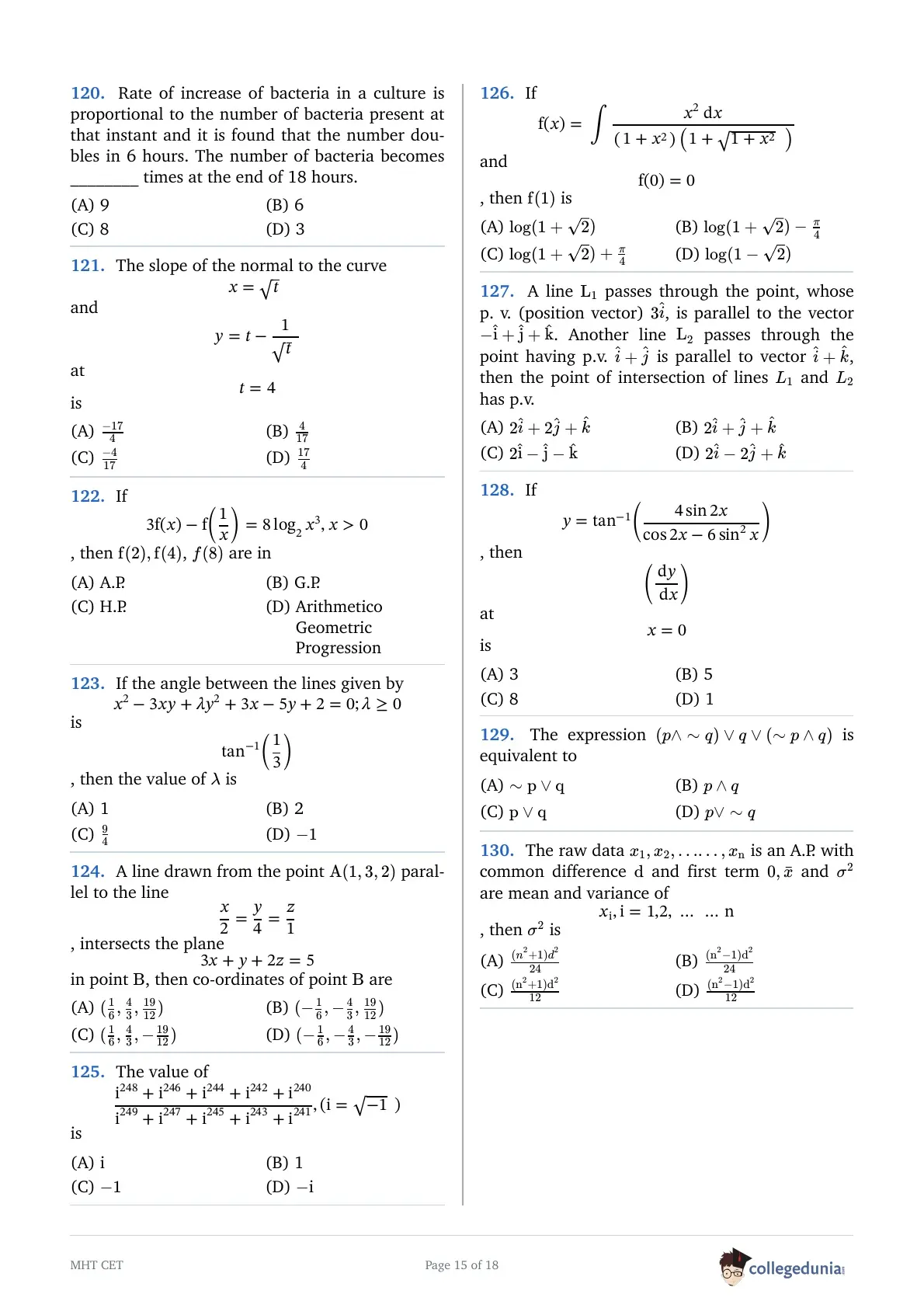
Question 120:

Rate of increase of bacteria in a culture is proportional to the number of bacteria present at that instant and it is found that the number doubles in 6 hours. The number of bacteria becomes ________ times at the end of 18 hours.

  • (A) 9
  • (B) 6
  • (C) 8
  • (D) 3

Question 121:

The slope of the normal to the curve \[x=\sqrt{t}\] and \[y=t-\frac{1}{\sqrt{t}}\] at \[t=4\] is

  • (A) \(\frac{-17}{4}\)
  • (B) \(\frac{4}{17}\)
  • (C) \(\frac{-4}{17}\)
  • (D) \(\frac{17}{4}\)

Question 122:

If \[3 \mathrm{f}(x)-\mathrm{f}\left(\frac{1}{x}\right)=8 \log _2 x^3, x>0\], then \[\mathrm{f}(2), \mathrm{f}(4)\], \[f(8)\] are in

  • (A) A.P.
  • (B) G.P.
  • (C) H.P.
  • (D) Arithmetico Geometric Progression

Question 123:

If the angle between the lines given by \[x^2-3 x y+\lambda y^2+3 x-5 y+2=0 ; \lambda \geq 0\] is \[\tan ^{-1}\left(\frac{1}{3}\right)\], then the value of \[\lambda\] is

  • (A) 1
  • (B) 2
  • (C) \(\frac{9}{4}\)
  • (D) \(-1\)

Question 124:

A line drawn from the point \[\mathrm{A}(1,3,2)\] parallel to the line \[\frac{x}{2}=\frac{y}{4}=\frac{z}{1}\], intersects the plane \[3 x+y+2 z=5\] in point \[\mathrm{B}\], then co-ordinates of point \[\mathrm{B}\] are

  • (A) \((\frac{1}{6},\frac{4}{3},\frac{19}{12})\)
  • (B) \((-\frac{1}{6},-\frac{4}{3},\frac{19}{12})\)
  • (C) \((\frac{1}{6},\frac{4}{3},-\frac{19}{12})\)
  • (D) \((-\frac{1}{6},-\frac{4}{3},-\frac{19}{12})\)

Question 125:

The value of \[\frac{\mathrm{i}^{248}+\mathrm{i}^{246}+\mathrm{i}^{244}+\mathrm{i}^{242}+\mathrm{i}^{240}}{\mathrm{i}^{249}+\mathrm{i}^{247}+\mathrm{i}^{245}+\mathrm{i}^{243}+\mathrm{i}^{241}}, (\mathrm{i}=\sqrt{-1})\] is

  • (A) i
  • (B) 1
  • (C) \(-1\)
  • (D) \(-\)i

Question 126:

If \[\mathrm{f}(x)=\int \frac{x^2 \mathrm{~d} x}{\left(1+x^2\right)\left(1+\sqrt{1+x^2}\right)}\] and \[\mathrm{f}(0)=0\], then \[\mathrm{f}(1)\] is

  • (A) \(\mathrm{log}(1+\sqrt{2})\)
  • (B) \(\mathrm{log}(1+\sqrt{2})-\frac{\pi}{4}\)
  • (C) \(\mathrm{log}(1+\sqrt{2})+\frac{\pi}{4}\)
  • (D) \(\mathrm{log}(1-\sqrt{2})\)

Question 127:

A line \[\mathrm{L}_1\] passes through the point, whose p. v. (position vector) \[3 \hat{i}\], is parallel to the vector \[-\hat{\mathrm{i}}+\hat{\mathrm{j}}+\hat{\mathrm{k}}\]. Another line \[\mathrm{L}_2\] passes through the point having p.v. \[\hat{i}+\hat{j}\] is parallel to vector \[\hat{i}+\hat{k}\], then the point of intersection of lines \[L_1\] and \[L_2\] has p.v.

  • (A) \(2\hat{i}+2\hat{j}+\hat{k}\)
  • (B) \(2\hat{i}+\hat{j}+\hat{k}\)
  • (C) \(2\hat{\mathrm{i}}-\hat{\mathrm{j}}-\hat{\mathrm{k}}\)
  • (D) \(2\hat{i}-2\hat{j}+\hat{k}\)

Question 128:

If \[y=\tan ^{-1}\left(\frac{4 \sin 2 x}{\cos 2 x-6 \sin ^2 x}\right)\], then \[\left(\frac{\mathrm{d} y}{\mathrm{~d} x}\right)\] at \[x=0\] is

  • (A) 3
  • (B) 5
  • (C) 8
  • (D) 1

Question 129:

The expression \[(p \wedge \sim q) \vee q \vee(\sim p \wedge q)\] is equivalent to

  • (A) \(\sim \mathrm{p}\vee \mathrm{q}\)
  • (B) \(p\wedge q\)
  • (C) \(\mathrm{p}\vee \mathrm{q}\)
  • (D) \(p\vee \sim q\)

Question 130:

The raw data \[x_1, x_2, \ldots \ldots, x_{\mathrm{n}}\] is an A.P. with common difference \[\mathrm{d}\] and first term \[0, \bar{x}\] and \[\sigma^2\] are mean and variance of \[x_{\mathrm{i}}, \mathrm{i}=1,2, \ldots \ldots \mathrm{n}\], then \[\sigma^2\] is

  • (A) \(\frac{(n^{2}+1)d^{2}}{24}\)
  • (B) \(\frac{(\mathrm{n}^{2}-1)\mathrm{d}^{2}}{24}\)
  • (C) \(\frac{(\mathrm{n}^{2}+1)\mathrm{d}^{2}}{12}\)
  • (D) \(\frac{(\mathrm{n}^{2}-1)\mathrm{d}^{2}}{12}\)

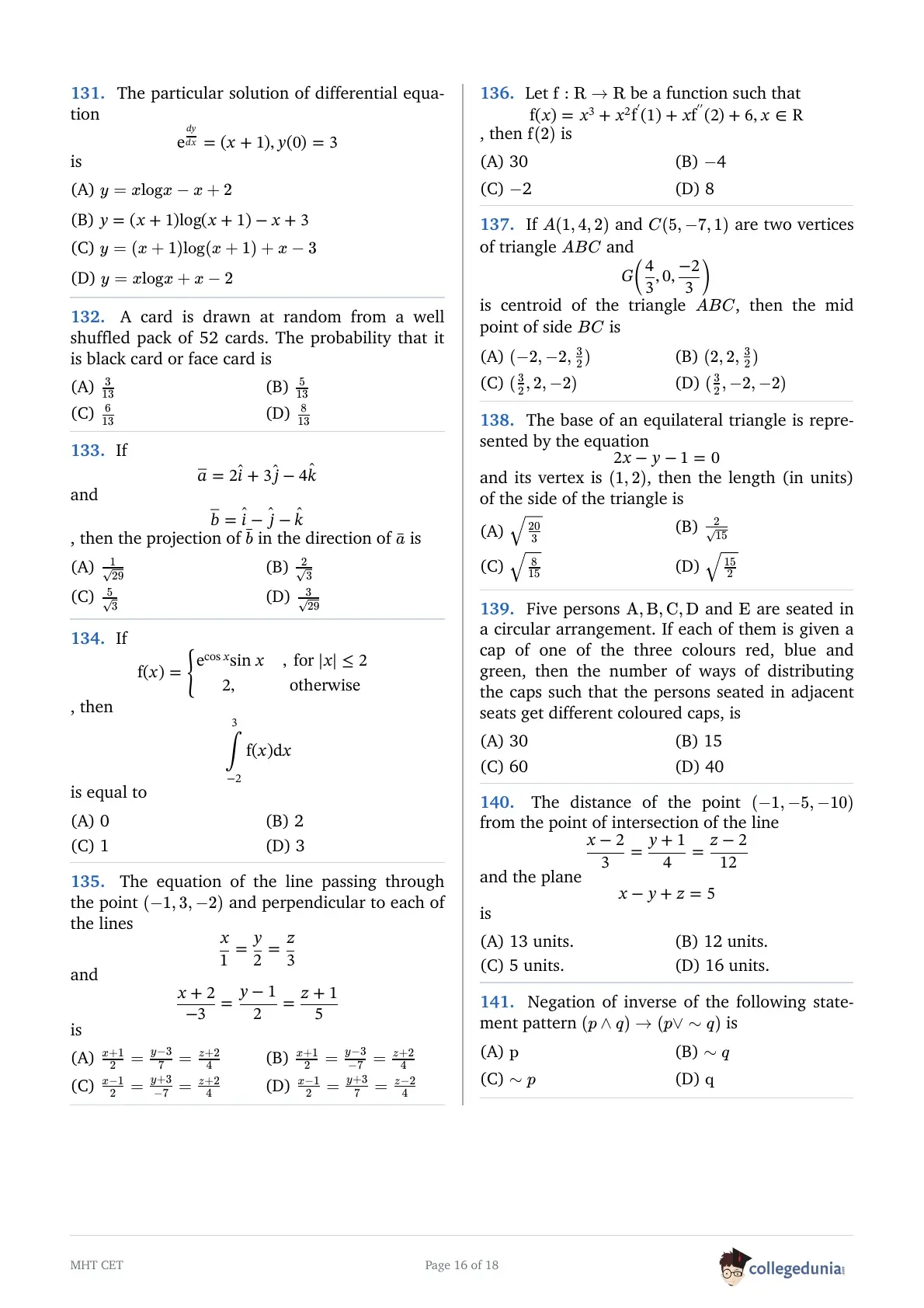
Question 131:

The particular solution of differential equation \[\mathrm{e}^{\frac{d y}{d x}}=(x+1), y(0)=3\] is

  • (A) \(y=x\mathrm{log}x-x+2\)
  • (B) \(y=(x+1)\mathrm{log}(x+1)-x+3\)
  • (C) \(y=(x+1)\mathrm{log}(x+1)+x-3\)
  • (D) \(y=x\mathrm{log}x+x-2\)

Question 132:

A card is drawn at random from a well shuffled pack of 52 cards. The probability that it is black card or face card is

  • (A) \(\frac{3}{13}\)
  • (B) \(\frac{5}{13}\)
  • (C) \(\frac{6}{13}\)
  • (D) \(\frac{8}{13}\)

Question 133:

If \[\bar{a}=2 \hat{i}+3 \hat{j}-4 \hat{k}\] and \[\bar{b}=\hat{i}-\hat{j}-\hat{k}\], then the projection of \[\bar{b}\] in the direction of \[\bar{a}\] is

  • (A) \(\frac{1}{\sqrt{29}}\)
  • (B) \(\frac{2}{\sqrt{3}}\)
  • (C) \(\frac{5}{\sqrt{3}}\)
  • (D) \(\frac{3}{\sqrt{29}}\)

Question 134:

If \[\mathrm{f}(x)=\left\{\begin{array}{ll}\mathrm{e}^{\cos x} \sin x & , \text { for }|x| \leq 2 \\ 2, & \text { otherwise }\end{array}\right.\], then \[\int_\limits{-2}^3 \mathrm{f}(x) \mathrm{d} x\] is equal to

  • (A) 0
  • (B) 2
  • (C) 1
  • (D) 3

Question 135:

The equation of the line passing through the point \[(-1,3,-2)\] and perpendicular to each of the lines \[\frac{x}{1}=\frac{y}{2}=\frac{z}{3}\] and \[\frac{x+2}{-3}=\frac{y-1}{2}=\frac{z+1}{5}\] is

  • (A) \(\frac{x+1}{2}=\frac{y-3}{7}=\frac{z+2}{4}\)
  • (B) \(\frac{x+1}{2}=\frac{y-3}{-7}=\frac{z+2}{4}\)
  • (C) \(\frac{x-1}{2}=\frac{y+3}{-7}=\frac{z+2}{4}\)
  • (D) \(\frac{x-1}{2}=\frac{y+3}{7}=\frac{z-2}{4}\)

Question 136:

Let \[\mathrm{f}: \mathrm{R} \rightarrow \mathrm{R}\] be a function such that \[\mathrm{f}(x)=x^3+x^2 \mathrm{f}^{\prime}(1)+x \mathrm{f}^{\prime \prime}(2)+6, x \in \mathrm{R}\], then \[\mathrm{f}(2)\] is

  • (A) 30
  • (B) \(-\)4
  • (C) \(-\)2
  • (D) 8

Question 137:

If \[A(1,4,2)\] and \[C(5,-7,1)\] are two vertices of triangle \[A B C\] and \[G\left(\frac{4}{3}, 0, \frac{-2}{3}\right)\] is centroid of the triangle \[A B C\], then the mid point of side \[B C\] is

  • (A) \((-2,-2,\frac{3}{2})\)
  • (B) \((2,2,\frac{3}{2})\)
  • (C) \((\frac{3}{2},2,-2)\)
  • (D) \((\frac{3}{2},-2,-2)\)

Question 138:

The base of an equilateral triangle is represented by the equation \[2 x-y-1=0\] and its vertex is \[(1,2)\], then the length (in units) of the side of the triangle is

  • (A) \(\sqrt{\frac{20}{3}}\)
  • (B) \(\frac{2}{\sqrt{15}}\)
  • (C) \(\sqrt{\frac{8}{15}}\)
  • (D) \(\sqrt{\frac{15}{2}}\)

Question 139:

Five persons \[\mathrm{A}, \mathrm{B}, \mathrm{C}, \mathrm{D}\] and \[\mathrm{E}\] are seated in a circular arrangement. If each of them is given a cap of one of the three colours red, blue and green, then the number of ways of distributing the caps such that the persons seated in adjacent seats get different coloured caps, is

  • (A) 30
  • (B) 15
  • (C) 60
  • (D) 40

Question 140:

The distance of the point \[(-1,-5,-10)\] from the point of intersection of the line \[\frac{x-2}{3}=\frac{y+1}{4}=\frac{z-2}{12}\] and the plane \[x-y+z=5\] is

  • (A) 13 units.
  • (B) 12 units.
  • (C) 5 units.
  • (D) 16 units.

Question 141:

Negation of inverse of the following statement pattern \[(p \wedge q) \rightarrow(p \vee \sim q)\] is

  • (A) \(\mathrm{p}\)
  • (B) \(\sim q\)
  • (C) \(\sim p\)
  • (D) \(\mathrm{q}\)

Question 142:

If \[\mathrm{f}(x)=3 x^{10}-7 x^8+5 x^6-21 x^3+3 x^2-7\], then \[\lim _\limits{\alpha \rightarrow 0} \frac{f(1-\alpha)-f(1)}{\alpha^3+3 \alpha}=\]

  • (A) \(\frac{53}{3}\)
  • (B) \(\frac{-53}{3}\)
  • (C) \(\frac{52}{3}\)
  • (D) \(\frac{-52}{3}\)

Question 143:

The area (in sq. units) of the region bounded by curves \[y=3 x+1, y=4 x+1\] and \[x=3\] is

  • (A) \(\frac{7}{2}\)
  • (B) \(\frac{9}{5}\)
  • (C) \(\frac{9}{2}\)
  • (D) \(\frac{7}{5}\)

Question 144:

Values of \[c\] as per Rolle's theorem for \[f(x)=\sin x+\cos x+6\] on \[[0,2 \pi]\] are

  • (A) \(\frac{\pi}{3},\frac{5\pi}{3}\)
  • (B) \(\frac{\pi}{6},\frac{5\pi}{6}\)
  • (C) \(\frac{\pi}{4},\frac{5\pi}{4}\)
  • (D) \(\frac{\pi}{4},\frac{7\pi}{4}\)

Question 145:

A vector \[\bar{a}\] has components 1 and \[2 p\] with respect to a rectangular Cartesian system. This system is rotated through a certain angle about origin in the counter clock wise sense. If, with respect to the new system, \[\bar{a}\] has components 1 and \[(p+1)\], then

  • (A) \(\mathrm{p}=1\) or \(\mathrm{p}=\frac{1}{3}\)
  • (B) \(\mathrm{p}=-1\) or \(\mathrm{p}=\frac{-1}{3}\)
  • (C) \(\mathrm{p}=\frac{-1}{3}\) or \(\mathrm{p}=1\)
  • (D) \(\mathrm{p}=\frac{1}{3}\) or \(\mathrm{p}=-1\)

Question 146:

A line is drawn through the point \[(1,2)\] to meet the co-ordinate axes at \[\mathrm{P}\] and \[\mathrm{Q}\] such that it forms a \[\triangle \mathrm{OPQ}\], where \[\mathrm{O}\] is the origin. If the area of \[\triangle \mathrm{OPQ}\] is least, then the slope of the line \[\mathrm{PQ}\] is

  • (A) \(-2\)
  • (B) 2
  • (C) \(\frac{-1}{2}\)
  • (D) \(\frac{1}{2}\)

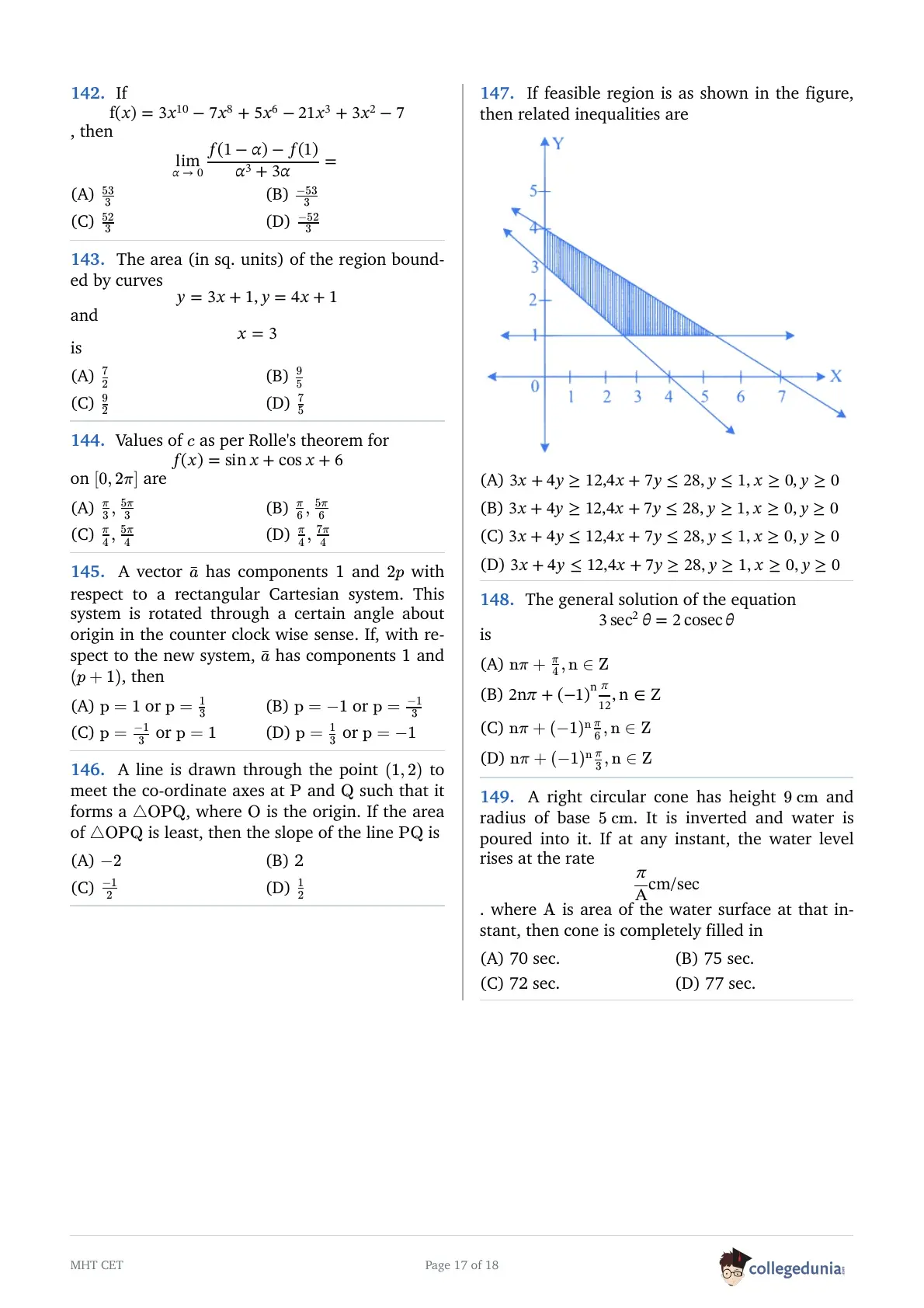
Question 147:

If feasible region is as shown in the figure, then related inequalities are

  • (A) \(3x+4y\geq 12,4x+7y\leq 28,y\leq 1,x\geq 0,y\geq 0\)
  • (B) \(3x+4y\geq 12,4x+7y\leq 28,y\geq 1,x\geq 0,y\geq 0\)
  • (C) \(3x+4y\leq 12,4x+7y\leq 28,y\leq 1,x\geq 0,y\geq 0\)
  • (D) \(3x+4y\leq 12,4x+7y\geq 28,y\geq 1,x\geq 0,y\geq 0\)

Question 148:

The general solution of the equation \[3 \sec ^2 \theta=2 \operatorname{cosec} \theta\] is

  • (A) \(\mathrm{n}\pi +\frac{\pi}{4},\mathrm{n}\in \mathrm{Z}\)
  • (B) \(2\mathrm{n}\pi +(-1)^{\mathrm{n}}\frac{\pi}{12},\mathrm{n}\in \mathrm{Z}\)
  • (C) \(\mathrm{n}\pi +(-1)^{\mathrm{n}}\frac{\pi}{6},\mathrm{n}\in \mathrm{Z}\)
  • (D) \(\mathrm{n}\pi +(-1)^{\mathrm{n}}\frac{\pi}{3},\mathrm{n}\in \mathrm{Z}\)

Question 149:

A right circular cone has height \[9 \mathrm{~cm}\] and radius of base \[5 \mathrm{~cm}\]. It is inverted and water is poured into it. If at any instant, the water level rises at the rate \[\frac{\pi}{\mathrm{A}} \mathrm{cm} / \mathrm{sec}\]. where \[\mathrm{A}\] is area of the water surface at that instant, then cone is completely filled in

  • (A) 70 sec.
  • (B) 75 sec.
  • (C) 72 sec.
  • (D) 77 sec.

Question 150:

If \[\theta\] is angle between the vectors \[\bar{a}\] and \[\bar{b}\] where \[|\bar{a}|=4,|\bar{b}|=3\] and \[\theta \in\left(\frac{\pi}{4}, \frac{\pi}{3}\right)\], then \[|(\bar{a}-\bar{b}) \times(\bar{a}+\bar{b})|^2+4(\bar{a} \cdot \bar{b})^2\] has the value

  • (A) 576
  • (B) 24
  • (C) 144
  • (D) 12

MHT CET 2023 PCM Exam Pattern and Marking Scheme

Parameter Details
Conducting Body Maharashtra Common Entrance Test Cell (Maharashtra CET Cell)
Exam Mode Online (Computer-Based Test)
Duration 180 minutes (3 hours)
Groups / Subjects PCM (Physics, Chemistry, Mathematics) for Engineering
Total Questions

150

Total Marks 200
Question Type Multiple Choice Questions (MCQs)
Marks Distribution
  • Mathematics – 2 marks/question
  • Physics and Chemistry – 1 mark/question
Negative Marking No
Syllabus Weightage
  • Class 12 – 80%
  • Class 11 – 20%