




The JEE Main Preparation Tips & Strategy 2027 can help students to structure their preparation around four key areas: completing the syllabus, solving PYQs, regular revision, and improving mock-test performance.
To crack JEE Main 2027, you need to have a strong foundation in NCERT textbooks, disciplined daily practice, and a smart subject-wise study plan.
- You need to complete Class 11 and 12 fundamentals, revise NCERT and prepare short formula notes. Aim for 90%+ syllabus coverage before moving heavily into full-length mocks.
- Solve 30-50 PYQs per chapter after completing a topic and increase practice to 50–80 questions for important or difficult chapters.
- Start with 1-2 mocks per week and increase to 3-4 mocks per week closer to the January attempt. Analyse every incorrect and unattempted question.
- Build conceptual clarity first and solve 30-40 numerical problems daily during intensive practice, using a timer to improve calculation speed.
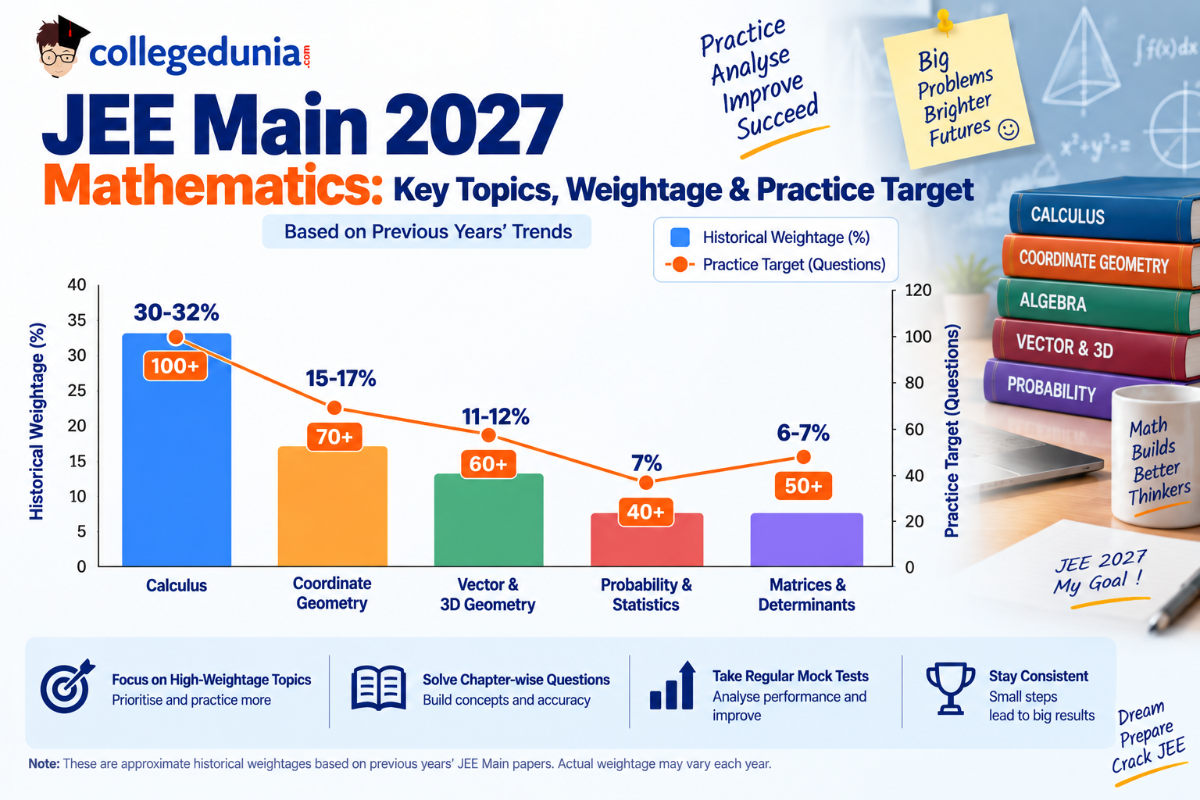
- Give additional practice to Calculus, Coordinate Geometry, and Vector & 3D Geometry, which together account for around 50-55% of Mathematics questions based on historical JEE Main chapter-wise trend analysis.
This guide covers the month-wise study plan, subject-wise preparation strategy, books, PYQs, mock-test strategy, toppers' tips, dropper strategy and final revision plan.
Related Links:
- JEE Main 2027 Zero to 220 Plus Marks in Last 120 Days Study Plan
- JEE Main Previous Years' Question Papers
- How to Prepare for JEE Main Aptitude Test for B. Arch and B. Planning?
- Top 10 Android apps for JEE Main Preparation
JEE Main Preparation Tips & Strategy 2027 Overview
- Students should set measurable targets for syllabus completion, PYQs, revision, tests, and mock practice.
- Completing 90-100% of the syllabus by November–December, followed by 2-3 revision rounds and regular mock tests, can help track preparation progress.
- After every mock, students should analyse errors and maintain an error notebook to identify and improve weak areas.
| Preparation Area | Target for 2027 | How to Measure |
|---|---|---|
| Syllabus | 90–100% by November–December | Chapter tracker |
| Chapter PYQs | 30–80 per chapter | Accuracy % |
| Revision | 2–3 rounds | Revision tracker |
| Chapter Tests | 2–3 per week | Chapter score |
| Full Mocks | 2–4 per week near Session 1 | Score + accuracy |
| Error Analysis | After every mock | Error notebook |
| Final Revision | Formulae + NCERT + PYQs | Daily checklist |
JEE Main Preparation Tips & Strategy 2027: Month-Wise Preparation Plan
- Students who complete 90% or more of the syllabus by November can use December mainly for revision and full-length tests.
- Students with 50-75% syllabus coverage should first complete important chapters before increasing full-mock frequency.
- Students should not wait until January to start PYQs.
- Chapter-wise PYQs should begin immediately after completing each chapter, while full-length papers can be increased once syllabus coverage reaches around 75-90%.
| Month | Main Target | Question/Test Target |
|---|---|---|
| September 2026 | Complete major Class 12 chapters + Class 11 backlog | 30-50 questions/chapter |
| October 2026 | Finish high-priority chapters + PYQs | 50-80 PYQs/chapter |
| November 2026 | Complete remaining syllabus | 2-3 tests/week |
| December 2026 | Full-syllabus revision | 3-4 mocks/week |
| January 2027 | Session 1 revision + mock practice | 1 mock every 1-2 days |
| February 2027 | Analyse Session 1 gaps | 2-3 mocks/week |
| March 2027 | Prepare weak areas for Session 2 | 3-4 mocks/week |
| April 2027 | Final Session 2 preparation | Targeted revision + mocks |
Also Check:
JEE Main Preparation Tips & Strategy 2027: Subject-Wise Preparation Strategy
- For Physics, students need to focus on high-weightage topics and practise concepts, formulas, and PYQs regularly.
- For Chemistry, students need to focus on NCERT-based topics and practise reactions, formulas, and PYQs regularly.
- For Mathematics, students need to focus on high-weightage topics and practise questions regularly to improve speed and accuracy.
JEE Main Physics Preparation Strategy
- Current Electricity (~9.9%), Electrostatics (~8.8%) and Waves & Oscillations (~8.5%) together account for roughly 27% of the historical weightage represented in this table, making them high-priority practice areas.
- Current Electricity, Electrostatics and Magnetism each have a 50+ question practice target, compared with 40+ for Waves & Oscillations and Ray Optics.
- The difference between the highest listed weightage (~9.9%) and lowest (~7.5%) is only about 2.4 percentage points, so students should not completely skip any of these chapters.
| Topic | Approx. Historical Weightage* | Practice Target |
|---|---|---|
| Current Electricity | 9.9% | 50+ questions |
| Electrostatics | 8.8% | 50+ questions |
| Waves & Oscillations | 8.5% | 40+ questions |
| Magnetism & Moving Charges | 8–9% | 50+ questions |
| Ray Optics | 7.5% | 40+ questions |
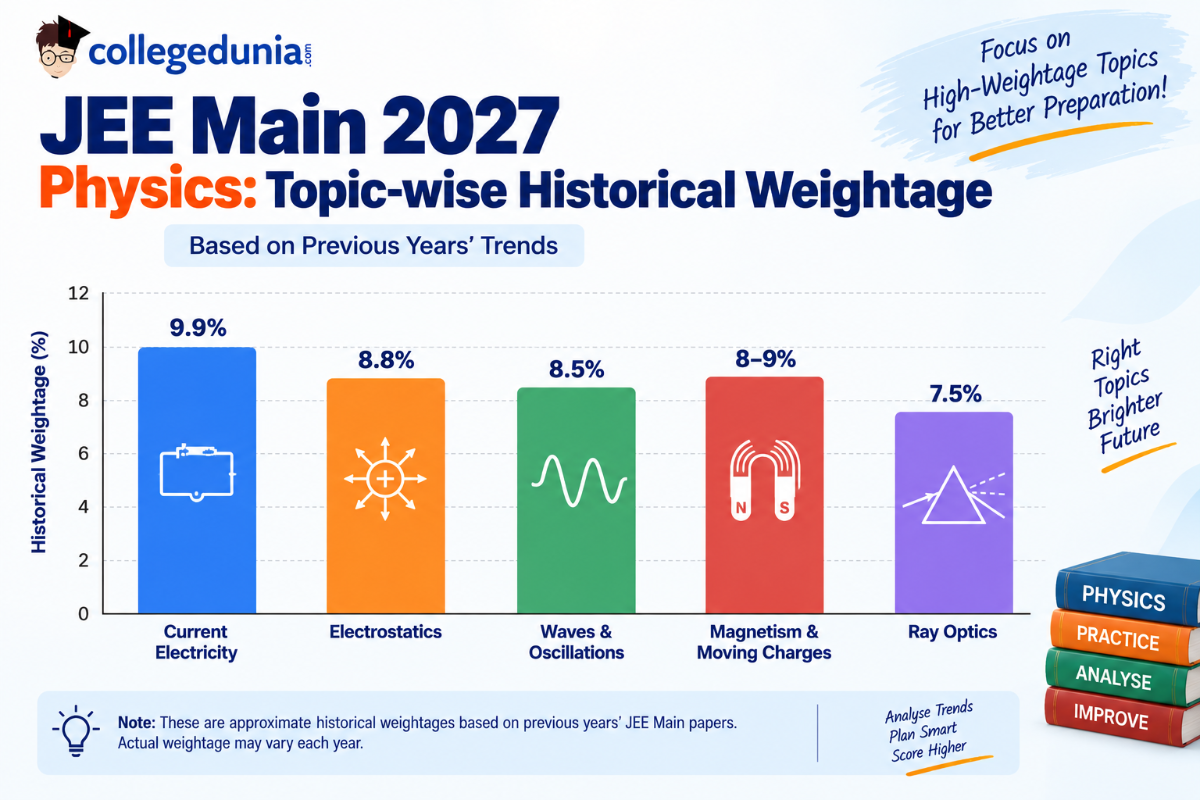
Check: High Weightage Chapters in JEE Physics 202 for Classes 11 and 12
As per the below-mentioned Reddit post:
- Heat & Thermodynamics remained one of the most consistent topics, with 44 questions in 2024, 50 in 2025 and 37 in 2026, contributing around 2–3 questions per shift.
- Electrostatics recorded 32, 37 and 26 questions across 2024–2026, while Current Electricity had 48 questions in 2024, 21 in 2025 and 28 in 2026, showing year-to-year variation but continued relevance.
- Kinematics contributed 35, 28 and 25 questions, while Atoms & Nuclei had 40, 20 and 24 questions across the three years, with both generally contributing around 1–2 questions per shift.
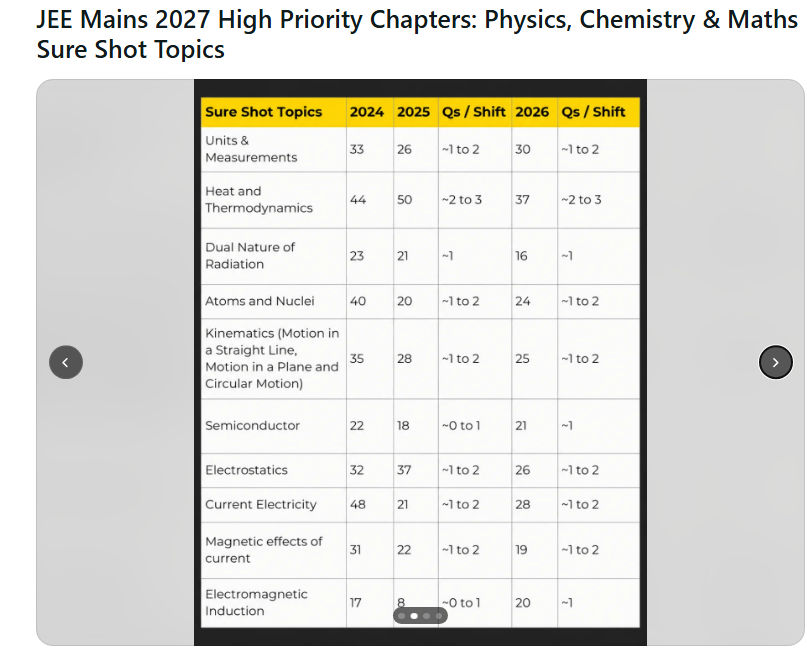
Source: Reddit
JEE Main Chemistry Preparation Strategy
- GOC + Hydrocarbons has the highest listed range at 15-18%, while Coordination Compounds is at 6-7%, making the top range more than twice the lower range.
- The three major areas-GOC + Hydrocarbons, Solutions + Thermodynamics and Chemical Bonding- have practice targets of 50-60+ questions each, reflecting their higher historical contribution.
- The strategy separates Chemistry practice by type: NCERT/revision for Inorganic, reaction practice for Organic and numerical practice for Physical Chemistry.
| Topic | Approx. Historical Weightage* | Practice Target |
|---|---|---|
| GOC + Hydrocarbons | 15-18% | 60+ questions |
| Solutions + Thermodynamics | 12-14% | 50+ questions |
| Chemical Bonding | 10-12% | 50+ questions |
| Electrochemistry | 7-9% | 40+ questions |
| Coordination Compounds | 6-7% | 40+ questions |
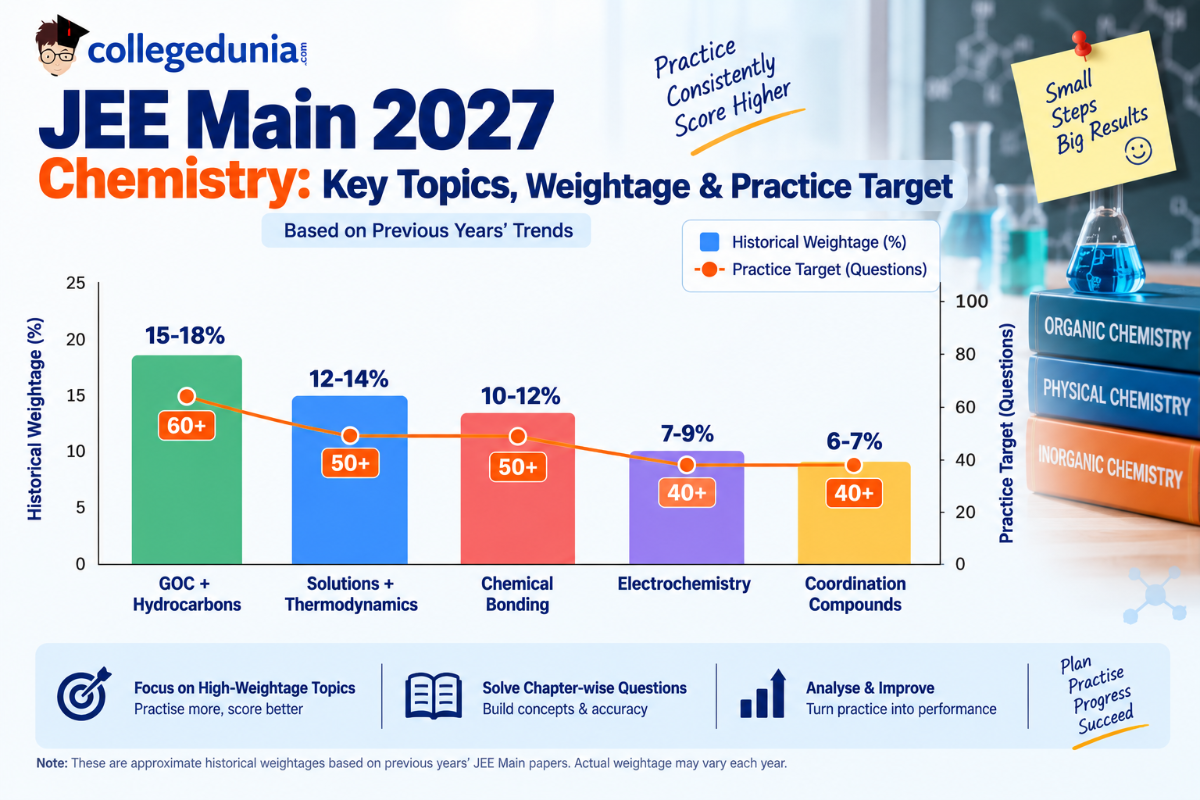
Check: High Weightage Chapters for JEE Mains 2026 Chemistry Classes 11 and 12
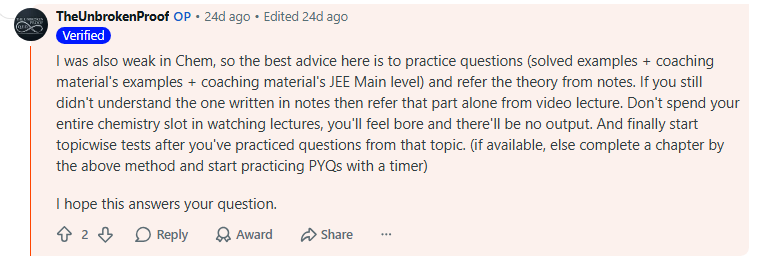
A user on Reddit suggested practising more questions in Chemistry, using solved examples and coaching material before referring back to theory. They also recommended taking topic-wise tests after practising a chapter and solving PYQs with a timer to improve speed.
Source: Reddit
JEE Main Mathematics Preparation Strategy
- Calculus has the highest listed historical weightage at 30-32%, approximately twice the combined range of several individual lower-weightage topics.
- Calculus, Coordinate Geometry, and Vector & 3D together represent approximately 56-61% of the historical weightage shown in the table, so they deserve a larger share of practice time.
- The practice target follows the same pattern: 100+ questions for Calculus, compared with 40+ for Probability & Statistics.
| Topic | Approx. Historical Weightage* | Practice Target |
|---|---|---|
| Calculus | 30-32% | 100+ questions |
| Coordinate Geometry | 15-17% | 70+ questions |
| Vector & 3D Geometry | 11-12% | 60+ questions |
| Probability & Statistics | 7% | 40+ questions |
| Matrices & Determinants | 6-7% | 50+ questions |
Check: High Weightage Chapters for JEE Mains 2026 Maths Class 11 and 12
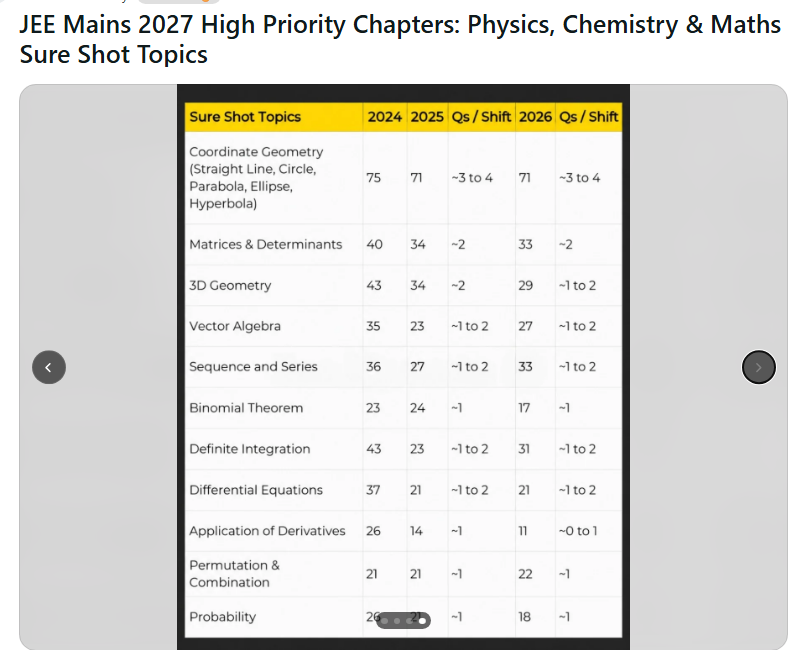
Another user on Reddit mentioned that:
- Coordinate Geometry is the highest-priority topic in the table, with 75 questions in 2024, 71 in 2025 and 71 in 2026, contributing around 3-4 questions per shift consistently.
- Matrices & Determinants and 3D Geometry contributed around 2 questions per shift, with 33 and 29 questions respectively in 2026, making them strong practice areas.
- Vector Algebra, Sequence & Series, Definite Integration and Differential Equations each contributed around 1-2 questions per shift in 2026, with 2026 question counts ranging from 21 to 33.
- Application of Derivatives declined from 26 questions in 2024 to 11 in 2026, while Binomial Theorem fell from 23 to 17, showing greater year-to-year variation in their contribution.
Source: Reddit
Check:
How Many Questions Should You Actually Attempt in JEE Main 2027?
- Under the latest official Paper 1 reference of 75 questions, the maximum possible attempt count is 75; therefore, ranges such as 75-85 questions would not be valid.
- A student attempting 60 questions at 95% accuracy can have around 57 correct answers, while 70 attempts at 80% accuracy produce around 56 correct answers.
- This shows why increasing attempts by 10 questions does not necessarily improve the number of correct responses; accuracy should be tracked alongside attempts.
| Questions Attempted | Accuracy Target | Approx. Correct Attempts |
|---|---|---|
| 55-60 | 90-95%+ | 50-57 |
| 60-65 | 90-95%+ | 54-62 |
| 65-70 | 85-90%+ | 55-63 |
| 70-75 | 80-85%+ | 56-64 |
Check:
How to Prepare for JEE Main 2027 in 12 Weeks?
- The plan allocates the first 4 weeks primarily to syllabus coverage, followed by 4 weeks of intensive question practice and testing.
- Mock-test frequency increases from 1 per week in Weeks 5–8 to 2 per week in Weeks 9–11, giving students more opportunities to improve speed and accuracy before the exam.
- The final week is deliberately lighter, with only 2 final mocks, so students can focus on formulas, weak areas and revision instead of starting new chapters.
| Weeks | What to Focus On |
|---|---|
| Weeks 1-4 | Complete NCERT and high-priority chapters. Strengthen concepts and prepare concise revision notes. |
| Weeks 5-8 | Practise topic-wise questions, start timed chapter tests and take 1 full-length mock per week. |
| Weeks 9-11 | Take 2 full-length mocks per week, analyse mistakes, update the error log and revise weak topics. |
| Week 12 | Focus on light revision, take 2 final mocks, revise important formulas and concepts, and prioritise proper rest before the exam. |
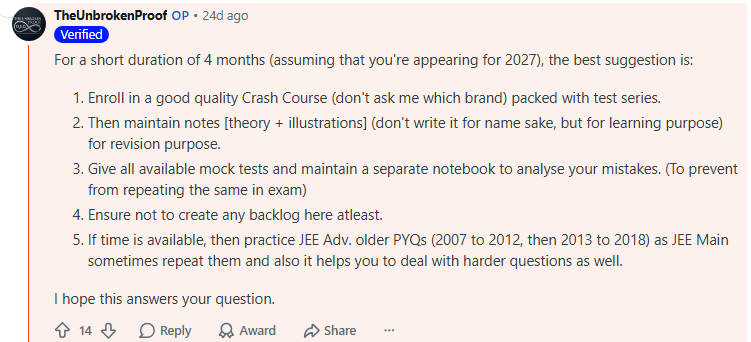
A user on Reddit suggested using a good crash course with a test series, making short revision notes, taking all available mock tests with a separate error notebook, and avoiding any backlog during the 4-month preparation period. He also recommended solving older JEE Advanced PYQs if enough time is available.
Source: Reddit
JEE Main Subject-wise Mock Test
JEE Main Preparation Tips & Strategy 2027: PYQ Strategy
- The plan begins with 30–50 PYQs per chapter and increases to 50–80 questions for high-priority chapters.
- December shifts from chapter-wise practice to full previous-year papers, while January focuses on recent papers and previously weak topics.
- Students can use PYQ accuracy as a measurable checkpoint: chapters with consistently lower accuracy should be added to the next revision cycle.
| PYQ Stage | Target | Purpose |
|---|---|---|
| After Each Chapter | 30-50 | Check understanding |
| High-Priority Chapter | 50-80 | Identify repeated concepts |
| After Major Unit | 50-80 | Mixed practice |
| December | Full papers | Exam simulation |
| January | Recent papers + weak topics | Final revision |
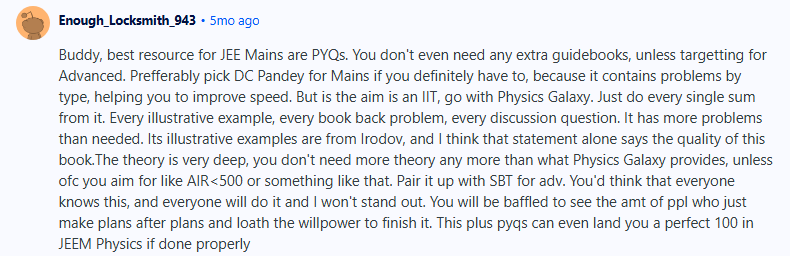
A user on Reddit suggested prioritising PYQs over extra guidebooks and choosing practice material based on the required level. They also stressed solving illustrative examples and discussion questions thoroughly and focusing on completing the material consistently rather than repeatedly making new study plans.
Source: Reddit
JEE Main Previous Year Question Papers
JEE Main Preparation Tips & Strategy 2027: Best Books for JEE Main 2027
- The strategy limits students to one primary resource plus PYQs, rather than requiring multiple books for every subject.
- Chemistry places NCERT at the centre, while Physics and Mathematics use one additional reference source for deeper problem practice.
- The existing Collegedunia material similarly recommends H.C. Verma/DC Pandey for Physics, NCERT plus targeted Chemistry books, and Arihant/Cengage for Mathematics
| Subject | Class | NCERT Book PDF | NCERT Solutions |
|---|---|---|---|
| Physics | 12 | Download NCERT Book | Check NCERT Solutions |
| 11 | Download NCERT Book | Check NCERT Solutions | |
| Chemistry | 12 | Download NCERT Book | Check NCERT Solutions |
| 11 | Download NCERT Book | Check NCERT Solutions | |
| Maths | 12 | Download NCERT Book | Check NCERT Solutions |
| 11 | Download NCERT Book | Check NCERT Solutions |
After completing concepts, combine standard reference books with previous-year papers and mock tests.
Check:
| Resource | Best Use |
|---|---|
| JEE Main PYQs | Understand question patterns and difficulty |
| JEE Main Mock Tests | Improve speed, accuracy and time management |
| JEE Main 2027 Important Notes and Formula | Quick revision before tests and the examination |
Check:
| Best Books JEE Mains Maths 2026 | Best Books JEE Mains Chemistry 2026 | Best Books JEE Mains Physics 2026 |
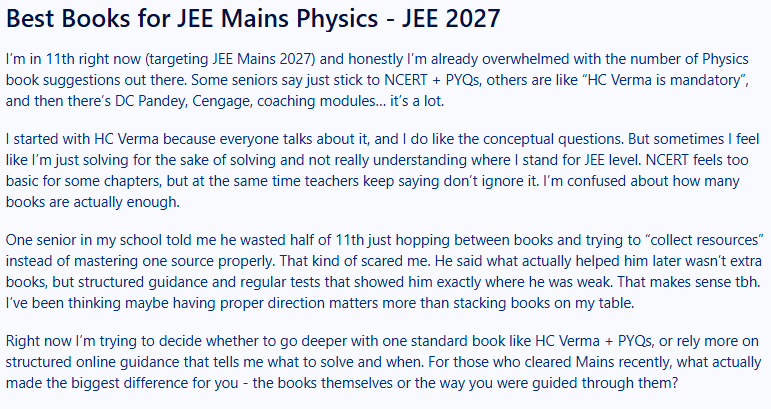
A user preparing for JEE Main 2027 shared that they felt overwhelmed by the number of Physics books suggested, including H.C. Verma, DC Pandey, Cengage and coaching modules. They noted that switching between multiple books had reduced their focus and that mastering one reliable resource with proper guidance and PYQs seemed more useful than collecting several books.
Source: Reddit
Check:
JEE Main 2027 Mock Test Strategy
| Preparation Stage | Mocks/Week | Main Objective |
|---|---|---|
| October | 1–2 | Identify weak areas |
| November | 2 | Improve question selection |
| December | 3–4 | Build exam stamina |
| January | 3–5 | Improve speed and accuracy |
| Before Session 2 | 2–4 | Repair Session 1 weaknesses |
JEE Main Preparation Tips & Strategy 2027 from Toppers
- The table sets a 30–50+ PYQ target per chapter, a 2–3-week revision cycle and 2–4 mocks per week, giving students measurable benchmarks rather than generic advice.
- Limiting preparation to one main source per subject leaves more time for PYQs, revision and test analysis.
- The existing topper-focused material also recommends daily problem solving, regular PYQs, revision and mock analysis as recurring preparation practices
| Preparation Area | Toppers' Approach | 2027 Target |
|---|---|---|
| PYQs | Solve after completing chapters | 30–50+ per chapter |
| Revision | Revisit formulas and mistakes | Every 2–3 weeks |
| Mock Tests | Increase near exam | 2–4/week |
| Error Analysis | Record repeated mistakes | After every mock |
| Study Material | Limited resources | 1 main source/subject |
| Time Management | Practise full papers | 3-hour papers |
JEE Main 2027 Handwritten Notes PDFs
Dropper's JEE Main Preparation Tips & Strategy 2027
- The first month is used for diagnosis, while Months 2–5 focus on rebuilding concepts, PYQs and mixed practice before full revision begins.
- Mock frequency increases from chapter/subject tests to 2–3 per week, reaching 3–5 per week in the final month.
- The key difference for droppers is that their previous JEE Main attempt provides measurable data on marks, accuracy, weak chapters and time management, which should determine the new study plan.
| Phase | Main Target | Test Target |
|---|---|---|
| Month 1 | Analyse previous attempt + weak chapters | Chapter tests |
| Months 2–3 | Rebuild weak concepts + PYQs | Subject tests |
| Months 4–5 | Complete syllabus + mixed practice | 1–2 mocks/week |
| Month 6 | Full revision | 2–3 mocks/week |
| Final Month | PYQs + errors + formulae | 3–5 mocks/week |
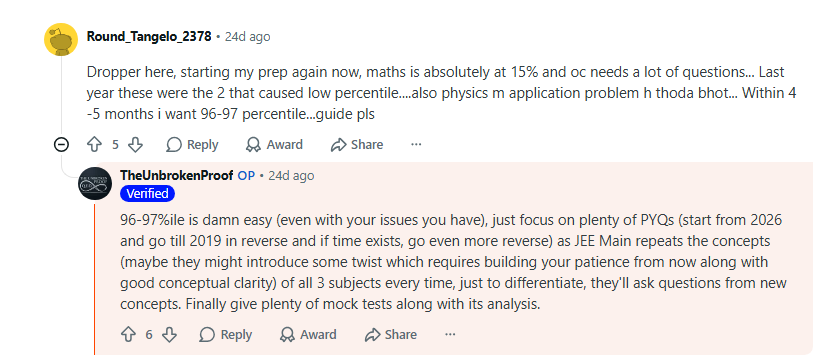
A dropper on Reddit suggested focusing on PYQs, especially recent papers, and regular mock tests with proper analysis. He also recommended improving conceptual clarity in all three subjects instead of focusing only on weak topics.
Source: Reddit
Check:
JEE Main Preparation Tips & Strategy 2027 FAQs
Ques. How should I start preparing for JEE Main 2027?
Ans. Start with the latest syllabus and divide your preparation into three phases: concept building, PYQ practice and mock tests. Complete the concepts first, solve 30–50 PYQs per chapter, and gradually increase mock-test frequency as the syllabus progresses.
Ques. Can I crack JEE Main 2027 through self-study?
Ans. Yes. You can prepare through NCERT, one reliable learning source, study notes, PYQs and mock tests. Track your syllabus completion, question accuracy and mock-test scores every week.
Ques. How many hours should I study for JEE Main 2027?
Ans. There is no fixed number of hours required. School students can target around 4–6 focused hours of self-study on weekdays, while students with more available time can increase their study hours gradually.
Ques. How should I prepare for JEE Main 2027 from Class 11?
Ans. Focus on building strong fundamentals and completing the Class 11 syllabus systematically. After each chapter, follow the sequence concepts → questions → PYQs → chapter test → revision and revise completed chapters every 2–3 weeks.
Ques. What is the best timetable for JEE aspirants with school?
Ans. Divide your available time between Physics, Chemistry, Mathematics and revision. Use weekdays for concepts and daily practice, and weekends for PYQs, chapter tests, mock tests and backlog completion.
Ques. How can I prepare for JEE Main 2027 at home?
Ans. Create a fixed study schedule, use one reliable lecture source, maintain concise notes and solve PYQs regularly. Keep a separate error notebook and track your weekly syllabus completion and test performance.
Ques. How many PYQs should I solve for JEE Main 2027?
Ans. Start with 30–50 PYQs per chapter after completing the concepts. For important or difficult chapters, increase the target to 50–80 questions. After completing the syllabus, practise complete previous-year papers under exam-like conditions.
Ques. When should I start taking full-length mock tests?
Ans. Start increasing full-length mocks once around 75–90% of the syllabus is completed. Begin with 1–2 mocks per week and gradually increase to around 3–4 mocks per week closer to the examination.
Ques. How should I analyse JEE Main mock tests?
Ans. Record your attempts, correct and incorrect answers, unanswered questions and time taken. Classify mistakes into concept, formula, calculation, silly, time-management and question-selection errors, then work on the category causing the most lost marks.
Ques. How many questions should I attempt in JEE Main 2027?
Ans. There is no fixed attempt target. Under the latest official Paper 1 reference, there are 75 questions, so students should focus on balancing attempts with accuracy. For example, 60 attempts at 95% accuracy can produce around 57 correct answers, while 70 attempts at 80% accuracy produce around 56 correct answers.



Comments