




JEE Main 2025 B.Planning April 9 (Paper 2B) Question Paper is available here with solutions PDF and detailed solutions for every question. NTA conducted the JEE Main 2025 B.Planning (Paper 2B) exam on April 9, 2025, from 9:00 AM to 12:00 PM (Session 2). The question paper includes the following:
- 100 questions in a 3-hour paper: Part I Mathematics (25), Part II Aptitude Test (50) and Part III Planning (25)
- Mathematics: 20 multiple choice questions (MCQs) and 5 numerical value questions, 4 marks each (100 marks)
- Aptitude Test: 50 MCQs, 4 marks each (200 marks)
- Planning: 25 MCQs, 4 marks each (100 marks)
- Marking: +4 for a correct answer, -1 for an incorrect MCQ or numerical answer, 0 for an unattempted question; maximum marks 400
JEE Main 2025 B.Planning April 9 (Paper 2B) Question Paper with Solution PDF
| NTA Official PDF | CD PDF | CD PDF with Solutions |
|---|---|---|
| Download official PDF 5.55 MB | Download Collegedunia PDF 5.73 MB | Download solutions PDF 2.62 MB |
Also Check:
JEE Main 2025 B.Planning April 9 (Paper 2B) Questions with Solutions
Mathematics (Q1 - Q25)
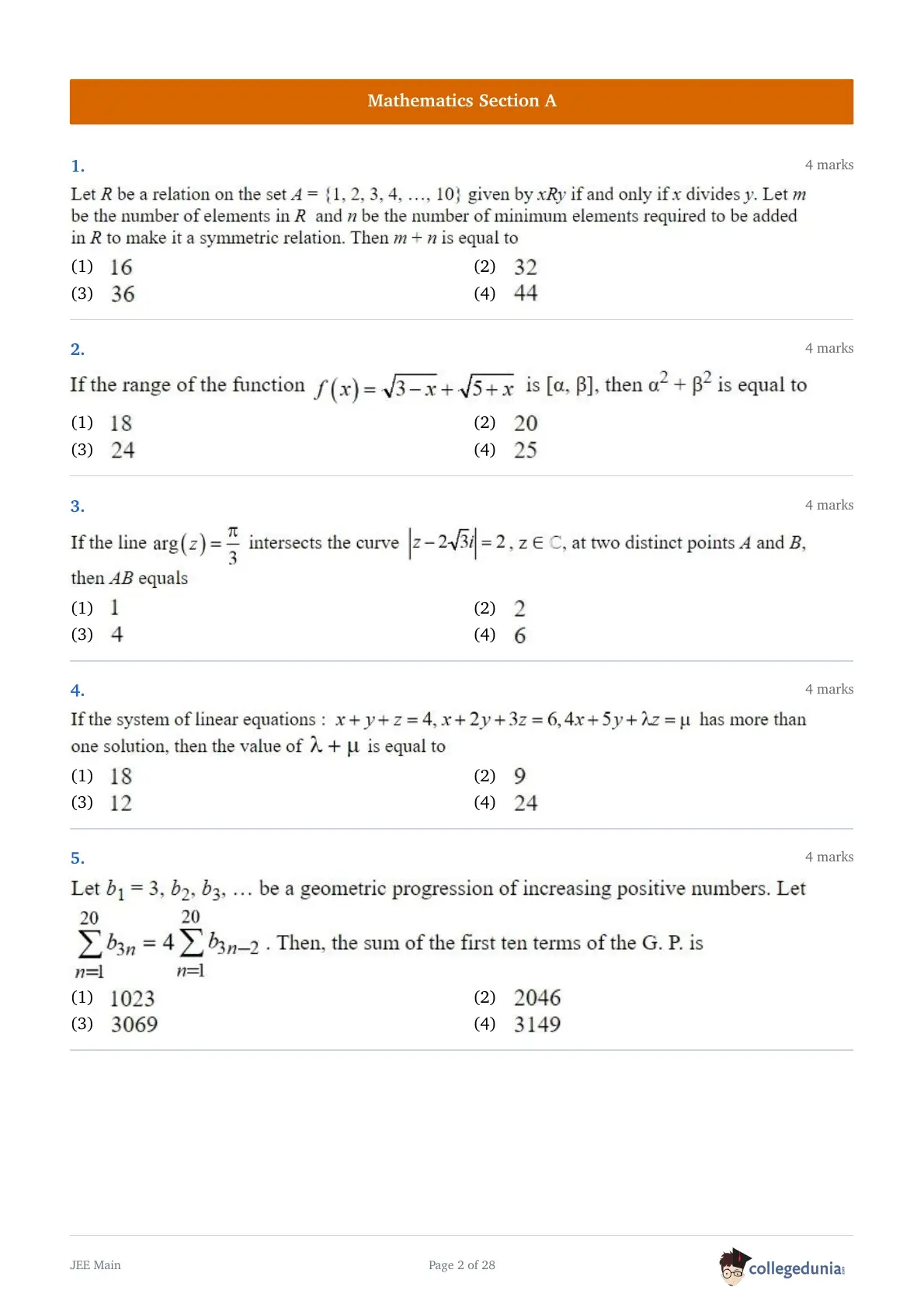
Let \(R\) be a relation on the set \(A=\{1,2,3,4,\ldots,10\}\) given by \(xRy\) if and only if \(x\) divides \(y\). Let \(m\) be the number of elements in \(R\) and \(n\) be the number of minimum elements required to be added in \(R\) to make it a symmetric relation. Then \(m+n\) is equal to
If the range of the function \( f(x) = \sqrt{3 - x} + \sqrt{5 + x} \) is \([\alpha, \beta]\), then \( \alpha^2 + \beta^2 \) is equal to:
If the line \( \arg(z) = \frac{\pi}{3} \) intersects the curve \( |z - 2\sqrt{3}i| = 2 \), \( z \in \mathbb{C} \), at two distinct points \(A\) and \(B\), then \(AB\) equals:
If the system of linear equations : \[ x+y+z=4,\quad x+2y+3z=6,\quad 4x+5y+\lambda z=\mu \] has more than one solution, then the value of \( \lambda+\mu \) is equal to:
Let \( b_1 = 3, b_2, b_3, \ldots \) be a geometric progression of increasing positive numbers. Let \[ \sum_{n=1}^{20} b_{3n} = 4\sum_{n=1}^{20} b_{3n-2}. \] Then, the sum of the first ten terms of the G.P. is:
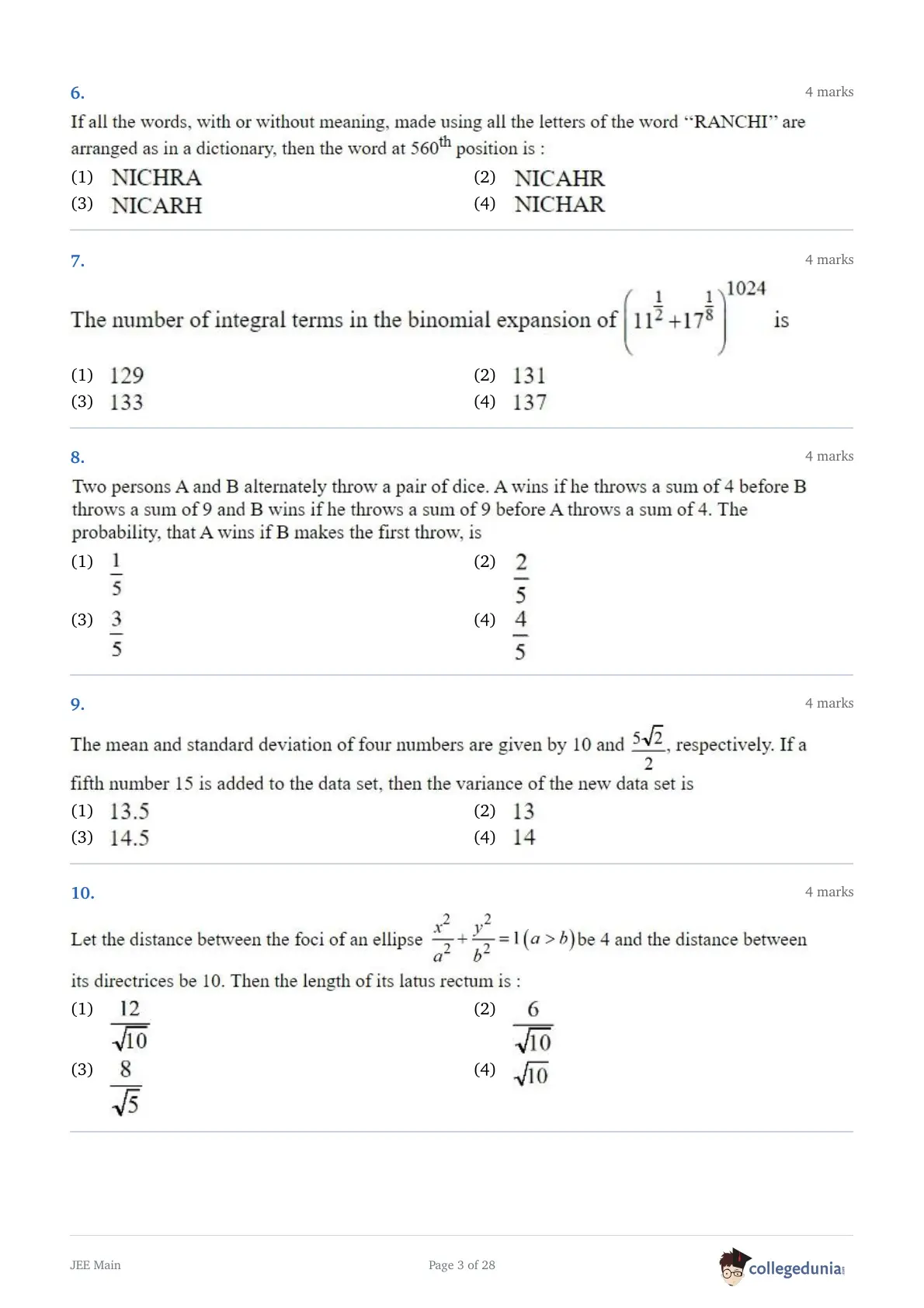
If all the words, with or without meaning, made using all the letters of the word ``RANCHI'' are arranged as in a dictionary, then the word at \(560^{\text{th}}\) position is:
The number of integral terms in the binomial expansion of \[ \left(11^{\frac{1}{2}} + 17^{\frac{1}{8}}\right)^{1024} \] is:
Two persons \(A\) and \(B\) alternately throw a pair of dice. \(A\) wins if he throws a sum of \(4\) before \(B\) throws a sum of \(9\), and \(B\) wins if he throws a sum of \(9\) before \(A\) throws a sum of \(4\). The probability that \(A\) wins if \(B\) makes the first throw is:
The mean and standard deviation of four numbers are given by \(10\) and \(\dfrac{5\sqrt{2}}{2}\), respectively. If a fifth number \(15\) is added to the data set, then the variance of the new data set is
Let the distance between the foci of an ellipse \[ \frac{x^2}{a^2} + \frac{y^2}{b^2} = 1 \quad (a>b) \] be \(4\) and the distance between its directrices be \(10\). Then the length of its latus rectum is:
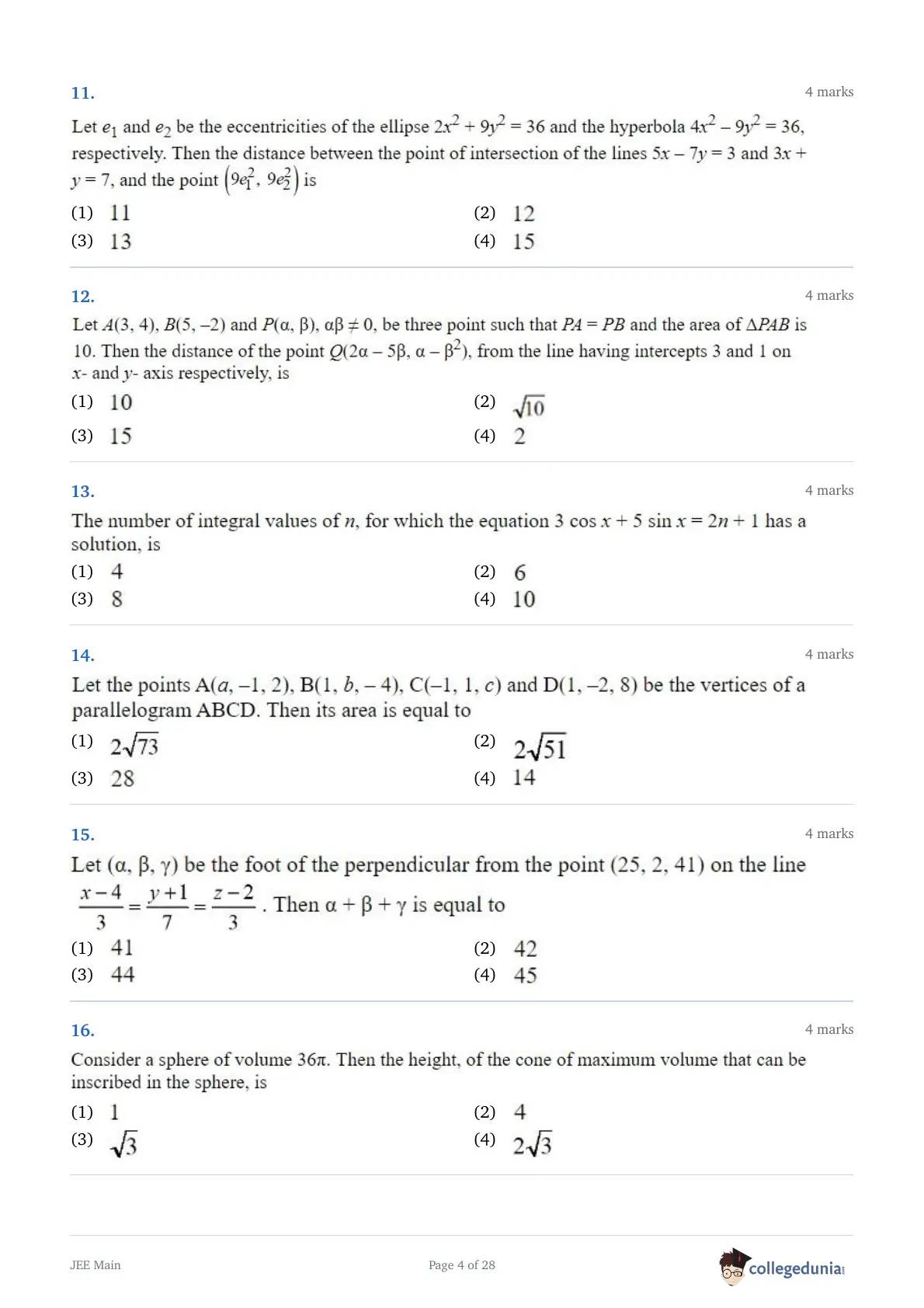
Let \(e_1\) and \(e_2\) be the eccentricities of the ellipse \(2x^2+9y^2=36\) and the hyperbola \(4x^2-9y^2=36\), respectively. Then the distance between the point of intersection of the lines \(5x-7y=3\) and \(3x+y=7\), and the point \( (9e_1^2,\;9e_2^2) \) is:
Let \(A(3,4)\), \(B(5,-2)\) and \(P(\alpha,\beta)\), \(\alpha\beta \neq 0\), be three points such that \(PA = PB\) and the area of \(\triangle PAB\) is \(10\). Then the distance of the point \(Q(2\alpha-5\beta,\; \alpha-\beta^2)\) from the line having intercepts \(3\) and \(1\) on the \(x\)- and \(y\)-axis respectively, is:
The number of integral values of \(n\), for which the equation \[ 3\cos x + 5\sin x = 2n + 1 \] has a solution, is:
Let the points \(A(a,-1,2)\), \(B(1,b,-4)\), \(C(-1,1,c)\) and \(D(1,-2,8)\) be the vertices of a parallelogram \(ABCD\). Then its area is equal to:
Let \((\alpha,\beta,\gamma)\) be the foot of the perpendicular from the point \((25,2,41)\) on the line \[ \frac{x-4}{3}=\frac{y+1}{7}=\frac{z-2}{3}. \] Then \(\alpha+\beta+\gamma\) is equal to:
Consider a sphere of volume \(36\pi\). Then the height of the cone of maximum volume that can be inscribed in the sphere is
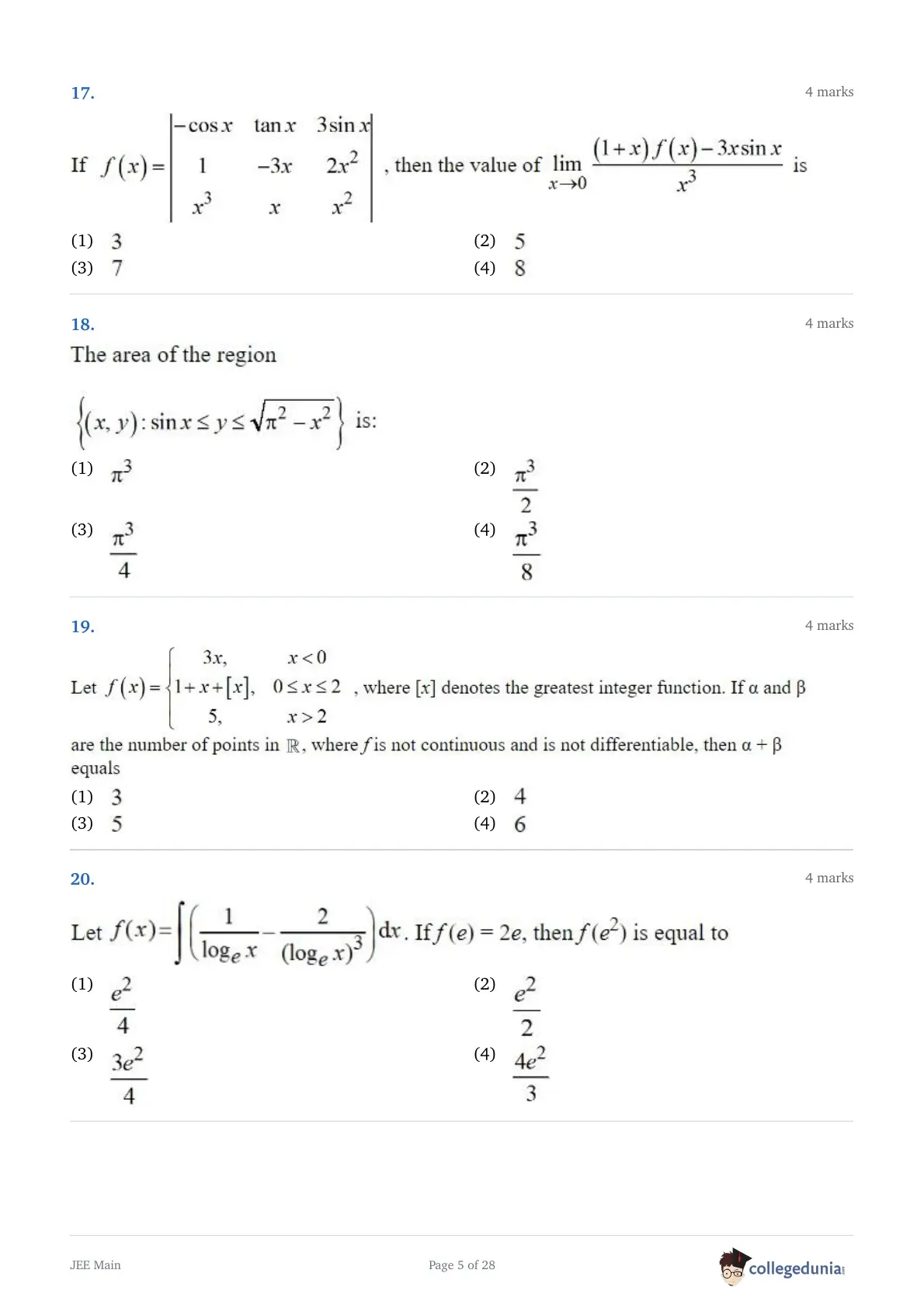
Let \[ f(x)= \begin{vmatrix} -\cos x & \tan x & 3\sin x\\ 1 & -3x & 2x^2\\ x^3 & x & x^2 \end{vmatrix}. \] Then the value of \[ \lim_{x\to 0}\frac{(1+x)f(x)-3x\sin x}{x^3} \] is:
The area of the region \[ \{(x,y): \sin x \le y \le \sqrt{\pi^2-x^2}\} \] is:
Let \[ f(x)= \begin{cases} 3x, & x<0,\\ 1+x+[x], & 0\le x\le 2,\\ 5, & x>2, \end{cases} \] where \([x]\) denotes the greatest integer function. If \(\alpha\) and \(\beta\) are the number of points in \(\mathbb{R}\) where \(f\) is not continuous and is not differentiable respectively, then \(\alpha+\beta\) equals:
Let \[ f(x)=\int\left(\frac{1}{\log_e x}-\frac{2}{(\log_e x)^3}\right)\,dx. \] If \(f(e)=2e\), then \(f(e^2)\) is equal to:
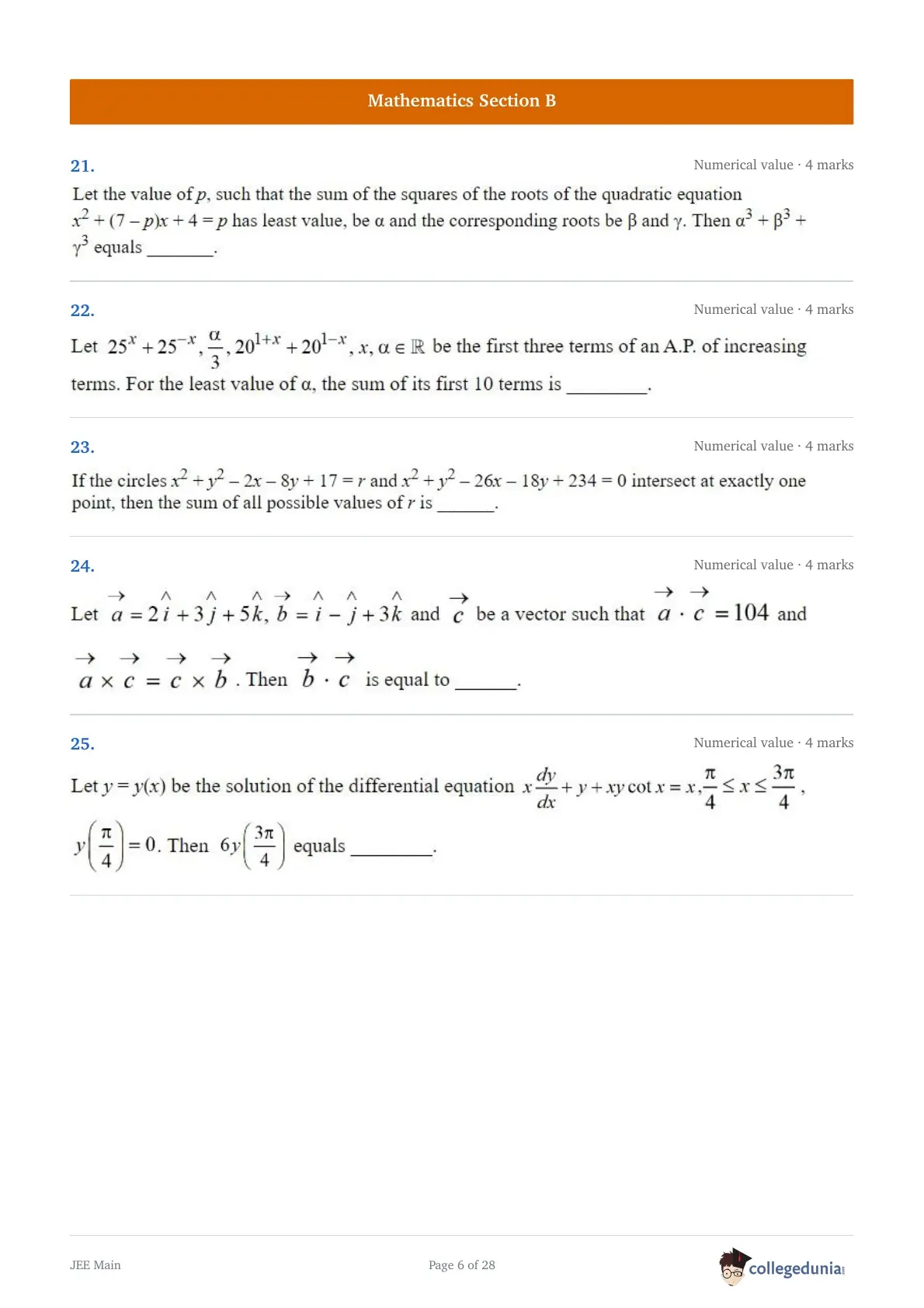
Let the value of \(p\), such that the sum of the squares of the roots of the quadratic equation \[ x^2+(7-p)x+4=p \] has the least value, be \(\alpha\), and the corresponding roots be \(\beta\) and \(\gamma\). Then \(\alpha^3+\beta^3+\gamma^3\) equals ________.}
Let \(25^x+25^{-x},\ \dfrac{\alpha}{3},\ 20^{1+x}+20^{1-x}\), where \(x,\alpha\in\mathbb{R}\), be the first three terms of an A.P. of increasing terms. For the least value of \(\alpha\), the sum of its first \(10\) terms is _____
If the circles \[ x^2+y^2-2x-8y+17=r \quad \text{and} \quad x^2+y^2-26x-18y+234=0 \] intersect at exactly one point, then the sum of all possible values of \(r\) is _______
Let \(\vec a = 2\hat i + 3\hat j + 5\hat k\), \(\vec b = \hat i - \hat j + 3\hat k\) and \(\vec c\) be a vector such that \[ \vec a \cdot \vec c = 104 \quad \text{and} \quad \vec a \times \vec c = \vec c \times \vec b. \] Then \(\vec b \cdot \vec c\) is equal to ______
Let \(y=y(x)\) be the solution of the differential equation \(x\dfrac{dy}{dx}+y+xy\cot x=x,\ \dfrac{\pi}{4}\le x\le\dfrac{3\pi}{4}\), \(y\left(\dfrac{\pi}{4}\right)=0\). Then \(6y\left(\dfrac{3\pi}{4}\right)\) equals ________.
Aptitude Test (Q26 - Q75)
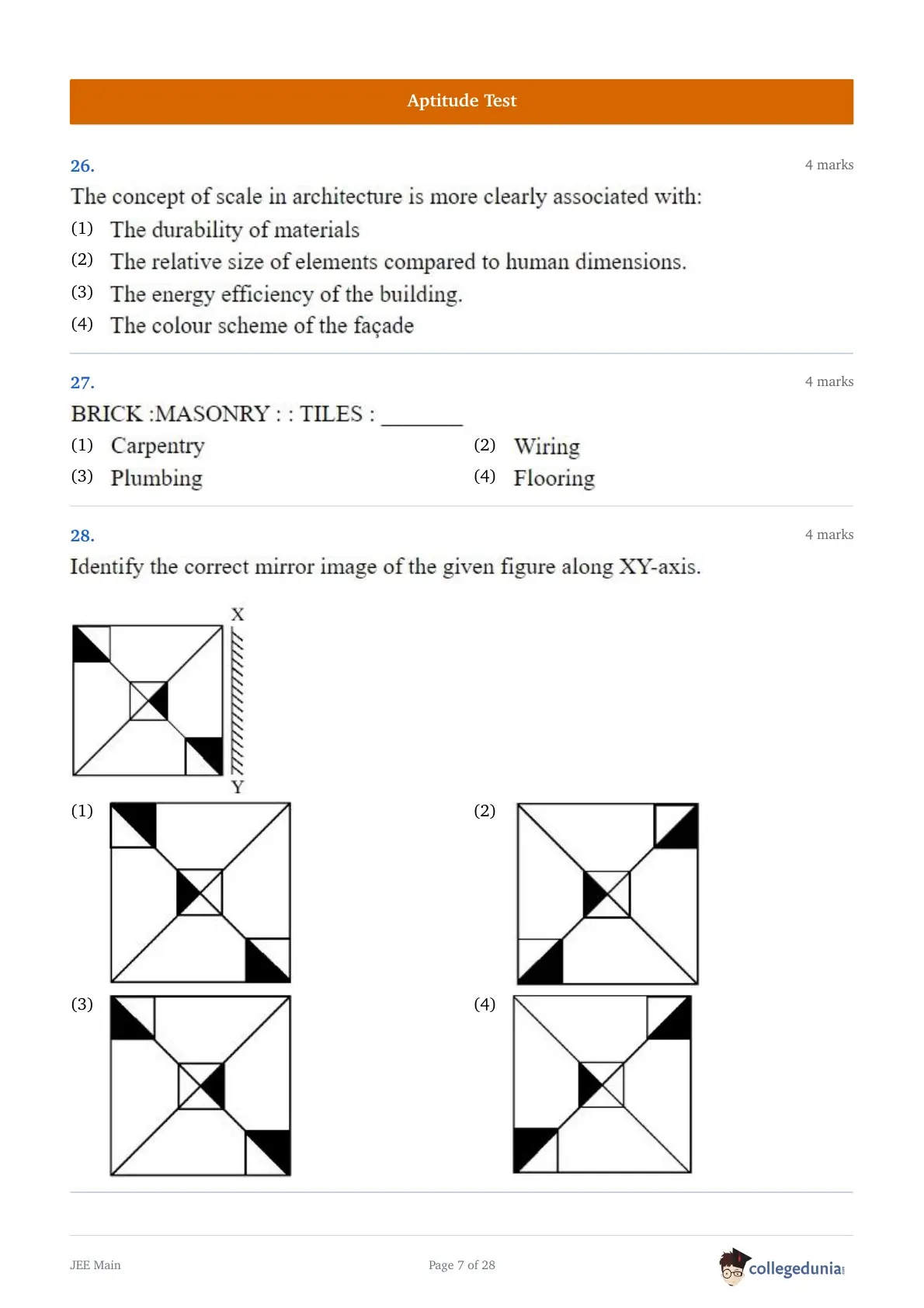
The concept of scale in architecture is more clearly associated with:
BRICK : MASONRY :: TILES : ________
Identify the correct mirror image of the given figure along the \(XY\)-axis.


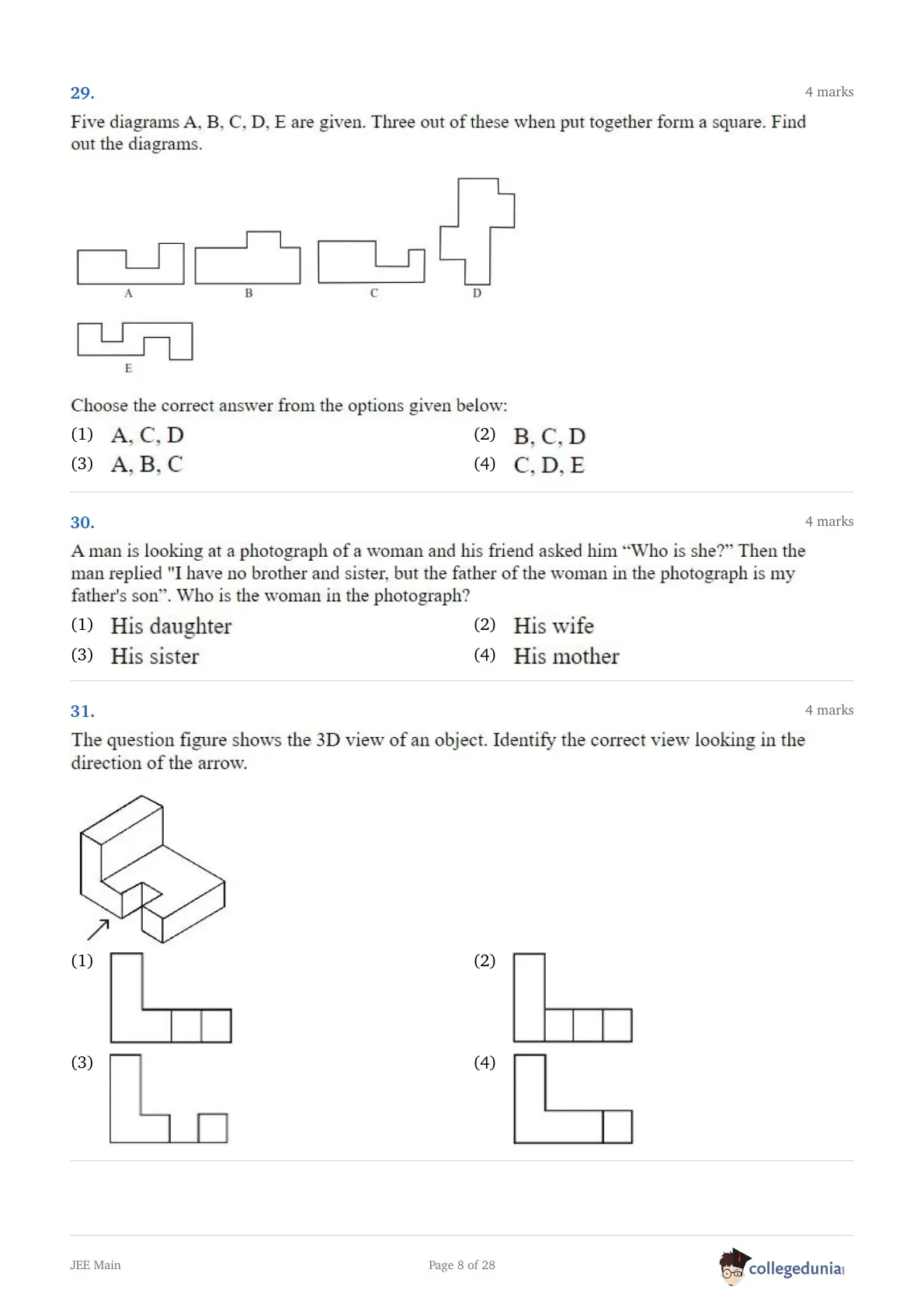
Five diagrams \(A, B, C, D,\) and \(E\) are given. Three out of these, when put together, form a square. Identify the correct set of diagrams.

A man is looking at a photograph of a woman and his friend asks him, “Who is she?” The man replies, “I have no brother or sister, but the father of the woman in the photograph is my father’s son.” Who is the woman in the photograph?
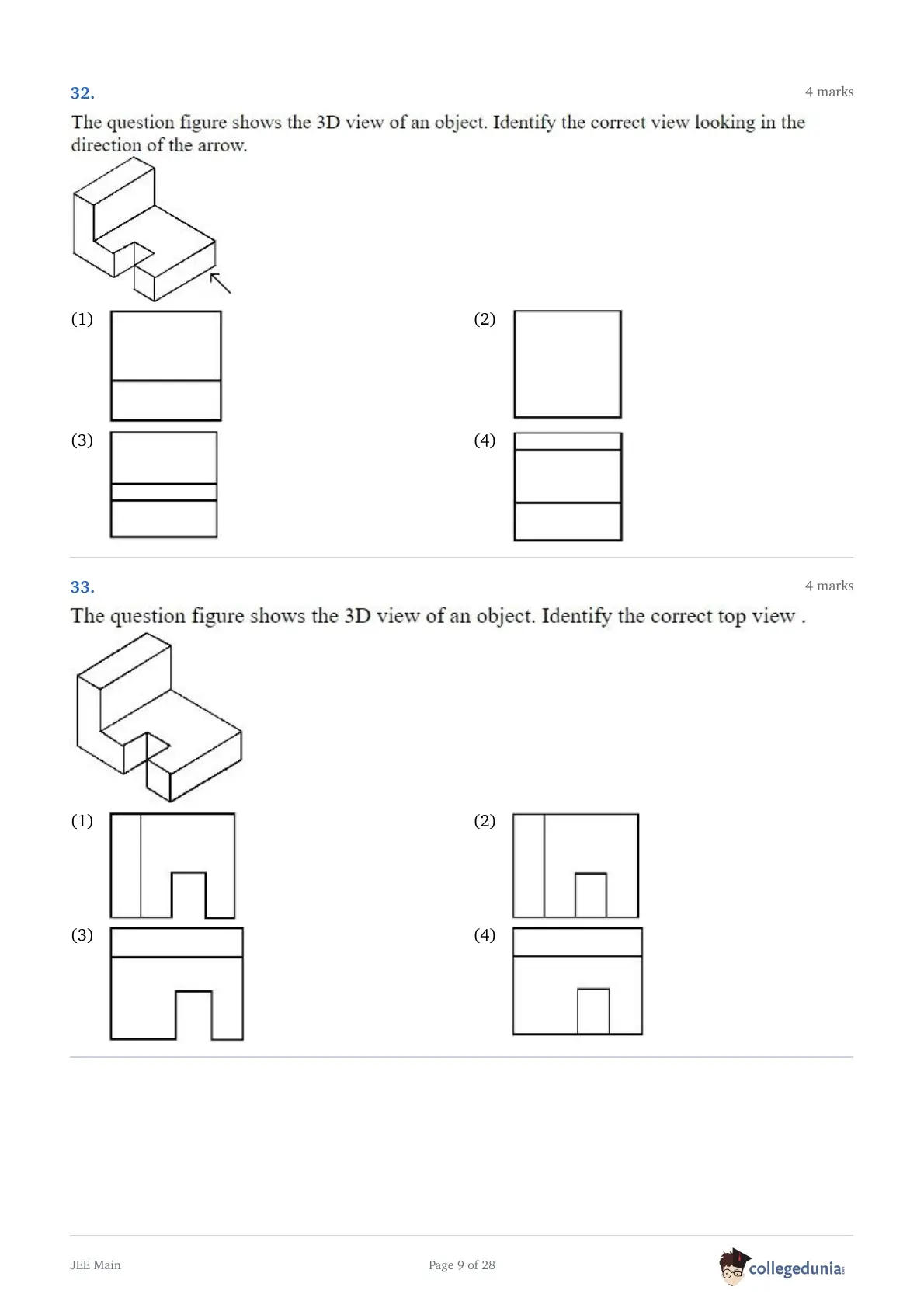
The question figure shows the 3D view of an object. Identify the correct view when looking in the direction of the arrow.

The question figure shows the 3D view of an object. Identify the correct view when looking in the direction of the arrow.

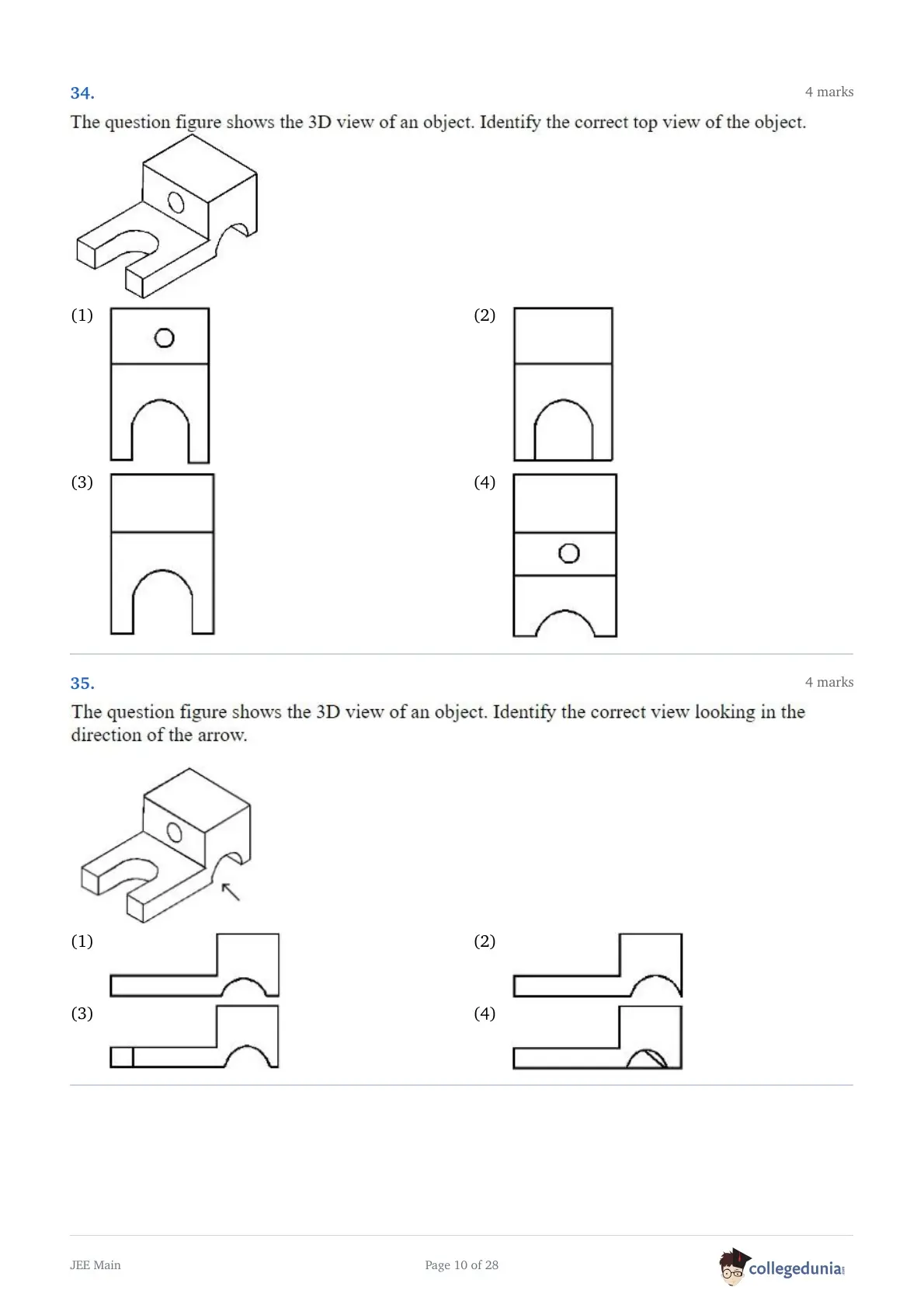
The question figure shows the 3D view of an object. Identify the correct top view.


The question figure shows the 3D view of an object. Identify the correct view when looking in the direction of the arrow.

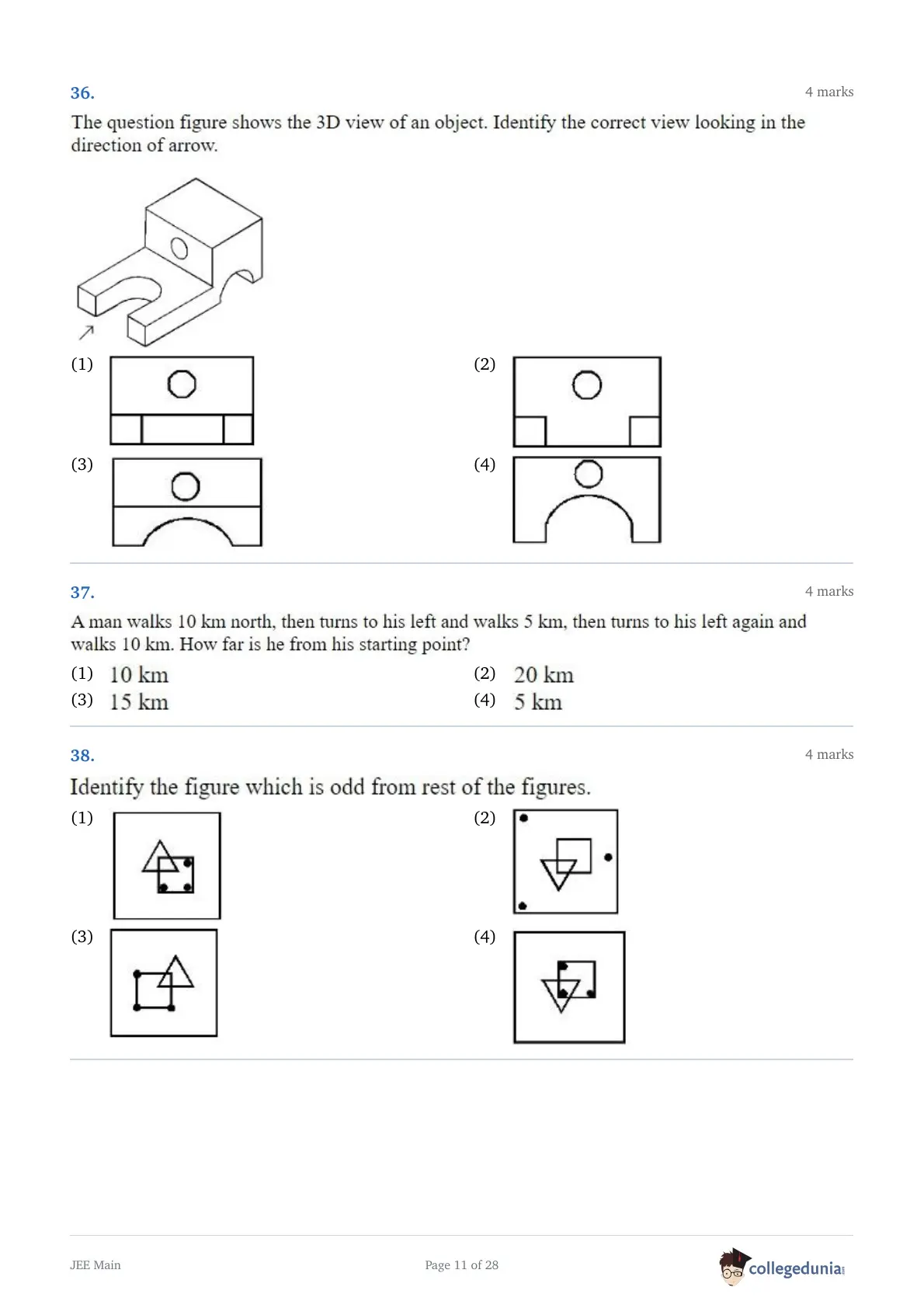
The question figure shows the 3D view of an object. Identify the correct view when looking in the direction of the arrow.

A person walks \(10\) km towards the north, then turns to his left and walks \(5\) km, and then again turns to his left and walks \(10\) km. How far is he from his starting point now?
Identify the figure which is odd from the rest of the figures.

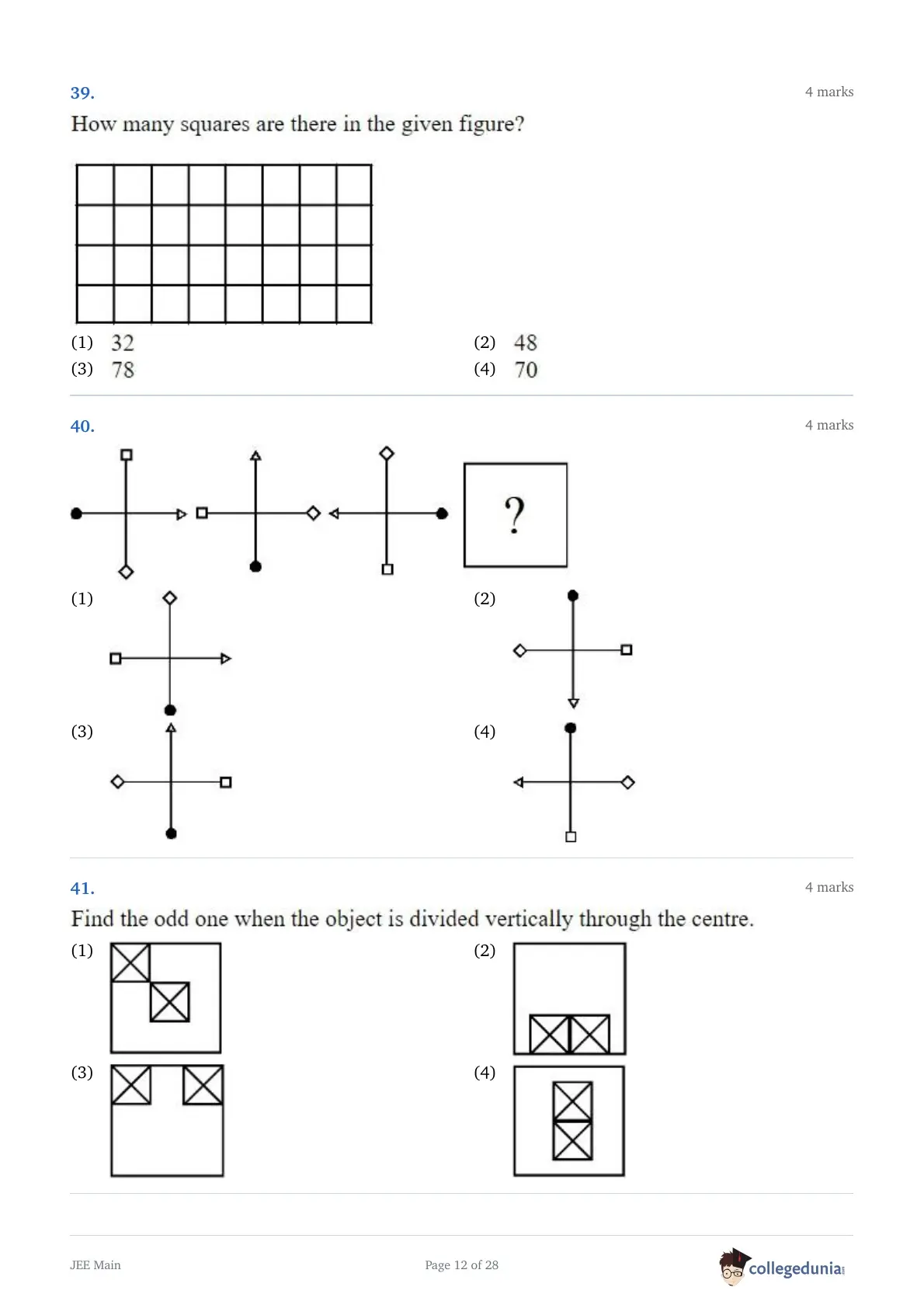
How many squares are there in the given figure?

Choose the figure that will correctly replace the question mark \((?)\) in the given series.


Find the odd one out when the object is divided vertically through the centre.

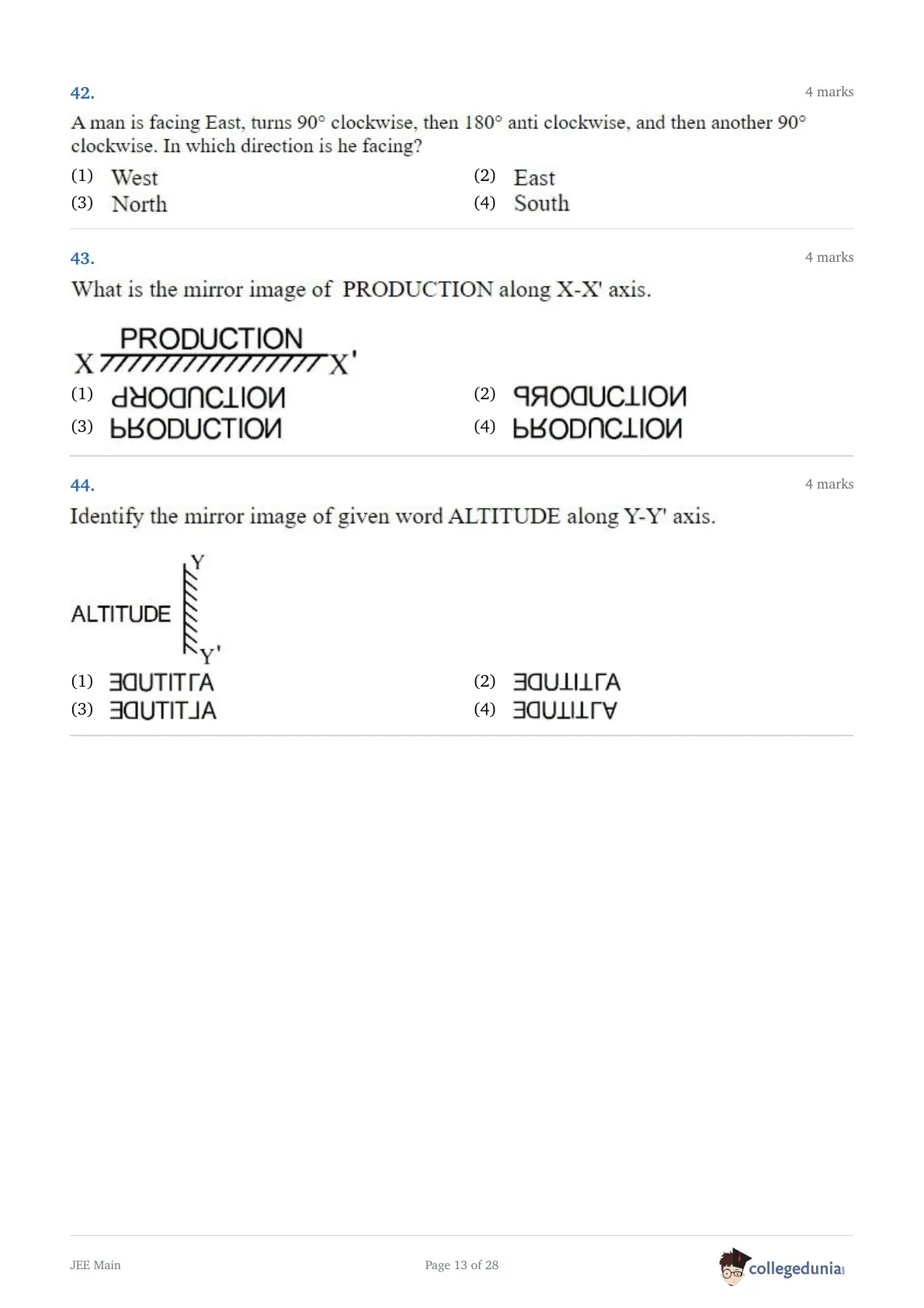
A man is facing East, turns \(90^\circ\) clockwise, then \(180^\circ\) anticlockwise, and then another \(90^\circ\) clockwise. In which direction is he facing?
What is the mirror image of the word PRODUCTION along the \(X\!-\!X'\) axis?

Identify the mirror image of the given word ALTITUDE along the \(Y\!-\!Y'\) axis.

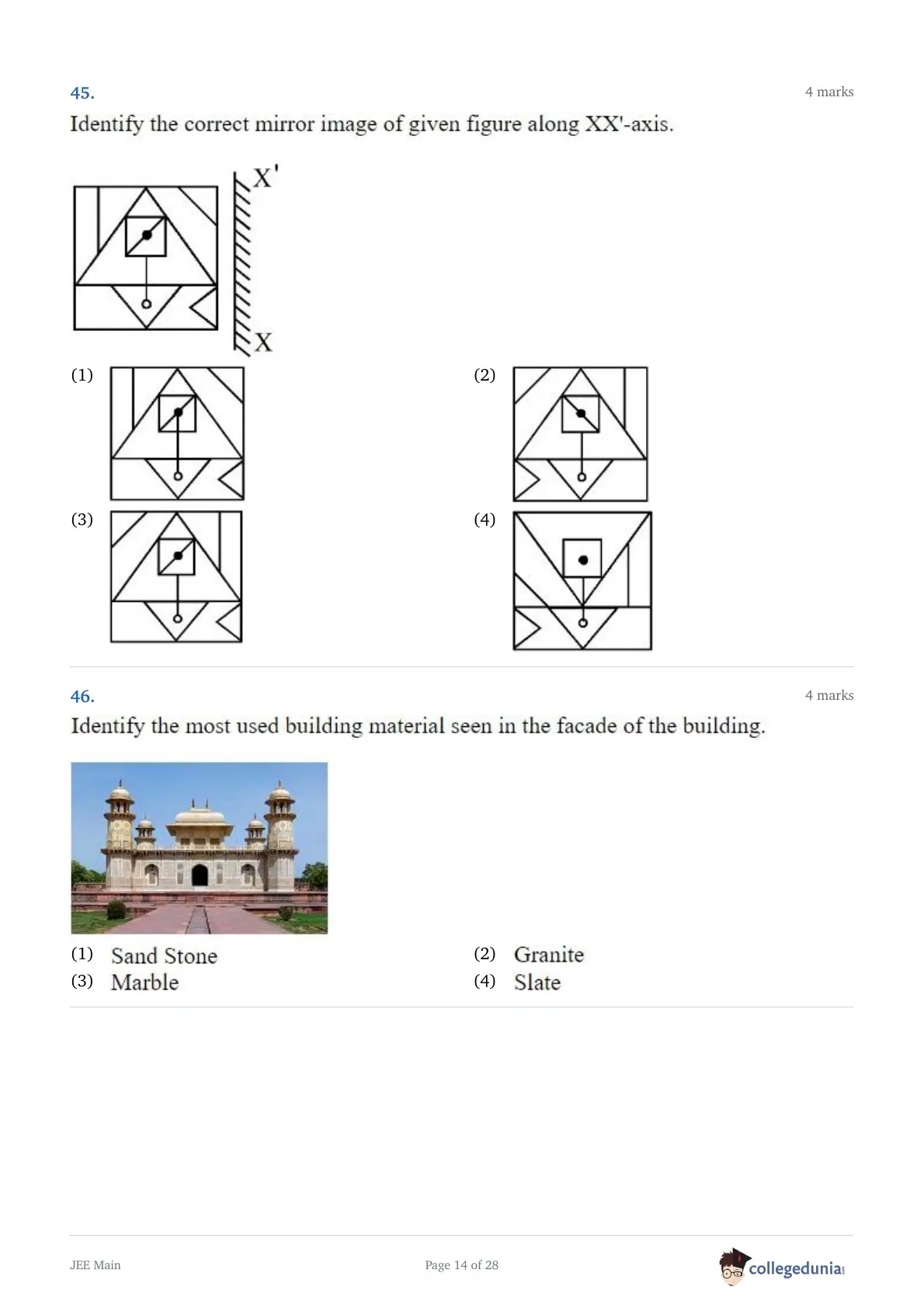
Identify the correct mirror image of the given figure along the \(X\!-\!X'\) axis.


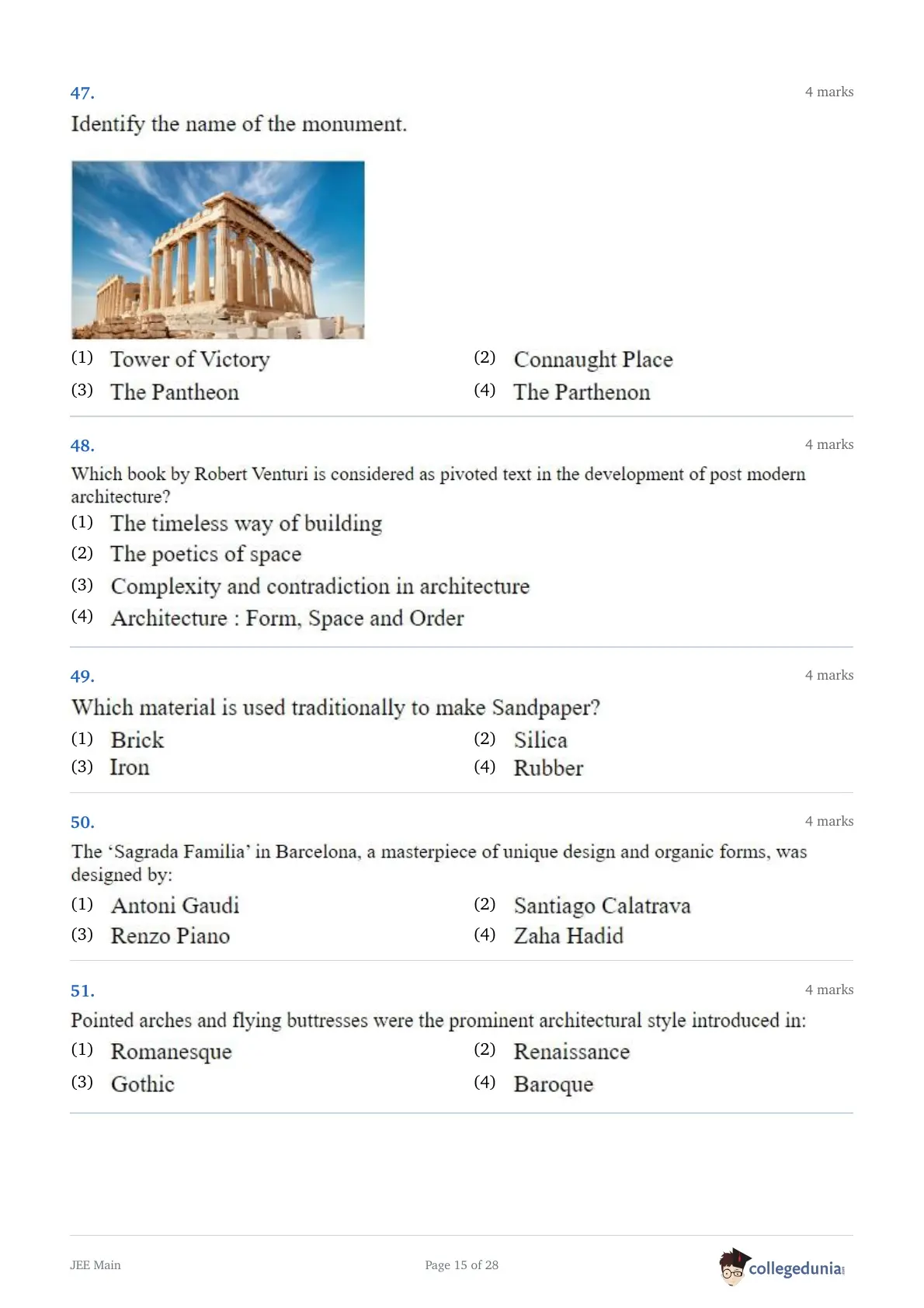
Identify the most used building material seen in the façade of the building shown in the picture.

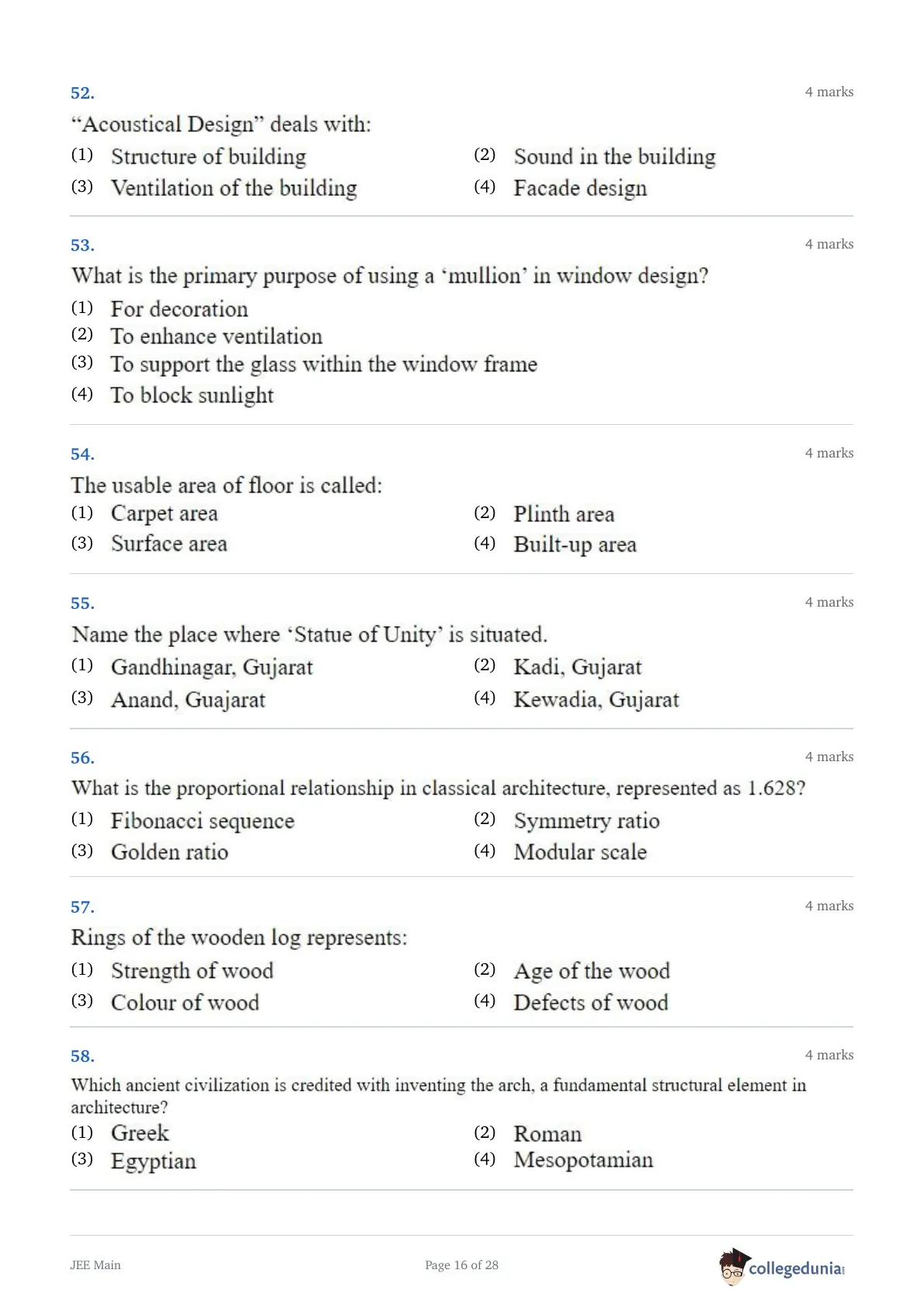
Identify the name of the monument shown in the picture.

Which book by Robert Venturi is considered a pivotal text in the development of postmodern architecture?
Which material is used traditionally to make sandpaper?
The ‘Sagrada Familia’ in Barcelona, a masterpiece of unique design and organic forms, was designed by:
Pointed arches and flying buttresses were the prominent architectural features introduced in which architectural style?
“Acoustical Design” deals with:
What is the primary purpose of using a `mullion' in window design?
The usable area of a floor is called:
Name the place where the Statue of Unity is situated.
What is the proportional relationship in classical architecture, represented as \(1.618\)?
Rings of the wooden log represent:
Which ancient civilization is credited with inventing the arch, a fundamental structural element in architecture?
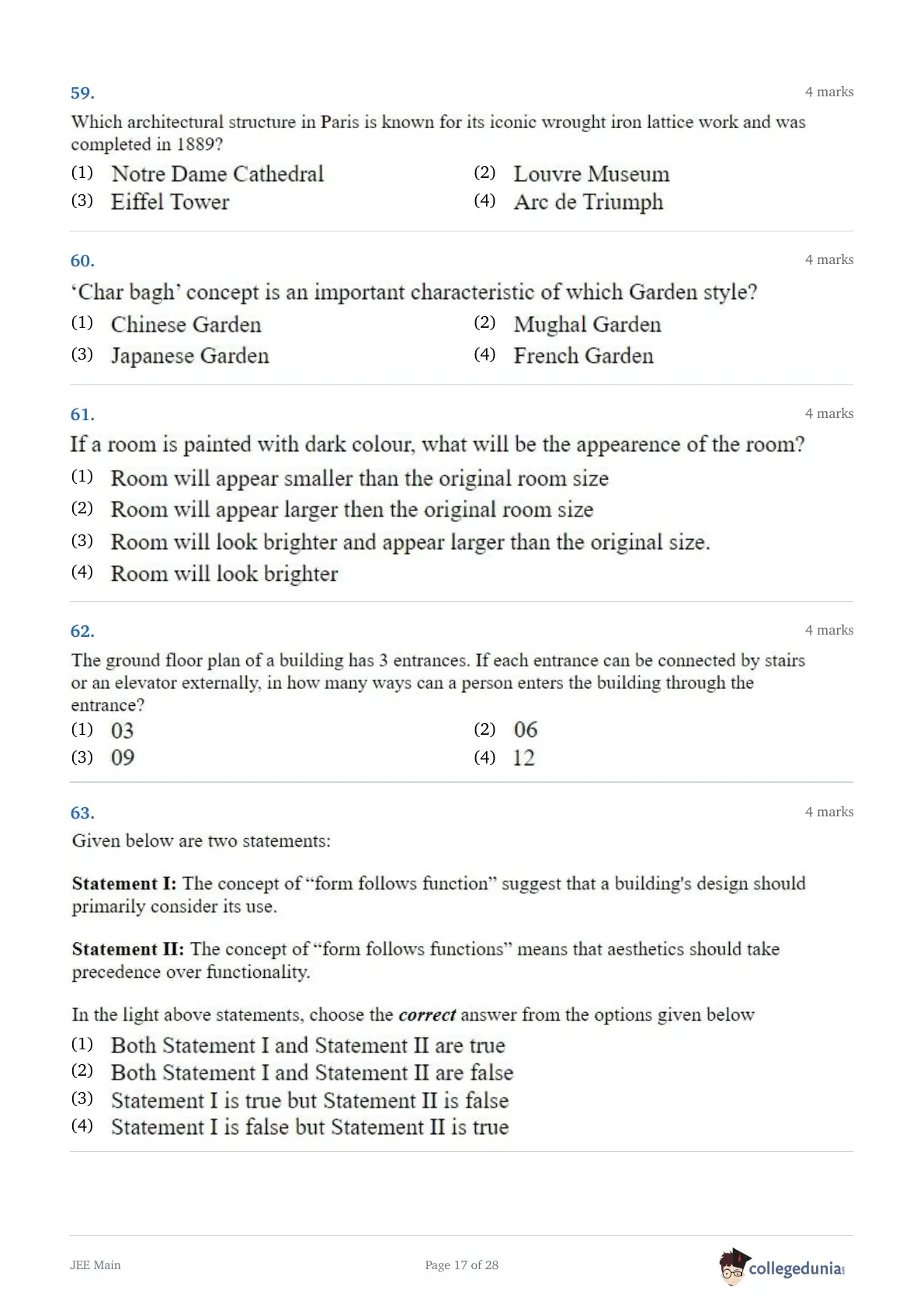
Which architectural structure in Paris is known for its iconic wrought iron lattice work and was completed in 1889?
In which type of garden style is the concept of the four-part garden given importance?
If a room is painted with a dark colour, what will be the appearance of the room?
The ground floor plan of a building has \(3\) entrances. If each entrance can be connected by stairs or an elevator externally, in how many ways can a person enter the building through the entrance?
Given below are two statements:
Statement I: The concept of “form follows function” suggests that a building's design should primarily consider its use.
Statement II: The concept of “form follows function” means that aesthetics should take precedence over functionality.
In the light of the above statements, choose the correct answer from the options given below.
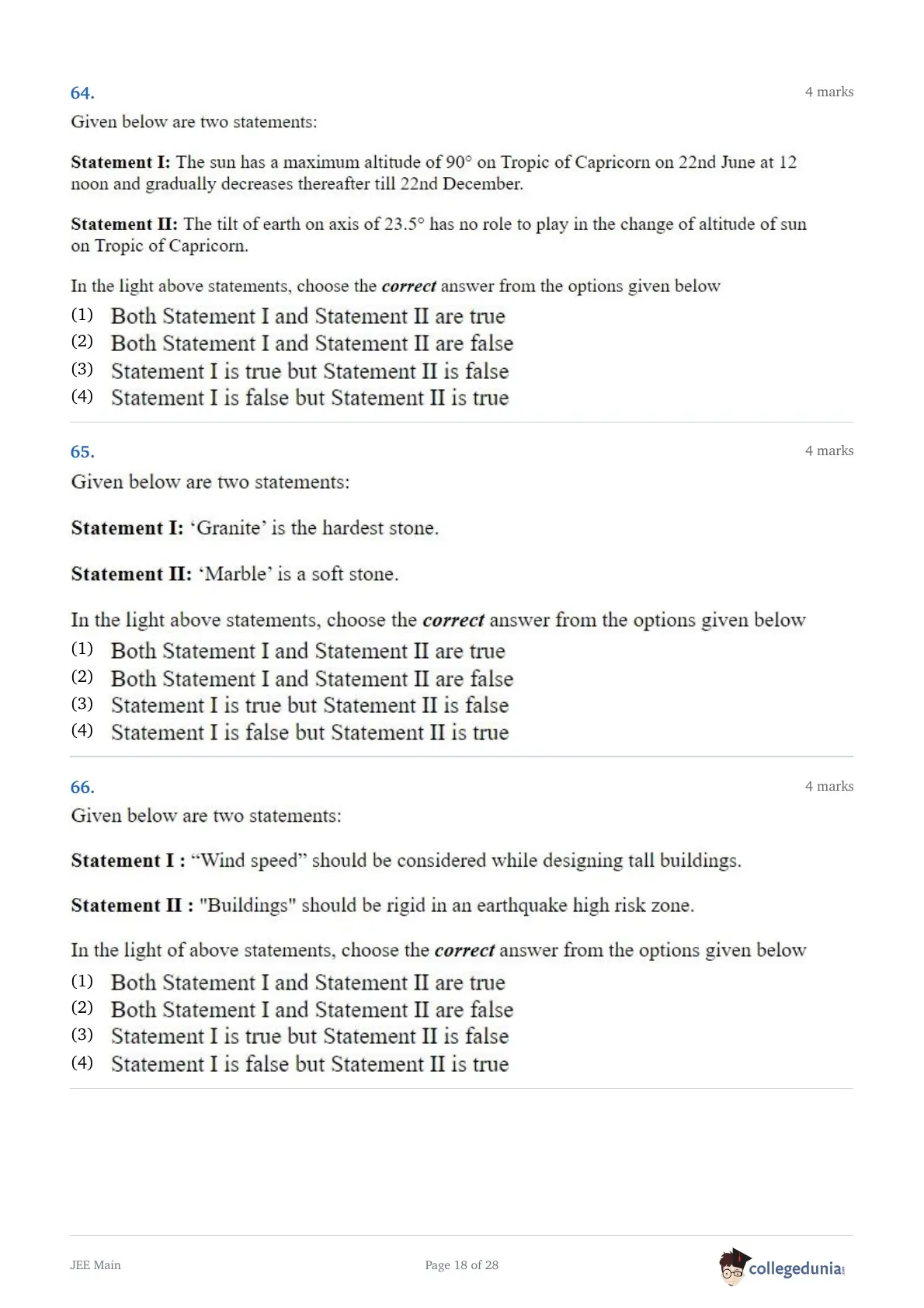
Given below are two statements:
Statement I: The sun has a maximum altitude of \(90^\circ\) on the Tropic of Capricorn on 22nd June at 12 noon and gradually decreases thereafter till 22nd December.
Statement II: The tilt of the Earth on its axis of \(23.5^\circ\) has no role to play in the change of altitude of the sun on the Tropic of Capricorn.
In the light of the above statements, choose the correct answer from the options given below.
Given below are two statements:
Statement I: \(\textit{Granite}\) is the hardest stone.
Statement II:\( \textit{Marble}\) is a soft stone.
In the light of the above statements, choose the correct answer from the options given below.
Given below are two statements:
Statement I: “Wind speed” should be considered while designing tall buildings.
Statement II: “Buildings” should be rigid in an earthquake high risk zone.
In the light of the above statements, choose the correct answer from the options given below.
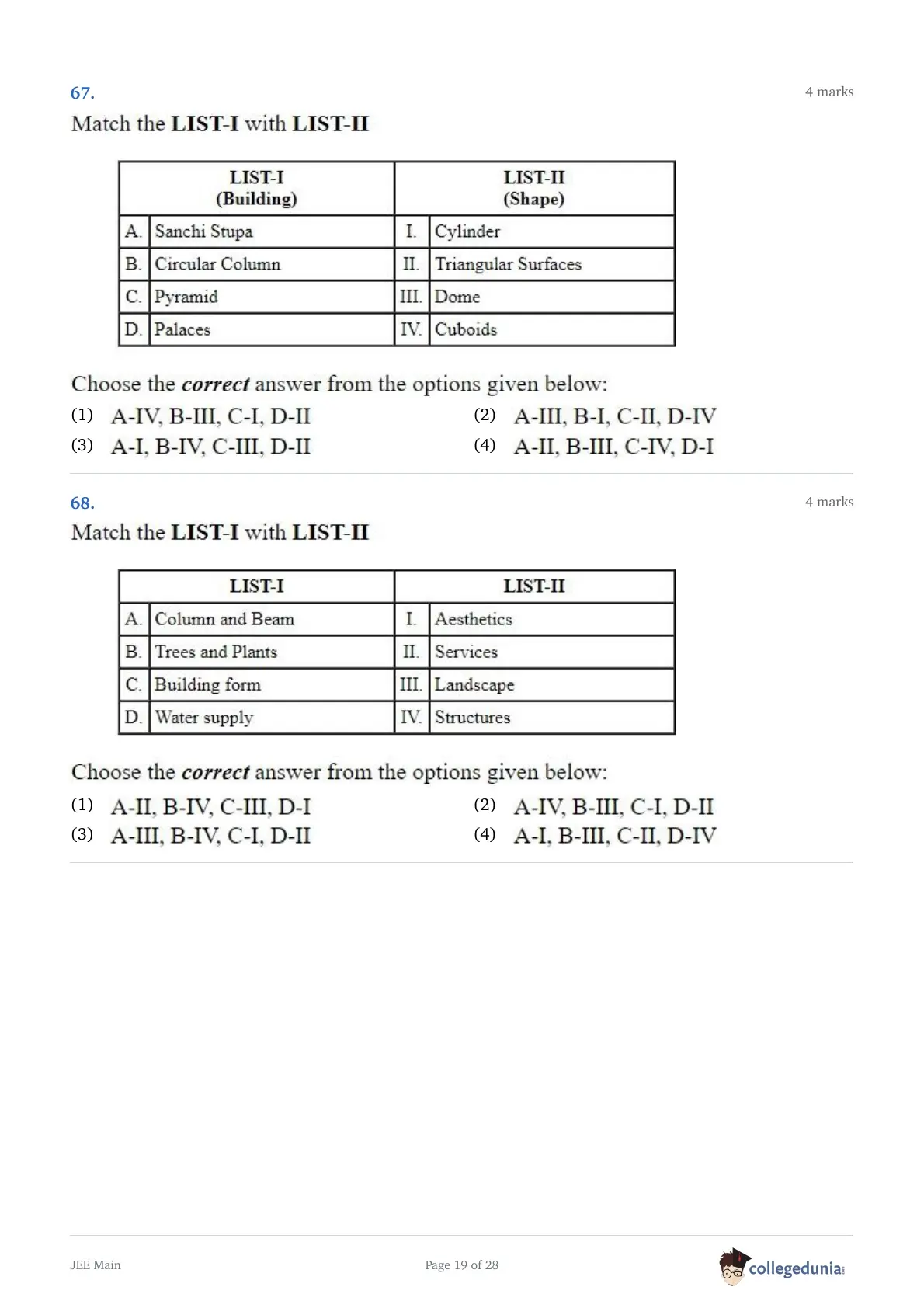
Match the LIST-I with LIST-II and choose the correct answer.
LIST-I (Building)
A. Sanchi Stupa
B. Circular Column
C. Pyramid
D. Palaces
LIST-II (Shape)
I. Cylinder
II. Triangular Surfaces
III. Dome
IV. Cuboids
| LIST-I | LIST-II | ||
| A. | Column and Beam | I. | Aesthetics |
| B. | Trees and Plants | II. | Services |
| C. | Building form | III. | Landscape |
| D. | Water supply | IV. | Structures |
Choose the correct answer from the options given below:
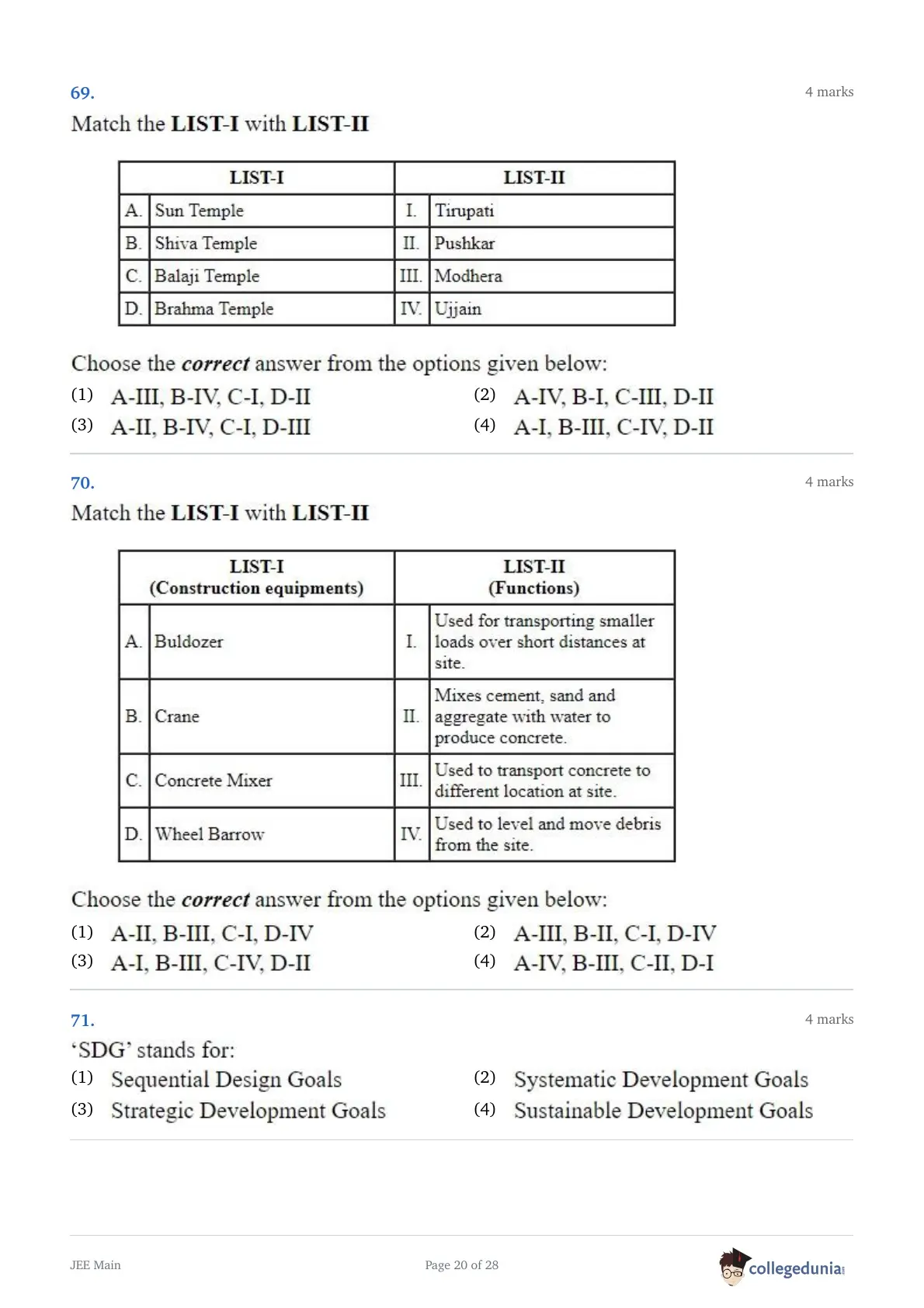
Match the LIST-I with LIST-II and choose the correct answer.
LIST-I (Temple)
A. Sun Temple
B. Shiva Temple
C. Balaji Temple
D. Brahma Temple
LIST-II (Location)
I. Tirupati
II. Pushkar
III. Modhera
IV. Ujjain
Match the LIST-I with LIST-II and choose the correct answer.
LIST-I (Construction Equipments)
A. Bulldozer
B. Crane
C. Concrete Mixer
D. Wheel Barrow
LIST-II (Functions)
I. Used for transporting smaller loads over short distances at site
II. Mixes cement, sand and aggregate with water to produce concrete
III. Used to transport concrete to different locations at site
IV. Used to level and move debris from the site
‘SDG’ stands for:
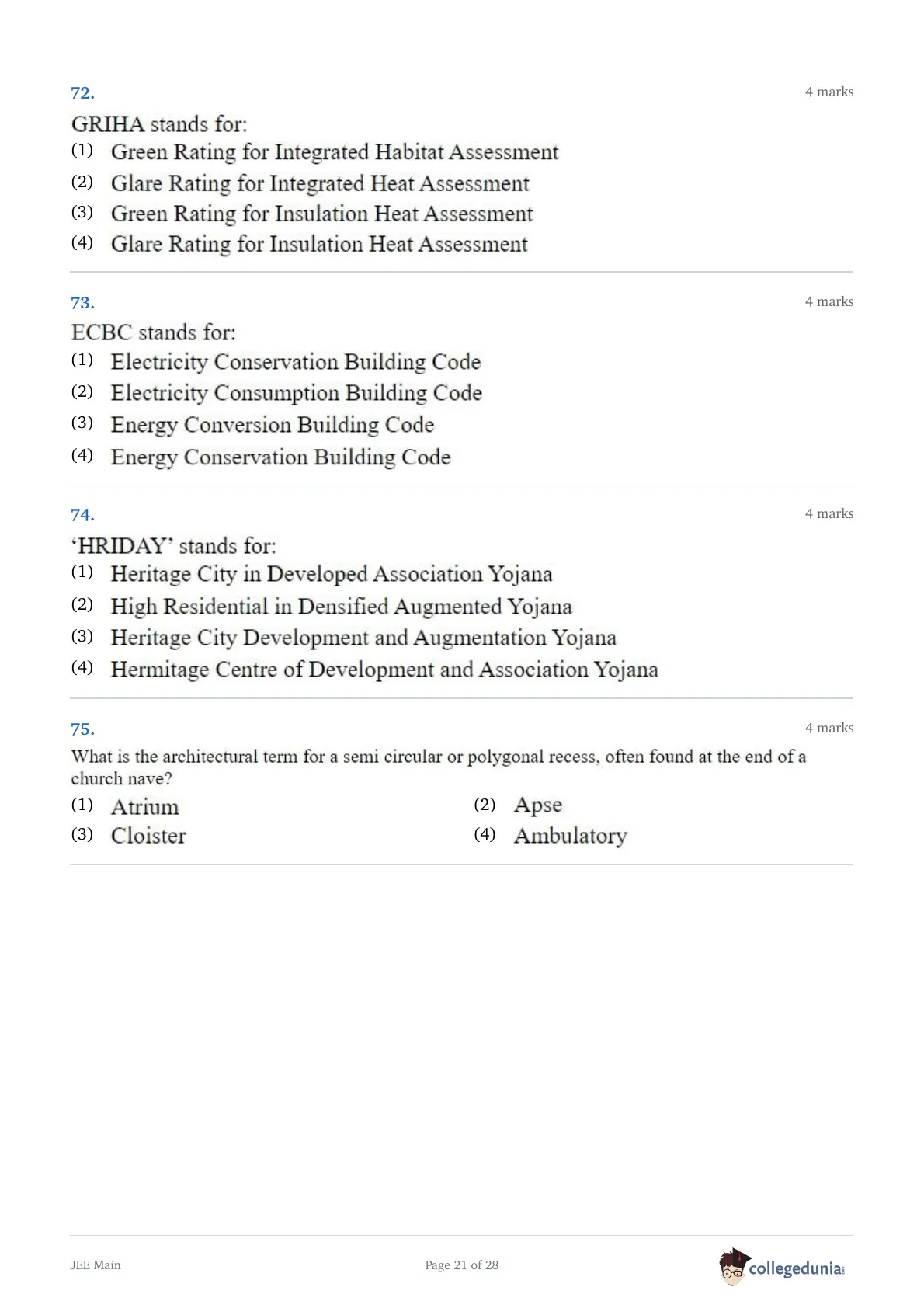
GRIHA stands for:
ECBC stands for:
‘HRIDAY’ stands for:
What is the architectural term for a semi-circular or polygonal recess, often found at the end of a church nave?
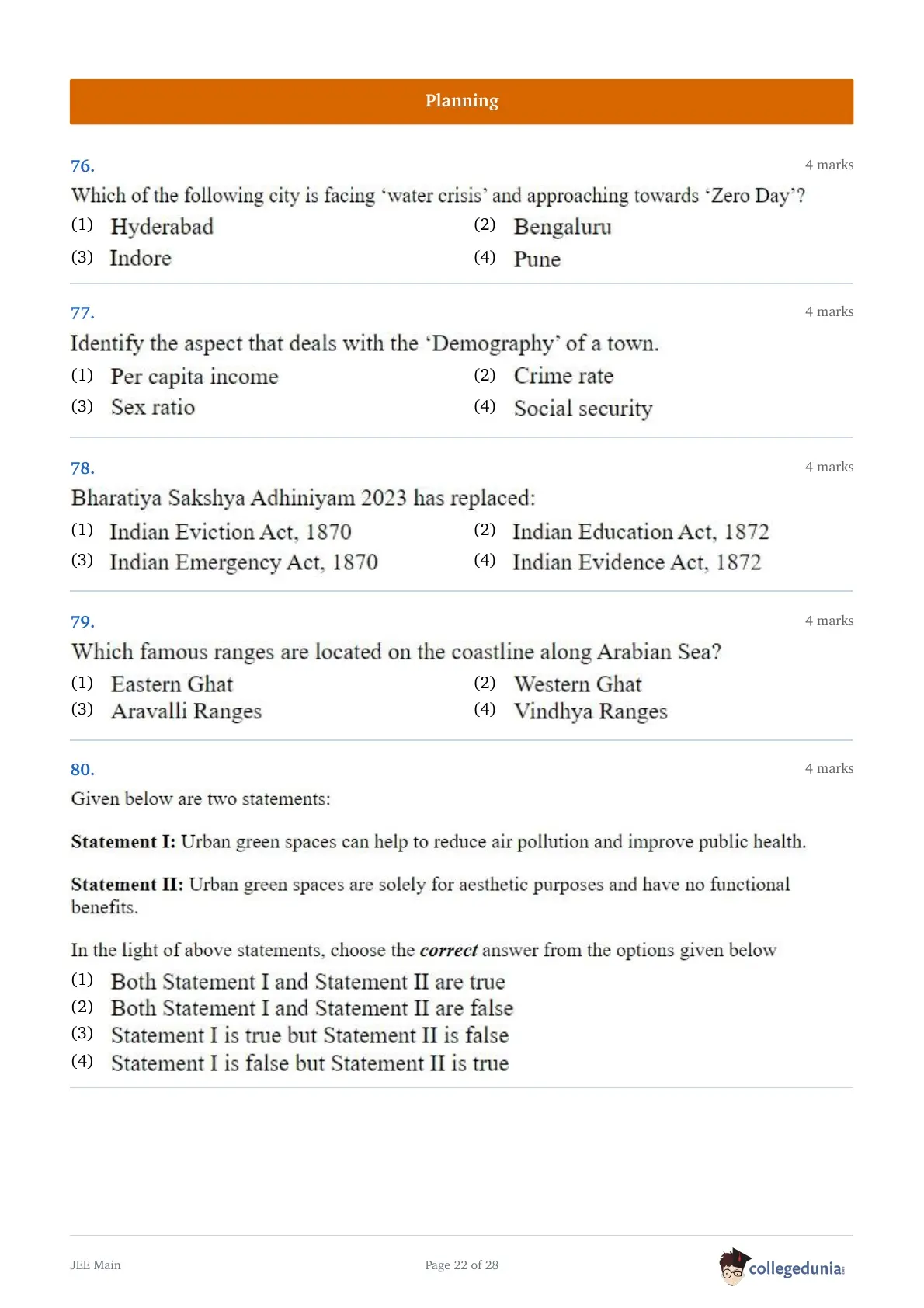
Planning (Q76 - Q100)
Which of the following city is facing a ‘water crisis’ and approaching towards ‘Zero Day’?
Identify the aspect that deals with the ‘Demography’ of a town.
Bharatiya Sakshya Adhiniyam, 2023 has replaced:
Which famous ranges are located on the coastline along Arabian Sea?
Given below are two statements:
Statement I: Urban green spaces can help to reduce air pollution and improve public health.
Statement II: Urban green spaces are solely for aesthetic purposes and have no functional benefits.
In the light of the above statements, choose the correct answer from the options given below:
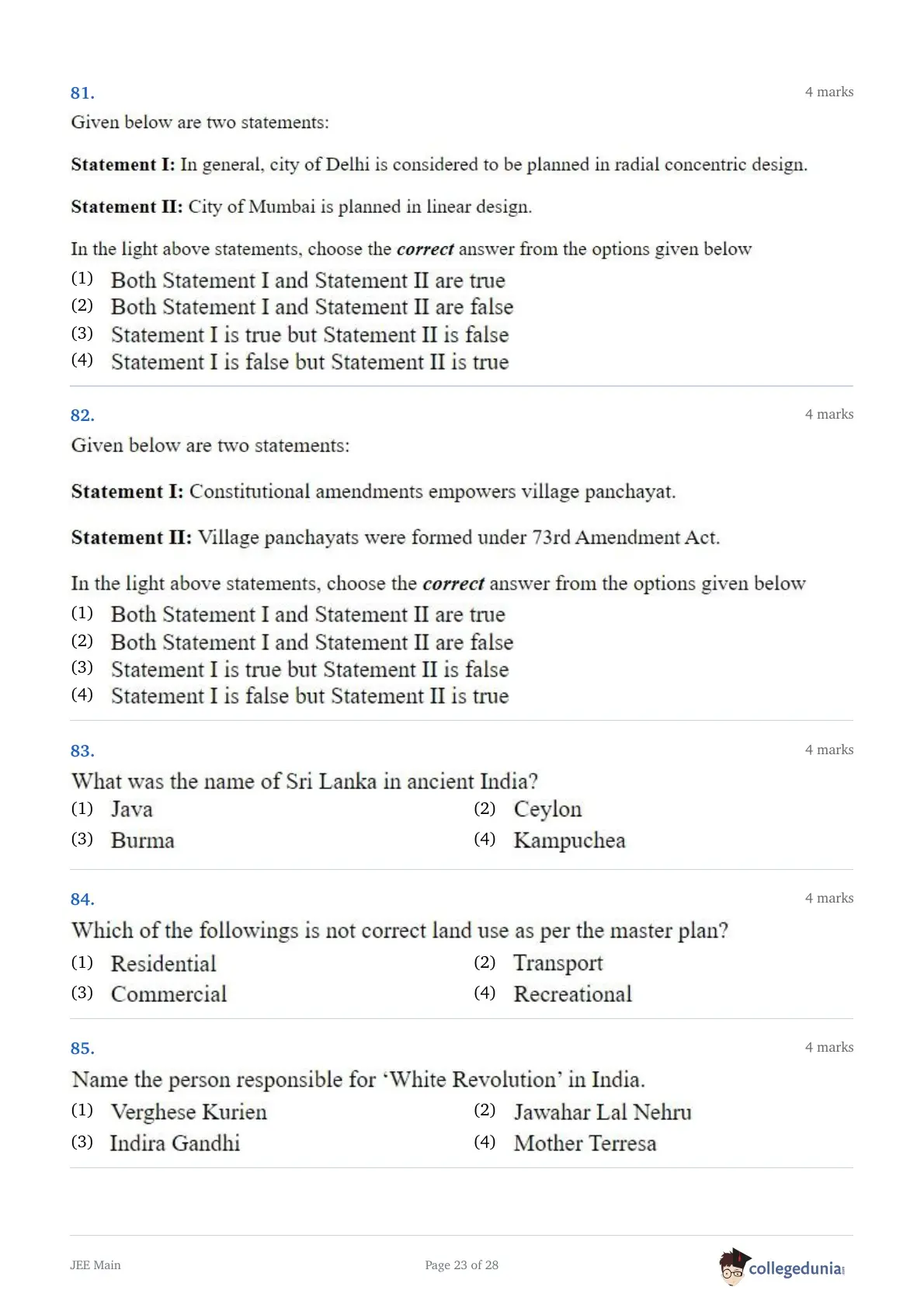
Given below are two statements:
Statement I: In general, city of Delhi is considered to be planned in radial concentric design.
Statement II: City of Mumbai is planned in linear design.
In the light of above statements, choose the correct answer from the options given below:
Given below are two statements:
Statement I: Constitutional amendments empower village panchayat.
Statement II: Village panchayats were formed under 73rd Amendment Act.
In the light of above statements, choose the correct answer from the options given below:
What was the name of Sri Lanka in ancient India?
Which of the followings is not correct land use as per the master plan?
Name the person responsible for ‘White Revolution’ in India.
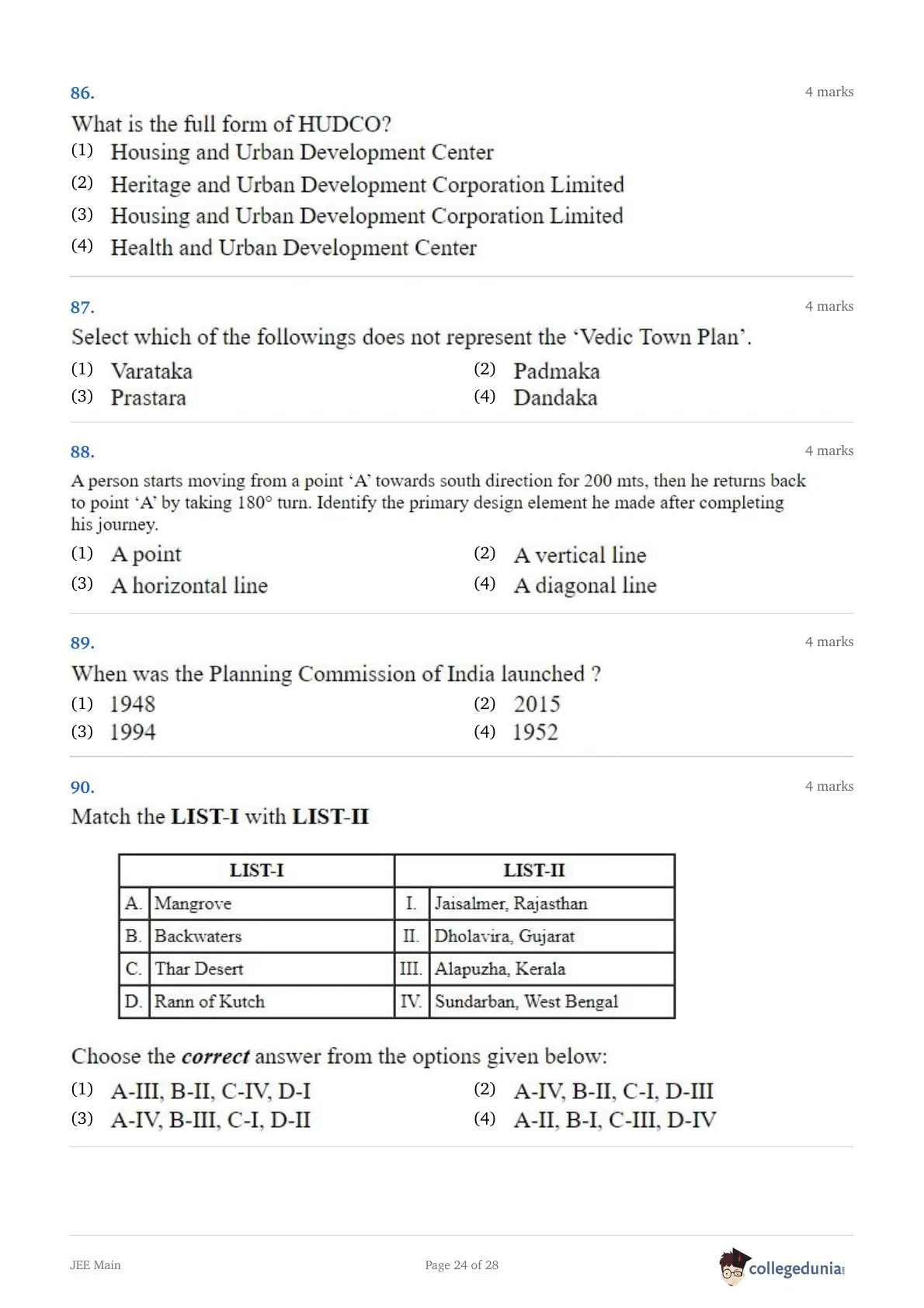
What is the full form of HUDCO?
Select which of the followings does not represent the ‘Vedic Town Plan’.
A person starts moving from a point ‘A’ towards south direction for 200 mts, then he returns back to point ‘A’ by taking 180° turn. Identify the primary design element he made after completing his journey.
When was the Planning Commission of India launched?
| LIST-I | LIST-II | ||
| A. | Mangrove | I. | Jaisalmer, Rajasthan |
| B. | Backwaters | II. | Dholavira, Gujarat |
| C. | Thar Desert | III. | Alapuzha, Kerala |
| D. | Rann of Kutch | IV. | Sundarban, West Bengal |
Choose the correct answer from the options given below:
| LIST-I | LIST-II | ||
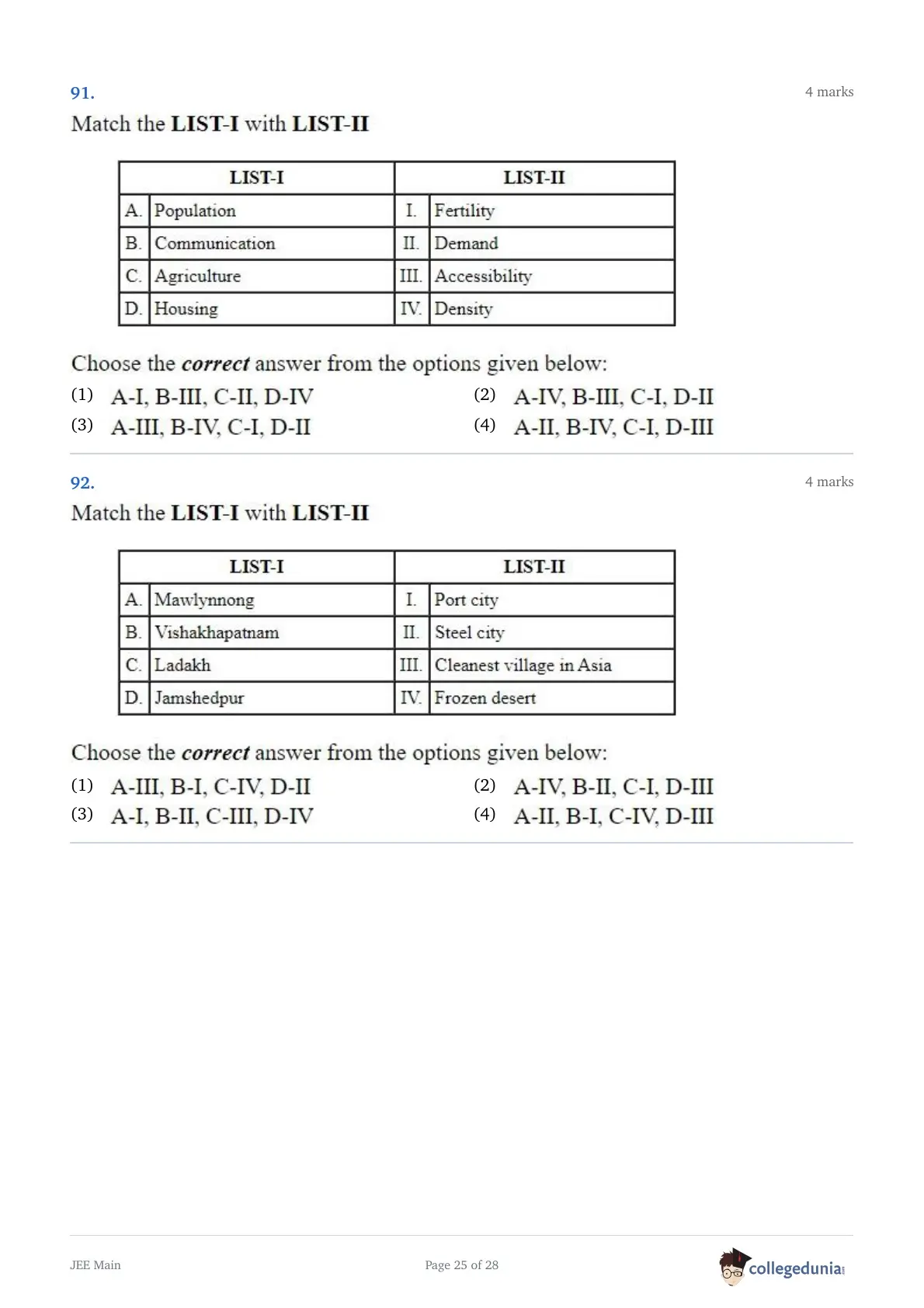
| A. | Population | I. | Fertility |
| B. | Communication | II. | Demand |
| C. | Agriculture | III. | Accessibility |
| D. | Housing | IV. | Density |
Choose the correct answer from the options given below:
Match the LIST–I with LIST–II.
 Choose the correct answer from the options given below:
Match the LIST–I with LIST–II.
 Choose the correct answer from the options given below:
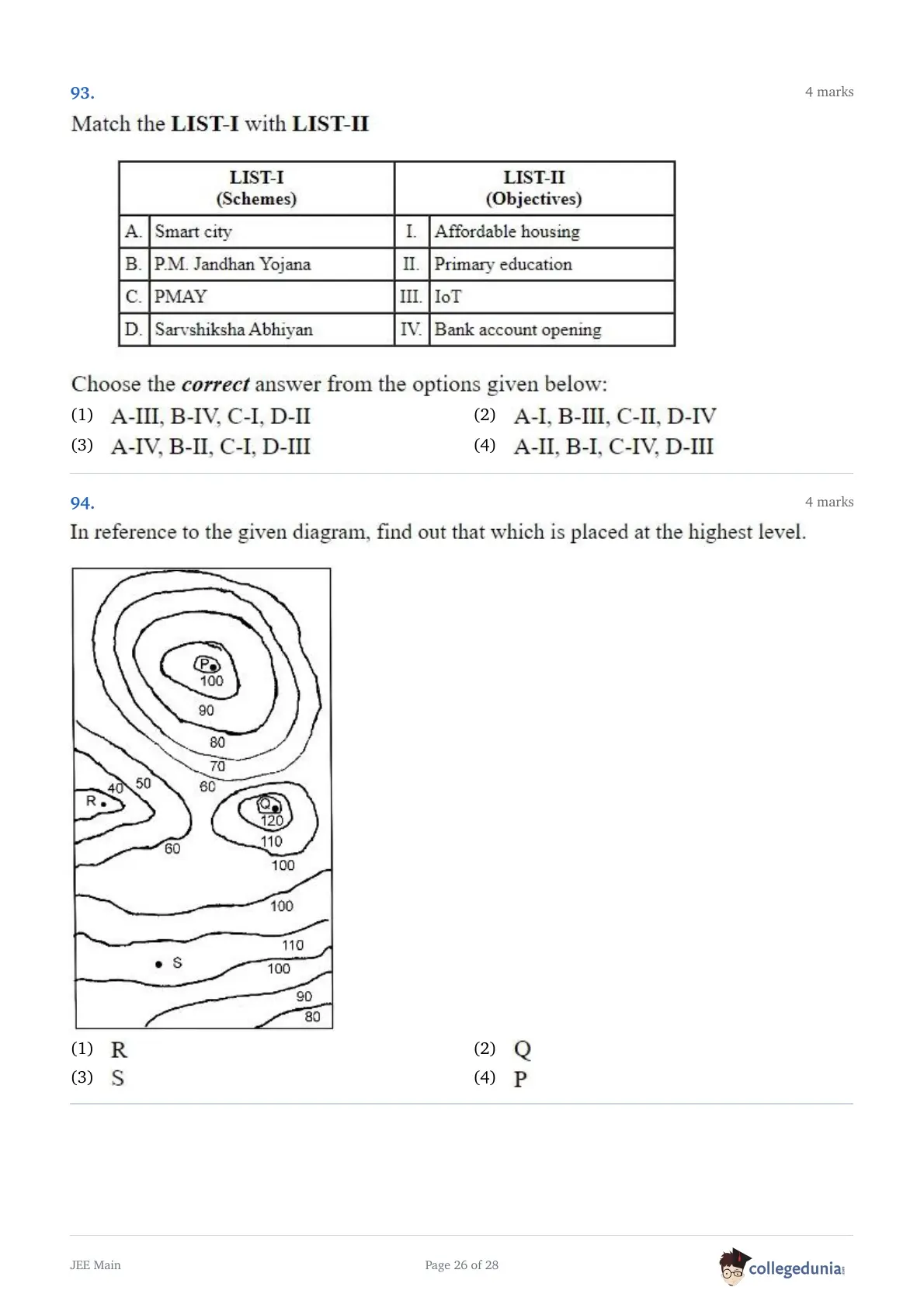
In reference to the given diagram, find out that which is placed at the highest level.
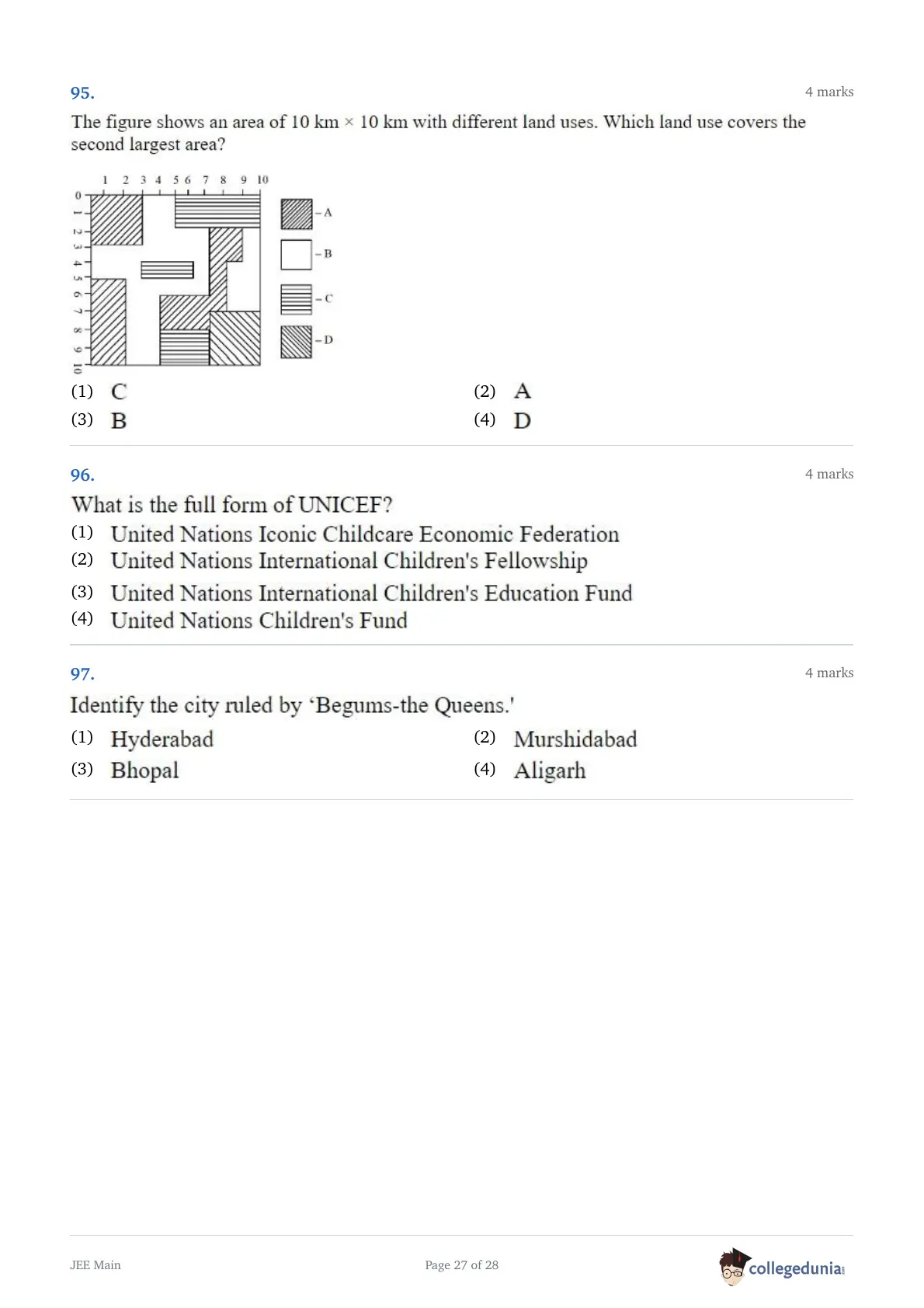
The figure shows an area of \(10 \text{ km} \times 10 \text{ km}\) with different land uses. Which land use covers the second largest area?

What is the full form of UNICEF?
Identify the city ruled by ‘Begums-the Queens.’
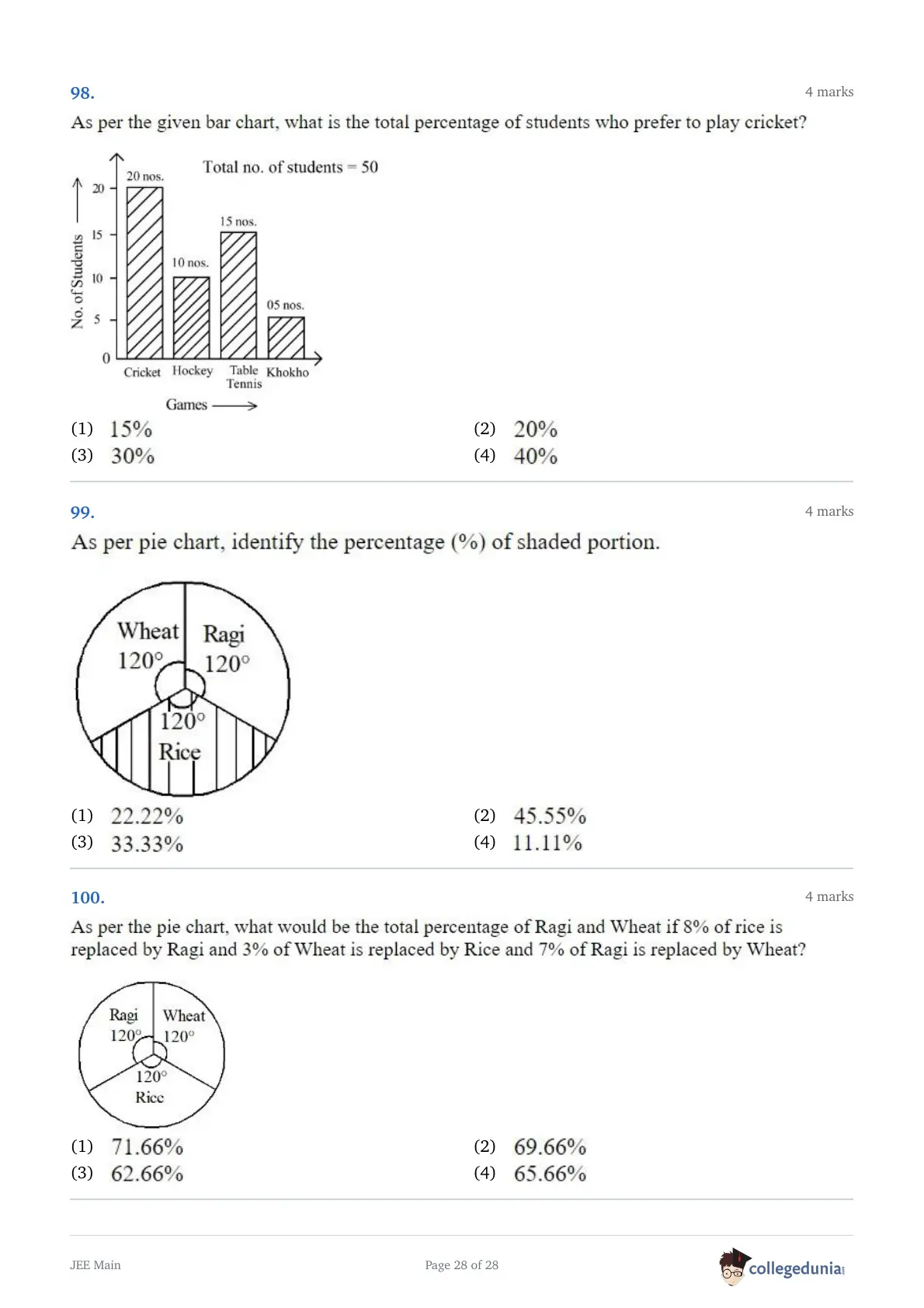
As per the given bar chart, what is the total percentage of students who prefer to play cricket?

As per the given pie chart, identify the percentage (%) of the shaded portion.

As per the pie chart, what would be the total percentage of Ragi and Wheat if 8% of rice is replaced by Ragi and 3% of Wheat is replaced by Rice and 7% of Ragi is replaced by Wheat?
JEE Main 2025 B.Planning (Paper 2B) Exam Pattern and Marking Scheme
| Particulars | Details |
|---|---|
| Exam Mode | Online (Computer-Based Test) for Mathematics and Aptitude; Drawing Test on paper |
| Paper | B.Planning (Paper 2B) |
| Duration | 3 hours (180 minutes) |
| Type of Questions | Multiple Choice Questions (MCQs), numerical value questions |
| Subjects | Mathematics, Aptitude Test, Planning |
| Total Questions | 100 questions |
| Total Marks | 400 marks |
| Marking Scheme | +4 for correct answer & -1 for incorrect answer; 0 for unattempted |
JEE Main B.Planning 2025 April 9 Answer Key: Coaching Institute PDF
| Coaching Institutes | Question Paper with Solutions PDF |
|---|---|
| Aakash BYJUs | Download |
| Allen Institute | Download |
| Resonance | Download |
| Vedantu | Download |
| Sri Chaitanya | Download |
JEE Main 2025 B.Arch And B.Planning Difficulty Level Analysis(Expected)
| Subject | Session 1 (January 30, 2025) | Session 2 (April 9, 2025) | Total Questions |
| Mathematics | Difficult | Easy to Moderate | 30 |
| Aptitude | Moderate | Easy | 50 |
| Planning | Difficult | Moderate | 25 |
| Overall | Moderate to Difficult | Easy to Moderate | 105 |
JEE Main 2025 Paper 2 Session 2 Cutoff (Expected)
| Category | Session 1 (January 2025) | Session 2 (April 2025) |
| General (Open) | 70 - 80 | 80 - 90 |
| OBC-NCL | 65 - 75 | 75 - 85 |
| SC | 50 - 60 | 60 - 70 |
| ST | 45 - 55 | 55 - 65 |
| PwD (General) | 30 - 40 | 40 - 50 |
| PwD (Reserved) | 30 - 40 | 40 - 50 |



Comments