




With CLAT 2027 scheduled for Sunday, 6 December 2026 (2:00 PM to 4:00 PM), less than a month remains. At this stage, success depends less on finishing every book and more on sharpening accuracy, mastering passage-reading speed, and revising current affairs smartly. The last few days should be spent on the five core sections: English Language, Current Affairs including General Knowledge, Legal Reasoning, Logical Reasoning, and Quantitative Techniques.
- For CLAT Legal Reasoning and Logical Reasoning, which together make up nearly 50% of the paper, solve passage-based sets daily and learn to identify the principle or argument structure quickly.
- For English Language and Current Affairs, dedicate 45 to 60 minutes every day to reading editorials from The Hindu or The Indian Express, legal columns, and long-form essays.
- For Quantitative Techniques, revise Class 10-level basics (percentages, ratio, average, profit and loss, data interpretation) and attempt only the questions you can solve confidently.
- Solve Previous Year Papers (PYQs) to understand how question patterns repeat and how to manage your time across all five sections.
- Finally, take full-length mock tests in the 2:00 PM to 4:00 PM slot and keep negative marking (-0.25 per wrong answer) in mind while attempting.
You must prioritise the sections of the CLAT paper based on your weaknesses and affinity. A winning last-month strategy is simple: revise what you know, practise under timed conditions, analyse every mistake, and avoid starting anything new in the final week.
Related Links:
- CLAT Question Paper: Check Previous Year Question Papers with Solution PDF
- CLAT Mock Test 2027: Attempt Online Free Mock Test, Section-wise
- CLAT PYQs: Practice Chapter-Wise CLAT Previous Year Questions for English, Legal Aptitude, Reasoning & GK
CLAT 2027 Preparation Tips: Last 1 Month Overview
Preparing for CLAT 2027 in the last month can feel stressful, but a clear plan with fixed daily targets removes most of the confusion. Break the remaining days into four short phases.
CLAT 2027 Preparation Tips: Step-by-Step Last-Month Roadmap
Phase 1: Know the Exam Pattern & Your Starting Point
- Know the Marking Scheme: CLAT UG is a 120-minute, pen-and-paper (OMR) test with 120 passage-based MCQs (120 marks). You earn +1 mark for each correct answer, and -0.25 mark is deducted for every incorrect answer. There is no penalty for unattempted questions.
- Take a Diagnostic Mock Now: Attempt one full-length paper in the first two days. Note your section-wise accuracy and time taken, and treat this as your baseline.
Check: CLAT 2027 Preparation Strategy to Score 85+: Get a Good Rank and Check Top Colleges
Phase 2: Fix the High-Weightage Sections
- Prioritise Legal Reasoning and Current Affairs: Together they carry roughly 50% of the paper. Daily passage practice here gives the fastest score improvement.
- Revise, Don't Restart: Use the notes, books, and sources you already have. Switching to new material in the last month wastes time.
- Make One-Page Notes: Prepare short sheets for legal maxims and principles, important constitutional provisions, vocabulary, quant formulas, and current affairs.
Also Check:
- CLAT English Syllabus: Subject-Wise Topics, Section Weightage and PDF Download
- CLAT Legal Reasoning Syllabus: Subject-Wise Topics, Section-Wise Weightage and PDF Download
Phase 3: Timed Practice
- Passage-Based Sets Daily: Solve 4–5 passages per sitting with a timer. CLAT rewards fast, accurate reading more than deep theory.
- Daily Current Affairs: Spend 45–60 minutes on newspapers and revision of the past 10–12 months of news.
- Sharpen Logical Reasoning: Practise critical reasoning (assumptions, strengthen/weaken, inference) and analogy or puzzle sets, as the section is largely passage-based.
Also Check:
- CLAT GK Syllabus: Subject-Wise Topics, Section Weightage and PDF Download
- CLAT Quant Syllabus: Subject-Wise Topics, Weightage and PDF Download
- CLAT Logical Reasoning Syllabus: Subject-Wise Topics, Section Weightage and PDF Download
Phase 4: Mocks & Final Revision
- Solve Previous Years' Papers (PYQs): Attempt the last 4–5 CLAT UG papers to understand passage style, difficulty, and the weight of each section.
- Take Timed Full-Length Mocks: Take one full mock every alternate day, strictly between 2:00 PM and 4:00 PM, to train your body clock.
- Analyse Every Mock: Spend at least one hour after each test sorting mistakes into conceptual gaps, careless errors, and time-pressure errors.
Ques. Is CLAT 2027 going to be hard?
Ans. CLAT 2027 is expected to be a moderate-to-high difficulty exam. It tests your reading speed and analytical reasoning rather than heavy memorisation. So always stay updated with recent events, legal acts and judgments.
How to crack CLAT 2027 on the first attempt?
Clearing CLAT 2027 on your first attempt in a short time depends on strong passage-reading speed, smart question selection, and strict control over negative marking.
| Strategy Phase | Objective | Execution Plan | First-Attempt Mastery Metric |
|---|---|---|---|
| 1. Pattern Mastery & Baseline (Days 1–2) | Understand the paper and your current level. | Learn section-wise question counts and the +1 / -0.25 marking scheme. | Clear list of weak and strong sections. |
| Attempt one full-length diagnostic mock and log the results. | |||
| 2. Core Revision (Days 3–10) | Close the biggest gaps in the highest-weightage sections. | Legal Reasoning: revise principles, maxims, and landmark legal developments. | All notes and formula sheets ready by Day 10. |
| Current Affairs: complete a topic-wise revision of the last 10–12 months. | |||
| Create 1-page notes for vocabulary, quant formulas, and static GK. | |||
| 3. Section-Wise Tactics (Days 11–17) | Increase speed and accuracy section by section. | Legal and Logical: solve 4–5 timed passages daily. | Around 8–9 minutes per passage with 80%+ accuracy. |
| English: read 2–3 editorials daily and solve 2 RC passages. | |||
| Quant: solve 10–15 data-based questions daily, targeting easy and moderate sets. | |||
| 4. PYQs & High-Yield Mocks (Days 18–23) | Train under real exam pressure. | Solve 4–5 years of CLAT UG previous year papers. | Consistent mock scores with a low negative-marking loss. |
| Take full-length mocks in the 2:00 PM to 4:00 PM slot. | |||
| Review every mock and update your error log. | |||
| 5. Exam-Day Execution (Days 24–25 and Exam Day) | Follow a fixed, tested attempt order. | Start with your strongest section to build momentum. | Leave doubtful questions unattempted to avoid negative marks. |
| Move to the lengthy passage sections with a strict time cap per passage. | |||
| Keep the last 8–10 minutes for OMR checking and marking. |
Also Read:
CLAT 2027: Timetable to crack CLAT 2027
To crack the CLAT entrance exam it is important to have a proper study plan. We have provided a daily study plan below. However, you can adjust the timings as per your need based on the preparation.
| Topic | Preferred Time Allotment |
|---|---|
| Reading Newspaper | 1.5 hours |
| Topics from Error Log | 1 hour |
| Vocabulary (High-frequency words, Regular Newspaper reading) | 45 mins |
| Current Legal Knowledge | 45 mins |
| Mathematics | 1.5 hours |
| GMAT Official Guide | 1.5 hour |
| Revising today's topics and preparing for tomorrow's topics | 2 hours |
| Puzzles/Analytical Reasoning | 30 mins |
| Passages & Grammar | 1.5 hours |
| Revision for the day and planning for the next day | 1.5 hours |
| Practice Mock Tests | Twice a Week |
| CLAT Mock Tests | Once in a week |
Also Check:
- CLAT Current Affairs & GK Sample Paper: Last 5 Years PYQs PDF Download and Subject Wise Weightage
- CLAT Legal Reasoning Sample Paper: Last 5 Years PYQs PDF Download and Subject Wise Weightage
A Reddit user asked “guys any tips for the prep for clat 2027”
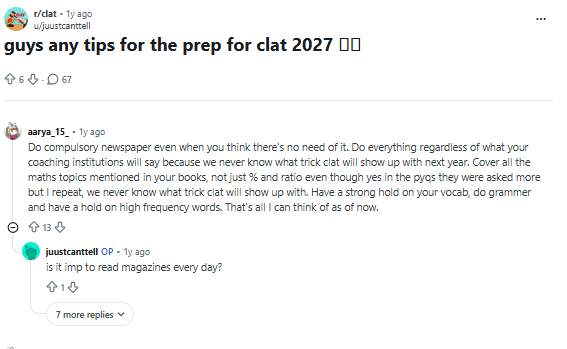
To this multiple ushered responded saying: Do compulsory newspaper even when you think there's no need of it.
Another user said: you dont really need a coaching class, just mocks and materials (materials too incase you want to solve sectionals)
Source: Reddit
CLAT 2027 Preparation: Section-wise Prep Tips
CLAT UG tests reading, reasoning, and awareness through passage-based questions. With limited time, candidates should match their effort to each section's weightage and their own strengths.
CLAT 2027 Legal Reasoning Tips
| Subject / Section | Weightage | Focused Topics & Preparation Strategy | Standard Recommended Books |
|---|---|---|---|
| Legal Reasoning | Approx. 25% (28–32 questions) | Practise applying a given legal principle to a fact situation. Revise basics of law of torts, contracts, criminal law, and constitutional law, along with important legal maxims and recent legal developments. Solve 3–4 passages daily and justify each answer using only the passage. | • Legal Aptitude for CLAT by A.P. Bhardwaj • Universal's Guide to CLAT |
| Recommended Overall Guide | — | Previous years' CLAT legal reasoning passages and mocks. | • CLAT previous year question papers with solutions |
CLAT 2027 Current Affairs including General Knowledge Tips
| Subject / Section | Weightage | Focused Topics & Preparation Strategy | Standard Recommended Books |
|---|---|---|---|
| Current Affairs, including General Knowledge | Approx. 25% (28–32 questions) | Revise national and international events, government schemes, important judgments, appointments, awards, sports, and summits of the last 10–12 months. Add static GK linked to current news such as the Constitution, international organisations, and geography. Revise daily and make short topic-wise notes. | • The Hindu / The Indian Express (editorial and national pages) • Monthly current affairs digests |
| Recommended Overall Guide | — | Topic-wise current affairs revision with quizzes. | • Latest monthly compilations and CLAT-specific GK guides |
Related Links:
- CLAT Legal Reasoning Preparation: Important Topics, Preparation Tips, Books, Questions
- How to Prepare for CLAT English: Important Topics, Tips, Books, Pattern
CLAT 2027 Logical Reasoning Tips
| Subject / Section | Weightage | Focused Topics & Preparation Strategy | Standard Recommended Books |
|---|---|---|---|
| Logical Reasoning | Approx. 20% (22–26 questions) | Concentrate on critical reasoning: identifying premises and conclusions, assumptions, inferences, strengthening and weakening arguments, and analogies. Practise short passage sets daily and avoid spending more than 7–8 minutes on one passage. | • Analytical Reasoning by M.K. Pandey • A Modern Approach to Verbal & Non-Verbal Reasoning by R.S. Aggarwal |
| Recommended Overall Guide | — | Timed passage sets from previous years' papers. | • CLAT previous year question papers with solutions |
CLAT 2027 English Language Tips
| Subject / Section | Weightage | Focused Topics & Preparation Strategy | Standard Recommended Books |
|---|---|---|---|
| English Language | Approx. 20% (22–26 questions) | Focus on reading comprehension: main idea, inference, tone, and vocabulary in context. Read 2–3 editorials daily at a steady pace and revise high-frequency words, idioms, and phrases. Grammar is tested through passages, so focus on sentence meaning rather than rules alone. | • Word Power Made Easy by Norman Lewis • Daily editorials from The Hindu / The Indian Express |
| Recommended Overall Guide | — | Timed RC sets from previous years' papers. | • CLAT previous year question papers with solutions |
Also Check:
- CLAT Logical Reasoning Preparations: Important Topics, Preparation Tips, Books
- CLAT Quant Preparation 2027: Syllabus, Important Topics, Best Books, Study Plan and Strategy
CLAT 2027 Quantitative Techniques Tips
| Subject / Section | Weightage | Focused Topics & Preparation Strategy | Standard Recommended Books |
|---|---|---|---|
| Quantitative Techniques | Approx. 10% (10–14 questions) | Questions are based on short data sets such as graphs, tables, and passages, with Class 10-level maths. Revise percentages, ratio and proportion, averages, profit and loss, simple and compound interest, time and work, and basic algebra and mensuration. Aim to secure accuracy here without sacrificing time from other sections. | • NCERT Mathematics (Class 8–10) • Quantitative Aptitude by R.S. Aggarwal |
| Recommended Overall Guide | — | Data interpretation sets from previous years' papers. | • CLAT previous year question papers with solutions |
Related Links:
- CLAT Logical Reasoning Mock Test 2027: Attempt Free Online Mock Test and Topic-wise Tests
- CLAT Quantitative Techniques Mock Test 2027: Attempt Free Online Mock Test and Topic-wise Tests
- CLAT English Language Mock Test 2027: Attempt Free Online Mock Test and Topic-wise Tests
- CLAT Current Affairs and GK Mock Test 2027: Attempt Free Online Mock Test and Topic-wise Tests
CLAT 2027 Preparation: Section-wise Time Allocation
CLAT gives 120 minutes for 120 questions, which means about one minute per question, but passages take longer than the questions that follow them. Plan your time by section during mocks and follow the same split on exam day.
- The suggested split below is a practice guideline. Adjust it after two or three mocks based on your strong and weak sections.
| Section | Approx. Questions | Suggested Time | Preparation Strategy |
|---|---|---|---|
| English Language | 22–26 | 22–25 minutes | Read the questions first, then skim the passage. Skip dense passages and return to them later. |
| Current Affairs including GK | 28–32 | 18–20 minutes | These are knowledge-based, so answer quickly and do not guess without eliminating at least two options. |
| Legal Reasoning | 28–32 | 32–35 minutes | Apply only the principle given in the passage. Do not bring in outside legal knowledge unless the passage allows it. |
| Logical Reasoning | 22–26 | 25–28 minutes | Identify the conclusion first, then check each option against the argument. |
| Quantitative Techniques | 10–14 | 10–12 minutes | Solve easy and moderate sets only. Skip long calculations. |
Also Check:
CLAT 2027 Preparation: Previous Year Papers
Solving previous year question papers is the most effective use of the last month. It helps candidates understand passage length, the difficulty of legal and logical sets, and how current affairs questions are framed. Attempt each paper in one sitting, in 120 minutes, and review it fully.
CLAT 2027 Preparation: Mock Test
Mock tests are the backbone of last-month CLAT preparation. They build reading stamina, show your real accuracy, and help you decide which questions to skip. Aim for 8–10 full-length mocks before the exam, with a detailed review after each.
| Subject | Mock tests |
|---|---|
| Legal Reasoning Mock Test | CLAT Legal Reasoning Mock Test |
| Current Affairs & GK Mock Test | CLAT Current Affairs Mock Test |
| Logical Reasoning Mock Test | CLAT Logical Reasoning Mock Test |
| English Language Mock Test | CLAT English Mock Test 1 |
| Quantitative Techniques Mock Test | CLAT Quantitative Techniques Mock Test 1 |
Can I Prepare for CLAT 2027 in the last 1 month?
Yes, you can still make a strong improvement in the last month, provided you follow a disciplined plan and avoid starting new material. CLAT is a skill-based exam, so speed, comprehension, and accuracy can improve noticeably in 3–4 weeks of focused daily practice. The 25-day plan below runs from 11 November to the exam on 6 December.
CLAT 2027 Preparation: Last Minute Preparation Tips
In the final 7–10 days before CLAT 2027, candidates should concentrate on revision, mock tests, and exam-day readiness rather than new topics.
- As the exam approaches, avoid starting new books, avoid comparing your scores with others, and focus on strengthening what you already know.
| Last-Minute Focus Area | Actionable Execution Strategy | Impact on Final Score |
|---|---|---|
| Zero New Concepts | Stop starting new chapters or sources. Consolidate the material you have already covered. | Prevents anxiety and confusion right before the exam. |
| Current Affairs Rapid Revision | Revise your short notes on the past 10–12 months, with special attention to the last 3 months, for 1–1.5 hours daily. | Secures the easy marks in the 28–32-question current affairs section. |
| One-Page Notes Revision | Go through legal maxims, principles, vocabulary lists, and quant formulas twice a day. | Improves recall speed during the 120-minute paper. |
| Exam Attempt Strategy | Start with the section you find easiest to build confidence and save time. | Locks in easy marks early without getting stuck on a difficult passage. |
| Set a maximum time per passage and move on when you reach it. | ||
| Keep the last 8–10 minutes for OMR checking and for returning to skipped questions. | ||
| Strict Negative Marking Control | With +1 / -0.25 marking, attempt a doubtful question only if you can eliminate at least two options with reasoning. | Reduces unnecessary deductions that lower your rank. |
| Exam Slot Simulation | Take at least two full mocks between 2:00 PM and 4:00 PM, using an OMR-style sheet and a pen. | Builds comfort with the pen-and-paper format and the exam timing. |
| Logistics & Admit Card Readiness | Download and print your CLAT admit card, keep a valid government photo ID, and check the route and travel time to your exam centre in advance. | Eliminates last-minute panic on exam day. |
Common mistakes to avoid during CLAT 2027 Preparation
Avoiding common mistakes in the last month is just as important as studying the right topics.
- Candidates should manage negative marking, practise timed passages, revise current affairs regularly, and review every mock carefully.
| Category | Common Mistake | Why It Reduces Your Score | Corrective Strategy |
|---|---|---|---|
| Negative Marking Management | Random Guessing | CLAT follows a +1 / -0.25 scheme. Every four wrong guesses cancel out one correct answer. | Attempt a doubtful question only after eliminating at least two options with a clear reason. |
| Preparation Strategy | Starting New Books | Switching to fresh material in the last month leaves no time to revise or practise what you already know. | Stick to your existing notes, previous years' papers, and mocks. |
| Practice Habits | Practising Without a Timer | CLAT is a speed-reading test with long passages. Untimed practice hides your real pace. | Set a time limit for every passage set (around 8–9 minutes for a passage with its questions). |
| Legal Reasoning | Using Outside Legal Knowledge | The section asks you to apply the principle given in the passage, even if it differs from the actual law. | Base every answer strictly on the principle and facts provided. |
| Mock Analysis | Taking Mocks Without Analysis | Attempting test after test without reviewing mistakes causes the same errors to repeat. | Spend at least one hour after each mock, sorting errors into conceptual gaps, careless mistakes, and time-pressure errors. |
| Current Affairs | Reading Without Revising | Reading large volumes of news without notes or revision leads to poor recall in the exam. | Maintain short topic-wise notes and revise them repeatedly, especially the last 3 months. |
| Exam Execution | Getting Stuck on One Passage | Spending too long on a single difficult passage costs you several easier questions later. | Set a time cap per passage, mark the question, and move on. |
CLAT 2027 Preparation FAQs
Ques. Can I crack CLAT 2027 in less than a month?
Ans. Yes, you can improve your score significantly in the last month, even though it will be a demanding schedule. CLAT tests reading speed, reasoning, and awareness rather than rote theory, so daily timed passage practice, current affairs revision, and regular mocks can produce quick gains. The result depends on your starting level and the consistency of your preparation.
Ques. What is the CLAT 2027 exam date and exam pattern?
Ans. CLAT 2027 will be held on Sunday, 6 December 2026, from 2:00 PM to 4:00 PM in offline (pen-and-paper) mode. The UG paper has 120 passage-based MCQs to be solved in 120 minutes, with +1 mark for each correct answer and -0.25 for each incorrect answer. The Consortium of NLUs has confirmed no change in the syllabus or exam pattern.
Ques. Which section should I focus on in the last month?
Ans. Focus first on Legal Reasoning and Current Affairs, which together carry nearly half of the paper. Then work on Logical Reasoning and English through daily timed passages. Quantitative Techniques has the fewest questions, so practise it for accuracy on easy and moderate sets rather than trying to master every topic.
Ques. How many months of current affairs should I revise for CLAT 2027?
Ans. Revise the last 10–12 months of current affairs, with extra attention to the most recent 3 months. Cover national and international events, government schemes, important judgments, appointments, awards, and summits, and link them with relevant static GK. Short topic-wise notes and quizzes work better than reading large amounts of news in the final days.
Ques. How many mock tests should I take before CLAT 2027?
Ans. Aim for roughly 8–10 full-length mocks in the last month, taking one every alternate day in the later phase. Always attempt them in the 2:00 PM to 4:00 PM slot, and spend at least an hour reviewing each one. The quality of your analysis matters more than the number of mocks you take.
Ques. Are previous year papers enough for CLAT preparation?
Ans. Previous year papers are essential because they show the passage style, difficulty level, and question types. However, they are not enough on their own. Combine them with current affairs revision, one-page notes, and additional mocks for the best results.
Ques. How should I handle negative marking in CLAT 2027?
Ans. Each wrong answer costs 0.25 mark, while unattempted questions carry no penalty. Attempt a question when you are confident or when you can eliminate at least two options with a clear reason, and skip it otherwise. Track your accuracy in every mock so you can find the number of attempts that gives you the best score.



Comments