




CLAT 2027 Current Affairs and GK Syllabus has been published by the Consortium of NLUs at consortiumofnlus.ac.in. The section tests awareness of current affairs and general knowledge through passages of up to 450 words. CLAT 2027 registration closed on 31 October 2026, and the exam is on 6 December 2026.
- The Current Affairs including General Knowledge section has 28 to 32 questions, which is about 25% of the 120-question CLAT UG paper.
- Every question is passage-based, and each passage runs up to 450 words. You will get 4 to 6 passages derived from news, journalistic, or non-fiction sources.
- The CLAT 2027 Current Affairs and GK Syllabus blends dynamic current affairs (75–80%) with contextual static general knowledge (20–25%).
- The official syllabus lists 4 areas: contemporary events, arts and culture, international affairs, and historical events of continuing significance.
- You can expect passages to come from news, journalistic sources, and other non-fiction writing.
- Each correct answer earns 1 mark, and each wrong answer costs 0.25 marks.
- CLAT 2027 Syllabus: Subject-wise Topics, Marking Scheme, Weightage, Preparation Tips & Best Books
- CLAT Exam Pattern 2027: Marking Scheme, CLAT Exam Sections, Section-wise Weightage, Total Marks & Duration
- High-Weightage GK Topics for CLAT 2027: Current Affairs and Common Topics in CLAT Previous-Year Questions
Key Summary
- The CLAT Current Affairs and GK section is entirely passage-based. It is not a standalone facts test.
- You face 28 to 32 questions, about 25% of the paper.
- Official areas: contemporary events, arts and culture, international affairs and historical events of continuing significance.
- The official syllabus names no start month for the news you should cover.
- The exam is on 6 December 2026 from 2 pm to 4 pm.
CLAT 2027 Current Affairs and GK Syllabus: Overview
Current Affairs including General Knowledge is one of the five sections in the UG paper, along with English Language, Legal Reasoning, Logical Reasoning, and Quantitative Techniques.
- The section has no standalone static GK block.
- You read a news-style passage and answer questions on it.
- Some questions test awareness of the wider event or background, so prior knowledge can occasionally help.
You should treat steady newspaper reading and recall of the last twelve months of events as the two habits that matter most. As per the CLAT official website, the CLAT Current Affairs and GK section tests these 4 areas:
- Contemporary events of significance from India and the world;
- Arts and culture;
- International affairs; and
- Historical events of continuing significance
| Feature | Official Detail |
|---|---|
| Passage length | Up to 450 words each |
| Passage source | News, journalistic sources and other non-fiction writing |
| Question type | Multiple-choice questions based on the passage |
| Legal content | May appear in the passage, but no extra knowledge of law is needed |
| Prior knowledge | Can occasionally help, though the paper tests skills more than recall |
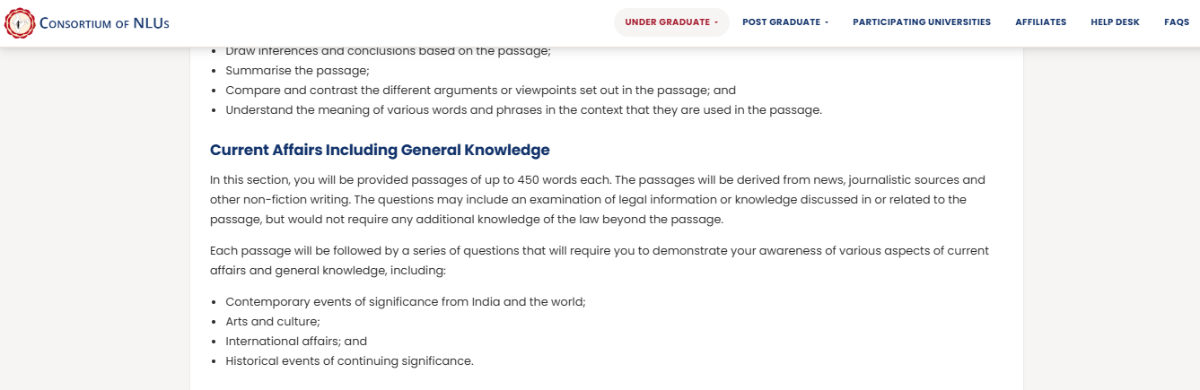
Source: CLAT 2027 UG Syllabus
Related Links:
CLAT Current Affairs and GK Syllabus: Detailed Topics
In the table below, we have mentioned what topics you need to study as per the sections included in CLAT Current affairs including GK syllabus.
| Official Area | What You Need to Know |
|---|---|
| Contemporary events of significance from India and the world | Major national and global developments, including policy, governance, courts and the economy |
| Arts and culture | Awards, heritage, literature, cultural events and personalities in the news |
| International affairs | Summits, groupings, treaties, conflicts and India's relations with other countries |
| Historical events of continuing significance | Past events that still shape today's debates, such as landmark movements, judgments and agreements |
Source: Consortium of NLUs: CLAT 2027 UG Syllabus
Related Articles:
- CLAT Current Affairs and GK Sample Paper
- CLAT 2027 Current Affairs and GK: Topic Weightage and Preparation
Important Topics for CLAT 2027 Current Affairs Syllabus
Candidates can check the list of important topics to cover while preparing for this section here:
- National & International Affairs
- Legal Current Affairs
- Economy and Business
- Science and Technology
- Environment and Climate Change
- Awards and Honours
- Sports Current Affairs
- Important Days and Events
- Arts and Culture
Important CLAT 2027 Static GK Topics
Check out some of the important static GK topics here:
| Subject | Important Areas |
|---|---|
| History | Freedom struggle, Modern Indian history |
| Polity | Constitution, Fundamental Rights, Parliament |
| Geography | Indian and World Geography |
| Economics | Basic concepts and institutions |
| Science | Important discoveries and inventions |
| International Relations | Countries, capitals and organisations |
High-Weightage Topics in Current Affairs and GK
Based on CLAT 2022–2025 paper analysis, the following topic areas carry the highest question frequency.
| Topic Area | Approx. Questions Per Paper | Priority |
|---|---|---|
| Law, Constitution and Judiciary | 6–8 | Very High |
| International Relations and Diplomacy | 4–6 | Very High |
| Environment and Climate | 4–5 | High |
| Economy, Finance and Business | 3–5 | High |
| Science, Space and Technology | 3–4 | High |
| Social Issues and Government Schemes | 2–4 | Moderate |
| Sports and Awards | 2–3 | Moderate |
| History, Culture and Static Polity | 2–3 | Moderate |
Check:
CLAT Current Affairs and GK: Previous Year Topics and Themes to Practise
The four official areas are fixed, but the passage themes change every year. Prep-portal analyses of recent papers show that international relations, polity and the judiciary appear often.
| Year | Themes Reported by Prep Portals |
|---|---|
| CLAT 2026 | Five passages with about 30 questions. Themes included the SCO, American taxation, Air India developments, Pahalgam, Article 370 and Supreme Court judgments |
| CLAT 2025 | International relations, including a passage on the BRICS summit |
| CLAT 2024 | The Presidency of Droupadi Murmu, Google LaMDA and AI, the FIFA World Cup 2022, the FTX collapse and crypto, and agriculture |
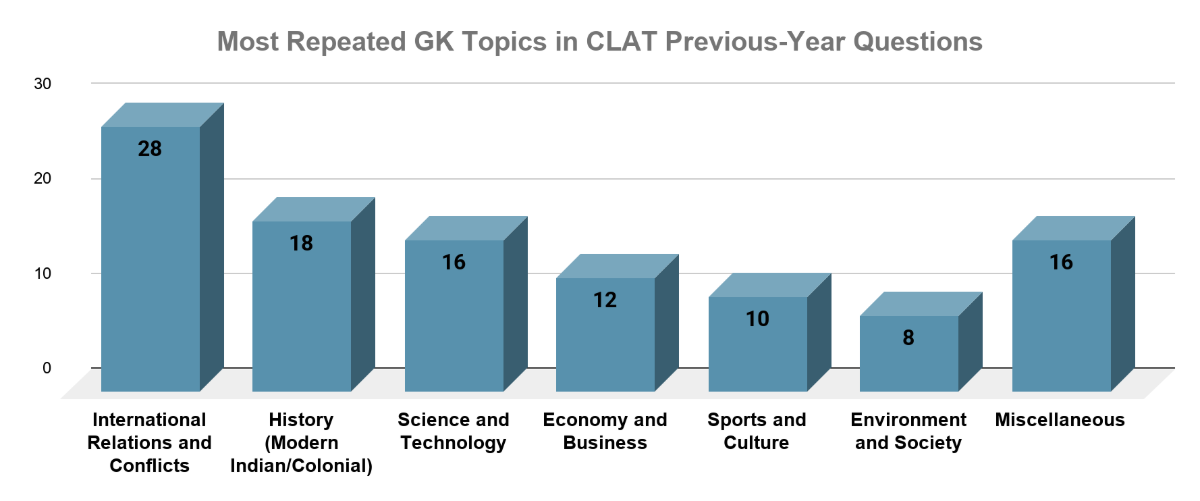
Most Repeated GK Topics in CLAT Previous-Year Questions
We analyzed 140 GK questions from the 2021 to 2025 papers. The results show that Polity and Governance have the most questions, followed by International Relations and Conflicts.
| Topic | Questions (out of 140) | Share | Typical Themes |
|---|---|---|---|
| Polity and Governance | 32 | 23% | Article 370, Ambedkar's speeches, reservations, federal structure, landmark acts |
| International Relations and Conflicts | 28 | 20% | BRICS, G20, India-China, India-Bangladesh, Israel-Hamas, Russia-Ukraine |
| History (Modern Indian/Colonial) | 18 | 13% | Civil Disobedience, Jallianwala Bagh, freedom struggle leaders |
| Science and Technology | 16 | 11% | Chandrayaan-3, ISRO missions, Gaganyaan, Digital Rupee |
| Economy and Business | 12 | 9% | G20 and BRICS economics, CSR, global trade |
| Sports and Culture | 10 | 7% | Paris 2024 Olympics |
| Environment and Society | 8 | 6% | Fossil fuels, pandemics, quality of life |
| Miscellaneous | 16 | 11% | COVID-19 effects, awards |
What Time Period Should You Cover?
- The official syllabus names no start month for the news. It says only "contemporary events of significance".
- One analysis of CLAT 2026 reports that questions drew mostly on events from mid-2024 to late 2025. That points to roughly the last 12 to 18 months before the exam.
- For CLAT 2027, a sensible plan is to cover the last 12 months in depth and revise bigger events from the year before.
- Recent passages have also used Supreme Court judgments and editorials about them, so follow major court rulings.
Static GK: What Is and Is Not Listed
- The four areas above are the only official topics.
- Standalone lists of capitals, currencies, awards or sports records are not named in the official syllabus.
- Static facts usually show up as background to a news passage, such as the history of an organisation or the article of the Constitution linked to a ruling.
- You should read the official page again before the exam to confirm there is no late change.
Related Links:
CLAT Current Affairs and GK Weightage and Marking Scheme
Current Affairs including General Knowledge carries about 25% of the CLAT UG paper. It is one of the two largest sections, along with Legal Reasoning. The published UG question format shows 28 to 32 questions here.
| Detail | CLAT UG |
|---|---|
| Total questions | 120 multiple-choice questions |
| Maximum marks | 120 |
| Duration | 2 hours |
| Current Affairs and GK questions | 28 to 32 |
| Current Affairs and GK weightage | About 25% |
| Number of passages | Usually 4 to 6, per prep-portal analyses |
| Marking | +1 for a correct answer, -0.25 for a wrong answer |
Source: Consortium of NLUs: CLAT UG Question Format
CLAT 2027 Question Papers: Previous 5-Year Quick Download
Best Books and Sources for CLAT Current Affairs and GK 2027
No official book list exists for CLAT Current Affairs and GK. The sources below are commonly recommended by prep portals and work best alongside daily newspaper reading.
| Focus Area | Sources Name | Author / Publisher | Why This Source |
|---|---|---|---|
| Daily current affairs | Editorial and news pages of The Hindu | The Hindu | Matches the news and editorial style of CLAT passages |
| Daily current affairs | The Indian Express | The Indian Express | Gives explained pieces on courts, policy and international affairs |
| Yearly recap | Manorama Yearbook | Malayala Manorama | Covers the year's events, facts and figures in one place |
| Static background | Lucent's General Knowledge | Lucent Publication | Builds basic history, geography and polity background |
| Polity and Constitution | Indian Polity | M. Laxmikanth, McGraw Hill | Clears constitutional concepts that come up in court-related passages |
| Monthly revision | A monthly current affairs compilation | Any trusted coaching or magazine publisher | Lets you revise a full month of events in one sitting |
How to Check the CLAT 2027 Syllabus
Follow these steps to read the official CLAT 2027 UG syllabus.
- Visit the official website at consortiumofnlus.ac.in.
- Open the CLAT 2027 section on the homepage.
- Click on the UG Syllabus link.
- Read the Current Affairs Including General Knowledge section on the page that opens.
- Press Ctrl + P (Windows) or Cmd + P (Mac) and choose Save as PDF to keep a copy.
Related Links:
CLAT Current Affairs and GK Preparation Tips
Current Affairs
- Read one national newspaper every day. Focus on the editorial page and the main national and international stories.
- Keep short monthly notes. For each event, write what happened, who was involved and why it matters.
- Follow Supreme Court judgments, constitutional issues and international summits closely, as these recur in recent papers.
- Revise the last 12 months in the final weeks instead of starting new sources.
Static GK and Background
- Learn background for every major event. If a treaty or grouping is in the news, know when and why it was formed.
- Keep revision of arts, culture, awards and sports light and tied to events in the news.
- Use your notes to link history to present-day debates, as the syllabus asks for historical events of continuing significance.
Mock Tests and Accuracy
- Attempt full-length mocks so you practise this section with the other four sections.
- Read the passage first, then answer. Many questions can be solved from the passage alone.
- Remember the 0.25 penalty. Skip a question only when you cannot remove at least two options.
- Track wrong answers by area. Check whether you miss international affairs or polity questions more often.
CLAT 2027 Current Affairs and GK Syllabus: FAQs
Ques. Is the CLAT Current Affairs and GK syllabus 2027 the same as last year?
Ans. The official CLAT 2027 syllabus page lists no change to this section. It still centres on passages of up to 450 words from news and non-fiction sources.
Ques. How many questions come from Current Affairs and GK in CLAT?
Ans. The published UG format shows 28 to 32 questions. That is about 25% of the 120-question paper.
Ques. What topics are covered in the CLAT GK syllabus?
Ans. The official syllabus lists four areas: contemporary events of significance from India and the world, arts and culture, international affairs, and historical events of continuing significance.
Ques. Is static GK part of the CLAT syllabus?
Ans. The official syllabus does not list static GK as a separate topic. Static facts usually appear as background inside a news passage.
Ques. How long is a CLAT Current Affairs passage?
Ans. Each passage is up to 450 words.
Ques. What kind of passages does CLAT use for Current Affairs and GK?
Ans. Passages come from news, journalistic sources and other non-fiction writing.
Ques. Do I need to know law for the Current Affairs section?
Ans. No. Questions may deal with legal information in or related to the passage, but the syllabus says no additional knowledge of law is needed.
Ques. Which months of current affairs should I cover for CLAT 2027?
Ans. The official syllabus does not name a period. Covering the last 12 months in depth, with a lighter revision of the year before, is a sensible plan.
Ques. Is there negative marking in the CLAT Current Affairs section?
Ans. Yes. Each wrong answer costs 0.25 marks, and each correct answer earns 1 mark.
Ques. Will the GK section be dropped from CLAT?
Ans. An expert committee report proposed dropping the General Knowledge and Current Affairs section. The Consortium has made no reforms for CLAT 2027, and the official 2027 syllabus still includes the section.
Ques. Where can I check the official CLAT 2027 syllabus?
Ans. You can read it on consortiumofnlus.ac.in under the CLAT 2027 UG Syllabus link.
Ques. When is CLAT 2027?
Ans. CLAT 2027 is on Sunday, 6 December 2026, from 2 pm to 4 pm.
Ques. How should I cover the Current Affairs syllabus in the weeks left?
Ans. You have about four weeks before the exam. Read the newspaper daily, revise your monthly notes, solve two passages a day and take a mock each week.



Comments