




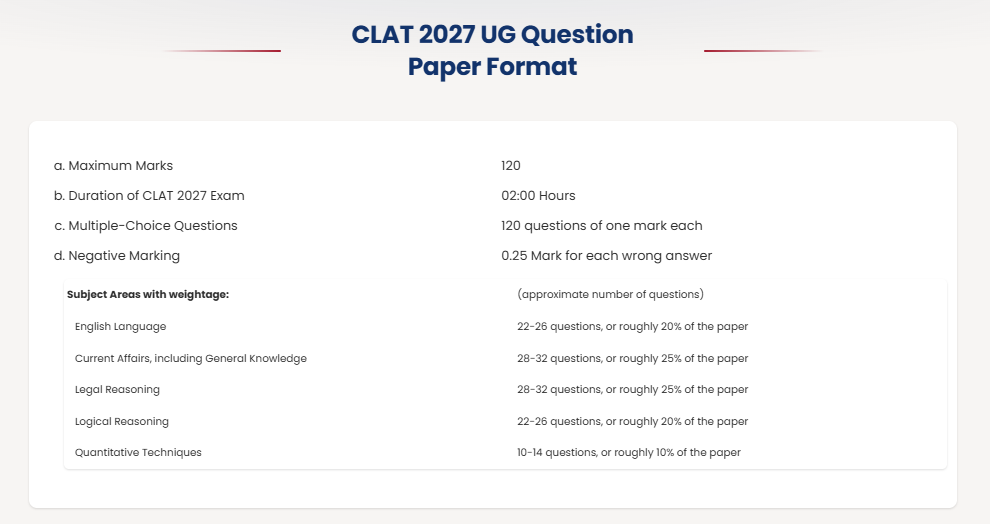
The CLAT Exam Pattern 2027 for undergraduate (UG) programmes has 120 objective, passage-based questions carrying 120 marks, to be solved in 120 minutes (2 hours). Each correct answer fetches +1 mark. Each incorrect answer leads to a deduction of 0.25 marks. Unattempted questions carry zero marks in CLAT 2027.
The CLAT 2027 exam is conducted offline, in pen-and-paper (OMR) mode, and the question paper is in English only. The Consortium of NLUs has confirmed that the syllabus and pattern of the UG paper remain unchanged for CLAT 2027.
- The paper has five sections: English Language, Current Affairs including General Knowledge, Legal Reasoning, Logical Reasoning, and Quantitative Techniques.
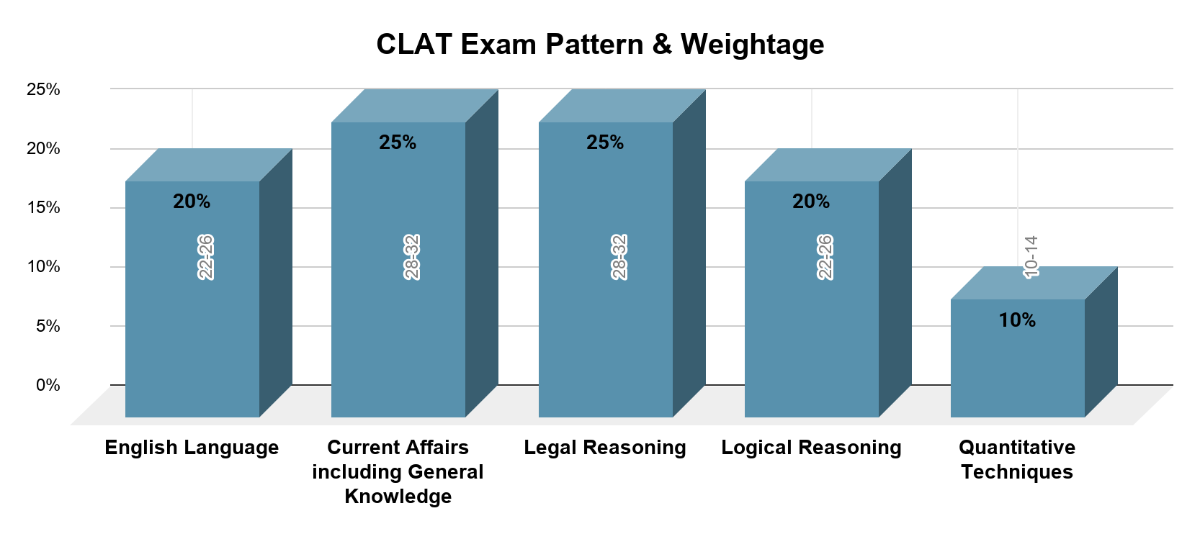
- CLAT Legal Reasoning and CLAT Current Affairs & GK carry the highest weightage, about 28–32 questions each. Together, these two carry 50% of the total weightage.
- Quantitative Techniques has the lowest weightage, about 10% (10-14 questions), but it often decides the rank in a tight race.
- CLAT English Language and CLAT Logical Reasoning have 22–26 questions each. Together, they contribute 40% (20% each) of the total weightage.
The CLAT 2027 exam date is Sunday, 6 December 2026, from 2:00 PM to 4:00 PM. Candidates can practice the CLAT exam pattern through the CLAT previous year question papers and mock test papers so that they can score better in the real exam.
Also Check:
- CLAT 2027 Syllabus: Subject-wise Topics, Section-wise Weightage and PDF Download
- CLAT 2027 Preparation: How to Prepare for CLAT, Toppers’ Tips, Books
What is the CLAT Exam Pattern 2027?
CLAT is conducted by the Consortium of National Law Universities for admission to 5-year integrated law programmes such as BA LLB (Hons), BBA LLB, BSc LLB, B.Com LLB and BSW LLB at participating NLUs. Many private law colleges also accept CLAT scores.
| Feature | Overview |
|---|---|
| Exam Duration | 2 hours (120 minutes) |
| Medium of Exam | English |
| Question Format | Passage-based Multiple Choice Questions (MCQs) |
| Total Questions | 120 |
| Total Marks | 120 |
| Marking Scheme | +1 mark for every correct answer |
| Negative Marking | −0.25 mark for every incorrect answer |
| Unattempted Questions | 0 marks (no penalty) |
| Sections | 5 |
CLAT Exam Pattern 2027: Year-wise Changes
The biggest change in the CLAT UG exam pattern came in 2020, when the paper was cut from 200 questions to 150.
- CLAT exam pattern was trimmed again to 120 questions from CLAT 2025 onwards.
- The paper is now fully passage-based, and rote-learning questions have largely been replaced by comprehension and reasoning.
| Year | Pre-2020 | 2020–2024 | 2025 | 2026 | 2027 |
|---|---|---|---|---|---|
| Total Questions | 200 | 150 | 120 | 120 | 120 |
| Total Marks | 200 | 150 | 120 | 120 | 120 |
| Duration | 2 hours | 2 hours | 2 hours | 2 hours | 2 hours |
| CLAT Marking Scheme | +1 / −0.25 | +1 / −0.25 | +1 / −0.25 | +1 / −0.25 | +1 / −0.25 |
Check:
CLAT Exam Pattern 2027: Section-wise Weightage (UG)
The CLAT 2027 UG paper has five sections. Each section has a question range and weightage band rather than a fixed count, so the number of questions can vary slightly from year to year.
| Section | Number of Questions | Weightage (%) | Marks |
|---|---|---|---|
| English Language | 22-26 | 20% | 22-26 |
| Current Affairs including General Knowledge | 28-32 | 25% | 28-32 |
| Legal Reasoning | 28-32 | 25% | 28-32 |
| Logical Reasoning | 22-26 | 20% | 22-26 |
| Quantitative Techniques | 10-14 | 10% | 10-14 |
| Total | 120 | 100% | 120 |
Also Check:
- CLAT 2027 English Syllabus: Subject-wise Topics, Section-wise Weightage and PDF Download
- CLAT 2027 GK Syllabus: Subject-wise Topics, Section-wise Weightage and PDF Download
- CLAT 2027 Legal Reasoning Syllabus: Subject-wise Topics, Section-wise Weightage and PDF Download
CLAT Exam Pattern: What does each CLAT exam section test?
In CLAT 2027, each section tests different skills and abilities of the students. These include:
- English Language: Reading comprehension from passages of about 450 words, with questions on inference, vocabulary in context, tone and the main idea.
- Current Affairs including GK: Passages on national and international events, and static GK from the past 12 months.
- Legal Reasoning: Passages on legal principles, constitutional law, torts, contracts and criminal law, with questions that apply a principle to a fact situation. No prior legal knowledge is needed.
- Logical Reasoning: Arguments, assumptions, conclusions, analogies and critical reasoning.
- Quantitative Techniques: Class 10-level maths, including ratios, percentages, averages, profit and loss, and data interpretation from graphs and tables.
Read More:
CLAT Exam Pattern 2027: Marking Scheme
The CLAT 2027 exam pattern remains unchanged. The consortium has released the marking scheme for the CLAT 2027 Exam.
| Particulars | Marks |
|---|---|
| Correct Answer | +1 mark |
| Incorrect Answer | −0.25 mark |
| Unattempted Question | 0 |
| Total Number of Questions | 120 |
| Total Marks | 120 |
How Is the CLAT 2027 Score Calculated?
CLAT Score = (Number of Correct Answers × 1) − (Number of Incorrect Answers × 0.25)
Example: A candidate gets 90 questions correct, attempts 20 incorrectly, and leaves 10 unanswered.
- Marks from correct answers = 90 × 1 = 90
- Negative marks = 20 × 0.25 = 5
- Unattempted = 0
- Final CLAT score = 90 − 5 = 85 out of 120
CLAT 2027 Negative Marking Rules
Each wrong answer costs one-quarter of what a correct answer earns, so the penalty is mild. A well-reasoned guess after eliminating two options is often worth the risk. Random guessing across a whole section is not.
CLAT Exam Pattern 2027: Question Types
| Particulars | Details |
|---|---|
| Type of Questions | Objective / Multiple Choice Questions (MCQs) |
| Question Style | Passage-based, with a set of questions after each passage |
| Number of Options | 4 per question |
| Correct Answers | Only one correct option |
| Subjective / Descriptive | Not asked in UG |
| Total Questions | 120 |
Related Links:
CLAT 2027 Sections & Important topics
Knowing the section-wise CLAT syllabus and related important topics is key to preparing well for the exam.
- CLAT exam sections like CLAT current affairs and CLAT general Knowledge will help you understand the recent trends.
- CLAT exam sections important topics help you to focus on CLAT preparation before the exam.
| CLAT Sections | Important Topics |
|---|---|
| English Language |
|
| Current Affairs including General Knowledge |
|
| Logical Reasoning |
|
| Legal Reasoning |
|
| Quantitative Techniques |
|
CLAT Exam Pattern 2027 vs AILET Exam Pattern 2027
| Parameter | CLAT 2027 (UG) | AILET 2027 (BA LLB) |
|---|---|---|
| Conducting body | Consortium of NLUs | NLU Delhi |
| Exam date | December 7 | December 13, 2026 |
| Mode | Offline (pen and paper) | Pen and paper (OMR sheet) |
| Duration | 2 hours | 120 minutes |
| Total questions | 120 MCQs | 150 MCQs |
| Total marks | 120 | 150 |
| Marks per correct answer | +1 | +1 |
| Negative marking | 0.25 per wrong answer | 0.25 per wrong answer |
| Unattempted | No deduction | No marks |
| Number of sections | 5 | 3 |
| Sections and questions |
|
|
| Legal aptitude/maths | Both included (Legal Reasoning and Quantitative Techniques) | Legal Aptitude and Mathematics sections removed |
| Question style | Passage-based | Standard MCQs |
| Sectional time limit | None | None |
| First tie-breaker | Marks in the Legal Aptitude section | Logical Reasoning marks, then age, then draw of lots |
CLAT Exam Pattern 2027: Previous Years’ Papers
The CLAT previous year question papers will help you practice and understand the CLAT exam pattern and the types of questions you might get.
CLAT Exam Pattern 2027: Mock Tests
| Section | Mock Tests |
|---|---|
| Full-length | CLAT Mock Test 2027: Attempt Free Online Mock Test |
| English Language | CLAT English Language Mock Test 2027 |
| Current Affairs & GK | CLAT Current Affairs and GK Mock Test 2027 |
| Legal Reasoning | CLAT Legal Reasoning Mock Test 2027 |
| Logical Reasoning | CLAT Logical Reasoning Mock Test 2027 |
| Quantitative Techniques | CLAT Quantitative Techniques Mock Test 2027 |
In Reddit, a student asked, “For CLAT, are previous year papers actually enough to understand the exam pattern, or are quality mocks more important?”

In response, multiple users answered,
One user stated that: PYQs are essential, but for practice I’d prioritise a good test series (like LPT).
Another user said: Previous years' questions are the base for understanding the limits to which the consortium has gone in each section. Mocks are for testing those limits, being comfortable with them, but also new experiments which the consortium can make in future.
Source: Reddit
How to Prepare for CLAT 2027 Based on the Exam Pattern?
- Understand the pattern: Know the sections, question ranges, marks and time limit before you start.
- Study the syllabus: Cover all five sections and note the high-weightage areas, Legal Reasoning and Current Affairs.
- Build a study schedule: Split daily time across sections and give extra hours to your weaker ones.
- Read daily: Newspaper editorials and long-form articles improve comprehension speed for English and Legal Reasoning.
- Revise current affairs monthly: Cover the last 12 months with a monthly compilation.
- Solve previous year papers: Practise at least the last five years of CLAT papers to see the question style.
- Take timed mock tests: Practise finishing 120 questions in 120 minutes. Review every mock to find weak areas.
- Practise attempt strategy: Start with your strongest section. Quant is quick to score, and the long passages come later.
- Avoid blind guessing: Use elimination, because each wrong answer costs 0.25 marks.
- Revise regularly: Revise legal principles, maths formulas and vocabulary every week.
CLAT Exam Pattern 2027 FAQs
Ques. What is the CLAT exam pattern 2027?
Ans. The CLAT 2027 UG paper has 120 passage-based MCQs for 120 marks, to be solved in 2 hours. It is conducted offline in pen-and-paper mode, with +1 for a correct answer and −0.25 for a wrong one.
Ques. Is there negative marking in CLAT?
Ans. Yes. CLAT UG deducts 0.25 marks for each incorrect answer. Unattempted questions are not penalised.
Ques. How many questions are there in CLAT UG 2027?
Ans. There are 120 multiple-choice questions, all based on passages.
Ques. What is the CLAT exam duration?
Ans. The exam lasts 2 hours (120 minutes), from 2:00 PM to 4:00 PM on 6 December 2026. There is no sectional time limit, so you can attempt sections in any order.
Ques. What is the CLAT exam date 2027?
Ans. CLAT 2027 will be held on Sunday, 6 December 2026, as per the Consortium’s notification.
Ques. Is CLAT 2027 online or offline?
Ans. CLAT UG 2027 is conducted offline, with answers marked on an OMR sheet.
Ques. Is there any change in the CLAT 2027 syllabus or exam pattern?
Ans. No. The Consortium has announced that the syllabus and pattern of both UG and PG papers remain unchanged for CLAT 2027.
Ques. Which section has the highest weightage in CLAT?
Ans. Legal Reasoning and Current Affairs including GK carry the highest weightage, about 28–32% each.
Ques. Is Maths compulsory in CLAT?
Ans. Yes. Quantitative Techniques is a compulsory section with roughly 13–17 questions, based on Class 10-level maths.
Ques. Is CLAT difficult?
Ans. CLAT is moderately difficult. The challenge lies in speed and comprehension rather than complex concepts, since you must read long passages and answer in about a minute per question.
Ques. What is a good score in CLAT 2027?
Ans. A good score depends on your target NLU and category. Top NLUs usually need a high score, often well above 100 in recent years, while other NLUs close at lower scores. Check the NLU-wise cut-offs from previous years.
Ques. Is there any age limit for CLAT UG?
Ans. No. The Consortium sets no upper age limit and no limit on the number of attempts.
Ques. Can Class 12 students apply for CLAT 2027?
Ans. Yes. Students appearing in their Class 12 exams can apply, subject to meeting the minimum marks (45% for General/OBC, 40% for SC/ST) when admission is confirmed.
Ques. Do I need legal knowledge to attempt CLAT?
Ans. No. Legal Reasoning questions give you the principle in the passage, and you apply it to the facts.



Comments