




JEE Main 2023 January 24 Shift 2 Question Paper is available here with answer key and solution pdf. NTA conducted the second shift on January 24, 2023, from 3:00 PM to 6:00 PM. The JEE Main 2023 Paper 1 (B.E./B.Tech) question paper includes the following:
- 90 questions in a 3-hour CBT Mode: 30 each from Mathematics, Physics and Chemistry (75 to be attempted)
- Section A: 20 multiple choice questions (MCQs) per subject, 4 marks each
- Section B: 10 numerical value questions per subject, attempt any 5, 4 marks each (integer answer)
- Marking: +4 for a correct answer, -1 for an incorrect answer, 0 for an unattempted question
JEE Main 2023 January 24 Shift 2 Question Paper with Solution PDF
| NTA Official PDF | CD PDF | CD PDF with Solutions |
|---|---|---|
| Download official PDF 4.76 MB | Download Collegedunia PDF 1.07 MB | Download solutions PDF 0.43 MB |
Also Check:
JEE Main 2023 January 24 Shift 2 Questions with Solutions
Mathematics - Section A (Q1 - Q20)
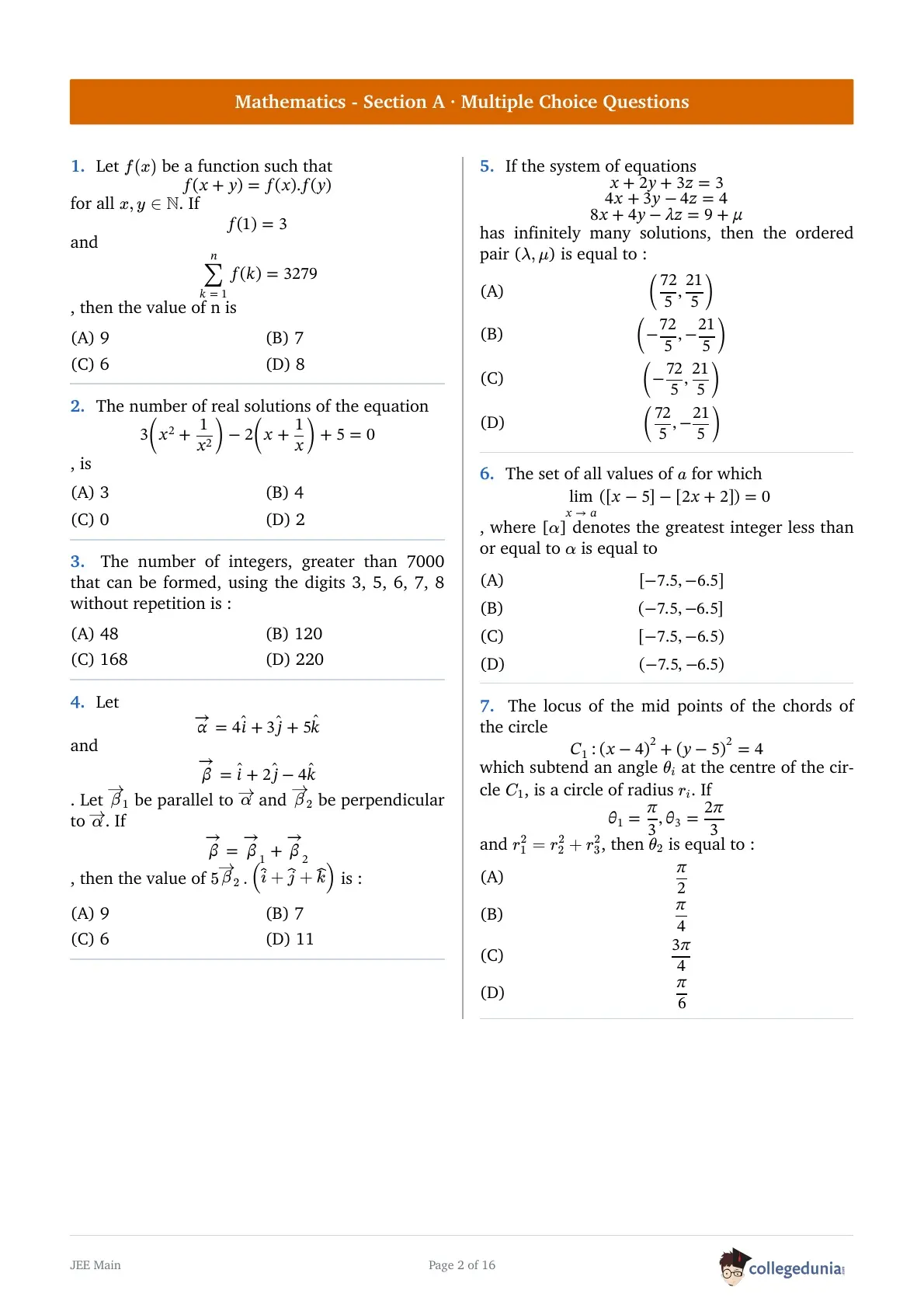
Let \(f(x)\) be a function such that \(f(x+y)=f(x) \cdot f(y)\) for all \(x, y \in\) N If \(f(1)=3\) and \(\displaystyle\sum_{k=1}^n f(k)=3279\), then the value of \(n\) is
The number of real solutions of the equation \(3\left(x^2+\frac{1}{x^2}\right)-2\left(x+\frac{1}{x}\right)+5=0\), is
The number of integers, greater than \(7000\) that can be formed, using the digits \(3,5,6,7,8\) without repetition, is
Let \(\vec{\alpha}=4 \hat{i}+3 \hat{j}+5 \hat{k}\) and \(\vec{\beta}=\hat{i}+2 \hat{j}-4 \hat{k}\) Let \(\vec{\beta}_1\) be parallel to \(\vec{\alpha}\) and \(\vec{\beta}_2\) be perpendicular to \(\vec{\alpha}\) If \(\vec{\beta}=\vec{\beta}_1+\vec{\beta}_2\), then the value of \(5 \vec{\beta}_2 \cdot(\hat{i}+\hat{j}+\hat{k})\) is
If the system of equations \( x+2 y+3 z=3\) \( 4 x+3 y-4 z=4 \) \( 8 x+4 y-\lambda z=9+\mu\) has infinitely many solutions, then the ordered pair \((\lambda, \mu)\) is equal to :
The set of all values of \(a\) for which \(\displaystyle\lim _{x \rightarrow a}([x-5]-[2 x+2])=0\),where \([\propto]\) denotes the greatest integer less than or equal to \(\propto\) is equal to
The locus of the mid points of the chords of the circle \(C_1:(x-4)^2+(y-5)^2=4\) which subtend an angle \(\theta_i\) at the centre of the circle \(C_1\), is a circle of radius \(r_i\) If \(\theta_1=\frac{\pi}{3}, \theta_3=\frac{2 \pi}{3}\) and \(r_1^2=r_2^2+r_3^2\), then \(\theta_2\) is equal to
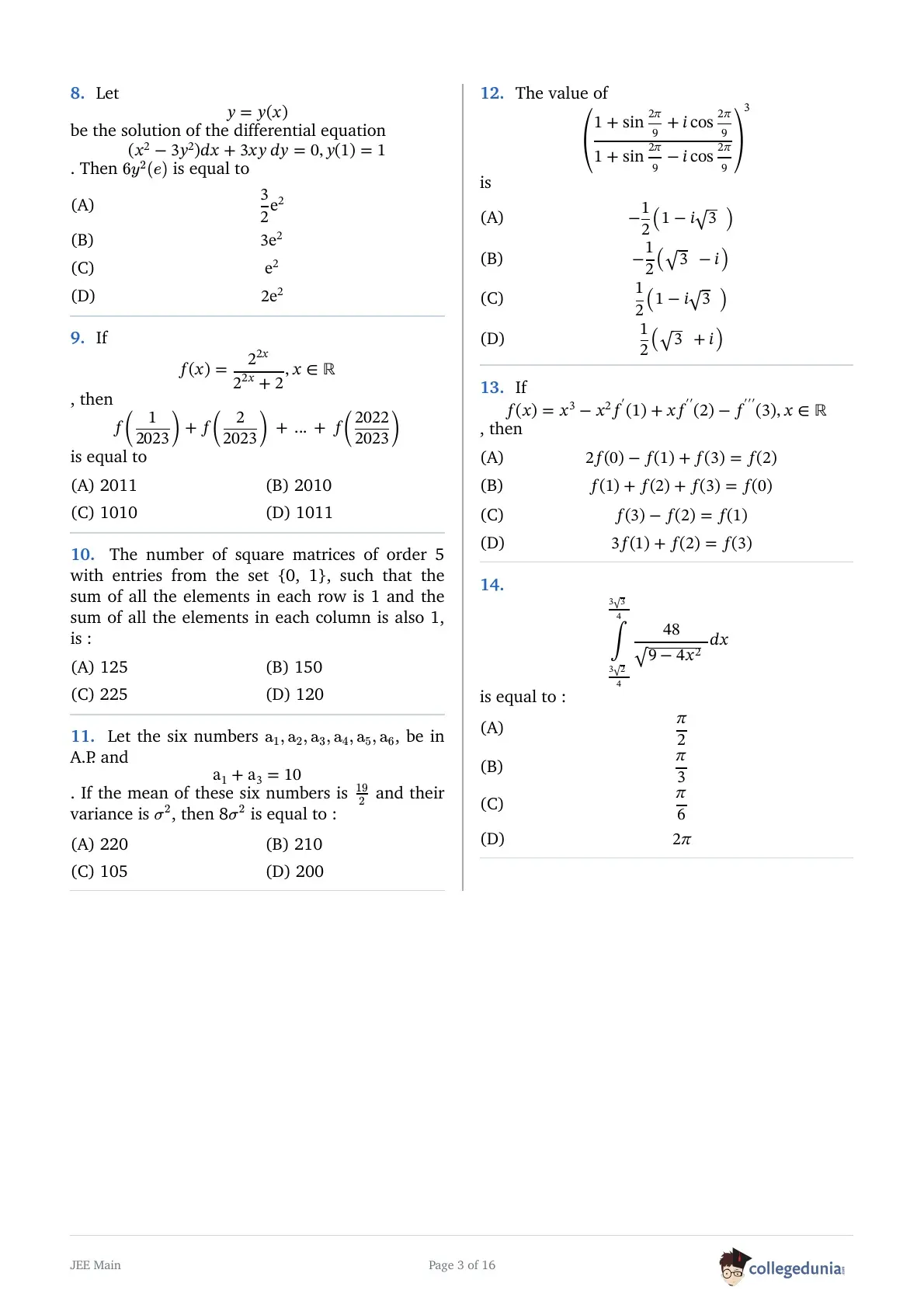
Let \(y=y(x)\) be the solution of the differential equation \(\frac{d y}{d x}=\frac{4 y^3+2 y x^2}{3 x y^2+x^3}, y(1)=1\) If for some \(n \in N , y (2) \in[ n -1, n )\), then \(n\) is equal to ______
If \(f(x)=\frac{2^{2 x}}{2^{2 x}+2}, x \in R\), then \(f\left(\frac{1}{2023}\right)+f\left(\frac{2}{2023}\right)+\ldots+f\left(\frac{2022}{2023}\right)\) is equal to
The number of square matrices of order 5 with entries from the set \(\{0,1\}\), such that the sum of all the elements in each row is 1 and the sum of all the elements in each column is also 1 , is
Let the six numbers \(a_1, a_2, a_3, a_4, a_5, a_6\), be in AP and \(a_1+a_3=10\) If the mean of these six numbers is \(\frac{19}{2}\) and their variance is \(\sigma^2\), then \(8 \sigma^2\) is equal to :
The value of \(\left(\frac{1+\sin \frac{2 \pi}{9}+i \cos \frac{2 \pi}{9}}{1+\sin \frac{2 \pi}{9}-i \cos \frac{2 \pi}{9}}\right)^3\) is
If \(f(x)=x^3-x^2 f^{\prime}(1)+x f^{\prime \prime}(2)-f^{\prime \prime \prime}(3), x \in R\), then
The value of the integral:\(\int\limits_{\frac{3 \sqrt{2}}{4}}^{\frac{3 \sqrt{3}}{4}} \frac{48}{\sqrt{9-4 x^2}} d x\) is equal to
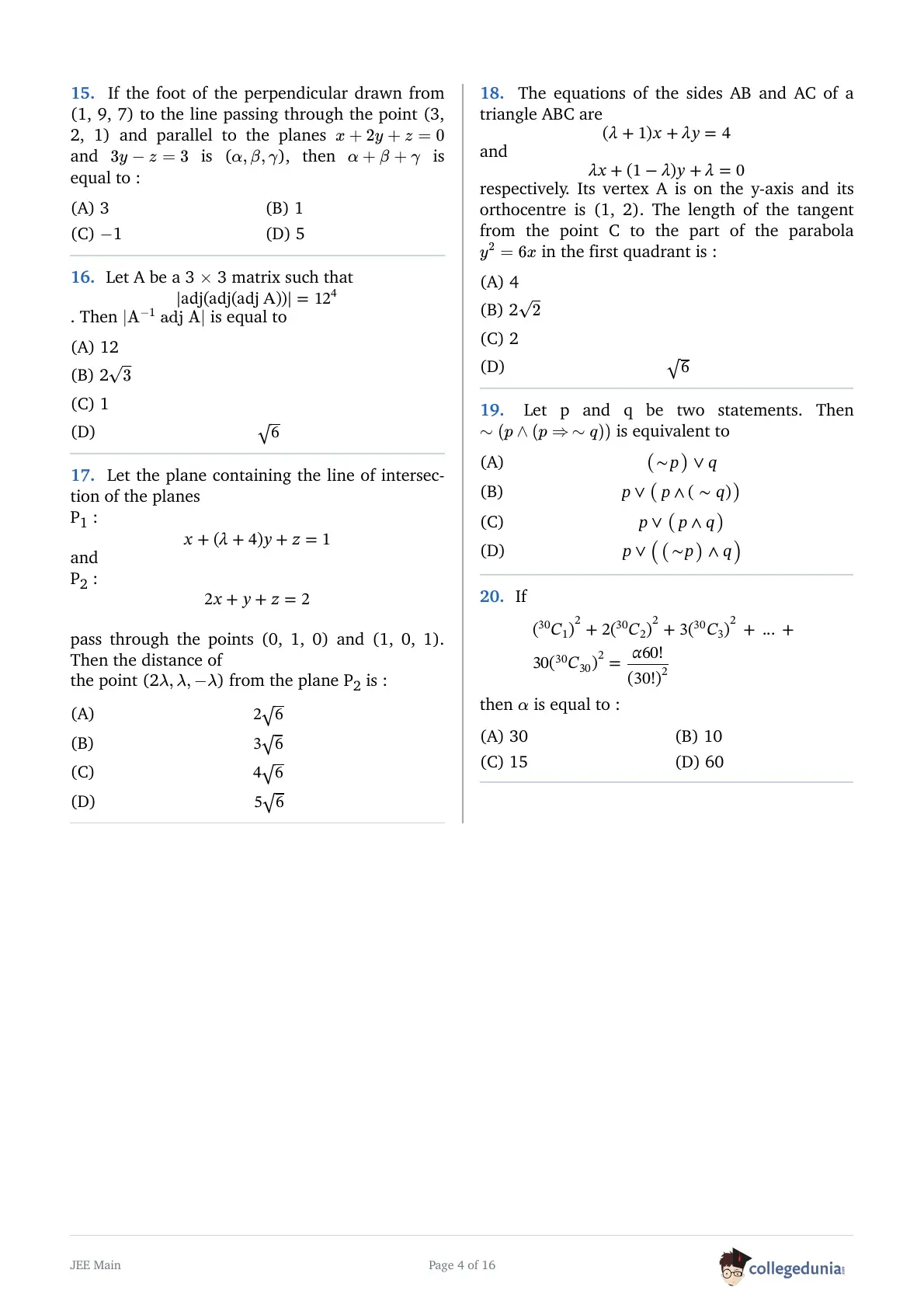
If the foot of the perpendicular drawn from \((1,9,7)\) to the line passing through the point \((3,2,1)\) and parallel to the planes \(x+2 y+z=0\) and \(3 y-z=3\) is \((\alpha, \beta, \gamma)\), then \(\alpha+\beta+\gamma\) is equal to
Let \(A\) be a \(3 \times 3\) matrix such that \(|\operatorname{adj}(\operatorname{adj}(\operatorname{adj} A ))|=12^4\) Then \(\mid A ^{-1}\) adj \(A \mid\) is equal to
Let the plane containing the line of intersection of the planes \(P 1: x+(\lambda+4) y+z=1\) and \(P 2: 2 x+\) \(y+z=2\) pass through the points \((0,1,0)\) and \((1,0,1)\) Then the distance of the point \((2 \lambda, \lambda,-\lambda)\) from the plane \(P 2\) is
The equations of the sides \(AB\) and \(AC\) of a triangle \(ABC\) are \((\lambda+1) x+\lambda y=4\) and \(\lambda x+(1-\lambda) y+\lambda=0\) respectively Its vertex \(A\) is on the \(y\) - axis and its orthocentre is \((1,2)\) The length of the tangent from the point \(C\) to the part of the parabola \(y^2=6 x\) in the first quadrant is :
Let \(p\) and \(q\) be two statements Then \(\sim(p \wedge(p \Rightarrow \sim q))\) is equivalent to
If \(\left({ }^{30} C _1\right)^2+2\left({ }^{30} C _2\right)^2+3\left({ }^{30} C _3\right)^2+\ldots+30\left({ }^{30} C _{30}\right)^2=\frac{\alpha 60 !}{(30 !)^2}\) then \(\alpha\) is equal to :
Mathematics - Section B (Q21 - Q30)
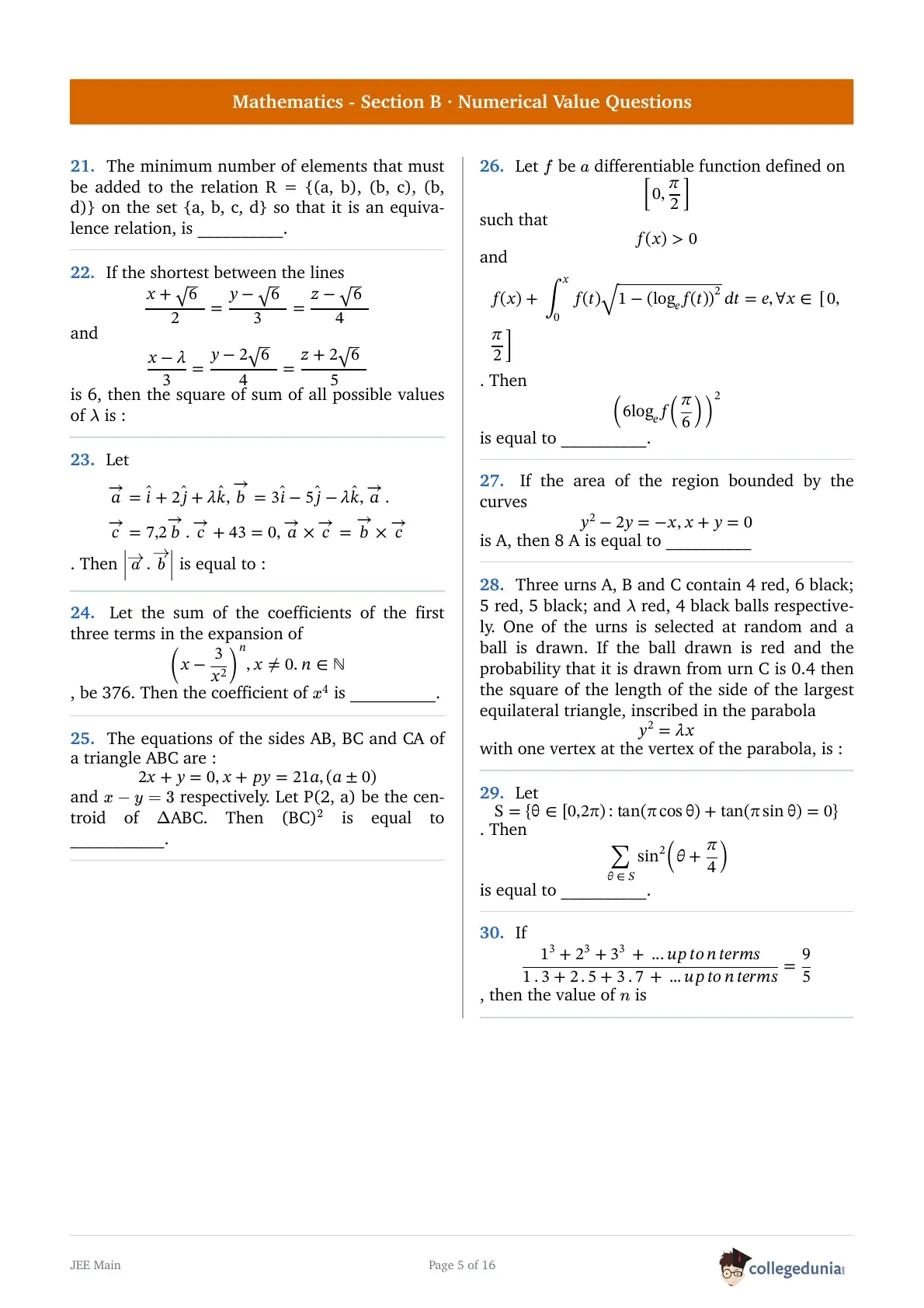
The minimum number of elements that must be added to the relation \(R=\{(a, b),(b, c),(b, d)\}\) on the set \(\{a, b, c, d\}\) so that it is an equivalence relation, is _______
If the shortest between the lines \(\frac{x+\sqrt{6}}{2}=\frac{y-\sqrt{6}}{3}=\frac{z-\sqrt{6}}{4}\) and \(\frac{x-\lambda}{3}=\frac{y-2 \sqrt{6}}{4}=\frac{z+2 \sqrt{6}}{5}\) is \(6\) , then the square of sum of all possible values of \(\lambda\) is
Let \(\vec{a}=\hat{i}+2 \hat{j}+\lambda \hat{k}, \vec{b}=3 \hat{i}-5 \hat{j}-\lambda \hat{k}, \vec{a} \cdot \vec{c}=7,2 \vec{b} \cdot \vec{c}+43=0, \vec{a} \times \vec{c}=\vec{b} \times \vec{c}\). Then \(|\vec{a} \cdot \vec{b}|\) is equal to
Let the sum of the coefficients of the first three terms in the expansion of \(\left(x-\frac{3}{x^2}\right)^n, x \neq 0 n \in N\), be \(376\). Then the coefficient of \(x^4\) is ______
The equations of the sides \(AB , BC\) and \(CA\) of a triangle \(ABC\) are : \(2 x+y=0, x+p y=21 a,(a \neq 0)\) and \(x-y=3\) respectively Let \(P (2, a )\) be the centroid of \(\triangle ABC\) Then \(( BC )^2\) is equal to
Let \(f\) be \(a\) differentiable function defined on \(\left[0, \frac{\pi}{2}\right]\) such that \(f(x)>0;\) and \(f(x)+\int\limits_0^x f(t) \sqrt{1-\left(\log _e f(t)\right)^2} d t=e, \forall x \in\left[0, \frac{\pi}{2}\right]\) Then \(\left(6 \log _e f\left(\frac{\pi}{6}\right)\right)^2\) is equal to _______
If the area of the region bounded by the curves \(y ^2-2 y=-x, x+y=0\) is \(A\), then \(8 A\) is equal to _________
Three urns \(A, B\) and \(C\) contain \(4\) red, \(6\) black; \(5\) red, \(5\) black; and \(\lambda\) red, \(4\) black balls respectively One of the urns is selected at random and a ball is drawn If the ball drawn is red and the probability that it is drawn from urn \(C\) is \(0.4\) then the square of the length of the side of the largest equilateral triangle, inscribed in the parabola \(y^2 = \lambda x\) with one vertex at the vertex of the parabola, is
Let \(S=\{\theta \in[0,2 \pi): \tan (\pi \cos \theta)+\tan (\pi \sin \theta)=0\}\) Then \(\displaystyle\sum_{\theta \in s } \sin ^2\left(\theta+\frac{\pi}{4}\right)\) is equal to _______
If \(\frac{1^3+2^3+3^3+\ldots \text { up to } n \text { terms }}{1 \cdot 3+2 \cdot 5+3 \cdot 7+\ldots \text { up to } n \text { terms }}=\frac{9}{5}\), then the value of \(n\) is
Physics - Section A (Q31 - Q50)
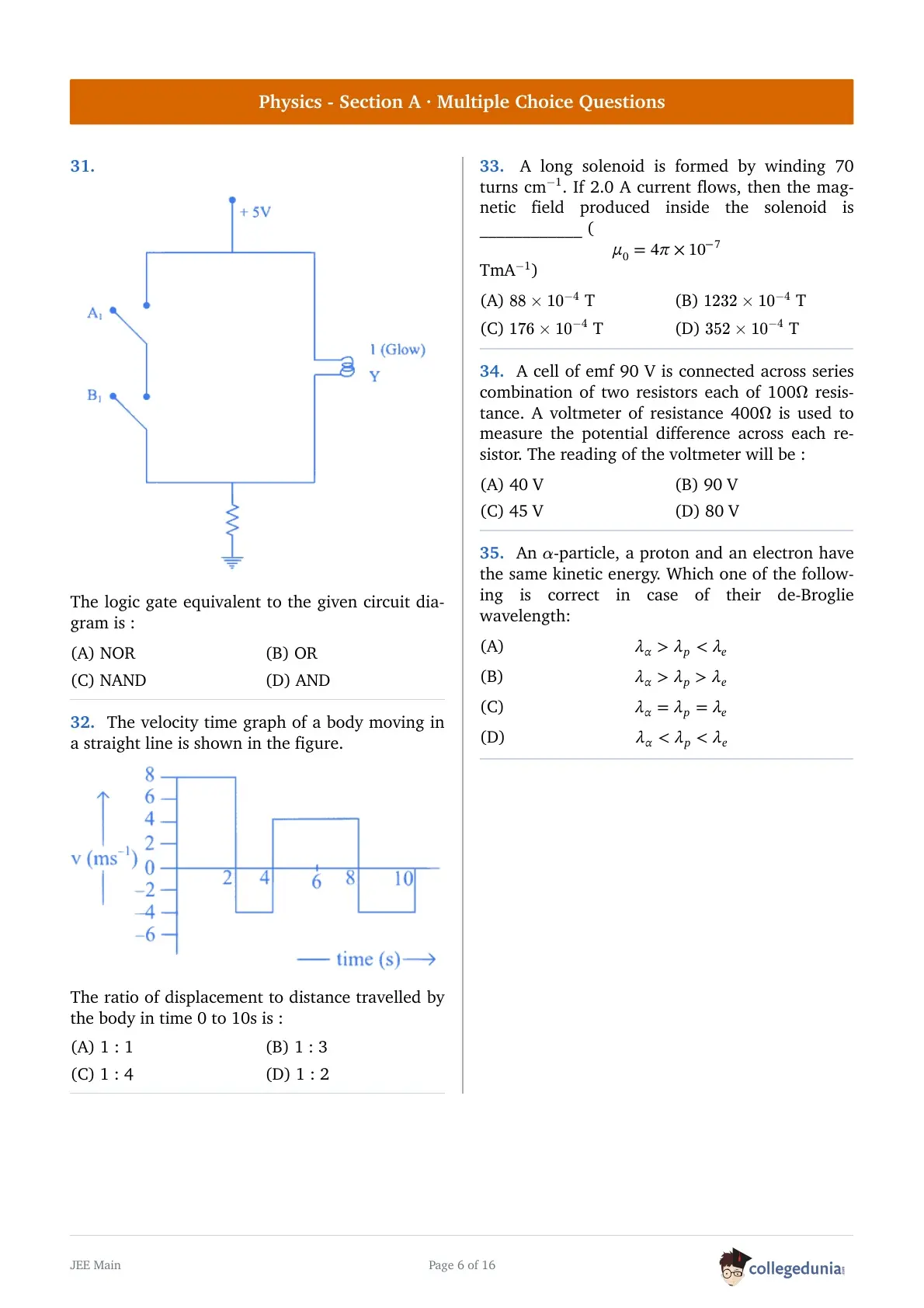
The logic gate equivalent to the given circuit diagram is :
The velocity-time graph of a body moving in a straight line is shown in the figure.
The ratio of displacement to distance travelled by the body in time 0 to 10s is:
A long solenoid is formed by winding 70 turns/cm. If 2.0 A current flows, then the magnetic field produced inside the solenoid is:
A cell of emf 90 V is connected across a series combination of two resistors, each of 100 \( \Omega \) resistance. A voltmeter of resistance 400 \( \Omega \) is used to measure the potential difference across each resistor. The reading of the voltmeter will be:
α-particle, proton & electron have same kinetic energy. Select correct order of their de-Broglie wavelength.
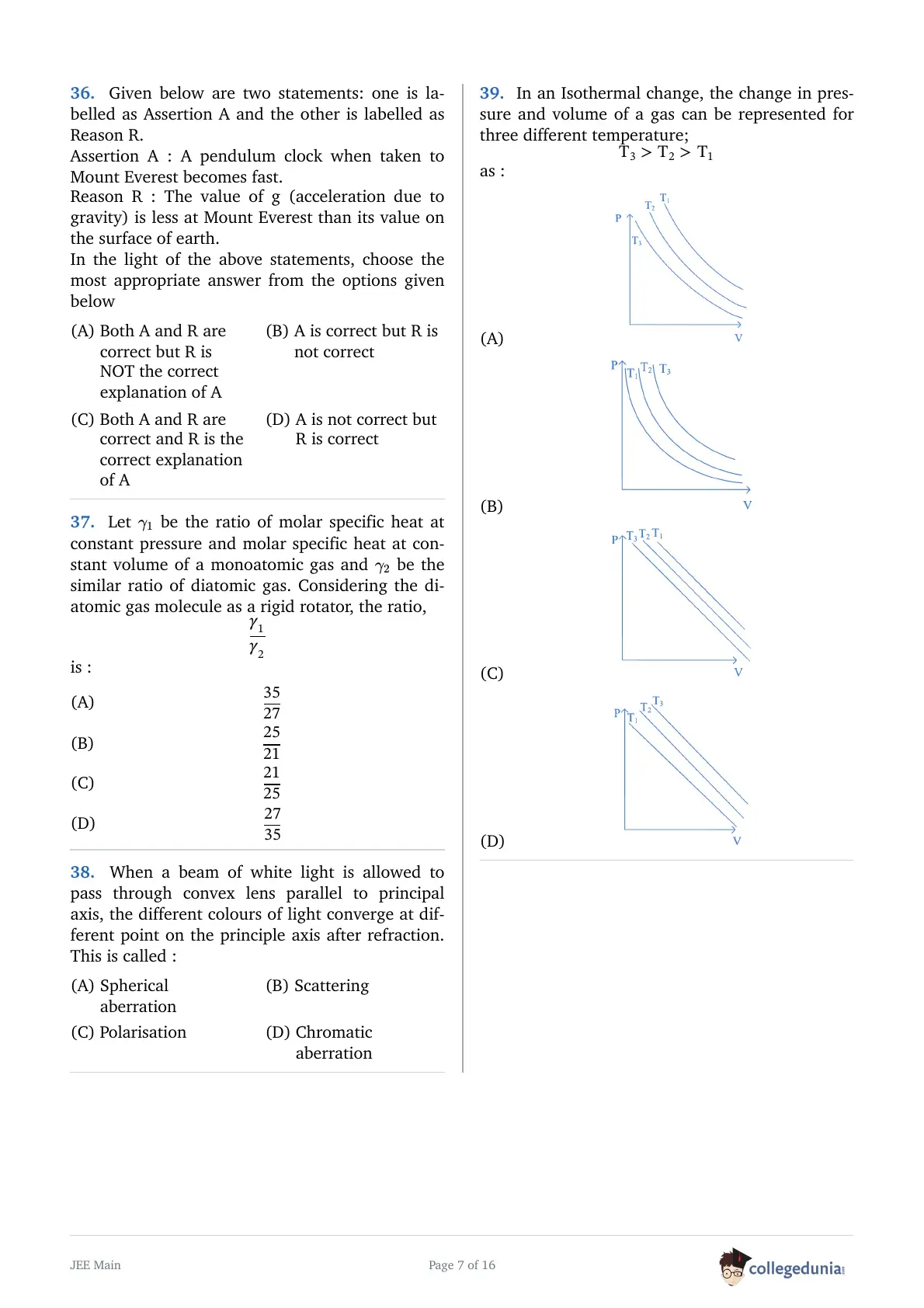
- Assertion (A): A pendulum clock when taken to Mount Everest becomes fast.
- Reason (R): The value of \( g \) (acceleration due to gravity) is less at Mount Everest than its value on the surface of Earth.
Let \(\gamma_1\)be the ratio of molar specific heat at constant pressure and molar specific heat at constant volume of a monoatomic gas and \(\gamma_2\) be the similar ratio of diatomic gas. Considering the diatomic gas molecule as a rigid rotator, the ratio, \(\frac{\gamma_1}{\gamma_2}\) is :
When a beam of white light is allowed to pass through convex lens parallel to principal axis, the different colours of light converge at different point on the principle axis after refraction. This is called :
In an Isothermal change, the change in pressure and volume of a gas can be represented for three different temperature \(T3 > T2 > T1\) as :
- (1)
![]()
- (2)
![]()
- (3)
![]()
- (4)
![]()


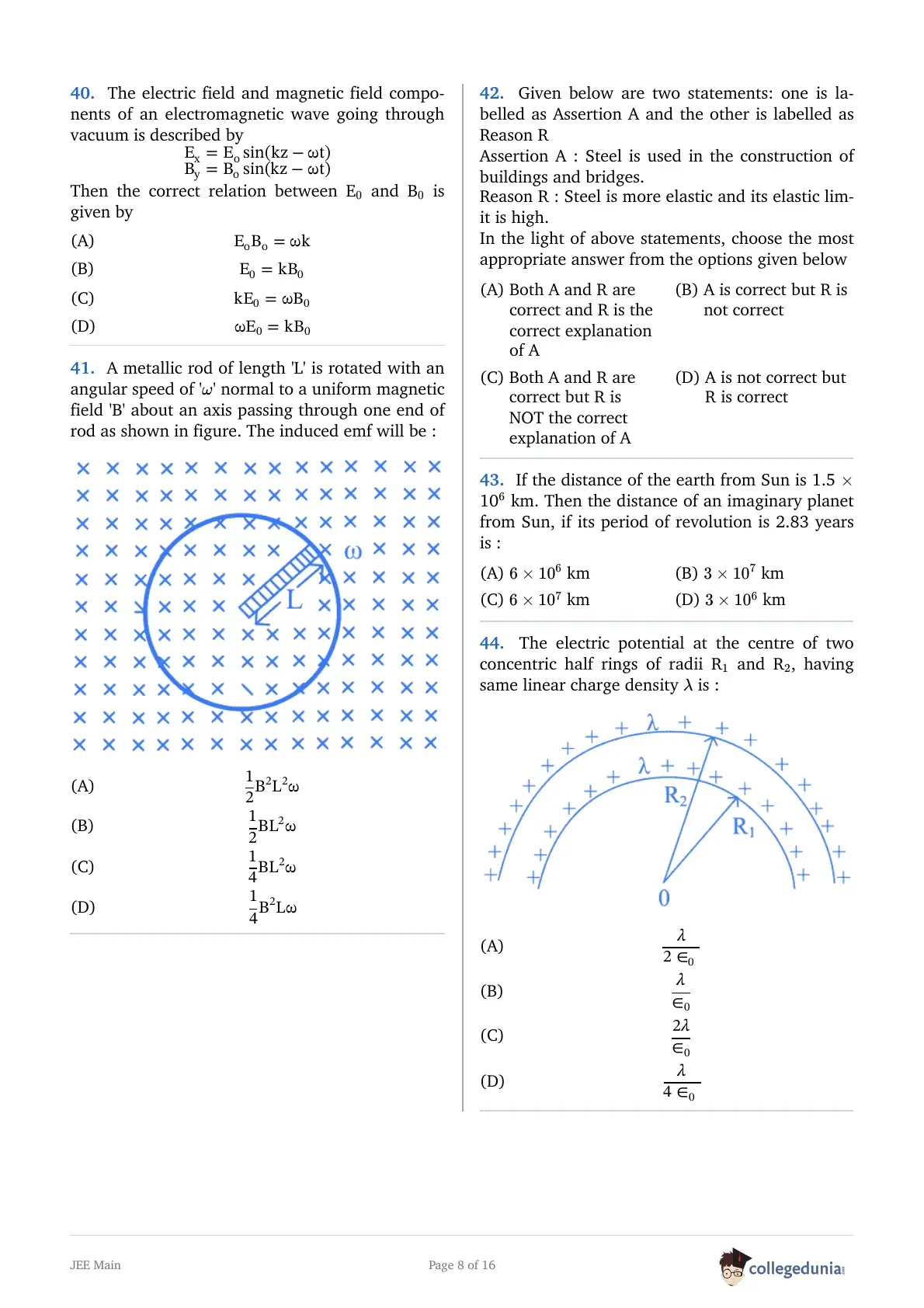
The electric field and magnetic field components of an electromagnetic wave going through vacuum are described by:
\[ E_x = E_0 \sin(kz - \omega t), \quad B_y = B_0 \sin(kz - \omega t). \]
Then the correct relation between \( E_0 \) and \( B_0 \) is given by:
A metallic rod of length ' \(L\) ' is rotated with an angular speed of ' \(\omega\) ' normal to a uniform magnetic field ' \(B\) ' about an axis passing through one end of rod as shown in figure. The induced emf will be :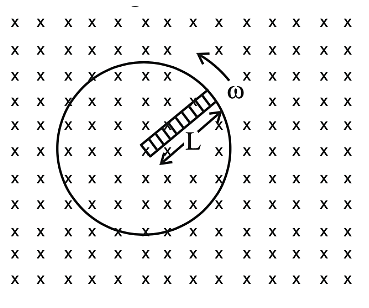
Given below are two statements: one is labelled as Assertion \(A\) and the other is labelled as Reason \(R\)
Assertion A: Steel is used in the construction of buildings and bridges.
Reason R: Steel is more elastic and its elastic limit is high.
In the light of above statements, choose the most appropriate answer from the options given below:
If the distance of the Earth from the Sun is \( 1.5 \times 10^6 \, \text{km} \), then the distance of an imaginary planet from the Sun, if its period of revolution is \( 2.83 \, \text{years} \), is:
The electric potential at the center of two concentric half rings of radii \(R_1\) and \(R_2\), having same linear charge density \(\lambda\) is :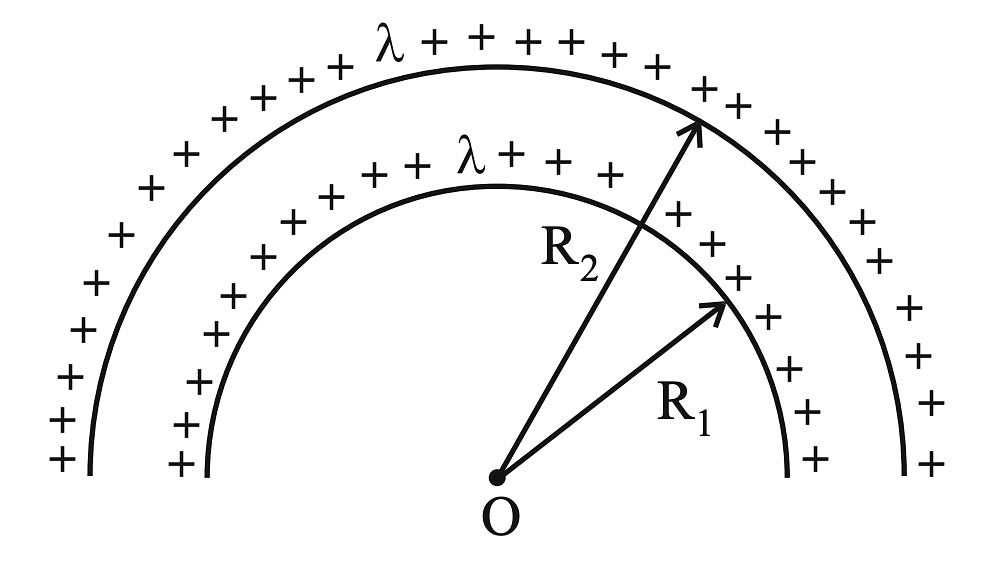
Given below are two statements:
Statement I : Acceleration due to earth's gravity decreases as you go 'up' or 'down' from earth's surface
Statement II : Acceleration due to earth's gravity is same at a height '\(h\)' and depth ' \(d\) ' from earth's surface, if \(h = d\).
In the light of above statements, Choose the most appropriate answer form the options given below
A photon is emitted in transition from n = 4 to n = 1 level in hydrogen atom. The corresponding wavelength for this transition is (given, h = 4 × 10⁻¹⁵ eVs) :
The frequency (\( \nu \)) of an oscillating liquid drop may depend upon the radius (\( r \)) of the drop, density (\( \rho \)) of the liquid, and the surface tension (\( s \)) of the liquid as: \[ \nu = k r^a \rho^b s^c \]
The values of \( a \), \( b \), and \( c \) respectively are:
If two vectors P = \(\hat{i} \)+2m\(\hat{j}\)+m\(\hat{k}\) & Q = 4\(\hat{i}\)-2\(\hat{j}\)+m\(\hat{k}\) are perpendicular to each other, then the value of m will be:
A body of mass 200 g is tied to a spring of spring constant 12.5 N/m, while the other end of the spring is fixed at point \( O \). If the body moves about \( O \) in a circular path on a smooth horizontal surface with constant angular speed 5 rad/s, then the ratio of extension in the spring to its natural length will be:
| List I | List II | ||
| A | AM Broadcast | I | 88-108 MHz |
| B | FM Broadcast | II | 540-1600 kHz |
| C | Television | III | 3.7-4.2 GHz |
| D | Satellite Communication | IV | 54 MHz-890 MHz |
Choose the correct answer from the options given below:
Physics - Section B (Q51 - Q60)
A convex lens of refractive index \(15\) and focal length\(18 \,cm\) in air is immersed in water. The change in focal length of the lens will be_______ cm (Given refractive index of water =\(\frac{4}{3}\))
A body of mass \(1 \, \text{kg}\) begins to move under the action of a time-dependent force \[ \vec{F} = (t \, \hat{i} + 3t^2 \, \hat{j}) \, \text{N}, \] where \(\hat{i}\) and \(\hat{j}\) are unit vectors along \(x\) and \(y\) axes. The power developed by the above force, at the time \(t = 2 \, \text{s}\), will be _____ W.
The energy released per fission of the nucleus of \(^{240}\text{X}\) is \(200 \, \text{MeV}\). The energy released if all the atoms in \(120 \, \text{g}\) of pure \(^{240}\text{X}\) undergo fission is _____ \(10^{25} \, \text{MeV}\). (Given \(N_A = 6 \times 10^{23}\))
A uniform solid cylinder with radius \(R\) and length \(L\) has a moment of inertia \(I_1\) about the axis of the cylinder. A concentric solid cylinder of radius \(R' = \frac{R}{2}\) and length \(L' = \frac{L}{2}\) is carved out of the original cylinder. If \(I_2\) is the moment of inertia of the carved-out portion, then \(\frac{I_1}{I_2} =\)
(Both \(I_1\) and \(I_2\) are about the axis of the cylinder.)
If a copper wire is stretched to increase its length by \(20 \%\) The percentage increase in resistance of the wire is _______\(\%\).
A parallel plate capacitor with air between the plate has a capacitance of \(15\, pF\) The separation between the plate becomes twice and the space between them is filled with a medium of dielectric constant \(3.5\). Then the capacitance becomes \(\frac{x}{4} pF\) The value of \(x\) is _______
A single turn current loop in the shape of a right angle triangle with sides 5cm, 12cm, 13cm is carrying a current of 2A. The loop is in a uniform magnetic field of magnitude 0.75T whose direction is parallel to the current in the 13 cm side of the loop. The magnitude of the magnetic force on the 5 cm side will be \(\frac{x}{130} N\). The value of x is ________ .
A spherical ball of radius \(1 \, \text{mm}\) and density \(10.5 \, \text{g/cc}\) is dropped in glycerine of coefficient of viscosity \(9.8 \, \text{poise}\) and density \(1.5 \, \text{g/cc}\). The viscous force on the ball when it attains constant velocity is \(3696 \times 10^{-x} \, \text{N}\). The value of \(x\) is:
(Given, \(g = 9.8 \, \text{m/s}^2\) and \(\pi = \frac{22}{7}\))
A mass \(m\) attached to free end of a spring executes SHM with a period of \(1 \,s\) If the mass is increased by \(3\, kg\) the period of oscillation increases by one second, the value of mass \(m\) is ______\(kg.\)
Three identical resistors with resistance \(R =12\, \Omega\) and two identical inductors with self inductance \(L\) \(=5\, mH\) are connected to an ideal battery with emf of \(12\, V\)as shown in figure. The current through the battery long after the switch has been closed will be ______A.
Chemistry - Section A (Q61 - Q80)
The number of s-electrons present in an ion with 55 protons in its unipositive state is
Find out the major products from the following reactions
- (1)
![]()
- (2)
![]()
- (3)
![]()
- (4)
![]()


Number of unpaired electron in highest occupied molecular orbital of following species is :\(N_2, N ^+_ 2 , O_2, O^+_ 2 \) ?
Given below are two statements, one is labelled as Assertion A and the other is labelled as Reason R
Assertion (A) : Benzene is more stable than hypothetical cyclohexatriene
Reason (R) : The delocalised π-electrons cloud is attracted more strongly by the nuclei of the carbon atoms than the electron cloud localised between two carbon atoms.
In the light of the above statements, choose the correct answer from the options given below
Choose the correct representation of conductometric titration of benzoic acid vs sodium hydroxide
- (1)
![Option 1]()
- (2)
![Option 2]()
- (3)
![Option 3]()
- (4)
![Option 4]()


Given below are two statements:
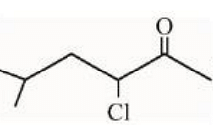
Statement I
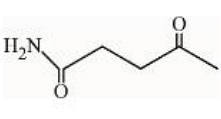
under Clemmensen reduction conditions will give
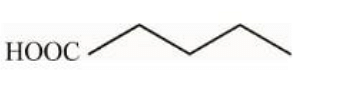
Statement II
under Wolff-Kishner reduction condition will give
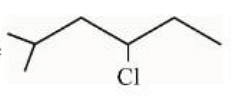
In the light of the above statements, choose the correct answer from the options given below:
Choose the correct colour of the product for the following reaction
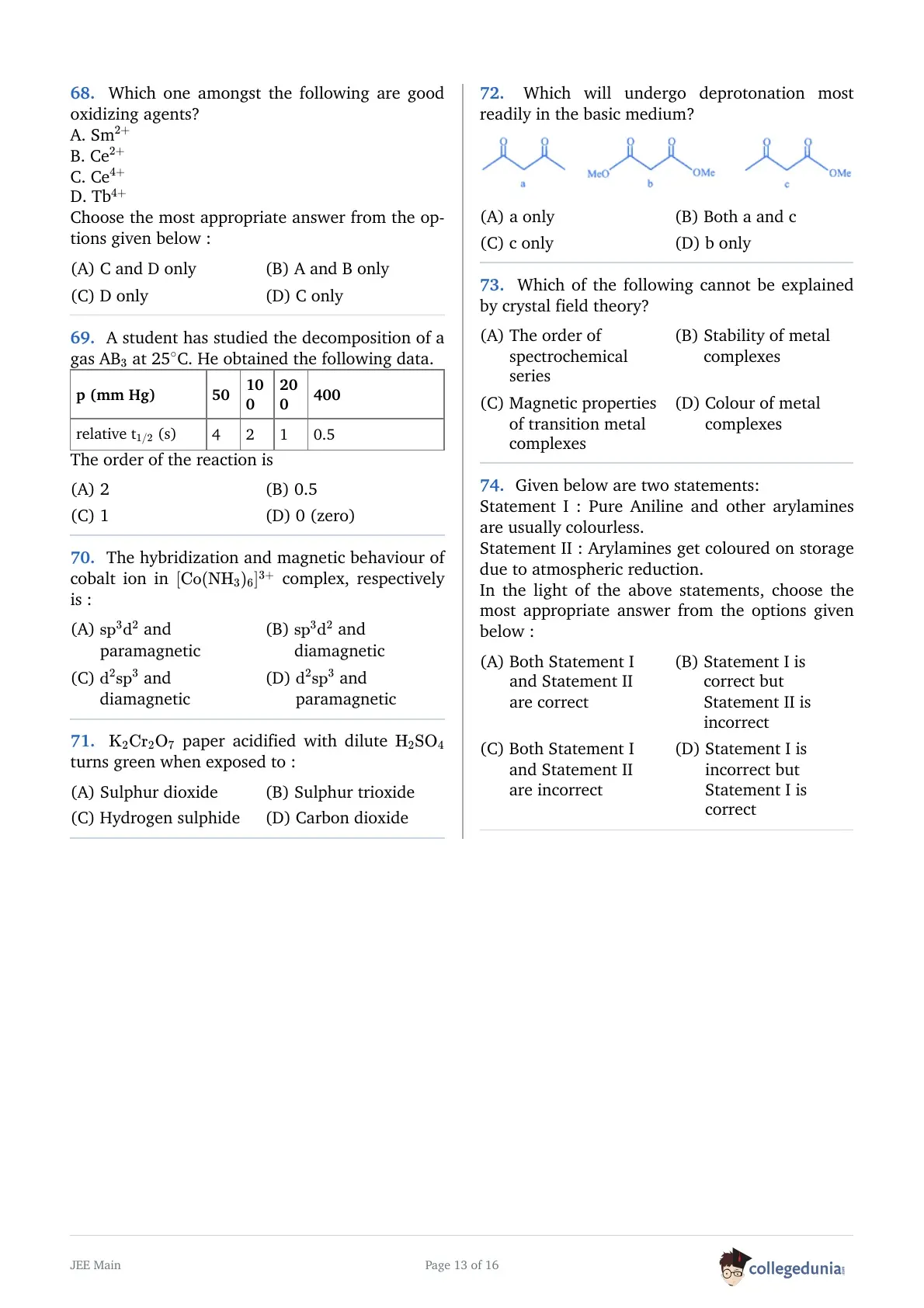
Which one amongst the following are good oxidizing agents?
(A) \( \text{Sm}^{\text{2+}}\)
(B) \(\text{Ce}^{\text{2+}}\)
(C)\( \text{Ce}^{\text{4+}}\)
(D) \(\text{Tb}^{\text{4+}}\)
Choose the most appropriate answer from the options given below:
| p(mmHg) | 50 | 100 | 200 | 400 |
| \(relative\space t_{1/2}(s)\) | 4 | 2 | 1 | 0.5 |
The hybridization and magnetic behaviour of cobalt ion in \(\left[ Co \left( NH _3\right)_6\right]^{3+}\) complex, respectively is
\(K_2Cr_2O_7\) paper acidified with dil. \(H_2SO_4\) turns green when exposed to :

Which of the following cannot be explained by crystal field theory?
Given below are two statements:
Statement-I: Pure Aniline and other arylamines are usually colourless.
Statement-II: Arylamines get coloured on storage due to atmospheric reduction
In the light of the above statements, choose the most appropriate answer from the options given below:
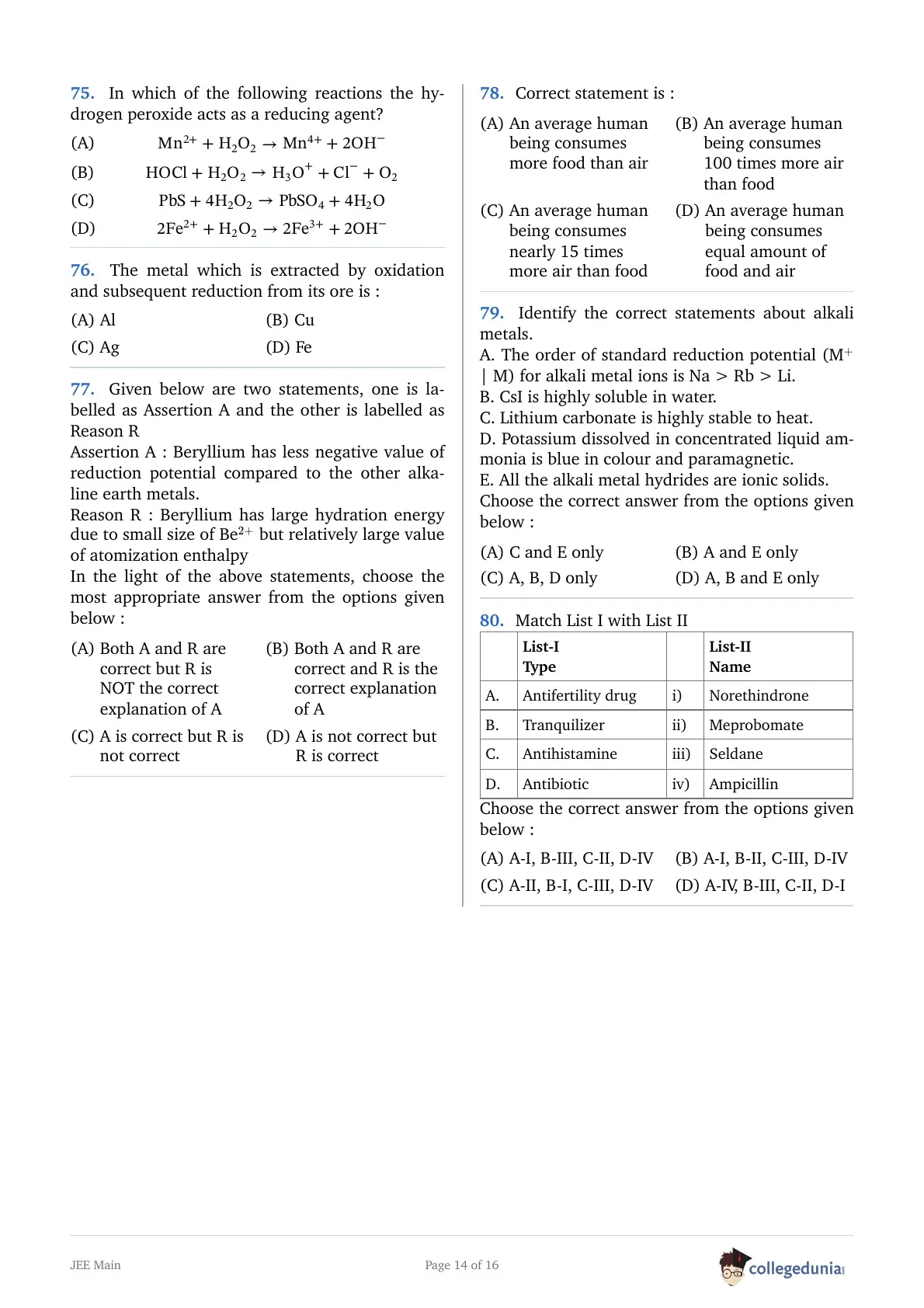
In which of the following reactions the hydrogen peroxide acts as a reducing agent?
The metal which is extracted by oxidation and subsequent reduction from its ore is:
Given below are two statements, one is labelled as Assertion A and the other is labelled as Reason R
Assertion A: Beryllium has less negative value of reduction potential compared to the other alkaline earth metals
Reason R: Beryllium has large hydration energy due to small size of \(Be ^{2+}\) but relatively large value of atomization enthalpy
In the light of the above statements, choose the most appropriate answer from the options given below
Correct statement is:
Identify the correct statements about alkali metals
A. The order of standard reduction potential \(\left( M ^{+} \mid M \right)\)for alkali metal ions is \(Na > Rb > Li\)
B. \(CsI\)is highly soluble in water.
C. Lithium carbonate is highly stable to heat.
D. Potassium dissolved in concentrated liquid ammonia is blue in colour and paramagnetic.
E. All the alkali metal hydrides are ionic solids.
Choose the correct answer from the options given below:
Match List I with List II:
| LIST I (Type) | LIST II (Name) |
| (P) Antifertility drugs | (A) Norethindrone |
| (Q) Antihistamines | (B) Seldane |
| (R) Tranquilizers | (C) Meprobamate |
| (S) Antibiotics | (D) Penicillin |
Choose the correct answer from the options given below:
Chemistry - Section B (Q81 - Q90)
Total number of tripeptides possible by mixing of valine and proline is ________
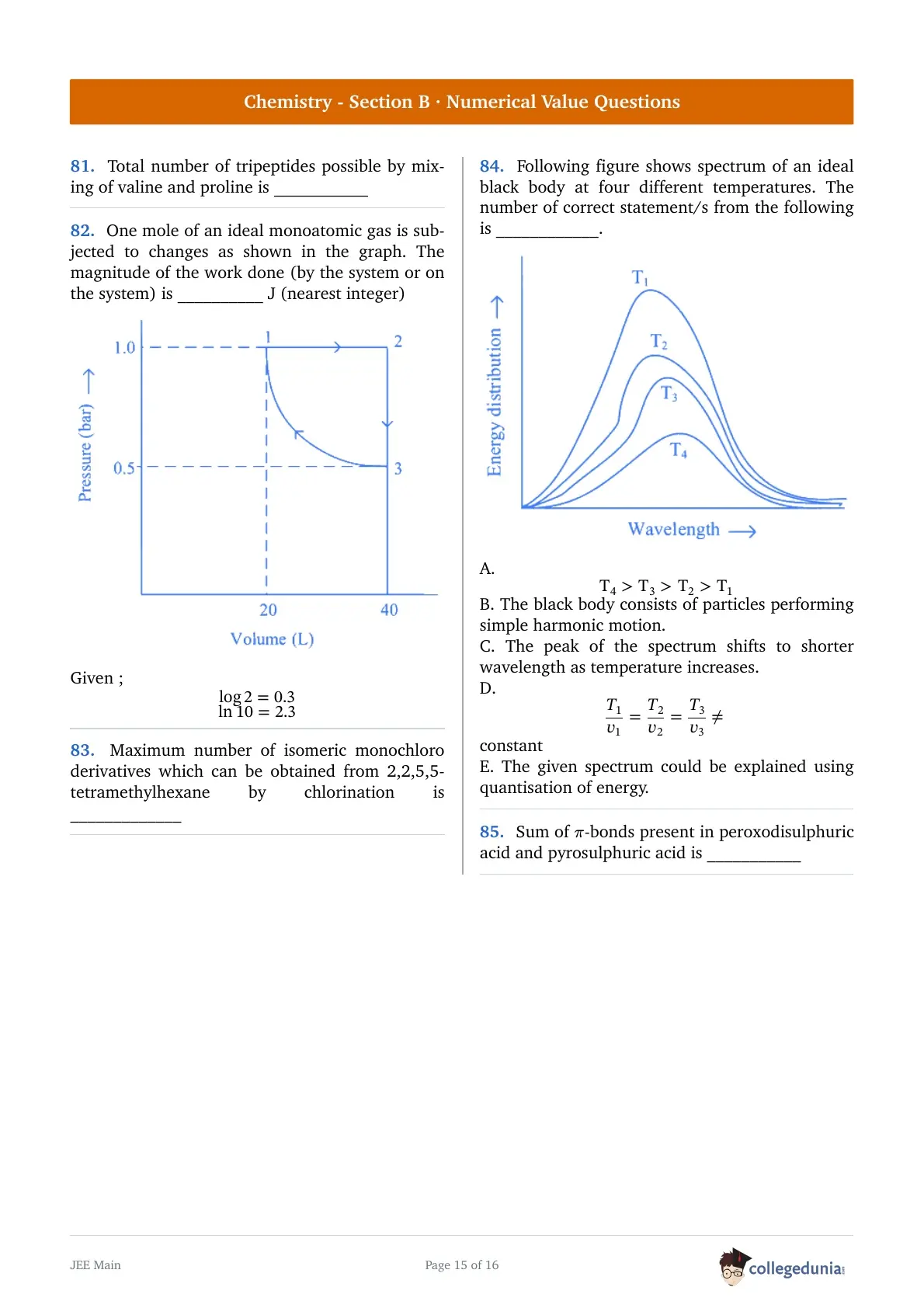
One mole of an ideal monoatomic gas is subjected to changes as shown in the graph The magnitude of the work done (by the system or on the system) is _______ J (nearest integer)
Given : \(\log 2=0.3 \ln 10=2.3\)
Maximum number of isomeric monochloro derivatives which can be obtained from 2,2,5,5-tetramethylhexane by chlorination is ________
Following figure shows spectrum of an ideal black body at four different temperatures The number of correct statement/s from the following is ________
[A.] \(T_4 > T_3 > T_2 > T_1\)
[B.] The black body consists of particles performing simple harmonic motion.
[C.] The peak of the spectrum shifts to shorter wavelengths as temperature increases.
[D.] \(\frac{T_1}{\nu_1} = \frac{T_2}{\nu_2} = \frac{T_3}{\nu_3} \neq \text{constant}.\)
[E.] The given spectrum could be explained using quantization of energy.
Sum of \(\pi\)-bonds present in peroxodisulphuric acid and pyrosulphuric acid is___________
The number of units, which are used to express concentration of solutions from the following is _______
Mass percent, Mole, Mole fraction, Molarity, ppm, Molality
The total pressure observed by mixing two liquids A and B is 350 , mm Hg when their mole fractions are 0.7 and 0.3 respectively The total pressure becomes 410 ,mm ,Hg if the mole fractions are changed to 0.2 and 0.8 respectively for A and B The vapour pressure of pure A is _________mm ,Hg (Nearest integer) Consider the liquids and solutions behave ideally.
If the pKa of lactic acid is 5, then the pH of 0.005 M calcium lactate solution at \(25^\circ \text{C}\) is \(\_\_\_\_\_\_ \times 10^{-1}\) (Nearest integer).
Lactic Acid
The number of statement/s which are the characteristics of physisorption is __________
A. It is highly specific in nature
B. Enthalpy of adsorption is high
C. It decreases with increase in temperature
D. It results into unimolecular layer
E. No activation energy is needed
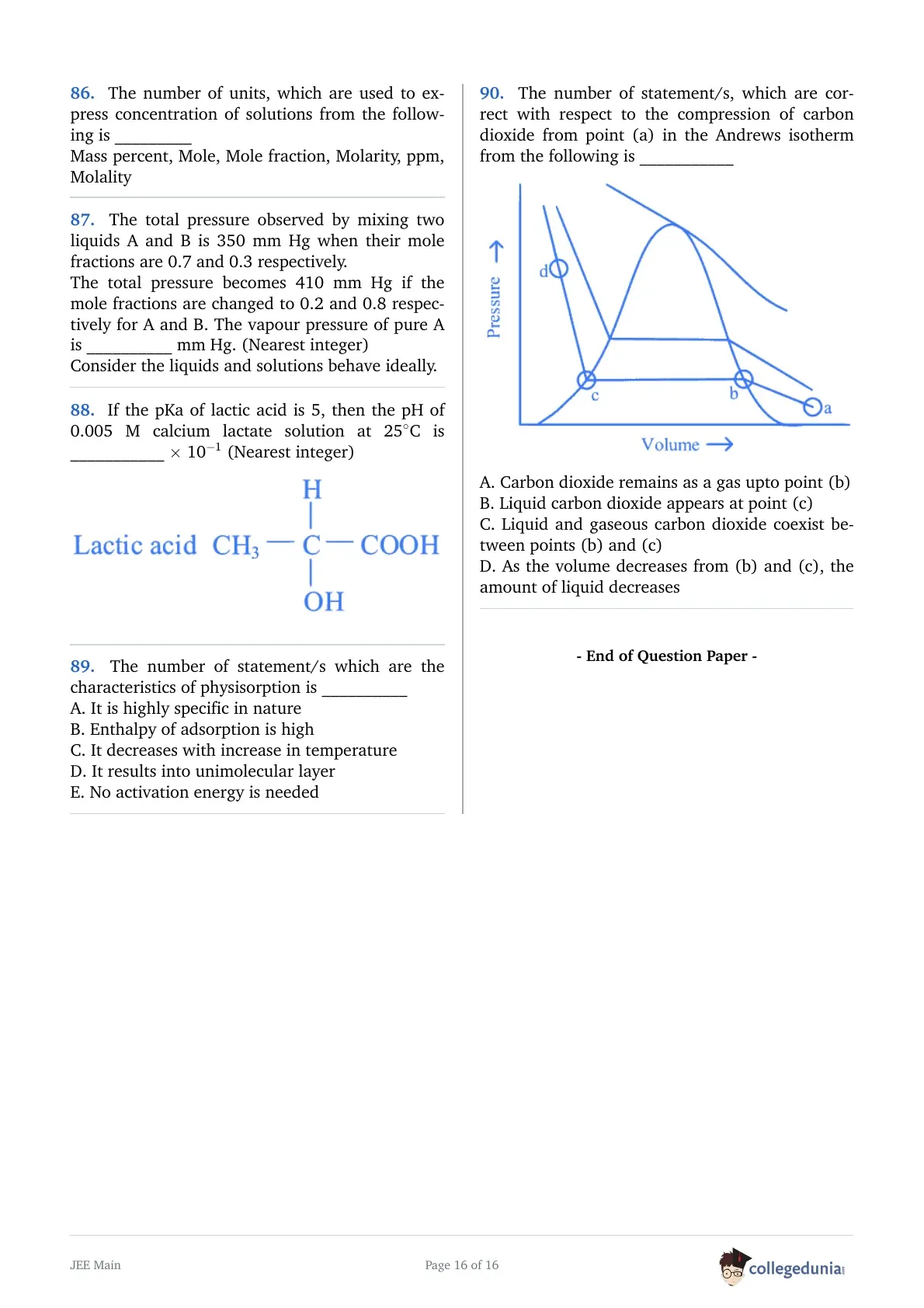
The number of statement/s, which are correct with respect to the compression of carbon dioxide from point (a) in the Andrews isotherm from the following is ______ 
A. Carbon dioxide remains as a gas upto point (b)
B. Liquid carbon dioxide appears at point (c)
C. Liquid and gaseous carbon dioxide coexist between points (b) and (c)
D. As the volume decreases from (b) to (c), the amount of liquid decreases
JEE Main 2023 Exam Pattern and Marking Scheme
| Particulars | Details |
|---|---|
| Exam Mode | Online (Computer-Based Test) |
| Paper | B.E./B.Tech |
| Medium of Exam | 13 languages: English, Hindi, Gujarati, Bengali, Tamil, Telugu, Kannada, Marathi, Malayalam, Odia, Punjabi, Assamese, Urdu |
| Duration | 3 hours (180 minutes) |
| Type of Questions | Multiple Choice Questions (MCQs) + Numerical Value Questions (attempt any 5 of 10 per subject) |
| Total Marks | 300 marks |
| Subjects | Mathematics, Physics, Chemistry |
| Marking Scheme | +4 for correct answer & -1 for incorrect MCQ and Numerical Value-based Questions |
| Total Questions | 90 Questions (30 per subject), 75 to be attempted |
| Eligibility | Passed or appearing in Class 12 with Physics, Chemistry, and Mathematics |
JEE Main 2023 Jan 24 Shift 2 Question Paper by Coaching Institute
| Coaching Institutes | Question Paper with Answer Key PDF |
|---|---|
| Aakash BYJUs | Check Here |
| Vedantu | Check Here |
JEE Main 2023 Paper Analysis Jan 24 Shift 2
JEE Main 2023 Paper Analysis for the January 24 Shift 2 exam is updated here. Candidates can use the link provided below to check the subject-wise paper analysis for JEE Main 2023 Jan 24 Shift 2 along with the topics with the highest weightage.
| JEE Main 2023 Paper Analysis Jan 24 Shift 2 | Check Here |



Comments