




The CAT 2022 DILR Slot 3 paper was conducted by IIM Bangalore on November 27, 2022 in the evening window from 4:30 PM to 6:30 PM. This Data Interpretation and Logical Reasoning section carried 20 questions for 60 marks, split into 4 sets of 5 questions each, with a sectional time limit of 40 minutes.
| CAT 2022 DILR Slot 3 Question Paper with Solutions | Download PDF | Check Solutions |
Around 6 of the 20 questions were TITA (Type In The Answer) type. On this page you get every one of the 20 questions with detailed, step-by-step solutions so you can see exactly how each of the 4 sets is cracked. Slot 3 was rated tougher than both Slot 1 and Slot 2, with only 1 of the 4 sets being genuinely easy, so smart set selection mattered more than raw speed.
CAT 2022 Slot 3 DILR Questions with Solutions
Comprehension:
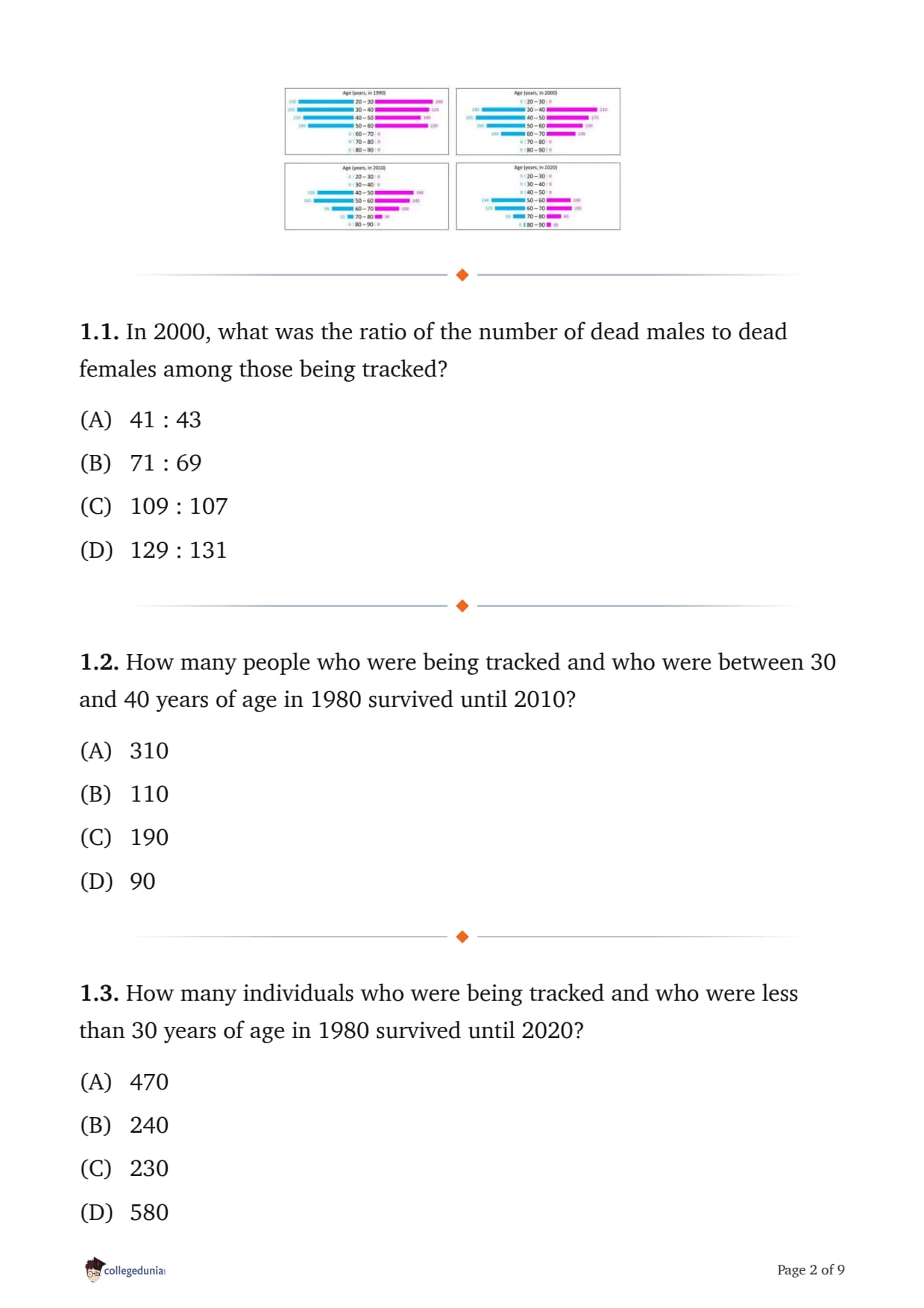
In the following,a year corresponds to 1st of January of that year. A study to determine the mortality rate for a disease began in 1980. The study chose 1000 males and 1000 females and followed them for forty years or until they died,whichever came first. The 1000 males chosen in 1980 consisted of 250 each of ages 10 to less than 20,20 to less than 30,30 to less than 40 and 40 to less than 50. The 1000 females chosen in 1980 also consisted of 250 each of ages 10 to less than 20,20 to less than 30,30 to less than 40 and 40 to less than 50. The four figures below depict the age profile of those among the 2000 individuals who were still alive in 1990,2000,2010 and 2020. The blue bars in each figure represent the number of males in each age group at that point in time,while the pink bars represent the number of females in each age group at that point in time. The numbers next to the bars give the exact numbers being represented by the bars. For example,we know that 230 males among those tracked and who were alive in 1990 were aged between 20 and 30.
Read More

In 2000, what was the ratio of the number of dead males to dead females among those being tracked?
How many people who were being tracked and who were between 30 and 40 years of age in 1980 survived until 2010?
How many individuals who were being tracked and who were less than 30 years of age in 1980 survived until 2020?
How many of the males who were being tracked and who were between 20 and 30 years of age in 1980 died in the period 2000 to 2010?
How many of the females who were being tracked and who were between 20 and 30 years of age in 1980 died between the ages of 50 and 60?
Comprehension:
Pulak, Qasim,Ritesh and Suresh participated in a tournament comprising of eight rounds. In each round,they formed two pairs, with each of them being in exactly one pair. The only restriction in the pairing was that the pairs would change in successive rounds. For example,if Pulak formed a pair with Qasim in the first round,then he would have to form a pair with Ritesh or Suresh in the second round. He would be free to pair with Qasim again in the third round. In each round,each pair decided whether to play the game in that round or not. If they decided not to play,then no money was exchanged between them. If they decided to play, they had to bet either ₹1 or ₹2 in that round. For example,if they chose to bet ₹2,then the player winning the game got ₹2 from the one losing the game.
Read More
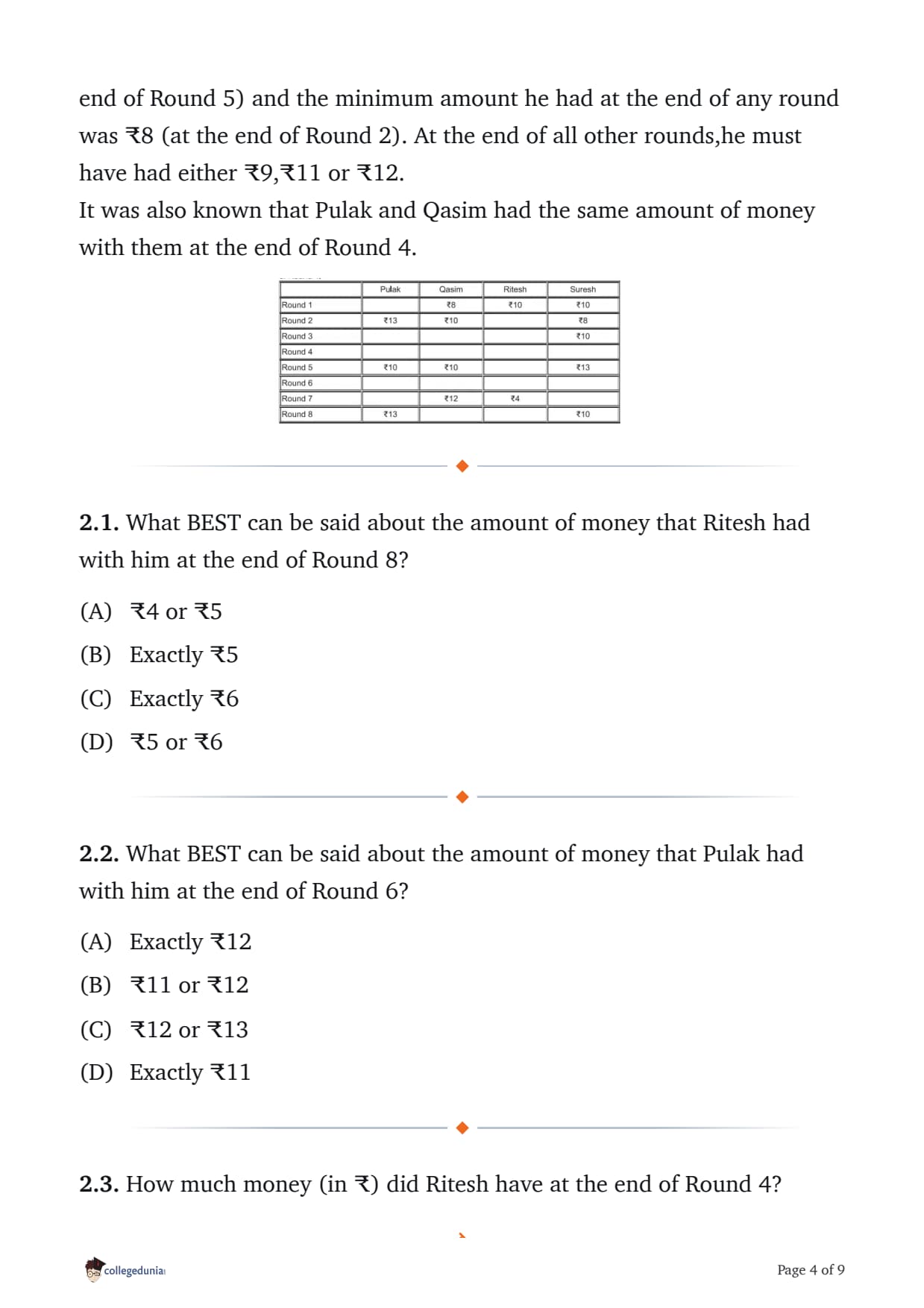
At the beginning of the tournament,the players had ₹10 each. The following table shows partial information about the amounts that the players had at the end of each of the eight rounds. It shows every time a player had ₹10 at the end of a round, as well as every time, at the end of a round, a player had either the minimum or the maximum amount that he would have had across the eight rounds. For example,Suresh had ₹10 at the end of Rounds 1,3 and 8 and not after any of the other rounds. The maximum amount that he had at the end of any round was ₹13 (at the end of Round 5) and the minimum amount he had at the end of any round was ₹8 (at the end of Round 2). At the end of all other rounds,he must have had either ₹9,₹11 or ₹12.It was also known that Pulak and Qasim had the same amount of money with them at the end of Round 4.

What BEST can be said about the amount of money that Ritesh had with him at the end of Round 8?
What BEST can be said about the amount of money that Pulak had with him at the end of Round 6?
How much money (in ₹) did Ritesh have at the end of Round 4?
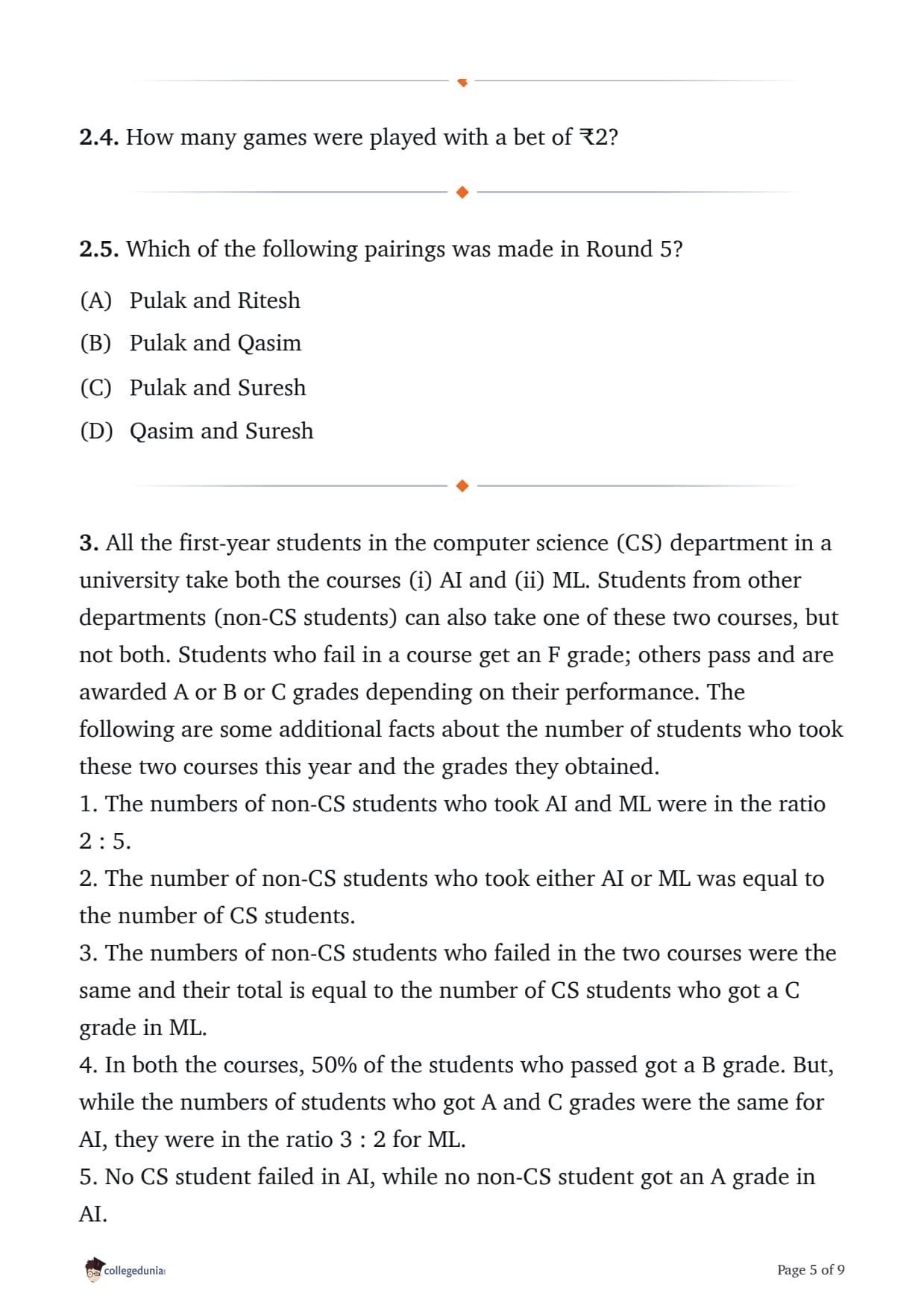
How many games were played with a bet of ₹2?
Which of the following pairings was made in Round 5?
Comprehension:
All the first-year students in the computer science (CS) department in a university take both the courses (i) AI and (ii) ML. Students from other departments (non-CS students) can also take one of these two courses, but not both. Students who fail in a course get an F grade; others pass and are awarded A or B or C grades depending on their performance. The following are some additional facts about the number of students who took these two courses this year and the grades they obtained.
1. The numbers of non-CS students who took AI and ML were in the ratio 2 : 5.
2. The number of non-CS students who took either AI or ML was equal to the number of CS students.
Read More
3. The numbers of non-CS students who failed in the two courses were the same and their total is equal to the number of CS students who got a C grade in ML.4. In both the courses, 50% of the students who passed got a B grade. But, while the numbers of students who got A and C grades were the same for AI, they were in the ratio 3 : 2 for ML.
5. No CS student failed in AI, while no non-CS student got an A grade in AI.
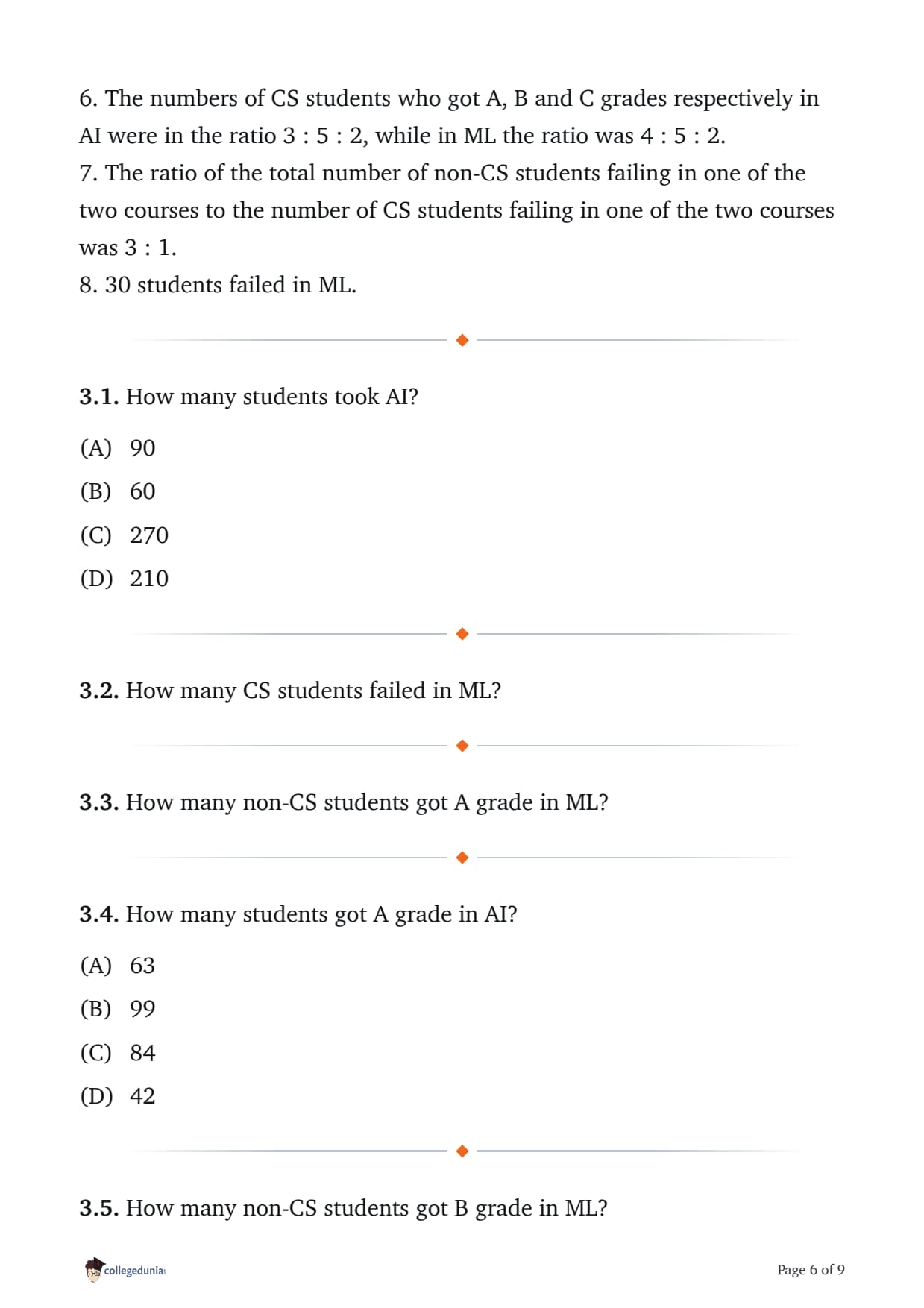
6. The numbers of CS students who got A, B and C grades respectively in AI were in the ratio 3 : 5 : 2, while in ML the ratio was 4 : 5 : 2.
7. The ratio of the total number of non-CS students failing in one of the two courses to the number of CS students failing in one of the two courses was 3 : 1.
8. 30 students failed in ML.
How many students took AI?
How many CS students failed in ML?
How many non-CS students got A grade in ML?
How many students got A grade in AI?
How many non-CS students got B grade in ML?
Comprehension:
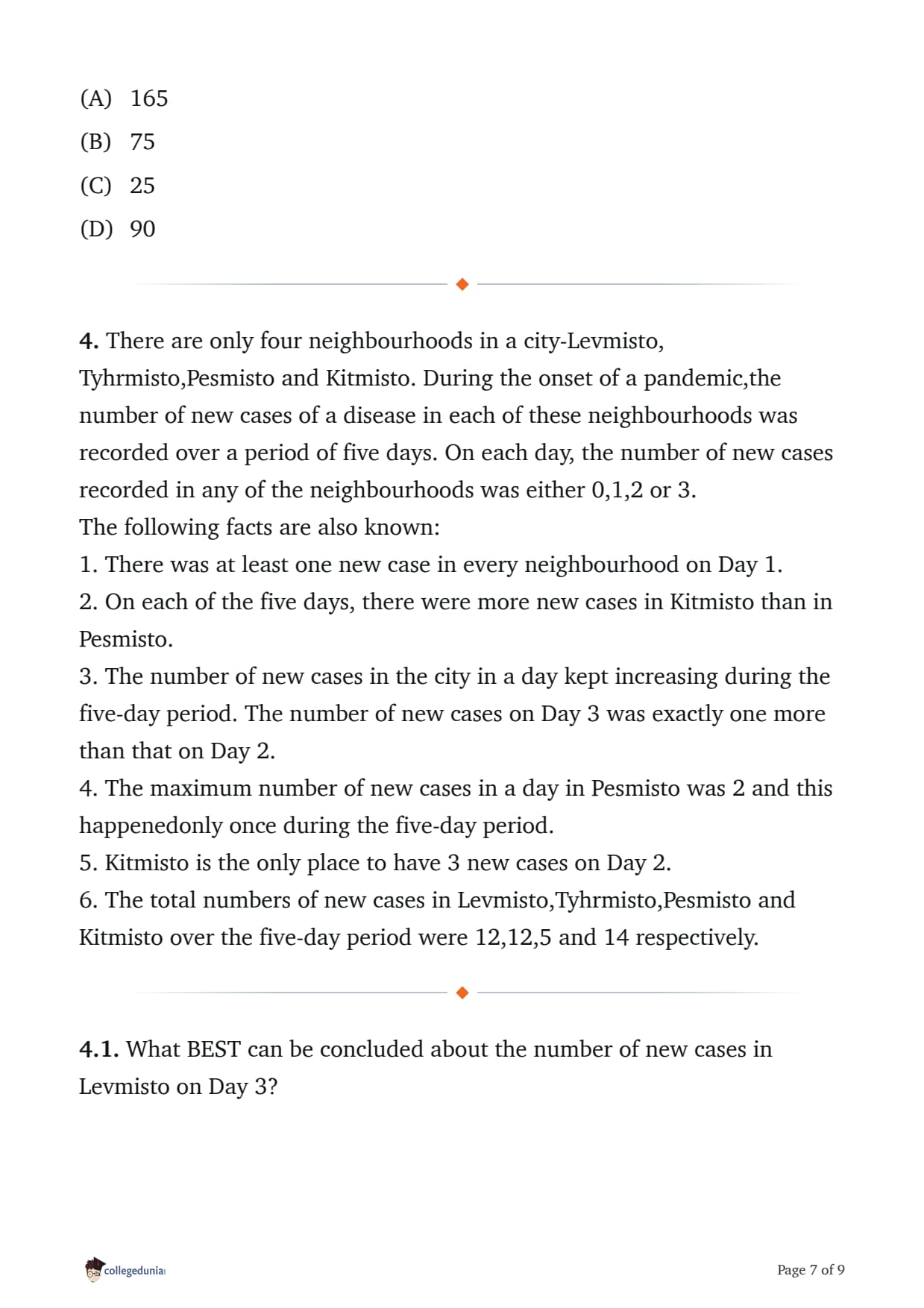
There are only four neighbourhoods in a city-Levmisto, Tyhrmisto,Pesmisto and Kitmisto. During the onset of a pandemic,the number of new cases of a disease in each of these neighbourhoods was recorded over a period of five days. On each day, the number of new cases recorded in any of the neighbourhoods was either 0,1,2 or 3.
The following facts are also known:
1. There was at least one new case in every neighbourhood on Day 1.
2. On each of the five days, there were more new cases in Kitmisto than in Pesmisto.
Read More
3. The number of new cases in the city in a day kept increasing during the five-day period. The number of new cases on Day 3 was exactly one more than that on Day 2.4. The maximum number of new cases in a day in Pesmisto was 2 and this happenedonly once during the five-day period.
5. Kitmisto is the only place to have 3 new cases on Day 2.
6. The total numbers of new cases in Levmisto,Tyhrmisto,Pesmisto and Kitmisto over the five-day period were 12,12,5 and 14 respectively.
What BEST can be concluded about the number of new cases in Levmisto on Day 3?
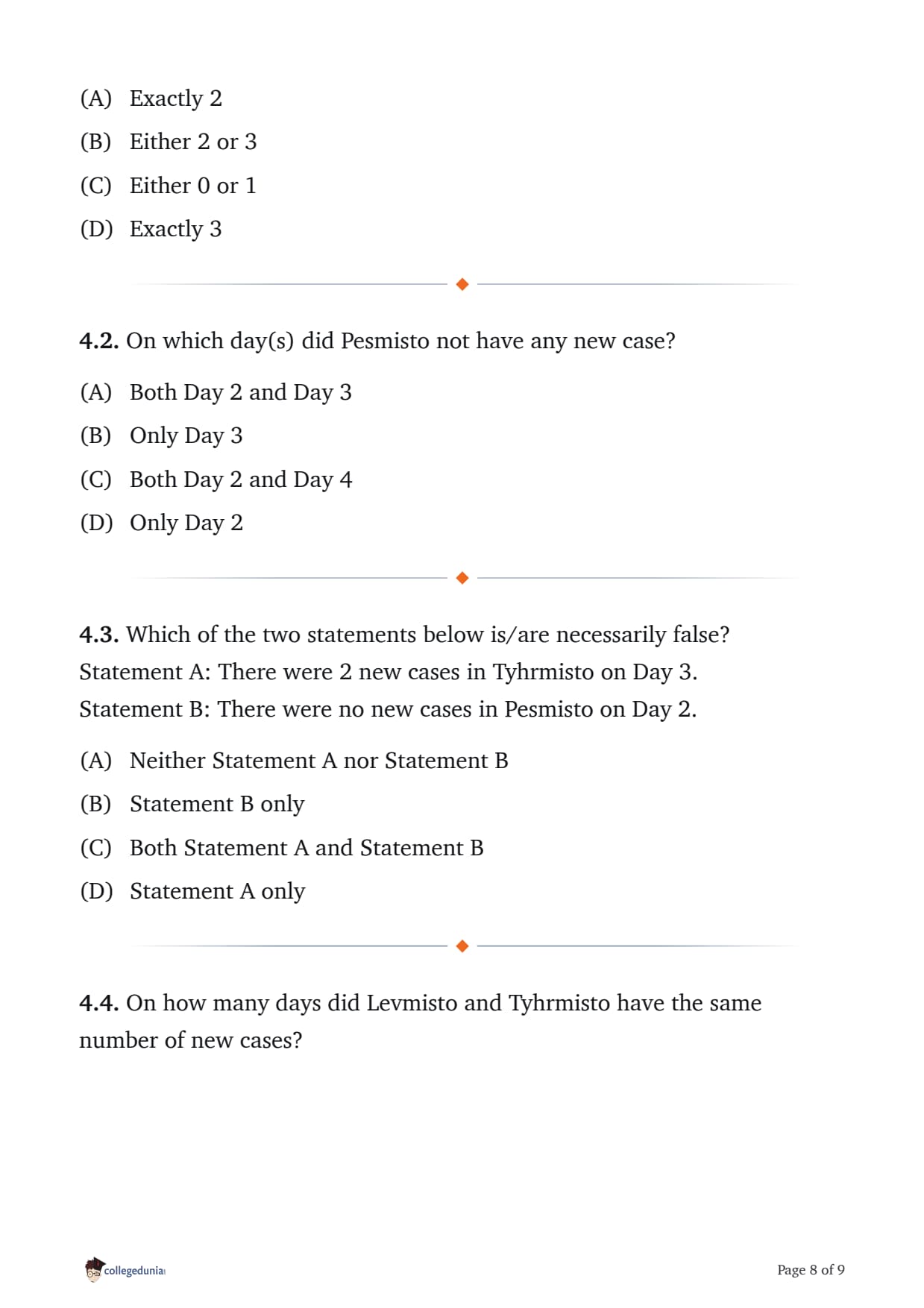
On which day(s) did Pesmisto not have any new case?
Which of the two statements below is/are necessarily false?
Statement A: There were 2 new cases in Tyhrmisto on Day 3.
Statement B: There were no new cases in Pesmisto on Day 2.
On how many days did Levmisto and Tyhrmisto have the same number of new cases?
What BEST can be concluded about the total number of new cases in the city on Day 2?
CAT 2022 DILR Slot 3 Exam Pattern and Marking Scheme
The DILR section in CAT 2022 Slot 3 held 20 questions for a total of 60 marks, all to be solved within a 40-minute sectional time limit. The 20 questions were arranged as 4 sets of 5 questions each, and about 6 of them were TITA questions. Knowing the marking rules below helps you decide how many of the 20 questions to actually attempt.
- Total questions: 20 in the Data Interpretation & Logical Reasoning section
- Section duration: 40 minutes (sectional time limit)
- Total marks: 60 (3 marks per question)
- Marking (MCQ): Each correct MCQ earns +3 marks and each wrong MCQ costs -1 mark (one-third negative).
- Marking (TITA): Each correct TITA question earns +3 marks with 0 negative marking for a wrong answer, so all 6 TITA questions are risk-free to attempt.
- Question types: MCQ and TITA (Type In The Answer), spread across 4 sets of 5 questions covering both Data Interpretation and Logical Reasoning.
CAT 2022 DILR Slot 3 Set-Wise Topics and Weightage
All 20 questions were divided into 4 sets of 5 questions each, so every set carried an equal 15 marks. The Slot 3 mix leaned heavily toward Logical Reasoning caselets, with only 1 of the 4 sets rated genuinely easy. The set themes and their 5-question loads are listed below.
- Route / Network based set (5 questions): a route-based diagram requiring you to trace connections, the type of LR puzzle that ate the most time among the 4 sets.
- Online Sites data set (5 questions): a data-led set built on online site usage figures, the closest the 4 sets came to a pure Data Interpretation set.
- Tests caselet, boys and girls (5 questions): a Logical Reasoning caselet on students and test scores that was the 1 easy set of the 4 and the best scoring opportunity.
- Window / Split AC caselet (5 questions): a conditions-based LR caselet that several students flagged as the most ambiguous of the 20 questions.
CAT 2022 DILR Slot 3 Video Solution Walkthrough
Source: MBA Karo
How to Use the CAT 2022 DILR Slot 3 Solved Paper
Treat this solved paper as a 40-minute mock first, then study the solutions. With only 1 of the 4 sets being easy, your scanning and set-selection skill decides your score more than your solving speed. Use these 4 steps with the 20 solved questions below.
- Spend the first 3 minutes scanning all 4 sets before solving anything, exactly as you would in the real 40-minute window.
- Lock in the easy boys-and-girls tests caselet first to bank a confident 15 marks, then move to the next most doable set.
- Attempt all 6 TITA questions you can reach, since a wrong TITA costs 0 marks while a wrong MCQ costs -1.
- After timing yourself, read the full solution for every one of the 20 questions and note which 2 sets you should have skipped.
Good Attempts and Percentile Benchmark for DILR Slot 3
- Attempting 9 to 11 questions out of 20 at 85 to 90% accuracy was considered a strong DILR Slot 3 performance.
- A DILR sectional score of around 26 to 27 marks was enough for a 99+ percentile in this section.
- Clearing 2 full sets out of the 4 cleanly already put you ahead of most test-takers in this tougher Slot 3.
- Because only 1 set was easy, attempting all 20 questions was a trap, accuracy on 10 chosen questions beat volume.
DILR Slot 3 Question Paper FAQs
Ques. How many questions were there in CAT 2022 DILR Slot 3?
Ans. The CAT 2022 DILR Slot 3 section had exactly 20 questions for 60 marks, arranged as 4 sets of 5 questions each. About 6 of these 20 questions were TITA (Type In The Answer) type, and you got 40 minutes to solve the whole section.
Ques. Was CAT 2022 DILR Slot 3 difficult?
Ans. Yes. CAT 2022 DILR Slot 3 was rated harder than both Slot 1 and Slot 2. Of the 4 sets, only 1 was genuinely easy, so set selection across the 20 questions mattered more than solving speed.
Ques. What is a good attempt in CAT 2022 DILR Slot 3?
Ans. Attempting 9 to 11 questions out of the 20 with 85 to 90% accuracy counted as a strong DILR Slot 3 performance. Clearing 2 of the 4 sets cleanly was enough to stay ahead of most candidates in this tougher slot.
Ques. How many marks in DILR Slot 3 gave a 99 percentile?
Ans. A DILR sectional score of around 26 to 27 marks out of 60 was enough for a 99+ percentile in CAT 2022 Slot 3. That works out to roughly 9 to 10 fully correct questions, which is why accuracy on chosen sets beat attempting all 20.
Ques. What is the marking scheme for the 20 DILR questions?
Ans. Each of the 20 questions carries 3 marks. A correct MCQ gives +3 and a wrong MCQ costs -1, while the roughly 6 TITA questions give +3 for a correct answer and 0 for a wrong one, making all 6 TITA questions safe to attempt.
Ques. Who conducted CAT 2022 and where can I check official details?
Ans. CAT 2022 was conducted by IIM Bangalore on November 27, 2022 across 3 slots, with Slot 3 running from 4:30 PM to 6:30 PM. You can verify the official exam pattern and conducting-body details at iimcat.ac.in.



Comments