



Biotechnology universities in Germany offer the subject mainly as a two-year, four-semester MSc. For a fully English-taught program, the University of Göttingen leads with its MSc in Molecular Life Sciences. If you are reading in October 2026, the Winter 2027/28 deadline still lies ahead in 2027.
- Göttingen, TU Dresden, Mainz, Hohenheim and Giessen lead the fully English-taught options.
- Annual fees start at €666.60 (INR 71,233) at Halle and reach €13,794 (INR 14.74 Lakhs) at TUM.
- Heidelberg ranks 28th for biological sciences, but its program requires German C1 and two interviews.
- As of October 2026, the DAAD STEM Study Scholarship for Winter 2027/28 does not list India.
- Graduates get 18 months to find a job, with no job offer needed to apply.
Check Out: Study in Germany
Exchange rate: all EUR figures convert at 1 EUR = INR 106.86, the ECB reference rate on 16 October 2026.
Latest Updates - October 2026
- Heidelberg closes its Summer 2027 window for MSc Molecular Biotechnology on 15 November 2026.
- Göttingen takes non-EU applications for Winter 2027/28 from 1 January 2027 to 15 February 2027.
- TUM charges new non-EU master's students €4,600 (INR 4.92 Lakhs) or €6,800 (INR 7.27 Lakhs) a semester from Winter 2027/28.
- APS India's new dMAT test holds its next sessions in January 2027 and March 2027.
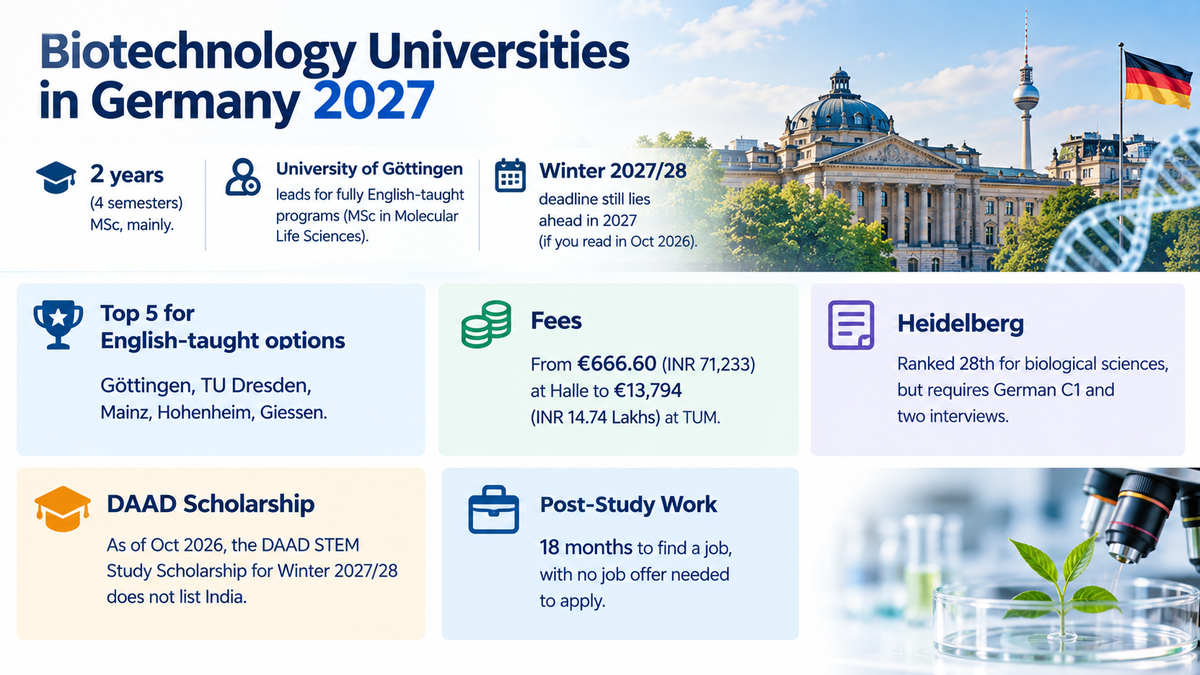
Table of Contents
- Top 10 Biotechnology Universities in Germany
- Biotechnology Specializations in Germany by Student Background
- Biotechnology Universities in Germany Application Deadlines for 2027
- Biotechnology Universities in Germany Fees for Indian Students
- Cost of Living for Biotechnology Students in Germany
- Eligibility and Requirements for Biotechnology Master's in Germany
- Visa and Blocked Account for Biotechnology Students in Germany
- Scholarships for Indian Biotechnology Students in Germany
- Jobs and Salary After Biotechnology Master's in Germany
- FAQs
Top 10 Biotechnology Universities in Germany
Top biotechnology universities in Germany include Heidelberg, TUM, Göttingen, TU Dresden and RWTH Aachen. The table ranks ten universities by the QS subject ranking for biological sciences. QS publishes no separate biotechnology table, so this is the closest QS subject.
| University | Location | QS World University Rankings by Subject 2026: Biological Sciences |
|---|---|---|
| Heidelberg University | Heidelberg | #28 |
| Technical University of Munich (TUM) | Munich | #55 |
| University of Göttingen | Göttingen | #81 |
| TU Dresden | Dresden | #195 |
| RWTH Aachen University | Aachen | #198 |
| Johannes Gutenberg University Mainz | Mainz | #301-350 |
| Martin Luther University Halle-Wittenberg | Halle | #351-400 |
| Philipps University of Marburg | Marburg | #351-400 |
| University of Hohenheim | Stuttgart | #401-450 |
| Justus Liebig University Giessen | Giessen | #401-450 |
Heidelberg, TUM and RWTH teach their biotechnology master's mainly or partly in German. All three ask for German proof, so they suit only applicants with strong German. Halle takes its final students for its biotechnology MSc in Winter 2027/28. The other six programs run fully in English.
Note: All ten Winter 2027/28 deadlines fall in 2027. So October 2026 is the month to shortlist programs and book your APS certificate.
Check Out: MS Biotechnology Universities
Biotechnology Specializations in Germany by Student Background
Biotechnology specializations in Germany are split into molecular, engineering, pharmaceutical, and agricultural routes. Each one suits a different Indian bachelor's degree. In October 2026, the key check is whether your degree counts as engineering for the new dMAT test.
| Your Background | Best-Fit Programs | Teaching Language | Why It Fits |
|---|---|---|---|
| BSc Biotechnology, Microbiology or Life Sciences | Göttingen Molecular Life Sciences; Mainz Molecular Biotechnology; Marburg Molecular Biotechnology | English | Admission rests on biology, biochemistry and lab credits, which science degrees carry |
| BTech Biotechnology or Chemical Engineering | TU Dresden Molecular Bioengineering; Hohenheim Biotechnology | English | Dresden admits engineering graduates; Hohenheim counts process engineering modules |
| BPharm or Biochemical Engineering | Halle Pharmaceutical and Industrial Biotechnology | English | Halle accepts pharmacy and biochemical engineering; last intake is Winter 2027/28 |
| BSc Agriculture or Plant Science | Giessen Agrobiotechnology | English | Giessen accepts agro-biology, agriculture and biology degrees of 180 credits |
| Any relevant degree plus German C1 | Heidelberg Molecular Biotechnology; TUM Molecular Biotechnology; RWTH Sustainable Biotechnology | German and English | Highest-ranked options, but each asks for German proof |
Note: APS India says its final list of dMAT fields is still to be announced. BTech Biotechnology graduates should confirm their status with APS India this month.
Check Out: Masters in Biology in Germany
Biotechnology Universities in Germany Application Deadlines for 2027
Biotechnology universities in Germany close most Winter 2027/28 applications between 15 February 2027 and 15 June 2027. Classes for this intake start in October 2027. Most programs on this list admit students only once a year.
| University | Window for Winter 2027/28 | Extra Step |
|---|---|---|
| University of Göttingen | 1 January 2027 to 15 February 2027 (non-EU) | Online English test and a short interview |
| RWTH Aachen University | 1 December 2026 to 1 March 2027 (non-EU) | German and English proof at enrollment |
| Heidelberg University | 1 February 2027 to 15 March 2027 | German C1 and two interviews |
| Martin Luther University Halle-Wittenberg | Until 31 March 2027 through uni-assist | Last intake for this program |
| Johannes Gutenberg University Mainz | 1 April 2027 to 15 May 2027 | Request a recognition certificate six weeks before the deadline |
| Technical University of Munich (TUM) | 1 April 2027 to 31 May 2027 | German proof and an aptitude assessment |
| TU Dresden | 1 April 2027 to 31 May 2027 | CMCB portal plus uni-assist, then an online interview |
| University of Hohenheim | Portal opens mid-April; deadline 15 June 2027 | APS certificate at application |
| Justus Liebig University Giessen | 1 May 2027 to 15 June 2027 | uni-assist documents due 14 days before the deadline |
| Philipps University of Marburg | 1 April to 15 July in the 2026 cycle; 2027 dates not yet published | Aptitude assessment |
Deadline Alert: Hohenheim advises applying by 15 May 2027, a month early, to leave time for the visa. Book your APS appointment with this earlier date in mind.
Check Out: Intakes in Germany
Biotechnology Universities in Germany Fees for Indian Students
Biotechnology universities in Germany charge Indian students €666.60 (INR 71,233) to €13,794 (INR 14.74 Lakhs) a year. Most of the ten charge no tuition for non-EU students. At those, you pay only a semester contribution. Baden-Württemberg charges non-EU students €1,500 (INR 1.60 Lakhs) a semester, which applies at Heidelberg and Hohenheim. TUM charges its own higher fee, shown as a range below.
| University | Program | Program Fees (Annual) (EUR) | Program Fees (Annual) (INR) |
|---|---|---|---|
| Heidelberg University | MSc Molecular Biotechnology | €3,379.60 | INR 3.61 Lakhs |
| Technical University of Munich (TUM) | MSc Molecular Biotechnology | €9,394 to €13,794 | INR 10.04 Lakhs to INR 14.74 Lakhs |
| University of Göttingen | MSc Molecular Life Sciences: Microbiology, Biotechnology and Biochemistry | €968.36 | INR 1.03 Lakhs |
| TU Dresden | MSc Molecular Bioengineering | €722 | INR 77,153 |
| RWTH Aachen University | MSc Sustainable Biotechnology | €750.38 | INR 80,186 |
| Johannes Gutenberg University Mainz | MSc Molecular Biotechnology | €733.80 | INR 78,414 |
| Martin Luther University Halle-Wittenberg | MSc Pharmaceutical and Industrial Biotechnology | €666.60 | INR 71,233 |
| Philipps University of Marburg | MSc Molecular Biotechnology | €0 | INR 0 |
| University of Hohenheim | MSc Biotechnology | €3,349 | INR 3.58 Lakhs |
| Justus Liebig University Giessen | MSc Agrobiotechnology | €842.86 | INR 90,068 |
Each annual figure equals two semesters of tuition plus two semester contributions. TUM's range reflects its two fee tiers, €4,600 (INR 4.92 Lakhs) or €6,800 (INR 7.27 Lakhs) a semester. Check the program page for the tier that applies. Göttingen, RWTH and Giessen include a Germany-wide semester ticket worth €226.80 (INR 24,236) in their contribution.
Note: Fee status as of October 2026: TUM has confirmed its rise for Winter 2027/28. Other contributions shown are the latest published, mostly for Winter 2026/27. Universities set them again each semester.
Check Out: Tuition-Free Universities in Germany
Cost of Living for Biotechnology Students in Germany
Cost of living for biotechnology students in Germany tops out at €2,000 (INR 2.14 Lakhs) a month in Munich. Munich's official range starts at €1,300 (INR 1.39 Lakhs). Dresden lists €900 (INR 96,174) a month. These figures cover rent, food, insurance, phone and personal spending, but not tuition or flights. Your student visa needs proof of €992 (INR 1.06 Lakhs) a month, which is below Munich and Aachen costs.
| University | City | Monthly Cost of Living (EUR) | Monthly Cost of Living (INR) |
|---|---|---|---|
| Technical University of Munich (TUM) | Munich | €1,300 to €2,000 | INR 1.39 Lakhs to INR 2.14 Lakhs |
| Johannes Gutenberg University Mainz | Mainz | €1,000 to €1,200 | INR 1.07 Lakhs to INR 1.28 Lakhs |
| RWTH Aachen University | Aachen | €1,100 or more | INR 1.18 Lakhs or more |
| Heidelberg University | Heidelberg | €1,000 | INR 1.07 Lakhs |
| Justus Liebig University Giessen | Giessen | €1,000 | INR 1.07 Lakhs |
| University of Hohenheim | Stuttgart | €992 or more | INR 1.06 Lakhs or more |
| University of Göttingen | Göttingen | €800 to €1,000 | INR 85,488 to INR 1.07 Lakhs |
| TU Dresden | Dresden | €900 | INR 96,174 |
Pro Tip for Indian Students: TUM warns that student dorms in Munich have long waiting lists. Register with the local Studierendenwerk in the week your admission arrives.
Check Out: Cost of Living in Germany
Eligibility and Requirements for Biotechnology Master's in Germany
Eligibility for a biotechnology master's in Germany starts with a 180-ECTS bachelor's in life sciences or engineering. You also need English proof and an APS certificate. In October 2026, you still have time to book APS before the first 2027 deadline.
- A three-year, 180-ECTS bachelor's qualifies at Göttingen, Halle, Hohenheim and Giessen.
- TUM asks for a bachelor's of at least six semesters in a related subject.
- Heidelberg asks for a German grade of 2.4, Mainz 2.5 and Halle better than 2.5.
- Göttingen and Hohenheim set no minimum grade but score your subject credits.
- Göttingen wants 65 ECTS in biology plus 25 ECTS in chemistry, math, physics or computer science.
- Work experience is not an entry requirement at any program reviewed here.
- None of the programs reviewed asks for the GRE; Göttingen adds an online English test and interview.
- IELTS 6.5 meets Heidelberg, TU Dresden, Halle and Hohenheim; Göttingen and Giessen ask for IELTS 7.0.
- Göttingen and TU Dresden accept an English-taught degree as proof; Heidelberg does not.
- Every Indian applicant needs an APS certificate, which costs INR 18,000.
- From Summer Semester 2027, APS adds a dMAT test costing €150 (INR 16,029) for some fields, including engineering.
- Heidelberg also requires German C1, such as TestDaF 4 in all parts or DSH-2.
- Keep transcripts, degree certificate, CV, motivation letter, two LORs, English score, APS certificate and passport ready.
Watch Out: The German Embassy says a low dMAT score does not block your APS certificate by itself. Your other APS documents must still meet the rules.
Check Out: APS Certificate for Germany
Visa and Blocked Account for Biotechnology Students in Germany
A German student visa for biotechnology needs €11,904 (INR 12.72 Lakhs) in a blocked account for 2026. You apply for a national D visa after your admit arrives.
- The national visa fee is €75 (INR 8,014), paid in INR.
- You can withdraw up to €992 (INR 1.06 Lakhs) a month from the blocked account.
- Public health insurance at TK costs €146.29 (INR 15,633) a month for students aged 23 or older without children.
- You can work 140 full days or 280 half days a year, up to 20 hours a week in term.
- Student assistant jobs at your university fall outside this limit, with approval from the Foreigners Authority.
- The minimum wage is €13.90 (INR 1,485) an hour, rising to €14.60 (INR 1,560) on 1 January 2027.
Note: The proof of funds follows Germany's BAföG maximum rate. A BAföG bill had its first Bundestag reading on 15 October 2026. So the amount for 2027 may rise; no new figure is official yet.
Check Out:
Scholarships for Indian Biotechnology Students in Germany
Scholarships for Indian biotechnology students in Germany include the Deutschlandstipendium, Heinrich Böll, JN Tata Endowment and KC Mahindra awards. Most programs on this list charge no tuition. So these awards mainly help with living costs.
| Scholarship | Coverage | Status for Winter 2027/28 |
|---|---|---|
| Deutschlandstipendium | €300 (INR 32,058) a month for at least two semesters | Apply through your university once admitted; dates vary by university |
| Heinrich Böll Foundation Scholarship | Monthly stipend for students of any subject and nationality | Windows run 15 January to 1 March 2027 and 15 July to 1 September 2027 |
| JN Tata Endowment Loan Scholarship | Merit-based loan scholarship for an overseas master's | The 2026 cycle ran from 5 January to 29 March 2026; 2027 dates not yet announced |
| KC Mahindra Scholarship for Post Graduate Studies Abroad | Interest-free loan up to INR 4 Lakhs; up to INR 8 Lakhs for three Fellows | Call announced yearly in newspapers; 2027 date not yet announced |
Watch Out: DAAD's STEM Study Scholarship for Winter 2027/28 does not list India, as of October 2026. Check the DAAD scholarships database before counting on DAAD funding.
Check Out: Scholarships in Germany
Jobs and Salary After Biotechnology Master's in Germany
Jobs after a biotechnology master's in Germany include bioinformatics scientist, research scientist, quality control analyst and regulatory affairs specialist. Average pay runs from €43,726 (INR 46.73 Lakhs) to €68,314 (INR 73.00 Lakhs) a year.
| Job Role | Average Annual Salary (EUR) | Average Annual Salary (INR) |
|---|---|---|
| Bioinformatics Scientist | €68,314 | INR 73.00 Lakhs |
| Research Scientist, Biotechnology | €60,111 | INR 64.23 Lakhs |
| Quality Control Analyst | €44,219 | INR 47.25 Lakhs |
| Regulatory Affairs Specialist (entry-level) | €43,726 | INR 46.73 Lakhs |
Salaries come from PayScale Germany. The quality control and regulatory figures rest on smaller, older samples.
- After graduation, you get up to 18 months to find a qualified job and may work any job meanwhile.
- Biologists are on Germany's shortage list, so the lower EU Blue Card threshold of €45,934.20 (INR 49.09 Lakhs) applies.
- The standard Blue Card threshold is €50,700 (INR 54.18 Lakhs) in 2026.
- Entry-level quality control and regulatory pay can fall below the Blue Card threshold. In that case, check the general skilled-worker permit.
Note: Blue Card thresholds took effect on 1 January 2026 and change each January. The values above apply to job offers starting in 2026.
Check Out: Post-Study Work in Germany
Pick Göttingen, Mainz or Marburg with a science degree; pick TU Dresden or Hohenheim with a BTech.
- Book your APS certificate this month, before Göttingen opens on 1 January 2027.
- Submit Göttingen's application by 15 February 2027 and Halle's by 31 March 2027.
- Apply to TU Dresden between 1 April 2027 and 31 May 2027.
- Budget €11,904 (INR 12.72 Lakhs) for the blocked account, plus your semester contribution.
FAQs
Ques. Can I do a masters in biotechnology in Germany in English?
Ans. Yes. Göttingen, TU Dresden, Mainz, Marburg, Halle, Hohenheim and Giessen teach their biotechnology master's fully in English. These are the realistic picks for most Indian applicants. However, the highest-ranked programs at Heidelberg (28th), TUM (55th) and RWTH (=198) ask for German proof. Heidelberg needs German C1 and two interviews in German and English. For English programs, plan for IELTS 6.5 at most schools. Göttingen and Giessen ask for IELTS 7.0 instead.
Ques. Is a three-year BSc Biotechnology from India enough for a master's in Germany?
Ans. Yes, at several schools. Göttingen, Halle, Hohenheim and Giessen accept a 180-ECTS bachelor's, which a three-year degree usually meets. The harder test is your subject mix. Göttingen wants 65 ECTS in biology plus 25 ECTS in chemistry, math, physics or computer science. Hohenheim scores points from biotechnology, biochemistry, microbiology and process engineering modules. So a degree from a Tier-2 or Tier-3 city college works if its syllabus covers these areas. Ask your college for a detailed module list with credit hours early.
Ques. Do I need the dMAT for a biotechnology master's in Germany?
Ans. It depends on your degree field. APS India adds the dMAT from Summer Semester 2027 for some fields, including engineering, commerce and management. A BSc in biotechnology or life sciences falls outside those groups. However, APS India has not yet published its final field list. So BTech Biotechnology graduates should confirm with APS India before booking. The test costs €150 (INR 16,029). The next sessions are in January 2027 and March 2027. A low score does not by itself block your APS certificate.
Ques. How much does a biotechnology master's in Germany cost an Indian student in total?
Ans. Fees run from €666.60 (INR 71,233) a year at Halle to €13,794 (INR 14.74 Lakhs) at TUM. Living costs add €900 (INR 96,174) a month in Dresden. In Munich, they add €1,300 to €2,000 (INR 1.39 Lakhs to INR 2.14 Lakhs) a month. Your visa needs €11,904 (INR 12.72 Lakhs) in a blocked account for the first year. Add the €75 (INR 8,014) visa fee and INR 18,000 for APS.
Ques. Can Indian students get DAAD funding for a biotechnology master's in Germany?
Ans. Not through the main STEM route for 2027/28. DAAD's STEM Study Scholarship pays €992 (INR 1.06 Lakhs) a month. However, its Winter 2027/28 call does not list India as an eligible country. So plan other funding first. The Deutschlandstipendium pays €300 (INR 32,058) a month once you enroll. Heinrich Böll accepts applications from 15 January 2027 to 1 March 2027. Indian loan scholarships such as JN Tata Endowment and KC Mahindra also fit this degree.
Ques. What salary do biotechnology graduates earn in Germany?
Ans. Average pay is €60,111 (INR 64.23 Lakhs) a year for a biotechnology research scientist. Bioinformatics scientists average €68,314 (INR 73.00 Lakhs). Quality control analysts average €44,219 (INR 47.25 Lakhs), based on an older sample. Biologists are on Germany's shortage list. So the lower EU Blue Card threshold of €45,934.20 (INR 49.09 Lakhs) applies to them in 2026. After graduation, you get 18 months to find a qualified job.



Found 31 universities
| Ranking | College Info | Top Courses | Fees & Cost of Living | ||||||||||||||||||||||||||||||||||||||||||||||||||||||||||||||||||||||||||||||||||||||||||||||||
|---|---|---|---|---|---|---|---|---|---|---|---|---|---|---|---|---|---|---|---|---|---|---|---|---|---|---|---|---|---|---|---|---|---|---|---|---|---|---|---|---|---|---|---|---|---|---|---|---|---|---|---|---|---|---|---|---|---|---|---|---|---|---|---|---|---|---|---|---|---|---|---|---|---|---|---|---|---|---|---|---|---|---|---|---|---|---|---|---|---|---|---|---|---|---|---|---|---|---|---|
 #40/500 ARWU Ranking 2022(Biotechnology) |  Technical University Munich, MunichBavaria, Germany8%Acceptance Rate | MS Molecular Biotechnology Course duration: 2 years Exams Accepted: TOEFL4.5 | Tuition: (€9,333/Yr)$10.5K/Yr Living: (€1,300/Yr)$1.5K/Yr | ||||||||||||||||||||||||||||||||||||||||||||||||||||||||||||||||||||||||||||||||||||||||||||||||
#51/500 ARWU Ranking 2022(Biotechnology) |  Heidelberg University, HeidelbergBaden-Wurttemberg, Germany45%Acceptance Rate | MS Molecular Biotechnology Course duration: 2 years | Tuition: (€3,000/Yr)$3.4K/Yr Living: (€7,978/Yr)$8.9K/Yr | ||||||||||||||||||||||||||||||||||||||||||||||||||||||||||||||||||||||||||||||||||||||||||||||||
#101/500 ARWU Ranking 2022(Biotechnology) |  RWTH Aachen University, AachenNorth Rhine-Westphalia, Germany | MS Molecular and Applied Biotechnology Course duration: 2 years Exams Accepted: IELTS6PTE60 | -- | ||||||||||||||||||||||||||||||||||||||||||||||||||||||||||||||||||||||||||||||||||||||||||||||||
#401/500 ARWU Ranking 2022(Biotechnology) |  Technical University Berlin, BerlinBerlin, Germany | MS Biotechnology Course duration: 2 years | Tuition: (€721/Yr)$807.52/Yr | ||||||||||||||||||||||||||||||||||||||||||||||||||||||||||||||||||||||||||||||||||||||||||||||||
#201/500 ARWU Ranking 2022(Biotechnology) |  University of Goettingen, GottingenLower Saxony, Germany32%Acceptance Rate | M.S Molecular Life Sciences: Microbiology, Biotechnology and Biochemistry Course duration: 2 years | Tuition: (€404/Yr)$452.48/Yr | ||||||||||||||||||||||||||||||||||||||||||||||||||||||||||||||||||||||||||||||||||||||||||||||||
#151/500 ARWU Ranking 2022(Biotechnology) |  Technical University Dresden, DresdenSaxony, Germany22%Acceptance Rate | MS Biotechnology and Applied Ecology Course duration: 2 years Exams Accepted: TOEFL4.5 | Tuition: (€676/Yr)$757.12/Yr Living: (€5,997/Yr)$6.7K/Yr | ||||||||||||||||||||||||||||||||||||||||||||||||||||||||||||||||||||||||||||||||||||||||||||||||
| -- |  Martin Luther University Halle-Wittenberg, HalleSaxony, Germany56%Acceptance Rate | M.S Pharmaceutical and Industrial Biotechnology Course duration: 2 years Exams Accepted: TOEFL90 | Tuition: (€105/Yr)$117.6/Yr Living: (€2,597/Yr)$2.9K/Yr | ||||||||||||||||||||||||||||||||||||||||||||||||||||||||||||||||||||||||||||||||||||||||||||||||
#201/500 ARWU Ranking 2022(Biotechnology) |  University of Cologne, CologneNorth Rhine-Westphalia, Germany20%Acceptance Rate | MS Drug Discovery and Development Course duration: 2 years | Tuition: (€671/Yr)$751.52/Yr | ||||||||||||||||||||||||||||||||||||||||||||||||||||||||||||||||||||||||||||||||||||||||||||||||
#401/500 ARWU Ranking 2022(Biotechnology) |  University of Rostock, RostockMecklenburg-Vorpommern, Germany48%Acceptance Rate | B.S Medical Biotechnology Course duration: 3 years | Tuition: (€464/Yr)$519.68/Yr | ||||||||||||||||||||||||||||||||||||||||||||||||||||||||||||||||||||||||||||||||||||||||||||||||
#201/500 ARWU Ranking 2022(Biotechnology) |  Goethe University Frankfurt, Frankfurt am MainHesse, Germany77%Acceptance Rate | MS Molecular Biosciences Course duration: 2 years Exams Accepted: TOEFL4 | Tuition: (€763/Yr)$854.56/Yr Living: (€7,752/Yr)$8.7K/Yr | ||||||||||||||||||||||||||||||||||||||||||||||||||||||||||||||||||||||||||||||||||||||||||||||||
 | |||||||||||||||||||||||||||||||||||||||||||||||||||||||||||||||||||||||||||||||||||||||||||||||||||
#201/500 ARWU Ranking 2022(Biotechnology) |  University of Muenster, MunsterNorth Rhine-Westphalia, Germany15%Acceptance Rate | MS Biotechnology Course duration: 2 years Exams Accepted: TOEFL80 | Tuition: (€700/Yr)$784/Yr | ||||||||||||||||||||||||||||||||||||||||||||||||||||||||||||||||||||||||||||||||||||||||||||||||
| -- |  Technical University Darmstadt, DarmstadtHesse, Germany29%Acceptance Rate | MS Biomolecular Engineering – Molekulare Biotechnologie Course duration: 2 years | Tuition: (€765/Yr)$856.8/Yr | ||||||||||||||||||||||||||||||||||||||||||||||||||||||||||||||||||||||||||||||||||||||||||||||||
#151/500 ARWU Ranking 2022(Biotechnology) |  University of Wuerzburg, WurzburgBavaria, Germany28%Acceptance Rate | MSc Biochemistry Course duration: 2 years Exams Accepted: IELTS6 | -- | ||||||||||||||||||||||||||||||||||||||||||||||||||||||||||||||||||||||||||||||||||||||||||||||||
| -- |  Otto von Guericke University, MagdeburgSaxony, Germany40%Acceptance Rate | BSc Biosystems Engineering Course duration: 42 months | -- | ||||||||||||||||||||||||||||||||||||||||||||||||||||||||||||||||||||||||||||||||||||||||||||||||
#201/500 ARWU Ranking 2022(Biotechnology) |  University of Hohenheim, StuttgartBaden-Wurttemberg, Germany45%Acceptance Rate | B.S Food Science and Biotechnology Course duration: 3 years Exams Accepted: TOEFL90 | Tuition: (€3,000/Yr)$3.4K/Yr | ||||||||||||||||||||||||||||||||||||||||||||||||||||||||||||||||||||||||||||||||||||||||||||||||
| -- |  Ruhr University Bochum, BochumNorth Rhine-Westphalia, Germany40%Acceptance Rate | M.S Biochemistry Course duration: 2 years | Tuition: (€700/Yr)$784/Yr | ||||||||||||||||||||||||||||||||||||||||||||||||||||||||||||||||||||||||||||||||||||||||||||||||
#201/500 ARWU Ranking 2022(Biotechnology) |  Ulm University, UlmBaden-Wurttemberg, Germany13%Acceptance Rate | MS Pharmaceutical and Molecular Biotechnology Course duration: 2 years | Tuition: (€3,000/Yr)$3.4K/Yr Living: (€5,234/Yr)$5.9K/Yr | ||||||||||||||||||||||||||||||||||||||||||||||||||||||||||||||||||||||||||||||||||||||||||||||||
#401/500 ARWU Ranking 2021(Biotechnology) |  Technical University of Braunschweig, BraunschweigLower Saxony, Germany51%Acceptance Rate | M.S Biotechnology Course duration: 2 years | Tuition: (€880/Yr)$985.6/Yr Living: (€5,328/Yr)$6K/Yr | ||||||||||||||||||||||||||||||||||||||||||||||||||||||||||||||||||||||||||||||||||||||||||||||||
| -- |  University of Bayreuth, BayreuthBavaria, Germany30%Acceptance Rate | MSc Biotechnology & Process Engineering Course duration: 2 years | -- | ||||||||||||||||||||||||||||||||||||||||||||||||||||||||||||||||||||||||||||||||||||||||||||||||
| -- |  Brandenburg University of Technology, CottbusBrandenburg, Germany70%Acceptance Rate | M.S Biotechnology Course duration: 2 years Exams Accepted: TOEFL79 | Tuition: (€747/Yr)$836.64/Yr | ||||||||||||||||||||||||||||||||||||||||||||||||||||||||||||||||||||||||||||||||||||||||||||||||
SUBSCRIBE TO OUR NEWS LETTER


