




The Amrita Entrance Examination – Engineering (AEEE) 2027 exam dates have been announced by Amrita Vishwa Vidyapeetham on the official website aeee.amrita.edu. As per the update, AEEE 2027 is scheduled to be conducted from April 15 to May 7, 2027. Registration is expected to begin in November 2026, while the exact application date, last date and slot-booking schedule are yet to be notified.

Source: Official AEEE Website
AEEE 2027 Latest Updates:
- The AEEE 2027 exam dates were announced on the official website of Amrita Vishwa Vidyapeetham, with the exam to be held from April 15 to May 7, 2027, as reported on October 7, 2026.
- Compared with last year, the AEEE 2027 exam window begins in April 2027, whereas the first phase of AEEE 2026 began in January 2026.
- AEEE 2027 registration is expected to begin in November 2026, with the application form likely to be made available at aeee.amrita.edu.
AEEE 2026 (Amrita Engineering Entrance Examination) is a computer-based engineering entrance test conducted by Amrita Vishwa Vidyapeetham for B.Tech admissions across its eight campuses in India. Both exam phases are now over — Phase 1 was held from January 29 to February 1, 2026, and Phase 2 from April 24 to 30, 2026. As of June 22, 2026, the CSAP Mop-Up round is in its final hours, with registration closing today — making this the second-to-last opportunity for AEEE 2026 candidates to secure a seat before the Spot Round in July.
- Mop-Up Round Registration: AEEE 2026 CSAP Mop-Up round registration closes today, June 22, 2026. Candidates who did not receive a seat in Round 1 or Round 2 — or who rejected an earlier allotment — must register at aeee.amrita.edu, pay the INR 5,000 CSAP fee, and submit campus and branch preferences before the window closes today.
- Mop-Up Allotment: Seat allotment for the Mop-Up round is expected within 2–3 days of the registration close, around June 24–26, 2026. Allotted candidates must pay INR 1,00,000 as the initial seat acceptance fee to confirm admission. In AEEE 2025, Mop-Up allotment was released 2 days after registration closed.
- Spot Round: After the Mop-Up round, Amrita is expected to hold a Spot Round in the first week of July 2026 for any remaining vacant seats. The Spot Round is first-come, first-served — only candidates already registered for CSAP (INR 5,000 fee paid) are eligible. This will be the final admission opportunity for AEEE 2026.
- CSAP Registration Window: The overall CSAP registration window remains open until June 30, 2026. Candidates with a valid AEEE rank or JEE Main percentile who have not yet registered must do so before June 30 to remain eligible for the Spot Round.
What is AEEE 2026?
The Amrita Engineering Entrance Examination (AEEE) 2026 is the university-level entrance test conducted by Amrita Vishwa Vidyapeetham for admission to four-year B.Tech programmes across its eight campuses. Amrita Vishwa Vidyapeetham is a deemed-to-be university recognised by the UGC and holds an A++ accreditation from NAAC — the highest possible grade. AEEE is a fully computer-based test held in two phases every year, and the best score across both phases determines the final rank.
AEEE is one of the most sought-after private engineering entrance exams in India, with more than 1.5 lakh candidates registering in recent years. More than 70% of total B.Tech seats at Amrita are filled through the AEEE rank. The remaining seats go to candidates with a qualifying JEE Main 2026 percentile — no AEEE score needed for that path. Both routes use the same CSAP (Centralised Seat Allotment Process) for counselling and seat allocation.
This year, both phases of AEEE 2026 have been completed. Phase 1 ran from January 29 to February 1, 2026, and Phase 2 ran from April 24 to 30, 2026. Results for both phases are out, and the CSAP counselling process is in its final stage — the Mop-Up round registration closes today, June 22, 2026, ahead of the final Spot Round expected in the first week of July.
AEEE 2026 introduced a revised paper pattern with five sections: Mathematics, Physics, Chemistry, Quantitative Aptitude, and English — covering 100 questions for 300 marks in 2 hours 30 minutes. The exam is open to Class 12 pass-outs and appearing candidates who meet the academic and age eligibility criteria.
AEEE 2026 Highlights
Here is a quick overview of all key details about AEEE 2026:
| Particulars | Details |
|---|---|
| Full Name | Amrita Engineering Entrance Examination |
| Short Form | AEEE |
| Conducting Body | Amrita Vishwa Vidyapeetham (Amrita University) |
| Exam Level | National (University-Level) |
| Exam Mode | Computer-Based Test (CBT) |
| Frequency | Two Phases Per Year |
| Phase 1 Exam Dates | January 29 – February 1, 2026 (Over) |
| Phase 2 Exam Dates | April 24–30, 2026 (Over) |
| Total Questions | 100 (Multiple Choice) |
| Total Marks | 300 |
| Duration | 2 hours 30 minutes (150 minutes) |
| Sections | Mathematics, Physics, Chemistry, Quantitative Aptitude, English |
| Marking Scheme | +3 for correct; −1 for incorrect; 0 for unattempted |
| Application Fee (AEEE) | INR 1,300 (Phase 1); INR 600 extra for Phase 2 |
| Application Fee (JEE Main Route) | INR 500 |
| CSAP Registration Fee | INR 5,000 |
| Seat Acceptance Fee | INR 1,00,000 |
| Number of Campuses | 8 |
| B.Tech Specialisations | 19 |
| Current Status | CSAP Mop-Up Round (registration closes June 22, 2026) |
| Official Website | aeee.amrita.edu |
Source: Amrita Engineering Entrance Examination Official Website
AEEE 2026 Important Dates
The AEEE 2026 cycle began in late 2025 with the official notification and has now reached the final counselling stage. The table below lists upcoming events first in chronological order, followed by past events from earliest to most recent.
| Event | Date | Status |
|---|---|---|
| CSAP Mop-Up Round Registration Closes | June 22, 2026 | Today — Last Day |
| CSAP Mop-Up Round Seat Allotment | Expected June 24–26, 2026 | Upcoming |
| Mop-Up Round Seat Acceptance Fee Payment | Expected June 27–29, 2026 | Upcoming |
| CSAP Overall Registration Window Closes | June 30, 2026 | Upcoming |
| Spot Round | Expected first week of July 2026 | Upcoming |
| AEEE 2026 Official Notification | November 2025 | (Over) |
| Phase 1 Registration Window Opens | November 2025 | (Over) |
| Phase 1 Registration Closes | January 2026 | (Over) |
| AEEE 2026 Phase 1 Exam | January 29 – February 1, 2026 | (Over) |
| AEEE 2026 Phase 1 Result | February 2026 | (Over) |
| Phase 2 Registration Closes | April 2026 | (Over) |
| AEEE 2026 Phase 2 Exam | April 24–30, 2026 | (Over) |
| AEEE 2026 Phase 2 Result | May 9, 2026 | (Over) |
| CSAP Counselling Registration Opens | May 12, 2026 | (Over) |
| CSAP Trial Allotment | Late May 2026 | (Over) |
| CSAP Round 1 Seat Allotment | Early June 2026 | (Over) |
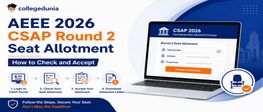
| CSAP Round 2 Seat Allotment | June 12, 2026 | (Over) |
| CSAP Round 2 Seat Acceptance Deadline | June 19, 2026 | (Over) |
| CSAP Mop-Up Round Begins | June 13, 2026 | (Over) |
The Mop-Up round registration window closes today — June 22, 2026. Candidates who have not yet secured a seat should register for CSAP (if not already done) and submit preferences before the window closes. The overall CSAP registration remains open until June 30, 2026, for those applying through the JEE Main route or to become eligible for the Spot Round.
Source: aeee.amrita.edu
AEEE 2026 Eligibility Criteria
Before applying for AEEE, you must check whether you meet the eligibility criteria set by Amrita Vishwa Vidyapeetham. The university verifies documents at the time of admission, so any gap in eligibility can result in cancellation even after a seat is allotted.
Academic Qualification
You must have passed Class 12 (10+2) or its equivalent from a board recognised by the Association of Indian Universities (AIU). Physics, Chemistry, and Mathematics must be your compulsory subjects in Class 12.
- You need at least 60% aggregate marks in PCM (Physics, Chemistry, and Mathematics combined).
- You also need at least 50% marks individually in each of Physics, Chemistry, and Mathematics.
- If you are appearing in the Class 12 board exam in 2026, you can apply provisionally. You must meet the required percentage after board results to retain your admission.
- All three subjects must be studied in the same board and completed in the same academic year.
Age Limit
- You must have been born on or after July 1, 2005 to apply for AEEE 2026.
- There is no upper age relaxation for any category.
Nationality
- Indian nationals, Overseas Citizens of India (OCI), Persons of Indian Origin (PIO), and foreign nationals are all eligible.
- NRI candidates are admitted under a separate NRI quota through a different fee structure.
AEEE vs JEE Main Route
Candidates who did not appear in AEEE 2026 can also apply for admission to Amrita using their JEE Main 2026 percentile score. About 30% of B.Tech seats are filled through this route. The eligibility conditions (academic qualification, age) are the same for both routes.
You must note that even if you appeared in both Phase 1 and Phase 2 of AEEE, you receive a single rank based on your higher score. Appearing in both phases does not give you two separate ranks.
AEEE 2026 Application Process and Fee
The AEEE 2026 exam registration is now over for both phases. However, the CSAP counselling registration window remains open until June 30, 2026, for candidates who want to apply through the JEE Main percentile route or register for the Spot Round. Registration is done fully online at aeee.amrita.edu.
Steps to Apply for AEEE
- Step 1 – Register: Create a new account on the AEEE portal with your email ID and mobile number. You will receive login credentials.
- Step 2 – Fill Application Form: Enter your personal details, academic details (board, marks, subjects), and contact information.
- Step 3 – Select Exam Mode: Choose whether you want to appear for AEEE or apply through the JEE Main percentile route.
- Step 4 – Choose Phase and Cities: Select your preferred phase (Phase 1, Phase 2, or both) and exam city preferences from the available options.
- Step 5 – Upload Documents: Upload a clear passport-size photograph and your signature in the required format and size.
- Step 6 – Pay Fee and Submit: Pay the application fee online through net banking, debit/credit card, or UPI. Submit the form and download the confirmation page.
AEEE 2026 Application Fee
| Category | Application Fee |
|---|---|
| AEEE Phase 1 Only | INR 1,300 |
| AEEE Phase 2 Only | INR 1,300 |
| AEEE Phase 1 + Phase 2 (combined) | INR 1,900 (INR 1,300 + INR 600 extra) |
| JEE Main Percentile Route Only | INR 500 |
The AEEE application fee is non-refundable under all circumstances. The INR 600 extra fee for Phase 2 is a low-risk investment — if you score better in Phase 2, that score replaces Phase 1 for rank calculation at no additional advantage to your rank position.
AEEE 2026 Exam Pattern
AEEE 2026 introduced a revised exam pattern with five sections instead of the earlier three-section format. The paper now includes Quantitative Aptitude and English alongside the core PCM sections. The exam remains a 100-question CBT of 300 marks to be completed in 2 hours 30 minutes.
AEEE 2026 Overall Structure
| Particular | Details |
|---|---|
| Mode of Exam | Computer-Based Test (CBT) |
| Duration | 2 hours 30 minutes (150 minutes) |
| Total Questions | 100 |
| Total Marks | 300 |
| Question Type | Multiple Choice Questions (MCQs), one correct answer each |
| Correct Answer | +3 marks |
| Incorrect Answer | −1 mark |
| Unattempted Question | 0 marks |
| Language | English |
AEEE 2026 Section-Wise Distribution
| Section | Number of Questions | Maximum Marks |
|---|---|---|
| Mathematics | 40 | 120 |
| Physics | 25 | 75 |
| Chemistry | 20 | 60 |
| Quantitative Aptitude | 10 | 30 |
| English | 5 | 15 |
| Total | 100 | 300 |
Mathematics continues to carry the highest weightage at 40% of total marks (40 questions, 120 marks). This makes it the most critical section for securing a good rank. The newly added Quantitative Aptitude section tests basic arithmetic and reasoning, while the English section is the lightest at 5 questions — both are accessible scoring areas for candidates who prepare even briefly for them.
AEEE has negative marking. Every wrong answer deducts 1 mark. You should avoid random guessing. Skipping a question is safer than guessing when you cannot eliminate at least two options with confidence.
With 100 questions in 150 minutes, you have an average of 90 seconds per question. Time management is especially important in Mathematics, where calculation-heavy problems can eat into your time.
AEEE 2026 Syllabus
The AEEE 2026 syllabus is based on the NCERT Class 11 and Class 12 curriculum for Physics, Chemistry, and Mathematics. The Quantitative Aptitude and English sections follow a general Class 12 standard with no fixed syllabus published by Amrita. Most AEEE questions are application-based, so conceptual clarity matters more than rote learning.
Mathematics
- Sets, Relations, and Functions
- Complex Numbers and Quadratic Equations
- Matrices and Determinants
- Permutations and Combinations
- Mathematical Induction; Binomial Theorem; Sequences and Series
- Differential Calculus: Limits, Continuity, Differentiability, and Applications of Derivatives
- Integral Calculus: Indefinite and Definite Integrals; Differential Equations
- Two-Dimensional Geometry: Straight Lines, Circles, Conic Sections
- Three-Dimensional Geometry and Vector Algebra
- Probability and Statistics
- Trigonometry and Inverse Trigonometry
Physics
- Units, Dimensions, and Measurements
- Mechanics: Kinematics, Laws of Motion, Work, Energy and Power, Rotational Motion, Gravitation
- Properties of Solids and Fluids; Oscillations and Waves
- Heat and Thermodynamics
- Electrostatics and Capacitance; Current Electricity
- Magnetic Effects of Current and Magnetism; Electromagnetic Induction; Alternating Currents
- Electromagnetic Waves and Ray Optics; Wave Optics
- Modern Physics: Dual Nature of Radiation, Atoms, Nuclei, and Semiconductor Electronics
Chemistry
- Basic Concepts; Atomic Structure; Chemical Bonding and Molecular Structure
- States of Matter; Thermodynamics; Equilibrium; Redox Reactions; Electrochemistry
- Chemical Kinetics; Surface Chemistry; Solid State; Solutions
- S-Block, P-Block, D-Block, and F-Block Elements; Coordination Compounds
- Basic Organic Chemistry; Hydrocarbons; Haloalkanes and Haloarenes
- Alcohols, Phenols, Ethers; Aldehydes, Ketones, Carboxylic Acids
- Organic Compounds with Nitrogen; Biomolecules; Polymers; Chemistry in Everyday Life
Quantitative Aptitude (New for 2026)
- Number System and Simplification
- Percentages, Ratios, and Proportions
- Time, Speed, Distance; Time and Work
- Data Interpretation; Logical Reasoning
English
- Reading Comprehension
- Vocabulary: Synonyms and Antonyms
- Grammar and Sentence Correction
Based on previous AEEE papers, Calculus and Coordinate Geometry carry the highest weightage in Mathematics. In Physics, Electrostatics, Electromagnetic Induction, and Modern Physics appear most frequently. In Chemistry, Organic Chemistry — especially named reactions and reaction mechanisms — is tested heavily.
AEEE 2026 Admit Card
The AEEE 2026 admit cards for both Phase 1 and Phase 2 have already been issued and both exams are over. Phase 1 admit cards were released about 4–5 days before the January 29 exam, and Phase 2 admit cards were similarly released before the April exam window began. Candidates needed to log in to the official portal with their application number and date of birth to download the admit card.
Details Printed on the AEEE Admit Card
- Candidate name, photograph, and signature
- Application number and roll number
- Exam date, reporting time, and shift details
- Exam centre name and full address
- Exam-day instructions from Amrita
Documents Required at the Exam Centre
- Printed admit card (soft copy on mobile is not accepted)
- A valid government-issued photo ID — Aadhaar card, PAN card, voter ID, or passport
- One recent passport-size photograph
Even though the exam is over, keep your admit card safely. You may need it during CSAP document verification when you report to the allotted campus for admission formalities.
Candidates who lost their AEEE admit card should download it again from the candidate login portal before the counselling reporting date.
AEEE 2026 Result and Rank List
Both AEEE 2026 results have been declared. The Phase 1 result was out in February 2026 and the Phase 2 result was declared on May 9, 2026, at aeee.amrita.edu. Amrita considers the best score across both phases to prepare the final AEEE 2026 rank list used for CSAP counselling.
How to Check the AEEE 2026 Result
- Visit aeee.amrita.edu and click "Login."
- Enter your registered email ID or mobile number. An OTP will be sent to your registered contact.
- Log in and open the "Result" or "Scorecard" section in your dashboard.
- Download and save the scorecard. You will need it during CSAP and document verification.
Details on the AEEE 2026 Scorecard
- Candidate name, application number, and roll number
- Date of birth and category
- Section-wise marks: Mathematics, Physics, Chemistry, Quantitative Aptitude, English
- Total marks out of 300
- Percentile score and AEEE 2026 rank
- Qualifying status for B.Tech admission through CSAP
How AEEE Rank is Calculated
If you appeared in both phases, your best score from the two attempts is used for ranking. Ranks are not calculated per phase — there is one unified rank list. Since the exam is conducted in multiple shifts across different days, Amrita applies a score normalisation process so that students in a tougher shift are not disadvantaged. The rank on your scorecard is the one used for all CSAP rounds.
In case of a tie, the candidate with higher marks in Mathematics gets the better rank. If still tied, Physics marks decide, followed by Chemistry.
AEEE 2026 Cutoff
The AEEE 2026 counselling is still ongoing as of June 22, 2026 — the Mop-Up round is in progress and the Spot Round is yet to begin. The final closing ranks for each campus and branch will be available only after all CSAP rounds are complete. The figures below are based on the 2025 CSAP closing rank trends and are for reference only.
AEEE 2025 Closing Rank Trends (Reference for 2026)
| Campus | Branch | Approx. Closing Rank — 2025 |
|---|---|---|
| Coimbatore | Computer Science and Engineering (CSE) | 1,200 to 1,800 |
| Coimbatore | CSE (Artificial Intelligence) | 1,400 to 2,000 |
| Bengaluru | Computer Science and Engineering | 1,500 to 2,200 |
| Amritapuri (Kollam) | Computer Science and Engineering | 2,000 to 2,800 |
| Chennai | Computer Science and Engineering | 2,500 to 3,500 |
| Coimbatore | Electronics and Communication Engineering | 3,000 to 4,500 |
| Amaravati | Computer Science and Engineering | 4,000 to 5,500 |
| Faridabad | Computer Science and Engineering | 3,500 to 5,000 |
| Coimbatore | Mechanical Engineering | 5,500 to 7,000 |
Note: The above closing ranks are based on AEEE 2025 CSAP data and are provided for reference only. AEEE 2026 cutoffs depend on the difficulty of this year’s paper, total applicant count, and seat availability at each campus. Ranks often relax during the Mop-Up and Spot rounds. The final 2026 cutoffs will be updated after all counselling rounds are complete.
What is a Good Score in AEEE 2026?
A score of 240 or above out of 300 is considered a very good score in AEEE. At this level, you can expect CSE at the Coimbatore or Bengaluru campus. A score above 180 is generally good enough for CSE at one of the newer campuses or for ECE and EEE at Coimbatore, based on previous year trends.
The addition of the Quantitative Aptitude and English sections in 2026 provides extra scoring opportunities beyond PCM — candidates who prepared for these sections gained an edge in the total score, which may shift the score-to-rank mapping slightly compared to 2025.
AEEE 2026 Marks vs Rank
The table below gives an approximate idea of what rank you can expect based on your AEEE 2026 total score. These figures are based on AEEE 2025 trends and historical patterns. Your actual rank also depends on how many candidates appeared in each phase, the normalisation process, and overall paper difficulty.
| AEEE Score (out of 300) | Expected Rank Range | Likely Admission Prospects |
|---|---|---|
| 270 and above | Below 200 | CSE / AI at Coimbatore — top branch choices |
| 240 to 269 | 200 to 1,000 | CSE at Coimbatore; ECE at Amritapuri |
| 210 to 239 | 1,000 to 2,500 | CSE at Bengaluru; CSE at Amritapuri |
| 180 to 209 | 2,500 to 5,000 | CSE at Chennai, Amaravati; ECE at Coimbatore |
| 150 to 179 | 5,000 to 9,000 | EEE, Mechanical at Coimbatore; CSE at Faridabad, Nagercoil |
| 120 to 149 | 9,000 to 15,000 | Civil and Mechanical at most campuses |
| 90 to 119 | 15,000 to 22,000 | Limited choices; seats at newer or smaller campuses |
| Below 90 | Above 22,000 | Very limited availability; Mop-Up or Spot round may help |
The above table is for approximate reference based on AEEE 2025 data. Actual AEEE 2026 marks vs rank data will be published by Amrita after all counselling rounds are complete. Candidates with a rank above 10,000 should focus on the Mop-Up and Spot rounds where closing ranks tend to relax for less-demanded branches.
It is worth noting that the JEE Main path fills 30% of seats separately. Candidates with a strong JEE Main percentile but a lower AEEE rank may still secure a good campus and branch through that route — both paths use CSAP for final allotment.
AEEE 2026 CSAP Counselling
Admission to Amrita Vishwa Vidyapeetham through AEEE uses the Centralised Seat Allotment Process (CSAP). All AEEE-qualified candidates — and candidates applying through the JEE Main route — must register separately for CSAP. Getting a rank does not auto-register you for counselling.
As of June 22, 2026, CSAP is in its penultimate stage. Round 1 and Round 2 allotments are complete, and the Mop-Up round registration closes today. The final Spot Round is expected in the first week of July 2026.
AEEE 2026 CSAP Round-Wise Status
| CSAP Event | Date | Status |
|---|---|---|
| Mop-Up Round Registration Closes | June 22, 2026 | Closes Today |
| Mop-Up Round Seat Allotment | Expected June 24–26, 2026 | Upcoming |
| Mop-Up Round Seat Acceptance Fee Payment | Expected June 27–29, 2026 | Upcoming |
| CSAP Registration Window Closes | June 30, 2026 | Upcoming |
| Spot Round | Expected first week of July 2026 | Upcoming |
| CSAP Counselling Registration Opens | May 12, 2026 | (Over) |
| CSAP Trial Allotment | Late May 2026 | (Over) |
| CSAP Round 1 Seat Allotment | Early June 2026 | (Over) |
| CSAP Round 2 Seat Allotment | June 12, 2026 | (Over) |
| CSAP Round 2 Seat Acceptance Deadline | June 19, 2026 | (Over) |
| Mop-Up Round Registration Opens | June 13, 2026 | (Over) |
How to Register for CSAP
- Step 1: Log in at aeee.amrita.edu with your application number and password.
- Step 2: Go to the CSAP section and pay the INR 5,000 registration fee online. This fee is non-refundable.
- Step 3: Fill in your choice of campuses and branches in order of preference. You can add multiple choices across all 8 campuses.
- Step 4: Submit your preferences before the deadline. You can edit choices until the preference-filling window closes for that round.
Seat Acceptance After Allotment
After receiving a seat allotment in any CSAP round, you have three options:
- Freeze: Accept the allotted seat by paying the INR 1,00,000 initial seat acceptance fee. This confirms your admission. You will not participate in further rounds.
- Slide / Float: Pay the seat acceptance fee but indicate that you want to be considered for higher-preference seats in the next round. If you get an upgrade in the next round, the earlier seat is released.
- Withdraw: Decline the seat entirely. Your INR 5,000 CSAP registration fee is forfeited. You can still participate in the next round if the window is open.
About the Mop-Up Round (Registration Closes Today)
The Mop-Up round is for candidates who did not get a seat in Round 1 or Round 2, and for Slide/Float candidates who want to try for a better option. Registration closes today — June 22, 2026. Allotment is expected within 2–3 days. Candidates who receive a Mop-Up allotment must pay the INR 1,00,000 seat acceptance fee within the deadline to confirm their seat.
About the Spot Round
After the Mop-Up round, if seats remain vacant, Amrita holds a Spot Round at the campus level in the first week of July 2026. The Spot Round is first-come, first-served. Candidates must present themselves at the campus with all documents and pay the fee on the spot. Only candidates already registered for CSAP and with the INR 5,000 fee paid are eligible.
Documents for Reporting to Campus
- AEEE 2026 admit card and scorecard
- CSAP seat allotment letter
- Class 10 and Class 12 mark sheets and pass certificates
- Transfer Certificate and Migration Certificate
- Category certificate if applicable (SC/ST/OBC/PwD)
- Passport-size photographs
- Original government photo ID
- Seat acceptance fee payment receipt
The CSAP registration fee of INR 5,000 is fully non-refundable. The seat acceptance fee of INR 1,00,000 may be partially refundable if you formally withdraw before the last date specified in the official CSAP handbook — always check the refund policy before paying.
Source: AEEE 2026 CSAP Official Portal
Amrita Campuses and B.Tech Branches
The AEEE 2026 rank gives admission access to 19 B.Tech specialisations across 8 Amrita Vishwa Vidyapeetham campuses in India. The flagship campus at Coimbatore in Tamil Nadu is the largest in terms of seat intake and programme variety. Campuses at Amritapuri, Bengaluru, and Chennai are the next most sought-after in CSAP preferences.
| Campus | Location | Key B.Tech Programmes |
|---|---|---|
| Coimbatore | Coimbatore, Tamil Nadu | CSE, CSE (AI), CSE (Cyber Security), CSE (Data Science), ECE, EEE, Mechanical, Civil, Chemical, Aerospace |
| Amritapuri | Kollam, Kerala | CSE, ECE, Electronics and Computer Engineering, EEE, Mechanical, Civil |
| Bengaluru | Bengaluru, Karnataka | CSE, CSE (AI), ECE, EEE, Mechanical, Robotics and Automation |
| Chennai | Chennai, Tamil Nadu | CSE, ECE, EEE, Mechanical, Civil, Mechatronics |
| Amaravati | Guntur, Andhra Pradesh | CSE, ECE, EEE, Mechanical, Civil |
| Nagercoil | Nagercoil, Tamil Nadu | CSE, ECE, EEE, Mechanical |
| Faridabad | Faridabad, Haryana | CSE, CSE (AI), ECE, EEE, Mechanical |
| Haridwar | Haridwar, Uttarakhand | CSE, ECE, EEE |
The Coimbatore campus is the most preferred in CSAP. It offers the widest variety of programmes and has the strongest placement record among all Amrita campuses. CSE (especially core CSE and the AI variant) at Coimbatore sees the highest demand and the tightest closing ranks.
The Amritapuri campus in Kerala is the original Amrita campus and is well-known for its research culture and residential environment. The Bengaluru campus is popular among candidates aiming for placement in Bengaluru’s tech ecosystem, given its proximity to major IT companies.
The newer campuses at Faridabad and Haridwar cater primarily to North Indian candidates. They have growing infrastructure and are expanding their programme offerings every year. Closing ranks at these campuses are generally lower than at the South India campuses, making them accessible to candidates with moderate AEEE scores.
AEEE 2026 Preparation Tips
Although AEEE 2026 is over, these preparation strategies will help candidates aiming for AEEE 2027, or for other engineering entrance exams at a similar level. The AEEE syllabus overlaps heavily with JEE Main, so most students prepare for both simultaneously.
Subject-Wise Strategy
- Mathematics: With 40 questions and 120 marks, Mathematics decides your rank more than any other section. Focus on Calculus (differentiation, integration, differential equations), Coordinate Geometry, Algebra, and Probability. Start with NCERT, then move to a standard reference book like RD Sharma or Arihant.
- Physics: Electrostatics, Electromagnetic Induction, and Modern Physics carry the most questions in AEEE. Practise numerical problems daily — accuracy under time pressure is key in CBT mode. HC Verma’s Concepts of Physics is an excellent reference alongside NCERT.
- Chemistry: Organic Chemistry is the easiest section to score in — focus on named reactions, mechanisms, and conversions. For Inorganic Chemistry, stick strictly to NCERT. For Physical Chemistry, practise calculations on equilibrium, electrochemistry, and kinetics.
- Quantitative Aptitude: This section was new in 2026 and tests basic arithmetic. Practise from any standard aptitude book like R.S. Aggarwal. Focus on percentages, ratios, data interpretation, and simple reasoning. 90 seconds per aptitude question is more than enough if you have covered the basics.
- English: At just 5 questions, this is the quickest section. Revise basic grammar rules, synonyms and antonyms, and practise short reading comprehension passages. This section should take no more than 5–7 minutes during the exam.
General Tips
- Take at least 15–20 full-length mock tests in CBT mode in the last two months. Practice on a screen, not on paper — scrolling through questions and saving answers on a computer is a separate skill.
- Solve 5 years of previous AEEE papers under time conditions. Analyse your mistakes after each mock to identify which topics need more work.
- Do not guess randomly. With −1 for every wrong answer, strategic skipping gives you a better net score than blindly attempting every question.
- If you plan to appear in both phases, treat Phase 1 as a full attempt — not a mock. Use the Phase 1 experience to fine-tune your approach for Phase 2.
- Create short formula revision sheets for Physics and Chemistry. Revise them daily in the last 30 days before the exam.
AEEE 2026 FAQs
Ques. Is AEEE 2026 over?
Ans. Yes, both phases of AEEE 2026 are over. Phase 1 was held from January 29 to February 1, 2026, and Phase 2 ran from April 24 to 30, 2026. Results for both phases have been declared, and the CSAP counselling is currently in its Mop-Up round stage, with registration closing on June 22, 2026.
Ques. What is the current status of AEEE 2026 counselling?
Ans. As of June 22, 2026, AEEE 2026 CSAP is in the Mop-Up round. Round 1 and Round 2 allotments are complete. Mop-Up round registration closes today. A Spot Round is expected in the first week of July 2026 for any remaining vacant seats. The CSAP registration window remains open until June 30, 2026.
Ques. What is the AEEE 2026 exam pattern?
Ans. AEEE 2026 is a 100-question CBT of 300 marks, to be completed in 2 hours 30 minutes. The five sections are: Mathematics (40 questions, 120 marks), Physics (25 questions, 75 marks), Chemistry (20 questions, 60 marks), Quantitative Aptitude (10 questions, 30 marks), and English (5 questions, 15 marks). Each correct answer gives +3 marks and each wrong answer deducts 1 mark.
Ques. What is a good score in AEEE 2026?
Ans. A score of 240 or above out of 300 is considered a very good score in AEEE 2026. At this level, you can expect CSE at the Coimbatore or Bengaluru campus based on past trends. A score above 180 is generally sufficient for CSE at one of the newer campuses or for ECE / EEE at the Coimbatore campus.
Ques. What is CSAP in AEEE 2026?
Ans. CSAP stands for Centralised Seat Allotment Process. It is Amrita Vishwa Vidyapeetham’s official counselling system for B.Tech admissions through AEEE 2026. After registering for CSAP (INR 5,000 fee), you fill your campus and branch preferences and receive seat allotments in multiple rounds — Trial Allotment, Round 1, Round 2, Mop-Up Round, and Spot Round.
Ques. Can I get into Amrita without an AEEE rank?
Ans. Yes. About 30% of B.Tech seats at Amrita campuses are filled through JEE Main 2026 percentile without requiring an AEEE rank. If you have a qualifying JEE Main percentile, you can register for CSAP (INR 500 application fee for this route) and go through the same seat allotment rounds. Note that AEEE-specific scholarships are not available through the JEE Main route.
Ques. How many times can I appear for AEEE?
Ans. There is no restriction on how many years you can appear for AEEE, as long as you continue to meet the age and academic eligibility criteria. In AEEE 2026, you could appear in both Phase 1 and Phase 2. If you appeared in both phases, only your higher score is used — you get one rank, not two.
Ques. What is the eligibility for AEEE 2026?
Ans. To be eligible for AEEE 2026, you must have passed or be appearing in Class 12 with Physics, Chemistry, and Mathematics as compulsory subjects. You need at least 60% aggregate marks in PCM and at least 50% individually in each subject. You must have been born on or after July 1, 2005.
Ques. Is there negative marking in AEEE 2026?
Ans. Yes. AEEE 2026 has negative marking. A correct answer gives +3 marks, an incorrect answer leads to −1 mark, and unattempted questions carry 0 marks. You should avoid guessing randomly — skip a question if you cannot narrow down the answer to two options confidently.
Ques. What are the 8 campuses of Amrita under AEEE 2026?
Ans. AEEE 2026 provides B.Tech admission to 8 Amrita Vishwa Vidyapeetham campuses: Coimbatore (Tamil Nadu), Amritapuri — Kollam (Kerala), Bengaluru (Karnataka), Chennai (Tamil Nadu), Amaravati (Andhra Pradesh), Nagercoil (Tamil Nadu), Faridabad (Haryana), and Haridwar (Uttarakhand).
Ques. What is the application fee for AEEE 2026?
Ans. The AEEE 2026 application fee was INR 1,300 for one phase. Candidates who appeared in both phases paid an additional INR 600, for a total of INR 1,900. Candidates applying only through the JEE Main percentile route paid INR 500. All application fees are non-refundable.
Ques. What documents do I need for AEEE CSAP reporting?
Ans. At the time of reporting to your allotted campus, you need: AEEE admit card and scorecard, CSAP seat allotment letter, Class 10 and Class 12 mark sheets and certificates, Transfer Certificate, Migration Certificate, category certificate (if applicable), passport-size photographs, original government photo ID, and the seat acceptance fee payment receipt.
Disclaimer: The information presented above about AEEE 2026 is based on the latest data available from the official Amrita Vishwa Vidyapeetham website and reliable public sources. Dates, fees, procedures, and cutoffs are subject to change as per official notifications. Candidates are advised to verify all details at the official AEEE portal at aeee.amrita.edu before making any decisions.
.jpeg?h=112&w=263&mode=stretch)
.jpeg?h=112&w=263&mode=stretch)







Comments