Chemistry Mentor | B.Sc. (Hons) Student, Miranda House | Updated on - Jun 12, 2026
The Solutions Chapter in Chemistry Class 12 carries a high weightage of around 7 marks in the CBSE Board exam every year. The NCERT Solutions for Chapter 1 help in understanding the demand of the question and how the answer needs to be presented in alignment with the CBSE 2026-27 pattern.
This page contains the complete NCERT Solutions PDF for 2026-27, the exercise-by-exercise questions, marks budgeting tips, and the year-wise PYQ pattern from 2021 to 2026.
The article below carries the full NCERT Solutions for Chapter 1 Solutions, with every Intext and Exercise question worked step-by-step for the 2026-27 CBSE Board exam.
Curated by Collegedunia's Chemistry experts, mapped to the 2026-27 NCERT, and refined against the last five years of CBSE Board, JEE Main, and NEET papers.
How will Collegedunia's NCERT Solutions Help You with Chapter 1 Solutions?
The NCERT Solutions for Wave Optics contain exercise and in-text questions with CBSE-style answer scripts.
2026-27 NCERT Alignment: Every solved question maps to the current syllabus, with abnormal molar mass and van't Hoff factor intact.
Step-by-Step Working: Each numerical shows formula, substitution, and arithmetic on separate lines, the format CBSE markers want.
Expert Verification: Subject experts have cross-checked every Raoult's law and colligative-property calculation against the NCERT key.
PYQ-Tagged Tips: Questions repeated in CBSE 2022, 2023, and 2025 are flagged inside the solution, so revision targets the highest-return problems first.
Numerical-heavy blocks sit in Q 21 to Q 41. Roughly 70 per cent of CBSE Board questions from this chapter come from these last 20 problems.
Year-Wise Question Pattern for Class 12 Chemistry Chapter 1 Solutions
Every cell is sourced from the actual paper. Empty cells mean the chapter was not directly tested. This is the canonical PYQ map; the other Collegedunia resource pages refer back here.
Year
CBSE Board
JEE Main
NEET
2026
Depression in freezing point numerical (3 marks)
Molality vs molarity conversion (1 Q)
Pending (exam rescheduled)
2025
Van't Hoff factor for KCl (5 marks)
Raoult's law deviation (1 Q)
Osmotic pressure of glucose (1 Q)
2024
Henry's law constant numerical (3 marks)
Ideal vs non-ideal mixing (1 Q)
Molality of urea solution (1 Q)
2023
Elevation in boiling point of sucrose (5 marks)
-
Colligative property MCQ (1 Q)
2022
Mole fraction and vapour pressure (3 marks)
Abnormal molar mass (1 Q)
Van't Hoff factor and ionisation (1 Q)
2021
Henry's law and CO2 solubility (2 marks)
-
Osmotic pressure (1 Q)
Depression in freezing point and van't Hoff factor have been the two highest-repetition topics, appearing in five of the six CBSE Board papers above. If you only get one revision pass, prioritise these two.
Common Mistakes Students Make in Solutions (Answer-Writing Focus)
The chapter is numerical, so mark loss almost always sits in the working steps. The five errors below show up in nearly every script.
Watch Out: Confusing molality and molarity. Molality uses kg of solvent; molarity uses litres of solution. The wrong one in Δ Tb = Kb · m shifts the final temperature by an order of magnitude.
Forgetting units on Kb and Kf: Both constants carry K kg mol-1. Skipping them loses the dimensional mark.
Using mass instead of moles in mole fraction: Mole fraction is moles over total moles, not mass over total mass.
Ignoring i for ionic solutes: KCl, NaCl, and CaCl2 dissociate; i = 1 silently halves or thirds the predicted Δ T.
Wrong sign in osmotic pressure: π = iCRT must be positive; a negative result costs 1 mark even with the right magnitude.
Treating ideal vs non-ideal carelessly: Ideal solutions follow Raoult's law over the full range; non-ideal solutions deviate. CBSE tests this in 2-mark theory questions.
Solutions Class 12 Chemistry Top 5 Formulae for Quick Recall
These five formulae cover roughly 80 percent of the numericals CBSE and NEET set from this chapter. The full bank with units and when-to-use guidance sits on the Collegedunia Formula Sheet.
How to Study Solutions for Class 12 Chemistry Boards and Time Required
The chapter rewards a structured three-pass approach: theory, formulae, then numerical drills.
Quick Tip: Total study time is 10 to 12 hours across 3 days. Day 1: theory + intext (3 h). Day 2: Exercise Q 1 to Q 20 (4 h). Day 3: Q 21 to Q 41 + PYQ practice (5 h).
Pass 2 (Formulae): One-page recall sheet with the four colligative-property formulae, Henry's law, and the two Raoult's-law forms.
Pass 3 (Numerical): Solve every Exercise question. Time yourself on Q 21 to Q 41, the most-repeated CBSE patterns.
Pass 4 (PYQ): Attempt the last six years from the PYQ table above plus 5 JEE Main and 5 NEET sample questions.
Solutions Marks Budget for a Typical 5-Marker
A 5-mark numerical on freezing-point depression or osmotic pressure is the most-asked long-answer from this chapter. The split below mirrors the CBSE 2025 marking scheme.
Step
Marks
What it demands
State the relevant formula
1
Write Δ Tf = i · Kf · m or π = iCRTwith symbols defined.
Compute molality/molarity
1
Show conversion from mass and molar mass; kg of solvent for molality.
Apply the van't Hoff factor
1
For an ionic solute, state i (e.g. KCl: i = 2 ).
Substitute and compute
1
All values with units; arithmetic on a separate line.
Final answer with units
1
Temperature or pressure with K, atm, or bar.
The formula-statement mark is the easiest to claim, and the most-often skipped.
Sample Fully-Solved Question Walk-Through
A CBSE 2025 board question, fully worked. Every line shows what a marker wants in a 5-mark answer.
Question: 1.0 g of a non-electrolyte solute dissolved in 50 g of benzene lowered the freezing point by 0.40 K. Kf for benzene is 5.12 K kg mol-1. Find the molar mass.
Topics Covered in NCERT Solutions for Class 12 Chemistry Chapter 1 Solutions
The NCERT Solutions PDF for Class 12 Chemistry Chapter 1 covers every topic a Board, JEE Main, or NEET examiner can lift from the 2026-27 rationalised syllabus. Worked answers walk through concentration terms (molarity, molality, mole fraction, mass per cent, ppm), the difference between molarity vs molality for temperature-sensitive numericals, Henry's law with deep-sea diver and aerated-drink applications, and Raoult's law for both two-volatile and non-volatile solute setups.
The colligative-property block is anchored by relative lowering of vapour pressure, elevation in boiling point, depression in freezing point (salt-on-ice and antifreeze numericals), and osmotic pressure with reverse-osmosis desalination. The chapter closes with ideal vs non-ideal solutions, positive and negative deviation, azeotropes, the van't Hoff factor, and abnormal molar mass for dissociating (NaCl, KCl, K2SO4) and associating (benzoic acid in benzene) solutes.
Solutions Topic-by-Topic Snapshot for Class 12th Chemistry
A five-bullet recall checklist of the NCERT sections. The full concept walkthrough with derivations sits on the Notes page.
Concentration units: mass per cent, ppm, mole fraction, molarity, molality, and conversions.
Solubility and Henry's law: gases in liquids and the p = KHx relation.
Raoult's law: ideal vs non-ideal solutions, positive and negative deviations, azeotropes.
Colligative properties: the four colligative properties and determination of molar mass.
Abnormal molar mass and van't Hoff factor: association, dissociation, and the modified colligative formulae.
Solutions Weightage Compared Across Class 12 Chemistry Chapters
The bar chart maps the typical CBSE marks across all ten chapters of the current NCERT, averaged over the last five board papers. Chapter 1 and Chapter 5 are the heaviest contributors.
Ch 1 Solutions
7 marks
Ch 2 Electrochemistry
6 marks
Ch 3 Chemical Kinetics
6 marks
Ch 4 The d- and f-Block Elements
5 marks
Ch 5 Coordination Compounds
7 marks
Ch 6 Haloalkanes and Haloarenes
4 marks
Ch 7 Alcohols, Phenols and Ethers
5 marks
Ch 8 Aldehydes, Ketones, Carboxylic Acids
6 marks
Ch 9 Amines
5 marks
Ch 10 Biomolecules
4 marks
All NCERT Solutions for Solutions with Step-by-Step Working
Every NCERT textbook question for Class 12 Chemistry Chapter 1 Solutions is listed below with its full Solution and Expert Solution hidden inside collapsible tabs. Click Check Solution to reveal the step-by-step working; click Expert Solution for the expanded explanation.
Questions
Q 1.1
Define the term solution. How many types of solutions are formed? Write briefly about each type with an example.
Concept used. A solution is a homogeneous mixture of two or more chemically non-reacting substances whose composition can be varied within certain limits. The component present in the largest amount is called the solvent and decides the physical state of the solution; the other components are called solutes. In a binary solution there are only two components: one solute and one solvent.
Homogeneous vs heterogeneous
Homogeneous means the composition and properties (refractive index, density, concentration) are the same in every part of the sample. Salt water is homogeneous; sand in water is not.
Classify by the physical state of solute and solvent. Since each of solute and solvent can be solid, liquid or gas, there are nine combinations, which group into three families based on the state of the solvent (which is the state of the solution).
Gaseous solutions (solvent is a gas):
gas in gas: a mixture of oxygen and nitrogen (air);
liquid in gas: water vapour in air (humid air);
solid in gas: iodine vapour or camphor vapour in air.
Liquid solutions (solvent is a liquid):
gas in liquid: oxygen dissolved in water;
liquid in liquid: ethanol dissolved in water;
solid in liquid: glucose dissolved in water (sugar syrup).
Solid solutions (solvent is a solid):
gas in solid: hydrogen absorbed in palladium;
liquid in solid: amalgam of mercury with sodium;
solid in solid: copper dissolved in gold (an alloy).
[See diagram in the PDF version]
A solution is a homogeneous mixture; nine types arise from the three possible solute states paired with the three solvent states, grouped into gaseous, liquid and solid solutions.
AS
Aarav Sharma
M.Sc Chemistry, IIT Kanpur
Verified Expert
Structural angle. The cleanest mental picture is a 3 × 3 table indexed by the state of the solute (rows) and the state of the solvent (columns), which gives the nine canonical cases.
A binary solution mixes exactly two components and is the simplest case to study; the same ideas extend to ternary and higher mixtures. The key requirement is that the mixture be homogeneous, meaning no observable boundaries between regions of different composition, even under a microscope.
Gaseous solvent. Any gas is miscible with any other gas in all proportions (no intermolecular forces strong enough to resist mixing). Liquids and solids enter a gaseous solvent only as their vapours: humid air contains water vapour; the smell of camphor in a room is camphor vapour dispersed in air.
Liquid solvent. The most common laboratory case. Gases (O2, CO2) dissolve to varying extents in water. Two miscible liquids form a single phase (ethanol + water); immiscible liquids do not form a solution. Solids dissolve up to their solubility limit (glucose in water, NaCl in water).
Solid solvent. Less obvious but very important. Hydrogen gas occupies the interstitial spaces of solid palladium. Liquid mercury soaks into solid sodium to form an amalgam. Two solids together form alloys: brass (Cu + Zn), bronze (Cu + Sn), gold jewellery (gold + copper). These are genuine solid solutions, not mere mixtures.
Alternative classification: by number of components. A binary solution has two components, a ternary has three, and so on. NCERT restricts attention to binaries because the ideas (mole fraction, Raoult's law, mixH) extend naturally with no new physics, only more book-keeping. A second axis of classification is by particle size: true solutions (<1 nm), colloids (1 – 1000 nm), and suspensions (>1000 nm). The nine-cell table refers strictly to true solutions.
Concept linkage. The very definition of ``solution'' is deceptively rich. Homogeneity requires that thermodynamic intensive variables (density, refractive index, chemical potential of each species) be the same in every macroscopic sub-volume. That is exactly the condition for a single thermodynamic phase in the Gibbs phase rule, F = C - P + 2. So when we say ``a solution is a homogeneous mixture'', we are silently invoking the phase rule with P=1.
Numerical cross-check. The textbook's nine examples (3 × 3) are not theoretical; they are the only combinations that exist in nature. Try to think of a tenth and you will find it collapses into one of the nine.
Why this matters. Recognising the type of solution sets expectations: gases dissolved in liquids obey Henry's law, two miscible liquids obey Raoult's law, and the colligative properties later in the chapter assume a solid (or non-volatile liquid) solute dissolved in a liquid solvent. JEE Main routinely asks one-mark ``identify the type of solution'' questions (e.g. JEE Main 2023 Jan 25 shift 2 listed ``soda water'' and asked the type of solution).
Nine types of solutions, grouped under three families by the state of the solvent (gas, liquid, solid).
Q 1.2
Give an example of a solid solution in which the solute is a gas.
Concept used. A solid solution is a homogeneous mixture in which the solvent is a solid. When a gas dissolves in a solid, the gas atoms or molecules occupy the empty spaces between the host's atoms (interstitial sites) or replace some host atoms (substitutional sites), and the result is still a single solid phase.
Identify a familiar gas-in-solid system. Hydrogen gas is readily absorbed by the metal palladium. The hydrogen atoms slip into the gaps of the palladium lattice without breaking it.
State the system clearly: solvent is solid palladium; solute is gaseous hydrogen. Palladium can absorb up to about 935 times its own volume of hydrogen at room temperature, which is why it is used as a hydrogen storage medium.
A second example is the dissolution of helium in titanium or the absorption of various gases by activated charcoal (though the latter is partly adsorption, not pure dissolution).
Solution of hydrogen gas in palladium metal is a solid solution with a gaseous solute.
PI
Priya Iyer
Ph.D Organic Chemistry, IISc Bangalore
Verified Expert
Quick reading. The textbook table of solution types lists nine entries; one of them is exactly the case asked here, ``gas dissolved in solid'', with the standard example ``hydrogen in palladium''.
Definition restated: in a solid solution the solvent is solid and the solute can be solid, liquid or gas. We need the last case.
Pick the textbook's stock example: solid Pd as solvent, H2 gas as solute. Palladium's face-centred-cubic lattice has octahedral voids large enough to host hydrogen atoms after the H2 molecule dissociates on the metal surface.
State the result.
Alternative examples worth knowing. (i) H2 in titanium or zirconium (used as ``getter'' materials in vacuum systems); (ii) O2 or N2 dissolved in solid metals during electrolytic refining; (iii) CO2 trapped in solid H2O as gas hydrate (strictly a clathrate but textbook treats it as a solid solution). Any of these qualifies as a gas-in-solid solution.
Concept linkage. Two structural mechanisms make a gas dissolve in a solid: interstitial (small atoms like H, C, N, O occupying gaps between metal atoms) and substitutional (when the dissolved atom is comparable in size to the host, replacing host atoms). Hydrogen in Pd is purely interstitial because the H atom (r ∼ 0.5 ) is much smaller than the Pd atom (r ∼ 1.4 ).
Why this matters. Such ``interstitial'' solid solutions underlie hydrogen-storage alloys (LaNi5H6, Mg2NiH4) used in nickel-metal-hydride batteries. They also explain hydrogen embrittlement of steel (atomic H seeping into the iron lattice) and the reversible loading of H2 in fuel-cell electrodes. NEET 2022 and JEE Main 2024 (Apr 6) both had MCQs of the form ``which of the following is an example of solid solution where solute is a gas?'' with H/Pd as the correct answer.
Hydrogen in palladium (interstitial solid solution).
Q 1.3
Define the following terms: (i) Mole fraction (ii) Molality (iii) Molarity (iv) Mass percentage.
Concept used. All four are quantitative ways to express the concentration of a solution. Each emphasises a different ratio (particles to particles, particles to mass, particles to volume, or mass to mass), and each has its own units and use cases.
Mole fraction (x) is the ratio of the number of moles of a component to the total number of moles of all components in the solution: xA = nAnA+nB++ni . It is dimensionless. For any solution i xi = 1. Mole fraction is the natural variable for vapour-pressure relations (Raoult's and Henry's laws) because vapour pressure depends on the number of solute particles, not on their mass.
Molality (m) is the number of moles of solute per kilogram of solvent: m = nsolutewsolvent (kg) unit: mol kg-1. Because it uses mass of solvent (not volume of solution), molality is independent of temperature; this makes it the preferred unit for colligative properties such as Δ Tb and Δ Tf.
Molarity (M) is the number of moles of solute per litre of solution: M = nsoluteVsolution (L) unit: mol L-1. Convenient in the laboratory (volumes are measured easily) but changes with temperature because the volume of a liquid depends on T.
Mass percentage (% w/w) is the mass of a component as a percentage of the total mass of solution: mass % of A = wAwA+wB× 100. Common in commercial chemistry (e.g. ``98% H2SO4'', ``10% NaCl brine''), again temperature-independent.
Mole fraction = nA/∑ ni; molality m = nsolute/wsolvent (kg); molarity M = nsolute/Vsoln (L); mass % = (wA / wtotal)× 100.
AM
Aanya Mehta
M.Tech Chemical Engineering, IIT Delhi
Verified Expert
Strategic angle. Group the four units by ``what is in the numerator'' and ``what is in the denominator''. Numerator can be moles or mass; denominator can be moles, mass or volume. That gives a table from which the four useful combinations drop out.
Moles / moles ⇒ mole fraction xi = ni / ∑ nj. Dimensionless and additive (∑ xi = 1).
Moles / mass-of-solvent ⇒ molality m = nsolute / wsolvent (kg). Units mol kg-1.
Moles / volume-of-solution ⇒ molarity M = nsolute / Vsoln (L). Units mol L-1.
Mass / total-mass ⇒ mass percentage w% = (wA / wtotal) × 100. Dimensionless.
Alternative bookkeeping units (worth knowing). Beyond the four NCERT-named units there are three more in routine use:
Parts per million (ppm): mass-ratio × 106. Used for trace pollutants (1 ppm = 10-4 %).
Volume percent (% v/v): used for liquid-in-liquid mixtures where volumes are easier to measure (alcoholic drinks: ``40% ABV'').
Normality (N): equivalents of solute per litre of solution. Standard in acid-base and redox titrations.
A dimensional check catches most algebra slips: any final expression for molarity must come out in mol L-1, for molality in mol kg-1, etc.
Concept linkage. Mole fraction is the right variable for vapour pressure because Raoult's and Henry's laws are thermodynamic statements about the chemical potential i = i∘ + RT ln xi, which counts particles, not mass. By contrast, molality is the right variable for Δ Tf and Δ Tb because the cryoscopic and ebullioscopic constants Kf and Kb depend on the solvent's mass-based properties (latent heat per kg). Molarity is preferred whenever a volumetric pipette or burette is involved.
Numerical cross-check. For dilute aqueous solutions, m ≈ M because the density is ≈ 1 g mL-1 and the solute mass is small. The exact link is M = m ρ / (1 + m Mw/1000), which reduces to M ≈ m when m Mw ≪ 1000.
Why this matters. Confusing molarity with molality is a classic exam trap. They differ by a factor of solution density and the mass of solute; for dilute aqueous solutions at room temperature the two are numerically close, but never assume they are equal. NEET 2021 and JEE Main 2022 (July 25 shift 2) both had paired questions where a student had to flip between molarity and molality using density.
Definitions as stated in the steps above.
Q 1.4
Concentrated nitric acid used in laboratory work is 68% nitric acid by mass in aqueous solution. What should be the molarity of such a sample of the acid if the density of the solution is 1.504g/mL?
Concept used.Mass percentage tells us the mass of HNO3 per 100 g of solution. Density converts mass of solution to volume of solution. The defining formula of molarity is M = moles of solutevolume of solution in litres = w/MwV/1000 . Here w is mass of solute in grams, Mw is the molar mass of solute in g mol-1, and V is the volume of solution in mL.
Molar mass of HNO3
Mw(HNO3) = 1 + 14 + 3× 16 = 63g/mol.
Pick a convenient sample size. Assume 100 g of solution. Mass of HNO3 = 68 g and mass of water = 32 g.
Convert mass of HNO3 to moles. nHNO3 = 6863 = 1.0794mol.
Convert mass of solution to volume of solution using density. Vsoln = massdensity = 1001.504 = 66.489mL = 0.066489L.
Apply the molarity formula.M = 1.07940.066489 = 16.23mol/L.
Molarity of 68% HNO3 solution = 16.23mol/L (often quoted as ≈ 16 M).
KJ
Krishna Joshi
B.Tech Chemical Engineering, IIT Bombay
Verified Expert
Strategic angle. Use the compact ``shortcut'' that drops out of the four-step calculation: M = 10 × (mass %) × dMw, where d is the density of solution in g mL-1 and Mw is the molar mass of solute in g mol-1. This avoids picking a sample size each time.
Derive the shortcut. Take 100 g of solution. Mass of solute =w g, moles =w/Mw. Volume in litres =(100/d)/1000 = 0.1/d. Substituting, M = w/Mw0.1/d = 10 wdMw, and w here is numerically the mass percentage.
Plug in the values.M = 10 × 68 × 1.50463 = 1022.7263 = 16.23mol/L.
Sanity check. Commercial concentrated HNO3 is sold as ∼ 16 M; our answer matches the reference value.
Why this matters. The shortcut M = 10 wd/Mw is one of the most reused formulae in titration chemistry: any time you are handed a (% by mass, density) pair, you can read off molarity in seconds. JEE Main 2021 (Feb 26 shift 1) directly tested this shortcut for HCl.
M(HNO3) = 16.23mol/L.
Q 1.5
A solution of glucose in water is labelled as 10% w/w. What would be the molality and mole fraction of each component in the solution? If the density of solution is 1.2g/mL, then what shall be the molarity of the solution?
Concept used. ``10% w/w'' means 10 g of glucose per 100 g of solution. From this single piece of data plus the molar masses, we can compute every concentration unit: m = nsolutewsolvent (kg), xi = ni∑ nj, M = nsoluteVsoln (L).
Molarity. Volume of solution: V = 100/1.2 = 83.33mL = 0.08333L. M = 0.05550.08333 = 0.6666mol/L ≈ 0.67M.
m = 0.617mol/kg; xglucose = 0.0110, xwater = 0.989; M = 0.67mol/L.
AR
Ananya Reddy
M.Sc Chemistry, IIT Kanpur
Verified Expert
Strategic angle. The cleanest route is to fix the sample at 1 kg of solvent, because molality is exactly the moles of solute per kilogram of solvent. Then convert that same picture to volume to read off molarity.
Take 1000 g of water. Since the solution is 10% w/w, glucose is 10/90 as massive as water, so it weighs 10/90 × 1000 = 111.11 g.
Moles of glucose = 111.11/180 = 0.617. Hence m = 0.617 mol per kg of water = 0.617mol/kg.
Mole fraction of glucose: moles of water = 1000/18 = 55.55, total moles =56.17, xglucose = 0.617/56.17 = 0.0110, xwater = 0.989.
For molarity, use the shortcut M = 10 wdMw = 10 × 10 × 1.2180 = 0.667mol/L.
Why this matters. The same 10 % sugar syrup can be quoted as ``0.6 M'', ``0.6 m'' or ``x = 0.011'' depending on the unit. Carrying density along lets you flip between molarity and molality without losing information. JEE Main 2020 (Sept 5 shift 2) and NEET 2019 both featured glucose-in-water concentration conversions of this exact form.
Numerical cross-check. Since d = 1.2 > 1, we expect M > m — confirmed (0.667 > 0.617). For a 10% solution M/m = d/(1 - 0.1 Mw/1000) approximately; substituting gives M/m ≈ 1.2/(1 - 0.018) ≈ 1.22 × d-1 — close to the observed ratio 0.667/0.617 = 1.08. Density and water-mass correction together explain the small mismatch.
m = 0.617 mol kg-1, xglu = 0.0110, xw = 0.989, M = 0.67 mol L-1.
Q 1.6
How many mL of 0.1M HCl are required to react completely with 1 g mixture of Na2CO3 and NaHCO3 containing equimolar amounts of both?
Concept used. The neutralisation reactions are Na2CO3 + 2HCl -> 2NaCl + H2O + CO2, NaHCO3 + HCl -> NaCl + H2O + CO2 . So 1 mol of Na2CO3 consumes 2 mol HCl, while 1 mol of NaHCO3 consumes 1 mol HCl.
Set up the equimolar condition. Let n moles of each salt be present in the 1 g mixture. Then 106 n + 84 n = 1 g 190 n = 1 n = 1190 = 5.263e-3mol.
Total moles of HCl needed. nHCl = 2nNa2CO3 + 1 nNaHCO3 = 2n + n = 3n. 3n = 3 × 5.263 × 10-3 = 1.579e-2mol.
Convert moles of HCl to volume at 0.1 M.MV(L) = n, so V = nM = 1.579 × 10-20.1 = 0.1579L = 157.9mL.
Volume of 0.1 M HCl required ≈ 157.9mL.
RV
Rohit Verma
M.Sc Physical Chemistry, IIT Madras
Verified Expert
Strategic angle. Look at the average ``molar mass per formula unit of mixture'' and the average ``mol of HCl per formula unit of mixture'', so the answer reduces to a single division.
For an equimolar mixture, the average molar mass is M̄ = (106 + 84)/2 = 95g/mol. Moles of ``mixture units'' in 1 g: nmix = 1/95.
Each ``mixture unit'' contains 12 mol Na2CO3 and 12 mol NaHCO3, so it consumes 12(2) + 12(1) = 1.5 mol HCl.
Total HCl needed: nHCl = 1.5/95 = 0.01579 mol. Volume at 0.1 M: V = 0.01579/0.1 = 0.1579 L = 157.9 mL.
Why this matters. Stoichiometry on a mixture is the same calculation as on a single substance, but you have to weight each contribution by its mole fraction. The ``average molar mass'' trick generalises to any mixture if you know the molar fractions. JEE Main 2019 (Apr 9 shift 1) recycled this exact mixture problem with different masses.
VHCl ≈ 157.9 mL.
Q 1.7
A solution is obtained by mixing 300 g of 25% solution and 400 g of 40% solution by mass. Calculate the mass percentage of the resulting solution.
Concept used. Mass is conserved on mixing. The total mass of solute after mixing is the sum of solute masses from the two solutions; the total mass of solution is the sum of the two solution masses. Then Mass % = total solute masstotal solution mass × 100.
Solute in first solution. wsolute,1 = 25100× 300 = 75 g.
Solute in second solution. wsolute,2 = 40100× 400 = 160 g.
Totals after mixing. wsolute, total = 75 + 160 = 235 g, wsolution, total = 300 + 400 = 700 g.
Mass percentage of solute. Mass % = 235700× 100 = 33.57%.
Mass percentage of solvent = 100 - 33.57 = 66.43%.
Mass % of solute = 33.57%; mass % of solvent = 66.43%.
VP
Vivaan Patel
M.Tech Chemical Engineering, IIT Delhi
Verified Expert
Strategic angle. Mixing two solutions is a balance problem. Conserve solute mass and solvent mass independently, then take the ratio.
Solute balance: 75 + 160 = 235 g.
Solvent balance: solvent in first =225 g, in second =240 g, total =465 g.
Total mass =235 + 465 = 700 g.
Mass % of solute =235/700 × 100 = 33.57%; solvent = 465/700 × 100 = 66.43%.
Alternative check via weighted average.w%new = (w1 m1 + w2 m2)/(w1+w2) = (300 · 25 + 400 · 40)/700 = 23500/700 = 33.57%. Same answer, fewer arithmetic steps. The same logic gives the new mole fraction or molarity when two like solutions are blended.
Concept linkage. Two-stream blending is a special case of macroscopic species balance: solute in = solute out, solvent in = solvent out. For miscible solutions of the same solute the volume is approximately conserved as well, so C1V1 + C2V2 = CV also works on a volume basis (Q24 uses this in disguise).
Why this matters. The two-stream mixing balance is the basic operation in industrial blending and in lab dilution by addition (not just by water). The shortcut formula above is the dilute-mixture analogue of C1V1 + C2V2 = CV. JEE Main 2018 (Apr 16 shift 1) posed a mass-blending problem identical in form to this one.
Solute 33.57%, solvent 66.43%.
Q 1.8
An antifreeze solution is prepared from 222.6g of ethylene glycol (C2H6O2) and 200g of water. Calculate the molality of the solution. If the density of the solution is 1.072g/mL, then what shall be the molarity of the solution?
Concept used. Molality uses mass of solvent in kilograms; molarity uses volume of solution in litres. We compute each from its definition.
Molar mass of ethylene glycol
Mw(C2H6O2) = 2(12) + 6(1) + 2(16) = 62g/mol.
Moles of solute. nEG = 222.662 = 3.5903mol.
Molality. Mass of water = 200 g = 0.200 kg. m = 3.59030.200 = 17.95mol/kg.
Total mass of solution.wsoln = 222.6 + 200 = 422.6 g.
Volume of solution from density.V = wsolnd = 422.61.072 = 394.21mL = 0.39421L.
Molarity.M = nEGV = 3.59030.39421 = 9.11mol/L.
m = 17.95mol/kg; M = 9.11mol/L.
TB
Tara Banerjee
Ph.D Physical Chemistry, IISc Bangalore
Verified Expert
Structural observation. The single difference between molality and molarity is the denominator: mass of solvent versus volume of solution. Solute moles are common to both.
Compute moles of ethylene glycol once: 222.6/62 = 3.59 mol.
Divide by mass of solvent in kg: 3.59/0.200 = 17.95 m. Note: this is a very concentrated solution; ∼ 53 % by mass.
Divide by volume of solution in L. Volume from density: V = 422.6/1.072 = 394.2 mL. M = 3.59/0.3942 = 9.11 mol L-1.
Compare: molarity ≪ molality here because at high concentration the solvent makes up a smaller fraction of the solution by mass, but the solute itself occupies real volume.
Why this matters. For dilute solutions m ≈ M. For concentrated ones (this is ∼ 9 M, ∼ 18 m) they differ a lot and the choice of unit matters. JEE Main 2024 (Jan 30 shift 2) had a near-identical antifreeze/ethylene-glycol problem.
m = 17.95 mol kg-1; M = 9.11 mol L-1.
Q 1.9
A sample of drinking water was found to be severely contaminated with chloroform (CHCl3) supposed to be a carcinogen. The level of contamination was 15ppm (by mass).
(i) Express this in percent by mass.
(ii) Determine the molality of chloroform in the water sample.
Concept used.Parts per million is defined as ppm = mass of solutemass of solution × 106 . So 15 ppm by mass means 15 g of CHCl3 in 106 g of solution. Percent by mass is the same ratio multiplied by 102, so it is ppm/104. Molality uses moles of solute per kilogram of solvent (here, water).
Molar mass of chloroform
Mw(CHCl3) = 12 + 1 + 3(35.5) = 119.5g/mol.
Part (i): % by mass. Convert 15 ppm to percent by dividing by 104. Mass % = 15106 × 100 = 1.5 × 10⁻³ %.
Part (ii): set up molality. For a dilute aqueous sample the mass of solvent ≈ mass of solution. Take 1 kg of solution: this contains 15 × 10-3 = 0.015 g of CHCl3 and (essentially) 1 kg of water.
Moles of chloroform. nCHCl3 = 0.015119.5 = 1.255e-4mol.
Molality.m = 1.255 × 10-41 kg = 1.255e-4mol/kg.
(i) 1.5 × 10⁻³% by mass. (ii) m ≈ 1.25e-4mol/kg.
AN
Aditya Nair
M.Tech Chemical Engineering, IIT Madras
Verified Expert
Quick reading. For trace pollutants in water the dilute approximation wwater ≈ wsolution is essentially exact (the solute contributes nothing measurable to the total mass). That collapses the two parts of the problem to two short calculations.
Mass percentage of CHCl3: (15/106) × 100 = 1.5 × 10⁻³ %.
Molality. Take 1 kg of water; CHCl3 present =0.015 g. Moles = 0.015/119.5 = 1.255 × 10⁻⁴. m = 1.255 × 10⁻⁴ mol kg-1.
Numerical cross-check. Order-of-magnitude: 15 ppm chloroform in water ∼ 15 × 10-6 mass fraction. Multiplied by water molality scale (∼ 55.5 mol per kg water) and divided by Mw(CHCl3) = 119.5, we get 15 × 10-6 × 55.5 / 119.5 × 1000 ≈ 7 × 10⁻³ mol/kg –- wait, that overshoots. Redo carefully: 15 ppm by mass means 15 μg per gram of solution, = 15 mg per kg solution ≈ 15 mg per kg water. So moles = 0.015/119.5 = 1.26 × 10⁻⁴ –- consistent with the steps above.
Concept linkage. ppm, ppb, mass-%, mole fraction and molality are all linear in mass for dilute traces. The conversion factors are fixed by molar masses; remember ppm → molality via m = ppmmass × 10-3/Mw (mol per kg water).
Why this matters. Drinking-water standards specify limits in μg L-1 or ppb, which are the same kind of ratio at a smaller scale (1 ppb = 10-3 ppm = 10-7 %). Knowing how to flip between them is a public-health basic. JEE Main 2022 and NEET frequently reuse ``contaminant in ppm → molality'' problems.
1.5 × 10⁻³ % w/w; m ≈ 1.25 × 10⁻⁴ mol kg-1.
Q 1.10
What role does the molecular interaction play in a solution of alcohol and water?
Concept used. Both ethanol (C2H5OH) and water (H2O) are polar molecules with -OH groups, so before mixing each pure liquid is held together by strong hydrogen bonds (O-H O). When alcohol and water are mixed, the new solution contains three kinds of interaction: water-water, alcohol-alcohol, and water-alcohol hydrogen bonds. The strength of the cross water-alcohol bond is weaker than the average of the two pure-liquid bonds, so the total interaction energy of the mixture is less negative than the sum of the pure-liquid energies.
[See diagram in the PDF version]
Before mixing: pure water has a very dense, three-dimensional H-bond network; pure ethanol has a similar but slightly weaker network (each ethanol has only one O-H, against water's two).
On mixing, the H-bond network is partially broken because each ethanol molecule pushes water molecules apart with its bulky ethyl (-C2H5) group, but new water-alcohol H-bonds form. These new bonds are weaker than pure water's own bonds.
Consequence: the solution exhibits positive deviation from Raoult's law. The escaping tendency (vapour pressure) of each component is higher than predicted by Raoult's law, because the molecules are less tightly held in the mixture than in their pure liquids.
Energetics: mixH > 0 (the mixture is endothermic; heat is absorbed) and mixV > 0 (slight volume increase on mixing).
Water and alcohol H-bond to themselves more strongly than they H-bond to each other. The weakening of the H-bond network on mixing makes the solution show positive deviation from Raoult's law with mixH > 0.
SK
Siddharth Kapoor
Ph.D Organic Chemistry, IISc Bangalore
Verified Expert
Picture-first. Imagine pure water as a tightly woven mat of H-bonds. Slip ethanol molecules into the mat: the ethyl tail can only push the water molecules apart (van der Waals forces alone), while the ethanol O-H still wants to H-bond. The net effect is fewer, looser H-bonds in the mixture.
Compare the three pairwise interactions: water-water (very strong H-bonds, ∼ 21 kJ mol-1), alcohol-alcohol (strong H-bonds), water-alcohol (slightly weaker than water-water, because the bulky -C2H5 disrupts the geometry).
Because Ēcross < 12(Eww+Eaa), mixing costs energy. Therefore mixH > 0 and mixV > 0 (small).
Vapour pressure shows positive deviation from Raoult's law: pobs > p∘A xA + p∘B xB. The ethanol-water mixture even forms a low-boiling azeotrope at 95.6 % ethanol, exactly because of this.
Alternative reasoning via thermodynamics. At constant temperature, the sign of mixG = mixH - TmixS governs whether mixing is spontaneous. Entropy of mixing is always positive (mixS > 0), so even an endothermic mixing process goes forward as long as TΔ S exceeds Δ H. Ethanol and water mix because the entropy gain dominates the (small positive) enthalpy cost –- exactly the situation flagged by positive deviation from Raoult's law.
Concept linkage.
Three force model. For any A–B binary mixture compare EAB with the average of EAA and EBB.
Numerical anchor. Pure water has ∼ 4 H-bonds per molecule, ethanol ∼ 2. In a 50:50 mixture by mole the average drops because the alcohol O-H makes the H-bond network sparser. The resulting mixing enthalpy is positive but small (∼ 1 kJ/mol), which is why ethanol and water mix in all proportions despite the positive deviation.
Why this matters. The same logic explains why ethanol-water cannot be separated into pure ethanol by simple distillation, and why absolute alcohol is made using a chemical drying agent or azeotrope breaker. NEET 2020 and JEE Main 2023 (Jan 24) both probed this exact ethanol–water reasoning chain.
Mixing weakens the H-bond network: positive deviation, mixH > 0.
Q 1.11
Why do gases always tend to be less soluble in liquids as the temperature is raised?
Concept used. Dissolution of a gas in a liquid is an exothermic process: gas molecules give up their kinetic energy as they get trapped by attractive forces with the solvent molecules, releasing heat. Schematically, Gas(g) + Solvent(l) <=> Solution(l) Δ Hdissolution < 0. By Le Chatelier's principle, raising the temperature shifts an equilibrium in the endothermic direction, which here is back to the left (release of dissolved gas). So gases become less soluble at higher T.
Write the dissolution as a reversible process, recognising it is exothermic (heat appears as a product): Gas + Solvent <=> Solution + heat.
Apply Le Chatelier: when T is raised, the system absorbs the extra heat by shifting backward, expelling gas from the solution.
Kinetic-molecular view (alternative reasoning): the kinetic energy of gas molecules increases with T, so more of them have enough energy to escape the weak solute-solvent attraction and re-enter the gas phase.
[See diagram in the PDF version]
Dissolution of a gas in a liquid is exothermic. By Le Chatelier's principle, raising T pushes the equilibrium back to the gas phase, so solubility decreases.
PB
Pranav Banerjee
M.Sc Physical Chemistry, IIT Madras
Verified Expert
Strategic angle. Treat dissolution as a reversible chemical ``reaction'' between gas and solvent, then read off the temperature dependence from the sign of Δ H.
Identify the sign of Δ H. When gas molecules move from the gas phase (free, high kinetic energy) into the liquid (held by weak intermolecular forces), they lose kinetic energy as heat. So Δ Hsoln < 0 (exothermic).
Apply Le Chatelier qualitatively: heating an exothermic equilibrium drives it backward, releasing gas.
Quantitatively, the van't Hoff equation dln KdT = Δ H∘RT2 with Δ H∘ < 0 gives K decreasing with T.
Alternative reasoning: kinetic theory. Above a liquid, dissolved gas molecules and gas-phase molecules exchange continuously. Raising T increases the kinetic energy of both populations, but the liquid is held together by intermolecular forces while the gas is essentially free. So heating preferentially helps dissolved molecules escape the weak solute-solvent attraction, shifting the equilibrium toward the gas side. Quantitatively, the fraction of molecules with E > Eescape rises as e-E/(kT) in a Maxwell-Boltzmann distribution, so solubility falls roughly exponentially with 1/T.
Concept linkage. Le Chatelier and the van't Hoff equation dln KH-1dT = -Δ HsolnRT2, give the same prediction: with Δ Hsoln < 0 the solubility constant decreases as T rises. The same equation governs the temperature dependence of all equilibrium constants and is the quantitative form of the qualitative Le Chatelier shift.
Why this matters. The same logic is why a warm soda goes flat faster than a cold one, and why beer foams more when poured cold into a warm glass. Real-world consequence: thermal pollution of rivers (from power-plant cooling water) lowers dissolved O2 levels and suffocates fish. NEET 2018 and JEE Main 2021 (Feb 24 shift 1) both reused this concept.
Because dissolution is exothermic, gas solubility decreases as temperature rises.
Q 1.12
State Henry's law and mention some important applications.
Concept used.Henry's law (1803) states that at constant temperature, the partial pressure of a gas above a solution is directly proportional to the mole fraction of the gas dissolved in the solution: p = KHx, where p is the partial pressure of the gas in equilibrium with the solution, x is the mole fraction of the dissolved gas, and KH is Henry's law constant (units of pressure). Equivalently, the solubility (mole fraction or concentration) of a gas in a liquid at a given temperature is proportional to its partial pressure above the liquid.
What KH tells you
A largerKH means a less soluble gas: at the same partial pressure, x = p/KH is smaller. For oxygen in water at 298 K, KH = 4.27 × 10⁴ atm; for CO2, KH = 1.67 × 10³ atm. So CO2 is far more soluble than O2.
Validity. Henry's law holds for dilute solutions of gases that do not react with the solvent. HCl in water and NH3 in water violate it because they ionise.
Temperature dependence.KH increases with T (gases become less soluble at higher T), consistent with the exothermic nature of dissolution.
Applications.
Carbonated drinks. Soft drinks and beer are bottled under high CO2 pressure so that more CO2 dissolves; on opening, the partial pressure drops and CO2 fizzes out.
Scuba divers and ``bends''. Underwater, the higher total pressure dissolves more N2 in the blood. On rapid ascent, N2 bubbles out, causing decompression sickness. Divers use a helium-oxygen mixture because helium has a higher KH (less soluble), reducing the risk.
Climbers at high altitude. Low atmospheric pO2 at altitude means less oxygen dissolved in blood, causing anoxia (``mountain sickness'').
Aquatic life. Sufficient dissolved oxygen, governed by Henry's law, is necessary for fish and other aquatic organisms.
Henry's law: p = KHx. At constant temperature, the solubility of a gas in a liquid is directly proportional to the partial pressure of the gas above the liquid.
AB
Ananya Bhat
Ph.D Physical Chemistry, IISc Bangalore
Verified Expert
Strategic angle. Henry's law is the dilute-solute limit of the vapour-pressure law. It is essentially a thermodynamic statement that for low concentrations the chemical potential of a dissolved gas is a linear function of its mole fraction.
Statement. At constant T, the partial pressure of a gas in equilibrium with its solution is proportional to the mole fraction of gas in solution: p = KHx.
Behaviour of KH. Increases with T. The larger the KH, the lower the solubility.
Four applications worth knowing. bottling of soft drinks; scuba diving (helium-oxygen mixtures to avoid bends); respiration at high altitude (anoxia); aquatic life dependent on dissolved O2.
Alternative forms of Henry's law. Henry's law can be written in three equivalent linear forms (all proportional to mole fraction x, molality m, or molar concentration C in the dilute regime):
p = KHx (mole-fraction form, NCERT default);
p = K'Hm (molality form, K'H in bar kg mol-1);
C = kH,cp (concentration form, used in environmental chemistry; kH,c in mol L-1 atm-1).
Each KH has different units; always check before substituting.
Concept linkage. Henry's law is the dilute-solute limit of the chemical-potential statement gas in soln = μ*gas + RTln x. The ``constant'' KH encodes the difference between standard chemical potentials of the gas in the two phases. As such, KH behaves like an equilibrium constant: ln KH = -Δ G∘/RT.
Temperature dependence (numerical anchor). For O2 in water: KH = 3.30 × 10⁴ atm at 293 K, ∼ 4.27 × 10⁴ atm at 298 K, ∼ 5.18 × 10⁴ atm at 310 K. The trend (rising KH with T) is consistent with the exothermic dissolution of O2 in water.
Quantitative comparison of solubilities. At p = 1 atm and 298 K: O2 (KH = 4.27 × 10⁴ atm) gives x = 2.34 × 10⁻⁵. CO2 (KH = 1.67 × 10³ atm) gives x = 6 × 10⁻⁴, about 26 times more soluble. N2 (KH = 8.68 × 10⁴ atm) gives the lowest aqueous solubility of the three.
When Henry's law fails. (i) When the gas reacts with the solvent (HCl, NH3, CO2 partial reaction with water); (ii) at high partial pressures where the linear regime breaks down; (iii) for dissociating solutes like HCl where the dissolved species splits into ions.
Why this matters. Henry's law is the bridge between gas-phase data (p, T) and aqueous-phase outcomes (how much gas dissolves). It is used in pollution dispersion, lung physiology, brewing, and the design of gas absorbers in chemical plants. NEET 2017 and JEE Main 2020 (Sept 6 shift 2) both placed Henry's law applications in their short-answer pools.
p = KHx. Applies to dilute, non-reacting gas-liquid systems; underlies fizz in drinks, the bends, altitude sickness and dissolved-oxygen levels in water.
Q 1.13
The partial pressure of ethane over a solution containing 6.56e-3g of ethane is 1bar. If the solution contains 5.00e-2g of ethane, then what shall be the partial pressure of the gas?
Concept used. Henry's law in its solubility form: at fixed T, the mass of dissolved gas is proportional to its partial pressure (since the mole fraction of a dilute solute is itself proportional to its mass). p1w1 = p2w2 (constant $T$, same solvent and same gas).
Identify the two states.
State 1: w1 = 6.56× 10⁻³ g of ethane, p1 = 1 bar.
State 2: w2 = 5.00× 10⁻² g of ethane, p2 = ?.
Apply the ratio. p2 = p1 × w2w1 = 1 bar × 5.00 × 10-26.56 × 10-3.
Compute.5.00 × 10-26.56 × 10-3 = 50.06.56 = 7.622, so p2 = 7.622 bar.
Partial pressure of ethane ≈ 7.62bar.
DP
Dev Pillai
M.Tech Chemical Engineering, IIT Bombay
Verified Expert
Quick reading. Same gas, same solvent, same temperature: only the amount of dissolved gas changes. So KH is the same in both states, and the ratio of pressures equals the ratio of solubilities.
Write Henry's law for both: p1 = KH x1, p2 = KH x2. Divide: p2/p1 = x2/x1.
Solubility ratio (dilute): x ∝ w. So p2 = p1 · (w2/w1).
p2 = 1 × (0.0500/0.00656) = 1 × 7.62 = 7.62 bar.
Numerical cross-check.p2/p1 = w2/w1 = 0.05/0.00656 = 7.62. Both pressures lie in the linear regime (a few bar over water at room temperature is well within the Henry's-law range). Order-of-magnitude is sensible: ∼ 8 × more dissolved gas needs ∼ 8 × higher pressure.
Why this matters. The proportionality form of Henry's law turns this from a thermodynamic statement into a one-line ratio you can use without ever computing KH explicitly. JEE Main has reused this exact ``ratio of two Henry states'' setup repeatedly (e.g. 2020 Sept 6 shift 1 with N2 in blood).
p2 ≈ 7.62 bar.
Q 1.14
What is meant by positive and negative deviations from Raoult's law and how is the sign of mixH related to positive and negative deviations from Raoult's law?
Concept used. For two volatile components A and B forming an ideal solution, each obeys Raoult's law: pA = p∘A xA, pB = p∘B xB, ptotal = p∘A xA + p∘B xB. The plots of pA, pB and ptotal versus mole fraction are straight lines. A non-ideal solution deviates from these straight lines: above the ideal line is positive deviation; below is negative deviation.
[See diagram in the PDF version]
Positive deviation.pobs > pideal. Each component escapes more readily than predicted because the A-B attractions in solution are weaker than the average of the pure-liquid A-A and B-B attractions. Mixing absorbs heat (endothermic): mixH > 0. Volume of mixing mixV > 0. Examples: ethanol + water, acetone + CS2, acetone + benzene.
Negative deviation.pobs < pideal. Each component escapes less readily because the A-B attractions in solution are stronger than the pure-liquid attractions (e.g. new H-bonds form between A and B). Mixing releases heat (exothermic): mixH < 0. mixV < 0. Examples: acetone + chloroform, HCl + water, nitric acid + water.
Ideal solution. A-B attractions equal the average of A-A and B-B; mixH = 0, mixV = 0. Examples: n-hexane +n-heptane, benzene + toluene.
Strategic angle. A deviation from Raoult's law is just a mismatch between A-B forces in solution and the A-A, B-B forces in the pure liquids. The mismatch shows up simultaneously in three quantities: vapour pressure, enthalpy of mixing, and volume of mixing.
If A-B is weaker than average → molecules escape more easily → vapour pressure too high (positive deviation); heat must be absorbed to break the stronger pure-liquid bonds, so Δ H > 0; molecules also pack a little looser, so Δ V > 0.
If A-B is stronger than average → molecules are held more tightly → vapour pressure too low (negative deviation); Δ H < 0 (energy released); Δ V < 0.
State Raoult's law for an ideal mixture and identify the ideal straight lines in p vs x.
Sketch the typical curves: positive deviation lies above the line and may show a vapour-pressure maximum (minimum-boiling azeotrope); negative deviation lies below and may show a minimum (maximum-boiling azeotrope).
Associate signs: positive deviation ⇔Δ H > 0 and Δ V > 0. Negative deviation ⇔Δ H < 0 and Δ V < 0.
Alternative criterion: vapour-pressure curve shape. Plot ptot vs xA from 0 to 1. The ideal line is a straight chord from p∘B (at xA=0) to p∘A (at xA=1). The shape of the experimental curve gives the diagnosis immediately:
Straight chord⇒ ideal, Δ H = 0, Δ V = 0. Examples: n-hexane +n-heptane, benzene + toluene, chlorobenzene + bromobenzene.
Positive deviation. A–B forces weaker than the average of A–A and B–B. The molecules of each component escape more easily, ptot rises above ideal. Heat is required to break the stronger A–A and B–B bonds (Δ H > 0, endothermic). The looser packing causes a small volume expansion (Δ V > 0).
Negative deviation. A–B forces stronger than the average of A–A and B–B. The mixture forms new attractions (often a H-bond between an O-H acceptor and a C-H or C=O donor). Heat is released (Δ H < 0, exothermic) and volume shrinks (Δ V < 0).
Ideal. A–B forces equal the average; no net enthalpy or volume change on mixing.
Azeotrope formation. A sufficiently strong deviation creates a stationary point on the ptot-x curve, hence on the Tb-x curve (boiling point at fixed total pressure).
Strong positive deviation → maximum ptot at some intermediate x→ minimum boiling point →minimum-boiling azeotrope (e.g. 95.6% ethanol + 4.4% water, b.p. 78.15 ∘C).
Strong negative deviation → minimum ptot at some intermediate x→ maximum boiling point →maximum-boiling azeotrope (e.g. 68% HNO3 + 32% water, b.p. 120 ∘C; 20.2% HCl + 79.8% water, b.p. 108.5 ∘C).
At the azeotrope, vapour and liquid have identical composition, so distillation cannot separate them further.
Numerical anchor. For acetone + chloroform near xac = 0.4 the experimental ptot is ∼ 220 mmHg, well below the Raoult prediction (∼ 280 mmHg) –- a textbook negative deviation (see Q1.37).
Why this matters. Azeotropes (constant-boiling mixtures) are exactly the result of extreme positive or negative deviation. They limit how pure you can make a binary distillate by simple distillation. JEE Main 2023 (Apr 6 shift 1), JEE Advanced 2019, and NEET 2018 each featured deviation-and-azeotrope MCQs based on this classification.
An aqueous solution of 2% non-volatile solute exerts a pressure of 1.004bar at the normal boiling point of the solvent. What is the molar mass of the solute?
Concept used. For a dilute solution of a non-volatile solute, relative lowering of vapour pressure equals the mole fraction of the solute (Raoult's law for the solvent): p∘ - psp∘ = xsolute = nsolutensolute + nsolvent. At the normal boiling point of the pure solvent (water, 100 ∘C), the vapour pressure of pure water is exactly p∘ = 1.013 bar (1 atm).
Set up the data. Take 100 g of solution: solute = 2 g, water = 98 g. Vapour pressure of solution ps = 1.004 bar, vapour pressure of pure water at its normal b.p. p∘ = 1.013 bar.
Moles of water. nwater = 9818 = 5.444 mol. Let M be the molar mass of the solute; moles of solute =2/M.
Dilute-solution form. For small mole fractions of solute, the denominator ≈ nwater. So p∘ - psp∘ ≈ 2/Mnwater = 2M · 5.444.
Solve for M. 8.885 × 10-3 = 2M · 5.444, M = 25.444 × 8.885 × 10-3 = 20.04837 = 41.35g/mol.
Molar mass of the solute ≈ 41.35g/mol.
RC
Rahul Chatterjee
M.Sc Physical Chemistry, IIT Madras
Verified Expert
Strategic angle. The relative lowering of vapour pressure is an exact colligative property: it depends only on the mole fraction of the solute, not on its identity. So one measurement of ps at known solute mass gives the molar mass directly.
Set the dilute approximation xsolute ≈ nsolute/nwater.
Substitute: 0.009/1.013 = (2/M) / (98/18).
Solve: M = (2 × 18) / (98 × 0.009/1.013) = (36)/(0.8709) = 41.35 g mol-1.
Alternative form: direct substitution. Solve ps = p∘ xw for M. With xw = nw/(nw + ns) and ns = 2/M, nw = 98/18 = 5.444: 1.004 = 1.013 × 5.444/(5.444 + 2/M). Rearranging: 5.444 + 2/M = 5.444 × (1.013/1.004) = 5.4928. So 2/M = 0.0488 ⇒ M = 40.98 ≈ 41 g mol-1. The slight numerical difference from the dilute-form answer (41.35 vs 40.98) reflects the dilute-approximation error.
Concept linkage. Relative lowering of vapour pressure is exact (it follows from Raoult's law without extra assumptions on the solute, beyond non-volatility). The dilute form (denominator ≈ nw) is an approximation for small xsolute. For xs 0.05 (typical 2-5% solutions) the error is below 1%; for larger xs, use the exact form.
Why this matters. This is exactly how the molar mass of a new, non-volatile compound is measured in the lab: dissolve a known mass, measure the vapour-pressure lowering, and invert the formula. The Ostwald–Walker dynamic method exploits this. JEE Main 2022 (June 25 shift 2) and NEET 2019 both pulled vapour-pressure molar-mass MCQs.
M ≈ 41.35 g mol-1.
Q 1.16
Heptane and octane form an ideal solution. At 373K, the vapour pressures of the two liquid components are 105.2kPa and 46.8kPa respectively. What will be the vapour pressure of a mixture of 26.0g of heptane and 35g of octane?
Concept used. For an ideal solution of two volatile liquids A and B, Raoult's law applies to both components: pA = p∘A xA, pB = p∘B xB, ptotal = pA + pB = p∘A xA + p∘B xB. We need the mole fractions of heptane and octane in the liquid, then plug into the formula.
Total vapour pressure. ptotal = 48.25 + 25.34 = 73.59kPa.
ptotal ≈ 73.59kPa.
KG
Karan Gupta
B.Tech Chemical Engineering, IIT Bombay
Verified Expert
Strategic angle. Raoult's law in the linear form ptot = p∘B + (p∘A - p∘B) xA shows that total vapour pressure varies linearly between the two pure-liquid values as composition changes from pure B to pure A.
Numerical cross-check.ptot = 46.8 + (105.2-46.8) · xhep = 46.8 + 58.4 · 0.459 = 73.6 kPa, matches the longer-route answer. Order-of-magnitude sanity: ptot must lie between 46.8 and 105.2 kPa (pure-liquid endpoints) –- our 73.6 kPa sits cleanly between them.
Why this matters. For ideal mixtures, ptot varies linearly with composition, which gives the iconic straight p-x line of Raoult's law and is the starting point for understanding non-ideal deviations. JEE Main 2020 (Jan 8) and NEET 2019 each used a benzene–toluene or heptane–octane ideal-mixture vapour-pressure problem.
ptotal ≈ 73.6kPa.
Q 1.17
The vapour pressure of water is 12.3kPa at 300K. Calculate the vapour pressure of 1 molal solution of a non-volatile solute in it.
Concept used. Raoult's law for a non-volatile solute gives psoln = p∘ · xsolvent. ``1 molal'' means 1 mol of solute per 1000 g of water.
Quick reading. The molality fixes the ratio of solute moles to solvent kilograms once and for all. The mole fraction of water in any 1-molal aqueous solution of a non-electrolyte is xw = 55.56/56.56 = 0.9823, independent of the solute's identity.
Compute xw once: 55.56/56.56 = 0.9823.
Multiply by p∘ = 12.3 kPa: p = 12.08 kPa.
The drop is about 1.8%, consistent with a dilute solution.
Why this matters. The same shortcut applies to any non-electrolyte in water at moderate concentration; the relevant parameter is nsolute/nwater, which for 1 m aqueous is 1/55.56. JEE Main 2018 (Apr 15) tested this exact ``1-molal aqueous vapour pressure'' setup.
p ≈ 12.08kPa.
Q 1.18
Calculate the mass of a non-volatile solute (molar mass 40g/mol) which should be dissolved in 114g octane to reduce its vapour pressure to 80%.
Concept used. Reducing the vapour pressure to 80% of the pure value means ps = 0.80 p∘, so the relative lowering is p∘ - psp∘ = 1 - 0.80 = 0.20 . By Raoult's law (dilute or otherwise), (p∘ - ps)/p∘ = xsolute.
Molar mass of octane
Mw(C8H18) = 8(12) + 18(1) = 114g/mol.
So 114 g of octane is exactly 1 mol.
Mole fraction of solute.xsolute = 0.20, so xoctane = 0.80.
Moles of octane.noct = 114/114 = 1 mol.
Let ns be moles of solute. From the mole-fraction definition, xs = nsns + noct 0.20 = nsns + 1. Cross-multiplying: 0.20(ns + 1) = ns, 0.20 ns + 0.20 = ns, 0.20 = 0.80 ns, ns = 0.25 mol.
Mass of solute.ws = ns × Ms = 0.25 × 40 = 10g.
Mass of non-volatile solute required = 10g.
AS
Aditi Sharma
Ph.D Physical Chemistry, IIT Delhi
Verified Expert
Strategic angle. A reduction to ``80 %'' of the original is a large effect, so be careful to use the exact form of the mole-fraction relation, not the linearised approximation.
Mole fraction of solute equals relative lowering: xs = 0.20.
Why this matters. The molality-based dilute approximation can under- or over-estimate by a factor of 1.25 for xs = 0.20. Always check whether the lowering is small (xs 0.05) before using the simplified form. JEE Main 2017 had a vapour-pressure problem with a comparable xs ≈ 0.2 that punished the dilute approximation.
wsolute = 10 g.
Q 1.19
A solution containing 30g of non-volatile solute exactly in 90g of water has a vapour pressure of 2.8kPa at 298K. Further, 18g of water is then added to the solution and the new vapour pressure becomes 2.9kPa at 298K. Calculate: (i) molar mass of the solute (ii) vapour pressure of water at 298K.
Concept used. Raoult's law for a non-volatile solute (exact form): p∘ - psps = nsolutensolvent, which is the rearrangement of ps = p∘ xsolvent that isolates the mole ratio. (Note the denominator is ps on the left and nsolvent on the right, so this exact form is the one to use when the solution is not very dilute.)
Let M = molar mass of solute (g mol-1) and p∘ = vapour pressure of pure water at 298 K. We have two states and two unknowns.
State 1: 30 g solute in 90 g water, ps = 2.8 kPa.nsolute = 30/M, nwater = 90/18 = 5 mol. p∘ - 2.82.8 = 30/M5 = 6M. 1
State 2: add 18 g water ⇒ now 108 g water, ps = 2.9 kPa.nwater = 108/18 = 6 mol; solute unchanged. p∘ - 2.92.9 = 30/M6 = 5M. 2
Substitute p∘ in (1) to get M.3.53 - 2.82.8 = 6M0.732.8 = 6M 0.2607 = 6M, M = 60.2607 = 23.01g/mol.
(i) Molar mass of solute ≈ 23g/mol. (ii) p∘water at 298 K ≈ 3.53kPa.
SI
Sanya Iyer
M.Sc Chemistry, IIT Kanpur
Verified Expert
Structural observation. The relative lowering form lets us write each measurement as a ratio of the same two unknowns. Eliminate one unknown by taking the ratio of the two equations; back-substitute to get the other.
Write both equations using (p∘ - ps)/ps = ns/nw: (p∘-2.8)/2.8 = 6/M and (p∘-2.9)/2.9 = 5/M.
Ratio eliminates M: (p∘-2.8)/(p∘-2.9) · (2.9/2.8) = 6/5, leading to p∘ = 3.53 kPa.
Back-substitute: 0.73/2.8 = 6/M, so M = 23.0 g mol-1. (Recognise this as the molar mass of sodium, suggesting the solute is something like NaOH or a Na salt –- but the problem only asks for the number.)
Alternative algebraic check. Plug M = 23 and p∘ = 3.53 back into both original equations:
State 1: (3.53-2.8)/2.8 = 0.2607. 6/M = 6/23 = 0.2609. Match .
State 2: (3.53-2.9)/2.9 = 0.2172. 5/M = 5/23 = 0.2174. Match .
Concept linkage. Two-measurement systems with two unknowns appear throughout physical chemistry: determining Ka and unknown initial concentration from two pH readings, deducing Δ H∘ and Δ S∘ from K at two temperatures, finding rate constant and order from two rate measurements. The technique generalises far beyond colligative properties.
Numerical anchor. The literature value of p∘w at 298 K is ≈ 3.17 kPa (∼ 23.8 mmHg). Our computed 3.53 kPa is slightly higher, consistent with the data being given to only 2 – 3 significant figures. The solute molar mass ≈ 23 matches the atomic mass of sodium.
Why this matters. The same two-state technique is used to determine Ka, Kb, equilibrium constants and other unknown ``intercepts'' whenever a parameter appears linearly in an experimentally measured relation. JEE Main 2021 (Sept 1 shift 1) used this exact ``two-vapour-pressure measurements'' setup.
p∘w = 3.53 kPa, Msolute ≈ 23 g mol-1.
Q 1.20
A 5% solution (by mass) of cane sugar in water has freezing point of 271K. Calculate the freezing point of 5% glucose in water if freezing point of pure water is 273.15K.
Concept used.Depression in freezing point is a colligative property: Δ Tf = Kf · m, where Kf is the cryoscopic constant of the solvent (independent of solute) and m is the molality of solute. Hence for the same solvent at the same molality, the depression is the same regardless of solute identity.
Freezing point of glucose solution. Tf,2 = 273.15 - 4.09 = 269.06K.
Freezing point of 5% glucose in water ≈ 269.06K.
MP
Meera Pillai
Ph.D Organic Chemistry, IISc Bangalore
Verified Expert
Strategic angle. Since the same solvent (water) is used in both experiments, Kf is the same. Two ratios of molality give one ratio of depressions, which transfers the cane-sugar result to glucose in one step.
Same mass percentage means the same mass of solute in the same mass of water, so molality is inversely proportional to molar mass: m2/m1 = M1/M2 = 342/180 = 1.9.
Hence depressions are in the same ratio: Δ Tf,2 = Δ Tf,1 × (M1/M2) = 2.15 × (342/180) = 2.15 × 1.9 = 4.085 K.
Freezing point of glucose solution = 273.15 - 4.085 = 269.07 K.
Numerical cross-check. Using the literature Kflit(water) = 1.86 K kg/mol would predict Δ Tf,1 = 1.86 × 0.1538 = 0.286 K, far smaller than the given 2.15 K. So the problem's data implicitly use a different Kf value (effective 13.98), which we extracted from the cane-sugar measurement and reused for glucose –- yielding the self-consistent 269.07 K answer.
Why this matters. For a same-solvent comparison, the colligative property is inversely proportional to the molar mass of the solute (at fixed mass percentage). That ``molar-mass inverse'' relation is the heart of cryoscopy and ebullioscopy. NEET 2020 and JEE Main 2022 (June 25) both included same-solvent freezing-point comparisons.
Freezing point ≈ 269.07 K.
Q 1.21
Two elements A and B form compounds having formula AB2 and AB4. When dissolved in 20g of benzene (C6H6), 1g of AB2 lowers the freezing point by 2.3K whereas 1.0g of AB4 lowers it by 1.3K. The molar depression constant for benzene is 5.1K kg/mol. Calculate atomic masses of A and B.
Concept used.Δ Tf = Kfm allows us to compute the molar mass of the dissolved compound from its freezing-point depression: M = Kf · wsolute · 1000Δ Tf · wsolvent (g).
Molar mass of AB2. Plug in Kf = 5.1, w = 1 g, Δ Tf = 2.3 K, wsolv = 20 g. MAB2 = 5.1 × 1 × 10002.3 × 20 = 510046 = 110.87g/mol.
Molar mass of AB4. Similarly with Δ Tf = 1.3 K. MAB4 = 5.1 × 1 × 10001.3 × 20 = 510026 = 196.15g/mol.
Set up two equations in atomic masses a and b.a + 2b = 110.87 (i) a + 4b = 196.15 (ii)
Solve. Subtract (i) from (ii): 2b = 85.28, so b = 42.64 g mol-1. Substitute back: a = 110.87 - 2(42.64) = 110.87 - 85.28 = 25.59 g mol-1.
Atomic mass of A ≈ 25.59, atomic mass of B ≈ 42.64 (g mol-1).
AR
Arjun Reddy
M.Sc Chemistry, IIT Kanpur
Verified Expert
Strategic angle. Two compounds of two elements give two molar masses, which give two linear equations in the unknown atomic masses. Solve simultaneously.
Subtract: 2b = 85.28, so b = 42.64 g mol-1. Substitute: a = 25.59 g mol-1.
Numerical cross-check. Plug a = 25.59, b = 42.64 back into the formulas: AB2: a + 2b = 25.59 + 85.28 = 110.87 . AB4: a + 4b = 25.59 + 170.56 = 196.15 . Both molar masses recover the cryoscopic data exactly.
Concept linkage. The atomic mass of B (∼ 42.6) is close to no real element –-this is a synthetic problem, but the technique of solving a linear pair to find atomic masses generalises: e.g. for a Group I + Group VII pair, one cryoscopic measurement plus one b.p. measurement gives both atomic masses.
Why this matters. Combining colligative-property measurements of two related compounds with the same elements is a classic ``mol-by-mol'' linear-algebra trick used to deduce formulas of unknown compounds. JEE Main 2018 (Apr 16) and NEET 2017 each used a two-compound cryoscopy linear-system problem.
aA ≈ 25.6, aB ≈ 42.6.
Q 1.22
At 300K, 36g of glucose present in a litre of its solution has an osmotic pressure of 4.98bar. If the osmotic pressure of the solution is 1.52bar at the same temperature, what would be its concentration?
Concept used.Osmotic pressure of a dilute solution obeys the van't Hoff equation π = CRT, where C is molar concentration. At constant T, π ∝ C, so 1C1 = 2C2 C2 = C1 · 21.
Concentration of state 1. 36 g of glucose (M = 180 g mol-1) in 1 L: C1 = 36/1801 = 0.200 mol/L.
Quick reading. Osmotic pressure scales linearly with concentration at fixed temperature. So we transfer the 36 g/L data point to the new osmotic pressure by simple proportion.
1 = 4.98 at C1 = 0.200 M. We want C2 at 2 = 1.52 bar.
C2/C1 = 2/1 = 1.52/4.98 = 0.3052.
C2 = 0.200 × 0.3052 = 0.0610 M.
Why this matters. The van't Hoff form π = CRT makes osmosis behave like an ``ideal gas of solute particles'' in the solvent. The same ratio technique determines unknown concentrations from osmotic-pressure measurements in biology and pharmacology. JEE Main 2019 (Apr 9 shift 2) used an osmotic-ratio problem of identical form.
C2 ≈ 0.061 M.
Q 1.23
Suggest the most important type of intermolecular attractive interaction in the following pairs.
(i) n-hexane and n-octane
(ii) I2 and CCl4
(iii) NaClO4 and water
(iv) methanol and acetone
(v) acetonitrile (CH3CN) and acetone (C3H6O).
Concept used. Intermolecular forces, in order of typical strength (weak to strong):
London dispersion (induced-dipole, present in all molecules; dominant in non-polar species);
Dipole-induced dipole (polar with non-polar);
Dipole-dipole (between polar molecules);
Hydrogen bonding (special, very strong dipole-dipole between H and an electronegative atom O, N, F);
Ion-dipole (between an ion and a polar molecule; very strong, the basis of dissolution of ionic salts in water).
For each pair, identify the polarity of the two species and pick the dominant interaction.
(i) n-hexane and n-octane. Both are non-polar hydrocarbons. The only attraction is London dispersion (induced-dipole - induced-dipole).
(ii) I2 and CCl4. I2 is non-polar (symmetric diatomic); CCl4 is also non-polar (tetrahedral with cancelling C-Cl dipoles). Again London dispersion dominates.
(iii) NaClO4 and water. NaClO4 is ionic (Na+ and ClO4-) and water is polar. The dominant force is ion-dipole: each ion is solvated by water dipoles. This is what makes NaClO4 highly soluble in water.
(iv) Methanol (CH3OH) and acetone ((CH3)2CO). Methanol has an O-H bond and acetone has a C=O lone pair on the oxygen. The O-H of methanol forms a hydrogen bond to the carbonyl oxygen of acetone.
(v) Acetonitrile and acetone. Both are polar molecules with significant dipole moments (CH3CN: 3.92 D; acetone: 2.88 D) but neither has an O-H or N-H, so no hydrogen bond. The dominant interaction is dipole-dipole.
(i) London dispersion; (ii) London dispersion; (iii) ion-dipole; (iv) hydrogen bond; (v) dipole-dipole.
NK
Neha Kumar
M.Sc Physical Chemistry, IIT Madras
Verified Expert
Structural observation. Three quick filters decide the interaction type for any pair: ``ion present?'' (then ion-dipole wins); ``O-H or N-H present and a lone-pair O/N/F partner?'' (then H-bond wins); ``both polar?'' (then dipole-dipole); else, ``both non-polar?'' (then dispersion).
Pair (v): polar + polar, no O-H/N-H ⇒dipole-dipole.
Alternative method: dipole-moment table. A quick reference: μ(H2O) = 1.85 D, μ(CH3OH) = 1.69 D, μ(CH3CN) = 3.92 D, μ(C3H6O) = 2.88 D, μ(CCl4) = 0, μ(I2) = 0, μ(n-hexane) = 0. Two species with μ > 0 but no O-H/N-H interact mainly by dipole-dipole; both with μ = 0 rely on dispersion; an ionic solid plus a polar liquid gives ion-dipole; an O-H/N-H plus a lone-pair acceptor gives H-bonding.
Concept linkage. The four canonical intermolecular forces (dispersion < dipole-dipole < H-bond < ion-dipole) span several orders of magnitude in energy (∼ 1 to ∼ 100 kJ/mol). The dominant force in a pair sets miscibility, boiling-point elevations, solubility class, and ultimately phase behaviour. The same ladder explains why NaCl dissolves in water but not in cyclohexane, and why I2 dissolves in CCl4 but not in water.
Why this matters. The same logic predicts whether two liquids will be miscible: the dominant intermolecular force tells you whether ``like dissolves like'' is satisfied. JEE Main 2024 (Jan 24 shift 1), JEE Main 2023 (Apr 10 shift 2), and NEET 2022 each featured pair-by- pair intermolecular-force MCQs of this exact form.
(i) dispersion, (ii) dispersion, (iii) ion-dipole, (iv) H-bond, (v) dipole-dipole.
Q 1.24
Based on solute-solvent interactions, arrange the following in order of increasing solubility in n-octane and explain. Cyclohexane, KCl, CH3OH, CH3CN.
Concept used. ``Like dissolves like.'' n-Octane (C8H18) is a long-chain non-polar hydrocarbon held together by London dispersion forces only. A solute will be most soluble in it if the solute is also non-polar and held by dispersion forces, less soluble if the solute is polar (must break stronger solute-solute attractions), and least soluble if the solute is ionic (must overcome very strong ionic lattice).
Cyclohexane (C6H12). Non-polar hydrocarbon, like n-octane. Most soluble (essentially miscible in all proportions).
CH3CN (acetonitrile). Polar molecule (dipole moment 3.92 D) but no H-bond donor. Modest solubility in n-octane: the polar dipole interactions must be broken to dissolve into dispersion-only octane.
CH3OH (methanol). Polar and hydrogen- bonded among itself. To dissolve into non-polar octane the strong H-bond network must be broken. Less soluble than CH3CN but more than KCl.
KCl. Ionic solid with very high lattice energy. The weak dispersion forces of n-octane cannot dissolve KCl appreciably; least soluble.
Strategic angle. Rank solutes by the strength of their internal cohesive forces relative to dispersion. The stronger the solute-solute attraction (ion-ion ≫ H-bond ≫ dipole-dipole ≫ dispersion), the more energy is needed to disperse it into a non-polar solvent, and the lower its solubility.
Alternative ranking by dipole moment. Quick polarity scoreboard: μ(KCl) → ionic lattice (infinite effective polarity), μ(CH3OH) = 1.69 D, μ(CH3CN) = 3.92 D, μ(cyclohexane) = 0. Reading right-to-left (decreasing polarity) gives the increasing-solubility order in n-octane: cyclohexane > CH3CN > CH3OH > KCl. Yes, methanol's dipole moment is smaller than acetonitrile's, but methanol also has an O-H that brings strong H-bonding among methanol molecules; that extra cohesive cost makes methanol less soluble in octane than acetonitrile.
Concept linkage. The general rule is: the more energy required to break the solute-solute attractions, the less soluble the solute in a non-polar solvent. Ion-ion (KCl) costs the most, H-bond (methanol) is next, dipole-dipole (acetonitrile) is third, and pure dispersion (cyclohexane) costs the least.
Why this matters. Polarity rules govern phase-transfer chemistry, extraction protocols, and chromatography. Cyclohexane washes are used to remove non-polar impurities; ionic salts are washed out with water. JEE Main 2022 (June 24 shift 2) and NEET 2021 both probed this ``arrange by solubility in non-polar solvent'' format.
KCl < CH3OH < CH3CN < cyclohexane.
Q 1.25
Amongst the following compounds, identify which are insoluble, partially soluble and highly soluble in water?
(i) phenol (ii) toluene (iii) formic acid
(iv) ethylene glycol (v) chloroform (vi) pentanol.
Concept used. Water dissolves substances that can H-bond with it (donate or accept) or that ionise in it. Non-polar species (hydrocarbons) are essentially insoluble.
Phenol (C6H5OH). O-H present (H-bond donor) but the bulky phenyl ring is hydrophobic. Result: partially soluble in water (about 8.3 g per 100 g water at 20 ∘C).
Toluene (C6H5CH3). Pure hydrocarbon, non-polar, no H-bond. Insoluble in water.
Formic acid (HCOOH). Small carboxylic acid, both H-bond donor (O-H) and acceptor (C=O), and ionises slightly. Highly soluble (miscible in all proportions).
Ethylene glycol (HOCH2CH2OH). Two O-H groups per molecule, very strong H-bonding with water, small hydrocarbon part. Highly soluble.
Chloroform (CHCl3). Polar molecule (dipole moment ∼ 1 D) but no O-H or N-H to donate. Some weak H-bonding via the C-H to water. Partially soluble (about 0.8 g per 100 g water).
Pentanol (C5H11OH). O-H present, but the long C5H11 chain is hydrophobic. The balance tips toward hydrophobic: partially soluble (about 2.7 g per 100 g water).
Structural observation. For each candidate, mark (a) presence of an O-H/N-H, (b) size of any hydrocarbon part, (c) ability to ionise. Water solubility then follows from a simple balance of these three.
Insoluble: toluene (pure hydrocarbon).
Partially soluble: phenol (O-H but big ring), chloroform (no O-H, weak H-bond donor), pentanol (O-H balanced by long alkyl chain).
Highly soluble: formic acid (small, two H-bond sites, weak acid), ethylene glycol (two O-H, small carbon skeleton).
Alternative method: ``hydroxyl-to-carbon ratio''. A rough rule of thumb: an alcohol or acid is freely miscible with water if it has at least one O-H per ∼ 4 carbons. Ethylene glycol (2 O-H per 2 C) and formic acid (1 O-H + 1 C=O per 1 C) sit at the high end. Methanol/ethanol/propanol are still miscible (1 O-H per ≤ 3 C). Pentanol (1 O-H per 5 C) is at the threshold and is only partially soluble. Octanol is essentially insoluble.
Concept linkage. Water dissolves what it can H-bond to and ionic species. Pure hydrocarbons (toluene, hexane) are insoluble. Partly-polar species with bulky hydrocarbon tails sit in the middle. Small, multiply hydroxylated species (sugars, glycols, glycerol) are miscible. Carboxylic acids are special because they can also ionise in water, adding ion-dipole on top of H-bonding.
Why this matters. This polarity-vs-size balance explains why methanol and ethanol are miscible with water but octanol is not; why short-chain carboxylic acids are miscible and long-chain ones (stearic acid) are not. JEE Main 2023 (Jan 31 shift 2) and NEET 2018 both used multi-compound water-solubility classification problems.
If the density of some lake water is 1.25g/mL and contains 92g of Na+ ions per kg of water, calculate the molarity of Na+ ions in the lake.
Concept used. Molarity is M = nsolute/Vsoln (L). We have mass of Na+ per kg of water and density of the solution. Take 1 kg of water and add the 92 g of Na+; the total mass of solution is 1092 g. Use density to find the volume of solution.
Atomic mass of Na+
a(Na+) = 23 g mol-1 (the electron mass is negligible).
Moles of Na+. nNa+ = 92/23 = 4.0 mol.
Total mass of solution.wsoln = 1000 + 92 = 1092 g.
Volume of solution.V = 10921.25 = 873.6mL = 0.8736L.
Molarity.M = 4.00.8736 = 4.58mol/L.
Molarity of Na+ in the lake ≈ 4.58mol/L.
RK
Riya Kapoor
M.Tech Chemical Engineering, IIT Delhi
Verified Expert
Quick reading. Convert mass to moles, add water mass, divide by density to get volume, then divide moles by litres.
n = 92/23 = 4 mol Na+.
Total mass =1092 g; volume =1092/1.25 = 873.6 mL.
M = 4/0.8736 = 4.58 mol L-1.
Numerical cross-check. Reverse: at 4.58 M and density 1.25 g/mL, mass of Na+ per L = 4.58 × 23 = 105.3 g; mass of solution per L = 1250 g; mass of water per L = 1250 - 105.3 = 1144.7 g = 1.145 kg; mass of Na+ per kg water = 105.3/1.145 = 91.97 g. Matches the given 92 g/kg .
Why this matters. The same calculation is the way municipal water plants convert their ``hardness'' or ``salinity'' numbers from mg/L of Ca^2+/Mg^2+ into proper molar concentrations. JEE Main 2020 (Sept 5 shift 1) had a brine-salinity molarity problem.
M ≈ 4.58 mol L-1.
Q 1.27
If the solubility product of CuS is 6e-16, calculate the maximum molarity of CuS in aqueous solution.
Concept used. For a sparingly soluble salt CuS dissolving as CuS(s) <=> Cu2+(aq) + S2-(aq), the solubility product is Ksp = [Cu2+][S2-]. If s is the molar solubility of CuS (mol L-1 of dissolved CuS at equilibrium), then in the saturated solution [Cu2+] = [S2-] = s, so Ksp = s2.
Maximum molarity of dissolved CuS equals the molar solubility (one formula-unit of CuS produces one Cu^2+ and one S^2-, so the dissolved amount equals s).
Maximum molarity of CuS in solution ≈ 2.45e-8mol/L.
KM
Karan Mehta
Ph.D Organic Chemistry, IISc Bangalore
Verified Expert
Strategic angle. For a 1:1 salt the solubility-product relation reduces to Ksp = s2 and the answer is a single square root.
Write Ksp = s2 for the 1:1 salt CuS.
s = √6 × 10-16 = √6 × 10-8 = 2.449 × 10⁻⁸ M.
Interpret: this is the solubility, also the maximum molarity of dissolved CuS.
Numerical cross-check.s2 = (2.449 × 10⁻⁸)2 = 6.0 × 10⁻¹⁶ . In mass terms: s × Mw(CuS) = 2.449 × 10-8 × 95.6 = 2.34 × 10⁻⁶ g/L = 2.34 μg/L –- on the order of micrograms per liter, vanishingly insoluble.
Why this matters. For 2:1 salts (e.g. CaF2), the exponent changes: Ksp = 4s3. For 3:1 salts (AlCl3 as sparingly soluble) it would be 27 s4. Always count the stoichiometry first. JEE Main 2022 (June 26 shift 1), NEET 2019, and JEE Advanced 2018 each tested Ksp-to-solubility conversions with different salt types.
s ≈ 2.45 × 10⁻⁸ M.
Q 1.28
Calculate the mass percentage of aspirin (C9H8O4) in acetonitrile (CH3CN) when 6.5g of C9H8O4 is dissolved in 450g of CH3CN.
Concept used. Mass % = wsolutewsolute+wsolvent× 100.
Total mass of solution.wsoln = 6.5 + 450 = 456.5 g.
Mass percentage of aspirin.w%aspirin = 6.5456.5 × 100 = 1.424 %.
Mass percentage of aspirin ≈ 1.42 %.
SR
Sneha Rao
M.Sc Chemistry, IIT Kanpur
Verified Expert
Quick reading. A single division.
Total mass = 6.5 + 450 = 456.5 g.
Mass % = 6.5/456.5 × 100 = 1.424 %.
Why this matters. Pharmacopoeial preparations are routinely specified as mass percentages; computing them correctly is the first step in any dosage calculation. JEE Main 2019 (Jan 10 shift 2) used this exact aspirin-in-acetonitrile problem.
≈ 1.42 % w/w.
Q 1.29
Nalorphene (C19H21NO3), similar to morphine, is used to combat withdrawal symptoms in narcotic users. The dose of nalorphene generally given is 1.5mg. Calculate the mass of 1.5e-3m aqueous solution required for the above dose.
Concept used. Molality m = nsolute/wsolvent (kg). The dose is 1.5 mg of nalorphene; we need to know what mass of 1.5 × 10⁻³ m solution contains exactly 1.5 mg of nalorphene.
Moles in 1.5 mg of nalorphene.n = 1.5 × 10-3311 = 4.823 × 10⁻⁶ mol.
Mass of water needed for this many moles at 1.5× 10⁻³ m. wwater = nm = 4.823 × 10-61.5 × 10-3 = 3.215 × 10⁻³ kg ≈ 3.215 g.
Mass of solution. Solute (1.5 mg) plus solvent (3.215 g): wsoln = 3.215 + 0.0015 ≈ 3.217 g.
Required mass of solution ≈ 3.22g.
AK
Aditya Kumar
M.Sc Biotechnology, AIIMS Delhi
Verified Expert
Strategic angle. Compute moles of drug per gram of solvent from the molality, then scale up to deliver the required dose.
Moles per 1 kg water at 1.5 × 10⁻³ m: that is the molality itself, 1.5 × 10⁻³ mol per 1000 g water.
Mass of drug per 1000 g water: 311 × 1.5 × 10-3 = 0.4665 g. So the solution is 0.4665 g drug per 1000 g water.
Mass of solution that contains 1.5 mg of drug: 1.5 × 10⁻³ / 0.4665 × 1000 ≈ 3.22 g.
Why this matters. Pharmaceutical molalities are typically 10-3 m or lower; computing the mass of carrier needed to deliver a milligram dose is a basic pharmacology calculation. JEE Main 2017 and NEET 2019 each used drug-dose molality problems.
Required mass ≈ 3.22 g.
Q 1.30
Calculate the amount of benzoic acid (C6H5COOH) required for preparing 250 mL of 0.15 M solution in methanol.
Concept used. Molarity M = n/V, so n = M × V (with V in litres). Mass w = n × Mw.
Numerical cross-check. At 0.15 M and V = 0.250 L, expected solute moles = 0.0375. Mass = 0.0375 × 122 = 4.575 g . The volumetric flask needs to be filled to exactly 250 mL after dissolution.
Why this matters. This is the basic recipe for any standard-solution preparation: ``weigh out MV · Mw grams, dissolve and make up to the mark.'' JEE Main 2018 (Apr 16) used a near-identical benzoic-acid recipe problem.
≈ 4.575 g.
Q 1.31
The depression in freezing point of water observed for the same amount of acetic acid, trichloroacetic acid and trifluoroacetic acid increases in the order given above. Explain briefly.
Concept used. For a weak acid HA in water, partial dissociation produces extra particles (H+ and A-), which increases the molality of solute particles above the formal molality. The colligative property Δ Tf = i Kfm, where i is the van't Hoff factor, depends on the extent of dissociation: more dissociation gives more particles, hence larger i and larger depression.
The strength of each acid depends on the stability of its conjugate base A-. Electron-withdrawing groups stabilise A- (by spreading the negative charge), making the acid stronger.
Acetic acid (CH3COOH). The methyl group is weakly electron-donating, destabilising the carboxylate CH3COO-. Weakest of the three (Ka ≈ 1.8 × 10⁻⁵), so i closest to 1, smallest Δ Tf.
Trichloroacetic acid (CCl3COOH). Three electron-withdrawing Cl atoms pull electron density from the carboxylate via inductive (-I) effect, stabilising it. Much stronger (Ka ≈ 0.2), i closer to 2 (essentially fully dissociated in dilute solution).
Trifluoroacetic acid (CF3COOH). Three F atoms; fluorine is the most electronegative element, so the -I effect is the strongest. Strongest of the three (Ka ≈ 0.59), i highest, largest Δ Tf.
Therefore the order of depression matches the order of acid strength: CH3COOH < CCl3COOH < CF3COOH.
Acid strength rises in the order CH3COOH < CCl3COOH < CF3COOH (because the -I effect of the halogens stabilises the conjugate base). More dissociation ⇒ more particles ⇒ larger i⇒ larger Δ Tf.
PD
Pranav Desai
Ph.D Organic Chemistry, IISc Bangalore
Verified Expert
Strategic angle. Colligative properties of weak electrolytes depend on i, which in turn depends on Ka. So rank by Ka and the order of Δ Tf follows.
Strength rises because of the -I effect: three electronegative halogens pull electron density from the O-H bond, weaken it, and stabilise the conjugate base.
More dissociation → more particles per mole of acid → higher i→ higher Δ Tf = i Kfm.
Alternative approach: estimate α. For each acid, α = √Ka/C at the same molality C: α(CH3COOH) = √1.8 × 10⁻⁵/C –- very small. α(CCl3COOH) and α(CF3COOH) –- both near 1 because Ka > 0.1. So i = 1 + α goes from ≈ 1 to ≈ 2 across the series, giving a depression ratio of nearly two between the weakest and the strongest.
Concept linkage. Periodic-trend angle: F (period 2) gives a shorter, stronger C-F bond than C-Cl, but the C-F bond is also more polar because F is the most electronegative element. Net effect: F shows a stronger inductive (-I) effect than Cl in a saturated chain, even though the bond is shorter. The -I effect of halogens also falls off with distance –- effective up to 3 carbons.
Why this matters. This problem is a classic bridge between organic chemistry (inductive effects) and physical chemistry (colligative properties). The same logic explains why HF is weaker than HCl as a halogen acid (different reasoning, but again about the stability of the conjugate base). JEE Advanced 2019, JEE Main 2023 (Jan 30 shift 1), and NEET 2020 all linked -I effect to colligative depression in this exact way.
Δ Tf: CH3COOH < CCl3COOH < CF3COOH (due to increasing -I effect of halogens, larger Ka, larger i).
Q 1.32
Calculate the depression in the freezing point of water when 10g of CH3CH2CHClCOOH is added to 250g of water. Ka = 1.4 × 10⁻³, Kf = 1.86K kg/mol.
Concept used. For a partially-ionised monoprotic weak acid HA at molality m, the equilibrium HA <=> H+ + A- with dissociation fraction α gives a van't Hoff factor i = 1 + α. The depression is then Δ Tf = i Kfm = (1+α) Kfm, with α obtained from Ka = C α21 - α ≈ C α2 (α small).
Strategic angle. Three small computations: molality, α from Ka, then Δ Tf = (1+α) Kfm.
Molality: 10/122.5 = 0.0816 mol in 0.250 kg water, so m = 0.3266 mol kg-1.
α = √Ka/C = √1.4× 10⁻³/0.3266 = 0.0655.
i = 1.0655, Δ Tf = 1.0655 × 1.86 × 0.3266 = 0.647 K.
Numerical cross-check. If we (wrongly) assumed full dissociation i=2: Δ Tf = 2 · 1.86 · 0.3266 = 1.215 K, almost twice our 0.647 K. The small Ka keeps α low (∼ 6.5%) so the depression is only slightly higher than for an undissociated solute (Kfm = 0.607 K). Our answer (0.647 K) sits cleanly between the two limits.
Concept linkage. Chloro-substituted carboxylic acids are stronger than acetic acid by 2-4 orders of magnitude in Ka due to the -I effect of Cl. Compare 2-chlorobutanoic acid here (Ka = 1.4 × 10⁻³) with acetic acid (Ka = 1.8 × 10⁻⁵): about 80 times more acidic.
Why this matters. Weak-acid colligative properties are the basis of measuring Ka by cryoscopy. The same data can be inverted to compute Ka if α is known (Q1.33 is exactly this inverse). JEE Main 2022 (July 26 shift 2) had a chloro-acid cryoscopy problem of identical structure.
Δ Tf ≈ 0.65 K.
Q 1.33
19.5g of CH2FCOOH is dissolved in 500g of water. The depression in the freezing point of water observed is 1.00∘C. Calculate the van't Hoff factor and dissociation constant of fluoroacetic acid.
Concept used. This is the inverse of Q1.32. We measure Δ Tf and compute the van't Hoff factor i directly from Δ Tf = i Kfm. Then i = 1 + α gives α, and Ka follows from C α2/(1-α).
Dissociation constant. For HA <=> H+ + A- at initial concentration C ≈ 0.500 M, Ka = C α21-α = 0.500 × (0.0753)21-0.0753 = 0.500 × 5.67 × 10-30.9247 = 2.835 × 10-30.9247 = 3.07e-3.
i ≈ 1.075; Ka ≈ 3.07 × 10⁻³.
TV
Tara Verma
Ph.D Organic Chemistry, IISc Bangalore
Verified Expert
Quick reading. Three computations: m from masses, i from Δ Tf, Ka from α.
m = 0.250/0.500 = 0.500 mol kg-1 for 19.5 g (Mw = 78).
Expected Δ Tf for i=1: 1.86 × 0.500 = 0.93 K. Observed: 1.00 K. So i = 1.00/0.93 = 1.0753.
α = i - 1 = 0.0753.
Ka = C α2/(1-α) = 0.5 × 0.005667 / 0.9247 = 3.07 × 10⁻³.
Numerical cross-check. Reverse: with Ka = 3.07 × 10⁻³ and C = 0.500 M, α = √Ka/C = √6.14 × 10-3 = 0.0784. Close to our 0.0753 (small discrepancy from the 1-α correction). Then Δ Tf = (1+0.0784) · 1.86 · 0.5 = 1.003 K, almost exactly the measured 1.00 K .
Concept linkage. Fluoroacetic acid is more acidic than acetic acid (Ka = 1.8 × 10⁻⁵) by about 170 times. The F atom's strong -I effect stabilises the conjugate base CH2FCOO-. Compare with trifluoroacetic acid (Ka ≈ 0.59), about ∼ 30 000 times more acidic than acetic acid –- three fluorines reinforce the -I effect.
Why this matters. Cryoscopic measurement of Ka predates modern pH meters. It also avoids the small-pH measurement problems for moderately strong acids where the activity correction is large. JEE Advanced 2018 and JEE Main 2023 (Jan 25 shift 2) used the inverse cryoscopy-to-Ka technique.
i ≈ 1.075; Ka ≈ 3.07 × 10⁻³.
Q 1.34
Vapour pressure of water at 293K is 17.535mmHg. Calculate the vapour pressure of water at 293K when 25g of glucose is dissolved in 450g of water.
Concept used. Raoult's law for a non-volatile solute: p∘ - psp∘ = xsolute = nsolutensolute+nwater. With known p∘, mass of solute and mass of water, we solve for ps.
Numerical cross-check. The lowering is Δ p = 0.097 mmHg (∼ 0.55% of p∘). For 25/180 = 0.139 mol solute against 450/18 = 25 mol water, xs ≈ 0.0055 –- consistent with the percentage drop. Reverse: ps/p∘ = 17.438/17.535 = 0.9945 = xw .
Why this matters. A small mole fraction of solute lowers vapour pressure by a small but measurable amount. The lowering is the universal indicator that any non-volatile species is present in the liquid. JEE Main 2021 (Feb 24 shift 2) and NEET 2018 each used glucose-in-water vapour-pressure problems.
ps ≈ 17.44 mmHg.
Q 1.35
Henry's law constant for the molality of methane in benzene at 298K is 4.27e5mmHg. Calculate the solubility of methane in benzene at 298K under 760mmHg.
Concept used. In the form p = KHx, the mole fraction of dissolved gas at equilibrium is x = pKH.
Plug in. xCH4 = 7604.27 × 105 = 1.78 × 10⁻³.
Mole fraction (solubility) of methane in benzene ≈ 1.78e-3.
KP
Krishna Pillai
M.Tech Chemical Engineering, IIT Madras
Verified Expert
Quick reading. One division.
Henry's law: x = p/KH.
x = 760/(4.27× 105) = 1.78× 10⁻³.
Why this matters. At atmospheric pressure (760 mmHg) only ∼ 0.18 % of the liquid is dissolved methane (by mole fraction). That's enough to be technologically relevant (gas-solvent extraction, natural-gas processing) but small enough that Henry's law (linear regime) applies. JEE Main 2020 (Jan 9 shift 1) used a Henry's-law gas-solubility computation of this type.
xCH4 ≈ 1.78 × 10⁻³.
Q 1.36
100g of liquid A (molar mass 140g/mol) was dissolved in 1000g of liquid B (molar mass 180g/mol). The vapour pressure of pure liquid B was found to be 500torr. Calculate the vapour pressure of pure liquid A and its vapour pressure in the solution if the total vapour pressure of the solution is 475torr.
Concept used. Both A and B are volatile, so Raoult's law applies to both: pA = p∘A xA, pB = p∘B xB, ptotal = pA + pB.
Vapour pressure of pure A. p∘A = pAxA = 31.930.1139 = 280.3torr.
pAsolution ≈ 31.93torr; p∘A ≈ 280.3torr.
RS
Rohit Singh
Ph.D Physical Chemistry, IISc Bangalore
Verified Expert
Strategic angle. The system has one unknown (p∘A), which can be reached in two steps: subtract pB from ptotal, then divide by xA.
Compute mole fractions: xA = 0.1139, xB = 0.8861.
pB = 500 × 0.8861 = 443.1 torr.
pA = 475 - 443.1 = 31.9 torr.
p∘A = 31.9/0.1139 = 280 torr.
Numerical cross-check. With p∘A = 280.3 and xA = 0.1139: pA = 280.3 × 0.1139 = 31.93 torr . pB = 500 × 0.8861 = 443.05 torr . ptot = 31.93 + 443.05 = 474.98 ≈ 475 torr .
Why this matters. This is how you measure the vapour pressure of a pure compound when only the mixture's total vapour pressure is convenient to measure (e.g. when the pure liquid is hard to obtain or unstable). JEE Main 2019 (Apr 12 shift 2) used this exact technique on an A–B binary.
pAsoln ≈ 31.9 torr, p∘A ≈ 280 torr.
Q 1.37
Vapour pressures of pure acetone and chloroform at 328K are 741.8mmHg and 632.8mmHg respectively. Assuming that they form ideal solution over the entire range of composition, plot ptotal, pchloroform, and pacetone as a function of xacetone. The experimental data observed for different compositions of mixture is:
[2pt]
tabular
[2pt] Plot this data also on the same graph paper. Indicate whether it has positive deviation or negative deviation from the ideal solution.
Concept used. For an ideal solution of two volatile liquids, Raoult's law gives straight-line plots of pA, pB and ptotal versus mole fraction: pacideal = 741.8 xac, pchlideal = 632.8 (1-xac), ptotideal = 632.8 + 109.0 xac. The experimental curve for the acetone-chloroform system lies below these straight lines: this is the signature of negative deviation.
[See diagram in the PDF version]
Plot the ideal lines. For each component, draw a straight line from (0,0) to (1, p∘) and from (0, p∘) to (1, 0). Their sum is the straight ideal ptotal, which runs from (0, 632.8) to (1, 741.8).
Plot the experimental data. For each tabulated composition, mark the three points. Compute ptotalexp = pac + pchl for each composition; the row sums (e.g. at x=0.508: 322.7+257.7=580.4) all lie below the ideal total.
Identify the deviation. The experimental curves lie below the corresponding ideal straight lines, with a clear minimum in ptotal near xac ≈ 0.4. This is a negative deviation from Raoult's law.
Why. In the mixture, acetone's C=O lone pair forms a hydrogen bond with chloroform's C-H (chloroform is a weak H-bond donor because the three Cl atoms acidify the H). The new A-B H-bond is stronger than the average of pure A-A and B-B forces, holding molecules in the liquid more tightly and lowering vapour pressure.
The acetone-chloroform mixture shows negative deviation from Raoult's law: the experimental p-x curve lies below the ideal straight lines because of acetone-chloroform hydrogen bonding.
AR
Aarav Reddy
Ph.D Physical Chemistry, IISc Bangalore
Verified Expert
Picture-first. Plot what Raoult predicts (three straight lines), overlay the experimental data, observe where the data sits relative to the lines. Below the lines means negative deviation.
Experimental data: at every interior composition, both partial pressures and the total are less than the Raoult prediction.
Deviation: negative. The acetone-chloroform H-bond holds more molecules in the liquid than Raoult predicts.
Tabular cross-check (experimental vs ideal totals). At each tabulated composition, sum the experimental partial pressures and compare to the Raoult prediction ptotid = 632.8 + 109 xac:
The experimental total stays below the ideal total throughout, with a distinct minimum near xac ≈ 0.36 – 0.50. This minimum is the maximum-boiling azeotrope.
Molecular origin.
Pure acetone: weak dipole-dipole among C=O groups.
Pure chloroform: weak dipole-dipole; the H on CHCl3 is slightly acidic because the three Cl atoms withdraw electron density.
Mixed: the C=O lone pair of acetone forms a directional hydrogen bond with the acidic C-H of chloroform (a textbook example of a C-H⋯O hydrogen bond, ∼ 9 kJ/mol). The new A-B attraction is stronger than the average of pure-liquid forces, so molecules are held in the liquid more tightly than Raoult predicts.
Concept linkage to thermodynamics.
mixH < 0 (exothermic) –- mixing the two liquids releases heat (acetone–chloroform mixing has been measured at ∼ -1.5 kJ/mol at xac ≈ 0.5).
mixV < 0 –- a slight volume contraction.
Strong negative deviation → minimum in ptot-vs-x→ maximum in Tb-vs-x→maximum-boiling azeotrope. Acetone–chloroform azeotrope: ∼ 64.5% chloroform, b.p. 64.5 ∘C (above either pure component, but only marginally above chloroform's 61.2 ∘C).
Why this matters. The negative deviation in this system is chemistry's textbook example of inter-component H-bonding raising the boiling point and lowering the vapour pressure. Industrial separation of acetone-chloroform mixtures requires extractive distillation because the azeotrope cannot be broken by ordinary distillation. JEE Advanced 2017 used acetone–chloroform deviation directly, and JEE Main 2022 (June 26) tested azeotrope/deviation pairs.
Negative deviation from Raoult's law throughout the composition range.
Q 1.38
Benzene and toluene form ideal solution over the entire range of composition. The vapour pressure of pure benzene and toluene at 300K are 50.71mmHg and 32.06mmHg respectively. Calculate the mole fraction of benzene in vapour phase if 80g of benzene is mixed with 100g of toluene.
Concept used. For an ideal mixture obeying Raoult's law, the mole fraction of A in the vapour (yA) is given by yA = pAptotal = p∘A xAp∘A xA + p∘B xB, where xA is the liquid-phase mole fraction.
Numerical cross-check.yben = xben · p∘ben/ptot = 0.4855 · 50.71/41.11 = 0.4855 · 1.234 = 0.599 . The enrichment factor α = (p∘A/p∘B) = 50.71/32.06 = 1.58 is the ratio of pure-liquid vapour pressures and is the relative-volatility constant of the column.
Concept linkage. Vapour-phase enrichment yA > xA whenever p∘A > p∘B. The amount of enrichment is quantified by the relative volatilityA,B = p∘A/p∘B (here = 1.58). Higher α means easier separation. For close-boiling pairs, α is barely above unity and many distillation stages are required.
Why this matters. Successive vaporisations and condensations (the operations of a fractionating column) build up enrichment of the more volatile component until effectively pure benzene leaves the top of the column. JEE Main 2019 (Apr 9 shift 1) and NEET 2017 each used benzene–toluene vapour-composition problems.
yben ≈ 0.599.
Q 1.39
The air is a mixture of a number of gases. The major components are oxygen and nitrogen with approximate proportion of 20% to 79% by volume at 298K. The water is in equilibrium with air at a pressure of 10atm. If the Henry's law constants for oxygen and nitrogen at 298K are 3.30e7mmHg and 6.51e7mmHg respectively, calculate the composition of these gases in water.
Concept used. For a gas mixture above a solution, each gas independently obeys Henry's law: pi = KH,i xi xi = piKH,i. The partial pressure of each gas is found from the total pressure and its volume (or mole) fraction in the gas phase: pi = yi · Ptotal.
Why this matters. This is why scuba divers breathing air at depth (high P) accumulate large amounts of dissolved N2 that can bubble out on ascent (the bends). The risk scales as the partial pressure of N2. JEE Main 2023 (Jan 24 shift 2) and NEET 2019 each used multi-gas Henry's-law problems of this form.
xO2 ≈ 4.61 × 10⁻⁵, xN2 ≈ 9.22 × 10⁻⁵.
Q 1.40
Determine the amount of CaCl2 (i = 2.47) dissolved in 2.5L of water such that its osmotic pressure is 0.75atm at 27∘C.
Concept used. For an electrolyte the van't Hoff form of osmotic pressure is π = iCRT, where i is the van't Hoff factor and C is the molar concentration of the salt. Rearrange to find C, then compute mass.
Constants
R = 0.0821L.atm.K-1.mol-1; T = 27 ∘C = 300 K; Mw(CaCl2) = 40 + 2(35.5) = 111g/mol.
Moles in 2.5 L.n = C · V = 0.01233 × 2.5 = 0.03083 mol.
Mass of CaCl2. w = n · Mw = 0.03083 × 111 = 3.42g.
Mass of CaCl2 required ≈ 3.42g.
AR
Aanya Rao
M.Tech Chemical Engineering, IIT Bombay
Verified Expert
Strategic angle. Solve van't Hoff π = iCRT for C, multiply by volume to get moles, multiply by molar mass to get mass.
C = π/(iRT) = 0.75/(2.47 × 0.0821 × 300) = 0.0123 M.
Moles in 2.5 L: 0.0123 × 2.5 = 0.0308 mol.
Mass: 0.0308 × 111 = 3.42 g.
Numerical cross-check. With C = 0.01233 M, iCRT = 2.47 · 0.01233 · 0.0821 · 300 = 0.750 atm .
Concept linkage. The van't Hoff factor i corrects π = CRT for ion dissociation. Theoretical imax(CaCl2) = 3 (one Ca^2+ + two Cl-); observed 2.47 falls short because of ion-pairing in solution. The same iCRT formula applies to Δ Tb, Δ Tf, and relative lowering of vapour pressure –- only RT changes to Kb, Kf, or 1.
Why this matters. Osmotic-pressure tonicity is the basis of intravenous saline preparations. Knowing i tells you what concentration of salt makes a solution isotonic with blood (π ≈ 7.7 atm). JEE Main 2022 (June 25 shift 2) and NEET 2018 both probed electrolyte π = iCRT problems.
≈ 3.42 g CaCl2.
Q 1.41
Determine the osmotic pressure of a solution prepared by dissolving 25mg of K2SO4 in 2L of water at 25∘C, assuming that it is completely dissociated.
Concept used. For a fully-dissociated salt K2SO4 -> 2K+ + SO4^2-, one formula unit gives 3 ions in solution, so i = 3. Osmotic pressure: π = iCRT.
Numbers
R = 0.0821L.atm.K-1.mol-1; T = 25 ∘C = 298 K; Mw(K2SO4) = 2(39) + 32 + 4(16) = 174g/mol.
Moles of K2SO4. n = 25 × 10-3/174 = 1.437 × 10⁻⁴ mol.
Concept linkage. Osmotic pressure is the most sensitive colligative property for very dilute solutions because R has a moderate value but T is large (in Kelvin). A 1-millimolar solution generates π ≈ 0.025 atm ∼ 19 mmHg of osmotic pressure –- easily measurable. By contrast, Δ Tf at the same C would be ∼ 0.002 K, below detection.
Why this matters. Osmotic-pressure measurements at ppm-level concentrations characterise polymers and proteins. The same equation underlies reverse osmosis for water purification and dialysis for kidney patients. JEE Main 2024 (Jan 31 shift 1) and NEET 2020 used electrolyte osmotic-pressure problems analogous to this one.
Ques. Where can I download the Solutions Class 12 Chemistry NCERT Solutions PDF?
Ans. You can download the Solutions Class 12 Chemistry NCERT Solutions PDF directly from this page. Both the Normal and HD versions are free, and the file covers all 41 Exercise questions plus 11 Intext examples.
Ques. Are these NCERT Solutions aligned with the 2026-27 NCERT for Class 12 Chemistry?
Ans. Yes. This PDF reflects the current 2026-27 syllabus. The new edition keeps every topic in Chapter 1 intact, including colligative properties, van't Hoff factor, and abnormal molar mass.
Ques. How many pages is the Class 12th Chemistry Solutions NCERT Solutions PDF?
Ans. The PDF runs approximately 32 pages and contains every Intext example, all 41 Exercise questions with step-by-step working, and a final formula recall page.
Ques. Which topic in Chapter 1 Solutions carries the highest CBSE Board weightage?
Ans. Colligative properties, especially depression in freezing point and osmotic pressure, account for roughly 4 of the 7 marks the chapter contributes to the CBSE Board paper. The van't Hoff factor calculation is the most-repeated 5-marker.
Ques. How many numerical questions are in the Solutions chapter Exercise?
Ans. Out of 41 Exercise questions, roughly 28 are numerical and 13 are conceptual or short-answer. The numerical block sits in Q 21 to Q 41 and forms the bulk of CBSE Board and NEET preparation.
Ques. Are the NCERT Solutions for Chapter 1 enough for JEE Main and NEET?
Ans. The NCERT Solutions cover every concept JEE Main and NEET test from this chapter. For extra practice, follow up with the NCERT Exemplar Solutions which carry MCQ-II and Assertion-Reason questions in the entrance-exam style.
Ques. Do I need to learn the van't Hoff factor formula for the board exam?
Ans. Yes. The van't Hoff factor i appears in nearly every colligative-property numerical the CBSE has set over the last five years. You should know its definition, how to compute it for ionic solutes such as KCl, NaCl, and CaCl2, and how it modifies the four colligative-property formulae.
Ques. What is the difference between molarity and molality in Class 12 Chemistry Chapter 1 Solutions?
Ans. Molarity (M) is moles of solute per litre of solution and changes with temperature because solution volume expands or contracts. Molality (m) is moles of solute per kilogram of solvent and is temperature-independent. Every colligative-property formula in Chapter 1 ( Δ Tb, Δ Tf, relative lowering of vapour pressure) uses molality; only the dilution equation and π = CRT use molarity.
Ques. How do you calculate molality from a mass-percent or mole-fraction question?
Ans. Start with 100 g of solution if mass percent is given. Compute the mass of solute, convert to moles using its molar mass, then express the solvent mass in kilograms. Molality = moles of solute / kg of solvent. The Q3 sample in the PDF walks through this with a 10% NaOH calculation that lands on m = 2.78 mol kg-1.
Ques. Why is salt added to ice on roads and in ice-cream makers?
Ans. Sodium chloride dissociates into Na+ and Cl-, so its van't Hoff factor is roughly 2. Substituting in Δ Tf = i Kfm gives a freezing-point depression of up to 21 ∘C for concentrated brine. On roads this melts ice; inside an ice-cream churn it pulls the surrounding bath below 0 ∘C so the cream itself freezes. NCERT Solutions for Chapter 1 covers this as a 2-mark application question.
Ques. How is Henry's law applied to scuba diving and aerated drinks?
Ans. Henry's law p = KHx says gas solubility rises with partial pressure. Scuba divers at depth breathe high-pressure air so more N2 dissolves in blood; a fast ascent drops the pressure and N2 bubbles out, causing "the bends". In a sealed cola bottle, the high CO2 partial pressure keeps the gas dissolved; opening the bottle drops the pressure and CO2 fizzes out. Both setups appear in CBSE 2024 and 2021 papers.
Ques. What is the difference between an ideal and a non-ideal solution?
Ans. An ideal solution obeys Raoult's law at all compositions, has Δ Hmix = 0 and Δ Vmix = 0 , and forms when solute-solvent attractions equal solute-solute and solvent-solvent attractions (e.g. n-hexane + n-heptane). A non-ideal solution shows positive deviation (weaker A-B forces, minimum-boiling azeotrope like ethanol-water) or negative deviation (stronger A-B forces, maximum-boiling azeotrope like HNO3-water).
Ques. What is an azeotrope and why can it not be separated by fractional distillation?
Ans. An azeotrope is a liquid mixture that boils at a fixed temperature and a fixed composition; the vapour above it carries the same mole fractions as the liquid below it. Because distillation depends on a composition difference between liquid and vapour, an azeotrope cannot be enriched any further. Large positive deviation gives a minimum-boiling azeotrope; large negative deviation gives a maximum-boiling one. NCERT Exercise Q 11-20 has two direct questions on this.
Ques. Why does benzoic acid show abnormal molar mass in benzene?
Ans. Benzoic acid dimerises in benzene through two intermolecular hydrogen bonds, so two formula units behave as a single particle. The number of particles is halved, the van't Hoff factor i drops to 0.5, and the observed molar mass works out to roughly twice the true value (244 g mol-1 instead of 122 g mol-1). This is the canonical association example in the NCERT chapter.





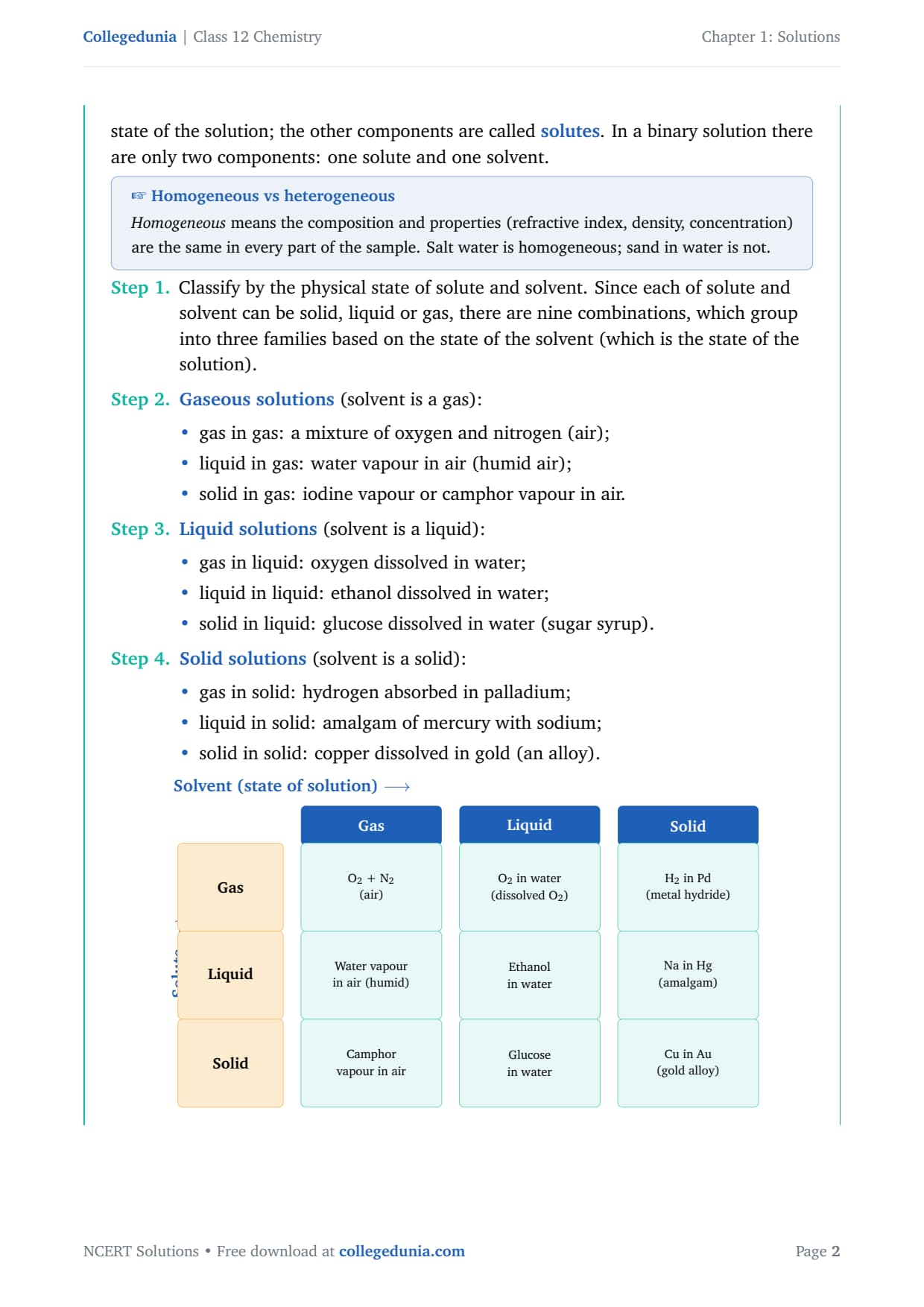
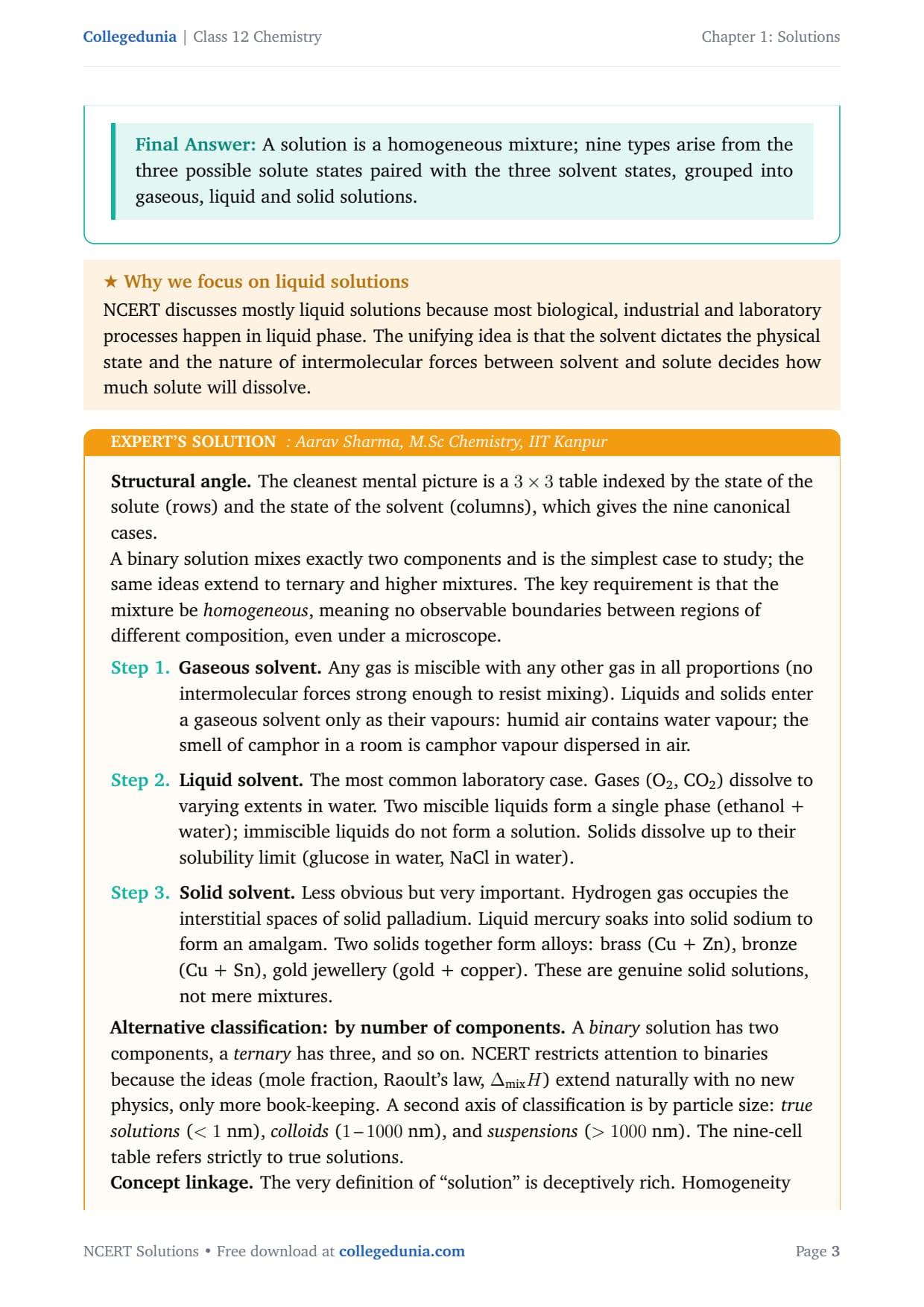
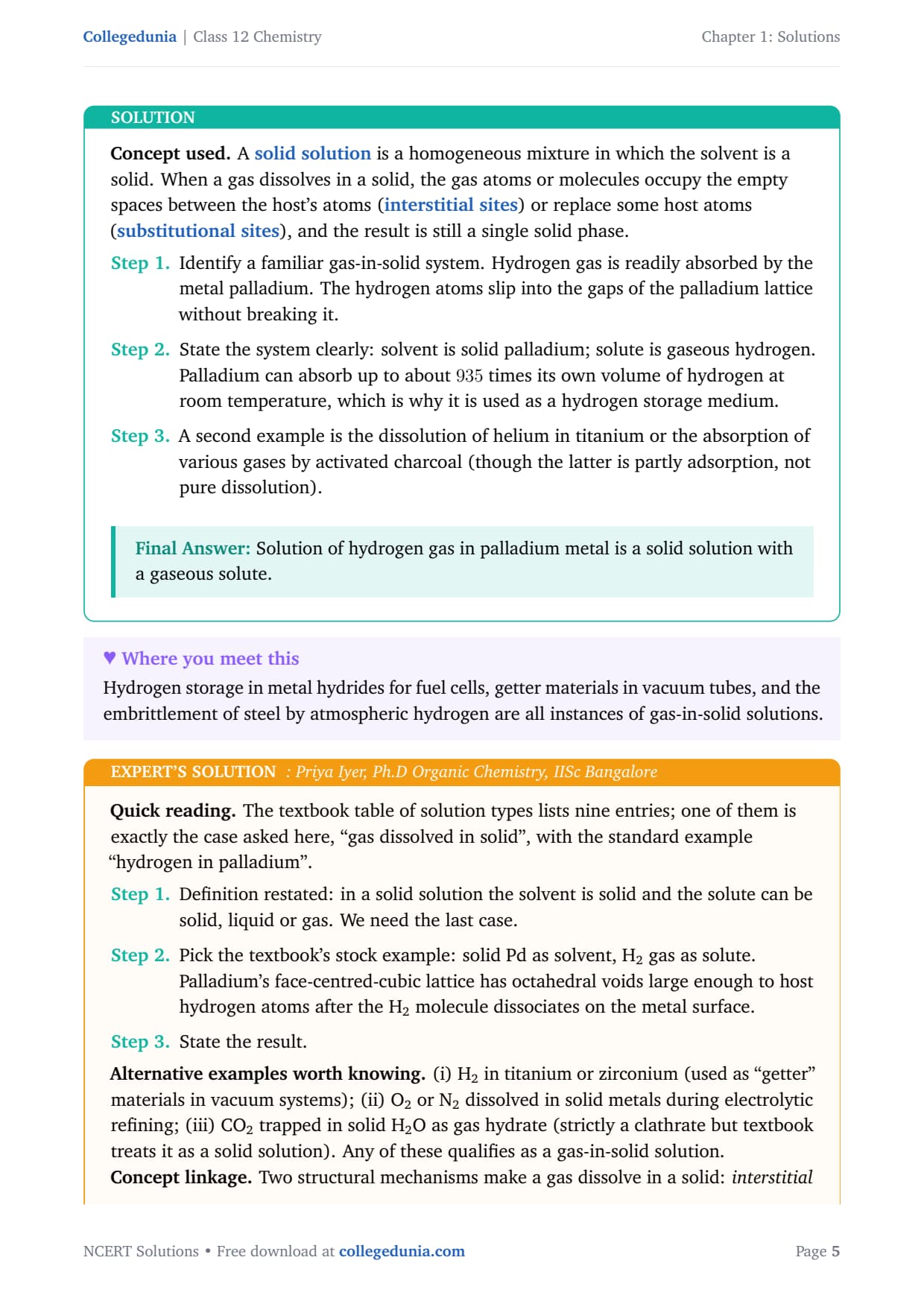
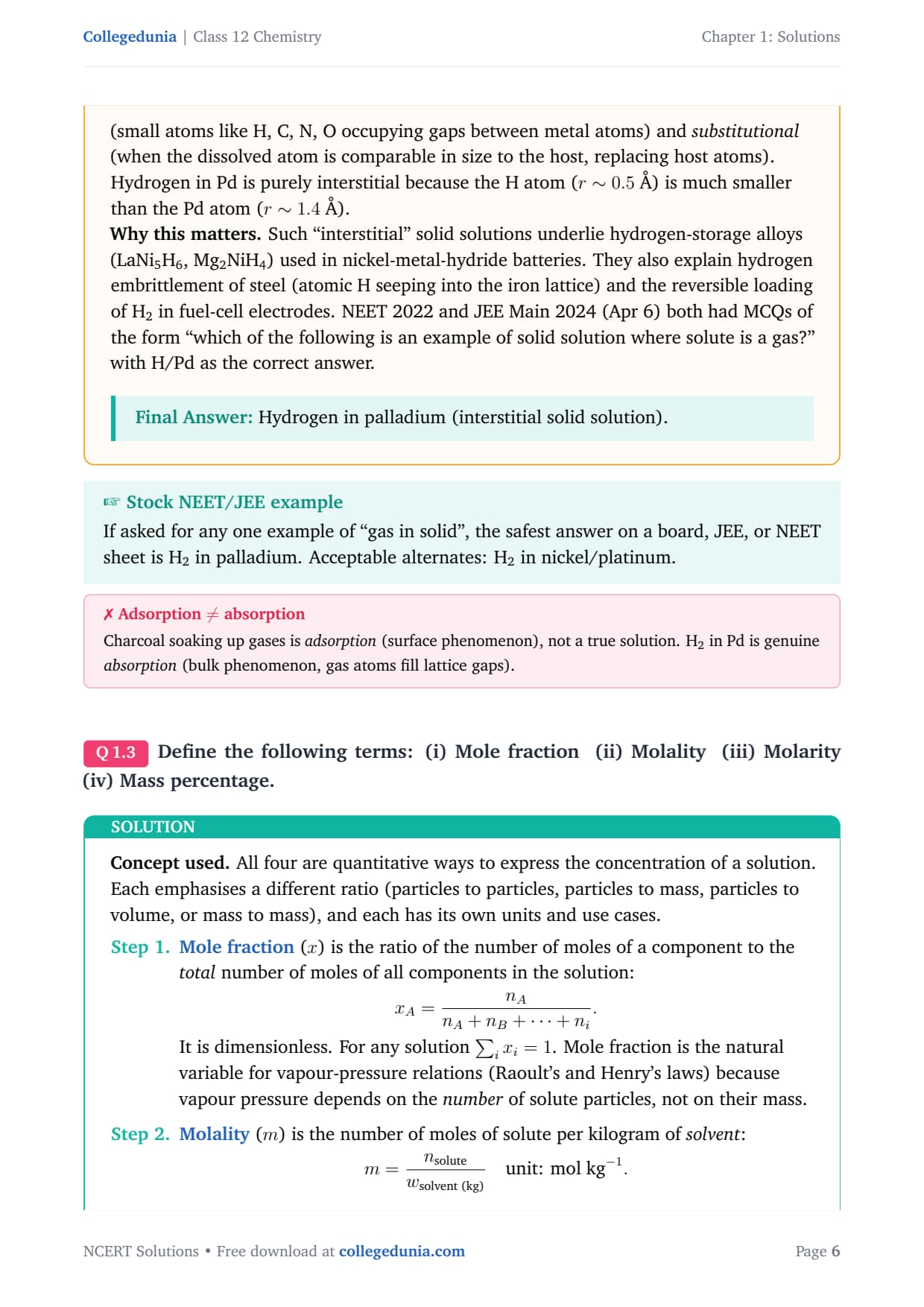
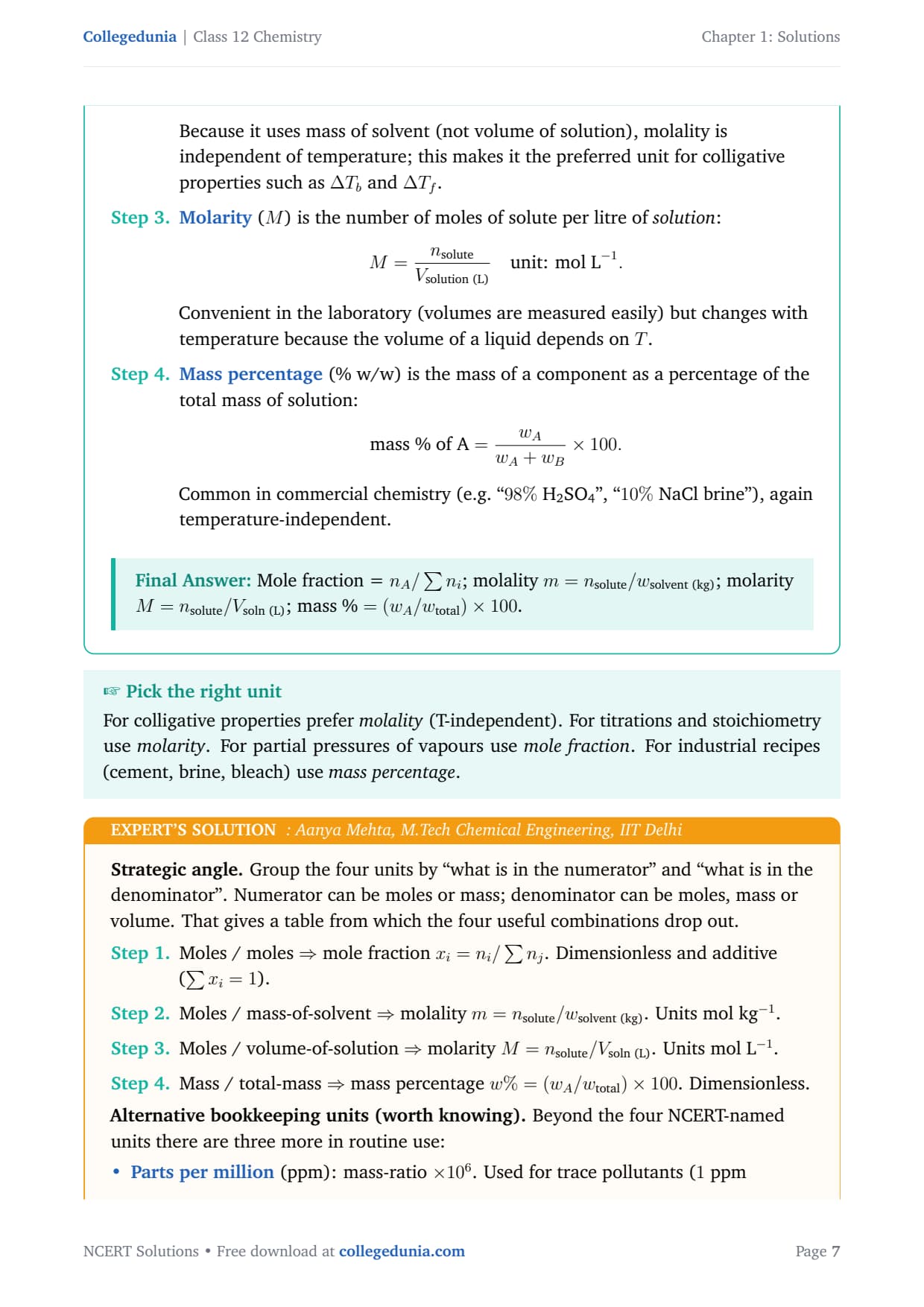
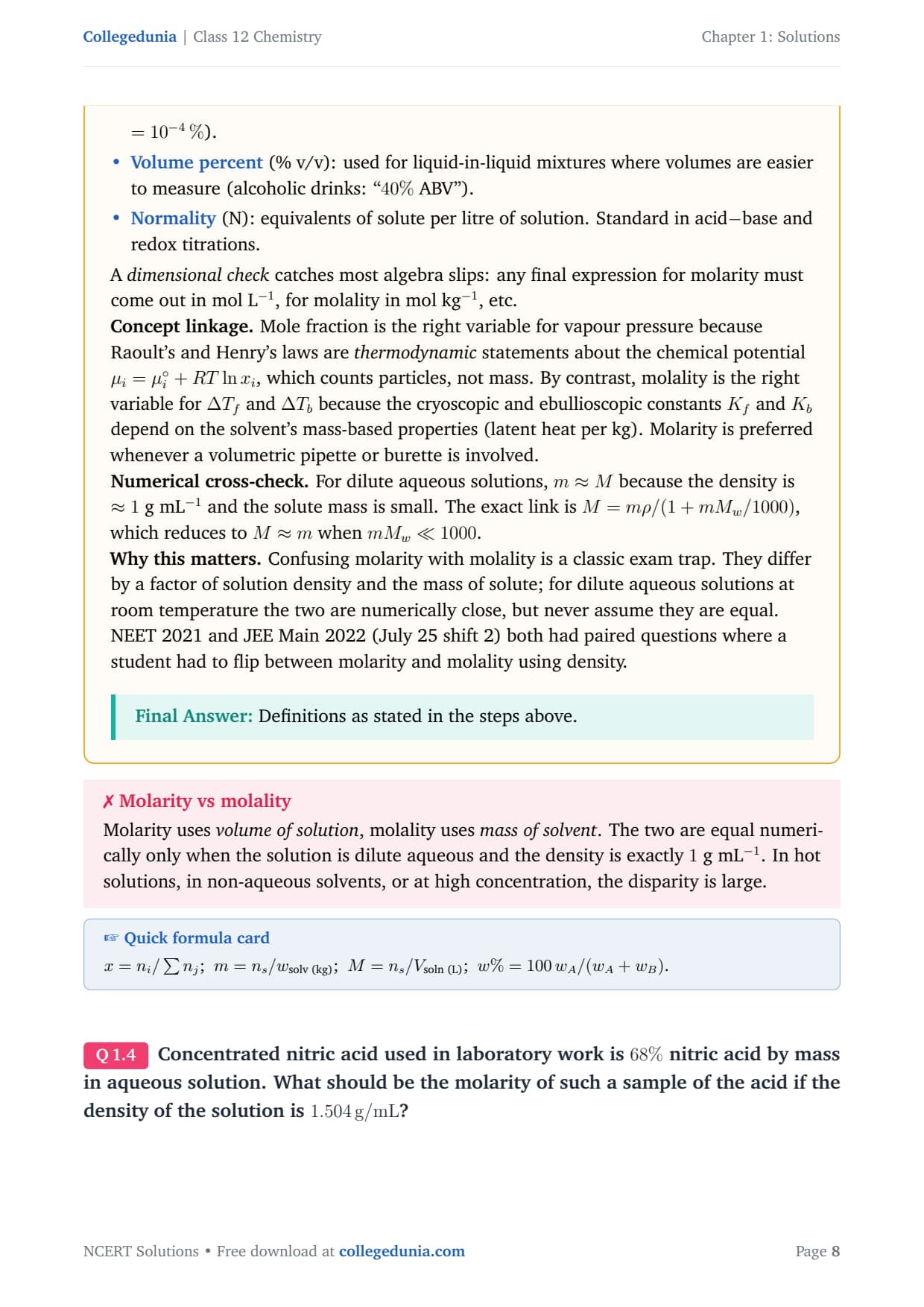
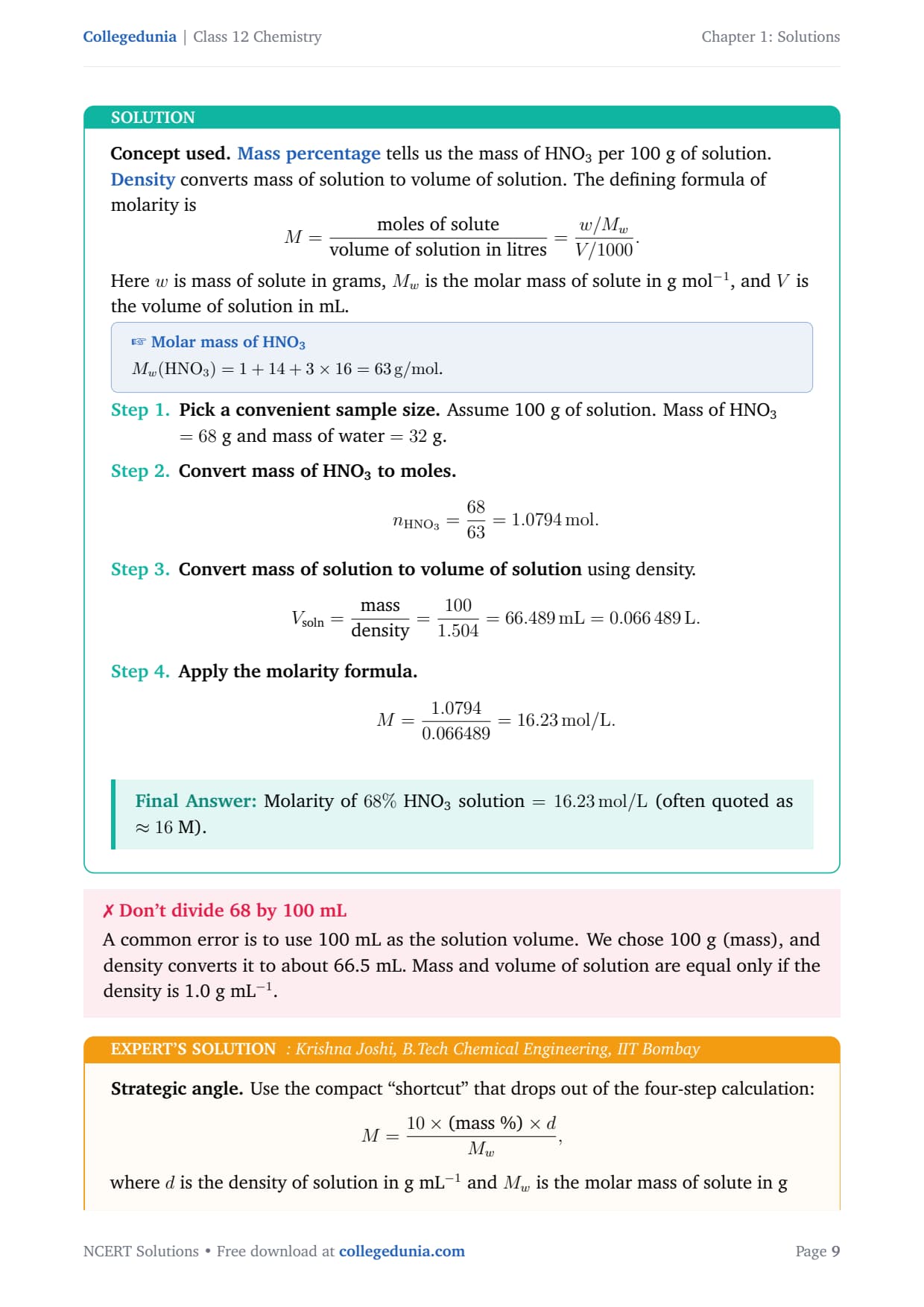
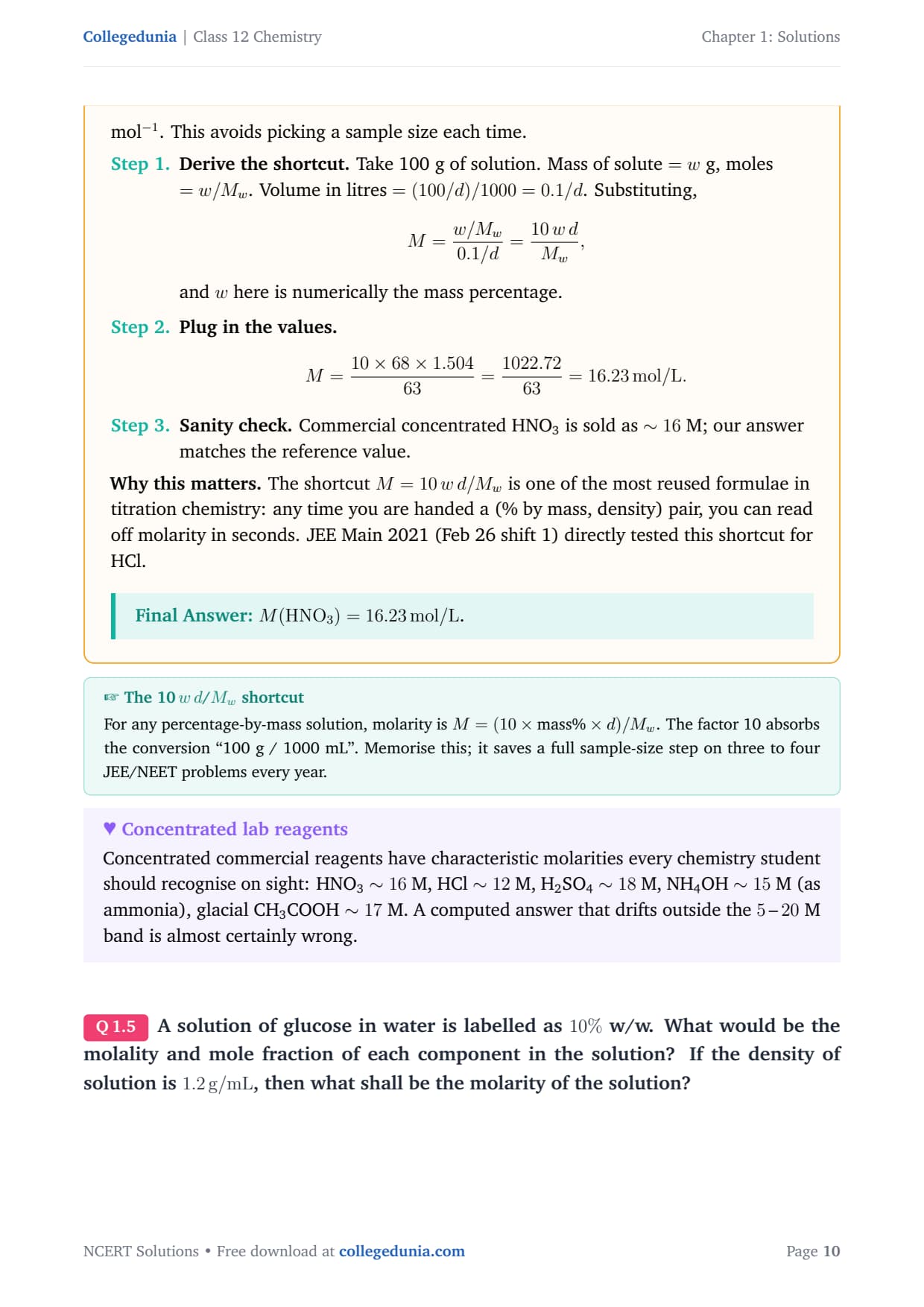
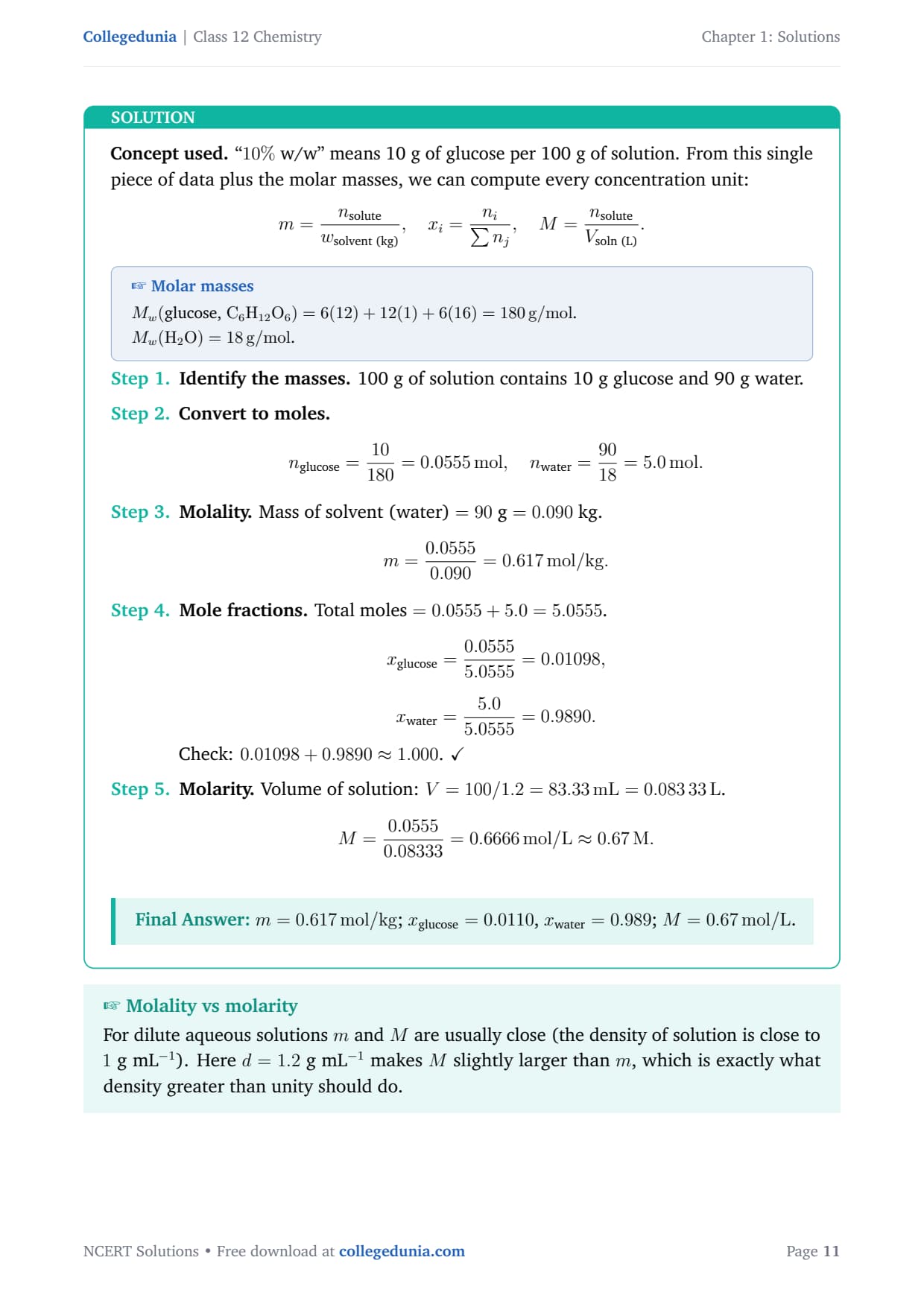
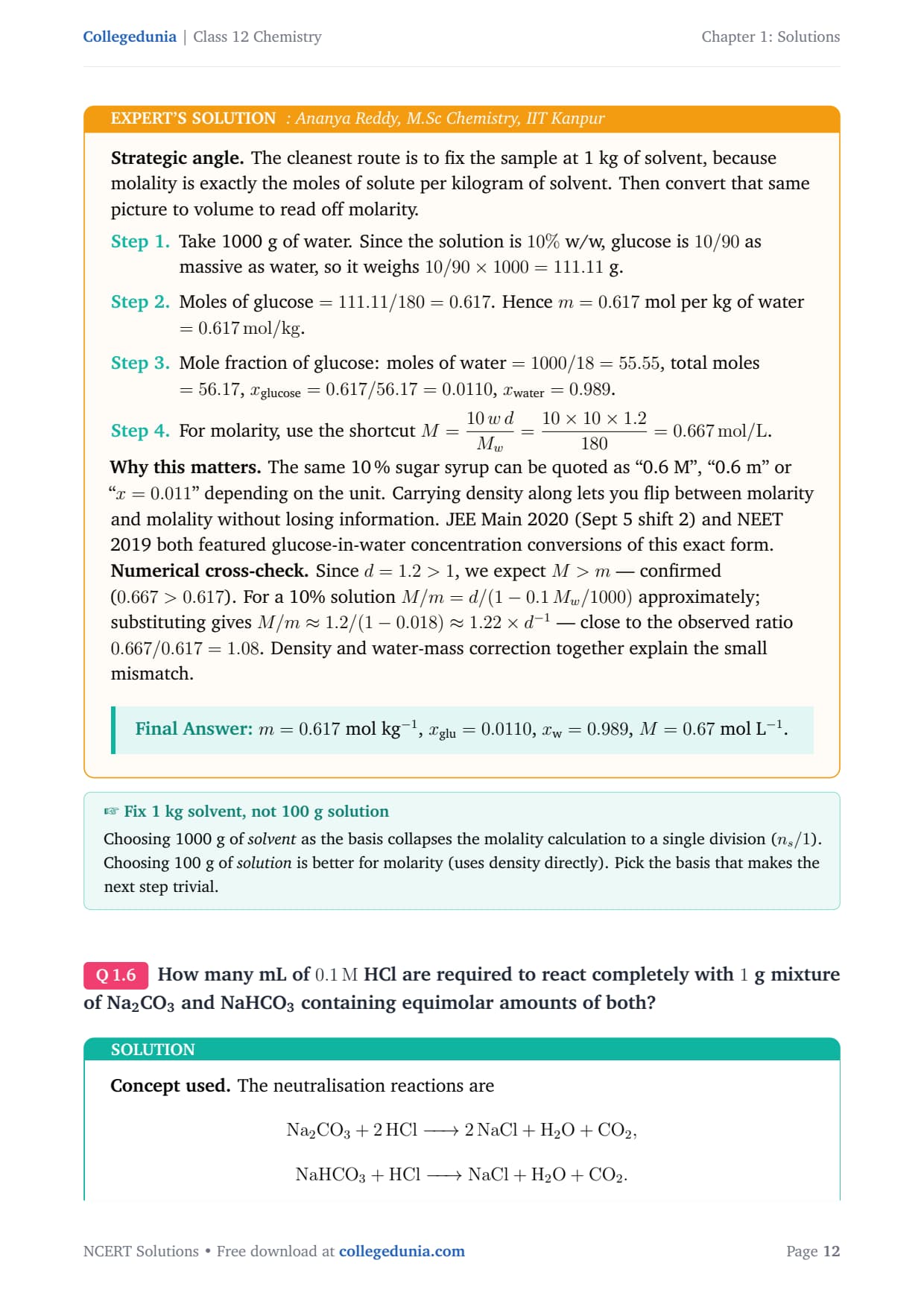
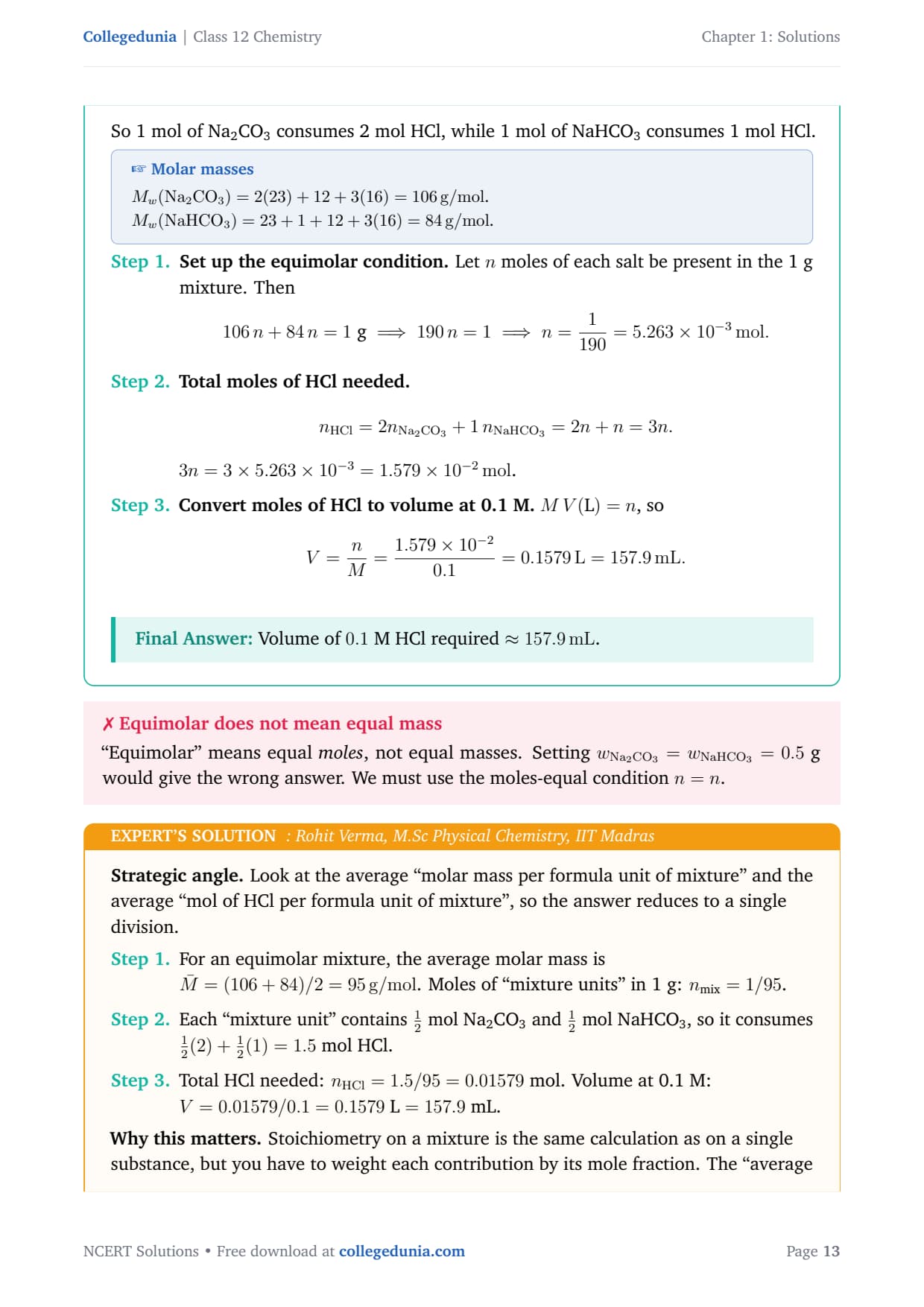
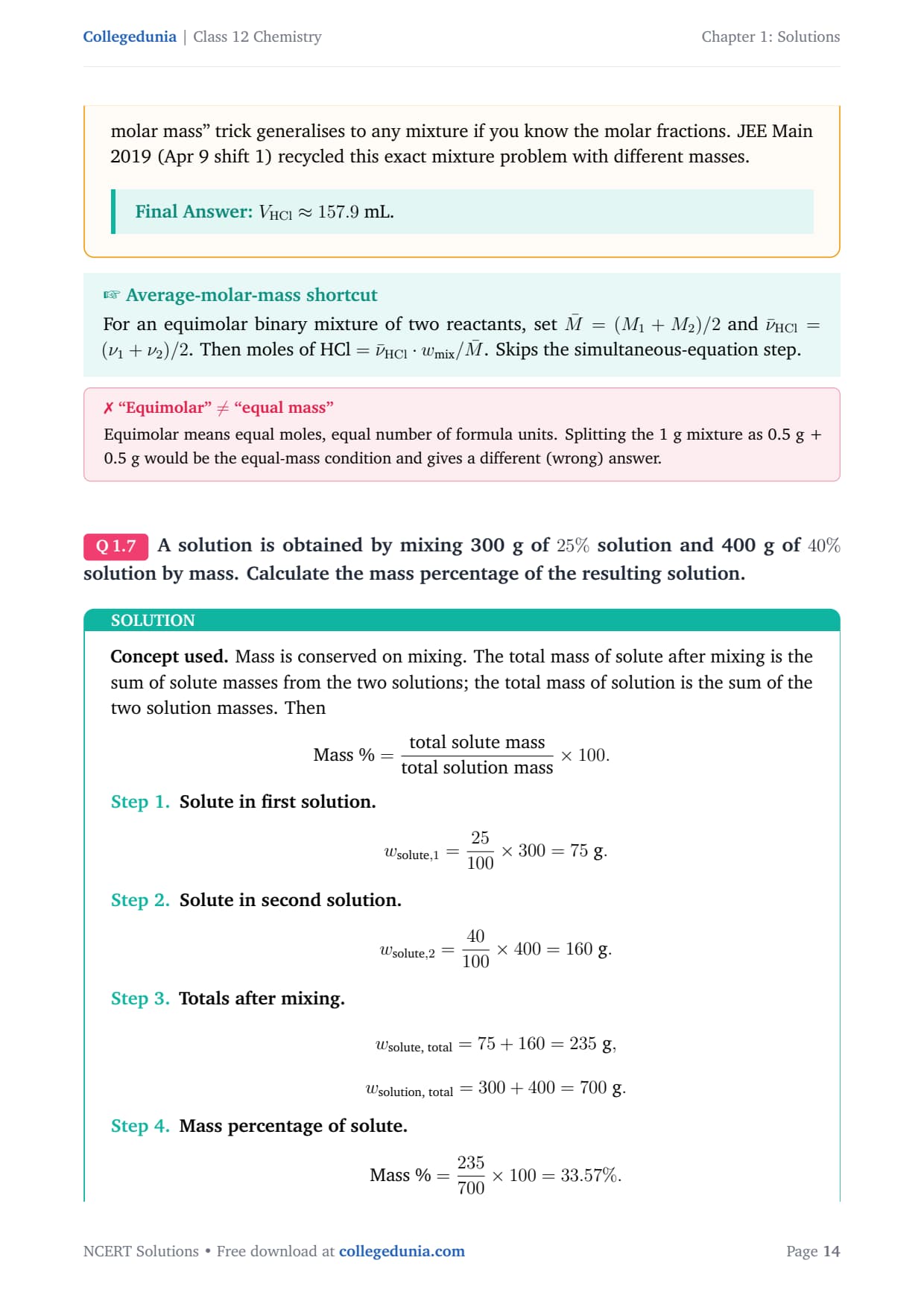
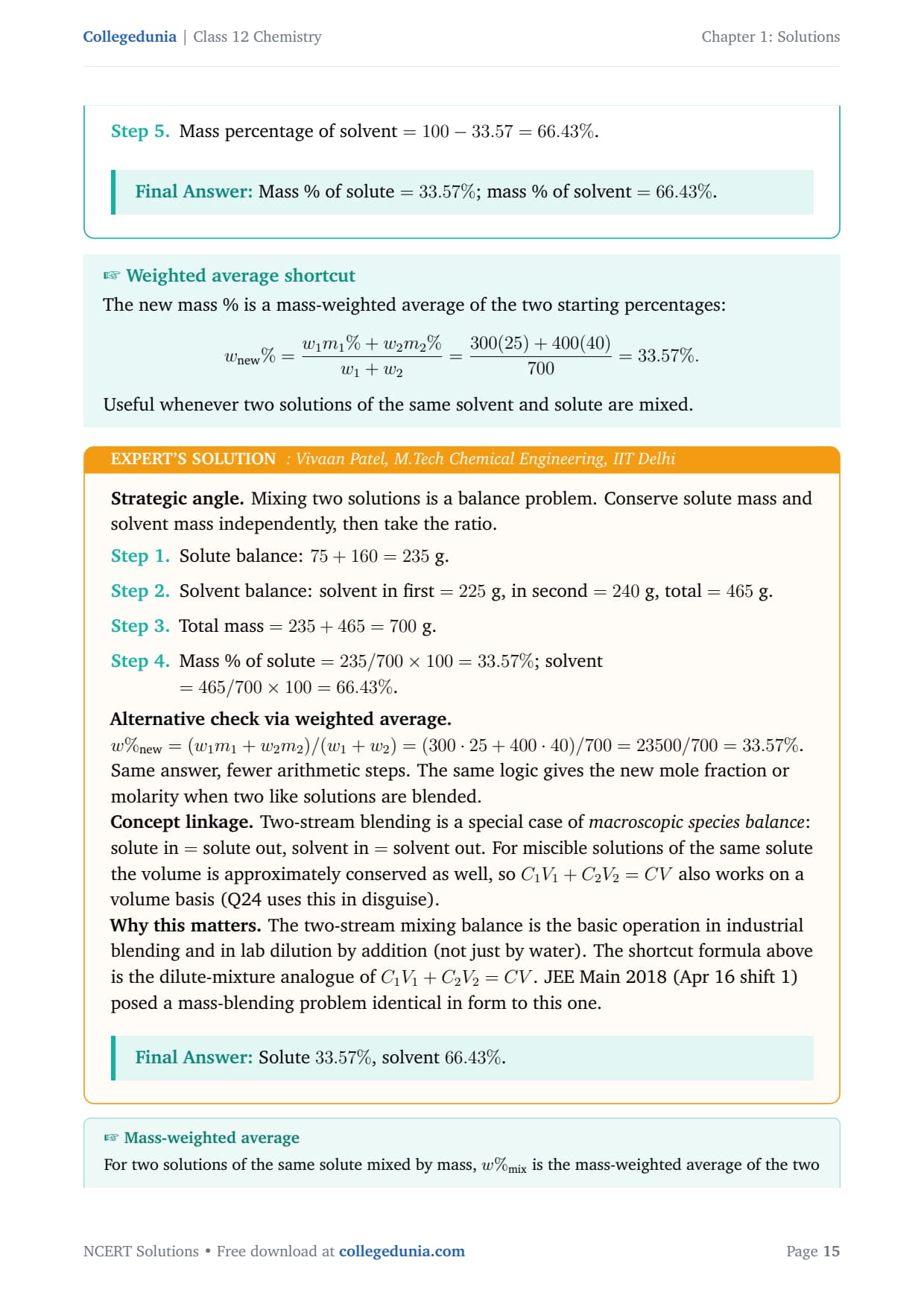
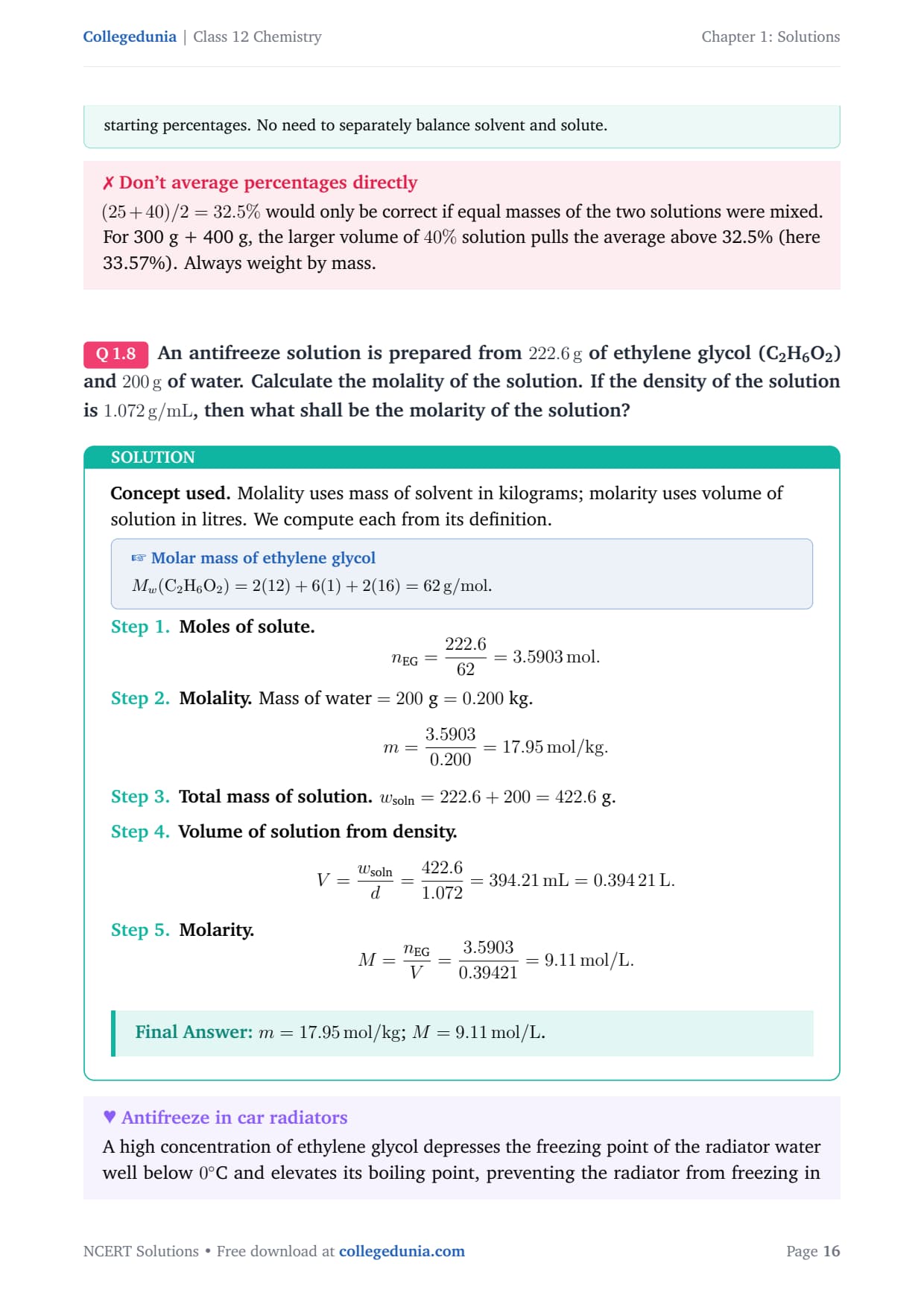
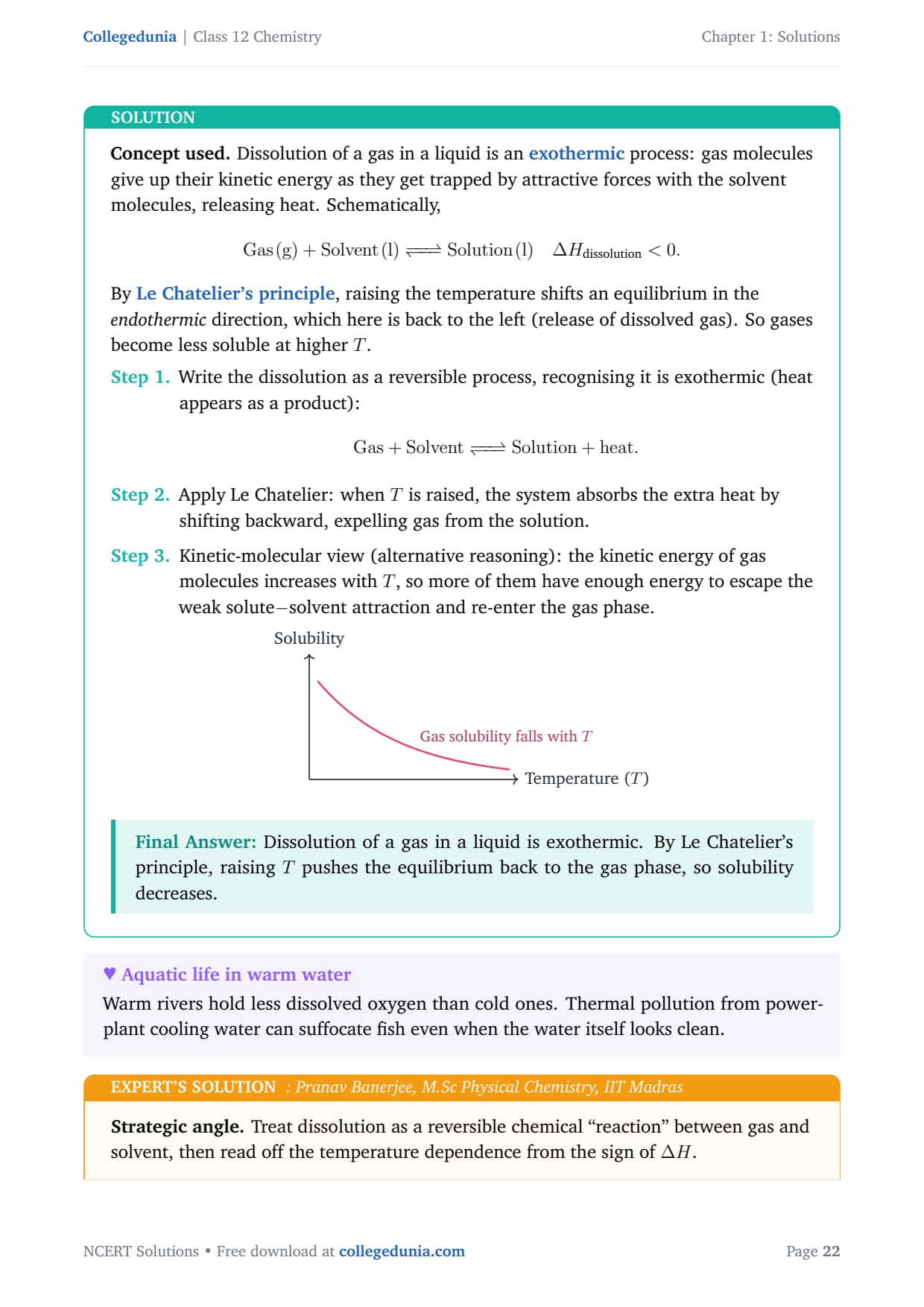
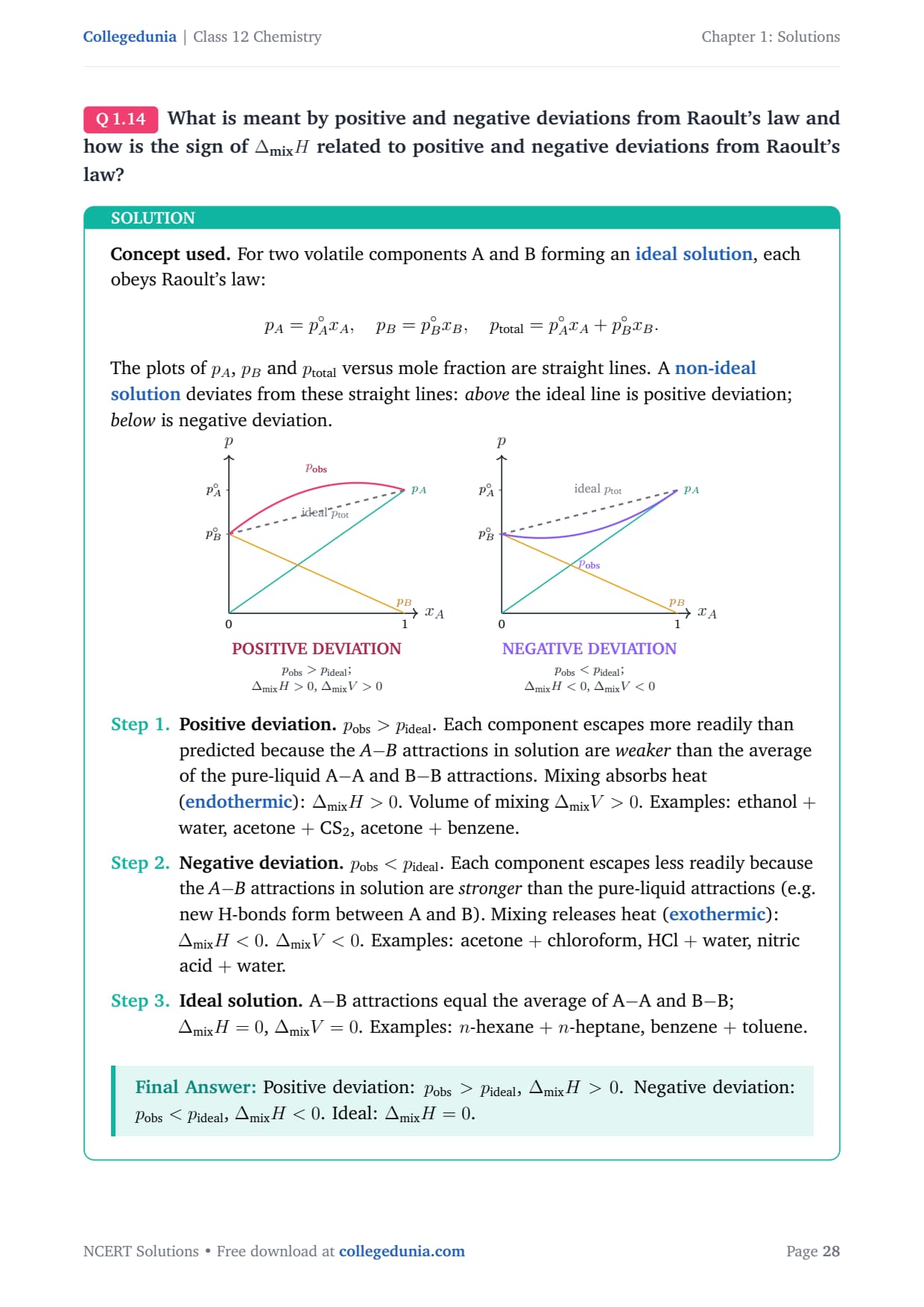
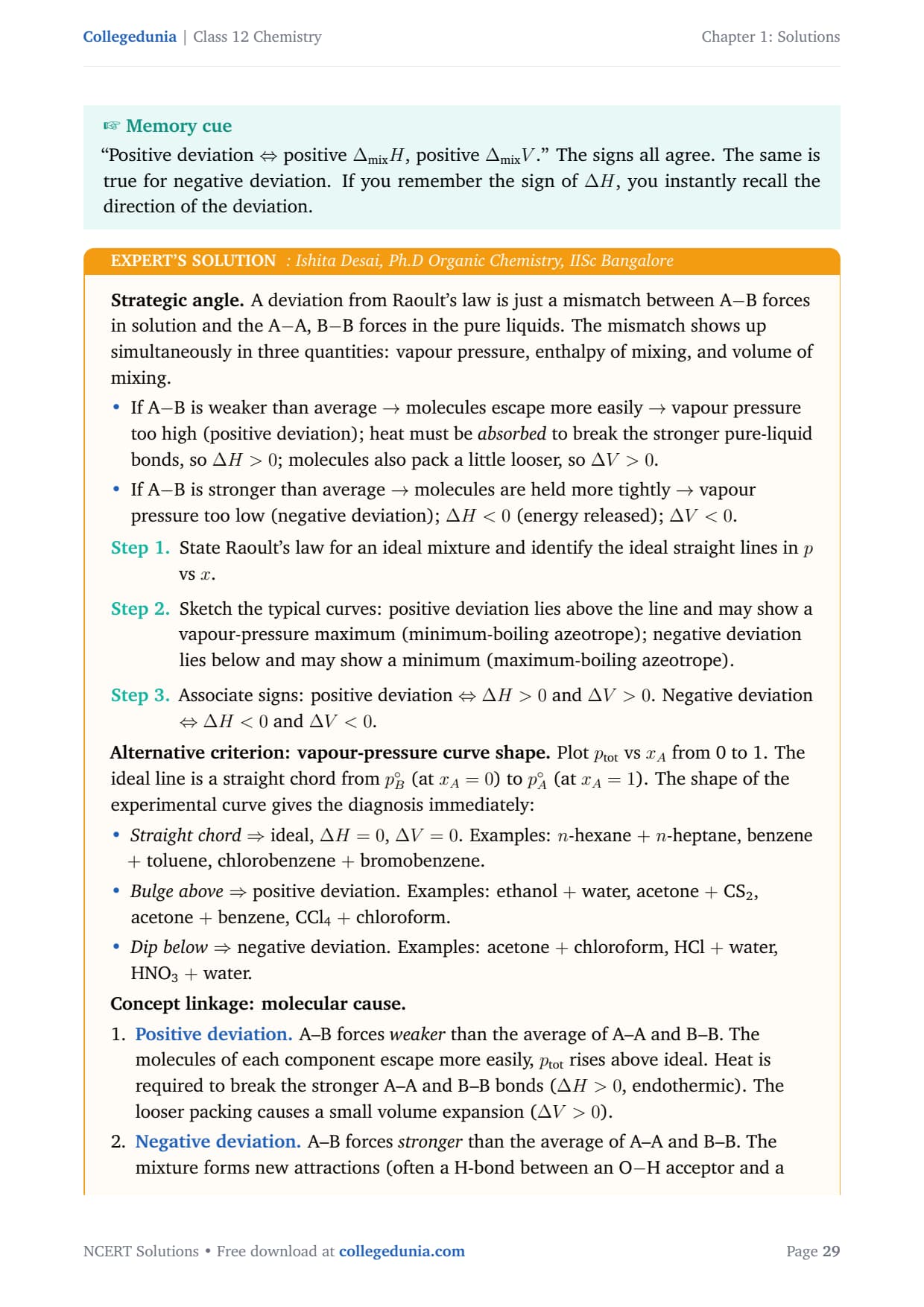
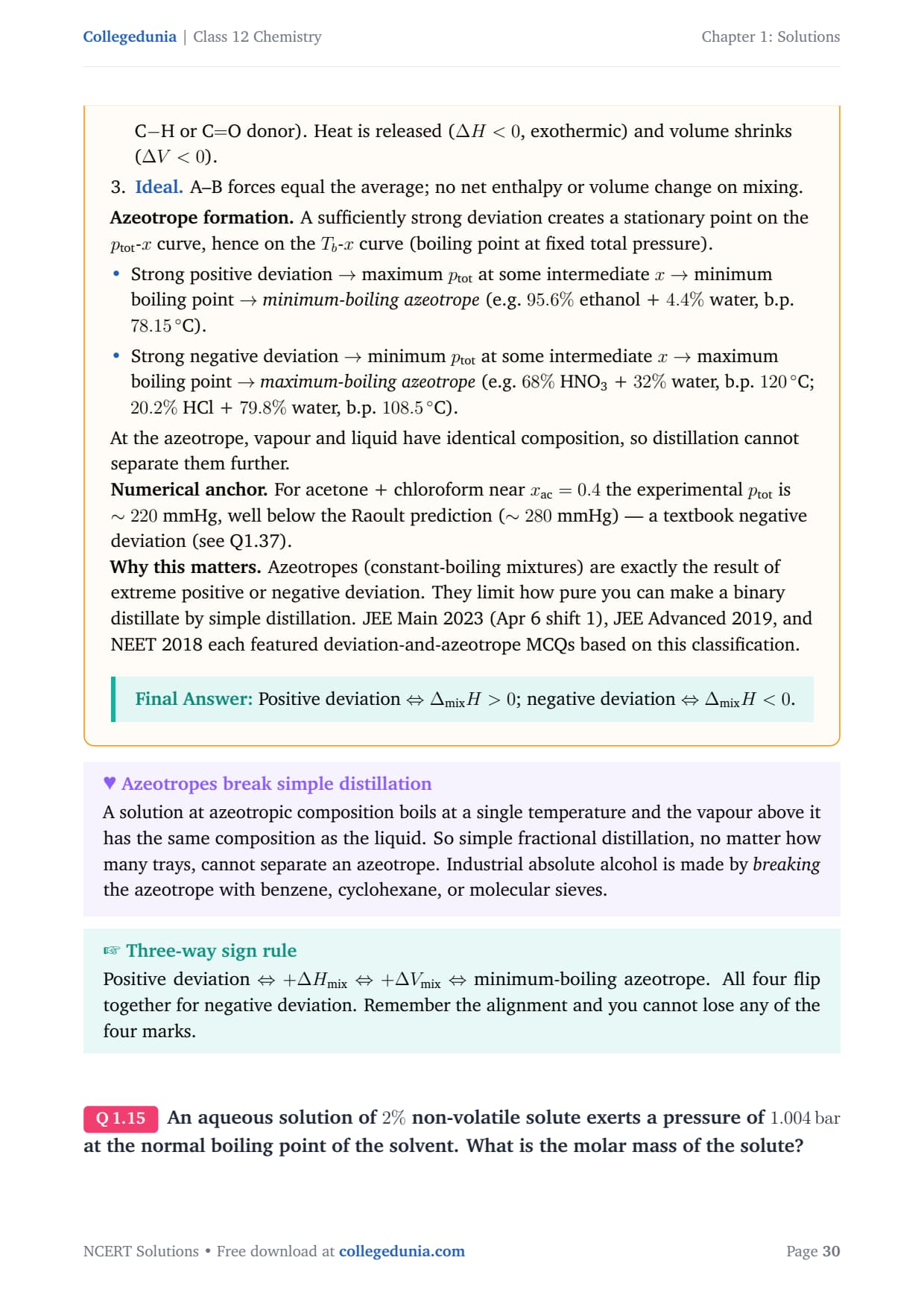
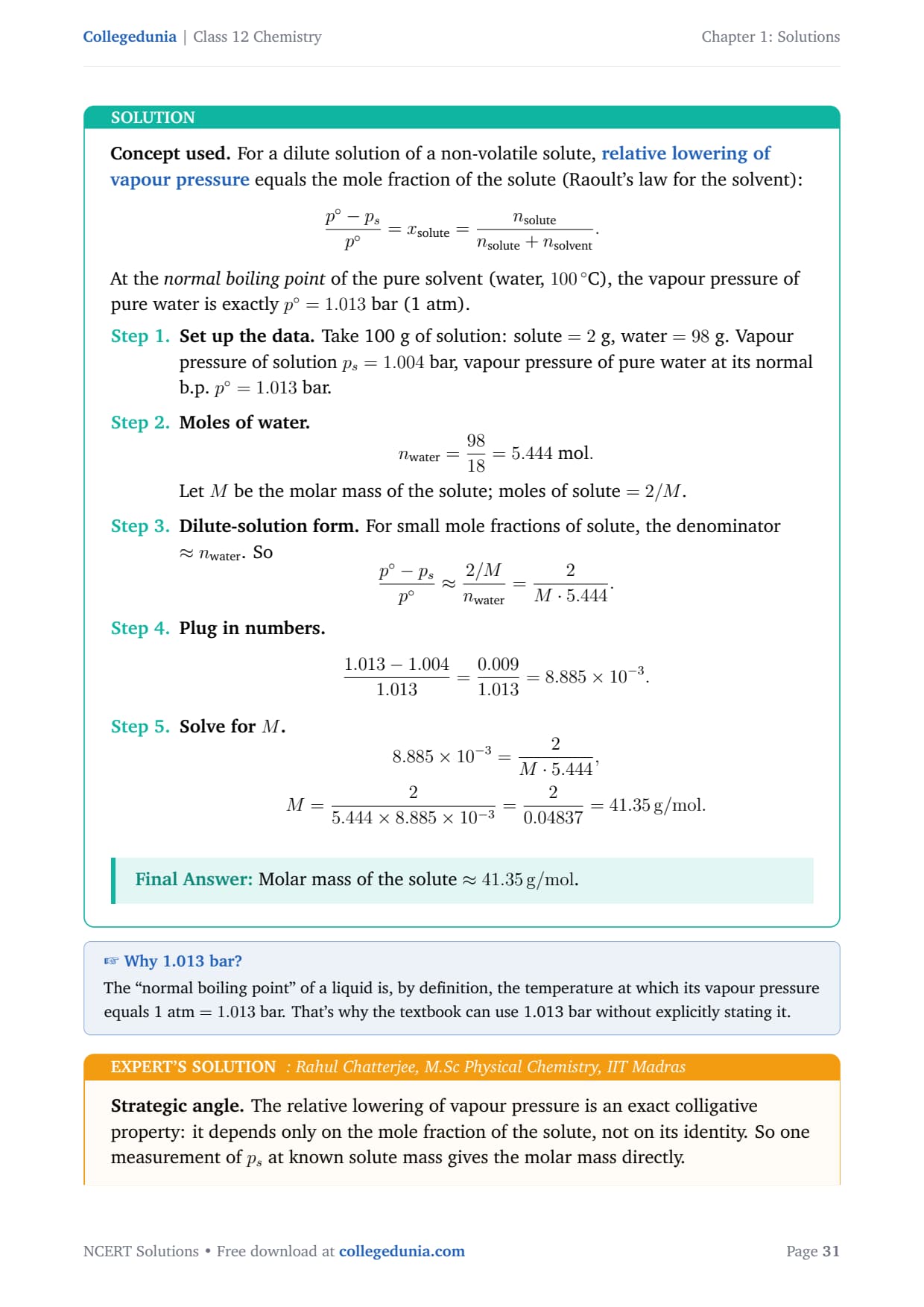
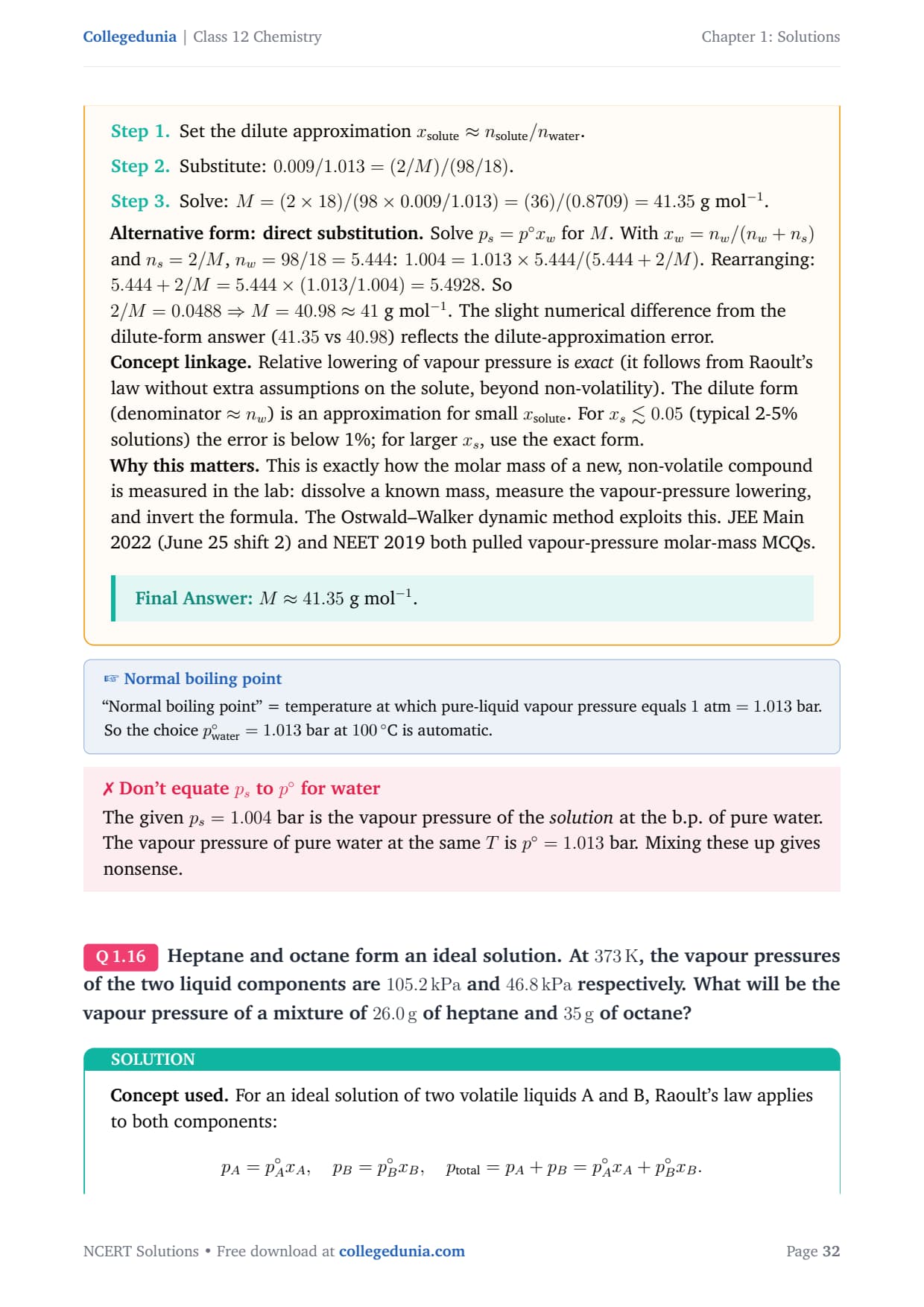
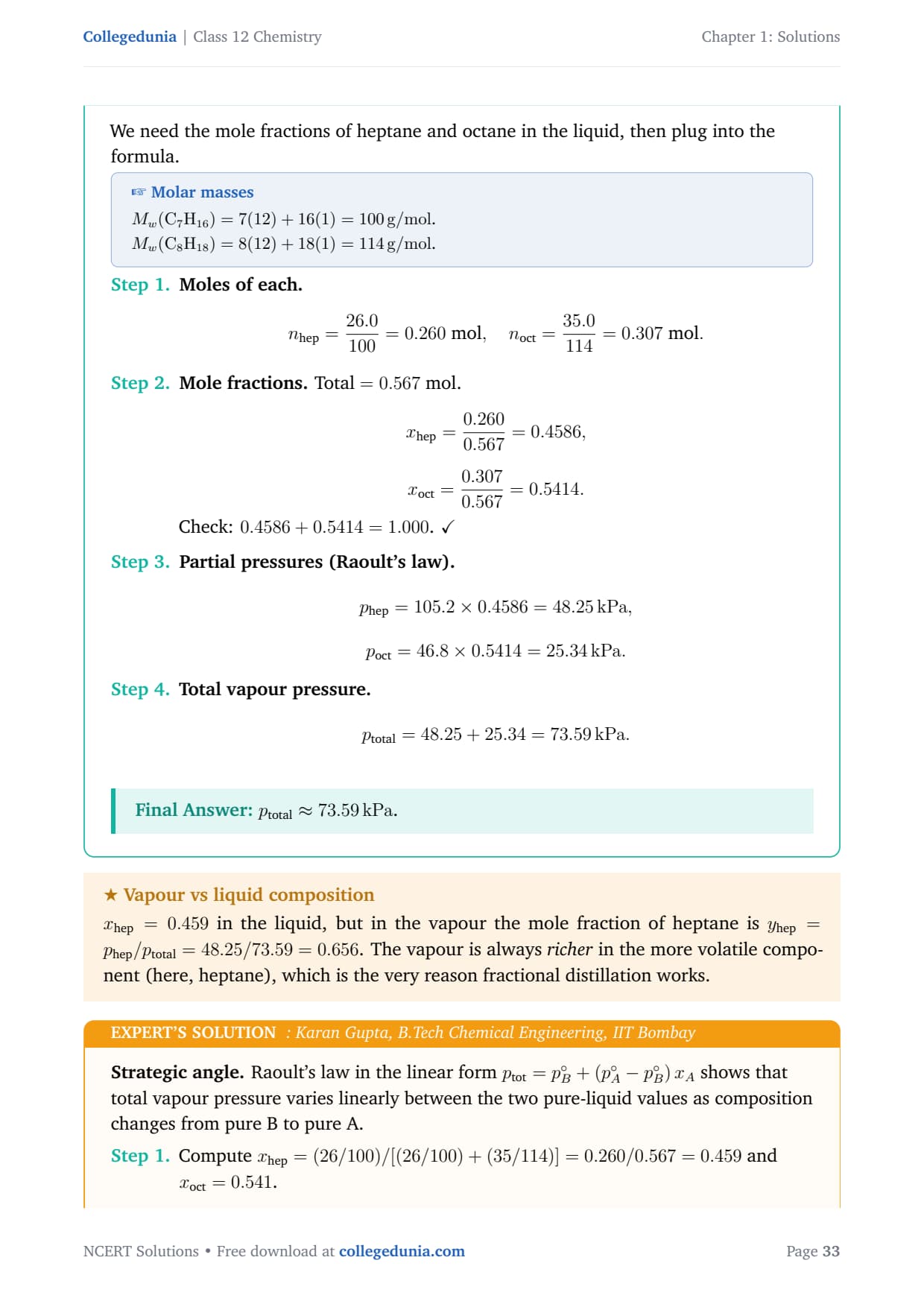
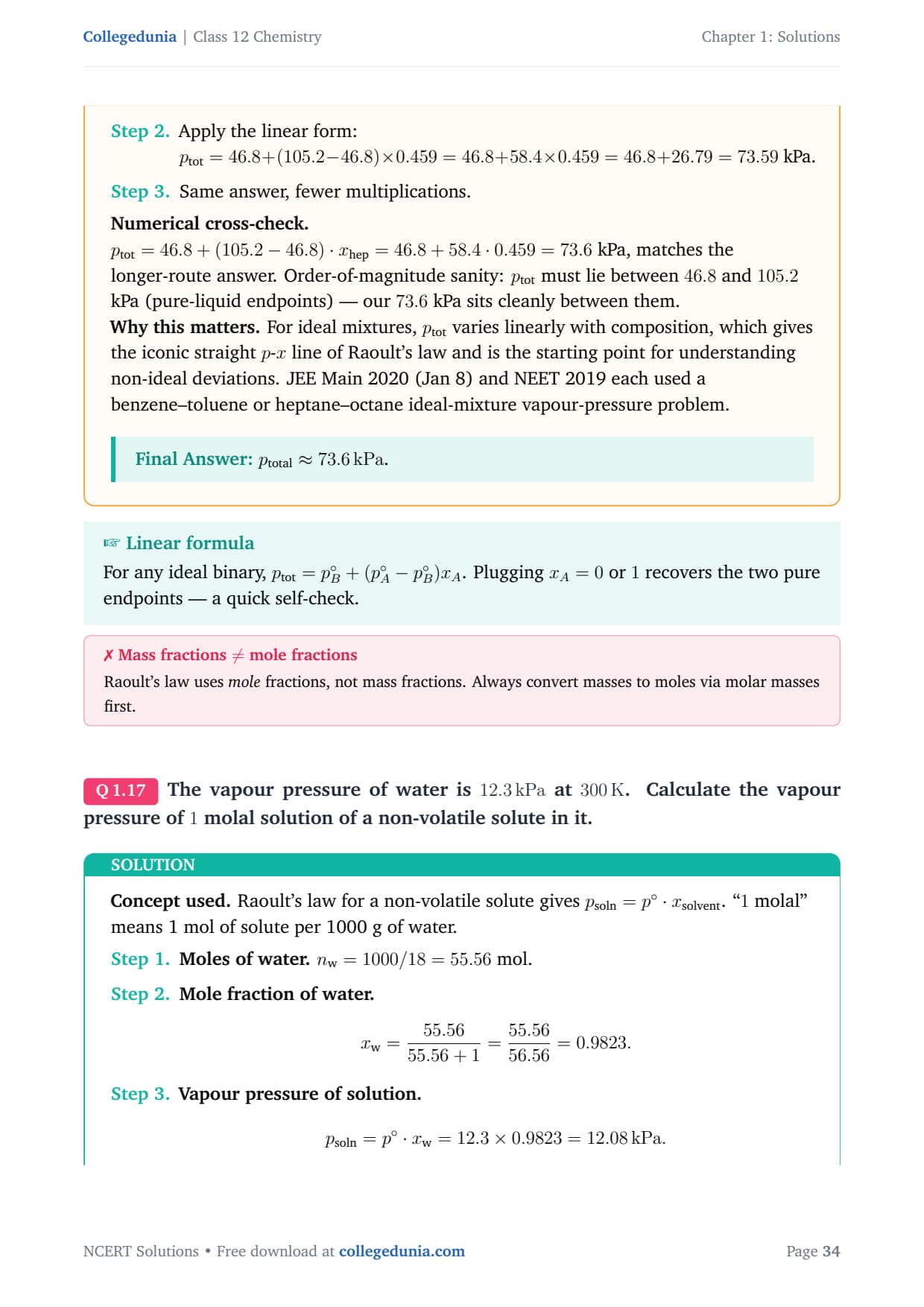
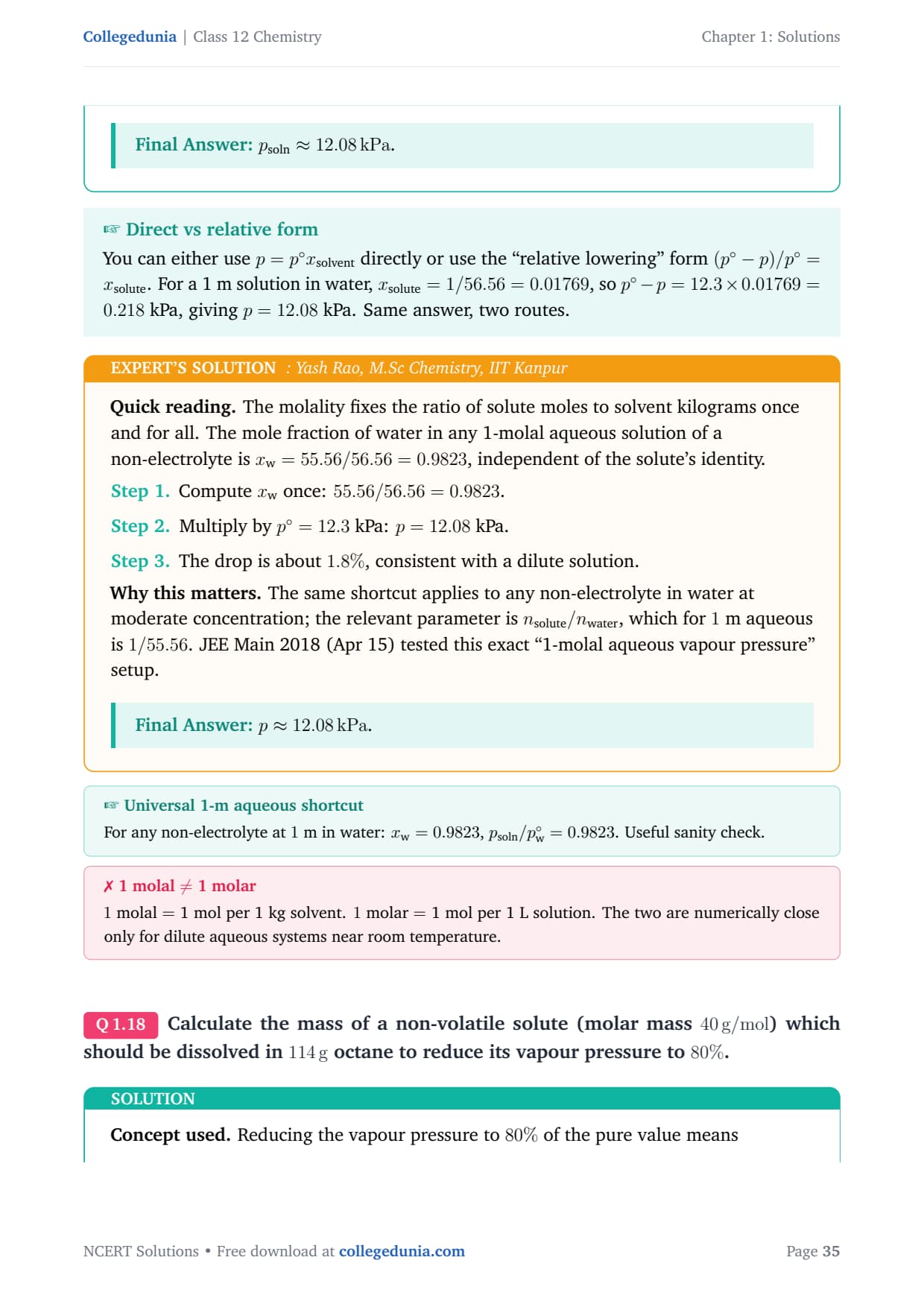
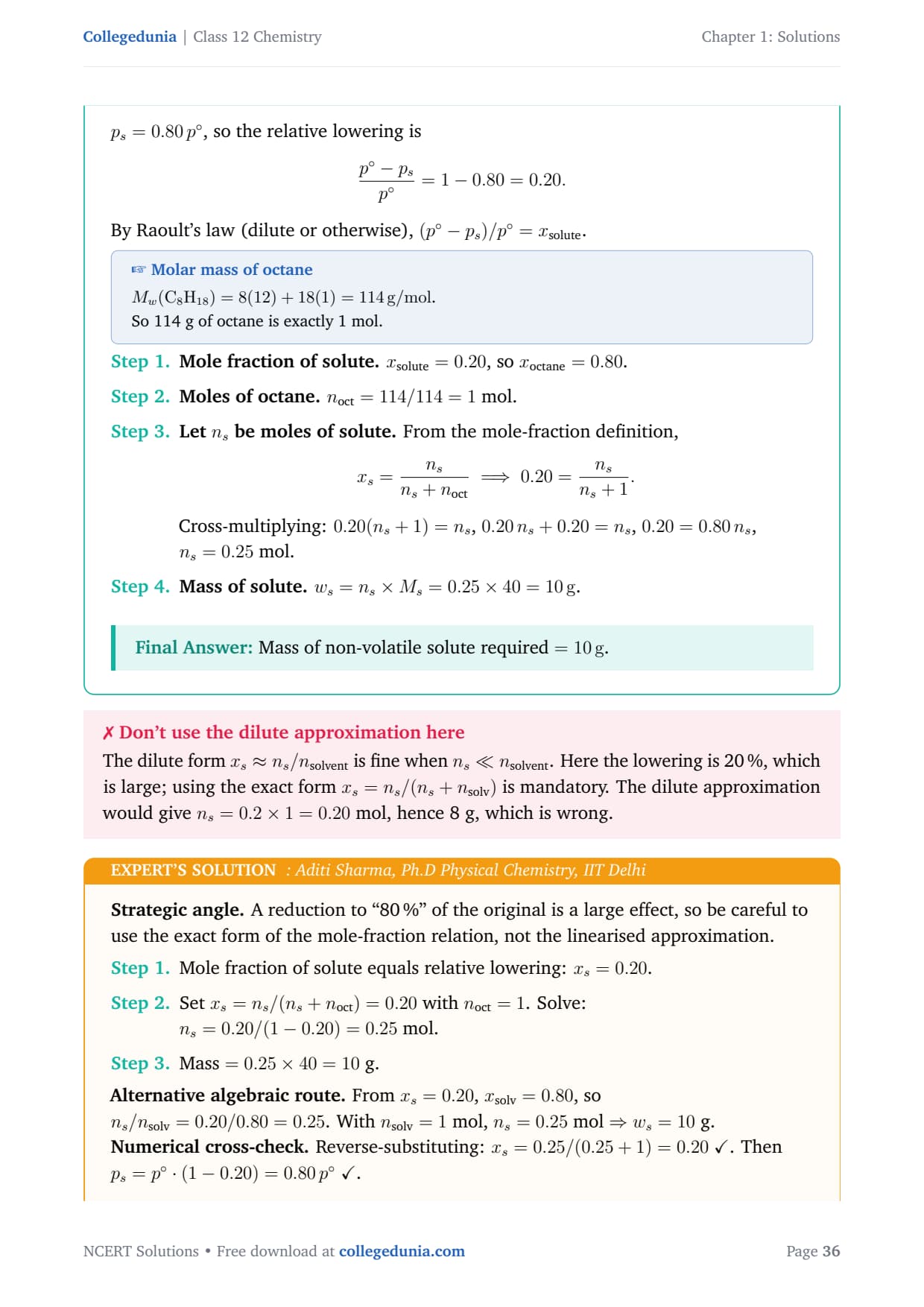
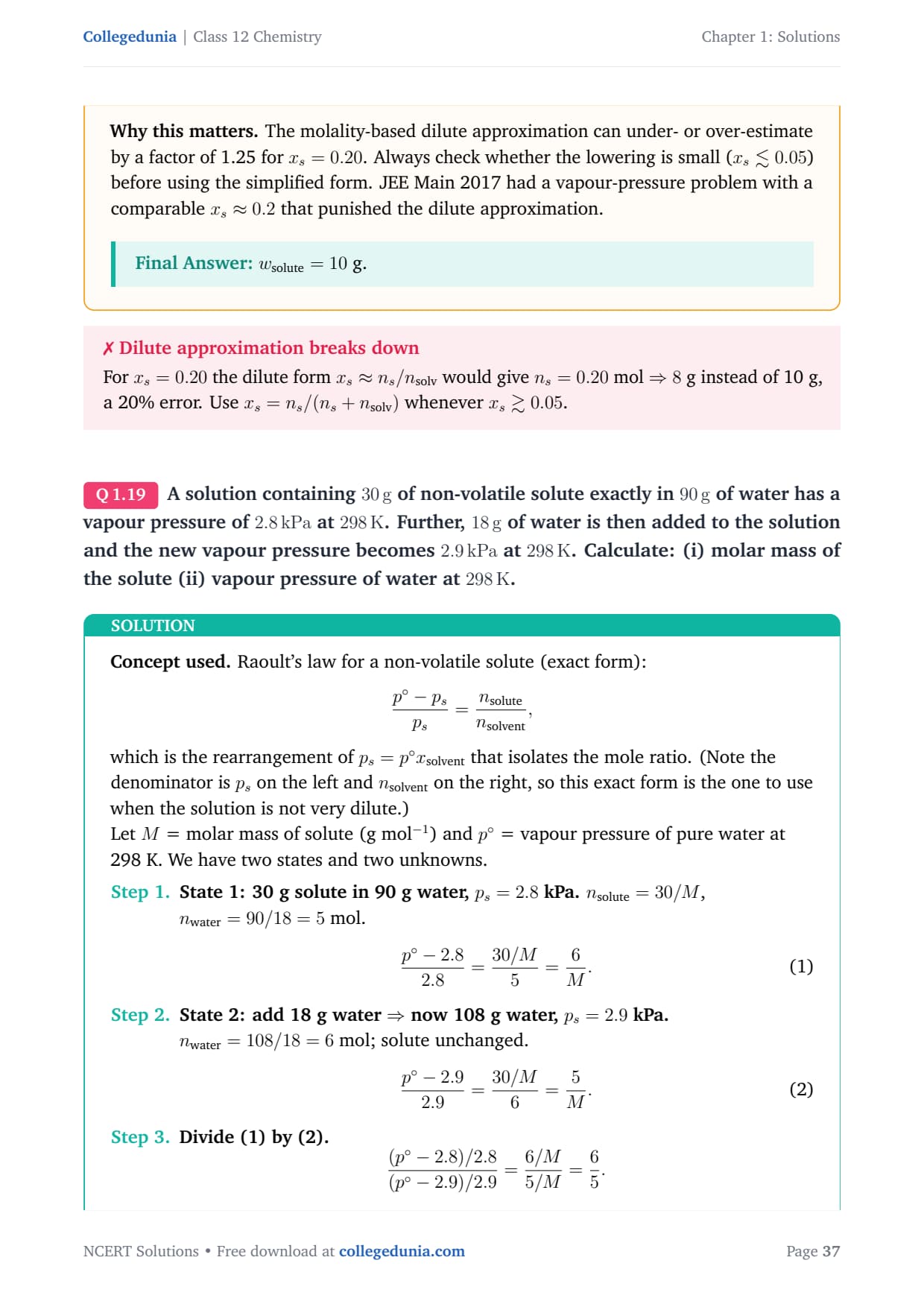
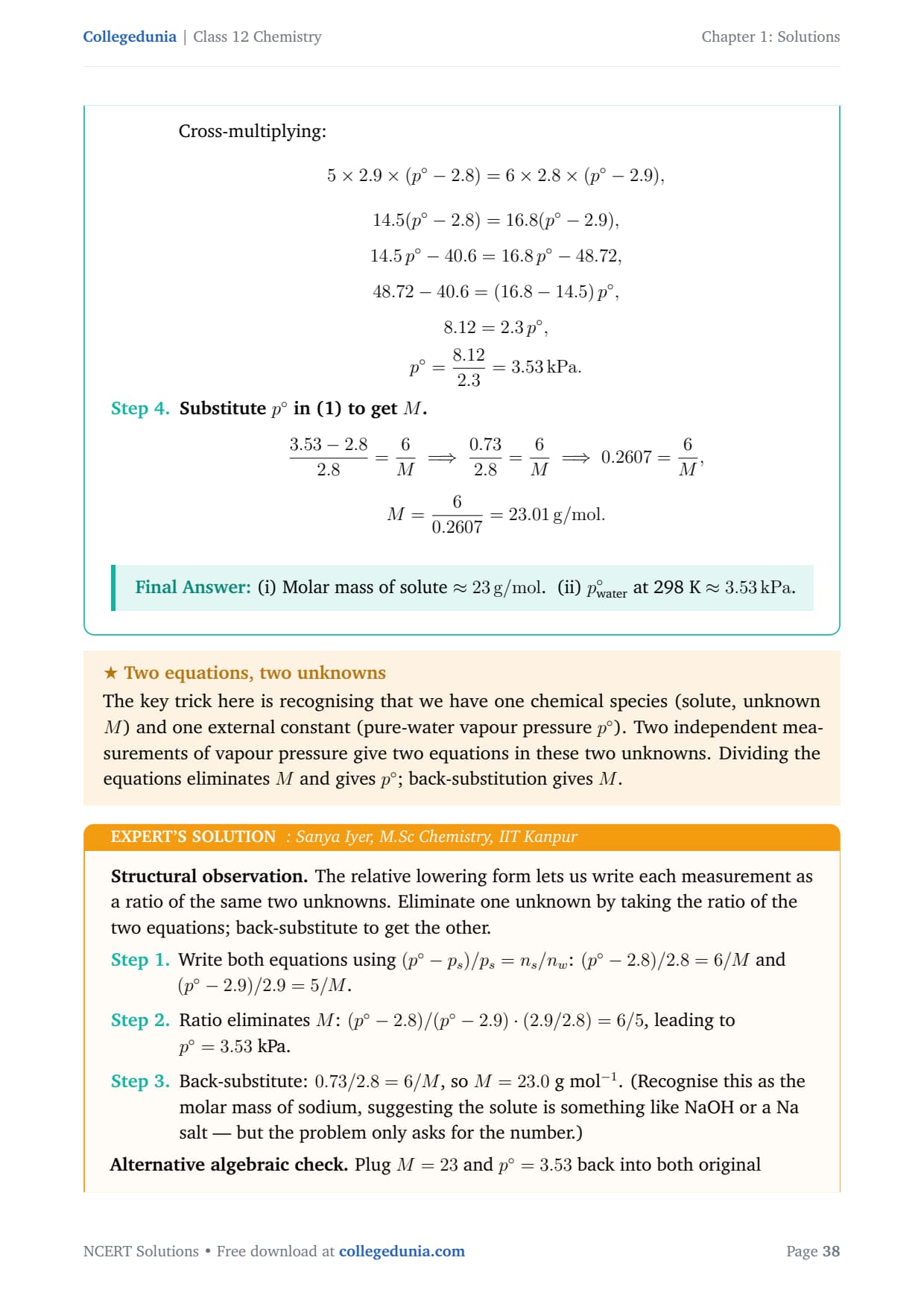
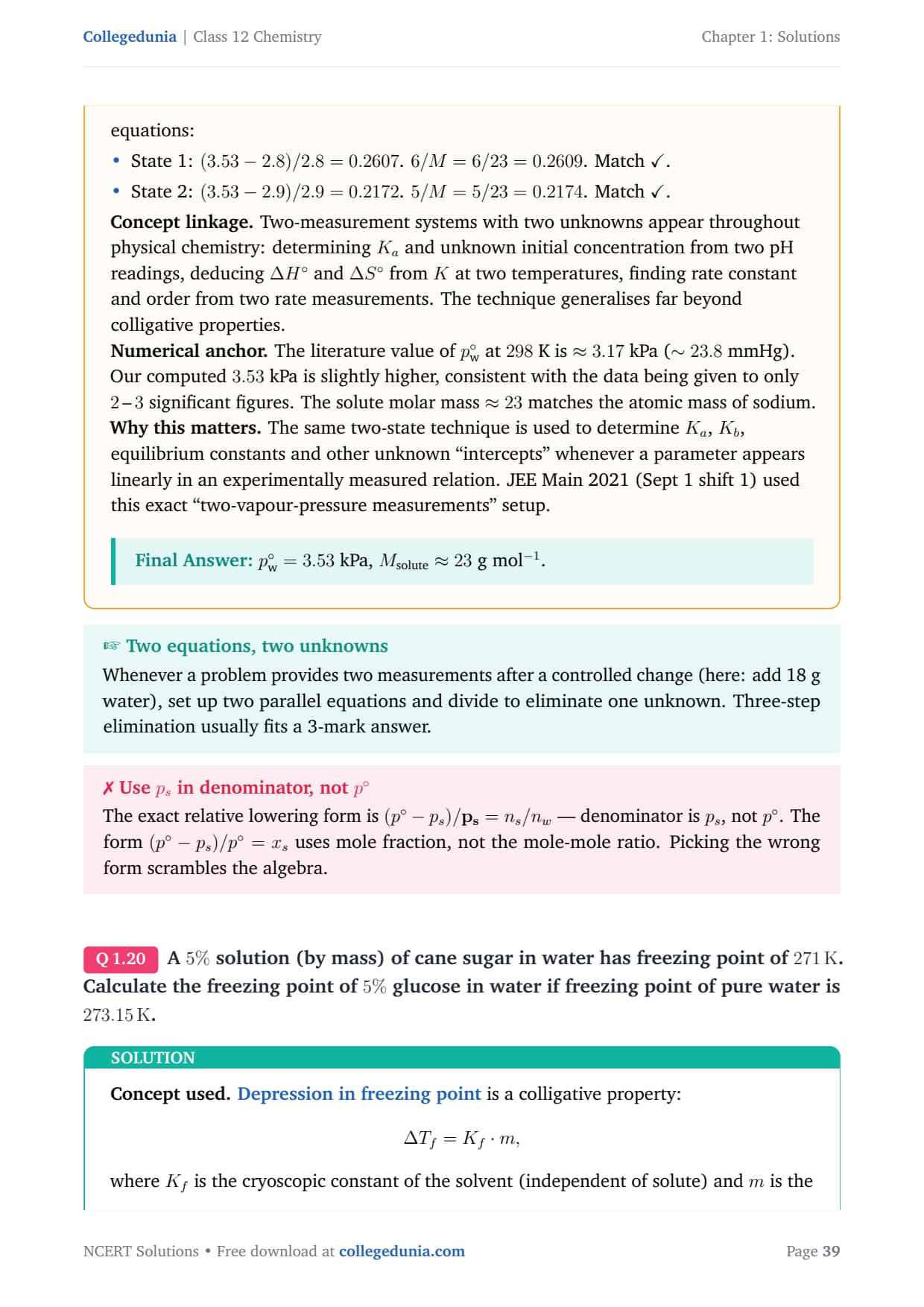
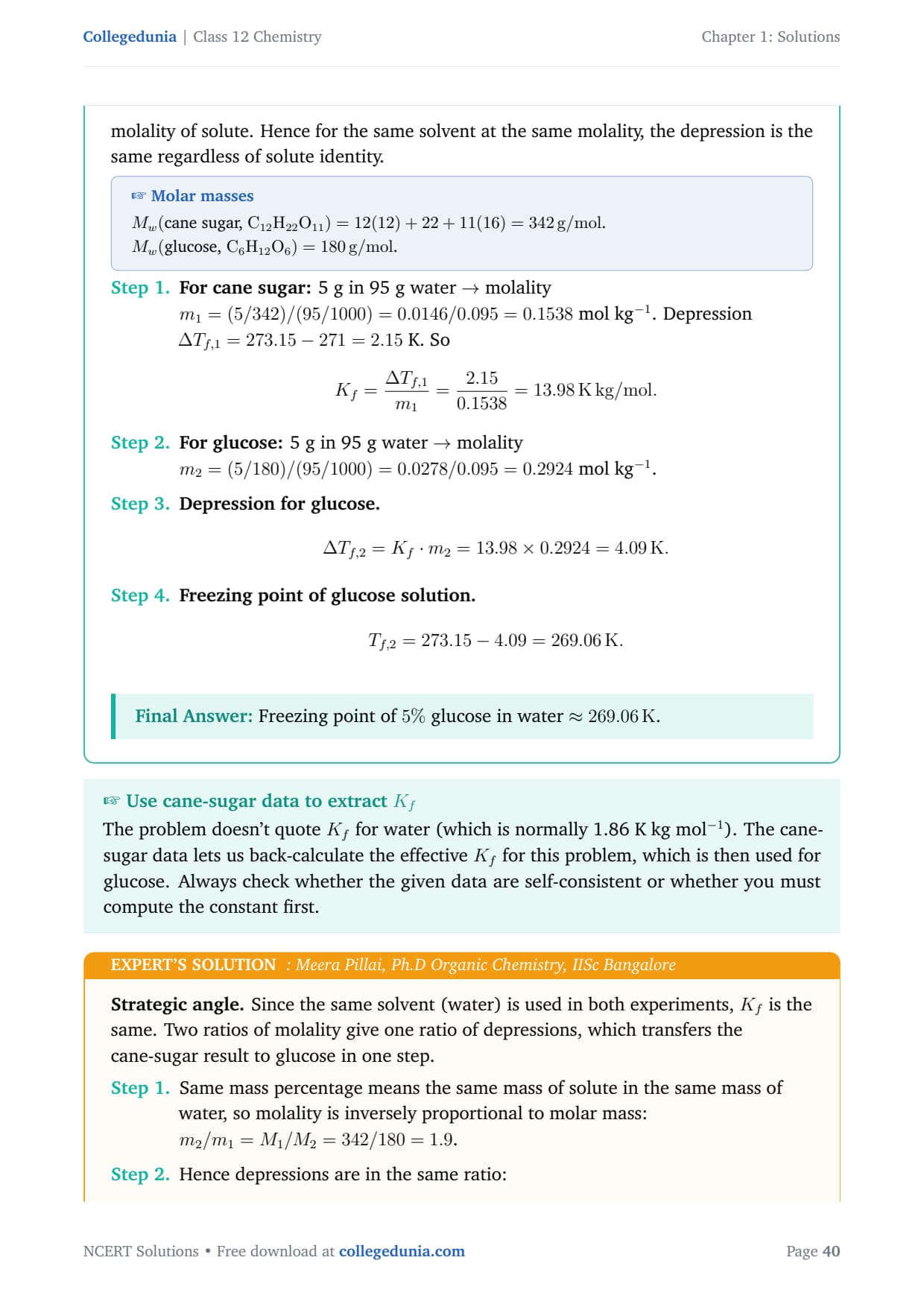
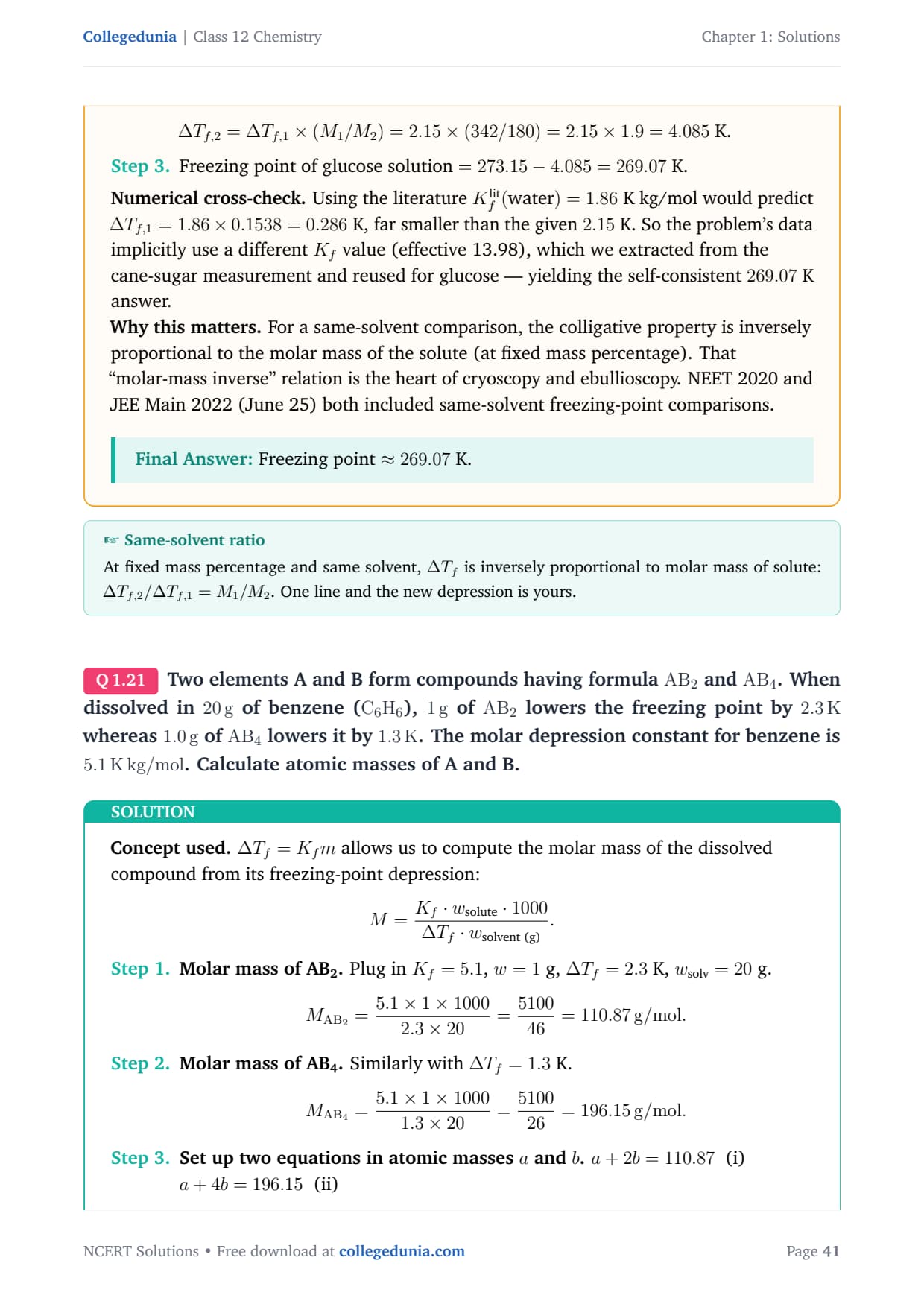
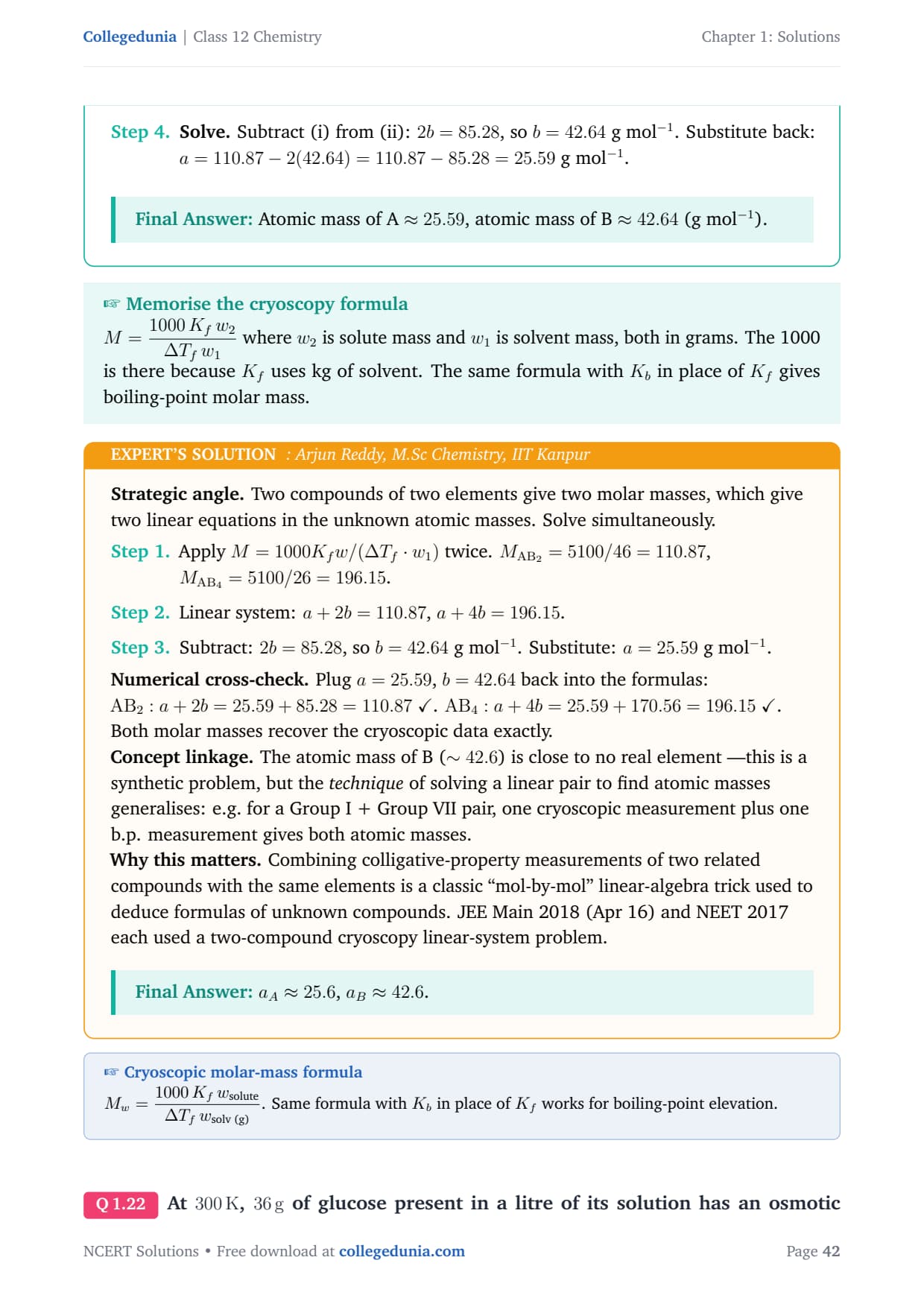
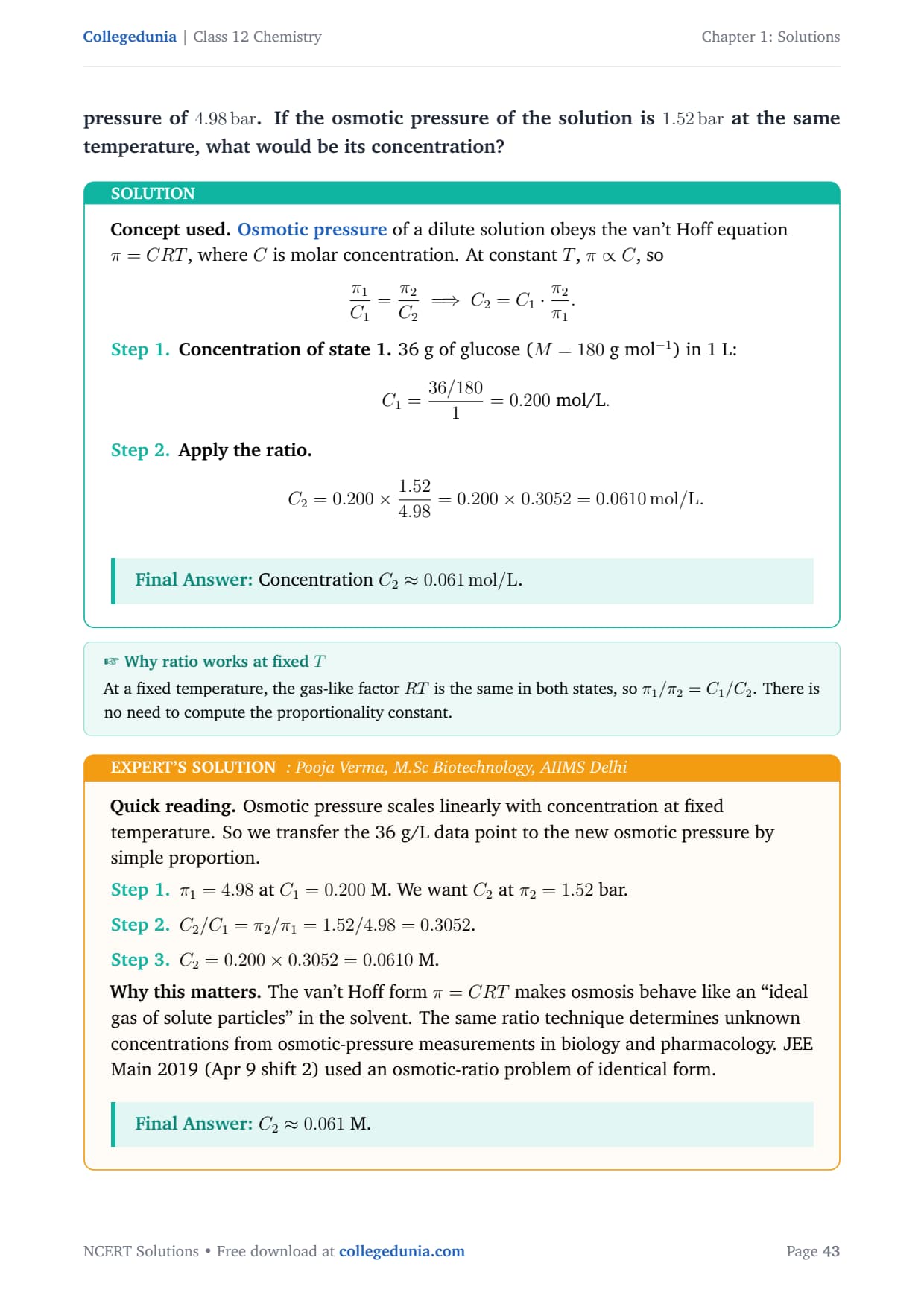
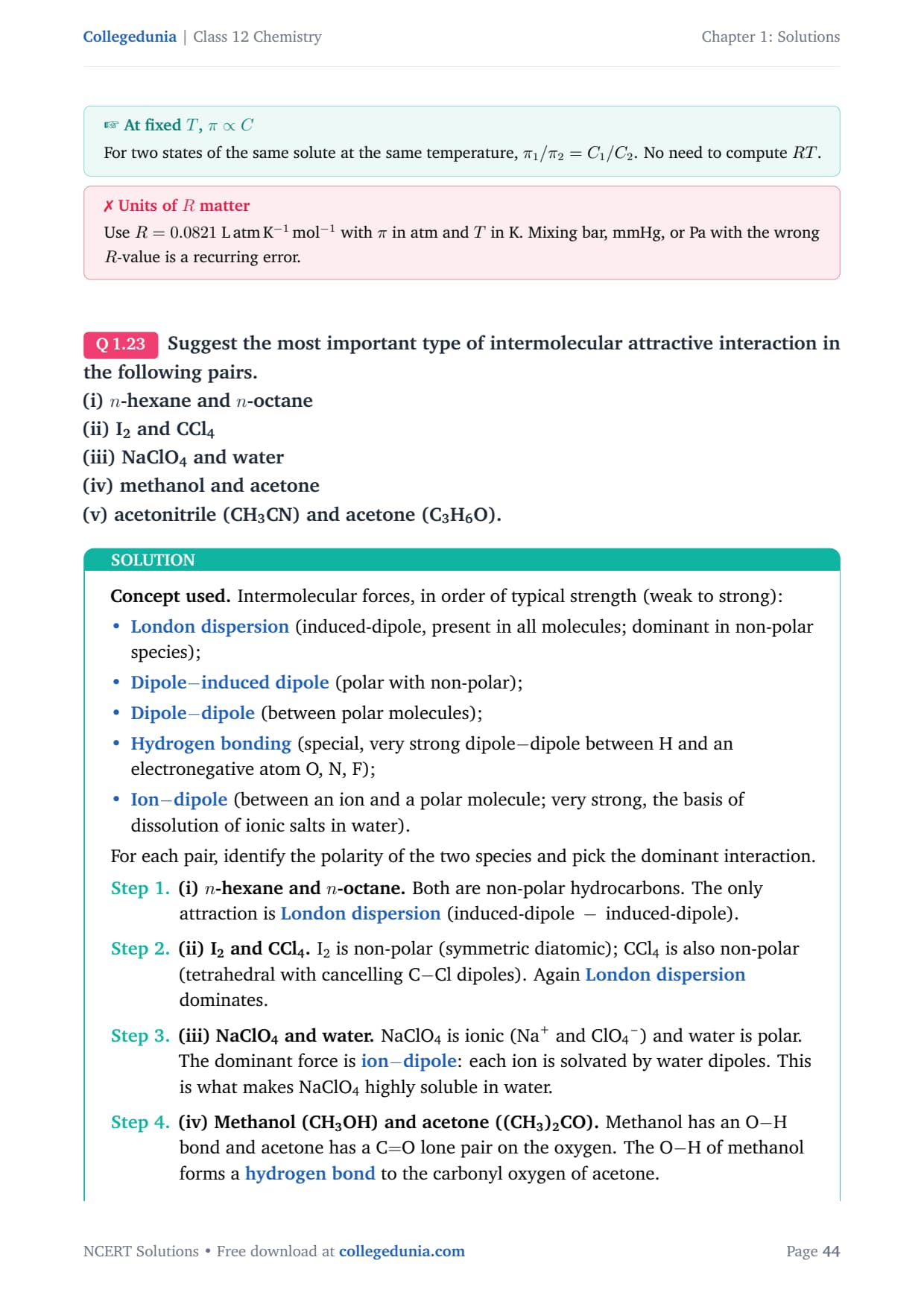
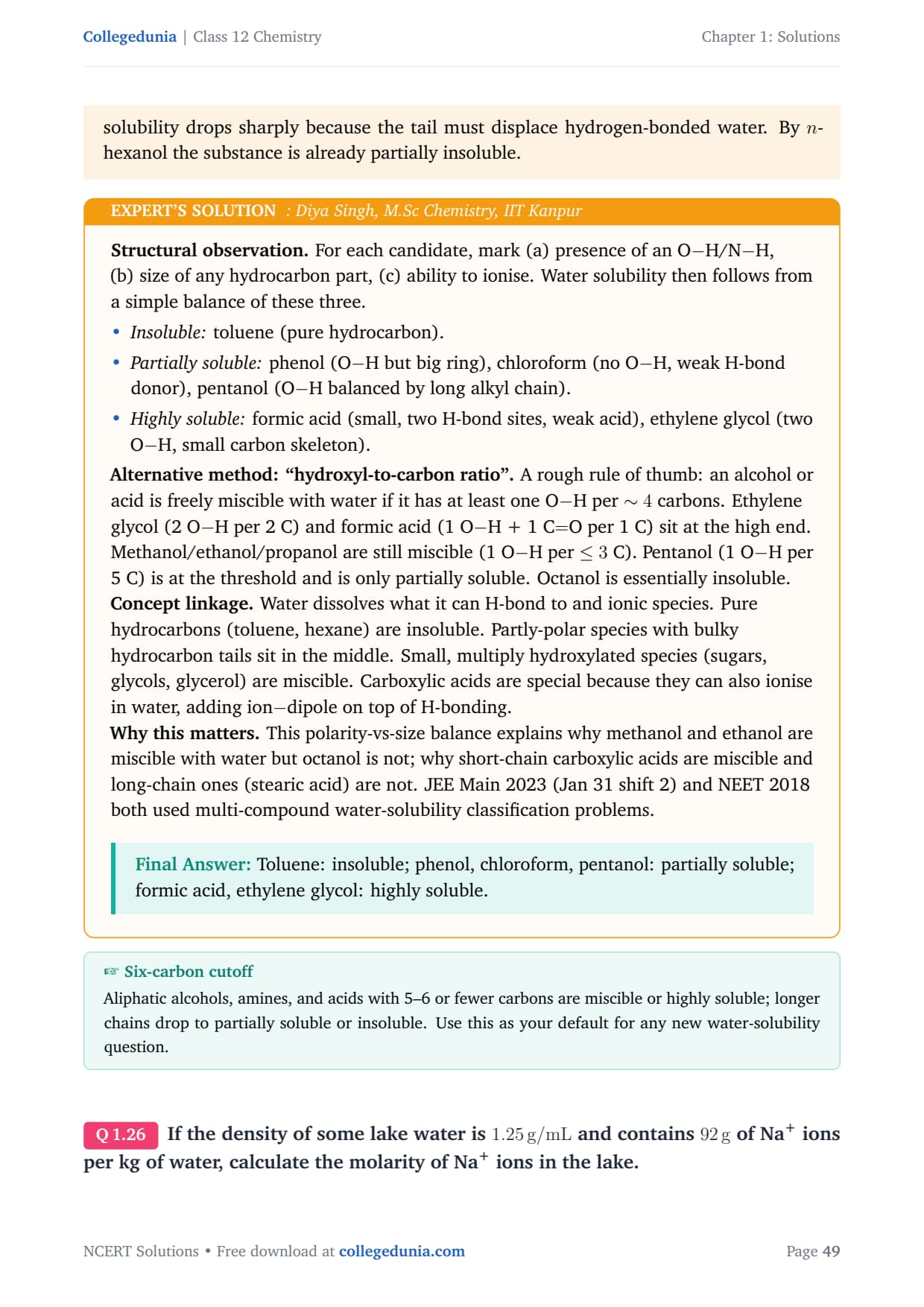
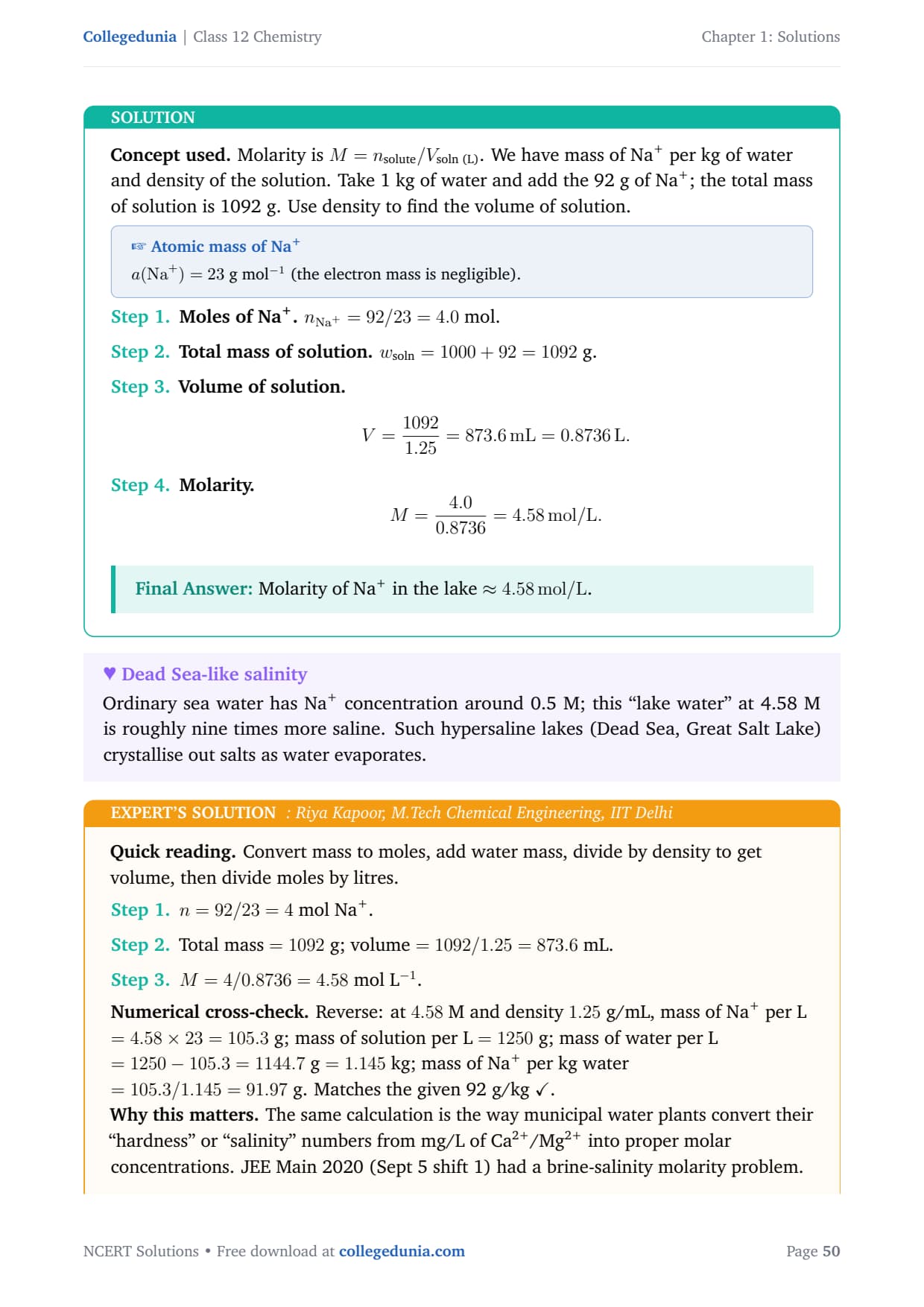
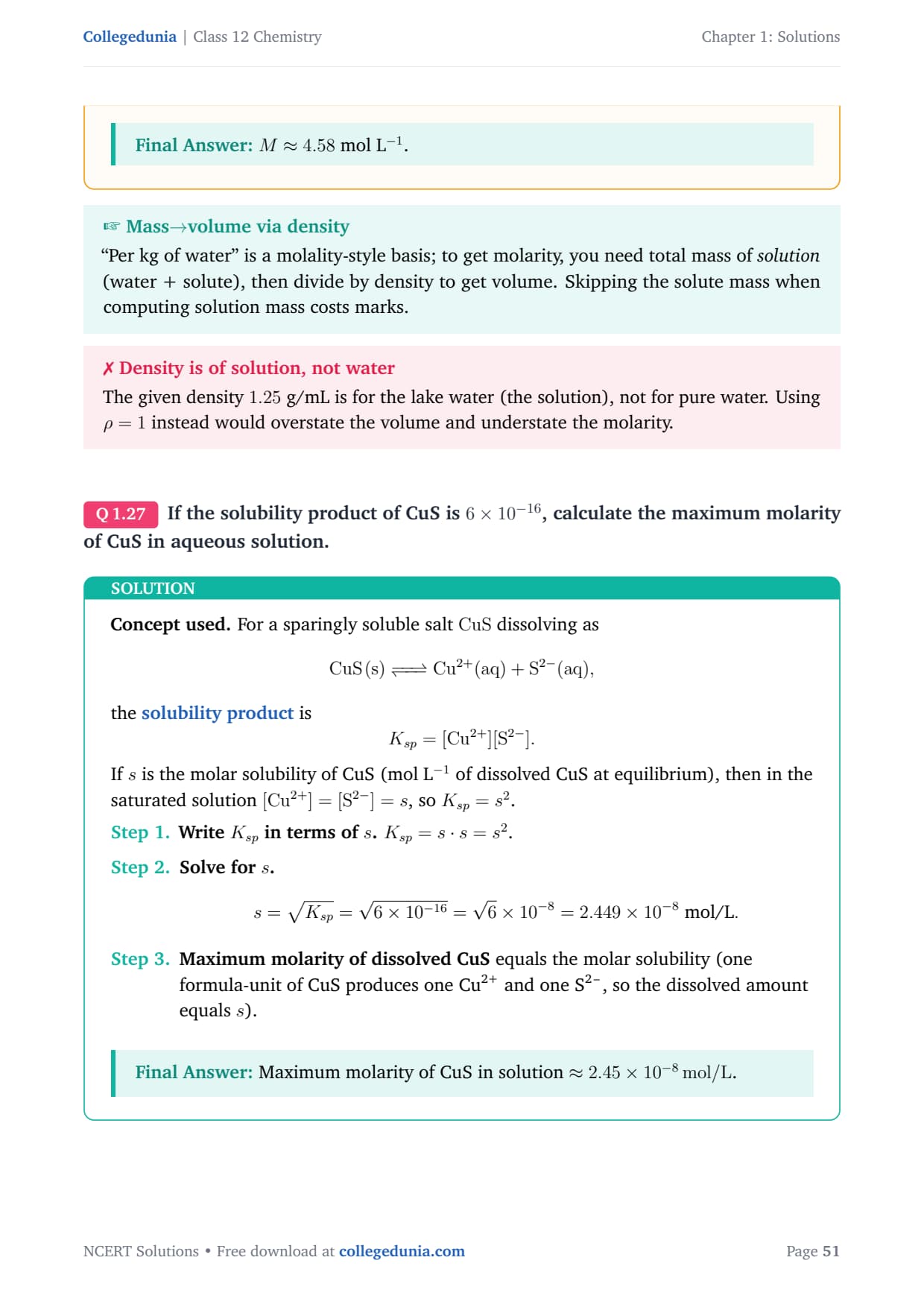
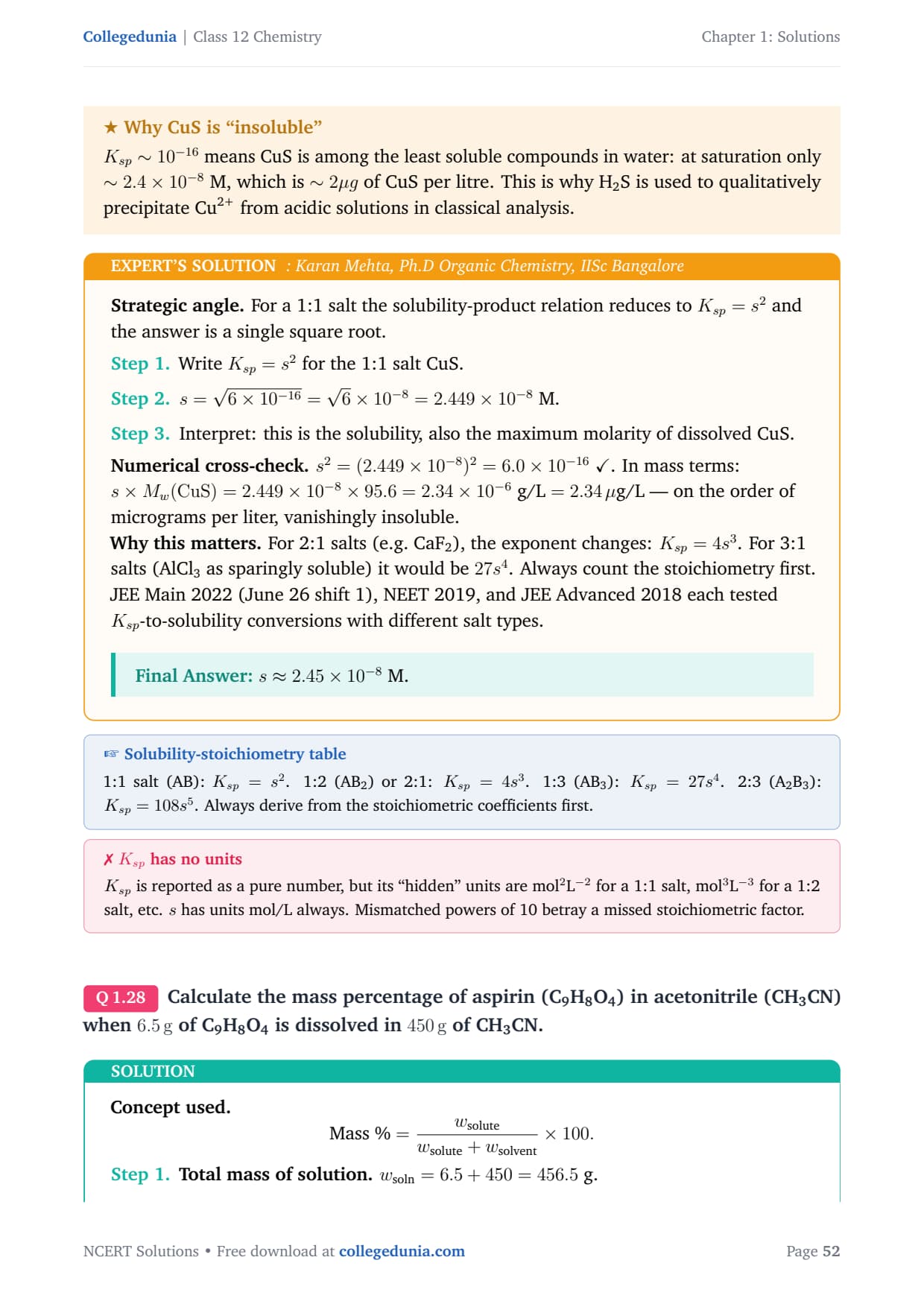
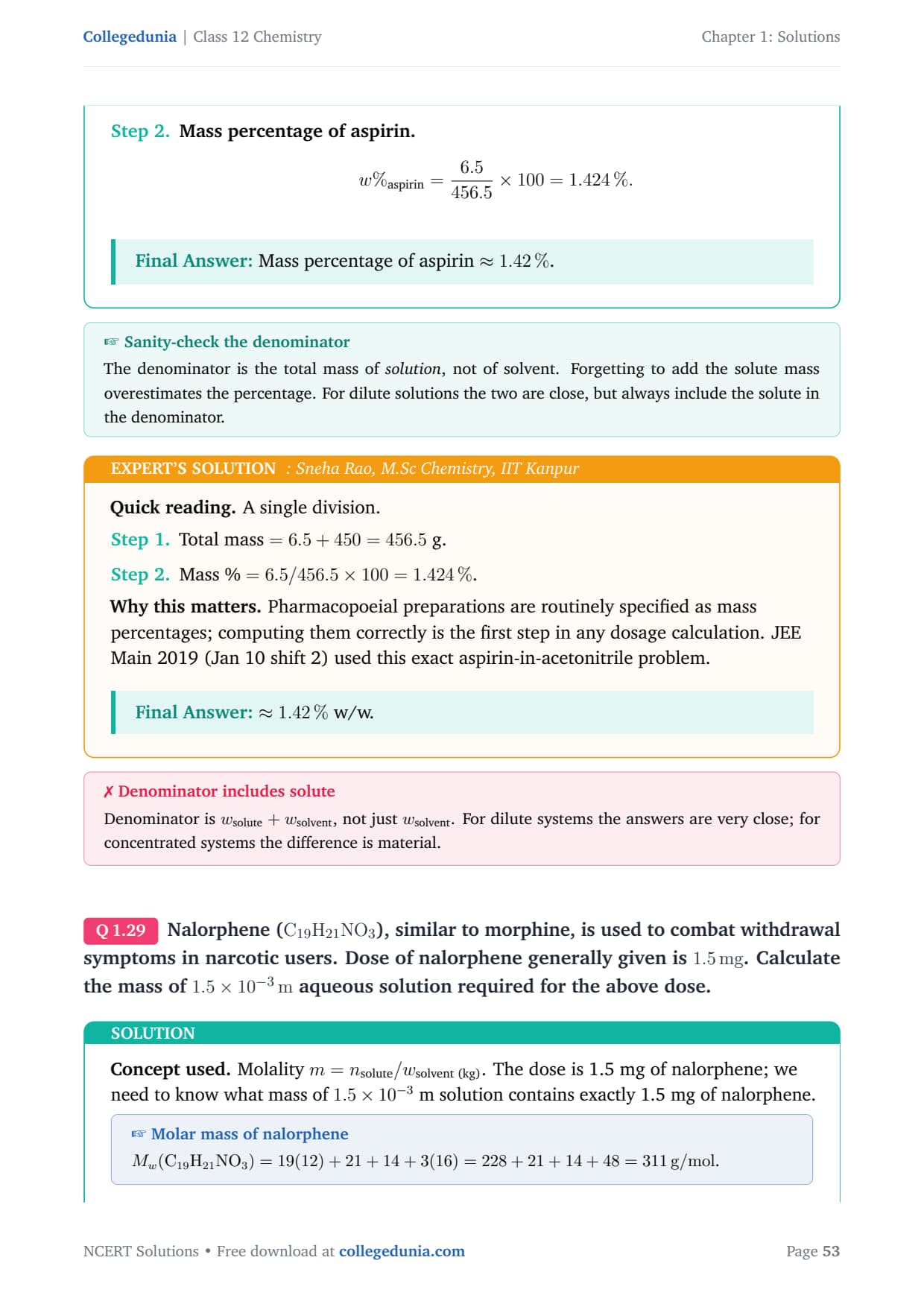
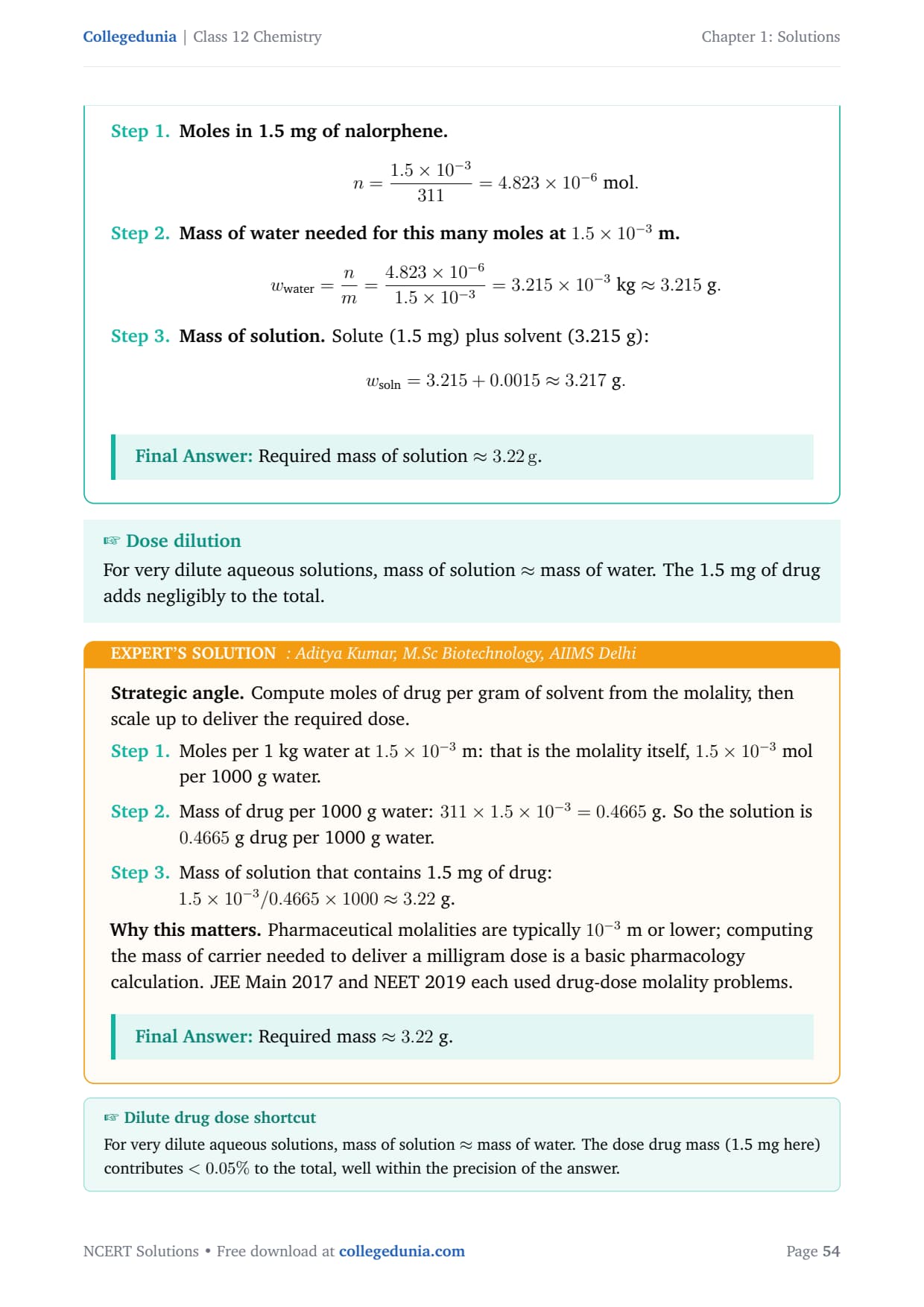
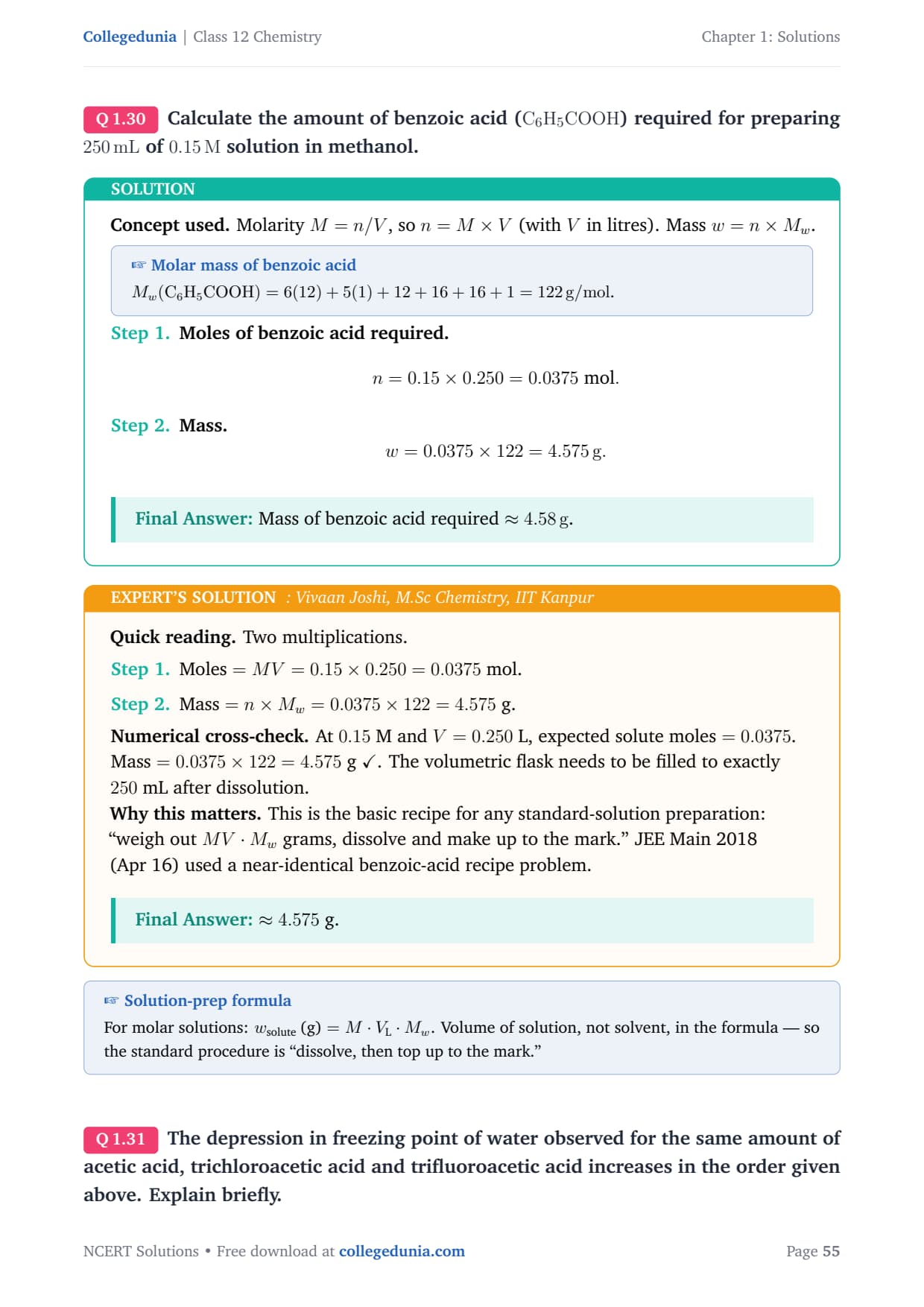
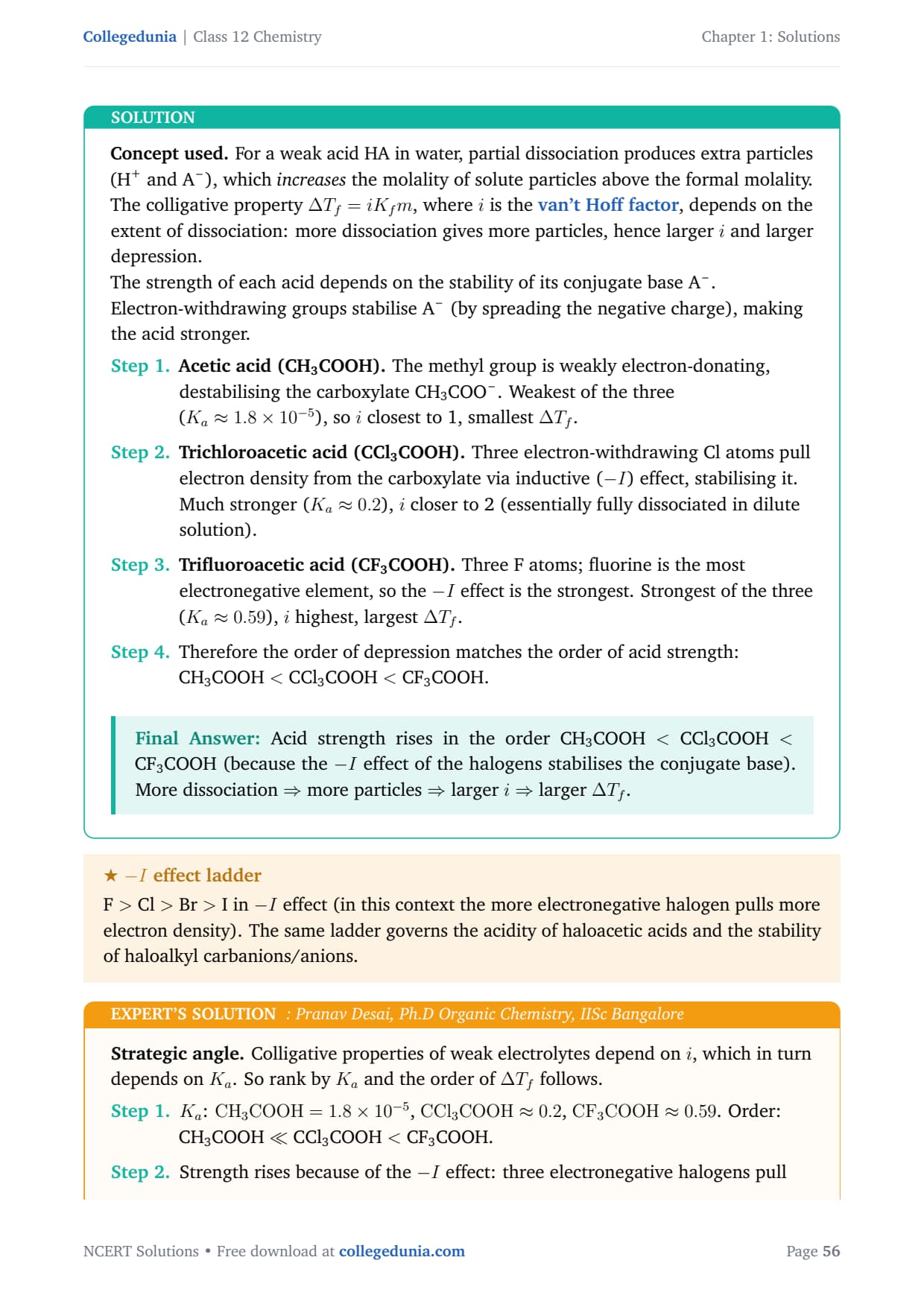
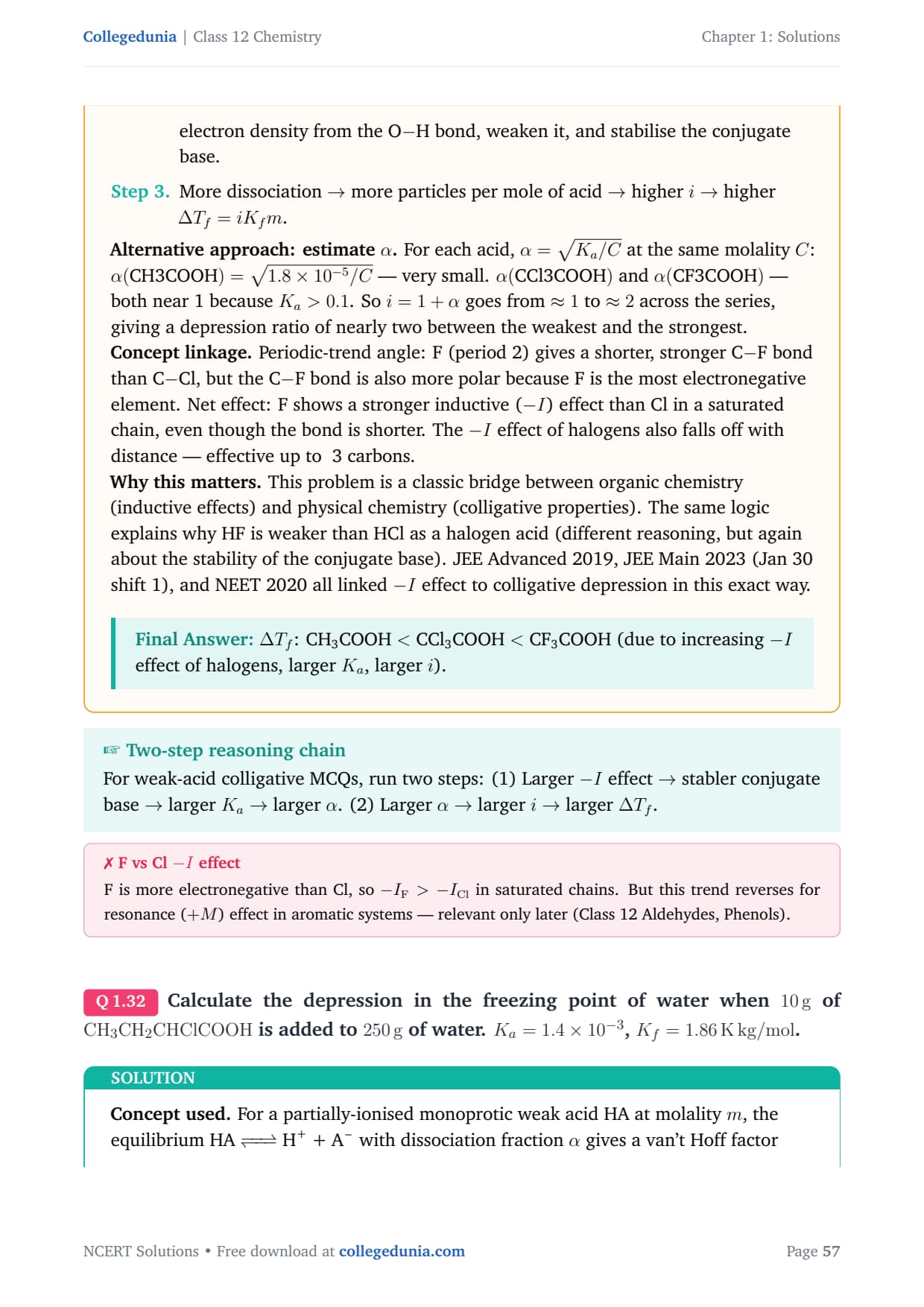
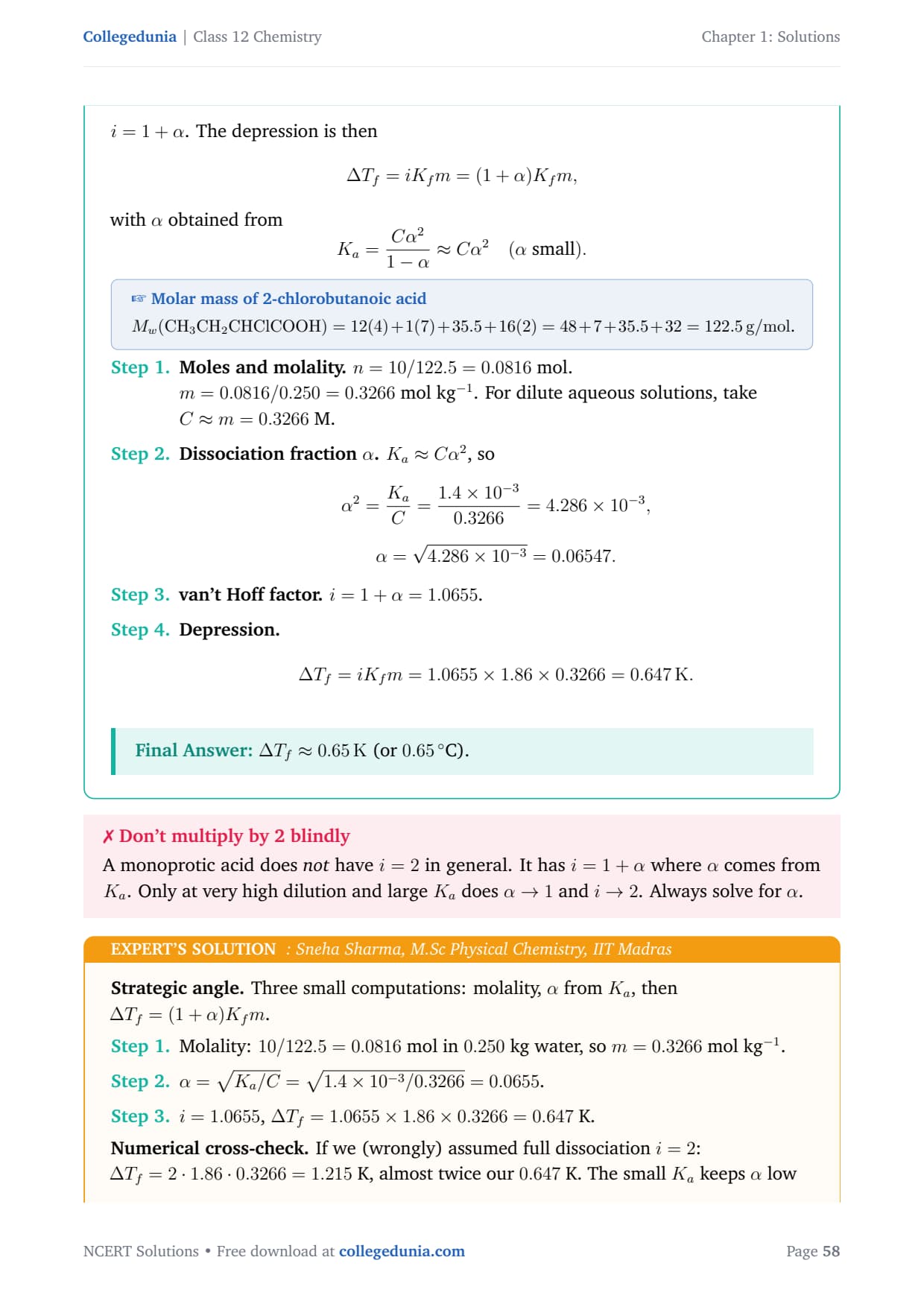
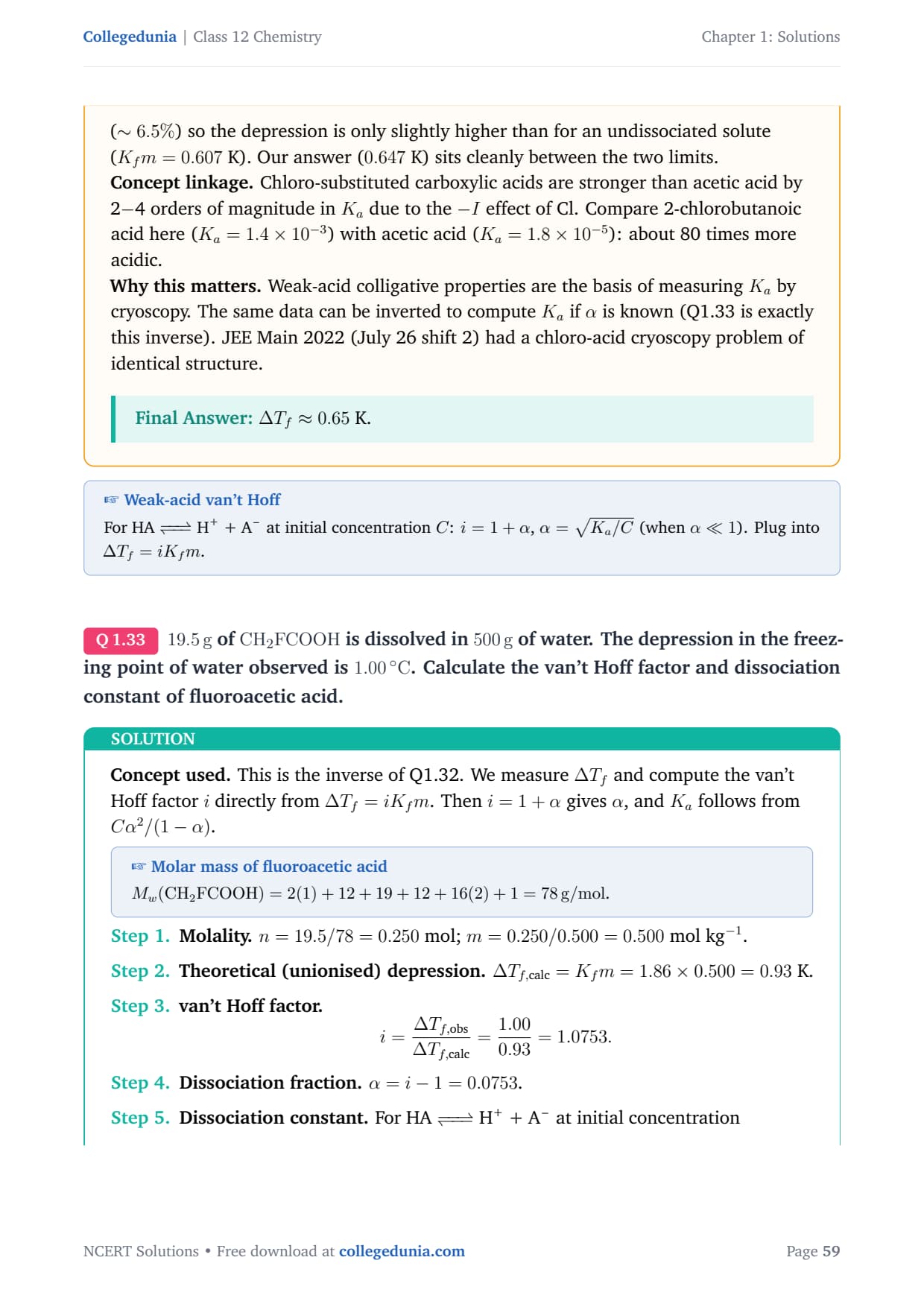
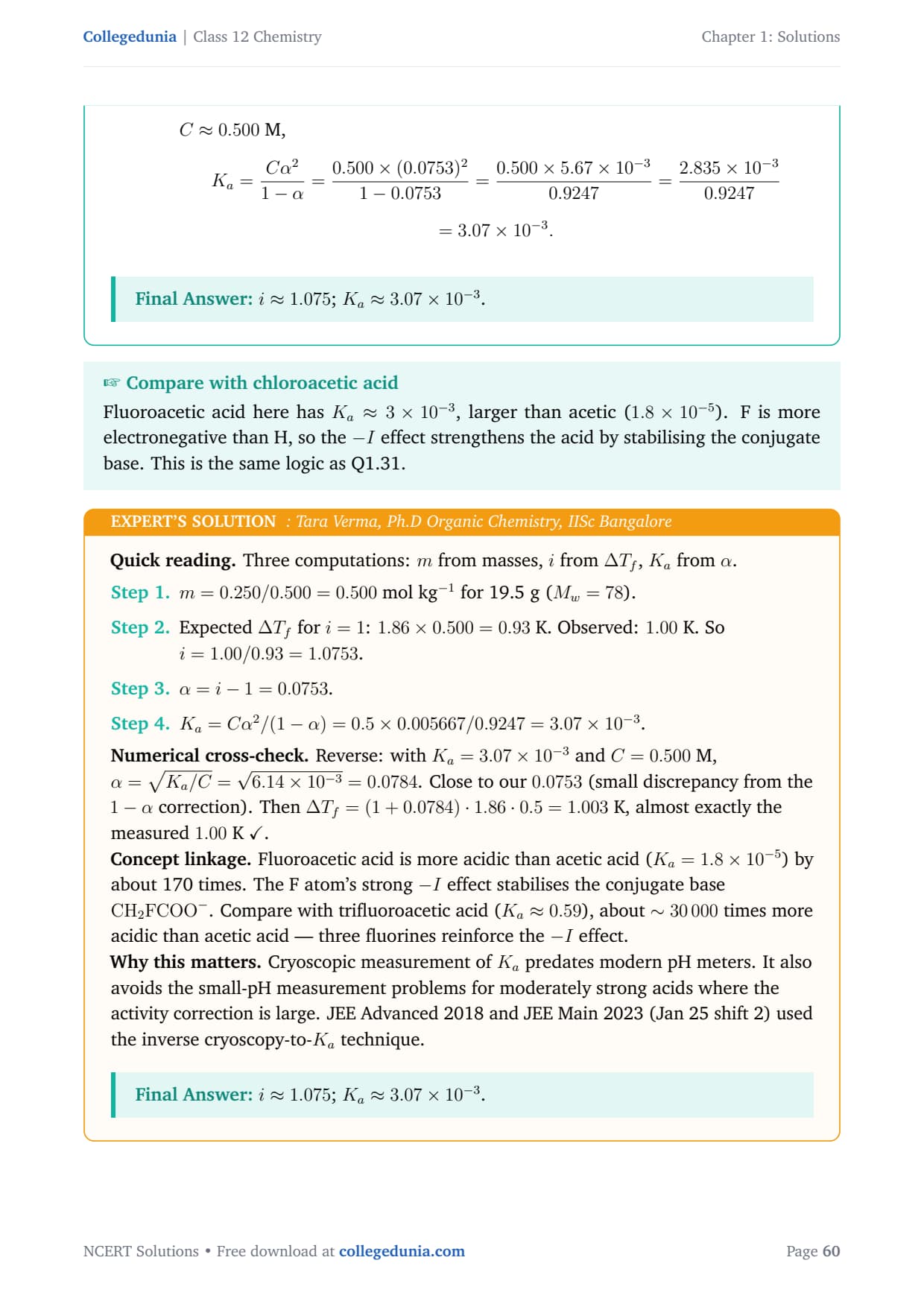
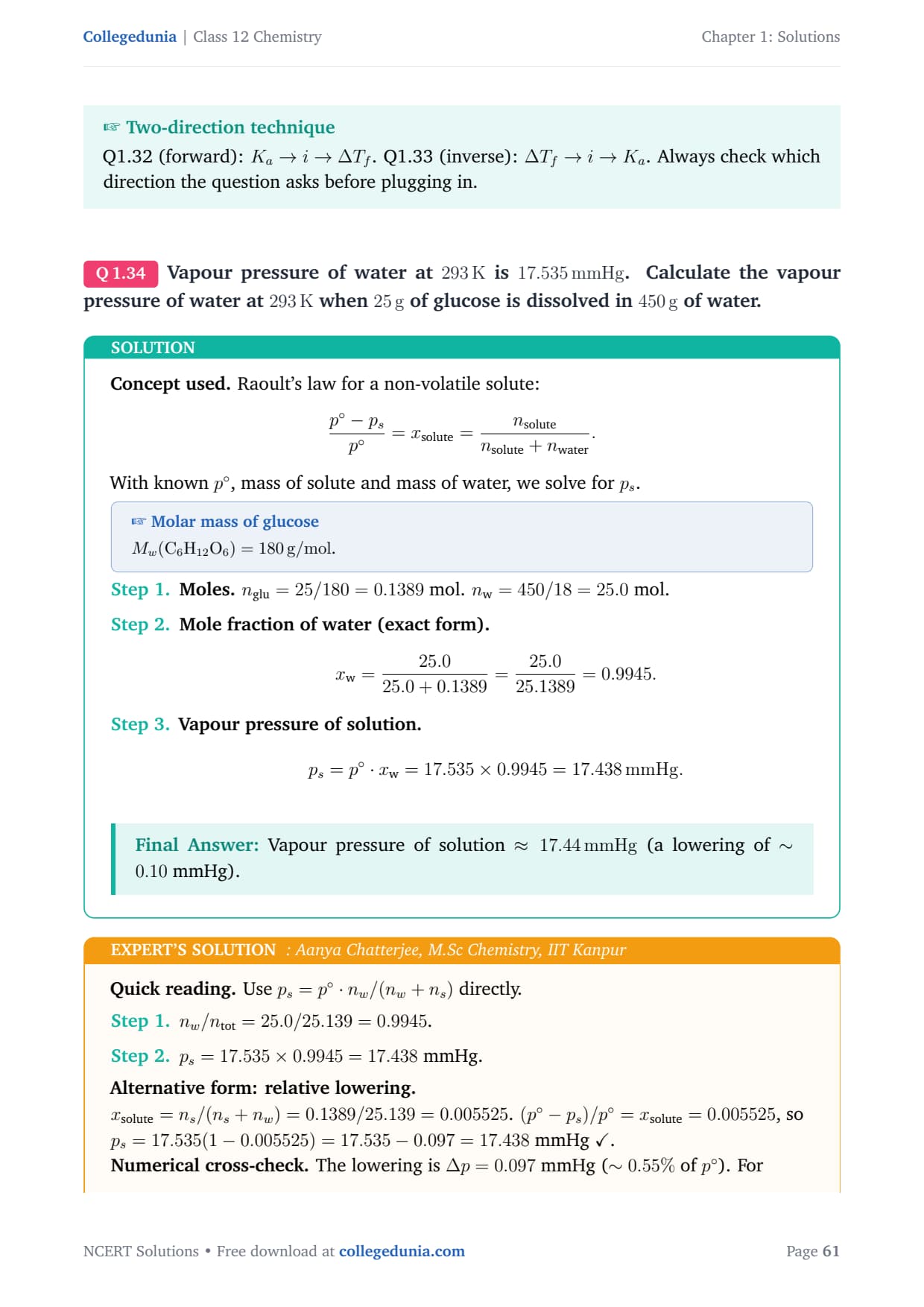
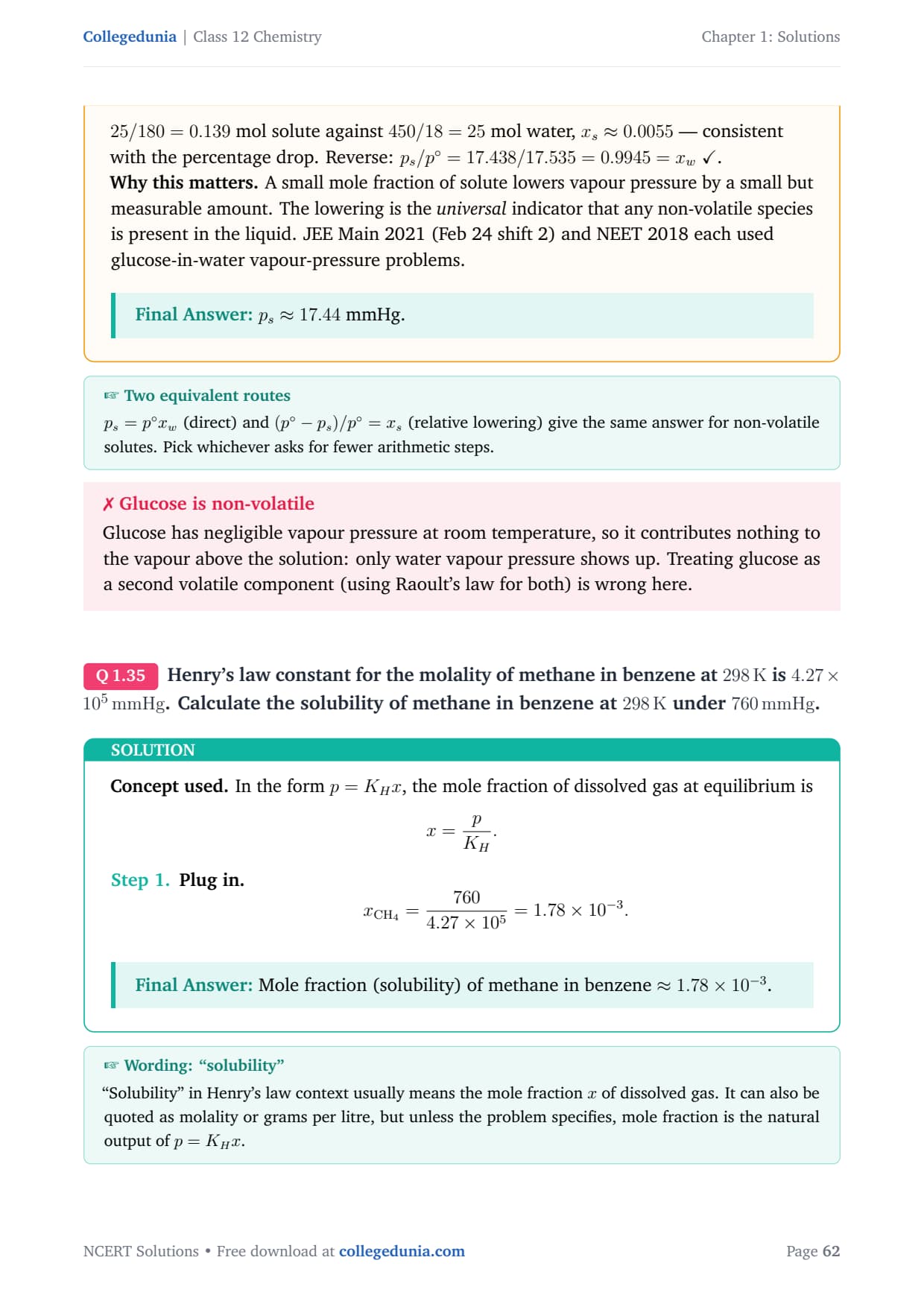
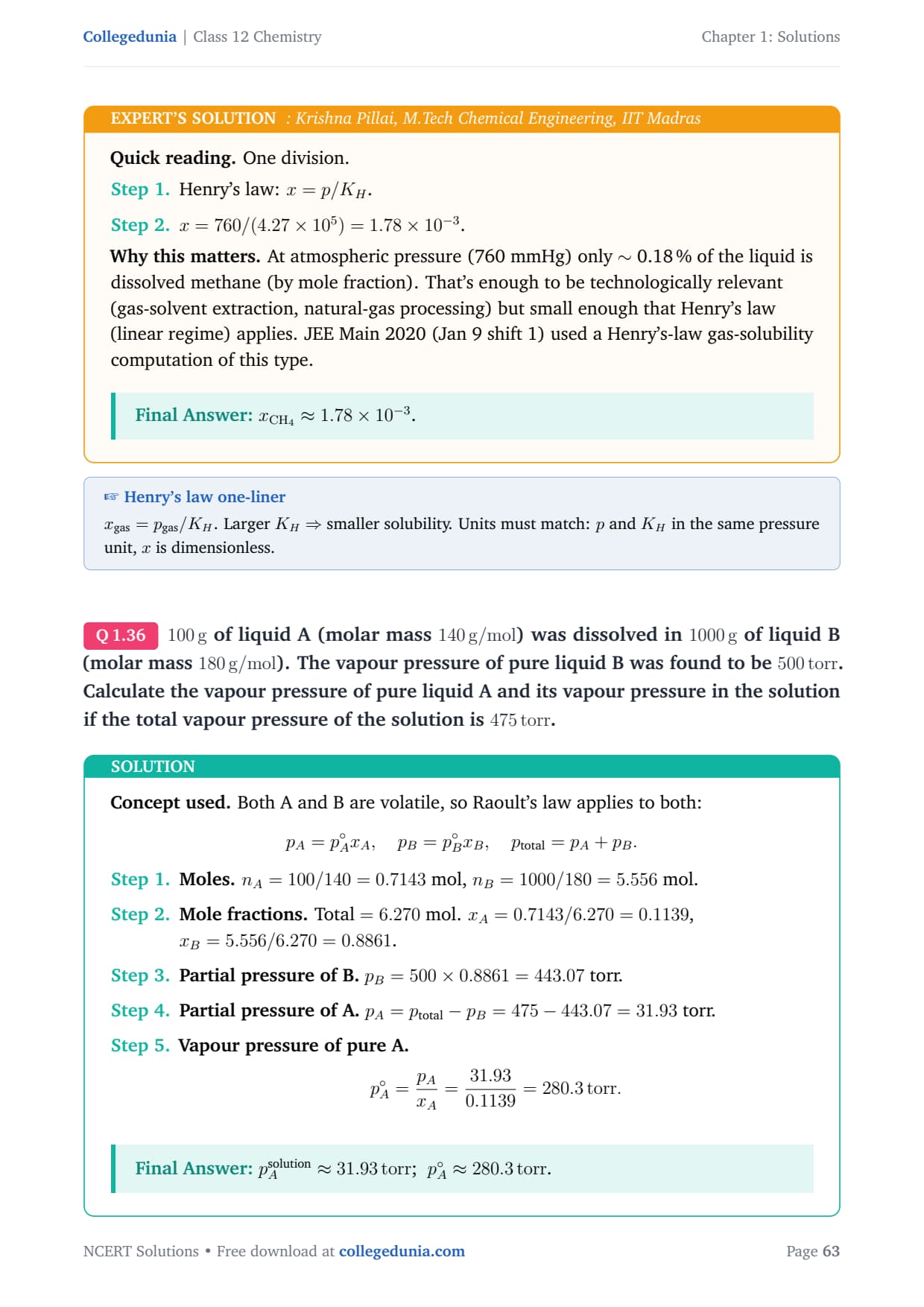
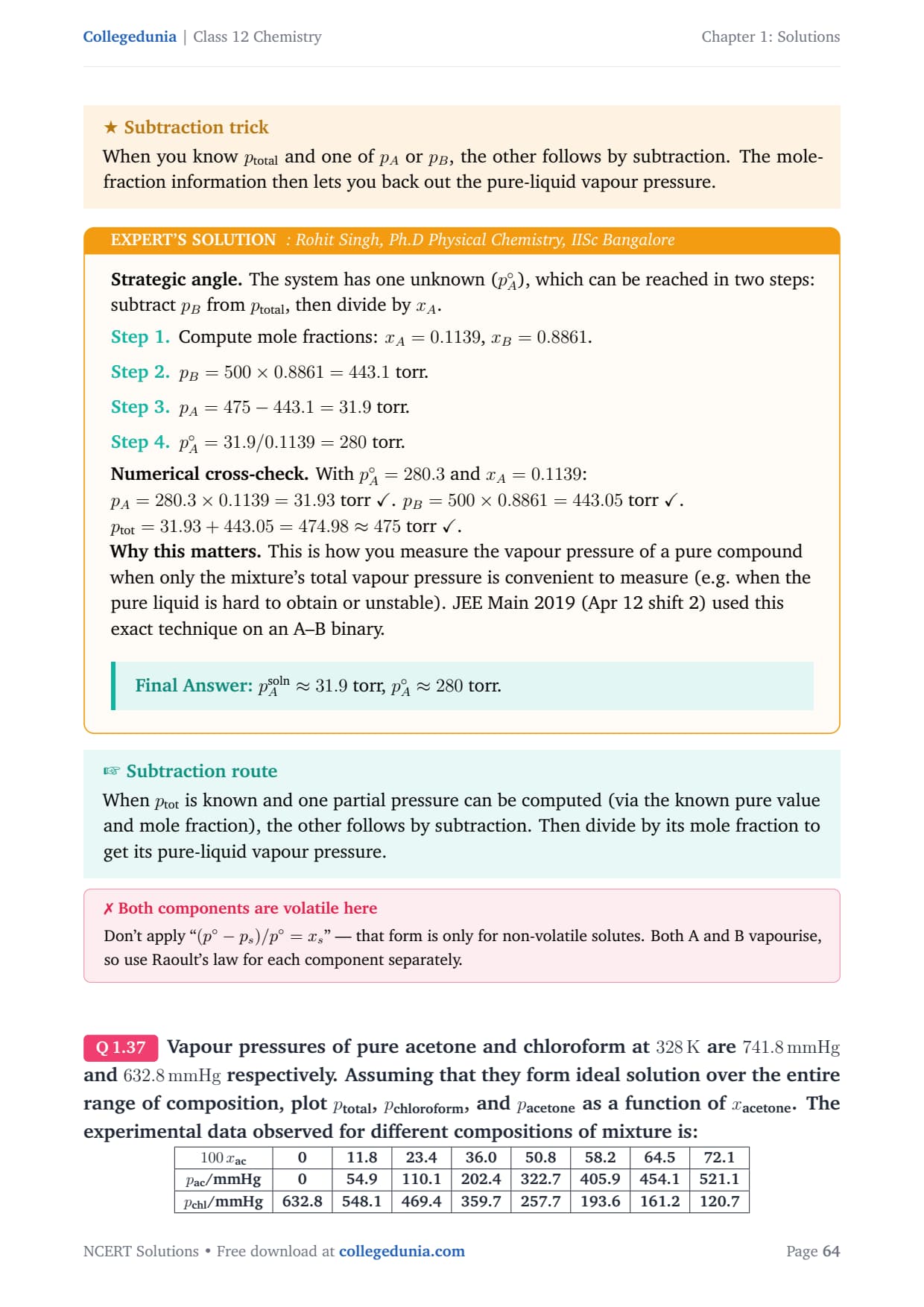
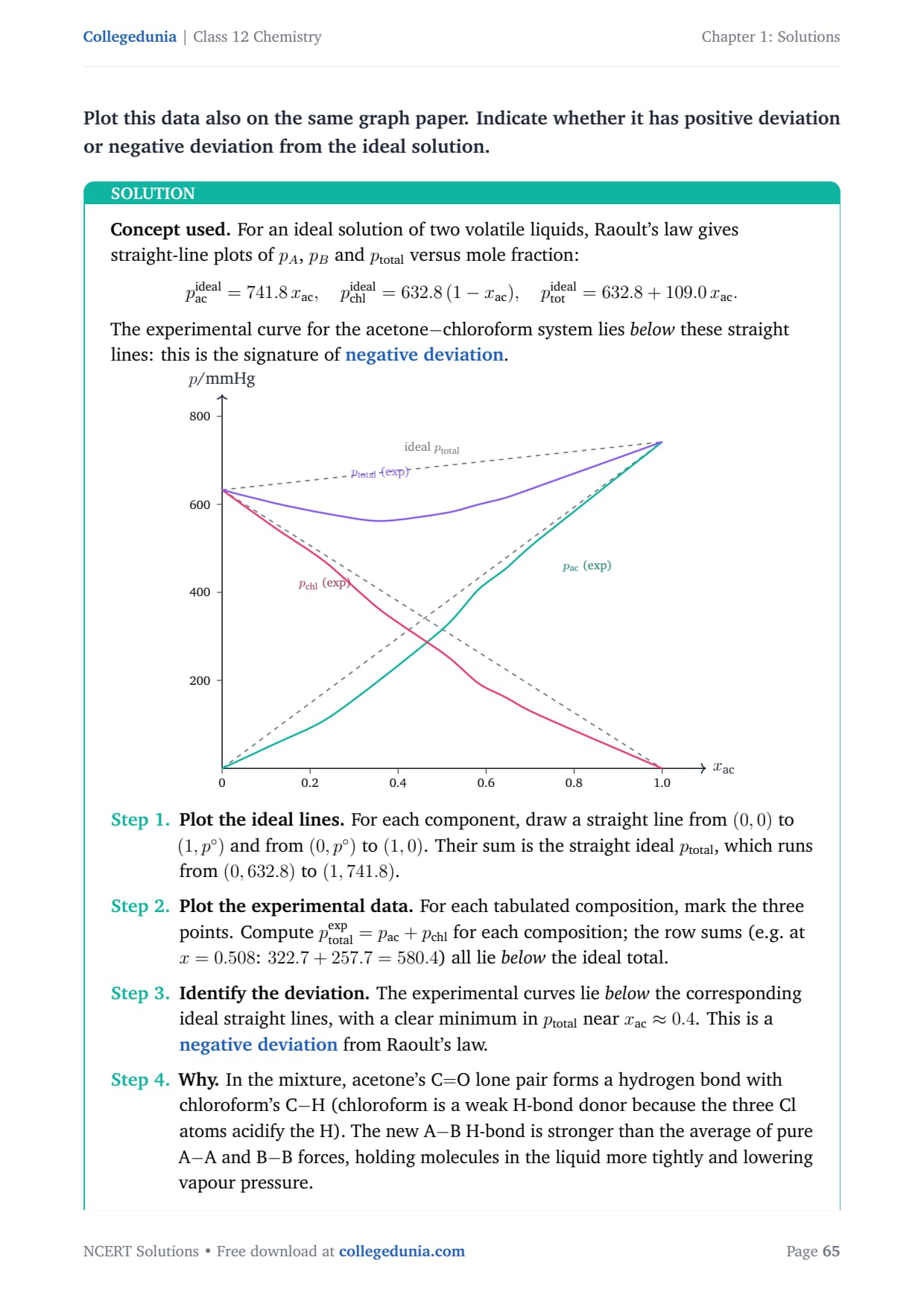
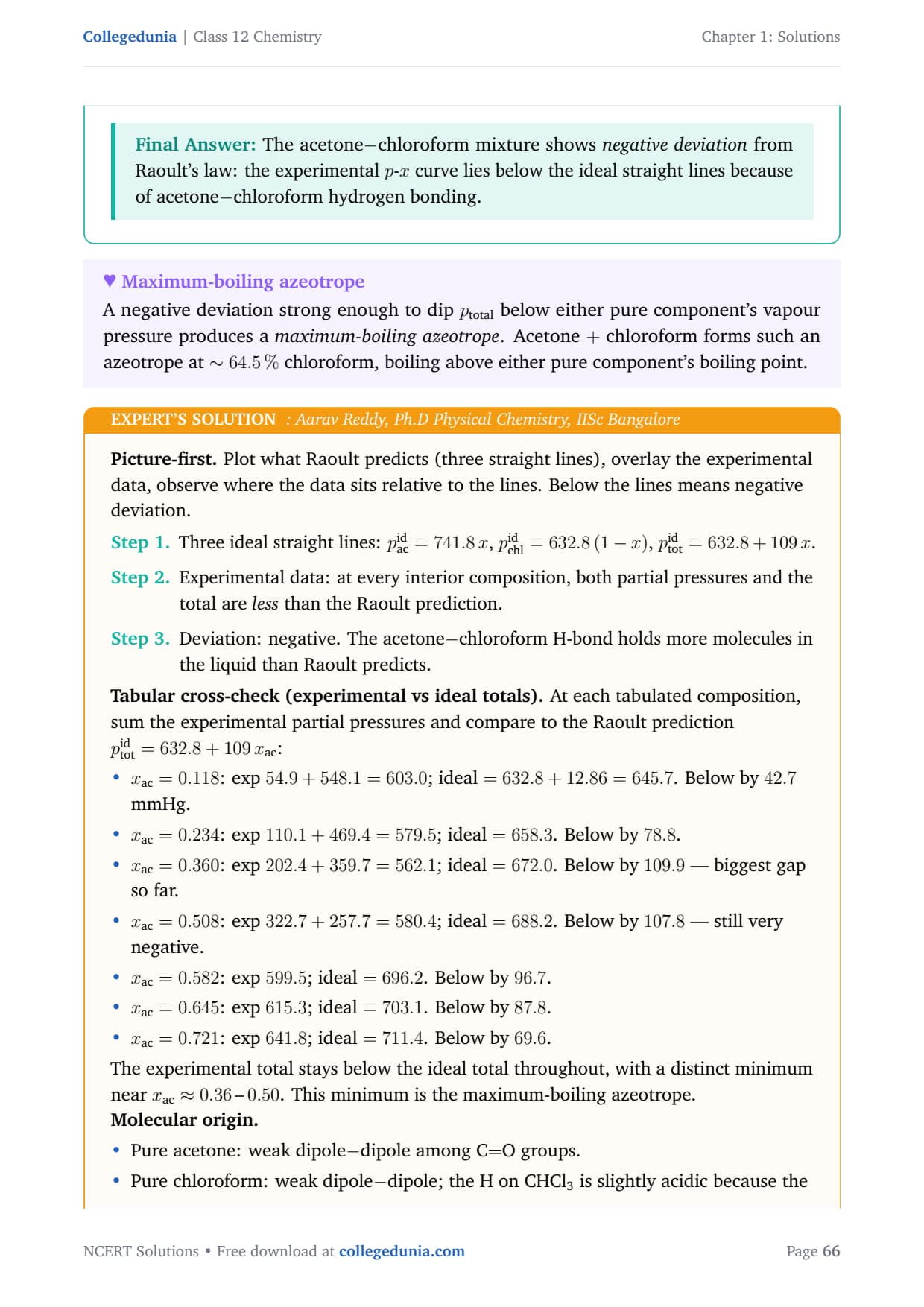
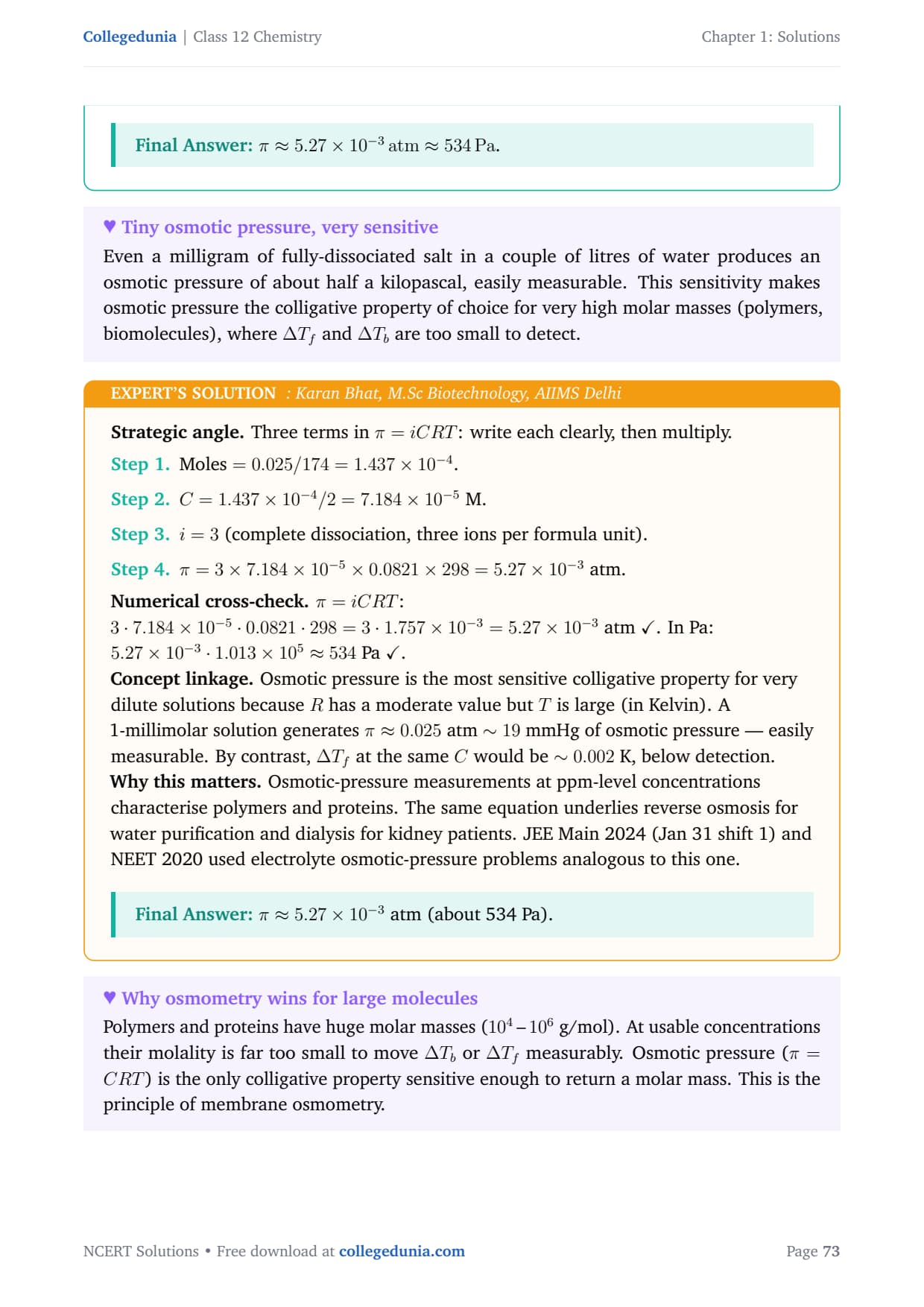
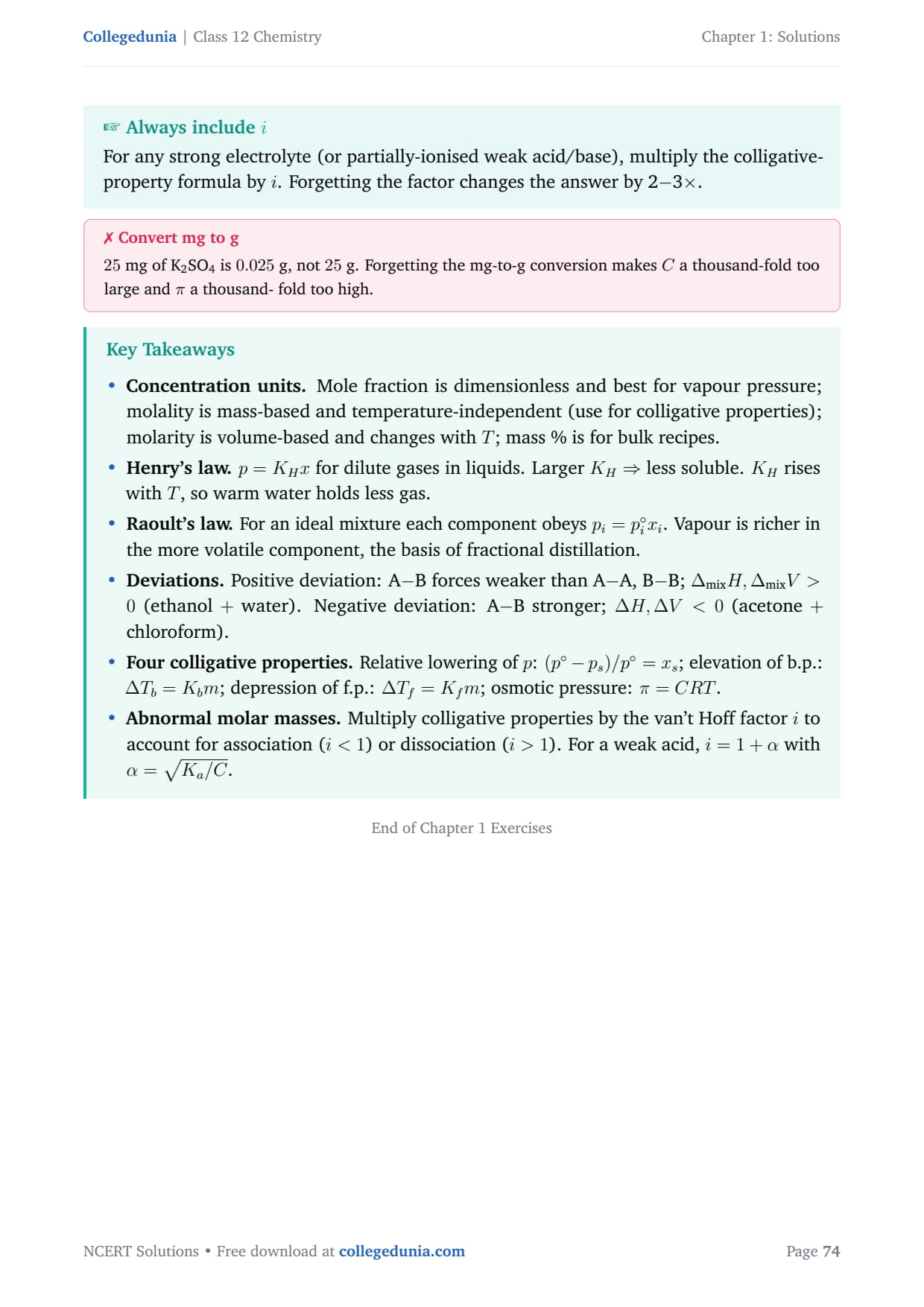


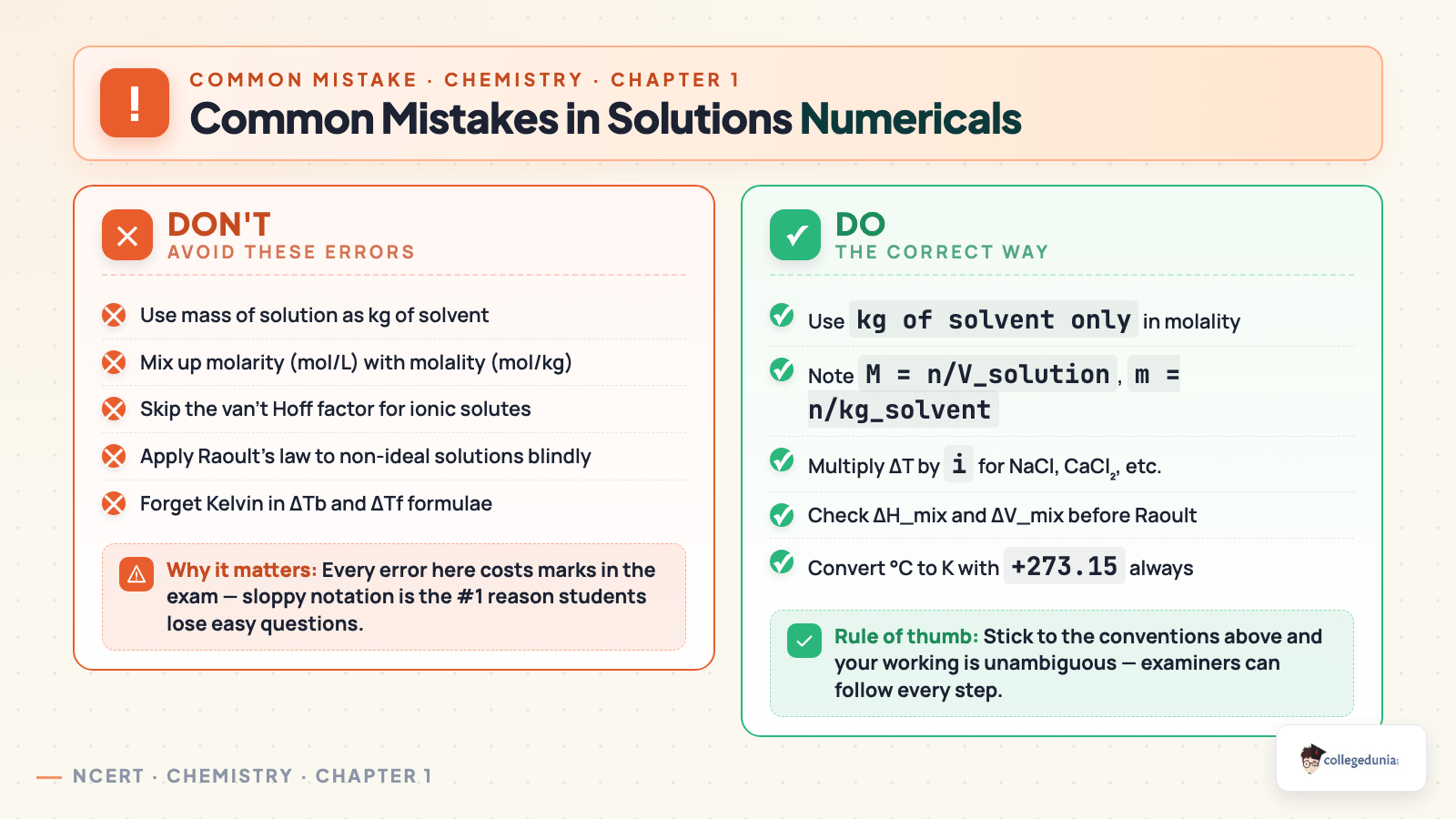



Comments