




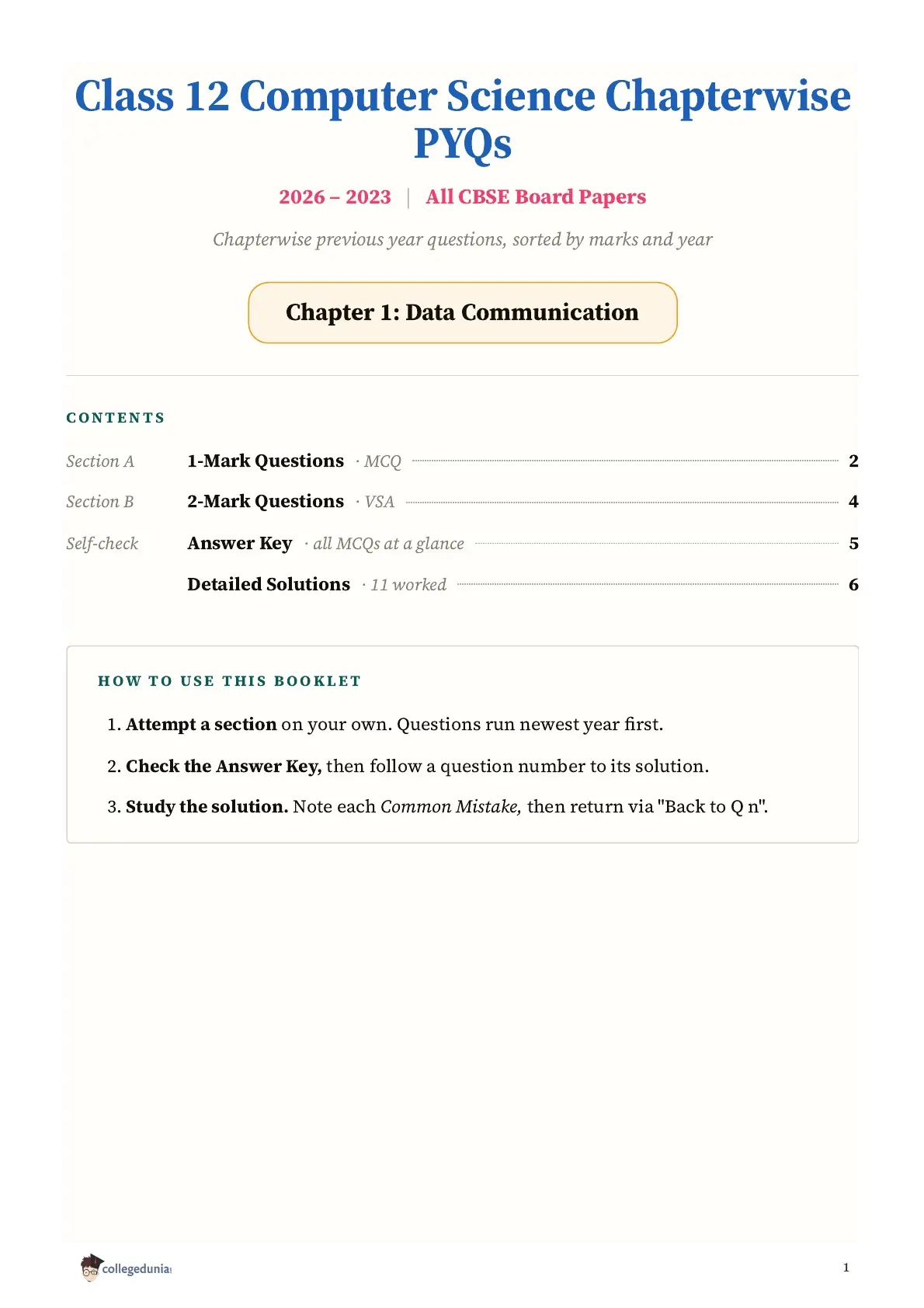
Class 12 Computer Science Data Communication PYQ, free to download as a 12-page PDF with 11 solved questions: 6 from the 2023 to 2026 board papers and 5 from CBSE's official sample papers. Data Communication belongs to the Computer Networks unit of the Class 12 Computer Science (083) syllabus, which carries 10 of the 70 theory marks.
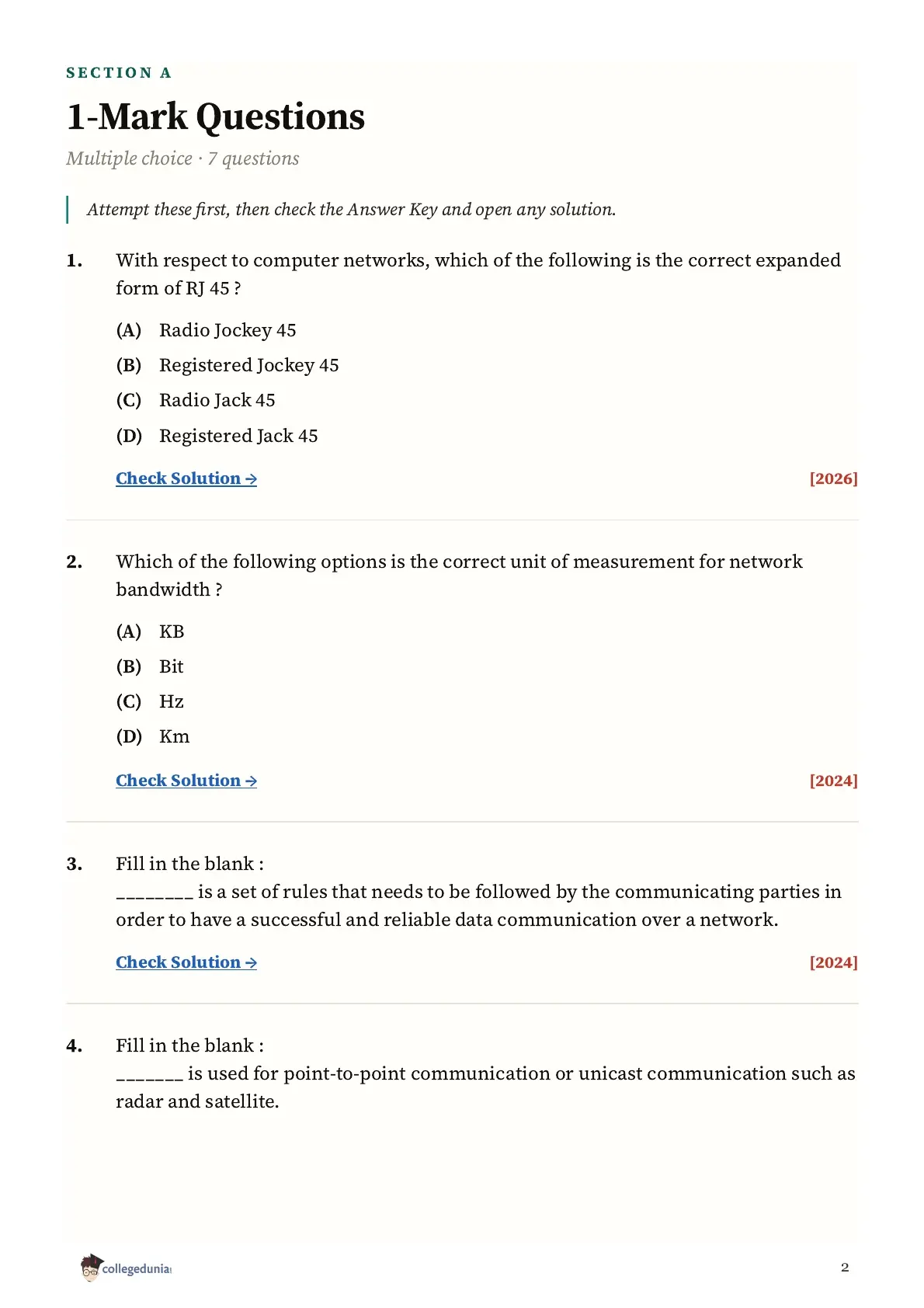
The questions keep returning to switching techniques (4 questions), transmission media (4), the expansion of terms such as XML, PPP and SMTP (3), the circuit versus packet switching comparison (4) and wired versus wireless transmission (2).
On this page you get:
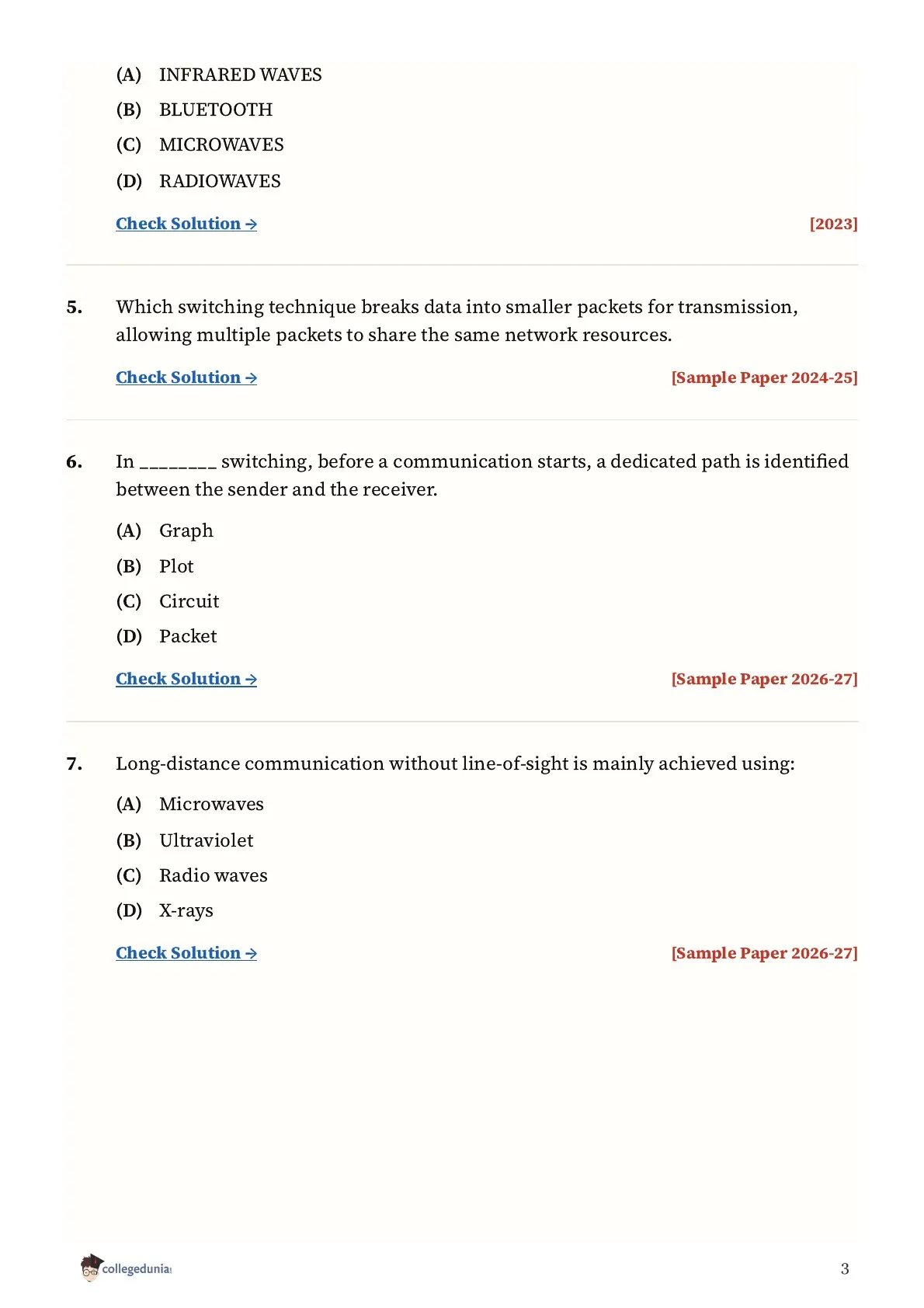
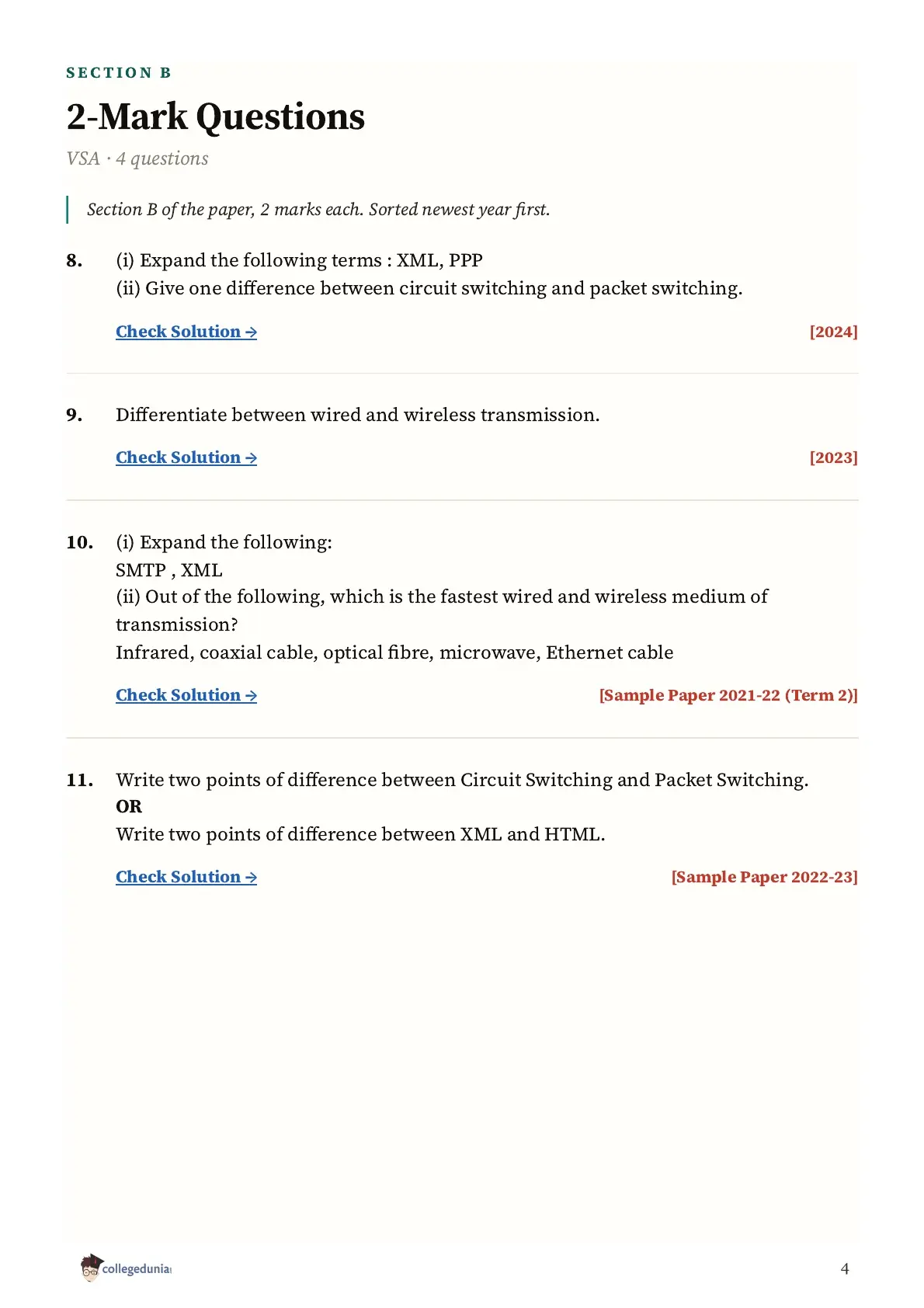
- 11 questions with a worked solution each: 7 one-mark MCQs and fill-in items, and 4 two-mark short answers
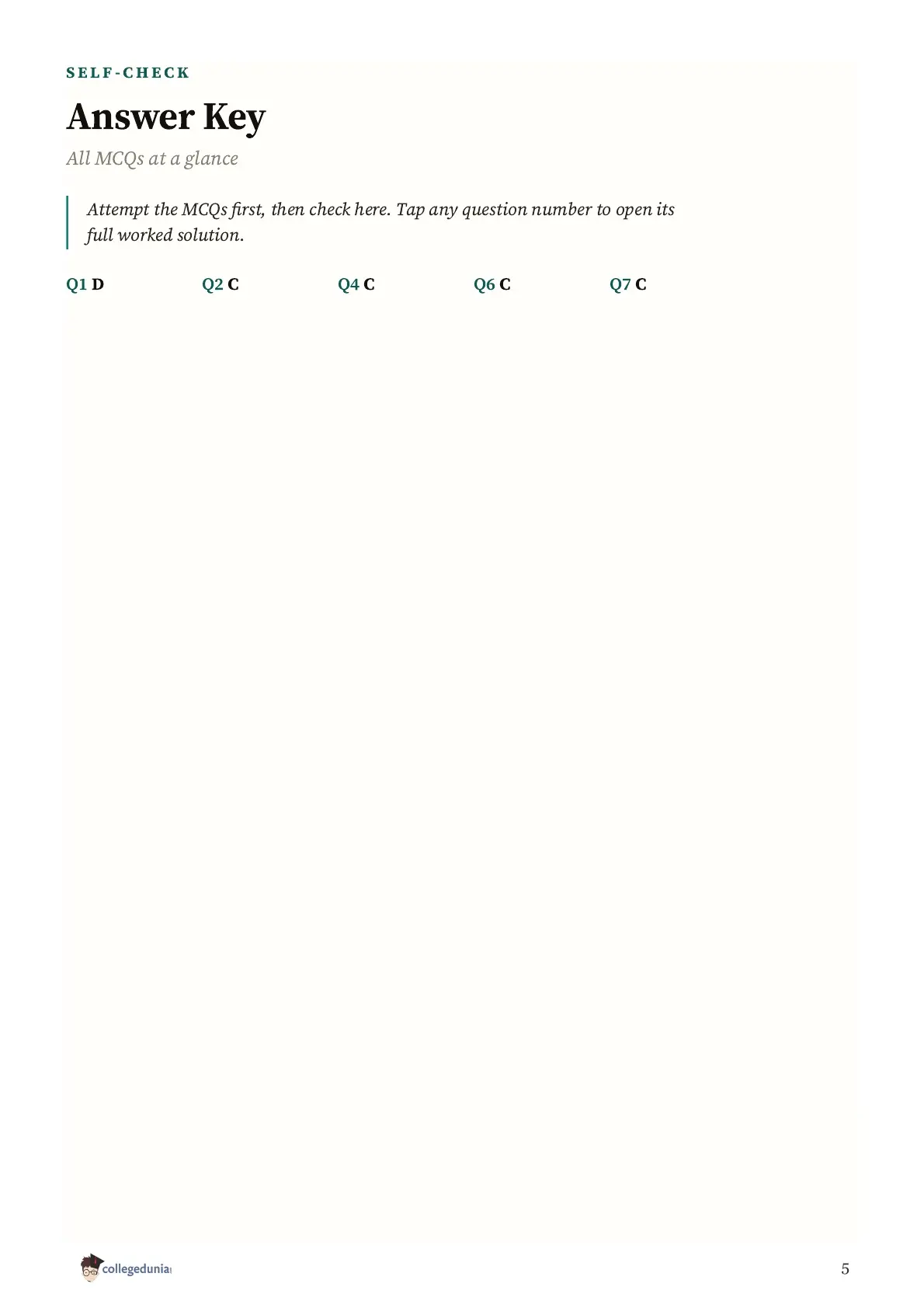
- An Answer Key that lists all 5 MCQs at a glance
- Question counts by topic, so you know whether to start with switching, transmission media or protocol expansions
- A marks-wise table of questions (1 and 2 mark)
- The common mistakes students make, such as mixing up bandwidth in Hz with data rate in bps, and a short FAQ
Data Communication Weightage in the Class 12 Computer Science Paper
CBSE does not print a mark figure for each chapter. In the Class 12 Computer Science (083) syllabus the Computer Networks unit carries 10 of the 70 theory marks (Computational Thinking and Programming carries 40 and Database Management 20). That is a unit-level figure, and it covers Data Communication together with the other networking topics. The unit marks are as reported by prep sites and the published syllabus summaries, and we could not confirm them on a CBSE document, so treat them as unofficial.
This set is small, 11 questions, and every one of them is a one-mark or two-mark item. The table below shows the split. Board papers supply 6 of the 11 (2026 one, 2024 three, 2023 two) and the sample papers supply the other 5.
| Marks per Question | Questions in the Set |
|---|---|
| 1 mark | 7 |
| 2 marks | 4 |
| 3, 4 and 5 marks | 0 |
Data Communication Questions by Topic
Switching is the most frequent theme. Four questions touch it: one asks which technique breaks data into packets, one asks which switching sets up a dedicated path first, and two ask for differences between circuit switching and packet switching, one of them as a "two points of difference" question with an OR choice of XML versus HTML.
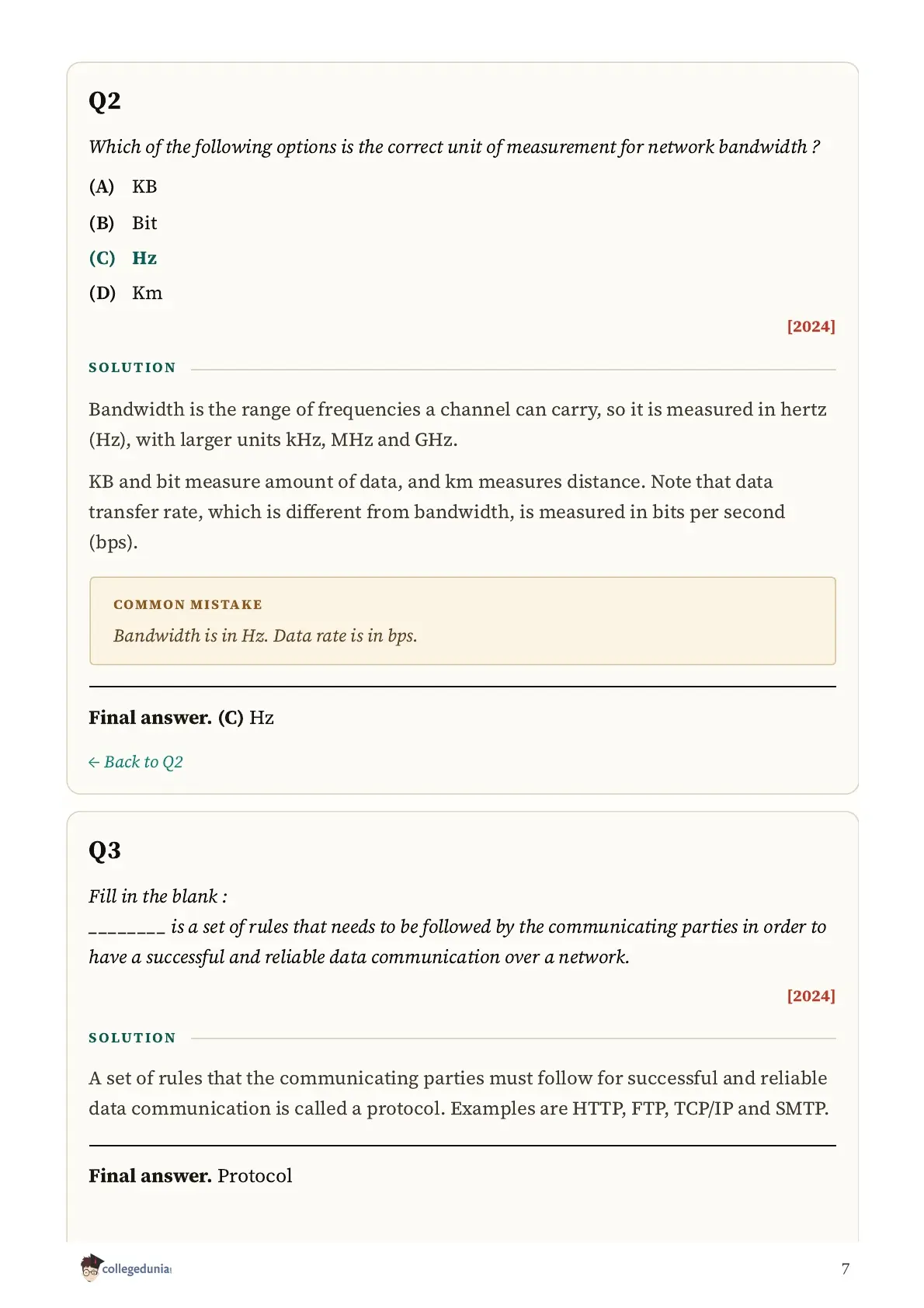
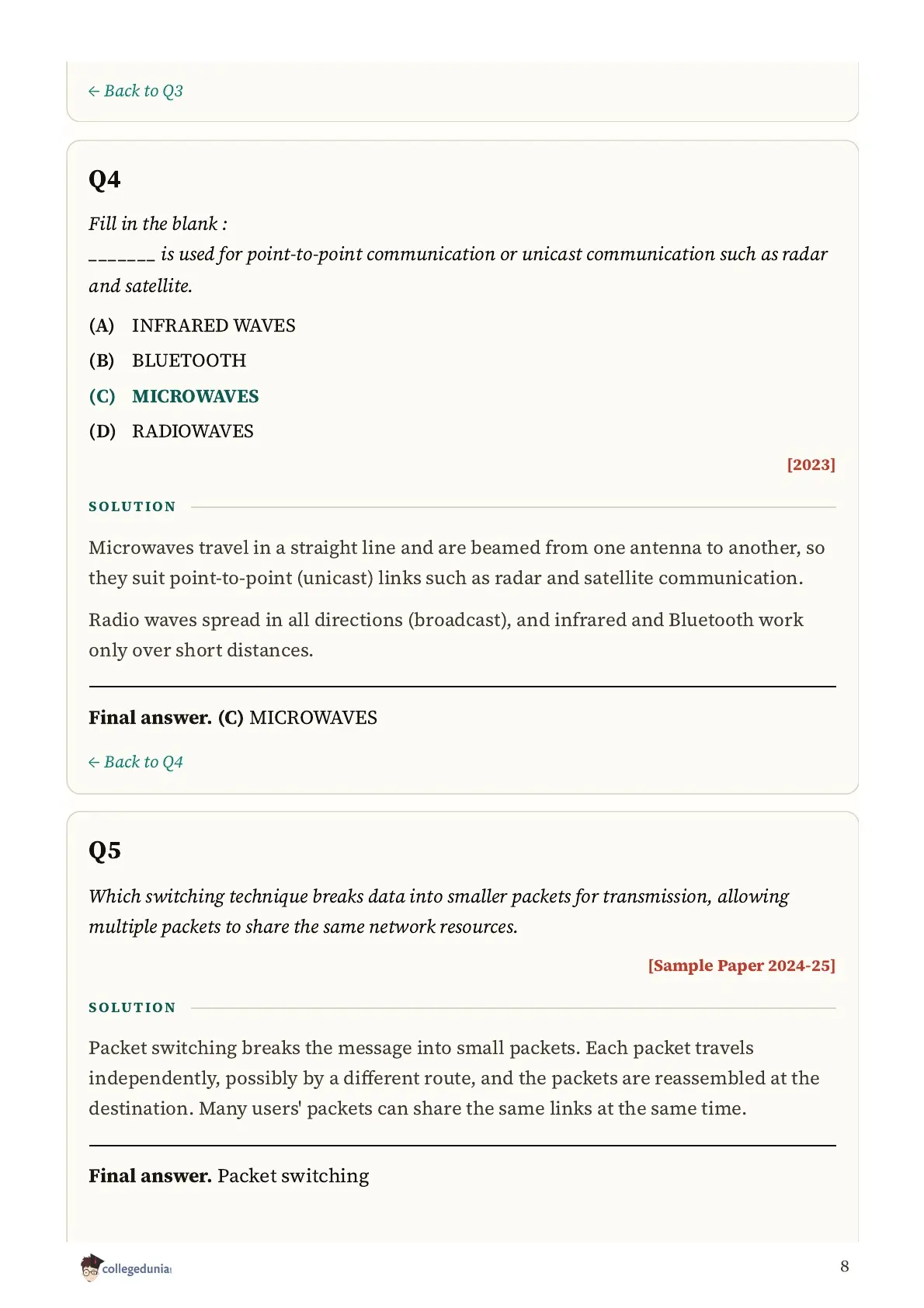
Transmission media also appear in 4 questions. They ask which wave suits point-to-point links such as radar and satellite (microwaves), which one works over long distances without line of sight (radio waves), the difference between wired and wireless transmission, and the fastest wired and wireless medium (optical fibre and microwave).
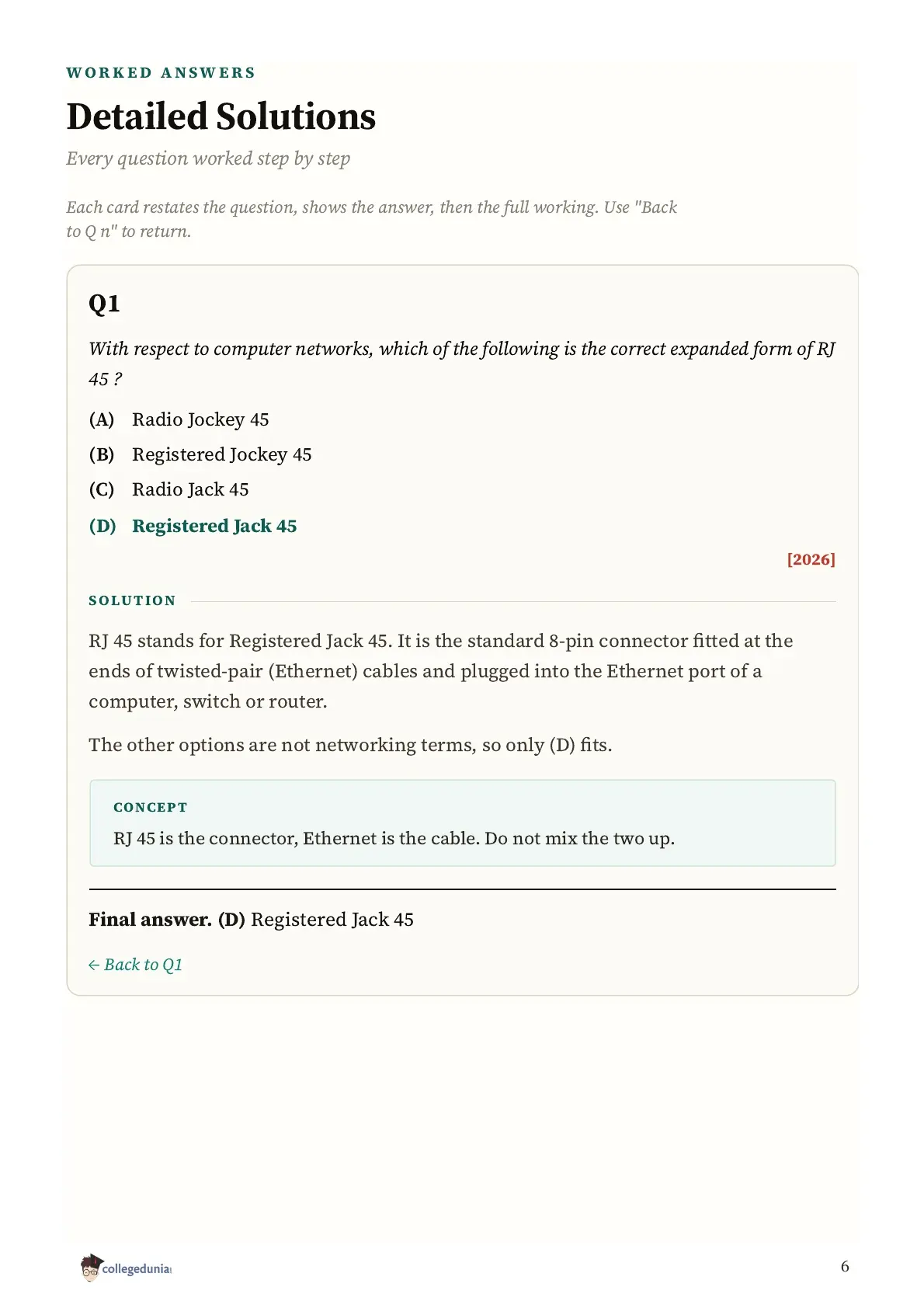
Terminology is the third group. RJ 45 (Registered Jack 45), XML, PPP and SMTP are each asked as an expansion, and one fill-in-the-blank asks for the word protocol. Bandwidth and its unit, hertz, is asked once.
Counts come from keyword matches over the question text, so a question that names two topics is counted under both. 5 of the 7 one-mark items have options and are listed in the Answer Key.
Source: Swati Chawla
How to Approach the Set
Start with the 7 one-mark items, since most are direct recall: an expansion, a unit, a medium. Learn the standard expansions (XML, PPP, SMTP, RJ 45) as a short list. Then prepare the two-mark answers. The circuit versus packet switching comparison deserves a ready two-point answer: dedicated path against no fixed path, and whole message in one go against separate packets reassembled at the destination. Keep a one-line example for each wave type (microwave for radar and satellite, radio waves for long distance, infrared and Bluetooth for short range).
Common Mistakes in Data Communication Questions
- Giving bandwidth in bps. Bandwidth is in hertz; bps is the unit of data transfer rate.
- Choosing radio waves for radar and satellite links. Those are point-to-point, which is microwave territory, while radio waves spread in all directions.
- Writing "Registered Jockey 45" or "Radio Jack 45" for RJ 45.
- Answering a "differentiate" question with two definitions and no contrast.
- Expanding PPP as Peer-to-Peer Protocol. It is Point-to-Point Protocol.
- Saying packet switching reserves a path. Only circuit switching does.
Using the Answer Key and Solutions
The PDF is 12 pages and free to download. Each section is sorted newest year first, the Answer Key lists every MCQ at a glance, and each question links to its worked solution and back. Attempt a section first, check the key, then read the solution. The solutions are written by Collegedunia's Computer Science experts and are not official CBSE marking schemes.
Class 12 Computer Science PYQs by Chapter
Data Communication Class 12 Computer Science PYQ FAQs
Ques. How many questions are in the Data Communication Class 12 Computer Science PYQ PDF?
Ans. The PDF has 11 questions: 6 from the 2023, 2024 and 2026 board papers and 5 from CBSE's official sample papers. 7 are one-mark items and 4 are two-mark short answers.
Ques. Does this PYQ PDF include solutions, or only the questions?
Ans. All 11 questions have a worked solution, and the 5 MCQs with options also appear in an Answer Key before the solutions.
Ques. Are the solutions official?
Ans. No. They are written by Collegedunia's Computer Science experts and checked against CBSE's marking schemes where CBSE has published them (2023, 2024 and 2025 board papers and the sample papers). The 2022 and 2026 board papers have no published scheme, so those answers were worked out by hand. They are not an official CBSE marking scheme.
Ques. How many marks does Data Communication carry in the Class 12 Computer Science paper?
Ans. CBSE publishes marks per unit, not per chapter. Data Communication sits in the Computer Networks unit, which carries 10 of the 70 theory marks in the 2025-26 syllabus. Check cbseacademic.nic.in for the current figure.
Ques. Which topics are asked most from Data Communication?
Ans. Switching techniques come up in 4 questions, transmission media in 4, and expansions of terms such as XML, PPP and SMTP in 3.
Ques. What is the difference between circuit switching and packet switching?
Ans. Circuit switching reserves a dedicated path between sender and receiver before data is sent. Packet switching splits the message into packets that each find their own route and are reassembled at the destination. This pair is asked in 4 questions of the set.



Comments