




JEECUP 2026 Group A Polytechnic Question Paper is available for download here. Joint Entrance Examination Council, Uttar Pradesh is conducting JEECUP 2026 exam from June 2 to June 9. JEECUP 2026 Question Paper consists of 100 questions for 400 marks to be attempted in 150 minutes.
- JEECUP Group A Polytechnic Question Paper 2026 is divided into 3 sections- Mathematics, Physics and Chemistry.
- Each question carries 4 marks and there is a negative marking of 1.
Candidates can download JEECUP 2026 Group A Polytechnic Question Paper with Answer Key and Solutions PDF from the link provided below.
Also Check: JEECUP 2026 Engineering Diploma Marks vs Rank for 300 marks
JEECUP 2026 Group A Polytechnic Question Paper with Solutions
| JEECUP Group A Polytechnic Question Paper 2026 June 2 | Download PDF | Check Solutions |
| JEECUP Group A Polytechnic Question Paper 2026 June 3 | Download PDF | Check Solutions |


JEECUP Group A Polytechnic Question Paper 2026 June 2
A body is moving with a constant speed \(v\) in a circular path of radius \(r\). The magnitude of average velocity after half a revolution is:
Which of the following is the most electronegative element?
If \(\alpha\) and \(\beta\) are the roots of \(x^2-5x+6=0\), the value of \(\alpha^2+\beta^2\) is:
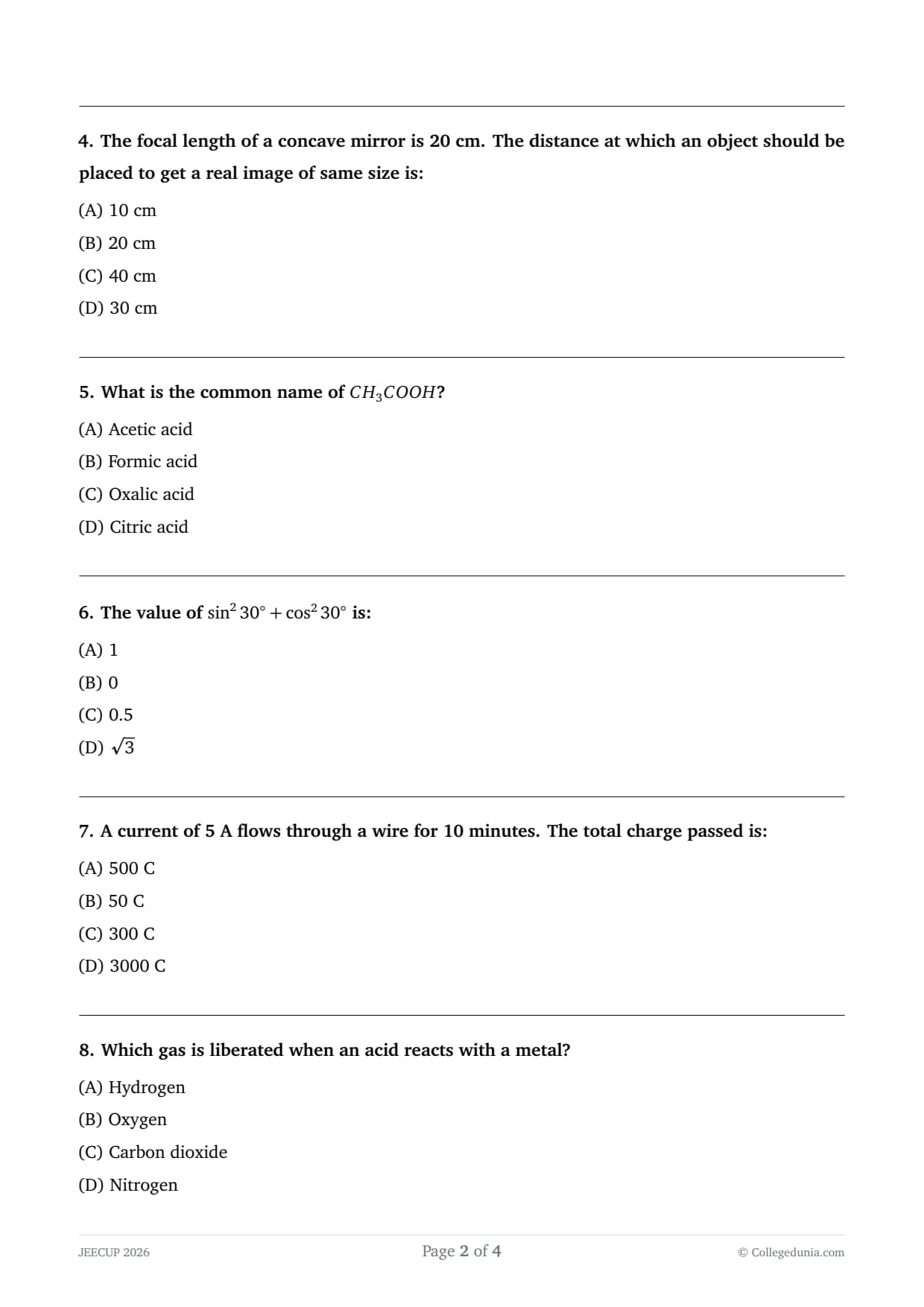
The focal length of a concave mirror is 20 cm. The distance at which an object should be placed to get a real image of same size is:
What is the common name of \(CH_3COOH\)?
The value of \(\sin^2 30^\circ + \cos^2 30^\circ\) is:
A current of 5 A flows through a wire for 10 minutes. The total charge passed is:
Which gas is liberated when an acid reacts with a metal?
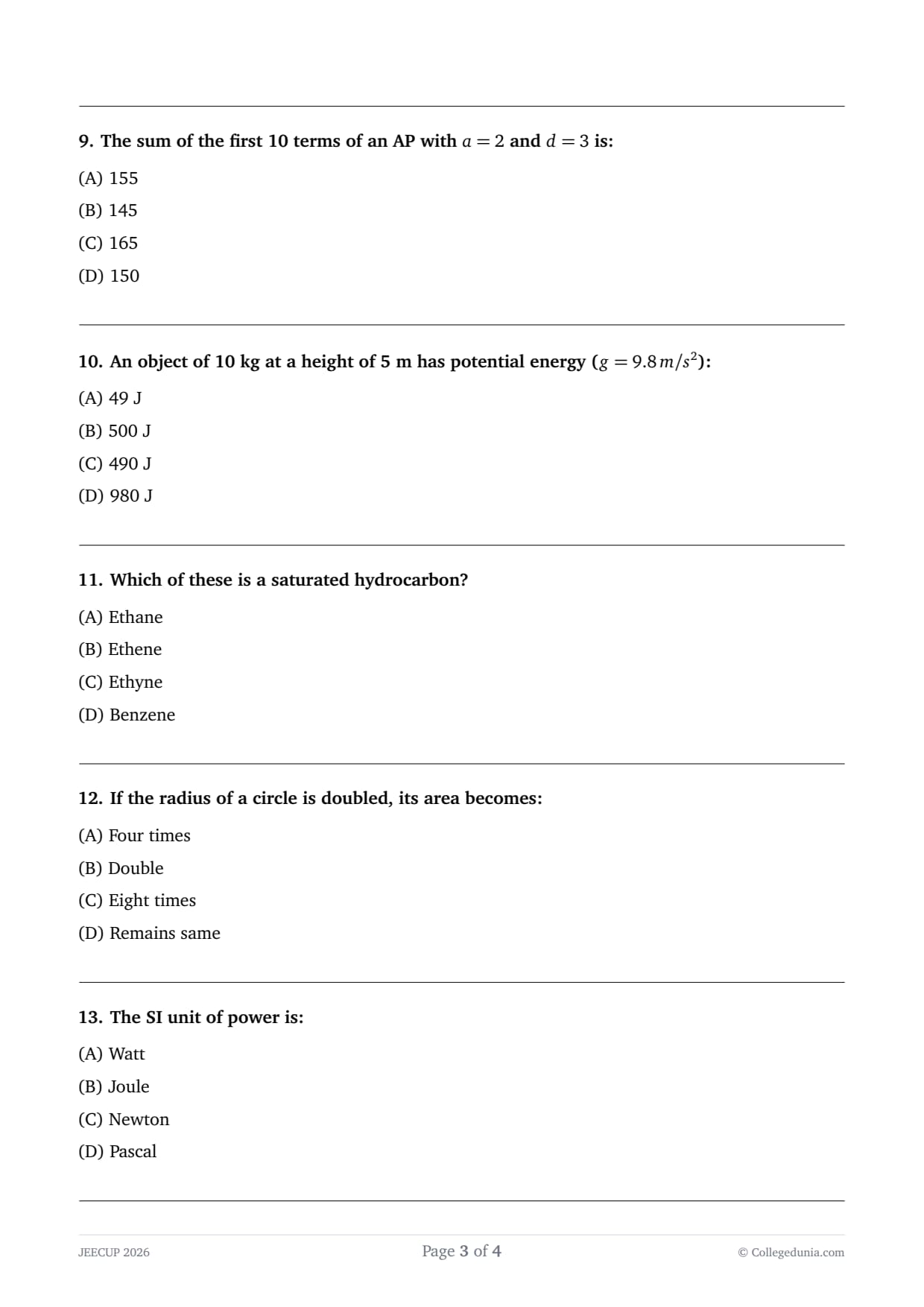
The sum of the first 10 terms of an AP with \(a=2\) and \(d=3\) is:
An object of 10 kg at a height of 5 m has potential energy (\(g = 9.8\,m/s^2\)):
Which of these is a saturated hydrocarbon?
If the radius of a circle is doubled, its area becomes:
The SI unit of power is:
Which non-metal is liquid at room temperature?
Probability of getting a number \(>4\) on a fair die is:
JEECUP Group A Polytechnic Question Paper 2026 June 3
The perimeter of an equilateral triangle whose area is \(4\sqrt{3}\,cm^2\) is equal to
\(\tan3A-\tan2A\cdot\tan A\) is equal to
The value of \(\sqrt[5]{\dfrac{72.9}{0.4096}}\) is
If \(7\) is the mean of \(5,3,0.5,4.5,a,8.5,9.5\), then the value of \(a\) is
The value of \(\sin\theta+\cos(90^\circ+\theta)+\sin(180^\circ-\theta)+\sin(180^\circ+\theta)\) is
One proton enters a magnetic field of intensity \[ 2500\ \text{N}\,\text{A}^{-1}\,\text{m}^{-1} \] with a velocity of \[ 4\times10^5\ \text{m s}^{-1} \] parallel to the magnetic field. The force exerted on the proton will be:
\(100\,g\) of water at \(60^\circ C\) is added to \(180\,g\) of water at \(95^\circ C\). The resultant temperature of mixture is
Two unlike parallel forces \(2\,N\) and \(16\,N\) act at the ends of a uniform rod of length \(21\,cm\). The point where the resultant acts is at a distance of ____ from the greater force.
Magnetic flux of a \(20\) turn coil is reduced to zero from \(0.3\,Wb\) in one second. The induced e.m.f. between the terminals of the coil is
The electric field strength at a point in an electric field is \(30\,N/C\). Find the force experienced by a charge of \(20\,C\) at that point.
Electronic configuration of copper can be represented as
Which among the following pairs are not having same number of total electrons?
The half life period of a radioactive element is \(150\) days. After \(600\) days \(1\,g\) of the element will be reduced to
The number of molecules present in \(2.8\,g\) of nitrogen is
The common name of 2-Butanone is
JEECUP Exam Pattern 2026
| Particulars | Details |
|---|---|
| Exam Mode | Online (Computer-Based Test) |
| Duration | 2 Hours 30 Minutes (150 Minutes) |
| Total Questions | 100 |
| Total Marks | 400 |
| Question Type | Objective Type (Multiple-Choice Questions) |
| Subjects & Questions | Vary as per Group (A to K) — • Group A (Engineering Diploma): Mathematics, Physics, Chemistry • Group B–K: Domain-specific subjects based on chosen course |
| Marking Scheme | 4 marks for each correct answer |
| Negative Marking | −1 mark for each incorrect answer |
| Language of Paper | English and Hindi |
| Level of Examination | Class 10 / 12 / Graduate level (as per course group) |
| Conducting Body | Joint Entrance Examination Council, Uttar Pradesh (JEECUP) |



Comments