Question:
Consider the function
\[
f:\left(-\frac{\pi}{2},\frac{\pi}{2}\right)\to(-\infty,\infty)
\]
defined by
\[
f(x)=\left(|x|+|x-1|\right)\sin x+[x\sin x]
\]
where \([x\sin x]\) denotes the greatest integer less than or equal to \(x\sin x\).
Let \(\alpha\) be the total number of points in the interval
\[
\left(-\frac{\pi}{2},\frac{\pi}{2}\right)
\]
at which \(f\) is NOT continuous, and let \(\beta\) be the total number of points in the interval
\[
\left(-\frac{\pi}{2},\frac{\pi}{2}\right)
\]
at which \(f\) is NOT differentiable.
Then the value of
\[
\alpha+\beta
\]
is ________.
Show Hint
The smooth part (|x|+|x-1|)sin x has only one kink, at x = 1. The floor part jumps at the two points where x sin x = 1.
Updated On: Nov 19, 2026
Show Solution

Verified By Collegedunia
Correct Answer: 5
Solution and Explanation
Step 1: Split f into two parts:
Write \(f(x)=g(x)+h(x)\), where \(g(x)=(|x|+|x-1|)\sin x\) and \(h(x)=[x\sin x]\).
On \(\left(-\dfrac\pi2,\dfrac\pi2\right)\) the function \(g\) is continuous everywhere because it is a product of continuous functions.
So any break in continuity of \(f\) comes from the greatest integer part \(h\).
Step 2: Where does h jump?:
Let \(u(x)=x\sin x\). It is even and \(u(0)=0\). For \(x>0\), \(u'(x)=\sin x+x\cos x>0\), so \(u\) rises from \(0\) to \(\dfrac\pi2\approx1.57\).
So \([u]=0\) while \(0\le u<1\), and \([u]=1\) once \(u\ge1\) (it never reaches \(2\)).
The equation \(x\sin x=1\) has exactly one root \(x_0\approx1.11\) in \(\left(0,\dfrac\pi2\right)\), and by symmetry \(-x_0\) is the other.
At \(\pm x_0\) the value of \(h\) jumps from \(0\) to \(1\) (or from \(1\) to \(0\)). Nowhere else does \([u]\) change.
Step 3: Count alpha:
\(f\) is discontinuous only at \(x=-x_0\) and \(x=x_0\). So \(\alpha=2\).
Step 4: Differentiability of g:
Remove the modulus signs. For \(x<0\): \(|x|+|x-1|=1-2x\). For \(0\le x\le1\): it equals \(1\). For \(x>1\): it equals \(2x-1\).
At \(x=0\): the left derivative of \((1-2x)\sin x\) is \(-2\sin0+(1)\cos0=1\). The right derivative of \(\sin x\) is \(\cos0=1\). They agree, so \(g\) is differentiable at \(0\).
At \(x=1\): the left derivative of \(\sin x\) is \(\cos1\). The right derivative of \((2x-1)\sin x\) is \(2\sin1+\cos1\).
These differ by \(2\sin1\ne0\). So \(g\) is not differentiable at \(x=1\).
Step 5: Differentiability of h:
Away from \(\pm x_0\), \(h\) is constant, so its derivative is \(0\). At \(\pm x_0\) it jumps, so it is not even continuous there, and not differentiable.
Near \(x=0\), \(h=0\) (since \(0\le x\sin x<1\)), so \(h\) is smooth at \(0\). Near \(x=1\), \(u(1)=\sin1\approx0.84<1\), so \(h\) is also constant there.
Step 6: Count beta:
\(f\) is not differentiable at \(x=-x_0\), \(x=x_0\) (jumps) and \(x=1\) (kink). The point \(x=0\) is fine.
These three points are different because \(x_0\approx1.11\ne1\). So \(\beta=3\).
\[ \alpha+\beta=2+3=5 \]
Final Answer:
The value of alpha + beta is 5. \[ \boxed{5} \]
Was this answer helpful?
0
0
Top JEE Advanced Mathematics Questions
- In a $\triangle$ ABC w ith fixed base BC, the vertex A moves such that cos B + cos C = 4 $ sin^2 \frac{A}{2}$. If a, b and c denote th e lengths of th e sides of th e triangle opposite to the angles A, B and C respectively, then
- Let $P=[a_{ij}]$ be a $3\times3$ matrix and let $Q=[b_{ij}]$ where $b_{ij}=2^{i+j} a_{ij}$ for $1 \le i, j \le $.If the determinant of $P$ is $2$, then the determinant of the matrix $Q$ is
- For the equation $3x^2+px+3=0,p>0,$ if one of the root is square of the other, then p is equal to
- The equation $\sqrt{x+1}-\sqrt{x-1}=\sqrt{4x-1}$ has
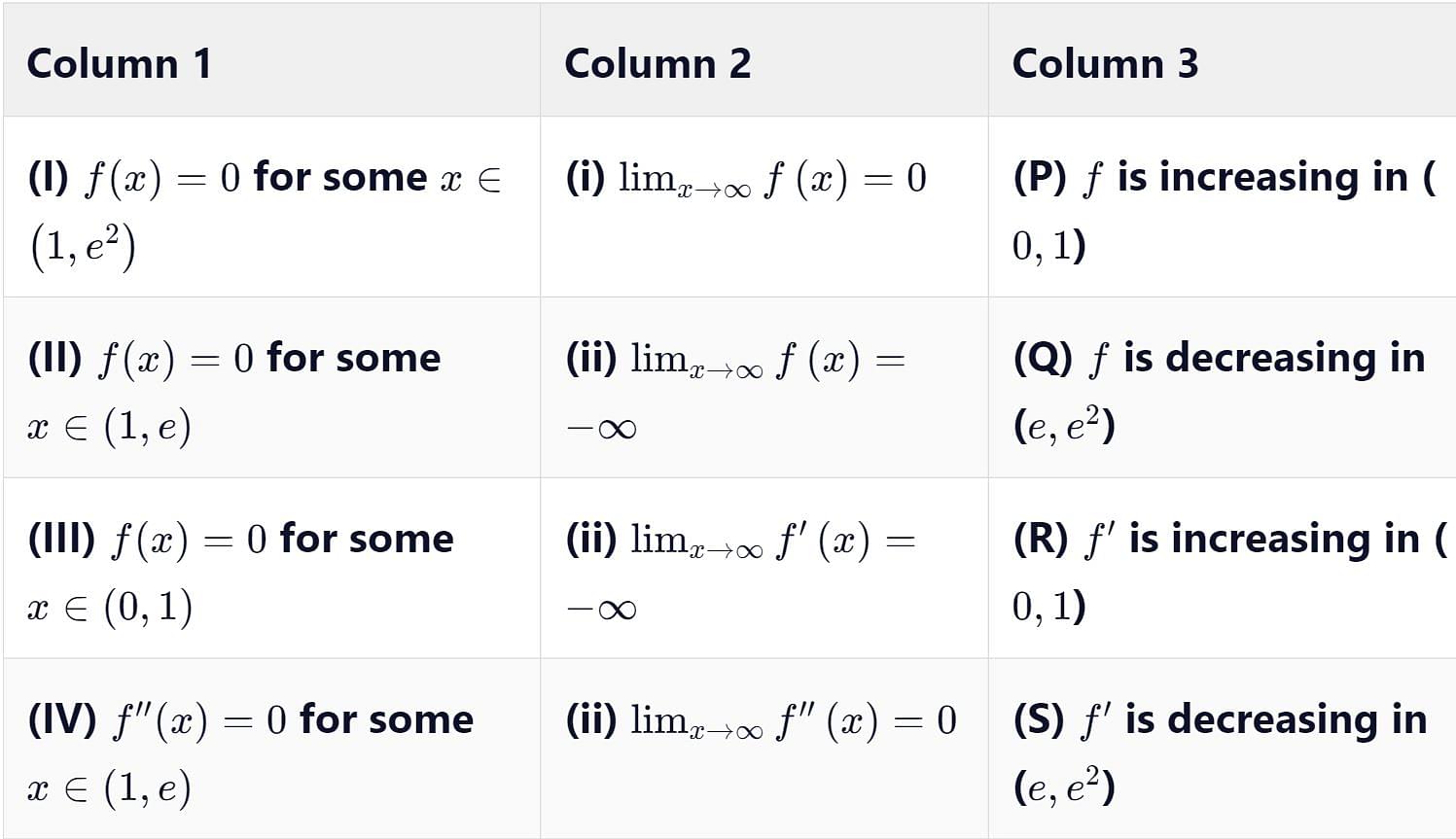
Let \(f(x)=x+log_{e}x−xlog_{e}x,\text{ }x∈(0,∞)\).
- Column 1 contains information about zeros of \(f(x)\), \(f'(x)\) and \(f''(x)\).
- Column 2 contains information about the limiting behavior of \(f(x)\), \(f'(x)\) and \(f''(x)\) at infinity.
- Column 3 contains information about increasing/decreasing nature of \(f(x)\) and \(f'(x)\).
View More Questions
Top JEE Advanced Continuity and differentiability Questions
- Let f (x) = min { x, $x^2$ } for every real number of x, then
- Let \(f:[0,2] \rightarrow R\) be the function defined by
\(f(x)=(3-\sin (2 \pi x)) \sin \left(\pi x-\frac{\pi}{4}\right)-\sin \left(3 \pi x+\frac{\pi}{4}\right)\) If \(\alpha, \beta \in[0,2]\) are such that \(\{x \in[0,2]: f(x) \geq 0\}=[\alpha, \beta]\), then the value of \(\beta-\alpha\) is ______ - For a polynomial $g(x)$ with real coefficients, let $m_{g}$ denote the number of distinct real roots of $g(x)$. Suppose $S$ in the set of polynomials with real coefficients defined by
$S =\left\{\left( x ^{2}-1\right)^{2}\left( a _{0}+ a _{1} x + a _{2} x ^{2}+ a _{3} x ^{3}\right): a _{0}, a _{1}, a _{2}, a _{3} \in R \right\} $
For a polynomial $f$, let $f'$ and $f"$ denote its first and second order derivatives, respectively. Then the minimum possible value of $\left(m_{f'}+m_{f''}\right)$, where $f \in S$, is - Let e denote the base of the natural logarithm. The value of the real number a for which the right hand limit
$\displaystyle\lim_{x\rightarrow 0^+} \frac{(1-x)^{\frac{1}{x}} - e^{-1}}{x^a}$
is equal to a nonzero real number, is_____ Let $ \mathbb{R} $ denote the set of all real numbers. Define the function $ f: \mathbb{R} \to \mathbb{R} $ by $$ f(x) = \begin{cases} 2 - 2x^2 - x^2 \sin\left(\frac{1}{x}\right), & \text{if } x \ne 0, \\ 2, & \text{if } x = 0. \end{cases} $$ Then which one of the following statements is TRUE?
View More Questions
Top JEE Advanced Questions
- Yellow light is used in a single slit diffraction experiment with slit width of 0.6 mm. If yellow light is replaced by X-rays, then the observed pattern will reveal
- The size of the image of an object, which is at infinity, as formed by a convex lens of focal length 30 cm is 2 cm. If a concave lens of focal length 20 cm is placed between the convex lens and the image at a distance of 26 cm from the convex lens, calculate the new size of the image.
- A concave lens of glass, refractive index 1.5 has both surfaces of same radius of curvature R. On immersion in a medium of refractive index 1.75, it will behave as a
- The position vector $\vec{r}$ of a particle of mass $m$ is given by the following equation $\vec{r}(t)=\alpha t^{3} \hat{i}+\beta t^{2} \hat{j}$ where $\alpha=\frac{10}{3} \,ms ^{-3}, \beta=5\, ms ^{-2}$ and $m =0.1 \,kg$. At $t =1\, s$, which of the following statement (s) is (are) true about the particle?
- In an n-p-n transistor circuit, the collector current is 10 mA. If 90% of the electrons emitted reach the collector
View More Questions