





The University of Birmingham does not publish an official overall acceptance rate. The honest picture is this: based on UCAS application and enrollment data, the estimated overall acceptance rate sits between 13% and 15%, making Birmingham one of the more selective Russell Group universities in the UK. But a student applying for Computer Science faces a very different admissions landscape than one applying for Medicine or Law.
Birmingham received over 13,500 international students from 134 countries in 2025-26, with more than 1,300 of them from India, a 10-fold increase over the past decade. The university ranks #76 globally (QS 2026) and #11 in the UK, and is a founding member of the Russell Group. For Indian students, it offers one of the most clearly documented entry requirement frameworks of any UK university, with specific percentage equivalents for CBSE, ISC and state board results published directly on the official admissions page.
All fee conversions use the rate of 1 GBP = Rs. 127.09.
Check University of Birmingham courses, fees and admissions 2026 in full detail.
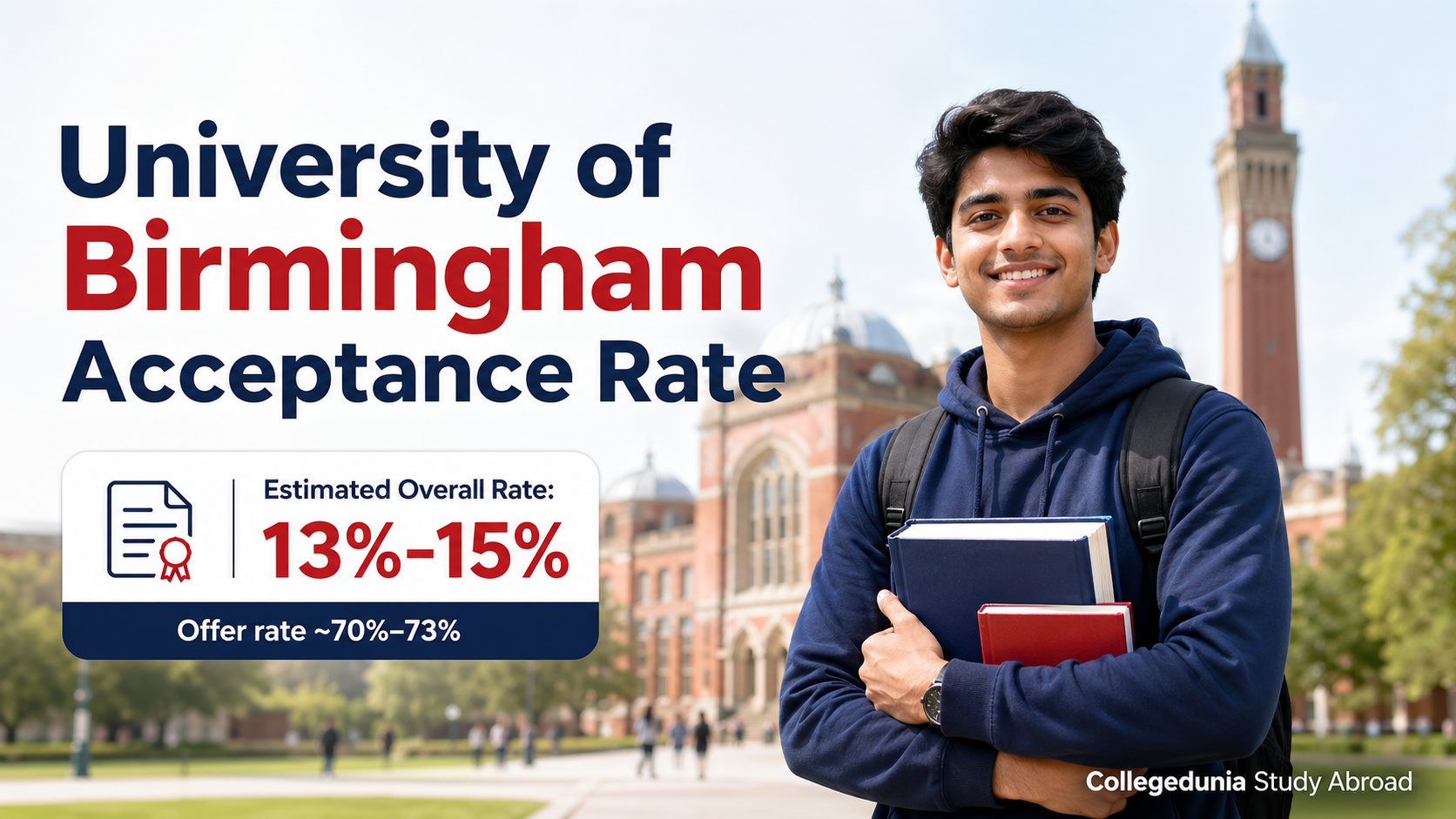
- University of Birmingham Acceptance Rate 2026
- Acceptance Rate by Course — Medicine, Law, Engineering, CS and More
- How Difficult Is It to Get Into Birmingham?
- University of Birmingham Acceptance Rate for Indian Students
- Entry Requirements for Indian Students — UG and PG
- Birmingham vs Other UK Universities — Acceptance Rate Comparison
- Scholarships for Indian Students at Birmingham 2026
- Frequently Asked Questions
University of Birmingham Acceptance Rate 2026
The University of Birmingham's estimated overall acceptance rate is 13% to 15%. This figure is derived from UCAS application and enrollment data — the university itself does not publish a single official acceptance rate figure.
- Different sources calculate this differently, depending on whether they use offer rate (applications that receive an offer) or enrollment rate (applicants who actually enrol).
- The offer rate is significantly higher, approximately 70 to 73% of applicants receive an offer.
- But the enrollment rate after accounting for students who receive offers from multiple universities and choose elsewhere brings the effective acceptance rate down to 13 to 15%.
Understanding this distinction matters for Indian students. Receiving an offer from Birmingham does not mean you compete with 87% of applicants being rejected. It means approximately 70% of applicants who meet the academic threshold receive an offer, but only a fraction of those ultimately enrol. The real competition is in meeting the academic entry requirements, not in the selection process.
| Metric | Data | Source |
|---|---|---|
| Estimated overall acceptance rate | 13% to 15% | UCAS application and enrollment data (estimated) |
| Offer rate (applications receiving an offer) | ~70% to 73% | SaveMyExams admissions statistics analysis |
| Total students enrolled | ~38,000 | HESA / UCAS 2026 |
| International students | 13,500+ from 134 countries (26% of total) | birmingham.ac.uk/study/international/country/india (official) |
| Indian students enrolled | 1,300+ | birmingham.ac.uk/study/international/country/india (official) |
| Female to male ratio | 56% female / 43% male | HESA via UCAS 2026 |
| UK vs international split | 72% UK / 2% EU / 26% international | HESA via UCAS 2026 |
| UG vs PG split | 64% undergraduate / 36% postgraduate | HESA via UCAS 2026 |
The key takeaway: Birmingham's selectivity is real, but it is primarily driven by academic thresholds. Students who meet the published entry requirements have a strong chance of receiving an offer. Students who fall below the threshold — regardless of personal statement quality — are unlikely to receive one. Indian students can review all University of Birmingham courses and their specific entry requirements before applying.
Acceptance Rate by Course — Medicine, Law, Engineering, CS and More
The overall acceptance rate of 13 to 15% masks enormous variation between courses.
- Medicine is the most competitive program at Birmingham by a significant margin.
- Computer Science and Engineering are moderately competitive.
- Business and social sciences are more accessible.
The table below uses the best available data — including official University of Birmingham MBChB admissions statistics published in September 2025 for the 2024-25 cycle.
| Course | Estimated Acceptance Rate | Typical Entry Requirement (A Level) | Difficulty Level |
|---|---|---|---|
| Medicine (A100) — Home applicants | 56.2% (845 offers from 1,503 applications — 2024-25 official data) | A*AA + UCAT + interview | Very High |
| Medicine (A100) — International applicants | 18.0% (79 offers from 438 applications — 2024-25 official data) | A*AA equivalent + UCAT 2920+ + interview | Extremely High |
| Law (LLB) | ~15% | AAA to A*AA | Very High |
| Computer Science | ~20% | AAA (including Maths) | High |
| Engineering (all disciplines) | ~18% | AAB to AAA (including Maths and Physics) | High |
| Economics | ~20 to 25% | AAA (including Maths) | High |
| Business and Management | ~25 to 30% | AAB to AAA | Moderate to High |
| Psychology | ~20 to 25% | AAB to AAA | High |
| English Literature | ~30 to 35% | AAB | Moderate |
| History | ~30 to 35% | AAB | Moderate |
Medicine International Acceptance Rate — The Official Data
The University of Birmingham is one of the few UK medical schools that publishes detailed admissions statistics publicly.
- For international applicants to Medicine (A100): 438 applications received, 117 interview invitations issued, 79 offers made, 16 enrolled.
- The offer rate for international Medicine applicants is 18.04% — but the enrollment rate is just 3.65% of all international applicants.
- Only 28 international places exist per year, of which up to 6 are reserved for IMU-Malaysia students entering clinical years.
For international students targeting Medicine at Birmingham, the minimum UCAT threshold for interview selection in 2024-25 was 2,920 (median 3,080; mean 3,097). The academic threshold is A*AA equivalent. This is among the most competitive medical school entry processes in the UK for international students. Indian students considering MBBS in the UK should review Birmingham's specific requirements alongside other UK medical schools before applying.
How Difficult Is It to Get Into Birmingham?
Birmingham sits in the moderately to highly selective tier of UK universities — more competitive than most post-92 institutions but less selective than Oxford, Cambridge or Imperial. The difficulty level varies significantly by course and by whether you are a home or international applicant. International students — including Indian students — face a more competitive admissions process than home students for most courses, particularly Medicine where international places are capped at 28 per year.
| Difficulty Factor | Assessment |
|---|---|
| Overall selectivity | Moderately high — estimated 13 to 15% acceptance rate; 70 to 73% offer rate |
| Academic threshold | High — most competitive courses require AAA to A*AA at A Level (85 to 90% CBSE/ISC equivalent) |
| International vs home competition | International applicants face more competition — especially for Medicine (18% vs 56.2% offer rate) |
| Most competitive courses | Medicine, Dentistry, Law — very high competition; limited international places |
| Moderately competitive courses | Engineering, Computer Science, Economics, Business — high but achievable with strong academics |
| Most accessible courses | Arts, Humanities, Social Sciences — lower entry requirements; higher offer rates |
| Personal statement weight | Important for all courses; critical for Medicine and Law where academic scores alone are insufficient |
| Admissions tests required | UCAT for Medicine and Dentistry; LNAT for Law; no additional test for most other courses |
Birmingham's position as a founding member of the Russell Group and its QS #76 global ranking place it firmly in the upper tier of UK universities. For Indian students, this means a Birmingham degree carries strong recognition with Indian employers and is well-regarded for postgraduate applications globally.
Students can compare University of Birmingham vs University of Edinburgh across rankings, courses and fees.
University of Birmingham Acceptance Rate for Indian Students
The University of Birmingham does not publish India-specific acceptance rate data. However, the combination of official data points paints a clear picture of Indian student prospects at Birmingham.
- Over 1,300 Indian students are currently enrolled, a 10-fold increase over the past decade.
- The university has enrolled 2,600 postgraduate and 170 undergraduate Indian students over the last 3 years alone.
- Birmingham has a dedicated India team (Navjyot Kohli, Niharika Gupta, Sifat Puri and Anita Nathan) and offers India-specific scholarships worth up to GBP 12,500.
The most important data point for Indian students is the international acceptance rate for Medicine: 18.04% (official 2024-25 data). For non-Medicine courses, Indian students who meet the published academic thresholds — which Birmingham has translated directly into CBSE and ISC percentage equivalents on its official India page — have a strong chance of receiving an offer. The challenge for Indian students is typically meeting the academic threshold, not competing in a subjective selection process.
| Factor | Data for Indian Students | Source |
|---|---|---|
| Indian students currently enrolled | 1,300+ | birmingham.ac.uk/study/international/country/india (official) |
| Growth in Indian enrollment | 10-fold increase over 10 years | Indian Express interview with UoB VC/Provost, 2025 |
| PG Indian students (last 3 years) | 2,600 enrolled | Indian Express, 2025 |
| UG Indian students (last 3 years) | 170 enrolled | Indian Express, 2025 |
| Medicine international offer rate (2024-25) | 18.04% (79 offers from 438 international applications) | UoB MBChB Admissions Statistics, September 2025 (official) |
| India-specific scholarships available | GBP 5,000 to GBP 12,500 per student | birmingham.ac.uk/study/international/country/india (official) |
| Dedicated India admissions team | Yes — india@contacts.bham.ac.uk | birmingham.ac.uk/study/international/country/india (official) |
The pattern is clear: Birmingham actively recruits Indian students and has built significant infrastructure to support them — from India-specific scholarships to a dedicated employability relationship manager based in India who supports students before arrival and after graduation. For Indian students with strong academics, Birmingham is a realistic and well-supported destination.
Indian students can read verified reviews from Indian students at University of Birmingham to understand the on-ground experience.
Read More: Study in UK 2026 — Complete Guide for Indian Students: Universities, Fees, Visa and ScholarshipsEntry Requirements for Indian Students: UG and PG
Birmingham is one of the few UK universities that publishes direct percentage equivalents for Indian qualifications on its official website. The table below gives Indian students a precise benchmark to assess their eligibility before applying.
Undergraduate Entry Requirements for Indian Students
| A Level Equivalent | ISC / CBSE / Maharashtra | West Bengal Board | Other State Boards |
|---|---|---|---|
| A*AA | 90% | 85% | 95% |
| AAA | 85% | 80% | 90% |
| AAB | 80% | 75% | 85% |
| ABB / BBB | 75% | 75% | 80% |
For subject-specific grade requirements — for example, where a course requires an A in Mathematics — the equivalent Indian percentage is: A* = 90% ISC/CBSE/Maharashtra; A = 85% ISC/CBSE/Maharashtra; B = 80% ISC/CBSE/Maharashtra. Medicine requires country-specific requirements — visit birmingham.ac.uk/schools/medical-school/applying-to-medicine for the full Medicine entry criteria. Indian students applying for University of Birmingham admissions should verify course-specific requirements directly on the university's course finder.
Postgraduate Entry Requirements for Indian Students
| Degree Type | Requirement |
|---|---|
| Taught Masters (MSc, MA, LLM) — 2:1 equivalent | 55% to 60% or higher in a 3 or 4-year Bachelor's degree from a recognised Indian university |
| Taught Masters — 2:2 equivalent | 50% to 55% in a 3 or 4-year Bachelor's degree |
| MSc programs (Business School) | 3-year degree (first class or very good upper second class) from recognised institutions |
| LLM programs | 3 or 5-year LLB from prestigious Indian institutions accepted |
| PhD / Postgraduate Research | Bachelor's degree plus Masters degree with 60%+ (2:1 equivalent) from a recognised institution |
| English language (IELTS) | Minimum IELTS 6.0 overall with no less than 5.5 in any band (standard requirement; varies by course) |
Tuition Fees for Indian Students 2026
| Program Level | Annual Fee (GBP) | Annual Fee (INR) |
|---|---|---|
| Undergraduate (international) | GBP 28,320/year (approx.) | Rs. 35.99 lakh/year |
| Postgraduate Taught (MSc/MA — international) | GBP 24,000 to 32,000/year (varies by course) | Rs. 30.50 lakh to Rs. 40.67 lakh/year |
| MBA (full-time) | GBP 38,000 to 42,000/year (approx.) | Rs. 48.29 lakh to Rs. 53.38 lakh/year |
| Medicine (MBChB — international) | GBP 45,000 to 50,000/year (approx.) | Rs. 57.19 lakh to Rs. 63.55 lakh/year |
Birmingham vs Other UK Universities — Acceptance Rate Comparison
Placed in context, Birmingham's 13 to 15% acceptance rate makes it more selective than most Russell Group universities but significantly less selective than Oxford, Cambridge and Imperial. For Indian students building a UK university shortlist, understanding where Birmingham sits in the selectivity spectrum helps calibrate application strategy — how many reach schools, target schools and safety schools to include.
| University | Acceptance Rate (est.) | QS Ranking 2026 | Russell Group | Difficulty vs Birmingham |
|---|---|---|---|---|
| University of Oxford | ~17% (offer rate); ~16 to 17% effective | #3 | Yes | Significantly harder |
| University of Cambridge | ~24.5% | #5 | Yes | Significantly harder |
| Imperial College London | ~17.6% | #8 | Yes | Harder |
| London School of Economics (LSE) | ~16 to 17% | #50 | Yes | Harder |
| University College London (UCL) | ~63% | #9 | Yes | Easier (higher offer rate) |
| University of Birmingham | ~13 to 15% | #76 | Yes | — |
| University of Manchester | ~57.7% | #34 | Yes | Easier (higher offer rate) |
| University of Leeds | ~59.9% | #86 | Yes | Easier |
| University of Nottingham | ~70% | #113 | Yes | Easier |
| King's College London (KCL) | ~41.3% | #40 | Yes | Easier (higher offer rate) |
| University of Edinburgh | ~52.6% | #27 | Yes | Easier (higher offer rate) |
The comparison reveals something counterintuitive: several higher-ranked universities have higher offer rates than Birmingham.
- UCL ranks #9 globally but has an offer rate of approximately 63%.
- Manchester ranks #34 but has an offer rate of 57.7%.
- This happens because offer rate and ranking measure different things — ranking reflects research output and academic reputation, while offer rate reflects the ratio of applicants to available places.
- Birmingham's lower offer rate reflects high demand relative to its intake size, not necessarily that it is harder to get into than UCL or Manchester for a well-qualified applicant.
For Indian students building a UK shortlist, a practical approach is: Oxford, Cambridge or Imperial as reach schools (if academically eligible); Birmingham, KCL or Bristol as target schools; Manchester, Leeds or Nottingham as safety schools. Indian students can compare University of Bristol vs University of Birmingham across rankings, fees and courses to refine their shortlist further.
Scholarships for Indian Students at Birmingham 2026
Birmingham offers more India-specific scholarships than most UK Russell Group universities — with over GBP 10.5 million in total international scholarships available and several awards designed specifically for Indian applicants. The scholarships below are sourced directly from the official University of Birmingham India page:
| Scholarship | Value (GBP) | Value (INR) | For | Deadline |
|---|---|---|---|---|
| Future Skills Scholarship | GBP 9,125 to GBP 12,500 | Rs. 11.60 lakh to Rs. 15.89 lakh | Indian PG students — selected Masters courses | 30 April 2026 |
| Postgraduate Chancellor's Scholarship for India | GBP 10,000 | Rs. 12.71 lakh | Indian PG Masters students — September 2026 entry | 31 May 2026 |
| Postgraduate High Fliers Scholarship | GBP 5,000 | Rs. 6.35 lakh | International PG Masters students — September 2026 | 29 May 2026 |
| High Fliers Undergraduate Scholarship for India | GBP 5,000 | Rs. 6.35 lakh | Indian UG students — September 2026 entry | 30 June 2026 |
| Inlaks Scholarship | Up to USD 1,00,000 (approx. GBP 72,700) | Up to Rs. 94.21 lakh | Young Indian graduates of exceptional talent | Applications reopen for 2026 |
| Alumni Scholarship | GBP 2,000 tuition fee discount | Rs. 2.54 lakh | UoB UG alumni commencing Masters in 2026 | 31 August 2026 |
The Chancellor's Scholarship (GBP 10,000) and High Fliers PG Scholarship (GBP 5,000) deadlines fall in May 2026. Indian students should apply for scholarships simultaneously with their course application — not after receiving an offer. Indian students can explore the latest University of Birmingham news and scholarship updates for any new awards announced for 2026-27.
Read More: Queen Mary University of London vs University of Birmingham — Rankings, Fees and Courses ComparedFrequently Asked Questions
Ques. What is the University of Birmingham acceptance rate in 2026?
Ans. The University of Birmingham's estimated overall acceptance rate is 13% to 15% based on UCAS application and enrollment data. The university does not publish an official acceptance rate. The offer rate — the percentage of applicants who receive an offer — is significantly higher at approximately 70 to 73%. The difference arises because many students who receive offers choose other universities. For Indian students, the key metric is whether you meet the published academic entry requirements — students who do have a strong chance of receiving an offer.
Ques. What is the University of Birmingham acceptance rate for Medicine?
Ans. For international applicants to Medicine (A100) in the 2024-25 cycle: 438 applications, 79 offers — an offer rate of 18.04%. For home applicants: 1,503 applications, 845 offers — an offer rate of 56.2%. Only 28 international Medicine places are available per year, of which up to 6 are reserved for IMU-Malaysia students. The minimum UCAT score for international interview selection in 2024-25 was 2,920.
Ques. Is University of Birmingham hard to get into for Indian students?
Ans. Birmingham is moderately to highly selective — harder than most post-92 universities but less selective than Oxford, Cambridge or Imperial. For Indian students, the primary challenge is meeting the academic threshold. Birmingham publishes direct CBSE and ISC percentage equivalents: A*AA = 90% CBSE/ISC; AAA = 85%; AAB = 80%; ABB/BBB = 75%. Indian students who meet these thresholds for their target course have a strong chance of receiving an offer. Medicine and Law are the most competitive courses. Engineering, Computer Science and Business are achievable with strong academics.
Ques. What percentage do Indian students need for University of Birmingham?
Ans. The official University of Birmingham entry requirements for Indian students (CBSE/ISC/Maharashtra boards) are: 90% for A*AA courses (most competitive — Medicine, top Law programs); 85% for AAA courses (Engineering, Computer Science, Economics); 80% for AAB courses (Business, Psychology, many Sciences); 75% for ABB/BBB courses (Arts, Humanities, Social Sciences). For West Bengal board students, requirements are 5% lower across all bands. For other state boards, requirements are 5% higher.
Ques. How many Indian students study at University of Birmingham?
Ans. Over 1,300 Indian students are currently enrolled at the University of Birmingham across undergraduate and postgraduate programs — confirmed on the official University of Birmingham India page (birmingham.ac.uk/study/international/country/india). This represents a 10-fold increase over the past decade. Over the last 3 years, Birmingham has enrolled 2,600 Indian postgraduate students and 170 Indian undergraduate students. The university has a dedicated India admissions team and offers India-specific scholarships worth up to GBP 12,500 per student.
Ques. How does University of Birmingham compare to Manchester and Leeds for Indian students?
Ans. Birmingham (QS #76, acceptance rate ~13 to 15%) is more selective than both Manchester (QS #34, offer rate ~57.7%) and Leeds (QS #86, offer rate ~59.9%). However, Manchester ranks higher globally than Birmingham. For Indian students, the practical difference is: Birmingham requires stronger academics (85 to 90% CBSE for competitive courses) but offers a more selective degree brand. Manchester and Leeds have higher offer rates and slightly lower academic thresholds for most courses. All three are Russell Group universities with strong graduate employment outcomes. The right choice depends on your target course and academic profile.
Ques. What IELTS score is required for University of Birmingham?
Ans. The standard IELTS requirement for most University of Birmingham programs is IELTS 6.0 overall with no less than 5.5 in any individual band. Some programs — particularly in Medicine, Law and Business — require higher scores of IELTS 6.5 or 7.0. The TOEFL equivalent is 80 overall with no less than 19 in Reading and Listening. Indian students from English-medium schools may be able to provide a Medium of Instruction certificate in lieu of IELTS for some programs — verify with the admissions team at india@contacts.bham.ac.uk.
Ques. What scholarships are available for Indian students at University of Birmingham in 2026?
Ans. Birmingham offers several India-specific scholarships for 2026 entry: Future Skills Scholarship (GBP 9,125 to GBP 12,500 — deadline 30 April 2026); Postgraduate Chancellor's Scholarship for India (GBP 10,000 — deadline 31 May 2026); Postgraduate High Fliers Scholarship (GBP 5,000 — deadline 29 May 2026); High Fliers Undergraduate Scholarship for India (GBP 5,000 — deadline 30 June 2026); Inlaks Scholarship (up to USD 1,00,000). Total international scholarship funding exceeds GBP 10.5 million.
Ques. Is University of Birmingham a good university for Indian students?
Ans. Yes — by multiple measures. Birmingham ranks #76 globally (QS 2026) and #11 in the UK. It is consistently one of the top 2 UK universities targeted by leading graduate employers (High Fliers 2026). Over 1,300 Indian students are currently enrolled with a 10-fold increase over 10 years. The university offers India-specific scholarships, a dedicated India admissions team and an employability relationship manager based in India who supports students before arrival and after graduation. Popular courses for Indian students include MSc Data Science, MSc International Money and Banking, MSc Cyber Security, MBA and various Engineering programs.
Ques. What is the University of Birmingham ranking in 2026?
Ans. The University of Birmingham's rankings in 2026 are: QS World University Rankings 2026: #76 globally, #11 in the UK; Times Higher Education (THE) World University Rankings 2026: #98 globally; Complete University Guide 2026: #14 in the UK; US News Best Global Universities: #94. In subject rankings, Birmingham features 7 subjects in the QS top 50 globally and 25 academic subjects in the top 10 in the Complete University Guide 2026.








interested in this College ?
Follow & Share this college to get information about admission.



Comments