\(∫\dfrac{x+5}{x^{2}+1}dx=\)
\( 3ln|x-1|-2ln|x+1|+C\)
\(2ln|x-1|-3ln|x+1|+C\)
\(ln|x-2|-ln|x+1|+C\)
\( ln|x+2|+ln|x+1|+C\)
\(2ln|x-1|+3ln|x-1|+C\)

The Correct Option is A
Approach Solution - 1
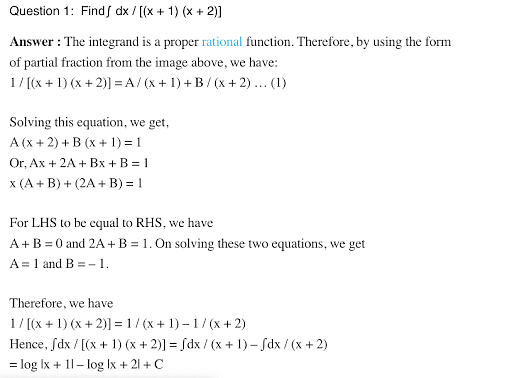
Given: \(∫\dfrac{x+5}{x^{2}+1}dx=\)
So to solve this question, we can again use partial fraction decomposition.
Step 1:
Factorize the denominator. \((x^2 - 1)\) can be factored as\((x - 1)(x + 1).\)
Step 2:
Partial fraction decomposition. The expression \(\dfrac{x+5}{x^2 - 1}\) can be rewritten as the sum of two fractions with unknown constants \(A\) and \(B\):
\(\dfrac{x+5}{x^2 - 1} = \dfrac{A}{x +1}+\dfrac{B}{x-1}\)
Step 3:
Now to find the values of A and B, we need to find a common denominator, which is \((x- 1)(x + 1)\), and then equate the numerators:
\(x + 5 = A(x+ 1) + B(x- 1)\)
Now, solve for A and B by comparing coefficients: \(A + B = 1\)
(by comparing the coefficients of \(x\)) \(A - B = 5\) ⇢(by comparing the constant terms)
Adding the two equations: \(2A = 6\)
⇒\(A=3\)
Substituting the value of \(A\) one of the equations to find we get
\(B = -2\)
Step 4:
Now we can re-write the parent expression as,
\(∫\dfrac{x + 5}{x^2 - 1} dx = ∫(\dfrac{A}{x - 1}+\dfrac{B}{x+ 1}) dx\)
\(=∫(\dfrac{3}{x-1}) - (\dfrac{2}{x+1})dx\)
\(=∫(\dfrac{3}{x-1}) - (\dfrac{2}{x+1})dx\)
\(=∫(\dfrac{3}{x-1})dx - ∫(\dfrac{2}{x+1})dx\)
\(= 3ln|x-1|-2ln|x+1|+C\) (Ans.)
Approach Solution -2
\(∫\dfrac{x+5}{x^{2}+1}dx\)
So to solve this question, we can use partial fraction decomposition.
Step 1 :- $\int (\frac{3}{x-1} + \frac{-2}{x+1}) dx $
Step 2 :- $\int \frac{3}{x-1} dx+ \int \frac{-2}{x+1} dx $
Step 3 :- $3ln|x-1| + \int \frac{-2}{x+1} dx $
Step 4 :- $3ln|x-1| - 2 ln |x+1| +C$
So, the correct option is (A) : $3ln|x-1| - 2 ln |x+1| +C$
Top KEAM Mathematics Questions
- If $\int e^{2x}f' \left(x\right)dx =g \left(x\right)$, then $ \int\left(e^{2x}f\left(x\right) + e^{2x} f' \left(x\right)\right)dx =$
- The value of $ \cos [{{\tan }^{-1}}\{\sin ({{\cot }^{-1}}x)\}] $ is
- The solutions set of inequation $\cos^{-1}x < \,\sin^{-1}x$ is
- Let $\Delta= \begin{vmatrix}1&1&1\\ 1&-1-w^{2}&w^{2}\\ 1&w&w^{4}\end{vmatrix}$, where $w \neq 1$ is a complex number such that $w^3 = 1$. Then $\Delta$ equals
- Let $p : 57$ is an odd prime number, $\quad \, q : 4$ is a divisor of $12$ $\quad$ $r : 15$ is the $LCM$ of $3$ and $5$ Be three simple logical statements. Which one of the following is true?
Top KEAM Integral Calculus Questions
\(∫sin^2 πx dx =\)?
- \(∫^1_0\dfrac{x}{x^2-4}dx=?\)
- \(∫\dfrac{1}{cosx(sinx+2cosx)} dx=\)
- The area of the region bounded by the curves y = x2 and y = √x is (in square units)
- The value of \(\displaystyle\int_{0}^{2}\frac{x^2}{(x^3+1)^2}dx\) is equal to
Top KEAM Questions
- i.$\quad$ They help in respiration ii.$\quad$ They help in cell wall formation iii.$\quad$ They help in DNA replication iv. $\quad$They increase surface area of plasma membrane Which of the following prokaryotic structures has all the above roles?
- A body oscillates with SHM according to the equation (in SI units), $x = 5 cos \left(2\pi t +\frac{\pi}{4}\right) .$ Its instantaneous displacement at $t = 1$ second is
- The pH of a solution obtained by mixing 60 mL of 0.1 M BaOH solution at 40m of 0.15m HCI solution is
Kepler's second law (law of areas) of planetary motion leads to law of conservation of
- If $\int e^{2x}f' \left(x\right)dx =g \left(x\right)$, then $ \int\left(e^{2x}f\left(x\right) + e^{2x} f' \left(x\right)\right)dx =$
Concepts Used:
Integration by Partial Fractions
The number of formulas used to decompose the given improper rational functions is given below. By using the given expressions, we can quickly write the integrand as a sum of proper rational functions.
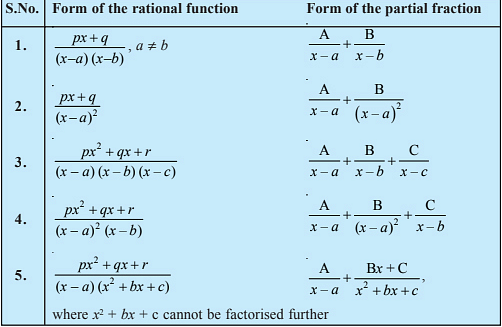
For examples,