The number of bent-shaped molecule(s) from the following is_______?
SO2, O3, I3-, N3-
SO2, O3, I3-, N3-

Solution and Explanation
1. SO2 (Sulfur Dioxide):
SO2 has a bent molecular geometry due to the lone pair of electrons on the sulfur atom, which causes electron pair repulsion and distorts the shape.
2. O3 (Ozone):
O3 has a central oxygen atom surrounded by one lone pair and three bonding electrons. This results in a bent molecular geometry, as the lone pair causes distortion in the structure.
3. I3- (Triiodide Ion):
I3- has a linear geometry. The central iodine atom has three lone pairs, and the bonding electrons are delocalized, maintaining a linear structure.
4. N3- (Azide Ion):
N3- is a linear molecule, as it consists of a chain of three nitrogen atoms connected by alternating double and single bonds, with delocalization of electrons across the structure.
Conclusion:
- Bent: SO2, O3
- Linear: I3-, N3-
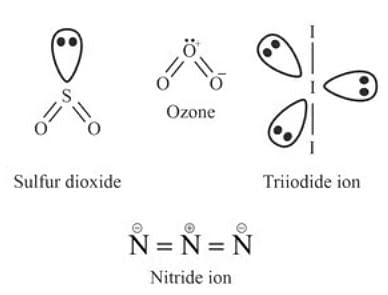
So, Two molecules/ions, SO2 and O3, have a bent shape. The other two, I3- and N3-, have a linear form.
Top JEE Main Chemistry Questions
What will be the equilibrium constant of the given reaction carried out in a \(5 \,L\) vessel and having equilibrium amounts of \(A_2\) and \(A\) as \(0.5\) mole and \(2 \times 10^{-6}\) mole respectively?
The reaction : \(A_2 \rightleftharpoons 2A\)- At equilibrium the concentrations of and in a sealed vessel at . What will be for the reaction
- Find out the major products from the following reactions

Cobalt chloride when dissolved in water forms pink colored complex $X$ which has octahedral geometry. This solution on treating with cone $HCl$ forms deep blue complex, $\underline{Y}$ which has a $\underline{Z}$ geometry $X, Y$ and $Z$, respectively, are
- The correct order of atomic radii is:
Top JEE Main coordination compounds Questions
- The hybridization of P exhibited in \(PF_5\) is \(sp_xd_y\). The value of y is _____ .
- In Kjeldahl's method for estimation of nitrogen, \(CuSO_4\) acts as
- Which is homoleptic complex?
- Find the total number of sigma and pi bonds in 2-formyl hex-4-enoic acid.
- Which of the following has maximum ionic character?
Top JEE Main Questions
- Two masses $m$ and $\frac{m}{2}$ are connected at the two ends of a massless rigid rod of length $l$. The rod is suspended by a thin wire of torsional constant $k$ at the centre of mass of the rod-mass system(see figure). Because of torsional constant $k$, the restoring torque is $\tau =k\theta$ for angular displacement $\theta$. If the rod is rota ted by $\theta_0$ and released, the tension in it when it passes through its mean position will be:
What will be the equilibrium constant of the given reaction carried out in a \(5 \,L\) vessel and having equilibrium amounts of \(A_2\) and \(A\) as \(0.5\) mole and \(2 \times 10^{-6}\) mole respectively?
The reaction : \(A_2 \rightleftharpoons 2A\)- The value of is
- The number of terms of an is even. The sum of the odd terms is and of the even terms is . The last term exceeds the first by . Then the number of terms in the series is ______.
A black body is at a temperature of 2880 K. The energy of radiation emitted by this body with wavelength between 499 nm and 500 nm is U1, between 999 nm and 1000 nm is U2 and between 1499 nm and 1500 nm is U3. The Wien's constant, b = 2.88×10⁶ nm-K. Then,
Concepts Used:
Coordination Compounds
A coordination compound holds a central metal atom or ion surrounded by various oppositely charged ions or neutral molecules. These molecules or ions are re-bonded to the metal atom or ion by a coordinate bond.
Coordination entity:
A coordination entity composes of a central metal atom or ion bonded to a fixed number of ions or molecules.
Ligands:
A molecule, ion, or group which is bonded to the metal atom or ion in a complex or coordination compound by a coordinate bond is commonly called a ligand. It may be either neutral, positively, or negatively charged.