Polar molecules are the molecules :
having a permanent electric dipole moment
having zero dipole moment
acquire a dipole moment only in the presence of electric field due to displacement of charges
acquire a dipole moment only when magnetic field is absent

The Correct Option is A
Solution and Explanation
To solve the question, "Polar molecules are the molecules," we need to understand the concept of molecular polarity in chemistry.
Understanding Polar Molecules:
Polar molecules are characterized by the presence of a permanent dipole moment. A dipole moment is a measure of the separation of positive and negative charges within a molecule. This occurs when there is an uneven distribution of electrons between atoms that have different electronegativities. As a result, one part of the molecule becomes more positively charged and the other more negatively charged, forming an electric dipole.
Let's evaluate each option provided in the question:
- Having a permanent electric dipole moment: This is the correct definition of a polar molecule. Molecules such as water (H2O) exhibit a permanent electric dipole moment due to their bent shape and the difference in electronegativity between hydrogen and oxygen.
- Having zero dipole moment: This describes nonpolar molecules. Nonpolar molecules have no permanent dipole moment, as their electron distribution is even.
- Acquire a dipole moment only in the presence of an electric field due to displacement of charges: This describes induced dipole moments, which occur temporarily when a nonpolar molecule is exposed to an external electric field.
- Acquire a dipole moment only when magnetic field is absent: This statement is incorrect and unrelated to the definition of polar molecules, as the dipole moment in molecules is not dependent on the presence of a magnetic field.
Conclusion:
The correct answer is that polar molecules are those having a permanent electric dipole moment. This distinguishes them from nonpolar molecules and explains their unique properties like higher boiling points and solubility in water.
Top NEET Physics Questions
- The time constant of C-R circuit is
- The correct Boolean operation represented by the circuit diagram drawn is :
- The driver of a car travelling with speed $30\, m/sec$ towards a hill sounds a horn of frequency $600\, Hz.$ If the velocity of sound in air is $330\, m/s,$ the frequency of reflected sound as heard by driver is
- Two simple harmonic motions of angular frequency 100 and 1000 rad $s^1$ have the same displacement amplitude. The ratio of their maximum acceleration is
- In an ac circuit , an alternating voltage $e = 200 \sqrt2 \,sin \,100\, t$ volts is connected to a capacitor of capacitance $1 \,\mu \,F$. The rms value of the current in the circuit is :
Top NEET Atoms Questions
- An electron in the hydrogen atom jumps from excited state n to the ground state. The wavelength so emitted illuminates a photosensitive material having work function $2.75 \,eV$. If the stopping potential of the photoelectron is $10 \,V$ , then the value of $n$ is
- An electron of a stationary hydrogen atom passes from the fifth energy level to the ground level. The velocity that the atom acquired as a result of photon emission will be ($m$ is the mass of the electron, $R$, Rydberg constant and $h$ Planck's constant)
- A sample of radioactive element has a mass of $10\, g$ at an instant $t = 0.$ The approximate mass of this element in the sample after two mean lives is
- The total energy of an electron in an atom in an orbit is $-3.4\,eV$ . Its kinetic and potential energies arc, respectively:
- The spectral series which corresponds to the electronic transition from the levels n2 = 5, 6,… to the level n1 = 4 is
Top NEET Questions
- A $100.0\, mL$ dilute solution of $Ag ^{+}$is electrolysed for $15.0$ minutes with a current of $1.25 \,mA$ and the silver is removed completely. What was the initial $\left[ Ag ^{+}\right]$?
- The time constant of C-R circuit is
- The chronological order of human evolution from early to the recent is
- The correct Boolean operation represented by the circuit diagram drawn is :
- The driver of a car travelling with speed $30\, m/sec$ towards a hill sounds a horn of frequency $600\, Hz.$ If the velocity of sound in air is $330\, m/s,$ the frequency of reflected sound as heard by driver is
Concepts Used:
Atoms
- The smallest unit of matter indivisible by chemical means is known as an atom.
- The fundamental building block of a chemical element.
- The smallest possible unit of an element that still has all the chemical properties of that element.
- An atom is consisting of a nucleus surrounded by one or more shells of electrons.
- Word origin: from the Greek word atomos, which means uncuttable, something that cannot be divided further.
All matter we encounter in everyday life consists of smallest units called atoms – the air we breath consists of a wildly careening crowd of little groups of atoms, my computer’s keyboard of a tangle of atom chains, the metal surface it rests on is a crystal lattice of atoms. All the variety of matter consists of less than hundred species of atoms (in other words: less than a hundred different chemical elements).
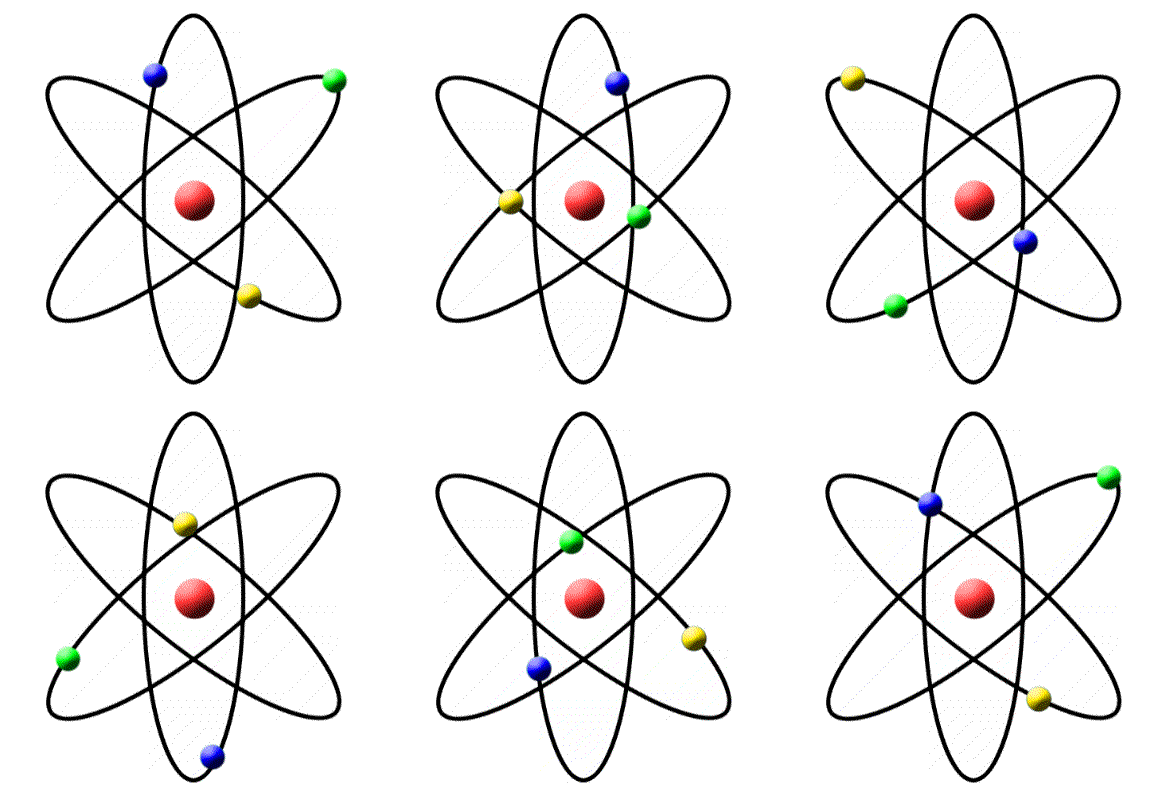
Every atom consists of an nucleus surrounded by a cloud of electrons. Nearly all of the atom’s mass is concentrated in its nucleus, while the structure of the electron cloud determines how the atom can bind to other atoms (in other words: its chemical properties). Every chemical element can be defined via a characteristic number of protons in its nucleus. Atoms that have lost some of their usual number of electrons are called ions. Atoms are extremely small (typical diameters are in the region of tenths of a billionth of a metre = 10-10 metres), and to describe their properties and behaviour, one has to resort to quantum theory.