



Education Journalist | Study Abroad Strategy Lead | Updated On - Jun 22, 2026
The toughest exam in the world is China's Gaokao, with a success rate as low as 0.003% for top universities. Two of the world's three hardest exams come from India: JEE Advanced and the UPSC Civil Services Exam. These are not ordinary tests. They are life-defining gateways that millions attempt and only a handful clear.
- The Gaokao draws over 13.35 million candidates a year, the largest single exam event on Earth.
- India's UPSC Civil Services Exam has a final selection rate of just 0.17%.
- Professional certifications like CFA, CCIE and the Master Sommelier Diploma pass under 26% of candidates, some far lower.
Read More: Top Universities to Study Abroad for Indian Students 2026
Most lists you find online disagree on the order, but the data settles it. When you rank by competition volume, selection rate and stakes, a clear top three emerges, and India owns two of those slots.
For Indian students, knowing where these exams stand and what actually makes them hard helps separate myth from reality before committing years of preparation.
The top 5 toughest exams in the world are the Gaokao (China), JEE Advanced (India), the UPSC Civil Services Exam (India), the All Souls Prize Fellowship (UK), and the Master Sommelier Diploma (USA).
Quick Facts on the World's Toughest Exams
| Parameter | Detail |
|---|---|
| Toughest exam overall | Gaokao (China) |
| Lowest success rate | 0.003% to 0.004% (Gaokao, top universities) |
| Largest candidate volume | 13.35 million (Gaokao 2025) |
| Toughest exam in India | UPSC Civil Services (0.17%) |
| Indian exams in global top 10 | 3 (JEE Advanced, UPSC, CA) |
| Toughest professional certification | Master Sommelier Diploma (under 10%) |
Top 10 Toughest Exams in the World 2026
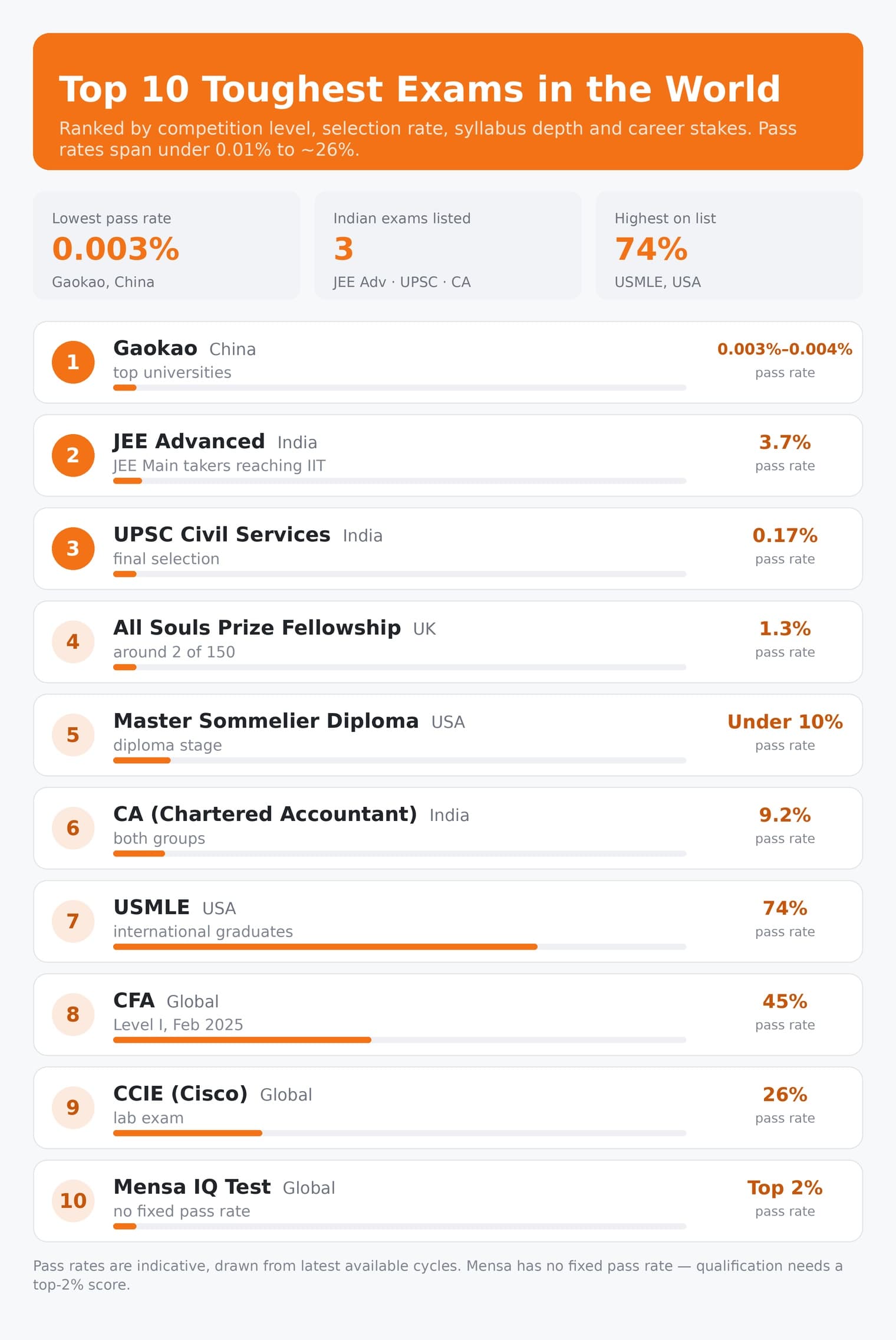
The list below ranks the world's toughest exams by competition level, selection rate, syllabus depth and career stakes. Most of these exams pass under 10% of candidates, some under 0.01%, which is what sets them apart from ordinary competitive exams.
| Rank | Exam | Country | Pass Rate |
|---|---|---|---|
| 1 | Gaokao | China | 0.003% to 0.004% (top universities) |
| 2 | JEE Advanced | India | 3.7% of JEE Main takers reach IIT |
| 3 | UPSC Civil Services | India | 0.17% final selection |
| 4 | All Souls Prize Fellowship | UK | 1.3% (around 2 of 150) |
| 5 | Master Sommelier Diploma | USA | Under 10% |
| 6 | CA (Chartered Accountant) | India | 9.2% (both groups) |
| 7 | CFA | Global | 45% (Level I, Feb 2025) |
| 8 | CCIE (Cisco) | Global | 26% |
| 9 | Mensa IQ Test | Global | Top 2% only |
| 10 | USMLE | USA | 74% (international graduates) |
The ranking weighs sheer competition more than raw pass percentage. Gaokao and JEE Advanced sit at the top because millions compete for a tiny number of elite seats, while UPSC ranks high for its multi-stage elimination and 0.17% final selection.
Key Insight: A low pass rate alone does not make an exam the toughest. The Master Sommelier passes under 10%, but the Gaokao ranks higher because 13 million people sit it for a handful of elite seats.
What Makes an Exam the Toughest in the World?
An exam earns the "world's toughest" label when it combines a low pass rate, a vast multi-year syllabus, millions of competitors and life-defining stakes. Difficulty is not just about hard questions. It is about how many people fail relative to how few seats exist.
| Criteria | What It Means |
|---|---|
| Pass Rate | Low overall — many below 10%, some as low as 0.003% |
| Syllabus Depth | Years of preparation across multiple advanced subjects |
| Competition Volume | Millions of candidates competing for hundreds of seats |
| Life-Defining Stakes | Results decide career, status and future opportunities |
This is why tests like IELTS, TOEFL, GRE and GMAT do not appear on the list. They matter a lot for studying abroad, but they have high pass rates and can be retaken easily. The exams below are different in kind, not just degree.
Gaokao Exam: The Toughest in the World
The Gaokao is widely regarded as the toughest exam in the world, with a success rate as low as 0.003% for elite universities. Also called the National College Entrance Exam (NCEE), it is mandatory for undergraduate admission in China and is held over 2 to 3 days each June.
- Around 13.35 million students sat the Gaokao in 2025, down slightly from the 2024 record of 13.42 million.
- Students need roughly 600 out of 750 to reach a top university.
- Less than 0.5% of candidates enter Tsinghua and Peking universities combined.
| Parameter | Details |
|---|---|
| Country | China |
| Frequency | Once a year (June) |
| Duration | 9 hours over 2 to 3 days |
| Core Subjects | Chinese, Mathematics (required for all) |
| Tracks | Arts (History, Politics, Geography); Science (Physics, Chemistry, Biology) |
| Top University Requirement | Top 0.5% to 1% of all scores |
| Eligibility | Mostly students aged 16 to 18 |
Source: China Ministry of Education, 2025. The exam is the sole criterion for admission into tier-1 Chinese universities, which is what pushes its difficulty above every other entrance test.
Why Gaokao Ranks First
Over 13 million students compete for roughly 50,000 to 60,000 elite seats. Entire cities go quiet on exam days, traffic is rerouted and parents wait outside test centres for hours. With one shot deciding 12 years of schooling, the pressure is unlike any other exam.
Indian students sometimes ask whether they can sit the Gaokao. They cannot, since it is reserved for Chinese nationals. Those exploring China can read the dedicated guide to the Gaokao exam in China for the full format.
JEE Advanced: 2nd Toughest Exam in the World
JEE Advanced is ranked the second toughest exam in the world and the hardest entrance exam in India. It is the gateway to the Indian Institutes of Technology (IITs), and only about 3.7% of all JEE Main takers ultimately qualify for an IIT seat.
Cracking the IITs is a two-step process. Candidates first clear JEE Main, and only the top scorers then qualify to sit the far harder JEE Advanced.
- Over 14.76 lakh students appeared for JEE Main 2025.
- Only the top 2.5 lakh Main scorers qualify for JEE Advanced.
- Out of 1,80,422 who sat Advanced 2025, around 54,348 cleared it for IIT admission.
Success Rate Summary for JEE
| Year | JEE Main applicants | Appeared for Advanced | Qualified | % of Main |
|---|---|---|---|---|
| 2024 | 1,476,557 | 186,584 | 48,248 | 3.27% |
| 2023 | 1,162,398 | 189,744 | 43,773 | 3.77% |
| 2022 | 1,026,799 | 160,038 | 40,712 | 3.96% |
| 2021 | 1,048,012 | 151,193 | 41,862 | 3.99% |
| 2020 | 1,174,000 | 160,838 | 43,204 | 3.68% |
The exam tests advanced Physics, Chemistry and Maths through multi-concept problems that reward conceptual clarity over memorisation, all under tight time limits.
UPSC: The Toughest Exam in India
The UPSC Civil Services Exam is the toughest exam in India, with a final selection rate of just 0.17%. Over 10 lakh candidates compete for roughly 1,000 posts across IAS, IPS, IFS and IRS, making it one of the most selective exams on Earth.
The exam runs across three stages: Prelims, Mains and a personality Interview. Failing any stage means restarting the entire cycle the following year.
| Parameter | UPSC CSE Details |
|---|---|
| Country | India |
| Conducting Body | Union Public Service Commission |
| Candidates (2025-26 Prelims) | 10,00,000+ |
| Total Duration | 31 hours (4 Prelims + 27 Mains) |
| Final Pass Percentage | 0.17% |
Success Rate Summary for UPSC
| Year | Applied | Qualified for Mains | Interview | Final Selections |
|---|---|---|---|---|
| 2023 | 13 lakh | 14,624 | 2,916 | 1,016 |
| 2022 | 11.5 lakh | 13,090 | 2,529 | 933 |
| 2021 | 11 lakh | 10,000 | 1,800 | 761 |
| 2020 | 10.5 lakh | 10,500 | 2,100 | 796 |
UPSC is known for unpredictable question patterns that test applied understanding across history, geography, polity, economics and current affairs rather than rote recall.
Aspirants often describe the difference this way: the Gaokao compresses the pressure into two days, while UPSC stretches it across two years of preparation and three elimination rounds.
All Souls Prize Fellowship Exam (UK)
The All Souls Prize Fellowship Exam at Oxford selects only one or two fellows from around 150 applicants each year. Conducted by All Souls College, University of Oxford, it grants a rare 7-year fellowship for independent research with no formal duties.
- Applicants write four essays on open-ended humanities topics.
- Each essay carries a strict 3-hour limit.
- Successful candidates face a demanding oral viva.
| Parameter | Details |
|---|---|
| Purpose | 7-year research fellowship |
| Conducted by | All Souls College, Oxford |
| Duration | Multiple days, 2 to 3 papers of 3 hours each |
| Selection Rate | Around 1.3% |
Its questions are deliberately subjective with no correct answer (for example, "Is Edward Snowden a hero or a villain?"), testing breadth of knowledge, independence of judgment and clarity of argument. Students keen on the UK can explore options to study in the UK.
Master Sommelier Diploma Exam (USA)
The Master Sommelier Diploma is the hardest professional certification on the list, with a pass rate under 10%. Run by the Court of Master Sommeliers, it tests elite wine knowledge and service skill. Since 1969, only around 273 people worldwide have passed.
| Stage | Format | Duration |
|---|---|---|
| Theory | Oral exam on wine regions, vintages and theory | 50 minutes |
| Deductive Tasting | Blind tasting of 6 wines by taste and smell alone | 25 minutes |
| Practical Service | Serve wines while answering pairing questions | 25 minutes |
Candidates need 75% in each stage and often spend over $30,000 (around INR 25.7 lakh) on travel, study and practice bottles. Most fail the practical service round, where serving and answering questions at once breaks concentration.
CA and USMLE Exams
India's Chartered Accountant (CA) exam passes only 9.2% across both groups, while the US USMLE passes 74% of international medical graduates. Both demand vast syllabi and multiple stages spread over years.
The CA, offered by ICAI, requires mastering eight dense subjects in tight windows, with most candidates re-sitting levels before clearing.
The USMLE earns its place through volume and endurance rather than a low pass rate — three steps spanning roughly 35 hours of testing and over 1,000 deliberately misleading clinical questions, attempted only after years of medical school.
| Exam | Country | Key Pass Rate |
|---|---|---|
| CA Final (Both Groups) | India | 9.2% |
| USMLE (US graduates) | USA | 94% to 97% |
| USMLE (international) | USA | 74% |
Indian students targeting medicine in the US can read the essentials to study medicine in the USA before committing to the USMLE route.
CFA, CCIE and Mensa Tests
The CFA, CCIE and Mensa tests round out the global toughest exams, with pass rates from 26% down to the top 2% only. Each tests a different kind of mastery: finance, networking and raw intelligence.
- CFA: 45% passed Level I in February 2025; the program needs roughly 300 study hours per level across three levels.
- CCIE (Cisco): around 26% pass, with an 8-hour hands-on lab that no memorisation can fake.
- Mensa: accepts only the top 2% of IQ scorers, with no syllabus to study from.
The CFA tests applied financial reasoning, CCIE tests live network troubleshooting and Mensa tests pure logic and pattern recognition under time pressure.
Other Notable Toughest Exams in the World
Beyond the global top 10, several exams are widely ranked among the world's hardest by competition ratio and elimination rate. The table below lists eight more that consistently appear on toughest-exam lists.
| Exam | Country | Field | Why It's Hard |
|---|---|---|---|
| California Bar Exam | USA | Law | Two-day exam, high passing score and vast subject volume |
| Suneung (CSAT) | South Korea | College entrance | 9-hour national exam; flights and traffic halted nationwide |
| GATE | India | Engineering (PG) | Around 16% qualify; gateway to M.Tech and PSU jobs |
| NEET UG | India | Medical | About 6% reach government MBBS seats |
| CAT | India | Management | Roughly 1% get IIM calls |
| MCAT | USA | Medical (admission) | 7.5-hour exam testing reasoning across the sciences |
| IMO | Global | Mathematics | Olympiad proofs even professional mathematicians find hard |
| JLPT N1 | Japan | Language | Requires roughly 10,000 vocabulary words and 2,000 kanji |
Why India Dominates the World's Toughest Exams
India has three exams in the global top 10 not because the questions are impossibly hard, but because the competition is unlike anywhere else. The aspirant-to-seat ratio is among the steepest on the planet.
- JEE Main 2025 had over 14.76 lakh students competing for roughly 17,000 IIT seats, about 87 applicants per seat.
- UPSC sees over 10 lakh candidates chase around 1,009 final posts, nearly 1,000 to 1.
- Multi-stage elimination in UPSC, JEE and CA means failure at any step restarts the cycle.
Add social and family pressure, with many students starting preparation as early as Class 9, and the psychological load climbs well beyond the syllabus itself.
Common Myths to Drop
| Myth | Reality |
|---|---|
| Only toppers can clear these exams | Many average students clear them with consistent, smart preparation |
| You must study 16 to 18 hours daily | Focused 6 to 8 hour days beat marathon burnout sessions |
| Coaching is compulsory | Many clear UPSC and JEE through disciplined self-study |
| Memorising everything is the key | Most test concepts, logic and problem-solving, not recall |
Conversions based on a USD-INR rate of INR 85.6 as of June 15, 2026. Rates fluctuate; check the current rate before financial planning.
Also Check:
The world's toughest exams, from China's Gaokao to India's UPSC and JEE Advanced, share one trait: failure is the default outcome and success is rare. China leads the ranking on sheer scale, while India dominates the list on competition intensity, contributing three of the global top 10. What unites them is not trick questions but the brutal gap between how many compete and how few seats exist. For any aspirant, the takeaway is that strategy and consistency matter far more than raw talent or marathon study hours.
FAQs on the Toughest Exam in the World
Ques. Which is the toughest exam in the world?
Ans. The Gaokao, China's National College Entrance Examination, is the toughest exam in the world. Over 13.35 million students compete annually for a limited number of elite seats, with a success rate of just 0.003% to 0.004% for top universities like Tsinghua and Peking.
Ques. What are the top 3 toughest exams in the world?
Ans. The top 3 toughest exams are the Gaokao (China), JEE Advanced (India) and the UPSC Civil Services Exam (India). Two of the world's three hardest exams are Indian, which is why India leads any global ranking by number of entries.
Ques. Which is the toughest exam in India?
Ans. The UPSC Civil Services Exam is the toughest exam in India. Over 10 lakh candidates compete for roughly 1,009 final selections, a pass rate of just 0.17%. JEE Advanced and CA Final are also among India's hardest exams.
Ques. Is Gaokao harder than JEE?
Ans. Gaokao is considered harder than JEE Advanced because it is the sole criterion for admission into tier-1 Chinese universities, with no second attempt in the same year. JEE Advanced is extremely tough too, but the Gaokao's scale and single-shot nature push it to the top.
Ques. What makes an exam the toughest in the world?
Ans. An exam earns the "world's toughest" label through four factors: an extremely low pass rate (often below 1%), a vast multi-subject syllabus needing years of prep, millions of competing candidates and life-defining stakes. The Gaokao, UPSC and JEE Advanced meet all four.
Ques. Which country has the toughest exams in the world?
Ans. India and China have the most representation in the world's toughest exams list. China's Gaokao ranks first globally, while India contributes three exams to the top 10: JEE Advanced, UPSC Civil Services and CA Final.
Ques. Which is harder, CA or IIT?
Ans. CA Final and IIT JEE Advanced have completely different syllabi, so a direct difficulty comparison is not meaningful. The CA passes around 9.2% across both groups, while only about 3.7% of JEE Main takers reach an IIT. Both are among India's toughest exams.
Ques. Is NEET tougher than JEE?
Ans. NEET is slightly more competitive than JEE Main because medical seats are more limited, making the aspirant-to-seat ratio steeper. The syllabi overlap heavily in Physics and Chemistry, but NEET adds Biology and JEE adds advanced Mathematics.
Ques. What if I fail the Gaokao?
Ans. There is no pass or fail threshold in the Gaokao. It gives you a score, and universities admit students based on that score. Candidates can retake the exam the following year, though it delays admission.
Ques. How many hours of study does UPSC require?
Ans. Most successful UPSC candidates study 10 to 12 hours per day for 12 to 18 months. Total preparation typically ranges from 1,500 to 2,500 hours across Prelims, Mains and the Interview.





Comments