



| Updated On - Jun 29, 2026
The packing list for Indian students going abroad breaks into six priorities: documents, electronics, climate-right clothing, medicines, a starter kitchen kit, and limited Indian food. The goal is to carry what is hard to find or expensive overseas and buy the rest after you land. Documents and electronics belong in your cabin bag, never in checked luggage.
- Pack for the first two weeks, not two years. Most daily items are cheaper to buy locally once you settle.
- Documents are the one category you cannot replace abroad, so originals plus copies go in your carry-on.
- Buy bulky winter wear at your destination, where it is better suited to the local climate and often cheaper.
- The real constraint is baggage weight, so every item competes for space against something more useful.
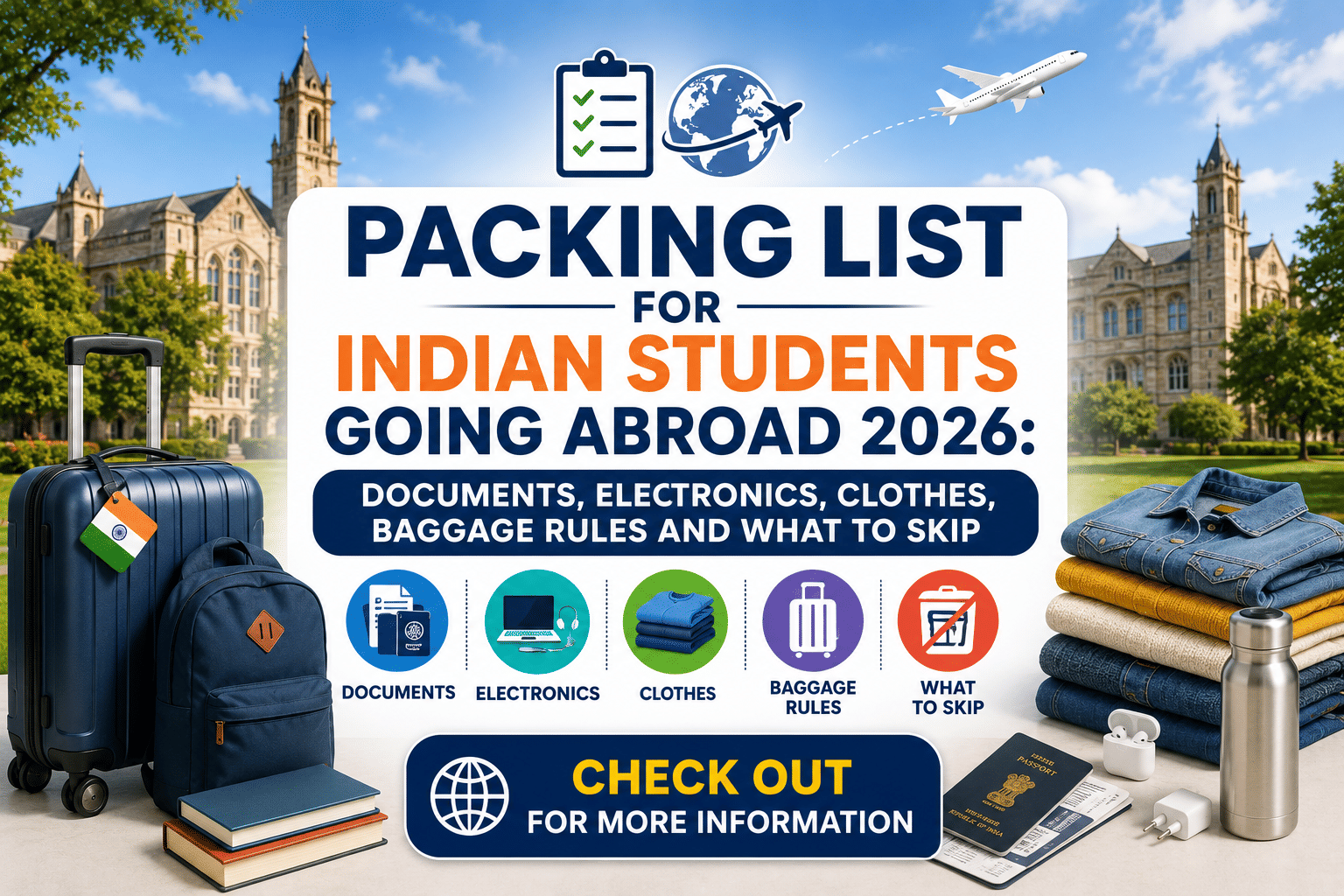
Over 13 lakh Indian students go abroad each year, and the most common regret is not a forgotten sock but a forgotten document or a suitcase stuffed with things sold cheaply down the street. Smart packing decides whether your first month abroad feels like a fresh start or a scramble of overspending and replacements.
- Baggage (US/Canada): usually 2 checked bags of 23 kg each, plus student perks on some airlines.
- Baggage (UK/Europe): often 1 checked bag, with a student extra piece available on select carriers.
- Cabin bag: typically 7 to 8 kg, holds documents, electronics and medicines.
- Power banks: cabin baggage only, never in checked bags.
- Liquids in cabin: under 100 ml each in a clear pouch.
- First-month spend: setting up a household abroad often costs INR 1.2 lakh to 2.5 lakh, so pack to reduce it.
Also Read:
Documents You Must Carry
Documents top every packing list for Indian students going abroad because they are the only items you cannot replace once you leave India. They clear immigration, confirm your enrolment and prove your funds, so they ride in your cabin bag with copies kept separately.
Carry originals, photocopies and scanned versions saved to cloud storage or emailed to yourself. If an original is lost or stolen, a copy keeps your situation manageable. Keep travel documents in one pouch and academic or financial papers in another so a single misplaced folder does not take everything.
- Passport and visa: plus two to three photocopies of each.
- Offer letter and enrolment proof: the university admission or I-20 type document.
- Academic records: mark sheets and certificates from Class 10 onward, attested.
- Financial proof: bank statements, loan sanction letter and fee receipts.
- Health and insurance: vaccination records and the insurance policy.
- Passport photos: a set in the destination's required size.
If you are still arranging funding, then sort the loan paperwork before you fly, since the sanction letter doubles as visa and arrival proof. A clear view of how education loans for studying abroad work helps you assemble the right papers.
Note: Photograph your packed suitcase inside and out before you check it in. If a bag goes missing, the airline knows what to look for and you have a record of what was inside.
Electronics and Gadgets
Electronics are worth carrying from India because they cost less here and your chargers will not fit foreign sockets without an adapter. Pack them in your cabin bag to avoid damage or loss in the hold.
Plug types differ across the US, UK and Europe, so a universal adapter is non-negotiable. A power bank covers long transit hours but must travel in cabin baggage only, as airlines ban it from checked luggage. Beyond the basics, a few small additions save money and stress in the first weeks.
- Laptop and charger: the one device you cannot study without.
- Smartphone and charger: set up roaming or a local SIM on arrival.
- Universal adapter (2 to 3): plug shapes vary by region.
- Power bank (10,000 mAh or more): cabin bag only.
- Scientific calculator: useful for technical or finance courses.
- Pen drive or external drive: for offline backups.
What electronics from India give you: savings and familiar devices. What they do not cover: socket compatibility, which only an adapter solves, and warranty support, which rarely transfers abroad.
Clothing for Your Climate
Clothing should match your destination's climate, and the smartest move is to buy heavy winter wear locally rather than haul it from India. Local winter jackets are better built for the actual cold and often cost less than carrying bulky coats.
For cold countries like Canada, the UK and the northern US, pack thermal inners, wool socks and a few layers to get through the first weeks, then buy the main jacket on arrival. For temperate destinations, breathable cotton and light layering work better. Carry a compact umbrella or raincoat anywhere with sudden showers.
- Thermals and base layers: light, warm and easy to pack for cold climates.
- Layering pieces: sweaters and a light jacket beat one heavy coat.
- Formal set: one or two outfits for presentations or interviews.
- Comfortable footwear: one everyday pair plus one weatherproof pair.
If you move to a cold-weather country, then budget INR 15,000 to 45,000 for winter clothing after arrival rather than overloading your suitcase. That means more baggage space for items that are genuinely hard to find abroad.
Note: Use vacuum storage bags to compress the few warm clothes you do carry. They free up significant suitcase space without adding weight.
Medicines and Health Kit
A compact medical kit belongs on every packing list because pharmacies abroad may not stock Indian brands and often require a local prescription for basics. Carry a sufficient supply of regular medication plus a doctor's prescription, all in your cabin bag.
Some medicines that are over-the-counter in India are restricted elsewhere, so check the destination's drug rules before packing. Keep the prescription with the medicine to make customs checks smoother, and sort items by use into labelled pouches.
- Prescription medication: enough supply for the settling-in period, with the prescription.
- Basic first aid: pain relief, antacids, band-aids and antiseptic.
- Supplements: any vitamins you take regularly.
- Spare glasses or lenses: plus your eye prescription.
What a home medical kit gives you: a buffer for the first weeks. What it does not cover: long-term needs, which means you should register with a local doctor and understand your insurance early. Source: drug-restriction guidance compiled from multiple study-abroad pre-departure advisories.
Kitchen and Food Items
A small starter kitchen kit and limited Indian food make the first two weeks easier, but neither should dominate your suitcase. The principle is to carry what is genuinely hard to find, not your whole pantry.
A compact pressure cooker is the single most requested item by Indian students abroad, alongside a non-stick pan and a few utensils. For food, pack small, clearly labelled containers of spices rather than bulk packets, since Indian grocery stores exist in most university cities. Check whether your accommodation provides kitchen facilities before deciding how much to bring.
- Pressure cooker (2 to 3 L): the top kitchen pick for quick Indian meals.
- One pan and one saucepan: lightweight, non-stick preferred.
- Basic utensils: a spatula, ladle and one set of plate, bowl and spoon.
- Spices in labelled pouches: 100 to 150 g each, not large packs.
If your dorm has a shared kitchen, then carry less, since pots and pans are easy to buy or inherit from graduating students. Research the nearest Indian grocery store in your city before you pack a single masala packet.
Toiletries and Personal Care
Pack only about a week's worth of toiletries, just enough to settle before your first local shopping trip. These items are heavy, widely available abroad and not worth the baggage weight in bulk.
Carry travel-sized bottles of the essentials so you are not hunting for a store the moment you land. Make sure caps are sealed tightly so nothing leaks across your clothes. Brands differ abroad, so if you depend on a specific product, bring a modest backup rather than a year's stock.
- Travel-size basics: toothpaste, soap, shampoo and a moisturiser.
- Climate add-ons: lip balm and a richer moisturiser for dry, cold air.
- Sun protection: sunscreen and UV sunglasses for sunny destinations.
- Personal items: a small supply of anything brand-specific you rely on.
What a week of toiletries gives you: a soft landing without an urgent store run. What it does not cover: the long term, which is cheaper and simpler to buy locally once you find the nearest supermarket.
Baggage Rules and Limits
Baggage allowance is the hard limit that shapes your entire packing list, and it differs by route and airline. Flights to the US and Canada usually follow a piece system, while UK and Europe routes often allow fewer bags.
On the India to US and Canada route, economy travellers typically get two checked bags of 23 kg each. Several airlines add student perks: Air India's Maharaja Scholars scheme gives an extra 10 kg over the standard allowance on US and Canada routes, and an extra 23 kg piece on UK and Europe routes, on a valid student visa. You must show your student documents at the check-in counter, since online check-in will not apply the extra allowance.
| Route | Typical Student Allowance |
|---|---|
| India to US / Canada (economy) | 2 x 23 kg checked, often +10 kg student extra |
| India to UK / Europe (economy) | 1 checked bag, often +1 piece (23 kg) for students |
| Cabin baggage | 7 to 8 kg, plus a small personal item |
| Single bag weight cap | Never above 32 kg per piece |
Pre-paying for excess baggage online is cheaper than paying at the airport, where rates can run USD 15 to 45 per kg on international routes. Shift heavy items like a laptop and chargers into your cabin allowance to protect your checked weight. Source: Air India student baggage policy, 2026.
Note: The student baggage perk only applies when you present your visa and ID at the counter. Book normally, then claim the extra allowance in person, never through the app.
Country-Specific Packing
Your destination's climate and rules should fine-tune the packing list, since a winter-heavy bag for Canada looks nothing like a light bag for a warmer country. Research the city's weather and local norms before you finalise anything.
For the US, UK and Canada, prioritise thermals and layering and buy the main winter coat locally. The deeper cost picture for these destinations sits in guides like the full cost breakdown for studying in the USA, which flags winter clothing as a first-month expense. For European destinations, factor in compact rain protection and check setup costs in the living-cost guide for Indian students in Europe.
- Canada and northern US: thermals, wool socks and touchscreen gloves.
- UK and Europe: a compact umbrella and a waterproof layer.
- Warm destinations: breathable cotton, sunglasses and a reusable bottle.
What Not to Pack
Leaving the wrong things out matters as much as packing the right ones, since dead weight crowds out useful items. Several categories are simply not worth the space.
Skip heavy textbooks, since libraries stock them and editions are easy to access abroad. Avoid large bottles of oil, sanitiser or shampoo, which are barred from flights and heavy anyway. Do not carry stacks of traditional clothes you are unlikely to wear, expensive jewellery that invites loss, or bulky snacks that eat baggage space.
- Textbooks: use the library or buy or rent locally.
- Large liquids: prohibited in cabin and wasteful in checked bags.
- Expensive jewellery: high risk of loss for little benefit.
- Bulk snacks: heavy and available at Indian stores abroad.
A good packing list for Indian students going abroad is less about cramming a suitcase and more about choosing well. Carry the documents you cannot replace, the electronics that cost more overseas, climate-right basics for the first weeks and a small kit of medicines, kitchen tools and spices. Buy the bulky winter wear, the toiletries and the household items after you land, where they are cheaper and better suited to local life. Pack for the first fortnight, respect the baggage limit and keep your essentials in your carry-on, and your first month abroad becomes a smooth start rather than a costly scramble.
FAQs
Ques. What should be on a packing list for Indian students going abroad?
Ans. The essentials are documents, electronics, climate-appropriate clothing, medicines with prescriptions, a small kitchen kit and limited Indian food. Carry documents and electronics in your cabin bag, and buy bulky or daily items locally after you arrive.
Ques. How much baggage can a student carry from India?
Ans. It depends on the route. Flights to the US and Canada usually allow 2 checked bags of 23 kg each, while UK and Europe routes often allow one. Several airlines add a student extra allowance on a valid student visa.
Ques. Should I carry winter clothes from India?
Ans. Carry only thermals and light layers for the first weeks. Buy the main winter jacket at your destination, where it suits the local climate better and often costs less. Budget around INR 15,000 to 45,000 for cold-country winter wear.
Ques. Can I carry medicines abroad as an Indian student?
Ans. Yes, with a doctor's prescription and within the destination's drug rules. Carry regular medication in your cabin bag with the prescription attached. Check first, since some medicines sold freely in India are restricted abroad.
Ques. Can I pack a power bank in checked luggage?
Ans. No. Power banks must travel in cabin baggage only and are banned from checked bags. The same caution applies to spare lithium batteries, which airlines require you to carry in the cabin.
Ques. What Indian food should I carry abroad?
Ans. Only small, labelled pouches of spices and a few items that are hard to find, not bulk packets. Most university cities have Indian grocery stores, so pack for the first two weeks rather than the whole year.
Ques. What should I not pack when going abroad?
Ans. Skip heavy textbooks, large liquid bottles, expensive jewellery, bulk snacks and high-wattage Indian appliances. These add weight, may be prohibited or are cheaply available abroad, and they crowd out genuinely useful items.
Ques. Do I need a universal adapter?
Ans. Yes. Plug types differ across the US, UK and Europe, so carry two or three universal adapters. Indian chargers will not fit foreign sockets without one, and buying them on arrival can be pricey.
Ques. How early should I start packing?
Ans. Begin a checklist two to three weeks before departure so you can shop during sales and avoid last-minute panic. Weigh your bags at home and keep all documents organised in your carry-on before you leave.
Ques. How much does the first month abroad cost to set up?
Ans. Setting up a household from scratch often costs INR 1.2 lakh to 2.5 lakh, covering bedding, kitchenware and deposits. Smart packing of hard-to-find items reduces this, but plan a buffer for the first-month essentials you will buy locally.


1691482074.png?tr=w-305,h-145,c-force?h=175&w=350&mode=stretch)



Comments