



Study Abroad Expert | Updated On - Oct 8, 2026
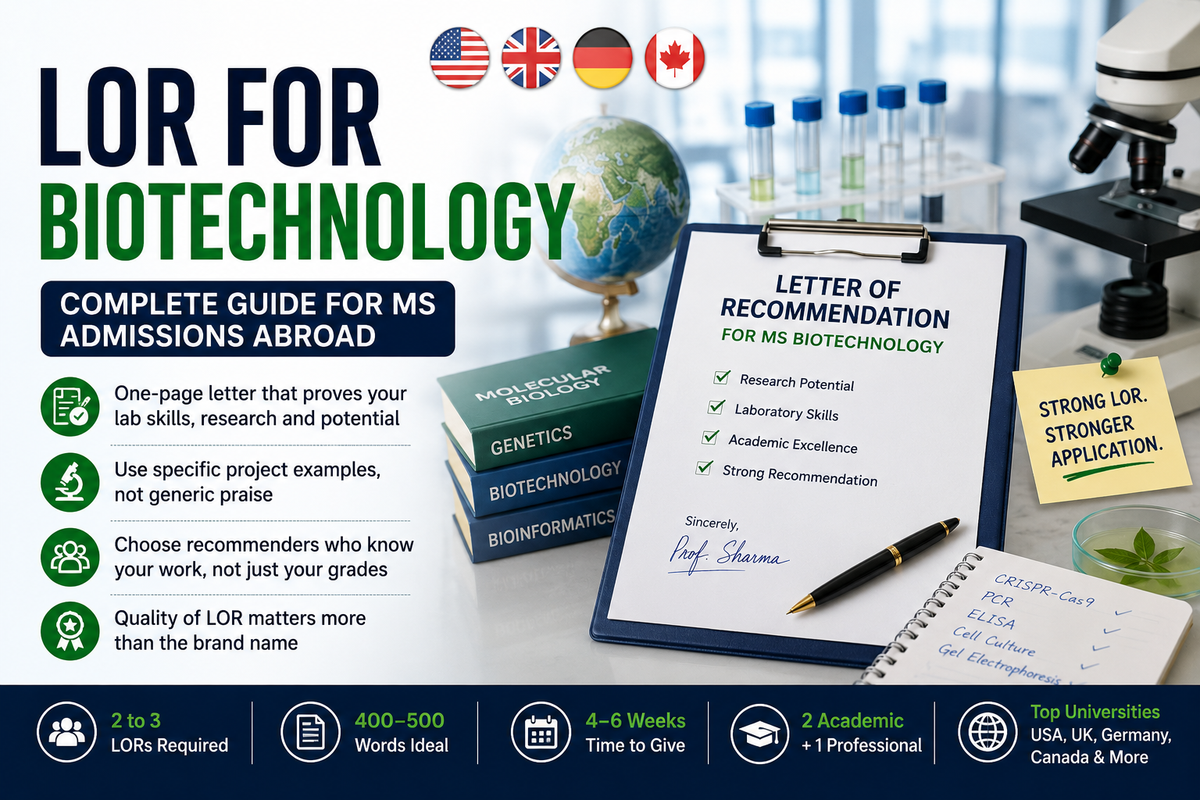
A strong LOR for Biotechnology is a one-page letter from a professor or research guide that proves you can handle lab work, research and coursework at the master’s level. Most top universities in the USA, UK, Germany and Canada ask for two or three such letters. Each letter should run 400 to 500 words and use specific project examples, not generic praise.
- A research-heavy LOR beats a grades-only LOR every time for biotech admissions.
- Pick recommenders who taught you recently and know your lab work, not the most senior name on campus.
- Every letter should feel different from your SOP and from the other two LORs in your file.
- Weak, generic letters hurt more than missing ones, so quality beats brand of the recommender.
Check SOP for MS in Biotechnology: samples and format for top universities
Applicants often over-focus on GPA and forget the LOR carries almost equal weight for lab-based programs. A single weak letter can pull down a strong file at Stanford, Johns Hopkins or TU Munich. Getting the LOR right early frees up time to polish your SOP, resume and visa file.
Quick Facts on LOR for Biotechnology
| Parameter | Detail |
|---|---|
| Number of LORs required | 2 to 3 per application |
| Ideal word count | 400 to 500 words (300 to 800 acceptable) |
| Ideal length | One page on official letterhead |
| Time to give recommender | 4 to 6 weeks minimum |
| Preferred mix (MS applicants) | 2 academic + 1 professional |
| Submission mode | Direct online upload by recommender via portal link |
| USA MS tuition range | USD 30,000 to 95,000 (INR 28.8 lakh to 91.2 lakh) total |
- How to Write an LOR for Biotechnology
- Biotech LOR for Bachelors vs Masters
- LOR Requirements at Top Biotech Universities
- Skills to Highlight in a Biotech LOR
- Sample LOR for MS Biotechnology
- Who Should Write Your Biotech LOR
- When to Request an LOR for Biotechnology
- Common Mistakes in a Biotech LOR
- Final Tips for a Strong Biotech LOR
How to Write an LOR for Biotechnology
A good LOR for Biotechnology follows a simple four-part structure: introduction, applicant skills, specific examples and a clear recommendation. The letter should read like a professional business letter. It sits on the recommender’s official letterhead and never runs past one page.
The opening paragraph names the recommender, their role and how they know you. It also states the course you are applying to. The middle paragraphs cover two or three lab or coursework moments in detail. The closing paragraph gives a direct recommendation and a contact line.
- Introduction: recommender’s name, designation, institute and years of teaching you.
- Applicant skills: two or three biotech skills backed by real lab or class stories.
- Comparison line: where you stand against peers in the same batch or lab.
- Conclusion: a clear "I strongly recommend" line and a way to contact the recommender.
Key Insight: Admissions readers scan the first and last paragraph of every LOR. If your recommender buries the recommendation line in the middle, the letter loses its punch.
Universities like Stanford Bioengineering ask the recommender to submit the letter directly through a secure portal link. That means your professor’s email address on your application must match the one they use to sign in. Country-wise LOR guidelines for master’s programs can help match tone and format to the destination.
Source: Stanford Bioengineering graduate admissions page and DAAD applicant handbook.
Biotech LOR for Bachelors vs Masters
A bachelor’s LOR proves you can handle a full undergraduate degree, while a master’s LOR proves you can handle independent research. The audience is different, so the content must shift.
LOR for Bachelor in Biotechnology
Schools admitting BSc Biotechnology students want proof of curiosity, discipline and science fundamentals. The recommender is usually a Class 11 to 12 subject teacher or a school principal. The letter should cover interest in biology and chemistry, willingness to do lab work and general classroom behaviour.
- Focus on consistent grades in biology, chemistry and maths.
- Add one story about a science fair, quiz or lab practical.
- Keep the tone warm but specific, not just "hardworking student".
LOR for Master in Biotechnology
MS admissions want proof you can drive a research project without hand-holding. Recommenders should focus on lab hours, thesis work, techniques used and any publication or poster. This is where names like PCR, CRISPR, gel electrophoresis or ELISA belong.
Explore bachelor biotechnology colleges abroad to see undergraduate LOR expectations at popular destinations.
LOR Requirements at Top Biotech Universities
Most top biotech programs ask for two or three letters, with at least one from a science professor. Some also allow one professional or industry recommender if you have work experience.
| University | Country | LORs Required | Notes |
|---|---|---|---|
| Stanford (MS Bioengineering) | USA | 3 | Academic or professional; submitted via portal |
| Johns Hopkins (MS Biotechnology) | USA | 3 | At least two academic strongly preferred |
| Harvard (Biological Sciences) | USA | 3 | Research supervisor letter carries weight |
| MIT (Biology / Biological Engg) | USA | 3 | All three usually academic |
| Cambridge (MPhil Biotech) | UK | 2 | Both academic; direct portal upload |
| Oxford (MSc Biochemistry) | UK | 3 | Two academic plus one flexible |
| TU Munich (Biotechnology) | Germany | 2 | Signed and stamped by recommender |
| Heidelberg (Molecular Biotech) | Germany | 2 | Research focus preferred |
| McGill (MSc Biotech) | Canada | 2 to 3 | At least two academic |
Requirements confirmed against university admission pages for the 2026 to 2027 intake. Numbers can change, so check each university before you apply.
See a full list of top biotechnology universities abroad and their document checklists in one place.
Skills to Highlight in a Biotech LOR
The strongest biotech LOR names three or four skills and backs each with a real classroom or lab story. Generic praise like "brilliant student" does not help admissions readers decide.
- Lab technique mastery: PCR, gel electrophoresis, cell culture, ELISA, Western blot, CRISPR editing.
- Analytical thinking: how you designed the control arm in a project or spotted a data error.
- Research writing: a thesis, a journal club summary or a review submitted for a class.
- Teamwork: lab rotations, group projects or peer-led practicals where you led a task.
- Independence: extra reading, night-shift lab work or self-taught software like GraphPad or R.
Key Insight: A skill without a story is just a claim. Every skill in a biotech LOR should point to a project, a technique or a result the professor watched you produce.
If you have coding or bioinformatics skills, ask your recommender to name the exact tool. "She used Bowtie2 to align 20 million short reads" beats "she is good at bioinformatics" for any research-heavy program. Read the SOP format and common mistakes so your LOR and SOP do not repeat the same stories.
Source: BioSpace professional recommendation letter template.
Sample LOR for MS Biotechnology
Below is a sample LOR for MS Biotechnology that follows the four-part structure and stays close to 450 words. Use it as a shape, not as text to copy.
[Recommender letterhead]
Date: 24 September 2026
To the Graduate Admissions Committee,
Department of Biotechnology,
[University name]
Subject: Letter of Recommendation for Ms. Ananya Rao, MS in Biotechnology
Dear Members of the Committee,
I am Dr. Priya Menon, Professor of Molecular Biology at [Institute name]. I have taught Ananya Rao for three years across genetics, molecular biology and a final year lab project. It is a real pleasure to recommend her for your MS in Biotechnology programme.
Ananya was among the top three students in a batch of 62 in my Advanced Molecular Biology course. She led her four-member team in the final year thesis on CRISPR-Cas9 gene editing in E. coli. She learned Cas9 vector design, ran three rounds of transformation and troubleshot low colony yield without any hand-holding. Her final report cited 22 papers and used clean, reproducible figures.
What sets Ananya apart is her lab hygiene and her patience. During a failed ELISA run last spring, she stayed back to redo the standard curve and traced the error to a diluted stop reagent. Most students would have blamed the kit. She also mentored two junior students in gel electrophoresis and cell culture technique.
Ananya writes clearly, presents calmly and asks the sort of questions that force the whole class to think again. She scored 9.2 out of 10 in my course. I rank her in the top 5 percent of undergraduates I have taught in 14 years.
I fully recommend Ananya for your MS in Biotechnology. She is ready for a research-heavy master’s programme and will contribute in and beyond the lab. Please reach me at [email] or [phone] for anything more.
Sincerely,
Dr. Priya Menon
Professor of Molecular Biology
[Institute name]
Notice how the letter names specific techniques, gives a ranking against peers and closes with a firm recommendation. That mix of numbers, stories and voice is what admissions readers look for.
Who Should Write Your Biotech LOR
Pick recommenders who taught you recently, know your lab work and can write in specific detail. A famous name who barely remembers you is a weaker choice than a mid-level professor who guided your thesis.
Best recommenders for MS Biotechnology
- Final year project guide: knows your research plan, technique and results.
- Core subject professor: can rank you against the batch and cite grades.
- Research lab head: if you did a summer internship or a semester rotation.
- Industry mentor: if you worked in a biotech firm or hospital lab for six months or more.
Recommender mix by profile
Fresh graduates should send three academic LORs. Applicants with one to two years of work experience often go with two academic and one professional LOR. Applicants with three years or more can send two professional and one academic LOR.
Key Insight: The department head or dean is only useful as a recommender if they actually taught or supervised you. Otherwise the letter reads as a formal courtesy, not a real assessment.
Applicants often ask if a family friend in a US lab can write a letter. The honest answer is no. Any relationship outside of academic or work supervision looks weak and can hurt the file. See MS Biotechnology in the US universities, fees and requirements for full document checklists.
When to Request an LOR for Biotechnology
Ask your recommenders at least four to six weeks before the university deadline. A rushed LOR reads rushed. Professors juggle 10 to 30 letters every application cycle, so early is safer.
| Timeline | Action |
|---|---|
| 10 to 12 weeks before deadline | Shortlist recommenders and check university portals for LOR format |
| 8 to 10 weeks before deadline | Meet each recommender in person or over a call to request the letter |
| 6 to 8 weeks before deadline | Share your SOP, resume, transcripts and university list |
| 4 weeks before deadline | Send a polite reminder and confirm portal access |
| 1 week before deadline | Final reminder and thank-you note |
Fall 2027 US deadlines mostly fall between December 2026 and January 2027. That means the ideal ask window is October 2026 for most Indian applicants targeting MS Biotechnology in the USA.
Common Mistakes in a Biotech LOR
The most common LOR mistakes are generic praise, repeated stories across letters and skipping specific lab techniques. Any one of these can drag a strong file into the wait-list pile.
- Generic praise: "hardworking, intelligent, disciplined" with no story to back it.
- Same story in every letter: all three LORs describing your final year project.
- No ranking: the letter never says where you stand versus the batch.
- Too long: anything above one page loses reader attention.
- Wrong recommender: a family friend or a distant HOD instead of your project guide.
- Writing it yourself: some professors ask you to draft the letter, but the voice must match theirs.
What students actually say on GradCafe: "My weakest letter came from the biggest name. My strongest came from the assistant professor who saw me struggle and grow in the lab."
What a strong LOR gives you
- A third-party voice that confirms your SOP claims.
- Specific proof of lab and research skills.
- A comparison line that helps the reader place you in the applicant pool.
What a LOR does not cover
- Your test scores, grades and GPA (that is what your transcript is for).
- Your visa or funding plan.
- Your career vision (that belongs in the SOP).
Final Tips for a Strong Biotech LOR
A strong biotech LOR is short, specific and honest. Give your recommender the tools to write well and follow up without being pushy.
- Share your SOP draft, resume and target universities in one folder.
- List two or three moments you want the professor to remember.
- Ask for one weakness or growth area to keep the letter honest.
- Never bcc yourself on the portal upload. It looks suspicious.
- Send a short thank-you email after each submission cycle.
If you plan to apply to Germany, remember that DAAD scholarship files also ask for LORs. Public university tuition in Germany is close to zero, but the LOR bar is still high. Applicants targeting the UK Chevening or the Fulbright-Nehru for the USA also need extra reference letters beyond the university’s requirement.
Conversions based on a USD-INR rate of INR 95.99 as of September 27, 2026. Rates fluctuate, so check the current rate before financial planning.
Also Check:
| MS Abroad Universities | Master Biotechnology Abroad | MS Biotechnology in USA |
| MS Biotechnology in Germany | Master in Biology Abroad | MS Molecular Biology Abroad |
A strong LOR for Biotechnology can carry a file that otherwise looks average. It gives an outside voice to what your grades and SOP already say. Pick recommenders who know your lab work, give them time and share a clear brief. If one letter comes back generic, ask a different professor or add a fourth recommender if the portal allows it. A little planning here saves a lot of stress in the final application week.
FAQs
Ques. How many LORs do I need for MS in Biotechnology?
Ans. Most top universities ask for two to three LORs. Stanford, Harvard, MIT and Johns Hopkins ask for three. TU Munich, Heidelberg and Cambridge accept two. Always check the exact number on the programme page before you request letters.
Ques. Can I submit a professional LOR for MS Biotechnology?
Ans. Yes, if you have real work experience. The usual mix is two academic plus one professional for applicants with one to two years in a lab or biotech firm. Fresh graduates should send three academic letters.
Ques. How long should a LOR for Biotechnology be?
Ans. Aim for 400 to 500 words on one page. Some professors write up to 800 words for research-heavy MS applications. Anything longer than one page loses reader attention.
Ques. Can I write my own LOR and get it signed?
Ans. Some Indian professors ask for a draft due to their workload. If that happens, use their voice and add real stories they can back. Universities check for reused text, so never copy any online sample word for word.
Ques. Who is the best recommender for a biotech MS application?
Ans. Your final year project guide or a core subject professor who taught you recently. They know your lab work, grades and effort. A famous name who barely remembers you is a weaker choice.
Ques. When should I ask for LORs for a Fall 2027 intake?
Ans. Start asking by October 2026 for most Fall 2027 US applications. Deadlines fall between December 2026 and January 2027. Give recommenders four to six weeks of clear notice.
Ques. Do I need a LOR for the DAAD scholarship for Biotechnology?
Ans. Yes. DAAD asks for two academic recommendations on top of the university’s own LORs. The DAAD form is a short signed page and different from a full academic letter, so plan for both.
Ques. Can a research supervisor from an internship write my LOR?
Ans. Yes, and it often carries more weight than a class teacher. A summer research fellow or lab rotation supervisor can speak to real lab work. Aim for at least three months of shared time before you ask.
Ques. Does a weak LOR reject my application?
Ans. A single weak LOR can drop a border-line file into the wait-list. Two weak LORs usually end the application. Two strong letters can still save you if the third is average, so protect at least two slots.
Ques. Should the LOR mention my weaknesses?
Ans. One honest growth area helps. It makes the letter feel real and shows the recommender knows you well. Do not let the weakness be a core research skill, because that hurts the file.
Ques. Do UK biotech universities want a different LOR format?
Ans. UK universities like Cambridge and Oxford ask for two academic LORs uploaded through the portal. The tone is a little more formal than in the US. Focus on academic ability and research potential over personality traits.
Ques. How is the biotech LOR different from a general MS LOR?
Ans. A biotech LOR must name specific lab techniques like PCR, ELISA, cell culture or CRISPR. A general MS LOR can stay high level. Skipping technique names makes a biotech LOR feel weak to admissions readers.



Comments