



Study Abroad Expert | Updated On - Oct 8, 2026
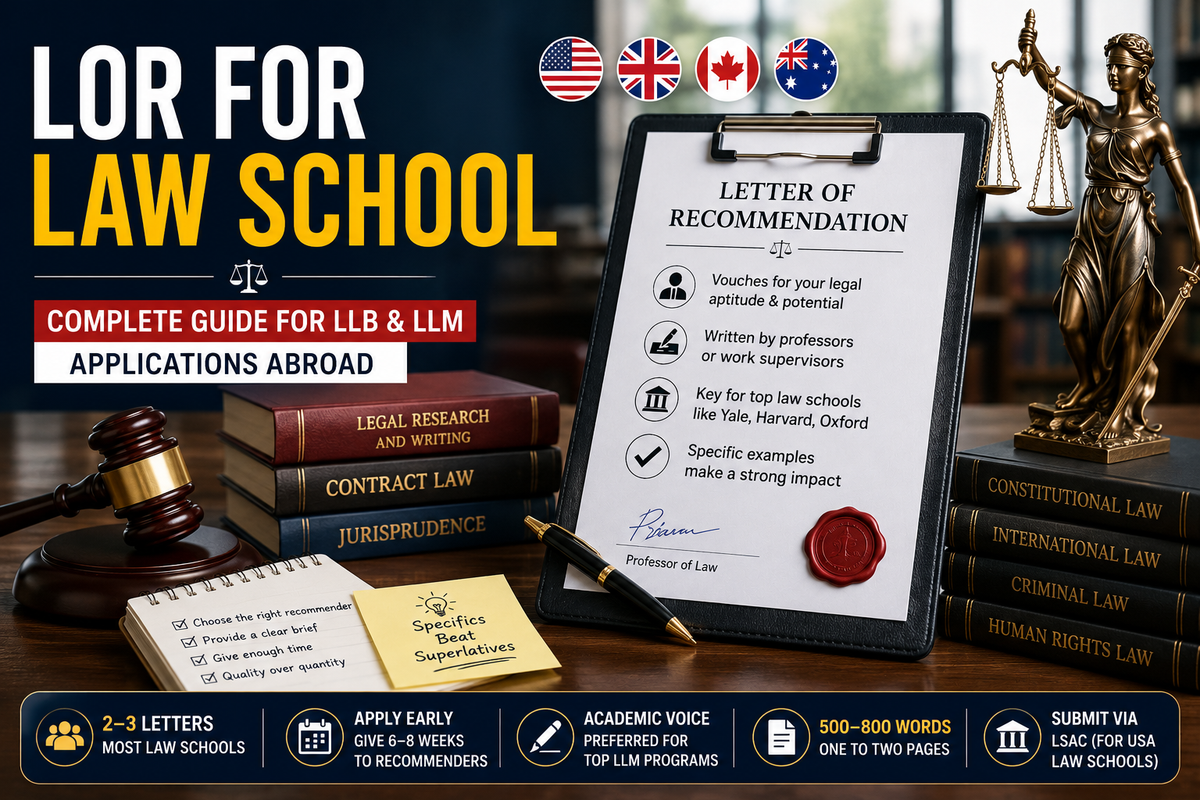
An LOR for Law School is a signed reference letter from your professor or work supervisor. It vouches for your legal aptitude, writing skill and courtroom potential in one page. Most law schools abroad ask for two to three letters per applicant.
- Recommender fit beats brand. Pick someone who has seen your legal thinking up close.
- Academic voice wins for top LLM programs like Yale, Harvard and Oxford.
- Specifics beat superlatives. A letter with real classroom or case examples outshines generic praise.
- Book early. Rushed letters read as rushed and can sink strong applications.
Check SOP for Law: Format and Samples for LLB and LLM
On the r/lawschooladmissions boards, admits often say the LOR was the one file they underestimated. Weak letters cost seats even at safety schools. A strong LOR can shift a borderline file into an admit stack, so treat it as a core essay, not a formality.
Quick Facts on LOR for Law School
| Parameter | Detail |
|---|---|
| Letters required (most law schools) | 2 to 3 |
| Harvard Law LLM range | 2 to 5 letters (most send 3) |
| Yale Law LLM range | 2 to 4 letters |
| NYU LLM minimum | 1 academic letter |
| Cambridge LLM / Oxford BCL requirement | 1 (Cambridge), 2 (Oxford) |
| Standard length | 500 to 800 words (one to two pages) |
| US LLM submission portal | LSAC LOR Service |
| LLM application opens (2027-28 cycle) | November 1, 2026 |
| Fall 2027 deadlines range | February 1 to May 1, 2027 |
Source: Yale Law School, Harvard Law School, NYU Law, LSAC, Cambridge Faculty of Law, Oxford Faculty of Law official pages.
- What is LOR for Law School?
- Types of LOR for Law School Applications
- LOR Format for Law School Applications
- How to Write LOR for LLB Law School
- How to Write LOR for LLM Law School
- Sample LOR for Law School Application
- Top Law School LOR Requirements Compared
- How to Submit LOR via LSAC Service
- Common LOR Mistakes Indian Students Make
- Tips to Write a Strong Law School LOR
- FAQs
What is LOR for Law School?
An LOR for Law School is a formal letter that speaks for your fit as a future lawyer. It sits alongside your transcripts, LSAT or CLAT score and SOP. Admissions officers use it to hear a third-party voice on your work.
Unlike your resume, the LOR is one of the few files you do not write yourself. That is why it carries so much weight for Indian applicants. Admissions teams know local grade inflation. A signed letter from a named professor cuts through that noise.
The letter must speak to skills that matter for law:
- Legal reasoning and how you argue a position.
- Written and oral communication in class or moot court.
- Research depth shown in a paper or seminar.
- Ethics and character as seen by the recommender.
- Leadership in a legal aid clinic, debate club or society.
Key Insight: A generic letter that only lists your CGPA adds no new signal. If the recommender cannot recall a specific class or case you argued, pick another writer.
The general LOR format for study abroad stays the same across streams. Law schools only demand sharper focus on advocacy skills.
Types of LOR for Law School Applications
Two LOR types dominate law school files: academic and professional. Most applicants send at least one of each. Very fresh graduates lean fully academic.
Academic LORs come from law faculty who have graded you. They know your writing, class arguments and seminar work. This is the letter Yale, Harvard and Oxford ask for first.
Professional LORs come from a workplace where you did legal or para-legal work. This could be a law firm partner, an in-house counsel or a research supervisor at an NGO. Send this if you have full-time work after your LLB.
| Type | Written by | Best for |
|---|---|---|
| Academic LOR | Law professor, dean, HOD, seminar guide | Fresh LLB graduates, LLM applicants under 3 years work experience |
| Professional LOR | Law firm partner, senior associate, in-house counsel, judge (during internship) | Applicants with 2+ years of legal practice |
| Character LOR (rare) | Community lead, NGO director | Only when a school explicitly invites it |
NYU asks for one academic letter as the required file. Berkeley Law prefers all academic writers unless you are already practicing. Source: NYU Law and Berkeley Law official LLM pages.
Read our Professional LOR guide for a full breakdown of workplace letters with samples.
LOR Format for Law School Applications
A law school LOR runs 500 to 800 words on the recommender’s official letterhead. One page is ideal. Two pages is the hard ceiling. Longer letters lose the reader.
The letter follows a fixed four-part shape:
- Header block: Recommender’s name, title, institution, address, phone, email and the date.
- Introduction (60 to 100 words): How the writer knows you, in which capacity and for how long.
- Body (300 to 500 words): Two or three specific stories that show one skill each. Case argued, paper written, moot won.
- Closing (60 to 100 words): A clear ranking or endorsement, signature and contact line.
Font stays formal: Times New Roman or Arial, size 11 or 12, single line spacing. Save as PDF. Never send Word files direct to schools.
Key Insight: Every strong law school LOR answers one silent question the admissions team is asking. Would this recommender fight for the student in a hiring meeting? The rest is filler.
Do not repeat the SOP. If the SOP already says you won a national moot, the LOR should say how you argued the constitutional question and what stood out. Two files, two angles, one story. Also skip flowery language. Adjectives like brilliant, outstanding or exceptional mean little without an example. Admissions readers see thousands of these lines each cycle.
How to Write LOR for LLB Law School
LOR for an LLB (Bachelor of Laws) admit relies fully on academic voice. Most applicants have no work history yet. School teachers, principals and undergraduate faculty write these letters. For UK LLB applications through UCAS, only one reference letter is needed. The UK format asks a school teacher or head to comment on your predicted grades and character. Source: UCAS official reference guide.
For US 3+3 or accelerated law programs, two academic letters are standard. Send one from your class teacher in humanities or social science. Send another from a subject like history, political science or English literature.
What to cover in an LLB LOR
- Analytical thinking: Cite a debate class or Model UN win.
- Written English: Point to a specific essay or research paper.
- Ethics and maturity: A tough moral debate handled well.
- Class participation: One story of a student-led discussion.
- Reading habit: Non-syllabus books read that show law curiosity.
Indian students often over-index on Physics or Maths teachers because of high scores in those subjects. This backfires for law. Pick a teacher who has seen you argue, write or research.
Read More: LOR for UK: Sample, Format and Program Guidelines
How to Write LOR for LLM Law School
LOR for an LLM (Master of Laws) admit is denser and more legal. It should read like a memo from a senior lawyer or law professor. Adjective-heavy student references get filtered out early. Top LLM programs ask for two or three letters. At least one must be from a law faculty member. The second can be from a workplace supervisor or another professor.
What every LLM LOR must contain
- Recommender credentials: Full designation, years of teaching or practice, area of law.
- Relationship context: Which course, seminar or case you worked on together.
- Two or three specific stories: Moot court, published paper, client brief, courtroom argument.
- Comparative ranking: "Top 5 out of 90 students I have taught in the last 4 years."
- Fit statement: Why the applicant suits an LLM at that school.
What LLM admits actually say on LLM GUIDE forums: "The letter that got me into Columbia had my professor describe a single seminar paper for two full paragraphs. That specificity was the difference."
If you are a working advocate, send one letter from a partner or judge who has watched you argue in court. Real courtroom moments carry more weight than abstract praise. Get help shaping the story around your LOR by pairing it with a strong SOP for Law in the USA. The two documents must speak to each other but never repeat the same anecdote.
Sample LOR for Law School Application
Below is a sample academic LOR for an LLM applicant, written by a law professor. Use it as a scaffold. Never lift the wording word for word.
[On official university letterhead]
Date: 15 October 2026
To the LLM Admissions Committee,
Harvard Law School,
Cambridge, Massachusetts, USA
Dear Members of the Committee,
It is my pleasure to recommend Ms. Ananya Sharma for admission to the Master of Laws programme at Harvard Law School. I am Professor of Constitutional Law at National Law School of India University, Bangalore. I have taught and supervised Ms. Sharma for three academic years across two seminar courses and one research project.
In my Advanced Constitutional Law seminar in 2025, Ms. Sharma submitted a 40-page paper on the Right to Privacy after the Puttaswamy judgment. Her argument that the proportionality test needed a fifth prong for digital surveillance was the most original claim in a class of 42 students. I would rank her paper in the top 3 out of the last 120 seminar papers I have graded at NLSIU.
Ms. Sharma also co-led a legal aid clinic that gave free advice to 180 domestic workers in Bangalore over 14 months. She drafted three template complaints for wage theft that our clinic still uses today. Her ability to translate constitutional principle into a working document that helps a non-lawyer is rare at her stage.
She combines the analytical care of a good research scholar with the practical drive of a young advocate. She has my full endorsement for a Harvard LLM and for the Human Rights Programme in particular. Please feel free to write to me for any further information.
Sincerely,
Professor XYZ
Professor of Constitutional Law
National Law School of India University, Bangalore
Email: xyz@nls.ac.in | Phone: +91 80 XXXX XXXX
Browse more study-abroad reference samples in our LOR samples and formats guide.
Top Law School LOR Requirements Compared
Every top law school sets its own LOR rules. The number of letters and who signs them varies more than students think. Check the school page before you brief a recommender.
| Law School (Programme) | Letters Required | Preferred Writer |
|---|---|---|
| Harvard Law (LLM) | 2 minimum, 5 max | Law faculty or professional supervisor |
| Yale Law (LLM) | 2 to 4 | Faculty members preferred |
| Stanford Law (LLM) | Via LSAC service | One legal practice, one academic |
| Columbia Law (LLM) | 2 to 3 | Faculty and professional mix |
| NYU Law (LLM) | 1 minimum (academic) | Law professor |
| Berkeley Law (LLM) | 2 to 3, up to 4 | Academic sources preferred |
| UCLA Law (LLM) | 2 minimum | Faculty first, then practice |
| Cambridge Faculty of Law (LLM) | 1 required | Academic referee |
| Oxford Faculty of Law (BCL / MJur) | 2 required | Academic referees only |
| LSE Law (LLM) | 2 required | Both academic |
Source: Harvard Law, Yale Law, Stanford Law, NYU Law, Berkeley Law, UCLA Law, Cambridge Faculty of Law, Oxford Faculty of Law and LSE Law official admissions pages, 2026-27 cycle.
Yale, Oxford and Cambridge lean fully academic. Harvard and Stanford accept a professional mix. NYU asks for the least. That does not mean it is easier: NYU expects the one letter to be excellent.
How to Submit LOR via LSAC Service
Most US law schools ask you to send letters through LSAC’s LOR service. LSAC stores the letters once and sends copies to every school you assign. This is the standard route for both JD and LLM files.
The submission flow works like this:
- Register on LSAC.org and pay for the Credential Assembly Service (CAS) or LLM CAS.
- Add each recommender’s name and email in your LSAC dashboard.
- LSAC emails the recommender a secure upload link.
- The writer uploads the letter as a PDF, signed on official letterhead.
- You then assign each letter to specific schools inside the LSAC portal.
For the 2027-28 cycle, LLM applications open on November 1, 2026. Fall 2027 deadlines run from February 1, 2027 (UCLA and priority Stanford) to May 1, 2027 (USC Gould international deadline). Source: LSAC and school admissions pages.
Key Insight: Once the recommender uploads to LSAC, you cannot see the letter. Ask for a courtesy copy before they hit submit. It is your one chance to catch a factual error.
UK, Canadian and European law schools mostly skip LSAC. Recommenders upload straight into each university portal (UCAS for UK undergrad, direct portals for LLM). Save PDF copies as a backup for every school.
Common LOR Mistakes Indian Students Make
Weak letters kill strong files every year. The mistakes below are the ones admissions officers flag most often on Reddit’s r/lawschooladmissions and on LLM GUIDE forums.
- Writing your own letter: A common practice in India that Yale, Harvard and Oxford explicitly warn against. Faculty ethics guides label this as academic dishonesty.
- Picking the most senior name over the closest teacher: A Dean who barely knows you writes a hollow letter. A guide who taught your seminar writes a rich one.
- Sending the same letter to every school: No tailoring for programme, no fit line, no target course mentioned.
- Repeating the SOP: Wasted paragraphs. Admissions readers spot this in one glance.
- Missing letterhead or signature: Some schools reject files with an unsigned PDF.
- Late uploads: Recommenders miss deadlines when asked less than three weeks out.
- Only school-teacher letters for LLM: LLM programmes want law faculty, not Class 12 subject teachers.
Also skip the flattery reflex. Phrases like "the brightest student I have ever taught" raise suspicion if the writer has taught for less than five years.
Tips to Write a Strong Law School LOR
Great law school LORs are built in the six weeks before the deadline. Rushing hurts even the sharpest recommender. Use the checklist below to brief your writer.
- Give six to eight weeks of notice. Faculty juggle multiple students each cycle.
- Share a one-page brief with your SOP, CV, target schools and two to three anecdotes the writer can pick from.
- List the schools and deadlines in a single table for the recommender.
- Suggest angles, not sentences. Yale’s own guidance allows students to share bullet points, never a draft.
- Ask for a fit line that mentions the target programme (Human Rights, IP Law, Tax) by name.
- Confirm the letterhead is official and the signature is scanned or wet.
- Follow up gently one week before the deadline. Then again three days out.
- Thank the recommender in writing once the file is submitted. Send an update when you get an admit.
Pair your LOR strategy with a solid documents-required checklist for study abroad. Transcripts, English scores and passport copies must be ready the same week as the LOR upload.
Key Insight: The best LORs for law come from a writer who has seen you fail once and recover. Struggle stories carry more weight than perfect-score stories in advocacy admissions.
Explore top law programmes in more depth on our Best LLM Colleges in the World guide before you finalise a school list.
Also Check:
A Letter of Recommendation for law school is one of the few application files that speaks in someone else’s voice. That voice must be specific, honest and rooted in real classroom or courtroom moments. Choose a recommender who knows your legal work, brief them well and leave enough runway for a careful draft. Match every letter to the target programme, keep it under two pages and never draft it yourself. Do this and your LOR moves from filler to file-changer.
FAQs
Ques. How many LORs are required for law school abroad?
Ans. Most law schools ask for two to three letters. Harvard Law LLM accepts up to five while NYU LLM asks for just one. Always check the school’s official admissions page before you brief writers.
Ques. Who should write my LOR for Law School?
Ans. Law faculty who have taught you in a seminar or graded your paper are the best choice. Partners at law firms or judges from your internship also work if you have practice years. Avoid Class 12 subject teachers unless you are applying to an LLB.
Ques. Can I write my own LOR and get it signed?
Ans. No. Yale, Harvard and other top schools mark this as a serious ethics issue. You can share bullet points and a CV. The recommender must write the actual letter. Getting caught can void your admit.
Ques. What is the ideal length for a Law School LOR?
Ans. Around 500 to 800 words on one page. Two pages is the hard maximum. Longer letters lose the reader. Fit two or three specific stories, one ranking line and a target-programme fit line.
Ques. When should I ask my professor for a Law School LOR?
Ans. At least six to eight weeks before the earliest deadline. Give a one-page brief with your SOP, CV, target schools and deadlines. Follow up one week and three days before the due date.
Ques. How do I submit LORs for a US law school?
Ans. Through the LSAC LOR service. You register on LSAC.org, add each recommender’s email, and LSAC sends them a secure upload link. You then assign each letter to the schools you are applying to.
Ques. Are academic or professional LORs stronger for LLM?
Ans. Academic letters win for top LLM programmes at Yale, Harvard, Oxford and Cambridge. If you have two-plus years of legal practice, one professional letter adds context. Send it alongside at least one law faculty letter.
Ques. What if my professor asks me to draft the LOR?
Ans. Politely offer a bullet-point brief instead. Share your SOP, CV and two or three anecdotes the professor can pick from. Yale’s guidance for faculty allows this while flagging student-written drafts as unethical.
Ques. Can I use the same LOR for every law school?
Ans. Not fully. The core content can repeat. The fit line at the end must name the target programme and school. LSAC lets recommenders upload one letter and assign copies to multiple schools, so the fit line is where tailoring happens.
Ques. Do UK law schools accept LSAC letters?
Ans. No. UK universities use their own direct portals or UCAS. Recommenders upload the PDF straight to the school. Cambridge asks for one letter and Oxford asks for two, both academic. Source: Cambridge and Oxford Faculty of Law official pages.
Ques. What skills should a Law School LOR highlight?
Ans. Legal reasoning, written and oral communication, research depth, ethics and leadership. Every skill must sit next to a real story. Vague adjectives like brilliant or outstanding without an example add no value.
Ques. What happens if my recommender misses the deadline?
Ans. Your file goes into pending status. Some schools review it once the letter arrives. Others hold it for the next cycle. Follow up one week before the deadline and again three days out to avoid this risk.



Comments