





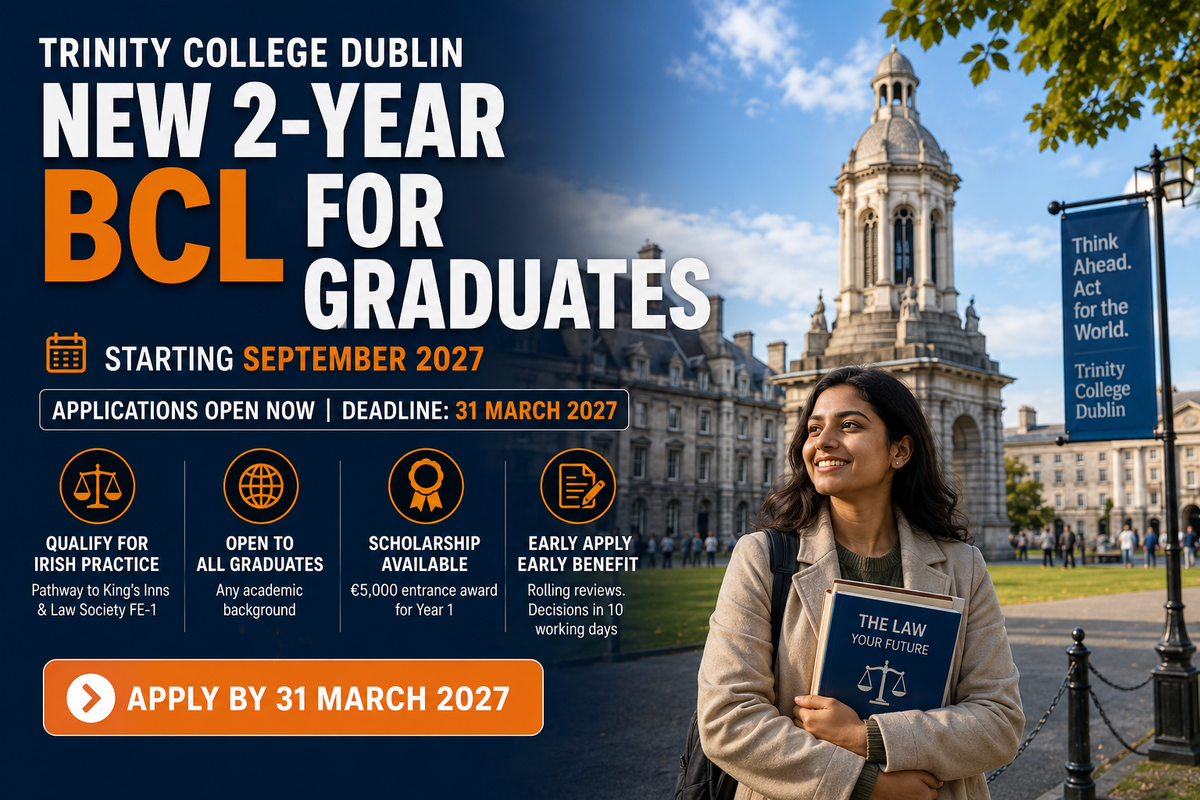
Trinity College Dublin graduate entry BCL is a new two-year law degree starting September 2027. Applications opened in November 2026 and close on 31 March 2027. The course lets graduates of any subject qualify for legal practice in Ireland.
- New pathway: this BCL is a fast law route for graduates who did not read law first.
- Real practice option: core modules match King’s Inns barrister training and Law Society FE-1 exam subjects.
- Scholarship cover: Trinity offers a first-year entrance award for applicants from the rest of the world.
- Early move wins: Trinity reviews on a rolling basis, so an early file catches the first review cycle.
Check Trinity College Dublin fees, courses and admissions for 2027
Trinity hosts an open info session on 19 November 2026 at 6 PM in the Arts Building. Applicants can preview the structure and meet faculty before committing. Indian graduates who did not study law earlier now have a two-year route into Irish practice. That is half the standard LLB timeline.
Quick facts on the Trinity BCL
| Parameter | Detail |
|---|---|
| Launch intake | September 2027 |
| Duration | 2 years, full-time |
| Applications open | November 2026 |
| Application deadline | 31 March 2027 |
| Non-EU tuition (year 1) | EUR 20,253 (INR 21.3 lakh) |
| EU tuition (year 1) | EUR 10,110 (INR 10.6 lakh) |
| Entrance scholarship | EUR 5,000 (around INR 5.25 lakh), year 1 |
| Application fee | EUR 55 |
| Offer deposit | EUR 500 |
| Minimum grade | II-2, Level 8 Award, any subject |
| English score | IELTS 7.0, no band below 6.0 |
| Year 1 credits | 70 ECTS |
| Weekly lectures | 10 to 12 hours |
- Quick facts on the Trinity BCL
- What the Trinity Dublin BCL offers
- Key dates for graduate entry BCL applicants
- Fees, costs and BCL scholarships 2027
- Who can apply for the graduate entry BCL
- What you study in the BCL course
- How Trinity BCL maps to Irish practice
- How to apply to the graduate entry BCL
- Visa and work rights after the BCL
- Why Indian students pick this BCL route
- FAQs on Trinity College Dublin graduate entry BCL
What the Trinity Dublin BCL offers
The Trinity College Dublin graduate entry BCL is a two-year full-time law degree for graduates of any subject. It gives credit for prior study, so classroom time is tighter than a standard four-year LLB. Trinity’s School of Law sits at QS rank 73 globally in the 2026 Law & Legal Studies subject table. The university as a whole holds #75 in the QS World University Rankings 2027. It remains Ireland’s top-ranked institution.
The course prepares graduates for two professional tracks in Ireland. First comes the barrister path at the Honorable Society of King’s Inns. Next comes the solicitor path through the Law Society of Ireland. The course also carries optional modules aimed at foreign jurisdictions. (Source: Trinity School of Law programme announcement, Irish Legal News.)
Key Insight: A BCL with King’s Inns alignment is a shortcut, not a bypass. Graduates still need to clear the King’s Inns entrance exam or the FE-1 papers to sit for professional training.
Candidates wondering how it differs from Trinity’s LLM should read the guide to LLM programmes in Ireland. An LLM adds a specialisation. The BCL builds the base qualification needed for Irish practice.
Key dates for graduate entry BCL applicants
The application window opened in November 2026 and shuts on 31 March 2027. Trinity reviews files on a rolling basis and aims to return a decision within ten working days.
| Milestone | Date |
|---|---|
| Applications open | November 2026 |
| Open info session, Arts Building | 19 November 2026, 6 PM |
| Final application deadline | 31 March 2027 |
| Decision window after submission | 10 working days |
| Conditional offer validity | 21 days |
| Final documents submission | Late July 2027 |
| Classes start | September 2027 |
Rolling review is why early submissions matter. If the fee is paid and references are in, a December file has a clean run at the first cycle.
If the plan stretches past March, a parallel Irish LLM route is worth tracking. The Trinity College Dublin admissions calendar covers deadlines across every programme stream.
Fees, costs and BCL scholarships 2027
Non-EU tuition for the Trinity graduate entry BCL is EUR 20,253 per year, roughly INR 21.3 lakh. EU-status students pay EUR 10,110 per year.
| Cost item | Amount (EUR) | Approximate INR |
|---|---|---|
| Tuition, non-EU, year 1 | EUR 20,253 | INR 21.3 lakh |
| Tuition, non-EU, two years | EUR 40,506 | INR 42.6 lakh |
| Tuition, EU, year 1 | EUR 10,110 | INR 10.6 lakh |
| Application fee | EUR 55 | INR 5,780 |
| Offer deposit | EUR 500 | INR 52,540 |
| Dublin living, per month | EUR 1,485 to 1,850 | INR 1.56 to 1.94 lakh |
| Trinity BCL entrance scholarship | EUR 5,000 | INR 5.25 lakh |
Conversions based on a EUR-INR rate of INR 105.08 as of November 6, 2026. Rates fluctuate. Check the current rate before financial planning.
Trinity offers three entrance scholarships worth EUR 5,000 each for year 1. One is for EU and UK applicants. One is for North America and Canada. The third is for applicants from the rest of the world, which covers India.
Total two-year sticker cost for an Indian student sits near INR 42.6 lakh on tuition. Dublin living costs add INR 31 to 39 lakh across the same two years. Factor in a 5 to 8% rupee buffer against the euro too. (Source: Trinity School of Law fees page.)
Key Insight: Trinity’s EUR 5,000 scholarship does not need a separate application for the first-year cycle. It is applied at offer stage based on the standard application review.
Indian lenders cover Irish tuition without collateral up to around INR 40 to 50 lakh. Named options include HDFC Credila, Avanse, InCred, Auxilo and Prodigy Finance. NBFC rates sit at 11 to 13.5%. SBI Global Ed-Vantage runs 10.5 to 11.5%. Prodigy Finance ranges from 12 to 14%. (Source: lender rate sheets as of November 2026.)
A full financial plan is covered in the cost of studying in Ireland for international students.
Who can apply for the graduate entry BCL
Trinity accepts any Level 8 Award (an honours bachelor’s degree) with at least a II-2 grade, regardless of subject. Prior law study is not required.
- Degree level: Level 8 honours award or equivalent, minimum second-class lower (II-2).
- Discipline: no subject restriction. Engineering, commerce, arts and science graduates all qualify.
- English: IELTS 7.0 overall with no band below 6.0.
- References: two academic letters, usually from undergraduate professors.
- Personal statement: up to 500 words.
- Curriculum vitae: a short CV covering education and work history.
Indian applicants who completed their degree fully in English can skip the IELTS. A formal letter from the awarding university confirming English-medium delivery is acceptable. (Source: Trinity English language policy.)
Graduates who already hold a common law LLB from India may find the BCL redundant. The programme is built for non-law graduates and holders of civil-law qualifications from other jurisdictions. For a wider sweep across Irish options, see the law colleges in Ireland listing. It covers ten institutions by fees and entry grade.
What you study in the BCL course
Year 1 of the graduate entry BCL is 70 ECTS, with 10 to 12 lecture hours each week per semester. Classes run between 9 AM and 7 PM, Monday to Friday. The core modules match two professional bodies in Ireland. First comes the Honorable Society of King’s Inns. It runs the Barrister-at-Law degree. Next comes the Law Society of Ireland. It sets the FE-1 entrance exams for solicitor training. The fit means the BCL doubles as preparation for both professional exams.
Core module focus areas
- Constitutional and administrative law: the foundation for public law practice.
- Contract and tort law: the bedrock of civil litigation.
- Criminal law and evidence: standard for both barrister and solicitor tracks.
- EU law and property law: required under FE-1 and King’s Inns entrance papers.
- Equity and company law: covered to match the full FE-1 subject list.
What the BCL does and does not cover
- Gives: academic grounding and FE-1 subject coverage.
- Gives: practice-focused modules on contemporary lawyering skills.
- Gives: optional modules aimed at foreign jurisdictions for cross-border work.
- Does not cover: the King’s Inns entrance exam itself. That is a separate sitting after graduation.
- Does not cover: the solicitor training years after FE-1 clearance.
Assessment blends formal exams with coursework. The timetable fills most of a normal working week, so part-time work during term is tight but allowed.
How Trinity BCL maps to Irish practice
The Trinity graduate entry BCL meets the academic entry bar for both barrister and solicitor training in Ireland. Graduates still complete a professional exam before any practice role.
Barrister track
The King’s Inns Barrister-at-Law degree is the professional course for any barrister in Ireland. Entry is by competitive examination after a recognised law qualification. The BCL covers all mandatory subjects in the entrance exam. Successful candidates then complete a one-year full-time or two-year modular Barrister-at-Law degree at King’s Inns.
Solicitor track
The Law Society of Ireland runs the FE-1 exams across eight subjects. The BCL aligns core modules with those eight papers. After passing FE-1, graduates complete the Professional Practice Course and training contracts with a firm. Total time to qualify as a solicitor is around two years after FE-1 clearance.
The BCL also adds optional modules built around foreign jurisdictions. That opens a route into London firms through the SQE. US LLM-plus-bar routes also open up, if the extra exams are cleared. The Trinity law courses catalogue lists the related postgraduate options for cross-border tracks.
How to apply to the graduate entry BCL
Applications go through Trinity’s online portal at my.tcd.ie, not through the CAO undergraduate system. The application fee is EUR 55 and must be paid online. The portal asks for a set of documents. Keep a clean PDF copy of every file before starting the form.
- Transcripts and degree certificate: certified copies from the Indian university.
- Two academic references: usually from undergraduate professors.
- Personal statement: up to 500 words, focused on why law and why Trinity.
- Curriculum vitae: one or two pages of education and work history.
- English language evidence: IELTS score or a formal medium-of-instruction letter.
- Passport copy: a scan of the photo page.
Trinity reviews files on a rolling basis. Once the committee clears a file, an offer letter lands within ten working days. Conditional offers stay open for 21 days, after which the seat opens up again.
Key Insight: An Indian applicant with a II-1 or higher and strong academic references should file by January 2027. That cycle still has open scholarship slots and leaves time for the visa file.
For a wider look at Trinity’s full course catalogue beyond the BCL, the Trinity programmes list breaks down every stream by fee and entry grade.
Check out University College Dublin, the closest head-to-head for law in Ireland
Visa and work rights after the BCL
Indian applicants need a D-type long-stay visa to study the Trinity graduate entry BCL. Once in Ireland, the stamp on the IRP card is Stamp 2 for the full two years.
| Visa item | Rule |
|---|---|
| Study visa type | D visa (long stay, more than 90 days) |
| Visa fee, single entry | EUR 60 (INR 6,305) |
| Visa fee, multiple entry | EUR 100 (INR 10,508) |
| VFS service charge | EUR 22 |
| Minimum bank balance | EUR 10,000 (INR 10.5 lakh) |
| Student stamp in Ireland | Stamp 2 |
| Term-time work limit | 20 hours per week |
| Post-study stamp (Level 8 award) | Stamp 1G, 1 year |
| Stamp 1G renewal fee | EUR 300 |
The Third Level Graduate Programme gives a Stamp 1G for one year after a Level 8 degree. That one-year stamp is the open-market job search window. Graduates who clear the King’s Inns entrance exam or start FE-1 preparation can use that year for the professional track. (Source: Immigration Service Delivery, Ireland.)
Why Indian students pick this BCL route
The Trinity College Dublin graduate entry BCL is one of the fastest routes for an Indian non-law graduate to practise in Ireland. It opens doors a straight LLM does not.Three draws stand out. One, the course bridges the FE-1 subject gap that blocks Indian LLB holders from the solicitor track directly. Two, Dublin is an English-medium legal market inside the EU. Three, Trinity’s name carries the same weight as Oxford or UCL in Irish firms.
Tuition at EUR 20,253 sits well below UK equivalents. A graduate-entry LLB at a top London school usually crosses GBP 28,000 per year. Trinity’s two-year tuition stays under INR 43 lakh. That is close to the cost of a one-year UK LLM.
What the BCL route gives you
- Qualifying law degree: covers all King’s Inns and FE-1 mandatory subjects.
- EU market access: Irish admission opens cross-border practice in European firms.
- English-medium delivery: no second-language barrier for Indian graduates.
- Brand strength: Trinity sits at QS rank 73 in law and #75 overall.
What the BCL does not cover
- Bar entry fees: King’s Inns and FE-1 are separate professional sittings.
- Housing cost: Dublin rent runs EUR 1,000 to 1,300 per month.
- Long post-study window: Stamp 1G at one year is shorter than the UK Graduate Route.
- Work-permit sponsorship: a job offer from an Irish firm is needed to stay past Stamp 1G.
For broader comparisons between Ireland and other English-language destinations, the Ireland study guide covers cost, course and visa data for Indian applicants.
Also Check:
| Trinity Dublin scholarships | LLB in Ireland | Trinity Dublin student reviews |
| Law universities in Ireland | QS-ranked colleges in Ireland | Trinity humanities courses |
Trinity College Dublin’s graduate entry BCL is the clearest two-year route into Irish legal practice for an Indian non-law graduate. The 31 March 2027 deadline sits inside a rolling review window, so an early file through my.tcd.ie carries a real edge on scholarships. Non-EU tuition at EUR 20,253 and a one-year Stamp 1G work window frame the trade-off against UK and US alternatives. King’s Inns and FE-1 sittings still sit between the degree and professional practice. For Indian applicants without a prior law degree, no faster bridge into Ireland’s barrister or solicitor market exists today.
FAQs
Ques. What is the Trinity College Dublin graduate entry BCL?
Ans. The Trinity College Dublin graduate entry BCL is a two-year law degree launched for September 2027 intake. It is open to graduates of any subject who hold a Level 8 honours award. The course covers all core subjects needed for Ireland’s barrister and solicitor professional routes.
Ques. When does the Trinity graduate entry BCL start?
Ans. September 2027. Classes begin in the first week of the Trinity autumn term. The two-year course runs across four semesters and ends in mid-2029 for the first batch.
Ques. What is the deadline to apply for the Trinity BCL?
Ans. 31 March 2027. Applications opened in November 2026 through the my.tcd.ie online portal. Trinity reviews files on a rolling basis, so an early submission usually returns an offer within ten working days.
Ques. What is the fee for the Trinity graduate entry BCL for Indian students?
Ans. EUR 20,253 per year for non-EU students, which is around INR 21.3 lakh. Total two-year tuition sits near INR 42.6 lakh at the November 2026 exchange rate. The programme fee for EU-status students is EUR 10,110 per year.
Ques. Is the Trinity BCL better than an LLM for an Indian non-law graduate?
Ans. It depends on the career goal. The graduate entry BCL is the stronger choice for someone who wants to practise law in Ireland. An LLM adds a specialisation on top of an existing law degree. It does not satisfy the FE-1 eligibility rule for Indian LLB holders.
Ques. Does Trinity offer scholarships for the graduate entry BCL?
Ans. Yes. Trinity offers a EUR 5,000 entrance scholarship for year 1 of the programme. Three separate awards cover EU and UK applicants, North American and Canadian applicants and candidates from the rest of the world. Indian applicants fall under the third category.
Ques. What are the eligibility requirements for the Trinity BCL?
Ans. A Level 8 honours award with a minimum II-2 grade in any subject. English language proof via IELTS 7.0 (no band below 6.0) is required, unless the prior degree was taught fully in English. Two academic references, a CV and a 500-word personal statement complete the file.
Ques. Can an Indian student practise law in Ireland after the Trinity BCL?
Ans. Yes, after further exams. The BCL opens the barrister route through the King’s Inns entrance exam. The solicitor route runs through the Law Society of Ireland FE-1 papers. Each route then adds a one to two-year professional training stage.
Ques. What post-study work visa is available after the Trinity BCL?
Ans. Stamp 1G for one year under the Third Level Graduate Programme. The BCL is a Level 8 Irish award, so the post-study permission matches the one-year bachelor’s rule. A follow-on Level 9 master’s in Ireland can extend that window to two years.
Ques. What documents are needed for the Trinity graduate entry BCL application?
Ans. Six documents are needed. Certified transcripts and the degree certificate head the list. Two academic references, a CV and a personal statement up to 500 words follow. English language evidence or a medium-of-instruction letter rounds out the file. The application fee is EUR 55.
Ques. What is the cost of living in Dublin for a Trinity BCL student?
Ans. Between EUR 1,485 and EUR 1,850 per month, which is around INR 1.56 to 1.94 lakh. Rent takes the biggest share at EUR 1,000 to 1,300 per month. Food, transport and personal expenses make up the rest of the Dublin budget.
Ques. How does the Trinity BCL compare to a UK graduate entry law programme?
Ans. Trinity’s BCL costs less than most UK graduate entry LLBs. A UK two-year graduate entry LLB at a Russell Group school usually crosses GBP 28,000 per year. Trinity sits at EUR 20,253, with closer access to EU legal work and a slightly shorter post-study visa window.




interested in this College ?
Follow & Share this college to get information about admission.



Comments