Question:
Which one of the following odontomes is a locally invasive malignant tumour?
Which one of the following odontomes is a locally invasive malignant tumour?
Show Hint
Think of the odontogenic lesion that needs wide bone resection, not simple curettage.
Updated On: Jul 7, 2026
- Odontogenic myxoma
- Fibromatous epulis
- Dentigerous cyst
- Ameloblastoma
Show Solution

Verified By Collegedunia
The Correct Option is D
Solution and Explanation
Step 1: Understanding the Question:
The question lists four lesions that arise from the tooth forming tissue (odontogenic lesions) and asks which one behaves as a locally invasive tumour rather than a simple cyst or a harmless overgrowth.
Step 2: Key Concept:
Among odontogenic lesions, most are either cysts (fluid filled sacs) or benign reactive growths that stay confined to one spot. Ameloblastoma is the one true exception. It is a benign tumour by cell type, but it grows in finger like projections into the surrounding jaw bone, so it behaves like a locally invasive tumour even though it almost never spreads to distant organs.
Step 3: Detailed Explanation:
Odontogenic myxoma is a benign tumour of the tooth forming mesenchyme. It can enlarge the jaw but grows slowly and is not the lesion classically labelled as locally invasive.
Fibromatous epulis is a reactive fibrous overgrowth of the gum, caused by chronic irritation. It stays on the gum surface and does not invade bone.
Dentigerous cyst is a fluid filled cyst that forms around the crown of an unerupted tooth. It can enlarge the jaw by slow pressure, but it is a cyst, not a tumour, and it does not invade surrounding tissue the way a tumour does.
Ameloblastoma arises from remnants of the dental lamina, the tissue that forms enamel. It grows as sheets and islands of cells that push into the cancellous bone of the jaw, destroying it locally. Because of this behaviour, surgeons treat it with a wide margin of normal bone, similar to how a malignant tumour is treated, even though true distant spread is rare.
Step 4: Final Answer:
The odontome that behaves as a locally invasive tumour is ameloblastoma.
The question lists four lesions that arise from the tooth forming tissue (odontogenic lesions) and asks which one behaves as a locally invasive tumour rather than a simple cyst or a harmless overgrowth.
Step 2: Key Concept:
Among odontogenic lesions, most are either cysts (fluid filled sacs) or benign reactive growths that stay confined to one spot. Ameloblastoma is the one true exception. It is a benign tumour by cell type, but it grows in finger like projections into the surrounding jaw bone, so it behaves like a locally invasive tumour even though it almost never spreads to distant organs.
Step 3: Detailed Explanation:
Odontogenic myxoma is a benign tumour of the tooth forming mesenchyme. It can enlarge the jaw but grows slowly and is not the lesion classically labelled as locally invasive.
Fibromatous epulis is a reactive fibrous overgrowth of the gum, caused by chronic irritation. It stays on the gum surface and does not invade bone.
Dentigerous cyst is a fluid filled cyst that forms around the crown of an unerupted tooth. It can enlarge the jaw by slow pressure, but it is a cyst, not a tumour, and it does not invade surrounding tissue the way a tumour does.
Ameloblastoma arises from remnants of the dental lamina, the tissue that forms enamel. It grows as sheets and islands of cells that push into the cancellous bone of the jaw, destroying it locally. Because of this behaviour, surgeons treat it with a wide margin of normal bone, similar to how a malignant tumour is treated, even though true distant spread is rare.
Step 4: Final Answer:
The odontome that behaves as a locally invasive tumour is ameloblastoma.
Was this answer helpful?
0
0
Top NEET PG Surgery Questions
- A 55-year-old male presented with verrucous carcinoma around the glans of the penis. Examination reveals that the inguinal lymph nodes are not enlarged. What is the appropriate management for this patient?
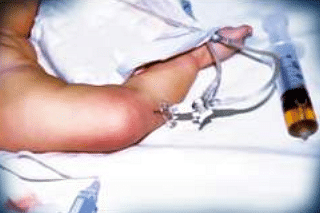
- Identify the procedure being performed in the image given below.
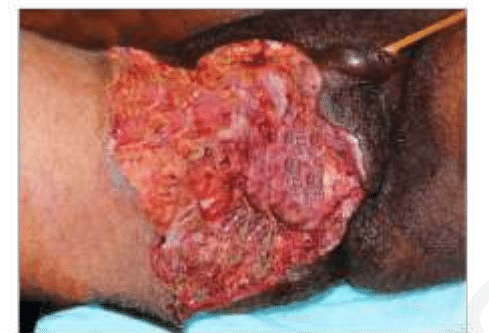
- A diabetic patient presents with sudden-onset perineal pain. On examination, foul-smelling discharge, and necrotic tissue as seen in the image is noted. Which of the following is true about the given condition?
- Which of the following is the most common complication following ligation of the first vessel during abdominoperineal resection for rectal carcinoma?(APR Abdominoperineal resection)
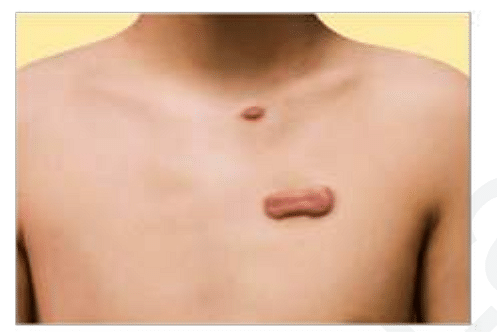
- A patient presents to the clinic with the lesion given in the image. He had a traumatic injury to the chest one year ago. What is the most likely diagnosis?
View More Questions
Top NEET PG Questions
- A patient hailing from Delhi presents with fever, arthralgia, and extensive petechial rash for 3 days. Lab investigations revealed a hemoglobin of 9 g/ dL, a white blood cell count of 9000 cells/mm3, a platelet count of 20000 cells/mm3, and a prolonged bleeding time. The clotting time was normal. What is the most likely diagnosis?
- Which of the following statements is true about Trichomonas vaginalis?
- A lady from West Rajasthan presented with an ulcer surrounded by erythema on the right leg. Microscopy of the biopsy from the edge of the ulcer showed organisms with dark staining nuclei and kinetoplast. What is the most likely causative agent?
- A child presents with a fever and a rash. Urine examination showed cells with owl's eye appearance. What is the most likely diagnosis?
- Infection with Clonorchis sinensis is associated with an increased risk of__?
View More Questions