Question:
What is NOT true about torsion of the testes?
What is NOT true about torsion of the testes?
Show Hint
Pyuria points away from torsion, not toward it, since torsion is a vascular, not infective, problem.
Updated On: Jul 8, 2026
- Absence of flow on Doppler clinches diagnosis
- Presence of pyuria assists the diagnosis
- The opposite side testis should be fixed
- Raising the testis worsens the pain
Show Solution

Verified By Collegedunia
The Correct Option is B
Solution and Explanation
Step 1: Understand the question format again.
This is another NOT true question about testicular torsion, so three statements are accurate and one is the false one we need to pick.
Step 2: Recall the basics of testicular torsion.
Torsion happens when the testis twists on its spermatic cord, cutting off its own blood supply. It is a surgical emergency, since the testis can become non viable within a few hours if not untwisted.
Step 3: Check the Doppler statement.
Option A says absent flow on Doppler ultrasound clinches the diagnosis. This is true, colour Doppler showing no blood flow to the testis in a patient with sudden severe scrotal pain is strong evidence of torsion, though a clinically obvious torsion should not wait for imaging if it delays surgery.
Step 4: Check the pyuria statement.
Option B says presence of pyuria, pus cells in urine, assists the diagnosis of torsion. This is false. Torsion is a purely vascular, mechanical problem, it does not cause pus cells in the urine. Pyuria instead points toward an infective cause of scrotal pain, such as epididymo-orchitis or a urinary tract infection, and is actually one of the ways doctors try to tell torsion apart from infection. So pyuria argues against torsion, it does not assist its diagnosis.
Step 5: Check the remaining two statements.
Option C, fixing the opposite testis, is true and important, since the anatomical defect, a bell clapper deformity, that allowed one testis to twist is usually present on both sides, so the other testis is fixed at the same operation to prevent it twisting later. Option D, that raising the testis worsens the pain, is also a recognised clinical sign, this is the basis of a negative Prehn's sign, where lifting the scrotum does not relieve pain in torsion, unlike in epididymitis, where lifting the testis, a positive Prehn's sign, tends to relieve pain.
Step 6: Final answer.
Since A, C, and D are all true and only B is false, the answer is
\[ \boxed{\text{Presence of pyuria assists the diagnosis}} \]
This is another NOT true question about testicular torsion, so three statements are accurate and one is the false one we need to pick.
Step 2: Recall the basics of testicular torsion.
Torsion happens when the testis twists on its spermatic cord, cutting off its own blood supply. It is a surgical emergency, since the testis can become non viable within a few hours if not untwisted.
Step 3: Check the Doppler statement.
Option A says absent flow on Doppler ultrasound clinches the diagnosis. This is true, colour Doppler showing no blood flow to the testis in a patient with sudden severe scrotal pain is strong evidence of torsion, though a clinically obvious torsion should not wait for imaging if it delays surgery.
Step 4: Check the pyuria statement.
Option B says presence of pyuria, pus cells in urine, assists the diagnosis of torsion. This is false. Torsion is a purely vascular, mechanical problem, it does not cause pus cells in the urine. Pyuria instead points toward an infective cause of scrotal pain, such as epididymo-orchitis or a urinary tract infection, and is actually one of the ways doctors try to tell torsion apart from infection. So pyuria argues against torsion, it does not assist its diagnosis.
Step 5: Check the remaining two statements.
Option C, fixing the opposite testis, is true and important, since the anatomical defect, a bell clapper deformity, that allowed one testis to twist is usually present on both sides, so the other testis is fixed at the same operation to prevent it twisting later. Option D, that raising the testis worsens the pain, is also a recognised clinical sign, this is the basis of a negative Prehn's sign, where lifting the scrotum does not relieve pain in torsion, unlike in epididymitis, where lifting the testis, a positive Prehn's sign, tends to relieve pain.
Step 6: Final answer.
Since A, C, and D are all true and only B is false, the answer is
\[ \boxed{\text{Presence of pyuria assists the diagnosis}} \]
Was this answer helpful?
0
0
Top NEET PG Surgery Questions
- A 55-year-old male presented with verrucous carcinoma around the glans of the penis. Examination reveals that the inguinal lymph nodes are not enlarged. What is the appropriate management for this patient?
- Identify the procedure being performed in the image given below.
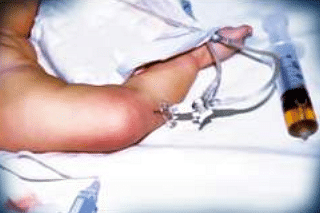
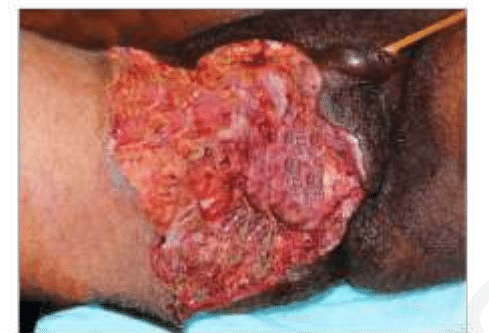
- A diabetic patient presents with sudden-onset perineal pain. On examination, foul-smelling discharge, and necrotic tissue as seen in the image is noted. Which of the following is true about the given condition?
- Which of the following is the most common complication following ligation of the first vessel during abdominoperineal resection for rectal carcinoma?(APR Abdominoperineal resection)
- A patient presents to the clinic with the lesion given in the image. He had a traumatic injury to the chest one year ago. What is the most likely diagnosis?
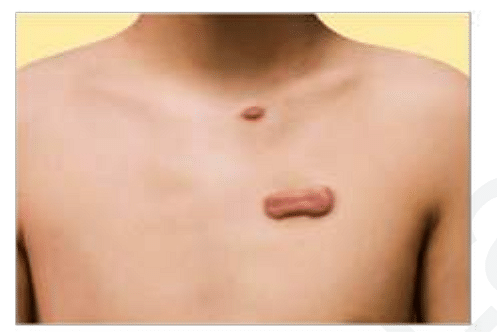
View More Questions
Top NEET PG Questions
- A patient hailing from Delhi presents with fever, arthralgia, and extensive petechial rash for 3 days. Lab investigations revealed a hemoglobin of 9 g/ dL, a white blood cell count of 9000 cells/mm3, a platelet count of 20000 cells/mm3, and a prolonged bleeding time. The clotting time was normal. What is the most likely diagnosis?
- Which of the following statements is true about Trichomonas vaginalis?
- A lady from West Rajasthan presented with an ulcer surrounded by erythema on the right leg. Microscopy of the biopsy from the edge of the ulcer showed organisms with dark staining nuclei and kinetoplast. What is the most likely causative agent?
- A child presents with a fever and a rash. Urine examination showed cells with owl's eye appearance. What is the most likely diagnosis?
- Infection with Clonorchis sinensis is associated with an increased risk of__?
View More Questions