Two radioactive elements A and B initially have the same number of atoms. The half-life of A is the same as the average life of B. If \( \lambda_A \) and \( \lambda_B \) are the decay constants of A and B respectively, then choose the correct relation from the given options:
Two radioactive elements A and B initially have the same number of atoms. The half-life of A is the same as the average life of B. If \( \lambda_A \) and \( \lambda_B \) are the decay constants of A and B respectively, then choose the correct relation from the given options:
\( \lambda_A = 2\lambda_B \)
\( \lambda_A = \lambda_B \)
\( \lambda_A \ln 2 = \lambda_B \)
\( \lambda_A = \lambda_B \ln 2 \)

The Correct Option is D
Solution and Explanation
We are given that the half-life of A is the same as the average life of B. The average life \( \tau \) and half-life \( T \) are related to the decay constant \( \lambda \) by the equations: \[ T = \frac{\ln 2}{\lambda} \quad \text{and} \quad \tau = \frac{1}{\lambda} \] Since the half-life of A is the same as the average life of B, we have: \[ \lambda_A = \lambda_B \ln 2 \] Hence, the correct relation is \( \lambda_A = \lambda_B \ln 2 \).
Top JEE Main Physics Questions
- Water drops fall from a tap on the floor, \(5\) m below, at regular intervals of time. The first drop strikes the floor when the sixth drop begins to fall. The height at which the fourth drop will be from the ground, at the instant when the first drop strikes the ground, is ________ m. (\( g = 10 \, \text{m s}^{-2} \))
- JEE Main - 2026
- Physics
- Kinematics
- A block of mass \(5\) kg is moving on an inclined plane which makes an angle of \(30^\circ\) with the horizontal. The coefficient of friction between the block and the inclined plane surface is \(\dfrac{\sqrt{3}}{2}\). The force to be applied on the block so that the block moves {down the plane without acceleration is ________ N. (\( g = 10 \, \text{m s}^{-2} \))}
- JEE Main - 2026
- Physics
- Newtons Laws of Motion
Identify the correct truth table of the given logic circuit.

- JEE Main - 2026
- Physics
- communication systems
- The escape velocity from a spherical planet \(A\) is \(10\ \text{km/s}\). The escape velocity from another planet \(B\), whose density and radius are \(10%\) of those of planet \(A\), is _______ m/s.
- JEE Main - 2026
- Physics
- Gravitation
- A current carrying solenoid is placed vertically and a particle of mass m with charge Q is released from rest. The particle moves along the axis of solenoid. If g is acceleration due to gravity then the acceleration (a) of the charged particle will satisfy:
- JEE Main - 2026
- Physics
- Moving charges and magnetism
Top JEE Main Radioactivity Questions
If a radioactive element with a half-life of 30 min undergoes beta decay. The fraction of the radioactive element that remains undecayed after 90 min is:
- JEE Main - 2023
- Physics
- Radioactivity
- A radioactive nuclei X decays simultaneously to two nuclei Y and Z as:
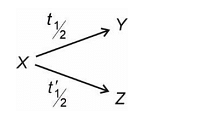
t½ is 12 minutes while t'½ is 3 minutes. Find the time in which nuclei X decays 50%.- JEE Main - 2023
- Physics
- Radioactivity
A radioactive element \({}^{242}_{92}X\) emits two \(\alpha\)-particles, one electron, and two positrons. The product nucleus is represented by \({}^{234}_{P}Y.\) The value of \(P\) is _______.
- JEE Main - 2023
- Physics
- Radioactivity
- A radio active material is reduced to 1/8 of its original amount in 3 days.
If 8×10⁻³ kg of the material is left after 5 days the initial amount of the material is- JEE Main - 2023
- Physics
- Radioactivity
- How many alpha and beta particles are emitted when Uranium 92U238 decays to lead 82Pb206
- JEE Main - 2022
- Physics
- Radioactivity
Top JEE Main Questions
- Let $a_1,a_2,a_3,a_4$ be an A.P. of four terms such that each term of the A.P. and its common difference are integers. If $a_1+a_2+a_3+a_4=48$ and $a_1^2a_2a_3a_4+1^4=361$, then the largest term of the A.P. is equal to
- JEE Main - 2026
- Arithmetic Progression
- If the coefficient of \( x \) in the expansion of \[ (ax^2 + bx + c)(1 - 2x)^{26} \] is \(-56\) and the coefficients of \( x^2 \) and \( x^3 \) are both zero, then \( a + b + c \) is equal to
- JEE Main - 2026
- Binomial theorem
- Water drops fall from a tap on the floor, \(5\) m below, at regular intervals of time. The first drop strikes the floor when the sixth drop begins to fall. The height at which the fourth drop will be from the ground, at the instant when the first drop strikes the ground, is ________ m. (\( g = 10 \, \text{m s}^{-2} \))
- JEE Main - 2026
- Kinematics
- Let \( y = x \) be the equation of a chord of the circle \( C_1 \) (in the closed half-plane \( x \ge 0 \)) of diameter 10 passing through the origin. Let \( C_2 \) be another circle described on the given chord as diameter. If the equation of the chord of the circle \( C_2 \), which passes through the point \( (2, 3) \) and is farthest from the center of \( C_2 \), is \( x + ay + b = 0 \), then \( b \) is equal to:
- JEE Main - 2026
- Coordinate Geometry
- If \[ \frac{\tan(A-B)}{\tan A}+\frac{\sin^2 C}{\sin^2 A}=1, \quad A,B,C\in\left(0,\frac{\pi}{2}\right), \] then:
- JEE Main - 2026
- Trigonometry